

SIST EN 50470-3:2022/oprA1:2026
(Amendment)Electricity metering equipment - Part 3: Particular requirements - Static meters for AC active energy (class indexes A, B and C)
- Abstract
Particular requirements for static meters intended for residential, commercial and light industrial use, of class indexes A, B and C, for the measurement of alternating current electrical active energy in 50 Hz networks. It specifies performance requirements and type test methods.
- Status
- Not Published
- Public Enquiry End Date
- 29-Sep-2026
- Technical Committee
- MEE - Equipment for electrical energy measurement and load control
- Current Stage
- 4020 - Public enquire (PE) (Adopted Project)
- Start Date
- 24-Jul-2026
- Due Date
- 11-Dec-2026
- Completion Date
- 07-Oct-2026

SIST EN 50470-3:2022/oprA1:2026 is a CENELEC draft amendment to EN 50470-3:2022 for static meters that measure AC active energy in 50 Hz networks. It applies to meters for residential, commercial and light industrial use, with class indexes A, B and C. The amendment updates performance and type test requirements, software protection, durability, reliability and the link to prEN IEC 62052-11:2021/prAC:2026.
What does SIST EN 50470-3:2022/oprA1:2026 specify?
SIST EN 50470-3:2022/oprA1:2026 specifies particular requirements for static meters of class indexes A, B and C, including the performance requirements and the type test methods used to check them. The amendment is organized as modifications to Clause 1, 2, 5, 7, 8, 10, 12 and 13, plus Annex ZZ and the bibliography.
The scope wording keeps the focus on AC active energy metering in 50 Hz networks. Clause 1 also clarifies the note on meters intended for low power instrument transformers (LPITs) when those meters are tested without the transformers.
Clause 9 is not a standalone clause in the contents, but the amendment changes Table 9 in Clause 7 and the Annex ZZ relationship to Directive 2014/32/EU.
What are the key requirements of SIST EN 50470-3:2022/oprA1:2026?
SIST EN 50470-3:2022/oprA1:2026 tightens several practical points that matter in testing, marking and software control. The most important changes are in accuracy testing, user indications, climatic marking, software integrity and reliability evidence.
Scope and references
- Clause 1 updates the note on voltage and LPIT-related wording. In practice, this keeps the scope aligned with the cited AC voltage framework and with how LPIT-connected meters are treated when tested.
- Clause 2 replaces the reference to EN IEC 62052-11:2021/A11:2022 with prEN IEC 62052-11:2021/prAC:2026. This matters because the test basis used with this standard is updated.
Construction and indications
- Clause 5 requires the indicated result to be readable under normal use and requires marks or inscriptions that explain what the result means. Extra indications are allowed only if they cannot be mistaken for metrologically controlled indications. In practice, display design and labelling must avoid confusing the measured value.
- Clause 7.12 adds a row to Table 11. This affects the detailed current-related checks used for meter configuration and test coverage.
Accuracy and disturbance immunity
- Clause 7 revises Table 9, including additional waveforms for immunity against severe current transients. The table links disturbances to acceptable error variation limits for class indexes A, B and C, so laboratories can verify how the meter behaves under electromagnetic and waveform stress.
- Clause 7 also adjusts wording around temperature-range-related testing and the way some test conditions are defined. For users, this means the declared meter rating and the test plan must match the revised language.
Climatic conditions
- Clause 8 requires the upper and lower temperature limits for the operating range to be specified, and they must be indicated on the nameplate or in the instruction manual. That gives buyers and installers a clear operating envelope.
Software and protection against corruption
- Clause 10 strengthens software control. The meter must have software identification, the metrologically relevant production software version must match the approved type version, and software must be protected against accidental or intentional change. If field-setting is allowed, access protection is required and the method must be defined in the documentation.
- Clause 10 also makes conformity checking rely on the software documentation and, where relevant, the tools and test methods defined there. That is important for audits and type examination.
Durability and reliability
- Clause 12 is streamlined to allow additional information where appropriate.
- Clause 13 replaces the reliability text with a requirement that the meter be designed to operate reliably. It lists acceptable evidence such as field data, laboratory reliability tests, reliability prediction, fault-reduction methods, and methods that indicate loss of accuracy or data integrity.
What terms does SIST EN 50470-3:2022/oprA1:2026 define?
- AC - Alternating current, the supply type covered by the meter requirements.
- LPIT - Low power instrument transformers, which are named in the scope note for meter connection and test conditions.
- Active energy - The electrical energy quantity this part of EN 50470 covers for AC metering.
- Class index A, B, C - The meter accuracy classes used throughout the document.
- Metrologically relevant software - Software that affects measurement or data integrity and therefore must be identified and protected.
- Metrologically controlled indications - Displayed information that forms part of the controlled metering result and must not be confused with extra indications.
- Type approval confirmation - The approval record that defines the software version used in serial production.
Who uses SIST EN 50470-3:2022/oprA1:2026?
SIST EN 50470-3:2022/oprA1:2026 is used by meter manufacturers, test laboratories, conformity assessment bodies, utilities and procurement teams that specify static electricity meters. It is also relevant to quality managers who need to verify the meter design, software protection, climatic marking and reliability evidence before placing meters on the market or into service.
What changed in SIST EN 50470-3:2022/oprA1:2026 from the previous edition?
SIST EN 50470-3:2022/oprA1:2026 amends EN 50470-3:2022. The document states two significant technical changes at the outset: it links the standard to prEN IEC 62052-11:2021/prAC:2026 and adapts Table 9 with additional waveforms to improve immunity against severe current transients.
Other stated changes include revised wording in the scope, updated normative references, clearer display and marking language, revised accuracy-test wording, stronger software protection text, streamlined durability wording, and a new reliability clause.
Which standards are used with SIST EN 50470-3:2022/oprA1:2026?
- prEN IEC 62052-11:2021/prAC:2026 - Provides the referenced general requirements and test basis used throughout the amendment, including several disturbance tests and waveform descriptions.
- EN IEC 62052-31:2024 - Supplies the AC voltage framework referenced in the scope note and the bibliography.
- EN 61869 series - Defines low power instrument transformers (LPITs), which are named in the scope note.
- EN 62059-41:2006 - Gives reliability prediction calculations cited in Clause 13.
- IEC/TR 62059-21:2002 - Gives guidance for collecting field dependability data cited in Clause 13.
What does the SIST EN 50470-3:2022/oprA1:2026 document contain?
The document contains amendment text, not a full reissue of the base standard. It changes specific clauses, updates Table 9 and Table 11, and revises Annex ZZ so the standard’s relationship with Directive 2014/32/EU stays aligned with the amended technical requirements.
It also points readers to the disturbance waveforms in Annex H of prEN IEC 62052-11:2021/prAC:2026, which are used for harmonic and transient testing. In practice, that means the document supports design review, type testing, software verification and conformity assessment for static AC electricity meters.
Relations
- Effective Date
- 07-May-2024
Get Certified
Connect with accredited certification bodies for this standard

DIBt (Deutsches Institut für Bautechnik)
German Institute for Building Technology.
DIN CERTCO
DIN Group product certification.

Aboma Certification B.V.
Specialized in construction, metal, and transport sectors.
Sponsored listings
Frequently Asked Questions
SIST EN 50470-3:2022/oprA1:2026 is a draft published by the Slovenian Institute for Standardization (SIST). Its full title is "Electricity metering equipment - Part 3: Particular requirements - Static meters for AC active energy (class indexes A, B and C)". This standard covers: Particular requirements for static meters intended for residential, commercial and light industrial use, of class indexes A, B and C, for the measurement of alternating current electrical active energy in 50 Hz networks. It specifies performance requirements and type test methods.
Particular requirements for static meters intended for residential, commercial and light industrial use, of class indexes A, B and C, for the measurement of alternating current electrical active energy in 50 Hz networks. It specifies performance requirements and type test methods.
SIST EN 50470-3:2022/oprA1:2026 is classified under the following ICS (International Classification for Standards) categories: 17.220.20 - Measurement of electrical and magnetic quantities; 91.140.50 - Electricity supply systems. The ICS classification helps identify the subject area and facilitates finding related standards.
SIST EN 50470-3:2022/oprA1:2026 has the following relationships with other standards: It is inter standard links to SIST EN 50470-3:2022. Understanding these relationships helps ensure you are using the most current and applicable version of the standard.
SIST EN 50470-3:2022/oprA1:2026 is associated with the following European legislation: EU Directives/Regulations: 2014/32/EU; Standardization Mandates: M/541. When a standard is cited in the Official Journal of the European Union, products manufactured in conformity with it benefit from a presumption of conformity with the essential requirements of the corresponding EU directive or regulation.
SIST EN 50470-3:2022/oprA1:2026 is available in PDF format for immediate download after purchase. The document can be added to your cart and obtained through the secure checkout process. Digital delivery ensures instant access to the complete standard document.
Standards Content (Sample)
SLOVENSKI STANDARD
01-september-2026
Oprema za merjenje električne energije - 3. del: Posebne zahteve - Statični števci
za izmenično delovno energijo (razredni indeksi A, B in C) - Dopolnilo A1
Electricity metering equipment - Part 3: Particular requirements - Static meters for AC
active energy (class indexes A, B and C)
Elektrizitätszähler - Teil 3: Besondere Anforderungen - Elektronische Wechselstrom
Wirkverbrauchszähler der Genauigkeitsklassen A, B und C
Equipement de comptage d'électricité - Partie 3: Exigences particulières - Compteurs
statiques d'énergie active en courant alternatif (indices de classe A, B et C)
Ta slovenski standard je istoveten z: EN 50470-3:2022/prA1:2026
ICS:
17.220.20 Merjenje električnih in Measurement of electrical
magnetnih veličin and magnetic quantities
91.140.50 Sistemi za oskrbo z elektriko Electricity supply systems
2003-01.Slovenski inštitut za standardizacijo. Razmnoževanje celote ali delov tega standarda ni dovoljeno.
EUROPEAN STANDARD DRAFT
EN 50470-3:2022
NORME EUROPÉENNE
EUROPÄISCHE NORM
prA1
July 2026
ICS 91.140.50 -
English Version
Electricity metering equipment - Part 3: Particular requirements -
Static meters for AC active energy (class indexes A, B and C)
Equipement de comptage d'électricité - Partie 3: Exigences Elektrizitätszähler - Teil 3: Besondere Anforderungen -
particulières - Compteurs statiques d'énergie active en Elektronische Wechselstrom Wirkverbrauchszähler der
courant alternatif (indices de classe A, B et C) Genauigkeitsklassen A, B und C
This draft amendment prA1, if approved, will modify the European Standard EN 50470-3:2022; it is submitted to CENELEC members for
enquiry.
Deadline for CENELEC: 2026-10-09.
It has been drawn up by CLC/TC 13.
If this draft becomes an amendment, CENELEC members are bound to comply with the CEN/CENELEC Internal Regulations which
stipulate the conditions for giving this amendment the status of a national standard without any alteration.
This draft amendment was established by CENELEC in three official versions (English, French, German).
A version in any other language made by translation under the responsibility of a CENELEC member into its own language and notified to
the CEN-CENELEC Management Centre has the same status as the official versions.
CENELEC members are the national electrotechnical committees of Austria, Belgium, Bulgaria, Croatia, Cyprus, the Czech Republic,
Denmark, Estonia, Finland, France, Germany, Greece, Hungary, Iceland, Ireland, Italy, Latvia, Lithuania, Luxembourg, Malta, the
Netherlands, Norway, Poland, Portugal, Republic of North Macedonia, Romania, Serbia, Slovakia, Slovenia, Spain, Sweden, Switzerland,
Türkiye and the United Kingdom.
Recipients of this draft are invited to submit, with their comments, notification of any relevant patent rights of which they are aware and to
provide supporting documentation.
Warning : This document is not a European Standard. It is distributed for review and comments. It is subject to change without notice and
shall not be referred to as a European Standard.
European Committee for Electrotechnical Standardization
Comité Européen de Normalisation Electrotechnique
Europäisches Komitee für Elektrotechnische Normung
CEN-CENELEC Management Centre: Rue de la Science 23, B-1040 Brussels
© 2026 CENELEC All rights of exploitation in any form and by any means reserved worldwide for CENELEC Members.
Project: 79961 Ref. No. EN 50470-3:2022/prA1:2026 E
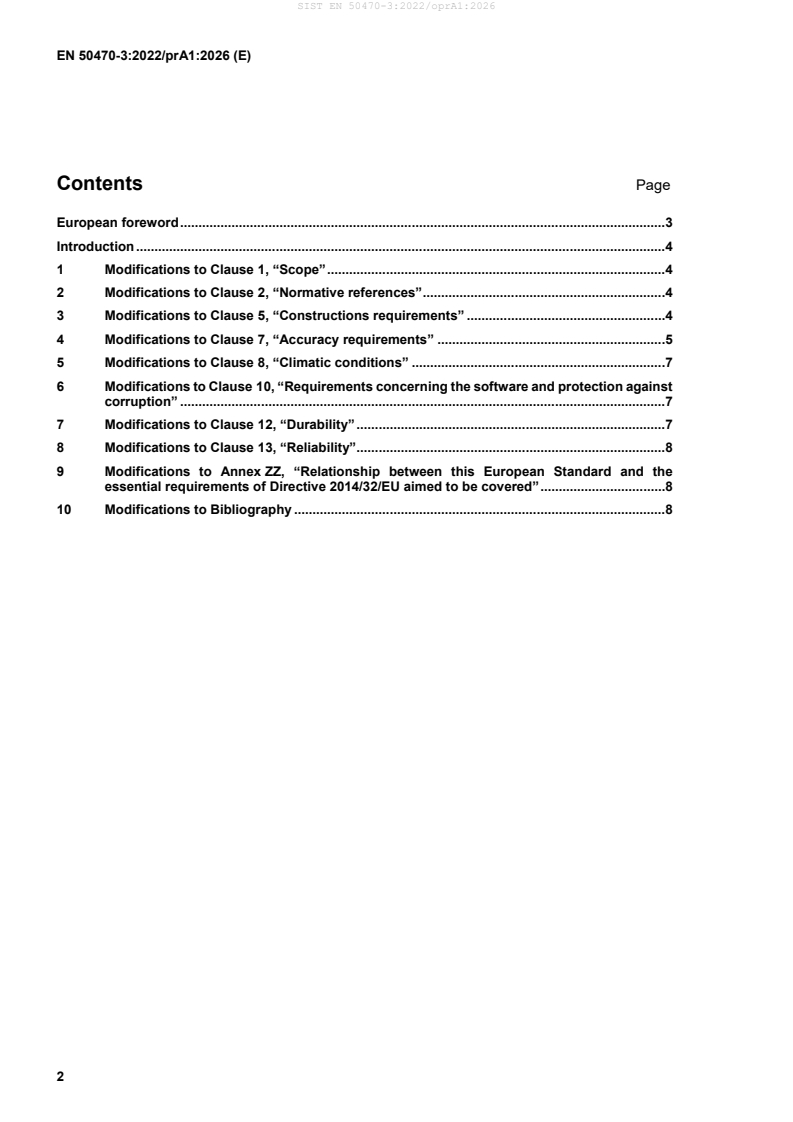
Contents Page
European foreword . 3
Introduction . 4
1 Modifications to Clause 1, “Scope” . 4
2 Modifications to Clause 2, “Normative references” . 4
3 Modifications to Clause 5, “Constructions requirements” . 4
4 Modifications to Clause 7, “Accuracy requirements” . 5
5 Modifications to Clause 8, “Climatic conditions” . 7
6 Modifications to Clause 10, “Requirements concerning the software and protection against
corruption” . 7
7 Modifications to Clause 12, “Durability” . 7
8 Modifications to Clause 13, “Reliability” . 8
9 Modifications to Annex ZZ, “Relationship between this European Standard and the
essential requirements of Directive 2014/32/EU aimed to be covered” . 8
10 Modifications to Bibliography . 8
European foreword
This document (EN 50470-3:2022/prA1:2026) has been prepared by CLC/TC 13 “Electrical energy
measurement and control”.
This document is currently submitted to the Enquiry.
The following dates are proposed:
• latest date by which the existence of this (doa) dav + 6 months
document has to be announced at national
level
• latest date by which this document has to be (dop) dav + 12 months
implemented at national level by publication of
an identical national standard or by
endorsement
• latest date by which the national standards (dow) dav + 36 months
conflicting with this document have to be (to be confirmed or
withdrawn modified when voting)
This document amends EN 50470-3:2022.
EN 50470-3:2022:
— link to prEN IEC 62052-11:2021/prAC:2026
— adaptation of Table 9 with additional waveforms to ensure immunity against severe current transients.
This document has been prepared under a standardization request addressed to CENELEC by the European
Commission. The Standing Committee of the EFTA States subsequently approves these requests for its
Member States.
For the relationship with EU Legislation, see informative Annex ZZ, which is an integral part of this document.
Introduction
The purpose of this amendment is to require an additional test waveform to ensure immunity against severe
current transients.
1 Modifications to Clause 1, “Scope”
Replace NOTE 2 with the following:
“
NOTE 2 For AC electricity meters, the voltage mentioned above is the line-to-neutral voltage derived from nominal
voltages. See EN IEC 62052-31:2024, Table 7. EN IEC 62052-31:2024 covers AC voltages up to 1000 V.“
Replace
“
— meters intended for connection with low power instrument transformers (LPITs as defined in the EN 61869
series) when tested without such transformers;“
with
“
— meters intended for connection with low power instrument transformers (LPITs as defined in the EN 61869
series) when tested without such transformers.
NOTE 6 The exclusion of meters designed for operation with LPITs not directly connected with the LPITs from the
scope of EN 50470-3:2022 does not imply that such meters are not permitted under Directive 2014/32/EU.“
Renumber NOTE 6 as NOTE 7.
Replace NOTE 7 with the following:
“
NOTE 8 Nevertheless, specific tampering detection and prevention requirements, and test methods, as relevant for a
particular market can be defined.“
Renumber NOTE 8 as NOTE 9.
Renumber NOTE 9 as NOTE 10.
Renumber NOTE 10 as NOTE 11.
Renumber NOTE 11 as NOTE 12.
Renumber NOTE 12 as NOTE 13.
2 Modifications to Clause 2, “Normative references”
In Clause 2 and throughout the text, replace “EN IEC 62052-11:2021/A11:2022” with
“prEN IEC 62052-11:2021/prAC:2026“.
3 Modifications to Clause 5, “Constructions requirements”
Replace list item b) with the following:
“
b) The indication of any result shall be readable under normal conditions of use. The necessary marks and
inscriptions to inform the user of the significance of the result shall be provided.
Additional indications may be shown provided they cannot be confused with the metrologically controlled
indications.“
4 Modifications to Clause 7, “Accuracy requirements”
In 7.9, NOTE 3, second sentence, delete “in an agreement between the manufacturer and the purchaser or
according to national regulatory requirements”.
In 7.10, 4th paragraph, replace “selected by the manuf
...