

SIST EN ISO 8892:1998
(Main)Oilseed residues - Determination of total residual hexane (ISO 8892:1987)
General Information
- Abstract
- Status
- Published
- Publication Date
- 31-Oct-1998
- Technical Committee
- KŽP - Agricultural food products
- Current Stage
- 6060 - National Implementation/Publication (Adopted Project)
- Start Date
- 01-Nov-1998
- Due Date
- 01-Nov-1998
- Completion Date
- 01-Nov-1998



Overview
EN ISO 8892:1995 (ISO 8892:1987) specifies a laboratory method for the determination of total residual hexane in oilseed residues after solvent extraction. The procedure quantifies volatile hydrocarbon residues (commonly referred to as hexane) by thermally desorbing the solvent into a closed vessel and analysing the headspace by gas chromatography (GC) with flame ionization detection (FID). Results are expressed as milligrams of n‑hexane per kilogram of residue.
Key topics and technical requirements
- Scope and purpose: Measurement of volatile hydrocarbon residues remaining in oilseed meals and residues after hydrocarbon-based extraction.
- Sampling and storage: Follow ISO 5500 for sampling. Laboratory samples must be hermetically sealed (metal preferred), stored at −20 °C or below, and analysed promptly to avoid hexane loss.
- Sample preparation: Typical test portion is 5 g of residue mixed with 2.5 ml distilled water in a 50–60 ml septum-sealed flask.
- Desorption conditions: Heat sealed flasks at 110 °C (oven) to desorb hexane into the headspace (90 min for test samples; calibration flasks treated for 15 min as specified).
- Headspace sampling and GC analysis:
- Headspace sample: 0.5 ml withdrawn at 50–60 °C with a heated gas syringe.
- Detector: Flame ionization detector (FID).
- Columns: Capillary column (~30 m × 0.3 mm, methylpolysiloxane) or packed column (≥1.7 m) coated with methylpolysiloxane.
- Injector/detector temperatures and carrier gas conditions are specified for reproducible peak response.
- Calibration and expression of results: Use calibration flasks prepared with known hexane masses; express results as n‑hexane and report the arithmetic mean of two determinations.
- Precision data: Interlaboratory studies (multiple labs) provide repeatability and reproducibility statistics; reproducibility variability can be significant for some residues and should be considered in interpretation.
Practical applications and users
- Laboratories performing residual solvent testing for oilseed meals (soy, sunflower, rape/colza).
- Quality control teams in oilseed extraction and vegetable oil processing plants for process monitoring and release testing.
- Food and feed safety laboratories ensuring compliance with regulatory or purchaser limits for solvent residues.
- Method developers and accreditation bodies validating headspace‑GC procedures for residual hydrocarbons.
Related standards
- ISO 5500 - Oilseed residues: sampling (referenced for sample handling).
- ISO 5725 - Precision of measurement methods (used for interlaboratory statistics).
Keywords: EN ISO 8892:1995, ISO 8892, oilseed residues, residual hexane, hexane determination, gas chromatography, headspace analysis, solvent residue testing.
Relations
- Effective Date
- 28-Jan-2026
- Effective Date
- 28-Jan-2026
- Effective Date
- 28-Jan-2026
- Effective Date
- 28-Jan-2026
- Referred By
SIST EN 12601:2011 - Reciprocating internal combustion engine driven generating sets - Safety - Effective Date
- 28-Jan-2026
Get Certified
Connect with accredited certification bodies for this standard

BSI Group
BSI (British Standards Institution) is the business standards company that helps organizations make excellence a habit.

Bureau Veritas
Bureau Veritas is a world leader in laboratory testing, inspection and certification services.

DNV
DNV is an independent assurance and risk management provider.
Sponsored listings
Frequently Asked Questions
SIST EN ISO 8892:1998 is a standard published by the Slovenian Institute for Standardization (SIST). Its full title is "Oilseed residues - Determination of total residual hexane (ISO 8892:1987)". This standard covers: La présente Norme internationale spécifie une méthode de dosage de la totalité des hydrocarbures volatils, globalement désignés sous l'appellation d'hexane, restant dans les tourteaux de graines oléagineuses après extraction par des solvants à base d'hydrocarbures.
La présente Norme internationale spécifie une méthode de dosage de la totalité des hydrocarbures volatils, globalement désignés sous l'appellation d'hexane, restant dans les tourteaux de graines oléagineuses après extraction par des solvants à base d'hydrocarbures.
SIST EN ISO 8892:1998 is classified under the following ICS (International Classification for Standards) categories: 67.200.20 - Oilseeds. The ICS classification helps identify the subject area and facilitates finding related standards.
SIST EN ISO 8892:1998 has the following relationships with other standards: It is inter standard links to SIST EN 1834-2:2000, SIST EN 1679-1:2000+A1:2011, SIST EN 1834-3:2000, SIST EN 1834-1:2000, SIST EN 12601:2011. Understanding these relationships helps ensure you are using the most current and applicable version of the standard.
SIST EN ISO 8892:1998 is available in PDF format for immediate download after purchase. The document can be added to your cart and obtained through the secure checkout process. Digital delivery ensures instant access to the complete standard document.
Standards Content (Sample)
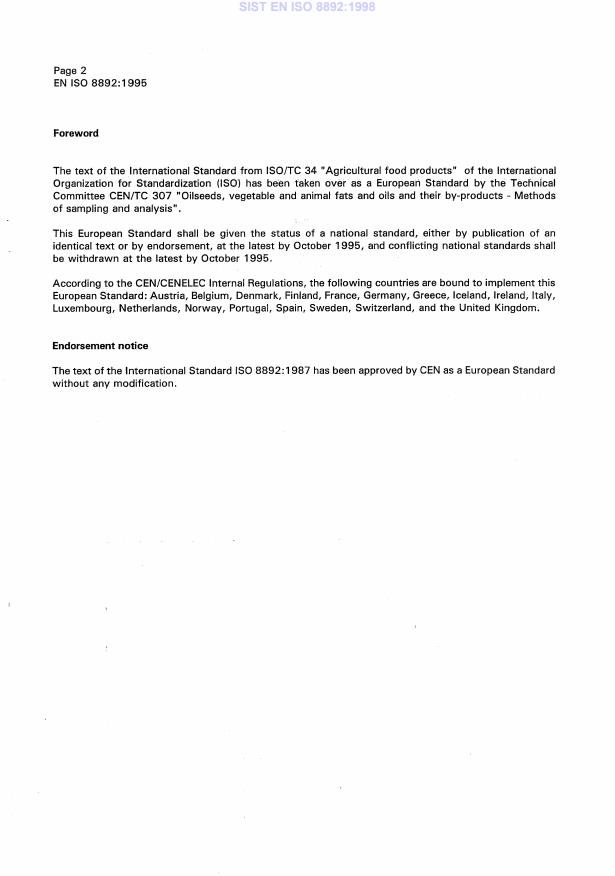
2003-01.Slovenski inštitut za standardizacijo. Razmnoževanje celote ali delov tega standarda ni dovoljeno.Ölsaatrückstände (Extraktionsschrot) - Bestimmung des gesamten Resthexans (ISO 8892:1987)Tourteaux de graines oléagineuses - Dosage de l'hexane résiduaire total (ISO 8892:1987)Oilseed residues - Determination of total residual hexane (ISO 8892:1987)67.200.20OljniceOilseedsICS:Ta slovenski standard je istoveten z:EN ISO 8892:1995SIST EN ISO 8892:1998en01-november-1998SIST EN ISO 8892:1998SLOVENSKI
STANDARD
INTERNATIONAL STANDARD 8892 INTERNATIONAL ORGANIZATIQN FOR STANDARDIZATION ORGANISATION INTERNATIONALE DE NORMALISATION MEXAYHAPO~HAIJ OPrAHM3A~MR RO CTAHflAPTM3A~MM I Oilseed residues - Determination of total residual hexane Tourteaux de graines o&agineuses - Dosage de l’hexane rtkiduaire total IS0 First edition 1987-06-01 Reference number IS0 8892 : 1987 (E) SIST EN ISO 8892:1998
Foreword IS0 (the International Organization for Standardization) is a worldwide federation of national standards bodies (IS0 member bodies). The work of preparing International Standards is normally carried out through IS0 technical committees. Each member body interested in a subject-for which a technical committee has been established has the right to be represented on that committee. International organizations, govern- mental and non-governmental, in liaison with ISO, also take part in the work. Draft International Standards adopted by the technical committees are circulated to the member bodies for approval before their acceptance as International Standards by the IS0 Council. They are approved in accordance with IS0 procedures requiring at least 75 % approval by the member bodies voting. International Standard IS0 8892 was prepared by Technical Committee ISO/TC 34, Agricultural food products. Users should note that all International Standards undergo revision from time to time and that any reference made herein to any other International Standard implies its latest edition, unless otherwise stated. International Organization for Standardization, 1987 Printed in Switzerland SIST EN ISO 8892:1998
INTERNATIONAL STANDARD IS0 8892 : 1987 (E) Oilseed residues - Determination of total residual hexane 1 Scope and field of application This International Standard specifies a method for the deter- mination of the total amount of volatile hydrocarbons, referred to generally as hexane, remaining in oilseed residues after extraction with hydrocarbon-based solvents. 2 Reference IS0 5500, Oilseed residues - Sampling. 3 Principle Desorption of hexane by heating at 110 OC with water in a closed vessel, and determination of the hexane in the headspace by gas chromatography using capillary or packed columns. Expression of the results as n-hexane. 4 Reagents and materials 4.1 Technical n-hexane or light petroleum, with a com- position similar to that used in the industrial extraction of oilseeds, or failing that, n-hexane. 4.2 Carrier gas : hydrogen or nitrogen, helium, etc., dry and containing less than 10 mg/kg of oxygen. 4.3 Auxiliary gases : - Hydrogen, 99,9 % pure, containing no organic im- purities. - Air, containing no organic impurities. 5 Apparatus Usual laboratory apparatus and in particular 5.1 Gas chromatograph, with flame ionization detector and integrator and/or recorder, equipped with a glass capillary col- umn approrimately 30 m long and 0,3 mm in diameter, coated with methylpolysiloxanes l) (film thickness 0,2 pm) or, failing this, a packed column at least I,7 m long and 2 to 4 mm inter- nal diameter, packed with acid-washed diatomaceous earth of particle size 150 to 180 pm *j, and coated with methylpolysilox- anes I). If a capillary column is used, the apparatus shall have a 1 /IO0 input divider. 5.2 Electric oven, capable of being maintained at 110 OC. 5.3 Gas syringe, graduated, of capacity 1 ml, preferably with a valve. 5.4 Penicillin-type flasks, of capacity 50 to 60 ml, all with the same volume to within 2 %. 5.5 Septa, inert to solvents, of approximately 3 mm thickness, of a material such as nitrile rubber (for example Perbunan), or butyl rubber with a PTFE or polychloroprene seam (for example Neoprene). NOTE - Ensure that the septa used will produce a hermetic seal after crimping. 5.6 Metallic foil caps, for example of aluminium. 5.7 Crimping pliers. 5.8 liquid syringe, of capacity 10 ~1. 6 Sampling and sample storage See IS0 5500. It is essential that loss of hexane from the sam- ple be prevented. ’ The laboratory sample shall fill a compl.etely sealed container (preferably a crimped metal box) and shall be stored at - 20 OC or below (for example in a deep-freezer). Plastics containers shall not be used. The determination of residual hexane shall be carried out as soon as the container has been brought to room temperature and opened. 1) SE 30 is suitable. 2) Chromosorb WAW is suitable. SIST EN ISO 8892:1998
I
...