

kSIST FprEN 13040-2:2026
(Amendment)Soil improvers and growing media - Sample preparation - Part 2: Sample preparation for microbiological examination
- Abstract
This document specifies the general requirements for the preparation of samples, initial suspensions and further dilutions prior to microbiological examinations of soil improvers and growing media. This method is applicable especially for sample preparation prior to microbiological examinations of e.g. Escherichia coli (E. coli), Salmonella spp. and enterococci.
If a laboratory receives a material/product that is not listed in Annex B but has external characteristics (i.e. hardness, fibrous nature, particle size) like one of the materials/products listed in Annex B, then the procedural steps for sample preparation (pre-treatment, treatment and dilution) are carried out in the same way as listed for the material/product which has comparable external characteristics.
Any special diluents or practices required for particular materials or microorganisms in specific standard methods take priority over the general requirements listed in this document.
- Status
- Not Published
- Public Enquiry End Date
- 14-Apr-2026
- Technical Committee
- KAT - Soil quality
- Current Stage
- 5020 - Formal vote (FV) (Adopted Project)
- Start Date
- 29-Sep-2026
- Due Date
- 17-Nov-2026

kSIST FprEN 13040-2:2026 is the SIST publication of the draft European Standard prEN 13040-2 for soil improvers and growing media. It specifies how laboratories prepare samples, initial suspensions and further dilutions before microbiological examination, especially when testing for Escherichia coli (E. coli), Salmonella spp. and enterococci.
What does kSIST FprEN 13040-2:2026 specify?
kSIST FprEN 13040-2:2026 specifies the general requirements for sample preparation before microbiological examinations of soil improvers and growing media. It covers laboratory preparation only - sampling itself is handled separately by EN 12579 - and it gives priority to any special diluent or practice required by a specific microbiological method.
| Annex | What it covers |
|---|---|
| Annex A | Culture media and reagents |
| Annex B | Example product types and the corresponding sample-preparation steps |
The document is organized into clauses on scope, normative references, terms and definitions, principle, reagents, apparatus and equipment, transport and storage, and the step-by-step procedure. That structure matters in practice because the user first checks whether the material fits the scope, then follows the preparation route for the matrix and the microbiological purpose.
What are the key requirements of kSIST FprEN 13040-2:2026?
kSIST FprEN 13040-2:2026 separates the work into two different aims: detection and enumeration. Detection prepares a suspension for enrichment, while enumeration prepares an initial suspension and, if needed, further dilutions so colonies can be counted after incubation.
Sample receipt, transport and storage
Clause 7 requires the laboratory to receive a representative sample that has not been altered during transport or storage. Samples are stored cool, not frozen, and examined promptly, because the microbiome can change over time. In practice, this means the lab needs controlled storage and a fast workflow after receipt.
Taking the test portion
Clause 8.1 requires thorough homogenisation before the test portion is taken. The work must be done aseptically, incidental foreign matter such as stones or plastic must be removed, and the treatment depends on the physical form of the material. Pre-shaped products are sampled directly, rigid solids are reduced in size, and compressed blocks are crushed in their original dry state rather than reconstituted.
Choosing the right preparation route
Clause 8.2 and Annex B link matrix type to pre-treatment, homogenisation method and dilution behaviour. This is important because different materials - for example compost, peat, bark, coir, mineral products or liquids - behave differently in suspension. If a received material is not listed in Annex B but has similar external characteristics, the same procedural steps are used for the comparable material.
Suspensions, pH and dilution
Clause 8.2 requires suitable diluents at laboratory temperature to avoid thermal shock to microorganisms. For matrices that can shift pH strongly, such as bog peat, Sphagnum, alkaline composts or blended products rich in minerals, the initial suspension is checked and corrected to a pH range suitable for the organisms. For Salmonella detection and for enumeration of E. coli and enterococci, the document uses buffered peptone water (BPW) or other specified diluents, with more dilute preparation when swelling materials need extra liquid.
Apparatus and laboratory practice
Clause 6 points to the usual microbiological laboratory equipment and allows disposable equipment if it is suitable. It also highlights sterilization equipment, size-reduction tools, homogenizers, pipettes, accurate weighing and aseptic containers. This tells the laboratory what kind of setup is expected before routine testing starts.
Culture media and special methods
Annex A gives the culture media and reagents and reminds the user to follow manufacturer instructions. It also recommends checking media performance under the laboratory's own storage conditions and points to EN ISO 11133 for performance testing of culture media.
What terms does kSIST FprEN 13040-2:2026 define?
- Laboratory sample - for microbiological testing, each separate segment sample intended for laboratory testing.
- Test sample - the sample prepared from the laboratory sample from which test portions are taken, especially when one sample is used for more than one type of analysis.
- Test portion - the amount of material actually taken for the test.
- Initial suspension - the primary dilution obtained after the test portion is mixed with a diluent, normally in a nine-fold ratio.
- Further dilution - a later dilution prepared from the initial suspension to build a dilution series suitable for inoculation and counting.
Who uses kSIST FprEN 13040-2:2026?
kSIST FprEN 13040-2:2026 is used by microbiology laboratories, quality control laboratories and technical staff who test soil improvers and growing media. It is also used by manufacturers, processors and suppliers of compost, peat, coir, bark, digestate, mineral growing media and similar products when they need a defined sample-preparation method before microbiological testing.
Quality managers and buyers use it to specify how samples should be handled before testing, especially when the result must support checks for E. coli, Salmonella spp. or enterococci. Laboratory supervisors use it to set aseptic handling, storage and dilution procedures.
Which standards are used with kSIST FprEN 13040-2:2026?
kSIST FprEN 13040-2:2026 relies on these companion documents:
- EN 12579 - provides the sampling rules for soil improvers and growing media.
- EN ISO 7218 - gives the general laboratory requirements and guidance for microbiological examinations.
- prEN 17732 - supplies the terminology used in this series.
- EN 13040-1 - is the other part of the EN 13040 series, covering sample preparation for chemical and physical tests.
- EN ISO 11133 - is referenced in Annex A as the guide for preparation and performance testing of culture media.
What does the kSIST FprEN 13040-2:2026 document contain?
kSIST FprEN 13040-2:2026 contains step-by-step procedures for the test portion, the initial suspension, combined qualitative-quantitative workflows and further decimal dilutions. It also includes a warning on safe laboratory practice, plus practical guidance on aseptic handling and homogenisation.
The document gives the media and reagent information in Annex A and maps example product types to suitable pre-treatment and dilution approaches in Annex B. Figures 1 and 2 summarize the qualitative and quantitative workflows, while Table B.1 links product forms to the equipment and preparation route used in practice.
Get Certified
Connect with accredited certification bodies for this standard

Control Union Certifications
Global certification for agriculture and sustainability.

ECOCERT
Organic and sustainability certification.

FSC International
Forest Stewardship Council certification.
Sponsored listings
Frequently Asked Questions
kSIST FprEN 13040-2:2026 is a draft published by the Slovenian Institute for Standardization (SIST). Its full title is "Soil improvers and growing media - Sample preparation - Part 2: Sample preparation for microbiological examination". This standard covers: This document specifies the general requirements for the preparation of samples, initial suspensions and further dilutions prior to microbiological examinations of soil improvers and growing media. This method is applicable especially for sample preparation prior to microbiological examinations of e.g. Escherichia coli (E. coli), Salmonella spp. and enterococci. If a laboratory receives a material/product that is not listed in Annex B but has external characteristics (i.e. hardness, fibrous nature, particle size) like one of the materials/products listed in Annex B, then the procedural steps for sample preparation (pre-treatment, treatment and dilution) are carried out in the same way as listed for the material/product which has comparable external characteristics. Any special diluents or practices required for particular materials or microorganisms in specific standard methods take priority over the general requirements listed in this document.
This document specifies the general requirements for the preparation of samples, initial suspensions and further dilutions prior to microbiological examinations of soil improvers and growing media. This method is applicable especially for sample preparation prior to microbiological examinations of e.g. Escherichia coli (E. coli), Salmonella spp. and enterococci. If a laboratory receives a material/product that is not listed in Annex B but has external characteristics (i.e. hardness, fibrous nature, particle size) like one of the materials/products listed in Annex B, then the procedural steps for sample preparation (pre-treatment, treatment and dilution) are carried out in the same way as listed for the material/product which has comparable external characteristics. Any special diluents or practices required for particular materials or microorganisms in specific standard methods take priority over the general requirements listed in this document.
kSIST FprEN 13040-2:2026 is classified under the following ICS (International Classification for Standards) categories: 65.080 - Fertilizers. The ICS classification helps identify the subject area and facilitates finding related standards.
kSIST FprEN 13040-2:2026 is associated with the following European legislation: EU Directives/Regulations: 2019/1009; Standardization Mandates: M/564, M/564 AMD 1, M/564 AMD 2. When a standard is cited in the Official Journal of the European Union, products manufactured in conformity with it benefit from a presumption of conformity with the essential requirements of the corresponding EU directive or regulation.
kSIST FprEN 13040-2:2026 is available in PDF format for immediate download after purchase. The document can be added to your cart and obtained through the secure checkout process. Digital delivery ensures instant access to the complete standard document.
Standards Content (Sample)
SLOVENSKI STANDARD
oSIST prEN 13040-2:2026
01-april-2026
Izboljševalci tal in rastni substrati - Priprava vzorcev - 2. del: Priprava vzorcev za
mikrobiološke preskuse
Soil improvers and growing media - Sample preparation - Part 2: Sample preparation for
microbiological examination
Bodenverbesserungsmittel und Kultursubstrate - Probenvorbereitung - Teil 2:
Probenvorbereitung für mikrobiologische Untersuchungen
Amendements du sol et supports de culture - Préparation des échantillons - Partie 2 :
Préparation des échantillons pour l’examen microbiologique
Ta slovenski standard je istoveten z: prEN 13040-2
ICS:
65.080 Gnojila Fertilizers
oSIST prEN 13040-2:2026 en,fr,de
2003-01.Slovenski inštitut za standardizacijo. Razmnoževanje celote ali delov tega standarda ni dovoljeno.
oSIST prEN 13040-2:2026
oSIST prEN 13040-2:2026
DRAFT
EUROPEAN STANDARD
prEN 13040-2
NORME EUROPÉENNE
EUROPÄISCHE NORM
December 2025
ICS 65.080
English Version
Soil improvers and growing media - Sample preparation -
Part 2: Sample preparation for microbiological
examination
Amendements du sol et supports de culture - Bodenverbesserungsmittel und Kultursubstrate -
Préparation des échantillons - Partie 2 : Préparation Probenvorbereitung - Teil 2: Probenvorbereitung für
des échantillons pour l'examen microbiologique mikrobiologische Untersuchungen
This draft European Standard is submitted to CEN members for second enquiry. It has been drawn up by the Technical
Committee CEN/TC 223.
If this draft becomes a European Standard, CEN members are bound to comply with the CEN/CENELEC Internal Regulations
which stipulate the conditions for giving this European Standard the status of a national standard without any alteration.
This draft European Standard was established by CEN in three official versions (English, French, German). A version in any other
language made by translation under the responsibility of a CEN member into its own language and notified to the CEN-CENELEC
Management Centre has the same status as the official versions.
CEN members are the national standards bodies of Austria, Belgium, Bulgaria, Croatia, Cyprus, Czech Republic, Denmark, Estonia,
Finland, France, Germany, Greece, Hungary, Iceland, Ireland, Italy, Latvia, Lithuania, Luxembourg, Malta, Netherlands, Norway,
Poland, Portugal, Republic of North Macedonia, Romania, Serbia, Slovakia, Slovenia, Spain, Sweden, Switzerland, Türkiye and
United Kingdom.
Recipients of this draft are invited to submit, with their comments, notification of any relevant patent rights of which they are
aware and to provide supporting documentation.
Warning : This document is not a European Standard. It is distributed for review and comments. It is subject to change without
notice and shall not be referred to as a European Standard.
EUROPEAN COMMITTEE FOR STANDARDIZATION
COMITÉ EUROPÉEN DE NORMALISATION
EUROPÄISCHES KOMITEE FÜR NORMUNG
CEN-CENELEC Management Centre: Rue de la Science 23, B-1040 Brussels
© 2025 CEN All rights of exploitation in any form and by any means reserved Ref. No. prEN 13040-2:2025 E
worldwide for CEN national Members.
oSIST prEN 13040-2:2026
prEN 13040-2:2025 (E)
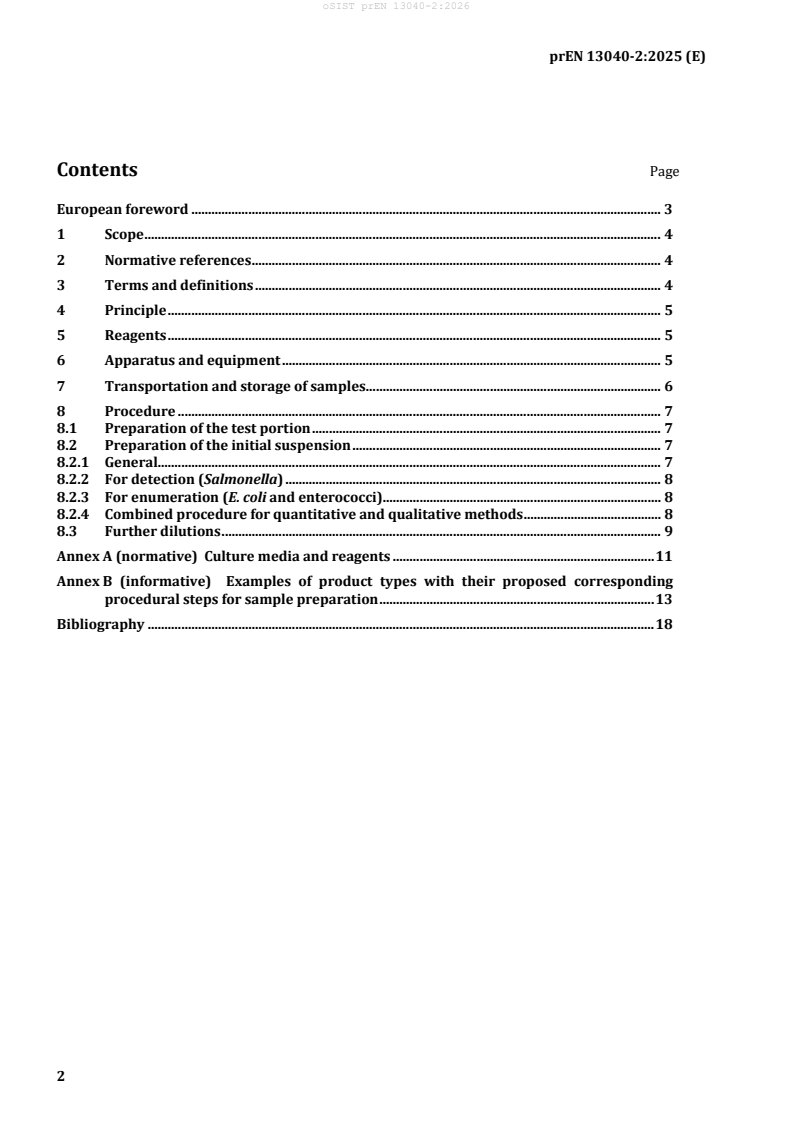
Contents Page
European foreword . 3
1 Scope . 4
2 Normative references . 4
3 Terms and definitions . 4
4 Principle . 5
5 Reagents . 5
6 Apparatus and equipment . 5
7 Transportation and storage of samples . 6
8 Procedure . 7
8.1 Preparation of the test portion . 7
8.2 Preparation of the initial suspension . 7
8.2.1 General. 7
8.2.2 For detection (Salmonella) . 8
8.2.3 For enumeration (E. coli and enterococci) . 8
8.2.4 Combined procedure for quantitative and qualitative methods . 8
8.3 Further dilutions . 9
Annex A (normative) Culture media and reagents . 11
Annex B (informative) Examples of product types with their proposed corresponding
procedural steps for sample preparation . 13
Bibliography . 18
oSIST prEN 13040-2:2026
prEN 13040-2:2025 (E)
European foreword
This document (prEN 13040-2:2025) has been prepared by Technical Committee CEN/TC 223 “Soil
improvers and growing media”, the secretariat of which is held by NEN.
nd
This document is currently submitted to the CEN 2 Enquiry.
This document has been prepared under a standardization request addressed to CEN by the European
Commission. The Standing Committee of the EFTA States subsequently approves these requests for its
Member States.
A list of all parts in this series can be found on the CEN website: www.cencenelec.eu.
EN 13040, Soil improvers and growing media — Sample preparation, is currently composed with the
following parts:
— Part 1: Sample preparation for chemical and physical tests, determination of dry matter content,
moisture content and laboratory bulk density;
— Part 2: Sample preparation for microbiological examination.
oSIST prEN 13040-2:2026
prEN 13040-2:2025 (E)
1 Scope
This document specifies the general requirements for the preparation of samples, initial suspensions and
further dilutions prior to microbiological examinations of soil improvers and growing media. This
method is intended especially for sample preparation prior to microbiological examinations of e.g.
Escherichia coli (E. coli), Salmonella spp. and enterococci.
If a laboratory receives a material/product that is not listed in Annex B but has external characteristics
(i.e. hardness, fibrous nature, particle size) like one of the materials/products listed in Annex B, then the
procedural steps for sample preparation (pre-treatment, treatment and dilution) are carried out in the
same way as listed for the material/product which has comparable external characteristics.
Any special diluents or practices required for particular materials or microorganisms in specific standard
methods take priority over the general requirements listed in this document.
2 Normative references
The following documents are referred to in the text in such a way that some or all of their content
constitutes requirements of this document. For dated references, only the edition cited applies. For
undated references, the latest edition of the referenced document (including any amendments) applies.
EN 12579, Soil improvers and growing media - Sampling
EN ISO 7218, Microbiology of the food chain - General requirements and guidance for microbiological
examinations (ISO 7218)
prEN 17732, Soil improvers and growing media - Terminology
3 Terms and definitions
For the purposes of this document, the terms and definitions given in EN 12579, prEN 17732 and the
following apply.
ISO and IEC maintain terminology databases for use in standardization at the following addresses:
— ISO Online browsing platform: available at https://www.iso.org/obp/
— IEC Electropedia: available at https://www.electropedia.org/
3.1
laboratory sample
in relation to chemical and physical testing, a final sample intended for laboratory testing and in relation
to microbiological testing, each separate segment sample intended for laboratory testing
3.2
test sample
sample prepared from the laboratory sample (3.1) and from which test portions (3.3) are taken
Note 1 to entry: A test sample is only necessary when the laboratory sample is used for multiple analysis (e.g.
microbiological and chemical analysis). When multiple analyses are performed (e.g. microbiological and chemical
analysis), appropriately sized test sample needs to be taken first for microbiological analysis in order to avoid
contamination. The remaining test sample material shall be stored in a cool place for possible subsequent analyses.
The remaining laboratory sample is thereafter passed on for chemical analyses, if necessary.
Under preparation. Stage at time of publication: prEN 17732:2025.
oSIST prEN 13040-2:2026
prEN 13040-2:2025 (E)
3.3
test portion
quantity of material drawn from the test sample or directly from the laboratory sample and on which the
tests and observations are actually carried out
3.4
initial suspension
primary dilution obtained after the test portion (3.2) has been treated with, normally, a nine-fold quantity
of diluent
Note 1 to entry: A closer ratio between the diluent and the quantity of material is often not recommended because
of possible inhibiting influences of the matrix.
3.5
further dilution
suspension or solution obtained by mixing a measured volume of the initial suspension (3.4) with an x-
fold volume of diluent and by repeating this operation with further dilutions until a dilution series is
obtained that is suitable for the inoculation of culture media
Note 1 to entry: Normally ten-fold dilutions are used to yield a decimal dilution series, but other ratios may be
required for specific purposes.
4 Principle
Sample preparation prior to microbiologal examination consists of two consecutive steps, for which the
second step depends on the intent of the subsequent microbiological examination, meaning enumeration
or detection.
1) Removal of a representative test portion (3.3) out of the test sample (3.2) or laboratory sample (3.1)
after thorough homogenisation
2) Addition of the homogenic test portion to the dilution or enrichment medium and homogenisation
2a) For detection: Preparation of a suspension for the first enrichment in a way to obtain an as
uniform as possible distribution of microorganisms contained in the test portion
2b) For enumeration: Preparation of an initial suspension in a way to obtain an as uniform as
possible distribution of microorganisms contained in the test portion. Preparation, if necessary,
of further dilutions in order to reduce the number of microorganisms per unit volume to allow
counting of colonies on enumeration plates after incubation
5 Reagents
Follow current laboratory practices in accordance with standards comparable to EN ISO 7218. The
composition of culture media and reagents and their preparation are specified in Annex A. For
performance testing of culture media, it is advised to follow the procedures of EN ISO 11133.
6 Apparatus and equipment
Disposable equipment is an acceptable alternative to reusable glassware if it has suitable specifications.
The usual microbiological laboratory equipment (see EN ISO 7218) and, in particular, the following shall
be used.
6.1 Apparatus for dry sterilization (oven) or wet sterilization (autoclave).
oSIST prEN 13040-2:2026
prEN 13040-2:2025 (E)
6.2 Equipment for size reduction; apparatuses (aseptic) may include:
— scissors;
— tweezers;
— spoons;
— scalpels;
— knives;
— hammers (used with a sterile bag around the sample);
— saws;
— spatulas;
— mortar and pestle.
6.3 Homogenization devices; apparatuses (aseptic) may include:
— a magnetic stirrer with vessels and stirring bars ;
— orbital shaker, with bottles (glass beads may be used in the case of viscous or thick materials);
— peristaltic blender (paddle blender), with sterile plastic bags, preferable with a filter;
— vortex mixer (for dilutions).
6.4 Other laboratory equipment; may include:
— pipettes or pipettor and sterile tips, to dispense 1 ml to 10 ml with tips (with large opening if
necessary);
— scales and gravimetric dilution controllers, capable of weighing to 1 % of the mass;
— aseptic containers (bowls, wide-mouth containers, developing tray) for homogenization of the
laboratory sample.
7 Transportation and storage of samples
Sampling is not part of the method specified in this document. EN 12579 shall be followed for sampling
soil improvers and growing media for microbiological examination. It is important that the laboratory
receives a sample that is representative of the product under consideration. The sample shall not have
been damaged or changed during transport or storage.
The samples as submitted to the laboratory, shall be stored and treated so that they shall not undergo
any further decomposition, physical damage, hydration or dehydration. Samples shall be stored at
5 °C ± 3 °C, but not frozen.
It is recommended to examine the samples within 72 h after reception as the microbiome can change
over time.
oSIST prEN 13040-2:2026
prEN 13040-2:2025 (E)
8 Procedure
8.1 Preparation of the test portion
WARNING — In order to safeguard the health of laboratory personnel, it is essential that the procedures
described in this document are only undertaken in properly equipped laboratories, under the supervision
of a skilled microbiologist, and that great care is taken in the disposal of all incubated materials. Persons
using this document shall be familiar with normal laboratory practice. This document does not purport
to address all of the safety aspects, if any, associated with its use. It is the responsibility of the user to
establish appropriate safety and health practices.
All operations before and after opening the packaged material shall be carried out under aseptic
conditions, to avoid any external contamination.
The types of packaged materials sent to the laboratory can be in flexible packaging. This shall be removed
or opened aseptically.
NOTE There is no need to disinfect the packaging if the contents can be removed aseptically after opening
without any risk of external contamination.
Before taking the test portion, the sample material of the laboratory sample or test sample shall be
thoroughly homogenized so that representative sampling is possible. Liquid samples should be
homogenized by shaking the container or stirring with an aseptic object. If possible, solid samples should
be mixed in the packaging with an aseptic device. If this is not possible, the laboratory sample shall be
transferred to an aseptic container (bowl, developing tray) and mixed.
Remove any incidental pieces (e.g. stones, glass, plastic pieces) aseptically.
The following special features shall be used:
— For pre-shaped materials (e.g. mineral wool slabs, plugs): The test portion (3.3) is taken directly
from the material, without “reconstitution” by addition of water.
— For solid rigid materials (e.g. compost, bark): Solid materials shall be reduced in size to obtain a
representative test portion (3.3) under aseptic conditions (6.1). The dimension of the pieces shall not
exceed approximately 2 cm in all dimensions.
— For block form (compressed non-pre shaped) materials (e.g. blocks of compressed coir,
blocks of compressed peat): The material shall be crushed and homogenized using suitable tools
and weighed out in its original dry state. It shall not be reconstituted (EN 12579).
8.2 Preparation of the initial suspension
8.2.1 General
Table B.1 provides an overview of exemplary materials and recommended equipment as well as a
description of the operating procedure for sample preparation.
To avoid damage to microorganisms by sudden temperature changes, the temperature of all diluents shall
be approximately equal to the ambient temperature of the laboratory, unless otherwise specified for
particular materials.
Some materials can significantly change the pH value of the initial suspension, which can negatively affect
the viability of the microorganisms under investigation. In general, a phosphate buffer or buffered
peptone water is sufficient to prepare the initial suspension.
When testing bog peat, Sphagnum, alk
...