

SIST EN 16302:2014
(Main)Conservation of cultural heritage - Test methods - Measurement of water absorption by pipe method
- Abstract
This European Standard specifies a method to measure water absorption of porous inorganic materials used for and constituting cultural property by pipe method.
The method may be used on porous inorganic materials which are untreated or have been subjected to any treatment or ageing.
The method may be used both in the laboratory and in situ due to its non destructive nature.
- Status
- Published
- Publication Date
- 11-Dec-2013
- Technical Committee
- I13 - Imaginarni 13
- Current Stage
- 6060 - National Implementation/Publication (Adopted Project)
- Start Date
- 05-Dec-2013
- Due Date
- 09-Feb-2014
- Completion Date
- 12-Dec-2013

SIST EN 16302:2014 is the Slovenian adoption of EN 16302:2013 from SIST. It specifies a pipe method for measuring water absorption in porous inorganic materials used for, or forming part of, cultural property. The method is intended for conservation work on materials in the laboratory and in situ, and it is described as non-destructive.
What does SIST EN 16302:2014 specify?
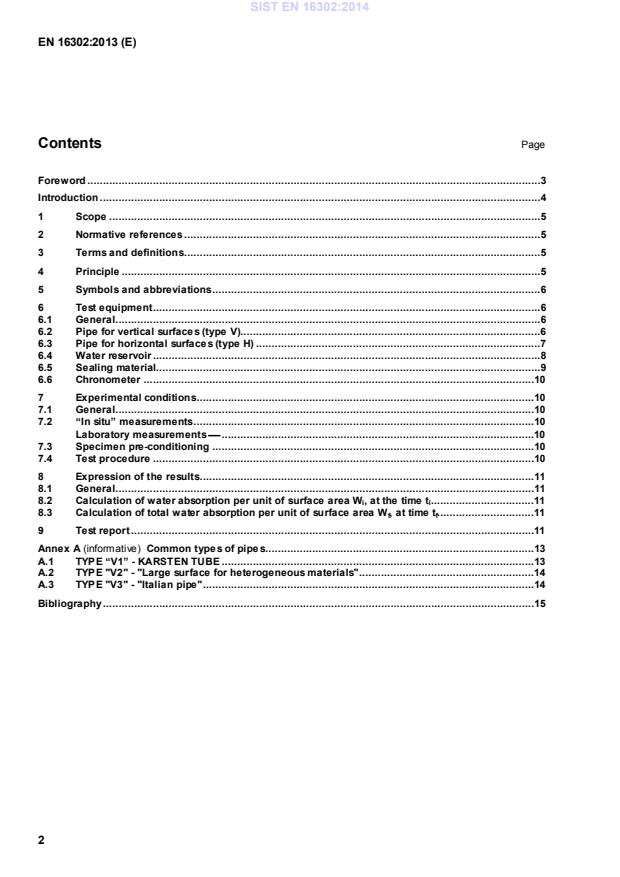
SIST EN 16302:2014 specifies a test method for porous inorganic materials in cultural heritage applications, using a pipe placed on the test surface to measure how much water is absorbed over time. The document is organized as scope, normative references, terms and definitions, principle, symbols and abbreviations, test equipment, experimental conditions, expression of the results, test report, and an informative annex.
| Annex | What it covers |
|---|---|
| Annex A | Common types of pipes, including the V1 Karsten tube, V2 for large surfaces on heterogeneous materials, and V3 the Italian pipe |
The scope covers untreated materials and materials that have been treated or aged. The method can be used both in the laboratory and in situ, which matters because heritage objects often cannot be removed for testing.
What are the key requirements of SIST EN 16302:2014?
Pipe setup and comparability
Clause 6 requires transparent pipe equipment, with separate pipe types for vertical surfaces (type V) and horizontal surfaces (type H). Clause 6.1 also states that results from different pipe types are directly comparable only when the pipe dimensions are the same, which matters when comparing measurements from different sites or campaigns.
Clause 6.4 uses a water reservoir connected to the cell through a transparent tube with a Hoffman clamp, and clause 6.5 requires sealing that prevents leakage without staining or altering the substrate. In practice, the setup must hold water at the test area without damaging the heritage material.
Surface conditions and specimen preparation
Clause 7.1 requires a flat, sufficiently homogeneous surface without visible cracks so the pipe can seal properly. Each series must include at least 3 specimens or 3 different surface areas, and anisotropic materials must be tested in the same orientation. For coarse mortars or similar materials, the measurement area should be large enough relative to the largest grain, so the result represents the material rather than a single inclusion.
Clause 7.3 gives laboratory pre-conditioning: polish, wash, and dry the specimen to constant mass, with adapted treatment for water-sensitive or temperature-sensitive materials. This matters because surface state strongly affects absorption, so the preparation must be consistent before measuring.
In situ conditions and measurement sequence
Clause 7.2 requires a flat, dry surface that is not exposed to direct sun or rain during the test, and recommends recording ambient temperature [T] and relative humidity [RH]. Clause 7.4 requires checking for air bubbles and leakage, then taking readings at intervals of 10 seconds to 1 minute depending on porosity, followed by 5-minute readings until a constant value is reached or until 1 hour has elapsed. This gives a time-based absorption profile rather than a single number.
Results and reporting
Clause 8 presents results as a water absorption graph, with absorbed volume as a function of time, and defines calculations for absorption per unit area and total absorption at the final time. Clause 9 requires the test report to identify the standard, the laboratory or exact in situ location, the material, specimen details, pipe type, water used, time intervals, the graph, the total absorption value, deviations, and any extra remarks. For users, that means the report is intended to be traceable and comparable, not just a recorded reading.
What terms does SIST EN 16302:2014 define?
- Porous inorganic material - A material such as sandstone, limestone, marble, mortar, plaster, or brick that can absorb water through pore structure.
- Water absorption by pipe method - The amount of water transferred from the pipe through a defined test area after a fixed time, expressed as ml/cm2.
- Specimen - A part considered representative of the material constituting an object, whether taken from similar materials, reference materials, or the object itself.
- Test area - The surface area inside the pipe that is exposed to water during the test.
- Water absorption per unit of surface area [Wi] - The absorbed water divided by the test area at a given time.
- Total water absorption [Wf] - The absorbed water divided by the test area at the final measurement time.
- Relative humidity [RH] - The ambient moisture content of the air near the test surface.
- Average ambient temperature [T] - The temperature near the test surface during measurement.
Who uses SIST EN 16302:2014?
SIST EN 16302:2014 is used by conservation scientists, conservators, testing laboratories, and restoration specialists working on stone, mortar, plaster, brick, and similar heritage materials. It also supports site testing during conservation projects, where the material cannot be removed.
For buyers, specifiers, and quality managers, the standard gives a common way to compare surface water uptake before and after treatment or ageing. That is useful when selecting materials, checking treatment performance, or documenting the condition of cultural property.
Which standards are used with SIST EN 16302:2014?
EN 15898:2011 is the normative reference named in the document, and it provides the main general terms and definitions used throughout the standard. A note in the definitions also points to EN 15801 for the broader material family covered by the method.
What does the SIST EN 16302:2014 document contain?
Clause 6 describes the test equipment in detail, including the pipe types for vertical and horizontal surfaces, the reservoir, the sealing material, and the chronometer. Annex A gives three common pipe types and their nominal dimensions, which helps users choose equipment that matches the surface and the material heterogeneity.
Clause 7 sets out the experimental conditions for in situ and laboratory work, including specimen pre-conditioning and the reading intervals during the test. Clause 8 gives the result presentation and calculation approach, while clause 9 defines what must be recorded in the test report.
Relations
- Effective Date
- 28-Jan-2026
- Effective Date
- 28-Jan-2026
- Effective Date
- 28-Jan-2026
- Effective Date
- 28-Jan-2026
Frequently Asked Questions
SIST EN 16302:2014 is a standard published by the Slovenian Institute for Standardization (SIST). Its full title is "Conservation of cultural heritage - Test methods - Measurement of water absorption by pipe method". This standard covers: This European Standard specifies a method to measure water absorption of porous inorganic materials used for and constituting cultural property by pipe method. The method may be used on porous inorganic materials which are untreated or have been subjected to any treatment or ageing. The method may be used both in the laboratory and in situ due to its non destructive nature.
This European Standard specifies a method to measure water absorption of porous inorganic materials used for and constituting cultural property by pipe method. The method may be used on porous inorganic materials which are untreated or have been subjected to any treatment or ageing. The method may be used both in the laboratory and in situ due to its non destructive nature.
SIST EN 16302:2014 is classified under the following ICS (International Classification for Standards) categories: 97.195 - Items of art and handicrafts. Cultural property and heritage. The ICS classification helps identify the subject area and facilitates finding related standards.
SIST EN 16302:2014 has the following relationships with other standards: It is inter standard links to SIST EN 15898:2011, SIST EN 17488:2021, SIST EN 17114:2019, SIST EN 16581:2015. Understanding these relationships helps ensure you are using the most current and applicable version of the standard.
SIST EN 16302:2014 is available in PDF format for immediate download after purchase. The document can be added to your cart and obtained through the secure checkout process. Digital delivery ensures instant access to the complete standard document.
Standards Content (Sample)
2003-01.Slovenski inštitut za standardizacijo. Razmnoževanje celote ali delov tega standarda ni dovoljeno.Erhaltung des kulturellen Erbes - Prüfverfahren - Messung der Wasseraufnahme bei niedrigem DruckConservation des biens culturels - Méthodes d'essai - Mesurage de l'absorption d'eau par la méthode à la pipetteConservation of cultural heritage - Test methods - Measurement of water absorption by pipe method97.195Umetniški in obrtniški izdelkiItems of art and handicraftsICS:Ta slovenski standard je istoveten z:EN 16302:2013SIST EN 16302:2014en,fr,de01-januar-2014SIST EN 16302:2014SLOVENSKI
STANDARD
EUROPEAN STANDARD NORME EUROPÉENNE EUROPÄISCHE NORM
EN 16302
February 2013 ICS 97.195 English Version
Conservation of cultural heritage - Test methods - Measurement of water absorption by pipe method
Conservation des biens culturels - Méthodes d'essai - Mesurage de l'absorption d'eau par la méthode à la pipette Erhaltung des kulturellen Erbes - Prüfverfahren - Messung der Wasseraufnahme bei niedrigem Druck This European Standard was approved by CEN on 28 December 2012.
CEN members are bound to comply with the CEN/CENELEC Internal Regulations which stipulate the conditions for giving this European Standard the status of a national standard without any alteration. Up-to-date lists and bibliographical references concerning such national standards may be obtained on application to the CEN-CENELEC Management Centre or to any CEN member.
This European Standard exists in three official versions (English, French, German). A version in any other language made by translation under the responsibility of a CEN member into its own language and notified to the CEN-CENELEC Management Centre has the same status as the official versions.
CEN members are the national standards bodies of Austria, Belgium, Bulgaria, Croatia, Cyprus, Czech Republic, Denmark, Estonia, Finland, Former Yugoslav Republic of Macedonia, France, Germany, Greece, Hungary, Iceland, Ireland, Italy, Latvia, Lithuania, Luxembourg, Malta, Netherlands, Norway, Poland, Portugal, Romania, Slovakia, Slovenia, Spain, Sweden, Switzerland, Turkey and United Kingdom.
EUROPEAN COMMITTEE FOR STANDARDIZATION
COMITÉ EUROPÉEN DE NORMALISATION EUROPÄISCHES KOMITEE FÜR NORMUNG
Management Centre:
Avenue Marnix 17,
B-1000 Brussels © 2013 CEN All rights of exploitation in any form and by any means reserved worldwide for CEN national Members. Ref. No. EN 16302:2013: ESIST EN 16302:2014
Laboratory measurements .10 7.3 Specimen pre-conditioning .10 7.4 Test procedure .10 8 Expression of the results.11 8.1 General .11 8.2 Calculation of water absorption per unit of surface area Wi, at the time ti .11 8.3 Calculation of total water absorption per unit of surface area Wf, at time tf.11 9 Test report .11 Annex A (informative)
Common types of pipes.13 A.1 TYPE “V1” - KARSTEN TUBE .13 A.2 TYPE "V2" - "Large surface for heterogeneous materials".14 A.3 TYPE "V3" - "Italian pipe" .14 Bibliography .15
...