

oSIST prEN 18381:2026
(Main)Biological durability of wood and wood-based products - Preparation of wood and wood-based material specimens before leaching testing
- Abstract
This document specifies a method for preparing treated wood test specimens prior leaching test to obtain water samples from treated wood which has been in conditions designed to simulate treated wood exposed out of ground contact (wood held in the storage yard after treatment and which has been in conditions designed to simulate outdoor, out of ground contact situations, use Class 3), or continuous contact with the ground or with water (use Class 4 or 5). This document is also applicable to untreated wood and modified wood.
NOTE 1 Test methods written in CEN/TC 38 include how to prepare specimens of wood and wood-based materials before leaching tests.
NOTE 2 EN 350 can be considered when using this document for testing untreated wood or modified wood, regarding reference wood species, number of test specimens etc.
- Status
- Not Published
- Public Enquiry End Date
- 30-Oct-2026
- Technical Committee
- LLZ - Les, lesni izdelki in zaščita lesa
- Current Stage
- 4020 - Public enquire (PE) (Adopted Project)
- Start Date
- 21-Aug-2026
- Due Date
- 08-Jan-2027

oSIST prEN 18381:2026 is a CEN draft European Standard on preparing wood and wood-based material specimens before leaching testing. It specifies how specimens are prepared so later leaching tests can assess emissions from treated wood exposed in Use Class 3, 4 or 5 conditions. It is also applicable to untreated wood and modified wood, and it is written for laboratories and other teams that need a consistent preparation method.
What does oSIST prEN 18381:2026 specify?
oSIST prEN 18381:2026 specifies the preparation of specimens before leaching tests; the document stops at specimen preparation and the reporting information that must accompany the later leaching study. It is organized into six clauses plus a bibliography.
| Clause | What it covers |
|---|---|
| 1 Scope | The preparation method and the wood situations covered |
| 2 Normative references | EN 15119-1 and EN 15119-2 |
| 3 Terms and definitions | The terminology section |
| 4 General considerations | Use Class, exposure conditions and treatment assumptions |
| 5 Test specimens | Specimen system, wood selection, end seal, conditioning and selection |
| 6 Information to be included in the test report | The information that must be recorded after testing |
The scope ties the method to wood exposed out of ground contact, in ground contact, in fresh water or in sea water. That matters in practice because the specimen preparation has to match the exposure case being assessed.
What are the key requirements of oSIST prEN 18381:2026?
Exposure conditions and test setup
oSIST prEN 18381:2026 links specimen preparation to the Use Class defined in EN 335. It treats rainfall as the main leaching driver for open-air storage and Use Class 3, soil water as the key factor for Use Class 4, and sea water as comparable to fresh water for Use Class 5.
The document also says the wood used for preservative testing should be representative of commercially used wood and treated according to the preservative manufacturer’s instructions. The post-treatment conditioning parameters have to be stated, because they affect how much material is available for leaching.
Preparing the test specimens
oSIST prEN 18381:2026 requires an inert container, such as glass or suitable plastic, with all faces of the specimen exposed to water and the container covered to reduce evaporation. It also sets the water-to-exposed-surface-area ratio used in the leaching setup, so different laboratories work under comparable conditions.
The wood species should be typical of those used in preservative efficacy testing, with Scots pine given as an example. Test specimens should be 100 % sapwood, straight grained, without knots, plain sawn and not sanded, and the report should record source, density and annual ring information.
End sealing, treatment and selection
oSIST prEN 18381:2026 distinguishes between superficial treatment and penetration treatment. For superficial treatment, the end seal is applied before treatment; for penetration treatment, the end grain stays open during treatment and the specimen is sealed after conditioning. The ends are protected so emission is assessed from the intended surface area only.
The specimen is weighed before and after treatment so uptake can be determined. After treatment, the specimens are conditioned according to the preservative supplier’s recommendations, and at least six representative specimens within ±5 % of the mean retention are selected for the study.
Reporting
oSIST prEN 18381:2026 requires the later test report to identify the document, the preservative, the wood species and its characteristics, the loading or retention and calculation basis, the treatment method, the conditioning, the end sealant, any further surface treatment, and any deviations or unusual observations. In practice, this makes the preparation history traceable when the leaching results are reviewed.
What terms does oSIST prEN 18381:2026 define?
- Use Class - The exposure category from EN 335 that sets the wetting and contact conditions for the wood.
- Preservative - The wood protection product applied to the specimens, including its active substances and other declared ingredients.
- End seal - A barrier applied to end grain to stop preservative penetration or leaching through the specimen ends.
- Retention - The amount of preservative retained in the wood after treatment.
- Loading - The amount of preservative applied to the wood, reported with the calculation basis used.
- Conditioning - The post-treatment storage or treatment period before leaching begins.
- Sapwood - The outer wood used for the specimens, which the document requires to make up the full test piece.
Who uses oSIST prEN 18381:2026?
oSIST prEN 18381:2026 is used by wood preservative manufacturers, testing laboratories, and environmental assessment teams. It is relevant when they prepare specimens for emission studies on treated wood in Use Class 3, 4 or 5 situations. It also matters to technical staff working with BPR and CPR-related assessments, because the specimen history has to be controlled and documented before leaching results are interpreted.
Which standards are used with oSIST prEN 18381:2026?
| Standard | What it contributes |
|---|---|
| EN 15119-1 | Laboratory method for emissions from preservative treated wood in storage yard and Use Class 3 situations |
| EN 15119-2 | Laboratory method for emissions from preservative treated wood in Use Class 4 or 5 situations |
| EN 335 | Defines the Use Classes used to set the exposure case |
| EN 350 | Can be considered when testing untreated wood or modified wood, especially for species and specimen number choices |
| EN 16663 | Semi-field method for emissions from preservative treated wood in Use Class 3 situations |
What does the oSIST prEN 18381:2026 document contain?
oSIST prEN 18381:2026 contains the specimen preparation framework needed before a leaching test starts. Clause 5 sets out the test system, wood selection rules, end sealing approach, treatment sequence, conditioning and specimen selection criteria. Clause 6 gives the information that should be reported after the leaching study, including preservative identity, wood characteristics, treatment details and any deviations. The bibliography points to related durability, emission and construction-product documents that support the method.
Relations
- Effective Date
- 28-Jan-2026
Get Certified
Connect with accredited certification bodies for this standard

ECOCERT
Organic and sustainability certification.

Eurofins Food Testing Global
Global leader in food, environment, and pharmaceutical product testing.

Intertek Bangladesh
Intertek certification and testing services in Bangladesh.
Sponsored listings
Frequently Asked Questions
oSIST prEN 18381:2026 is a draft published by the Slovenian Institute for Standardization (SIST). Its full title is "Biological durability of wood and wood-based products - Preparation of wood and wood-based material specimens before leaching testing". This standard covers: This document specifies a method for preparing treated wood test specimens prior leaching test to obtain water samples from treated wood which has been in conditions designed to simulate treated wood exposed out of ground contact (wood held in the storage yard after treatment and which has been in conditions designed to simulate outdoor, out of ground contact situations, use Class 3), or continuous contact with the ground or with water (use Class 4 or 5). This document is also applicable to untreated wood and modified wood. NOTE 1 Test methods written in CEN/TC 38 include how to prepare specimens of wood and wood-based materials before leaching tests. NOTE 2 EN 350 can be considered when using this document for testing untreated wood or modified wood, regarding reference wood species, number of test specimens etc.
This document specifies a method for preparing treated wood test specimens prior leaching test to obtain water samples from treated wood which has been in conditions designed to simulate treated wood exposed out of ground contact (wood held in the storage yard after treatment and which has been in conditions designed to simulate outdoor, out of ground contact situations, use Class 3), or continuous contact with the ground or with water (use Class 4 or 5). This document is also applicable to untreated wood and modified wood. NOTE 1 Test methods written in CEN/TC 38 include how to prepare specimens of wood and wood-based materials before leaching tests. NOTE 2 EN 350 can be considered when using this document for testing untreated wood or modified wood, regarding reference wood species, number of test specimens etc.
oSIST prEN 18381:2026 is classified under the following ICS (International Classification for Standards) categories: 71.100.50 - Wood-protecting chemicals. The ICS classification helps identify the subject area and facilitates finding related standards.
oSIST prEN 18381:2026 has the following relationships with other standards: It is inter standard links to SIST EN ISO 23581:2024. Understanding these relationships helps ensure you are using the most current and applicable version of the standard.
oSIST prEN 18381:2026 is available in PDF format for immediate download after purchase. The document can be added to your cart and obtained through the secure checkout process. Digital delivery ensures instant access to the complete standard document.
Standards Content (Sample)
SLOVENSKI STANDARD
01-oktober-2026
Biološka odpornost lesa in lesnih proizvodov - Priprava vzorcev lesa in lesnih
materialov pred izpiranjem
Biological durability of wood and wood-based products - Preparation of wood and wood-
based material specimens before leaching testing
Biologische Dauerhaftigkeit von Holz und Holzprodukten - Vorbereitung von Prüfkörpern
aus Holz- und Holzprodukten vor der Auswaschprüfung
Durabilité biologique du bois et des matériaux à base de bois - Préparation des
éprouvettes de bois et de matériaux à base de bois avant essai de lixiviation
Ta slovenski standard je istoveten z: prEN 18381
ICS:
71.100.50 Kemikalije za zaščito lesa Wood-protecting chemicals
2003-01.Slovenski inštitut za standardizacijo. Razmnoževanje celote ali delov tega standarda ni dovoljeno.
DRAFT
EUROPEAN STANDARD
NORME EUROPÉENNE
EUROPÄISCHE NORM
August 2026
ICS 71.100.50
English Version
Biological durability of wood and wood-based products -
Preparation of wood and wood-based material specimens
before leaching testing
Durabilité biologique du bois et des matériaux à base Biologische Dauerhaftigkeit von Holz und
de bois - Préparation des éprouvettes de bois et de Holzprodukten - Vorbereitung von Holz- und
matériaux à base de bois avant essai de délavage Holzwerkstoffproben vor der Auswaschprüfung
This draft European Standard is submitted to CEN members for enquiry. It has been drawn up by the Technical Committee
CEN/TC 38.
If this draft becomes a European Standard, CEN members are bound to comply with the CEN/CENELEC Internal Regulations
which stipulate the conditions for giving this European Standard the status of a national standard without any alteration.
This draft European Standard was established by CEN in three official versions (English, French, German). A version in any other
language made by translation under the responsibility of a CEN member into its own language and notified to the CEN-CENELEC
Management Centre has the same status as the official versions.
CEN members are the national standards bodies of Austria, Belgium, Bulgaria, Croatia, Cyprus, Czech Republic, Denmark, Estonia,
Finland, France, Germany, Greece, Hungary, Iceland, Ireland, Italy, Latvia, Lithuania, Luxembourg, Malta, Netherlands, Norway,
Poland, Portugal, Republic of North Macedonia, Romania, Serbia, Slovakia, Slovenia, Spain, Sweden, Switzerland, Türkiye and
United Kingdom.
Recipients of this draft are invited to submit, with their comments, notification of any relevant patent rights of which they are
aware and to provide supporting documentation.
Warning : This document is not a European Standard. It is distributed for review and comments. It is subject to change without
notice and shall not be referred to as a European Standard.
EUROPEAN COMMITTEE FOR STANDARDIZATION
COMITÉ EUROPÉEN DE NORMALISATION
EUROPÄISCHES KOMITEE FÜR NORMUNG
CEN-CENELEC Management Centre: Rue de la Science 23, B-1040 Brussels
© 2026 CEN All rights of exploitation in any form and by any means reserved Ref. No. prEN 18381:2026 E
worldwide for CEN national Members.
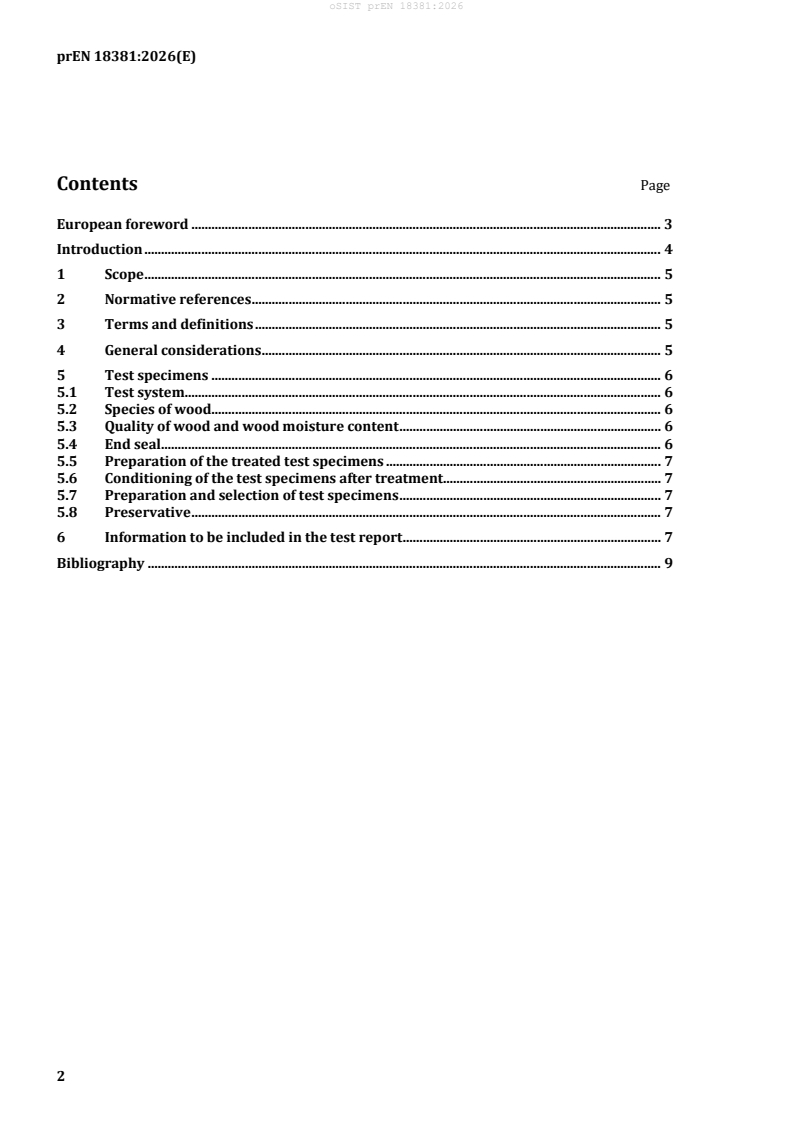
Contents Page
European foreword . 3
Introduction . 4
1 Scope . 5
2 Normative references . 5
3 Terms and definitions . 5
4 General considerations . 5
5 Test specimens . 6
5.1 Test system. 6
5.2 Species of wood. 6
5.3 Quality of wood and wood moisture content . 6
5.4 End seal . 6
5.5 Preparation of the treated test specimens . 7
5.6 Conditioning of the test specimens after treatment. 7
5.7 Preparation and selection of test specimens . 7
5.8 Preservative . 7
6 Information to be included in the test report . 7
Bibliography . 9
European foreword
This document (prEN 18381:2026) has been prepared by Technical Committee CEN/TC 38 “Biological
durability of wood and wood-based products”, the secretariat of which is held by SIS.
This document is currently submitted to the CEN Enquiry.
CEN/TC 38 has leaching standards for estimating environmental emissions from preservative treated
wood. These standards describe the preparation of wood-based specimens that are specific and perfectly
suited to anisotropic materials. Other Technical Committees such as CEN/TC 351 also have leaching
standards for the assessment of release of dangerous substances.
This document aims to describe precisely how to prepare specimens of wood and wood-based materials
before leaching tests for the needs of the CEN/TC 38 standards and if other leaching standards other than
those of CEN/TC 38 are used.
The wood preservative rules request the preparation of specimen then the immersion brings dimensions
considerations at laboratory scales. The immersion regime will be determined by use class (EN 335):
• EN 15119 Part 1: Wood held in the storage yard after treatment and wooden commodities
exposed in Use Class 3 (not covered, not in contact with the ground) — Laboratory method
• EN 15119 Part 2: Wooden commodities exposed in Use Class 4 or 5 (in contact with the ground,
fresh water or sea water) — Laboratory method
• EN 16663 Biological durability of wood and wood-based products — Determination of emissions
from preservative treated wood to the environment — Wooden commodities exposed in Use
Class 3 (Not covered, not in contact with the ground) — Semi-field method
Introduction
For the need of regulations such as Biocidal Product Regulation (BPR), the emissions from preservative
treated wood to the environment need to be quantified to enable an environmental risk assessment of
the treated wood.
For the need of Construction Product Regulation (CPR), the emissions from untreated wood or modified
wood can be evaluated.
As wood is an anisotropic material, an appropriate procedure to prepare the wooden test specimens prior
leaching test can be defined.
This document describes a method for the preparation of the treated test specimens for the estimation
of emissions from preservative treated wood in the case where:
— the preservative treated wood is not covered and not in contact with the ground or the water;
— the preservative treated wood is in contact with the ground, fresh water or seawater.
There are five situations in this case where emissions could enter the environment:
a) emissions from preservative treated wood stored outside in the storage yard of a preservative
treatment site. Rain falling on the treated wood could produce emissions that run off into surface
water and / or soil (see EN15119-1).
b) emissions from treated wood used in commodities exposed in Use Class 3. This is the situation in
which the wood or wood-based product is not covered and not in contact with the ground. It is either
continually exposed to the weather or is protected from the weather but subject to frequent wetting.
Use classes are specified in EN 335 and categorize the biological hazard to which the treated
commodity will be subjected. The Use Classes also specify the situation in which the treated
commodity is used and determine the environmental compartments (air, water, soil) which are
potentially at risk from the preservative treated wood. Rain falling on treated wood in Use Class 3
could produce emissions that run off into surface water and/ or soil (see EN 15119-1 and EN 16663).
c) emissions from treated wood in contact with the ground. Use Class 4. Emissions from the surface of
the treated wood could enter the soil via the soil water (see EN 15119-2).
d) emissions from treated wood in contact with fresh water. Use Class 4. Emissions from the surface of
the treated wood could enter the water (see EN 15119-2).
e) emissions from treated wood in contact with sea water. Use Class 5. Emissions from the surface of the
treated wood could enter the sea (see EN 15119-2).
1 Scope
This document specifies a method for preparing treated wood test specimens prior leaching test to obtain
water samples from treated wood which has been in conditions designed to simulate treated wood
exposed out of ground contact (wood held in the storage yard after treatment and which has been in
conditions designed to simulate outdoor, out of ground contact situations, use Class 3), or continuous
contact with the ground or with water (use Class 4 or 5). This document is also applicable to untreated
wood and modified wood.
NOTE 1 Test methods written in CEN/TC 38 include how to prepare specimens of wood and wood-based
materials before leaching tests.
NOTE 2 EN 350 can be considered when using this document for testing untreated wood or modified wood,
regarding reference wood species, number of test specimens etc.
2 Normative references
The following documents are referr
...