

SIST EN 4158:2009
(Main)Aerospace series - Paints and varnishes - Test method for measurement of electrical surface resistance of conductive layers
- Abstract
This standard describes a method of measurement of the electrical resistance of electrically conducting surface coatings on non-conductive parts and samples for aerospace applications.
If electrical contact areas are provided, the method is also applicable on electrical conducting layers over coated with non-conducting layers.
- Status
- Published
- Publication Date
- 03-May-2009
- Technical Committee
- I13 - Imaginarni 13
- Current Stage
- 6060 - National Implementation/Publication (Adopted Project)
- Start Date
- 17-Apr-2009
- Due Date
- 22-Jun-2009
- Completion Date
- 04-May-2009



SIST EN 4158:2009 is a European standard for measuring the electrical surface resistance of conductive coatings on non-conductive aerospace parts and samples. It specifies a contact method based on applying a known voltage, measuring current, and calculating resistance. The document is for engineers, coating suppliers, test laboratories, and quality staff who need a repeatable way to check conductive paint performance.
What does SIST EN 4158:2009 specify?
SIST EN 4158:2009 specifies a test method for electrically conducting surface coatings used on non-conductive parts and samples for aerospace applications. It also applies to conducting layers that are covered by non-conducting layers when electrical contact areas are provided.
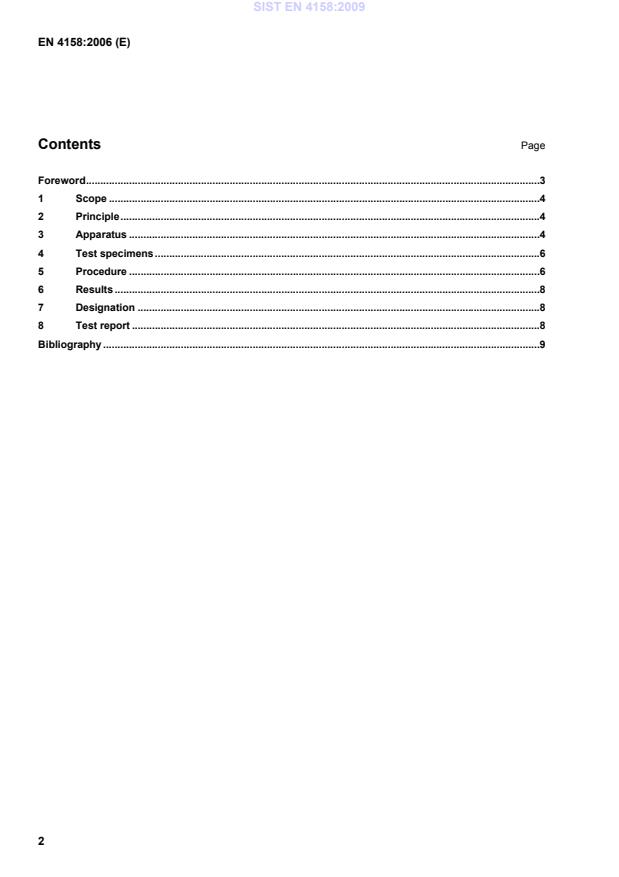
The document is organized into clauses for scope, principle, apparatus, test specimens, procedure, results, designation, and test report, followed by a bibliography. In practice, that structure takes the user from the measurement set-up all the way to the report content.
What are the key requirements of SIST EN 4158:2009?
SIST EN 4158:2009 uses a simple contact measurement principle: apply a known voltage, measure the current, and determine the resistance by Ohm’s law. The standard then gives the assumptions needed to convert the measured value into layer resistance, so the result is meaningful for the coating itself and not only for the measuring set-up.
Measurement set-up and apparatus
Clause 3 describes a fixed electrode assembly made from an insulating support and two conductive silicone elastomer electrodes. The electrodes, support, and measuring instrument must be suitable for the resistance range being checked, and the instrument must be controlled and calibrated regularly. In practice, this means the lab needs a stable set-up, not an improvised contact arrangement.
The fixed geometry is important because the calculated layer resistance depends on electrode spacing and contact area. The standard notes that, with the specified geometry, the measured resistance can be used directly for the layer resistance.
Test specimens and coating condition
Clause 4 requires specimens or parts coated with conductive paint, with a minimum size of 300 mm × 300 mm. If the coating is to be tested under a non-conductive topcoat, protected contact areas must be prepared so the measuring electrodes can still touch the conductive layer.
That matters because the coating must be tested after the intended build-up is complete, not on a simplified sample that does not represent the final part.
Procedure and measuring points
Clause 5 says measurements are made after complete curing of the conductive paint. It also gives a preferred ambient range of temperature and humidity, and it requires checking the electrode assembly on an uncoated metal reference before measuring the component.
For actual parts, the standard says the number and position of measuring points depend on geometry, and the points should be placed far enough from edges. This helps avoid falsely high readings caused by edge effects and uneven contact.
Calculation and reporting
Clause 6 gives the calculation used when the fixed electrode set-up is not used. Clause 8 lists the information that the test report shall contain, including the material tested, the measuring apparatus, electrode spacing if relevant, measuring range, number of points, individual values or average value, deviations from the standard, and the test date and examiner signature.
For a buyer or quality manager, that report list is the practical checklist for comparing suppliers and repeating the test later.
What terms does SIST EN 4158:2009 use?
- Electrical surface resistance - the resistance measured across the surface of the conductive coating.
- Conductive layer - the coating layer whose electrical performance is being checked.
- Electrical contact areas - prepared areas that allow the electrodes to touch the conductive layer through a non-conductive topcoat.
- Assembly of electrodes - the insulated support and conductive electrodes used to make the measurement.
- Measured resistance, Rmeasured - the resistance obtained from the applied voltage and measured current.
- Layer resistance, RL - the resistance of the coating layer calculated from the measured value and the electrode geometry.
- Test specimen - the coated part or sample submitted for measurement.
- Measuring point - a location on the part where the resistance is checked.
Who uses SIST EN 4158:2009?
SIST EN 4158:2009 is used by aerospace coating manufacturers, finishing shops, test laboratories, and quality assurance teams. It is also relevant to purchasers and inspectors who need to verify that conductive paints or coated surfaces meet the agreed electrical performance before use on parts and assemblies.
What changed in SIST EN 4158:2009 from the previous edition?
SIST EN 4158:2009 corresponds to EN 4158:2006.
Which standards are used with SIST EN 4158:2009?
The bibliography names ISO 1513, which covers examination and preparation of samples for testing, and ISO 3696, which covers water for analytical laboratory use. These references support sample preparation and laboratory practice around the test method.
What does the SIST EN 4158:2009 document contain?
SIST EN 4158:2009 contains a principle section with the measurement method, a description of the electrode set-up, specimen requirements, and a step-by-step procedure for checking the equipment and measuring the coated part. It also includes the calculation rule for deriving layer resistance when the fixed geometry is not used.
The document includes figures showing the fixed electrode assembly and the intended measuring-point placement on strongly bent, slightly bent, and flat components. It also gives a designation example and a detailed test report item list, which are useful for lab records, supplier declarations, and conformity documentation.
Relations
- Effective Date
- 28-Jan-2026
Get Certified
Connect with accredited certification bodies for this standard

BUREAU VERITAS Certification Germany
Bureau Veritas certification in Germany.

Element Materials Technology
Materials testing and product certification.

AQMS Ltd.
AQMS provides ISO certification to SMEs across the UK.
Sponsored listings
Frequently Asked Questions
SIST EN 4158:2009 is a standard published by the Slovenian Institute for Standardization (SIST). Its full title is "Aerospace series - Paints and varnishes - Test method for measurement of electrical surface resistance of conductive layers". This standard covers: This standard describes a method of measurement of the electrical resistance of electrically conducting surface coatings on non-conductive parts and samples for aerospace applications. If electrical contact areas are provided, the method is also applicable on electrical conducting layers over coated with non-conducting layers.
This standard describes a method of measurement of the electrical resistance of electrically conducting surface coatings on non-conductive parts and samples for aerospace applications. If electrical contact areas are provided, the method is also applicable on electrical conducting layers over coated with non-conducting layers.
SIST EN 4158:2009 is classified under the following ICS (International Classification for Standards) categories: 49.040 - Coatings and related processes used in aerospace industry. The ICS classification helps identify the subject area and facilitates finding related standards.
SIST EN 4158:2009 has the following relationships with other standards: It is inter standard links to SIST EN 3840:2009. Understanding these relationships helps ensure you are using the most current and applicable version of the standard.
SIST EN 4158:2009 is available in PDF format for immediate download after purchase. The document can be added to your cart and obtained through the secure checkout process. Digital delivery ensures instant access to the complete standard document.
Standards Content (Sample)
2003-01.Slovenski inštitut za standardizacijo. Razmnoževanje celote ali delov tega standarda ni dovoljeno.Luft- und Raumfahrt - Beschichtungsstoffe - Messung des elektrischen Oberflächenwiderstandes von elektrisch leitfähigen SchichtenSérie aérospatiale - Peintures et vernis - Mesure de la résistance de surface électrique des couches conductriceAerospace series - Paints and varnishes - Test method for measurement of electrical surface resistance of conductive layers49.040Prevleke in z njimi povezani postopki, ki se uporabljajo v letalski in vesoljski industrijiCoatings and related processes used in aerospace industryICS:Ta slovenski standard je istoveten z:EN 4158:2006SIST EN 4158:2009en,de01-junij-2009SIST EN 4158:2009SLOVENSKI
STANDARD
EUROPEAN STANDARDNORME EUROPÉENNEEUROPÄISCHE NORMEN 4158December 2006ICS 49.040 English VersionAerospace series - Paints and varnishes - Test method formeasurement of electrical surface resistance of conductivelayersSérie aérospatiale - Peintures et vernis - Mesure de larésistance de surface électrique des couches conductriceLuft- und Raumfahrt - Anstrichstoffe - Messen deselektrischen Oberflächenwiderstandes von elektrischleitfähigen SchichtenThis European Standard was approved by CEN on 28 August 2006.CEN members are bound to comply with the CEN/CENELEC Internal Regulations which stipulate the conditions for giving this EuropeanStandard the status of a national standard without any alteration. Up-to-date lists and bibliographical references concerning such nationalstandards may be obtained on application to the Central Secretariat or to any CEN member.This European Standard exists in three official versions (English, French, German). A version in any other language made by translationunder the responsibility of a CEN member into its own language and notified to the Central Secretariat has the same status as the officialversions.CEN members are the national standards bodies of Austria, Belgium, Cyprus, Czech Republic, Denmark, Estonia, Finland, France,Germany, Greece, Hungary, Iceland, Ireland, Italy, Latvia, Lithuania, Luxembourg, Malta, Netherlands, Norway, Poland, Portugal, Romania,Slovakia, Slovenia, Spain, Sweden, Switzerland and United Kingdom.EUROPEAN COMMITTEE FOR STANDARDIZATIONCOMITÉ EUROPÉEN DE NORMALISATIONEUROPÄISCHES KOMITEE FÜR NORMUNGManagement Centre: rue de Stassart, 36
B-1050 Brussels© 2006 CENAll rights of exploitation in any form and by any means reservedworldwide for CEN national Members.Ref. No. EN 4158:2006: ESIST EN 4158:2009
If electrical contact areas are provided, the method is also applicable on electrical conducting layers over coated with non-conducting layers. 2 Principle The principle of the method involves applying a known voltage U to the conductive layer, measuring the c
...