


SIST EN 302-5:2023
(Main)Adhesives for load-bearing timber structures - Test methods - Part 5: Determination of maximum assembly time under referenced conditions
Adhesives for load-bearing timber structures - Test methods - Part 5: Determination of maximum assembly time under referenced conditions
This document specifies a laboratory method of determining the maximum assembly time at two spread rate levels in standard atmosphere [20/65].
This document is applicable to obtaining a reliable base of comparison of the maximum assembly time between adhesives at referenced conditions.
Klebstoffe für tragende Holzbauteile - Prüfverfahren - Teil 5: Bestimmung der maximalen Wartezeit bei Referenzbedingungen
Dieses Dokument legt ein Labor-Verfahren zur Bestimmung der maximalen Wartezeit von Klebstoffen bei zwei unterschiedlichen aufgetragenen Klebstoffmengen im Normalklima [20/65] fest.
Dieses Dokument ist anwendbar, um eine zuverlässige Grundlage zum Vergleich der maximalen Wartezeit von Klebstoffen unter Referenzbedingungen zu erhalten.
Adhésifs pour structures portantes en bois - Méthodes d'essai - Partie 5 : Détermination du temps d'assemblage maximal dans des conditions de référence
Le présent document spécifie une méthode de laboratoire qui permet de déterminer le temps d’assemblage maximal pour deux niveaux de grammage en atmosphère normale [20/65].
Le présent document s’applique pour obtenir une base fiable de comparaison du temps d’assemblage maximal entre les adhésifs dans des conditions de référence.
Lepila za nosilne lesene konstrukcije - Preskusne metode - 5. del: Določanje najdaljšega časa za montažo (sestavo) pri referenčnih pogojih
Ta dokument določa laboratorijsko metodo za določanje najdaljšega časa za montažo (sestavo) pri dveh hitrostih nanašanja v standardni atmosferi [20/65].
Ta dokument je namenjen za pridobivanje zanesljive podlage za primerjavo najdaljšega časa za montažo med lepili pri referenčnih pogojih.
General Information
- Status
- Published
- Public Enquiry End Date
- 24-Nov-2021
- Publication Date
- 28-Feb-2023
- Technical Committee
- IPMA - Polimer materials and products
- Current Stage
- 6060 - National Implementation/Publication (Adopted Project)
- Start Date
- 23-Feb-2023
- Due Date
- 30-Apr-2023
- Completion Date
- 01-Mar-2023
Relations
- Effective Date
- 19-Jan-2023
Overview
EN 302-5:2023 - Adhesives for load-bearing timber structures: Test methods - Part 5 specifies a laboratory procedure to determine the maximum assembly time of timber adhesives under referenced laboratory conditions (standard atmosphere 20/65: 20 °C / 65 % RH). Approved by CEN in Dec 2022 and published 2023, this method provides a reliable comparative basis to assess when an applied adhesive coat loses bonding ability for load-bearing timber applications.
Key topics and requirements
- Purpose: Determine the maximum interval from adhesive application to cramping (assembly time) beyond which bonding performance fails.
- Test stages: Two-stage method - a screening test followed by a final test to confirm results.
- Referenced climate: Standard atmosphere 20/65 (20 ±2 °C, 65 ±5 % RH); strict climate control is emphasised because small changes affect drying and assembly time.
- Glue spread levels: Tests performed at two spread rates: 250 g/m² and 400 g/m².
- Specimen preparation: Laminated members of six lamellae (approx. 150 ±5 mm wide, 30 ±1 mm thick, ~500 mm long), made from flat-sawn Norway spruce (Picea abies) with density (450 ±25) kg/m³ at 12 % moisture content. Timber conditioned ≥7 days to reach (12 ±1) % MC.
- Test principle: Produce delamination test pieces (similar to EN 302-2) with controlled assembly times using 5 mm spacers in corners; evaluate delamination after climatic and pressure treatments to identify maximum acceptable assembly time.
- Apparatus: Typical lab equipment - autoclave/pressure vessel, vacuum pump, air-circulating ovens, balance, chisels, 5 mm spacers.
- Results: Maximum assembly time is the time after which measured delamination exceeds the permitted level (used to compare adhesives under the same referenced conditions).
Applications and users
Who uses EN 302-5:2023:
- Adhesive manufacturers for product development and quality data
- Timber product and glulam manufacturers to set production/assembly windows
- Third‑party test laboratories and certification bodies
- Structural engineers and specifiers validating adhesive suitability for load‑bearing timber
- R&D teams formulating adhesives to meet Eurocode 5 requirements
Practical uses:
- Compare maximum assembly times across adhesive types and formulations
- Define safe assembly/pressing schedules in factory or site conditions when referenced to standard atmosphere
- Support compliance and classification according to adhesives standards for timber structures
Related standards
- EN 302 series (EN 302-1 to EN 302-8) - test methods for timber adhesives
- EN 301 - Classification and performance for phenolic and aminoplastic adhesives
- EN 302-2 - Determination of resistance to delamination (closely referenced)
- EN 1995 (Eurocode 5) - design of timber structures
Keywords: EN 302-5:2023, maximum assembly time, adhesives for load-bearing timber structures, delamination test, glue spread, standard atmosphere 20/65, timber adhesive testing, CEN.



Frequently Asked Questions
SIST EN 302-5:2023 is a standard published by the Slovenian Institute for Standardization (SIST). Its full title is "Adhesives for load-bearing timber structures - Test methods - Part 5: Determination of maximum assembly time under referenced conditions". This standard covers: This document specifies a laboratory method of determining the maximum assembly time at two spread rate levels in standard atmosphere [20/65]. This document is applicable to obtaining a reliable base of comparison of the maximum assembly time between adhesives at referenced conditions.
This document specifies a laboratory method of determining the maximum assembly time at two spread rate levels in standard atmosphere [20/65]. This document is applicable to obtaining a reliable base of comparison of the maximum assembly time between adhesives at referenced conditions.
SIST EN 302-5:2023 is classified under the following ICS (International Classification for Standards) categories: 83.180 - Adhesives; 91.080.20 - Timber structures. The ICS classification helps identify the subject area and facilitates finding related standards.
SIST EN 302-5:2023 has the following relationships with other standards: It is inter standard links to SIST EN 302-5:2013. Understanding these relationships helps ensure you are using the most current and applicable version of the standard.
SIST EN 302-5:2023 is available in PDF format for immediate download after purchase. The document can be added to your cart and obtained through the secure checkout process. Digital delivery ensures instant access to the complete standard document.
Standards Content (Sample)
SLOVENSKI STANDARD
01-april-2023
Lepila za nosilne lesene konstrukcije - Preskusne metode - 5. del: Določanje
najdaljšega časa za montažo (sestavo) pri referenčnih pogojih
Adhesives for load-bearing timber structures - Test methods - Part 5: Determination of
maximum assembly time under referenced conditions
Klebstoffe für tragende Holzbauteile - Prüfverfahren - Teil 5: Bestimmung der maximalen
Wartezeit bei Referenzbedingungen
Adhésifs pour structures portantes en bois - Méthodes d'essai - Partie 5 : Détermination
du temps d'assemblage maximal dans des conditions de référence
Ta slovenski standard je istoveten z: EN 302-5:2023
ICS:
83.180 Lepila Adhesives
91.080.20 Lesene konstrukcije Timber structures
2003-01.Slovenski inštitut za standardizacijo. Razmnoževanje celote ali delov tega standarda ni dovoljeno.
EN 302-5
EUROPEAN STANDARD
NORME EUROPÉENNE
February 2023
EUROPÄISCHE NORM
ICS 83.180 Supersedes EN 302-5:2013
English Version
Adhesives for load-bearing timber structures - Test
methods - Part 5: Determination of maximum assembly
time under referenced conditions
Adhésifs pour structures portantes en bois - Méthodes Klebstoffe für tragende Holzbauteile - Prüfverfahren -
d'essai - Partie 5 : Détermination du temps Teil 5: Bestimmung der maximalen Wartezeit bei
d'assemblage maximal dans des conditions de Referenzbedingungen
référence
This European Standard was approved by CEN on 18 December 2022.
CEN members are bound to comply with the CEN/CENELEC Internal Regulations which stipulate the conditions for giving this
European Standard the status of a national standard without any alteration. Up-to-date lists and bibliographical references
concerning such national standards may be obtained on application to the CEN-CENELEC Management Centre or to any CEN
member.
This European Standard exists in three official versions (English, French, German). A version in any other language made by
translation under the responsibility of a CEN member into its own language and notified to the CEN-CENELEC Management
Centre has the same status as the official versions.
CEN members are the national standards bodies of Austria, Belgium, Bulgaria, Croatia, Cyprus, Czech Republic, Denmark, Estonia,
Finland, France, Germany, Greece, Hungary, Iceland, Ireland, Italy, Latvia, Lithuania, Luxembourg, Malta, Netherlands, Norway,
Poland, Portugal, Republic of North Macedonia, Romania, Serbia, Slovakia, Slovenia, Spain, Sweden, Switzerland, Türkiye and
United Kingdom.
EUROPEAN COMMITTEE FOR STANDARDIZATION
COMITÉ EUROPÉEN DE NORMALISATION
EUROPÄISCHES KOMITEE FÜR NORMUNG
CEN-CENELEC Management Centre: Rue de la Science 23, B-1040 Brussels
© 2023 CEN All rights of exploitation in any form and by any means reserved Ref. No. EN 302-5:2023 E
worldwide for CEN national Members.
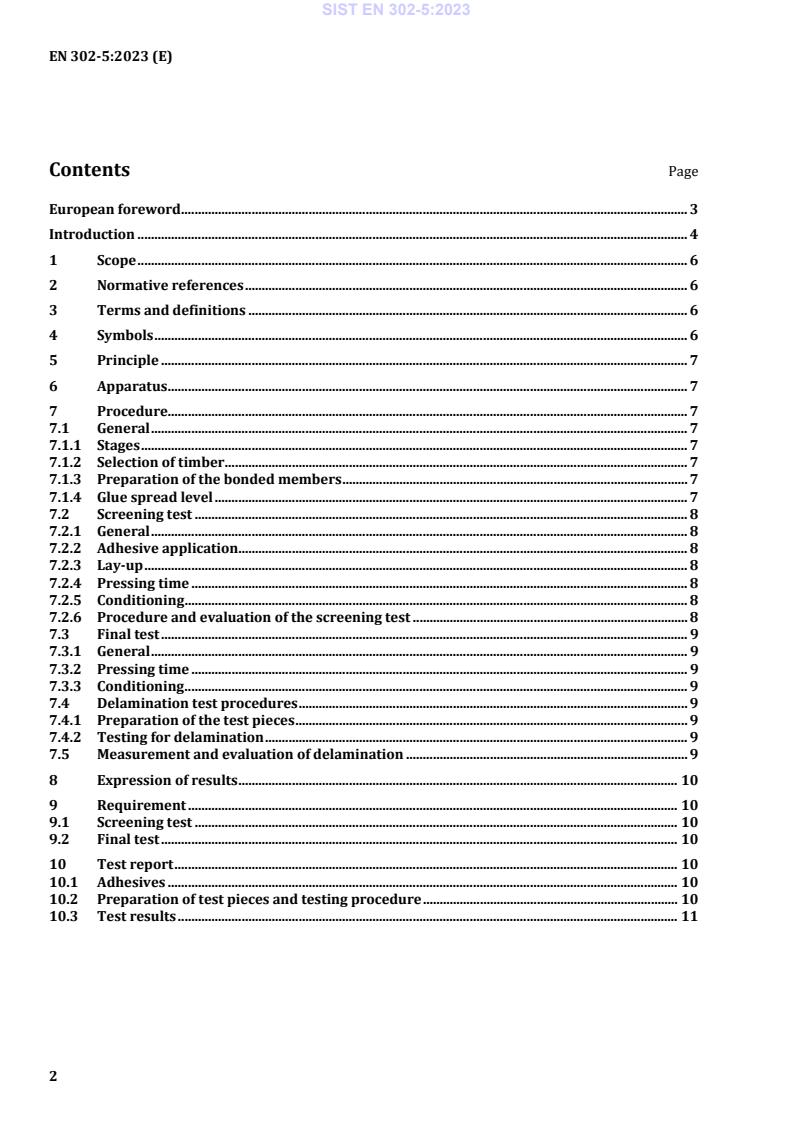
Contents Page
European foreword . 3
Introduction . 4
1 Scope . 6
2 Normative references . 6
3 Terms and definitions . 6
4 Symbols . 6
5 Principle . 7
6 Apparatus . 7
7 Procedure. 7
7.1 General . 7
7.1.1 Stages . 7
7.1.2 Selection of timber . 7
7.1.3 Preparation of the bonded members . 7
7.1.4 Glue spread level . 7
7.2 Screening test . 8
7.2.1 General . 8
7.2.2 Adhesive application. 8
7.2.3 Lay-up . 8
7.2.4 Pressing time . 8
7.2.5 Conditioning . 8
7.2.6 Procedure and evaluation of the screening test . 8
7.3 Final test . 9
7.3.1 General . 9
7.3.2 Pressing time . 9
7.3.3 Conditioning . 9
7.4 Delamination test procedures . 9
7.4.1 Preparation of the test pieces . 9
7.4.2 Testing for delamination . 9
7.5 Measurement and evaluation of delamination . 9
8 Expression of results . 10
9 Requirement . 10
9.1 Screening test . 10
9.2 Final test . 10
10 Test report . 10
10.1 Adhesives . 10
10.2 Preparation of test pieces and testing procedure . 10
10.3 Test results . 11
European foreword
This document (EN 302-5:2023) has been prepared by Technical Committee CEN/TC 193 “Adhesives”,
the secretariat of which is held by UNE.
This European Standard shall be given the status of a national standard, either by publication of an
identical text or by endorsement, at the latest by August 2023, and conflicting national standards shall
be withdrawn at the latest by August 2023.
Attention is drawn to the possibility that some of the elements of this document may be the subject of
patent rights. CEN shall not be held responsible for identifying any or all such patent rights.
This document supersedes EN 302-5:2013.
The main changes compared to the previous edition are listed below:
a) the list of standards in the Introduction has been updated;
b) one new clause (Symbols) has been introduced;
c) Clause 10 has been changed.
Any feedback and questions on this document should be directed to the users’ national standards body.
A complete listing of these bodies can be found on the CEN website.
According to the CEN-CENELEC Internal Regulations, the national standards organisations of the
following countries are bound to implement this European Standard: Austria, Belgium, Bulgaria,
Croatia, Cyprus, Czech Republic, Denmark, Estonia, Finland, France, Germany, Greece, Hungary, Iceland,
Ireland, Italy, Latvia, Lithuania, Luxembourg, Malta, Netherlands, Norway, Poland, Portugal, Republic of
North Macedonia, Romania, Serbia, Slovakia, Slovenia, Spain, Sweden, Switzerland, Türkiye and the
United Kingdom.
Introduction
This document is one of a series dealing with adhesives for use with timber structures, and is published
in support of the EN 1995 series, Eurocode 5: Design of timber structures. The series consists of five
classification and performance requirements for adhesives for load-bearing timber structures, phenolic
and aminoplastic adhesives (EN 301), one component polyurethane adhesives (EN 15425), emulsion
polymer isocyanate adhesives (EN 16254), two component epoxy and polyurethane adhesives for glued
in rods (EN 17334) and for on-site repair of cracked timber structures (EN 17418) and all together
twelve test methods (EN 302-1, EN 302-2, EN 302-3, EN 302-4, EN 302-5, EN 302-6, EN 302-7,
EN 302-8, EN 15416-1, EN 15416-3, EN 15416-4 and EN 15416-5).
These European Standards have the following titles:
EN 301, Adhesives, phenolic and aminoplastic, for load-bearing timber structures — Classification and
performance requirements
EN 302, Adhesives for load-bearing timber structures — Test methods:
— Part 1: Determination of longitudinal tensile shear strength
— Part 2: Determination of resistance to delamination
— Part 3: Determination of the effect of acid damage to wood fibres by temperature and humidity
cycling on the transverse tensile strength
— Part 4: Determination of the effects of wood shrinkage on the shear strength
— Part 5: Determination of maximum assembly time under referenced conditions
— Part 6: Determination of the minimum pressing time under referenced conditions
— Part 7: Determination of the working life under referenced conditions
— Part 8: Static load test of multiple bond line specimens in compression shear
EN 15416, Adhesives for load bearing timber structures other than phenolic and aminoplastic — Test
methods:
— Part 1: Long-term tension load test perpendicular to the bond line at varying climate conditions with
specimens perpendicular to the glue line (Glass house test)
— Part 3: Creep deformation test at cyclic climate conditions with specimens loaded in bending shear
— Part 4: Determination of open assembly time under referenced conditions
— Part 5: Determination of minimum pressing time under referenced conditions
EN 15425, Adhesives — One component polyurethane (PUR) for load-bearing timber structures —
Classification and performance requirements
EN 16254, Adhesives — Emulsion polymer isocyanate (EPI) for load-bearing timber structures —
Classification and
...
Questions, Comments and Discussion
Ask us and Technical Secretary will try to provide an answer. You can facilitate discussion about the standard in here.
Loading comments...