


SIST EN IEC 61472-2:2021
(Main)Live working - Minimum approach distances - Part 2: Method of determination of the electrical component distance for AC systems from 1,0 kV to 72,5 kV
Live working - Minimum approach distances - Part 2: Method of determination of the electrical component distance for AC systems from 1,0 kV to 72,5 kV
IEC 61472-2:2021 specifies a method for determining the electrical component of the minimum approach distances for live working, for AC systems 1 kV up to and including 72,5 kV. This document addresses system overvoltages and the working air distances between equipment and/or workers at different potentials.
The withstand voltage and minimum approach distances determined by the method described in this document can be used only if the following working conditions prevail:
- workers are trained for, and skilled in, working live lines or close to live conductors or equipment;
- the operating conditions are adjusted so that the statistical overvoltage does not exceed the value selected for the determination of the required withstand voltage;
- transient overvoltages are the determining overvoltages;
- tool insulation has no continuous film of moisture present on the surface;
- no lightning is observed within 10 km of the work site;
- allowance is made for the effect of the conducting components of tools.
Arbeiten unter Spannung - Mindestarbeitsabstände - Teil 2: Berechnungsverfahren für Abstände in Wechselspannungsnetzen größer 1,0 kV bis 72,5 kV
Travaux sous tension - Distances minimales d’approche - Partie 2: Méthode de détermination de la distance du composant électrique pour les réseaux en courant alternatif de tension comprise entre 1,0 kV et 72,5 kV
IEC 61472-2:2021 spécifie une méthode pour déterminer la composante électrique des distances minimales d’approche pour le travail en direct, pour les systèmes AC 1 kV jusqu’à 72,5 kV et y compris. Ce document traite des survoltages du système et des distances aériennes de travail entre l’équipement et/ou les travailleurs à différents potentiels.
La tension de résisté et les distances minimales d’approche déterminées par la méthode décrite dans ce document ne peuvent être utilisées que si les conditions de travail suivantes prévalent:
- les travailleurs sont formés et qualifiés dans les lignes de travail en direct ou à proximité de conducteurs ou d’équipement vivants;
- les conditions d’exploitation sont ajustées de sorte que la surtension statistique ne dépasse pas la valeur sélectionnée pour déterminer la tension de résisté requise;
- les survoltages transitoires sont les survoltages déterminants;
- l’isolation de l’outil n’a pas de film continu de l’humidité présente à la surface;
- aucune foudre n’est observée à moins de 10 km du chantier;
- l’effet des composants conducteurs des outils.
Delo pod napetostjo - Najmanjše razdalje za dostop - 2. del: Metoda izračuna razdalj za komponente izmeničnih sistemov od 1,0 kV do 72,5 kV
General Information
- Status
- Published
- Publication Date
- 09-May-2021
- Technical Committee
- DPN - Live Working
- Current Stage
- 6060 - National Implementation/Publication (Adopted Project)
- Start Date
- 05-May-2021
- Due Date
- 10-Jul-2021
- Completion Date
- 10-May-2021
Overview
EN IEC 61472-2:2021 - "Live working - Minimum approach distances - Part 2" specifies a method to determine the electrical component of minimum approach distances (MAD) for live working on AC systems from 1.0 kV to 72.5 kV. The standard addresses how to calculate the electrical distance required to prevent sparkovers under specified overvoltage conditions and describes the factors that affect required withstand voltages and air distances between equipment and personnel at different potentials.
Key topics & technical requirements
- Scope and applicability
- Method applies to AC systems 1 kV to 72.5 kV and is valid only under stated working conditions (see below).
- Core formula
- The minimum approach distance is the sum of the electrical distance (DU) and the ergonomic distance (DE): DA = DU + DE.
- Definitions
- Electrical distance (DU): air gap required to prevent sparkover under the chosen electrical stress.
- Ergonomic distance (DE): allowance for inadvertent movement, human error and work procedures.
- Overvoltages
- The method accounts for transient overvoltages (switching and lightning) and statistical overvoltage levels to select required withstand voltages.
- Working conditions required
- Workers must be trained and skilled in live-line work.
- Operating arrangements must limit statistical overvoltages to the selected design value.
- Transient overvoltages must be the governing overvoltages.
- Tool insulation must be free of continuous moisture films.
- No lightning observed within 10 km of the worksite.
- Effects of conducting tool components must be considered.
- Supporting material
- Informative annexes cover overvoltage types and ergonomic considerations (training, barriers, monitoring).
- Tables provide phase-to-earth and phase-to-phase electrical distances for system voltages.
Practical applications & who uses it
- Utilities and transmission operators use the standard to set safe minimum approach distances for live-line maintenance and emergency repairs.
- Safety engineers and compliance officers adopt the method to verify withstand voltages and document risk controls.
- Live-line technicians and trainers use the ergonomic guidance to design procedures and training programs.
- Designers of protective devices (surge arresters, protective gaps) reference the standard when designing measures to control overvoltages at work locations.
- Regulators and auditors rely on the standard to assess conformity of live working practices and permits.
Related standards
- EN/IEC standards referenced in the document include IEC 61472 (other parts), IEC 61477, IEC 60060‑1, IEC 60071 series and IEC 60038 - useful for voltage designations, overvoltage classification and test methods.
Keywords: EN IEC 61472-2:2021, minimum approach distances, live working, electrical component distance, AC systems 1 kV–72.5 kV, overvoltages, transient overvoltage, statistical overvoltage, ergonomic distance, withstand voltage, live-line safety.

Frequently Asked Questions
SIST EN IEC 61472-2:2021 is a standard published by the Slovenian Institute for Standardization (SIST). Its full title is "Live working - Minimum approach distances - Part 2: Method of determination of the electrical component distance for AC systems from 1,0 kV to 72,5 kV". This standard covers: IEC 61472-2:2021 specifies a method for determining the electrical component of the minimum approach distances for live working, for AC systems 1 kV up to and including 72,5 kV. This document addresses system overvoltages and the working air distances between equipment and/or workers at different potentials. The withstand voltage and minimum approach distances determined by the method described in this document can be used only if the following working conditions prevail: <ul> <li>workers are trained for, and skilled in, working live lines or close to live conductors or equipment;</li> <li>the operating conditions are adjusted so that the statistical overvoltage does not exceed the value selected for the determination of the required withstand voltage;</li> <li>transient overvoltages are the determining overvoltages;</li> <li>tool insulation has no continuous film of moisture present on the surface;</li> <li>no lightning is observed within 10 km of the work site;</li> <li>allowance is made for the effect of the conducting components of tools.</li> </ul>
IEC 61472-2:2021 specifies a method for determining the electrical component of the minimum approach distances for live working, for AC systems 1 kV up to and including 72,5 kV. This document addresses system overvoltages and the working air distances between equipment and/or workers at different potentials. The withstand voltage and minimum approach distances determined by the method described in this document can be used only if the following working conditions prevail: <ul> <li>workers are trained for, and skilled in, working live lines or close to live conductors or equipment;</li> <li>the operating conditions are adjusted so that the statistical overvoltage does not exceed the value selected for the determination of the required withstand voltage;</li> <li>transient overvoltages are the determining overvoltages;</li> <li>tool insulation has no continuous film of moisture present on the surface;</li> <li>no lightning is observed within 10 km of the work site;</li> <li>allowance is made for the effect of the conducting components of tools.</li> </ul>
SIST EN IEC 61472-2:2021 is classified under the following ICS (International Classification for Standards) categories: 13.260 - Protection against electric shock. Live working. The ICS classification helps identify the subject area and facilitates finding related standards.
SIST EN IEC 61472-2:2021 is available in PDF format for immediate download after purchase. The document can be added to your cart and obtained through the secure checkout process. Digital delivery ensures instant access to the complete standard document.
Standards Content (Sample)
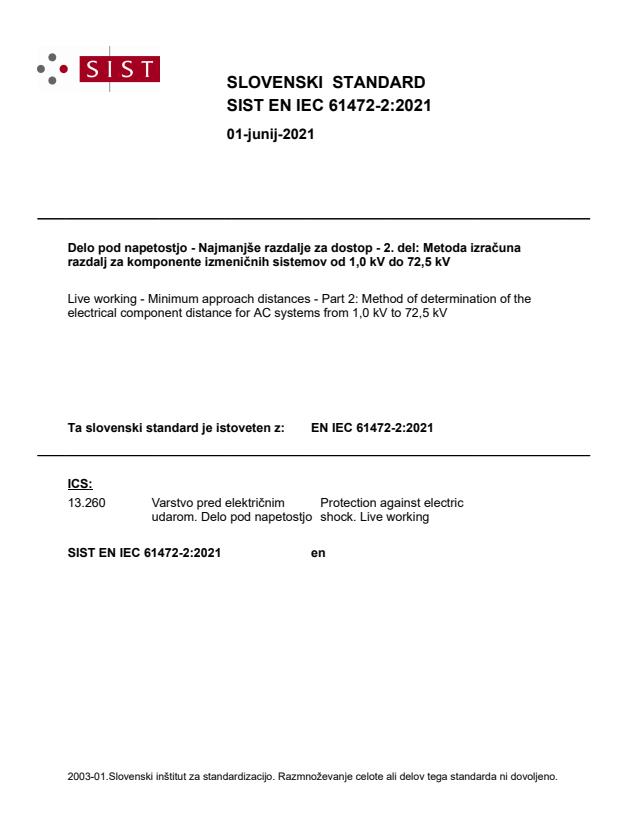
SLOVENSKI STANDARD
01-junij-2021
Delo pod napetostjo - Najmanjše razdalje za dostop - 2. del: Metoda izračuna
razdalj za komponente izmeničnih sistemov od 1,0 kV do 72,5 kV
Live working - Minimum approach distances - Part 2: Method of determination of the
electrical component distance for AC systems from 1,0 kV to 72,5 kV
Ta slovenski standard je istoveten z: EN IEC 61472-2:2021
ICS:
13.260 Varstvo pred električnim Protection against electric
udarom. Delo pod napetostjo shock. Live working
2003-01.Slovenski inštitut za standardizacijo. Razmnoževanje celote ali delov tega standarda ni dovoljeno.
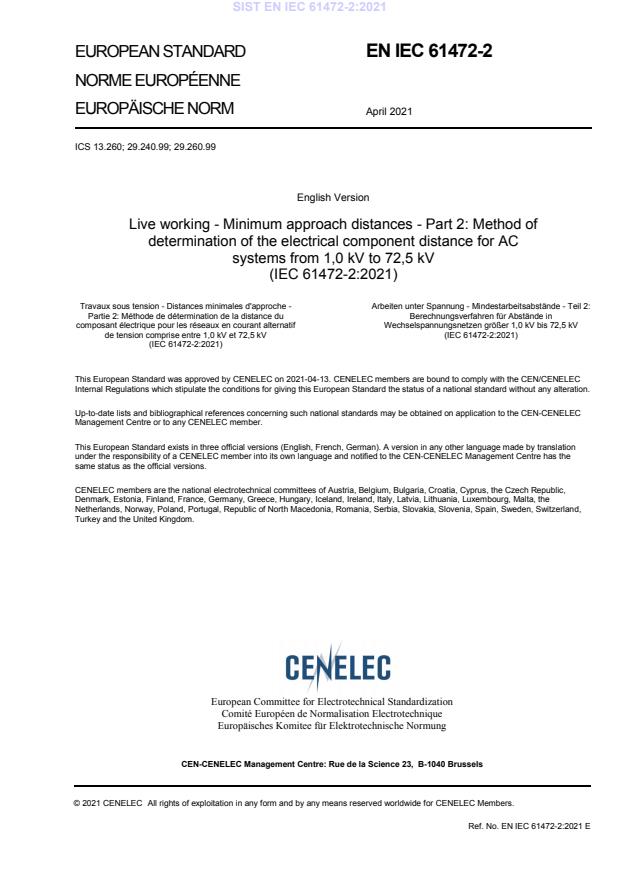
EUROPEAN STANDARD EN IEC 61472-2
NORME EUROPÉENNE
EUROPÄISCHE NORM
April 2021
ICS 13.260; 29.240.99; 29.260.99
English Version
Live working - Minimum approach distances - Part 2: Method of
determination of the electrical component distance for AC
systems from 1,0 kV to 72,5 kV
(IEC 61472-2:2021)
Travaux sous tension - Distances minimales d'approche - Arbeiten unter Spannung - Mindestarbeitsabstände - Teil 2:
Partie 2: Méthode de détermination de la distance du Berechnungsverfahren für Abstände in
composant électrique pour les réseaux en courant alternatif Wechselspannungsnetzen größer 1,0 kV bis 72,5 kV
de tension comprise entre 1,0 kV et 72,5 kV (IEC 61472-2:2021)
(IEC 61472-2:2021)
This European Standard was approved by CENELEC on 2021-04-13. CENELEC members are bound to comply with the CEN/CENELEC
Internal Regulations which stipulate the conditions for giving this European Standard the status of a national standard without any alteration.
Up-to-date lists and bibliographical references concerning such national standards may be obtained on application to the CEN-CENELEC
Management Centre or to any CENELEC member.
This European Standard exists in three official versions (English, French, German). A version in any other language made by translation
under the responsibility of a CENELEC member into its own language and notified to the CEN-CENELEC Management Centre has the
same status as the official versions.
CENELEC members are the national electrotechnical committees of Austria, Belgium, Bulgaria, Croatia, Cyprus, the Czech Republic,
Denmark, Estonia, Finland, France, Germany, Greece, Hungary, Iceland, Ireland, Italy, Latvia, Lithuania, Luxembourg, Malta, the
Netherlands, Norway, Poland, Portugal, Republic of North Macedonia, Romania, Serbia, Slovakia, Slovenia, Spain, Sweden, Switzerland,
Turkey and the United Kingdom.
European Committee for Electrotechnical Standardization
Comité Européen de Normalisation Electrotechnique
Europäisches Komitee für Elektrotechnische Normung
CEN-CENELEC Management Centre: Rue de la Science 23, B-1040 Brussels
© 2021 CENELEC All rights of exploitation in any form and by any means reserved worldwide for CENELEC Members.
Ref. No. EN IEC 61472-2:2021 E
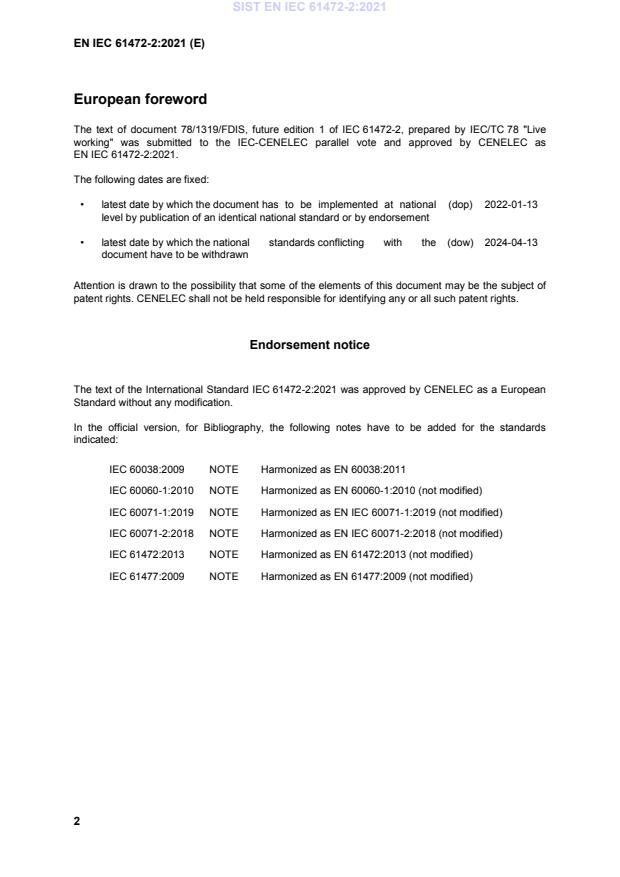
European foreword
The text of document 78/1319/FDIS, future edition 1 of IEC 61472-2, prepared by IEC/TC 78 "Live
working" was submitted to the IEC-CENELEC parallel vote and approved by CENELEC as
The following dates are fixed:
• latest date by which the document has to be implemented at national (dop) 2022-01-13
level by publication of an identical national standard or by endorsement
• latest date by which the national standards conflicting with the (dow) 2024-04-13
document have to be withdrawn
Attention is drawn to the possibility that some of the elements of this document may be the subject of
patent rights. CENELEC shall not be held responsible for identifying any or all such patent rights.
Endorsement notice
The text of the International Standard IEC 61472-2:2021 was approved by CENELEC as a European
Standard without any modification.
In the official version, for Bibliography, the following notes have to be added for the standards
indicated:
IEC 60038:2009 NOTE Harmonized as EN 60038:2011
IEC 60060-1:2010 NOTE Harmonized as EN 60060-1:2010 (not modified)
IEC 60071-1:2019 NOTE Harmonized as EN IEC 60071-1:2019 (not modified)
IEC 60071-2:2018 NOTE Harmonized as EN IEC 60071-2:2018 (not modified)
IEC 61472:2013 NOTE Harmonized as EN 61472:2013 (not modified)
IEC 61477:2009 NOTE Harmonized as EN 61477:2009 (not modified)
IEC 61472-2 ®
Edition 1.0 2021-03
INTERNATIONAL
STANDARD
NORME
INTERNATIONALE
Live working – Minimum approach distances –
Part 2: Method of determination of the electrical component distance for AC
systems from 1,0 kV to 72,5 kV
Travaux sous tension – Distances minimales d’approche –
Partie 2: Méthode de détermination de la distance du composant électrique pour
les réseaux en courant alternatif de tension comprise entre 1,0 kV et 72,5 kV
INTERNATIONAL
ELECTROTECHNICAL
COMMISSION
COMMISSION
ELECTROTECHNIQUE
INTERNATIONALE
ICS 13.260; 29.240.99; 29.260.99 ISBN 978-2-8322-9220-4
– 2 – IEC 61472-2:2021 © IEC 2021
CONTENTS
FOREWORD . 3
1 Scope . 5
2 Normative references . 5
3 Terms and definitions . 5
4 Minimum approach distance, D . 6
A
5 Factors influencing the minimum approach distance . 7
5.1 Control of system overvoltages . 7
5.2 Statistical overvoltage . 7
5.3 Conductive floating object . 8
5.4 Insulators . 8
5.5 Determination of minimum electrical distance, D . 8
U
6 Example calculation . 8
Annex A (informative) Overvoltages . 11
A.1 General . 11
A.2 Highest voltage of a system . 11
A.3 Temporary overvoltage . 11
A.4 Transient overvoltage . 12
A.4.1 General . 12
A.4.2 Switching overvoltage . 12
A.4.3 Lightning overvoltages . 13
Annex B (informative) Ergonomic considerations . 14
B.1 General . 14
B.2 Training, knowledge and skill . 14
B.3 Protective barriers . 14
B.4 Possibility of error . 14
B.5 Work procedure . 14
B.6 Personal factors . 15
B.7 Monitoring . 15
Bibliography . 16
Table 1 – Distance for rod-to-rod gap from IEEE 516-2009 . 9
Table 2 – Phase-to-earth electrical distance for system voltages from 1,0 kV up to and
including 72,5 kV, u = 3,5. 9
e2
Table 3 – Phase-to-phase electrical distances for system voltages from 1,0 kV up to
and including 72,5 kV, u = 5,2 . 10
p2
IEC 61472-2:2021 © IEC 2021 – 3 –
INTERNATIONAL ELECTROTECHNICAL COMMISSION
____________
LIVE WORKING –
MINIMUM APPROACH DISTANCES –
Part 2: Method of determination of the electrical component
distance for AC systems from 1,0 kV to 72,5 kV
FOREWORD
1) The International Electrotechnical Commission (IEC) is a worldwide organization for standardization comprising
all national electrotechnical committees (IEC National Committees). The object of IEC is to promote international
co-operation on all questions concerning standardization in the electrical and electronic fields. To this end and
in addition to other activities, IEC publishes International Standards, Technical Specifications, Technical Reports,
Publicly Available Specifications (PAS) and Guides (hereafter referred to as “IEC Publication(s)”). Their
preparation is entrusted to technical committees; any IEC National Committee interested in the subject dealt with
may participate in this preparatory work. International, governmental and non-governmental organizations liaising
with the IEC also participate in this preparation. IEC collaborates closely with the International Organization for
Standardization (ISO) in accordance with conditions determined by agreement between the two organizations.
2) The formal decisions or agreements of IEC on technical matters express, as nearly as possible, an international
consensus of opinion on the relevant subjects since each technical committee has representation from all
interested IEC National Committees.
3) IEC Publications have the form of recommendations for international use and are accepted by IEC National
Committees in that sense. While all reasonable efforts are made to ensure that the technical content of IEC
Publications is accurate, IEC cannot be held responsible for the way in which they are used or for any
misinterpretation by any end user.
4) In order to promote international uniformity, IEC National Committees undertake to apply IEC Publications
transparently to the maximum extent possible in their national and regional publications. Any divergence between
any IEC Publication and the corresponding national or regional publication shall be clearly indicated in the latter.
5) IEC itself does not provide any attestation of conformity. Independent certification bodies provide conformity
assessment services and, in some areas, access to IEC marks of conformity. IEC is not responsible for any
services carried out by independent certification bodies.
6) All users should ensure that they have the latest edition of this publication.
7) No liability shall attach to IEC or its directors, employees, servants or agents including individual experts and
members of its technical committees and IEC National Committees for any personal injury, property damage or
other damage of any nature whatsoever, whether direct or indirect, or for costs (including legal fees) and
expenses arising out of the publication, use of, or reliance upon, this IEC Publication or any other IEC
Publications.
8) Attention is drawn to the Normative references cited in this publication. Use of the referenced publications is
indispensable for the correct application of this publication.
9) Attention is drawn to the possibility that some of the elements of this IEC Publication may be the subject of patent
rights. IEC shall not be held responsible for identifying any or all such patent rights.
International Standard IEC 61472-2 has been prepared by IEC technical committee technical
committee 78: Live working.
The text of this International Standard is based on the following documents:
FDIS Report on voting
78/1319/FDIS 78/1326/RVD
Full information on the voting for the approval of this International Standard can be found in the
report on voting indicated in the above table.
This document has been drafted in accordance with the ISO/IEC Directives, Part 2.
A list of all parts in the IEC 61472 series, published under the general title Live working –
Miminum approach distances, can be found on the IEC website.
– 4 – IEC 61472-2:2021 © IEC 2021
The committee has decided that the contents of this document will remain unchanged until the
stability date indicated on the IEC website under "http://webstore.iec.ch" in the data related to
the specific document. At this date, the document will be
• reconfirmed,
• withdrawn,
• replaced by a revised edition, or
• amended.
IEC 61472-2:2021 © IEC 2021 – 5 –
LIVE WORKING –
MINIMUM APPROACH DISTANCES –
Part 2: Method of determination of the electrical component
distance for AC systems from 1,0 kV to 72,5 kV
1 Scope
This part of IEC 61472 specifies a method for determining the electrical component of the
minimum approach distances for live working, for AC systems 1 kV up to and including 72,5 kV.
This document addresses system overvoltages and the working air distances between
equipment and/or workers at different potentials.
The withstand voltage and minimum approach distances determined by the method described
in this document can be used only if the following working conditions prevail:
– workers are trained for, and skilled in, working live lines or close to live conductors or
equipment;
– the operating conditions are adjusted so that the statistical overvoltage does not exceed the
value selected for the determination of the required withstand voltage;
– transient overvoltages are the determining overvoltages;
– tool insulation has no continuous film of moisture present on the surface;
– no lightning is observed within 10 km of the work site;
– allowance is made for the effect of the conducting components of tools.
NOTE In some countries, special procedures have been developed to permit live working with surface moisture on
tools at distribution voltages (below 50 kV).
2 Normative references
There are no normative references in this document.
3 Terms and definitions
For the purposes of this document, the following terms and definitions apply.
ISO and IEC maintain terminological databases for use in standardization at the following
addresses:
• IEC Electropedia: available at http://www.electropedia.org/
• ISO Online browsing platform: available at http://www.iso.org/obp
3.1
highest voltage of a system
U
s
highest value of operating voltage (phase-to-phase voltage) which occurs under normal
operating conditions at any time and any point in the system
Note 1 to entry: Transient overvoltages and permanent induction from adjacent lines are not taken into account in
the calculation formula
– 6 – IEC 61472-2:2021 © IEC 2021
[SOURCE: IEC 60050-601:1985, 601-01-23, modified – the symbol U and the words "(phase-
s
to-phase voltage)" have been added, and Note 1 has been revised.]
3.2
transient overvoltage
short duration overvoltage of a few milliseconds or less, oscillatory or non-oscillatory, usually
highly damped
[SOURCE: IEC 60050-614:2016, 614-03-14]
3.3
nominal system voltage
suitable approximate value of voltage used to designate or identify a system
[SOURCE: IEC 60038:2009, 3.1]
3.4
per unit statistical overvoltage phase-to-earth
u
e2
phase-to-earth per unit overvoltage that has a 2 % probability of being exceeded
3.5
per unit statistical overvoltage phase-to-phase
u
p2
per unit overvoltage that has a 2 % probability of being exceeded
3.6
statistical overvoltage
U
overvoltage that has a 2 % probability of being exceeded
3.7
minimum approach distance
D
A
minimum electrical and ergonomic distance in air to be maintained between any part of the body
of a worker, or any conductive tool being directly handled, and any live conductors or equipment
at different potentials
3.8
electrical distance
D
U
electrical component of the mini
...
Questions, Comments and Discussion
Ask us and Technical Secretary will try to provide an answer. You can facilitate discussion about the standard in here.
Loading comments...