


ASTM A1085/A1085M-22
(Specification)Standard Specification for Cold-Formed Welded Carbon Steel Hollow Structural Sections (HSS)
Standard Specification for Cold-Formed Welded Carbon Steel Hollow Structural Sections (HSS)
ABSTRACT
This specification covers cold-formed welded carbon steel hollow structural sections (HSS) for welded or bolted construction that are used in, although not limited to, buildings, bridges, towers, cranes, sign supports and poles, off-shore production and drilling platforms, roll-over protective structures (ROPS), falling object protective structures (FOPS), and amusement rides. This HSS is produced in welded sizes with a periphery of not more than 88 in. [2235 mm] as well as a specified nominal wall thickness of at least 0.148 in. [3.8 mm] and not more than 0.875 in. [22 mm]. The standard addresses areas such as ordering information, the steel-making process, HSS manufacture, heat analysis, product analysis, tensile requirements, flattening test, permissible variations in dimensions, number of tests, retests, test methods, rejection, certification, product marking, packing and loading, and government procurement.
SCOPE
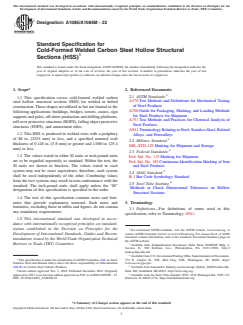
1.1 This specification covers cold-formed welded carbon steel hollow structural sections (HSS) for welded or bolted construction. These shapes are utilized in but not limited to the following applications: buildings, bridges, towers, cranes, sign supports and poles, off-shore production and drilling platforms, roll-over protective structures (ROPS), falling object protective structures (FOPS), and amusement rides.
1.2 This HSS is produced in welded sizes with a periphery of 88 in. [2235 mm] or less, and a specified nominal wall thickness of 0.148 in. [3.8 mm] or greater and 1.000 in. [25.4 mm] or less.
1.3 The values stated in either SI units or inch-pound units are to be regarded separately as standard. Within the text, the SI units are shown in brackets. The values stated in each system may not be exact equivalents; therefore, each system shall be used independently of the other. Combining values from the two systems may result in non-conformance with the standard. The inch-pound units shall apply unless the “M” designation of this specification is specified in the order.
1.4 The text of this specification contains notes and footnotes that provide explanatory material. Such notes and footnotes, excluding those in tables and figures, do not contain any mandatory requirements.
1.5 This international standard was developed in accordance with internationally recognized principles on standardization established in the Decision on Principles for the Development of International Standards, Guides and Recommendations issued by the World Trade Organization Technical Barriers to Trade (TBT) Committee.
General Information
- Status
- Published
- Publication Date
- 31-Oct-2022
- Technical Committee
- A01 - Steel, Stainless Steel and Related Alloys
- Drafting Committee
- A01.09 - Carbon Steel Tubular Products
Relations
- Effective Date
- 01-Mar-2024
- Effective Date
- 01-Mar-2024
- Effective Date
- 01-Nov-2019
- Effective Date
- 01-Jul-2019
- Refers
ASTM A370-17a - Standard Test Methods and Definitions for Mechanical Testing of Steel Products - Effective Date
- 15-Nov-2017
- Effective Date
- 01-Sep-2017
- Effective Date
- 01-Jan-2017
- Effective Date
- 01-Nov-2015
- Effective Date
- 01-Nov-2015
- Effective Date
- 01-Nov-2014
- Effective Date
- 15-May-2014
- Effective Date
- 01-Mar-2014
- Effective Date
- 15-Nov-2013
- Effective Date
- 01-Jun-2013
- Effective Date
- 01-May-2013
Overview
ASTM A1085/A1085M-22: Standard Specification for Cold-Formed Welded Carbon Steel Hollow Structural Sections (HSS) is an internationally recognized standard developed by ASTM International. It establishes the requirements for cold-formed welded carbon steel hollow structural sections (HSS), which are utilized in welded or bolted construction across a variety of structural applications. These HSS products are specified for their consistent performance in buildings, bridges, towers, cranes, sign supports and poles, off-shore platforms, protective structures, and amusement rides. This standard delivers clarity and uniformity in ordering, manufacturing, testing, certification, and marking of structural steel tubing, supporting reliability and safety in structural steel applications.
Key Topics
- Scope and Range: Covers welded HSS with a periphery of 88 inches (2235 mm) or less and a nominal wall thickness between 0.148 inches (3.8 mm) and 1.000 inches (25.4 mm).
- Steelmaking and Manufacturing: Specifies permitted steelmaking processes and details on electric-resistance welding, prohibiting transverse coil splices.
- Material Requirements: Defines mechanical properties such as yield strength, tensile strength, elongation, and Charpy V-Notch (CVN) impact values.
- Chemical Composition: Outlines limits for carbon, manganese, phosphorus, sulfur, silicon, and aluminum for optimal performance.
- Dimensional Tolerances: Sets clear permissible variations for outside dimensions, wall thickness, mass, straightness, squareness, twist, and corner radii.
- Test Methods and Inspection: Requires tension and impact tests, product analysis, flattening tests for round HSS, and describes retest procedures.
- Certification and Marking: Details requirements for product marking, certification of compliance, and optional bar coding to enable traceability.
- Procurement and Packaging: Provides guidance for government procurement, packing, and loading methods to ensure safe and compliant delivery.
Applications
Cold-formed welded carbon steel hollow structural sections manufactured to ASTM A1085/A1085M-22 are widely specified for applications requiring high strength, durability, and precision in geometry. Typical uses include:
- Construction: Load-bearing frameworks in high-rise buildings, commercial structures, and industrial facilities.
- Bridges and Transportation: Critical components in bridge trusses, supports, and transport infrastructure.
- Towers and Poles: Structural supports for communication towers, utility poles, and lighting standards.
- Cranes and Material Handling: Key elements in the fabrication of cranes and lifting equipment.
- Off-Shore and Heavy-Duty Structures: Used in off-shore drilling and production platforms, as well as roll-over and falling object protective structures (ROPS and FOPS).
- Amusement and Specialty Equipment: Framework for amusement rides and specialty architectural structures.
The standard’s strict requirements for mechanical properties, testing, and dimensional tolerances help ensure that HSS products deliver consistent structural integrity and safety, making them a reliable choice for critical structural applications.
Related Standards
Users of ASTM A1085/A1085M-22 may also reference several related standards and documents to ensure a comprehensive approach to HSS manufacturing, testing, and application, including:
- ASTM A370: Test Methods and Definitions for Mechanical Testing of Steel Products
- ASTM A700: Guide for Packaging, Marking, and Loading Methods for Steel Products for Shipment
- ASTM A751: Test Methods and Practices for Chemical Analysis of Steel Products
- ASTM A941: Terminology Relating to Steel, Stainless Steel, Related Alloys, and Ferroalloys
- Steel Tube Institute's Methods to Check Dimensional Tolerances on Hollow Structural Sections
- Federal and Military Standards: Covering marking for shipment and storage
Keywords: ASTM A1085, welded carbon steel, hollow structural sections, HSS, structural steel tubing, welded construction, bridges, buildings, steel standards, ASTM International, testing, certification, dimensional tolerances, mechanical properties
Buy Documents
ASTM A1085/A1085M-22 - Standard Specification for Cold-Formed Welded Carbon Steel Hollow Structural Sections (HSS)
REDLINE ASTM A1085/A1085M-22 - Standard Specification for Cold-Formed Welded Carbon Steel Hollow Structural Sections (HSS)
Get Certified
Connect with accredited certification bodies for this standard

Element Materials Technology
Materials testing and product certification.

Inštitut za kovinske materiale in tehnologije
Institute of Metals and Technology. Materials testing, metallurgical analysis, NDT.
Sponsored listings
Frequently Asked Questions
ASTM A1085/A1085M-22 is a technical specification published by ASTM International. Its full title is "Standard Specification for Cold-Formed Welded Carbon Steel Hollow Structural Sections (HSS)". This standard covers: ABSTRACT This specification covers cold-formed welded carbon steel hollow structural sections (HSS) for welded or bolted construction that are used in, although not limited to, buildings, bridges, towers, cranes, sign supports and poles, off-shore production and drilling platforms, roll-over protective structures (ROPS), falling object protective structures (FOPS), and amusement rides. This HSS is produced in welded sizes with a periphery of not more than 88 in. [2235 mm] as well as a specified nominal wall thickness of at least 0.148 in. [3.8 mm] and not more than 0.875 in. [22 mm]. The standard addresses areas such as ordering information, the steel-making process, HSS manufacture, heat analysis, product analysis, tensile requirements, flattening test, permissible variations in dimensions, number of tests, retests, test methods, rejection, certification, product marking, packing and loading, and government procurement. SCOPE 1.1 This specification covers cold-formed welded carbon steel hollow structural sections (HSS) for welded or bolted construction. These shapes are utilized in but not limited to the following applications: buildings, bridges, towers, cranes, sign supports and poles, off-shore production and drilling platforms, roll-over protective structures (ROPS), falling object protective structures (FOPS), and amusement rides. 1.2 This HSS is produced in welded sizes with a periphery of 88 in. [2235 mm] or less, and a specified nominal wall thickness of 0.148 in. [3.8 mm] or greater and 1.000 in. [25.4 mm] or less. 1.3 The values stated in either SI units or inch-pound units are to be regarded separately as standard. Within the text, the SI units are shown in brackets. The values stated in each system may not be exact equivalents; therefore, each system shall be used independently of the other. Combining values from the two systems may result in non-conformance with the standard. The inch-pound units shall apply unless the “M” designation of this specification is specified in the order. 1.4 The text of this specification contains notes and footnotes that provide explanatory material. Such notes and footnotes, excluding those in tables and figures, do not contain any mandatory requirements. 1.5 This international standard was developed in accordance with internationally recognized principles on standardization established in the Decision on Principles for the Development of International Standards, Guides and Recommendations issued by the World Trade Organization Technical Barriers to Trade (TBT) Committee.
ABSTRACT This specification covers cold-formed welded carbon steel hollow structural sections (HSS) for welded or bolted construction that are used in, although not limited to, buildings, bridges, towers, cranes, sign supports and poles, off-shore production and drilling platforms, roll-over protective structures (ROPS), falling object protective structures (FOPS), and amusement rides. This HSS is produced in welded sizes with a periphery of not more than 88 in. [2235 mm] as well as a specified nominal wall thickness of at least 0.148 in. [3.8 mm] and not more than 0.875 in. [22 mm]. The standard addresses areas such as ordering information, the steel-making process, HSS manufacture, heat analysis, product analysis, tensile requirements, flattening test, permissible variations in dimensions, number of tests, retests, test methods, rejection, certification, product marking, packing and loading, and government procurement. SCOPE 1.1 This specification covers cold-formed welded carbon steel hollow structural sections (HSS) for welded or bolted construction. These shapes are utilized in but not limited to the following applications: buildings, bridges, towers, cranes, sign supports and poles, off-shore production and drilling platforms, roll-over protective structures (ROPS), falling object protective structures (FOPS), and amusement rides. 1.2 This HSS is produced in welded sizes with a periphery of 88 in. [2235 mm] or less, and a specified nominal wall thickness of 0.148 in. [3.8 mm] or greater and 1.000 in. [25.4 mm] or less. 1.3 The values stated in either SI units or inch-pound units are to be regarded separately as standard. Within the text, the SI units are shown in brackets. The values stated in each system may not be exact equivalents; therefore, each system shall be used independently of the other. Combining values from the two systems may result in non-conformance with the standard. The inch-pound units shall apply unless the “M” designation of this specification is specified in the order. 1.4 The text of this specification contains notes and footnotes that provide explanatory material. Such notes and footnotes, excluding those in tables and figures, do not contain any mandatory requirements. 1.5 This international standard was developed in accordance with internationally recognized principles on standardization established in the Decision on Principles for the Development of International Standards, Guides and Recommendations issued by the World Trade Organization Technical Barriers to Trade (TBT) Committee.
ASTM A1085/A1085M-22 is classified under the following ICS (International Classification for Standards) categories: 77.140.75 - Steel pipes and tubes for specific use. The ICS classification helps identify the subject area and facilitates finding related standards.
ASTM A1085/A1085M-22 has the following relationships with other standards: It is inter standard links to ASTM A941-24, ASTM A370-24, ASTM A700-14(2019), ASTM A370-19, ASTM A370-17a, ASTM A941-17, ASTM A370-17, ASTM A370-15, ASTM A941-15, ASTM A700-14, ASTM A370-14, ASTM A751-14, ASTM A370-13, ASTM A941-13b, ASTM A941-13a. Understanding these relationships helps ensure you are using the most current and applicable version of the standard.
ASTM A1085/A1085M-22 is available in PDF format for immediate download after purchase. The document can be added to your cart and obtained through the secure checkout process. Digital delivery ensures instant access to the complete standard document.
Standards Content (Sample)
This international standard was developed in accordance with internationally recognized principles on standardization established in the Decision on Principles for the
Development of International Standards, Guides and Recommendations issued by the World Trade Organization Technical Barriers to Trade (TBT) Committee.
Designation:A1085/A1085M −22
Standard Specification for
Cold-Formed Welded Carbon Steel Hollow Structural
Sections (HSS)
This standard is issued under the fixed designation A1085/A1085M; the number immediately following the designation indicates the
year of original adoption or, in the case of revision, the year of last revision. A number in parentheses indicates the year of last
reapproval. A superscript epsilon (´) indicates an editorial change since the last revision or reapproval.
1. Scope* 2. Referenced Documents
2.1 ASTM Standards:
1.1 This specification covers cold-formed welded carbon
A370 Test Methods and Definitions for Mechanical Testing
steel hollow structural sections (HSS) for welded or bolted
of Steel Products
construction. These shapes are utilized in but not limited to the
A700 Guide for Packaging, Marking, and Loading Methods
following applications: buildings, bridges, towers, cranes, sign
for Steel Products for Shipment
supportsandpoles,off-shoreproductionanddrillingplatforms,
A751 Test Methods and Practices for Chemical Analysis of
roll-overprotectivestructures(ROPS),fallingobjectprotective
Steel Products
structures (FOPS), and amusement rides.
A941 TerminologyRelatingtoSteel,StainlessSteel,Related
1.2 This HSS is produced in welded sizes with a periphery
Alloys, and Ferroalloys
of 88 in. [2235 mm] or less, and a specified nominal wall 3
2.2 Military Standard:
thickness of 0.148 in. [3.8 mm] or greater and 1.000 in. [25.4
MIL-STD-129 Marking for Shipment and Storage
mm] or less.
2.3 Federal Standards:
1.3 The values stated in either SI units or inch-pound units
Fed. Std. No. 123 Marking for Shipment
are to be regarded separately as standard. Within the text, the
Fed. Std. No. 183 Continuous Identification Marking of Iron
SI units are shown in brackets. The values stated in each and Steel Products
system may not be exact equivalents; therefore, each system 5
2.4 AIAG Standard:
shall be used independently of the other. Combining values
B-1 Bar Code Symbology Standard
from the two systems may result in non-conformance with the
2.5 Steel Tube Institute:
standard. The inch-pound units shall apply unless the “M”
Methods to Check Dimensional Tolerances on Hollow
designation of this specification is specified in the order.
Structural Sections
1.4 The text of this specification contains notes and foot-
notes that provide explanatory material. Such notes and
3. Terminology
footnotes, excluding those in tables and figures, do not contain
3.1 Definitions—For definitions of terms used in this
any mandatory requirements.
specification, refer to Terminology A941.
1.5 This international standard was developed in accor-
dance with internationally recognized principles on standard-
ization established in the Decision on Principles for the
For referenced ASTM standards, visit the ASTM website, www.astm.org, or
Development of International Standards, Guides and Recom- contact ASTM Customer Service at service@astm.org. For Annual Book of ASTM
Standards volume information, refer to the standard’s Document Summary page on
mendations issued by the World Trade Organization Technical
the ASTM website.
Barriers to Trade (TBT) Committee. 3
Available from Standardization Documents Order Desk, DODSSP, Bldg. 4,
Section D, 700 Robbins Ave., Philadelphia, PA 19111-5098, http://
dodssp.daps.dla.mil.
AvailablefromU.S.GovernmentPrintingOfficeSuperintendentofDocuments,
This specification is under the jurisdiction of ASTM Committee A01 on Steel, 732 N. Capitol St., NW, Mail Stop: SDE, Washington, DC 20401, http://
Stainless Steel and Related Alloys and is the direct responsibility of Subcommittee www.access.gpo.gov.
A01.09 on Carbon Steel Tubular Products. Available fromAutomotive IndustryAction Group (AIAG), 26200 Lahser Rd.,
Current edition approved Nov. 1, 2022. Published December 2022. Originally Suite 200, Southfield, MI 48033, http://www.aiag.org.
approved in 2013. Last previous edition approved in 2015 as A1085/A1085M – 15. Available from the Steel Tube Institute (STI), 2516 Waukegan Rd., STE 172,
DOI: 10.1520/A1085_A1085M-22. Glenview, IL 60025-1774, https://steeltubeinstitute.org.
*A Summary of Changes section appears at the end of this standard
Copyright © ASTM International, 100 Barr Harbor Drive, PO Box C700, West Conshohocken, PA 19428-2959. United States
A1085/A1085M−22
4. Ordering Information 7.2 The maximum permissible carbon equivalent shall be
0.45 %. The carbon equivalent shall be based upon the heat
4.1 Orders for material under this specification shall contain
analysis. The required heat analysis and the carbon equivalent
information concerning as many of the following items as are
shall be reported. The carbon equivalent shall be calculated
required to describe the desired material adequately:
using the following formula:
4.1.1 Quantity (feet [metres] or number of lengths),
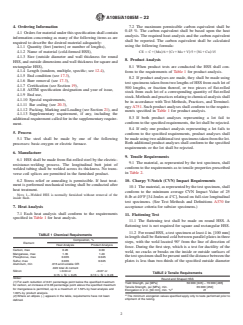
CE 5 C1 Mn ⁄61 Cr1Mo1V ⁄51 Ni1Cu ⁄15
4.1.2 Name of material (cold-formed HSS), ~ ! ~ ! ~ !
4.1.3 Size (outside diameter and wall thickness for round
8. Product Analysis
HSS, and outside dimensions and wall thickness for square and
rectangular HSS),
8.1 When product tests are conducted the HSS shall con-
4.1.4 Length (random, multiple, specific; see 12.4), form to the requirements of Table 1 for product analysis.
4.1.5 End condition (see 17.3),
8.2 If product analyses are made, they shall be made using
4.1.6 Burr removal (see 17.3),
test specimens taken from two lengths of HSS from each lot of
4.1.7 Certification (see Section 19),
500 lengths, or fraction thereof, or two pieces of flat-rolled
4.1.8 ASTM specification designation and year of issue,
stock from each lot of a corresponding quantity of flat-rolled
4.1.9 End use,
stock.Methodsandpracticesrelatingtochemicalanalysisshall
4.1.10 Special requirements,
be in accordance with Test Methods, Practices, and Terminol-
4.1.11 Bar coding (see 20.3),
ogy A751. Such product analyses shall conform to the require-
4.1.12 Packing, Marking and Loading (see Section 21), and
ments specified in Table 1 for product analysis.
4.1.13 Supplementary requirement, if any, including the
8.3 If both product analyses representing a lot fail to
additional requirement called for in the supplementary require-
conform to the specified requirements, the lot shall be rejected.
ment.
8.4 If only one product analysis representing a lot fails to
5. Process
conform to the specified requirements, product analyses shall
bemadeusingtwoadditionaltestspecimenstakenfromthelot.
5.1 The steel shall be made by one of the following
Both additional product analyses shall conform to the specified
processes: basic-oxygen or electric furnace.
requirements or the lot shall be rejected.
6. Manufacture
9. Tensile Requirements
6.1 HSS shall be made from flat-rolled steel by the electric-
9.1 The material, as represented by the test specimen, shall
resistance-welding process. The longitudinal butt joint of
conform to the requirements as to tensile properties prescribed
welded tubing shall be welded across its thickness. No trans-
in Table 2.
verse coil splices are permitted in the furnished product.
6.2 Stress relief or annealing is permissible. If heat treat-
10. Charpy V-Notch (CVN) Impact Requirements
ment is performed mechanical testing shall be conducted after
10.1 The material, as represented by the test specimen, shall
heat treatment.
conform to the minimum average CVN Impact Value of 25
NOTE 1—Welded HSS is normally furnished without removal of the
ft-lb at 40°F [34 Joules at 4°C], based on full-size longitudinal
inside flash.
test specimens. (See Test Methods and Definitions A370 for
acceptance criteria for subsize specimens.)
7. Heat Analysis
7.1 Each heat analysis shall conform to the requirements
11. Flattening Test
specified in Table 1 for heat analysis.
11.1 The flattening test shall be made on round HSS. A
flattening test is not required for square and rectangular HSS.
11.2 For round HSS, a test specimen at least 4 in. [100 mm]
TABLE 1 Chemical Requirements
in length shall be flattened cold between parallel plates in three
Composition, %
steps, with the weld located 90° from the line of direction of
Element
Heat Analysis Product Analysis
force. During the first step, which is a test for ductility of the
Carbon, max 0.26 0.30
weld, no cracks or breaks on the inside or outside surfaces of
Manganese, max 1.35 1.40
thetestspecimenshallbepresentuntilthedistancebetweenthe
Phosphorus, max 0.035 0.045
Sulfur, max 0.035 0.045
plates is less than two-thirds of the specified outside diameter
Aluminum, min .015 acid soluble OR {
.020 total Al content
Silicon #0.04 or <0.07 or
TABLE 2 Tensile Requirements
0.15# Si# 0.25 0.13# Si# 0.28
Notes:
Round and Shaped HSS
(1) For each reduction of 0.01 percentage point below the specified maximum
Yield Strength, psi [MPa] 50 000 [345] – 70 000 [485]
for carbon, an increase of 0.06 percentage point above the specified maximum
Tensile Strength, psi [MPa], min. 65 000 [450]
for manganese is permitted, up to a maximum of 1.50% by heat analysis and
A
Elongation in 2 in. [50 mm], min. % 21
1.60% by product analysis.
A
The minimum elongation values specified apply only to tests performed prior to
(2) Where an ellipsis ({) appears in the table, requirements have not been
defined. shipment of the tubing.
A1085/A1085M−22
of the tubing. For the second step, no cracks or breaks on the rectangular tubing the wall thickness requirements shall apply
inside or outside parent metal surfaces of the test specimen, only to the centers of the flats.
except as provided for in 11.4, shall be present until the
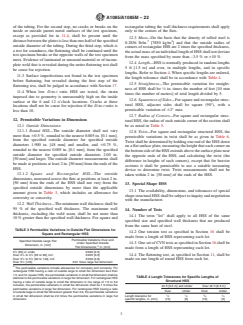
12.3 Mass—On the basis that the density of rolled steel is
distancebetweentheplatesislessthanone-halfofthespecified 3 3
0.2836 lb/in. [7850 kg/m ] and that the outside radius of
outside diameter of the tubing. During the third step, which is
corners of rectangular HSS are 2 times the specified thickness,
a test for soundness, the flattening shall be continued until the
theactualmassofanindividuallengthofHSSshallnotdeviate
test specimen breaks or the opposite walls of the test specimen
from the mass specified by more than –3.5 % or +10 %.
meet. Evidence of laminated or unsound material or of incom-
12.4 Length—HSS is normally produced in random lengths
plete weld that is revealed during the entire flattening test shall
5 ft [1.5 m] and over, in multiple lengths, and in specific
be cause for rejection.
lengths. Refer to Section 4. When specific lengths are ordered,
11.3 Surface imperfections not found in the test specimen
the length tolerance shall be in accordance with Table 4.
before flattening, but revealed during the first step of the
12.5 Straightness—The permissible variation for straight-
flattening test, shall be judged in accordance with Section 17.
ness of HSS shall be ⁄8 in. times the number of feet [10 mm
11.4 When low D-to-t ratio HSS are tested, the strain
times the number of metres] of total length divided by 5.
imposed due to geometry is unreasonably high on the inside
12.6 Squareness of Sides—For square and rectangular struc-
surface at the 6 and 12 o’clock locations. Cracks at these
tural HSS, adjacent sides shall be square (90°), with a
locations shall not be cause for rejection if the D-to-t ratio is
permissible variation of 62° max.
less than 10.
12.7 Radius of Corners—For square and rectangular struc-
12. Permissible Variations in Dimensions
tural HSS, the radius of each outside corner of the section shall
be as noted in Table 5.
12.1 Outside Dimensions:
12.1.1 Round HSS—The outside diameter shall not vary
12.8 Twist—For square and rectangular structural HSS, the
more than 60.5 %, rounded to the nearest 0.005 in. [0.1 mm],
permissible variations in twist shall be as given in Table 6.
from the specified outside diameter for specified outside
Twist shall be determined by holding one end of the HSS down
diameters 1.900 in. [48 mm] and smaller, and 60.75 %,
on a flat surface plate, measuring the height that each corner on
rounded to the nearest 0.005 in. [0.1 mm], from the specified
thebottomsideoftheHSSextendsabovethesurfaceplatenear
outside diameter for specified outside diameters 2.00 in.
the opposite ends of the HSS, and calculating the twist (the
[50 mm] and larger. The outside diameter measurements shall
difference in heights of such corners), except that for heavier
be made at positions at least 2 in. [50 mm] from the ends of the
sections it shall be permissible to use a suitable measuring
HSS.
device to determine twist. Twist measurements shall not be
12.1.2 Square and Rectangular HSS—The outside
taken within 2 in. [50 mm] of the ends of the HSS.
dimensions, measured across the flats at positions at least 2 in.
[50 mm] from the ends of the HSS shall not vary from the
13. Special Shape HSS
specified outside dimensions by more than the applicable
13.1 The availability, dimensions, and tolerances of special
amount given in Table 3, which includes an allowance for
shapestructuralHSSshallbesubjecttoinquiryandnegotiation
co
...
This document is not an ASTM standard and is intended only to provide the user of an ASTM standard an indication of what changes have been made to the previous version. Because
it may not be technically possible to adequately depict all changes accurately, ASTM recommends that users consult prior editions as appropriate. In all cases only the current version
of the standard as published by ASTM is to be considered the official document.
Designation: A1085/A1085M − 15 A1085/A1085M − 22
Standard Specification for
Cold-Formed Welded Carbon Steel Hollow Structural
Sections (HSS)
This standard is issued under the fixed designation A1085/A1085M; the number immediately following the designation indicates the
year of original adoption or, in the case of revision, the year of last revision. A number in parentheses indicates the year of last
reapproval. A superscript epsilon (´) indicates an editorial change since the last revision or reapproval.
1. Scope*
1.1 This specification covers cold-formed welded carbon steel hollow structural sections (HSS) for welded or bolted construction.
These shapes are utilized in but not limited to the following applications: buildings, bridges, towers, cranes, sign supports and
poles, off-shore production and drilling platforms, roll-over protective structures (ROPS), falling object protective structures
(FOPS), and amusement rides.
1.2 This HSS is produced in welded sizes with a periphery of 88 in. [2235 mm] or less, and a specified nominal wall thickness
of 0.148 in. [3.8 mm] or greater and 0.8751.000 in. [22[25.4 mm] or less.
1.3 The values stated in either SI units or inch-pound units are to be regarded separately as standard. Within the text, the SI units
are shown in brackets. The values stated in each system may not be exact equivalents; therefore, each system shall be used
independently of the other. Combining values from the two systems may result in non-conformance with the standard. The
inch-pound units shall apply unless the “M” designation of this specification is specified in the order.
1.4 The text of this specification contains notes and footnotes that provide explanatory material. Such notes and footnotes,
excluding those in tables and figures, do not contain any mandatory requirements.
1.5 This international standard was developed in accordance with internationally recognized principles on standardization
established in the Decision on Principles for the Development of International Standards, Guides and Recommendations issued
by the World Trade Organization Technical Barriers to Trade (TBT) Committee.
2. Referenced Documents
2.1 ASTM Standards:
A370 Test Methods and Definitions for Mechanical Testing of Steel Products
A700 Guide for Packaging, Marking, and Loading Methods for Steel Products for Shipment
A751 Test Methods and Practices for Chemical Analysis of Steel Products
A941 Terminology Relating to Steel, Stainless Steel, Related Alloys, and Ferroalloys
2.2 Military Standard:
MIL-STD-129 Marking for Shipment and Storage
This specification is under the jurisdiction of ASTM Committee A01 on Steel, Stainless Steel and Related Alloys and is the direct responsibility of Subcommittee A01.09
on Carbon Steel Tubular Products.
Current edition approved Nov. 15, 2015Nov. 1, 2022. Published November 2015December 2022. Originally approved in 2013. Last previous edition approved in 20132015
as A1085A1085/A1085M – 15.–13. DOI: 10.1520/A1085_A1085M-15.10.1520/A1085_A1085M-22.
For referenced ASTM standards, visit the ASTM website, www.astm.org, or contact ASTM Customer Service at service@astm.org. For Annual Book of ASTM Standards
volume information, refer to the standard’s Document Summary page on the ASTM website.
Available from Standardization Documents Order Desk, DODSSP, Bldg. 4, Section D, 700 Robbins Ave., Philadelphia, PA 19111-5098, http://dodssp.daps.dla.mil.
*A Summary of Changes section appears at the end of this standard
Copyright © ASTM International, 100 Barr Harbor Drive, PO Box C700, West Conshohocken, PA 19428-2959. United States
A1085/A1085M − 22
2.3 Federal Standards:
Fed. Std. No. 123 Marking for Shipment
Fed. Std. No. 183 Continuous Identification Marking of Iron and Steel Products
2.4 AIAG Standard:
B-1 Bar Code Symbology Standard
2.5 Steel Tube Institute:
Methods to Check Dimensional Tolerances on Hollow Structural Sections
3. Terminology
3.1 Definitions—For definitions of terms used in this specification, refer to Terminology A941.
4. Ordering Information
4.1 Orders for material under this specification shall contain information concerning as many of the following items as are required
to describe the desired material adequately:
4.1.1 Quantity (feet [metres] or number of lengths),
4.1.2 Name of material (cold-formed HSS),
4.1.3 Size (outside diameter and wall thickness for round HSS, and outside dimensions and wall thickness for square and
rectangular HSS),
4.1.4 Length (random, multiple, specific; see 12.4),
4.1.5 End condition (see 17.3),
4.1.6 Burr removal (see 17.3),
4.1.7 Certification (see Section 19),
4.1.8 ASTM specification designation and year of issue,
4.1.9 End use,
4.1.10 Special requirements,
4.1.11 Bar coding (see 20.3),
4.1.12 Packing, Marking and Loading (see Section 21), and
4.1.13 Supplementary requirement, if any, including the additional requirement called for in the supplementary requirement.
5. Process
5.1 The steel shall be made by one or more of the following processes: open-hearth, basic-oxygen, basic-oxygen or electric
furnace.
5.2 When steels of different grades are sequentially strand cast, the steel producer shall identify the resultant transition material
and remove it using an established procedure that positively separates the grades.
Available from U.S. Government Printing Office Superintendent of Documents, 732 N. Capitol St., NW, Mail Stop: SDE, Washington, DC 20401, http://
www.access.gpo.gov.
Available from Automotive Industry Action Group (AIAG), 26200 Lahser Rd., Suite 200, Southfield, MI 48033, http://www.aiag.org.
Available from the Steel Tube Institute (STI), 2516 Waukegan Rd., STE 172, Glenview, IL 60025-1774, https://steeltubeinstitute.org.
A1085/A1085M − 22
6. Manufacture
6.1 HSS shall be made from flat-rolled steel by the electric-resistance-welding process. The longitudinal butt joint of welded
tubing shall be welded across its thickness. No transverse coil splices are permitted in the furnished product.
6.2 Stress relief or annealing is permissible. If heat treatment is performed mechanical testing shall be conducted after heat
treatment.
NOTE 1—Welded HSS is normally furnished without removal of the inside flash.
7. Heat Analysis
7.1 Each heat analysis shall conform to the requirements specified in Table 1 for heat analysis.
7.2 The maximum permissible carbon equivalent shall be 0.45 %. The carbon equivalent shall be based upon the heat analysis.
The required heat analysis and the carbon equivalent shall be reported. The carbon equivalent shall be calculated using the
following formula:
CE5 C1~M n!⁄61~C r 1 M o 1 V!⁄51~N i 1 C u!⁄15
CE5 C1 Mn ⁄61 Cr1Mo1V ⁄51 Ni1Cu ⁄15
~ ! ~ ! ~ !
8. Product Analysis
8.1 When product tests are conducted the HSS shall conform to the requirements of Table 1 for product analysis.
8.2 If product analyses are made, they shall be made using test specimens taken from two lengths of HSS from each lot of 500
lengths, or fraction thereof, or two pieces of flat-rolled stock from each lot of a corresponding quantity of flat-rolled stock. Methods
and practices relating to chemical analysis shall be in accordance with Test Methods, Practices, and Terminology A751. Such
product analyses shall conform to the requirements specified in Table 1 for product analysis.
8.3 If both product analyses representing a lot fail to conform to the specified requirements, the lot shall be rejected.
8.4 If only one product analysis representing a lot fails to conform to the specified requirements, product analyses shall be made
using two additional test specimens taken from the lot. Both additional product analyses shall conform to the specified
requirements or the lot shall be rejected.
9. Tensile Requirements
9.1 The material, as represented by the test specimen, shall conform to the requirements as to tensile properties prescribed in Table
2.
TABLE 1 Chemical Requirements
Composition, %
Element
Heat Analysis Product Analysis
Carbon, max 0.26 0.30
Manganese, max 1.35 1.40
Phosphorus, max 0.035 0.045
Sulfur, max 0.035 0.045
Aluminum, min .015 acid soluble OR {
.020 total Al content
Silicon #0.04 or <0.07 or
0.15 # Si # 0.25 0.13 # Si # 0.28
Notes:
(1) For each reduction of 0.01 percentage point below the specified maximum
for carbon, an increase of 0.06 percentage point above the specified maximum
for manganese is permitted, up to a maximum of 1.50% by heat analysis and
1.60% by product analysis.
(2) Where an ellipsis ({) appears in the table, requirements have not been
defined.
A1085/A1085M − 22
TABLE 2 Tensile Requirements
Round and Shaped HSS
Grade A
Yield Strength, psi [MPa] 50,000 [345] – 70,000 [485]
Yield Strength, psi [MPa] 50 000 [345] – 70 000 [485]
Tensile Strength, psi [MPa], min. 65,000 [450]
Tensile Strength, psi [MPa], min. 65 000 [450]
A
Elongation in 2 in. [50 mm], min. % 21
A
The minimum elongation values specified apply only to tests performed prior to
shipment of the tubing.
10. Charpy V-Notch (CVN) Impact Requirements
10.1 The material, as represented by the test specimen, shall conform to the minimum average CVN Impact Value of 25 ft-lb at
40°F [34 Joules at 4°C], based on full-size longitudinal test specimens. (See Test Methods and Definitions A370 for acceptance
criteria for subsize specimens.)
11. Flattening Test
11.1 The flattening test shall be made on round HSS. A flattening test is not required for square and rectangular HSS.
11.2 For round HSS, a test specimen at least 4 in. [100 mm] in length shall be flattened cold between parallel plates in three steps,
with the weld located 90° from the line of direction of force. During the first step, which is a test for ductility of the weld, no cracks
or breaks on the inside or outside surfaces of the test specimen shall be present until the distance between the plates is less than
two-thirds of the specified outside diameter of the tubing. For the second step, no cracks or breaks on the inside or outside parent
metal surfaces of the test specimen, except as provided for in 11.4, shall be present until the distance between the plates is less
than one-half of the specified outside diameter of the tubing. During the third step, which is a test for soundness, the flattening shall
be continued until the test specimen breaks or the opposite walls of the test specimen meet. Evidence of laminated or unsound
material or of incomplete weld that is revealed during the entire flattening test shall be cause for rejection.
11.3 Surface imperfections not found in the test specimen before flattening, but revealed during the first step of the flattening test,
shall be judged in accordance with Section 17.
11.4 When low D-to-t ratio HSS are tested, the strain imposed due to geometry is unreasonably high on the inside surface at the
6 and 12 o’clock locations. Cracks at these locations shall not be cause for rejection if the D-to-t ratio is less than 10.
12. Permissible Variations in Dimensions
12.1 Outside Dimensions:
12.1.1 Round HSS—The outside diameter shall not vary more than 60.5 %, rounded to the nearest 0.005 in. [0.1 mm], from the
specified outside diameter for specified outside diameters 1.900 in. [48 mm] and smaller, and 60.75 %, rounded to the nearest
0.005 in. [0.1 mm], from the specified outside diameter for specified outside diameters 2.00 in. [50 mm] and larger. The outside
diameter measurements shall be made at positions at least 2 in. [50 mm] from the ends of the HSS.
12.1.2 Square and Rectangular HSS—The outside dimensions, measured across the flats at positions at least 2 in. [50 mm] from
the ends of the HSS shall not vary from the specified outside dimensions by more than the applicable amount given in Table 3,
which includes an allowance for convexity or concavity.
12.2 Wall Thickness—The minimum wall thickness shall be 95 % of the specified wall thickness. The maximum wall thickness,
excluding the weld seam, shall be not more than 10 % greater than the specified wall thickness. For square and rectangular tubing
the wall thickness requirements shall apply only to the centers of the flats.
3 3
12.3 Mass—On the basis that the density of rolled steel is 0.2836 lb/in. [7850 kg/m ] and that the outside radius of corners of
rectangular HSS are 2 times the specified thickness, the actual mass of an individual length of HSS shall not deviate from the mass
specified by more than –3.5 % or +10 %.
A1085/A1085M − 22
TABLE 3 Permissible Variations in Outside Flat Dimensions for
Square and Rectangular HSS
Permissible Variations Over and
Specified Outside Large Flat
Under Specified Outside
Dimension, in. [mm]
A
Flat Dimensions, in. [mm]
2 ⁄2 [65] or under 0.020 [0.5]
1 1
Over 2 ⁄2 to 3 ⁄2 [65 to 90], incl 0.025 [0.6]
1 1
Over 3 ⁄2 to 5 ⁄2 [90 to 140], incl 0.030 [0.8]
Over 5 ⁄2 [140] 0.01 times large flat dimension
A
The permissible variations include allowances for convexity and concavity. For
rectangular HSS having a ratio of outside large to small flat dimension less than
1.5, and for square HSS, the permissible variations in small flat dimension shall be
identical to the permissible variations in large flat dimension. For rectangular HSS
having a ratio of outside large to small flat dimension in the range of 1.5 to 3.0
inclusive, the permissible variations in small flat dimension shall be 1.5 times the
permissi
...
Questions, Comments and Discussion
Ask us and Technical Secretary will try to provide an answer. You can facilitate discussion about the standard in here.
Loading comments...