

ASTM C32-23
(Specification)Standard Specification for Sewer and Manhole Brick (Made From Clay or Shale)
General Information
- Abstract
ABSTRACT
This specification covers brick intended for use in drainage structures for the conveyance of sewage, industrial wastes, and storm water, and related structures such as manholes and catch basins. The bricks are classified as sewer bricks (Grades SS and SM) and manhole bricks (Grades MS and MM). Sewer brick shall have plain or smooth surfaces on both ends and on the face side. Manhole brick shall have plain, slightly, or moderately textured surfaces. The brick shall be sampled and tested in accordance with applicable requirements specified.
SCOPE
1.1 This specification covers brick intended for use in (1) drainage structures for the conveyance of sewage, industrial wastes, and storm water, and (2) related structures such as manholes and catch basins.
1.2 The requirements of this specification apply at the time of purchase. The use of results from testing of brick extracted from masonry structures for determining conformance or non-conformance to the requirements of this specification is beyond the scope of this standard.
1.3 Brick are ceramic products manufactured primarily from clay, shale, or similar naturally occurring earthy substances and subjected to a heat treatment at elevated temperatures (firing). Additives or recycled materials are permitted to be included at the option of the manufacturer. The heat treatment must develop sufficient fired bond between the particulate constituents to provide the strength and durability requirements of this specification. (See Terminology C1232.)
1.4 Brick are shaped during manufacture by molding, pressing, or extrusion, and the shaping method is a way to describe the brick.
1.4.1 This specification and its individual requirements shall not be used to qualify or corroborate the performance of a masonry unit made from other materials, or made with other forming methods, or other means of binding the materials.
1.5 The text of this specification references notes and footnotes which provide explanatory material. These notes and footnotes, excluding those in tables and figures, shall not be considered as requirements of the specification.
1.6 The values stated in inch-pound units are to be regarded as standard. The values given in parentheses are mathematical conversions to SI units that are provided for information only and are not considered standard.
1.7 This international standard was developed in accordance with internationally recognized principles on standardization established in the Decision on Principles for the Development of International Standards, Guides and Recommendations issued by the World Trade Organization Technical Barriers to Trade (TBT) Committee.
- Status
- Published
- Publication Date
- 31-May-2023
- Technical Committee
- C15 - Masonry – Manufactured Masonry Units, Mortars and Grouts
- Drafting Committee
- C15.02 - Brick and Structural Clay Tile
Buy Documents


ASTM C32-23 - Standard Specification for Sewer and Manhole Brick (Made From Clay or Shale)
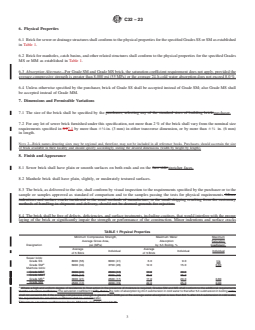
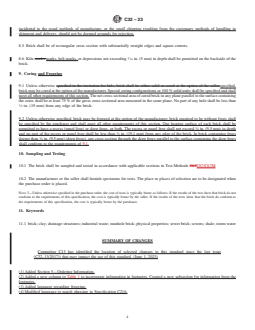
REDLINE ASTM C32-23 - Standard Specification for Sewer and Manhole Brick (Made From Clay or Shale)
Overview
ASTM C32-23 is the standard specification developed by ASTM International for sewer and manhole brick made from clay or shale. This specification is essential for manufacturers, engineers, specifiers, and contractors involved in the design, construction, and maintenance of drainage structures, including sewers, manholes, catch basins, and related systems that convey sewage, industrial wastes, and storm water.
The standard outlines the requirements for brick composition, physical properties (such as compressive strength and water absorption), appearance, dimensions, and testing methods to ensure reliable performance and structural integrity under harsh conditions. ASTM C32-23 classifies bricks into sewer brick (Grades SS and SM) and manhole brick (Grades MS and MM) based on their application and required performance characteristics.
Key Topics
- Material Requirements: Bricks must be primarily composed of clay, shale, or similar earthy substances and processed through heat treatment (firing) to achieve the necessary strength and durability. Additives or recycled materials may be included at the discretion of the manufacturer.
- Classification and Grades:
- Sewer Brick:
- Grade SS: For high-abrasion environments with velocities exceeding 8 ft/s.
- Grade SM: For moderate-abrasion environments with velocities up to 8 ft/s.
- Manhole Brick:
- Grade MS: For environments requiring high, uniform resistance to frost action and disintegration.
- Grade MM: For applications needing moderate, non-uniform frost and disintegration resistance.
- Sewer Brick:
- Physical and Visual Properties:
- Compressive strength and water absorption limits are specified by grade to ensure performance.
- Sewer bricks must have plain or smooth surfaces; manhole bricks may be plain, slightly, or moderately textured.
- Dimensional tolerances, coring, and frogging options are defined to accommodate specific project needs.
- Sampling and Testing: Bricks must be sampled and tested in accordance with ASTM C67/C67M to verify compliance with quality and performance criteria at the time of purchase.
Applications
ASTM C32-23 provides guidelines that are directly applicable to the construction and maintenance of:
- Sewer Systems: Ensuring the bricks withstand continuous exposure to sewage, industrial waste, and storm water, often under abrasive and corrosive conditions.
- Manholes and Catch Basins: Guaranteeing bricks have the necessary resistance to freeze-thaw cycles and surface durability.
- Municipal and Industrial Infrastructure: Enabling reliable performance in public works, industrial drainage, and utility tunnels.
- Specification and Procurement: Assisting architects, civil engineers, and contractors in specifying the correct brick type and grade for their specific project demands.
For optimal results, specifiers should ensure that ordering information includes brick grade, size, desired sampling methods, and any special requirements such as solid or cored units, or specific surface finishes.
Related Standards
- ASTM C67/C67M: Standard test methods for sampling and testing brick and structural clay tile.
- ASTM C1232: Terminology for masonry, providing definitions relevant for this standard.
- AASHTO M91-78: Relates to specifications for sewer and manhole brick.
- ASTM C216: For facing brick (not interchangeable, but referenced for terminology and certain requirements).
Practical Value
Compliance with ASTM C32-23 ensures that sewer and manhole bricks possess the mechanical strength, water resistance, and durability necessary for long-term infrastructural reliability. This standard protects public health and safety by promoting consistent quality and performance in critical underground drainage applications.
Keywords: ASTM C32-23, sewer brick, manhole brick, clay brick, shale brick, drainage structures, storm water, sewage, industrial waste, masonry standards, infrastructure, ASTM International, compressive strength, water absorption, frost resistance.
Relations
- Effective Date
- 15-Dec-2023
- Refers
ASTM C67/C67M-19 - Standard Test Methods for Sampling and Testing Brick and Structural Clay Tile - Effective Date
- 01-Jul-2019
- Refers
ASTM C67/C67M-18 - Standard Test Methods for Sampling and Testing Brick and Structural Clay Tile - Effective Date
- 01-Feb-2018
- Effective Date
- 01-Jun-2017
- Effective Date
- 01-Sep-2015
- Effective Date
- 01-Jun-2015
- Effective Date
- 01-Jun-2012
- Effective Date
- 15-Dec-2010
- Effective Date
- 15-Jun-2010
- Effective Date
- 01-May-2010
- Effective Date
- 01-Jan-2010
- Effective Date
- 15-Dec-2009
- Effective Date
- 01-Jul-2009
- Effective Date
- 01-Feb-2009
- Effective Date
- 01-Jul-2008
Buy Documents
ASTM C32-23 - Standard Specification for Sewer and Manhole Brick (Made From Clay or Shale)
REDLINE ASTM C32-23 - Standard Specification for Sewer and Manhole Brick (Made From Clay or Shale)
Get Certified
Connect with accredited certification bodies for this standard

DIBt (Deutsches Institut für Bautechnik)
German Institute for Building Technology.
DIN CERTCO
DIN Group product certification.

Aboma Certification B.V.
Specialized in construction, metal, and transport sectors.
Sponsored listings
Frequently Asked Questions
ASTM C32-23 is a technical specification published by ASTM International. Its full title is "Standard Specification for Sewer and Manhole Brick (Made From Clay or Shale)". This standard covers: ABSTRACT This specification covers brick intended for use in drainage structures for the conveyance of sewage, industrial wastes, and storm water, and related structures such as manholes and catch basins. The bricks are classified as sewer bricks (Grades SS and SM) and manhole bricks (Grades MS and MM). Sewer brick shall have plain or smooth surfaces on both ends and on the face side. Manhole brick shall have plain, slightly, or moderately textured surfaces. The brick shall be sampled and tested in accordance with applicable requirements specified. SCOPE 1.1 This specification covers brick intended for use in (1) drainage structures for the conveyance of sewage, industrial wastes, and storm water, and (2) related structures such as manholes and catch basins. 1.2 The requirements of this specification apply at the time of purchase. The use of results from testing of brick extracted from masonry structures for determining conformance or non-conformance to the requirements of this specification is beyond the scope of this standard. 1.3 Brick are ceramic products manufactured primarily from clay, shale, or similar naturally occurring earthy substances and subjected to a heat treatment at elevated temperatures (firing). Additives or recycled materials are permitted to be included at the option of the manufacturer. The heat treatment must develop sufficient fired bond between the particulate constituents to provide the strength and durability requirements of this specification. (See Terminology C1232.) 1.4 Brick are shaped during manufacture by molding, pressing, or extrusion, and the shaping method is a way to describe the brick. 1.4.1 This specification and its individual requirements shall not be used to qualify or corroborate the performance of a masonry unit made from other materials, or made with other forming methods, or other means of binding the materials. 1.5 The text of this specification references notes and footnotes which provide explanatory material. These notes and footnotes, excluding those in tables and figures, shall not be considered as requirements of the specification. 1.6 The values stated in inch-pound units are to be regarded as standard. The values given in parentheses are mathematical conversions to SI units that are provided for information only and are not considered standard. 1.7 This international standard was developed in accordance with internationally recognized principles on standardization established in the Decision on Principles for the Development of International Standards, Guides and Recommendations issued by the World Trade Organization Technical Barriers to Trade (TBT) Committee.
ABSTRACT This specification covers brick intended for use in drainage structures for the conveyance of sewage, industrial wastes, and storm water, and related structures such as manholes and catch basins. The bricks are classified as sewer bricks (Grades SS and SM) and manhole bricks (Grades MS and MM). Sewer brick shall have plain or smooth surfaces on both ends and on the face side. Manhole brick shall have plain, slightly, or moderately textured surfaces. The brick shall be sampled and tested in accordance with applicable requirements specified. SCOPE 1.1 This specification covers brick intended for use in (1) drainage structures for the conveyance of sewage, industrial wastes, and storm water, and (2) related structures such as manholes and catch basins. 1.2 The requirements of this specification apply at the time of purchase. The use of results from testing of brick extracted from masonry structures for determining conformance or non-conformance to the requirements of this specification is beyond the scope of this standard. 1.3 Brick are ceramic products manufactured primarily from clay, shale, or similar naturally occurring earthy substances and subjected to a heat treatment at elevated temperatures (firing). Additives or recycled materials are permitted to be included at the option of the manufacturer. The heat treatment must develop sufficient fired bond between the particulate constituents to provide the strength and durability requirements of this specification. (See Terminology C1232.) 1.4 Brick are shaped during manufacture by molding, pressing, or extrusion, and the shaping method is a way to describe the brick. 1.4.1 This specification and its individual requirements shall not be used to qualify or corroborate the performance of a masonry unit made from other materials, or made with other forming methods, or other means of binding the materials. 1.5 The text of this specification references notes and footnotes which provide explanatory material. These notes and footnotes, excluding those in tables and figures, shall not be considered as requirements of the specification. 1.6 The values stated in inch-pound units are to be regarded as standard. The values given in parentheses are mathematical conversions to SI units that are provided for information only and are not considered standard. 1.7 This international standard was developed in accordance with internationally recognized principles on standardization established in the Decision on Principles for the Development of International Standards, Guides and Recommendations issued by the World Trade Organization Technical Barriers to Trade (TBT) Committee.
ASTM C32-23 is classified under the following ICS (International Classification for Standards) categories: 91.100.15 - Mineral materials and products. The ICS classification helps identify the subject area and facilitates finding related standards.
ASTM C32-23 has the following relationships with other standards: It is inter standard links to ASTM C1232-23, ASTM C67/C67M-19, ASTM C67/C67M-18, ASTM C1232-17, ASTM C1232-15a, ASTM C1232-15, ASTM C1232-12, ASTM C1232-10c, ASTM C1232-10b, ASTM C1232-10a, ASTM C1232-10, ASTM C1232-09b, ASTM C1232-09a, ASTM C1232-09, ASTM C1232-08. Understanding these relationships helps ensure you are using the most current and applicable version of the standard.
ASTM C32-23 is available in PDF format for immediate download after purchase. The document can be added to your cart and obtained through the secure checkout process. Digital delivery ensures instant access to the complete standard document.
Standards Content (Sample)
This international standard was developed in accordance with internationally recognized principles on standardization established in the Decision on Principles for the
Development of International Standards, Guides and Recommendations issued by the World Trade Organization Technical Barriers to Trade (TBT) Committee.
Designation: C32 − 23 American Association State
Highway and Transportation Officials Standard
AASHTO No.: M91-78
Standard Specification for
Sewer and Manhole Brick (Made From Clay or Shale)
This standard is issued under the fixed designation C32; the number immediately following the designation indicates the year of original
adoption or, in the case of revision, the year of last revision. A number in parentheses indicates the year of last reapproval. A superscript
epsilon (´) indicates an editorial change since the last revision or reapproval.
This standard has been approved for use by agencies of the U.S. Department of Defense.
1. Scope* 1.7 This international standard was developed in accor-
dance with internationally recognized principles on standard-
1.1 This specification covers brick intended for use in (1)
ization established in the Decision on Principles for the
drainage structures for the conveyance of sewage, industrial
Development of International Standards, Guides and Recom-
wastes, and storm water, and (2) related structures such as
mendations issued by the World Trade Organization Technical
manholes and catch basins.
Barriers to Trade (TBT) Committee.
1.2 The requirements of this specification apply at the time
2. Referenced Documents
of purchase. The use of results from testing of brick extracted
from masonry structures for determining conformance or
2.1 ASTM Standards:
non-conformance to the requirements of this specification is
C67/C67M Test Methods for Sampling and Testing Brick
beyond the scope of this standard.
and Structural Clay Tile
C1232 Terminology for Masonry
1.3 Brick are ceramic products manufactured primarily
from clay, shale, or similar naturally occurring earthy sub-
3. Terminology
stances and subjected to a heat treatment at elevated tempera-
3.1 Definitions—For definitions relating to masonry, sewer
tures (firing). Additives or recycled materials are permitted to
brick, and manhole brick, refer to Terminology C1232.
be included at the option of the manufacturer. The heat
treatment must develop sufficient fired bond between the
4. Classification
particulate constituents to provide the strength and durability
4.1 Grades—Two grades of sewer brick are covered:
requirements of this specification. (See Terminology C1232.)
4.1.1 Grade SS—Brick intended for use in structures requir-
1.4 Brick are shaped during manufacture by molding,
ing low absorption and resistance to the action of sewage
pressing, or extrusion, and the shaping method is a way to
carrying large quantities of abrasive material at velocities
describe the brick.
exceeding 8 ft/s (2.4 m/s).
1.4.1 This specification and its individual requirements shall
4.1.2 Grade SM—Brick intended for use in structures re-
not be used to qualify or corroborate the performance of a
quiring resistance to the action of sewage carrying abrasive
masonry unit made from other materials, or made with other
materials at velocities of no more than 8 ft/s (2.4 m/s).
forming methods, or other means of binding the materials.
4.2 Grades—Two grades of manhole brick are covered:
1.5 The text of this specification references notes and
4.2.1 Grade MS—Brick intended for use in manholes and
footnotes which provide explanatory material. These notes and
catch basins not requiring high degrees of abrasive resistance
footnotes, excluding those in tables and figures, shall not be
but where a high and uniform degree of resistance to frost
considered as requirements of the specification.
action and disintegration is needed when the brick may be
1.6 The values stated in inch-pound units are to be regarded
frozen when permeated with water.
as standard. The values given in parentheses are mathematical
4.2.2 Grade MM—Brick intended for use in manholes not
conversions to SI units that are provided for information only
requiring high degrees of abrasive resistance but where a
and are not considered standard.
moderate and nonuniform degree of resistance to frost action
and disintegration is needed when the brick may be permeated
with water.
This specification is under the jurisdiction of ASTM Committee C15 on
Manufactured Masonry Units and is the direct responsibility of Subcommittee
C15.02 on Brick and Structural Clay Tile. For referenced ASTM standards, visit the ASTM website, www.astm.org, or
Current edition approved June 1, 2023. Published June 2023. Originally contact ASTM Customer Service at service@astm.org. For Annual Book of ASTM
approved in 1921. Last previous edition approved in 2017 as C32 – 13(2017). DOI: Standards volume information, refer to the standard’s Document Summary page on
10.1520/C0032-23. the ASTM website.
*A Summary of Changes section appears at the end of this standard
Copyright © ASTM International, 100 Barr Harbor Drive, PO Box C700, West Conshohocken, PA 19428-2959. United States
C32 − 23
5. Ordering Information 7.2 For any lot of sewer brick furnished under this
specification, not more than 2 % of the brick shall vary from
5.1 Orders for sewer or manhole brick under this specifica-
the nominal size requirements specified in 7.1 by more than
tion shall include the following information:
6 ⁄8 in. (3 mm) in either transverse dimension, or by more than
5.1.1 Grade (4.1 and 4.2)—Grade SS for sewer brick and
6 ⁄4 in. (6 mm) in length.
Grade MS for manhole brick governs when grade is not
specified.
NOTE 2—Brick names denoting sizes may be regional and, therefore,
5.1.2 Size (7.1)—Specify width by height by length. may not be included in all reference books. Purchasers should ascertain
the size of brick available in their locality and should specify accordingly,
5.1.3 Sampling (10.2)—Person to select samples and place
stating the desired dimensions (width by height by length).
or places of selection of samples for testing.
5.2 Orders for sewer or manhole brick under this specifica-
8. Finish and Appearance
tion may include the following information:
8.1 Sewer brick shall have plain or smooth surfaces on both
5.2.1 Strength (6.1, 6.2)—Specify only if above minimum
ends and on the stretcher faces.
compressive strength in Table 1.
5.2.2 Coring (9.1)—At option of manufacturer if not speci-
8.2 Manhole brick shall have plain, slightly, or moderately
fied.
textured surfaces.
5.2.3 Frogging (9.2)—Frog permitted in one bearing face if
8.3 The brick, as delivered to the site, shall conform by
not spec
...
This document is not an ASTM standard and is intended only to provide the user of an ASTM standard an indication of what changes have been made to the previous version. Because
it may not be technically possible to adequately depict all changes accurately, ASTM recommends that users consult prior editions as appropriate. In all cases only the current version
of the standard as published by ASTM is to be considered the official document.
Designation: C32 − 13 (Reapproved 2017) C32 − 23 American Association State
Highway and Transportation Officials Standard
AASHTO No.: M91-78
Standard Specification for
Sewer and Manhole Brick (Made From Clay or Shale)
This standard is issued under the fixed designation C32; the number immediately following the designation indicates the year of original
adoption or, in the case of revision, the year of last revision. A number in parentheses indicates the year of last reapproval. A superscript
epsilon (´) indicates an editorial change since the last revision or reapproval.
This standard has been approved for use by agencies of the U.S. Department of Defense.
1. Scope Scope*
1.1 This specification covers brick intended for use in (1) drainage structures for the conveyance of sewage, industrial wastes, and
storm water, and (2) related structures such as manholes and catch basins.
1.2 The property requirements of this standardspecification apply at the time of purchase. The use of results from testing of brick
extracted from masonry structures for determining conformance or non-conformance to the property requirements (Section 5) of
this standardspecification is beyond the scope of this standard.
1.3 Brick covered by this standard are manufactured are ceramic products manufactured primarily from clay, shale, or similar
naturally occurring earthy substances and subjected to a heat treatment at elevated temperatures (firing). Additives or recycled
materials are permitted to be included at the option of the manufacturer. The heat treatment must develop sufficient fired bond
between the particulate constituents to provide the strength and durability requirements of this specification. (See firing and fired
bond in Terminology C1232.)
1.4 Brick are shaped during manufacture by molding, pressing, or extrusion, and the shaping method is a way to describe the brick.
1.4.1 This specification and its individual requirements shall not be used to qualify or corroborate the performance of a masonry
unit made from other materials, or made with other forming methods, or other means of binding the materials.
1.5 The text of this specification references notes and footnotes which provide explanatory material. These notes and footnotes,
excluding those in tables and figures, shall not be considered as requirements of the specification.
1.6 The values stated in inch-pound units are to be regarded as standard. The values given in parentheses are mathematical
conversions to SI units that are provided for information only and are not considered standard.
1.7 This international standard was developed in accordance with internationally recognized principles on standardization
established in the Decision on Principles for the Development of International Standards, Guides and Recommendations issued
by the World Trade Organization Technical Barriers to Trade (TBT) Committee.
This specification is under the jurisdiction of ASTM Committee C15 on Manufactured Masonry Units and is the direct responsibility of Subcommittee C15.02 on Brick
and Structural Clay Tile.
Current edition approved Dec. 1, 2017June 1, 2023. Published January 2018June 2023. Originally approved in 1921. Last previous edition approved in 20132017 as
C32 – 13.C32 – 13(2017). DOI: 10.1520/C0032-13R17.10.1520/C0032-23.
*A Summary of Changes section appears at the end of this standard
Copyright © ASTM International, 100 Barr Harbor Drive, PO Box C700, West Conshohocken, PA 19428-2959. United States
C32 − 23
2. Referenced Documents
2.1 ASTM Standards:
C67C67/C67M Test Methods for Sampling and Testing Brick and Structural Clay Tile
C1232 Terminology for Masonry
3. Terminology
3.1 Definitions—For definitions relating to masonry, sewer brick, and manhole brick, refer to Terminology C1232.
4. Classification
4.1 Grades—Two grades of sewer brick are covered:
4.1.1 Grade SS—Brick intended for use in structures requiring low absorption and resistance to the action of sewage carrying large
quantities of abrasive material at velocities exceeding 8 ft (2.4 m)/s.ft/s (2.4 m/s).
4.1.2 Grade SM—Brick intended for use in structures requiring resistance to the action of sewage carrying abrasive materials at
velocities less of no more than 8 ft (2.4 m)/s.ft/s (2.4 m/s).
4.2 Grades—Two grades of manhole brick are covered:
4.2.1 Grade MS—Brick intended for use in manholes and catch basins not requiring high degrees of abrasive resistance but where
a high and uniform degree of resistance to frost action and disintegration is needed when the brick may be frozen when permeated
with water.
4.2.2 Grade MM—Brick intended for use in manholes not requiring high degrees of abrasive resistance but where a moderate and
nonuniform degree of resistance to frost action and disintegration is needed when the brick may be permeated with water.
5. Ordering Information
5.1 Orders for sewer or manhole brick under this specification shall include the following information:
5.1.1 Grade (4.1 and 4.2)—Grade SS for sewer brick and Grade MS for manhole brick governs when grade is not specified.
5.1.2 Size (7.1)—Specify width by height by length.
5.1.3 Sampling (10.2)—Person to select samples and place or places of selection of samples for testing.
5.2 Orders for sewer or manhole brick under this specification may include the following information:
5.2.1 Strength (6.1, 6.2)—Specify only if above minimum compressive strength in Table 1.
5.2.2 Coring (9.1)—At option of manufacturer if not specified.
5.2.3 Frogging (9.2)—Frog permitted in one bearing face if not specified.
5.2.4 Costs of Tests (Note 3)—Party who will pay and conditions for payment of compliance testing.
5.2.5 Special Shapes—Specify size, dimensions and finished faces by approved shop drawing or other means.
NOTE 1—Nominal dimensions should not be used to specify size.
For referenced ASTM standards, visit the ASTM website, www.astm.org, or contact ASTM Customer Service at service@astm.org. For Annual Book of ASTM Standards
volume information, refer to the standard’s Document Summary page on the ASTM website.
C32 − 23
6. Physical Properties
6.1 Brick for sewer or drainage structures shall conform to the physical properties for the specified Grades SS or SM as established
in Table 1.
6.2 Brick for manholes, catch basins, and other related structures shall conform to the physical properties for the specified Grades
MS or MM as established in Table 1.
6.3 Absorption Alternate—For Grade SM and Grade MS brick, the saturation coefficient requirement does not apply, provided the
average compressive strength is greater than 8,000 psi (55 MPa) or the average 24-h cold water absorption does not exceed 8.0 %.
6.4 Unless otherwise specified by the purchaser, brick of Grade SS shall be accepted instead of Grade SM; also Grade MS shall
be accepted instead of Grade MM.
7. Dimensions and Permissible Variations
7.1 The size of the brick shall be specified by the purchaser, selecting a
...