

ASTM C62-23
(Specification)Standard Specification for Building Brick (Solid Masonry Units Made from Clay or Shale)
General Information
- Abstract
ABSTRACT
This specification covers building bricks intended for use in structural and nonstructural masonry where external appearance is not a requirement. The bricks are prismatic units available in a variety of sizes, shapes, textures, and colors and are manufactured from clay, shale, or similar naturally occurring earthy substances by firing. The heat treatment should develop sufficient fired bond between material particulates to produce a material that conforms to the required strength and durability. During manufacture, the breaks are shaped by molding, pressing, or extrusion. Bricks are classified into grades according to their resistance to damage by freezing when wet. All the materials should comply with the requirements on appearance, durability, absorption alternate, freezing and thawing alternative, breakage, cracking, weathering index alternative, strength, and initial absorption rate.
SCOPE
1.1 This specification covers brick intended for use in both structural and nonstructural masonry where external appearance is not a requirement. The brick are prismatic units available in a variety of sizes, shapes, textures, and colors. This specification does not cover brick intended for use as facing units or where surface appearance is a requirement. If brick are required to have a particular color, texture, finish, uniformity, or limits on cracks, warpage, or other imperfections detracting from the appearance they are purchased under Specification C216. This specification does not cover brick intended for use as paving brick (see Specifications C902 and C1272).
1.2 The requirements of this specification apply at the time of purchase. The use of results from testing of brick extracted from masonry structures for determining conformance or nonconformance to the requirements of this specification is beyond the scope of this standard.
1.3 Brick are ceramic products manufactured primarily from clay, shale, or similar naturally occurring earthy substances and subjected to a heat treatment at elevated temperatures (firing). Additives or recycled materials are permitted to be included at the option of the manufacturer. The heat treatment must develop sufficient fired bond between the particulate constituents to provide the strength and durability requirements of this specification (see Terminology C1232).
1.4 Brick are shaped during manufacture by molding, pressing, or extrusion, and the shaping method is a way to describe the brick.
1.4.1 This specification and its individual requirements shall not be used to qualify or corroborate the performance of a masonry unit made from other materials, or made with other forming methods, or other means of binding the materials.
1.5 Three grades of brick are covered.
1.6 The text of this specification references notes and footnotes which provide explanatory material. These notes and footnotes (excluding those in tables and figures) shall not be considered as requirements of the specification.
1.7 The values stated in inch-pound units are to be regarded as standard. The values given in parentheses are mathematical conversions to SI units that are provided for information only and are not considered standard.
1.8 This international standard was developed in accordance with internationally recognized principles on standardization established in the Decision on Principles for the Development of International Standards, Guides and Recommendations issued by the World Trade Organization Technical Barriers to Trade (TBT) Committee.
- Status
- Published
- Publication Date
- 31-May-2023
- Technical Committee
- C15 - Masonry – Manufactured Masonry Units, Mortars and Grouts
- Drafting Committee
- C15.02 - Brick and Structural Clay Tile
Buy Documents
ASTM C62-23 - Standard Specification for Building Brick (Solid Masonry Units Made from Clay or Shale)
REDLINE ASTM C62-23 - Standard Specification for Building Brick (Solid Masonry Units Made from Clay or Shale)
Overview
ASTM C62-23 is the standard specification set by ASTM International for building brick, specifically solid masonry units manufactured from clay, shale, or similar naturally occurring materials. This standard details the minimum requirements for bricks intended for use in structural and nonstructural masonry where external appearance is not a primary concern. ASTM C62-23 applies to building bricks that are prismatic and made by molding, pressing, or extrusion, ensuring the fired material achieves vital strength and durability for construction applications.
The specification emphasizes the physical properties, quality control, and classification of bricks according to their resistance to freezing and thawing, making it a cornerstone reference for construction professionals, architects, and manufacturers working with solid masonry units.
Key Topics
- Scope and Limitations: Defines bricks covered by the standard, excluding facing and paving bricks. Emphasizes that ASTM C62-23 applies where appearance is secondary to function.
- Material and Manufacturing: Covers bricks made primarily from clay or shale, with provisions for the inclusion of additives or recycled materials at the manufacturer’s discretion.
- Grades of Building Brick:
- Grade SW (Severe Weathering): High resistance to cyclic freezing and thawing, suitable for demanding climates and exposures.
- Grade MW (Moderate Weathering): Moderate resistance, recommended where occasional freeze-thaw cycles occur.
- Grade NW (Negligible Weathering): Minimal resistance, suitable for protected or indoor applications.
- Physical Requirements: Includes minimum compressive strength, maximum water absorption, and dimensional tolerances. Also addresses alternatives for absorption and freezing/thawing tests.
- Sampling and Testing: References ASTM C67 for standard test methods regarding sampling, compressive strength, and water absorption.
- Coring and Frogging: Outlines requirements for cored or frogged bricks, with specific provisions for structural integrity.
- Order Information: Provides guidelines for specifying grade, size, sampling, and optional properties during procurement.
Applications
ASTM C62-23 is widely used in the construction sector for specifying the requirements and acceptance criteria of building bricks in masonry projects. Key practical applications include:
- Structural Masonry Walls: Ensuring bricks meet strength and durability standards required for load-bearing walls.
- Nonstructural Partitioning: Providing reliable material standards for interior and non-load-bearing partitions.
- Below-Grade and Foundation Work: Recommending grades for exposure to moisture and freeze/thaw conditions typically found in foundation and retaining walls.
- General Construction: Facilitating the consistent procurement, quality control, and installation of bricks across projects where appearance is not critical.
By following ASTM C62-23, contractors and manufacturers can ensure that building bricks are suitable for their intended use, especially in environments prone to harsh weather conditions.
Related Standards
- ASTM C216: Specification for Facing Brick (Solid Masonry Units Made from Clay or Shale) - for projects requiring specific aesthetic or surface quality.
- ASTM C902: Specification for Pedestrian and Light Traffic Paving Brick - for pavers subjected to lighter loads.
- ASTM C1272: Specification for Heavy Vehicular Paving Brick - for pavers in heavy-duty applications.
- ASTM C67: Test Methods for Sampling and Testing Brick and Structural Clay Tile - provides detailed procedures for evaluating brick properties.
- ASTM C1232: Terminology for Masonry - offers definitions to ensure consistency across masonry standards.
Keywords: building brick, ASTM C62, solid masonry units, clay brick specification, shale brick, masonry standards, brick grades, compressive strength, water absorption, freezing and thawing resistance, construction materials, ASTM International.
Relations
- Effective Date
- 15-Dec-2023
- Refers
ASTM C67/C67M-19 - Standard Test Methods for Sampling and Testing Brick and Structural Clay Tile - Effective Date
- 01-Jul-2019
- Refers
ASTM C67/C67M-18 - Standard Test Methods for Sampling and Testing Brick and Structural Clay Tile - Effective Date
- 01-Feb-2018
- Effective Date
- 01-Oct-2017
- Effective Date
- 01-Jun-2017
- Refers
ASTM C216-17 - Standard Specification for Facing Brick (Solid Masonry Units Made from Clay or Shale) - Effective Date
- 15-Mar-2017
- Effective Date
- 01-Dec-2016
- Effective Date
- 01-Jun-2016
- Refers
ASTM C216-16 - Standard Specification for Facing Brick (Solid Masonry Units Made from Clay or Shale) - Effective Date
- 01-Jun-2016
- Effective Date
- 15-Jan-2016
- Effective Date
- 01-Dec-2015
- Effective Date
- 01-Sep-2015
- Effective Date
- 01-Jun-2015
- Refers
ASTM C216-15 - Standard Specification for Facing Brick (Solid Masonry Units Made from Clay or Shale) - Effective Date
- 01-Feb-2015
- Effective Date
- 15-Dec-2014
Buy Documents
ASTM C62-23 - Standard Specification for Building Brick (Solid Masonry Units Made from Clay or Shale)
REDLINE ASTM C62-23 - Standard Specification for Building Brick (Solid Masonry Units Made from Clay or Shale)
Get Certified
Connect with accredited certification bodies for this standard

DIBt (Deutsches Institut für Bautechnik)
German Institute for Building Technology.
DIN CERTCO
DIN Group product certification.

Aboma Certification B.V.
Specialized in construction, metal, and transport sectors.
Sponsored listings
Frequently Asked Questions
ASTM C62-23 is a technical specification published by ASTM International. Its full title is "Standard Specification for Building Brick (Solid Masonry Units Made from Clay or Shale)". This standard covers: ABSTRACT This specification covers building bricks intended for use in structural and nonstructural masonry where external appearance is not a requirement. The bricks are prismatic units available in a variety of sizes, shapes, textures, and colors and are manufactured from clay, shale, or similar naturally occurring earthy substances by firing. The heat treatment should develop sufficient fired bond between material particulates to produce a material that conforms to the required strength and durability. During manufacture, the breaks are shaped by molding, pressing, or extrusion. Bricks are classified into grades according to their resistance to damage by freezing when wet. All the materials should comply with the requirements on appearance, durability, absorption alternate, freezing and thawing alternative, breakage, cracking, weathering index alternative, strength, and initial absorption rate. SCOPE 1.1 This specification covers brick intended for use in both structural and nonstructural masonry where external appearance is not a requirement. The brick are prismatic units available in a variety of sizes, shapes, textures, and colors. This specification does not cover brick intended for use as facing units or where surface appearance is a requirement. If brick are required to have a particular color, texture, finish, uniformity, or limits on cracks, warpage, or other imperfections detracting from the appearance they are purchased under Specification C216. This specification does not cover brick intended for use as paving brick (see Specifications C902 and C1272). 1.2 The requirements of this specification apply at the time of purchase. The use of results from testing of brick extracted from masonry structures for determining conformance or nonconformance to the requirements of this specification is beyond the scope of this standard. 1.3 Brick are ceramic products manufactured primarily from clay, shale, or similar naturally occurring earthy substances and subjected to a heat treatment at elevated temperatures (firing). Additives or recycled materials are permitted to be included at the option of the manufacturer. The heat treatment must develop sufficient fired bond between the particulate constituents to provide the strength and durability requirements of this specification (see Terminology C1232). 1.4 Brick are shaped during manufacture by molding, pressing, or extrusion, and the shaping method is a way to describe the brick. 1.4.1 This specification and its individual requirements shall not be used to qualify or corroborate the performance of a masonry unit made from other materials, or made with other forming methods, or other means of binding the materials. 1.5 Three grades of brick are covered. 1.6 The text of this specification references notes and footnotes which provide explanatory material. These notes and footnotes (excluding those in tables and figures) shall not be considered as requirements of the specification. 1.7 The values stated in inch-pound units are to be regarded as standard. The values given in parentheses are mathematical conversions to SI units that are provided for information only and are not considered standard. 1.8 This international standard was developed in accordance with internationally recognized principles on standardization established in the Decision on Principles for the Development of International Standards, Guides and Recommendations issued by the World Trade Organization Technical Barriers to Trade (TBT) Committee.
ABSTRACT This specification covers building bricks intended for use in structural and nonstructural masonry where external appearance is not a requirement. The bricks are prismatic units available in a variety of sizes, shapes, textures, and colors and are manufactured from clay, shale, or similar naturally occurring earthy substances by firing. The heat treatment should develop sufficient fired bond between material particulates to produce a material that conforms to the required strength and durability. During manufacture, the breaks are shaped by molding, pressing, or extrusion. Bricks are classified into grades according to their resistance to damage by freezing when wet. All the materials should comply with the requirements on appearance, durability, absorption alternate, freezing and thawing alternative, breakage, cracking, weathering index alternative, strength, and initial absorption rate. SCOPE 1.1 This specification covers brick intended for use in both structural and nonstructural masonry where external appearance is not a requirement. The brick are prismatic units available in a variety of sizes, shapes, textures, and colors. This specification does not cover brick intended for use as facing units or where surface appearance is a requirement. If brick are required to have a particular color, texture, finish, uniformity, or limits on cracks, warpage, or other imperfections detracting from the appearance they are purchased under Specification C216. This specification does not cover brick intended for use as paving brick (see Specifications C902 and C1272). 1.2 The requirements of this specification apply at the time of purchase. The use of results from testing of brick extracted from masonry structures for determining conformance or nonconformance to the requirements of this specification is beyond the scope of this standard. 1.3 Brick are ceramic products manufactured primarily from clay, shale, or similar naturally occurring earthy substances and subjected to a heat treatment at elevated temperatures (firing). Additives or recycled materials are permitted to be included at the option of the manufacturer. The heat treatment must develop sufficient fired bond between the particulate constituents to provide the strength and durability requirements of this specification (see Terminology C1232). 1.4 Brick are shaped during manufacture by molding, pressing, or extrusion, and the shaping method is a way to describe the brick. 1.4.1 This specification and its individual requirements shall not be used to qualify or corroborate the performance of a masonry unit made from other materials, or made with other forming methods, or other means of binding the materials. 1.5 Three grades of brick are covered. 1.6 The text of this specification references notes and footnotes which provide explanatory material. These notes and footnotes (excluding those in tables and figures) shall not be considered as requirements of the specification. 1.7 The values stated in inch-pound units are to be regarded as standard. The values given in parentheses are mathematical conversions to SI units that are provided for information only and are not considered standard. 1.8 This international standard was developed in accordance with internationally recognized principles on standardization established in the Decision on Principles for the Development of International Standards, Guides and Recommendations issued by the World Trade Organization Technical Barriers to Trade (TBT) Committee.
ASTM C62-23 is classified under the following ICS (International Classification for Standards) categories: 91.100.15 - Mineral materials and products. The ICS classification helps identify the subject area and facilitates finding related standards.
ASTM C62-23 has the following relationships with other standards: It is inter standard links to ASTM C1232-23, ASTM C67/C67M-19, ASTM C67/C67M-18, ASTM C216-17a, ASTM C1232-17, ASTM C216-17, ASTM C1272-16b, ASTM C1272-16a, ASTM C216-16, ASTM C1272-16, ASTM C1272-15, ASTM C1232-15a, ASTM C1232-15, ASTM C216-15, ASTM C1272-14b. Understanding these relationships helps ensure you are using the most current and applicable version of the standard.
ASTM C62-23 is available in PDF format for immediate download after purchase. The document can be added to your cart and obtained through the secure checkout process. Digital delivery ensures instant access to the complete standard document.
Standards Content (Sample)
This international standard was developed in accordance with internationally recognized principles on standardization established in the Decision on Principles for the
Development of International Standards, Guides and Recommendations issued by the World Trade Organization Technical Barriers to Trade (TBT) Committee.
Designation: C62 − 23
Standard Specification for
Building Brick (Solid Masonry Units Made from Clay or
Shale)
This standard is issued under the fixed designation C62; the number immediately following the designation indicates the year of original
adoption or, in the case of revision, the year of last revision. A number in parentheses indicates the year of last reapproval. A superscript
epsilon (´) indicates an editorial change since the last revision or reapproval.
This standard has been approved for use by agencies of the U.S. Department of Defense.
1. Scope* 1.6 The text of this specification references notes and
footnotes which provide explanatory material. These notes and
1.1 This specification covers brick intended for use in both
footnotes (excluding those in tables and figures) shall not be
structural and nonstructural masonry where external appear-
considered as requirements of the specification.
ance is not a requirement. The brick are prismatic units
available in a variety of sizes, shapes, textures, and colors. This 1.7 The values stated in inch-pound units are to be regarded
specification does not cover brick intended for use as facing as standard. The values given in parentheses are mathematical
units or where surface appearance is a requirement. If brick are conversions to SI units that are provided for information only
required to have a particular color, texture, finish, uniformity, and are not considered standard.
or limits on cracks, warpage, or other imperfections detracting
1.8 This international standard was developed in accor-
from the appearance they are purchased under Specification
dance with internationally recognized principles on standard-
C216. This specification does not cover brick intended for use
ization established in the Decision on Principles for the
as paving brick (see Specifications C902 and C1272).
Development of International Standards, Guides and Recom-
mendations issued by the World Trade Organization Technical
1.2 The requirements of this specification apply at the time
Barriers to Trade (TBT) Committee.
of purchase. The use of results from testing of brick extracted
from masonry structures for determining conformance or
2. Referenced Documents
nonconformance to the requirements of this specification is
2.1 ASTM Standards:
beyond the scope of this standard.
C67/C67M Test Methods for Sampling and Testing Brick
1.3 Brick are ceramic products manufactured primarily
and Structural Clay Tile
from clay, shale, or similar naturally occurring earthy sub-
C216 Specification for Facing Brick (Solid Masonry Units
stances and subjected to a heat treatment at elevated tempera-
Made from Clay or Shale)
tures (firing). Additives or recycled materials are permitted to
C902 Specification for Pedestrian and Light Traffic Paving
be included at the option of the manufacturer. The heat
Brick
treatment must develop sufficient fired bond between the
C1232 Terminology for Masonry
particulate constituents to provide the strength and durability
C1272 Specification for Heavy Vehicular Paving Brick
requirements of this specification (see Terminology C1232).
1.4 Brick are shaped during manufacture by molding, 3. Terminology
pressing, or extrusion, and the shaping method is a way to
3.1 Definitions—For definitions relating to masonry and
describe the brick.
building brick, refer to Terminology C1232.
1.4.1 This specification and its individual requirements shall
not be used to qualify or corroborate the performance of a
4. Classification
masonry unit made from other materials, or made with other
4.1 Grades—Grades classify brick according to their resis-
forming methods, or other means of binding the materials.
tance to damage by freezing and thawing when saturated at a
1.5 Three grades of brick are covered.
moisture content not exceeding the 24-h cold water absorption.
Three grades of building brick are covered and the require-
ments are given in Section 6.
This specification is under the jurisdiction of ASTM Committee C15 on
Manufactured Masonry Units and is the direct responsibility of Subcommittee
C15.02 on Brick and Structural Clay Tile. For referenced ASTM standards, visit the ASTM website, www.astm.org, or
Current edition approved June 1, 2023. Published June 2023. Originally contact ASTM Customer Service at service@astm.org. For Annual Book of ASTM
approved in 1927. Last previous edition approved in 2017 as C62 – 17. DOI: Standards volume information, refer to the standard’s Document Summary page on
10.1520/C0062-23. the ASTM website.
*A Summary of Changes section appears at the end of this standard
Copyright © ASTM International, 100 Barr Harbor Drive, PO Box C700, West Conshohocken, PA 19428-2959. United States
C62 − 23
4.1.1 Grade SW (Severe Weathering)—Brick intended for 5.1.1 Grade (4.1)—Grade SW governs when grade is not
use where high resistance to damage caused by cyclic freezing specified.
and thawing is desired.
5.1.2 Size (7.1)—Specify width by height by length.
4.1.2 Grade MW (Moderate Weathering)—Brick intended
5.1.3 Sampling (10.2)—Person to select samples and place
for use where moderate resistance to cyclic freezing and
or places of selection of samples for testing.
thawing damage is permissible.
4.1.3 Grade NW (Negligible Weathering)—Brick intended
5.2 Orders for building brick under this specification may
for use where little resistance to cyclic freezing and thawing
include the following information:
damage is acceptable.
5.2.1 Strength (6.2)—Specify only if above minimum com-
NOTE 1—Although grade is associated with resistance to deterioration pressive strength in Table 1.
under freeze/thaw exposures, freeze/thaw resistance of a clay brick unit is
5.2.2 Coring (9.1)—At option of manufacturer if not speci-
also affected by the properties of the surrounding materials, the construc-
fied otherwise.
tion details, and the overall environment in which the clay unit is placed;
each of which may influence exposure to moisture and freezing condi-
5.2.3 Frogging (9.2)—Frog permitted in one bearing face if
tions. Brick masonry should be detailed to minimize saturation or
not specified otherwise.
near-saturation of the units in freezing conditions. Measurement of
5.2.4 Costs of Tests (Note 8)—Party who will pay and
moisture content of brick in buildings indicates that, when the building is
designed and constructed to reduce water penetration, the 24-h cold water
conditions for payment of compliance testing.
absorption is unlikely to be exceeded.
5.2.5 Special Shapes—Specify size, dimensions and fin-
ished faces by approved shop drawing or other means.
5. Ordering Information
5.1 Orders for building brick under this specification shall
NOTE 2—Nominal dimensions should not be used to specify size. See
include the following information: 6.3 for optional information.
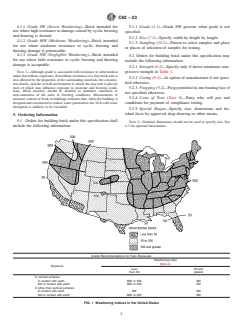
Grade Recommendations for Face Exposures
Weathering Index
(Note 4)
Exposure
Less 50 and
than 50 greater
In vertical surfaces:
In contact with earth MW or SW SW
Not in contact with earth MW or SW SW
In other than vertical surfaces:
In contact with earth SW SW
Not in contact with earth MW or SW SW
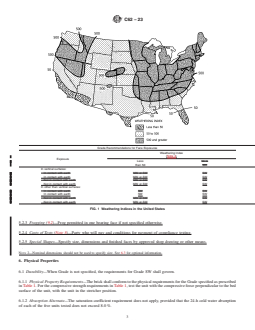
FIG. 1 Weathering Indices in the United States
C62 − 23
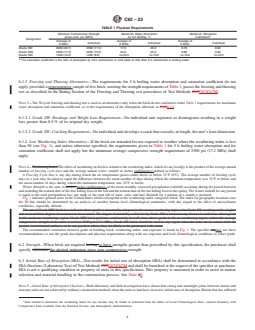
TABLE 1 Physical Requirements
Minimum Compressive Strength Maximum Water Absorption Maximum Saturation
A
gross area, psi (MPa) by 5-h Boiling, % Coefficient
Designation
Average of Average of Average of
Individual Individual Individual
5 Brick 5 Brick 5 Brick
Grade SW 3000 (20.7) 2500 (17.2) 17.0 20.0 0.78 0.80
Grade MW 2500 (17.2) 2200 (15.2) 22.0 25.0 0.88 0.90
Grade NW 1500 (10.3) 1250 (8.6) no limit no limit no limit no limit
A
The saturation coefficient is the ratio of absorption by 24-h submersion in cold water to that after 5-h submersion in boiling water.
cycle days in a year may be taken to equal the difference between the
6. Physical Properties
mean number of days during which the minimum temperature was 32°F
6.1 Durability—When Grade is not specified, the require-
or below and the mean number of days during which the maximum
ments for Grade SW shall govern.
temperature was 32°F or below.
Winter Rainfall is the sum, in inches (millimeters), of the mean monthly
6.1.1 Physical Property Requirements—The brick shall con-
corrected precipitation (rainfall) occurring during the period between and
form to the physical requirements for the Grade specified as
including the normal date of the first killing frost in the fall and the normal
prescribed in Table 1. For the compressive strength require-
date of the last killing frost in the spring. The winter rainfall for any period
ments in Table 1, test the unit with the compressive force
is equal to the total precipitation less one tenth of the total fall of snow,
perpendicular to the bed surface of the unit, with the unit in the sleet, and hail. Rainfall for a portion of a month is prorated.
Fig. 1 indicates general areas in the United States which correspond to
stretcher position.
the weathering index categories listed. The index for geographic locations
6.1.2 Absorption Alternate—The saturation coefficient re-
near the 50 line should be determined by an analysis of weather bureau
quirement does not apply, provided that the 24-h cold water
local climatological summaries, with due regard to the effect of microcli-
absorption of each of the five units tested does not exceed
mate conditions, especially altitude.
8.0 %. The recommended correlation between grade of building brick, weath-
ering index, and exposure is found in Fig. 1. The specifier may use these
6.1.3 Freezing and Thawing Alternative—The requirements
recommendations or use the grade d
...
This document is not an ASTM standard and is intended only to provide the user of an ASTM standard an indication of what changes have been made to the previous version. Because
it may not be technically possible to adequately depict all changes accurately, ASTM recommends that users consult prior editions as appropriate. In all cases only the current version
of the standard as published by ASTM is to be considered the official document.
Designation: C62 − 17 C62 − 23
Standard Specification for
Building Brick (Solid Masonry Units Made Fromfrom Clay or
Shale)
This standard is issued under the fixed designation C62; the number immediately following the designation indicates the year of original
adoption or, in the case of revision, the year of last revision. A number in parentheses indicates the year of last reapproval. A superscript
epsilon (´) indicates an editorial change since the last revision or reapproval.
This standard has been approved for use by agencies of the U.S. Department of Defense.
1. Scope*
1.1 This specification covers brick intended for use in both structural and nonstructural masonry where external appearance is not
a requirement. The brick are prismatic units available in a variety of sizes, shapes, textures, and colors. TheThis specification does
not cover brick intended for use as facing units or where surface appearance is a requirement. If brick are required to have a
particular color, texture, finish, uniformity, or limits on cracks, warpage, or other imperfections detracting from the appearance they
are purchased under Specification C216. This specification does not cover brick intended for use as paving brick (see
SpecificationSpecifications C902 and C1272).
1.2 The property requirements of this standardspecification apply at the time of purchase. The use of results from testing of brick
extracted from masonry structures for determining conformance or nonconformance to the property requirements (Section 4) of
this standardspecification is beyond the scope of this standard.
1.3 Brick are ceramic products manufactured primarily from clay, shale, or similar naturally occurring earthy substances and
subjected to a heat treatment at elevated temperatures (firing). Additives or recycled materials are permitted to be included at the
option of the manufacturer. The heat treatment must develop sufficient fired bond between the particulate constituents to provide
the strength and durability requirements of this specification (see Terminology C1232).
1.4 Brick are shaped during manufacture by molding, pressing, or extrusion, and the shaping method is a way to describe the brick.
1.4.1 This specification and its individual requirements shall not be used to qualify or corroborate the performance of a masonry
unit made from other materials, or made with other forming methods, or other means of binding the materials.
1.5 Three grades of brick are covered.
1.6 The text of this standardspecification references notes and footnotes which provide explanatory material. These notes and
footnotes (excluding those in tables and figures) shall not be considered as requirements of the standard.specification.
1.7 The values stated in inch-pound units are to be regarded as standard. The values given in parentheses are mathematical
conversions to SI units that are provided for information only and are not considered standard.
This specification is under the jurisdiction of ASTM Committee C15 on Manufactured Masonry Units and is the direct responsibility of Subcommittee C15.02 on Brick
and Structural Clay Tile.
Current edition approved Oct. 1, 2017June 1, 2023. Published October 2017June 2023. Originally approved in 1927. Last previous edition approved in 20132017 as
C62 – 13a.C62 – 17. DOI: 10.1520/C0062-17.10.1520/C0062-23.
*A Summary of Changes section appears at the end of this standard
Copyright © ASTM International, 100 Barr Harbor Drive, PO Box C700, West Conshohocken, PA 19428-2959. United States
C62 − 23
1.8 This international standard was developed in accordance with internationally recognized principles on standardization
established in the Decision on Principles for the Development of International Standards, Guides and Recommendations issued
by the World Trade Organization Technical Barriers to Trade (TBT) Committee.
2. Referenced Documents
2.1 ASTM Standards:
C67C67/C67M Test Methods for Sampling and Testing Brick and Structural Clay Tile
C216 Specification for Facing Brick (Solid Masonry Units Made from Clay or Shale)
C902 Specification for Pedestrian and Light Traffic Paving Brick
C1232 Terminology for Masonry
C1272 Specification for Heavy Vehicular Paving Brick
3. Terminology
3.1 Definitions—For definitions relating to masonry and building brick, refer to Terminology C1232.
4. Classification
4.1 Grades—Grades classify brick according to their resistance to damage by freezing and thawing when saturated at a moisture
content not exceeding the 24-h cold water absorption. Three grades of building brick are covered and the requirements are given
in Section 56.
4.1.1 Grade SW (Severe Weathering)—Brick intended for use where high resistance to damage caused by cyclic freezing and
thawing is desired.
4.1.2 Grade MW (Moderate Weathering)—Brick intended for use where moderate resistance to cyclic freezing and thawing
damage is permissible.
4.1.3 Grade NW (Negligible Weathering)—Brick intended for use where little resistance to cyclic freezing and thawing damage
is acceptable.
NOTE 1—The word “saturated,” with respect to this standard, refers to the condition of a brick that has absorbed water to an amount equal to that resulting
from submersion in room temperature water for 24 h.Although grade is associated with resistance to deterioration under freeze/thaw exposures,
freeze/thaw resistance of a clay brick unit is also affected by the properties of the surrounding materials, the construction details, and the overall
environment in which the clay unit is placed; each of which may influence exposure to moisture and freezing conditions. Brick masonry should be detailed
to minimize saturation or near-saturation of the units in freezing conditions. Measurement of moisture content of brick in buildings indicates that, when
the building is designed and constructed to reduce water penetration, the 24-h cold water absorption is unlikely to be exceeded.
5. Ordering Information
5.1 Orders for building brick under this specification shall include the following information:
5.1.1 Grade (4.1)—Grade SW governs when grade is not specified.
5.1.2 Size (7.1)—Specify width by height by length.
5.1.3 Sampling (10.2)—Person to select samples and place or places of selection of samples for testing.
5.2 Orders for building brick under this specification may include the following information:
5.2.1 Strength (6.2)—Specify only if above minimum compressive strength in Table 1.
5.2.2 Coring (9.1)—At option of manufacturer if not specified otherwise.
For referenced ASTM standards, visit the ASTM website, www.astm.org, or contact ASTM Customer Service at service@astm.org. For Annual Book of ASTM Standards
volume information, refer to the standard’s Document Summary page on the ASTM website.
C62 − 23
Grade Recommendations for Face Exposures
Weathering Index
(Note 4)
Exposure
Less 50 to
than 50 500
In vertical surfaces:
In contact with earth MW or SW SW
In contact with earth MW or SW SW
Not in contact with earth MW or SW SW
Not in contact with earth MW or SW SW
In other than vertical surfaces:
In contact with earth SW SW
In contact with earth SW SW
Not in contact with earth MW or SW SW
Not in contact with earth MW or SW SW
FIG. 1 Weathering Indices in the United States
5.2.3 Frogging (9.2)—Frog permitted in one bearing face if not specified otherwise.
5.2.4 Costs of Tests (Note 8)—Party who will pay and conditions for payment of compliance testing.
5.2.5 Special Shapes—Specify size, dimensions and finished faces by approved shop drawing or other means.
NOTE 2—Nominal dimensions should not be used to specify size. See 6.3 for optional information.
6. Physical Properties
6.1 Durability—When Grade is not specified, the requirements for Grade SW shall govern.
6.1.1 Physical Property Requirements—The brick shall conform to the physical requirements for the Grade specified as prescribed
in Table 1. For the compressive strength requirements in Table 1, test the unit with the compressive force perpendicular to the bed
surface of the unit, with the unit in the stretcher position.
6.1.2 Absorption Alternate—The saturation coefficient requirement does not apply, provided that the 24-h cold water absorption
of each of the five units tested does not exceed 8.0 %.
C62 − 23
TABLE 1 Physical Requirements
Minimum Compressive Strength Maximum Water Absorption Maximum Saturation
A
gross area, psi (MPa) by 5-h Boiling, % Coefficient
Designation
Average of Average of Average of
Individual Individual Individual
5 Brick 5 Brick 5 Brick
Grade SW 3000 (20.7) 2500 (17.2) 17.0 20.0 0.78 0.80
Grade MW 2500 (17.2) 2200 (15.2) 22.0 25.0 0.88 0.90
Grade NW 1500 (10.3) 1250 (8.6) no limit no limit no limit no limit
A
The saturation coefficient is the ratio of absorption by 24-h submersion in cold water to that after 5-h submersion in boiling water.
6.1.3 Freezing and Thawing Alternative—The requirements for 5 h boiling water absorption and saturation coefficient do not
apply, provided a representative sample of five brick, meeting the strength requirements of Table 1, passes the freezing and thawing
test as described in the Rating Section of the Freezing and Thawing test procedures of Test Methods C67C67/C67M.
NOTE 3—The 50 cycle freezing and thawing test is used as an alternative only when the brick do not conform to either Table 1 requirements for maximum
water absorption and saturation coefficient, or to the requirements of the Absorption Alternate in 5.1.26.1.2.
6.1.3.1 Grade SW: Breakage and Weight Loss Requirement—No individual unit separates or disintegrates resulting in a weight
loss greater than 0.5 % of its original dry weight.
6.1.3.2 Grade SW: Cracking Requirement—No individual unit develops a crack that exceeds, in length, the unit’s least dimension.
6.1.4 Low Weathering Index Alternative—If the brick are intended for use exposed to weather where the weathering index is less
than 50 (see Fig. 1), and unless otherwise specified, the requirements given in Table 1 for 5 h boiling water absorption and for
saturation coefficient shall not apply but the minimum average compressive strength requirement of 2500 psi (17.2 MPa) shall
apply.
NOTE 4—Weathering Index:The effect of weathering on brick is related to the weathering index, which for any locality is the product of the average annual
number of freezing cycle days and the avera
...