

ASTM E2150-17
(Classification)Standard Classification for Life-Cycle Environmental Work Elements—Environmental Cost Element Structure
General Information
- Abstract
SIGNIFICANCE AND USE
4.1 This classification identifies and hierarchically arranges the work elements, activities, and tasks required for environmental projects. This classification increases the level of communication and allows for more effective exchange of cost and performance data between environmental projects.
4.2 This classification defines environmental work elements as major components of environmental projects. It is the common thread linking activities and participants in an environmental project from initial planning through operations and maintenance, D&D, and SLTM.
4.3 The users of ECES include program and project managers, cost estimators, and cost analysts in both the public and private sector.
4.4 This classification uses an increased level of standardization, uniformity, and consistency that provides a common basis for comparing, analyzing, and calibrating cost data. This classification can also be used as a checklist of project activities to be completed.
4.5 Use this classification when:
4.5.1 Developing a company-specific Code of Accounts (COAs) for capturing and reporting cost early in the project development for more effective project controls and management. COA is a logical breakdown of a project into controllable elements for the purpose of cost collection, control, and reporting. COA is organized at lower detailed levels that summarize to higher levels and is company or site, or both, and project-specific.
4.5.2 Developing a work breakdown structure (WBS) early in the project development for proper management of the project. The WBS provides a framework for managing the cost, schedule, and performance objectives of a project. This framework allows the project to be separated into logical components and makes the relationship of the components clear. The WBS defines the project in terms of hierarchically related action and product-oriented elements. Each element provides logical summary points for assessing technical accomplishments and for ...
SCOPE
1.1 This standard establishes a classification of the comprehensive hierarchical list of elements for life-cycle environmental work. The classification is based on the Interagency Environmental Cost Element Structure (ECES).2 Elements, as defined here, are major components common to environmental projects.3 The elements represent the life-cycle activities for environmental projects regardless of the project design specification, construction method, technology type, or materials used. The classification serves as a consistent reference for cost estimating, analysis, and monitoring during the various phases of the project life cycle. Using ECES ensures consistency, over time and from project to project, in the cost management and performance measurement of environmental projects. It also enhances reporting at all phases of a project, from assessment and studies through design, construction, operations and maintenance (O&M), and surveillance and long-term monitoring (SLTM).
1.2 This classification applies to all environmental work, including environmental restoration, waste management, decontamination and decommissioning (D&D), surveillance and long-term monitoring, and technology development.
1.3 The use of this classification increases the level of standardization, uniformity, and consistency of collected environmental project costs. Such uniformity and standardization allows for ease of understanding project costs, provides a common “cost language” for sharing and comparing cost information, and allows for easier analysis and calibration of cost data. This standard classification can be used as a checklist of activities to be completed in environmental projects.
1.4 Guide E2637 is intended to facilitate the application of the ECES to any environmental remediation project, without regard to project size.
1.5 This international standard was developed in accordance with internationally recognized principles on ...
- Status
- Published
- Publication Date
- 28-Feb-2017
- Technical Committee
- E06 - Performance of Buildings
- Drafting Committee
- E06.81 - Building Economics
Buy Documents
ASTM E2150-17 - Standard Classification for Life-Cycle Environmental Work Elements—Environmental Cost Element Structure
REDLINE ASTM E2150-17 - Standard Classification for Life-Cycle Environmental Work Elements—Environmental Cost Element Structure
Overview
ASTM E2150-17: Standard Classification for Life-Cycle Environmental Work Elements-Environmental Cost Element Structure provides a comprehensive and hierarchical framework for organizing the work elements, activities, and tasks associated with life-cycle environmental projects. Developed by ASTM International, this classification is based on the Interagency Environmental Cost Element Structure (ECES) and is essential for standardizing environmental cost estimation, cost tracking, and performance monitoring throughout the project life cycle. It facilitates clear communication among stakeholders, enhances consistency in reporting and analysis, and establishes a “common cost language” across the environmental industry.
Key Topics
- Hierarchical Structure: Organizes environmental project work into phases and elements, ensuring clarity and traceability from planning through surveillance and long-term monitoring.
- Life-Cycle Phases: Defines six primary regulatory project phases:
- Assessment
- Studies
- Design
- Construction
- Operations and Maintenance (O&M)
- Surveillance and Long-Term Monitoring (SLTM)
- Standardized Cost Elements: Outlines major work elements like program management, project management, site work, sample collection and analysis, facility construction, waste management, and specific remediation technologies.
- Consistency and Uniformity: Promotes standardization and uniformity in cost collection and reporting, supporting cost comparison, benchmarking, and best practice dissemination.
- Project Management Tools: Serves as a reference for developing project-specific Codes of Accounts (COAs) and Work Breakdown Structures (WBS), critical to effective environmental project management and control.
Applications
ASTM E2150-17 is widely used by program managers, cost estimators, analysts, and contractors in both the public and private sectors. Key practical applications include:
- Environmental Restoration: Supports cost tracking and planning for remediation of contaminated sites, including assessment, clean-up, and ongoing monitoring.
- Waste Management Projects: Enables detailed cost element capture for hazardous, radioactive, and solid waste handling, storage, and disposal operations.
- Decontamination and Decommissioning (D&D): Structures and standardizes cost data collection and reporting for facility decommissioning and site closure activities.
- Lifecycle Cost Analysis: Facilitates the evaluation and comparison of alternative approaches for environmental remediation by providing a consistent classification for long-term project costs.
- Project Controls and Reporting: Acts as a checklist for comprehensive project element completion, helping organizations improve project control, scheduling, and reporting accuracy.
- Bid Solicitation and Evaluation: Supports standardized bid documentation and evaluation for environmental service procurement, ensuring clarity in scope and comparability of proposals.
Related Standards
ASTM E2150-17 interfaces and aligns with several other international and industry standards relevant to environmental project management and cost engineering:
- ASTM E2637 – Guide for Utilizing the Environmental Cost Element Structure: Offers guidance on applying the ECES framework to remediation projects of any size.
- ASTM E917 – Practice for Measuring Life-Cycle Costs of Buildings and Building Systems: Establishes methodologies for life-cycle cost analysis.
- ASTM E631 – Terminology of Building Constructions: Provides key definitions for terms used in building and construction-related standards.
- ASTM E833 – Terminology of Building Economics: Covers economic and financial terminology for construction and facility management.
- UNIFORMAT II Structure: While ECES is unique to environmental projects, compatibility is maintained for integration with broader construction cost classification systems.
By using ASTM E2150-17, organizations ensure greater transparency, accountability, and efficiency in managing the complex cost structures of life-cycle environmental projects. Its adoption supports regulatory compliance, stakeholder communication, and continuous improvement in environmental cost management practices.
Relations
- Effective Date
- 01-Mar-2017
- Refers
ASTM E917-17 - Standard Practice for Measuring Life-Cycle Costs of Buildings and Building Systems - Effective Date
- 01-Sep-2017
- Effective Date
- 01-Mar-2017
- Refers
ASTM E917-15 - Standard Practice for Measuring Life-Cycle Costs of Buildings and Building Systems - Effective Date
- 01-Oct-2015
- Effective Date
- 01-Mar-2015
- Effective Date
- 01-Nov-2014
- Effective Date
- 01-Nov-2013
- Effective Date
- 15-Oct-2013
- Effective Date
- 01-Oct-2013
- Effective Date
- 01-Sep-2013
- Refers
ASTM E917-13 - Standard Practice for Measuring Life-Cycle Costs of Buildings and Building Systems - Effective Date
- 01-Sep-2013
- Effective Date
- 01-May-2012
- Effective Date
- 01-Apr-2010
- Effective Date
- 01-Nov-2009
- Effective Date
- 01-May-2009
Buy Documents
ASTM E2150-17 - Standard Classification for Life-Cycle Environmental Work Elements—Environmental Cost Element Structure
REDLINE ASTM E2150-17 - Standard Classification for Life-Cycle Environmental Work Elements—Environmental Cost Element Structure
Get Certified
Connect with accredited certification bodies for this standard

BSI Group
BSI (British Standards Institution) is the business standards company that helps organizations make excellence a habit.

Bureau Veritas
Bureau Veritas is a world leader in laboratory testing, inspection and certification services.

DNV
DNV is an independent assurance and risk management provider.
Sponsored listings
Frequently Asked Questions
ASTM E2150-17 is a standard published by ASTM International. Its full title is "Standard Classification for Life-Cycle Environmental Work Elements—Environmental Cost Element Structure". This standard covers: SIGNIFICANCE AND USE 4.1 This classification identifies and hierarchically arranges the work elements, activities, and tasks required for environmental projects. This classification increases the level of communication and allows for more effective exchange of cost and performance data between environmental projects. 4.2 This classification defines environmental work elements as major components of environmental projects. It is the common thread linking activities and participants in an environmental project from initial planning through operations and maintenance, D&D, and SLTM. 4.3 The users of ECES include program and project managers, cost estimators, and cost analysts in both the public and private sector. 4.4 This classification uses an increased level of standardization, uniformity, and consistency that provides a common basis for comparing, analyzing, and calibrating cost data. This classification can also be used as a checklist of project activities to be completed. 4.5 Use this classification when: 4.5.1 Developing a company-specific Code of Accounts (COAs) for capturing and reporting cost early in the project development for more effective project controls and management. COA is a logical breakdown of a project into controllable elements for the purpose of cost collection, control, and reporting. COA is organized at lower detailed levels that summarize to higher levels and is company or site, or both, and project-specific. 4.5.2 Developing a work breakdown structure (WBS) early in the project development for proper management of the project. The WBS provides a framework for managing the cost, schedule, and performance objectives of a project. This framework allows the project to be separated into logical components and makes the relationship of the components clear. The WBS defines the project in terms of hierarchically related action and product-oriented elements. Each element provides logical summary points for assessing technical accomplishments and for ... SCOPE 1.1 This standard establishes a classification of the comprehensive hierarchical list of elements for life-cycle environmental work. The classification is based on the Interagency Environmental Cost Element Structure (ECES).2 Elements, as defined here, are major components common to environmental projects.3 The elements represent the life-cycle activities for environmental projects regardless of the project design specification, construction method, technology type, or materials used. The classification serves as a consistent reference for cost estimating, analysis, and monitoring during the various phases of the project life cycle. Using ECES ensures consistency, over time and from project to project, in the cost management and performance measurement of environmental projects. It also enhances reporting at all phases of a project, from assessment and studies through design, construction, operations and maintenance (O&M), and surveillance and long-term monitoring (SLTM). 1.2 This classification applies to all environmental work, including environmental restoration, waste management, decontamination and decommissioning (D&D), surveillance and long-term monitoring, and technology development. 1.3 The use of this classification increases the level of standardization, uniformity, and consistency of collected environmental project costs. Such uniformity and standardization allows for ease of understanding project costs, provides a common “cost language” for sharing and comparing cost information, and allows for easier analysis and calibration of cost data. This standard classification can be used as a checklist of activities to be completed in environmental projects. 1.4 Guide E2637 is intended to facilitate the application of the ECES to any environmental remediation project, without regard to project size. 1.5 This international standard was developed in accordance with internationally recognized principles on ...
SIGNIFICANCE AND USE 4.1 This classification identifies and hierarchically arranges the work elements, activities, and tasks required for environmental projects. This classification increases the level of communication and allows for more effective exchange of cost and performance data between environmental projects. 4.2 This classification defines environmental work elements as major components of environmental projects. It is the common thread linking activities and participants in an environmental project from initial planning through operations and maintenance, D&D, and SLTM. 4.3 The users of ECES include program and project managers, cost estimators, and cost analysts in both the public and private sector. 4.4 This classification uses an increased level of standardization, uniformity, and consistency that provides a common basis for comparing, analyzing, and calibrating cost data. This classification can also be used as a checklist of project activities to be completed. 4.5 Use this classification when: 4.5.1 Developing a company-specific Code of Accounts (COAs) for capturing and reporting cost early in the project development for more effective project controls and management. COA is a logical breakdown of a project into controllable elements for the purpose of cost collection, control, and reporting. COA is organized at lower detailed levels that summarize to higher levels and is company or site, or both, and project-specific. 4.5.2 Developing a work breakdown structure (WBS) early in the project development for proper management of the project. The WBS provides a framework for managing the cost, schedule, and performance objectives of a project. This framework allows the project to be separated into logical components and makes the relationship of the components clear. The WBS defines the project in terms of hierarchically related action and product-oriented elements. Each element provides logical summary points for assessing technical accomplishments and for ... SCOPE 1.1 This standard establishes a classification of the comprehensive hierarchical list of elements for life-cycle environmental work. The classification is based on the Interagency Environmental Cost Element Structure (ECES).2 Elements, as defined here, are major components common to environmental projects.3 The elements represent the life-cycle activities for environmental projects regardless of the project design specification, construction method, technology type, or materials used. The classification serves as a consistent reference for cost estimating, analysis, and monitoring during the various phases of the project life cycle. Using ECES ensures consistency, over time and from project to project, in the cost management and performance measurement of environmental projects. It also enhances reporting at all phases of a project, from assessment and studies through design, construction, operations and maintenance (O&M), and surveillance and long-term monitoring (SLTM). 1.2 This classification applies to all environmental work, including environmental restoration, waste management, decontamination and decommissioning (D&D), surveillance and long-term monitoring, and technology development. 1.3 The use of this classification increases the level of standardization, uniformity, and consistency of collected environmental project costs. Such uniformity and standardization allows for ease of understanding project costs, provides a common “cost language” for sharing and comparing cost information, and allows for easier analysis and calibration of cost data. This standard classification can be used as a checklist of activities to be completed in environmental projects. 1.4 Guide E2637 is intended to facilitate the application of the ECES to any environmental remediation project, without regard to project size. 1.5 This international standard was developed in accordance with internationally recognized principles on ...
ASTM E2150-17 is classified under the following ICS (International Classification for Standards) categories: 03.100.99 - Other standards related to company organization and management. The ICS classification helps identify the subject area and facilitates finding related standards.
ASTM E2150-17 has the following relationships with other standards: It is inter standard links to ASTM E2150-13, ASTM E917-17, ASTM E2637-17, ASTM E917-15, ASTM E631-15, ASTM E631-14, ASTM E833-13b, ASTM E833-13a, ASTM E833-13, ASTM E2637-13, ASTM E917-13, ASTM E833-12, ASTM E917-05(2010), ASTM E833-09a, ASTM E833-09. Understanding these relationships helps ensure you are using the most current and applicable version of the standard.
ASTM E2150-17 is available in PDF format for immediate download after purchase. The document can be added to your cart and obtained through the secure checkout process. Digital delivery ensures instant access to the complete standard document.
Standards Content (Sample)
This international standard was developed in accordance with internationally recognized principles on standardization established in the Decision on Principles for the
Development of International Standards, Guides and Recommendations issued by the World Trade Organization Technical Barriers to Trade (TBT) Committee.
Designation:E2150 −17
Standard Classification for
Life-Cycle Environmental Work Elements—Environmental
Cost Element Structure
This standard is issued under the fixed designation E2150; the number immediately following the designation indicates the year of
original adoption or, in the case of revision, the year of last revision. A number in parentheses indicates the year of last reapproval. A
superscript epsilon (´) indicates an editorial change since the last revision or reapproval.
1. Scope 1.4 Guide E2637 is intended to facilitate the application of
the ECES to any environmental remediation project, without
1.1 This standard establishes a classification of the compre-
regard to project size.
hensive hierarchical list of elements for life-cycle environmen-
1.5 This international standard was developed in accor-
tal work. The classification is based on the Interagency
Environmental Cost Element Structure (ECES). Elements, as dance with internationally recognized principles on standard-
defined here, are major components common to environmental ization established in the Decision on Principles for the
projects. The elements represent the life-cycle activities for
Development of International Standards, Guides and Recom-
environmental projects regardless of the project design mendations issued by the World Trade Organization Technical
specification, construction method, technology type, or mate- Barriers to Trade (TBT) Committee.
rialsused.Theclassificationservesasaconsistentreferencefor
cost estimating, analysis, and monitoring during the various
2. Referenced Documents
phases of the project life cycle. Using ECES ensures
2.1 ASTM Standards:
consistency, over time and from project to project, in the cost
E631 Terminology of Building Constructions
management and performance measurement of environmental
E833 Terminology of Building Economics
projects. It also enhances reporting at all phases of a project,
E917 Practice for Measuring Life-Cycle Costs of Buildings
from assessment and studies through design, construction,
and Building Systems
operations and maintenance (O&M), and surveillance and
E2637 Guide for Utilizing the Environmental Cost Element
long-term monitoring (SLTM).
Structure Presented by Classification E2150
1.2 This classification applies to all environmental work,
2.2 ASTM Adjunct:
including environmental restoration, waste management, de-
Adjunct E2150 Adjunct to Classification E2150: Environ-
contamination and decommissioning (D&D), surveillance and
mental Cost Element Structure at Levels 3, 4, and 5 and
long-term monitoring, and technology development.
Definitions
1.3 The use of this classification increases the level of
standardization, uniformity, and consistency of collected envi-
3. Terminology
ronmental project costs. Such uniformity and standardization
3.1 Definitions—Fordefinitionsofgeneraltermsusedinthis
allows for ease of understanding project costs, provides a
classification,refertoTerminologyE631,andforgeneralterms
common “cost language” for sharing and comparing cost
related to building economics, refer to Terminology E833.
information, and allows for easier analysis and calibration of
3.1.1 Comprehensive Environmental Response,
costdata.Thisstandardclassificationcanbeusedasachecklist
Compensation, and Liability Act (CERCLA)—Also known as
of activities to be completed in environmental projects.
“Superfund,” CERCLA prescribes actions, and regulatory
requirements for reducing risks to human health and the
environment resulting from releases or threatened releases of
This classification is under the jurisdiction of ASTM Committee E06 on
hazardous substances into the environment.
Performance of Buildings and is the direct responsibility of Subcommittee E06.81
on Building Economics.
Current edition approved March 1, 2017. Published May 2017. Originally
approved in 2001. Last previous edition approved in 2013 as E2150-13. DOI:
10.1520/E2150-17. For referenced ASTM standards, visit the ASTM website, www.astm.org, or
ECES was developed by the lnteragency Environmental Cost Engineering contact ASTM Customer Service at service@astm.org. For Annual Book of ASTM
Committee to increase effectiveness of cost management for federal environmental Standards volume information, refer to the standard’s Document Summary page on
projects. the ASTM website.
3 5
The use of the term “cost element” in Classification E2150 differs from that Available from ASTM International Headquarters. Order Adjunct No.
within the UNIFORMAT II family of standards. ADJE2150A. Original adjunct produced in 2002. Adjunct last revised in 2009.
Copyright © ASTM International, 100 Barr Harbor Drive, PO Box C700, West Conshohocken, PA 19428-2959. United States
E2150−17
FIG. 1Level 1 Life-Cycle Phases
3.1.2 Resource Conservation and Recovery Act (RCRA)—A 3.2.20 O&M—Operations and Maintenance
congressional mandate that requires the management of regu-
3.2.21 OECD—Organization of Economic Cooperation and
lated hazardous waste and requires that permits be obtained for
Development
facilities(bothprivateandpublic)thattreat,store,ordisposeof
3.2.22 PA/SI—Preliminary Assessment/Site Investigation
hazardous waste.
3.2.23 RA—Remedial Action
3.1.2.1 Discussion—RCRA also establishes standards for
these facilities and requires corrective actions (for example, 3.2.24 RACER—RemedialAction Cost Estimating Require-
remediation) of past releases of hazardous waste from regu-
ment (System)
lated waste management units.
3.2.25 RCRA—Resource Conservation and Recovery Act
3.2 Acronyms:
3.2.26 RD—Remedial Design
3.2.1 AST—Aboveground Storage Tank
3.2.27 RFA—RCRA Facility Assessment
3.2.2 CERCLA—Comprehensive Environmental Response,
3.2.28 RFI—RCRA Facility Investigation
Compensation, and Liability Act
3.2.29 RI—Remedial Investigation
3.2.3 CLP—Certified Laboratory Procedure
3.2.30 SLTM—Surveillance and Long-Term Monitoring
3.2.4 CMS—Corrective Measure Study
3.2.31 S&M—Surveillance and Maintenance
3.2.5 COA—Code of Accounts
3.2.32 SM&A—Sampling, Monitoring, and Analysis
3.2.6 CWM—Chemical Warfare Materials
3.2.33 USACE—U.S. Army Corps of Engineers
3.2.7 D&D—Decontamination and Decommissioning
3.2.34 UST—Underground Storage Tank
3.2.8 DOE—Department of Energy
3.2.35 WBS—Work Breakdown Structure
3.2.9 (EC) —Environmental Cost Engineering Committee
3.2.36 WM—Waste Management
3.2.10 ECAS—Environmental Cost Analysis System
3.2.11 ECES—Environmental Cost Element Structure
4. Significance and Use
3.2.12 EM—Environmental Management
4.1 This classification identifies and hierarchically arranges
3.2.13 EPA—Environmental Protection Agency
the work elements, activities, and tasks required for environ-
3.2.14 ER—Environmental Restoration mental projects. This classification increases the level of
communication and allows for more effective exchange of cost
3.2.15 FRTR—Federal Remediation Technologies Round-
and performance data between environmental projects.
table
4.2 This classification defines environmental work elements
3.2.16 FS—Feasibility Study
as major components of environmental projects. It is the
3.2.17 HRS—Hazard Ranking System
common thread linking activities and participants in an envi-
3.2.18 HTRW—Hazardous, Toxic, and Radioactive Waste
ronmental project from initial planning through operations and
3.2.19 LTSM—Long-Term Surveillance and Maintenance maintenance, D&D, and SLTM.
E2150−17
FIG. 2Hierarchical Organization of ECES Classification Standard
4.3 The users of ECES include program and project used to collect, maintain, and analyze the cost of completed
managers, cost estimators, and cost analysts in both the public projects. Federal agencies performing environmental work
and private sector. intend to incorporate the ECES.
4.4 This classification uses an increased level of
5. Basis of Classification
standardization, uniformity, and consistency that provides a
common basis for comparing, analyzing, and calibrating cost
5.1 Inenvironmentalmanagementwork,thelifecycleofthe
data. This classification can also be used as a checklist of
project is represented by six different regulatory phases. With
project activities to be completed.
minor variations in the definitions, these life-cycle phases
apply to most or all environmental projects including environ-
4.5 Use this classification when:
mental restoration, waste management, decontamination and
4.5.1 Developing a company-specific Code of Accounts
decommissioning, ordnance and explosive retrievals, under-
(COAs) for capturing and reporting cost early in the project
ground storage tanks (USTs), and aboveground storage tanks
development for more effective project controls and manage-
(ASTs). In addition to the six regulatory life-cycle phases, a
ment.COAisalogicalbreakdownofaprojectintocontrollable
Cross Cut cost category was added to address costs not
elements for the purpose of cost collection, control, and
attributable to a particular phase or to a specific project. Fig. 1
reporting. COA is organized at lower detailed levels that
shows the life-cycle nature of environmental phases.As can be
summarizetohigherlevelsandiscompanyorsite,orboth,and
seen from Fig. 1, the phases may not be linear and their
project-specific.
sequencing may be iterative since results from one phase may
4.5.2 Developing a work breakdown structure (WBS) early
require the execution of earlier phases again, to meet the
in the project development for proper management of the
regulatory requirement. Additional information on each of the
project.TheWBSprovidesaframeworkformanagingthecost,
six Level 1 phases is provided in Fig. X1.1 of Appendix X1.
schedule, and performance objectives of a project. This frame-
The six regulatory life-cycle phases are Phase 1 (Assessment),
work allows the project to be separated into logical compo-
Phase 2 (Studies), Phase 3 (Design), Phase 4 (Construction),
nents and makes the relationship of the components clear. The
Phase 5 (Operations and Maintenance), and Phase 6 (Surveil-
WBS defines the project in terms of hierarchically related
lance and Long-Term Monitoring). Cross Cut covers all phases
action and product-oriented elements. Each element provides
of the lifecycle. Because the combined life-cycle phases of
logical summary points for assessing technical accomplish-
environmental projects shown in Fig. 1 often span several
ments and for measuring cost and schedule performance.
decades, use life-cycle cost analysis (see Practice E917) for
4.5.3 Supportingprogramsandprojectfunctions.UseECES
evaluatinganenvironmentalprojectorprojectalternativesover
for bid solicitation, collection, and evaluation; communicating
a designated study period. Use of life-cycle cost analysis is
project data between installations or agencies and industry;
required for the comparison of alternative environmental
cost and schedule estimating; historical cost and schedule data
remedies in CERCLARemedial Investigation/Feasibility Stud-
collection; historical project data collection for technology
ies which lead up to Records of Decision.
deployments and project conditions; validating and calibrating
cost estimates and software tools; and establishing and dis-
5.2 Whereas Level 1 depicts the life-cycle phases or time-
seminating best practices and lessons learned.
frame of environmental work, Level 2 of the classification
4.6 The hierarchical nature of the classification allows for represents the major work elements that need to be performed
collecting data using more detailed lower level elements or for
in an environmental project. There are thirty-four major work
summarizing data at higher levels. elements included in Level 2 of the classification. In addition,
there is an “Other,” element available for those unique or
4.7 ECES, as described in this classification, is being
special tasks that cannot be described closely by available
included in the RemedialAction Cost Estimating Requirement
elements. “Other” elements are designated by .9x numbering
(RACER) system and the Environmental Cost Analysis Sys-
system. For the purposes of this standard, only two levels are
tem (ECAS). RACER is used for estimating cost and ECAS is
discussed, but more detailed levels are available. Fig. 2
illustrates a sample Level 2 for the Construction phase. Fig. 3
RACER is a parametric cost estimating tool for environmental projects.
representsamatrixoftheLevel 1elementsandhowtheyapply
ECAS was developed by U.S. Department of Energy and is being used to
to each of the Level 2 categories. Phases 1–6 are listed by their
capture the costs of completed environmental projects. Please contactAllen Moe at
513–246–0230 or Kevin Barry at 513–246–1371 for further information. phase number. The cross cut category is listed as “X.”
E2150−17
FIG. 3Level 1 and Level 2 Classification Matrix
E2150−17
5.3 As seen from Fig. 3, the columns on the left-hand side 6.1.1.6 Phase 6: Surveillance and Long-Term Monitoring—
have been reserved for Level 1 life-cycle phases. The numbers Activities, conducted after remediation, such as monitoring,
in these columns provide a general guidance on the applica-
repairing and replacing parts, record keeping, maintenance,
bility of that phase to the Level 2 major work elements that are and other activities that are required to maintain an adequate
shown in the two columns under the Major Work Elements
level of human health and environmental protection from
heading. For example, the Level 2 element, Preparation of
hazardous and radioactive waste residues.
Plans, is marked with numbers 1, 2, 3, 4, 5, and 6 in the
6.1.2 The Cross Cut category includes overhead or
left-hand columns.This means that this element can be applied
program-wide activities that are required to implement envi-
or conducted during Phases 1–6. If any of the numbered rows
ronmental projects but which are not specific to a distinct
under the column entitled Cross Cut is marked with letter “X,”
project or phase. The designation X in Level 1 is used to
then that element is cross-cutting and the costs apply to more
represent those activities that are not readily segregated into
than one phase. The numbers are not necessarily all inclusive
Phases 1–6. These activities are not generally associated with
or definitive. There may be cases where an element may be
individual projects, but are essential in order to plan and
applicable to a phase that is not marked or may be marked and
implement the collected projects that comprise the majority of
not applicable for that specific project. This structure is
the program. These activities apply to both government/owner
flexible,andtheusercanuseotherphaseseventhoughtheyare
and prime contractor.
not marked in the columns.
6.1.3 The six phases described in 6.1.1.1 – 6.1.1.6 apply to
5.4 PositionedbetweentheCrossCutcolumnandLevel 2is
all environmental projects including environment restoration,
the Sub-Project Identifier that uses the alphabetical designa-
waste management, and facility decontamination and decom-
tions from a to z. The purpose of the Sub-Project Identifier is
missioning projects, but there are slightly different definitions
to allow users to differentiate between similar tasks that have
for each. Fig. 4 provides examples of how the phases apply to
the same designation number. For example, there may be two
various project types. The examples are not in any particular
different Disposal Facility/Process, 4.13 (Level 1—Phase 4
order.
and Level 2—element .13) to be constructed. To distinguish
6.2 The following sections describe the major elements of
thefirstfacilityfromthesecond,theletters“a”and“b”(thatis,
work established at Level 2 of the cost classification. These
“4.a .13” and “4.b .13”) could be used to designate the first and
descriptions indicate what items are included or not included
second facility respectively. The use of the Sub-Project Iden-
for the element and refer to those elements that are more
tifier is not typical in many environmental projects, but it is
applicable. Also note that some of the definitions refer to
included to provide flexibility to the structure.
Level 3 or 4 elements that are available, but not currently
included in this standard. Each element presented below
6. Description of Environmental Cost Elements
includes the phase number and applicable definition, a list of
6.1 The following describes the Level 1 phases. These
subordinate elements, and supplemental notes where required.
descriptions outline what elements are generally included and,
6.2.1 (.01) Program Management, Support, and Infrastruc-
as appropriate, provide guidelines on what is not included.
ture:
Generic definitions of the phases are included as are more
6.2.1.1 All Phases—This element includes expenses for
specific application of the life-cycle phases to various types of
main office personnel, overhead, and contract activities asso-
environmental projects. Additional information on each of the
ciated with the development of plans and programs for
six Level 1 phases is provided in Fig. X1.1 of Appendix X1.
environmental restoration, compliance, waste management,
6.1.1 Below is a generic definition of Level 1 phases.
pollution prevention, and other environmental management
6.1.1.1 Phase 1: Assessment—Assess and inspect site and
activities. Program support includes services rendered by
prepare site inspection reports.
offices and agencies in support of program planning such as
6.1.1.2 Phase 2: Studies—Risk assessment, characterization
legal, community relations, procurement, and contracting.
and investigations, development and analysis of treatment or
Contract procurement activities, when the individual projects
remediation options, and treatability studies.
are unknown, would be included in this element. Program
6.1.1.3 Phase 3: Design—Engineering design and pre-
infrastructure includes overhead elements such as insurance,
construction activities of treatment or remediation alternatives.
interest, fees, rent, warehousing, building maintenance, and
6.1.1.4 Phase 4: Construction—Construction of selected equipment maintenance, required to implement environmental
treatment or remediation alternatives. Includes start-up, but
programs. A Government agency, contractor, or other organi-
excludes operations. zation may choose to account for its program management
activity costs, including overhead, in this Level 2 element (.01)
6.1.1.5 Phase 5: Operations and Maintenance—Includes all
operations and maintenance, after startup and testing, for the or may choose to spread such activity under individual
elements (.02 to .34, and .9x) of the structure. If program
selected treatment or remediation alternatives. Examples of
O&M activities include inspection of facilities or areas, cost of management costs, including overhead are spread across indi-
vidual elements, then this (.01) element should not show any
utilities, preventive and corrective maintenance, operations of
the equipment and facilities, cost of consumable materials, costs. Note that some costs are reported in this element even
though some overhead charges are included in the project.
performance testing, replacement parts, and other miscella-
neous activities. Caution should be used to prevent double counting.
E2150−17
FIG. 4Generic Description of Phases by Project Type
6.2.1.2 Also, for cross cutting activities that cannot be example, RD or RA work plans) needed for all projects. This
allocated among the phases, the designation X is used to task includes only the effort required to develop the plans.
identify that the cost is distributed for all activities. Work such as data acquisition (for example, sample collection
6.2.2 (.02) Project Management and Support:
and analysis) is not part of this element. These activities are
6.2.2.1 All Phases—The Project Management and Support covered under Level 2 elements .07, .08, and .09.
element includes the development of project engineering,
6.2.3.2 For those situations where the preparation of plans
engineering support, and other management activities specific
applies to the site and program level, use number “X” at
to individual projects. Unlike program management, the costs
Level 1. For example, site wide health and safety plan,
in this element cannot be spread over individual elements of
management plans, technical goals and objectives, and other
the structure. While the definition for this element does not
plans that are prepared for more than one project. If these types
change from phase to phase, the magnitude of the effort may.
of cost are included under Program Management, Support, and
For example, project support for community relations may be
Infrastructure, do not include them in the Project Management
more predominant during Phase 2 (Studies). This element
and Support element.
includes the project engineering tasks to develop project plans
6.2.4 (.04) Studies/Design and Documentation:
and reports such as cost estimates, schedules, implementation
6.2.4.1 Phase 1—During Phase 1, the studies work for this
plans,projectcontrolplansandreports,procurementplans,and
element is far more limited. The only study element of
other project related tasks.
significance during Phase 1 is the Hazard Ranking System
6.2.2.2 Some project management and support elements are
(HRS).
performed across numerous phases of the same project or site,
6.2.4.2 Phase 2—The Studies/Design and Documentation
and these project management function costs are captured by
element includes the development of all studies necessary to
using “X” at Level 1. An example of this type of activity is
conduct environmental restoration, waste management, or
“institution controls” that takes place at the site-wide level and
facility D&D projects.
where costs cannot be clearly allocated to a distinct project. If
such costs are included under Cross Cut, do not include the 6.2.4.3 Phase 3—Allofthedesignelements(includedinthe
same cost in the Project Management and Support element. lower levels) address the preliminary, intermediate, pre-final,
6.2.3 (.03) Preparation of Plans: and final design. Project design includes design for environ-
6.2.3.1 All Phases—This element consists of developing all mental restoration projects, for decontamination and decom-
plans necessary to conduct environmental remediation, waste missioning projects, as well as for the design of treatment,
management, facility D&D, and SLTM projects. When using storage, and disposal facilities. This element addresses only
Phases 1–6, the plans are being prepared for specific projects. design work and should not be confused with the entire design
Activities include plan development from the beginning or phase. Phase 3 (Design) includes all elements of work during
planning stages to the end or closure of a site or project. The this life-cycle phase (for example, Program Management,
element work plan is intended to include all work plans (for Project Management, Preparation of Plans).
E2150−17
6.2.4.4 Phases 4–6—Includes all design necessary during real-time analysis of the samples. The analyses for these items
construction, operations, and during the actual SLTM phases. are in accordance with the Certified Laboratory Procedures
(CLP) when they are conducted in fully equipped on-site
6.2.5 (.05) Site Work:
laboratory facilities or off-site laboratory facilities. The mobile
6.2.5.1 All Phases—This element includes activities to es-
analyses (often performed in a trailer) are less extensive. The
tablish the physical infrastructure necessary to accomplish the
real-time analyses are conducted on location, often with
project.The site work activities are for non-contaminated areas
instruments that provide an immediate reading.
or for “clean-work.” The element includes activities such as
access road, clear and grub, excavation and earthwork,
6.2.8.2 The user of this structure must exercise caution to
lighting, and other elements needed for site preparation, site
determine if costs included for the on-site CLP analyses are
improvement, and site utilities. It should also be noted that
burdened or unburdened. If they are unburdened the user
technologysetupcostssometimesknownasfreightonboardor
should note whether the overhead costs are included in the
technology specific mobilization and demobilization costs are
element .01, Program Management, Support, and Infrastruc-
fourth level costs included in the technologies (Level 2 ele-
ture.
ments .21 to .31, and .34) and not under site work.
6.2.9 (.09) Sample Management/Data Validation/Data
6.2.5.2 For those situations where the site work applies to
Evaluation:
the site and program level, the users are to use number “X” at
6.2.9.1 All Phases—This element provides the chain-of-
Level 1. For example, road construction and utilities may be
custody for the sample, the quality assurance, usability, and
common to more than one project. If the costs for this work are
data analysis. The entire procedure for sample collection
included under Program Management, Support and
through final analysis is addressed. Sample disposal and
Infrastructure, do not include them in the Sitework element.
modeling costs are included in this element.
6.2.5.3 For more conventional projects and facilities (for
6.2.10 (.10) Treatability/Research and Development:
example, office buildings, guard houses, laboratory buildings),
6.2.10.1 Phases 2 and 3—This element includes the tech-
refer to building classifications such as UNIFORMAT II or
nology development testing and evaluation necessary to ensure
MasterFormat.
successful cleanup implementation. All types of technologies
6.2.6 (.06) Surveillance and Maintenance (S&M):
(for example, in situ biological, ex situ thermal, decontamina-
6.2.6.1 All Phases—This element includes activities to en-
tion) regardless of whether they are deployed for environmen-
sure acceptable risk to the environment and human health and
tal restoration, waste management, or decontamination and
safety posed by radiological hazards, chemical munitions, or
decommissioning are all included in this element.
other hazardous materials inventory of active/inactive waste
6.2.11 (.11) Treatment Plant/Facility/Process:
sites and facilities. Examples of S&M activities consist of
6.2.11.1 Phase 4—This element includes construction of
facility transition, indoor and outdoor surveillance and
maintenance, inspections, and other elements. environmentalmanagementplantandfacilities.Thesefacilities
are used for housing technologies for environmental cleanup,
6.2.6.2 Letter “X” at Level 1 has been reserved for those
waste treatment, treatment or destruction of ordnance and
surveillance and maintenance activities conducted across the
explosives, destruction of decontaminated materials, or other
program. For example, this will include S&M activities asso-
purposes. These subordinate elements follow typical construc-
ciated with cumulative impacts for the whole site such as an
tion procedures. UNIFORMAT II and MasterFormat classifi-
entire military base or entire set of facilities.
cationsusearerecommendedforeachfacilitytypeatthelower
6.2.7 (.07) Investigations and Monitoring/Sample Collec-
level of the cost structure.
tion:
6.2.7.1 Phases 1–3—This element includes the initial site 6.2.11.2 Phase 5—The operation of treatment plants/
facilities includes the operations labor, material, utilities, and
reconnaissance and other generally available site characteriza-
consumables. The maintenance for these facilities includes the
tion approaches such as meteorological monitoring. It also
maintena
...
This document is not an ASTM standard and is intended only to provide the user of an ASTM standard an indication of what changes have been made to the previous version. Because
it may not be technically possible to adequately depict all changes accurately, ASTM recommends that users consult prior editions as appropriate. In all cases only the current version
of the standard as published by ASTM is to be considered the official document.
Designation: E2150 − 13 E2150 − 17
Standard Classification for
Life-Cycle Environmental Work Elements—Environmental
Cost Element Structure
This standard is issued under the fixed designation E2150; the number immediately following the designation indicates the year of
original adoption or, in the case of revision, the year of last revision. A number in parentheses indicates the year of last reapproval. A
superscript epsilon (´) indicates an editorial change since the last revision or reapproval.
1. Scope
1.1 This standard establishes a classification of the comprehensive hierarchical list of elements for life-cycle environmental
work. The classification is based on the Interagency Environmental Cost Element Structure (ECES). Elements, as defined here,
are major components common to environmental projects. The elements represent the life-cycle activities for environmental
projects regardless of the project design specification, construction method, technology type, or materials used. The classification
serves as a consistent reference for cost estimating, analysis, and monitoring during the various phases of the project life cycle.
Using ECES ensures consistency, over time and from project to project, in the cost management and performance measurement
of environmental projects. It also enhances reporting at all phases of a project, from assessment and studies through design,
construction, operations and maintenance (O&M), and surveillance and long-term monitoring (SLTM).
1.2 This classification applies to all environmental work, including environmental restoration, waste management, decontami-
nation and decommissioning (D&D), surveillance and long-term monitoring, and technology development.
1.3 The use of this classification increases the level of standardization, uniformity, and consistency of collected environmental
project costs. Such uniformity and standardization allows for ease of understanding project costs, provides a common “cost
language” for sharing and comparing cost information, and allows for easier analysis and calibration of cost data. This standard
classification can be used as a checklist of activities to be completed in environmental projects.
1.4 Guide E2637 is intended to facilitate the application of the ECES to any environmental remediation project, without regard
to project size.
1.5 This international standard was developed in accordance with internationally recognized principles on standardization
established in the Decision on Principles for the Development of International Standards, Guides and Recommendations issued
by the World Trade Organization Technical Barriers to Trade (TBT) Committee.
2. Referenced Documents
2.1 ASTM Standards:
E631 Terminology of Building Constructions
E833 Terminology of Building Economics
E917 Practice for Measuring Life-Cycle Costs of Buildings and Building Systems
E2637 Guide for Utilizing the Environmental Cost Element Structure Presented by Classification
2.2 ASTM Adjunct:
Adjunct E2150 Adjunct to Classification E2150: Environmental Cost Element Structure at Levels 3, 4, and 5 and Definitions
3. Terminology
3.1 Definitions—For definitions of general terms used in this classification, refer to Terminology E631, and for general terms
related to building economics, refer to Terminology E833.
This classification is under the jurisdiction of ASTM Committee E06 on Performance of Buildings and is the direct responsibility of Subcommittee E06.81 on Building
Economics.
Current edition approved Sept. 1, 2013March 1, 2017. Published October 2013May 2017. Originally approved in 2001. Last previous edition approved in 20092013 as
E2150 – 09.E2150-13. DOI: 10.1520/E2150-13.10.1520/E2150-17.
ECES was developed by the lnteragency Environmental Cost Engineering Committee to increase effectiveness of cost management for federal environmental projects.
The use of the term “cost element” in Classification E2150E2150 differs from that within the UNIFORMAT II family of standards.
For referenced ASTM standards, visit the ASTM website, www.astm.org, or contact ASTM Customer Service at service@astm.org. For Annual Book of ASTM Standards
volume information, refer to the standard’sstandard’s Document Summary page on the ASTM website.
Available from ASTM International Headquarters. Order Adjunct No. ADJE2150A. Original adjunct produced in 2002. Adjunct last revised in 2009.
Copyright © ASTM International, 100 Barr Harbor Drive, PO Box C700, West Conshohocken, PA 19428-2959. United States
E2150 − 17
3.1.1 Comprehensive Environmental Response, Compensation, and Liability Act (CERCLA)—Also known as “Superfund,”
CERCLA prescribes actions, and regulatory requirements for reducing risks to human health and the environment resulting from
releases or threatened releases of hazardous substances into the environment.
3.1.2 Resource Conservation and Recovery Act (RCRA)—A congressional mandate that requires the management of regulated
hazardous waste and requires that permits be obtained for facilities (both private and public) that treat, store, or dispose of
hazardous waste.
3.1.2.1 Discussion—
RCRA also establishes standards for these facilities and requires corrective actions (for example, remediation) of past releases of
hazardous waste from regulated waste management units.
3.2 Acronyms:
3.2.1 AST—Aboveground Storage Tank
3.2.2 CERCLA—Comprehensive Environmental Response, Compensation, and Liability Act
3.2.3 CLP—Certified Laboratory Procedure
3.2.4 CMS—Corrective Measure Study
3.2.5 COA—Code of Accounts
3.2.6 CWM—Chemical Warfare Materials
3.2.7 D&D—Decontamination and Decommissioning
3.2.8 DOE—Department of Energy
3.2.9 (EC) —Environmental Cost Engineering Committee
3.2.10 ECAS—Environmental Cost Analysis System
3.2.11 ECES—Environmental Cost Element Structure
3.2.12 EM—Environmental Management
3.2.13 EPA—Environmental Protection Agency
3.2.14 ER—Environmental Restoration
3.2.15 FRTR—Federal Remediation Technologies Roundtable
3.2.16 FS—Feasibility Study
3.2.17 HRS—Hazard Ranking System
3.2.18 HTRW—Hazardous, Toxic, and Radioactive Waste
3.2.19 LTSM—Long-Term Surveillance and Maintenance
3.2.20 O&M—Operations and Maintenance
3.2.21 OECD—Organization of Economic Cooperation and Development
3.2.22 PA/SI—Preliminary Assessment/Site Investigation
3.2.23 RA—Remedial Action
3.2.24 RACER—Remedial Action Cost Estimating Requirement (System)
3.2.25 RCRA—Resource Conservation and Recovery Act
3.2.26 RD—Remedial Design
3.2.27 RFA—RCRA Facility Assessment
3.2.28 RFI—RCRA Facility Investigation
3.2.29 RI—Remedial Investigation
3.2.30 SLTM—Surveillance and Long-Term Monitoring
3.2.31 S&M—Surveillance and Maintenance
3.2.32 SM&A—Sampling, Monitoring, and Analysis
3.2.33 USACE—U.S. Army Corps of Engineers
3.2.34 UST—Underground Storage Tank
3.2.35 WBS—Work Breakdown Structure
3.2.36 WM—Waste Management
E2150 − 17
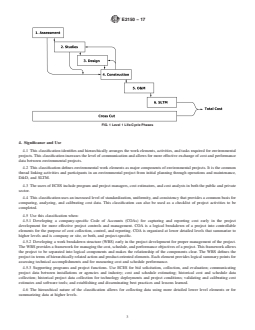
FIG. 1 Level 1 Life-Cycle Phases
4. Significance and Use
4.1 This classification identifies and hierarchically arranges the work elements, activities, and tasks required for environmental
projects. This classification increases the level of communication and allows for more effective exchange of cost and performance
data between environmental projects.
4.2 This classification defines environmental work elements as major components of environmental projects. It is the common
thread linking activities and participants in an environmental project from initial planning through operations and maintenance,
D&D, and SLTM.
4.3 The users of ECES include program and project managers, cost estimators, and cost analysts in both the public and private
sector.
4.4 This classification uses an increased level of standardization, uniformity, and consistency that provides a common basis for
comparing, analyzing, and calibrating cost data. This classification can also be used as a checklist of project activities to be
completed.
4.5 Use this classification when:
4.5.1 Developing a company-specific Code of Accounts (COAs) for capturing and reporting cost early in the project
development for more effective project controls and management. COA is a logical breakdown of a project into controllable
elements for the purpose of cost collection, control, and reporting. COA is organized at lower detailed levels that summarize to
higher levels and is company or site, or both, and project-specific.
4.5.2 Developing a work breakdown structure (WBS) early in the project development for proper management of the project.
The WBS provides a framework for managing the cost, schedule, and performance objectives of a project. This framework allows
the project to be separated into logical components and makes the relationship of the components clear. The WBS defines the
project in terms of hierarchically related action and product-oriented elements. Each element provides logical summary points for
assessing technical accomplishments and for measuring cost and schedule performance.
4.5.3 Supporting programs and project functions. Use ECES for bid solicitation, collection, and evaluation; communicating
project data between installations or agencies and industry; cost and schedule estimating; historical cost and schedule data
collection; historical project data collection for technology deployments and project conditions; validating and calibrating cost
estimates and software tools; and establishing and disseminating best practices and lessons learned.
4.6 The hierarchical nature of the classification allows for collecting data using more detailed lower level elements or for
summarizing data at higher levels.
E2150 − 17
FIG. 2 Hierarchical Organization of ECES Classification Standard
4.7 ECES, as described in this classification, is being included in the Remedial Action Cost Estimating Requirement (RACER)
system and the Environmental Cost Analysis System (ECAS). RACER is used for estimating cost and ECAS is used to collect,
maintain, and analyze the cost of completed projects. Federal agencies performing environmental work intend to incorporate the
ECES.
5. Basis of Classification
5.1 In environmental management work, the life cycle of the project is represented by six different regulatory phases. With
minor variations in the definitions, these life-cycle phases apply to most or all environmental projects including environmental
restoration, waste management, decontamination and decommissioning, ordnance and explosive retrievals, underground storage
tanks (USTs), and aboveground storage tanks (ASTs). In addition to the six regulatory life-cycle phases, a Cross Cut cost category
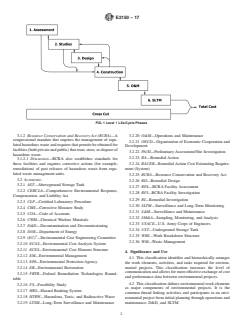
was added to address costs not attributable to a particular phase or to a specific project. Fig. 1 shows the life-cycle nature of
environmental phases. As can be seen from Fig. 1, the phases may not be linear and their sequencing may be iterative since results
from one phase may require the execution of earlier phases again, to meet the regulatory requirement. Additional information on
each of the six Level 1 phases is provided in Fig. X1.1 of Appendix X1. The six regulatory life-cycle phases are Phase 1
(Assessment), Phase 2 (Studies), Phase 3 (Design), Phase 4 (Construction), Phase 5 (Operations and Maintenance), and Phase 6
(Surveillance and Long-Term Monitoring). Cross Cut covers all phases of the lifecycle. Because the combined life-cycle phases
of environmental projects shown in Fig. 1 often span several decades, use life-cycle cost analysis (see Practice E917) for evaluating
an environmental project or project alternatives over a designated study period. Use of life-cycle cost analysis is required for the
comparison of alternative environmental remedies in CERCLA Remedial Investigation/Feasibility Studies which lead up to
Records of Decision.
5.2 Whereas Level 1 depicts the life-cycle phases or timeframe of environmental work, Level 2 of the classification represents
the major work elements that need to be performed in an environmental project. There are thirty-four major work elements
included in Level 2 of the classification. In addition, there is an “Other,” element available for those unique or special tasks that
cannot be described closely by available elements. “Other” elements are designated by .9x numbering system. For the purposes
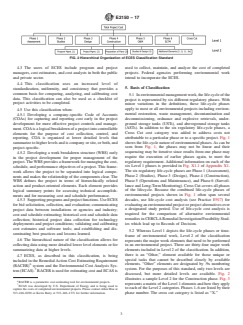
of this standard, only two levels are discussed, but more detailed levels are available. Fig. 2 illustrates a sample Level 2 for the
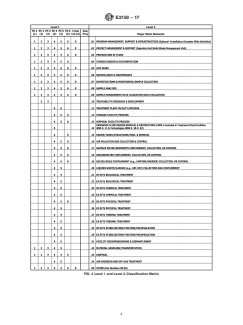
Construction phase. Fig. 3 represents a matrix of the Level 1 elements and how they apply to each of the Level 2 categories.
Phases 1–6 are listed by their phase number. The cross cut category is listed as “X.”
RACER is a parametric cost estimating tool for environmental projects.
ECAS was developed by U.S. Department of Energy and is being used to capture the costs of completed environmental projects. Please contact Allen Moe at
513–246–0230 or Kevin Barry at 513–246–1371 for further information.
E2150 − 17
FIG. 3 Level 1 and Level 2 Classification Matrix
E2150 − 17
5.3 As seen from Fig. 3, the columns on the left-hand side have been reserved for Level 1 life-cycle phases. The numbers in
these columns provide a general guidance on the applicability of that phase to the Level 2 major work elements that are shown
in the two columns under the Major Work Elements heading. For example, the Level 2 element, Preparation of Plans, is marked
with numbers 1, 2, 3, 4, 5, and 6 in the left-hand columns. This means that this element can be applied or conducted during
Phases 1–6. If any of the numbered rows under the column entitled Cross Cut is marked with letter “X,” then that element is
cross-cutting and the costs apply to more than one phase. The numbers are not necessarily all inclusive or definitive. There may
be cases where an element may be applicable to a phase that is not marked or may be marked and not applicable for that specific
project. This structure is flexible, and the user can use other phases even though they are not marked in the columns.
5.4 Positioned between the Cross Cut column and Level 2 is the Sub-Project Identifier that uses the alphabetical designations
from a to z. The purpose of the Sub-Project Identifier is to allow users to differentiate between similar tasks that have the same
designation number. For example, there may be two different Disposal Facility/Process, 4.13 (Level 1—Phase 4 and Level 2—
element .13) to be constructed. To distinguish the first facility from the second, the letters “a” and “b” (that is, “4.a .13” and
“4.b .13”) could be used to designate the first and second facility respectively. The use of the Sub-Project Identifier is not typical
in many environmental projects, but it is included to provide flexibility to the structure.
6. Description of Environmental Cost Elements
6.1 The following describes the Level 1 phases. These descriptions outline what elements are generally included and, as
appropriate, provide guidelines on what is not included. Generic definitions of the phases are included as are more specific
application of the life-cycle phases to various types of environmental projects. Additional information on each of the six Level 1
phases is provided in Fig. X1.1 of Appendix X1.
6.1.1 Below is a generic definition of Level 1 phases.
6.1.1.1 Phase 1: Assessment—Assess and inspect site and prepare site inspection reports.
6.1.1.2 Phase 2: Studies—Risk assessment, characterization and investigations, development and analysis of treatment or
remediation options, and treatability studies.
6.1.1.3 Phase 3: Design—Engineering design and pre-construction activities of treatment or remediation alternatives.
6.1.1.4 Phase 4: Construction—Construction of selected treatment or remediation alternatives. Includes start-up, but excludes
operations.
6.1.1.5 Phase 5: Operations and Maintenance—Includes all operations and maintenance, after startup and testing, for the
selected treatment or remediation alternatives. Examples of O&M activities include inspection of facilities or areas, cost of utilities,
preventive and corrective maintenance, operations of the equipment and facilities, cost of consumable materials, performance
testing, replacement parts, and other miscellaneous activities.
6.1.1.6 Phase 6: Surveillance and Long-Term Monitoring—Activities, conducted after remediation, such as monitoring,
repairing and replacing parts, record keeping, maintenance, and other activities that are required to maintain an adequate level of
human health and environmental protection from hazardous and radioactive waste residues.
6.1.2 The Cross Cut category includes overhead or program-wide activities that are required to implement environmental
projects but which are not specific to a distinct project or phase. The designation X in Level 1 is used to represent those activities
that are not readily segregated into Phases 1–6. These activities are not generally associated with individual projects, but are
essential in order to plan and implement the collected projects that comprise the majority of the program. These activities apply
to both government/owner and prime contractor.
6.1.3 The six phases described in 6.1.1.1 – 6.1.1.6 apply to all environmental projects including environment restoration, waste
management, and facility decontamination and decommissioning projects, but there are slightly different definitions for each. Fig.
4 provides examples of how the phases apply to various project types. The examples are not in any particular order.
6.2 The following sections describe the major elements of work established at Level 2 of the cost classification. These
descriptions indicate what items are included or not included for the element and refer to those elements that are more applicable.
Also note that some of the definitions refer to Level 3 or 4 elements that are available, but not currently included in this standard.
Each element presented below includes the phase number and applicable definition, a list of subordinate elements, and
supplemental notes where required.
6.2.1 (.01) Program Management, Support, and Infrastructure:
6.2.1.1 All Phases—This element includes expenses for main office personnel, overhead, and contract activities associated with
the development of plans and programs for environmental restoration, compliance, waste management, pollution prevention, and
other environmental management activities. Program support includes services rendered by offices and agencies in support of
program planning such as legal, community relations, procurement, and contracting. Contract procurement activities, when the
individual projects are unknown, would be included in this element. Program infrastructure includes overhead elements such as
insurance, interest, fees, rent, warehousing, building maintenance, and equipment maintenance, required to implement
environmental programs. A Government agency, contractor, or other organization may choose to account for its program
management activity costs, including overhead, in this Level 2 element (.01) or may choose to spread such activity under
individual elements (.02 to .34, and .9x) of the structure. If program management costs, including overhead are spread across
E2150 − 17
FIG. 4 Generic Description of Phases by Project Type
individual elements, then this (.01) element should not show any costs. Note that some costs are reported in this element even
though some overhead charges are included in the project. Caution should be used to prevent double counting.
6.2.1.2 Also, for cross cutting activities that cannot be allocated among the phases, the designation X is used to identify that
the cost is distributed for all activities.
6.2.2 (.02) Project Management and Support:
6.2.2.1 All Phases—The Project Management and Support element includes the development of project engineering,
engineering support, and other management activities specific to individual projects. Unlike program management, the costs in this
element cannot be spread over individual elements of the structure. While the definition for this element does not change from
phase to phase, the magnitude of the effort may. For example, project support for community relations may be more predominant
during Phase 2 (Studies). This element includes the project engineering tasks to develop project plans and reports such as cost
estimates, schedules, implementation plans, project control plans and reports, procurement plans, and other project related tasks.
6.2.2.2 Some project management and support elements are performed across numerous phases of the same project or site, and
these project management function costs are captured by using “X” at Level 1. An example of this type of activity is “institution
controls” that takes place at the site-wide level and where costs cannot be clearly allocated to a distinct project. If such costs are
included under Cross Cut, do not include the same cost in the Project Management and Support element.
6.2.3 (.03) Preparation of Plans:
6.2.3.1 All Phases—This element consists of developing all plans necessary to conduct environmental remediation, waste
management, facility D&D, and SLTM projects. When using Phases 1–6, the plans are being prepared for specific projects.
Activities include plan development from the beginning or planning stages to the end or closure of a site or project. The element
work plan is intended to include all work plans (for example, RD or RA work plans) needed for all projects. This task includes
only the effort required to develop the plans. Work such as data acquisition (for example, sample collection and analysis) is not
part of this element. These activities are covered under Level 2 elements .07, .08, and .09.
6.2.3.2 For those situations where the preparation of plans applies to the site and program level, use number “X” at Level 1.
For example, site wide health and safety plan, management plans, technical goals and objectives, and other plans that are prepared
for more than one project. If these types of cost are included under Program Management, Support, and Infrastructure, do not
include them in the Project Management and Support element.
6.2.4 (.04) Studies/Design and Documentation:
6.2.4.1 Phase 1—During Phase 1, the studies work for this element is far more limited. The only study element of significance
during Phase 1 is the Hazard Ranking System (HRS).
6.2.4.2 Phase 2—The Studies/Design and Documentation element includes the development of all studies necessary to conduct
environmental restoration, waste management, or facility D&D projects.
6.2.4.3 Phase 3—All of the design elements (included in the lower levels) address the preliminary, intermediate, pre-final, and
final design. Project design includes design for environmental restoration projects, for decontamination and decommissioning
E2150 − 17
projects, as well as for the design of treatment, storage, and disposal facilities. This element addresses only design work and should
not be confused with the entire design phase. Phase 3 (Design) includes all elements of work during this life-cycle phase (for
example, Program Management, Project Management, Preparation of Plans).
6.2.4.4 Phases 4–6—Includes all design necessary during construction, operations, and during the actual SLTM phases.
6.2.5 (.05) Site Work:
6.2.5.1 All Phases—This element includes activities to establish the physical infrastructure necessary to accomplish the project.
The site work activities are for non-contaminated areas or for “clean-work.” The element includes activities such as access road,
clear and grub, excavation and earthwork, lighting, and other elements needed for site preparation, site improvement, and site
utilities. It should also be noted that technology setup costs sometimes known as freight on board or technology specific
mobilization and demobilization costs are fourth level costs included in the technologies (Level 2 elements .21 to .31, and .34) and
not under site work.
6.2.5.2 For those situations where the site work applies to the site and program level, the users are to use number “X” at Level 1.
For example, road construction and utilities may be common to more than one project. If the costs for this work are included under
Program Management, Support and Infrastructure, do not include them in the Sitework element.
6.2.5.3 For more conventional projects and facilities (for example, office buildings, guard houses, laboratory buildings), refer
to building classifications such as UNIFORMAT II or MasterFormat.
6.2.6 (.06) Surveillance and Maintenance (S&M):
6.2.6.1 All Phases—This element includes activities to ensure acceptable risk to the environment and human health and safety
posed by radiological hazards, chemical munitions, or other hazardous materials inventory of active/inactive waste sites and
facilities. Examples of S&M activities consist of facility transition, indoor and outdoor surveillance and maintenance, inspections,
and other elements.
6.2.6.2 Letter “X” at Level 1 has been reserved for those surveillance and maintenance activities conducted across the program.
For example, this will include S&M activities associated with cumulative impacts for the whole site such as an entire military base
or entire set of facilities.
6.2.7 (.07) Investigations and Monitoring/Sample Collection:
6.2.7.1 Phases 1–3—This element includes the initial site reconnaissance and other generally available site characterization
approaches such as meteorological monitoring. It also includes other site investigation methods including contaminant surveys,
groundwater/surface water geological and soil investigations, and other geophysical investigations. Sample collections for all
media are also included.
6.2.7.2 Phase 4—This element includes other site investigations including contaminant surveys, groundwater/surface water
geological and soil investigations, and other geophysical investigation conducted during Phase 4. The sample collections for all
media are also included.
6.2.7.3 Phases 5 and 6—This element includes all of the field work necessary to conduct on-site investigations of the site’s
physical (for example, geological) characteristics and sample collection during O&M or SLTM.
6.2.8 (.08) Sample Analysis:
6.2.8.1 All Phases—This element addresses the analysis of samples in a laboratory, analysis in mobile facilities, and real-time
analysis of the samples. The analyses for these items are in accordance with the Certified Laboratory Procedures (CLP) when they
are conducted in fully equipped on-site laboratory facilities or off-site laboratory facilities. The mobile analyses (often performed
in a trailer) are less extensive. The real-time analyses are conducted on location, often with instruments that provide an immediate
reading.
6.2.8.2 The user of this structure must exercise caution to determine if costs included for the on-site CLP analyses are burdened
or unburdened. If they are unburdened the user should note whether the overhead costs are included in the element .01, Program
Management, Support, and Infrastructure.
6.2.9 (.09) Sample Management/Data Validation/Data Evaluation:
6.2.9.1 All Phases—This element provides the chain-of-custody for the sample, the quality assurance, usability, and data
analysis. The entire procedure for sample collection through final analysis is addressed. Sample disposal and modeling costs are
included in this element.
6.2.10 (.10) Treatability/Research and Development:
6.2.10.1 Phases 2 and 3—This element includes the technology development testing and evaluation necessary to ensure
successful cleanup implementati
...