

ASTM D7618-13(2021)
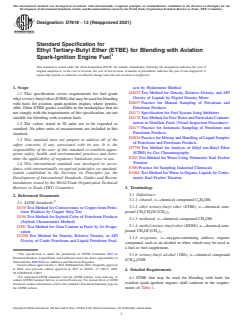
(Specification)Standard Specification for Ethyl Tertiary-Butyl Ether (ETBE) for Blending with Aviation Spark-Ignition Engine Fuel
General Information
- Abstract
ABSTRACT
This specification covers requirements for fuel grade ethyl tertiary-butyl ether (ETBE) that may be used for blending with fuels for aviation spark-ignition engines where permissible. The requirements for ETBE that may be used for blending with fuels for aviation spark-ignition engines are given. The ETBE shall be visually free of undissolved water, sediment, and suspended matter that could render the material unacceptable for the intended application.
SCOPE
1.1 This specification covers requirements for fuel grade ethyl tertiary-butyl ether (ETBE) that may be used for blending with fuels for aviation spark-ignition engines where permissible. Other ETBE grades available in the marketplace that do not comply with the requirements of this specification, are not suitable for blending with aviation fuels.
1.2 The values stated in SI units are to be regarded as standard. No other units of measurement are included in this standard.
1.3 This standard does not purport to address all of the safety concerns, if any, associated with its use. It is the responsibility of the user of this standard to establish appropriate safety, health, and environmental practices and determine the applicability of regulatory limitations prior to use.
1.4 This international standard was developed in accordance with internationally recognized principles on standardization established in the Decision on Principles for the Development of International Standards, Guides and Recommendations issued by the World Trade Organization Technical Barriers to Trade (TBT) Committee.
- Status
- Published
- Publication Date
- 30-Jun-2021
- Technical Committee
- D02 - Petroleum Products, Liquid Fuels, and Lubricants
- Drafting Committee
- D02.J0.04 - Additives and Electrical Properties

Overview
ASTM D7618-13(2021) is the standard specification developed by ASTM International for ethyl tertiary-butyl ether (ETBE) intended for blending with aviation spark-ignition engine fuel. This specification is critical in ensuring that only appropriate grades of ETBE are used in aviation fuels, maintaining safety and performance standards for aviation spark-ignition engines. The document defines requirements for ETBE purity, allowable levels of common contaminants, and physical and chemical properties, reflecting international standardization principles recognized by the World Trade Organization.
Key Topics
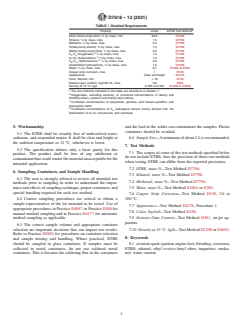
- Purity and Composition: The standard specifies a minimum of 95.0% ETBE by mass, with strict limits on contaminants such as ethanol, methanol, tertiary-butyl alcohol, methyl tertiary-butyl ether, and other oxygenates or hydrocarbons. These requirements help ensure optimal performance and compatibility with aviation fuels.
- Contaminant Control: The specification sets clear maximum permissible levels for water, gum content, and unidentified hydrocarbons, supporting fuel system reliability and safety.
- Physical Characteristics: ETBE must appear clear and bright, free from undissolved water, sediment, or suspended matter, and comply with color and density parameters to confirm acceptable quality at the point of delivery.
- Test Methods: Reference is made to a suite of ASTM test methods for sampling, analysis, and determination of chemical composition, water content, and other critical parameters.
- Safety Considerations: The standard emphasizes the importance of establishing appropriate safety, health, and environmental practices when handling ETBE and using it in fuel blending.
Applications
ASTM D7618-13(2021) is utilized wherever ETBE is blended with aviation spark-ignition engine fuel, such as in small aircraft and general aviation. The specification's detailed limits are designed to:
- Protect Engine Performance: By controlling impurities and component concentrations, the standard safeguards against operational issues like increased vapor pressure, reduced knock performance, and component corrosion or degradation.
- Support Fuel Compatibility: Limiting water content and monitoring the presence of oxygenates and hydrocarbons helps maintain fuel system integrity and stability, preventing phase separation or hazardous residue formation.
- Aid Manufacturers and Blenders: Fuel producers and refiners use this standard to certify ETBE batches for compliance, ensuring consistent fuel quality delivered to the aviation industry.
- Facilitate Regulatory Compliance: The specification supports conformance to both national and international regulatory requirements for aviation fuel safety and composition.
Related Standards
For a thorough approach to ETBE assessment and aviation fuel quality, ASTM D7618-13(2021) references and aligns with several other standards, including:
- ASTM D7796: Analysis of ETBE by gas chromatography
- ASTM D130: Corrosiveness to copper from petroleum products
- ASTM D4176: Free water and particulate contamination (visual inspection)
- ASTM D156: Saybolt color determination
- ASTM D381: Gum content analysis
- ASTM D1298, D4052: Density and relative density measurements
- ASTM E203, E1064: Water content analysis using Karl Fischer titration
- ASTM D4057, E300, D4177, D5854: Sampling and handling of petroleum products
Practical Value
The ASTM D7618-13(2021) standard is crucial for aviation fuel blenders, quality assurance professionals, and regulatory bodies. It establishes uniform benchmarks for ETBE used in aviation fuel compositions, directly enhancing fuel safety, performance consistency, and global interoperability within the aviation sector. Using this standard helps avoid operational disruptions and ensures compliance with internationally recognized fuel quality requirements.
Keywords: ETBE, aviation spark-ignition engine fuel, ASTM D7618, fuel blending, fuel quality, aviation fuel specification, fuel sampling standards, ETBE purity, aviation safety.
Relations
- Effective Date
- 01-Jan-2024
- Effective Date
- 01-Jan-2024
- Effective Date
- 01-Oct-2023
- Effective Date
- 15-Jun-2016
- Effective Date
- 01-Nov-2012
- Effective Date
- 15-May-2012
- Effective Date
- 15-May-2012
- Effective Date
- 01-Apr-2012
- Refers
ASTM D4057-06(2011) - Standard Practice for Manual Sampling of Petroleum and Petroleum Products - Effective Date
- 01-Jun-2011
- Effective Date
- 01-May-2011
- Effective Date
- 01-Nov-2010
- Effective Date
- 01-Jul-2010
- Effective Date
- 01-May-2010
- Effective Date
- 01-Jun-2009
- Effective Date
- 15-Apr-2009
Get Certified
Connect with accredited certification bodies for this standard

Element Materials Technology
Materials testing and product certification.

ABS Group Brazil
ABS Group certification services in Brazil.

ABS Quality Evaluations Inc.
American Bureau of Shipping quality certification.
Sponsored listings
Frequently Asked Questions
ASTM D7618-13(2021) is a technical specification published by ASTM International. Its full title is "Standard Specification for Ethyl Tertiary-Butyl Ether (ETBE) for Blending with Aviation Spark-Ignition Engine Fuel". This standard covers: ABSTRACT This specification covers requirements for fuel grade ethyl tertiary-butyl ether (ETBE) that may be used for blending with fuels for aviation spark-ignition engines where permissible. The requirements for ETBE that may be used for blending with fuels for aviation spark-ignition engines are given. The ETBE shall be visually free of undissolved water, sediment, and suspended matter that could render the material unacceptable for the intended application. SCOPE 1.1 This specification covers requirements for fuel grade ethyl tertiary-butyl ether (ETBE) that may be used for blending with fuels for aviation spark-ignition engines where permissible. Other ETBE grades available in the marketplace that do not comply with the requirements of this specification, are not suitable for blending with aviation fuels. 1.2 The values stated in SI units are to be regarded as standard. No other units of measurement are included in this standard. 1.3 This standard does not purport to address all of the safety concerns, if any, associated with its use. It is the responsibility of the user of this standard to establish appropriate safety, health, and environmental practices and determine the applicability of regulatory limitations prior to use. 1.4 This international standard was developed in accordance with internationally recognized principles on standardization established in the Decision on Principles for the Development of International Standards, Guides and Recommendations issued by the World Trade Organization Technical Barriers to Trade (TBT) Committee.
ABSTRACT This specification covers requirements for fuel grade ethyl tertiary-butyl ether (ETBE) that may be used for blending with fuels for aviation spark-ignition engines where permissible. The requirements for ETBE that may be used for blending with fuels for aviation spark-ignition engines are given. The ETBE shall be visually free of undissolved water, sediment, and suspended matter that could render the material unacceptable for the intended application. SCOPE 1.1 This specification covers requirements for fuel grade ethyl tertiary-butyl ether (ETBE) that may be used for blending with fuels for aviation spark-ignition engines where permissible. Other ETBE grades available in the marketplace that do not comply with the requirements of this specification, are not suitable for blending with aviation fuels. 1.2 The values stated in SI units are to be regarded as standard. No other units of measurement are included in this standard. 1.3 This standard does not purport to address all of the safety concerns, if any, associated with its use. It is the responsibility of the user of this standard to establish appropriate safety, health, and environmental practices and determine the applicability of regulatory limitations prior to use. 1.4 This international standard was developed in accordance with internationally recognized principles on standardization established in the Decision on Principles for the Development of International Standards, Guides and Recommendations issued by the World Trade Organization Technical Barriers to Trade (TBT) Committee.
ASTM D7618-13(2021) is classified under the following ICS (International Classification for Standards) categories: 75.160.20 - Liquid fuels. The ICS classification helps identify the subject area and facilitates finding related standards.
ASTM D7618-13(2021) has the following relationships with other standards: It is inter standard links to ASTM E203-24, ASTM E1064-24, ASTM D156-23, ASTM D4171-16, ASTM D156-12, ASTM D7796-12, ASTM D1298-12a, ASTM D1298-12, ASTM D4057-06(2011), ASTM D4171-11, ASTM D130-10, ASTM D4171-03(2010), ASTM D5854-96(2010), ASTM D4176-04(2009), ASTM D381-09. Understanding these relationships helps ensure you are using the most current and applicable version of the standard.
ASTM D7618-13(2021) is available in PDF format for immediate download after purchase. The document can be added to your cart and obtained through the secure checkout process. Digital delivery ensures instant access to the complete standard document.
Standards Content (Sample)
This international standard was developed in accordance with internationally recognized principles on standardization established in the Decision on Principles for the
Development of International Standards, Guides and Recommendations issued by the World Trade Organization Technical Barriers to Trade (TBT) Committee.
Designation: D7618 −13 (Reapproved 2021)
Standard Specification for
Ethyl Tertiary-Butyl Ether (ETBE) for Blending with Aviation
Spark-Ignition Engine Fuel
This standard is issued under the fixed designation D7618; the number immediately following the designation indicates the year of
original adoption or, in the case of revision, the year of last revision. A number in parentheses indicates the year of last reapproval. A
superscript epsilon (´) indicates an editorial change since the last revision or reapproval.
1. Scope ucts by Hydrometer Method
D4052 Test Method for Density, Relative Density, and API
1.1 This specification covers requirements for fuel grade
Gravity of Liquids by Digital Density Meter
ethyltertiary-butylether(ETBE)thatmaybeusedforblending
D4057 Practice for Manual Sampling of Petroleum and
with fuels for aviation spark-ignition engines where permis-
Petroleum Products
sible. Other ETBE grades available in the marketplace that do
D4171 Specification for Fuel System Icing Inhibitors
not comply with the requirements of this specification, are not
D4176 Test Method for FreeWater and Particulate Contami-
suitable for blending with aviation fuels.
nation in Distillate Fuels (Visual Inspection Procedures)
1.2 The values stated in SI units are to be regarded as
D4177 Practice for Automatic Sampling of Petroleum and
standard. No other units of measurement are included in this
Petroleum Products
standard.
D5854 Practice for Mixing and Handling of Liquid Samples
1.3 This standard does not purport to address all of the
of Petroleum and Petroleum Products
safety concerns, if any, associated with its use. It is the
D7796 Test Method for Analysis of Ethyl tert-Butyl Ether
responsibility of the user of this standard to establish appro-
(ETBE) by Gas Chromatography
priate safety, health, and environmental practices and deter-
E203 Test Method for Water Using Volumetric Karl Fischer
mine the applicability of regulatory limitations prior to use.
Titration
1.4 This international standard was developed in accor-
E300 Practice for Sampling Industrial Chemicals
dance with internationally recognized principles on standard-
E1064 Test Method for Water in Organic Liquids by Coulo-
ization established in the Decision on Principles for the
metric Karl Fischer Titration
Development of International Standards, Guides and Recom-
mendations issued by the World Trade Organization Technical
Barriers to Trade (TBT) Committee.
3. Terminology
3.1 Definitions:
2. Referenced Documents
3.1.1 ethanol, n—chemical compound C H OH.
2 2 5
2.1 ASTM Standards:
D130 Test Method for Corrosiveness to Copper from Petro- 3.1.2 ethyl tertiary-butyl ether (ETBE), n—chemical com-
leum Products by Copper Strip Test pound CH CH OC(CH ) .
3 2 3 3
D156 Test Method for Saybolt Color of Petroleum Products
3.1.3 methanol, n—chemical compound CH OH.
(Saybolt Chromometer Method)
D381 Test Method for Gum Content in Fuels by Jet Evapo- 3.1.4 methyl tertiary-butyl ether (MTBE), n—chemicalcom-
ration pound CH OC(CH ) .
3 3 3
D1298 Test Method for Density, Relative Density, or API
3.1.5 oxygenate, n—oxygen-containing ashless, organic
Gravity of Crude Petroleum and Liquid Petroleum Prod-
compound, such as an alcohol or ether, which may be used as
a fuel or fuel supplement.
This specification is under the jurisdiction of ASTM Committee D02 on
3.1.6 tertiary-butyl alcohol (TBA), n—chemical compound
Petroleum Products, Liquid Fuels, and Lubricants and is the direct responsibility of
(CH ) COH.
Subcommittee D02.J0.04 on Additives and Electrical Properties. 3 3
Current edition approved July 1, 2021. Published July 2021. Originally approved
in 2010. Last previous edition approved in 2017 as D7618 – 13 (2017). DOI:
4. Detailed Requirements
10.1520/D7618-13R21.
For referenced ASTM standards, visit the ASTM website, www.astm.org, or
4.1 ETBE that may be used for blending with fuels for
contact ASTM Customer Service at service@astm.org. For Annual Book of ASTM
aviation spark-ignition engines shall conform to the require-
Standards volume information, refer to the standard’s Document Summary page on
the ASTM website. ments of Table 1.
Copyright © ASTM International, 100 Barr Harbor Drive, PO Box C700, West Conshohocken, PA 19428-2959. United States
D7618 − 13 (2021)
TABLE 1 Detailed Requirements
A
Property Limits ASTM Test Method
Ethyl tertiary-butyl ether, % by mass, min. 95.0 D7796
Ethanol, % by mass, max. 1.5 D7796
Methanol, % by mass, max. 0.3 D7796
Tertiary-butyl alcohol, % by mass, max 1.5 D7796
Methyl tertiary-butyl ether, % by mass, max. 2.0 D7796
B
C -C Oxygenates, % by mass, max. 1.5 D7796
2 4
C
C -C Hydrocarbons, % by mass, max. 1.5 D7796
4 6
D
C -C Hydrocarbons, % by mass, max. 2.0 D7796
8 10
Unidentified hydrocarbons, % by mass, max. 1.0 D7796
Water, % by mass, max. 0.1 E1064 or E203
Copper strip corrosion, max. 1 D130
Appearance Clear and bright D4176
Color, Saybolt, min. + 16 D156
Existent gum content, mg/100 mL, max. 5.0 D381
Density at 15 °C, kg/L 0.735 to 0.755 D1298 or D4052
A
The test methods indicated in this table are referred to in Section 7.
B
Oxygenates, excluding alcohols, of combined concentrations of diethyl and
dimethyl ethers, acetone and methyl ethyl ketone.
C
Combined concentrations of isopentane, pentane, and hexane paraffins, and
isobutylene olefin.
D
Combined concentrations of C isobutylene dimers mainly derived from the
dimerization of C -C compounds, and isooctane.
4 5
5. Workmanship and the lead in the solder can contaminate the samples. Plastic
containers should be avoided.
5.1 The ETBE shall be visually free of undissolved water,
sediment, and suspended matter. It shall be clear and bright at 6.4 SampleSize—Aminimumofabout2 Lisrecommended.
the ambient temperature or 21 °C, whichever is lower.
7. Test Methods
5.2 The specification defines only a basic purity for this
7.1 The scopes of some of the test methods specified below
product. The product shall be free of any adulterant or
do not include ETBE, thus the precision of those test methods
contaminantthatcouldrenderthematerialunacceptableforthe
when testing ETBE can differ from the reported precisions.
intended application.
7.2 ETBE, mass %—Test Method D7796.
6. Sampling, Containers, and Sample Handling
7.3 Ethanol, mass %—Test Method D7796.
6.1 The user is strongly advised to review all intended test
7.4 Methanol, mass %—Test Method D7796.
methods prior to sampling in order to understand the impor-
tance and effects of sampling technique, proper containers, and 7.5 Water, mass %—Test Method E1064 or E203.
special handling required for each test method.
7.6 Copper Strip Corrosion—Test Method D130,2hat
6.2 Correct sampling procedures are critical to obtain a 100 °C.
sample representative of the lot intended to be tested. Use of
7.7 Appearance—Test Method D4176, Procedure 1.
appropriate procedures in Practice D4057 or Practice E300 for
7.8 Color, Saybolt—Test Method D156.
manual method sampling and in Practice D4177 for automatic
method sampling as applicable. 7.9 Existent Gum Content—Test Method D381, air-jet ap-
paratus.
6.3 The correct sample volume and appropriate container
...