

ASTM D1200-23
(Test Method)Standard Test Method for Viscosity by Ford Viscosity Cup
General Information
- Abstract
SIGNIFICANCE AND USE
5.1 This test method is useful for the determination of package and application viscosities of a number of paints and other coatings and in the thinning of these materials, but is limited to Newtonian or near-Newtonian liquids.
5.2 There are other types of apparatus for measuring viscosity in the laboratory that produce more accurate results.
SCOPE
1.1 This test method covers the determination of the viscosity of Newtonian or near-Newtonian paints, varnishes, lacquers, and related liquid materials with the Ford-type efflux viscosity cup. If the material is non-Newtonian, that is, shear-thinning or thixotropic, Test Method D2196 should be used.
1.2 The values stated in SI units are to be regarded as the standard. The values given in parentheses are for information only.
1.3 This standard does not purport to address all of the safety concerns, if any, associated with its use. It is the responsibility of the user of this standard to establish appropriate safety, health, and environmental practices and determine the applicability of regulatory limitations prior to use.
1.4 This international standard was developed in accordance with internationally recognized principles on standardization established in the Decision on Principles for the Development of International Standards, Guides and Recommendations issued by the World Trade Organization Technical Barriers to Trade (TBT) Committee.
- Status
- Published
- Publication Date
- 31-May-2023
- Technical Committee
- D01 - Paint and Related Coatings, Materials, and Applications
- Drafting Committee
- D01.24 - Physical Properties of Liquid Paints & Paint Materials

Overview
ASTM D1200-23: Standard Test Method for Viscosity by Ford Viscosity Cup provides an established procedure for the determination of the viscosity of Newtonian or near-Newtonian paints, varnishes, lacquers, and similar liquid coatings using a Ford-type efflux viscosity cup. This method is widely recognized for its practical application in quality control and material specification environments in the paint and coatings industry. ASTM D1200-23 helps manufacturers, applicators, and laboratories assess product consistency, application properties, and compliance with industry standards.
Key Topics
Scope and Limitations
- Applicable to Newtonian or near-Newtonian liquids; not suitable for non-Newtonian (shear-thinning or thixotropic) materials.
- Utilizes a Ford viscosity cup with designated orifices for measurement.
- Standard test temperature is 25°C (77°F) unless otherwise agreed.
- Results are limited in precision compared to other laboratory methods, but offer valuable on-site and production-level viscosity assessment.
Test Procedure Essentials
- The Ford cup is filled level with the test liquid.
- Efflux time (in seconds) is measured as the liquid flows through the cup’s orifice.
- Appropriate cup size is selected based on the expected viscosity range for accurate results.
- The test is conducted in a draft-free, temperature-controlled environment.
Calibration and Quality Control
- Regular calibration of Ford cups is required to maintain measurement accuracy.
- Use of certified viscosity standards and adherence to maintenance procedures, such as gentle cleaning and inspection for orifice wear, are critical.
- Corrections are applied if the cup deviates from standard viscosity performance by more than 10%.
Reporting Requirements
- Viscosity values must be reported with efflux time, cup number, test temperature, and sample handling notes, supporting repeatability and reproducibility.
Applications
Paints and Coating Manufacturing
- Used for batch quality control to ensure viscosity remains within desired specifications for application or packaging.
- Facilitates production adjustments, such as thinning, to achieve optimal application characteristics and drying performance.
Application Suitability
- Assists end users (painters, contractors) in determining if a product is suitable for specific tools or techniques (e.g., spraying, brushing).
- Provides practical data for field and shop floor settings where standardized, rapid viscosity checks are needed.
Product Development and Comparison
- Enables benchmarking and formulation adjustments during development and testing of new coatings.
- Used in comparative testing between different lots, formulations, or brands to ensure consistency.
Related Standards
- ASTM D2196: Test Methods for Rheological Properties of Non-Newtonian Materials by Rotational Viscometer - Recommended for shear-thinning or thixotropic materials not suitable for Ford cup testing.
- ASTM E1: Specification for ASTM Liquid-in-Glass Thermometers - Covers thermometer requirements for temperature measurement in viscosity tests.
Keywords: ASTM D1200-23, Ford viscosity cup, viscosity test method, Newtonian liquids, paints and coatings, efflux viscosity, quality control, laboratory standard, liquid coatings testing.
Relations
- Effective Date
- 01-Jun-2018
- Effective Date
- 01-May-2013
- Effective Date
- 01-Jul-2010
- Effective Date
- 01-Nov-2007
- Effective Date
- 01-Nov-2005
- Effective Date
- 01-Jul-2005
- Effective Date
- 01-Nov-2003
- Effective Date
- 10-May-2003
- Effective Date
- 10-Oct-2001
- Effective Date
- 10-Oct-2001
- Effective Date
- 10-Oct-2001
- Effective Date
- 10-Apr-1999
Frequently Asked Questions
ASTM D1200-23 is a standard published by ASTM International. Its full title is "Standard Test Method for Viscosity by Ford Viscosity Cup". This standard covers: SIGNIFICANCE AND USE 5.1 This test method is useful for the determination of package and application viscosities of a number of paints and other coatings and in the thinning of these materials, but is limited to Newtonian or near-Newtonian liquids. 5.2 There are other types of apparatus for measuring viscosity in the laboratory that produce more accurate results. SCOPE 1.1 This test method covers the determination of the viscosity of Newtonian or near-Newtonian paints, varnishes, lacquers, and related liquid materials with the Ford-type efflux viscosity cup. If the material is non-Newtonian, that is, shear-thinning or thixotropic, Test Method D2196 should be used. 1.2 The values stated in SI units are to be regarded as the standard. The values given in parentheses are for information only. 1.3 This standard does not purport to address all of the safety concerns, if any, associated with its use. It is the responsibility of the user of this standard to establish appropriate safety, health, and environmental practices and determine the applicability of regulatory limitations prior to use. 1.4 This international standard was developed in accordance with internationally recognized principles on standardization established in the Decision on Principles for the Development of International Standards, Guides and Recommendations issued by the World Trade Organization Technical Barriers to Trade (TBT) Committee.
SIGNIFICANCE AND USE 5.1 This test method is useful for the determination of package and application viscosities of a number of paints and other coatings and in the thinning of these materials, but is limited to Newtonian or near-Newtonian liquids. 5.2 There are other types of apparatus for measuring viscosity in the laboratory that produce more accurate results. SCOPE 1.1 This test method covers the determination of the viscosity of Newtonian or near-Newtonian paints, varnishes, lacquers, and related liquid materials with the Ford-type efflux viscosity cup. If the material is non-Newtonian, that is, shear-thinning or thixotropic, Test Method D2196 should be used. 1.2 The values stated in SI units are to be regarded as the standard. The values given in parentheses are for information only. 1.3 This standard does not purport to address all of the safety concerns, if any, associated with its use. It is the responsibility of the user of this standard to establish appropriate safety, health, and environmental practices and determine the applicability of regulatory limitations prior to use. 1.4 This international standard was developed in accordance with internationally recognized principles on standardization established in the Decision on Principles for the Development of International Standards, Guides and Recommendations issued by the World Trade Organization Technical Barriers to Trade (TBT) Committee.
ASTM D1200-23 is classified under the following ICS (International Classification for Standards) categories: 87.040 - Paints and varnishes. The ICS classification helps identify the subject area and facilitates finding related standards.
ASTM D1200-23 has the following relationships with other standards: It is inter standard links to ASTM D2196-18, ASTM E1-13, ASTM D2196-10, ASTM E1-07, ASTM E1-05, ASTM D2196-05, ASTM E1-03a, ASTM E1-03, ASTM E1-01, ASTM E1-98e1, ASTM E1-98, ASTM D2196-99. Understanding these relationships helps ensure you are using the most current and applicable version of the standard.
ASTM D1200-23 is available in PDF format for immediate download after purchase. The document can be added to your cart and obtained through the secure checkout process. Digital delivery ensures instant access to the complete standard document.
Standards Content (Sample)
This international standard was developed in accordance with internationally recognized principles on standardization established in the Decision on Principles for the
Development of International Standards, Guides and Recommendations issued by the World Trade Organization Technical Barriers to Trade (TBT) Committee.
Designation: D1200 − 23
Standard Test Method for
Viscosity by Ford Viscosity Cup
This standard is issued under the fixed designation D1200; the number immediately following the designation indicates the year of
original adoption or, in the case of revision, the year of last revision. A number in parentheses indicates the year of last reapproval. A
superscript epsilon (´) indicates an editorial change since the last revision or reapproval.
This standard has been approved for use by agencies of the U.S. Department of Defense.
1. Scope 3.1.1 Newtonian liquid, n—a liquid in which the viscosity is
independent of the shear stress or shear rate. If the ratio of
1.1 This test method covers the determination of the viscos-
shear stress to shear rate is not constant, the liquid is non-
ity of Newtonian or near-Newtonian paints, varnishes,
Newtonian.
lacquers, and related liquid materials with the Ford-type efflux
3.1.2 Near-Newtonian liquid, n—a liquid in which the
viscosity cup. If the material is non-Newtonian, that is,
variation of viscosity with shear rate is small and the effect on
shear-thinning or thixotropic, Test Method D2196 should be
viscosity of mechanical disturbances such as stirring is negli-
used.
gible.
1.2 The values stated in SI units are to be regarded as the
standard. The values given in parentheses are for information
4. Summary of Test Method
only.
4.1 The Ford viscosity cup is filled level full with the liquid
1.3 This standard does not purport to address all of the
under test, and the time for the material to flow through one of
safety concerns, if any, associated with its use. It is the
the standard orifices is measured.
responsibility of the user of this standard to establish appro-
priate safety, health, and environmental practices and deter-
5. Significance and Use
mine the applicability of regulatory limitations prior to use.
5.1 This test method is useful for the determination of
1.4 This international standard was developed in accor-
package and application viscosities of a number of paints and
dance with internationally recognized principles on standard-
other coatings and in the thinning of these materials, but is
ization established in the Decision on Principles for the
limited to Newtonian or near-Newtonian liquids.
Development of International Standards, Guides and Recom-
mendations issued by the World Trade Organization Technical
5.2 There are other types of apparatus for measuring vis-
Barriers to Trade (TBT) Committee.
cosity in the laboratory that produce more accurate results.
2. Referenced Documents
6. Apparatus
2.1 ASTM Standards:
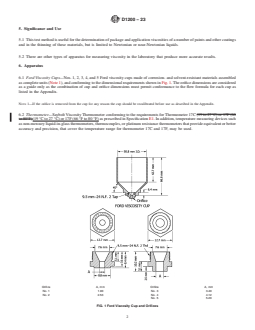
6.1 Ford Viscosity Cups—Nos. 1, 2, 3, 4, and 5 Ford
D2196 Test Methods for Rheological Properties of Non-
viscosity cups made of corrosion- and solvent-resistant mate-
Newtonian Materials by Rotational Viscometer
rials assembled as complete units (Note 1), and conforming to
E1 Specification for ASTM Liquid-in-Glass Thermometers
the dimensional requirements shown in Fig. 1. The orifice
dimensions are considered as a guide only as the combination
3. Terminology
of cup and orifice dimensions must permit conformance to the
flow formula for each cup as listed in the Appendix.
3.1 Definitions:
NOTE 1—If the orifice is removed from the cup for any reason the cup
should be recalibrated before use as described in the Appendix.
This test method is under the jurisdiction of ASTM Committee D01 on Paint
6.2 Thermometer—Saybolt Viscosity Thermometer con-
and Related Coatings, Materials, and Applications and is the direct responsibility of
forming to the requirements for Thermometer 17C (19 °C to
Subcommittee D01.24 on Physical Properties of Liquid Paints & Paint Materials.
27 °C) or 17F (66 °F to 80 °F) as prescribed in Specification
Current edition approved June 1, 2023. Published June 2023. Originally
E1. In addition, temperature measuring devices such as non-
approved in 1952. Last previous edition approved in 2018 as D1200 – 10 (2018).
DOI: 10.1520/D1200-23.
mercury liquid-in-glass thermometers, thermocouples, or plati-
For referenced ASTM standards, visit the ASTM website, www.astm.org, or
num resistance thermometers that provide equivalent or better
contact ASTM Customer Service at service@astm.org. For Annual Book of ASTM
accuracy and precision, that cover the temperature range for
Standards volume information, refer to the standard’s Document Summary page on
the ASTM website. thermometer 17C and 17F, may be used.
Copyright © ASTM International, 100 Barr Harbor Drive, PO Box C700, West Conshohocken, PA 19428-2959. United States
D1200 − 23
10. Conditioning
10.1 Bring the material to a temperature a few degrees
below that desired and then agitate vigorously for 10 min on a
reciprocating shaker in a pint can two-thirds full. Allow to
stand undisturbed for 10 min while adjusting further to the
desired temperature. Make the viscosity determination at the
end of the 10 min period.
11. Procedure
11.1 Make viscosity determinations in a room free of drafts
and rapid changes in temperature. For the highest degree of
precision the room temperature should be between 22 °C and
28 °C (72 °F and 82 °F). Determinations should be made at a
temperature above the dew point of the atmosphere surround-
ing the apparatus.
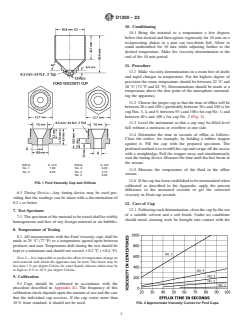
11.2 Choose the proper cup so that the time of efflux will be
between 20 s and 100 s (preferably between 30 s and 100 s) for
cup Nos. 3, 4, and 5; between 55 s and 100 s for cup No. 1; and
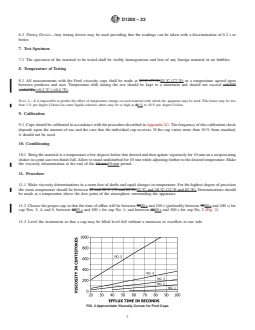
between 40 s and 100 s for cup No. 2 (Fig. 2).
11.3 Level the instrument so that a cup may be filled level
full without a meniscus or overflow at one side.
11.4 Determine the time in seconds of efflux as follows:
Close the orifice, for example, by holding a rubber stopper
against it. Fill the cup with the prepared specimen. The
preferred method is to overfill the cup and scrape off the excess
with a straightedge. Pull the stopper away and simultaneously
start the timing device. Measure the time until the first break in
the stream.
Orifice A, mm Orifice A, mm
No. 1 1.90 No. 3 3.40
11.5 Measure the temperature of the fluid in the efflux
No. 2 2.53 No. 4 4.12
stream.
No. 5 5.20
11.6 If the cup has been established to be nonstandard when
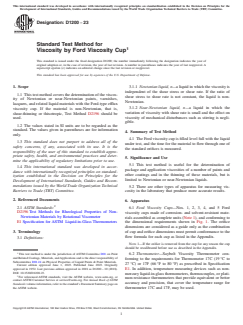
FIG. 1 Ford Viscosity Cup and Orifices
calibrated as described in the Appendix, apply the percent
difference to the measured seconds to get the corrected
6.3 Timing Device—Any timing device may be used pro-
viscosity in Ford-cup seconds.
viding that the readings can
...
This document is not an ASTM standard and is intended only to provide the user of an ASTM standard an indication of what changes have been made to the previous version. Because
it may not be technically possible to adequately depict all changes accurately, ASTM recommends that users consult prior editions as appropriate. In all cases only the current version
of the standard as published by ASTM is to be considered the official document.
Designation: D1200 − 10 (Reapproved 2018) D1200 − 23
Standard Test Method for
Viscosity by Ford Viscosity Cup
This standard is issued under the fixed designation D1200; the number immediately following the designation indicates the year of
original adoption or, in the case of revision, the year of last revision. A number in parentheses indicates the year of last reapproval. A
superscript epsilon (´) indicates an editorial change since the last revision or reapproval.
This standard has been approved for use by agencies of the U.S. Department of Defense.
1. Scope
1.1 This test method covers the determination of the viscosity of Newtonian or near-Newtonian paints, varnishes, lacquers, and
related liquid materials with the Ford-type efflux viscosity cup. If the material is non-Newtonian, that is, shear-thinning or
thixotropic, Test Method D2196 should be used.
1.2 The values stated in SI units are to be regarded as the standard. The values given in parentheses are for information only.
1.3 This standard does not purport to address all of the safety concerns, if any, associated with its use. It is the responsibility
of the user of this standard to establish appropriate safety, health, and environmental practices and determine the applicability of
regulatory limitations prior to use.
1.4 This international standard was developed in accordance with internationally recognized principles on standardization
established in the Decision on Principles for the Development of International Standards, Guides and Recommendations issued
by the World Trade Organization Technical Barriers to Trade (TBT) Committee.
2. Referenced Documents
2.1 ASTM Standards:
D2196 Test Methods for Rheological Properties of Non-Newtonian Materials by Rotational Viscometer
E1 Specification for ASTM Liquid-in-Glass Thermometers
3. Terminology
3.1 Definitions:
3.1.1 Newtonian liquid, n—a liquid in which the viscosity is independent of the shear stress or shear rate. If the ratio of shear stress
to shear rate is not constant, the liquid is non-Newtonian.
3.1.2 Near-Newtonian liquid, n—a liquid in which the variation of viscosity with shear rate is small and the effect on viscosity
of mechanical disturbances such as stirring is negligible.
4. Summary of Test Method
4.1 The Ford viscosity cup is filled level full with the liquid under test, and the time for the material to flow through one of the
standard orifices is measured.
This test method is under the jurisdiction of ASTM Committee D01 on Paint and Related Coatings, Materials, and Applications and is the direct responsibility of
Subcommittee D01.24 on Physical Properties of Liquid Paints & Paint Materials.
Current edition approved Nov. 1, 2018June 1, 2023. Published December 2018June 2023. Originally approved in 1952. Last previous edition approved in 20142018 as
D1200 – 10 (2014).(2018). DOI: 10.1520/D1200-10R18.10.1520/D1200-23.
For referenced ASTM standards, visit the ASTM website, www.astm.org, or contact ASTM Customer Service at service@astm.org. For Annual Book of ASTM Standards
volume information, refer to the standard’s Document Summary page on the ASTM website.
Copyright © ASTM International, 100 Barr Harbor Drive, PO Box C700, West Conshohocken, PA 19428-2959. United States
D1200 − 23
5. Significance and Use
5.1 This test method is useful for the determination of package and application viscosities of a number of paints and other coatings
and in the thinning of these materials, but is limited to Newtonian or near-Newtonian liquids.
5.2 There are other types of apparatus for measuring viscosity in the laboratory that produce more accurate results.
6. Apparatus
6.1 Ford Viscosity Cups—Nos. 1, 2, 3, 4, and 5 Ford viscosity cups made of corrosion- and solvent-resistant materials assembled
as complete units (Note 1), and conforming to the dimensional requirements shown in Fig. 1. The orifice dimensions are considered
as a guide only as the combination of cup and orifice dimensions must permit conformance to the flow formula for each cup as
listed in the Appendix.
NOTE 1—If the orifice is removed from the cup for any reason the cup should be recalibrated before use as described in the Appendix.
6.2 Thermometer—Saybolt Viscosity Thermometer conforming to the requirements for Thermometer 17C (19 to 27°C) or 17F (66
to 80°F)(19 °C to 27 °C) or 17F (66 °F to 80 °F) as prescribed in Specification E1. In addition, temperature measuring devices such
as non-mercury liquid-in-glass thermometers, thermocouples, or platinum resistance thermometers that provide equivalent or better
accuracy and precision, that cover the temperature range for thermometer 17C and 17F, may be used.
Orifice A, mm Orifice A, mm
No. 1 1.90 No. 3 3.40
No. 2 2.53 No. 4 4.12
No. 5 5.20
FIG. 1 Ford Viscosity Cup and Orifices
D1200 − 23
6.3 Timing Device—Any timing device may be used providing that the readings can be taken with a discrimination of 0.2 s or
better.
7. Test Specimen
7.1 The specimen of the material to be tested shall be visibly homogeneous and free of any foreign material or air bubbles.
8. Temperature of Testing
8.1 All measurements with the Ford viscosity cups shall be made at 25°C (77°F)25 °C (77 °F) or a temperature agreed upon
between producer and user. Temperature drift during the test should be kept to a minimum and should not exceed 60.2°C
(60.4°F).60.2 °C (60.4 °F).
NOTE 2— It is impossible to predict the effect of temperature change on each material with which the apparatus may be used. This factor may be less
than 1 % per degree Celsius for some liquids whereas others may be as high as 88 % to 10 % per degree Celsius.
9. Calibration
9.1 Cups should be calibrated in accordance with the procedure described in Appendix X1. The frequency of this calibration check
depends upon the amount of use and the care that the individual cup receives. If the cup varies more than 10 % from standard,
it should not be used.
10. Conditioning
10.1 Bring the material to a temperature a few degrees below that desired and then agitate vigorously for 10 min on a reciprocating
shaker in a pint can two-thirds full. Allow to stand undisturbed for 10 min while adjusting further to the desired temperature. Make
the viscosity determination at the end of the 10-min10 min period.
11. Procedure
11.1 Make viscosity determinations in a room free of drafts and rapid changes in temperature. For the highest degree of precision
the room temperature should be between 22 and 28°C (72 and 82°F).22 °C and 28 °C (72 °F
...