

ASTM D6567-23
(Test Method)Standard Test Method for Measuring the Light Penetration of a Rolled Erosion Control Product (RECP)
General Information
- Abstract
SIGNIFICANCE AND USE
5.1 Light penetration may be used to control the quality of many RECPs. Light penetration has not been proven to relate to field performance for all materials.
5.2 The light penetration of RECPs may vary considerably, depending on the composite materials used in the matrix of the mat or due to inconsistency within a given mat. To minimize variation, specific sample size and procedures are indicated in this test method to help ensure comparable results.
5.3 This test method may be used to determine the effect of different composite materials and makeup of RECPs on the penetration of light.
5.4 This test method may be used for acceptance testing of commercial shipments of RECPs. Comparative tests as directed in 5.4.1 may be advisable.
5.4.1 In case of a dispute arising from differences in reported test results when using this test method for acceptance testing of commercial shipments, the purchaser and the supplier should conduct comparative tests to determine if there is a statistical bias between their laboratories. Competent statistical assistance is recommended for the investigation of bias. At a minimum, the two parties should take a group of test specimens that are as homogeneous as possible and that are formed from a lot of material of the type in question. The test specimens should be randomly assigned in equal numbers to each laboratory for testing. The average results from the two laboratories should be compared using Student’s t-test for unpaired data and an acceptable probability level chosen by the two begun. If bias is found, either its cause must be corrected, or the purchaser and supplier must agree upon the known bias.
Note 1: The light penetration has no definitive relationship to the amount of ground cover provided by a RECP, as the amount of light penetration may include light passing through translucent elements or light deflecting off of elements of the RECP structure. Thus, this test method is not intended to be used to determine a...
SCOPE
1.1 This test method covers measuring the amount of light that penetrates through a rolled erosion control product.
1.2 This test method does not provide light penetration values for RECPs under variable normal sun and soil conditions. This test method determines nominal light penetration.
1.3 This test method is not to be used to determine a percent ground cover value for RECPs, as the amount of light penetration may include light passing through translucent material or reflecting off surfaces.
1.4 The values stated as a percentage are to be regarded as the standard. The values provided in footcandles are for information only.
1.5 This standard does not purport to address all of the safety concerns, if any, associated with its use. It is the responsibility of the user of this standard to establish appropriate safety, health, and environmental practices and determine the applicability of regulatory limitations prior to use.
1.6 This international standard was developed in accordance with internationally recognized principles on standardization established in the Decision on Principles for the Development of International Standards, Guides and Recommendations issued by the World Trade Organization Technical Barriers to Trade (TBT) Committee.
- Status
- Published
- Publication Date
- 31-Oct-2023
- Technical Committee
- D35 - Geosynthetics
- Drafting Committee
- D35.05 - Geosynthetic Erosion Control
Buy Documents
ASTM D6567-23 - Standard Test Method for Measuring the Light Penetration of a Rolled Erosion Control Product (RECP)
REDLINE ASTM D6567-23 - Standard Test Method for Measuring the Light Penetration of a Rolled Erosion Control Product (RECP)
Overview
ASTM D6567-23: Standard Test Method for Measuring the Light Penetration of a Rolled Erosion Control Product (RECP) provides a widely recognized methodology for determining the nominal amount of light that passes through rolled erosion control products. Published by ASTM International, this standard supports the assessment and quality control of RECPs, which play a critical role in soil stabilization and erosion prevention in civil engineering and environmental management projects.
This test method quantifies light penetration as the percentage of incident light that is transmitted through the material. The procedure is designed to deliver consistent, comparable results across RECP samples by defining sample selection, test conditions, and calculation of results.
Key Topics
Purpose of Light Penetration Testing
- Controls the quality of RECP products.
- Assesses effects of different composite materials and configurations on light transmission.
- Provides data for quality assurance in production and shipment of RECPs.
Limitations of the Method
- Not designed to measure light penetration under variable outdoor conditions (natural sunlight or soil contact).
- Does not determine percent ground cover, as readings may be affected by translucency or reflectivity of RECP components.
Sampling and Repeatability
- Specifies standard specimen sizes and sampling procedures to minimize variability.
- Recommends procedures for resolving disputes over test results, including comparative laboratory tests and statistical analysis.
Test Apparatus and Measurement
- Utilizes a light penetration box with a controlled light source (incandescent or equivalent LED) and a calibrated light meter.
- Measurements are expressed as a percentage, with footcandle values for informational purposes.
Applications
ASTM D6567-23 is most often utilized by manufacturers, suppliers, and engineers who need to:
- Perform quality control during RECP production, ensuring uniformity and regulatory compliance.
- Evaluate the influence of material design changes (such as varying fiber types or mat thickness) on light penetration.
- Conduct acceptance testing for commercial shipments of RECPs, underpinning fair supplier-customer transactions.
- Support research and development efforts in improving or customizing erosion control solutions for specific projects.
The standard also plays a role in laboratory-based dispute resolution, where data comparability across independent labs is crucial. Its consistent methodology allows stakeholders to accurately assess whether RECPs meet required performance criteria before field deployment.
Related Standards
For effective implementation and interpretation, the following ASTM standards are frequently referenced alongside ASTM D6567-23:
- ASTM D123: Terminology Relating to Textiles - defines key terms for clarity in testing textiles, including geosynthetics.
- ASTM D4354: Sampling of Geosynthetics and RECPs for Testing - outlines methods for appropriate sampling.
- ASTM D4439: Terminology for Geosynthetics - ensures common understanding across geosynthetic testing.
- ASTM E177: Precision and Bias in ASTM Test Methods - guides statistical analysis of test results.
- ASTM E691: Conducting Interlaboratory Studies - supports precision assessments and laboratory collaboration.
Practical Value
Adhering to ASTM D6567-23 supports standardized, repeatable measurement of light penetration in RECPs, enabling more transparent quality assurance processes within the erosion control industry. This, in turn, helps engineers, manufacturers, and project managers make informed decisions about product selection and compliance, minimizing risks related to material performance and contract fulfillment.
Keywords: ASTM D6567-23, light penetration, rolled erosion control product, RECP, geosynthetics, quality control, erosion prevention, ASTM standard, laboratory testing, sampling, acceptance testing.
Relations
- Effective Date
- 01-Nov-2023
- Effective Date
- 01-Feb-2024
- Effective Date
- 15-Jul-2023
- Effective Date
- 01-Nov-2023
- Effective Date
- 01-Nov-2023
- Effective Date
- 01-Nov-2023
- Effective Date
- 01-Nov-2023
Buy Documents
ASTM D6567-23 - Standard Test Method for Measuring the Light Penetration of a Rolled Erosion Control Product (RECP)
REDLINE ASTM D6567-23 - Standard Test Method for Measuring the Light Penetration of a Rolled Erosion Control Product (RECP)
Get Certified
Connect with accredited certification bodies for this standard

Control Union Certifications
Global certification for agriculture and sustainability.

ECOCERT
Organic and sustainability certification.

FSC International
Forest Stewardship Council certification.
Sponsored listings
Frequently Asked Questions
ASTM D6567-23 is a standard published by ASTM International. Its full title is "Standard Test Method for Measuring the Light Penetration of a Rolled Erosion Control Product (RECP)". This standard covers: SIGNIFICANCE AND USE 5.1 Light penetration may be used to control the quality of many RECPs. Light penetration has not been proven to relate to field performance for all materials. 5.2 The light penetration of RECPs may vary considerably, depending on the composite materials used in the matrix of the mat or due to inconsistency within a given mat. To minimize variation, specific sample size and procedures are indicated in this test method to help ensure comparable results. 5.3 This test method may be used to determine the effect of different composite materials and makeup of RECPs on the penetration of light. 5.4 This test method may be used for acceptance testing of commercial shipments of RECPs. Comparative tests as directed in 5.4.1 may be advisable. 5.4.1 In case of a dispute arising from differences in reported test results when using this test method for acceptance testing of commercial shipments, the purchaser and the supplier should conduct comparative tests to determine if there is a statistical bias between their laboratories. Competent statistical assistance is recommended for the investigation of bias. At a minimum, the two parties should take a group of test specimens that are as homogeneous as possible and that are formed from a lot of material of the type in question. The test specimens should be randomly assigned in equal numbers to each laboratory for testing. The average results from the two laboratories should be compared using Student’s t-test for unpaired data and an acceptable probability level chosen by the two begun. If bias is found, either its cause must be corrected, or the purchaser and supplier must agree upon the known bias. Note 1: The light penetration has no definitive relationship to the amount of ground cover provided by a RECP, as the amount of light penetration may include light passing through translucent elements or light deflecting off of elements of the RECP structure. Thus, this test method is not intended to be used to determine a... SCOPE 1.1 This test method covers measuring the amount of light that penetrates through a rolled erosion control product. 1.2 This test method does not provide light penetration values for RECPs under variable normal sun and soil conditions. This test method determines nominal light penetration. 1.3 This test method is not to be used to determine a percent ground cover value for RECPs, as the amount of light penetration may include light passing through translucent material or reflecting off surfaces. 1.4 The values stated as a percentage are to be regarded as the standard. The values provided in footcandles are for information only. 1.5 This standard does not purport to address all of the safety concerns, if any, associated with its use. It is the responsibility of the user of this standard to establish appropriate safety, health, and environmental practices and determine the applicability of regulatory limitations prior to use. 1.6 This international standard was developed in accordance with internationally recognized principles on standardization established in the Decision on Principles for the Development of International Standards, Guides and Recommendations issued by the World Trade Organization Technical Barriers to Trade (TBT) Committee.
SIGNIFICANCE AND USE 5.1 Light penetration may be used to control the quality of many RECPs. Light penetration has not been proven to relate to field performance for all materials. 5.2 The light penetration of RECPs may vary considerably, depending on the composite materials used in the matrix of the mat or due to inconsistency within a given mat. To minimize variation, specific sample size and procedures are indicated in this test method to help ensure comparable results. 5.3 This test method may be used to determine the effect of different composite materials and makeup of RECPs on the penetration of light. 5.4 This test method may be used for acceptance testing of commercial shipments of RECPs. Comparative tests as directed in 5.4.1 may be advisable. 5.4.1 In case of a dispute arising from differences in reported test results when using this test method for acceptance testing of commercial shipments, the purchaser and the supplier should conduct comparative tests to determine if there is a statistical bias between their laboratories. Competent statistical assistance is recommended for the investigation of bias. At a minimum, the two parties should take a group of test specimens that are as homogeneous as possible and that are formed from a lot of material of the type in question. The test specimens should be randomly assigned in equal numbers to each laboratory for testing. The average results from the two laboratories should be compared using Student’s t-test for unpaired data and an acceptable probability level chosen by the two begun. If bias is found, either its cause must be corrected, or the purchaser and supplier must agree upon the known bias. Note 1: The light penetration has no definitive relationship to the amount of ground cover provided by a RECP, as the amount of light penetration may include light passing through translucent elements or light deflecting off of elements of the RECP structure. Thus, this test method is not intended to be used to determine a... SCOPE 1.1 This test method covers measuring the amount of light that penetrates through a rolled erosion control product. 1.2 This test method does not provide light penetration values for RECPs under variable normal sun and soil conditions. This test method determines nominal light penetration. 1.3 This test method is not to be used to determine a percent ground cover value for RECPs, as the amount of light penetration may include light passing through translucent material or reflecting off surfaces. 1.4 The values stated as a percentage are to be regarded as the standard. The values provided in footcandles are for information only. 1.5 This standard does not purport to address all of the safety concerns, if any, associated with its use. It is the responsibility of the user of this standard to establish appropriate safety, health, and environmental practices and determine the applicability of regulatory limitations prior to use. 1.6 This international standard was developed in accordance with internationally recognized principles on standardization established in the Decision on Principles for the Development of International Standards, Guides and Recommendations issued by the World Trade Organization Technical Barriers to Trade (TBT) Committee.
ASTM D6567-23 is classified under the following ICS (International Classification for Standards) categories: 65.020.20 - Plant growing. The ICS classification helps identify the subject area and facilitates finding related standards.
ASTM D6567-23 has the following relationships with other standards: It is inter standard links to ASTM D6567-18, ASTM D4439-24, ASTM D4439-23b, ASTM D8298/D8298M-23, ASTM D8297/D8297M-23, ASTM D6460-19, ASTM D6459-19. Understanding these relationships helps ensure you are using the most current and applicable version of the standard.
ASTM D6567-23 is available in PDF format for immediate download after purchase. The document can be added to your cart and obtained through the secure checkout process. Digital delivery ensures instant access to the complete standard document.
Standards Content (Sample)
This international standard was developed in accordance with internationally recognized principles on standardization established in the Decision on Principles for the
Development of International Standards, Guides and Recommendations issued by the World Trade Organization Technical Barriers to Trade (TBT) Committee.
Designation: D6567 − 23
Standard Test Method for
Measuring the Light Penetration of a Rolled Erosion Control
Product (RECP)
This standard is issued under the fixed designation D6567; the number immediately following the designation indicates the year of
original adoption or, in the case of revision, the year of last revision. A number in parentheses indicates the year of last reapproval. A
superscript epsilon (´) indicates an editorial change since the last revision or reapproval.
1. Scope E177 Practice for Use of the Terms Precision and Bias in
ASTM Test Methods
1.1 This test method covers measuring the amount of light
E691 Practice for Conducting an Interlaboratory Study to
that penetrates through a rolled erosion control product.
Determine the Precision of a Test Method
1.2 This test method does not provide light penetration
values for RECPs under variable normal sun and soil condi- 3. Terminology
tions. This test method determines nominal light penetration.
3.1 Definitions:
1.3 This test method is not to be used to determine a percent 3.1.1 light penetration, n—the percent of light incident on
ground cover value for RECPs, as the amount of light
the front surface of a material that is emitted from the back
penetration may include light passing through translucent surface of the material.
material or reflecting off surfaces.
3.2 For definitions of other textile terms used in this test
1.4 The values stated as a percentage are to be regarded as method, refer to Terminology D123.
the standard. The values provided in footcandles are for
3.3 For definitions of other terms relating to geotextiles and
information only.
geomembranes used in this test method, refer to Terminology
1.5 This standard does not purport to address all of the
D4439.
safety concerns, if any, associated with its use. It is the
4. Summary of Test Method
responsibility of the user of this standard to establish appro-
priate safety, health, and environmental practices and deter-
4.1 The nominal light penetration of RECPs is determined
mine the applicability of regulatory limitations prior to use.
by the meter reading in footcandles with and without place-
1.6 This international standard was developed in accor-
ment of the specimen in a determined location between the
dance with internationally recognized principles on standard-
light source and the meter.
ization established in the Decision on Principles for the
5. Significance and Use
Development of International Standards, Guides and Recom-
mendations issued by the World Trade Organization Technical
5.1 Light penetration may be used to control the quality of
Barriers to Trade (TBT) Committee.
many RECPs. Light penetration has not been proven to relate
to field performance for all materials.
2. Referenced Documents
5.2 The light penetration of RECPs may vary considerably,
2.1 ASTM Standards:
depending on the composite materials used in the matrix of the
D123 Terminology Relating to Textiles
mat or due to inconsistency within a given mat. To minimize
D4354 Practice for Sampling of Geosynthetics and Rolled
variation, specific sample size and procedures are indicated in
Erosion Control Products (RECPs) for Testing
this test method to help ensure comparable results.
D4439 Terminology for Geosynthetics
5.3 This test method may be used to determine the effect of
different composite materials and makeup of RECPs on the
penetration of light.
This test method is under the jurisdiction of ASTM Committee D35 on
Geosynthetics and is the direct responsibility of Subcommittee D35.05 on Geosyn-
5.4 This test method may be used for acceptance testing of
thetic Erosion Control.
commercial shipments of RECPs. Comparative tests as di-
Current edition approved Nov. 1, 2023. Published December 2023. Originally
rected in 5.4.1 may be advisable.
approved in 2000. Last previous edition approved in 2018 as D6567 – 18. DOI:
10.1520/D6567-23.
5.4.1 In case of a dispute arising from differences in
For referenced ASTM standards, visit the ASTM website, www.astm.org, or
reported test results when using this test method for acceptance
contact ASTM Customer Service at service@astm.org. For Annual Book of ASTM
testing of commercial shipments, the purchaser and the sup-
Standards volume information, refer to the standard’s Document Summary page on
the ASTM website. plier should conduct comparative tests to determine if there is
Copyright © ASTM International, 100 Barr Harbor Drive, PO Box C700, West Conshohocken, PA 19428-2959. United States
D6567 − 23
FIG. 1 Light Penetration Box
each laboratory for testing. The average results from the two
laboratories should be compared using Student’s t-test for
unpaired data and an acceptable probability level chosen by the
two begun. If bias is found, either its cause must be corrected,
or the purchaser and supplier must agree upon the known bias.
NOTE 1—The light penetration has no definitive relationship to the
amount of ground cover provided by a RECP, as the amount of light
penetration may include light passing through translucent elements or
light deflecting off of elements of the RECP structure. Thus, this test
method is not intended to be used to determine a percent ground cover
value for RECPs.
NOTE 2—The user should be aware that the makeup and possible
movement of the composite materials, and the like, may affect the RECPs
following the time when they are rolled up on rolls, shipped, and stored.
6. Apparatus
FIG. 2 End View of Box
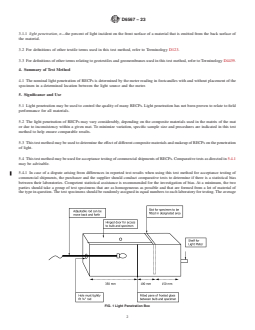
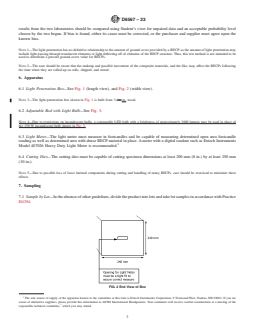
6.1 Light Penetration Box—See Fig. 1 (length view), and
Fig. 2 (width view).
NOTE 3—The light penetration box shown in Fig. 1 is built from ⁄4 in.
wood.
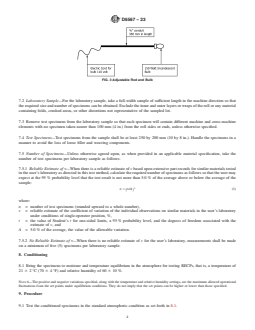
6.2 Adjustable Rod with Light Bulb—See Fig. 3.
NOTE 4—Due to restrictions on incandescent bulbs, a comparable LED
bulb with a brightness of approximately 2600 lumens may be used in place
of the 150 W incandescent bulb shown in Fig. 3.
6.3 Light Meter—The light meter must measure in foot-
candles and be capable of measuring determined open area
footcandle reading as well as determined area with dense
RECP material in place. A meter with a digital readout such as
FIG. 3 Adjustable Rod and Bulb
Extech Instruments Model 407026 Heavy Duty Light Meter is
recommended.
a statistical bias between their laboratories. Competent statis-
tical assistance is recommended for the investigation of bias.
The sole source of supply of the apparatus known to the committee at this time
At a minimum, the two parties should take a group of test
is Extech Instruments Corporation, 9 Townsend West, Nashua, NH 03063. If you are
specimens that are as homogeneous as possible and that are
aware of alternative suppliers, please provide this information to ASTM Interna-
formed from a lot of material of the type in question. The test
tional Headquarters. Your comments will receive careful consideration at a meeting
specimens should be randomly assigned in equal numbers to of the responsible technical committee, which you may attend.
D6567 − 23
6.4 Cutting Dies—The cutting dies must be capable of 8. Conditioning
cutting specimen dimensions at least 200 mm (8 in.) by at least
8.1 Bring the specimens to moisture and temperature equi-
250 mm (10 in.).
librium in the atmosphere for testing RECPs, that is, a
temperature of 21 6 2 °C (70 6 4 °F) and relative humidity of
NOTE 5—Due to possible loss of loose internal components during
cutting and handling of many RECPs, care should be exercised to 60 6 10 %.
minimize these effects.
NOTE 6—The positive and negative variations specified, along with the
temperature and relative humidity settings, are the maximum allowed
7. Sampling
operational fluctuations from the set points under equilibrium conditions.
They do not imply that the set points can be higher or lower than those
7.1 Sample by Lot—In the absence of other guidelines,
specified.
divide the product into lots and take lot samples in accordance
with Practice D4354.
9. Procedure
7.2 Laboratory Sample—For the laboratory sample, take a
9.1 Test the conditioned specimens in the standard atmo-
full-width sample of sufficient length in the machine direction
spheric condition as set forth in 8.1.
so that the required size and number of specimens can be
9.2 Care should be taken in handling of the test specimens
obtained. Exclude the inner and outer layers or wraps of the
to avoid altering the natural finished state of the material.
roll or any material containing folds, crushed areas, or other
9.3 Close the top of the box, cover the slot where the sample
distortions not representative of the sampled lot.
is placed, and turn on the light source. Place the light meter on
7.3 Remove test specimens from the laboratory sample so
the shelf in front of the opening at
...
This document is not an ASTM standard and is intended only to provide the user of an ASTM standard an indication of what changes have been made to the previous version. Because
it may not be technically possible to adequately depict all changes accurately, ASTM recommends that users consult prior editions as appropriate. In all cases only the current version
of the standard as published by ASTM is to be considered the official document.
Designation: D6567 − 18 D6567 − 23
Standard Test Method for
Measuring the Light Penetration of a Rolled Erosion Control
Product (RECP)
This standard is issued under the fixed designation D6567; the number immediately following the designation indicates the year of
original adoption or, in the case of revision, the year of last revision. A number in parentheses indicates the year of last reapproval. A
superscript epsilon (´) indicates an editorial change since the last revision or reapproval.
1. Scope
1.1 This test method covers measuring the amount of incandescent light that penetrates through a rolled erosion control product.
1.2 This test method does not provide light penetration values for RECPs under variable normal sun and soil conditions. This test
method determines nominal light penetration.
1.3 This test method is not to be used to determine a percent ground cover value for RECPs, as the amount of light penetration
may include light passing through translucent material or reflecting off surfaces.
1.4 The values stated as a percentage are to be regarded as the standard. The values provided in footcandles are for information
only.
1.5 This standard does not purport to address all of the safety concerns, if any, associated with its use. It is the responsibility
of the user of this standard to establish appropriate safety, health, and environmental practices and determine the applicability of
regulatory limitations prior to use.
1.6 This international standard was developed in accordance with internationally recognized principles on standardization
established in the Decision on Principles for the Development of International Standards, Guides and Recommendations issued
by the World Trade Organization Technical Barriers to Trade (TBT) Committee.
2. Referenced Documents
2.1 ASTM Standards:
D123 Terminology Relating to Textiles
D4354 Practice for Sampling of Geosynthetics and Rolled Erosion Control Products (RECPs) for Testing
D4439 Terminology for Geosynthetics
E177 Practice for Use of the Terms Precision and Bias in ASTM Test Methods
E691 Practice for Conducting an Interlaboratory Study to Determine the Precision of a Test Method
3. Terminology
3.1 Definitions:
This test method is under the jurisdiction of ASTM Committee D35 on Geosynthetics and is the direct responsibility of Subcommittee D35.05 on Geosynthetic Erosion
Control.
Current edition approved June 1, 2018Nov. 1, 2023. Published June 2018December 2023. Originally approved in 2000. Last previous edition approved in 20172018 as
D6567 – 17.D6567 – 18. DOI: 10.1520/D6567-18.10.1520/D6567-23.
For referenced ASTM standards, visit the ASTM website, www.astm.org, or contact ASTM Customer Service at service@astm.org. For Annual Book of ASTM Standards
volume information, refer to the standard’s Document Summary page on the ASTM website.
Copyright © ASTM International, 100 Barr Harbor Drive, PO Box C700, West Conshohocken, PA 19428-2959. United States
D6567 − 23
3.1.1 light penetration, n—the percent of light incident on the front surface of a material that is emitted from the back surface of
the material.
3.2 For definitions of other textile terms used in this test method, refer to Terminology D123.
3.3 For definitions of other terms relating to geotextiles and geomembranes used in this test method, refer to Terminology D4439.
4. Summary of Test Method
4.1 The nominal light penetration of RECPs is determined by the meter reading in footcandles with and without placement of the
specimen in a determined location between the light source and the meter.
5. Significance and Use
5.1 Light penetration may be used to control the quality of many RECPs. Light penetration has not been proven to relate to field
performance for all materials.
5.2 The light penetration of RECPs may vary considerably, depending on the composite materials used in the matrix of the mat
or due to inconsistency within a given mat. To minimize variation, specific sample size and procedures are indicated in this test
method to help ensure comparable results.
5.3 This test method may be used to determine the effect of different composite materials and makeup of RECPs on the penetration
of light.
5.4 This test method may be used for acceptance testing of commercial shipments of RECPs. Comparative tests as directed in 5.4.1
may be advisable.
5.4.1 In case of a dispute arising from differences in reported test results when using this test method for acceptance testing of
commercial shipments, the purchaser and the supplier should conduct comparative tests to determine if there is a statistical bias
between their laboratories. Competent statistical assistance is recommended for the investigation of bias. At a minimum, the two
parties should take a group of test specimens that are as homogeneous as possible and that are formed from a lot of material of
the type in question. The test specimens should be randomly assigned in equal numbers to each laboratory for testing. The average
FIG. 1 Light Penetration Box
D6567 − 23
results from the two laboratories should be compared using Student’s t-test for unpaired data and an acceptable probability level
chosen by the two begun. If bias is found, either its cause must be corrected, or the purchaser and supplier must agree upon the
known bias.
NOTE 1—The light penetration has no definitive relationship to the amount of ground cover provided by a RECP, as the amount of light penetration may
include light passing through translucent elements or light deflecting off of elements of the RECP structure. Thus, this test method is not intended to be
used to determine a percent ground cover value for RECPs.
NOTE 2—The user should be aware that the makeup and possible movement of the composite materials, and the like, may affect the RECPs following
the time when they are rolled up on rolls, shipped, and stored.
6. Apparatus
6.1 Light Penetration Box—See Fig. 1 (length view), and Fig. 2 (width view).
NOTE 3—The light penetration box shown in Fig. 1 is built from ⁄4-in. in. wood.
6.2 Adjustable Rod with Light Bulb—See Fig. 3.
NOTE 4—Due to restrictions on incandescent bulbs, a comparable LED bulb with a brightness of approximately 2600 lumens may be used in place of
the 150 W incandescent bulb shown in Fig. 3.
6.3 Light Meter—The light meter must measure in footcandles and be capable of measuring determined open area footcandle
reading as well as determined area with dense RECP material in place. A meter with a digital readout such as Extech Instruments
Model 407026 Heavy Duty Light Meter is recommended.
6.4 Cutting Dies—The cutting dies must be capable of cutting specimen dimensions at least 200 mm (8 in.) by at least 250 mm
(10 in.).
NOTE 5—Due to possible loss of loose internal components during cutting and handling of many RECPs, care should be exercised to minimize these
effects.
7. Sampling
7.1 Sample by Lot—In the absence of other guidelines, divide the product into lots and take lot samples in accordance with Practice
D4354.
FIG. 2 End View of Box
The sole source of supply of the apparatus known to the committee at this time is Extech Instruments Corporation, 9 Townsend West, Nashua, NH 03063. If you are
aware of alternative suppliers, please provide this information to ASTM International Headquarters. Your comments will receive careful consideration at a meeting of the
responsible technical committee, which you may attend.
D6567 − 23
FIG. 3 Adjustable Rod and Bulb
7.2 Laboratory Sample—For the laboratory sample, take a full-width sample of sufficient length in the machine direction so that
the required size and number of specimens can be obtained. Exclude the inner and outer layers or wraps of the roll or any material
containing folds, crushed areas, or other distortions not representative of the sampled lot.
7.3 Remove test specimens from the laboratory sample so that each specimen will contain different machine and cross-machine
elements with no specimen taken nearer than 100 mm (4 in.) from the roll sides or ends, unless otherwise specified.
7.4 Test Specimens—Test specimens from the sample shall be at least 250 by 200 mm (10 by 8 in.). Handle the specimens in a
manner to avoid the loss of loose filler and weaving components.
7.5 Number of Specimens—Unless otherwise agreed upon, as when provided in an applicable material specification, take the
number of test specimens per laboratory sample as follows:
7.5.1 Reliable Estimate of v—When there is a reliable estimate of v based upon extensive part records for similar materials tested
in the user’s laboratory as directed in this test method, calculate the required number of specimens as follows so t
...