

ASTM D8270-23b
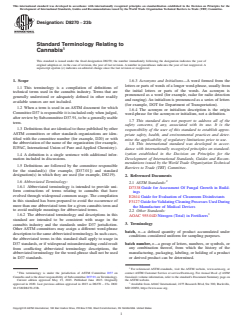
(Terminology)Standard Terminology Relating to Cannabis
General Information
- Abstract
SCOPE
1.1 This terminology is a compilation of definitions of technical terms used in the cannabis industry. Terms that are generally understood or adequately defined in other readily available sources are not included.
1.2 When a term is used in an ASTM document for which Committee D37 is responsible it is included only when judged, after review by Subcommittee D37.91, to be a generally usable term.
1.3 Definitions that are identical to those published by other ASTM committees or other standards organizations are identified with the committee number (for example, D20) or with the abbreviation of the name of the organization (for example, IUPAC, International Union of Pure and Applied Chemistry).
1.4 A definition is a single sentence with additional information included in discussions.
1.5 Definitions are followed by the committee responsible for the standard(s) (for example, [D37.01]) and standard designation(s) in which they are used (for example, D8219).
1.6 Abbreviated Terminology:
1.6.1 Abbreviated terminology is intended to provide uniform contractions of terms relating to cannabis that have evolved through widespread common usage. The compilation in this standard has been prepared to avoid the occurrence of more than one abbreviated term for a given cannabis term and to avoid multiple meanings for abbreviated terms.
1.6.2 The abbreviated terminology and descriptions in this standard are intended to be consistent with usage in the cannabis industry and the standards under D37 jurisdiction. Other ASTM committees may assign a different word-phrase description to the same abbreviated terminology. In such cases, the abbreviated terms in this standard shall apply to usage in D37 standards, or if widespread misunderstanding could result from conflicting abbreviated terminology descriptions, the abbreviated terminology for the word-phrase shall not be used in D37 standards.
1.6.3 Acronyms and Initialisms—A word formed from the letters or parts of words of a longer word-phrase, usually from the initial letters or parts of the words. An acronym is pronounced as a word (for example, radar for radio detection and ranging). An initialism is pronounced as a series of letters (for example, DOT for Department of Transportation).
1.6.4 The acronym or initialism description is the origin word-phrase for the acronym or initialism, not a definition.
1.7 This standard does not purport to address all of the safety concerns, if any, associated with its use. It is the responsibility of the user of this standard to establish appropriate safety, health, and environmental practices and determine the applicability of regulatory limitations prior to use.
1.8 This international standard was developed in accordance with internationally recognized principles on standardization established in the Decision on Principles for the Development of International Standards, Guides and Recommendations issued by the World Trade Organization Technical Barriers to Trade (TBT) Committee.
- Status
- Published
- Publication Date
- 14-May-2023
- Technical Committee
- D37 - Cannabis
- Drafting Committee
- D37.91 - Terminology
Overview
ASTM D8270-23b: Standard Terminology Relating to Cannabis provides a comprehensive and authoritative compilation of definitions for technical terms used throughout the cannabis industry. Developed under the jurisdiction of ASTM Committee D37 on Cannabis, this terminology standard is essential for ensuring clear communication and consistent interpretation across various sectors, including research, cultivation, manufacturing, quality assurance, and regulatory compliance. By specifying standardized definitions and abbreviations that are widely accepted in the cannabis industry, ASTM D8270-23b plays a critical role in harmonizing language and supporting the growth and professionalism of the global cannabis market.
Key Topics
ASTM D8270-23b covers crucial terminology areas that facilitate consistency and understanding in cannabis-related activities:
- Technical Definitions: Provides clear, single-sentence definitions for terms specific to cannabis (e.g., cannabinoid, hemp, extract, batch, bioactive).
- Abbreviated Terminology: Establishes uniform acronyms and initialisms used for cannabis materials, processes, and products, reducing ambiguity and duplication.
- Quality Control Vocabulary: Includes terms related to manufacturing, quality, safety, and batch identification (e.g., batch number, certified seed, quality control).
- Processing Terms: Defines processes such as extraction, cultivation, decontamination, and dispensing within the cannabis context.
- Industry-Specific Distinctions: Differentiates between substances and materials derived from cannabis, such as various types of cultivars (medical, nutritional, resin, commercial), hempseed products, and oils.
- Regulatory and Testing References: Cites referencing ASTM and other recognized standards organizations for related terminology and methodologies, supporting regulatory compliance and international trade.
Applications
ASTM D8270-23b is an invaluable resource with broad practical applications across the cannabis value chain:
- Regulatory Compliance: Enables regulators and compliance officers to reference authoritative definitions, assisting in the creation and enforcement of legislation and standards.
- Quality Assurance: Supports quality control and assurance personnel in establishing, auditing, and documenting consistent processes.
- Research and Development: Assists scientists and researchers by standardizing language, thereby supporting rigorous, reproducible studies and technical reports.
- Cultivation and Manufacturing: Provides operators, producers, and processors with clear terminology for documentation, labeling, and operational procedures.
- Labeling and Packaging: Ensures standardized usage of terms and abbreviations, minimizing consumer confusion and meeting labeling requirements.
- Supply Chain Communication: Facilitates precise communication between vendors, manufacturers, and distributors in all cannabis-related transactions.
- Education and Training: Serves as an effective tool for onboarding staff and educating stakeholders about cannabis industry terminology.
Related Standards
ASTM D8270-23b is part of a network of standards supporting the cannabis industry. Related and referenced standards include:
- ASTM D7338: Guide for Assessment Of Fungal Growth in Buildings
- ASTM E2614: Guide for Evaluation of Cleanroom Disinfectants
- ASTM F3127: Guide for Validating Cleaning Processes Used During the Manufacture of Medical Devices
- AOAC 955.04D: Nitrogen (Total) in Fertilizers (Referenced for protein measurements in hempseed products)
Other important terminology standards may be issued by recognized bodies such as IUPAC, with references provided for identical definitions to ensure consistency and interoperability.
Keywords: cannabis terminology, ASTM D8270, cannabis industry definitions, hemp, cannabinoids, quality control, cannabis extraction, regulatory compliance, cannabis processing, standard abbreviations, cannabis research
Relations
- Effective Date
- 01-Apr-2020
- Effective Date
- 01-May-2015
- Effective Date
- 01-Dec-2010
- Effective Date
- 01-Apr-2008
Get Certified
Connect with accredited certification bodies for this standard

BSI Group
BSI (British Standards Institution) is the business standards company that helps organizations make excellence a habit.

TÜV Rheinland
TÜV Rheinland is a leading international provider of technical services.

TÜV SÜD
TÜV SÜD is a trusted partner of choice for safety, security and sustainability solutions.
Sponsored listings
Frequently Asked Questions
ASTM D8270-23b is a standard published by ASTM International. Its full title is "Standard Terminology Relating to Cannabis". This standard covers: SCOPE 1.1 This terminology is a compilation of definitions of technical terms used in the cannabis industry. Terms that are generally understood or adequately defined in other readily available sources are not included. 1.2 When a term is used in an ASTM document for which Committee D37 is responsible it is included only when judged, after review by Subcommittee D37.91, to be a generally usable term. 1.3 Definitions that are identical to those published by other ASTM committees or other standards organizations are identified with the committee number (for example, D20) or with the abbreviation of the name of the organization (for example, IUPAC, International Union of Pure and Applied Chemistry). 1.4 A definition is a single sentence with additional information included in discussions. 1.5 Definitions are followed by the committee responsible for the standard(s) (for example, [D37.01]) and standard designation(s) in which they are used (for example, D8219). 1.6 Abbreviated Terminology: 1.6.1 Abbreviated terminology is intended to provide uniform contractions of terms relating to cannabis that have evolved through widespread common usage. The compilation in this standard has been prepared to avoid the occurrence of more than one abbreviated term for a given cannabis term and to avoid multiple meanings for abbreviated terms. 1.6.2 The abbreviated terminology and descriptions in this standard are intended to be consistent with usage in the cannabis industry and the standards under D37 jurisdiction. Other ASTM committees may assign a different word-phrase description to the same abbreviated terminology. In such cases, the abbreviated terms in this standard shall apply to usage in D37 standards, or if widespread misunderstanding could result from conflicting abbreviated terminology descriptions, the abbreviated terminology for the word-phrase shall not be used in D37 standards. 1.6.3 Acronyms and Initialisms—A word formed from the letters or parts of words of a longer word-phrase, usually from the initial letters or parts of the words. An acronym is pronounced as a word (for example, radar for radio detection and ranging). An initialism is pronounced as a series of letters (for example, DOT for Department of Transportation). 1.6.4 The acronym or initialism description is the origin word-phrase for the acronym or initialism, not a definition. 1.7 This standard does not purport to address all of the safety concerns, if any, associated with its use. It is the responsibility of the user of this standard to establish appropriate safety, health, and environmental practices and determine the applicability of regulatory limitations prior to use. 1.8 This international standard was developed in accordance with internationally recognized principles on standardization established in the Decision on Principles for the Development of International Standards, Guides and Recommendations issued by the World Trade Organization Technical Barriers to Trade (TBT) Committee.
SCOPE 1.1 This terminology is a compilation of definitions of technical terms used in the cannabis industry. Terms that are generally understood or adequately defined in other readily available sources are not included. 1.2 When a term is used in an ASTM document for which Committee D37 is responsible it is included only when judged, after review by Subcommittee D37.91, to be a generally usable term. 1.3 Definitions that are identical to those published by other ASTM committees or other standards organizations are identified with the committee number (for example, D20) or with the abbreviation of the name of the organization (for example, IUPAC, International Union of Pure and Applied Chemistry). 1.4 A definition is a single sentence with additional information included in discussions. 1.5 Definitions are followed by the committee responsible for the standard(s) (for example, [D37.01]) and standard designation(s) in which they are used (for example, D8219). 1.6 Abbreviated Terminology: 1.6.1 Abbreviated terminology is intended to provide uniform contractions of terms relating to cannabis that have evolved through widespread common usage. The compilation in this standard has been prepared to avoid the occurrence of more than one abbreviated term for a given cannabis term and to avoid multiple meanings for abbreviated terms. 1.6.2 The abbreviated terminology and descriptions in this standard are intended to be consistent with usage in the cannabis industry and the standards under D37 jurisdiction. Other ASTM committees may assign a different word-phrase description to the same abbreviated terminology. In such cases, the abbreviated terms in this standard shall apply to usage in D37 standards, or if widespread misunderstanding could result from conflicting abbreviated terminology descriptions, the abbreviated terminology for the word-phrase shall not be used in D37 standards. 1.6.3 Acronyms and Initialisms—A word formed from the letters or parts of words of a longer word-phrase, usually from the initial letters or parts of the words. An acronym is pronounced as a word (for example, radar for radio detection and ranging). An initialism is pronounced as a series of letters (for example, DOT for Department of Transportation). 1.6.4 The acronym or initialism description is the origin word-phrase for the acronym or initialism, not a definition. 1.7 This standard does not purport to address all of the safety concerns, if any, associated with its use. It is the responsibility of the user of this standard to establish appropriate safety, health, and environmental practices and determine the applicability of regulatory limitations prior to use. 1.8 This international standard was developed in accordance with internationally recognized principles on standardization established in the Decision on Principles for the Development of International Standards, Guides and Recommendations issued by the World Trade Organization Technical Barriers to Trade (TBT) Committee.
ASTM D8270-23b is classified under the following ICS (International Classification for Standards) categories: 01.040.11 - Health care technology (Vocabularies); 01.040.65 - Agriculture (Vocabularies); 11.120.99 - Other standards related to pharmaceutics; 65.020.20 - Plant growing. The ICS classification helps identify the subject area and facilitates finding related standards.
ASTM D8270-23b has the following relationships with other standards: It is inter standard links to ASTM E2614-15(2020)e1, ASTM E2614-15, ASTM D7338-10, ASTM E2614-08. Understanding these relationships helps ensure you are using the most current and applicable version of the standard.
ASTM D8270-23b is available in PDF format for immediate download after purchase. The document can be added to your cart and obtained through the secure checkout process. Digital delivery ensures instant access to the complete standard document.
Standards Content (Sample)
This international standard was developed in accordance with internationally recognized principles on standardization established in the Decision on Principles for the
Development of International Standards, Guides and Recommendations issued by the World Trade Organization Technical Barriers to Trade (TBT) Committee.
Designation: D8270 − 23b
Standard Terminology Relating to
Cannabis
This standard is issued under the fixed designation D8270; the number immediately following the designation indicates the year of
original adoption or, in the case of revision, the year of last revision. A number in parentheses indicates the year of last reapproval. A
superscript epsilon (´) indicates an editorial change since the last revision or reapproval.
1. Scope 1.6.3 Acronyms and Initialisms—A word formed from the
letters or parts of words of a longer word-phrase, usually from
1.1 This terminology is a compilation of definitions of
the initial letters or parts of the words. An acronym is
technical terms used in the cannabis industry. Terms that are
pronounced as a word (for example, radar for radio detection
generally understood or adequately defined in other readily
and ranging). An initialism is pronounced as a series of letters
available sources are not included.
(for example, DOT for Department of Transportation).
1.2 When a term is used in an ASTM document for which
1.6.4 The acronym or initialism description is the origin
Committee D37 is responsible it is included only when judged,
word-phrase for the acronym or initialism, not a definition.
after review by Subcommittee D37.91, to be a generally usable
1.7 This standard does not purport to address all of the
term.
safety concerns, if any, associated with its use. It is the
1.3 Definitions that are identical to those published by other
responsibility of the user of this standard to establish appro-
ASTM committees or other standards organizations are iden-
priate safety, health, and environmental practices and deter-
tified with the committee number (for example, D20) or with
mine the applicability of regulatory limitations prior to use.
the abbreviation of the name of the organization (for example,
1.8 This international standard was developed in accor-
IUPAC, International Union of Pure and Applied Chemistry).
dance with internationally recognized principles on standard-
ization established in the Decision on Principles for the
1.4 A definition is a single sentence with additional infor-
Development of International Standards, Guides and Recom-
mation included in discussions.
mendations issued by the World Trade Organization Technical
1.5 Definitions are followed by the committee responsible
Barriers to Trade (TBT) Committee.
for the standard(s) (for example, [D37.01]) and standard
designation(s) in which they are used (for example, D8219).
2. Referenced Documents
1.6 Abbreviated Terminology:
2.1 ASTM Standards:
1.6.1 Abbreviated terminology is intended to provide uni-
D7338 Guide for Assessment Of Fungal Growth in Build-
form contractions of terms relating to cannabis that have
ings
evolved through widespread common usage. The compilation
E2614 Guide for Evaluation of Cleanroom Disinfectants
in this standard has been prepared to avoid the occurrence of
F3127 Guide for Validating Cleaning Processes Used During
more than one abbreviated term for a given cannabis term and
the Manufacture of Medical Devices
to avoid multiple meanings for abbreviated terms.
2.2 Other Standards:
1.6.2 The abbreviated terminology and descriptions in this
AOAC 955.04D Nitrogen (Total) in Fertilizers
standard are intended to be consistent with usage in the
3. Terminology
cannabis industry and the standards under D37 jurisdiction.
Other ASTM committees may assign a different word-phrase
batch, n—a defined quantity of product accumulated under
description to the same abbreviated terminology. In such cases,
conditions considered uniform for sampling purposes.
the abbreviated terms in this standard shall apply to usage in
D37 standards, or if widespread misunderstanding could result batch number, n—a group of letters, numbers, or symbols, or
any combination thereof, from which the history of the
from conflicting abbreviated terminology descriptions, the
abbreviated terminology for the word-phrase shall not be used manufacturing, packaging, labeling, or holding of a product
or derived product can be determined.
in D37 standards.
For referenced ASTM standards, visit the ASTM website, www.astm.org, or
This terminology is under the jurisdiction of ASTM Committee D37 on contact ASTM Customer Service at service@astm.org. For Annual Book of ASTM
Cannabis and is the direct responsibility of Subcommittee D37.91 on Terminology. Standards volume information, refer to the standard’s Document Summary page on
Current edition approved May 15, 2023. Published June 2023. Originally the ASTM website.
approved in 2020. Last previous edition approved in 2023 as D8270 – 23a. DOI: Available from AOAC International, 2275 Research Blvd, Ste 300, Rockville,
10.1520/D8270-23B. MD 20850, https://www.aoac.org.
Copyright © ASTM International, 100 Barr Harbor Drive, PO Box C700, West Conshohocken, PA 19428-2959. United States
D8270 − 23b
DISCUSSION—The terms batch number, lot number, or control number
regions that touch cannabis, components, or cannabis-
refer to the manufactured/produced unit identified.
derived product, which may occur during the normal course
of operations.
bioactive, adj—having an effect upon a living organism, tissue,
or cell.
contact time, n—predetermined time that a test microorganism
is exposed to the activity of a test material.
biocomposite, n—a product formed by two or more materials,
one of them being biologically derived and including a
contaminant, n—any material that potentially has adverse
binder or resin.
impacts on the functioning of, and/or shows an undesirable
interaction. F3127
biosecurity, n—preventative measures designed to protect
DISCUSSION—A contaminant may be a single component or any
crops and property from the entry and spread of pests and
combination of components. Examples of possible types of contami-
diseases.
nants includes biological or non-biological in nature; living or dead;
particles or thin films; solid, liquid, or gas; organic or inorganic.
cannabinoid(s), n—a class of chemical compounds produced
by the cannabis plant.
controlled access area, n—an area in the physical plant,
DISCUSSION—Cannabinoids are synonymous with ‘phytocannabi-
dispensary, or location, designed to prevent entry by anyone
noids’ when referring to the cannabinoids produced by the cannabis
except authorized personnel.
plant. ‘Endocannabinoids’ refer to those cannabinoids produced by
normal human/animal physiological functions.
cultivar, n—a plant variety that has been produced in cultiva-
tion by selective breeding.
cannabis, n—a genus of flowering plants within the Canna-
baceae family identified by their distinctive glandular
cultivar, commercial (cannabis), n—cannabis that is grown
trichomes, divided serrated leaves and tough bast fibers.
for the purposes of fiber, textiles, biofuels, bio/
DISCUSSION—Cannabis is derived from the homogeneous cultivars of
phytoremediation, or any other purposes not intended for
the plant Cannabis sativa L. (Family Cannabaceae) and its subspecies,
human and/or animal consumption.
varieties, and chemotypes.
cultivar, multi-purpose (cannabis), n—cannabis that is
cannabis, medical, n—cannabis and cannabinoid materials
grown for multiple end uses whether that be for a combina-
that are produced and used for medicinal purposes in
tion of drug, nutritional, and/or commercial purposes.
accordance with applicable regulatory standards.
cultivar, nutritional (cannabis), n—cannabis that is grown
cannabis, oil, n—concentrated liquid extracts from the canna-
for the purposes of seed production or any other purposes
bis plant.
intended for human and/or animal consumption except for
DISCUSSION—The term cannabis oil or CBD ‘oil’ is commonly used
the purposes of collecting, isolating or extracting the essen-
to refer to a product or ingredient that actually consists of a concen-
trated extract of cannabis material (liquid or otherwise) dissolved in tial oils, resins, saps, glandular trichomes, and flower(s).
some type of fixed oil, such as olive or coconut. There are two types of
cultivar, resin (cannabis), n—cannabis that is grown for the
traditional cannabis oil; fixed oil pressed from the seed, and volatile or
essential oil from the glandular trichomes. purposes of collecting, isolating or extracting the essential
oils, resins, saps, glandular trichomes, or flower(s) intended
certified seed, n—seed that meets standards administered by a
for human and/or animal use.
recognized member of the Association of Official Seed
Certifying Agencies (AOSCA) and produced in a way that cultivate, v—to grow, harvest, dry, and cure agricultural
maintains satisfactory genetic purity and varietal identity.
products.
DISCUSSION—Requirements include genetic stability, percent
cultivation operation, n—a facility where agricultural prod-
germination, and agronomic consistency. Certified seed is a subcat-
egory of pedigreed seed in some countries. ucts are grown.
cleaning, v—physical removal of dirt, debris, and other poten-
cultivator, n—a person, group of persons, non-profit entity, or
tial contaminants to the extent necessary for further process- business entity that grows drug, nutritional, and/or commer-
ing or intended use.
cial products.
component, n—a substance or item intended for use in the
decontamination, n—the use of physical or chemical means to
manufacture of a product including ingredients, additives,
remove, inactivate or destroy microorganisms on a surface
fillers, other ingredients, and processing aids.
or item so there are no infectious organisms and the surface
or item is rendered safe for handling, use, or disposal.
composition, n—the aggregate mixture which results from the
manufacture of a product according to the formula and
dehulled hempseed, n—internal material of the hemp seed.
process defined in the product’s manufacturing protocol.
DISCUSSION—Dehulled hempseed is synonymous with hempseed
heart, hempseed nut, and hulled hempseed.
contact surface, n—any boundary region that directly touches
cannabis, components, or cannabis-derived product, and any disinfectant, n—a physical or chemical agent or process that
boundary region from which drainage onto cannabis, destroys pathogenic or potentially pathogenic microorgan-
components, or cannabis-derived product, or onto other isms on inanimate surfaces or objects.
D8270 − 23b
DISCUSSION—The terms mold and mildew are frequently used by
dispense, v—to provide cannabis or cannabis-derived product
laypersons when referring to various fungal colonization.
to compliant individuals and/or entities.
hazard, n—a biological, chemical, or physical agent or condi-
dispensing operation, n—a person, group of persons, non-
tion with the intrinsic capacity to cause an unwanted or
profit entity, or business entity that provides cannabis or
adverse effect.
cannabis-derived product to individuals or other entities.
DISCUSSION—A dispensing operation may include delivery services,
hemp, n—a Cannabis sativa L. plant, or any part of that plant,
direct-from-garden operations, growing co-ops, and storefront opera-
in which the concentration of total delta-9 tetrahydrocan-
tions.
nabinol (THC) in the flowering tops is equal to or less than
disposition, n—review and approval or rejection of a batch,
the regulated maximum level as established by authorities
lot, or other item by quality control personnel.
having jurisdiction.
DISCUSSION—The term hemp is synonymous with industrial hemp.
drug, n—(A) articles recognized in the official
...
This document is not an ASTM standard and is intended only to provide the user of an ASTM standard an indication of what changes have been made to the previous version. Because
it may not be technically possible to adequately depict all changes accurately, ASTM recommends that users consult prior editions as appropriate. In all cases only the current version
of the standard as published by ASTM is to be considered the official document.
Designation: D8270 − 23a D8270 − 23b
Standard Terminology Relating to
Cannabis
This standard is issued under the fixed designation D8270; the number immediately following the designation indicates the year of
original adoption or, in the case of revision, the year of last revision. A number in parentheses indicates the year of last reapproval. A
superscript epsilon (´) indicates an editorial change since the last revision or reapproval.
1. Scope
1.1 This terminology is a compilation of definitions of technical terms used in the cannabis industry. Terms that are generally
understood or adequately defined in other readily available sources are not included.
1.2 When a term is used in an ASTM document for which Committee D37 is responsible it is included only when judged, after
review by Subcommittee D37.91, to be a generally usable term.
1.3 Definitions that are identical to those published by other ASTM committees or other standards organizations are identified with
the committee number (for example, D20) or with the abbreviation of the name of the organization (for example, IUPAC,
International Union of Pure and Applied Chemistry).
1.4 A definition is a single sentence with additional information included in discussions.
1.5 Definitions are followed by the committee responsible for the standard(s) (for example, [D37.01]) and standard designation(s)
in which they are used (for example, D8219).
1.6 Abbreviated Terminology:
1.6.1 Abbreviated terminology is intended to provide uniform contractions of terms relating to cannabis that have evolved through
widespread common usage. The compilation in this standard has been prepared to avoid the occurrence of more than one
abbreviated term for a given cannabis term and to avoid multiple meanings for abbreviated terms.
1.6.2 The abbreviated terminology and descriptions in this standard are intended to be consistent with usage in the cannabis
industry and the standards under D37 jurisdiction. Other ASTM committees may assign a different word-phrase description to the
same abbreviated terminology. In such cases, the abbreviated terms in this standard shall apply to usage in D37 standards, or if
widespread misunderstanding could result from conflicting abbreviated terminology descriptions, the abbreviated terminology for
the word-phrase shall not be used in D37 standards.
1.6.3 Acronyms and Initialisms—A word formed from the letters or parts of words of a longer word-phrase, usually from the initial
letters or parts of the words. An acronym is pronounced as a word (for example, radar for radio detection and ranging). An
initialism is pronounced as a series of letters (for example, DOT for Department of Transportation).
1.6.4 The acronym or initialism description is the origin word-phrase for the acronym or initialism, not a definition.
This terminology is under the jurisdiction of ASTM Committee D37 on Cannabis and is the direct responsibility of Subcommittee D37.91 on Terminology.
Current edition approved May 1, 2023May 15, 2023. Published June 2023. Originally approved in 2020. Last previous edition approved in 2023 as D8270 – 23. DOI:
10.1520/D8270-23A.23a. DOI: 10.1520/D8270-23B.
Copyright © ASTM International, 100 Barr Harbor Drive, PO Box C700, West Conshohocken, PA 19428-2959. United States
D8270 − 23b
1.7 This standard does not purport to address all of the safety concerns, if any, associated with its use. It is the responsibility
of the user of this standard to establish appropriate safety, health, and environmental practices and determine the applicability of
regulatory limitations prior to use.
1.8 This international standard was developed in accordance with internationally recognized principles on standardization
established in the Decision on Principles for the Development of International Standards, Guides and Recommendations issued
by the World Trade Organization Technical Barriers to Trade (TBT) Committee.
2. Referenced Documents
2.1 ASTM Standards:
D7338 Guide for Assessment Of Fungal Growth in Buildings
E2614 Guide for Evaluation of Cleanroom Disinfectants
F3127 Guide for Validating Cleaning Processes Used During the Manufacture of Medical Devices
2.2 Other Standards:
AOAC 955.04D Nitrogen (Total) in Fertilizers
3. Terminology
batch, n—a defined quantity of product accumulated under conditions considered uniform for sampling purposes.
batch number, n—a group of letters, numbers, or symbols, or any combination thereof, from which the history of the
manufacturing, packaging, labeling, or holding of a product or derived product can be determined.
DISCUSSION—
The terms batch number,lot number, or control number refer to the manufactured/produced unit identified.
bioactive, adj—having an effect upon a living organism, tissue, or cell.
biocomposite, n—a product formed by two or more materials, one of them being biologically derived and including a binder
or resin.
biosecurity, n—preventative measures designed to protect crops and property from the entry and spread of pests and diseases.
cannabinoid(s), n—a class of chemical compounds produced by the cannabis plant.
DISCUSSION—
Cannabinoids are synonymous with ‘phytocannabinoids’ when referring to the cannabinoids produced by the cannabis plant. ‘Endocannabinoids’ refer
to those cannabinoids produced by normal human/animal physiological functions.
cannabis, n—a genus of flowering plants within the Cannabaceae family identified by their distinctive glandular trichomes,
divided serrated leaves and tough bast fibers.
DISCUSSION—
Cannabis is derived from the homogeneous cultivars of the plant Cannabis sativa L. (Family Cannabaceae) and its subspecies, varieties, and
chemotypes.
cannabis, medical, n—cannabis and cannabinoid materials that are produced and used for medicinal purposes in accordance
with applicable regulatory standards.
cannabis, oil, n—concentrated liquid extracts from the cannabis plant.
DISCUSSION—
The term cannabis oil or CBD ‘oil’ is commonly used to refer to a product or ingredient that actually consists of a concentrated extract of cannabis
material (liquid or otherwise) dissolved in some type of fixed oil, such as olive or coconut. There are two types of traditional cannabis oil; fixed oil
pressed from the seed, and volatile or essential oil from the glandular trichomes.
For referenced ASTM standards, visit the ASTM website, www.astm.org, or contact ASTM Customer Service at service@astm.org. For Annual Book of ASTM Standards
volume information, refer to the standard’s Document Summary page on the ASTM website.
Available from AOAC International, 2275 Research Blvd, Ste 300, Rockville, MD 20850, https://www.aoac.org.
D8270 − 23b
certified seed, n—seed that meets standards administered by a recognized member of the Association of Official Seed Certifying
Agencies (AOSCA) and produced in a way that maintains satisfactory genetic purity and varietal identity.
DISCUSSION—
Requirements include genetic stability, percent germination, and agronomic consistency. Certified seed is a subcategory of pedigreed seed in some
countries.
cleaning, v—physical removal of dirt, debris, and other potential contaminants to the extent necessary for further processing or
intended use.
component, n—a substance or item intended for use in the manufacture of a product including ingredients, additives, fillers,
other ingredients, and processing aids.
composition, n—the aggregate mixture which results from the manufacture of a product according to the formula and process
defined in the product’s manufacturing protocol.
contact surface, n—any boundary region that directly touches cannabis, components, or cannabis-derived product, and any
boundary region from which drainage onto cannabis, components, or cannabis-derived product, or onto other regions that touch
cannabis, components, or cannabis-derived product, which may occur during the normal course of operations.
contact time, n—predetermined time that a test microorganism is exposed to the activity of a test material.
contaminant, n—any material that potentially has adverse impacts on the functioning of, and/or shows an undesirable
interaction. F3127
DISCUSSION—
A contaminant may be a single component or any combination of components. Examples of possible types of contaminants includes biological or
non-biological in nature; living or dead; particles or thin films; solid, liquid, or gas; organic or inorganic.
controlled access area, n—an area in the physical plant, dispensary, or location, designed to prevent entry by anyone except
authorized personnel.
cultivar, n—a plant variety that has been produced in cultivation by selective breeding.
cultivar, commercial (cannabis), n—cannabis that is grown for the purposes of fiber, textiles, biofuels, bio/phytoremediation,
or any other purposes not intended for human and/or animal consumption.
cultivar, multi-purpose (cannabis), n—cannabis that is grown for multiple end uses whether that be for a combination of drug,
nutritional, and/or commercial purposes.
cultivar, nutritional (cannabis), n—cannabis that is grown for the purposes of seed production or any other purposes intended
for human and/or animal consumption except for the purposes of collecting, isolating or extracting the essential oils, resins, saps,
glandular trichomes, and flower(s).
cultivar, resin (cannabis), n—cannabis that is grown for the purposes of collecting, isolating or extracting the essential oils,
resins, saps, glandular trichomes, or flower(s) intended for human and/or animal use.
cultivate, v—to grow, harvest, dry, and cure agricultural products.
cultivation operation, n—a facility where agricultural products are grown.
D8270 − 23b
cultivator, n—a person, group of persons, non-profit entity, or business entity that grows drug, nutritional, and/or commercial
products.
decontamination, n—the use of physical or chemical means to remove, inactivate or destroy microorganisms on a surface or
item so there are no infectious organisms and the surface or item is rendered safe for handling, use, or disposal.
dehulled hempseed, n—internal material of the hemp seed.
DISCUSSION—
Dehulled hempseed is synonymous with hempseed heart, hempseed nut, and hulled hempseed.
disinfectant, n—a physical or chemical agent or process that destroys pathogenic or potentially pathogenic microorganisms on
inanimate surfaces or objects.
dispense, v—to provide cannabis or cannabis-derived product to compliant individuals and/or entities.
dispensing operation, n—a person, group of persons, non-profit entity, or business entity that provides cannabis or
cannabis-derived product to individuals or other entities.
DISCUSSION—
A dispensing operation may include delivery services, direct-from-garden operations, growing co-ops, and storefront operations.
disposition, n—review and approval or rejection of a batch, lot, or other item by quality control personnel.
drug, n—(A) articles recognized in the official United States Pharmacopoeia, official Homoeopathic Pharmacopoeia of the
United States, or official National Formulary, or any supplement to any of them; and (B) articles intended for use in the diagnosis,
cure, mitigation, treatment, or prevention of disease in man or other animals; and (C) articles (other than food) intended to affect
the structure or any function of the body of man or other animals; and (D) articles intended for use as a component of any article
specified in clause (A), (B), or (C).
drug substance, botanical, n—a product i
...