

ASTM F2228-13(2021)
(Test Method)Standard Test Method for Non-Destructive Detection of Leaks in Packaging Which Incorporates Porous Barrier Material by CO2 Tracer Gas Method
General Information
- Abstract
SIGNIFICANCE AND USE
5.1 Harmful biological or particulate contaminants may enter the package through incomplete seals or imperfections such as pinholes or cracks in the trays.
5.2 After initial instrument set-up and calibration, the operations of individual tests and test results do not need operator interpretation. The non-destructive nature of the test may be important when testing high value added products.
5.3 Leak test results that exceed the permissible threshold setting are indicated by audible or visual signal responses, or both, or by other means.
5.4 This non-destructive test method may be performed in either laboratory or production environments. This testing may be undertaken on either a 100 % or a statistical sampling basis. This test method, in single instrument use and current implementation, may not be fast enough to work on a production packaging line, but is well suited for statistical testing as well as package developmental design work.
SCOPE
1.1 This non-destructive test method detects leaks in non-porous rigid thermoformed trays, as well as the seal between the porous lid and the tray. The test method detects channel leaks in packages as small as 100 μm (0.004 in.) diameter in the seal as well as 50 μm (0.002 in.) diameter pinholes, or equivalently sized cracks in the tray, subject to trace gas concentration in the package, package design and manufacturing tolerances.
Note 1: This test method does not claim to challenge the porous (breathable) lidding material. Any defects that may exist in the porous portion of the package will not be detected by this test method.
1.2 The values stated in SI units are to be regarded as standard. The values given in parentheses after SI units are provided for information only and are not considered standard.
1.3 This standard does not purport to address all of the safety concerns, if any, associated with its use. It is the responsibility of the user of this standard to establish appropriate safety, health, and environmental practices and determine the applicability of regulatory limitations prior to use.
1.4 This international standard was developed in accordance with internationally recognized principles on standardization established in the Decision on Principles for the Development of International Standards, Guides and Recommendations issued by the World Trade Organization Technical Barriers to Trade (TBT) Committee.
- Status
- Published
- Publication Date
- 14-Jan-2021
- Technical Committee
- F02 - Primary Barrier Packaging
- Drafting Committee
- F02.40 - Package Integrity
Overview
ASTM F2228-13(2021) is the international standard test method for non-destructive detection of leaks in packaging that utilizes porous barrier materials, applying a carbon dioxide (CO₂) tracer gas method. Developed by ASTM International, this standard enables reliable package integrity testing without damaging the package, making it essential for medical device packaging, pharmaceutical containers, and other applications where sterility and product safety are critical.
This test method efficiently identifies channel leaks, pinholes, and cracks in rigid thermoformed trays and in the seal between the porous lid and the tray-detecting channel leaks as small as 100 µm and pinholes down to 50 µm in diameter. It does not detect defects in the porous (breathable) lidding material itself.
Key Topics
- Non-destructive package integrity testing: Allows complete assessment of package seals and trays for leaks without compromising product sterility or value.
- CO₂ tracer gas detection: Utilizes carbon dioxide as a tracer to identify and quantify leaks with high sensitivity.
- Quantitative and qualitative analysis: Offers pass/fail leak assessments suitable for both statistical sampling and package development.
- High sensitivity: Capable of detecting extremely small seal and tray imperfections, supporting stringent sterility requirements.
- Operator independence: Minimal need for subjective test result interpretation post instrument calibration, reducing the impact of human error.
- Flexible application: Suitable for both laboratory environments and certain production areas, though not typically fast enough for continuous in-line testing.
- Safety considerations: Emphasizes responsible handling of CO₂ and instrument calibration.
Applications
The ASTM F2228-13(2021) standard plays a critical role in industries where packaging integrity impacts product safety and regulatory compliance. Major application areas include:
- Medical packaging: Ensures that medical devices and sterile supplies remain uncontaminated by detecting leaks that could allow microbial ingress.
- Pharmaceutical packaging: Protects sensitive drugs by verifying the integrity of packaging incorporating porous barriers, particularly in thermoformed trays with porous lids.
- Quality assurance: Supports statistical sampling, process validation, and package design qualification by providing a repeatable, non-destructive method for detecting seal and tray leaks.
- Research and development: Useful in package developmental design work where iterative testing is required without consuming valuable product with each test.
- Packaging process control: Complements visual inspection methods, offering objective leak detection for high-value or critical packaging.
Related Standards
When implementing ASTM F2228-13(2021) for package leak detection using the CO₂ tracer gas method, consider the following related standards for comprehensive package integrity assessment:
- ASTM D996: Terminology of Packaging and Distribution Environments.
- ASTM F17: Terminology Relating to Primary Barrier Packaging.
- ASTM F1327 (Withdrawn): Terminology Relating to Barrier Materials for Medical Packaging.
These standards provide important definitions, terminology, and context that support effective implementation and interpretation of test results under ASTM F2228.
Keywords: non-destructive package integrity testing, CO₂ tracer gas leak detection, ASTM F2228, medical packaging, porous barrier materials, thermoformed trays, pharmaceutical packaging, package seal integrity, pinhole detection, quality control, package leak test.
Relations
- Effective Date
- 01-May-2020
- Effective Date
- 01-Oct-2018
- Effective Date
- 15-Aug-2018
- Effective Date
- 01-Jun-2017
- Effective Date
- 01-Aug-2013
- Effective Date
- 15-Apr-2013
- Effective Date
- 01-Nov-2012
- Effective Date
- 01-Dec-2010
- Effective Date
- 01-Aug-2008
- Effective Date
- 01-Sep-2007
- Effective Date
- 01-May-2007
- Effective Date
- 01-Dec-2006
- Effective Date
- 01-Apr-2005
- Effective Date
- 01-Apr-2004
- Effective Date
- 10-Oct-2002
Get Certified
Connect with accredited certification bodies for this standard

BSI Group
BSI (British Standards Institution) is the business standards company that helps organizations make excellence a habit.

TÜV Rheinland
TÜV Rheinland is a leading international provider of technical services.

TÜV SÜD
TÜV SÜD is a trusted partner of choice for safety, security and sustainability solutions.
Sponsored listings
Frequently Asked Questions
ASTM F2228-13(2021) is a standard published by ASTM International. Its full title is "Standard Test Method for Non-Destructive Detection of Leaks in Packaging Which Incorporates Porous Barrier Material by CO<inf>2</inf> Tracer Gas Method". This standard covers: SIGNIFICANCE AND USE 5.1 Harmful biological or particulate contaminants may enter the package through incomplete seals or imperfections such as pinholes or cracks in the trays. 5.2 After initial instrument set-up and calibration, the operations of individual tests and test results do not need operator interpretation. The non-destructive nature of the test may be important when testing high value added products. 5.3 Leak test results that exceed the permissible threshold setting are indicated by audible or visual signal responses, or both, or by other means. 5.4 This non-destructive test method may be performed in either laboratory or production environments. This testing may be undertaken on either a 100 % or a statistical sampling basis. This test method, in single instrument use and current implementation, may not be fast enough to work on a production packaging line, but is well suited for statistical testing as well as package developmental design work. SCOPE 1.1 This non-destructive test method detects leaks in non-porous rigid thermoformed trays, as well as the seal between the porous lid and the tray. The test method detects channel leaks in packages as small as 100 μm (0.004 in.) diameter in the seal as well as 50 μm (0.002 in.) diameter pinholes, or equivalently sized cracks in the tray, subject to trace gas concentration in the package, package design and manufacturing tolerances. Note 1: This test method does not claim to challenge the porous (breathable) lidding material. Any defects that may exist in the porous portion of the package will not be detected by this test method. 1.2 The values stated in SI units are to be regarded as standard. The values given in parentheses after SI units are provided for information only and are not considered standard. 1.3 This standard does not purport to address all of the safety concerns, if any, associated with its use. It is the responsibility of the user of this standard to establish appropriate safety, health, and environmental practices and determine the applicability of regulatory limitations prior to use. 1.4 This international standard was developed in accordance with internationally recognized principles on standardization established in the Decision on Principles for the Development of International Standards, Guides and Recommendations issued by the World Trade Organization Technical Barriers to Trade (TBT) Committee.
SIGNIFICANCE AND USE 5.1 Harmful biological or particulate contaminants may enter the package through incomplete seals or imperfections such as pinholes or cracks in the trays. 5.2 After initial instrument set-up and calibration, the operations of individual tests and test results do not need operator interpretation. The non-destructive nature of the test may be important when testing high value added products. 5.3 Leak test results that exceed the permissible threshold setting are indicated by audible or visual signal responses, or both, or by other means. 5.4 This non-destructive test method may be performed in either laboratory or production environments. This testing may be undertaken on either a 100 % or a statistical sampling basis. This test method, in single instrument use and current implementation, may not be fast enough to work on a production packaging line, but is well suited for statistical testing as well as package developmental design work. SCOPE 1.1 This non-destructive test method detects leaks in non-porous rigid thermoformed trays, as well as the seal between the porous lid and the tray. The test method detects channel leaks in packages as small as 100 μm (0.004 in.) diameter in the seal as well as 50 μm (0.002 in.) diameter pinholes, or equivalently sized cracks in the tray, subject to trace gas concentration in the package, package design and manufacturing tolerances. Note 1: This test method does not claim to challenge the porous (breathable) lidding material. Any defects that may exist in the porous portion of the package will not be detected by this test method. 1.2 The values stated in SI units are to be regarded as standard. The values given in parentheses after SI units are provided for information only and are not considered standard. 1.3 This standard does not purport to address all of the safety concerns, if any, associated with its use. It is the responsibility of the user of this standard to establish appropriate safety, health, and environmental practices and determine the applicability of regulatory limitations prior to use. 1.4 This international standard was developed in accordance with internationally recognized principles on standardization established in the Decision on Principles for the Development of International Standards, Guides and Recommendations issued by the World Trade Organization Technical Barriers to Trade (TBT) Committee.
ASTM F2228-13(2021) is classified under the following ICS (International Classification for Standards) categories: 11.020 - Medical sciences and health care facilities in general; 19.100 - Non-destructive testing. The ICS classification helps identify the subject area and facilitates finding related standards.
ASTM F2228-13(2021) has the following relationships with other standards: It is inter standard links to ASTM F17-20, ASTM F17-18a, ASTM F17-18, ASTM F17-17, ASTM F17-13a, ASTM F17-13, ASTM F17-12, ASTM D996-10a, ASTM F17-08, ASTM F17-07a, ASTM F17-07, ASTM F17-06, ASTM F1327-05, ASTM D996-04, ASTM F17-02. Understanding these relationships helps ensure you are using the most current and applicable version of the standard.
ASTM F2228-13(2021) is available in PDF format for immediate download after purchase. The document can be added to your cart and obtained through the secure checkout process. Digital delivery ensures instant access to the complete standard document.
Standards Content (Sample)
This international standard was developed in accordance with internationally recognized principles on standardization established in the Decision on Principles for the
Development of International Standards, Guides and Recommendations issued by the World Trade Organization Technical Barriers to Trade (TBT) Committee.
Designation: F2228 − 13 (Reapproved 2021)
Standard Test Method for
Non-Destructive Detection of Leaks in Packaging Which
Incorporates Porous Barrier Material by CO Tracer Gas
Method
This standard is issued under the fixed designation F2228; the number immediately following the designation indicates the year of
original adoption or, in the case of revision, the year of last revision. A number in parentheses indicates the year of last reapproval. A
superscript epsilon (´) indicates an editorial change since the last revision or reapproval.
1. Scope F17 Terminology Relating to Primary Barrier Packaging
F1327 Terminology Relating to Barrier Materials for Medi-
1.1 This non-destructive test method detects leaks in non-
cal Packaging (Withdrawn 2007)
porous rigid thermoformed trays, as well as the seal between
the porous lid and the tray. The test method detects channel
3. Terminology
leaksinpackagesassmallas100µm(0.004in.)diameterinthe
3.1 General Term Definitions—For definitions used in this
seal as well as 50 µm (0.002 in.) diameter pinholes, or
standard, see Terminologies D996, F17, and F1327.
equivalently sized cracks in the tray, subject to trace gas
concentration in the package, package design and manufactur-
3.2 Definitions of Terms Specific to This Standard:
ing tolerances.
3.2.1 basal flow, n—transverse transport of trace gas across
the seal due to gas flow within the plane of the porous barrier
NOTE 1—This test method does not claim to challenge the porous
(breathable) lidding material. Any defects that may exist in the porous material as well as flow between the porous barrier and the
portion of the package will not be detected by this test method.
temporary gasketing. This is an expected property of the
porous barrier material and does not represent a leak.
1.2 The values stated in SI units are to be regarded as
Experimentally, this flow may be thought of as noise, which
standard. The values given in parentheses after SI units are
willalwaysbepresent,tosomedegree,duringtestingandmust
provided for information only and are not considered standard.
be accounted for.
1.3 This standard does not purport to address all of the
3.2.2 trace gas, n—a compound selected solely for use to
safety concerns, if any, associated with its use. It is the
identify leakage flow.
responsibility of the user of this standard to establish appro-
priate safety, health, and environmental practices and deter-
4. Summary of Test Method
mine the applicability of regulatory limitations prior to use.
1.4 This international standard was developed in accor-
4.1 This test method utilizes CO sensing techniques in the
dance with internationally recognized principles on standard-
detection of a CO trace gas to quantify leaks in medical
ization established in the Decision on Principles for the
packaging, which incorporates porous barrier material. This
Development of International Standards, Guides and Recom-
test method provides a qualitative (accept/reject) inspection
mendations issued by the World Trade Organization Technical
method to evaluate packages for pinhole, crack and channel
Barriers to Trade (TBT) Committee.
leaks. Further information on the “Leak Test Theory” may be
found in Annex A1.
2. Referenced Documents
2.1 ASTM Standards: 5. Significance and Use
D996 Terminology of Packaging and Distribution Environ-
5.1 Harmful biological or particulate contaminants may
ments
enter the package through incomplete seals or imperfections
such as pinholes or cracks in the trays.
This test method is under the jurisdiction ofASTM Committee F02 on Primary
5.2 After initial instrument set-up and calibration, the op-
Barrier Packaging and is the direct responsibility of Subcommittee F02.40 on
erations of individual tests and test results do not need operator
Package Integrity.
interpretation. The non-destructive nature of the test may be
Current edition approved Jan. 15, 2021. Published February 2021. Originally
approved in 2002. Last previous edition approved in 2013 as F2228 – 13. DOI:
important when testing high value added products.
10.1520/F2228-13R21.
For referenced ASTM standards, visit the ASTM website, www.astm.org, or
contact ASTM Customer Service at service@astm.org. For Annual Book of ASTM
Standards volume information, refer to the standard’s Document Summary page on The last approved version of this historical standard is referenced on
the ASTM website. www.astm.org.
Copyright © ASTM International, 100 Barr Harbor Drive, PO Box C700, West Conshohocken, PA 19428-2959. United States
F2228 − 13 (2021)
5.3 Leak test results that exceed the permissible threshold 8. Reagents and Materials
setting are indicated by audible or visual signal responses, or
8.1 CO Trace Gas Cylinder and Regulator—A cylinder of
both, or by other means.
“Commercial” or “Bone Dry” grade carbon dioxide with a
minimum of 206.84 kPa (30 psi) pressure is required for
5.4 This non-destructive test method may be performed in
calibration and testing.
either laboratory or production environments. This testing may
be undertaken on either a 100 % or a statistical sampling basis.
8.2 Sealing Membrane—The temporary sealing membrane
This test method, in single instrument use and current
must exhibit the correct pliability and tackiness in order to
implementation, may not be fast enough to work on a produc-
form a gas-tight bond with the porous lidding materials during
tion packaging line, but is well suited for statistical testing as
the testing process, and must release at the end of the test
well as package developmental design work.
without damaging the porous lid or the edge seal.
8.3 Sealing Membrane-induced Damage—During the pro-
6. Apparatus
cess of membrane selection for a specific package design and
6.1 Non-destructive Trace Gas Leak Detection Apparatus—
configuration, inspect the packages for the following indica-
The apparatus’test fixture consists of three major elements and
tions of membrane-induced damage after the membrane is
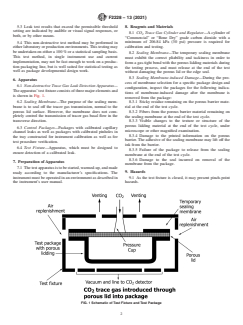
is shown in Fig. 1.
removed from the package:
6.2 Sealing Membrane—The purpose of the sealing mem- 8.3.1 Sticky residue remaining on the porous barrier mate-
brane is to seal off the tracer gas transmission, normal to the
rial at the end of the test cycle.
porous lid surface. However, the membrane does not com- 8.3.2 Fibers from the porous barrier material remaining on
pletely control the transmission of tracer gas basal flow in the the sealing membrane at the end of the test cycle.
transverse direction. 8.3.3 Visible changes to the texture or structure of the
porous lidding material at the end of the test cycle, under
6.3 Control Packages—Packages with calibrated capillary
microscope or other magnified examination.
channel leaks as well as packages with calibrated pinholes in
8.3.4 Damage to the printed information on the porous
the tray constructed for instrument calibration as well as for
barrier. The adhesive of the sealing membrane may lift off the
test procedure verification.
ink from the barrier.
6.4 Test Fixture—Apparatus, which must be designed to
8.3.5 Failure of the package to release from the sealing
ensure detection of a calibrated leak.
membrane at the end of the test cycle.
8.3.6 Damage to the seal incurred on removal of the
7. Preparation of Apparatus
membrane from the package.
7.1 Thetestapparatusistobestarted,warmed-up,andmade
9. Hazards
ready according to the manufacturer’s specifications. The
instrument must be operated in an environment as described in 9.1 As the test fixture is closed, it may present pinch-point
the instrument’s user manual. hazards.
FIG. 1 Schematic of Test Fixture and Test Package
F2228 − 13 (2021)
9.2 CO , although inert and non-toxic, can cause danger of 12.1.2 The serial numbers, calibration values and most
suffocation if it is allowed to displace oxygen. Thus it is recent calibration dates for all calibration standards used.
recommendedthatthespentcarbondioxidebenaturallyvented 12.1.3 Record the date, time, location, and identification of
away from the test area and that adequate ventilation be the apparatus and the operator.
provided. 12.1.4 Record the package type, size, material, product, and
traceable identification numbers.
10. Calibration and Standardization
12.1.5 Record the leak rate reject set point as programmed
10.1 Before any measurements are made, the apparatus into the apparatus.
12.1.6 Record the number of packages tested, and the
must be calibrated. The calibration procedure is used for
overall system checkout, as well as to establish an initial number of failed packages.
12.1.7 Record the failed packages to be rejected by identi-
referenceprofileforasimulatedchannelorpinholeleak,andto
determine test limits for each different package geometry that fying either individual serial numbers or lot numbers.
12.1.8 Record the disposition of good packages as well as
is to be tested using a specific test fixture. The calibration
procedureisperformedtoestablishthesensitivitysettingofthe failed packages.
instrumentation. It is expected that the calibration procedures 12.1.9 Copies of any software-generated data sheets, or
reports produced during the testing.
are carried out frequently; typically, at least one or more times
a day, preferably at the beginning of every shift.
13. Precision and Bias
10.2 Refer to the instrument manufacturer’s operating in-
13.1 Precision—A round robin study was conducted in
structionsregardingpreparationofCalibrationStandards,Con-
2002, which included three la
...