

ASTM E1638-22
(Terminology)Standard Terminology Relating to Sieves, Sieving Methods, and Screening Media
General Information
- Abstract
SCOPE
1.1 This terminology includes all those terms used in all of the standards under the jurisdiction of Subcommittee E29.01. Terms are defined that are related to the manufacture of standard test sieves and screening media, as well as terms related to the methods, analysis, procedures, and equipment for sizing and separating particles.
1.2 Committee E29 on Particle and Spray Characterization feels that it is essential to include terms and definitions explicit to the scope, regardless of whether the terms appear in existing ASTM standards. Terms that are in common usage and appear in common-language dictionaries are generally not included.
1.3 Units—The values stated in inch-pound units are to be regarded as standard. The values given in parentheses are mathematical conversions to SI units that are provided for information only and are not considered standard.
1.4 This international standard was developed in accordance with internationally recognized principles on standardization established in the Decision on Principles for the Development of International Standards, Guides and Recommendations issued by the World Trade Organization Technical Barriers to Trade (TBT) Committee.
- Status
- Published
- Publication Date
- 31-Oct-2022
- Technical Committee
- E29 - Particle and Spray Characterization
- Drafting Committee
- E29.01 - Sieves, Sieving Methods, and Screening Media
Overview
ASTM E1638-22 – Standard Terminology Relating to Sieves, Sieving Methods, and Screening Media – provides a comprehensive set of defined terms and concepts fundamental to particle size analysis, sieving, and screening processes. Developed under the jurisdiction of ASTM Committee E29 on Particle and Spray Characterization, this terminology standard is essential for professionals involved in the manufacture and use of standard test sieves, screening media, and related particle characterization methods.
By harmonizing precise definitions, ASTM E1638-22 fosters accurate communication, data comparison, and best practices throughout laboratory, industrial, and research settings where particle size determination and particle separation are critical.
Key Topics
This terminology standard covers a range of essential concepts and definitions relevant to:
- Sieves and Sieve Cloth: Definitions of test sieves (including electroformed, wire cloth, and perforated plate sieves), mesh size, sieve aperture, and sieve cloth construction.
- Screening Media: Terms related to woven wire cloth, filter cloth (including Dutch weave and market grade), crimp types, and perforated plate patterns.
- Sieving and Screening Methods: Descriptions of sieving processes, screening procedures, use of sieve shakers, cumulative distribution graphs, and particle size analysis.
- Particle Size and Measurement: Terms such as particle size distribution, micron rating, median particle size, percent retained and passing, bulk density, porosity, and absolute filtration rating.
- Certifications and Traceability: Definitions concerning material certification, certificates of compliance, heat and lot numbers, inspection reports, and revision levels to ensure product quality and traceability.
- Units and Conventions: Standardization of inch-pound as the primary unit, with SI units provided for reference.
This standard excludes terms in common usage that appear in general-language dictionaries, focusing only on specialized and industry-specific vocabulary necessary for technical consistency.
Applications
ASTM E1638-22 terminology is crucial for a diverse range of industries and applications where particle sizing, material screening, and separation processes are integral, including:
- Materials Testing Laboratories: Ensures uniform understanding of test procedures and results for soil, aggregates, powders, and other materials.
- Manufacturing and Quality Control: Supports specification and quality management for sieves, screening equipment, and raw materials in sectors such as mining, pharmaceuticals, food processing, and chemicals.
- Filter and Screen Production: Promotes consistent manufacturing, certification, and sourcing of woven wire cloth, filter cloth, perforated plates, and custom screening media.
- Compliance and Documentation: Assists in fulfilling regulatory requirements for reporting, documentation, and international trade, including traceability and certification of sieve and screen components.
By standardizing terminology, ASTM E1638-22 enhances the reliability of data exchange, method interpretation, and global communication across organizations and supply chains wherever sieving, screening, or filtration is involved.
Related Standards
ASTM E1638-22 is closely linked with other standards that specify manufacturing, testing, and certification of sieves, screening media, and particle size analysis methods, including:
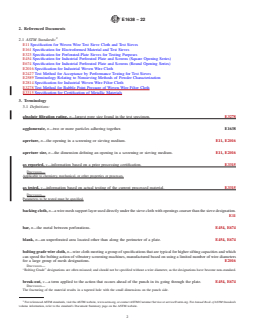
- ASTM E11 – Specification for Woven Wire Test Sieve Cloth and Test Sieves
- ASTM E161 – Specification for Electroformed Material and Test Sieves
- ASTM E323 – Specification for Perforated-Plate Sieves
- ASTM E454/E674 – Specifications for Industrial Perforated Plate and Screens (Square/Round Opening Series)
- ASTM E2016 – Specification for Industrial Woven Wire Cloth
- ASTM E2427 – Test Method for Acceptance by Performance Testing for Test Sieves
- ASTM E2589 – Terminology Relating to Nonsieving Methods of Powder Characterization
- ASTM E3278, E3315 – Methods and specifications for filter cloth, certification, and bubble point pressure
Consult ASTM E1638-22 alongside these referenced documents for comprehensive guidance on terminology, test procedures, equipment, and quality assurance within particle size analysis and screening.
Keywords: particle measurement, sieves, sieve analysis, screening media, particle size, mesh, filter cloth, material certification, test sieve, sieve cloth, wire cloth, terminology, particle size distribution, ASTM standards.
Relations
- Refers
ASTM E2589-23a - Standard Terminology Relating to Nonsieving Methods of Powder Characterization - Effective Date
- 01-Sep-2023
- Effective Date
- 01-Nov-2015
- Effective Date
- 01-Nov-2013
- Effective Date
- 01-Oct-2013
- Effective Date
- 15-Jun-2012
- Effective Date
- 15-Jun-2012
- Effective Date
- 01-Apr-2012
- Effective Date
- 15-Nov-2011
- Effective Date
- 15-Nov-2011
- Effective Date
- 15-Nov-2011
- Effective Date
- 15-Nov-2011
- Effective Date
- 01-Oct-2011
- Refers
ASTM E2589-11 - Standard Terminology Relating to Nonsieving Methods of Powder Characterization - Effective Date
- 01-Apr-2011
- Effective Date
- 01-Apr-2011
- Effective Date
- 01-May-2010
Get Certified
Connect with accredited certification bodies for this standard

IMP NDT d.o.o.
Non-destructive testing services. Radiography, ultrasonic, magnetic particle, penetrant, visual inspection.
Inštitut za kovinske materiale in tehnologije
Institute of Metals and Technology. Materials testing, metallurgical analysis, NDT.
Q Techna d.o.o.
NDT and quality assurance specialist. 30+ years experience. NDT personnel certification per ISO 9712, nuclear and thermal power plant inspections, QA/
Sponsored listings
Frequently Asked Questions
ASTM E1638-22 is a standard published by ASTM International. Its full title is "Standard Terminology Relating to Sieves, Sieving Methods, and Screening Media". This standard covers: SCOPE 1.1 This terminology includes all those terms used in all of the standards under the jurisdiction of Subcommittee E29.01. Terms are defined that are related to the manufacture of standard test sieves and screening media, as well as terms related to the methods, analysis, procedures, and equipment for sizing and separating particles. 1.2 Committee E29 on Particle and Spray Characterization feels that it is essential to include terms and definitions explicit to the scope, regardless of whether the terms appear in existing ASTM standards. Terms that are in common usage and appear in common-language dictionaries are generally not included. 1.3 Units—The values stated in inch-pound units are to be regarded as standard. The values given in parentheses are mathematical conversions to SI units that are provided for information only and are not considered standard. 1.4 This international standard was developed in accordance with internationally recognized principles on standardization established in the Decision on Principles for the Development of International Standards, Guides and Recommendations issued by the World Trade Organization Technical Barriers to Trade (TBT) Committee.
SCOPE 1.1 This terminology includes all those terms used in all of the standards under the jurisdiction of Subcommittee E29.01. Terms are defined that are related to the manufacture of standard test sieves and screening media, as well as terms related to the methods, analysis, procedures, and equipment for sizing and separating particles. 1.2 Committee E29 on Particle and Spray Characterization feels that it is essential to include terms and definitions explicit to the scope, regardless of whether the terms appear in existing ASTM standards. Terms that are in common usage and appear in common-language dictionaries are generally not included. 1.3 Units—The values stated in inch-pound units are to be regarded as standard. The values given in parentheses are mathematical conversions to SI units that are provided for information only and are not considered standard. 1.4 This international standard was developed in accordance with internationally recognized principles on standardization established in the Decision on Principles for the Development of International Standards, Guides and Recommendations issued by the World Trade Organization Technical Barriers to Trade (TBT) Committee.
ASTM E1638-22 is classified under the following ICS (International Classification for Standards) categories: 01.040.19 - Testing (Vocabularies); 19.120 - Particle size analysis. Sieving. The ICS classification helps identify the subject area and facilitates finding related standards.
ASTM E1638-22 has the following relationships with other standards: It is inter standard links to ASTM E2589-23a, ASTM E2016-15, ASTM E2427-13, ASTM E11-13, ASTM E454-12, ASTM E674-12, ASTM E161-12, ASTM E674-11, ASTM E454-11, ASTM E323-11, ASTM E2016-11, ASTM E2427-11, ASTM E2589-11, ASTM E2814-11, ASTM E161-00(2010). Understanding these relationships helps ensure you are using the most current and applicable version of the standard.
ASTM E1638-22 is available in PDF format for immediate download after purchase. The document can be added to your cart and obtained through the secure checkout process. Digital delivery ensures instant access to the complete standard document.
Standards Content (Sample)
This international standard was developed in accordance with internationally recognized principles on standardization established in the Decision on Principles for the
Development of International Standards, Guides and Recommendations issued by the World Trade Organization Technical Barriers to Trade (TBT) Committee.
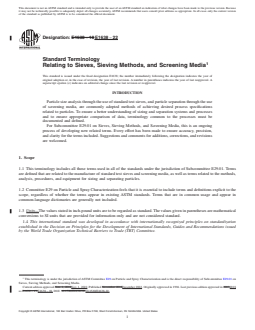
Designation: E1638 − 22
Standard Terminology
Relating to Sieves, Sieving Methods, and Screening Media
This standard is issued under the fixed designation E1638; the number immediately following the designation indicates the year of
original adoption or, in the case of revision, the year of last revision. A number in parentheses indicates the year of last reapproval. A
superscript epsilon (´) indicates an editorial change since the last revision or reapproval.
INTRODUCTION
Particle size analysis through the use of standard test sieves, and particle separation through the use
of screening media, are commonly adopted methods of achieving desired process specifications
related to particles. To ensure a better understanding of sizing and separation systems and processes
and to ensure appropriate comparison of data, terminology common to the processes must be
documented and defined.
For Subcommittee E29.01 on Sieves, Sieving Methods, and Screening Media, this is an ongoing
process of developing new related terms. Every effort has been made to ensure accuracy, precision,
and clarity for the terms included. Suggestions and comments for additions, corrections, and revisions
are welcomed.
1. Scope 2. Referenced Documents
1.1 This terminology includes all those terms used in all of 2.1 ASTM Standards:
the standards under the jurisdiction of Subcommittee E29.01. E11 Specification for Woven Wire Test Sieve Cloth and Test
Terms are defined that are related to the manufacture of Sieves
standard test sieves and screening media, as well as terms E161 Specification for Electroformed Material and Test
related to the methods, analysis, procedures, and equipment for Sieves
sizing and separating particles. E323 Specification for Perforated-Plate Sieves for Testing
Purposes
1.2 Committee E29 on Particle and Spray Characterization
E454 Specification for Industrial Perforated Plate and
feels that it is essential to include terms and definitions explicit
Screens (Square Opening Series)
to the scope, regardless of whether the terms appear in existing
E674 Specification for Industrial Perforated Plate and
ASTM standards. Terms that are in common usage and appear
Screens (Round Opening Series)
in common-language dictionaries are generally not included.
E2016 Specification for Industrial Woven Wire Cloth
1.3 Units—The values stated in inch-pound units are to be
E2427 Test Method for Acceptance by Performance Testing
regarded as standard. The values given in parentheses are
for Test Sieves
mathematical conversions to SI units that are provided for
E2589 Terminology Relating to Nonsieving Methods of
information only and are not considered standard.
Powder Characterization
1.4 This international standard was developed in accor- E2814 Specification for Industrial Woven Wire Filter Cloth
dance with internationally recognized principles on standard-
E3278 Test Method for Bubble Point Pressure of Woven
ization established in the Decision on Principles for the Wire Filter Cloth
Development of International Standards, Guides and Recom- E3315 Specification for Certification of Metallic Materials
mendations issued by the World Trade Organization Technical
Barriers to Trade (TBT) Committee.
3. Terminology
3.1 Definitions:
absolute filtration rating, n—largest pore size found in the
test specimen. E3278
This terminology is under the jurisdiction ofASTM Committee E29 on Particle
and Spray Characterization and is the direct responsibility of Subcommittee E29.01
on Sieves, Sieving Methods, and Screening Media. For referenced ASTM standards, visit the ASTM website, www.astm.org, or
Current edition approved Nov. 1, 2022. Published December 2022. Originally contact ASTM Customer Service at service@astm.org. For Annual Book of ASTM
approved in 1994. Last previous edition approved in 2018 as E1638 – 18. DOI: Standards volume information, refer to the standard’s Document Summary page on
10.1520/E1638-22. the ASTM website.
Copyright © ASTM International, 100 Barr Harbor Drive, PO Box C700, West Conshohocken, PA 19428-2959. United States
E1638 − 22
agglomerate, n—two or more particles adhering together. candidate test sieve, n—the test sieve to be performance
E1638 tested. E2427
aperture, n—the opening in a screening or sieving medium.
centers, n—the dimensional sum of one perforation and one
E11, E2016 bar, or the dimensional distance from the center of one
perforation to the center of an adjacent perforation.
aperture size, n—the dimension defining an opening in a
E454, E674
screening or sieving medium. E11, E2016
certificate of compliance, n—an attestation document in
as reported, v—information based on a prior processing
accordance with 5.1.1. E3315
certification. E3315
DISCUSSION—Informally also known as certificate of conformance or
DISCUSSION—Applicable to chemistry, mechanical, or other proper-
CofC.
ties or processes.
DISCUSSION—While generally these terms are considered synony-
as tested, v—information based on actual testing of the current
mous and used interchangeably, there is also argument that compliance
processed material. E3315
is a more binding term when used in reference to an external
specification (for example, wire in accordance with Specification
DISCUSSION—Parameters to be tested must be specified.
A478), while conformance may be used in reference to an internal
specification (for example, quality system in accordance withAS9100).
backing cloth, n—a wire mesh support layer used directly
under the sieve cloth with openings coarser than the sieve
cloth thickness, n—overall thickness of the filter cloth, nomi-
designation. E11
nally estimated by adding the warp wire diameter plus two
times the shute wire diameter. E2814
bar, n—the metal between perforations. E454, E674
country of melt origin, n—the country where the original raw
blank, n—an unperforated area located other than along the
material was melted/smelted. E3315
perimeter of a plate. E454, E674
DISCUSSION—Just the term country of origin is a vague clause subject
to interpretation without qualification; see Defense FederalAcquisition
bolting grade wire cloth, n—wire cloth meeting a group of
Regulation Supplement (DFARS), Supplementary Requirements sec-
specifications that are typical for higher sifting capacities
tion.
and which can speed the bolting action of vibratory screen-
ing machines, manufactured based on using a limited num-
compliance test sieve, n—a test sieve manufactured using
ber of wire diameters for a large group of mesh designations.
sieve cloth which has been inspected prior to being mounted
E2016
in the sieve frame, and that meets the requirements in
DISCUSSION—“Bolting Grade” designations are often misused; and
accordance with Specification E11, Table 1, in part based on
should not be specified without a wire diameter, as the designations
the standard deviation of the required number of sample
have become non-standard.
openings per 100 square feet of sieve cloth (Column 7) not
exceeding the maximum allowable for a confidence level of
break-out, v—a term applied to the action that occurs ahead of
66 % (Column 8). E11
the punch in its going through the plate. E454, E674
DISCUSSION—The fracturing of the material results in a tapered hole
crimp, n—the corrugation in the warp or shute wire, or both.
with the small dimensions on the punch side.
DISCUSSION—The crimp in the wires is formed either during the
weaving process, or with a crimping machine prior to weaving. If
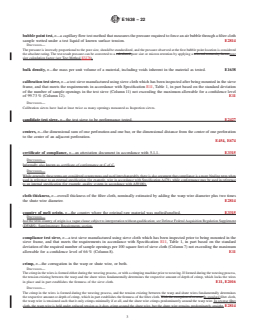
bubble point test, n—a capillary flow test method that
formed during the weaving process, the tension existing between the
measuresthepressurerequiredtoforceanairbubblethrough
warp and the shute wires fundamentally determines the respective
a filter cloth sample wetted under a test liquid of known
amount of depth of crimp, which locks the wires in place and in part
surface tension. E2814
establishes the firmness of the sieve cloth. E11, E2016
DISCUSSION—The pressure is inversely proportional to the pore size,
should be standardized, and the pressure observed at the first bubble DISCUSSION—The crimp in the wires is formed during the weaving
point location is considered the absolute rating. The test result pressure process, and the tension existing between the warp and shute wires
can be converted to a pore size or micron retention by applying a pore fundamentally determines the respective amount or depth of crimp,
size calculation factor (see Test Method E3278). which in part establishes the firmness of the filter cloth. In standard
filter cloth, the warp wire is tensioned such that it only crimps
bulk density, n—the mass per unit volume of a material,
minimally if at all, and the shute wire crimps predominately around the
including voids inherent in the material as tested. E1638
warp wire. In reverse filter cloth, the warp wire is held under reduced
tension as it does crimp around the shute wire, but the shute wire
calibration test sieve, n—a test sieve manufactured using
remains predominately straight. E2814
sieve cloth which has been inspected after being mounted in
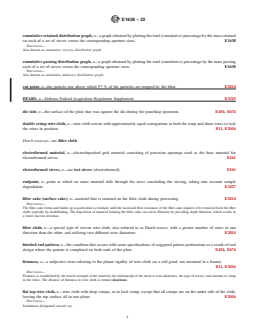
cumulative retained distribution graph, n—a graph obtained
the sieve frame, and that meets the requirements in accor-
by plotting the total (cumulative) percentage by the mass
dance with Specification E11, Table 1, in part based on the
retained on each of a set of sieves versus the corresponding
standard deviation of the number of sample openings in the
aperture sizes. E1638
test sieve (Column 11) not exceeding the maximum allow-
DISCUSSION—Also known as cumulative oversize distribution graph.
able for a confidence level of 99.73 % (Column 12). E11
cumulative passing distribution graph, n—a graph obtained
DISCUSSION—Calibration sieves have had at least twice as many
openings measured as Inspection sieves. by plotting the total (cumulative) percentage by the mass
E1638 − 22
passing each of a set of sieves versus the corresponding glass bead test, n—method for determining the filtration rating
aperture sizes. E1638 of filter cloth using a set of presorted precisely sized
spherical glass beads, passing them through the filter cloth,
DISCUSSION—Also known as cumulative undersize distribution
graph.
and examining the beads passed or captured. E2814
DISCUSSION—The largest bead passed is considered the absolute
cut point, n—the particle size above which 97 % of the
micron retention rating.
particles are trapped by the filter. E2814
heat number, n—traceable reference as established by the
DFARS, n—Defense Federal Acquisition Regulation
original melt mill. E3315
Supplement. E3315
DISCUSSION—For some products, it is common that multiple heats of
material may be used in their manufacture.
die side, n—the surface of the plate that was against the die
during the punching operation. E454, E674
hydraulic diameter, n—the diameter equal to four times the
pore throat area divided by the pore throat perimeter. E3278
double crimp wire cloth, n—wire cloth woven with approxi-
mately equal corrugations in both the warp and shute wires
DISCUSSION—This diameter can be generated using the PoroDict
to lock the wires in position. E11, E2016 module in the software GeoDict4,5 (see 4.2.2).
hydraulic diameter bubble point pressure, n—a pressure
Dutch weave, n—see filter cloth.
calculated using the hydraulic diameter. E3278
electroformed material, n—electrodeposited grid material
DISCUSSION—This pressure can be generated using the PoroDict
consistingofprecisionopeningsusedasthebasematerialfor
module in the software GeoDict (see 4.2.2), and is based on a
electroformed sieves. E161
statistically fitted bubble contact angle of 40 degrees and the hydraulic
diameter.
electroformed sieves, n—see test sieves (electroformed).
E161
inspection report, n—a document that states dimensional
inspection result data. E3315
endpoint, n—point at which no more material falls through the
sieve concluding the sieving, taking into account sample inspection test sieve, n—a test sieve manufactured using sieve
cloth which has been inspected after being mounted in the
degradation. E2427
sieve frame, and that meets the requirements in accordance
filter cake (surface cake), n—material that is retained on the
withSpecificationE11,Table1,inpartbasedonthestandard
filter cloth during processing. E2814
deviation of the required number of sample openings in the
DISCUSSION—The filter cake forms and builds up as particulate is
test sieve (Column 9) not exceeding the maximum allowable
retained, until the increased flow resistance of the filter cake requires it
for a confidence level of 99 % (Column 10). E11
be removed from the filter cloth, typically by backflushing. The
deposition of material forming the filter cake can aid in filtration by
intermediate crimp wire cloth, n—precrimped wire cloth
providing depth filtration, which results in a lower micron retention.
with extra crimps or corrugations between the points of
intersection. E2016
filter cloth, n—a special type of woven wire cloth, also
DISCUSSION—Sometimes designated intercrimp or multiple crimp.
referred to as Dutch weave, with a greater number of wires
in one direction than the other, and utilizing two different
lock crimp wire cloth, n—precrimped wire cloth with deep
wire diameters. E2814
crimps at the points of intersection to lock the wires securely
in place. E2016
finished end pattern, n—the condition that occurs with some
specifications of staggered pattern perforations as a result of
lot number, n—traceable reference used by any processor of
tool design where the pattern is completed on both ends of
the material. E3315
the plate. E454, E674
DISCUSSION—This is also known as batch, charge, roll, work, etc.,
number, but not in lieu of heat number if traceability is required.
firmness, n—a subjective term referring to the planar rigidity
of wire cloth (as a roll good, not mounted in a frame).
margin or border, n—an unperforated area located along the
E11, E2016
perimeter of a plate. E454, E674
DISCUSSION—Firmness is established by the tensile strength of the
market grade wire cloth, n—wire cloth meeting a group of
material, the relationship of the mesh to wire diameters, the type of
spe
...
This document is not an ASTM standard and is intended only to provide the user of an ASTM standard an indication of what changes have been made to the previous version. Because
it may not be technically possible to adequately depict all changes accurately, ASTM recommends that users consult prior editions as appropriate. In all cases only the current version
of the standard as published by ASTM is to be considered the official document.
Designation: E1638 − 18 E1638 − 22
Standard Terminology
Relating to Sieves, Sieving Methods, and Screening Media
This standard is issued under the fixed designation E1638; the number immediately following the designation indicates the year of
original adoption or, in the case of revision, the year of last revision. A number in parentheses indicates the year of last reapproval. A
superscript epsilon (´) indicates an editorial change since the last revision or reapproval.
INTRODUCTION
Particle size analysis through the use of standard test sieves, and particle separation through the use
of screening media, are commonly adopted methods of achieving desired process specifications
related to particles. To ensure a better understanding of sizing and separation systems and processes
and to ensure appropriate comparison of data, terminology common to the processes must be
documented and defined.
For Subcommittee E29.01 on Sieves, Sieving Methods, and Screening Media, this is an ongoing
process of developing new related terms. Every effort has been made to ensure accuracy, precision,
and clarity for the terms included. Suggestions and comments for additions, corrections, and revisions
are welcomed.
1. Scope
1.1 This terminology includes all those terms used in all of the standards under the jurisdiction of Subcommittee E29.01. Terms
are defined that are related to the manufacture of standard test sieves and screening media, as well as terms related to the methods,
analysis, procedures, and equipment for sizing and separating particles.
1.2 Committee E29 on Particle and Spray Characterization feels that it is essential to include terms and definitions explicit to the
scope, regardless of whether the terms appear in existing ASTM standards. Terms that are in common usage and appear in
common-language dictionaries are generally not included.
1.3 Units—The values stated in inch-pound units are to be regarded as standard. The values given in parentheses are mathematical
conversions to SI units that are provided for information only and are not considered standard.
1.4 This international standard was developed in accordance with internationally recognized principles on standardization
established in the Decision on Principles for the Development of International Standards, Guides and Recommendations issued
by the World Trade Organization Technical Barriers to Trade (TBT) Committee.
This terminology is under the jurisdiction of ASTM Committee E29 on Particle and Spray Characterization and is the direct responsibility of Subcommittee E29.01 on
Sieves, Sieving Methods, and Screening Media.
Current edition approved Nov. 1, 2018Nov. 1, 2022. Published November 2018December 2022. Originally approved in 1994. Last previous edition approved in 20132018
as E1638 – 13.E1638 – 18. DOI: 10.1520/E1638-18.10.1520/E1638-22.
Copyright © ASTM International, 100 Barr Harbor Drive, PO Box C700, West Conshohocken, PA 19428-2959. United States
E1638 − 22
2. Referenced Documents
2.1 ASTM Standards:
E11 Specification for Woven Wire Test Sieve Cloth and Test Sieves
E161 Specification for Electroformed Material and Test Sieves
E323 Specification for Perforated-Plate Sieves for Testing Purposes
E454 Specification for Industrial Perforated Plate and Screens (Square Opening Series)
E674 Specification for Industrial Perforated Plate and Screens (Round Opening Series)
E2016 Specification for Industrial Woven Wire Cloth
E2427 Test Method for Acceptance by Performance Testing for Test Sieves
E2589 Terminology Relating to Nonsieving Methods of Powder Characterization
E2814 Specification for Industrial Woven Wire Filter Cloth
E3278 Test Method for Bubble Point Pressure of Woven Wire Filter Cloth
E3315 Specification for Certification of Metallic Materials
3. Terminology
3.1 Definitions:
absolute filtration rating, n—largest pore size found in the test specimen. E3278
agglomerate, n—two or more particles adhering together. E1638
aperture, n—the opening in a screening or sieving medium. E11, E2016
aperture size, n—the dimension defining an opening in a screening or sieving medium. E11, E2016
as reported, v—information based on a prior processing certification. E3315
DISCUSSION—
Applicable to chemistry, mechanical, or other properties or processes.
as tested, v—information based on actual testing of the current processed material. E3315
DISCUSSION—
Parameters to be tested must be specified.
backing cloth, n—a wire mesh support layer used directly under the sieve cloth with openings coarser than the sieve designation.
E11
bar, n—the metal between perforations. E454, E674
blank, n—an unperforated area located other than along the perimeter of a plate. E454, E674
bolting grade wire cloth, n—wire cloth meeting a group of specifications that are typical for higher sifting capacities and which
can speed the bolting action of vibratory screening machines, manufactured based on using a limited number of wire diameters
for a large group of mesh designations. E2016
DISCUSSION—
“Bolting Grade” designations are often misused; and should not be specified without a wire diameter, as the designations have become non-standard.
break-out, v—a term applied to the action that occurs ahead of the punch in its going through the plate. E454, E674
DISCUSSION—
The fracturing of the material results in a tapered hole with the small dimensions on the punch side.
For referenced ASTM standards, visit the ASTM website, www.astm.org, or contact ASTM Customer Service at service@astm.org. For Annual Book of ASTM Standards
volume information, refer to the standard’s Document Summary page on the ASTM website.
E1638 − 22
bubble point test, n—a capillary flow test method that measures the pressure required to force an air bubble through a filter cloth
sample wetted under a test liquid of known surface tension. E2814
DISCUSSION—
The pressure is inversely proportional to the pore size, should be standardized, and the pressure observed at the first bubble point location is considered
the absolute rating. The test result pressure can be converted to a calculated pore size or micron retention by applying a selected tortuosity factor.pore
size calculation factor (see Test Method E3278).
bulk density, n—the mass per unit volume of a material, including voids inherent in the material as tested. E1638
calibration test sieve, n—a test sieve manufactured using sieve cloth which has been inspected after being mounted in the sieve
frame, and that meets the requirements in accordance with Specification E11, Table 1, in part based on the standard deviation
of the number of sample openings in the test sieve (Column 11) not exceeding the maximum allowable for a confidence level
of 99.73 % (Column 12). E11
DISCUSSION—
Calibration sieves have had at least twice as many openings measured as Inspection sieves.
candidate test sieve, n—the test sieve to be performance tested. E2427
centers, n—the dimensional sum of one perforation and one bar, or the dimensional distance from the center of one perforation
to the center of an adjacent perforation.
E454, E674
certificate of compliance, n—an attestation document in accordance with 5.1.1. E3315
DISCUSSION—
Informally also known as certificate of conformance or C of C.
DISCUSSION—
While generally these terms are considered synonymous and used interchangeably, there is also argument that compliance is a more binding term when
used in reference to an external specification (for example, wire in accordance with Specification A478), while conformance may be used in reference
to an internal specification (for example, quality system in accordance with AS9100).
cloth thickness, n—overall thickness of the filter cloth, nominally estimated by adding the warp wire diameter plus two times
the shute wire diameter. E2814
country of melt origin, n—the country where the original raw material was melted/smelted. E3315
DISCUSSION—
Just the term country of origin is a vague clause subject to interpretation without qualification; see Defense Federal Acquisition Regulation Supplement
(DFARS), Supplementary Requirements section.
compliance test sieve, n—a test sieve manufactured using sieve cloth which has been inspected prior to being mounted in the
sieve frame, and that meets the requirements in accordance with Specification E11, Table 1, in part based on the standard
deviation of the required number of sample openings per 100 square feet of sieve cloth (Column 7) not exceeding the maximum
allowable for a confidence level of 66 % (Column 8). E11
crimp, n—the corrugation in the warp or shute wire, or both.
DISCUSSION—
The crimp in the wires is formed either during the weaving process, or with a crimping machine prior to weaving. If formed during the weaving process,
the tension existing between the warp and the shute wires fundamentally determines the respective amount of depth of crimp, which locks the wires
in place and in part establishes the firmness of the sieve cloth. E11, E2016
DISCUSSION—
The crimp in the wires is formed during the weaving process, and the tension existing between the warp and shute wires fundamentally determines
the respective amount or depth of crimp, which in part establishes the firmness of the filter cloth. With the exception of reverse In standard filter cloth,
the warp wire is tensioned such that it only crimps minimally if at all, and the shute wire crimps predominately around the warp wire. In reverse filter
cloth, the warp wire is held under reduced tension as it does crimp around the shute wire, but the shute wire remains predominately straight. E2814
E1638 − 22
cumulative retained distribution graph, n—a graph obtained by plotting the total (cumulative) percentage by the mass retained
on each of a set of sieves versus the corresponding aperture sizes. E1638
DISCUSSION—
Also known as cumulative oversize distribution graph.
cumulative passing distribution graph, n—a graph obtained by plotting the total (cumulative) percentage by the mass passing
each of a set of sieves versus the corresponding aperture sizes. E1638
DISCUSSION—
Also known as cumulative undersize distribution graph.
cut point, n—the particle size above which 97 % of the particles are trapped by the filter. E2814
DFARS, n—Defense Federal Acquisition Regulation Supplement. E3315
die side, n—the surface of the plate that was against the die during the punching operation. E454, E674
double crimp wire cloth, n—wire cloth woven with approximately equal corrugations in both the warp and shute wires to lock
the wires in position. E11, E2016
Dutch weave,n—see filter cloth.
electroformed material, n—electrodeposited grid material consisting of precision openings used as the base material for
electroformed sieves. E161
electroformed sieves, n—see test sieves (electroformed). E161
endpoint, n—point at which no more material falls through the sieve concluding the sieving, taking into account sample
degradation. E2427
filter cake (surface cake), n—material that is retained on the filter cloth during processing. E2814
DISCUSSION—
The filter cake forms and builds up as particulate is retained, until the increased flow resistance of the filter cake requires it be removed from the filter
cloth, typically by backflushing. The deposition of material forming the filter cake can aid in filtration by providing depth filtration, which results in
a lower micron retention.
filter cloth, n—a special type of woven wire cloth, also referred to as Dutch weave, with a greater number of wires in one
direction than the other, and utilizing two different wire diameters. E2814
finished end pattern, n—the condition that occurs with some specifications of staggered pattern perforations as a result of tool
design where the pattern is completed on both ends of the plate. E454, E674
firmness, n—a subjective term referring to the planar rigidity of wire cloth (as a roll good, not mounted in a frame).
E11, E2016
DISCUSSION—
Firmness is established by the tensile strength of the material, the relationship of the mesh to wire diameters, the type of weave, and amount of crimp
in the wires. The absence of firmness in wire cloth is termed sleaziness.
flat top wire cloth, n—wire cloth with deep crimps, as in lock crimp, except that all crimps are on the under side of the cloth,
leaving the top surface all in one plane. E2016
DISCUSSION—
Sometimes designated smooth top.
E1638 − 22
gage (also gauge), n—a number designating a specific thickness of metal sheet tabulated in a standardized series, each of which
represents a decimal fraction of an inch. E454
glass bead test, n—method for determining the filtration rating of filter cloth using a set of presorted precisely sized spherical
glass beads, passing them through the filter cloth, and examining the beads passed or captured. E2814
DISCUSSION—
The largest bead passed is considered the absolute micron retention rating.
heat number, n—traceable reference as established by the original melt mill. E3315
DISCUSSION—
For some products, it is common that multiple heats of material may be used in their manufacture.
hydraulic diameter, n—the diameter equal to four times the pore throat area divided by the pore throat perimeter. E3278
DISCUSSION—
This diameter can be generated using the PoroDict module in the software GeoDict4,5 (see 4.2.2).
hydraulic diameter bubble point pressure, n—a pressure calculated using the hydraulic diameter. E3278
DISCUSSION—
This pressure can be generated using the PoroDict module in the software GeoDict (see 4.2.2), and is based on a statistically fitted bubble contact angle
of 40 degrees and the hydraulic diameter.
inspection report, n—a document that states dimensional inspection result data. E3315
inspection test sieve, n—a test sieve manufactured using sieve cloth which has been inspected after being mounted in the sieve
frame, and that meets the requirements in accordance with Specification E11, Table 1, in part based on the standard deviation
of the required number of sample openings in the test sieve (Column 9) not exceeding the maximum allowable for a confidence
level of 99 % (Column 10). E11
intermediate crimp wire cloth, n—precrimped wire cloth with extra crimps or corrugations between the points of intersection.
E2016
DISCUSSION—
Sometimes designated intercrimp or multiple crimp.
lock crimp wire cloth, n—precrimped wi
...