

ASTM D7383-19
(Test Method)Standard Test Methods for Axial Rapid Load (Compressive Force Pulse) Testing of Deep Foundations
General Information
- Abstract
SIGNIFICANCE AND USE
4.1 Based on the measurements of force and displacement at the pile top, possibly combined with those from accelerometers or strain transducers located further down the pile, these test methods measure the pile top deflection in response to an axial compressive force pulse. The relatively long duration of the force pulse compared to the natural period of the test pile causes the pile to compress and translate approximately as a unit during a portion of the pulse, simultaneously mobilizing compressive axial static resistance and dynamic resistance at all points along the length of the pile for that portion of the test.
4.2 The compressive axial static resistance is derived from the test data and is therefore an indirect result. Test Method D1143/D1143M provides a direct and therefore more reliable measurement of static resistance.
4.3 The Engineer should ensure that the test as specified will generate the required peak force to meet the purpose of the test. In case that purpose is to establish geotechnical failure, the Engineer should also ensure that peak force results in significant permanent axial movement during the axial force pulse event.
4.4 The Engineer may analyze the acquired data using engineering principles and judgment to evaluate the performance of the force pulse apparatus, and the characteristics of the pile's response to the force pulse loading. This analysis typically includes a reduction factor to account for the loading rate effect, that is, additional load resistance that occurs as a result of a faster rate of loading than used during a static test. Test results from piles installed in cohesive soils generally require a greater reduction. The Engineer should determine how the type, size, and shape of the pile, and the properties of the soil or rock beneath and adjacent to the pile, affect the rate-of-loading reduction factors and the amount of movement required to mobilize and accurately assess the static resistance by eliminating the dy...
SCOPE
1.1 These test methods, commonly referred to as Rapid Load Testing, cover procedures for testing an individual vertical or inclined deep foundation element to determine the displacement response to an axial compressive force pulse applied at its top. These non-static foundation test methods apply to all deep foundation units, referred to herein as “piles,” that function in a manner similar to driven or cast-in-place piles, regardless of their method of installation.
1.2 Two alternative procedures are provided:
1.2.1 Procedure A uses a combustion gas pressure apparatus to produce the required axial compressive force pulse.
1.2.2 Procedure B uses a cushioned drop mass apparatus to produce the required axial compressive force pulse.
1.3 This standard provides minimum requirements for testing deep foundations under an axial compressive force pulse. Plans, specifications, provisions (or combinations thereof) prepared by a qualified engineer, may provide additional requirements and procedures as needed to satisfy the objectives of a particular deep foundation test program. The engineer in responsible charge of the foundation design, referred to herein as the “Engineer,” shall approve any deviations, deletions, or additions to the requirements of this standard.
1.4 The proper conduct and evaluation of the test requires special knowledge and experience. A qualified engineer should directly supervise the acquisition of field data and the interpretation of the test results so as to predict the actual performance and adequacy of deep foundations used in the constructed foundation. A qualified engineer shall approve the apparatus used for applying the force pulse, rigging and hoisting equipment, support frames, templates, and test procedures.
1.5 The text of this standard references notes and footnotes which provide explanatory material. These notes and footnotes (excluding those in tables and figures) shall not be...
- Status
- Published
- Publication Date
- 28-Feb-2019
- Technical Committee
- D18 - Soil and Rock
- Drafting Committee
- D18.11 - Deep Foundations
Buy Documents
ASTM D7383-19 - Standard Test Methods for Axial Rapid Load (Compressive Force Pulse) Testing of Deep Foundations
REDLINE ASTM D7383-19 - Standard Test Methods for Axial Rapid Load (Compressive Force Pulse) Testing of Deep Foundations
Overview
ASTM D7383-19: Standard Test Methods for Axial Rapid Load (Compressive Force Pulse) Testing of Deep Foundations provides standardized procedures for evaluating the displacement response of deep foundation elements, such as piles, to an axial compressive force pulse applied at the pile top. Also known as rapid load testing, this method is essential in geotechnical engineering for assessing static and dynamic pile resistance, assisting in the reliable design and quality assurance of deep foundations. The procedures apply to all types of deep foundations, including both driven and cast-in-place piles, regardless of their installation method.
The standard includes two alternative testing procedures-one using a combustion gas pressure device and the other employing a cushioned drop mass apparatus. The procedures help derive the static axial compressive resistance of piles from test data collected via calibrated force, acceleration, and displacement measurements.
Key Topics
- Rapid Load Testing Principles: Measures pile head deflection in response to a controlled force pulse with a duration exceeding the natural period of the test pile, allowing piles to compress and translate nearly as a unit.
- Indirect Assessment of Static Resistance: The axial static resistance is calculated indirectly from dynamic test data, whereas static load tests (e.g., ASTM D1143/D1143M) provide direct measurement.
- Testing Apparatus:
- Procedure A: Uses a combustion gas pressure apparatus.
- Procedure B: Employs a cushioned drop mass for force generation.
- Instrumentation:
- Force transducers, accelerometers, and displacement transducers are used for precise measurement.
- Optional instruments, such as embedded strain transducers, may improve data quality and resolution.
- Data Evaluation:
- Requires thorough engineering analysis, considering pile type, size, soil properties, and load rate effects.
- Must include reduction factors to account for increased resistance from the rapid loading rate, especially for piles in cohesive soils.
- Supervision and Competence: The methods must be executed and interpreted by qualified engineers with expertise in deep foundation testing.
Applications
- Foundation Design Validation: Rapid load testing is a crucial component in the design verification and quality control of deep foundations for bridges, high-rise buildings, and other large structures.
- Assessment of Pile Capacity: Used to estimate mobilized static resistance and evaluate the performance and adequacy of piling systems without the long durations required for static load tests.
- Site/Soil Suitability Analysis: Helps engineers understand how various soil conditions and installation methods influence pile behavior under compressive loads.
- Supplementary to Static Tests: Rapid load tests can be paired with static tests to optimize testing programs, especially in time-sensitive projects or where high testing productivity is required.
Related Standards
- ASTM D1143/D1143M: Standard Test Methods for Deep Foundations Under Static Axial Compressive Load. Provides direct measurement of static resistance and is often used as a benchmark.
- ASTM D653: Terminology Relating to Soil, Rock, and Contained Fluids.
- ASTM D3689/D3689M: Test Methods for Deep Foundations Under Static Axial Tensile Load.
- ASTM D3740: Practice for Minimum Requirements for Agencies Engaged in Testing and/or Inspection of Soil and Rock.
- ASTM D5882: Test Method for Low Strain Impact Integrity Testing of Deep Foundations.
- ASTM D6760: Test Method for Integrity Testing of Concrete Deep Foundations by Ultrasonic Crosshole Testing.
- ASTM D6026: Practice for Using Significant Digits in Geotechnical Data.
Practical Value
ASTM D7383-19 enables geotechnical professionals and construction project managers to efficiently validate deep foundation performance through rapid axial load testing. By following standardized procedures, construction teams can identify pile capacity, detect potential defects, and ensure project safety and structural integrity. The test methods offer flexibility to suit various project requirements and ground conditions, promoting consistency, accuracy, and engineering confidence in foundation assessment.
Relations
- Effective Date
- 01-Mar-2019
- Effective Date
- 01-Nov-2023
- Effective Date
- 01-Oct-2019
- Effective Date
- 01-Dec-2016
- Effective Date
- 01-Aug-2014
- Effective Date
- 15-Jun-2013
- Effective Date
- 01-May-2012
- Effective Date
- 01-Mar-2012
- Effective Date
- 01-Sep-2011
- Effective Date
- 01-Sep-2011
- Effective Date
- 01-Mar-2010
- Effective Date
- 01-Jan-2009
- Effective Date
- 01-Dec-2008
- Effective Date
- 01-Nov-2008
- Effective Date
- 01-Mar-2008
Buy Documents
ASTM D7383-19 - Standard Test Methods for Axial Rapid Load (Compressive Force Pulse) Testing of Deep Foundations
REDLINE ASTM D7383-19 - Standard Test Methods for Axial Rapid Load (Compressive Force Pulse) Testing of Deep Foundations
Get Certified
Connect with accredited certification bodies for this standard

Zavod za gradbeništvo Slovenije (ZAG) - Inšpekcija
ZAG inspection body for construction products, structures, and materials.
Sponsored listings
Frequently Asked Questions
ASTM D7383-19 is a standard published by ASTM International. Its full title is "Standard Test Methods for Axial Rapid Load (Compressive Force Pulse) Testing of Deep Foundations". This standard covers: SIGNIFICANCE AND USE 4.1 Based on the measurements of force and displacement at the pile top, possibly combined with those from accelerometers or strain transducers located further down the pile, these test methods measure the pile top deflection in response to an axial compressive force pulse. The relatively long duration of the force pulse compared to the natural period of the test pile causes the pile to compress and translate approximately as a unit during a portion of the pulse, simultaneously mobilizing compressive axial static resistance and dynamic resistance at all points along the length of the pile for that portion of the test. 4.2 The compressive axial static resistance is derived from the test data and is therefore an indirect result. Test Method D1143/D1143M provides a direct and therefore more reliable measurement of static resistance. 4.3 The Engineer should ensure that the test as specified will generate the required peak force to meet the purpose of the test. In case that purpose is to establish geotechnical failure, the Engineer should also ensure that peak force results in significant permanent axial movement during the axial force pulse event. 4.4 The Engineer may analyze the acquired data using engineering principles and judgment to evaluate the performance of the force pulse apparatus, and the characteristics of the pile's response to the force pulse loading. This analysis typically includes a reduction factor to account for the loading rate effect, that is, additional load resistance that occurs as a result of a faster rate of loading than used during a static test. Test results from piles installed in cohesive soils generally require a greater reduction. The Engineer should determine how the type, size, and shape of the pile, and the properties of the soil or rock beneath and adjacent to the pile, affect the rate-of-loading reduction factors and the amount of movement required to mobilize and accurately assess the static resistance by eliminating the dy... SCOPE 1.1 These test methods, commonly referred to as Rapid Load Testing, cover procedures for testing an individual vertical or inclined deep foundation element to determine the displacement response to an axial compressive force pulse applied at its top. These non-static foundation test methods apply to all deep foundation units, referred to herein as “piles,” that function in a manner similar to driven or cast-in-place piles, regardless of their method of installation. 1.2 Two alternative procedures are provided: 1.2.1 Procedure A uses a combustion gas pressure apparatus to produce the required axial compressive force pulse. 1.2.2 Procedure B uses a cushioned drop mass apparatus to produce the required axial compressive force pulse. 1.3 This standard provides minimum requirements for testing deep foundations under an axial compressive force pulse. Plans, specifications, provisions (or combinations thereof) prepared by a qualified engineer, may provide additional requirements and procedures as needed to satisfy the objectives of a particular deep foundation test program. The engineer in responsible charge of the foundation design, referred to herein as the “Engineer,” shall approve any deviations, deletions, or additions to the requirements of this standard. 1.4 The proper conduct and evaluation of the test requires special knowledge and experience. A qualified engineer should directly supervise the acquisition of field data and the interpretation of the test results so as to predict the actual performance and adequacy of deep foundations used in the constructed foundation. A qualified engineer shall approve the apparatus used for applying the force pulse, rigging and hoisting equipment, support frames, templates, and test procedures. 1.5 The text of this standard references notes and footnotes which provide explanatory material. These notes and footnotes (excluding those in tables and figures) shall not be...
SIGNIFICANCE AND USE 4.1 Based on the measurements of force and displacement at the pile top, possibly combined with those from accelerometers or strain transducers located further down the pile, these test methods measure the pile top deflection in response to an axial compressive force pulse. The relatively long duration of the force pulse compared to the natural period of the test pile causes the pile to compress and translate approximately as a unit during a portion of the pulse, simultaneously mobilizing compressive axial static resistance and dynamic resistance at all points along the length of the pile for that portion of the test. 4.2 The compressive axial static resistance is derived from the test data and is therefore an indirect result. Test Method D1143/D1143M provides a direct and therefore more reliable measurement of static resistance. 4.3 The Engineer should ensure that the test as specified will generate the required peak force to meet the purpose of the test. In case that purpose is to establish geotechnical failure, the Engineer should also ensure that peak force results in significant permanent axial movement during the axial force pulse event. 4.4 The Engineer may analyze the acquired data using engineering principles and judgment to evaluate the performance of the force pulse apparatus, and the characteristics of the pile's response to the force pulse loading. This analysis typically includes a reduction factor to account for the loading rate effect, that is, additional load resistance that occurs as a result of a faster rate of loading than used during a static test. Test results from piles installed in cohesive soils generally require a greater reduction. The Engineer should determine how the type, size, and shape of the pile, and the properties of the soil or rock beneath and adjacent to the pile, affect the rate-of-loading reduction factors and the amount of movement required to mobilize and accurately assess the static resistance by eliminating the dy... SCOPE 1.1 These test methods, commonly referred to as Rapid Load Testing, cover procedures for testing an individual vertical or inclined deep foundation element to determine the displacement response to an axial compressive force pulse applied at its top. These non-static foundation test methods apply to all deep foundation units, referred to herein as “piles,” that function in a manner similar to driven or cast-in-place piles, regardless of their method of installation. 1.2 Two alternative procedures are provided: 1.2.1 Procedure A uses a combustion gas pressure apparatus to produce the required axial compressive force pulse. 1.2.2 Procedure B uses a cushioned drop mass apparatus to produce the required axial compressive force pulse. 1.3 This standard provides minimum requirements for testing deep foundations under an axial compressive force pulse. Plans, specifications, provisions (or combinations thereof) prepared by a qualified engineer, may provide additional requirements and procedures as needed to satisfy the objectives of a particular deep foundation test program. The engineer in responsible charge of the foundation design, referred to herein as the “Engineer,” shall approve any deviations, deletions, or additions to the requirements of this standard. 1.4 The proper conduct and evaluation of the test requires special knowledge and experience. A qualified engineer should directly supervise the acquisition of field data and the interpretation of the test results so as to predict the actual performance and adequacy of deep foundations used in the constructed foundation. A qualified engineer shall approve the apparatus used for applying the force pulse, rigging and hoisting equipment, support frames, templates, and test procedures. 1.5 The text of this standard references notes and footnotes which provide explanatory material. These notes and footnotes (excluding those in tables and figures) shall not be...
ASTM D7383-19 is classified under the following ICS (International Classification for Standards) categories: 93.020 - Earthworks. Excavations. Foundation construction. Underground works. The ICS classification helps identify the subject area and facilitates finding related standards.
ASTM D7383-19 has the following relationships with other standards: It is inter standard links to ASTM D7383-10, ASTM D3740-23, ASTM D3740-19, ASTM D6760-16, ASTM D653-14, ASTM D1143/D1143M-07(2013), ASTM D3740-12a, ASTM D3740-12, ASTM D3740-11, ASTM D653-11, ASTM D3740-10, ASTM D653-09, ASTM D653-08a, ASTM D653-08, ASTM D3740-08. Understanding these relationships helps ensure you are using the most current and applicable version of the standard.
ASTM D7383-19 is available in PDF format for immediate download after purchase. The document can be added to your cart and obtained through the secure checkout process. Digital delivery ensures instant access to the complete standard document.
Standards Content (Sample)
This international standard was developed in accordance with internationally recognized principles on standardization established in the Decision on Principles for the
Development of International Standards, Guides and Recommendations issued by the World Trade Organization Technical Barriers to Trade (TBT) Committee.
Designation: D7383 − 19
Standard Test Methods for
Axial Rapid Load (Compressive Force Pulse) Testing of
Deep Foundations
This standard is issued under the fixed designation D7383; the number immediately following the designation indicates the year of
original adoption or, in the case of revision, the year of last revision. A number in parentheses indicates the year of last reapproval. A
superscript epsilon (´) indicates an editorial change since the last revision or reapproval.
1. Scope as requirements of the standard. The word “shall” indicates a
mandatory provision, and the word “should” indicates a
1.1 These test methods, commonly referred to as Rapid
recommended or advisory provision. Imperative sentences
Load Testing, cover procedures for testing an individual
indicate mandatory provisions.
vertical or inclined deep foundation element to determine the
displacement response to an axial compressive force pulse
1.6 The values stated in SI units are to be regarded as
applied at its top. These non-static foundation test methods
standard. No other units of measurement are included in this
apply to all deep foundation units, referred to herein as “piles,”
standard.
that function in a manner similar to driven or cast-in-place
1.7 All observed and calculated values shall conform to the
piles, regardless of their method of installation.
guidelines for significant digits and rounding established in
1.2 Two alternative procedures are provided:
Practice D6026.
1.2.1 ProcedureAuses a combustion gas pressure apparatus
1.7.1 Theproceduresusedtospecifyhowdataarecollected/
to produce the required axial compressive force pulse.
recorded or calculated in the standard are regarded as the
1.2.2 Procedure B uses a cushioned drop mass apparatus to
industry standard. In addition, they are representative of the
produce the required axial compressive force pulse.
significant digits that generally should be retained. The proce-
1.3 This standard provides minimum requirements for test-
dures used do not consider material variation, purpose for
ing deep foundations under an axial compressive force pulse.
obtaining the data, special purpose studies, or any consider-
Plans, specifications, provisions (or combinations thereof)
ations for the user’s objectives; and it is common practice to
prepared by a qualified engineer, may provide additional
increase or reduce significant digits of reported data to be
requirementsandproceduresasneededtosatisfytheobjectives
commensuratewiththeseconsiderations.Itisbeyondthescope
of a particular deep foundation test program. The engineer in
of this standard to consider significant digits used in analysis
responsible charge of the foundation design, referred to herein
methods for engineering data
as the “Engineer,” shall approve any deviations, deletions, or
additions to the requirements of this standard.
1.8 The method used to specify how data are collected,
1.4 The proper conduct and evaluation of the test requires
calculated or recorded in this standard is not directly related to
special knowledge and experience.Aqualified engineer should
the accuracy to which the data can be applied in the design or
directly supervise the acquisition of field data and the interpre-
other uses, or both. How one uses the results obtained using
tation of the test results so as to predict the actual performance
this standard is beyond its scope.
and adequacy of deep foundations used in the constructed
1.9 ASTM International takes no position respecting the
foundation. A qualified engineer shall approve the apparatus
validity of any patent rights asserted in connection with any
used for applying the force pulse, rigging and hoisting
item mentioned in this standard. Users of this standard are
equipment, support frames, templates, and test procedures.
expresslyadvisedthatdeterminationofthevalidityofanysuch
1.5 The text of this standard references notes and footnotes
patent rights, and the risk of infringement of such rights, are
which provide explanatory material. These notes and footnotes
entirely their own responsibility.
(excluding those in tables and figures) shall not be considered
1.10 This standard does not purport to address all of the
safety concerns, if any, associated with its use. It is the
1 responsibility of the user of this standard to establish appro-
These test methods are under the jurisdiction ofASTM Committee D18 on Soil
and Rock and is the direct responsibility of Subcommittee D18.11 on Deep
priate safety, health, and environmental practices and deter-
Foundations.
mine the applicability of regulatory limitations prior to use.
Current edition approved March 1, 2019. Published March 2019. Originally
Section 7 provides a partial list of specific hazards and
approved in 2008 as D7383–08. Last previous edition approved in 2010 as
D7383–10. DOI: 10.1520/D7383-19. precautions.
Copyright © ASTM International, 100 Barr Harbor Drive, PO Box C700, West Conshohocken, PA 19428-2959. United States
D7383 − 19
1.11 This international standard was developed in accor- 3.1.1 For definitions of common technical terms used in this
dance with internationally recognized principles on standard- standard, refer to Terminology D653.
ization established in the Decision on Principles for the
3.2 Definitions of Terms Specific to This Standard:
Development of International Standards, Guides and Recom-
3.2.1 cast-in-place pile, n—a deep foundation unit made of
mendations issued by the World Trade Organization Technical
cement grout or concrete and constructed in its final location
Barriers to Trade (TBT) Committee.
(such as drilled shafts, bored piles, caissons, augercast piles,
and pressure-injected footings).
2. Referenced Documents
2 3.2.2 deep foundation, n—a load supporting system made
2.1 ASTM Standards:
up of relatively slender structural elements (length greater than
D653 Terminology Relating to Soil, Rock, and Contained
width) that transmits some or all of the load it supports to soil
Fluids
or rock well below the ground surface. It may consist of driven
D1143/D1143M Test Methods for Deep Foundations Under
piles, cast-in-place piles, or alternate structural elements hav-
Static Axial Compressive Load
ing similar functions.
D3689/D3689M Test Methods for Deep Foundations Under
Static Axial Tensile Load 3.2.3 driven pile, n—a deep foundation element made of
D3740 Practice for Minimum Requirements for Agencies preformed material with a predetermined shape and size and
Engaged in Testing and/or Inspection of Soil and Rock as typically installed by impact hammering, vibrating, or pushing.
Used in Engineering Design and Construction
3.2.4 force pulse, n—a force that increases smoothly and
D5882 Test Method for Low Strain Impact Integrity Testing
continuously to the peak force and then decreases smoothly
of Deep Foundations
and continuously, and results in a force-time event similar to
D6026 Practice for Using Significant Digits in Geotechnical
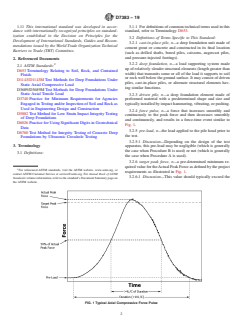
Fig. 1.
Data
3.2.5 pre-load, n—the load applied to the pile head prior to
D6760 Test Method for Integrity Testing of Concrete Deep
the test.
Foundations by Ultrasonic Crosshole Testing
3.2.5.1 Discussion—Depending on the design of the test
3. Terminology apparatus, this pre-load may be negligible (which is generally
the case when Procedure B is used) or not (which is generally
3.1 Definitions:
the case when Procedure A is used).
3.2.6 target peak force, n—a pre-determined minimum re-
quiredvaluefortheActualPeakForceasdefinedbytheproject
For referenced ASTM standards, visit the ASTM website, www.astm.org, or
requirements as illustrated in Fig. 1.
contact ASTM Customer Service at service@astm.org. For Annual Book of ASTM
3.2.6.1 Discussion—This value should typically exceed the
Standards volume information, refer to the standard’s Document Summary page on
the ASTM website.
FIG. 1 Typical Axial Compressive Force Pulse
D7383 − 19
sum of the required ultimate axial compressive static capacity initial installation, (3) pile material properties and dimensions,
plus the dynamic resistance of the pile by an amount deter- (4) type, density, strength, stratification, and saturation of the
mined by the Engineer based on factors including, but not soil, or rock, or both adjacent to and beneath the pile, (5)
limited to, pile type, soil type, structural strength of the pile, quality of force pulse test data, and (6) final foundation
type of structural load, physical restrictions, or other project settlement.
requirements (see Section 4).
4.6 The accuracy of the derived results may improve when
3.2.7 wave speed, c, n—the speed with which a strain wave
using additional strain transducers embedded in the pile.When
propagates through a pile.
combinedwithanappropriatemethodofanalysis,theEngineer
3.2.7.1 Discussion—For this test, one-dimensional, strain-
may use data from these optional transducers to estimate the
wave propagation is generally assumed to occur along the axis
relative contribution of side shear and end bearing to the
of an elastic pile, so that the wave speed equals the square root
mobilized axial static compressive resistance of the pile, or to
of the ratio of the dynamic elastic modulus, E, to the mass
infer the relative contribution of certain soil layers to the
1/2
density, ρ:or c=(E/ρ) . Variations in material down the pile
overall mobilized axial compressive resistance of the pile.
and discontinuities may affect the overall wave speed of the
NOTE 1—The quality of the result produced by these test methods is
pile.
dependent on the competence of the personnel performing it, and the
suitability of the equipment and facilities used. Agencies that meet the
4. Significance and Use
criteria of Practice D3740 are generally considered capable of competent
and objective testing and inspection. Users of these test methods are
4.1 Basedonthemeasurementsofforceanddisplacementat
cautioned that compliance with Practice D3740 does not in itself assure
thepiletop,possiblycombinedwiththosefromaccelerometers
reliable results. Reliable results depend on many factors; Practice D3740
or strain transducers located further down the pile, these test
provides a means of evaluating some of those factors.
methods measure the pile top deflection in response to an axial
compressive force pulse. The relatively long duration of the
5. Apparatus
force pulse compared to the natural period of the test pile
5.1 General—The test requires that the equipment applies a
causes the pile to compress and translate approximately as a
force pulse, which shall exceed the pre-load for a duration time
unit during a portion of the pulse, simultaneously mobilizing
of at least ten times the test pile length (L) divided by the strain
compressive axial static resistance and dynamic resistance at
wave speed (c), or 10L/c, unless supplemental transducers are
allpointsalongthelengthofthepileforthatportionofthetest.
used in accordance with 5.4.4. The applied force shall also
4.2 The compressive axial static resistance is derived from
exceed 50 % of the actual peak force for a minimum duration
the test data and is therefore an indirect result. Test Method
time of four times L/c. The force pulse shall increase smoothly
D1143/D1143M provides a direct and therefore more reliable
and continuously to theActual Peak Force, which shall exceed
measurement of static resistance.
the Target Peak Force in accordance with Fig. 1, and then
decrease smoothly and continuously.Any apparatus capable of
4.3 TheEngineershouldensurethatthetestasspecifiedwill
applying such a force pulse to a pile foundation shall be
generatetherequiredpeakforcetomeetthepurposeofthetest.
considered acceptable. The apparatus selected shall be capable
In case that purpose is to establish geotechnical failure, the
of applying a target peak force in accordance with the project
Engineer should also ensure that peak force results in signifi-
requirements. This section describes two specific types of
cant permanent axial movement during the axial force pulse
equipment used to generate an axial compressive force pulse:
event.
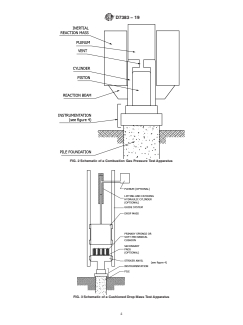
a combustion gas pressure apparatus as shown in Fig. 2 and a
4.4 The Engineer may analyze the acquired data using
cushioned drop-mass apparatus as shown in Fig. 3.
engineering principles and judgment to evaluate the perfor-
5.2 Combustion Gas Pressure Apparatus (for Procedure A):
mance of the force pulse apparatus, and the characteristics of
the pile’s response to the force pulse loading. This analysis 5.2.1 Piston and cylinder jack capable of confining the
typically includes a reduction factor to account for the loading operating pressure, and capable of centering the force pulse
rate effect, that is, additional load resistance that occurs as a application to the pile.
result of a faster rate of loading than used during a static test. 5.2.2 Fuel and ignition mechanism to create gas pressure in
Test results from piles installed in cohesive soils generally
the combustion chamber.
require a greater reduction. The Engineer should determine
5.2.3 Reaction beam, supported by cylinder portion of jack
how the type, size, and shape of the pile, and the properties of
to transfer the combustion force to the inertial or other reaction
the soil or rock beneath and adjacent to the pile, affect the
system.
rate-of-loading reduction factors and the amount of movement
5.2.4 Reaction mass or other means to resist the combustion
required to mobilize and accurately assess the static resistance
forces.Areaction mass system will typically weigh between 5
by eliminating the dynamic component of the response.
and 15 % of the target peak force and will be comprised of
concrete, steel or contained water.
4.5 The scope of this standard does not include analysis for
5.2.5 Accumulatororplenumtoreceivethecombustiongas.
foundation capacity, but in order to analyze the test data
5.2.6 Venting apparatus for the release of combustion gas
appropriately it is important that information on factors that
from the plenum.
affect the derived axial static capacity is properly documented.
These factors may include, but are not limited to, the: (1) pile 5.2.7 Silencer apparatus to muffle the noise of the venting
installation equipment and procedures, (2) elapsed time since combustion gas.
D7383 − 19
FIG. 2 Schematic of a Combustion Gas Pressure Test Apparatus
FIG. 3 Schematic of a Cushioned Drop Mass Test Apparatus
D7383 − 19
5.2.8 Means or mechanism to protect the pile from damage 10 % greater than the target peak force and shall be calibrated
caused by the fall of the reaction mass system (this will to a minimum of the target peak force plus 10 %. The force
typically consist of a gravel-filled enclosure or a mechanism transducer shall be calibrated to an accuracy of 2 % throughout
for arresting the reaction mass such as a hydraulic or mechani- the applicable measurement range. Calibration of the force
cal system). transducer shall demonstrate linearity to within 2 %. Hysterisis
5.2.9 Meansormechanismsuchasarupturevalveordiskto shall not exceed 2 %. The force transducer shall have a
release the combustion gas in the event of an accidental response time of less than 0.1 ms.
increase in system pressure or malfunction of the system. 5.4.2 The primary apparatus for measuring the vertical
acceleration shall consist of at least one calibrated accelerom-
5.3 Cushioned Drop Mass Apparatus (for Procedure B):
eter attached parallel to the central longitudinal pile axis. The
5.3.1 A drop mass comprised of concrete, steel or another
resonant frequency of the accelerometers shall be greater than
material, typically weighing between 5 and 15 % of the target
5 kHz, and the accelerometers shall be linear to at least the
peak force.
anticipated peak acceleration plus 10 %. The accelerometers
5.3.2 Acylinder jack, crane, or winch, capable of lifting the
shall be calibrated to an accuracy of 3 % throughout the
drop mass to the required height.
applicable measurement range. Bolt-on, glue-on, or weld-on
5.3.3 Release mechanism for the drop mass.
accelerometers are acceptable.The accelerometers may also be
5.3.4 A guiding system for the fall of the drop mass to
attached to a force-distribution plate or another part of the
properly center the force pulse application to the pile.
testing apparatus that is firmly attached to the pile head.
5.3.5 Springs or cushion material of sufficient strength and
stiffness to transfer a force pulse to the test pile.
NOTE2—Anaccelerometerthatislineartoatleast50gislikelytomeet
5.3.6 Optional secondary springs or cushion material to
the linearity requirement.
further cushion the force pulse at the beginning and end of the
5.4.3 The apparatus for measuring the axial displacement at
force pulse application.
the pile head shall consist of a calibrated displacement trans-
5.3.7 Optional clamping or catching mechanism on the drop
ducer(s). The device shall be capable of measuring displace-
mass, guide system, or lift cylinder to catch the rebounding
ments directly and continuously over a range of not less than
drop mass after the application of the force pulse, preventing
the larger of: (a) 50 mm plus the theoretical elastic shortening
the application of additional force and improving the verifica-
of the pile; or (b) D/20 plus the theoretical elastic shortening of
tion of the permanent pile head displacement by means of an
thepile,where Disthepilediameter.Thetransducershallhave
elevation check as described in 6.4.4. This clamping or
a precision of at least 0.25 mm and a response time of less than
catching mechanism is preferred but not required.
0.1 ms. The transducer shall be calibrated to an accuracy of
5.3.8 Accessibility for the measurement of the drop height.
2 % throughout the applicable measurement range. The dis-
5.3.9 Optional accumulator or plenum to receive the hy-
placement transducer shall be positioned at and parallel to the
draulic fluids used to raise and to catch the drop mass.
central longitudinal axis of the pile. If a single transducer
cannot be located at the central axis, then two or more
5.4 Force, Acceleration and Displacement Measurements:
5.4.1 The apparatus for measuring the force pulse applied to transducers shall be positioned parallel to and at symmetrical
the pile shall consist of a calibrated force transducer mounted locationswithrespecttothecentrallongitudinalaxissothatthe
directly between the test apparatus and the pile head and in average of their measurements cancels any rotational move-
alignmentwiththecentrallongitudinalaxisofthetestpile.The ment of the pile head. The displacement shall be measured
force transducer shall have a rated service capacity at least using a stationary reference, such as shown in Fig. 4. This
FIG. 4 Apparatus for Conditioning, Recording and Displaying Signals from an Axial Compressive Force Pulse
D7383 − 19
stationary reference shall be positioned at a sufficient distance, 5.5 Conditioning, Recording, and Displaying Data:
but no less than 15 m from the test pile such that the 5.5.1 General—The signals from the accelerometers and
measurements are not influenced by test-induced disturbances,
transducers shall be transmitted to a system to collect and store
considering the expected force pulse duration and wave speed the raw test data in digital form. The collection and storage
in the surrounding soil and surface material.
system shall be connected to a system to graphically or
numerically display the results. The data acquisition system
NOTE 3—To ensure that the stationary reference is not influenced by
shall acquire at least 50 ms of data before the start of the force
test-induced disturbances it may have to be placed at such a distance from
thepilethatisnotpractical.Inthatcasedisplacementofthepileheadmay pulse and at least 450 ms of data after the start of the force
be derived by double integrating the signals of accelerometers as
pulse. All data shall be synchronized.
described in 5.4.4.
5.5.2 Signal Conditioning—The signal conditioning of any
5.4.4 The accelerometer specified in 5.4.2 can be used as an
signals shall not create differential phase shift or differential
alternate apparatus for measuring axial pile head displacement
amplification of individual measurements. Frequency compo-
by performing double integration of the measured acceleration
nentsshallhaveaminimumlowpasscutofffrequencyof1000
signalintime.Thisresultshallbecross-checkedwiththedirect
Hz.
displacement measurement specified in 5.4.3. In situations
5.5.3 Recording Apparatus—All signals shall be recorded
where this cross-check cannot be done (for example, where
digitally. When digitizing, the sample frequency shall be at
physical restrictions prevent the use of a stationary reference),
least 4000 Hz for each data channel.
accelerometers can be used as the main displacement measure-
5.5.4 Display Apparatus—All signals shall be displayed
ment system, with appropriate redundancy in the
with respect to time by means of an apparatus such as a digital
measurements, notation in the report, and independent verifi-
graphics screen, or computer monitor. The apparatus shall also
cation of final set. Where accelerometers are used as the main
be capable of displaying the measured force pulse with respect
displacement measurement system a minimum of two cali-
to displacement.
brated a
...
This document is not an ASTM standard and is intended only to provide the user of an ASTM standard an indication of what changes have been made to the previous version. Because
it may not be technically possible to adequately depict all changes accurately, ASTM recommends that users consult prior editions as appropriate. In all cases only the current version
of the standard as published by ASTM is to be considered the official document.
Designation: D7383 − 10 D7383 − 19
Standard Test Methods for
Axial Compressive Force Pulse (Rapid) Rapid Load
(Compressive Force Pulse) Testing of Deep Foundations
This standard is issued under the fixed designation D7383; the number immediately following the designation indicates the year of
original adoption or, in the case of revision, the year of last revision. A number in parentheses indicates the year of last reapproval. A
superscript epsilon (´) indicates an editorial change since the last revision or reapproval.
1. Scope
1.1 These test methods methods, commonly referred to as Rapid Load Testing, cover procedures for testing an individual
vertical or inclined deep foundation element to determine the displacement response to an axial compressive force pulse applied
at its top. These non-static foundation test methods apply to all deep foundation units, referred to herein as “piles,” that function
in a manner similar to driven or cast-in-place piles, regardless of their method of installation.
1.2 Two alternative procedures are provided:
1.2.1 Procedure A uses a combustion gas pressure apparatus to produce the required axial compressive force pulse.
1.2.2 Procedure B uses a cushioned drop mass apparatus to produce the required axial compressive force pulse.
1.3 This standard provides minimum requirements for testing deep foundations under an axial compressive force pulse. Plans,
specifications, provisions (or combinations thereof) prepared by a qualified engineer, may provide additional requirements and
procedures as needed to satisfy the objectives of a particular deep foundation test program. The engineer in responsible charge of
the foundation design, referred to herein as the “Engineer,” shall approve any deviations, deletions, or additions to the requirements
of this standard.
1.4 The proper conduct and evaluation of force pulse testing the test requires special knowledge and experience. A qualified
engineer should directly supervise the acquisition of field data and the interpretation of the test results so as to predict the actual
performance and adequacy of deep foundations used in the constructed foundation. A qualified engineer shall approve the apparatus
used for applying the force pulse, rigging and hoisting equipment, support frames, templates, and test procedures.
1.5 The text of this standard references notes and footnotes which provide explanatory material. These notes and footnotes
(excluding those in tables and figures) shall not be considered as requirements of the standard. The word “shall” indicates a
mandatory provision, and the word “should” indicates a recommended or advisory provision. Imperative sentences indicate
mandatory provisions.
1.6 The values stated in SI units are to be regarded as standard. No other units of measurement are included in this standard.
1.7 All observed and calculated values shall conform to the guidelines for significant digits and rounding established in Practice
D6026.
1.7.1 The procedures used to specify how data are collected/recorded or calculated in the standard are regarded as the industry
standard. In addition, they are representative of the significant digits that generally should be retained. The procedures used do not
consider material variation, purpose for obtaining the data, special purpose studies, or any considerations for the user’s objectives;
and it is common practice to increase or reduce significant digits of reported data to be commensurate with these considerations.
It is beyond the scope of this standard to consider significant digits used in analysis methods for engineering data
1.8 The method used to specify how data are collected, calculated or recorded in this standard is not directly related to the
accuracy to which the data can be applied in the design or other uses, or both. How one uses the results obtained using this standard
is beyond its scope.
1.9 ASTM International takes no position respecting the validity of any patent rights asserted in connection with any item
mentioned in this standard. Users of this standard are expressly advised that determination of the validity of any such patent rights,
and the risk of infringement of such rights, are entirely their own responsibility.
1.10 This standard may involve hazardous materials, operations, and equipment. This standard does not purport to address all
of the safety concerns, if any, associated with its use. It is the responsibility of the user of this standard to establish appropriate
These test methods are under the jurisdiction of ASTM Committee D18 on Soil and Rock and is the direct responsibility of Subcommittee D18.11 on Deep Foundations.
Current edition approved July 1, 2010March 1, 2019. Published August 2010March 2019. Originally approved in 2008 as D7383–08. Last previous edition approved in
2010 as D7383–10. DOI: 10.1520/D7383-10.10.1520/D7383-19.
Copyright © ASTM International, 100 Barr Harbor Drive, PO Box C700, West Conshohocken, PA 19428-2959. United States
D7383 − 19
safety safety, health, and healthenvironmental practices and determine the applicability of regulatory limitations prior to use.
Section 7 provides a partial list of specific hazards and precautions.
1.11 This international standard was developed in accordance with internationally recognized principles on standardization
established in the Decision on Principles for the Development of International Standards, Guides and Recommendations issued
by the World Trade Organization Technical Barriers to Trade (TBT) Committee.
2. Referenced Documents
2.1 ASTM Standards:
D653 Terminology Relating to Soil, Rock, and Contained Fluids
D1143D1143/D1143M Test Methods for Deep Foundations Under Static Axial Compressive Load
D3689D3689/D3689M Test Methods for Deep Foundations Under Static Axial Tensile Load
D3740 Practice for Minimum Requirements for Agencies Engaged in Testing and/or Inspection of Soil and Rock as Used in
Engineering Design and Construction
D5882 Test Method for Low Strain Impact Integrity Testing of Deep Foundations
D6026 Practice for Using Significant Digits in Geotechnical Data
D6760 Test Method for Integrity Testing of Concrete Deep Foundations by Ultrasonic Crosshole Testing
3. Terminology
3.1 Definitions:
3.1.1 For common definitions of common technical terms used in this standard, see refer to Terminology D653.
3.2 Definitions of Terms Specific to This Standard:
3.2.1 cast-in-place pile, n—a deep foundation unit made of cement grout or concrete and constructed in its final location, for
example,location (such as drilled shafts, bored piles, caissons, augercast piles, and pressure-injected footings, etc.footings).
3.2.2 deep foundation, n—a load supporting system made up of relatively slender structural elementelements (length greater
than width) that transmits some or all of the load it supports to soil or rock well below the ground surface. It may be a driven pile,
a cast-in-place pile, or an alternate structural element having a similar function.consist of driven piles, cast-in-place piles, or
alternate structural elements having similar functions.
3.2.3 driven pile, n—a deep foundation unitelement made of preformed material with a predetermined shape and size and
typically installed by impact hammering, vibrating, or pushing.
FIG. 1 Typical Axial Compressive Force Pulse
For referenced ASTM standards, visit the ASTM website, www.astm.org, or contact ASTM Customer Service at service@astm.org. For Annual Book of ASTM Standards
volume information, refer to the standard’s Document Summary page on the ASTM website.
D7383 − 19
3.2.4 force pulse, n—for the purposes of this standard, a “force pulse” shall result a force that increases smoothly and
continuously to the peak force and then decreases smoothly and continuously, and results in a force-time event similar to Fig. 1,
typically reaching a target peak force. The applied force shall exceed the pre-load for a duration time of at least twelve times the
test pile length (.L) divided by the strain wave speed (c), or 12L/c. The applied force shall also exceed 50 % of the actual peak
force for a minimum duration time of four times L/c. The force pulse shall increase smoothly and continuously to the peak force
and then decrease smoothly and continuously. Typical force pulse durations range from 90 to 250 ms.
NOTE 1—A force pulse duration of less that 12L/c may be acceptable to the Engineer when using supplemental transducers as described in 5.4.
3.2.5 pre-load, n—the load applied to the pile head due to the static weight of the test apparatus prior to the test, possibly
negligible depending on the design of the test apparatus.test.
3.2.5.1 Discussion—
Depending on the design of the test apparatus, this pre-load may be negligible (which is generally the case when Procedure B is
used) or not (which is generally the case when Procedure A is used).
3.2.6 target peak force, n—a pre-determined target minimum required value for the desired amplitude of the force pulse Actual
Peak Force as defined by the project requirements. This value should typically exceed the sum of the required ultimate axial
compressive static capacity plus the dynamic resistance of the pile by an amount determined by the Engineer based on factors
including, but not limited to, pile type, soil type, structural strength of the pile, type of structural load, physical restrictions, or other
project requirements (see Sectionrequirements as illustrated 4).in Fig. 1.
3.2.6.1 Discussion—
This value should typically exceed the sum of the required ultimate axial compressive static capacity plus the dynamic resistance
of the pile by an amount determined by the Engineer based on factors including, but not limited to, pile type, soil type, structural
strength of the pile, type of structural load, physical restrictions, or other project requirements (see Section 4).
3.2.7 wave speed, c, n—the speed with which a strain wave propagates through a pile. It is a property of the pile composition
and is represented herein by c. For one-dimensional wave propagation, c is equal to the square root of Elastic Modulus divided
1/2
by mass density: c = (E/ρ) . Typical values of c are 4000 m/s for concrete piles and 5100 m/s for steel piles.
3.2.7.1 Discussion—
For this test, one-dimensional, strain-wave propagation is generally assumed to occur along the axis of an elastic pile, so that the
1/2
wave speed equals the square root of the ratio of the dynamic elastic modulus, E, to the mass density, ρ: or c = (E/ρ) . Variations
in material down the pile and discontinuities may affect the overall wave speed of the pile.
4. Significance and Use
4.1 Based on the measurements of force and displacement at the pile top, possibly combined with those from accelerationac-
celerometers or strain transducers located further down the pile, these test methods measure the pile top deflection in response to
an axial compressive force pulse. The relatively long duration of the force pulse compared to the natural period of the test pile
causes the pile to compress and translate approximately as a unit during a portion of the pulse, simultaneously mobilizing
compressive axial static capacityresistance and dynamic resistance at all points along the length of the pile for that portion of the
test. The Engineer may analyze the acquired data using engineering principles and judgment to evaluate the performance of the
force pulse apparatus, and the characteristics of the pile’s response to the force pulse loading.
4.2 The compressive axial static resistance is derived from the test data and is therefore an indirect result. Test Method
D1143/D1143M provides a direct and therefore more reliable measurement of static resistance.
4.3 The Engineer should ensure that the test as specified will generate the required peak force to meet the purpose of the test.
In case that purpose is to establish geotechnical failure, the Engineer should also ensure that peak force results in significant
permanent axial movement during the axial force pulse event.
4.4 The Engineer may analyze the acquired data using engineering principles and judgment to evaluate the performance of the
force pulse apparatus, and the characteristics of the pile’s response to the force pulse loading. This analysis typically includes a
reduction factor to account for the loading rate effect, that is, additional load resistance that occurs as a result of a faster rate of
loading than used during a static test. Test results from piles installed in cohesive soils generally require a greater reduction. The
Engineer should determine how the type, size, and shape of the pile, and the properties of the soil or rock beneath and adjacent
to the pile, affect the rate-of-loading reduction factors and the amount of movement required to mobilize and accurately assess the
static resistance by eliminating the dynamic component of the response.
D7383 − 19
4.5 If significant permanent axial movement occurs during the axial force pulse event, the Engineer may analyze the results of
the test to estimate, after assessing inertial effects and the dynamic soil and rock response along the side and bottom of the pile,
the ultimate axial static compression capacity (see Note 2). The scope of this standard does not include analysis for either ultimate
or design foundation capacity. Factors that may affect the foundation capacity, but in order to analyze the test data appropriately
it is important that information on factors that affect the derived axial static capacity estimated from force pulse tests is properly
documented. These factors may include, but are not limited to, the: ((1)1) pile installation equipment and procedures, ((2)2) elapsed
time since initial installation, ( (3)3) pile material properties and dimensions, ((4)4) type, density, strength, stratification, and
saturation of the soil, or rock, or both adjacent to and beneath the pile, ((5)5) quality of force pulse test data, (6) foundation
settlement, (7) analysis method, and ((8)6 engineering judgment and experience. If the Engineer does not have adequate previous
experience with these factors, and with the analysis of force pulse test data, then a static load test carried out according to Test
Method ) final foundation settlement.D1143 should be used to verify estimates of static capacity and its distribution along the pile
length. Test Method D1143 provides a direct and more reliable measurement of static capacity.
NOTE 2—If a force pulse test produces insufficient axial movement, subsequent analysis may overestimate the static capacity because of difficulty in
separating the static and dynamic components of the response. The analysis of a force pulse test to estimate static capacity also typically includes a
reduction factor to account for the additional load resistance that occurs as a result of a faster rate of loading than used during a static test. Force pulse
test results from cohesive soils generally require a greater reduction factor due to the rate of loading effect, chosen conservatively to produce a lower static
capacity estimate. The Engineer should determine how the type, size, and shape of the pile, and the properties of the soil or rock beneath and adjacent
to the pile, affect the rate-of-loading reduction factors and the amount of movement required to mobilize and accurately assess the static capacity.
Correlations between actual measurements and force pulse estimates of the ultimate axial static compression capacity generally improve when using
additional transducers embedded in the pile. Static capacity may also change over time after the pile installation, especially for driven piles. Both static
and force pulse tests represent the capacity at the time of the respective test, and correlation attempts should provide results for a similar time of testing
after pile installation or include analysis to account for changes in the soil strength during the time between the two tests.
4.6 When used in conjunction with additional The accuracy of the derived results may improve when using additional strain
transducers embedded in the pile, these test methods may also be used to measure the pile response to the axial force pulse along
the pile length. pile. When combined with an appropriate method of analysis, the Engineer may use data from these optional
transducers to estimate the relative contribution of side shear and end bearing to the mobilized axial static compressive
capacityresistance of the pile, or to infer the relative contribution of certain soil layers to the overall mobilized axial compressive
capacityresistance of the pile.
NOTE 1—The quality of the result produced by these test methods is dependent on the competence of the personnel performing it, and the suitability
of the equipment and facilities used. Agencies that meet the criteria of Practice D3740 are generally considered capable of competent and objective testing
and inspection. Users of these test methods are cautioned that compliance with Practice D3740 does not in itself assure reliable results. Reliable results
depend on many factors; Practice D3740 provides a means of evaluating some of those factors.
NOTE 3—When used in conjunction with additional transducers embedded in the pile the force pulse test analysis may provide an estimate of the pile’s
tension (uplift) capacity. Users of this standard are cautioned to interpret the estimated side resistance conservatively. If the Engineer does not have
adequate previous experience for the specific site and pile type with the analysis of force pulse test data for tension capacity, then a static load test carried
out according to Test Method D3689 should be used to verify tension capacity estimates. Test Method D3689 provides a direct and more reliable
measurement of static tension capacity.
NOTE 4—The quality of the result produced by these test methods is dependent on the competence of the personnel performing it, and the suitability
of the equipment and facilities used. Agencies that meet the criteria of Practice D3740 are generally considered capable of competent and objective testing
and inspection. Users of these test methods are cautioned that compliance with Practice D3740 does not in itself assure reliable results. Reliable results
depend on many factors; Practice D3740 provides a means of evaluating some of those factors.
5. Apparatus
5.1 General—The test requires that the equipment applies a force pulse, which shall exceed the pre-load for a duration time of
at least ten times the test pile length (L) divided by the strain wave speed (c), or 10L/c, unless supplemental transducers are used
in accordance with 5.4.4. The applied force shall also exceed 50 % of the actual peak force for a minimum duration time of four
times L/c. The force pulse shall increase smoothly and continuously to the Actual Peak Force, which shall exceed the Target Peak
Force in accordance with Fig. 1, and then decrease smoothly and continuously. Any apparatus capable of applying such a force
pulse to a pile foundation that is in accordance with Section 3shall be considered acceptable. The apparatus selected shall be
capable of applying a target peak force in accordance with the project requirements. This section describes two specific types of
equipment used to generate an axial compressive force pulse: a combustion gas pressure apparatus as shown in Fig. 2 and a
cushioned drop-mass apparatus as shown in Fig. 3.
5.2 Combustion Gas Pressure Apparatus (for Procedure A):
5.2.1 Piston and cylinder jack capable of confining the operating pressure, and capable of centering the force pulse application
to the pile.
5.2.2 Fuel and ignition mechanism to create gas pressure in the combustion chamber.
5.2.3 Reaction beam, supported by cylinder portion of jack to transfer the combustion force to the inertial or other reaction
system.
5.2.4 Reaction mass or other means to resist the combustion forces. A reaction mass system will typically weigh between 5 and
15 % of the target peak force and will be comprised of concrete, steel or contained water.
5.2.5 Accumulator or plenum to receive the combustion gas.
D7383 − 19
FIG. 2 Schematic of a Combustion Gas Pressure Test Apparatus
FIG. 3 Schematic of a Cushioned Drop Mass Test Apparatus
D7383 − 19
5.2.6 Venting apparatus for the release of combustion gas from the plenum.
5.2.7 Silencer apparatus to muffle the noise of the venting combustion gas.
5.2.8 Means or mechanism to protect the pile from damage caused by the fall of the reaction mass system (this will typically
consist of a gravel-filled enclosure or a mechanism for arresting the reaction mass such as a hydraulic or mechanical system).
5.2.9 Means or mechanism such as a rupture valve or disk to release the combustion gas in the event of an accidental increase
in system pressure or malfunction of the system.
5.3 Cushioned Drop Mass Apparatus (for Procedure B):
5.3.1 A drop mass comprised of concrete, steel or another material, typically weighing between 5 and 15 % of the target peak
force.
5.3.2 A cylinder jack, crane, or winch, capable of lifting the drop mass to the required height.
5.3.3 Release mechanism for the drop mass.
5.3.4 A guiding system for the fall of the drop mass to properly center the force pulse application to the pile.
5.3.5 Springs or cushion material of sufficient strength and stiffness to transfer a force pulse to the test pile.
5.3.6 Optional secondary springs or cushion material to further cushion the force pulse at the beginning and end of the force
pulse application.
5.3.7 Optional clamping or catching mechanism on the drop mass, guide system, or lift cylinder to catch the rebounding drop
mass after the application of the force pulse, preventing the application of additional force and improving the verification of the
permanent pile head displacement by means of an elevation check as described in 6.4.4. This clamping or catching mechanism is
preferred but not required.
5.3.8 Accessibility for the measurement of the drop height.
5.3.9 Accumulator Optional accumulator or plenum to receive the hydraulic fluids used to raise and to catch the drop mass.
5.4 Force Force, Acceleration and Displacement Measurements:
5.4.1 The apparatus for measuring the force pulse applied to the pile shall consist of a calibrated force transducer mounted
directly between the test apparatus and the pile head and in alignment with the central longitudinal axis of the test pile. The force
transducer shall have a rated service capacity at least 10 % greater than the target peak force and shall be calibrated to a minimum
of the target peak force plus 10 %. The force transducer shall be calibrated to an accuracy of 2 % throughout the applicable
measurement range. Calibration of the force transducer shall demonstrate linearity to within 2 %. Hysterisis shall not exceed 2 %.
The force transducer shall have a response time of less than 0.1 ms.
5.4.2 The primary apparatus for measuring the vertical acceleration shall consist of at least one calibrated accelerometer
attached parallel to the central longitudinal pile axis. The resonant frequency of the accelerometers shall be greater than 5 kHz,
and the accelerometers shall be linear to at least the anticipated peak acceleration plus 10 %. The accelerometers shall be calibrated
to an accuracy of 3 % throughout the applicable measurement range. Bolt-on, glue-on, or weld-on accelerometers are acceptable.
The accelerometers may also be attached to a force-distribution plate or another part of the testing apparatus that is firmly attached
to the pile head.
NOTE 2—An accelerometer that is linear to at least 50 g is likely to meet the linearity requirement.
5.4.3 The primary apparatus for measuring the axial displacement at the pile head shall consist of a calibrated displacement
transducer(s). The device shall be capable of measuring displacements directly and continuously over a range of not less than the
larger of: (a) 50 mm plus the theoretical elastic shortening of the pile; or (b)D/20 plus the theoretical elastic shortening of the pile,
where D is the pile diameter. The transducer shall have a precision of at least 0.25 mm and a response time of less than 0.1 ms.
The transducer shall be calibrated to an accuracy of 2 % throughout the applicable measurement range. The displacement
transducer shall be positioned at and parallel to the central longitudinal axis of the pile. If a single transducer cannot be located
at the central axis, then position two or more transducers shall be positioned parallel to and at symmetrical locations with respect
to the central longitudinal axis so that the average of their measurements cancels theany rotational movement of the pile head. The
displacement shall be measured using a stationary reference, such as shown in Fig. 4. Position the displacement reference This
stationary reference shall be positioned at a sufficient distance distance, but no less than 15 m from the test pile such that the
measurements are not influenced by test-induced disturbances (typically 20 to 30 m), disturbances, considering the expected force
pulse duration and wave speed in the surrounding soil and surface material.
NOTE 3—To ensure that the stationary reference is not influenced by test-induced disturbances it may have to be placed at such a distance from the
pile that is not practical. In that case displacement of the pile head may be derived by double integrating the signals of accelerometers as described in
5.4.4.
5.4.4 A secondary The accelerometer specified in 5.4.2 can be used as an alternate apparatus for measuring axial pile head
displacement is required, and shall consist by performing double integration of the measured acceleration signal in time. This result
shall be cross-checked with the direct displacement measurement specified in 5.4.3of accelerometers, redundant displacement
transducers, or other apparatus as approved by the Engineer. Accelerometers indicate pile head displacement by doubly integrating
the acceleration signal. Securely attach . In situations where this cross-check cannot be done (for example, where physical
restrictions prevent the use of a stationary reference), accelerometers can be used as the main displacement measurement system,
with appropriate redundancy in the measurements, notation in the report, and independent verification of final set. Where
D7383 − 19
FIG. 4 Apparatus for Conditioning, Recording and Displaying Signals from an Axial Compressive Force Pulse
accelerometers are used as the main displacement measurement system a minimum of two calibrated acceleration transducers
accelerometers at symmetrical locations with respect to and parallel to the central longitudinal pile axis (see Fig. 4), or one
calibrated transduceraccelerometer at and parallel to the central longitudinal pile axis. The resonant frequency of the
accelerometers shall be greater than 5 kHz, and the accelerometers shall be linear to at least 50 g. The transducers shall be
calibrated to an accuracy of 3 % throughout the applicable measurement range. Bolt-on, glue-on, or weld-on accelerometers are
acceptable. The accelerometers may also be attached to a force-distribution plate or another part of the testing apparatus that is
firmly attached to the pile head.axis shall be securely attached.
NOTE 4—Direct Assuming that the stationary reference is not influenced by test-induced disturbances, direct displacement measurements generally
provide better accuracy than that obtained by double integration of acceleration.
NOTE 6—In situations where physical restrictions prevent the use of a stationary reference, the Engineer may approve acceleration transducers as the
primary displacement measurement system, with appropriate redundancy in the measurements, notation in the report, and independent verification of final
set (see Section 6).
5.4.5 Optional or supplemental accelerometers and transducers may consist of bolt-on, weld-on, glue-on, or embedded force or
strain transducers, or additional accelerometers or displacement transducers. Specifications for these accelerometers and
transducers shall be consistent with those for similar measurements as required in 5.45.4.1, 5.4.2, 5.4.3. The location and
specifications of all optional or supplemental accelerometers and transducers shall be approved by the Engineer and described in
the test report as per Section 8. When the duration of the force pulse as described in Section 3 is less than the required 1210L/c,
supplemental strain transducers are required alo
...