


ASTM C660-81(2015)
(Practice)Standard Practices for Production and Preparation of Gray Iron Castings for Porcelain Enameling
Standard Practices for Production and Preparation of Gray Iron Castings for Porcelain Enameling
ABSTRACT
These practices are intended for production and preparation of gray iron castings for porcelain enamelling. Design of the casting should be such as to minimize variations in temperature during firing and cooling. The governing factors in pattern layout and shop control are elimination of discontinuities, chill, and inclusions at or near the surfaces to be coated. Visual inspection methods for enamelling surfaces should place emphasis on the detection and remedy of porosity, sand inclusions, and gas holes. Porosity consisting of essentially subsurface pinholes, shallow covered blows, body scars, or shrinkage near the surface may or may not be acceptable for correction, depending upon severity.
SCOPE
1.1 These practices are intended to indicate certain casting characteristics and pre-enameling practices which will facilitate finishing by the wet- or dry-process methods of porcelain enameling. All of the listed recommendations are based on experiences with gray iron casting and enameling.
1.2 The values stated in inch-pound units are to be regarded as standard. The values given in parentheses are mathematical conversions to SI units that are provided for information only and are not considered standard.
1.3 This standard does not purport to address all of the safety concerns, if any, associated with its use. It is the responsibility of the user of this standard to establish appropriate safety and health practices and determine the applicability of regulatory limitations prior to use.
General Information
Buy Standard
Standards Content (Sample)
NOTICE: This standard has either been superseded and replaced by a new version or withdrawn.
Contact ASTM International (www.astm.org) for the latest information
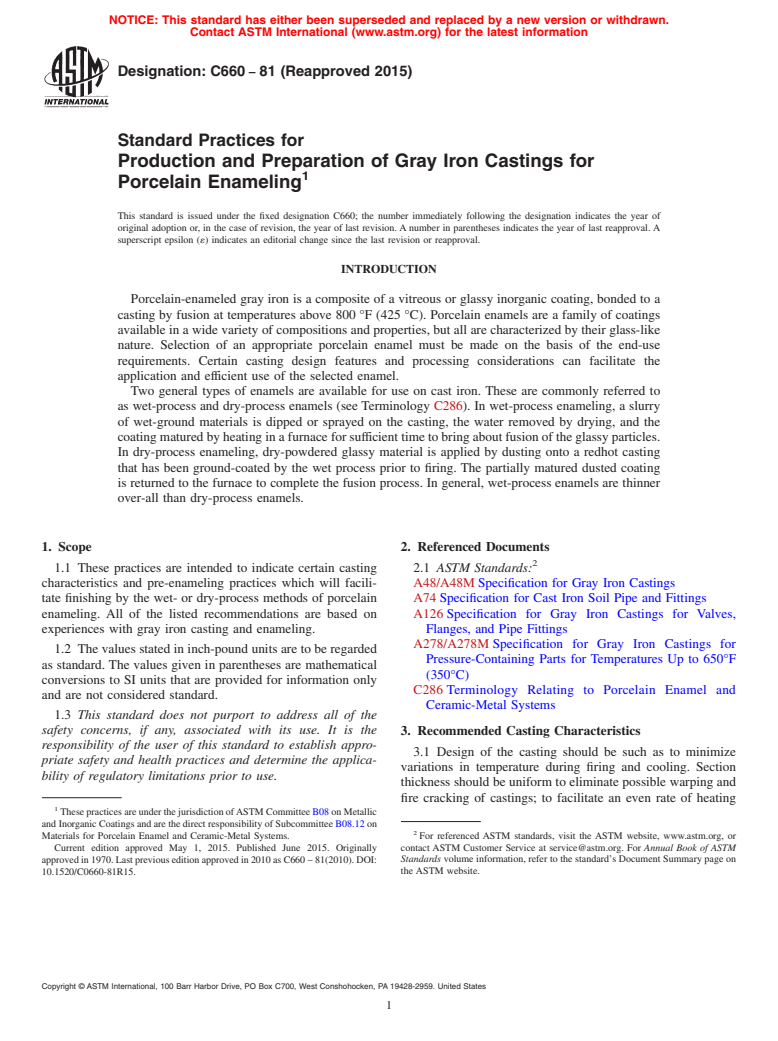
Designation: C660 − 81 (Reapproved 2015)
Standard Practices for
Production and Preparation of Gray Iron Castings for
Porcelain Enameling
This standard is issued under the fixed designation C660; the number immediately following the designation indicates the year of
original adoption or, in the case of revision, the year of last revision.Anumber in parentheses indicates the year of last reapproval.A
superscript epsilon (´) indicates an editorial change since the last revision or reapproval.
INTRODUCTION
Porcelain-enameled gray iron is a composite of a vitreous or glassy inorganic coating, bonded to a
casting by fusion at temperatures above 800 °F (425 °C). Porcelain enamels are a family of coatings
available in a wide variety of compositions and properties, but all are characterized by their glass-like
nature. Selection of an appropriate porcelain enamel must be made on the basis of the end-use
requirements. Certain casting design features and processing considerations can facilitate the
application and efficient use of the selected enamel.
Two general types of enamels are available for use on cast iron. These are commonly referred to
as wet-process and dry-process enamels (see Terminology C286). In wet-process enameling, a slurry
of wet-ground materials is dipped or sprayed on the casting, the water removed by drying, and the
coatingmaturedbyheatinginafurnaceforsufficienttimetobringaboutfusionoftheglassyparticles.
In dry-process enameling, dry-powdered glassy material is applied by dusting onto a redhot casting
that has been ground-coated by the wet process prior to firing. The partially matured dusted coating
is returned to the furnace to complete the fusion process. In general, wet-process enamels are thinner
over-all than dry-process enamels.
1. Scope 2. Referenced Documents
1.1 These practices are intended to indicate certain casting 2.1 ASTM Standards:
characteristics and pre-enameling practices which will facili- A48/A48MSpecification for Gray Iron Castings
tate finishing by the wet- or dry-process methods of porcelain A74Specification for Cast Iron Soil Pipe and Fittings
enameling. All of the listed recommendations are based on A126 Specification for Gray Iron Castings for Valves,
experiences with gray iron casting and enameling. Flanges, and Pipe Fittings
A278/A278M Specification for Gray Iron Castings for
1.2 The values stated in inch-pound units are to be regarded
Pressure-Containing Parts for Temperatures Up to 650°F
as standard. The values given in parentheses are mathematical
(350°C)
conversions to SI units that are provided for information only
C286 Terminology Relating to Porcelain Enamel and
and are not considered standard.
Ceramic-Metal Systems
1.3 This standard does not purport to address all of the
safety concerns, if any, associated with its use. It is the
3. Recommended Casting Characteristics
responsibility of the user of this standard to establish appro-
3.1 Design of the casting should be such as to minimize
priate safety and health practices and determine the applica-
variations in temperature during firing and cooling. Section
bility of regulatory limitations prior to use.
thickness should be uniform to eliminate possible warping and
fire cracking of castings; to facilitate an even rate of heating
ThesepracticesareunderthejurisdictionofASTMCommitteeB08onMetallic
andInorganicCoatingsandarethedirectresponsibilityofSubcommitteeB08.12on
Materials for Porcelain Enamel and Ceramic-Metal Systems. For referenced ASTM standards, visit the ASTM website, www.astm.org, or
Current edition approved May 1, 2015. Published June 2015. Originally contact ASTM Customer Service at service@astm.org. For Annual Book of ASTM
approvedin1970.Lastpreviouseditionapprovedin2010asC660–81(2010).DOI: Standards volume information, refer to the standard’s Document Summary page on
10.1520/C0660-81R15. the ASTM website.
Copyright © ASTM International, 100 Barr Harbor Drive, PO Box C700, West Conshohocken, PA 19428-2959. United States
C660 − 81 (2015)
and cooling and to prevent possible spalling, hairlining, and 4.2.3 Manganese content of the iron must be sufficient to
blistering of the porcelain enamel. balance the sulfur content. A slight excess of manganese is
preferred in order to assure sulfur tie-up; that is, Mn, per-
3.2 When a variation in section thickness is unavoidable,
cent=(1.7×S, percent)+0.3.
the transition of the two sections should be gradual and
4.2.4 High phosphorus content of 0.70 % may be desirable
smooth. Abrupt changes in sections give rise to significant
for improved strength at enameling temperatures. Phosphorus
differences in heating and cooling rates, resulting in nonuni-
in the iron has no reported association with boiling defects in
form coating conditions.
the coating.
3.3 Special styling techniques should be used for designing
4.3 When pouring thin-walled or complex shapes to be
appendages, internal passages, and lug-fastening faces so as
enameled, one must consider the effect of metal composition
not to emplace a mass of metal near an otherwise uniform
onmicrostructure.Whiteormottledstructureswillnotroughen
enameling surface.These design considerations should include
adequately during cleaning, and also may introduce other
a thorough review of the available mold-making techniques in
problemsinthecoatingprocess.Siliconcontentover2.4%and
conjunction with the pattern designer.
the use of heater strips may be effective, but a suitable anneal
3.4 Where functional or mating surfaces of an enameled
is the desirable corrective measure.
casting are a design consideration, allowances must be in-
4.4 Metal having a microstructure containing massive car-
cluded for the thickness of the coating and the method of
bides and high pearlite content will introduce enameling
application. The optimum thickness of wet-process enamels is
problems. Heat treatments employed to obtain desired me-
about 10 mils (0.25 mm) in dry process enamels it is about 40
chanical properties in the casting should minimize these
mils (1.0 mm).
problems.
3.5 Sharp edges on castings should be avoided, because
4.5 Where annealing is a regular part of the foundry
neither the wetnor dry-process coatings will adequately cover
operations,anoxidizingfurnaceatmosphereishighlydesirable
sharp edges. Inside and outside corners should be rounded to
in order to produce easily removed scale and obtain decarbur-
uniform thickness and generous radii provided for fillets and
ized enameling surfaces. Decarburized surfaces are advanta-
outside corners.
geous to enameling.
3.6 Material identifications for the castings should be se-
4.6 Heating and cooling cycles employed in the enameling
lected from appropriateASTM specifications which are found
process cause transformations that affect microstructure. Ap-
under the various headings for gray iron.
propriate metallurgical constituents used to stabilize or retard
3.6.1 An example of the more desirable types of iron for
these conditions should not be incorporated until a thorough
enameling purposes are the normally ferritic Class 20 irons
studyismadeoftheireffectonthecoatingresults.Examplesof
(see Specification A48/A48M for Gray Iron Castings). They
pearlite stabilizers are tin or manganese.
cast more readily into complex shapes,
...
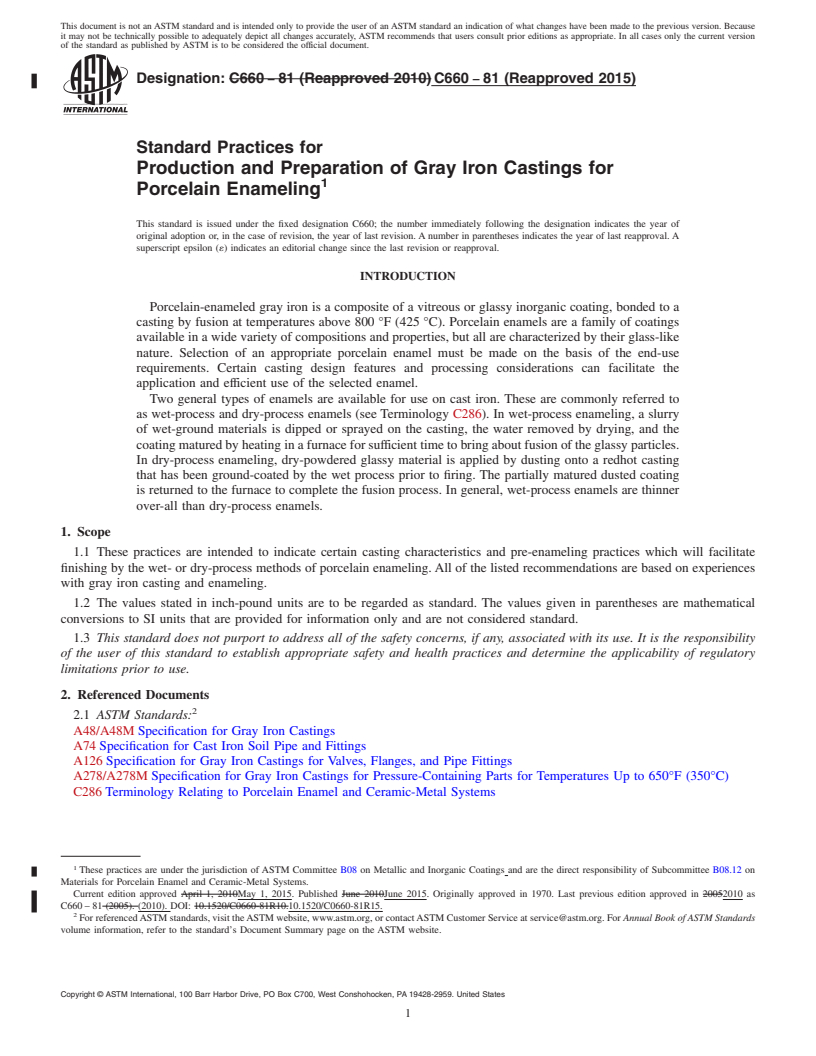
This document is not an ASTM standard and is intended only to provide the user of an ASTM standard an indication of what changes have been made to the previous version. Because
it may not be technically possible to adequately depict all changes accurately, ASTM recommends that users consult prior editions as appropriate. In all cases only the current version
of the standard as published by ASTM is to be considered the official document.
Designation: C660 − 81 (Reapproved 2010) C660 − 81 (Reapproved 2015)
Standard Practices for
Production and Preparation of Gray Iron Castings for
Porcelain Enameling
This standard is issued under the fixed designation C660; the number immediately following the designation indicates the year of
original adoption or, in the case of revision, the year of last revision. A number in parentheses indicates the year of last reapproval. A
superscript epsilon (´) indicates an editorial change since the last revision or reapproval.
INTRODUCTION
Porcelain-enameled gray iron is a composite of a vitreous or glassy inorganic coating, bonded to a
casting by fusion at temperatures above 800 °F (425 °C). Porcelain enamels are a family of coatings
available in a wide variety of compositions and properties, but all are characterized by their glass-like
nature. Selection of an appropriate porcelain enamel must be made on the basis of the end-use
requirements. Certain casting design features and processing considerations can facilitate the
application and efficient use of the selected enamel.
Two general types of enamels are available for use on cast iron. These are commonly referred to
as wet-process and dry-process enamels (see Terminology C286). In wet-process enameling, a slurry
of wet-ground materials is dipped or sprayed on the casting, the water removed by drying, and the
coating matured by heating in a furnace for sufficient time to bring about fusion of the glassy particles.
In dry-process enameling, dry-powdered glassy material is applied by dusting onto a redhot casting
that has been ground-coated by the wet process prior to firing. The partially matured dusted coating
is returned to the furnace to complete the fusion process. In general, wet-process enamels are thinner
over-all than dry-process enamels.
1. Scope
1.1 These practices are intended to indicate certain casting characteristics and pre-enameling practices which will facilitate
finishing by the wet- or dry-process methods of porcelain enameling. All of the listed recommendations are based on experiences
with gray iron casting and enameling.
1.2 The values stated in inch-pound units are to be regarded as standard. The values given in parentheses are mathematical
conversions to SI units that are provided for information only and are not considered standard.
1.3 This standard does not purport to address all of the safety concerns, if any, associated with its use. It is the responsibility
of the user of this standard to establish appropriate safety and health practices and determine the applicability of regulatory
limitations prior to use.
2. Referenced Documents
2.1 ASTM Standards:
A48/A48M Specification for Gray Iron Castings
A74 Specification for Cast Iron Soil Pipe and Fittings
A126 Specification for Gray Iron Castings for Valves, Flanges, and Pipe Fittings
A278/A278M Specification for Gray Iron Castings for Pressure-Containing Parts for Temperatures Up to 650°F (350°C)
C286 Terminology Relating to Porcelain Enamel and Ceramic-Metal Systems
These practices are under the jurisdiction of ASTM Committee B08 on Metallic and Inorganic Coatings and are the direct responsibility of Subcommittee B08.12 on
Materials for Porcelain Enamel and Ceramic-Metal Systems.
Current edition approved April 1, 2010May 1, 2015. Published June 2010June 2015. Originally approved in 1970. Last previous edition approved in 20052010 as
C660 – 81 (2005). (2010). DOI: 10.1520/C0660-81R10.10.1520/C0660-81R15.
For referenced ASTM standards, visit the ASTM website, www.astm.org, or contact ASTM Customer Service at service@astm.org. For Annual Book of ASTM Standards
volume information, refer to the standard’s Document Summary page on the ASTM website.
Copyright © ASTM International, 100 Barr Harbor Drive, PO Box C700, West Conshohocken, PA 19428-2959. United States
C660 − 81 (2015)
3. Recommended Casting Characteristics
3.1 Design of the casting should be such as to minimize variations in temperature during firing and cooling. Section thickness
should be uniform to eliminate possible warping and fire cracking of castings; to facilitate an even rate of heating and cooling and
to prevent possible spalling, hairlining, and blistering of the porcelain enamel.
3.2 When a variation in section thickness is unavoidable, the transition of the two sections should be gradual and smooth. Abrupt
changes in sections give rise to significant differences in heating and cooling rates, resulting in nonuniform coating conditions.
3.3 Special styling techniques should be used for designing appendages, internal passages, and lug-fastening faces so as not to
emplace a mass of metal near an otherwise uniform enameling surface. These design considerations should include a thorough
review of the available mold-making techniques in conjunction with the pattern designer.
3.4 Where functional or mating surfaces of an enameled casting are a design consideration, allowances must be included for
the thickness of the coating and the method of application. The optimum thickness of wet-process enamels is about 10 mils (0.25
mm) in dry process enamels it is about 40 mils (1.0 mm).
3.5 Sharp edges on castings should be avoided, because neither the wetnor dry-process coatings will adequately cover sharp
edges. Inside and outside corners should be rounded to uniform thickness and generous radii provided for fillets and outside
corners.
3.6 Material identifications for the castings should be selected from appropriate ASTM specifications which are found under the
various headings for gray iron.
3.6.1 An example of the more desirable types of iron for enameling purposes are the normally ferritic Class 20 irons (see
Specification A48/A48M for Gray Iron Castings). They cast more readily into complex shapes, and are better suited to the coating
process.
3.6.2 Some applications, such as valve bodies, may require other types of gray iron for which Class B, Specification A126,
would be selected. Other appropriate Specifications would be A74 and A278/A278M, in which the lowest strength class is
preferable for coating purposes.
3.7 Parting lines coincident with an enameling surface should be accessible for grind finishing.
4. Recommended Foundry Practices
4.1 The governing factors in pattern layout and shop control are elimination of discontinuities, chill, and inclusions at or near
the surfaces to be coated.
4.2 Metal compositions and unnecessary increases of carbon equivalents in hypereutectic irons that give rise to coarse graphite
or kish in heavy sections should be avoided. Heavy combined carbon will result in the formation of kish during the enameling fire
and may cause poor adherence, spalling, or blistering, or combination thereof.
4.2.1 For lighter section castings ⁄4 in. (6.35 mm) thick and under, the desirable range for carbon equivalent is 4.3 to 4.5 %.
Carbon equivalent is generally calculated as: C.E. = percent total carbon + ⁄3 (percent silicon + percent phosphorus).
4.2.2 Sulfur in excess of 0.14 % and out-of-balance sulfur will cause enamel defects.
4.2.3 Manganese content of the iron must be sufficient to balance the sulfur content. A slight excess of manganese is preferred
in order to assure sulfur tie-up; that is, Mn, percent = (1.7 × S, percent) + 0.3.
4.2.4 High phosp
...
Questions, Comments and Discussion
Ask us and Technical Secretary will try to provide an answer. You can facilitate discussion about the standard in here.