

ASTM E1592-05(2017)
(Test Method)Standard Test Method for Structural Performance of Sheet Metal Roof and Siding Systems by Uniform Static Air Pressure Difference
General Information
- Abstract
SIGNIFICANCE AND USE
5.1 This test method provides a standard procedure to evaluate or confirm structural performance under uniform static air pressure difference. This procedure is intended to represent the effects of uniform loads on exterior building surface elements.
5.2 It is also permissible to develop data for load-span tables by interpolating between the test results at different spans.
Note 1: When applying the results of tests to determine allowable design loads by application of a factor of safety, bear in mind that the performance of a wall or roof and its components, or both, can be a function of fabrication, installation, and adjustment. The specimen must represent the actual structure closely. In service, the performance can also depend on the rigidity of supporting construction and on the resistance of components to deterioration by various causes, to vibration, to thermal expansion and contraction, and so forth.
SCOPE
1.1 This test method covers the evaluation of the structural performance of sheet metal panels and anchor-to-panel attachments for roof or siding systems under uniform static air pressure differences using a test chamber or support surface.
1.2 The provisions of this test method are applicable to standing seam, trapezoidal, ribbed, or corrugated metal panels in the range of thickness from 0.012 to 0.050-in. (0.3 to 1.3-mm) and apply to the evaluation of uniform pressure applied to single-skin construction or one sheet metal layer of multiple-skin construction. They do not cover requirements for the construction of a specimen to determine the load sharing that can occur with either composite or multiple-layer construction such as: (1) metal cladding over wood sheathing; or (2) field assemblies of insulation sandwiched between corrugated or formed metal panels.
1.3 Proper use of this test method requires knowledge of the principles of pressure and deflection measurement.
1.4 This test method describes optional apparatus and procedures for use in evaluating the structural performance of a given system for a range of support spacings or for confirming the structural performance of a specific installation.
1.5 The values stated in inch-pound units are to be regarded as standard. The values given in parentheses are mathematical conversions to SI units that are provided for information only and are not considered standard.
1.6 The text of this standard references notes and footnotes exclusive of those for tables and figures. These notes and footnotes provide explanatory material and shall not be considered as requirements of the standard.
1.7 This standard does not purport to address all of the safety concerns, if any, associated with its use. It is the responsibility of the user of this standard to establish appropriate safety, health, and environmental practices and determine the applicability of regulatory limitations prior to use. For specific precautionary statements, see Section 7.
1.8 This international standard was developed in accordance with internationally recognized principles on standardization established in the Decision on Principles for the Development of International Standards, Guides and Recommendations issued by the World Trade Organization Technical Barriers to Trade (TBT) Committee.
- Status
- Published
- Publication Date
- 30-Sep-2017
- Technical Committee
- E06 - Performance of Buildings
- Drafting Committee
- E06.57 - Performance of Metal Roof Systems
Overview
ASTM E1592-05(2017), "Standard Test Method for Structural Performance of Sheet Metal Roof and Siding Systems by Uniform Static Air Pressure Difference," provides a comprehensive procedure for evaluating the structural integrity of metal roof and wall panels under uniform static air pressure. Developed by ASTM International, this standard is crucial for manufacturers, designers, and builders seeking to ensure that sheet metal roofing and siding systems meet required safety and performance criteria before installation on exterior building surfaces.
The test method assesses the ability of metal panels and their anchor attachments to withstand static pressure differences that simulate uniform loads such as wind or snow. By creating controlled laboratory conditions, it helps determine the performance of these systems in real-world applications, enhance load-span data, and aid in the safe design of buildings.
Key Topics
- Applicability: Covers standing seam, trapezoidal, ribbed, or corrugated sheet metal panels ranging from 0.012 to 0.050 inch (0.3 to 1.3 mm) in thickness. Evaluates single-skin and certain multi-skin configurations.
- Test Methodology:
- Panels are mounted to a test chamber and subjected to increasing static air pressures.
- Measurements include panel deflection, pan distortion, rib spread, anchor strength, yield, and ultimate load.
- Observes and records the progression of structural and anchorage failures.
- Specimen Requirements:
- Test specimens must closely replicate actual field installations, including attachment systems and support conditions.
- Multiple load increments create a detailed load-deformation curve to inform load-span tables.
- Performance Factors:
- Considers fabrication, installation quality, supporting construction rigidity, and elements such as resistance to vibration and thermal movement.
- Notes that service performance depends on both material properties and construction details.
- Data Utilization:
- Results support the development of load-span tables through interpolation.
- Data informs allowable design loads using appropriate safety factors.
Applications
- Roof and Wall System Design:
Enables designers and engineers to select and specify metal panels that meet structural requirements for wind, snow, and other uniform loads. - Quality Assurance:
Verifies that manufactured panels and attachment systems conform to required standards and perform as intended under load. - Compliance:
Assists in meeting building code requirements for structural capacity and safety of exterior sheet metal panels. - Performance Validation:
Supports product development and improvement by providing quantifiable results for different panel designs, gauges, and attachment methods.
Related Standards
- ASTM A370: Test Methods for Mechanical Testing of Steel Products.
- ASTM B557: Test Methods for Tension Testing of Aluminum- and Magnesium-Alloy Products.
- AISI Specification for Cold-Formed Steel Structural Members: Industry reference for cold-formed steel design and computational methods.
- Aluminum Association Specifications for Aluminum Structures: Guidelines for aluminum structural component design.
- ASCE 7: Minimum Design Loads for Buildings and Other Structures, essential for calculating environmental loads such as wind and snow.
Practical Value
Using ASTM E1592 ensures that sheet metal roof and siding systems are rigorously tested using consistent, repeatable procedures that reflect field conditions as closely as possible. This promotes product reliability, structural safety, and regulatory compliance. The standard is an important reference for manufacturers, building professionals, and code officials involved in the specification, approval, and installation of metal building envelopes.
Keywords: ASTM E1592, sheet metal roof testing, static air pressure test, metal siding system performance, structural testing standard, load-span tables, anchor strength, building envelope, wind load resistance, code compliance.
Relations
- Effective Date
- 01-Oct-2017
- Effective Date
- 01-Mar-2024
- Effective Date
- 01-Jul-2019
- Refers
ASTM A370-17a - Standard Test Methods and Definitions for Mechanical Testing of Steel Products - Effective Date
- 15-Nov-2017
- Effective Date
- 01-Jan-2017
- Effective Date
- 01-Nov-2015
- Effective Date
- 15-May-2014
- Effective Date
- 15-May-2014
- Effective Date
- 15-Nov-2013
- Refers
ASTM A370-12a - Standard Test Methods and Definitions for Mechanical Testing of Steel Products - Effective Date
- 15-Oct-2012
- Effective Date
- 15-Mar-2012
- Refers
ASTM A370-11a - Standard Test Methods and Definitions for Mechanical Testing of Steel Products - Effective Date
- 15-Nov-2011
- Effective Date
- 01-Jul-2010
- Effective Date
- 15-Jun-2010
- Refers
ASTM A370-09a - Standard Test Methods and Definitions for Mechanical Testing of Steel Products - Effective Date
- 01-Jun-2009
Get Certified
Connect with accredited certification bodies for this standard

DIBt (Deutsches Institut für Bautechnik)
German Institute for Building Technology.
DIN CERTCO
DIN Group product certification.

Aboma Certification B.V.
Specialized in construction, metal, and transport sectors.
Sponsored listings
Frequently Asked Questions
ASTM E1592-05(2017) is a standard published by ASTM International. Its full title is "Standard Test Method for Structural Performance of Sheet Metal Roof and Siding Systems by Uniform Static Air Pressure Difference". This standard covers: SIGNIFICANCE AND USE 5.1 This test method provides a standard procedure to evaluate or confirm structural performance under uniform static air pressure difference. This procedure is intended to represent the effects of uniform loads on exterior building surface elements. 5.2 It is also permissible to develop data for load-span tables by interpolating between the test results at different spans. Note 1: When applying the results of tests to determine allowable design loads by application of a factor of safety, bear in mind that the performance of a wall or roof and its components, or both, can be a function of fabrication, installation, and adjustment. The specimen must represent the actual structure closely. In service, the performance can also depend on the rigidity of supporting construction and on the resistance of components to deterioration by various causes, to vibration, to thermal expansion and contraction, and so forth. SCOPE 1.1 This test method covers the evaluation of the structural performance of sheet metal panels and anchor-to-panel attachments for roof or siding systems under uniform static air pressure differences using a test chamber or support surface. 1.2 The provisions of this test method are applicable to standing seam, trapezoidal, ribbed, or corrugated metal panels in the range of thickness from 0.012 to 0.050-in. (0.3 to 1.3-mm) and apply to the evaluation of uniform pressure applied to single-skin construction or one sheet metal layer of multiple-skin construction. They do not cover requirements for the construction of a specimen to determine the load sharing that can occur with either composite or multiple-layer construction such as: (1) metal cladding over wood sheathing; or (2) field assemblies of insulation sandwiched between corrugated or formed metal panels. 1.3 Proper use of this test method requires knowledge of the principles of pressure and deflection measurement. 1.4 This test method describes optional apparatus and procedures for use in evaluating the structural performance of a given system for a range of support spacings or for confirming the structural performance of a specific installation. 1.5 The values stated in inch-pound units are to be regarded as standard. The values given in parentheses are mathematical conversions to SI units that are provided for information only and are not considered standard. 1.6 The text of this standard references notes and footnotes exclusive of those for tables and figures. These notes and footnotes provide explanatory material and shall not be considered as requirements of the standard. 1.7 This standard does not purport to address all of the safety concerns, if any, associated with its use. It is the responsibility of the user of this standard to establish appropriate safety, health, and environmental practices and determine the applicability of regulatory limitations prior to use. For specific precautionary statements, see Section 7. 1.8 This international standard was developed in accordance with internationally recognized principles on standardization established in the Decision on Principles for the Development of International Standards, Guides and Recommendations issued by the World Trade Organization Technical Barriers to Trade (TBT) Committee.
SIGNIFICANCE AND USE 5.1 This test method provides a standard procedure to evaluate or confirm structural performance under uniform static air pressure difference. This procedure is intended to represent the effects of uniform loads on exterior building surface elements. 5.2 It is also permissible to develop data for load-span tables by interpolating between the test results at different spans. Note 1: When applying the results of tests to determine allowable design loads by application of a factor of safety, bear in mind that the performance of a wall or roof and its components, or both, can be a function of fabrication, installation, and adjustment. The specimen must represent the actual structure closely. In service, the performance can also depend on the rigidity of supporting construction and on the resistance of components to deterioration by various causes, to vibration, to thermal expansion and contraction, and so forth. SCOPE 1.1 This test method covers the evaluation of the structural performance of sheet metal panels and anchor-to-panel attachments for roof or siding systems under uniform static air pressure differences using a test chamber or support surface. 1.2 The provisions of this test method are applicable to standing seam, trapezoidal, ribbed, or corrugated metal panels in the range of thickness from 0.012 to 0.050-in. (0.3 to 1.3-mm) and apply to the evaluation of uniform pressure applied to single-skin construction or one sheet metal layer of multiple-skin construction. They do not cover requirements for the construction of a specimen to determine the load sharing that can occur with either composite or multiple-layer construction such as: (1) metal cladding over wood sheathing; or (2) field assemblies of insulation sandwiched between corrugated or formed metal panels. 1.3 Proper use of this test method requires knowledge of the principles of pressure and deflection measurement. 1.4 This test method describes optional apparatus and procedures for use in evaluating the structural performance of a given system for a range of support spacings or for confirming the structural performance of a specific installation. 1.5 The values stated in inch-pound units are to be regarded as standard. The values given in parentheses are mathematical conversions to SI units that are provided for information only and are not considered standard. 1.6 The text of this standard references notes and footnotes exclusive of those for tables and figures. These notes and footnotes provide explanatory material and shall not be considered as requirements of the standard. 1.7 This standard does not purport to address all of the safety concerns, if any, associated with its use. It is the responsibility of the user of this standard to establish appropriate safety, health, and environmental practices and determine the applicability of regulatory limitations prior to use. For specific precautionary statements, see Section 7. 1.8 This international standard was developed in accordance with internationally recognized principles on standardization established in the Decision on Principles for the Development of International Standards, Guides and Recommendations issued by the World Trade Organization Technical Barriers to Trade (TBT) Committee.
ASTM E1592-05(2017) is classified under the following ICS (International Classification for Standards) categories: 91.060.20 - Roofs. The ICS classification helps identify the subject area and facilitates finding related standards.
ASTM E1592-05(2017) has the following relationships with other standards: It is inter standard links to ASTM E1592-05(2012), ASTM A370-24, ASTM A370-19, ASTM A370-17a, ASTM A370-17, ASTM A370-15, ASTM B557-14, ASTM A370-14, ASTM A370-13, ASTM A370-12a, ASTM A370-12, ASTM A370-11a, ASTM B557-10, ASTM A370-10, ASTM A370-09a. Understanding these relationships helps ensure you are using the most current and applicable version of the standard.
ASTM E1592-05(2017) is available in PDF format for immediate download after purchase. The document can be added to your cart and obtained through the secure checkout process. Digital delivery ensures instant access to the complete standard document.
Standards Content (Sample)
This international standard was developed in accordance with internationally recognized principles on standardization established in the Decision on Principles for the
Development of International Standards, Guides and Recommendations issued by the World Trade Organization Technical Barriers to Trade (TBT) Committee.
Designation: E1592 − 05 (Reapproved 2017)
Standard Test Method for
Structural Performance of Sheet Metal Roof and Siding
Systems by Uniform Static Air Pressure Difference
This standard is issued under the fixed designation E1592; the number immediately following the designation indicates the year of
original adoption or, in the case of revision, the year of last revision. A number in parentheses indicates the year of last reapproval. A
superscript epsilon (´) indicates an editorial change since the last revision or reapproval.
INTRODUCTION
Computations are the accepted method for determining the structural capacity of most metal
products. However, some conditions are outside the scope of analysis by industry specifications.
Methodsofcomputationandadiscussionoftheseconditionsarefoundinthefollowingdocuments:
AISI Specification for the Design of Cold-Formed Steel Structural Members and Load and Resistance
Factor Specification for Cold-Formed Steel Structural Members and Aluminum Association Specifi-
cations for Aluminum Structures.
This test method is not to be considered as a wind design standard. It is a structural capacity test
to determine the ability of a panel system (including attachments) to resist uniform static pressure.
Actual wind pressure is nonuniform and dynamic. These uniform static test results should be used in
conjunction with commonly recognized wind design standards, and will yield highly conservative
results.
Whenadditionalfastenersareinstalledacrosspanelflatsateaves,ridges,orreinforcedendlaps,the
crosswise distortion is eliminated and both flexural capacity and anchor-to-panel attachment strength
can vary with the distance from such conditions. This test procedure can be used to evaluate the
strength of panels and attachments at any distance from end or edge perimeter conditions. The size of
the specimen and limitations on air seals are designed to minimize any interference with the natural
response of the panels under load.
1. Scope struction such as: (1) metal cladding over wood sheathing; or
(2) field assemblies of insulation sandwiched between corru-
1.1 This test method covers the evaluation of the structural
gated or formed metal panels.
performance of sheet metal panels and anchor-to-panel attach-
ments for roof or siding systems under uniform static air
1.3 Proper use of this test method requires knowledge of the
pressure differences using a test chamber or support surface.
principles of pressure and deflection measurement.
1.2 The provisions of this test method are applicable to
1.4 This test method describes optional apparatus and pro-
standing seam, trapezoidal, ribbed, or corrugated metal panels
cedures for use in evaluating the structural performance of a
in the range of thickness from 0.012 to 0.050-in. (0.3 to
given system for a range of support spacings or for confirming
1.3-mm) and apply to the evaluation of uniform pressure
the structural performance of a specific installation.
applied to single-skin construction or one sheet metal layer of
multiple-skin construction.They do not cover requirements for
1.5 The values stated in inch-pound units are to be regarded
the construction of a specimen to determine the load sharing
as standard. The values given in parentheses are mathematical
that can occur with either composite or multiple-layer con-
conversions to SI units that are provided for information only
and are not considered standard.
This test method is under the jurisdiction of ASTM Committee E06 on
1.6 The text of this standard references notes and footnotes
Performance of Buildings and is the direct responsibility of Subcommittee E06.57
on Performance of Metal Roof Systems.
exclusive of those for tables and figures. These notes and
Current edition approved Oct. 1, 2017. Published October 2017. Originally
footnotes provide explanatory material and shall not be con-
approved in 1995. Last previous edition approved in 2012 as E1592 – 05(2012).
sidered as requirements of the standard.
DOI: 10.1520/E1592-05R17.
Copyright © ASTM International, 100 Barr Harbor Drive, PO Box C700, West Conshohocken, PA 19428-2959. United States
E1592 − 05 (2017)
1.7 This standard does not purport to address all of the 3.1.5 interior support, n—any support other than those at
safety concerns, if any, associated with its use. It is the either extreme in a series of supports for a continuous panel.
responsibility of the user of this standard to establish appro-
3.1.6 pan distortion, n—displacement under load of nor-
priate safety, health, and environmental practices and deter-
mally flat portions of a panel profile normal to the plane of the
mine the applicability of regulatory limitations prior to use.
roof or wall surface.
For specific precautionary statements, see Section 7.
3.1.7 panel deflection, n—displacement under load mea-
1.8 This international standard was developed in accor-
sured normal to the plane of the roof or wall surface of a
dance with internationally recognized principles on standard-
longitudinalstructuralelementasmeasuredfromastraightline
ization established in the Decision on Principles for the
between structural supports.
Development of International Standards, Guides and Recom-
3.1.8 permanent deformation, n—the permanent displace-
mendations issued by the World Trade Organization Technical
ment in any direction from an original position that remains
Barriers to Trade (TBT) Committee.
after an applied load has been removed.
2. Referenced Documents
3.1.9 reference zero load, n—nominal pressure applied to a
2.1 ASTM Standards: specimen to provide a reference position free of variations
A370 Test Methods and Definitions for Mechanical Testing
from internal stresses or friction within the system assembly.
of Steel Products
3.1.10 rib spread, n—panel distortion under load at the base
B557 Test Methods for Tension Testing Wrought and Cast
ofariborstandingseamasmeasuredcrosswisetotheribinthe
Aluminum- and Magnesium-Alloy Products
plane of the roof or wall surface.
2.2 Aluminum Association Standard:
3.1.11 span length, n—thecenter-to-centerdistancebetween
Aluminum Formed-Sheet Building Sheathing Design
anchors or supports measured parallel to the longitudinal axis
Guide, Appendix B of Specifications for Aluminum
of the panel.
Structures, Latest Edition
3.1.12 specimen, n—the entire assembled unit submitted for
2.3 AISI Standard:
testing, as described in Section 8.
Specification for the Design of Cold-Formed Steel Struc-
tural Members, Latest Edition
3.1.13 specimen length, n—the distance from center to
2.4 Other Document:
center of the end supports; the sum of individual span lengths.
ASCE 7 (Formerly ANSI A58.1) Minimum Design Loads
3.1.14 structural element, n—the width of a panel profile as
for Buildings and Other Structures
measured between center lines of repeating longitudinal stiff-
eners for continuously supported panels in a positive load test
3. Terminology
or the width between anchor attachments to repeating stiffener
3.1 Definitions of Terms Specific to This Standard:
elements in a negative load test.
3.1.1 anchor, n—a fastener, bolt, screw, or formed device
3.1.15 test load, n—the difference in static air pressure
such as a clip that connects panels to the support structure.
(positive or negative) between the inside and outside face of
3.1.2 anchor failure, n—any failure at the anchor device,
the specimen, expressed in pounds-force per square foot
including separation of the device from the panel, of the device
(lbf/ft ) or pascals (Pa).
itself, or of the connection to the structural support.
3.1.16 test panel length, n—specimen length plus over-
3.1.3 crosswise restraint, n—any attachment in the flat of a
hangs.
panel between structural elements that controls or limits pan
3.1.17 ultimate load, n—the difference in static air pressure
distortion under pressure.
(positive or negative) at which failure of the specimen occurs,
3.1.4 failure, n—fracture or disengagement of any of the 2
expressed in pounds-force per square foot (lbf/ft ) or pascals
components where the system is no longer capable of sustain-
(Pa).
ing load, or the system no longer functions as a weathertight
3.1.18 unlatching failure, n—disengagement of a panel
membrane.
seam or anchor that occurs in an unloaded assembly due to
permanent set or distortion that occurred under a previous load
For referenced ASTM standards, visit the ASTM website, www.astm.org, or
condition.
contact ASTM Customer Service at service@astm.org. For Annual Book of ASTM
Standards volume information, refer to the standard’s Document Summary page on
the ASTM website.
3 6
Available fromAluminumAssociation, 1400 Crystal Dr., Suite 430,Arlington, Industry design procedures propose different factors of safety on yield and
VA 22202, http://www.aluminum.org. ultimate strength. Not all permanent distortion is harmful to the structural perfor-
Available from American Iron and Steel Institute (AISI), 25 Massachusetts manceofthesystem.Onlypermanentdistortionthatinterfereswiththeperformance
Ave., NW, Suite 800, Washington, DC 20001, http://www.steel.org. of the system is significant.
5 7
Available from American Society of Civil Engineers (ASCE), 1801 Alexander This permanent set is not always detectable from readings taken normal to the
Bell Dr., Reston, VA 20191, http://www.asce.org. panel.
E1592 − 05 (2017)
3.1.19 yield load, n—that pressure at which deflection
increases are no longer proportional to the increase in pressure.
Yielding is not failure.
3.1.20 zero load, n—the absence of air pressure difference
across the specimen.
4. Summary of Test Method
4.1 This test method consists of the following: (1) sealing
the test specimen into or against one face of a test chamber; (2)
supplying air to, or exhausting air from, the chamber at the rate
required to maintain the test pressure difference across the
specimen; and (3) observing, measuring, and recording the
deflection,deformations,andnatureofanyfailuresofprincipal
or critical elements of the panel profile or members of the
anchor system.
4.2 The increments of load application shall be chosen such
that a sufficient number of readings will be obtained to
determine the load deformation curve of the system.
4.3 End and edge restraint shall be representative of field
conditions, and the unit shall contain sufficient individual
componentstominimizetheeffectofvariationsinmaterialand
workmanship.
5. Significance and Use
5.1 This test method provides a standard procedure to
evaluate or confirm structural performance under uniform
static air pressure difference. This procedure is intended to
represent the effects of uniform loads on exterior building
surface elements.
5.2 Itisalsopermissibletodevelopdataforload-spantables
FIG. 1 Schematic of Test Apparatus
by interpolating between the test results at different spans.
NOTE 1—When applying the results of tests to determine allowable
design loads by application of a factor of safety, bear in mind that the
is unaffected by the velocity of the air supply to or from the
performance of a wall or roof and its components, or both, can be a
chamber or any other air movement. The air supply opening
function of fabrication, installation, and adjustment. The specimen must
into the chamber shall be arranged so that the air does not
represent the actual structure closely. In service, the performance can also
impinge directly on the test specimen with any significant
depend on the rigidity of supporting construction and on the resistance of
components to deterioration by various causes, to vibration, to thermal velocity. A means of access into the chamber to facilitate
expansion and contraction, and so forth.
adjustments and observations after the specimen has been
installed is optional.
6. Apparatus
NOTE 2—The test chamber or the specimen mounting frame, or both,
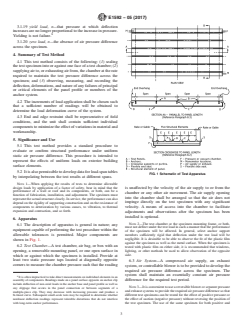
6.1 The description of apparatus is general in nature; any
must not deflect under the test load in such a manner that the performance
equipment capable of performing the test procedure within the
of the specimen will be affected. In general, select anchor support
allowable tolerances is permitted. Major components are
members sufficiently rigid that deflection under the test load will be
negligible. It is desirable to be able to observe the fit of the plastic film
shown in Fig. 1.
against the specimen as well as the metal surface. When the specimen is
6.2 Test Chamber—A test chamber, air bag, or box with an
tested with plastic film on either side, it is recommended that windows,
opening, a removable mounting panel, or one open surface in
lighting, or other methods be used to allow observation of the opposite
side.
which or against which the specimen is installed. Provide at
least two static pressure taps located at diagonally opposite
6.3 Air System—A compressed air supply, an exhaust
corners to measure the chamber pressure such that the reading
system, or controllable blower is to be provided to develop the
required air pressure difference across the specimen. The
system shall maintain an essentially constant air pressure
It is often impractical to take direct measurements on individual elements in an
assembly of components. Readings made on a panel surface opposite an anchor clip difference for the required test period.
include deflection of non-axial loads in the anchor base and panel profile as well as
NOTE3—Itisconvenienttouseareversibleblowerorseparatepressure
any slippage that occurs in the panel connection or between segments of a
and exhaust systems to provide the required air pressure difference so that
multiple-piece clip. They may decrease with increasing pressure and produce a
different test specimens can be tested for the effect of positive pressure or
bi-lineal curve. Subsequent small-scale tests may be required to determine whether
nonlinear deflection readings represent tolerable distortions that do not interfere the effect of suction (negative pressure) without reversing the position of
with long-term anchor performance. the test specimen. The use of the same specimen for both positive and
E1592 − 05 (2017)
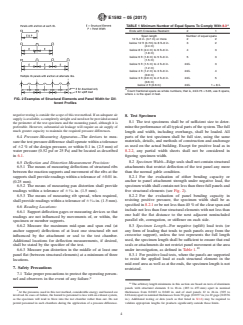
A
TABLE 1 Minimum Number of Equal Spans To Comply With 8.3
Ends with Crosswise Restraint 2 1
Span length Number of equal spans
12 ft–0 in. (3.7 m) or more 2 2
below 12 ft (3.7m) to 8 ft–0 in. 32
(2.4 m)
below8ft(2.4m)to6ft–0in. 43
(1.8 m)
below6ft(1.8m)to5ft–0in. 53
(1.5 m)
below5ft(1.5m)to4ft–0in. 24/L 3
(1.2 m)
below4ft(1.2m)to3ft–0in. 24/L 4
(0.9 m)
below3ft(0.9m)to2ft–0in. 24/L 5
(0.6 m)
below 2 ft (0.6 m) 24/L 1 + 8 ⁄L
A
Count fractional spans as whole numbers, that is, 24/4.75 = 5.05, use 6 spans,
where L is the span in feet.
FIG. 2 Examples of Structural Elements and Panel Width for Dif-
ferent Profiles
negative testing is outside the scope of this test method. If an adequate air
8. Test Specimen
supply is available, a completely airtight seal need not be provided around
8.1 The test specimens shall be of sufficient size to deter-
the perimeter of the test specimen and the mounting panel, although it is
preferable. However, substantial air leakage will require an air supply of
minetheperformanceofalltypicalpartsofthesystem.Thefull
much greater capacity to maintain the required pressure differences.
length and width, including overhangs, shall be loaded. All
6.4 Pressure-Measuring Apparatus—The devices to mea- parts of the test specimen shall be full size, using the same
materials, details, and methods of construction and anchorage
surethetestpressuredifferenceshalloperatewithinatolerance
of 62 % of the design pressure, or within 0.1 in. (2.5 mm) of as used on the actual building. Except for positive load as in
8.2.2, any partial width sheets shall not be considered in
water pressure (0.52 psf or 25 Pa) and be located as described
in 6.1. figuring specimen width.
8.2 Specimen Width—Edge seals shall not contain structural
6.5 Deflection and Distortion Measurement Precision:
6.5.1 The means of measuring deflections of structural ribs attachments that restrict deflection of the test panel any more
than the normal gable condition.
between the reaction supports and movement of the ribs at the
supports shall provide readings within a tolerance of 60.01 in. 8.2.1 For the evaluation of either bending capacity or
anchor to panel attachment strength under negative load, the
(0.25 mm).
specimen width shall contain not less than three full panels and
6.5.2 The means of measuring pan distortion shall provide
five structural elements (see Fig. 2).
readings within a tolerance of 6 ⁄16 in. (1.5 mm).
8.2.2 For the evaluation of panel bending capacity in
6.5.3 The means of measuring rib spread, when required,
resisting positive pressure, the specimen width shall be as
shall provide readings within a tolerance of 6 ⁄16 in. (1.5 mm).
specified in 8.2.1 or be not less than 40 % of the clear span and
6.6 Reading Locations:
include not less than four structural elements with not less than
6.6.1 Support deflection gages or measuring devices so that
one half the flat distance to the next adjacent nonincluded
readings are not influenced by movements of, or within, the
parallel rib, corrugation, or stiffener on each side.
specimen or member supports.
8.3 Specimen Length—For negative (uplift) load tests (or
6.6.2 Measure the maximum mid-span and span end (at
anchor support) deflections of at least one structural rib not any form of loading that tends to push panels away from the
crosswise support), unless the test represents the full length
influenced by the attachment or seal to the test chamber.
Additional locations for deflection measurements, if desired, used, the specimen length shall be sufficient to ensure that end
seals or attachments do not restrict panel movement at the area
shall be stated by the specifier of the test.
6.6.3 Measure pan distortion in the middle of at least one under investigation, as defined in Table 1.
8.3.1 For positive load tests, where the panels are supported
panel flat (between structural elements) at a minimum of three
locations. to resist the applied load at each structural element in the
mid-roof area as well as at the ends, the specimen length is not
7. Safety Precautions
restricted.
7.1 Take proper precautions to protect the operating person-
nel and observers in the event of any failure.
The arbitrary length minimums in this section are based on tests of aluminum
panels with structural elements 8 to 18-in. (203 to 457-mm) apart in nominal
At the pressures used in this test method, considerable energy and hazard are thicknesses from 0.0165 to 0.040 in. and of steel panels 12 to 24-in. (305 to
involved. In cases of failure, the hazard to personnel is less with an exhaust system, 610-mm) apart in nominal thicknesses from 30 gage (0.0157 in.) to 22 gage (0.0336
as the specimen will tend to blow into the test chamber rather than out. Do not in.). Additional testing or data (such as that listed in X1.6) may be required to
permit personnel in such chambers during the application of a pressure difference. validate appropriate lengths for products significantly outside these limits.
E1592 − 05 (2017)
8.4 Structural supports used in the test shall be of sufficient 9. Calibration
strength and rigidity to minimize deflection of the assembly.
9.1 The calibration of liquid column manometers, dial
For supports used in positive pressure tests, due consideration
gages,andgraduatedscalesortapemeasuresisnotrequiredfor
must be given to the width of the support that is in contact with 12
each test.
the panel.
10. Procedure
8.5 End conditions that simulate eave or ridge flashing
situations in which the panel terminates at or slightly beyond
10.1 Omit from the test specimen any undue influence from
the purlin are considered to have crosswise restraint and gravity, sealing, or construction material that does not occur
influence distortion for some distance along the length of the
during actual installation.
panel. An open-end condition is one without crosswise re- 10.1.1 If the test panel orientation is either inverted or
straint.
vertical, a gravity correction, based upon the weight of the
8.5.1 It is permissible to reinforce open-end conditions to panelitself,shallbemadeinthed
...