

ASTM E1587-17
(Test Method)Standard Test Methods for Chemical Analysis of Refined Nickel
General Information
- Abstract
SIGNIFICANCE AND USE
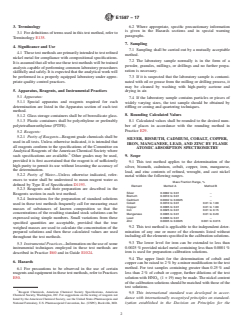
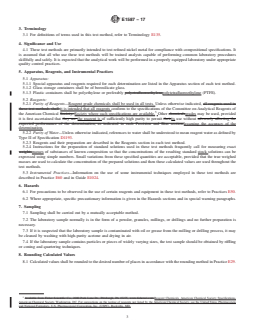
4.1 These test methods are primarily intended to test refined nickel metal for compliance with compositional specifications. It is assumed that all who use these test methods will be trained analysts capable of performing common laboratory procedures skillfully and safely. It is expected that the analytical work will be performed in a properly equipped laboratory under appropriate quality control practices.
SCOPE
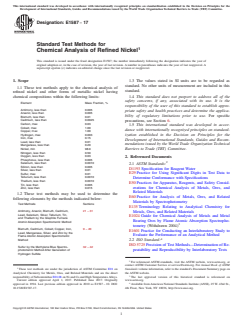
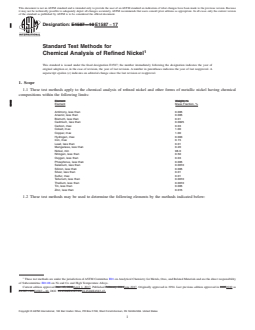
1.1 These test methods apply to the chemical analysis of refined nickel and other forms of metallic nickel having chemical compositions within the following limits:
Element
Mass Fraction, %
Antimony, less than
0.005
Arsenic, less than
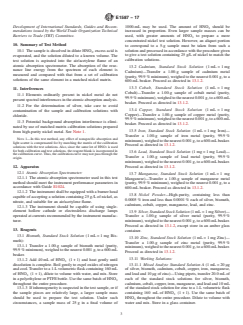
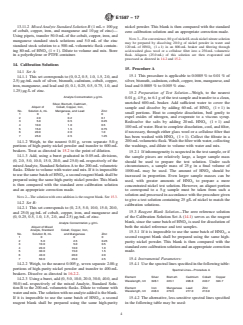
0.005
Bismuth, less than
0.01
Cadmium, less than
0.0025
Carbon, max
0.03
Cobalt, max
1.00
Copper, max
1.00
Hydrogen, max
0.003
Iron, max
0.15
Lead, less than
0.01
Manganese, less than
0.20
Nickel, min
98.0
Nitrogen, less than
0.50
Oxygen, less than
0.03
Phosphorus, less than
0.005
Selenium, less than
0.0010
Silicon, less than
0.005
Silver, less than
0.01
Sulfur, max
0.01
Tellurium, less than
0.0010
Thallium, less than
0.0010
Tin, less than
0.005
Zinc, less than
0.015
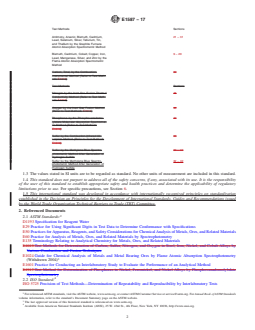
1.2 These test methods may be used to determine the following elements by the methods indicated below:
Test Methods
Sections
Antimony, Arsenic, Bismuth, Cadmium, Lead, Selenium, Silver, Tellurium, Tin, and Thallium by the Graphite Furnace Atomic Absorption Spectrometric Method
21 – 31
Bismuth, Cadmium, Cobalt, Copper, Iron, Lead, Manganese, Silver, and Zinc by the Flame Atomic Absorption Spectrometric Method
9 – 20
Sulfur by the Methylene Blue Spectrophotometric Method After Generation of Hydrogen Sulfide
32 – 42
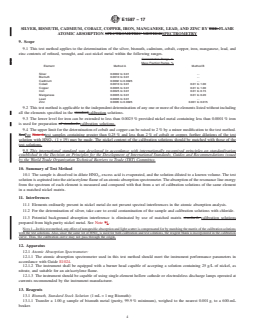
1.3 The values stated in SI units are to be regarded as standard. No other units of measurement are included in this standard.
1.4 This standard does not purport to address all of the safety concerns, if any, associated with its use. It is the responsibility of the user of this standard to establish appropriate safety and health practices and determine the applicability of regulatory limitations prior to use. For specific precautions, see Section 6.
1.5 This international standard was developed in accordance with internationally recognized principles on standardization established in the Decision on Principles for the Development of International Standards, Guides and Recommendations issued by the World Trade Organization Technical Barriers to Trade (TBT) Committee.
- Status
- Published
- Publication Date
- 31-Mar-2017
- Technical Committee
- E01 - Analytical Chemistry for Metals, Ores, and Related Materials
- Drafting Committee
- E01.08 - Ni and Co and High Temperature Alloys
Overview
ASTM E1587-17: Standard Test Methods for Chemical Analysis of Refined Nickel specifies reliable procedures for determining the chemical composition of refined and other forms of metallic nickel. Issued by ASTM International, this standard is primarily used to validate nickel against compositional specifications across various industries. The methods ensure only appropriately trained analysts equipped with refined laboratory practices and quality controls handle samples, strengthening data validity and safety.
Key Topics
- Scope of Analysis: The test methods apply to refined nickel and similar metallic forms within specific compositional limits for up to 22 elements, including antimony, arsenic, bismuth, cadmium, cobalt, copper, iron, lead, manganese, silver, sulfur, zinc, and more.
- Elemental Detection Techniques:
- Flame Atomic Absorption Spectrometric (FAAS) Method: Used for elements such as bismuth, cadmium, cobalt, copper, iron, lead, manganese, silver, and zinc.
- Graphite Furnace Atomic Absorption Spectrometric (GF-AAS) Method: Applied to antimony, arsenic, bismuth, cadmium, lead, selenium, silver, tellurium, tin, and thallium.
- Spectrophotometric and Combustion Methods: Used for elements like sulfur, carbon, nitrogen, oxygen, and phosphorus.
- Accuracy and Reliability: Emphasis is placed on using high-purity reagents, matched calibration solutions, and rigorous handling procedures to minimize interferences and contamination.
- Quality and Safety: Users are expected to implement sound laboratory practices, adequate equipment, and compliance with safety protocols specific to chemical analysis and hazardous materials.
Applications
The ASTM E1587-17 standard is highly practical for organizations where refined nickel’s precise composition is mission-critical. Its applications include:
- Quality Control in Nickel Production: Ensures that manufacturers meet strict material specifications, supporting product reliability in automotive, aerospace, chemical processing, and electronics industries.
- Compliance Verification: Helps certifying bodies and regulatory agencies confirm manufacturers’ adherence to local and international compositional standards for nickel products.
- Research and Development: Facilitates material science research where understanding trace element content in nickel can inform product development, performance analysis, and advanced alloy formulation.
- Laboratory Accreditation: Serves as a reference document for laboratories seeking accreditation in metals analysis, endorsing the use of validated test methods and standard calibration practices.
Related Standards
ASTM E1587-17 references and aligns with several established standards to promote methodological consistency and analytical accuracy, including:
- ASTM D1193: Specification for Reagent Water
- ASTM E29: Practice for Using Significant Digits in Test Data
- ASTM E50: Practices for Apparatus, Reagents, and Safety Considerations for Chemical Analysis of Metals
- ASTM E135: Terminology Relating to Analytical Chemistry for Metals, Ores, and Related Materials
- ASTM E1019: Methods for Determination of Carbon, Sulfur, Nitrogen, and Oxygen in Nickel and Alloys
- ISO 5725: Precision of Test Methods-Determination of Repeatability and Reproducibility
By adhering to ASTM E1587-17, analytical labs and manufacturers can achieve consistent, reliable, and internationally recognized results in the chemical analysis of refined nickel, supporting both compliance and safe application across global markets.
Keywords: ASTM E1587-17, refined nickel, nickel chemical analysis, atomic absorption spectrometry, quality control, nickel compositional standards, laboratory methods for nickel, ASTM standards for metals.
Relations
- Effective Date
- 01-Apr-2017
- Effective Date
- 01-Jan-2020
- Effective Date
- 01-Nov-2019
- Effective Date
- 15-May-2019
- Effective Date
- 01-Sep-2017
- Effective Date
- 01-Aug-2016
- Effective Date
- 15-May-2016
- Effective Date
- 01-Jul-2015
- Effective Date
- 15-May-2015
- Effective Date
- 15-Aug-2014
- Effective Date
- 01-Apr-2014
- Effective Date
- 15-Feb-2014
- Effective Date
- 01-Dec-2013
- Effective Date
- 15-Dec-2012
- Effective Date
- 15-Oct-2011
Get Certified
Connect with accredited certification bodies for this standard

Element Materials Technology
Materials testing and product certification.

Inštitut za kovinske materiale in tehnologije
Institute of Metals and Technology. Materials testing, metallurgical analysis, NDT.
Sponsored listings
Frequently Asked Questions
ASTM E1587-17 is a standard published by ASTM International. Its full title is "Standard Test Methods for Chemical Analysis of Refined Nickel". This standard covers: SIGNIFICANCE AND USE 4.1 These test methods are primarily intended to test refined nickel metal for compliance with compositional specifications. It is assumed that all who use these test methods will be trained analysts capable of performing common laboratory procedures skillfully and safely. It is expected that the analytical work will be performed in a properly equipped laboratory under appropriate quality control practices. SCOPE 1.1 These test methods apply to the chemical analysis of refined nickel and other forms of metallic nickel having chemical compositions within the following limits: Element Mass Fraction, % Antimony, less than 0.005 Arsenic, less than 0.005 Bismuth, less than 0.01 Cadmium, less than 0.0025 Carbon, max 0.03 Cobalt, max 1.00 Copper, max 1.00 Hydrogen, max 0.003 Iron, max 0.15 Lead, less than 0.01 Manganese, less than 0.20 Nickel, min 98.0 Nitrogen, less than 0.50 Oxygen, less than 0.03 Phosphorus, less than 0.005 Selenium, less than 0.0010 Silicon, less than 0.005 Silver, less than 0.01 Sulfur, max 0.01 Tellurium, less than 0.0010 Thallium, less than 0.0010 Tin, less than 0.005 Zinc, less than 0.015 1.2 These test methods may be used to determine the following elements by the methods indicated below: Test Methods Sections Antimony, Arsenic, Bismuth, Cadmium, Lead, Selenium, Silver, Tellurium, Tin, and Thallium by the Graphite Furnace Atomic Absorption Spectrometric Method 21 – 31 Bismuth, Cadmium, Cobalt, Copper, Iron, Lead, Manganese, Silver, and Zinc by the Flame Atomic Absorption Spectrometric Method 9 – 20 Sulfur by the Methylene Blue Spectrophotometric Method After Generation of Hydrogen Sulfide 32 – 42 1.3 The values stated in SI units are to be regarded as standard. No other units of measurement are included in this standard. 1.4 This standard does not purport to address all of the safety concerns, if any, associated with its use. It is the responsibility of the user of this standard to establish appropriate safety and health practices and determine the applicability of regulatory limitations prior to use. For specific precautions, see Section 6. 1.5 This international standard was developed in accordance with internationally recognized principles on standardization established in the Decision on Principles for the Development of International Standards, Guides and Recommendations issued by the World Trade Organization Technical Barriers to Trade (TBT) Committee.
SIGNIFICANCE AND USE 4.1 These test methods are primarily intended to test refined nickel metal for compliance with compositional specifications. It is assumed that all who use these test methods will be trained analysts capable of performing common laboratory procedures skillfully and safely. It is expected that the analytical work will be performed in a properly equipped laboratory under appropriate quality control practices. SCOPE 1.1 These test methods apply to the chemical analysis of refined nickel and other forms of metallic nickel having chemical compositions within the following limits: Element Mass Fraction, % Antimony, less than 0.005 Arsenic, less than 0.005 Bismuth, less than 0.01 Cadmium, less than 0.0025 Carbon, max 0.03 Cobalt, max 1.00 Copper, max 1.00 Hydrogen, max 0.003 Iron, max 0.15 Lead, less than 0.01 Manganese, less than 0.20 Nickel, min 98.0 Nitrogen, less than 0.50 Oxygen, less than 0.03 Phosphorus, less than 0.005 Selenium, less than 0.0010 Silicon, less than 0.005 Silver, less than 0.01 Sulfur, max 0.01 Tellurium, less than 0.0010 Thallium, less than 0.0010 Tin, less than 0.005 Zinc, less than 0.015 1.2 These test methods may be used to determine the following elements by the methods indicated below: Test Methods Sections Antimony, Arsenic, Bismuth, Cadmium, Lead, Selenium, Silver, Tellurium, Tin, and Thallium by the Graphite Furnace Atomic Absorption Spectrometric Method 21 – 31 Bismuth, Cadmium, Cobalt, Copper, Iron, Lead, Manganese, Silver, and Zinc by the Flame Atomic Absorption Spectrometric Method 9 – 20 Sulfur by the Methylene Blue Spectrophotometric Method After Generation of Hydrogen Sulfide 32 – 42 1.3 The values stated in SI units are to be regarded as standard. No other units of measurement are included in this standard. 1.4 This standard does not purport to address all of the safety concerns, if any, associated with its use. It is the responsibility of the user of this standard to establish appropriate safety and health practices and determine the applicability of regulatory limitations prior to use. For specific precautions, see Section 6. 1.5 This international standard was developed in accordance with internationally recognized principles on standardization established in the Decision on Principles for the Development of International Standards, Guides and Recommendations issued by the World Trade Organization Technical Barriers to Trade (TBT) Committee.
ASTM E1587-17 is classified under the following ICS (International Classification for Standards) categories: 77.120.40 - Nickel, chromium and their alloys. The ICS classification helps identify the subject area and facilitates finding related standards.
ASTM E1587-17 has the following relationships with other standards: It is inter standard links to ASTM E1587-10, ASTM E135-20, ASTM E1601-19, ASTM E135-19, ASTM E50-17, ASTM E50-11(2016), ASTM E135-16, ASTM E135-15a, ASTM E135-15, ASTM E135-14b, ASTM E135-14a, ASTM E135-14, ASTM E135-13a, ASTM E1601-12, ASTM E50-11. Understanding these relationships helps ensure you are using the most current and applicable version of the standard.
ASTM E1587-17 is available in PDF format for immediate download after purchase. The document can be added to your cart and obtained through the secure checkout process. Digital delivery ensures instant access to the complete standard document.
Standards Content (Sample)
This international standard was developed in accordance with internationally recognized principles on standardization established in the Decision on Principles for the
Development of International Standards, Guides and Recommendations issued by the World Trade Organization Technical Barriers to Trade (TBT) Committee.
Designation:E1587 −17
Standard Test Methods for
Chemical Analysis of Refined Nickel
This standard is issued under the fixed designation E1587; the number immediately following the designation indicates the year of
original adoption or, in the case of revision, the year of last revision. A number in parentheses indicates the year of last reapproval. A
superscript epsilon (´) indicates an editorial change since the last revision or reapproval.
1. Scope 1.3 The values stated in SI units are to be regarded as
standard. No other units of measurement are included in this
1.1 These test methods apply to the chemical analysis of
standard.
refined nickel and other forms of metallic nickel having
1.4 This standard does not purport to address all of the
chemical compositions within the following limits:
safety concerns, if any, associated with its use. It is the
Element Mass Fraction, %
responsibility of the user of this standard to establish appro-
Antimony, less than 0.005
priate safety and health practices and determine the applica-
Arsenic, less than 0.005
bility of regulatory limitations prior to use. For specific
Bismuth, less than 0.01
Cadmium, less than 0.0025 precautions, see Section 6.
Carbon, max 0.03
1.5 This international standard was developed in accor-
Cobalt, max 1.00
dance with internationally recognized principles on standard-
Copper, max 1.00
Hydrogen, max 0.003 ization established in the Decision on Principles for the
Iron, max 0.15
Development of International Standards, Guides and Recom-
Lead, less than 0.01
mendations issued by the World Trade Organization Technical
Manganese, less than 0.20
Nickel, min 98.0
Barriers to Trade (TBT) Committee.
Nitrogen, less than 0.50
Oxygen, less than 0.03
2. Referenced Documents
Phosphorus, less than 0.005
Selenium, less than 0.0010
2.1 ASTM Standards:
Silicon, less than 0.005
D1193 Specification for Reagent Water
Silver, less than 0.01
E29 Practice for Using Significant Digits in Test Data to
Sulfur, max 0.01
Tellurium, less than 0.0010
Determine Conformance with Specifications
Thallium, less than 0.0010
E50 Practices for Apparatus, Reagents, and Safety Consid-
Tin, less than 0.005
erations for Chemical Analysis of Metals, Ores, and
Zinc, less than 0.015
Related Materials
1.2 These test methods may be used to determine the
E60 Practice for Analysis of Metals, Ores, and Related
following elements by the methods indicated below:
Materials by Spectrophotometry
Test Methods Sections
E135 Terminology Relating to Analytical Chemistry for
Antimony, Arsenic, Bismuth, Cadmium, 21–31
Metals, Ores, and Related Materials
Lead, Selenium, Silver, Tellurium, Tin,
E1024 Guide for Chemical Analysis of Metals and Metal
and Thallium by the Graphite Furnace
Bearing Ores by Flame Atomic Absorption Spectropho-
Atomic Absorption Spectrometric Method
tometry (Withdrawn 2004)
Bismuth, Cadmium, Cobalt, Copper, Iron, 9–20
E1601 Practice for Conducting an Interlaboratory Study to
Lead, Manganese, Silver, and Zinc by the
Evaluate the Performance of an Analytical Method
Flame Atomic Absorption Spectrometric
Method
2.2 ISO Standard:
ISO 5725 Precision of Test Methods—Determination of Re-
Sulfur by the Methylene Blue Spectro- 32–42
peatability and Reproducibility by Interlaboratory Tests
photometric Method After Generation of
Hydrogen Sulfide
For referenced ASTM standards, visit the ASTM website, www.astm.org, or
contact ASTM Customer Service at service@astm.org. For Annual Book of ASTM
These test methods are under the jurisdiction of ASTM Committee E01 on Standards volume information, refer to the standard’s Document Summary page on
Analytical Chemistry for Metals, Ores, and Related Materials and are the direct the ASTM website.
responsibility of Subcommittee E01.08 on Ni and Co and HighTemperatureAlloys. The last approved version of this historical standard is referenced on
Current edition approved April 1, 2017. Published June 2017. Originally www.astm.org.
approved in 1994. Last previous edition approved in 2010 as E1587 – 10. DOI: Available from American National Standards Institute (ANSI), 25 W. 43rd St.,
10.1520/E1587-17. 4th Floor, New York, NY 10036, http://www.ansi.org.
Copyright © ASTM International, 100 Barr Harbor Drive, PO Box C700, West Conshohocken, PA 19428-2959. United States
E1587−17
3. Terminology 6.2 Where appropriate, specific precautionary information
is given in the Hazards sections and in special warning
3.1 For definitions of terms used in this test method, refer to
paragraphs.
Terminology E135.
7. Sampling
4. Significance and Use
7.1 Sampling shall be carried out by a mutually acceptable
4.1 These test methods are primarily intended to test refined
method.
nickel metal for compliance with compositional specifications.
7.2 The laboratory sample normally is in the form of a
Itisassumedthatallwhousethesetestmethodswillbetrained
powder, granules, millings, or drillings and no further prepa-
analysts capable of performing common laboratory procedures
ration is necessary.
skillfully and safely. It is expected that the analytical work will
be performed in a properly equipped laboratory under appro-
7.3 If it is suspected that the laboratory sample is contami-
priate quality control practices. nated with oil or grease from the milling or drilling process, it
may be cleaned by washing with high-purity acetone and
5. Apparatus, Reagents, and Instrumental Practices
drying in air.
5.1 Apparatus:
7.4 If the laboratory sample contains particles or pieces of
5.1.1 Special apparatus and reagents required for each
widely varying sizes, the test sample should be obtained by
determination are listed in the Apparatus section of each test
riffling or coning and quartering techniques.
method.
8. Rounding Calculated Values
5.1.2 Glass storage containers shall be of borosilicate glass.
5.1.3 Plastic containers shall be polyethylene or preferably 8.1 Calculated values shall be rounded to the desired num-
polytetrafluoroethylene (PTFE).
ber of places in accordance with the rounding method in
Practice E29.
5.2 Reagents:
5.2.1 Purity of Reagents—Reagent grade chemicals shall be
SILVER, BISMUTH, CADMIUM, COBALT, COPPER,
used in all tests. Unless otherwise indicated, it is intended that
IRON, MANGANESE, LEAD, AND ZINC BY FLAME
all reagents conform to the specifications of the Committee on
ATOMIC ABSORPTION SPECTROMETRY
Analytical Reagents of the American Chemical Society where
9. Scope
such specifications are available. Other grades may be used,
provided it is first ascertained that the reagent is of sufficiently
9.1 This test method applies to the determination of the
high purity to permit its use without lessening the accuracy of
silver, bismuth, cadmium, cobalt, copper, iron, manganese,
the determination.
lead, and zinc contents of refined, wrought, and cast nickel
5.2.2 Purity of Water—Unless otherwise indicated, refer-
metal within the following ranges.
ences to water shall be understood to mean reagent water as
Mass Fraction Range, %
defined by Type II of Specification D1193.
Element Method A Method B
5.2.3 Reagents and their preparation are described in the
Silver 0.0002 to 0.01 .
Reagents section in each test method.
Bismuth 0.0010 to 0.01 .
5.2.4 Instructions for the preparation of standard solutions
Cadmium 0.0002 to 0.0025 .
Cobalt 0.0010 to 0.01 0.01 to 1.00
used in these test methods frequently call for measuring exact
Copper 0.0005 to 0.01 0.01 to 1.00
masses of substances of known composition so that the
Iron 0.0025 to 0.01 0.01 to 0.15
concentrations of the resulting standard stock solutions can be
Manganese 0.0005 to 0.01 0.01 to 0.20
Lead 0.0006 to 0.01 .
expressed using simple numbers. Small variations from these
Zinc 0.0005 to 0.0025 0.001 to 0.015
specified quantities are acceptable, provided that the true
9.2 This test method is applicable to the independent deter-
weighed masses are used to calculate the concentration of the
mination of any one or more of the elements listed without
prepared solutions and then these calculated values are used
including all the elements specified in the calibration solutions.
throughout the test methods.
9.3 The lower level for iron can be extended to less than
5.3 Instrumental Practices—Information on the use of some
0.0025 % provided nickel metal containing less than 0.0001 %
instrumental techniques employed in these test methods are
iron is used for preparation calibration solutions.
described in Practice E60 and in Guide E1024.
9.4 The upper limit for the determination of cobalt and
6. Hazards
copper can be raised to 2 % by a minor modification to the test
method. For test samples containing greater than 0.25 % and
6.1 For precautions to be observed in the use of certain
less than 2 % of cobalt or copper, further dilutions of the test
reagentsandequipmentinthesetestmethods,refertoPractices
solution with HNO (1 + 19) may be made.The nickel content
E50.
ofthecalibrationsolutionsshouldbematchedwiththoseofthe
test solutions.
Reagent Chemicals, American Chemical Society Specifications, American
9.5 This international standard was developed in accor-
Chemical Society, Washington, DC. For suggestions on the testing of reagents not
dance with internationally recognized principles on standard-
listed by the American Chemical Society, see the United States Pharmacopeia and
National Formulary, U.S. Pharmacopeial Convention, Inc. (USPC), Rockville, MD. ization established in the Decision on Principles for the
E1587−17
Development of International Standards, Guides and Recom- 1000-mL may be used. The amount of HNO should be
mendations issued by the World Trade Organization Technical increased in proportion. Even larger sample masses can be
Barriers to Trade (TBT) Committee. used, with greater amounts of HNO to prepare a more
concentrated nickel test solution. However, an aliquot portion
10. Summary of Test Method
to correspond to a 5-g sample must be taken from such a
solution and processed in accordance with the procedure given
10.1 The sample is dissolved in dilute HNO , excess acid is
to give a test solution containing 25 g/L of nickel to match the
evaporated, and the solution diluted to a known volume. The
calibration solutions.
test solution is aspirated into the air/acetylene flame of an
atomic absorption spectrometer. The absorption of the reso-
13.2 Cadmium, Standard Stock Solution (1mL=1mg
nance line energy from the spectrum of each element is
Cadmium)—Transfer a 1.00-g sample of cadmium metal
measured and compared with that from a set of calibration
(purity, 99.9 % minimum), weighed to the nearest 0.001 g, to a
solutions of the same element in a matched nickel matrix.
600-mL beaker. Proceed as directed in 13.1.2.
11. Interferences 13.3 Cobalt, Standard Stock Solution (1mL=1mg
Cobalt)—Transfer a 1.00-g sample of cobalt metal (purity,
11.1 Elements ordinarily present in nickel metal do not
99.9 %minimum),weighedtothenearest0.001 g,toa600-mL
presentspectralinterferencesintheatomicabsorptionanalysis.
beaker. Proceed as directed in 13.1.2.
11.2 For the determination of silver, take care to avoid
13.4 Copper, Standard Stock Solution (1mL=1mg
contamination of the sample and calibration solutions with
Copper)—Transfer a 1.00-g sample of copper metal (purity,
chloride.
99.9 %minimum),weighedtothenearest0.001 g,toa600-mL
11.3 Potential background absorption interference is elimi-
beaker. Proceed as directed in 13.1.2.
nated by use of matched matrix calibration solutions prepared
13.5 Iron, Standard Stock Solution (1mL=1mg Iron)—
from high-purity nickel metal. See Note 1.
Transfer a 1.00-g sample of iron metal (purity, 99.9 %
NOTE 1—In this test method, any effect of nonspecific absorption and
minimum),weighedtothenearest0.001 g,toa600-mLbeaker.
light scatter is compensated for by matching the matrix of the calibration
Proceed as directed in 13.1.2.
solutions with the test solutions.Also, since the same lot of HNO is used
for both calibration and test solutions, the reagent blank is incorporated in
13.6 Lead, Standard Stock Solution (1mg=1mg Lead)—
the calibration curve.Thus, the calibration curve may not pass through the
Transfer a 1.00-g sample of lead metal (purity, 99.9 %
origin.
minimum),weighedtothenearest0.001 g,toa600-mLbeaker.
12. Apparatus Proceed as directed in 13.1.2.
12.1 Atomic Absorption Spectrometer:
13.7 Manganese, Standard Stock Solution (1 mL = 1 mg
12.1.1 The atomic absorption spectrometer used in this test
Manganese)—Transfer a 1.00-g sample of manganese metal
method should meet the instrument performance parameters in
(purity, 99.9 % minimum), weighed to the nearest 0.001 g, to a
accordance with Guide E1024.
600-mL beaker. Proceed as directed in 13.1.2.
12.1.2 The instrument shall be equipped with a burner head
13.8 Nickel Powder—High-purity, containing less than
capable of accepting a solution containing 25 g⁄L of nickel, as
0.0005 % iron and less than 0.0001 % each of silver, bismuth,
nitrate, and suitable for an air/acetylene flame.
cadmium, cobalt, copper, manganese, lead, and zinc.
12.1.3 The instrument should be capable of using single-
element hollow cathode or electrodeless discharge lamps
13.9 Silver, Standard Stock Solution(1mL=1mg Silver)—
operated at currents recommended by the instrument manufac-
Transfer a 1.00-g sample of silver metal (purity, 99.9 %
turer.
minimum),weighedtothenearest0.001 g,toa600-mLbeaker.
Proceed as directed in 13.1.2, except store in an amber glass
13. Reagents
container.
13.1 Bismuth, Standard Stock Solution (1mL=1mg Bis-
13.10 Zinc, Standard Stock Solution(1mL=1mg Zinc)—
muth):
Transfer a 1.00-g sample of zinc metal (purity, 99.9 %
13.1.1 Transfer a 1.00-g sample of bismuth metal (purity,
minimum),weighedtothenearest0.001 g,toa600-mLbeaker.
99.9 %minimum),weighedtothenearest0.001 g,toa600-mL
Proceed as directed in 13.1.2.
beaker.
13.11 Working Solutions:
13.1.2 Add 40 mL of HNO (1 + 1) and heat gently until
dissolution is complete. Boil gently to expel oxides of nitrogen 13.11.1 Mixed Analyte Standard Solution A (1mL=20µg
and cool.Transfer to a 1-Lvolumetric flask containing 160 mL of silver, bismuth, cadmium, cobalt, copper, iron, manganese,
of HNO (1 + 1), dilute to volume with water, and mix. Store and lead and 10 µg of zinc)—Using pipets, transfer 20.0 mLof
in a polyethylene or PTFE bottle. Use the same batch of HNO each of the standard stock solutions for silver, bismuth,
throughout the entire procedure. cadmium,cobalt,copper,iron,manganese,andleadand10 mL
13.1.3 Ifinhomogeneityissuspectedinthetestsample,orif of the standard stock solution for zinc to a 1-Lvolumetric flask
the sample pieces are relatively large, a larger sample mass containing 160 mL of HNO (1 + 1). Use the same batch of
should be used to prepare the test solution. Under such HNO throughout the entire procedure. Dilute to volume with
circumstances, a sample mass of 25 g in a final volume of water and mix. Store in a glass container.
E1587−17
13.11.2 Mixed Analyte Standard Solution B (1 mL = 100 µg nickel powder. This blank is then compared with the standard
of cobalt, copper, iron, and manganese and 10 µg of zinc)— zero calibration solution and an appropriate correction made.
Using pipets, transfer 50.0 mL of the cobalt, copper, iron, and
NOTE 3—For convenience, 80 g of nickel/Lstock nickel nitrate solution
manganese standard stock solutions and 5.0 mL of the zinc
may be prepared by dissolving 20.0 g of nickel powder in water and
standard stock solution to a 500-mL volumetric flask contain-
120 mL of HNO (1 + 1) in an 800-mL beaker and filtering through
ing 80 mL of HNO (1 + 1). Dilute to volume and mix. Store
3 acid-washed glass wool or a cellulose filter into a 250-mL volumetric
in a polyethylene or PTFE container. flask. Aliquots (25.0 mL) of this solution are then evaporated and
processed as directed in 14.2 and 15.2.
14. Calibration Solutions
15. Procedure A
14.1 Set A:
15.1 This procedure is applicable to 0.0005 % to 0.01 % of
14.1.1 This set corresponds to (0, 0.2, 0.5, 1.0, 1.5, 2.0, and
silver, bismuth, cadmium, cobalt, copper, iron, manganese, and
2.5) µg⁄mL each of silver, bismuth, cadmium, cobalt, copper,
iron, manganese, and lead and (0, 0.1, 0.25, 0.5, 0.75, 1.0, and lead and 0.0005 % to 0.005 % zinc.
1.25) µg⁄L of zinc.
15.2 Preparation of Test Solution—Weigh, to the nearest
Analyte Concentration µ g/mL
0.01 g, 4.9 g, to 6.1 g of the test sample and transfer to a clean,
unetched 600-mL beaker. Add sufficient water to cover the
Silver, Bismuth, Cadmium,
Aliquot of Cobalt, Copper, Iron,
sample and dissolve by adding 60 mL of HNO (1+1) in
No. Solution A, mL Manganese, and Lead Zinc
small portions. Heat to complete dissolution, boil gently to
10 0 0
expel oxides of nitrogen, and evaporate to a viscous syrup.
2 2.0 0.2 0.1
3 5.0 0.5 0.25
Redissolve the salts by adding 20 mL HNO (1 + 1) and
4 10.0 1.0 0.5
100 mLof water. Heat to complete dissolution, cool, and filter,
5 15.0 1.5 0.75
if necessary, through either glass wool or a cellulose filter that
6 20.0 2.0 1.0
7 25.0 2.5 1.25
has been washed with HNO (1 + 1). Collect the filtrate in a
200-mLvolumetric flask. Wash the filter with water, collecting
14.1.2 Weigh, to the nearest 0.01 g, seven separate 5.0-g
portions of high-purity nickel powder and transfer to 600-mL the washings, and dilute to volume with water and mix.
beakers. Treat as directed in 15.2 to the point of dilution.
15.2.1 Ifinhomogeneityissuspectedinthetestsample,orif
14.1.3 Add, using a buret graduated in 0.05-mL divisions,
the sample pieces are relatively large, a larger sample mass
(0, 2.0, 5.0, 10.0, 15.0, 20.0, and 25.0) mL respectively of the
should be used to prepare the test solution. Under such
mixedAnalyte, Standard Solution Ato the 200-mL volumetric
circumstances, a sample mass of 25 g in a final volume of
flasks. Dilute to volume with water and mix. If it is impossible
1000-mL may be used. The amount of HNO should be
tousethesamebatchofHNO ,asecondreagentblankshallbe
increased in proportion. Even larger sample masses can be
prepared using the same high-purity nickel powder. This blank
used, with greater amounts of HNO to prepare a more
is then compared with the standard zero calibration solution
concentrated nickel test solution. However, an aliquot portion
and an appropriate correction made.
to correspond to a 5-g sample must be taken from such a
solution and processed in accordance with the procedure given
NOTE 2—The solution with zero addition is the reagent blank. See 15.3.
to give a test solution containing 25 g/L of nickel to match the
14.2 Set B:
calibration solutions.
14.2.1 This set corresponds to (0, 2.5, 5.0, 10.0, 15.0, 20.0,
15.3 Reagent Blank Solution—The zero reference solution
and 25.0) µg⁄mL of cobalt, copper, iron, and manganese and
of the Calibration Solution Set A (14.1) serves as the reagent
(0, 0.25, 0.5, 1.0, 1.5, 2.0, and 2.5) µg⁄mL of zinc.
blank, since the same batch of HNO is used for dissolution of
Analyte Concentration µ g/mL 3
Aliquot of Mixed both the nickel reference and test samples.
Analyte, Standard Cobalt, Copper, Iron,
15.3.1 If it is impossible to use the same batch of HNO,a
No. Solution B, mL and Manganese Zinc
10 0 0 second reagent blank shall be prepared using the same high-
2 5.0 2.5 0.25
purity nickel powder. This blank is then compared with the
3 10.0 5.0 0.5
standardzerocalibrationsolutionandanappropriatecorrection
4 20.0 10.0 1.0
5 30.0 15.0 1.5
made.
6 40.0 20.0 2.0
7 50.0 25.0 2.5 15.4 Instrumental Parameters:
14.2.2 Weigh, to the nearest 0.005 g, seven separate 2.00-g 15.4.1 Usethespectrallinesspecifiedinthefollowingtable:
portions of high-purity nickel powder and transfer to 400-mL
Spectral Lines—Procedure A
beakers. Dissolve as directed in 16.2.2.
Element Silver Bismuth Cadmium Cobalt Copper
14.2.3 Using a buret, add (0, 5.0, 10.0, 20.0, 30.0, 40.0, and
Wavelength, nm 328.1 223.1 228.8 240.7 324.7
50.0) mL respectively of the mixed Analyte, Standard Solu-
Element Iron Manganese Lead Zinc
tion B to the 200-mL volumetric flasks. Dilute to volume with
Wavelength, nm 248.3 279.5 217.0 213.9
waterandmix.Thesolutionwithnoanalyteaddedistheblank.
15.4.2 The alternative, less-sensitive spectral lines specified
If it is impossible to use the same batch of HNO , a second
reagent blank shall be prepared using the same high-purity in the following table may be used:
E1587−17
Alternate Spectral Lines—Procedure A Spectral Lines—Procedure B
Element Cobalt Copper Iron Manganese Lead Element Cobalt Copper Iron Manganese Zinc
Wavelength, nm 241.2 327.4 252.3 403.1 283.3 Wavelength, nm 241.2 327.4 252.3 403.1 213.9
16.4.2 Proceed as directed in 15.4.3 and 15.4.4.
15.4.3 Set the required instrument parameters in accordance
with the manufacturer’s recommendations. Light the burner
16.5 Spectrometry:
and aspirate diluted HNO (1 + 19) until thermal equilibrium
16.5.1 Proceed as directed in 15.5.1 through 15.5.6, substi-
is reached. A fuel-lean air-acetylene flame shall be used.
tuting the Set B calibration solution (14.2) for the Set A
15.4.4 Ensure that the instrument meets the performance
solutions.
requirements given in Practice E60. Optimum settings for the
16.5.2 Proceed with the preparation of the calibrations
operating parameters vary from instrument to instrument.
curves and calculations as directed in Sections 17 and 18.
15.5 Spectrometry:
17. Preparation of Calibration Curves
15.5.1 Ensurethatthetestsolution(15.2)andthecalibration
17.1 Plot the average instrument reading against the con-
solutions,Set A(14.1)arewithin1 °Cofthesametemperature.
centration of the analyte for the calibration solutions for each
15.5.2 Aspirate diluted HNO (1 + 19) and zero the instru-
set of measurements.
ment.
17.2 For instruments that have automated calibration fea-
15.5.3 Aspirate the test solution(s) and note the reading to
tures and direct read-out in concentration, plotting of calibra-
determine its place within the set of calibration solutions.
tion curves is not required. Follow the instrument operating
15.5.4 Aspirate diluted HNO (1 + 19) until the initial
instructions for calibration and curvature correction proce-
reading is obtained. Zero the instrument if necessary.
dures.
15.5.5 AspiratetheSetAcalibrationsolutions(14.1)andthe
test solution(s) in order of increasing instrument response,
18. Calculations
starting with the zero reference solution. When a stable
18.1 Determine the concentration of analyte in the test
response is obtained, record the reading. Flush the system by
solution from the corresponding calibration curves or instru-
aspirating diluted HNO (1 + 19) between each test or cali-
ment read-out for each of the three sets of instrument readings.
bration solution.Avoid aspirating the high-nickel solutions for
Average the resultant concentrations.
long periods without flushing; otherwise, the burner may tend
to clog.
18.2 Procedure A—Calculate the mass fraction of the ana-
15.5.6 Repeat the measurement of the full set of the
lyte in the test sample as follows:
calibration and test solutions twice more and record the data.
A 3 B
See Note 1. Analyte, % 5 310 (1)
C
15.5.7 Proceed with the preparation of the calibration
where:
curves and calculations as directed in Sections 17 and 18.
A = analyte concentration found in the test solution, µg/mL,
16. Procedure B
B = volume of the test solution, mL, and
16.1 This procedure is applicable to 0.01 % to 0.25 % of
C = mass of the test sample, g.
cobalt,copper,iron,andmanganeseand0.005 %to0.025 %of
18.3 Procedure B:
zinc.
18.3.1 For the procedure in 16.2.1, calculate mass fraction
16.2 Preparation of Test Solution:
of the analyte in the test sample as follows:
16.2.1 If a test solution has been prepared by Procedure A
A 3 B
(15.2), using a pipet, transfer a 100.0-mLaliquot portion into a
Analyte, % 5 32.5 310 (2)
C
250-mLvolumetric flask, dilute to volume with diluted HNO
(1 + 19). Otherwise, proceed as directed in 16.2.2. where 2.5 = correction factor for the dilution made.
16.2.2 Weightothenearest0.005 g,1.9 gto2.1 gofthetest
19. Precision and Bias
sample, transfer to a 400-mL beaker and dissolve in 20 mL of
HNO (1 + 1). Complete the preparation as directed in 15.2. 19.1 Precision:
19.1.1 Eighteen laboratories in nine countries participated
16.3 Reagent Blank Solution—The zero reference solution
in testing this method under the auspices of ISO/TC-155/SC-
of the calibration solution Set B (14.2) serves as the reagent
3/WG-1 in the early 1980s and obtained the statistical data
blank. If it is impossible to use the same batch of HNO,a
summarized in Table 1 as evaluated by ISO 5725 and equiva-
second reagent blank shall be prepared using the same high-
lent to Practice E1601. Precision may be judged by examina-
purity nickel powder. This blank is then compared with the
tion of these data. Twelve sample were analyzed to cover the
standardzerocalibrationsolutionandanappropriatecorrection
scope of this test method. Of these, ten were specially prepared
made.
as no materials containing the impurity levels were available
16.4 Instrumental Parameters:
commercially.
16.4.1 The spectral lines specified in the following table are 19.1.2 The laboratory test program was designed so that the
to be used in the analysis: statistics on repeatability would include variations because of a
E1587−17
TABLE 1 Statistical Information—Flame AAS Method,
if the nickel metal used for the preparation of the calibration
ProcedureA
solutions does not meet the purity specifications given in the
Repeatability Reproducibility,
test method and appropriate corrections are not made.
Test Material Mean, % Index, r Index R
(Practice E1601) (Practice E1601)
20. Keywords
Silver
P45 0.00043 0.00003 0.00012
20.1 bismuth; cadmium; cobalt; copper; flame atomic ab-
P44 0.00077 0.00005 0.00007
sorption spectrometry; iron; lead; manganese; refined nickel;
P46 0.00095 0.00012 0.00015
P41 0.00191 0.00008 0.00017
silver; spectrometry; zinc
J63 0.00232 0.00010 0.00022
P43 0.00282 0.00017 0.00022
SILVER, ARSENIC, BISMUTH, CADMIUM, LEAD,
J61 0.00970 0.00025 0.00142
ANTIMONY, SELENIUM, TIN, TELLURIUM, AND
Bismuth
P44 0.00133 0.00027 0.00076
THALLIUM BY THE GRAPHITE FURNACE ATOMIC
P41 0.00171 0.00028 0.00047
ABSORPTION SPECTROMETRY
P43 0.00245 0.00031 0.00049
J61 0.01037 0.00044 0.00057
Cadmium
21. Scope
P46 0.00019 0.00003 0.00008
J63 0.00025 0.00002 0.00009
21.1 This test method applies to the determination of the
J61 0.00135 0.00007 0.00025
silver, arsenic, bismuth, cadmium, lead, antimony, selenium,
S65 0.00225 0.00007 0.00025
tin, tellurium, and thallium contents of high-purity, refined,
Cobalt
P43 0.00105 0.00007 0.00016
wrought, and cast nickel metal within the ranges specified in
P44 0.00155 0.00007 0.00040
the following table:
P41 0.00185 0.00011 0.00014
J62 0.00508 0.00023 0.00030 Element Mass Fraction Range, µg/g
J61 0.01002 0.00038 0.00060
Copper Silver 0.3 to 10
S65 0.00079 0.00012 0.00022 Arsenic 1.3 to 20
J62 0.00517 0.00009 0.00025 Bismuth 4.0 to 15
J61 0.01006 0.00009 0.00041 Cadmium 0.3 to 2
Lead 0.7 to 10
Iron
P46 0.00241 0.00020 0.00059 Antimony 1.8 to 10
Selenium 1.8 to 10
P45 0.00298 0.00033 0.00060
P44 0.00311 0.00013 0.00058 Tin 2.2 to 5
P41 0.00437 0.00018 0.00103 Tellurium 1.5 to 10
S65 0.00474 0.00026 0.00058 Thallium 0.5 to 10
Manganese
21.2 This test method is applicable to the independent
P41 0.00054 0.00003 0.00020
P46 0.00070 0.00005 0.00020 determinationofanyoneormoreoftheelementslistedwithout
P45 0.00107 0.00008 0.00020
including all elements specified in the calibration solutions.
P43 0.00200 0.00005 0.00014
J62 0.00536 0.00013 0.00037
21.3 This international standard was developed in accor-
J61 0.01028 0.00027 0.00052
dance with internationally recognized principles on standard-
Lead
ization established in the Decision on Principles for the
H79 0.00078 0.00003 0.00017
P46 0.00090 0.00030 0.00036
Development of International Standards, Guides and Recom-
P41 0.00202 0.00032 0.00048
mendations issued by the World Trade Organization Technical
P44 0.00252 0.00024 0.00026
Barriers to Trade (TBT) Committee.
J62 0.00350 0.00011 0.00041
J63 0.00365 0.00017 0.00017
J61 0.00777 0.00020 0.00046
22. Summary of Test Method
Zinc
H79 0.00029 0.00004 0.00015
22.1 The test sample is dissolved in HNO and the solution
P44 0.00041 0.00004 0.00020
is diluted to a known volume. An aliquot is introduced into a
P41 0.00050 0.00007 0.00016
P46 0.00062 0.00008 0.00010
graphite furnace atomic absorption spectrometer (GF-AAS)
S65 0.00101 0.00009 0.00017
and the absorption of the resonance line energy from the
P43 0.00117 0.00009 0.00028
spectrum of each element is measured and compared with that
P45 0.00128 0.00023 0.00040
J62 0.00269 0.00014 0.00024
from a set of calibration solutions of the same element in a
matched nickel matrix.All readings are background-corrected.
23. Interferences
change in the atomic absorption instrument or operator, or
23.1 Elements ordinarily present in nickel metal do not
both, while maintaining the same test solution.
present spectral interferences in graphite furnace atomic ab-
19.2 Bias—No information is currently available on the bias
sorption analysis.
of this test method, because of the lack of appropriate certified
reference materials. The bias of a test method may be judged, 23.2 Potential background absorption interference is elimi-
however, by comparing accepted reference values with the nated by instrumental background correction and by the use of
arithmetic average obtained by interlaboratory testing. The matched-matrix calibration solutions prepared from high-
user is cautioned that the results will be biased to the low side purity nickel metal.
E1587−17
23.3 Thelowerlimitforthedeterminationoftheelementsis 25.3 Bismuth, Standard Stock Solution (1 mL=1 mg
affected by the residual level of each element in the high-purity Bismuth)—Transfer a 0.100-g sample of bismuth metal (purity,
nickel metal used to prepare the matched matrix standard stock 99.9 % minimum), weighed to the nearest 0.1 mg, to a 100-mL
solutions. beaker. Proceed as directed
...
This document is not an ASTM standard and is intended only to provide the user of an ASTM standard an indication of what changes have been made to the previous version. Because
it may not be technically possible to adequately depict all changes accurately, ASTM recommends that users consult prior editions as appropriate. In all cases only the current version
of the standard as published by ASTM is to be considered the official document.
Designation: E1587 − 10 E1587 − 17
Standard Test Methods for
Chemical Analysis of Refined Nickel
This standard is issued under the fixed designation E1587; the number immediately following the designation indicates the year of
original adoption or, in the case of revision, the year of last revision. A number in parentheses indicates the year of last reapproval. A
superscript epsilon (´) indicates an editorial change since the last revision or reapproval.
1. Scope
1.1 These test methods apply to the chemical analysis of refined nickel and other forms of metallic nickel having chemical
compositions within the following limits:
Element Weight, %
Element Mass Fraction, %
Antimony, less than 0.005
Arsenic, less than 0.005
Bismuth, less than 0.01
Cadmium, less than 0.0025
Carbon, max 0.03
Cobalt, max 1.00
Copper, max 1.00
Hydrogen, max 0.003
Iron, max 0.15
Lead, less than 0.01
Manganese, less than 0.20
Nickel, min 98.0
Nitrogen, less than 0.50
Oxygen, less than 0.03
Phosphorus, less than 0.005
Selenium, less than 0.0010
Silicon, less than 0.005
Silver, less than 0.01
Sulfur, max 0.01
Tellurium, less than 0.0010
Thallium, less than 0.0010
Tin, less than 0.005
Zinc, less than 0.015
1.2 These test methods may be used to determine the following elements by the methods indicated below:
These test methods are under the jurisdiction of ASTM Committee E01 on Analytical Chemistry for Metals, Ores, and Related Materials and are the direct responsibility
of Subcommittee E01.08 on Ni and Co and High Temperature Alloys.
Current edition approved Dec. 15, 2010April 1, 2017. Published February 2011June 2017. Originally approved in 1994. Last previous edition approved in 20052010 as
E1587 – 05.E1587 – 10. DOI: 10.1520/E1587-10.10.1520/E1587-17.
Copyright © ASTM International, 100 Barr Harbor Drive, PO Box C700, West Conshohocken, PA 19428-2959. United States
E1587 − 17
Test Methods Sections
Antimony, Arsenic, Bismuth, Cadmium, 21 – 31
Lead, Selenium, Silver, Tellurium, Tin,
and Thallium by the Graphite Furnace
Atomic Absorption Spectrometric Method
Bismuth, Cadmium, Cobalt, Copper, Iron, 9 – 20
Lead, Manganese, Silver, and Zinc by the
Flame Atomic Absorption Spectrometric
Method
Carbon, Total, by the Combustion- 32
Instrumental Method (Refer to Test Meth-
ods E1019)
Test Methods Sections
Nitrogen by the Inert Gas Fusion Thermal 45
Conductivity Method (Refer to Test Meth-
ods E1019)
Oxygen by the Inert Gas Fusion Method 46
(Refer to Test Methods E1019)
Phosphorus by the Phosphovanadomo- 47
lybdate Molecular Absorption Spectromet-
ric Method (Refer to Test Methods
E1019)
Sulfur by the Combustion-Infrared Ab- 33
sorption Method (Refer to Test Methods
E1019)
Sulfur by the Methylene Blue Spectro- 34 – 44
photometric Method After Generation of
Hydrogen Sulfide
Sulfur by the Methylene Blue Spectro- 32 – 42
photometric Method After Generation of
Hydrogen Sulfide
1.3 The values stated in SI units are to be regarded as standard. No other units of measurement are included in this standard.
1.4 This standard does not purport to address all of the safety concerns, if any, associated with its use. It is the responsibility
of the user of this standard to establish appropriate safety and health practices and determine the applicability of regulatory
limitations prior to use. For specific precautions, see Section 6.
1.5 This international standard was developed in accordance with internationally recognized principles on standardization
established in the Decision on Principles for the Development of International Standards, Guides and Recommendations issued
by the World Trade Organization Technical Barriers to Trade (TBT) Committee.
2. Referenced Documents
2.1 ASTM Standards:
D1193 Specification for Reagent Water
E29 Practice for Using Significant Digits in Test Data to Determine Conformance with Specifications
E50 Practices for Apparatus, Reagents, and Safety Considerations for Chemical Analysis of Metals, Ores, and Related Materials
E60 Practice for Analysis of Metals, Ores, and Related Materials by Spectrophotometry
E135 Terminology Relating to Analytical Chemistry for Metals, Ores, and Related Materials
E1019 Test Methods for Determination of Carbon, Sulfur, Nitrogen, and Oxygen in Steel, Iron, Nickel, and Cobalt Alloys by
Various Combustion and Fusion Techniques
E1024 Guide for Chemical Analysis of Metals and Metal Bearing Ores by Flame Atomic Absorption Spectrophotometry
(Withdrawn 2004)
E1601 Practice for Conducting an Interlaboratory Study to Evaluate the Performance of an Analytical Method
E1917 Test Method for Determination of Phosphorus in Nickel, Ferronickel, and Nickel Alloys by Phosphovanadomolybdate
Spectrophotometry
2.2 ISO Standard:
ISO 5725 Precision of Test Methods—Determination of Repeatability and Reproducibility by Interlaboratory Tests
For referenced ASTM standards, visit the ASTM website, www.astm.org, or contact ASTM Customer Service at service@astm.org. For Annual Book of ASTM Standards
volume information, refer to the standard’s Document Summary page on the ASTM website.
The last approved version of this historical standard is referenced on www.astm.org.
Available from American National Standards Institute (ANSI), 25 W. 43rd St., 4th Floor, New York, NY 10036, http://www.ansi.org.
E1587 − 17
3. Terminology
3.1 For definitions of terms used in this test method, refer to Terminology E135.
4. Significance and Use
4.1 These test methods are primarily intended to test refined nickel metal for compliance with compositional specifications. It
is assumed that all who use these test methods will be trained analysts capable of performing common laboratory procedures
skillfully and safely. It is expected that the analytical work will be performed in a properly equipped laboratory under appropriate
quality control practices.
5. Apparatus, Reagents, and Instrumental Practices
5.1 Apparatus:
5.1.1 Special apparatus and reagents required for each determination are listed in the Apparatus section of each test method.
5.1.2 Glass storage containers shall be of borosilicate glass.
5.1.3 Plastic containers shall be polyethylene or preferably polyetrafluoroethylenepolytetrafluoroethylene (PTFE).
5.2 Reagents:
5.2.1 Purity of Reagents—Reagent grade chemicals shall be used in all tests. Unless otherwise indicated, all reagents used in
these test methods shall it is intended that all reagents conform to the specifications of the Committee on Analytical Reagents of
the American Chemical Society. Society where such specifications are available. Other chemicalsgrades may be used, provided
it is first ascertained that they are the reagent is of sufficiently high purity to permit theirits use without adversely affecting the
expected performance of the determination, as indicated in each Precision and Bias section.lessening the accuracy of the
determination.
5.2.2 Purity of Water—Unless otherwise indicated, references to water shall be understood to mean reagent water as defined by
Type II of Specification D1193.
5.2.3 Reagents and their preparation are described in the Reagents section in each test method.
5.2.4 Instructions for the preparation of standard solutions used in these test methods frequently call for measuring exact
weightsmasses of substances of known composition so that the concentrations of the resulting standard stock solutions can be
expressed using simple numbers. Small variations from these specified quantities are acceptable, provided that the true weighed
masses are used to calculate the concentration of the prepared solutions and then these calculated values are used throughout the
test methods.
5.3 Instrumental Practices—Information on the use of some instrumental techniques employed in these test methods are
described in Practice E60 and in Guide E1024.
6. Hazards
6.1 For precautions to be observed in the use of certain reagents and equipment in these test methods, refer to Practices E50.
6.2 Where appropriate, specific precautionary information is given in the Hazards sections and in special warning paragraphs.
7. Sampling
7.1 Sampling shall be carried out by a mutually acceptable method.
7.2 The laboratory sample normally is in the form of a powder, granules, millings, or drillings and no further preparation is
necessary.
7.3 If it is suspected that the laboratory sample is contaminated with oil or grease from the milling or drilling process, it may
be cleaned by washing with high-purity acetone and drying in air.
7.4 If the laboratory sample contains particles or pieces of widely varying sizes, the test sample should be obtained by riffling
or coning and quartering techniques.
8. Rounding Calculated Values
8.1 Calculated values shall be rounded to the desired number of places in accordance with the rounding method in Practice E29.
Available from Fisher Scientific Co., 2000 Park Lane Dr., Pittsburgh, PA 15275, www.fishersci.com.Reagent Chemicals, American Chemical Society Specifications,
American Chemical Society, Washington, DC. For suggestions on the testing of reagents not listed by the American Chemical Society, see the United States Pharmacopeia
and National Formulary, U.S. Pharmacopeial Convention, Inc. (USPC), Rockville, MD.
E1587 − 17
SILVER, BISMUTH, CADMIUM, COBALT, COPPER, IRON, MANGANESE, LEAD, AND ZINC BY THE FLAME
ATOMIC ABSORPTION SPECTROMETRIC METHODSPECTROMETRY
9. Scope
9.1 This test method applies to the determination of the silver, bismuth, cadmium, cobalt, copper, iron, manganese, lead, and
zinc contents of refined, wrought, and cast nickel metal within the following ranges.
Concentration Range, %
Mass Fraction Range, %
Element Method A Method B
Silver 0.0002 to 0.01 .
Bismuth 0.0010 to 0.01 .
Cadmium 0.0002 to 0.0025 .
Cobalt 0.0010 to 0.01 0.01 to 1.00
Copper 0.0005 to 0.01 0.01 to 1.00
Iron 0.0025 to 0.01 0.01 to 0.15
Manganese 0.0005 to 0.01 0.01 to 0.20
Lead 0.0006 to 0.01 .
Zinc 0.0005 to 0.0025 0.001 to 0.015
9.2 This test method is applicable to the independent determination of any one or more of the elements listed without including
all the elements specified in the standardcalibration solutions.
9.3 The lower level for iron can be extended to less than 0.0025 % provided nickel metal containing less than 0.0001 % iron
is used for preparation of standards.calibration solutions.
9.4 The upper limit for the determination of cobalt and copper can be raised to 2 % by a minor modification to the test method.
SeeFor Note 6.test samples containing greater than 0.25 % and less than 2 % of cobalt or copper, further dilutions of the test
solution with HNO (1 + 19) may be made. The nickel content of the calibration solutions should be matched with those of the
test solutions.
9.5 This international standard was developed in accordance with internationally recognized principles on standardization
established in the Decision on Principles for the Development of International Standards, Guides and Recommendations issued
by the World Trade Organization Technical Barriers to Trade (TBT) Committee.
10. Summary of Test Method
10.1 The sample is dissolved in dilute HNO , excess acid is evaporated, and the solution diluted to a known volume. The test
solution is aspirated into the air/acetylene flame of an atomic absorption spectrometer. The absorption of the resonance line energy
from the spectrum of each element is measured and compared with that from a set of calibration solutions of the same element
in a matched nickel matrix.
11. Interferences
11.1 Elements ordinarily present in nickel metal do not present spectral interferences in the atomic absorption analysis.
11.2 For the determination of silver, take care to avoid contamination of the sample and calibration solutions with chloride.
11.3 Potential background absorption interference is eliminated by use of matched matrix standards calibration solutions
prepared from high-purity nickel metal. See Note 71.
NOTE 1—In this test method, any effect of nonspecific absorption and light scatter is compensated for by matching the matrix of the calibration solutions
with the test solutions. Also, since the same lot of HNO is used for both calibration and test solutions, the reagent blank is incorporated in the calibration
curve. Thus, the calibration curve may not pass through the origin.
12. Apparatus
12.1 Atomic Absorption Spectrometer:
12.1.1 The atomic absorption spectrometer used in this test method should meet the instrument performance parameters in
accordance with Guide E1024.
12.1.2 The instrument shall be equipped with a burner head capable of accepting a solution containing 25 g ⁄L of nickel, as
nitrate, and suitable for an air/acetylene flame.
12.1.3 The instrument should be capable of using single-element hollow cathode or electrodeless discharge lamps operated at
currents recommended by the instrument manufacturer.
13. Reagents
13.1 Bismuth, Standard Stock Solution (1 mL = 1 mg Bismuth):
13.1.1 Transfer a 1.00-g sample of bismuth metal (purity, 99.9 % minimum), weighed to the nearest 0.001 g, to a 600-mL
beaker.
E1587 − 17
13.1.2 Add 40 mL of HNO (1 + 1) (Note 1) and heat gently until dissolution is complete. Boil gently to expel oxides of
nitrogen and cool. Transfer to a 1-L volumetric flask containing 160 mL of HNO (1 + 1), dilute to volume with water, and mix.
Store in a polyethylene or PTFE bottle. Use the same batch of HNO throughout the entire procedure.
NOTE 1—Use the same batch of HNO throughout the entire procedure. Also see Note 4.
13.1.3 If inhomogeneity is suspected in the test sample, or if the sample pieces are relatively large, a larger sample mass should
be used to prepare the test solution. Under such circumstances, a sample mass of 25 g in a final volume of 1000-mL may be used.
The amount of HNO should be increased in proportion. Even larger sample masses can be used, with greater amounts of HNO
3 3
to prepare a more concentrated nickel test solution. However, an aliquot portion to correspond to a 5-g sample must be taken from
such a solution and processed in accordance with the procedure given to give a test solution containing 25 g/L of nickel to match
the calibration solutions.
13.2 Cadmium, Standard Stock Solution (1 mL = 1 mg Cadmium)—Transfer a 1.00-g sample of cadmium metal (purity, 99.9 %
minimum), weighed to the nearest 0.001 g, to a 600-mL beaker. Proceed as directed in 13.1.2.
13.3 Cobalt, Standard Stock Solution (1 mL = 1 mg Cobalt)—Transfer a 1.00-g sample of cobalt metal (purity, 99.9 %
minimum), weighed to the nearest 0.001 g, to a 600-mL beaker. Proceed as directed in 13.1.2.
13.4 Copper, Standard Stock Solution (1 mL = 1 mg Copper)—Transfer a 1.00-g sample of copper metal (purity, 99.9 %
minimum), weighed to the nearest 0.001 g, to a 600-mL beaker. Proceed as directed in 13.1.2.
13.5 Iron, Standard Stock Solution (1 mL = 1 mg Iron)—Transfer a 1.00-g sample of iron metal (purity, 99.9 % minimum),
weighed to the nearest 0.001 g, to a 600-mL beaker. Proceed as directed in 13.1.2.
13.6 Lead, Standard Stock Solution (1 mg = 1 mg Lead)—Transfer a 1.00-g sample of lead metal (purity, 99.9 % minimum),
weighed to the nearest 0.001 g, to a 600-mL beaker. Proceed as directed in 13.1.2.
13.7 Manganese, Standard Stock Solution (1 mL = 1 mg Manganese)—Transfer a 1.00-g sample of manganese metal (purity,
99.9 % minimum), weighed to the nearest 0.001 g, to a 600-mL beaker. Proceed as directed in 13.1.2.
13.8 Nickel Powder—High-purity, containing less than 0.0005 % Ironiron and less than 0.0001 % each of silver, bismuth,
cadmium, cobalt, copper, manganese, lead, and zinc.
13.9 Silver, Standard Stock Solution (1 mL = 1 mg Silver)—Transfer a 1.00-g sample of silver metal (purity, 99.9 % minimum),
weighed to the nearest 0.001 g, to a 600-mL beaker. Proceed as directed in 13.1.2, except store in an amber glass container.
13.10 Zinc, Standard Stock Solution (1 mL = 1 mg Zinc)—Transfer a 1.00-g sample of zinc metal (purity, 99.9 % minimum),
weighed to the nearest 0.001 g, to a 600-mL beaker. Proceed as directed in 13.1.2.
13.11 Working Solutions:
13.11.1 Mixed Analyte Standard Solution A (1 mL = 20 μg of silver, bismuth, cadmium, cobalt, copper, iron, manganese, and
lead and 10 μg of zinc)—Using pipets, transfer 20.0 mL of each of the standard stock solutions for silver, bismuth, cadmium,
cobalt, copper, iron, manganese, and lead and 10 mL of the standard stock solution for zinc to a 1-L volumetric flask containing
160 mL of HNO (1 + 1) ((1 + 1). UseNote 1). the same batch of HNO throughout the entire procedure. Dilute to volume with
3 3
water and mix. Store in a glass container.
13.11.2 Mixed Analyte Standard Solution B (1 mL = 100 μg of cobalt, copper, iron, and manganese and 10 μg of zinc)—Using
pipets, transfer 50.0 mL of the cobalt, copper, iron, and manganese standard stock solutions and 5.0 mL of the zinc standard stock
solution to a 500-mL volumetric flask. flask containing 80 mL of HNO (1 + 1). Dilute to volume and mix. Store in a polyethylene
or PTFE container.
14. Calibration Solutions
14.1 Set A:
14.1.1 This set corresponds to (0, 0.2, 0.5, 1.0, 1.5, 2.0, and 2.5) μg ⁄mL each of silver, bismuth, cadmium, cobalt, copper, iron,
manganese, and lead and (0, 0.1, 0.25, 0.5, 0.75, 1.0, and 1.25) μg ⁄L of zinc.
Analyte Concentration μ g/mL
Silver, Bismuth, Cadmium,
Aliquot of Cobalt, Copper, Iron,
No. Solution A, mL Manganese, and Lead Zinc
1 0 0 0
2 2.0 0.2 0.1
3 5.0 0.5 0.25
4 10.0 1.0 0.5
5 15.0 1.5 0.75
6 20.0 2.0 1.0
7 25.0 2.5 1.25
14.1.2 Weigh, to the nearest 0.01 g, seven separate 5.0-g portions of high-purity nickel powder and transfer to 600-mL beakers.
Treat as directed in 15.2 to the point of dilution.
E1587 − 17
14.1.3 Add, using a buret graduated in 0.05-mL divisions, (0, 2.0, 5.0, 10.0, 15.0, 20.0, and 25.0) mL respectively of the mixed
Analyte, Standard Solution A to the 200-mL volumetric flasks. Dilute to volume with water and mix. If it is impossible to use the
same batch of HNO , a second reagent blank shall be prepared using the same high-purity nickel powder. This blank is then
compared with the standard zero calibration solution and an appropriate correction made.
NOTE 2—The solution with zero addition is the reagent blank. See 15.3 and Note 5.
14.2 Set B:
14.2.1 This set corresponds to (0, 2.5, 5.0, 10.0, 15.0, 20.0, and 25.0) μg ⁄mL of cobalt, copper, iron, and manganese and (0, 0.25,
0.5, 1.0, 1.5, 2.0, and 2.5) μg ⁄mL of zinc.
Analyte Concentration μ g/mL
Aliquot of Mixed
Analyte, Standard Cobalt, Copper, Iron,
No. Solution B, mL and Manganese Zinc
1 0 0 0
2 5.0 2.5 0.25
3 10.0 5.0 0.5
4 20.0 10.0 1.0
5 30.0 15.0 1.5
6 40.0 20.0 2.0
7 50.0 25.0 2.5
14.2.2 Weigh, to the nearest 0.005 g, seven separate 2.00-g portions of high-purity nickel powder and transfer to 400-mL
beakers. Dissolve as directed in 16.2.2.
14.2.3 Using a buret, add (0, 5.0, 10.0, 20.0, 30.0, 40.0, and 50.0) mL respectively of the mixed Analyte, Standard Solution B
to the 200-mL volumetric flasks. Dilute to volume with water and mix. The solution with no analyte added is the blank. SeeIf Note
5.it is impossible to use the same batch of HNO , a second reagent blank shall be prepared using the same high-purity nickel
powder. This blank is then compared with the standard zero calibration solution and an appropriate correction made.
NOTE 3—For convenience, 80 g of nickel/L stock nickel nitrate solution may be prepared by dissolving 20.0 g of nickel powder in water and 120 mL
of HNO (1 + 1) in an 800-mL beaker and filtering through acid-washed glass wool or a cellulose filter into a 250-mL volumetric flask. Aliquots
(25.0 mL) of this solution are then evaporated and processed as directed in 14.2 and 15.2.
15. Procedure A
15.1 This procedure is applicable to 0.0005 % to 0.01 % of silver, bismuth, cadmium, cobalt, copper, iron, manganese, and lead
and 0.0005 % to 0.005 % zinc.
15.2 Preparation of Test Solution—Weigh, to the nearest 0.01 g, 4.9 g, to 6.1 g of the test sample and transfer to a clean,
unetched 600-mL beaker. Add sufficient water to cover the sample and dissolve by adding 60 mL of HNO (1 + 1) in small
portions. Heat to complete dissolution, boil gently to expel oxides of nitrogen, and evaporate to a viscous syrup. Redissolve the
salts by adding 20 mL HNO (1 + 1) and 100 mL of water. Heat to complete dissolution, cool, and filter, if necessary, through
either glass wool or a cellulose filter which havethat has been washed with HNO (1 + 1). Collect the filtrate in a 200-mL
volumetric flask. Wash the filter with water, collecting the washings, and dilute to volume with water and mix.
NOTE 4—If inhomogeneity is suspected in the test sample, or if the sample pieces are relatively large, a larger sample weight should be used to prepare
the test solution. Under such circumstances, a sample weight of 25 g in a final volume of 1000-mL may be used. The amount of HNO should be increased
in proportion. Even larger sample weights can be used, with greater amounts of HNO to prepare a more concentrated nickel test solution. However, an
aliquot portion to correspond to a 5-g sample must be taken from such a solution and processed in accordance with the procedure given to give a test
solution containing 25 g/L of nickel to match the calibration solutions.
15.2.1 If inhomogeneity is suspected in the test sample, or if the sample pieces are relatively large, a larger sample mass should
be used to prepare the test solution. Under such circumstances, a sample mass of 25 g in a final volume of 1000-mL may be used.
The amount of HNO should be increased in proportion. Even larger sample masses can be used, with greater amounts of HNO
3 3
to prepare a more concentrated nickel test solution. However, an aliquot portion to correspond to a 5-g sample must be taken from
such a solution and processed in accordance with the procedure given to give a test solution containing 25 g/L of nickel to match
the calibration solutions.
15.3 Reagent Blank Solution—The zero reference solution of the Calibration Solution Set A (14.1) serves as the reagent blank,
since the same batch of HNO is used for dissolution of both the nickel reference and test samples.
NOTE 5—If it is impossible to use the same batch of HNO , a second reagent blank shall be prepared using the same high-purity nickel powder. This
blank is then compared with the standard zero calibration solution and an appropriate correction made.
15.3.1 If it is impossible to use the same batch of HNO , a second reagent blank shall be prepared using the same high-purity
nickel powder. This blank is then compared with the standard zero calibration solution and an appropriate correction made.
15.4 Instrumental Parameters:
15.4.1 Use the spectral lines specified in the following table:
E1587 − 17
Spectral Lines—Procedure A
Element Silver Bismuth Cadmium Cobalt Copper
Wavelength, nm 328.1 223.1 228.8 240.7 324.7
Element Iron Manganese Lead Zinc
Wavelength, nm 248.3 279.5 217.0 213.9
15.4.2 The alternative, less-sensitive spectral lines specified in the following table may be used:
Alternate Spectral Lines—Procedure A
Element Cobalt Copper Iron Manganese Lead
Wavelength, nm 241.2 327.4 252.3 403.1 283.3
15.4.3 Set the required instrument parameters in accordance with the manufacturer’s recommendations. Light the burner and
aspirate diluted HNO (1 + 19) until thermal equilibrium is reached. A fuel-lean air-acetylene flame shall be used.
15.4.4 Ensure that the instrument meets the performance requirements given in Practice E60. Optimum settings for the operating
parameters vary from instrument to instrument.
15.5 Spectrometry:
15.5.1 Ensure that the test solution (15.2) and the calibration solutions, Set A (14.1) are within 1 °C of the same temperature.
15.5.2 Aspirate diluted HNO (1 + 19) and zero the instrument.
15.5.3 Aspirate the test solution(s) and note the reading to determine its place within the set of calibration solutions.
15.5.4 Aspirate diluted HNO (1 + 19) until the initial reading is obtained. Zero the instrument if necessary.
15.5.5 Aspirate the Set A calibration solutions (14.1) and the test solution(s) in order of increasing instrument response, starting
with the zero reference solution. When a stable response is obtained, record the reading. Flush the system by aspirating diluted
HNO (1 + 19) between each test or calibration solution. Avoid aspirating the high-nickel solutions for long periods without
flushing; otherwise, the burner may tend to clog.
15.5.6 Repeat the measurement of the full set of the calibration and test solutions twice more and record the data. See Note 71.
15.5.7 Proceed with the preparation of the calibration curves and calculations as directed in Sections 17 and 18.
16. Procedure B
16.1 This procedure is applicable to 0.01 % to 0.25 % of cobalt, copper, iron, and manganese and 0.005 % to 0.025 % of zinc.
16.2 Preparation of Test Solution:
16.2.1 If a test solution has been prepared by Procedure A (15.2), using a pipet, transfer a 100.0-mL aliquot portion into a
250-mL volumetric flask, dilute to volume with diluted HNO (1 + 19). Otherwise, proceed as directed in 16.2.2.
16.2.2 Weigh to the nearest 0.005 g, 1.9 g to 2.1 g of the test sample, transfer to a 400-mL beaker and dissolve in 20 mL of
HNO (1 + 1). Complete the preparation as directed in 15.2.
16.3 Reagent Blank Solution—The zero reference solution of the calibration solution Set B (14.2) serves as the reagent blank.
SeeIf Note 5.it is impossible to use the same batch of HNO , a second reagent blank shall be prepared using the same high-purity
nickel powder. This blank is then compared with the standard zero calibration solution and an appropriate correction made.
16.4 Instrumental Parameters:
16.4.1 The spectral lines specified in the following table are to be used in the analysis:
Spectral Lines—Procedure B
Element Cobalt Copper Iron Manganese Zinc
Wavelength, nm 241.2 327.4 252.3 403.1 213.9
16.4.2 Proceed as directed in 15.4.3 and 15.4.4.
16.5 Spectrometry:
16.5.1 Proceed as directed in 15.5.1 through 15.5.6, substituting the Set B calibration solution (14.2) for the Set A solutions.
16.5.2 Proceed with the preparation of the calibrations curves and calculations as directed in Sections 17 and 18.
NOTE 6—For test samples containing greater than 0.25 % and less than 2 % of cobalt or copper, further dilutions of the test solution with HNO
(1 + 19) may be made. The nickel content of the calibration solutions should be matched with those of the test solutions.
17. Preparation of Calibration Curves
17.1 Plot the average instrument reading against the concentration of the analyte for the calibration solutions for each set of
measurements.
17.2 For instruments that have automated calibration features and direct read-out in concentration, plotting of calibration curves
is not required. Follow the instrument operating instructions for calibration and curvature correction procedures.
NOTE 7—In this test method, any effect of nonspecific absorption and light scatter is compensated for by matching the matrix of the calibration
standards with the test solutions. Also, since the same lot of HNO is used for both calibration and test solutions, the reagent blank is incorporated in
the calibration curve. Thus, the calibration curve may not pass through the origin.
E1587 − 17
18. Calculations
18.1 Determine the concentration of analyte in the test solution from the corresponding calibration curves or instrument read-out
for each of the three sets of instrument readings. Average the resultant concentrations.
18.2 Procedure A—Calculate the concentration mass fraction of the analyte in the test sample as follows:
A 3B
Analyte, %5 310 (1)
C
where:
A = analyte concentration found in the test solution, μg/mL,
B = volume of the test solution, mL, and
C = weight of the test sample, g.
C = mass of the test sample, g.
18.3 Procedure B:
18.3.1 For the procedure in 16.2.1, calculate concentration mass fraction of the analyte in the test sample as follows:
A 3B
Analyte, %5 32.5 310 (2)
C
where 2.5 = correction factor for the dilution made.
19. Precision and Bias
19.1 Precision:
19.1.1 Eighteen laboratories in nine countries participated in testing this method under the auspices of ISO/TC-155/SC-3/WG-1
in the early 1980s and obtained the statistical data summarized in Table 1 as evaluated by ISO 5725 and equivalent to Practice
E1601. Precision may be judged by examination of these data. Twelve sample were analyzed to cover the scope of this test method.
Of these, ten were specially prepared as no materials containing the impurity levels were available commercially.
19.1.2 The laboratory test program was designed so that the statistics on repeatability would include variations due tobecause
of a change in the atomic absorption instrument or operator, or both, while maintaining the same test solution.
19.2 Bias—No information is currently available on the bias of this test method, due tobecause of the lack of appropriate
certified reference materials. The bias of a test method may be judged, however, by comparing accepted reference values with the
arithmetic average obtained by interlaboratory testing. The user is cautioned that the results will be biased to the low side if the
nickel metal used for the preparation of the calibration solutions does not meet the purity specifications given in the test method
and appropriate corrections are not made.
20. Keywords
20.1 bismuth; cadmium; cobalt; copper; flame atomic absorption spectrometry; iron; lead; manganese; refined nickel; silver;
spectrometry; zinc
SILVER, ARSENIC, BISMUTH, CADMIUM, LEAD, ANTIMONY, SELENIUM, TIN, TELLURIUM, AND
THALLIUM BY THE GRAPHITE FURNACE ATOMIC ABSORPTION SPECTROMETRIC
METHODSPECTROMETRY
21. Scope
21.1 This test method applies to the determination of the silver, arsenic, bismuth, cadmium, lead, antimony, selenium, tin,
tellurium, and thallium contents of high-purity, refined, wrought, and cast nickel metal within the ranges specified in the following
table:
Element Concentration Range, μg/g
Element Mass Fraction Range, μg/g
Silver 0.3 to 10
Arsenic 1.3 to 20
Bismuth 4.0 to 15
Cadmium 0.3 to 2
Lead 0.7 to 10
Antimony 1.8 to 10
Selenium 1.8 to 10
Tin 2.2 to 5
Tellurium 1.5 to 10
Thallium 0.5 to 10
21.2 This test method is applicable to the independent determination of any one or more of the elements listed without including
all elements specified in the standardcalibration solutions.
E1587 − 17
TABLE 1 Statistical Information—Flame AAS Method,
Procedure A
Repeatability Reproducibility,
Test Material Mean, % Index, r Index R
(Practice E1601) (Practice E1601)
Silver
P45 0.00043 0.00003 0.00012
P44 0.00077 0.00005 0.00007
P46 0.00095 0.00012 0.00015
P41 0.00191 0.00008 0.00017
J63 0.00232 0.00010 0.00022
P43 0.00282 0.00017 0.00022
J61 0.00970 0.00025 0.00142
Bismuth
P44 0.00133 0.00027 0.00076
P41 0.00171 0.00028 0.00047
P43 0.00245 0.00031 0.00049
J61 0.01037 0.00044 0.00057
Cadmium
P46 0.00019 0.00003 0.00008
J63 0.00025 0.00002 0.00009
J61 0.00135 0.00007 0.00025
S65 0.00225 0.00007 0.00025
Cobalt
P43 0.00105 0.00007 0.00016
P44 0.00155 0.00007 0.00040
P41 0.00185 0.00011 0.00014
J62 0.00508 0.00023 0.00030
J61 0.01002 0.00038 0.00060
Copper
S65 0.00079 0.00012 0.00022
J62 0.00517 0.00009 0.00025
J61 0.01006 0.00009 0.00041
Iron
P46 0.00241 0.00020 0.00059
P45 0.00298 0.00033 0.00060
P44 0.00311 0.00013 0.00058
P41 0.00437 0.00018 0.00103
S65 0.00474 0.00026 0.00058
Manganese
P41 0.00054 0.00003 0.00020
P46 0.00070 0.00005 0.00020
P45 0.00107 0.00008 0.00020
P43 0.00200 0.00005 0.00014
J62 0.00536 0.00013 0.00037
J61 0.01028 0.00027 0.00052
Lead
H79 0.00078 0.00003 0.00017
P46 0.00090 0.00030 0.00036
P41 0.00202 0.00032 0.00048
P44 0.00252 0.00024 0.00026
J62 0.00350 0.00011 0.00041
J63 0.00365 0.00017 0.00017
J61 0.00777 0.00020 0.00046
Zinc
H79 0.00029 0.00004 0.00015
P44 0.00041 0.00004 0.00020
P41 0.00050 0.00007 0.00016
P46 0.00062 0.00008 0.00010
S65 0.00101 0.00009 0.00017
P43 0.00117 0.00009 0.00028
P45 0.00128 0.00023 0.00040
J62 0.00269 0.00014 0.00024
21.3 This international standard was developed in accordance with internationally recognized principles on standardization
established in the Decision on Principles for the Development of International Standards, Guides and Recommendations issued
by the World Trade Organization Technical Barriers to Trade (TBT) Committee.
22. Summary of Test Method
22.1 The test sample is dissolved in HNO and the solution is diluted to a known volume. An aliquot is introduced into a
graphite furnace atomic absorption spectrometer (GF-AAS) and the absorption of the resonance line energy from the spectrum of
each element is measured and compared with that from a set of calibration solutions of the same element in a matched nickel
matrix. All readings are background-corrected.
E1587 − 17
23. Interferences
23.1 Elements ordinarily present in nickel metal do not present spectral interferences in graphite furnace atomic absorption
analysis.
23.2 Potential background absorption interference is eliminated by instrumental background correction and by the use of
matched-matrix standards calibration solutions prepared from high-purity nickel metal.
23.3 The lower limit for the determination of the elements is affected by the residual level of each element in the high-purity
nickel metal used to prepare the matched matrix standards.standard stock solutions.
23.4 For the determination of silver and tin, care must be taken to avoid contamination of the sample and calibration solutions
with chloride ion.
23.5 Because of the high sensitivity of GF-AAS, stringent precautions must be taken to clean all glassware and avoid
contamination of sample, standard, standard stock, and calibration solutions from foreign material and dust from the laboratory
atmosphere.
24. Apparatus
24.1 Atomic Absorption Spectrometer and Graphite Furnace Analyzer—The instrument shall be equipped with a background
corrector and high-speed read-out electronics or a high-speed recorder, or both. The instrument should also be capable of using
single element hollow cathode or electrodeless discharge lamps operated at currents recommended by the lamp and instrument
manufacturers.
24.2 Micropipets, 5 μL to 25 μL.
24.3 Glass Storage Bottles—The glass bottles used to store mixed analyte standard stock and calibration solutions shall be of
borosilicate glass, thoroughly cleaned, then soaked for several days in HNO (1 + 19), and rinsed thoroughly with water.
24.4 Plastic Containers—Plastic storage containers shall be of polytetrafluoroethylene (PTFE).
25. Reagents
25.1 Antimony, Standard Stock Solution (1 mL = 1 mg Antimony)—Transfer 0.274 g of potassium antimonyl tartrate
[K(SbO)C H O · ⁄2 H O] (purity, 99.9 % minimum), weighed exactly, to a 100-mL volumetric flask, dissolve in water, dilute to
4 4 6 2
volume, and mix. Do not use a solution that has stood for more than one day.
NOTE 4—The antimony concentrations in the more dilute, acidified solutions prepared from this solution are stable.
25.2 Arsenic, Standard Stock Solution (1 mL = 1 mg Arsenic)—Transfer a 0.100-g sample of arsenic metal (purity, 99.9 % min),
weighed to the nearest 0.1 mg, to a 100-mL beaker.
25.2.1 Add 10 mL of HNO (1 + 1) (Note 9) and heat until dissolution is complete. Boil gently to expel oxides of nitrogen and
cool. Transfer to a 100-mL volumetric flask containing 10 mL of HNO (1 + 1), dilute to volume with water, and mix. Store in
a glass or PTFE container.
NOTE 9—The same reagent lot of HNO shall be used throughout the procedure. If high blanks are obtained, the HNO must be redistilled and the
3 3
entire procedure repeated. See Note 12.
25.2.2 The same reagent lot of HNO shall be used throughout the procedure. If high blanks are obtained, the HNO must be
3 3
redistilled and the entire procedure repeated. If it is impossible to use the same batch of HNO , a second reagent blank must be
prepared using the same high-purity nickel metal. This blank is then compared with the standard zero calibration solution and an
appropriate correction made, if significant.
25.3 Bismuth, Standard Stock Solution (1 mL = 1 mg Bismuth)—Transfer a 0.100-g sample of bismuth metal (purity, 99.9 %
minimum), weighed to the nearest 0.1 mg, to a 100-mL beaker. Proceed as directed in 25.2.1.
25.4 Cadmium, Standard Stock Solution (1 mL = 1 mg Cadmium)—Transfer a 0.100-g sample of cadmium metal (purity,
99.9 % minimum), weighed to the nearest 0.1 mg, to a 100-mL beaker. Proceed as directed in 25.2.1.
25.5 Lead, Standard Stock Solution (1 mL = 1 mg Lead)—Transfer a 0.100-g sample of lead metal (purity, 99.9 % minimum),
weighed to the nearest 0.1 mg, to a 100-mL beaker. Proceed as directed in 25.2.1.
25.6 Nickel Metal, high-purity, containing less than 5 μg ⁄g of iron and less than 1 μg ⁄g of silver, arsenic, bismuth, cadmium,
lead, antimony, selenium, tin, tellurium, and thallium.
25.7 Selenium, Standard Stock Solution (1 mL = 1 mg Selenium)—Transfer a 0.100-g sample of selenium metal (purity, 99.9 %
minimum), weighed to the nearest 0.1 mg, to a 100-mL beaker. Proceed as directed in 25.2.1.
25.8 Silver, Standard Stock Solution (1 mL = 1 mg Silver)—Transfer a 0.100-g sample of silver metal (purity, 99.9 % minimum),
weighed to the nearest 0.1 mg, to a 100-mL beaker. Proceed as directed in 25.2.1, except store in an amber glass bottle.
E1587 − 17
25.9 Tellurium, Standard Stock Solution (1 mL = 1 mg Tellurium)—Transfer a 0.100 g sample of tellurium metal (purity, 99.9 %
minimum), weighed to the nearest 0.1 mg, to a 100-mL beaker. Proceed as directed in 25.2.1.
25.10 Thallium, Standard Stock Solution (1 mL = 1 mg Thallium)—Transfer a 0.112-g sample of thallium (III) oxide (Tl O )
2 3
(purity, 99.9 % minimum), weighed to the nearest 0.1 mg, to a 100-mL beaker. Add 10 mL of HNO and heat to dissolve (dissolve.
TheNote 9). same reagent lot of HNO shall be used throughout the procedure. If high blanks are obtained, the HNO must be
3 3
redistilled and the entire procedure repeated. Cool and transfer to a 100-mL volumetric flask, dilute to volume, and mix. Store in
a glass or PTFE container.
25.11 Tin, Standard Stock Solution (1 mL = 1 mg Tin)—Transfer a 0.250-g sample of tin metal (purity, 99.9 % minimum),
weighed to the nearest 0.1 mg, to a 100-mL poly(tetrafluoroethylene) beaker. Add 7.5 mL of a mixture of equal parts of HF, HNO
(, Note 9), and water. The same reagent lot of HNO shall be used throughout the procedure. If high blanks are obtained, the HNO
3 3
must be redistilled and the entire procedure repeated. Heat until dissolved. Boil gently to expel oxides of nitrogen. Cool and
transfer to a 250-mL PTFE volumetric flask. Dilute to volume and mix. Store in a PTFE container.
25.12 Working Solutions:
25.12.1 Mixed Analyte Standard Solution A (1 mL = 1 μg of Arsenic, Bismuth, Lead, Antimony, Selenium, Tin, Tellurium, and
Thallium)—Using a pipet, transfer 10.0 mL of each of the standard stock solutions (arsenic, bismuth, lead, antimony, selenium,
tin, tellurium, and thallium) to a 1-L volumetric flask containing 100 mL of HNO (1 + 1). Dilute to volume with water and mix.
Using a pipet, transfer 10.0 mL of this solution to a 100-mL volumetric flask containing 10 mL of HNO (1 + 1). Dilute to volume
with water and mix. Store in a glass or PTFE container (PTFE container. TheNote 9). same reagent lot of HNO shall be used
throughout the procedure. If high blanks are obtained, the HNO must be redistilled and the entire procedure repeated.
25.12.2 Mixed Analyte Standard Solution B (1 mL = 0.1 μg of Silver and Cadmium)—Using a pipet, transfer 10.0 mL of the
silver and the cadmium stock solutions to a 1-L volumetric flask containing 100 mL of HNO (1 + 1). Dilute to volume with water
and mix. Store in a glass container. Using a pipet, transfer 10.0 mL of this solution to a 1-L volumetric flask containing 100 mL
of HNO (1 + 1). Dilute to volume with water and mix. Prepare this solution immediately before use.
25.12.3 Nickel Nitrate Solution (40 g Nickel/L)—Transfer a 4.00-g sample of nickel metal (25.6), weighed to the nearest 1 mg,
to a 400-mL beaker. Add 50 mL of water and 28 mL of HNO (. TheNote 9). same reagent lot of HNO shall be used throughout
3 3
the procedure. If high blanks are obtained, the HNO must be redistilled and the entire procedure repeated. Do not stir or apply
heat until the vigorous reaction has ceased. Heat to complete dissolution, then boil gently to expel oxides of nitrogen. Cool and
filter through a low-porosity filter paper whichthat has been pre-washed with HNO (1 + 1). Recycle the filtrate through the filter
paper to collect the fine carbon particles which may have escaped the first filtration. Collect the filtrate in a 100-mL volumetric
flask. Wash the filter with water, also collecting the washings, and dilute to volume with water and mix.
26. Calibration Solutions
26.1 Set A:
26.1.1 This set corresponds to (0, 0.005, 0.010, 0.02, 0.05, 0.07, 0.1, 0.15, 0.20, 0.25, and 0.30) μg ⁄mL each of arsenic, bismuth,
lead, antimony, selenium, tin, tellurium, and thallium, respectively, and is used for analyte levels from 0.5 μg ⁄g to 30.0 μg ⁄g.
26.1.2 Using a buret, transfer 2.50 mL of the nickel nitrate solution (25.12.3) to each of eleven 10-mL volumetric flasks. Add,
using a buret graduated in 0.01-mL divisions, (0, 0.05, 0.1, 0.2, 0.5, 0.7, 1.0, 1.5, 2.0, 2.5, and 3.0) mL, respectively, of mixed
analyte standard Solution A (25.12.1). Dilute to volume with HNO (1 + 1) and mix. See the following table:
Aliquot, of Mixed Analyte Standard Analyte Concentration, μg/mL
Solution A, mL Arsenic, Bismuth, Lead, Antimony,
Selenium, Tin, Tellurium, and
Thallium
0 Blank
0.05 0.005
0.1 0.010
0.2 0.02
0.5 0.05
0.7 0.07
1.0 0.10
1.5 0.15
2.0 0.20
2.5 0.25
3.0 0.30
26.2 Set B:
26.2.1 This set corresponds to (0, 0.0005, 0.001, 0.002, 0.005, 0.010, 0.02, and 0.05) μg ⁄mL each of Silver and Cadmium and
is used for analyte levels from 0.01 μg ⁄g to 5.0 μg ⁄g.
26.2.2 Using a buret, transfer 2.50 mL of nickel nitrate stock solution (25.12.3) to each of eight 10-mL volumetric flasks. Add,
using a buret graduated in 0.01-mL divisions, (0, 0.05, 0.1, 0.2, 0.5, 1.0, 2.0, and 5.0) mL respectively of the mixed analyte standard
Solution B (25.12.2). Dilute to volume with HNO (1 + 19) and mix.
E1587 − 17
Aliquot, of Mixed Analyte Standard Analyte Concentration, μg/mL
Solution B, mL Silver and Cadmium
0 Blank
0.05 0.0005
0.10 0.0010
0.20 0.0020
0.50 0.0050
1.0 0.010
2.0 0.020
5.0 0.050
27. Procedure
27.1 Preparation of Test Solution—Weigh, to the nearest 0.01 g, 0.9 g to 1.1 g of the test sample and transfer to a clean unetched
100-mL beaker. Add 30 mL of water and 12 mL of HNO and allow to dissolve. Heat to complete dissolution, boil gently to expel
oxides of nitrogen, cool, and transfer to a 100-mL volumetric flask. Dilute to volume with water and mix.
27.1.1 If inhomogeneity is suspected in the test sample, or if the sample pieces are relatively large, a larger sample mass should
be used to prepare the test solution. Under such circumstances a sample mass of 10 g in a final volume of 1000 mL is
recommended. The amount of HNO should be increased in proportion. Even larger sample masses can be used, with greater
amounts of HNO , to prepare a more concentrated nickel test solution. However, this must then be diluted to give a test portion
containing 10 g ⁄L nickel to match the calibration solutions.
NOTE 5—The life of the graphite furnace tubes may be extended by using 5 mL of HNO rather than 12 mL.
NOTE 11—If inhomogeneity is suspected in the test sample, or if the sample pieces are relatively large, a larger sample weight should be used to prepare
the test solution. Under such circumstances a sample weight of 10 g in a final volume of 1000 mL is recommended. The amount of HNO should be
increased in proportion. Even larger sample weights can be used, with greater amou
...