


ASTM F3186-24
(Specification)Standard Specification for Adult Portable Bed Rails and Related Products
Standard Specification for Adult Portable Bed Rails and Related Products
ABSTRACT
This safety specification establishes the performance requirements for adult portable bed rails, related products, and adult portable bedrail accessories, including requirements for resistance to entrapment, marking and adhered labels, instructional literature, and advertising. It is intended to minimize entrapment and strangulation hazards that are attributed to design components, whether these hazards arise from normal installation and use, reasonably foreseeable mis-installation/misuse, or changes to the stability of the attachment over time, or combinations thereof. This specification applies to adult portable bed rails that meet the definition of a medical device and are therefore under the jurisdiction of the Food and Drug Administration (FDA), and to adult portable bed rails that are not medical devices, and which therefore fall under the jurisdiction of the Consumer Product Safety Commission (CPSC).
SCOPE
1.1 This safety specification establishes performance requirements for adult portable bed rails, related products, and adult portable bedrail accessories, including requirements for resistance to entrapment, marking and adhered labels, instructional literature, and advertising.
1.2 This standard is applicable to any such product (as defined below) that is not designed as part of the bed by the bed manufacturer, and is installed on, against, or adjacent to the side of an adult bed and is for use by adults to reduce the risk of falling from the bed, assist in repositioning in the bed, assist in transitioning into or out of the bed, or other similar purposes as stated by the manufacturer.
1.3 This safety specification includes adult portable bed rails that meet the definition of a medical device and are therefore under the jurisdiction of the Food and Drug Administration (FDA), and adult portable bed rails that are not medical devices, and which therefore fall under the jurisdiction of the Consumer Product Safety Commission (CPSC).2
1.4 This safety specification does not cover guardrails or side rails intended for use on FDA regulated hospital beds, or portable rails for children which are included in Consumer Safety Specification F1821 for toddler beds, Consumer Safety Specification F2085 for portable bed rails for children, or IEC 60601-2-52 for medical beds.
1.5 This safety specification is intended to minimize entrapment and strangulation hazards that are attributed to design components, whether these hazards arise from normal installation and use, reasonably foreseeable mis-installation/misuse, or changes to the stability of the attachment over time, or combinations thereof. Other hazards may exist (for example, falls) that are not within the scope of this specification. Such hazards will be the subject of additional standards.
1.6 No adult portable bed rail, or related product as defined in this specification, shall, either by label or other means, indicate compliance with this specification unless it conforms to all the requirements contained herein.
1.7 Units—The values stated in inch-pound units are to be regarded as standard. The values given in parentheses are mathematical conversion to SI units that are provided for information only and are not considered standard.
1.8 This standard does not purport to address all of the safety concerns, if any, associated with its use. It is the responsibility of the user of this standard to establish appropriate safety, health, and environmental practices and determine the applicability of regulatory limitations prior to use.
1.9 This international standard was developed in accordance with internationally recognized principles on standardization established in the Decision on Principles for the Development of International Standards, Guides and Recommendations issued by the World Trade Organization Technical Barriers to Trade (TBT) Committee.
General Information
- Status
- Published
- Publication Date
- 29-Feb-2024
- Technical Committee
- F15 - Consumer Products
- Drafting Committee
- F15.70 - Adult Safety Products
Relations
- Effective Date
- 01-Mar-2024
Overview
ASTM F3186-24: Standard Specification for Adult Portable Bed Rails and Related Products defines safety and performance requirements for adult portable bed rails, related products, and accessories. The goal is to minimize entrapment and strangulation hazards resulting from design or installation issues, and to ensure product labeling and instructions clearly communicate safe usage.
This ASTM standard applies to products installed on, against, or adjacent to an adult bed for the purpose of:
- Reducing the risk of falling from the bed
- Assisting with repositioning in the bed
- Aiding entry and exit from the bed
ASTM F3186-24 covers bed rails classified as medical devices (regulated by the FDA) and those not considered medical devices (regulated by the CPSC). It does not include hospital bed rails, children’s portable rails, or rails for toddler beds.
Key Topics
Entrapment and Strangulation Resistance
- Specifies dimensional and strength requirements to minimize gaps and reduce risk of injury or death.
- Includes test methods for key entrapment zones (within the product, under it, between rail and mattress, at product ends).
Structural Integrity
- Products must maintain performance after repeated use and under applied forces; no hazardous conditions or dimensional changes should occur.
Retention Systems
- Products must include permanently attached retention devices or systems to secure the rail to the bed.
- Straps and retention components must withstand specific force tests and require tools for removal after assembly.
Marking, Labeling, and Instructions
- Permanent, conspicuous product and packaging labels are required, detailing manufacturer information, model/date, usage guidance, and warnings.
- Warnings must address entrapment, strangulation, suffocation, and fall hazards, and be formatted for clarity and visibility.
- Instructional literature must provide clear, easy-to-understand directions for assembly, installation, operation, and maintenance, including diagrams and all hazard warnings.
Scope and Limitations
- Only applicable to adult bed rails not originally designed as part of the bed.
- Does not address all hazards (e.g., falls); future standards may cover additional risks.
Applications
Healthcare Settings
- Portable adult bed rails meeting ASTM F3186-24 are used in private homes, assisted living, nursing facilities, and rehabilitation centers.
- Products designed per this standard help caregivers support adults at risk of falling or with limited mobility, enhancing safety without compromising accessibility.
Retail and Commercial Distribution
- Manufacturers and suppliers must ensure products comply with ASTM F3186-24 to meet regulatory requirements and market expectations regarding adult bed rail safety.
- Retailers can reference this standard to select compliant products for their inventory, providing confidence to customers and caregivers.
Product Development and Quality Assurance
- Designers and engineers use this specification to guide safe innovation and ensure products minimize entrapment hazards.
- Quality assurance teams employ the outlined test methods to verify ongoing compliance and safety during product lifecycle.
Regulatory Compliance
- Compliance with ASTM F3186-24 assists manufacturers in meeting FDA and CPSC requirements, depending on medical device classification, and in passing relevant inspections.
Related Standards
- ASTM F1821: Consumer Safety Specification for Toddler Beds
- ASTM F2085: Consumer Safety Specification for Portable Bed Rails for Children
- IEC 60601-2-52: Medical Electrical Equipment - Requirements for Basic Safety and Essential Performance of Medical Beds
- ANSI Z535.4: American National Standard for Product Safety Signs and Labels
- 16 CFR 1500.48/49: US Federal Requirements for Sharp Points/Edges
Manufacturers should review these related standards for comprehensive product compliance and to address additional safety hazards not within the scope of ASTM F3186-24.
Keywords: ASTM F3186-24, adult bed rails, portable bed rail safety, bed rail entrapment, CPSC, FDA medical devices, bed safety standards, bed rail labeling, fall prevention, entrapment hazard prevention.
Buy Documents
ASTM F3186-24 - Standard Specification for Adult Portable Bed Rails and Related Products
REDLINE ASTM F3186-24 - Standard Specification for Adult Portable Bed Rails and Related Products
Frequently Asked Questions
ASTM F3186-24 is a technical specification published by ASTM International. Its full title is "Standard Specification for Adult Portable Bed Rails and Related Products". This standard covers: ABSTRACT This safety specification establishes the performance requirements for adult portable bed rails, related products, and adult portable bedrail accessories, including requirements for resistance to entrapment, marking and adhered labels, instructional literature, and advertising. It is intended to minimize entrapment and strangulation hazards that are attributed to design components, whether these hazards arise from normal installation and use, reasonably foreseeable mis-installation/misuse, or changes to the stability of the attachment over time, or combinations thereof. This specification applies to adult portable bed rails that meet the definition of a medical device and are therefore under the jurisdiction of the Food and Drug Administration (FDA), and to adult portable bed rails that are not medical devices, and which therefore fall under the jurisdiction of the Consumer Product Safety Commission (CPSC). SCOPE 1.1 This safety specification establishes performance requirements for adult portable bed rails, related products, and adult portable bedrail accessories, including requirements for resistance to entrapment, marking and adhered labels, instructional literature, and advertising. 1.2 This standard is applicable to any such product (as defined below) that is not designed as part of the bed by the bed manufacturer, and is installed on, against, or adjacent to the side of an adult bed and is for use by adults to reduce the risk of falling from the bed, assist in repositioning in the bed, assist in transitioning into or out of the bed, or other similar purposes as stated by the manufacturer. 1.3 This safety specification includes adult portable bed rails that meet the definition of a medical device and are therefore under the jurisdiction of the Food and Drug Administration (FDA), and adult portable bed rails that are not medical devices, and which therefore fall under the jurisdiction of the Consumer Product Safety Commission (CPSC).2 1.4 This safety specification does not cover guardrails or side rails intended for use on FDA regulated hospital beds, or portable rails for children which are included in Consumer Safety Specification F1821 for toddler beds, Consumer Safety Specification F2085 for portable bed rails for children, or IEC 60601-2-52 for medical beds. 1.5 This safety specification is intended to minimize entrapment and strangulation hazards that are attributed to design components, whether these hazards arise from normal installation and use, reasonably foreseeable mis-installation/misuse, or changes to the stability of the attachment over time, or combinations thereof. Other hazards may exist (for example, falls) that are not within the scope of this specification. Such hazards will be the subject of additional standards. 1.6 No adult portable bed rail, or related product as defined in this specification, shall, either by label or other means, indicate compliance with this specification unless it conforms to all the requirements contained herein. 1.7 Units—The values stated in inch-pound units are to be regarded as standard. The values given in parentheses are mathematical conversion to SI units that are provided for information only and are not considered standard. 1.8 This standard does not purport to address all of the safety concerns, if any, associated with its use. It is the responsibility of the user of this standard to establish appropriate safety, health, and environmental practices and determine the applicability of regulatory limitations prior to use. 1.9 This international standard was developed in accordance with internationally recognized principles on standardization established in the Decision on Principles for the Development of International Standards, Guides and Recommendations issued by the World Trade Organization Technical Barriers to Trade (TBT) Committee.
ABSTRACT This safety specification establishes the performance requirements for adult portable bed rails, related products, and adult portable bedrail accessories, including requirements for resistance to entrapment, marking and adhered labels, instructional literature, and advertising. It is intended to minimize entrapment and strangulation hazards that are attributed to design components, whether these hazards arise from normal installation and use, reasonably foreseeable mis-installation/misuse, or changes to the stability of the attachment over time, or combinations thereof. This specification applies to adult portable bed rails that meet the definition of a medical device and are therefore under the jurisdiction of the Food and Drug Administration (FDA), and to adult portable bed rails that are not medical devices, and which therefore fall under the jurisdiction of the Consumer Product Safety Commission (CPSC). SCOPE 1.1 This safety specification establishes performance requirements for adult portable bed rails, related products, and adult portable bedrail accessories, including requirements for resistance to entrapment, marking and adhered labels, instructional literature, and advertising. 1.2 This standard is applicable to any such product (as defined below) that is not designed as part of the bed by the bed manufacturer, and is installed on, against, or adjacent to the side of an adult bed and is for use by adults to reduce the risk of falling from the bed, assist in repositioning in the bed, assist in transitioning into or out of the bed, or other similar purposes as stated by the manufacturer. 1.3 This safety specification includes adult portable bed rails that meet the definition of a medical device and are therefore under the jurisdiction of the Food and Drug Administration (FDA), and adult portable bed rails that are not medical devices, and which therefore fall under the jurisdiction of the Consumer Product Safety Commission (CPSC).2 1.4 This safety specification does not cover guardrails or side rails intended for use on FDA regulated hospital beds, or portable rails for children which are included in Consumer Safety Specification F1821 for toddler beds, Consumer Safety Specification F2085 for portable bed rails for children, or IEC 60601-2-52 for medical beds. 1.5 This safety specification is intended to minimize entrapment and strangulation hazards that are attributed to design components, whether these hazards arise from normal installation and use, reasonably foreseeable mis-installation/misuse, or changes to the stability of the attachment over time, or combinations thereof. Other hazards may exist (for example, falls) that are not within the scope of this specification. Such hazards will be the subject of additional standards. 1.6 No adult portable bed rail, or related product as defined in this specification, shall, either by label or other means, indicate compliance with this specification unless it conforms to all the requirements contained herein. 1.7 Units—The values stated in inch-pound units are to be regarded as standard. The values given in parentheses are mathematical conversion to SI units that are provided for information only and are not considered standard. 1.8 This standard does not purport to address all of the safety concerns, if any, associated with its use. It is the responsibility of the user of this standard to establish appropriate safety, health, and environmental practices and determine the applicability of regulatory limitations prior to use. 1.9 This international standard was developed in accordance with internationally recognized principles on standardization established in the Decision on Principles for the Development of International Standards, Guides and Recommendations issued by the World Trade Organization Technical Barriers to Trade (TBT) Committee.
ASTM F3186-24 is classified under the following ICS (International Classification for Standards) categories: 97.180 - Miscellaneous domestic and commercial equipment. The ICS classification helps identify the subject area and facilitates finding related standards.
ASTM F3186-24 has the following relationships with other standards: It is inter standard links to ASTM F3186-17. Understanding these relationships helps ensure you are using the most current and applicable version of the standard.
ASTM F3186-24 is available in PDF format for immediate download after purchase. The document can be added to your cart and obtained through the secure checkout process. Digital delivery ensures instant access to the complete standard document.
Standards Content (Sample)
This international standard was developed in accordance with internationally recognized principles on standardization established in the Decision on Principles for the
Development of International Standards, Guides and Recommendations issued by the World Trade Organization Technical Barriers to Trade (TBT) Committee.
Designation: F3186 − 24
Standard Specification for
Adult Portable Bed Rails and Related Products
This standard is issued under the fixed designation F3186; the number immediately following the designation indicates the year of
original adoption or, in the case of revision, the year of last revision. A number in parentheses indicates the year of last reapproval. A
superscript epsilon (´) indicates an editorial change since the last revision or reapproval.
1. Scope 1.6 No adult portable bed rail, or related product as defined
in this specification, shall, either by label or other means,
1.1 This safety specification establishes performance re-
indicate compliance with this specification unless it conforms
quirements for adult portable bed rails, related products, and
to all the requirements contained herein.
adult portable bedrail accessories, including requirements for
1.7 Units—The values stated in inch-pound units are to be
resistance to entrapment, marking and adhered labels, instruc-
regarded as standard. The values given in parentheses are
tional literature, and advertising.
mathematical conversion to SI units that are provided for
1.2 This standard is applicable to any such product (as
information only and are not considered standard.
defined below) that is not designed as part of the bed by the bed
1.8 This standard does not purport to address all of the
manufacturer, and is installed on, against, or adjacent to the
safety concerns, if any, associated with its use. It is the
side of an adult bed and is for use by adults to reduce the risk
responsibility of the user of this standard to establish appro-
of falling from the bed, assist in repositioning in the bed, assist
priate safety, health, and environmental practices and deter-
in transitioning into or out of the bed, or other similar purposes
mine the applicability of regulatory limitations prior to use.
as stated by the manufacturer.
1.9 This international standard was developed in accor-
1.3 This safety specification includes adult portable bed
dance with internationally recognized principles on standard-
rails that meet the definition of a medical device and are
ization established in the Decision on Principles for the
therefore under the jurisdiction of the Food and Drug Admin-
Development of International Standards, Guides and Recom-
istration (FDA), and adult portable bed rails that are not
mendations issued by the World Trade Organization Technical
medical devices, and which therefore fall under the jurisdiction
Barriers to Trade (TBT) Committee.
of the Consumer Product Safety Commission (CPSC).
2. Referenced Documents
1.4 This safety specification does not cover guardrails or
side rails intended for use on FDA regulated hospital beds, or 2.1 ASTM Standards:
D3359 Test Methods for Rating Adhesion by Tape Test
portable rails for children which are included in Consumer
Safety Specification F1821 for toddler beds, Consumer Safety F1821 Consumer Safety Specification for Toddler Beds
Specification F2085 for portable bed rails for children, or IEC F2085 Consumer Safety Specification for Portable Bed Rails
60601-2-52 for medical beds.
2.2 Federal Standards and Guidelines:
16 CFR 1500.48 Technical Requirements for Determining a
1.5 This safety specification is intended to minimize entrap-
Sharp Point in Toys and Other Articles Intended for Use
ment and strangulation hazards that are attributed to design
by Children Under 8 Years of Age
components, whether these hazards arise from normal instal-
16 CFR 1500.49 Technical Requirements for Determining a
lation and use, reasonably foreseeable mis-installation/misuse,
Sharp Metal or Glass Edge in Toys and Other Articles
or changes to the stability of the attachment over time, or
Intended for Use by Children Under 8 Years of Age
combinations thereof. Other hazards may exist (for example,
falls) that are not within the scope of this specification. Such 2.3 Other Standards:
hazards will be the subject of additional standards. IEC 60601-2-52 Medical Electrical Equipment – Part 2-52:
Particular Requirements for the Basic Safety and Essential
This specification is under the jurisdiction of ASTM Committee F15 on
Consumer Products and is the direct responsibility of Subcommittee F15.70 on For referenced ASTM standards, visit the ASTM website, www.astm.org, or
Adult Safety Products. contact ASTM Customer Service at service@astm.org. For Annual Book of ASTM
Current edition approved March 1, 2024. Published March 2024. Originally Standards volume information, refer to the standard’s Document Summary page on
approved in 2017. Last previous edition approved in 2017 as F3186 – 17. DOI: the ASTM website.
10.1520/F3186-24. Available from U.S. Government Printing Office, Superintendent of
See “Is The Product a Medical Device?,” www.fda.gov/medicaldevices/ Documents, 732 N. Capitol St., NW, Washington, DC 20401-0001, http://
deviceregulationandguidance/overview/classifyyourdevice/ucm051512.htm. www.access.gpo.gov.
Copyright © ASTM International, 100 Barr Harbor Drive, PO Box C700, West Conshohocken, PA 19428-2959. United States
F3186 − 24
Performance of Medical Beds mattress more comfortable and may be made of an egg crate
ANSI Z535.4 American National Standard for Product foam, memory or visco-elastic foam, poly fibers, feathers, or
Safety Signs and Labels other materials
3.1.11 retention system, n—those parts of the product that
3. Terminology
serve to keep the product in place when installed on a bed in
accordance with the manufacturer’s instructions for use.
3.1 Definitions of Terms Specific to This Standard:
3.1.1 adult portable bed rail, n—an adjacent type bed rail,
4. Test Set-up Requirements
grab bar, assistive bar, transfer aid, cane or rail (henceforth
identified as the product or products) intended by the manu- 4.1 The product shall be completely assembled in accor-
dance with the instructions for use, unless otherwise noted in
facturer to be installed on, against, or adjacent to an adult bed.
the tests below.
3.1.1.1 Discussion—The product may vary in lengths (for
example, full, half, or partial rails, grab bar or handle or
4.2 No testing shall be conducted within 48 h of manufac-
transfer post or pole), and is intended by the manufacturer to
turing.
provide assistance to the bed occupant in moving on the bed
4.3 The product to be tested shall be in a room with an
surface, in entering or exiting the bed, to minimize the
ambient temperature of 73 °F 6 9 °F (23 °C 6 5 °C) for at
possibility of falling out of bed, or for other similar purposes.
least 1 h prior to testing. Testing shall then be conducted within
This includes similar products that are likely to be used for
this temperature range.
these purposes even if this is not explicitly stated by the
4.4 All testing required by this specification shall be con-
manufacturer. However, the standard does not address ALL
products that might be so used, for example, a chair. ducted on the same unit.
3.1.2 adjacent type bed rail, n—a portable bed rail or related
5. General Requirements
product in which the guard portion (portion that an adult would
5.1 There shall be no hazardous sharp point or edges as
contact when rolling toward the mattress edge) is essentially a
defined by 16 CFR 1500.48 and 16 CFR 1500.49.
vertical plane or pole that is positioned against the side of the
mattress.
5.2 Any exposed parts shall be smooth and free from rough
or jagged surfaces.
3.1.3 conspicuous, adj—visible, when the product is in the
manufacturer’s recommended use position, to a person stand-
5.3 Products covered by this specification that can be
ing near the unit at any one position around the unit but not
installed on a bed that articulates shall meet all of the
necessarily visible from all positions.
performance requirements in Section 6 when the bed is in the
flat and articulated positions and shall be assessed for risk of
3.1.4 consumer adjustment, n—those activities defined by
entrapment as specified in Section 8.
the instructions to be taken by the installer in order to properly
fit and secure the product to the mattress and bed structure.
6. Performance Requirements
3.1.5 free end, n—the location on the retention system that
6.1 Retention Systems:
is designed to produce a counter force; it may be a single
6.1.1 All products shall include a method for maintaining
distinct point or a location on a loop.
the installed product on a bed in a position for which the
3.1.6 hazardous condition, n—product design or arrange-
product will continue to perform to the test methods in Section
ment between product, mattress, and accessories that is likely
8 without requiring readjustment of any components. Some
to create a condition that is likely to cause death or serious
movement of product or mattress is acceptable as long as it
personal injury to persons exposed to such conditions.
does not lead to failure to meet the tests in Section 8.
3.1.7 initial assembly, n—the first assembly of the product
6.1.2 The retention system shall be permanently attached to
components after purchase, and prior to installation on the bed.
the product, as described in 6.1.3, by the manufacturer or by
the consumer during the initial assembly.
3.1.8 initial installation, n—the first installation of the
6.1.3 Permanently attached retention system components
product onto a bed or mattress.
shall not be able to be removed without the use of a tool after
3.1.9 installation component, n—component(s) of the bed
initial assembly.
rail that is/are specifically designed to attach to the bed and
6.1.4 Retention system components shall not allow the
typically located under the mattress when in the manufacturer’s
retention system to slip when tested in accordance with the
recommended use position.
entrapment tests in Section 8.
3.1.10 mattress topper, n—a soft cushion that sits on top or
6.1.5 Straps:
encloses a bed’s mattress that is used to make the existing
6.1.5.1 Any straps used to attach the product to the bed must
be shown to allow for the product to continue to meet the test
requirements under the forces used for attachment and adjust-
ment when tested in accordance with 8.6.
Available from International Electrotechnical Commission (IEC), 3, rue de
Varembé, 1st Floor, P.O. Box 131, CH-1211, Geneva 20, Switzerland, http:// 6.1.5.2 After initial assembly the straps shall require the use
www.iec.ch.
of a tool for removal.
Available from American National Standards Institute (ANSI), 25 W. 43rd St.,
4th Floor, New York, NY 10036, http://www.ansi.org. 6.2 Structural Integrity:
F3186 − 24
6.2.1 When installed using the thickest mattress recom- 6.3.4 Zone 4—The test probe shall not pass completely
mended by the product manufacturer, the top of the product through the opening or touch the product in the red area of the
shall extend at least 4.0 in. (101.6 mm) above the top surface test probe when tested according to 8.4.6.
of the mattress.
6.4 Openings:
6.2.2 After testing in accordance with 8.1 – 8.3, there shall
6.4.1 Holes or slots that extend entirely through a wall
be no changes in dimensions or hazardous condition created as
section of any rigid material less than ⁄4 in. (6.35 mm) thick
defined in Section 5.
and admit a ⁄8 in. (13 mm) diameter rod shall also admit a 1 in.
6.3 Entrapment—Products shall be tested with respect to (25.4 mm) diameter rod. Holes or slots that are between 8 mm
each applicable Zone (Fig. 1) in accordance with Section 8. and 25 mm and have a wall thickness less than ⁄4 in. (6.35 mm)
These zones are described in the cited FDA Guidance (see but are limited in depth to ⁄4 in. (6.35 mm) maximum by
Appendix X1 for further details). Fig. 1 is similar to that used another rigid surface shall be permissible (see Fig. 2).
in the FDA Guidance. Adult portable bed rail products vary in
6.5 Misassembled Products:
shape, design, and use. Therefore, this figure serves as a
6.5.1 Any structural components and retention system com-
reference for zone or areas of entrapment for a portable bed
ponents of a product covered by this specification that requires
rails, but the actual shapes and sizes of products could be
consumer assembly or adjustment, or components that may be
different from Fig. 1.
removed by the consumer without the use of a tool, shall not be
6.3.1 A bed rail type product is shown in Fig. 1. Other bed
able to be misassembled when evaluated to 6.5.2.
rails and products covered by this specification may not have
6.5.2 Determining Misassembled Product: A product cov-
one or more of the indicated entrapment zones and testing shall
ered by this specification shall be considered misassembled if
be adjusted accordingly, for example a product without pen-
it appears to be functional under any condition and it does not
etrating openings will not have Zone 1. However, if the area
meet the requirements of 6.1 – 6.4.
represented by a zone is present, that area must pass the
applicable test. Most products will have an area at each end
7. Test Equipment:
indicated by Zone 4.
7.1 Test Platform:
6.3.2 Zones 1–2—The test probe (see 7.2 for discussion of
7.1.1 Mattress and Mattress Support—Testing shall be con-
the test probe) shall not pass completely through the opening
ducted on each mattress and mattress support and type of bed
when tested according to 8.4.3 and 8.4.4.
that the manufacturer specifies as suitable for use with their
6.3.3 Zone 3—The highest point on the cylinder of the test
product.
probe (see 7.2) shall not pass completely below the horizontal
7.1.2 Products intended by the manufacturer to be used on
uncompressed plane of the mattress when tested according to
articulating type bed systems shall be tested using the recom-
8.4.5.
mended system. Testing shall be performed with the mattress
oriented in the flat position and in the articulated positions that
present the greatest risk of entrapment as determined by the
tester.
See Hospital Bed System Dimensional and Assessment Guidance to Reduce
Entrapment (issued March 10, 2006), US Food and Drug Administration, http://
www.fda.gov/MedicalDevices/DeviceRegulationandGuidance/
GuidanceDocuments/ucm072662.htm.
NOTE 1—See FDA Guidance for further discussion of entrapment
zones.
FIG. 1 Entrapment Zones FIG. 2 Opening Example
F3186 − 24
7.2 Entrapment Test Probe—The test probe shall be as
described in the FDA Guidance Document “Hospital Bed
System Dimensional and Assessment Guidance to Reduce
Entrapment”. The test probe can be independently manufac-
tured per the dimensional constraints in the guidance
document, or it can be purchased from Bionix Development
Corporation. A video illustrating use of the test probe is
available.
7.3 Force Gauge—The force gauge of the test probe shall
have a minimum range of 0 lbf to 50 lbf (222.5 N) with a
maximum tolerance of 60.25 lbf (1.11 N).
8. Test Requirements and Methods
8.1 All products shall be tested fully assembled in accor-
dance with the manufacturer’s instructions.
8.1.1 All tests in this section shall be performed sequen-
tially.
8.1.2 Adjustments may be made between tests to realign
product with mattress provided that any movement shall not
NOTE 1—Forces are applied at the locations most likely to result in
have caused the product to fail the prior test.
failure.
FIG. 3 Structural Integrity
8.2 Products provided with accessories shall be tested in
positions that create the greatest risk of entrapment. Such
testing shall be done with and without supplied accessories
and ensure that the strap does not interfere with testing. Ensure
installed unless accessories are intended as a functional part of
that the strap is short enough to keep the tool from injuring
the product by the manufacturer and require use of a tool for your feet if it falls and long enough so it does not interfere with
removal.
the test being performed.
8.4.2 Any component provided with the product that can be
8.3 Test Method for Structural Integrity of Product:
removed without the use of a tool shall be removed prior to
8.3.1 Product shall be secured to a rigid, smooth surface in
testing.
the same orientation as it would be installed on a bed.
8.4.3 Zone 1 (Fig. 1), Within the Product:
Adjustments may be made to test equipment securing the
8.4.3.1 This test requires the use of a force gauge and the
product to the test platform between tests. Product component
cone portion of the test probe.
adjustments shall not be performed between load tests.
8.4.3.2 Determine the largest opening within the product.
8.3.2 Apply a force of 22.5 lbf (100 N) perpendicular to the
8.4.3.3 Insert the 2.4 in. (60 mm) end of the entrapment test
top middle section of the product in the direction of E (Fig. 3).
cone perpendicular to the opening until it is in full contact with
Apply the force in the reverse direction, D (Fig. 3). Repeat for
the product.
500 cycles.
8.4.3.4 If the test probe does not pull through freely attach
8.3.3 Apply a force of 22.5 lbf (100 N) lengthwise on the
the force gauge and exert a 22.5 lbf (100 N) pulling force to the
product in the direction indicated by C. Apply the force in the
2.4 in. (60 mm) cylindrical end of the entrapment test tool
reverse direction, B (Fig. 3). Repeat for 500 cycles and at each
perpendicular to the plane of the opening in both directions. If
end.
the 4.7 in. (120 mm) end of the cone does not enter any of the
8.3.4 Apply a force of 22.5 lbf (100 N) on the uppermost
openings, this space passes the test. If the 4.7 in. (120 mm) end
part of the product in the vertical direction indicated by A (Fig.
of the test probe co
...
This document is not an ASTM standard and is intended only to provide the user of an ASTM standard an indication of what changes have been made to the previous version. Because
it may not be technically possible to adequately depict all changes accurately, ASTM recommends that users consult prior editions as appropriate. In all cases only the current version
of the standard as published by ASTM is to be considered the official document.
Designation: F3186 − 17 F3186 − 24
Standard Specification for
Adult Portable Bed Rails and Related Products
This standard is issued under the fixed designation F3186; the number immediately following the designation indicates the year of
original adoption or, in the case of revision, the year of last revision. A number in parentheses indicates the year of last reapproval. A
superscript epsilon (´) indicates an editorial change since the last revision or reapproval.
1. Scope
1.1 This safety specification establishes performance requirements for adult portable bed rails, related products, and adult portable
bedrail accessories, including requirements for resistance to entrapment, marking and adhered labels, instructional literature, and
advertising.
1.2 This standard is applicable to any such product (as defined below) that is not designed as part of the bed by the bed
manufacturer, and is installed on, against, or adjacent to the side of an adult bed and is for use by adults to reduce the risk of falling
from the bed, assist in repositioning in the bed, assist in transitioning into or out of the bed, or other similar purposes as stated
by the manufacturer.
1.3 This safety specification includes adult portable bed rails that meet the definition of a medical device and are therefore under
the jurisdiction of the Food and Drug Administration (FDA), and adult portable bed rails that are not medical devices, and which
therefore fall under the jurisdiction of the Consumer Product Safety Commission (CPSC).
1.4 This safety specification does not cover guardrails or side rails intended for use on FDA regulated hospital beds, or portable
rails for children which are included in Consumer Safety Specification F1821 for toddler beds, Consumer Safety Specification
F2085 for portable bed rails for children, or IEC 60601-2-52 for medical beds.
1.5 This safety specification is intended to minimize entrapment and strangulation hazards that are attributed to design
components, whether these hazards arise from normal installation and use, reasonably foreseeable mis-installation/misuse, or
changes to the stability of the attachment over time, or combinations thereof. Other hazards may exist (for example, falls) that are
not within the scope of this specification. Such hazards will be the subject of additional standards.
1.6 No adult portable bed rail, or related product as defined in this specification, shall, either by label or other means, indicate
compliance with this specification unless it conforms to all the requirements contained herein.
1.7 Units—The values stated in inch-pound units are to be regarded as standard. The values given in parentheses are mathematical
conversion to SI units that are provided for information only and are not considered standard.
1.8 This standard does not purport to address all of the safety concerns, if any, associated with its use. It is the responsibility
of the user of this standard to establish appropriate safety, health, and environmental practices and determine the applicability of
regulatory limitations prior to use.
This specification is under the jurisdiction of ASTM Committee F15 on Consumer Products and is the direct responsibility of Subcommittee F15.70 on Adult Safety
Products.
Current edition approved Aug. 1, 2017March 1, 2024. Published August 2017March 2024. Originally approved in 2017. Last previous edition approved in 2017 as
F3186 – 17. DOI: 10.1520/F3186-17.10.1520/F3186-24.
See “Is The Product a Medical Device?”,Device?,” www.fda.gov/medicaldevices/deviceregulationandguidance/overview/classifyyourdevice/ucm051512.htm.
Copyright © ASTM International, 100 Barr Harbor Drive, PO Box C700, West Conshohocken, PA 19428-2959. United States
F3186 − 24
1.9 This international standard was developed in accordance with internationally recognized principles on standardization
established in the Decision on Principles for the Development of International Standards, Guides and Recommendations issued
by the World Trade Organization Technical Barriers to Trade (TBT) Committee.
2. Referenced Documents
2.1 ASTM Standards:
D3359 Test Methods for Rating Adhesion by Tape Test
F1821 Consumer Safety Specification for Toddler Beds
F2085 Consumer Safety Specification for Portable Bed Rails
2.2 Federal Standards and Guidelines:
16 CFR 1500.48 Technical Requirements for Determining a Sharp Point in Toys and Other Articles Intended for Use by Children
Under 8 Years of Age
16 CFR 1500.49 Technical Requirements for Determining a Sharp Metal or Glass Edge in Toys and Other Articles Intended for
Use by Children Under 8 Years of Age
2.3 Other Standards:
IEC 60601-2-52 Medical Electrical Equipment – Part 2-52: Particular Requirements for the Basic Safety and Essential
Performance of Medical Beds
ANSI Z535.4 American National Standard for Product Safety Signs and Labels
3. Terminology
3.1 Definitions of Terms Specific to This Standard:
3.1.1 adult portable bed rail, n—an adjacent type bed rail, grab bar, assistive bar, transfer aid, cane or rail (henceforth identified
as the product or products) intended by the manufacturer to be installed on, against, or adjacent to an adult bed. The product may
vary in lengths (for example, full, half, or partial rails, grab bar or handle or transfer post or pole), and is intended by the
manufacturer to provide assistance to the bed occupant in moving on the bed surface, in entering or exiting the bed, to minimize
the possibility of falling out of bed, or for other similar purposes. This includes similar products that are likely to be used for these
purposes even if this is not explicitly stated by the manufacturer. However, the standard does not address ALL products that might
be so used, for example, a chair.
3.1.1.1 Discussion—
The product may vary in lengths (for example, full, half, or partial rails, grab bar or handle or transfer post or pole), and is intended
by the manufacturer to provide assistance to the bed occupant in moving on the bed surface, in entering or exiting the bed, to
minimize the possibility of falling out of bed, or for other similar purposes. This includes similar products that are likely to be used
for these purposes even if this is not explicitly stated by the manufacturer. However, the standard does not address ALL products
that might be so used, for example, a chair.
3.1.2 adjacent type bed rail, n—a portable bed rail or related product in which the guard portion (portion that an adult would
contact when rolling toward the mattress edge) is essentially a vertical plane or pole that is positioned against the side of the
mattress.
3.1.3 conspicuous, adj—visible, when the product is in the manufacturer’s recommended use position, to a person standing near
the unit at any one position around the unit but not necessarily visible from all positions.
3.1.4 consumer adjustment, n—those activities defined by the instructions to be taken by the installer in order to properly fit and
secure the product to the mattress and bed structure.
3.1.5 free end, n—the location on the retention system that is designed to produce a counter force; it may be a single distinct point
or a location on a loop.
3.1.6 hazardous condition, n—product design or arrangement between product, mattress, and accessories that is likely to create
a condition that is likely to cause death or serious personal injury to persons exposed to such conditions.
For referenced ASTM standards, visit the ASTM website, www.astm.org, or contact ASTM Customer Service at service@astm.org. For Annual Book of ASTM Standards
volume information, refer to the standard’s Document Summary page on the ASTM website.
Available from U.S. Government Printing Office, Superintendent of Documents, 732 N. Capitol St., NW, Washington, DC 20401-0001, http://www.access.gpo.gov.
Available from International Electrotechnical Commission (IEC), 3, rue de Varembé, 1st Floor, P.O. Box 131, CH-1211, Geneva 20, Switzerland, http://www.iec.ch.
Available from American National Standards Institute (ANSI), 25 W. 43rd St., 4th Floor, New York, NY 10036, http://www.ansi.org.
F3186 − 24
3.1.7 initial assembly, n—the first assembly of the product components after purchase, and prior to installation on the bed.
3.1.8 initial installation, n—the first installation of the product onto a bed or mattress.
3.1.9 installation component, n—component(s) of the bed rail that is/are specifically designed to attach to the bed and typically
located under the mattress when in the manufacturer’s recommended use position.
3.1.10 mattress topper, n—a soft cushion that sits on top or encloses a bed’s mattress that is used to make the existing mattress
more comfortable and may be made of an egg crate foam, memory or visco-elastic foam, poly fibers, feathers, or other materials
3.1.11 retention system, n—those parts of the product that serve to keep the product in place when installed on a bed in accordance
with the manufacturer’s instructions for use.
4. Test Set-up Requirements
4.1 The product shall be completely assembled in accordance with the instructions for use, unless otherwise noted in the tests
below.
4.2 No testing shall be conducted within 48 h of manufacturing.
4.3 The product to be tested shall be in a room with an ambient temperature of 73 6 9°F (23 6 5°C)73 °F 6 9 °F (23 °C 6 5 °C)
for at least 1 h prior to testing. Testing shall then be conducted within this temperature range.
4.4 All testing required by this specification shall be conducted on the same unit.
5. General Requirements
5.1 There shall be no hazardous sharp point or edges as defined by 16 CFR 1500.48 and 16 CFR 1500.49.
5.2 Any exposed parts shall be smooth and free from rough or jagged surfaces.
5.3 Products covered by this specification that can be installed on a bed that articulates shall meet all of the performance
requirements in Section 6 when the bed is in the flat and articulated positions and shall be assessed for risk of entrapment as
specified in Section 8.
6. Performance Requirements
6.1 Retention Systems:
6.1.1 All products shall include a method for maintaining the installed product on a bed in a position for which the product will
continue to perform to the test methods in Section 8 without requiring readjustment of any components. Some movement of
product or mattress is acceptable as long as it does not lead to failure to meet the tests in Section 8.
6.1.2 The retention system shall be permanently attached to the product, as described in 6.1.3, by the manufacturer or by the
consumer during the initial assembly.
6.1.3 Permanently attached retention system components shall not be able to be removed without the use of a tool after initial
installation.assembly.
6.1.4 Retention system components shall not allow the retention system to slip when tested in accordance with the entrapment tests
in Section 8.
6.1.5 Straps:
F3186 − 24
6.1.5.1 Any straps used to attach the product to the bed must be shown to allow for the product to continue to meet the test
requirements under the forces used for attachment and adjustment when tested in accordance with 8.6.
6.1.5.2 After initial assembly the straps shall require the use of a tool for removal.
6.2 Structural Integrity:
6.2.1 When installed using the thickest mattress recommended by the product manufacturer, the top of the product shall extend
at least 4.0 in. (101.6 mm) above the top surface of the mattress.
6.2.2 After testing in accordance with 8.1 – 8.3, there shall be no changes in dimensions or hazardous condition created as defined
in Section 5.
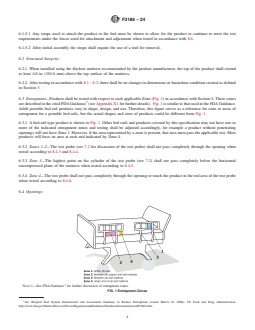
6.3 Entrapment—Products shall be tested with respect to each applicable Zone (Fig. 1) in accordance with Section 8. These zones
are described in the cited FDA Guidance (see Appendix X1 for further details). Fig. 1 is similar to that used in the FDA Guidance.
Adult portable bed rail products vary in shape, design, and use. Therefore, this figure serves as a reference for zone or areas of
entrapment for a portable bed rails, but the actual shapes and sizes of products could be different from Fig. 1.
6.3.1 A bed rail type product is shown in Fig. 1. Other bed rails and products covered by this specification may not have one or
more of the indicated entrapment zones and testing shall be adjusted accordingly, for example a product without penetrating
openings will not have Zone 1. However, if the area represented by a zone is present, that area must pass the applicable test. Most
products will have an area at each end indicated by Zone 4.
6.3.2 Zones 1–2—The test probe (see 7.2 for discussion of the test probe) shall not pass completely through the opening when
tested according to 8.4.3 and 8.4.4.
6.3.3 Zone 3—The highest point on the cylinder of the test probe (see 7.2) shall not pass completely below the horizontal
uncompressed plane of the mattress when tested according to 8.4.5.
6.3.4 Zone 4—The test probe shall not pass completely through the opening or touch the product in the red area of the test probe
when tested according to 8.4.6.
6.4 Openings:
NOTE 1—See FDA Guidance for further discussion of entrapment zones.
FIG. 1 Entrapment Zones
See Hospital Bed System Dimensional and Assessment Guidance to Reduce Entrapment (issued March 10, 2006), US Food and Drug Administration,
http://www.fda.gov/MedicalDevices/DeviceRegulationandGuidance/GuidanceDocuments/ucm072662.htm.
F3186 − 24
6.4.1 Holes or slots that extend entirely through a wall section of any rigid material less than ⁄4 in. (6.35 mm) thick and admit
a ⁄8 in. (13 mm) diameter rod shall also admit a 1 in. (25.4 mm) diameter rod. Holes or slots that are between 8 mm and 25 mm
1 1
and have a wall thickness less than ⁄4 in. (6.35 mm) but are limited in depth to ⁄4 in. (6.35 mm) maximum by another rigid surface
shall be permissible (see Fig. 2).
6.5 Misassembled Products:
6.5.1 Any structural components and retention system components of a product covered by this specification that requires
consumer assembly or adjustment, or components that may be removed by the consumer without the use of a tool, shall not be
able to be misassembled when evaluated to 6.5.2.
6.5.2 Determining Misassembled Product: A product covered by this specification shall be considered misasssembledmisas-
sembled if it appears to be functional under any condition and it does not meet the requirements of 6.1 – 6.4.
7. Test Equipment:
7.1 Test Platform:
7.1.1 Mattress and Mattress Support—Testing shall be conducted on each mattress and mattress support and type of bed that the
manufacturer specifies as suitable for use with their product.
7.1.2 Products intended by the manufacturer to be used on articulating type bed systems shall be tested using the recommended
system. Testing shall be performed with the mattress oriented in the flat position and in the articulated positions that present the
greatest risk of entrapment as determined by the tester.
7.2 Entrapment Test Probe—The test probe shall be as described in the FDA Guidance Document “Hospital Bed System
Dimensional and Assessment Guidance to Reduce Entrapment””. which can be found at http://www.fda.gov/
MedicalDeviceRegulationandGuidance/GuidanceDocuments/ucm072662. The test probe can be independently manufactured,
manufactured per the dimensional constraints in the guidance document, or it can be purchased from NST Sales & Customer
FIG. 2 Opening Example
Available at http://www.fda.gov/media/71460/download.
F3186 − 24
Service Office, 5154 Enterprise Blvd., Toledo, Ohio 43612, 800–678–7072, www.nst-usa.com.Bionix Development Corporation.
A video illustrating use of the test probe is available available.at the NST website (free registration required).
7.3 Force Gauge—The force gauge of the test probe shall have a minimum range of 00 lbf to 50 lbf (222.5 N) with a maximum
tolerance of 60.25 lbf (1.11 N).
8. Test Requirements and Methods
8.1 All products shall be tested fully assembled in accordance with the manufacturer’s instructions.
8.1.1 All tests in this section shall be performed sequentially.
8.1.2 Adjustments may be made between tests to realign product with mattress provided that any movement shall not have caused
the product to fail the prior test.
8.2 Products provided with accessories shall be tested in positions that create the greatest risk of entrapment. Such testing shall
be done with and without supplied accessories installed unless accessories are intended as a functional part of the product by the
manufacturer and require use of a tool for removal.
8.3 Test Method for Structural Integrity of Product:
8.3.1 Product shall be secured to a rigid, smooth surface in the same orientation as it would be installed on a bed. Adjustments
may be made to test equipment securing the product to the test platform between tests. Product component adjustments shall not
be performed between load tests.
8.3.2 Apply a force of 22.5 lbf (100 N) perpendicular to the top middle section of the product in the direction of E (Fig. 3). Apply
the force in the reverse direction, D (Fig. 3). Repeat for 500 cycles.
8.3.3 Apply a force of 22.5 lbf (100 N) lengthwise on the product in the direction indicated by C. Apply the force in the reverse
direction, B (Fig. 3). Repeat for 500 cycles and at each end.
NOTE 1—Forces are applied at the locations most likely to result in failure.
FIG. 3 Structural Integrity
The sole source of supply of the apparatus known to the committee at this time is Bionix Safety Technologies. Development Corporation, 5154 Enterprise Blvd., Toledo,
OH 43612, Ph. 800–551–7096, https://bionix.com. If you are aware of alternative suppliers, please provide this information to ASTM International Headquarters. Your
comments will receive careful consideration at a meeting of the responsible technical committee, which you may attend.
https://www.youtube.com/c/BionixLLC/search?query=Bed%20Rail.
F3186 − 24
8.3.4 Apply a force of 22.5 lbf (100 N) on the uppermost part of the product in the vertical direction indicated by A (Fig. 3). Repeat
for 500 cycles.
8.4 Entrapment Tests:
NOTE 1—The tests described in this section are identical to those described in the referenced FDA Guidance Document and in the NSA video.
8.4.1 The test probe safety strap should be attached to the test probe and attached to the rail prior to testing to avoid injury and
ensure that the strap does not
...
Questions, Comments and Discussion
Ask us and Technical Secretary will try to provide an answer. You can facilitate discussion about the standard in here.
Loading comments...