


ASTM D5450/D5450M-22
(Test Method)Standard Test Method for Transverse Tensile Properties of Hoop Wound Polymer Matrix Composite Cylinders
Standard Test Method for Transverse Tensile Properties of Hoop Wound Polymer Matrix Composite Cylinders
SIGNIFICANCE AND USE
5.1 This test method is used to produce transverse tensile property data for material specifications, research and development, quality assurance, and structural design and analysis. Factors which influence the transverse tensile response and should, therefore, be reported are: material, methods of material preparation, specimen preparation, specimen conditioning, environment of testing, specimen alignment and gripping, speed of testing, void content, and fiber volume fraction. Properties, in the test direction, which may be obtained from this test method include:
5.1.1 Transverse Tensile Strength,
5.1.2 Transverse Tensile Strain at Failure,
5.1.3 Transverse Tensile Modulus of Elasticity, E22, and
5.1.4 Poisson's Ratio, υ21.
SCOPE
1.1 This test method determines the transverse tensile properties of wound polymer matrix composites reinforced by high-modulus continuous fibers. It describes testing of hoop wound (90°) cylinders in axial tension for determination of transverse tensile properties.
1.2 The technical content of this test method has been stable since 1993 without significant objection from its stakeholders. As there is limited technical support for the maintenance of this test method, changes since that date have been limited to items required to retain consistency with other ASTM D30 Committee standards, including editorial changes and incorporation of updated guidance on specimen preconditioning and environmental testing. The test method, therefore, should not be considered to include any significant changes in approach and practice since 1993. Future maintenance of the test method will only be in response to specific requests and performed only as technical support allows.
1.3 Units—The values stated in either SI units or inch-pound units are to be regarded separately as standard. The values stated in each system are not necessarily exact equivalents; therefore, to ensure conformance with the standard, each system shall be used independently of the other, and values from the two systems shall not be combined.
1.3.1 Within the text, the inch-pound units are shown in brackets.
1.4 This standard does not purport to address all of the safety concerns, if any, associated with its use. It is the responsibility of the user of this standard to establish appropriate safety, health, and environmental practices and determine the applicability of regulatory limitations prior to use.
1.5 This international standard was developed in accordance with internationally recognized principles on standardization established in the Decision on Principles for the Development of International Standards, Guides and Recommendations issued by the World Trade Organization Technical Barriers to Trade (TBT) Committee.
General Information
- Status
- Published
- Publication Date
- 30-Apr-2022
- Technical Committee
- D30 - Composite Materials
- Drafting Committee
- D30.04 - Lamina and Laminate Test Methods
Relations
- Effective Date
- 01-Feb-2024
- Effective Date
- 01-Nov-2023
- Effective Date
- 01-Oct-2023
- Effective Date
- 01-Apr-2022
- Effective Date
- 15-Aug-2020
- Effective Date
- 01-Jun-2020
- Effective Date
- 01-May-2020
- Effective Date
- 01-Mar-2020
- Effective Date
- 01-Jan-2020
- Effective Date
- 15-Oct-2019
- Effective Date
- 01-Aug-2019
- Effective Date
- 15-Apr-2019
- Effective Date
- 15-Apr-2019
- Effective Date
- 01-Feb-2019
- Effective Date
- 01-Dec-2018
Overview
ASTM D5450/D5450M-22 is the international standard test method for determining the transverse tensile properties of hoop wound polymer matrix composite cylinders. Developed and maintained by ASTM Committee D30 on Composite Materials, this standard specifies axial tension testing procedures for cylinders reinforced with high-modulus continuous fibers and wound in the hoop (circumferential) direction. These test methods provide accurate and reproducible data essential for material specifications, research and development, quality assurance, and structural design and analysis in composites engineering.
Key Topics
- Transverse Tensile Properties: The standard outlines procedures for measuring:
- Transverse tensile strength
- Transverse tensile strain at failure
- Transverse tensile modulus of elasticity (E22)
- Poisson’s ratio (υ21)
- Specimen Preparation and Conditioning: Key factors influencing results include raw materials, manufacturing methods, specimen geometry, conditioning, environmental controls, specimen alignment, and gripping techniques.
- Test Procedures:
- Use of strain gauges to record stress-strain response
- Requirements for measurement equipment and instrumentation
- Environmental chambers for non-ambient testing conditions
- Detailed guidelines for aligning specimens and bonding to fixtures to ensure valid results
- Calculation and Statistical Analysis: The standard covers methods for:
- Correcting strain gauge readings for transverse sensitivity
- Calculating principal strains and modulus of elasticity
- Determining Poisson’s ratio and statistical variations in results
Applications
Organizations utilize ASTM D5450/D5450M-22 to:
- Material Specification: Generate precise material property data to specify and certify high-performance composites in critical engineering applications, such as aerospace, automotive, energy, and defense sectors.
- Quality Assurance: Ensure manufactured hoop wound composite cylinders meet defined transverse tensile performance characteristics.
- Research and Development: Provide a reliable method for evaluating new fiber/resin combinations and defining the influence of fabrication, preconditioning, or environmental exposure on composite performance.
- Structural Design and Analysis: Supply design engineers with accurate mechanical property data required for modeling and simulation, enabling robust prediction of in-service behavior.
- Compliance: Demonstrate adherence to internationally recognized composite testing practices, supporting product approval and regulatory requirements.
Related Standards
ASTM D5450/D5450M-22 references and complements several other ASTM standards, including:
- ASTM D792 – Density and specific gravity of plastics
- ASTM D2584 – Ignition loss for reinforced resins
- ASTM D2734 – Void content of reinforced plastics
- ASTM D3171 – Constituent content of composite materials
- ASTM D3878 – Terminology for composite materials
- ASTM D5229/D5229M – Moisture absorption and conditioning of polymer matrix composites
- ASTM D5448/D5448M – Inplane shear properties of hoop wound cylinders
- ASTM D5449/D5449M – Transverse compressive properties of hoop wound cylinders
- ASTM E4/E6/E111/E132 – Mechanical testing calibration, terminology, modulus measurements, and Poisson’s ratio determination
- ASTM E122/E177/E456/E691 – Statistical methods for test result precision and sample size determination
Practical Value
By following ASTM D5450/D5450M-22, users obtain reliable, documented transverse tensile data vital for the design and performance verification of hoop wound composite cylinders. The standard supports uniform data reporting, facilitates inter-laboratory comparisons, and underpins robust product qualification and compliance processes in the advanced composites industry.
Buy Documents
ASTM D5450/D5450M-22 - Standard Test Method for Transverse Tensile Properties of Hoop Wound Polymer Matrix Composite Cylinders
REDLINE ASTM D5450/D5450M-22 - Standard Test Method for Transverse Tensile Properties of Hoop Wound Polymer Matrix Composite Cylinders
Get Certified
Connect with accredited certification bodies for this standard

Smithers Quality Assessments
US management systems and product certification.

DIN CERTCO
DIN Group product certification.
Sponsored listings
Frequently Asked Questions
ASTM D5450/D5450M-22 is a standard published by ASTM International. Its full title is "Standard Test Method for Transverse Tensile Properties of Hoop Wound Polymer Matrix Composite Cylinders". This standard covers: SIGNIFICANCE AND USE 5.1 This test method is used to produce transverse tensile property data for material specifications, research and development, quality assurance, and structural design and analysis. Factors which influence the transverse tensile response and should, therefore, be reported are: material, methods of material preparation, specimen preparation, specimen conditioning, environment of testing, specimen alignment and gripping, speed of testing, void content, and fiber volume fraction. Properties, in the test direction, which may be obtained from this test method include: 5.1.1 Transverse Tensile Strength, 5.1.2 Transverse Tensile Strain at Failure, 5.1.3 Transverse Tensile Modulus of Elasticity, E22, and 5.1.4 Poisson's Ratio, υ21. SCOPE 1.1 This test method determines the transverse tensile properties of wound polymer matrix composites reinforced by high-modulus continuous fibers. It describes testing of hoop wound (90°) cylinders in axial tension for determination of transverse tensile properties. 1.2 The technical content of this test method has been stable since 1993 without significant objection from its stakeholders. As there is limited technical support for the maintenance of this test method, changes since that date have been limited to items required to retain consistency with other ASTM D30 Committee standards, including editorial changes and incorporation of updated guidance on specimen preconditioning and environmental testing. The test method, therefore, should not be considered to include any significant changes in approach and practice since 1993. Future maintenance of the test method will only be in response to specific requests and performed only as technical support allows. 1.3 Units—The values stated in either SI units or inch-pound units are to be regarded separately as standard. The values stated in each system are not necessarily exact equivalents; therefore, to ensure conformance with the standard, each system shall be used independently of the other, and values from the two systems shall not be combined. 1.3.1 Within the text, the inch-pound units are shown in brackets. 1.4 This standard does not purport to address all of the safety concerns, if any, associated with its use. It is the responsibility of the user of this standard to establish appropriate safety, health, and environmental practices and determine the applicability of regulatory limitations prior to use. 1.5 This international standard was developed in accordance with internationally recognized principles on standardization established in the Decision on Principles for the Development of International Standards, Guides and Recommendations issued by the World Trade Organization Technical Barriers to Trade (TBT) Committee.
SIGNIFICANCE AND USE 5.1 This test method is used to produce transverse tensile property data for material specifications, research and development, quality assurance, and structural design and analysis. Factors which influence the transverse tensile response and should, therefore, be reported are: material, methods of material preparation, specimen preparation, specimen conditioning, environment of testing, specimen alignment and gripping, speed of testing, void content, and fiber volume fraction. Properties, in the test direction, which may be obtained from this test method include: 5.1.1 Transverse Tensile Strength, 5.1.2 Transverse Tensile Strain at Failure, 5.1.3 Transverse Tensile Modulus of Elasticity, E22, and 5.1.4 Poisson's Ratio, υ21. SCOPE 1.1 This test method determines the transverse tensile properties of wound polymer matrix composites reinforced by high-modulus continuous fibers. It describes testing of hoop wound (90°) cylinders in axial tension for determination of transverse tensile properties. 1.2 The technical content of this test method has been stable since 1993 without significant objection from its stakeholders. As there is limited technical support for the maintenance of this test method, changes since that date have been limited to items required to retain consistency with other ASTM D30 Committee standards, including editorial changes and incorporation of updated guidance on specimen preconditioning and environmental testing. The test method, therefore, should not be considered to include any significant changes in approach and practice since 1993. Future maintenance of the test method will only be in response to specific requests and performed only as technical support allows. 1.3 Units—The values stated in either SI units or inch-pound units are to be regarded separately as standard. The values stated in each system are not necessarily exact equivalents; therefore, to ensure conformance with the standard, each system shall be used independently of the other, and values from the two systems shall not be combined. 1.3.1 Within the text, the inch-pound units are shown in brackets. 1.4 This standard does not purport to address all of the safety concerns, if any, associated with its use. It is the responsibility of the user of this standard to establish appropriate safety, health, and environmental practices and determine the applicability of regulatory limitations prior to use. 1.5 This international standard was developed in accordance with internationally recognized principles on standardization established in the Decision on Principles for the Development of International Standards, Guides and Recommendations issued by the World Trade Organization Technical Barriers to Trade (TBT) Committee.
ASTM D5450/D5450M-22 is classified under the following ICS (International Classification for Standards) categories: 83.140.20 - Laminated sheets. The ICS classification helps identify the subject area and facilitates finding related standards.
ASTM D5450/D5450M-22 has the following relationships with other standards: It is inter standard links to ASTM D883-24, ASTM D883-23, ASTM D2734-23, ASTM E456-13a(2022)e1, ASTM E1237-20, ASTM E251-20a, ASTM E251-20, ASTM D5229/D5229M-20, ASTM D883-20, ASTM D3878-19a, ASTM D883-19c, ASTM D3878-19, ASTM D883-19a, ASTM D883-19, ASTM D883-18a. Understanding these relationships helps ensure you are using the most current and applicable version of the standard.
ASTM D5450/D5450M-22 is available in PDF format for immediate download after purchase. The document can be added to your cart and obtained through the secure checkout process. Digital delivery ensures instant access to the complete standard document.
Standards Content (Sample)
This international standard was developed in accordance with internationally recognized principles on standardization established in the Decision on Principles for the
Development of International Standards, Guides and Recommendations issued by the World Trade Organization Technical Barriers to Trade (TBT) Committee.
Designation: D5450/D5450M − 22
Standard Test Method for
Transverse Tensile Properties of Hoop Wound Polymer
Matrix Composite Cylinders
This standard is issued under the fixed designation D5450/D5450M; the number immediately following the designation indicates the
year of original adoption or, in the case of revision, the year of last revision. A number in parentheses indicates the year of last
reapproval. A superscript epsilon (´) indicates an editorial change since the last revision or reapproval.
This standard has been approved for use by agencies of the U.S. Department of Defense.
1. Scope Development of International Standards, Guides and Recom-
mendations issued by the World Trade Organization Technical
1.1 This test method determines the transverse tensile prop-
Barriers to Trade (TBT) Committee.
erties of wound polymer matrix composites reinforced by
high-modulus continuous fibers. It describes testing of hoop
2. Referenced Documents
wound (90°) cylinders in axial tension for determination of
2.1 ASTM Standards:
transverse tensile properties.
D792Test Methods for Density and Specific Gravity (Rela-
1.2 Thetechnicalcontentofthistestmethodhasbeenstable
tive Density) of Plastics by Displacement
since 1993 without significant objection from its stakeholders.
D883Terminology Relating to Plastics
Asthereislimitedtechnicalsupportforthemaintenanceofthis
D2584Test Method for Ignition Loss of Cured Reinforced
testmethod,changessincethatdatehavebeenlimitedtoitems
Resins
required to retain consistency with otherASTM D30 Commit-
D2734TestMethodsforVoidContentofReinforcedPlastics
tee standards, including editorial changes and incorporation of
D3171Test Methods for Constituent Content of Composite
updated guidance on specimen preconditioning and environ-
Materials
mental testing. The test method, therefore, should not be
D3878Terminology for Composite Materials
considered to include any significant changes in approach and
D5229/D5229MTestMethodforMoistureAbsorptionProp-
practicesince1993.Futuremaintenanceofthetestmethodwill
erties and Equilibrium Conditioning of Polymer Matrix
only be in response to specific requests and performed only as
Composite Materials
technical support allows.
D5448/D5448MTest Method for Inplane Shear Properties
1.3 Units—The values stated in either SI units or inch-
of Hoop Wound Polymer Matrix Composite Cylinders
pound units are to be regarded separately as standard. The
D5449/D5449MTest Method for Transverse Compressive
values stated in each system are not necessarily exact equiva-
Properties of Hoop Wound Polymer Matrix Composite
lents; therefore, to ensure conformance with the standard, each
Cylinders
system shall be used independently of the other, and values
E4Practices for Force Calibration and Verification of Test-
from the two systems shall not be combined.
ing Machines
1.3.1 Within the text, the inch-pound units are shown in
E6Terminology Relating to Methods of Mechanical Testing
brackets.
E111Test Method for Young’s Modulus, Tangent Modulus,
1.4 This standard does not purport to address all of the and Chord Modulus
E122PracticeforCalculatingSampleSizetoEstimate,With
safety concerns, if any, associated with its use. It is the
responsibility of the user of this standard to establish appro- Specified Precision, the Average for a Characteristic of a
Lot or Process
priate safety, health, and environmental practices and deter-
mine the applicability of regulatory limitations prior to use. E132Test Method for Poisson’s Ratio at RoomTemperature
E177Practice for Use of the Terms Precision and Bias in
1.5 This international standard was developed in accor-
dance with internationally recognized principles on standard- ASTM Test Methods
E251Test Methods for Performance Characteristics of Me-
ization established in the Decision on Principles for the
tallic Bonded Resistance Strain Gages
This test method is under the jurisdiction of ASTM Committee D30 on
Composite Materials and is the direct responsibility of Subcommittee D30.04 on
Lamina and Laminate Test Methods. For referenced ASTM standards, visit the ASTM website, www.astm.org, or
Current edition approved May 1, 2022. Published May 2022. Originally contact ASTM Customer Service at service@astm.org. For Annual Book of ASTM
approved in 1993. Last previous edition approved in 2016 as D5450/D5450M–16. Standards volume information, refer to the standard’s Document Summary page on
DOI: 10.1520/D5450_D5450M-22. the ASTM website.
Copyright © ASTM International, 100 Barr Harbor Drive, PO Box C700, West Conshohocken, PA 19428-2959. United States
D5450/D5450M − 22
E456Terminology Relating to Quality and Statistics sponse and should, therefore, be reported are: material, meth-
E691Practice for Conducting an Interlaboratory Study to ods of material preparation, specimen preparation, specimen
Determine the Precision of a Test Method conditioning, environment of testing, specimen alignment and
E1237Guide for Installing Bonded Resistance Strain Gages gripping, speed of testing, void content, and fiber volume
fraction. Properties, in the test direction, which may be
3. Terminology obtained from this test method include:
ut
5.1.1 Transverse Tensile Strength, σ ,
3.1 Definitions—Terminology D3878 defines terms relating
ut
to high-modulus fibers and their composites. Terminology 5.1.2 Transverse Tensile Strain at Failure, ε ,
D883definestermsrelatingtoplastics.TerminologyE6defines
5.1.3 Transverse Tensile Modulus of Elasticity, E , and
terms relating to mechanical testing. Terminology E456 and
5.1.4 Poisson’s Ratio, υ .
Practice E177 define terms relating to statistics. In the event of
a conflict between terms, Terminology D3878 shall have 6. Interference
precedence over other standards.
6.1 Material and Specimen Preparation—Poormaterialfab-
rication practices, lack of control of fiber alignment, and
NOTE 1—If the term represents a physical quantity, its analytical
dimensionsarestatedimmediatelyfollowingtheterm(orlettersymbol)in
damage induced by improper specimen machining are known
fundamental dimension form, using the following ASTM standard sym-
causes of high material data scatter in composites.
bology for fundamental dimensions, shown within square brackets: [M]
for mass, [L] for length, [T] for time, [θ] for thermodynamic temperature,
6.2 Bonding Specimens to Test Fixtures—Ahigh percentage
and[nd]fornon-dimensionalquantities.Useofthesesymbolsisrestricted
of failures in or near the bond between the test specimen and
to analytical dimensions when used with square brackets, as the symbols
the test fixtures, especially when combined with high material
may have other definitions when used without the brackets.
data scatter, is an indicator of specimen bonding problems.
3.2 Definitions of Terms Specific to This Standard:
Specimen to fixture bonding is discussed in 11.5.
3.2.1 hoop wound, n—awindingofacylindricalcomponent
6.3 System Alignment—Excessive bending may cause pre-
where the filaments are circumferentially oriented.
mature failure, as well as highly inaccurate modulus of
3.2.2 specimen, n—a single part cut from a winding; each
elasticity determination. Every effort should be made to elimi-
winding may yield several specimens.
nate excess bending from the test system. Bending may occur
−1 −2
3.2.3 transverse tensile elastic modulus, E [ML T ],
due to misaligned grips, misaligned specimens in the test
n—the tensile elastic modulus of a unidirectional material in
fixtures, or from departures of the specimen from tolerance
the direction perpendicular to the reinforcing fibers.
requirements. The alignment should always be checked as
ut
discussed in 13.2.
3.2.4 transverse tensile strain at failure, ε [nd], n—the
value of strain, perpendicular to the reinforcing fibers in a
7. Apparatus
unidirectional material, at failure when a tensile force is
7.1 Micrometers and Calipers—A micrometer witha4to
applied in the direction perpendicular to the reinforcing fibers.
−1 −2 8mm[0.16to0.32in.]nominaldiameterball-interfaceoraflat
ut
3.2.5 transverse tensile strength, σ , [ML T ], n—the
anvil interface shall be used to measure the specimen wall
strength of a unidirectional material when a tensile force is
thickness, inner diameter, and outer diameter. A ball interface
applied in the direction perpendicular to the reinforcing fibers.
is recommended for these measurements when at least one
3.2.6 winding, n—an entire part completed by one winding
surface is irregular (for example, a coarse peel ply surface,
operation and then cured.
which is neither smooth nor flat).Amicrometer or caliper with
a flat anvil interface shall be used for measuring the overall
4. Summary of Test Method
specimen length, the gage length (the free length between the
4.1 Athin walled hoop wound cylinder nominally 100 mm fixtures), and other machined surface dimensions. The use of
[4 in.] in diameter and 140 mm [5.5 in.] in length is bonded alternative measurement devices is permitted if specified (or
into two end fixtures. The specimen/fixture assembly is agreed to) by the test requestor and reported by the testing
mounted in the testing machine and monotonically loaded in laboratory.Theaccuracyoftheinstrumentsshallbesuitablefor
tension while recording force. The transverse tensile strength reading to within1%ofthe sample dimensions. For typical
can be determined from the maximum force carried prior to specimen geometries, an instrument with an accuracy of
failure. If the cylinder strain is monitored with strain gages, 60.0025 mm [60.0001 in.] is adequate for wall thickness
then the stress-strain response of the material can be deter- measurements, while an instrument with an accuracy of
mined. From the stress-strain response, the transverse tensile 60.025 mm [60.001 in.] is adequate for measurement of the
strain at failure, transverse tensile modulus of elasticity, and inner diameter, outer diameter, overall specimen length, gage
Poisson’s ratio can be derived. length, and other machined surface dimensions.
7.2 Tension Fixture—The tension fixture consists of a steel
5. Significance and Use
outershell,insert,loadrod,andsphericalwasher.Anassembly
5.1 This test method is used to produce transverse tensile drawing for these components and the test fixture is seen in
property data for material specifications, research and Fig. 1.
development, quality assurance, and structural design and 7.2.1 Outer Shell—The outer shell (metric units Fig. 2,
analysis. Factors which influence the transverse tensile re- english units Fig. 3) is circular with a concentric circular
D5450/D5450M − 22
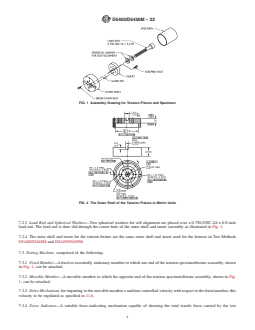
FIG. 1 Assembly Drawing for Tension Fixture and Specimen
FIG. 3 The Outer Shell of the Tension Fixture in English Units
FIG. 2 The Outer Shell of the Tension Fixture in Metric Units
FIG. 4 The Insert of the Tensile Fixture in Metric Units
hollow in one face, a grove along the diameter of the other
face, and a center hole through the thickness. Along the
2A×6.0 inch load rod. The load rod is then slid through the
diameter perpendicular to the grove, three pairs of small
center hole of the outer shell and insert assembly as illustrated
eccentric holes are placed at three radial distances. The two
in Fig. 1.
outer pairs of holes are threaded. Four additional threaded
7.2.4 Theoutershellandinsertforthetensionfixturearethe
holes are placed at the same radial distance as the innermost
same outer shell and insert used for the fixtures in Test
pair of holes, at ninety degree intervals starting forty-five
Methods D5448/D5448M and D5449/D5449M.
degreesfromthediameterthatpassesthroughthecentergrove.
7.2.2 Insert—Thefixtureinsertiscircularwithacenterhole
7.3 Testing Machine, comprised of the following:
throughthethickness(metricunitsFig.4,englishunitsFig.5).
7.3.1 Fixed Member—A fixed or essentially stationary
Two sets of holes are placed along a concentric centerline.
member to which one end of the tension specimen/fixture
These holes align with the innermost set of holes in the outer
assembly, shown in Fig. 1, can be attached.
shell. The set of four holes at ninety degree intervals are
7.3.2 Movable Member—A movable member to which the
counterbored. The insert is fastened inside the hollow of the
opposite end of the tension specimen/fixture assembly, shown
outer shell to form the concentric grove used to put the
in Fig. 1, can be attached.
specimen in the fixture (Fig. 1).
7.3.3 Drive Mechanism,forimpartingtothemovablemem-
7.2.3 Load Rod and Spherical Washers—Two spherical ber a uniform controlled velocity with respect to the fixed
washers for self alignment are placed over a 0.750-UNC- member, this velocity to be regulated as specified in 11.6.
D5450/D5450M − 22
7.4.2 Gage Resistance—Consideration should be given to
the selection of gages having larger resistance to reduce
heating effects on low-conductivity materials. Resistances of
350Ωorhigherarepreferred.Additionalconsiderationsshould
be given to the use of the minimum possible gage excitation
voltage consistent with the desired accuracy (1 to 2 volts is
recommended) to further reduce the power consumed by the
gage. Heating of the specimen by the gage may affect the
performance of the material directly, or it may affect the
indicated strain due to a difference between the gage tempera-
ture compensation factor and the coefficient of thermal expan-
sion of the specimen material.
7.4.3 Temperature Considerations—Consideration of some
form of temperature compensation is recommended, even
when testing at standard laboratory atmosphere. Temperature
compensationisrequiredwhentestinginnonambienttempera-
ture environments.
FIG. 5 The Insert of the Tensile Fixture in English Units 7.4.4 Transverse Sensitivity—Considerationshouldbegiven
to the transverse sensitivity of the selected strain gage. The
strain gage manufacturer should be consulted for recommen-
dations on transverse sensitivity corrections and effects on
7.3.4 Force Indicator—A suitable force-indicating mecha-
composites. This is particularly important for a transversely
nism capable of showing the total tensile force carried by the
mounted gage used to determine Poisson’s ratio.
test specimen. This mechanism shall be essentially free of
7.5 Conditioning Chamber—When conditioning materials
inertia-lag at the specified rate of testing and shall indicate the
at non-laboratory environments, a temperature/vapor-level
forcewithinanaccuracyof 61%oftheactualvalue,orbetter.
controlled environment conditioning chamber is required that
The accuracy of the testing machine shall be verified in
shall be capable of maintaining the required temperature to
accordance with Practice E4.
within 63°C[65°F] and the required relative humidity level
7.3.5 Construction Materials—The fixed member, movable
to within 63% RH. Chamber conditions shall be monitored
member, drive mechanism, and fixtures shall be constructed of
either on an automated continuous basis or on a manual basis
such materials and in such proportions that the total longitu-
at regular intervals.
dinal deformation of the system contributed by these parts is
7.6 Environmental Test Chamber—An environmental test
minimized.
chamber is required for test environment other than ambient
7.4 Strain-Indicating Device—Force versus strain data shall
testing laboratory conditions.This chamber shall be capable of
be determined by means of bonded resistance strain gages.
maintaining the gage section of the test specimen at the
Each strain gage shall be 6.3 mm [0.25 in.] in length. The
required test environment during the mechanical test. The test
specimen shall be instrumented to measure strain in both the
temperature shall be maintained within 63°C[65°F] of the
axial and circumferential directions to determine Poisson’s
required temperature, and the relative humidity level shall be
ratio. Strain gage rosettes (0°/45°/90°) shall be used to correct
maintained to within 63% RH of the required humidity level.
for gage misalignment. Gage calibration certification shall
complywithTestMethodE251.Someguidelinesontheuseof
8. Sampling and Test Specimens
strain gages on composites are as follows.Ageneral reference
8.1 Sampling—At least five specimens per test condition
on the subject is Tuttle and Brinson.
should be tested unless valid results can be gained through the
7.4.1 Surface Preparation—The surface preparation of
use of fewer specimens, such as in the case of a designed
fiber-reinforced composites, discussed in Practice E1237, can
experiment. For statistically significant data, the procedures
penetrate the matrix material and cause damage to the rein-
outlined in Practice E122 should be consulted. The method of
forcing fibers, resulting in improper specimen failures. Rein-
sampling shall be reported.
forcing fibers should not be exposed or damaged during the
surface preparation process. The strain gage manufacturer
NOTE 2—If specimens are to undergo environmental conditioning to
should be consulted regarding surface preparation guidelines
equilibrium, and are of such type or geometry that the weight change of
and recommended bonding agents for composites, pending the thematerialcannotbeproperlymeasuredbyweighingthespecimenitself,
then another traveler of the same nominal thickness and appropriate size
development of a set of standard practices for strain gage
shall be used to determine when equilibrium has been reached for the
installation surface preparation of fiber-reinforced composite
specimens being conditioned.
materials.
8.2 Geometry—The test specimen shall be as shown in Fig.
6. The length of all specimens shall be 140 mm [5.5 in.]. This
providesagagelengthof102mm[4.0in.].Theinnerdiameter
Tuttle,M.E.,andBrinson,H.F.,“Resistance-FoilStrain-GaugeTechnologyas
of all specimens shall be 102 6 4 mm [4.000 6 0.015 in.].
Applied to Composite Materials,” Experimental Mechanics, Vol 24, No. 1, March
1984; pp. 54–64; errata noted in Vol 26, No. 2, Jan. 1986, pp. 153–154. Specimens may be fabricated on a tapered mandrel yielding a
D5450/D5450M − 22
10.2 The pre-test specimen conditioning process, to include
specifiedenvironmentalexposurelevelsandresultingmoisture
content, shall be reported with the test data.
NOTE 3—The term moisture, as used in Test Method D5229/D5229M,
includes not only the vapor of a liquid and its condensate, but the liquid
itself in large quantities, as for immersion.
10.3 If no explicit conditioning process is performed, the
specimen conditioning process shall be reported as “uncondi-
tioned” and the moisture content as “unknown.”
11. Procedure
NOTE 1—Tube may be fabricated on a tapered mandrel with maximum 11.1 Parameters to be Specified Prior to Test:
taper of 0.0005 in./in. (0.0005 mm/mm) on the diameter.
11.1.1 The sampling method, specimen geometry, and test
NOTE 2—Actual measure of inner diameter will depend on specimen
parameters used to determine density and reinforcement
placement along tapered mandrel during fabrication.
volume,
FIG. 6 Test Specimen Shown with Strain Gage Configuration
11.1.2 The tension specimen sampling method,
11.1.3 The environmental conditioning test parameters, and
11.1.4 The tensile property and data reporting format de-
maximum taper over the specimen length of 0.0005 mm/mm
sired.
[in./in.] on the diameter. The specimens shall have a nominal
wall thickness of 2 mm [0.08 in.], the actual thickness to be
NOTE 4—Specific material property, accuracy, and data reporting
requirements should be determined prior to test for proper selection of
specifiedbythewindingparametersandshallbemaintainedas
instrumentation and data recording equipment. Estimates of operating
the test specimen is wound and cured.
stress and strain levels should also be made to aid in transducer selection,
calibration of equipment, and determination of equipment settings.
8.3 Winding—All specimens shall be hoop wound (approxi-
mately 90°) with a single tow and enough layers to meet the
11.2 General Instructions:
thickness criterion previously described.
11.2.1 Any deviation from this test method shall be re-
8.4 Unless otherwise directed, determine specific gravity ported.
and reinforcement and void volume percentages for each 11.2.2 Following any conditioning, but before the tension
winding. The material used for the determination of these testing, measure and report the specimen’s outer diameter
properties should be extracted from the center of the winding (OD), inner diameter (ID), and length. The specimens are
if multiple specimens are extracted from one winding or from measured by first marking two randomly selected locations
withinthemiddletwo-thirdsofthespecimenlength.Ateachof
one of the ends of the winding if only one specimen is
extracted from the winding. Determine and report specific thepoints,averagefourmeasurementsoftheouterdiameteron
a
...
This document is not an ASTM standard and is intended only to provide the user of an ASTM standard an indication of what changes have been made to the previous version. Because
it may not be technically possible to adequately depict all changes accurately, ASTM recommends that users consult prior editions as appropriate. In all cases only the current version
of the standard as published by ASTM is to be considered the official document.
Designation: D5450/D5450M − 16 D5450/D5450M − 22
Standard Test Method for
Transverse Tensile Properties of Hoop Wound Polymer
Matrix Composite Cylinders
This standard is issued under the fixed designation D5450/D5450M; the number immediately following the designation indicates the
year of original adoption or, in the case of revision, the year of last revision. A number in parentheses indicates the year of last
reapproval. A superscript epsilon (´) indicates an editorial change since the last revision or reapproval.
This standard has been approved for use by agencies of the U.S. Department of Defense.
1. Scope
1.1 This test method determines the transverse tensile properties of wound polymer matrix composites reinforced by high-modulus
continuous fibers. It describes testing of hoop wound (90°) cylinders in axial tension for determination of transverse tensile
properties.
1.2 The technical content of this standard test method has been stable since 1993 without significant objection from its
stakeholders. As there is limited technical support for the maintenance of this standard, test method, changes since that date have
been limited to items required to retain consistency with other ASTM D30 Committee standards, including editorial changes and
incorporation of updated guidance on specimen preconditioning and environmental testing. The standard, test method, therefore,
should not be considered to include any significant changes in approach and practice since 1993. Future maintenance of the
standard test method will only be in response to specific requests and performed only as technical support allows.
1.3 Units—The values stated in either SI units or inch-pound units are to be regarded separately as standard. The values stated in
each system are not necessarily exact equivalents; therefore, to ensure conformance with the standard, each system mustshall be
used independently of the other. Combiningother, and values from the two systems may result in nonconformance with the
standard.shall not be combined.
1.3.1 Within the text, the inch-pound units are shown in brackets.
1.4 This standard does not purport to address all of the safety concerns, if any, associated with its use. It is the responsibility
of the user of this standard to establish appropriate safety safety, health, and healthenvironmental practices and determine the
applicability of regulatory limitations prior to use.
1.5 This international standard was developed in accordance with internationally recognized principles on standardization
established in the Decision on Principles for the Development of International Standards, Guides and Recommendations issued
by the World Trade Organization Technical Barriers to Trade (TBT) Committee.
2. Referenced Documents
2.1 ASTM Standards:
D792 Test Methods for Density and Specific Gravity (Relative Density) of Plastics by Displacement
This test method is under the jurisdiction of ASTM Committee D30 on Composite Materials and is the direct responsibility of Subcommittee D30.04 on Lamina and
Laminate Test Methods.
Current edition approved July 1, 2016May 1, 2022. Published July 2016May 2022. Originally approved in 1993. Last previous edition approved in 20122016 as
D5450/D5450M – 12.D5450/D5450M – 16. DOI: 10.1520/D5450_D5450M-16. 10.1520/D5450_D5450M-22.
For referenced ASTM standards, visit the ASTM website, www.astm.org, or contact ASTM Customer Service at service@astm.org. For Annual Book of ASTM Standards
volume information, refer to the standard’s Document Summary page on the ASTM website.
Copyright © ASTM International, 100 Barr Harbor Drive, PO Box C700, West Conshohocken, PA 19428-2959. United States
D5450/D5450M − 22
D883 Terminology Relating to Plastics
D2584 Test Method for Ignition Loss of Cured Reinforced Resins
D2734 Test Methods for Void Content of Reinforced Plastics
D3171 Test Methods for Constituent Content of Composite Materials
D3878 Terminology for Composite Materials
D5229/D5229M Test Method for Moisture Absorption Properties and Equilibrium Conditioning of Polymer Matrix Composite
Materials
D5448/D5448M Test Method for Inplane Shear Properties of Hoop Wound Polymer Matrix Composite Cylinders
D5449/D5449M Test Method for Transverse Compressive Properties of Hoop Wound Polymer Matrix Composite Cylinders
E4 Practices for Force Calibration and Verification of Testing Machines
E6 Terminology Relating to Methods of Mechanical Testing
E111 Test Method for Young’s Modulus, Tangent Modulus, and Chord Modulus
E122 Practice for Calculating Sample Size to Estimate, With Specified Precision, the Average for a Characteristic of a Lot or
Process
E132 Test Method for Poisson’s Ratio at Room Temperature
E177 Practice for Use of the Terms Precision and Bias in ASTM Test Methods
E251 Test Methods for Performance Characteristics of Metallic Bonded Resistance Strain Gages
E456 Terminology Relating to Quality and Statistics
E691 Practice for Conducting an Interlaboratory Study to Determine the Precision of a Test Method
E1237 Guide for Installing Bonded Resistance Strain Gages
3. Terminology
3.1 Definitions—Terminology D3878 defines terms relating to high-modulus fibers and their composites. Terminology D883
defines terms relating to plastics. Terminology E6 defines terms relating to mechanical testing. Terminology E456 and Practice
E177 define terms relating to statistics. In the event of a conflict between terms, Terminology D3878 shall have precedence over
other standards.
NOTE 1—If the term represents a physical quantity, its analytical dimensions are stated immediately following the term (or letter symbol) in fundamental
dimension form, using the following ASTM standard symbology for fundamental dimensions, shown within square brackets: [M][M] for mass, [L][L]
for length, [T][T] for time, [θ] for thermodynamic temperature, and [nd][nd] for non-dimensional quantities. Use of these symbols is restricted to
analytical dimensions when used with square brackets, as the symbols may have other definitions when used without the brackets.
3.2 Definitions of Terms Specific to This Standard:
3.2.1 hoop wound, n—a winding of a cylindrical component where the filaments are circumferentially oriented.
3.2.2 specimen, n—a single part cut from a winding. Eachwinding; each winding may yield several specimens.
−1 −2
3.2.3 transverse tensile elastic modulus, E [ML T ], n—the tensile elastic modulus of a unidirectional material in the direction
perpendicular to the reinforcing fibers.
ut
3.2.4 transverse tensile strain at failure, ε [nd], n—the value of strain, perpendicular to the reinforcing fibers in a unidirectional
material, at failure when a tensile force is applied in the direction perpendicular to the reinforcing fibers.
−1 −2
ut
3.2.5 transverse tensile strength, σ , [ML T ], n—the strength of a unidirectional material when a tensile force is applied in the
direction perpendicular to the reinforcing fibers.
3.2.6 winding, n—an entire part completed by one winding operation and then cured.
4. Summary of Test Method
4.1 A thin walled hoop wound cylinder nominally 100 mm [4 in.] in diameter and 140 mm [5.5 in.] in length is bonded into two
end fixtures. The specimen/fixture assembly is mounted in the testing machine and monotonically loaded in tension while recording
force. The transverse tensile strength can be determined from the maximum force carried prior to failure. If the cylinder strain is
monitored with strain gauges,gages, then the stress-strain response of the material can be determined. From the stress-strain
response, the transverse tensile strain at failure, transverse tensile modulus of elasticity, and Poisson’s ratio can be derived.
D5450/D5450M − 22
5. Significance and Use
5.1 This test method is used to produce transverse tensile property data for material specifications, research and development,
quality assurance, and structural design and analysis. Factors which influence the transverse tensile response and should, therefore,
be reported are: material, methods of material preparation, specimen preparation, specimen conditioning, environment of testing,
specimen alignment and gripping, speed of testing, void content, and fiber volume fraction. Properties, in the test direction, which
may be obtained from this test method include:
ut
5.1.1 Transverse Tensile Strength, σ ,
ut
5.1.2 Transverse Tensile Strain at Failure, ε ,
5.1.3 Transverse Tensile Modulus of Elasticity, E , and
5.1.4 Poisson’s Ratio, υ .
6. Interference
6.1 Material and Specimen Preparation—Poor material fabrication practices, lack of control of fiber alignment, and damage
induced by improper specimen machining are known causes of high material data scatter in composites.
6.2 Bonding Specimens to Test Fixtures—A high percentage of failures in or near the bond between the test specimen and the test
fixtures, especially when combined with high material data scatter, is an indicator of specimen bonding problems. Specimen to
fixture bonding is discussed in 11.5.
6.3 System Alignment—Excessive bending may cause premature failure, as well as highly inaccurate modulus of elasticity
determination. Every effort should be made to eliminate excess bending from the test system. Bending may occur due to misaligned
grips, misaligned specimens in the test fixtures, or from departures of the specimen from tolerance requirements. The alignment
should always be checked as discussed in 13.2.
7. Apparatus
7.1 Micrometers and Calipers—A micrometer with a 4 to 7 mm8 mm [0.16 to 0.280.32 in.] nominal diameter ball-interface or a
flat anvil interface shall be used to measure the specimen wall thickness, inner diameter, and outer diameter. A ball interface is
recommended for these measurements when at least one surface is irregular (e.g. (for example, a coursecoarse peel ply surface,
which is neither smooth nor flat). A micrometer or caliper with a flat anvil interface shall be used for measuring the overall
specimen length, the gaugegage length (the free length between the fixtures)fixtures), and other machined surface dimensions. The
use of alternative measurement devices is permitted if specified (or agreed to) by the test requestor and reported by the testing
laboratory. The accuracy of the instruments shall be suitable for reading to within 1 % of the sample dimensions. For typical
specimen geometries, an instrument with an accuracy of 60.0025 mm [60.0001 in.] is adequate for wall thickness measurements,
while an instrument with an accuracy of 60.025 mm [60.001 in.] is adequate for measurement of the inner diameter, outer
diameter, overall specimen length, gaugegage length, and other machined surface dimensions.
7.2 Tension Fixture—The tension fixture consists of a steel outer shell, insert, load rod, and spherical washer. An assembly drawing
for these components and the test fixture is seen in Fig. 1.
7.2.1 Outer Shell—The outer shell (metric units Fig. 2, english units Fig. 3) is circular with a concentric circular hollow in one
face, a grove along the diameter of the other face, and a center hole through the thickness. Along the diameter perpendicular to
the grove, three pairs of small eccentric holes are placed at three radial distances. The two outer pairs of holes are threaded. Four
additional threaded holes are placed at the same radial distance as the innermost pair of holes, at ninety degree intervals starting
forty-five degrees from the diameter that passes through the center grove.
7.2.2 Insert—The fixture insert is circular with a center hole through the thickness (metric units Fig. 4, english units Fig. 5). Two
sets of holes are placed along a concentric centerline. These holes align with the innermost set of holes in the outer shell. The set
of four holes at ninety degree intervals are counterbored. The insert is fastened inside the hollow of the outer shell to form the
concentric grove used to put the specimen in the fixture (Fig. 1).
D5450/D5450M − 22
FIG. 1 Assembly Drawing for Tension Fixture and Specimen
FIG. 2 The Outer Shell of the Tension Fixture in Metric Units
7.2.3 Load Rod and Spherical Washers—Two spherical washers for self alignment are placed over a 0.750-UNC-2A × 6.0 inch
load rod. The load rod is then slid through the center hole of the outer shell and insert assembly as illustrated in Fig. 1.
7.2.4 The outer shell and insert for the tension fixture are the same outer shell and insert used for the fixtures in Test Methods
D5448/D5448M and D5449/D5449M.
7.3 Testing Machine, comprised of the following:
7.3.1 Fixed Member—A fixed or essentially stationary member to which one end of the tension specimen/fixture assembly, shown
in Fig. 1, can be attached.
7.3.2 Movable Member—A movable member to which the opposite end of the tension specimen/fixture assembly, shown in Fig.
1, can be attached.
7.3.3 Drive Mechanism, for imparting to the movable member a uniform controlled velocity with respect to the fixed member, this
velocity to be regulated as specified in 11.6.
7.3.4 Force Indicator—A suitable force-indicating mechanism capable of showing the total tensile force carried by the test
D5450/D5450M − 22
FIG. 3 The Outer Shell of the Tension Fixture in English Units
FIG. 4 The Insert of the Tensile Fixture in Metric Units
specimen. This mechanism shall be essentially free of inertia-lag at the specified rate of testing and shall indicate the force within
an accuracy of 61 % of the actual value, or better. The accuracy of the testing machine shall be verified in accordance with Practice
E4.
7.3.5 Construction Materials—The fixed member, movable member, drive mechanism, and fixtures shall be constructed of such
materials and in such proportions that the total longitudinal deformation of the system contributed by these parts is minimized.
7.4 Strain-Indicating Device—Force versus strain data shall be determined by means of bonded resistance strain gauges.gages.
Each strain gaugegage shall be 6.3 mm [0.25 in.] in length. The specimen shall be instrumented to measure strain in both the axial
and circumferential directions to determine Poisson’s ratio. Strain gaugegage rosettes (0°/45°/90°) shall be used to correct for
gaugegage misalignment. GaugeGage calibration certification shall comply with Test Method E251. Some guidelines on the use
of strain gaugesgages on composites are as follows. A general reference on the subject is Tuttle and Brinson.
Tuttle, M. E., and Brinson, H. F., “Resistance-Foil Strain-Gauge Technology as Applied to Composite Materials,” Experimental Mechanics, Vol 24, No. 1, March 1984;
pp. 54–64; errata noted in Vol 26, No. 2, Jan. 1986, pp. 153–154.
D5450/D5450M − 22
FIG. 5 The Insert of the Tensile Fixture in English Units
7.4.1 Surface Preparation—The surface preparation of fiber-reinforced composites, discussed in Practice E1237, can penetrate the
matrix material and cause damage to the reinforcing fibers, resulting in improper specimen failures. Reinforcing fibers should not
be exposed or damaged during the surface preparation process. The strain gaugegage manufacturer should be consulted regarding
surface preparation guidelines and recommended bonding agents for composites, pending the development of a set of standard
practices for strain gaugegage installation surface preparation of fiber-reinforced composite materials.
7.4.2 GaugeGage Resistance—Consideration should be given to the selection of gaugesgages having larger resistance to reduce
heating effects on low-conductivity materials. Resistances of 350Ω or higher are preferred. Additional considerations should be
given to the use of the minimum possible gaugegage excitation voltage consistent with the desired accuracy (1 to 2 volts is
recommended) to further reduce the power consumed by the gauge.gage. Heating of the specimen by the gaugegage may affect
the performance of the material directly, or it may affect the indicated strain due to a difference between the gaugegage temperature
compensation factor and the coefficient of thermal expansion of the specimen material.
7.4.3 Temperature Considerations—Consideration of some form of temperature compensation is recommended, even when testing
at standard laboratory atmosphere. Temperature compensation is required when testing in nonambient temperature environments.
7.4.4 Transverse Sensitivity—Consideration should be given to the transverse sensitivity of the selected strain gauge.gage. The
strain gaugegage manufacturer should be consulted for recommendations on transverse sensitivity corrections and effects on
composites. This is particularly important for a transversely mounted gaugegage used to determine Poisson’s ratio.
7.5 Conditioning Chamber—When conditioning materials at nonlaboratorynon-laboratory environments, a temperature/vapor-
level controlled environment conditioning chamber is required, whichrequired that shall be capable of maintaining the required
temperature to within 63°C [65°F]63 °C [65 °F] and the required relative vaporhumidity level to within 63 %. 63 % RH.
Chamber conditions shall be monitored either on an automated continuous basis or on a manual basis at regular intervals.
7.6 Environmental Test Chamber—An environmental test chamber is required for test environment other than ambient testing
laboratory conditions. This chamber shall be capable of maintaining the gaugegage section of the test specimen at the required test
environment during the mechanical test. The test temperature shall be maintained within 63 °C [65 °F] of the required
temperature, and the relative humidity level shall be maintained to within 63 % RH of the required humidity level.
8. Sampling and Test Specimens
8.1 Sampling—At least five specimens per test condition should be tested unless valid results can be gained through the use of
fewer specimens, such as in the case of a designed experiment. For statistically significant data, the procedures outlined in Practice
E122 should be consulted. The method of sampling shall be reported.
NOTE 2—If specimens are to undergo environmental conditioning to equilibrium, and are of such type or geometry that the weight change of the material
D5450/D5450M − 22
cannot be properly measured by weighing the specimen itself, then another traveler of the same nominal thickness and appropriate size shall be used to
determine when equilibrium has been reached for the specimens being conditioned.
8.2 Geometry—The test specimen shall be as shown in Fig. 6. The length of all specimens shall be 140 mm [5.5 in.]. This provides
a gaugegage length of 102 mm [4.0 in.]. The inner diameter of all specimens shall be 102 6 4 mm [4.000 6 0.015 in.]. Specimens
may be fabricated on a tapered mandrel yielding a maximum taper over the specimen length of 0.0005 mm/mm [in./in.] on the
diameter. The specimens shall have a nominal wall thickness of 2 mm [0.08 in.], the actual thickness to be specified by the winding
parameters and shall be maintained as the test specimen is wound and cured.
8.3 Winding—All specimens shall be hoop wound (approximately 90°) with a single tow and enough layers to meet the thickness
criterion previously described.
8.4 Unless otherwise directed, determine specific gravity and reinforcement and void volume percentages for each winding. The
material used for the determination of these properties should be extracted from the center of the winding if multiple specimens
are extracted from one winding or from one of the ends of the winding if only one specimen is extracted from the winding.
Determine and report specific gravity and density in accordance with Test Methods D792. Determine and report volume percent
of the constituents by one of the matrix digestion procedures of Test Method D3171, or, for certain reinforcement materials such
as glass and ceramics, by the matrix burn-off technique of Test Method D2584. The void content equations of Test Methods D2734
are applicable to both Test Method D2584 and the matrix digestion procedures.
8.5 Labeling—Label the specimens so that they will be distinct from each other and traceable back to the raw material, and will
neither influence the test nor be affected by it.
9. Calibration
9.1 The accuracy of all measuring equipment shall have certified calibrations that are current at the time the equipment is used.
10. Conditioning
10.1 The recommended pre-test condition is effective moisture equilibrium at a specific relative humidity as established by Test
Method D5229/D5229M; however, if the test requestor does not explicitly specify a pre-test conditioning environment, no
conditioning is required and the test specimens may be tested as prepared.
10.2 The pre-test specimen conditioning process, to include specified environmental exposure levels and resulting moisture
content, shall be reported with the test data.
NOTE 3—The term moisture, as used in Test Method D5229/D5229M, includes not only the vapor of a liquid and its condensate, but the liquid itself in
large quantities, as for immersion.
10.3 If no explicit conditioning process is performed, the specimen conditioning process shall be reported as “unconditioned” and
the moisture content as “unknown.”
NOTE 1—Tube may be fabricated on a tapered mandrel with maximum taper of 0.0005 in./in. (0.0005 mm/mm) on the diameter.
NOTE 2—Actual measure of inner diameter will depend on specimen placement along tapered mandrel during fabrication.
FIG. 6 Test Specimen Shown with Strain GaugeGage Configuration
D5450/D5450M − 22
11. Procedure
11.1 Parameters to be Specified Prior to Test:
11.1.1 The sampling method, specimen geometry, and test parameters used to determine density and reinforcement volume,
11.1.2 The tension specimen sampling method,
11.1.3 The environmental conditioning test parameters, and
11.1.4 The tensile property and data reporting format desired.
NOTE 4—Specific material property, accuracy, and data reporting requirements should be determined prior to test for proper selection of instrumentation
and data recording equipment. Estimate
...
Questions, Comments and Discussion
Ask us and Technical Secretary will try to provide an answer. You can facilitate discussion about the standard in here.
Loading comments...