

ASTM E4-21
(Practice)Standard Practices for Force Calibration and Verification of Testing Machines
General Information
- Abstract
SIGNIFICANCE AND USE
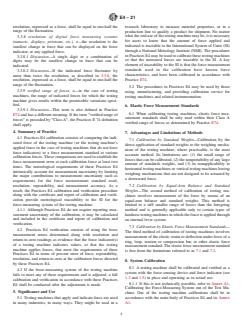
5.1 Testing machines that apply and indicate force are used in many industries, in many ways. They might be used in a research laboratory to measure material properties, or in a production line to qualify a product for shipment. No matter what the end use of the testing machine may be, it is necessary for users to know that the amount of force applied and indicated is traceable to the International System of Units (SI) through a National Metrology Institute (NMI). The procedures in Practices E4 may be used to calibrate these testing machines so that the measured forces are traceable to the SI. A key element of traceability to the SI is that the force measurement standards used in the calibration have known force characteristics, and have been calibrated in accordance with Practice E74.
5.2 The procedures in Practices E4 may be used by those using, manufacturing, and providing calibration service for testing machines and related instrumentation.
SCOPE
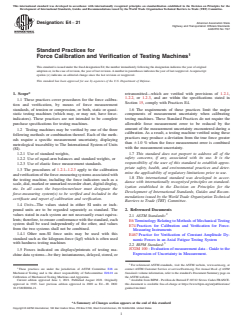
1.1 These practices cover procedures for the force calibration and verification, by means of force measurement standards, of tension or compression, or both, static or quasi-static testing machines (which may, or may not, have force-indicators). These practices are not intended to be complete purchase specifications for testing machines.
1.2 Testing machines may be verified by one of the three following methods or combination thereof. Each of the methods require a specific measurement uncertainty, displaying metrological traceability to The International System of Units (SI).
1.2.1 Use of standard weights,
1.2.2 Use of equal-arm balances and standard weights, or
1.2.3 Use of elastic force measurement standards.
1.3 The procedures of 1.2.1–1.2.3 apply to the calibration and verification of the force-measuring systems associated with the testing machine, including the force indicators such as a scale, dial, marked or unmarked recorder chart, digital display, etc. In all cases the buyer/owner/user must designate the force-measuring system(s) to be verified and included in the certificate and report of calibration and verification.
1.4 Units—The values stated in either SI units or inch-pound units are to be regarded separately as standard. The values stated in each system are not necessarily exact equivalents; therefore, to ensure conformance with the standard, each system shall be used independently of the other, and values from the two systems shall not be combined.
1.4.1 Other non-SI force units may be used with this standard such as the kilogram-force (kgf) which is often used with hardness testing machines
1.5 Forces indicated on displays/printouts of testing machine data systems—be they instantaneous, delayed, stored, or retransmitted—which are verified with provisions of 1.2.1, 1.2.2, or 1.2.3, and are within the specifications stated in Section 15, comply with Practices E4.
1.6 The requirements of these practices limit the major components of measurement uncertainty when calibrating testing machines. These Standard Practices do not require the allowable force measurement error to be reduced by the amount of the measurement uncertainty encountered during a calibration. As a result, a testing machine verified using these practices may produce a deviation from the true force greater than ±1.0 % when the force measurement error is combined with the measurement uncertainty.
1.7 This standard does not purport to address all of the safety concerns, if any, associated with its use. It is the responsibility of the user of this standard to establish appropriate safety, health, and environmental practices and determine the applicability of regulatory limitations prior to use.
1.8 This international standard was developed in accordance with internationally recognized principles on standardization established in the Decision on Principles for the Development of International Standards, Guides and Recommendations issued...
- Status
- Published
- Publication Date
- 31-May-2021
- Technical Committee
- E28 - Mechanical Testing
- Drafting Committee
- E28.01 - Calibration of Mechanical Testing Machines and Apparatus
Overview
ASTM E4-21: Standard Practices for Force Calibration and Verification of Testing Machines establishes standardized procedures for calibrating and verifying testing machines that measure and indicate force. These practices ensure force measurements are traceable to the International System of Units (SI) via a National Metrology Institute (NMI). Testing machines are essential in various sectors, from research laboratories measuring material properties to production environments qualifying products for shipment. Following ASTM E4-21 helps maintain measurement accuracy, repeatability, and reliability across applications and industries.
Key Topics
Force Calibration Procedures
- Methods outlined in ASTM E4-21 use force measurement standards such as standard weights, equal-arm balances with standard weights, or elastic force measurement standards.
- These methods ensure metrological traceability and require specific measurement uncertainty.
Verification of Force-Measuring Systems
- The practices cover calibration and verification of both static and quasi-static testing machines, including those with no direct force indicators.
- The buyer, owner, or user must identify the force-measuring systems to be verified and ensure these are documented in calibration reports.
Units and Traceability
- Measurements and calibrations can be reported in SI units or inch-pound units, but units should not be mixed within a single calibration.
- Other non-SI units, such as kilogram-force (kgf), are permitted for specific applications like hardness testing.
- Ensures force readings are traceable to SI through proper calibration of force measurement standards per ASTM E74.
Measurement Uncertainty
- ASTM E4-21 limits the major contributors to measurement uncertainty but does not mandate reduction of allowable force measurement error by the uncertainty found during calibration.
- After calibration, combined force measurement error and uncertainty may result in deviations exceeding ±1.0% from true force.
Calibration Documentation
- Proper records must include calibration forces, measurement error calculations, and verification of the traceability chain, ensuring compliance and auditability.
Applications
The calibration and verification procedures described by ASTM E4-21 are widely used in:
- Research Laboratories
- Ensuring precision in mechanical testing, material properties evaluation, and experimental studies.
- Quality Control and Manufacturing
- Confirming product compliance and performance before shipping, reducing the risk of product recalls and ensuring consistent output.
- Calibration Service Providers
- Maintaining a standardized approach to force calibration services, aligning with international best practices and client requirements.
- Testing Machine Manufacturers
- Assembling systems that meet calibration and traceability criteria, supporting customers in adhering to industry standards.
- Industries Requiring Accredited Test Results
- Aerospace, automotive, construction, and medical device sectors depend on reliable force calibration for safety and regulatory compliance.
Related Standards
ASTM E4-21 references several other international standards, enhancing its robustness and interoperability:
- ASTM E74: Practices for Calibration and Verification for Force-Measuring Instruments - the primary reference for calibration procedures and traceability in E4-21.
- ASTM D76: Specification for Tensile Testing Machines for Textiles.
- ASTM E6: Terminology Relating to Methods of Mechanical Testing.
- ASTM E467: Practice for Verification of Constant Amplitude Dynamic Forces in an Axial Fatigue Testing System.
- JCGM 100: Guide to the Expression of Uncertainty in Measurement.
- JCGM 200: International Vocabulary of Metrology – Basic and General Concepts and Associated Terms (VIM).
Practical Value
Implementing ASTM E4-21 provides:
- Assured traceability and accuracy of force measurements in critical applications.
- Compliance with global and industry requirements, supporting certification, contracts, and regulatory acceptance.
- Consistent reporting and calibration procedures, aiding both internal quality programs and external audits.
Regularly calibrating testing machines per ASTM E4-21 is crucial for any organization committed to quality, safety, and reliable test results.
Relations
- Effective Date
- 01-May-2013
- Effective Date
- 01-Mar-2013
- Effective Date
- 01-Dec-2012
- Effective Date
- 01-Nov-2011
- Effective Date
- 15-May-2009
- Effective Date
- 15-May-2009
- Effective Date
- 01-Apr-2009
- Effective Date
- 01-Jan-2009
- Effective Date
- 01-Nov-2008
- Effective Date
- 01-Oct-2008
- Effective Date
- 01-Feb-2008
- Effective Date
- 01-Nov-2007
- Effective Date
- 01-Jun-2007
- Effective Date
- 01-Mar-2007
- Effective Date
- 01-Apr-2006
Get Certified
Connect with accredited certification bodies for this standard

IMP NDT d.o.o.
Non-destructive testing services. Radiography, ultrasonic, magnetic particle, penetrant, visual inspection.
Inštitut za kovinske materiale in tehnologije
Institute of Metals and Technology. Materials testing, metallurgical analysis, NDT.
Q Techna d.o.o.
NDT and quality assurance specialist. 30+ years experience. NDT personnel certification per ISO 9712, nuclear and thermal power plant inspections, QA/
Sponsored listings
Frequently Asked Questions
ASTM E4-21 is a standard published by ASTM International. Its full title is "Standard Practices for Force Calibration and Verification of Testing Machines". This standard covers: SIGNIFICANCE AND USE 5.1 Testing machines that apply and indicate force are used in many industries, in many ways. They might be used in a research laboratory to measure material properties, or in a production line to qualify a product for shipment. No matter what the end use of the testing machine may be, it is necessary for users to know that the amount of force applied and indicated is traceable to the International System of Units (SI) through a National Metrology Institute (NMI). The procedures in Practices E4 may be used to calibrate these testing machines so that the measured forces are traceable to the SI. A key element of traceability to the SI is that the force measurement standards used in the calibration have known force characteristics, and have been calibrated in accordance with Practice E74. 5.2 The procedures in Practices E4 may be used by those using, manufacturing, and providing calibration service for testing machines and related instrumentation. SCOPE 1.1 These practices cover procedures for the force calibration and verification, by means of force measurement standards, of tension or compression, or both, static or quasi-static testing machines (which may, or may not, have force-indicators). These practices are not intended to be complete purchase specifications for testing machines. 1.2 Testing machines may be verified by one of the three following methods or combination thereof. Each of the methods require a specific measurement uncertainty, displaying metrological traceability to The International System of Units (SI). 1.2.1 Use of standard weights, 1.2.2 Use of equal-arm balances and standard weights, or 1.2.3 Use of elastic force measurement standards. 1.3 The procedures of 1.2.1–1.2.3 apply to the calibration and verification of the force-measuring systems associated with the testing machine, including the force indicators such as a scale, dial, marked or unmarked recorder chart, digital display, etc. In all cases the buyer/owner/user must designate the force-measuring system(s) to be verified and included in the certificate and report of calibration and verification. 1.4 Units—The values stated in either SI units or inch-pound units are to be regarded separately as standard. The values stated in each system are not necessarily exact equivalents; therefore, to ensure conformance with the standard, each system shall be used independently of the other, and values from the two systems shall not be combined. 1.4.1 Other non-SI force units may be used with this standard such as the kilogram-force (kgf) which is often used with hardness testing machines 1.5 Forces indicated on displays/printouts of testing machine data systems—be they instantaneous, delayed, stored, or retransmitted—which are verified with provisions of 1.2.1, 1.2.2, or 1.2.3, and are within the specifications stated in Section 15, comply with Practices E4. 1.6 The requirements of these practices limit the major components of measurement uncertainty when calibrating testing machines. These Standard Practices do not require the allowable force measurement error to be reduced by the amount of the measurement uncertainty encountered during a calibration. As a result, a testing machine verified using these practices may produce a deviation from the true force greater than ±1.0 % when the force measurement error is combined with the measurement uncertainty. 1.7 This standard does not purport to address all of the safety concerns, if any, associated with its use. It is the responsibility of the user of this standard to establish appropriate safety, health, and environmental practices and determine the applicability of regulatory limitations prior to use. 1.8 This international standard was developed in accordance with internationally recognized principles on standardization established in the Decision on Principles for the Development of International Standards, Guides and Recommendations issued...
SIGNIFICANCE AND USE 5.1 Testing machines that apply and indicate force are used in many industries, in many ways. They might be used in a research laboratory to measure material properties, or in a production line to qualify a product for shipment. No matter what the end use of the testing machine may be, it is necessary for users to know that the amount of force applied and indicated is traceable to the International System of Units (SI) through a National Metrology Institute (NMI). The procedures in Practices E4 may be used to calibrate these testing machines so that the measured forces are traceable to the SI. A key element of traceability to the SI is that the force measurement standards used in the calibration have known force characteristics, and have been calibrated in accordance with Practice E74. 5.2 The procedures in Practices E4 may be used by those using, manufacturing, and providing calibration service for testing machines and related instrumentation. SCOPE 1.1 These practices cover procedures for the force calibration and verification, by means of force measurement standards, of tension or compression, or both, static or quasi-static testing machines (which may, or may not, have force-indicators). These practices are not intended to be complete purchase specifications for testing machines. 1.2 Testing machines may be verified by one of the three following methods or combination thereof. Each of the methods require a specific measurement uncertainty, displaying metrological traceability to The International System of Units (SI). 1.2.1 Use of standard weights, 1.2.2 Use of equal-arm balances and standard weights, or 1.2.3 Use of elastic force measurement standards. 1.3 The procedures of 1.2.1–1.2.3 apply to the calibration and verification of the force-measuring systems associated with the testing machine, including the force indicators such as a scale, dial, marked or unmarked recorder chart, digital display, etc. In all cases the buyer/owner/user must designate the force-measuring system(s) to be verified and included in the certificate and report of calibration and verification. 1.4 Units—The values stated in either SI units or inch-pound units are to be regarded separately as standard. The values stated in each system are not necessarily exact equivalents; therefore, to ensure conformance with the standard, each system shall be used independently of the other, and values from the two systems shall not be combined. 1.4.1 Other non-SI force units may be used with this standard such as the kilogram-force (kgf) which is often used with hardness testing machines 1.5 Forces indicated on displays/printouts of testing machine data systems—be they instantaneous, delayed, stored, or retransmitted—which are verified with provisions of 1.2.1, 1.2.2, or 1.2.3, and are within the specifications stated in Section 15, comply with Practices E4. 1.6 The requirements of these practices limit the major components of measurement uncertainty when calibrating testing machines. These Standard Practices do not require the allowable force measurement error to be reduced by the amount of the measurement uncertainty encountered during a calibration. As a result, a testing machine verified using these practices may produce a deviation from the true force greater than ±1.0 % when the force measurement error is combined with the measurement uncertainty. 1.7 This standard does not purport to address all of the safety concerns, if any, associated with its use. It is the responsibility of the user of this standard to establish appropriate safety, health, and environmental practices and determine the applicability of regulatory limitations prior to use. 1.8 This international standard was developed in accordance with internationally recognized principles on standardization established in the Decision on Principles for the Development of International Standards, Guides and Recommendations issued...
ASTM E4-21 is classified under the following ICS (International Classification for Standards) categories: 19.060 - Mechanical testing. The ICS classification helps identify the subject area and facilitates finding related standards.
ASTM E4-21 has the following relationships with other standards: It is inter standard links to ASTM E74-13a, ASTM E74-13, ASTM E74-12, ASTM E467-08e1, ASTM E6-09be1, ASTM E6-09b, ASTM E6-09a, ASTM E6-09, ASTM E467-08, ASTM E6-08a, ASTM E6-08, ASTM E6-07b, ASTM E6-07a, ASTM E6-07, ASTM E6-06. Understanding these relationships helps ensure you are using the most current and applicable version of the standard.
ASTM E4-21 is available in PDF format for immediate download after purchase. The document can be added to your cart and obtained through the secure checkout process. Digital delivery ensures instant access to the complete standard document.
Standards Content (Sample)
This international standard was developed in accordance with internationally recognized principles on standardization established in the Decision on Principles for the
Development of International Standards, Guides and Recommendations issued by the World Trade Organization Technical Barriers to Trade (TBT) Committee.
Designation:E4 −21 American Association State
Highway and Transportation Officials Standards
AASHTO No: T67
Standard Practices for
Force Calibration and Verification of Testing Machines
This standard is issued under the fixed designation E4; the number immediately following the designation indicates the year of original
adoptionor,inthecaseofrevision,theyearoflastrevision.Anumberinparenthesesindicatestheyearoflastreapproval.Asuperscript
epsilon (´) indicates an editorial change since the last revision or reapproval.
This standard has been approved for use by agencies of the U.S. Department of Defense.
1. Scope* retransmitted—which are verified with provisions of 1.2.1,
1.2.2,or 1.2.3, and are within the specifications stated in
1.1 These practices cover procedures for the force calibra-
Section 15, comply with Practices E4.
tion and verification, by means of force measurement
standards, of tension or compression, or both, static or quasi- 1.6 The requirements of these practices limit the major
static testing machines (which may, or may not, have force- components of measurement uncertainty when calibrating
indicators). These practices are not intended to be complete testing machines. These Standard Practices do not require the
purchase specifications for testing machines. allowable force measurement error to be reduced by the
amount of the measurement uncertainty encountered during a
1.2 Testing machines may be verified by one of the three
calibration. As a result, a testing machine verified using these
following methods or combination thereof. Each of the meth-
practices may produce a deviation from the true force greater
ods require a specific measurement uncertainty, displaying
than 61.0 % when the force measurement error is combined
metrological traceability to The International System of Units
with the measurement uncertainty.
(SI).
1.7 This standard does not purport to address all of the
1.2.1 Use of standard weights,
safety concerns, if any, associated with its use. It is the
1.2.2 Use of equal-arm balances and standard weights, or
responsibility of the user of this standard to establish appro-
1.2.3 Use of elastic force measurement standards.
priate safety, health, and environmental practices and deter-
1.3 The procedures of 1.2.1–1.2.3 apply to the calibration
mine the applicability of regulatory limitations prior to use.
andverificationoftheforce-measuringsystemsassociatedwith
1.8 This international standard was developed in accor-
the testing machine, including the force indicators such as a
dance with internationally recognized principles on standard-
scale, dial, marked or unmarked recorder chart, digital display,
ization established in the Decision on Principles for the
etc. In all cases the buyer/owner/user must designate the
Development of International Standards, Guides and Recom-
force-measuring system(s) to be verified and included in the
mendations issued by the World Trade Organization Technical
certificate and report of calibration and verification.
Barriers to Trade (TBT) Committee.
1.4 Units—The values stated in either SI units or inch-
2. Referenced Documents
pound units are to be regarded separately as standard. The
values stated in each system are not necessarily exact equiva-
2.1 ASTM Standards:
lents; therefore, to ensure conformance with the standard, each
E6Terminology Relating to Methods of Mechanical Testing
system shall be used independently of the other, and values
E74Practices for Calibration and Verification for Force-
from the two systems shall not be combined.
Measuring Instruments
1.4.1 Other non-SI force units may be used with this
E467Practice for Verification of Constant Amplitude Dy-
standard such as the kilogram-force (kgf) which is often used
namic Forces in an Axial Fatigue Testing System
with hardness testing machines
2.2 BIPM Standard:
JCGM 100: Evaluation of measurement data - Guide to the
1.5 Forces indicated on displays/printouts of testing ma-
Expression of Uncertainty in Measurement.
chine data systems—be they instantaneous, delayed, stored, or
For referenced ASTM standards, visit the ASTM website, www.astm.org, or
These practices are under the jurisdiction of ASTM Committee E28 on contact ASTM Customer Service at service@astm.org. For Annual Book of ASTM
Mechanical Testing and is the direct responsibility of Subcommittee E28.01 on Standards volume information, refer to the standard’s Document Summary page on
Calibration of Mechanical Testing Machines and Apparatus. the ASTM website.
Current edition approved June 1, 2021. Published August 2021. Originally Available from BIPM - Pavillon de Breteuil F-92312 Sèvres Cedex FRANCE.
approved in 1923. Last previous edition approved in 2020 as E4–20. DOI: this document is available free-of-charge at https://www.bipm.org/en/publications/
10.1520/E0004-21. guides/vim.html
*A Summary of Changes section appears at the end of this standard
Copyright © ASTM International, 100 Barr Harbor Drive, PO Box C700, West Conshohocken, PA 19428-2959. United States
E4−21
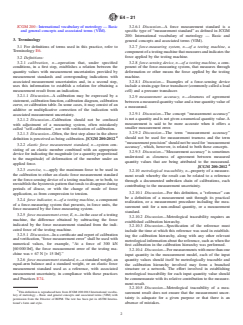
JCGM 200: International vocabulary of metrology — Basic 3.2.6.1 Discussion—A force measurement standard is a
and general concepts and associated terms (VIM). specific type of “measurement standard” as defined in JCGM
200: International vocabulary of metrology — Basic and
3. Terminology
general concepts and associated terms (VIM).
3.1 For definitions of terms used in this practice, refer to
3.2.7 force-measuring system, n—of a testing machine,a
Terminology E6.
componentofatestingmachinethatmeasuresandindicatesthe
force applied by the testing machine.
3.2 Definitions:
3.2.1 calibration, n—operation that, under specified
3.2.8 force-sensing device, n—of a testing machine, a com-
conditions, in a first step, establishes a relation between the ponent of the force-measuring system, that measures through
quantity values with measurement uncertainties provided by
deformation or other means the force applied by the testing
measurement standards and corresponding indications with machine.
associated measurement uncertainties and, in a second step,
3.2.8.1 Discussion— Examples of a force-sensing device
uses this information to establish a relation for obtaining a includeastrain-gageforcetransducer(commonlycalledaload
measurement result from an indication. cell) and a pressure transducer.
3.2.1.1 Discussion—A calibration may be expressed by a
3.2.9 measurement accuracy, n—closeness of agreement
statement,calibrationfunction,calibrationdiagram,calibration
betweenameasuredquantityvalueandatruequantityvalueof
curve, or calibration table. In some cases, it may consist of an
a measurand.
additive or multiplicative correction of the indication with
3.2.9.1 Discussion—The concept “measurement accuracy”
associated measurement uncertainty.
is not a quantity and is not given a numerical quantity value.A
3.2.1.2 Discussion—Calibration should not be confused
measurement is said to be more accurate when it offers a
with adjustment of a measuring system, often mistakenly
smaller measurement error.
called “self-calibration”, nor with verification of calibration.
3.2.9.2 Discussion—The term “measurement accuracy”
3.2.1.3 Discussion—Often, the first step alone in the above
should not be used for measurement trueness and the term
definition is perceived as being calibration. JCGM 200:2012
“measurementprecision”shouldnotbeusedfor‘measurement
3.2.2 elastic force measurement standard, n—system con-
accuracy’, which, however, is related to both these concepts.
sisting of an elastic member combined with an appropriate
3.2.9.3 Discussion—“Measurement accuracy” is sometimes
device for indicating the magnitude (or a quantity proportional
understood as closeness of agreement between measured
to the magnitude) of deformation of the member under an
quantity values that are being attributed to the measurand.
applied force.
JCGM 200:2012
3.2.3 exercise, v—apply the maximum force to be used in
3.2.10 metrological traceability, n—property of a measure-
the calibration to either an elastic force measurement standard
ment result whereby the result can be related to a reference
or the force-sensing device of a testing machine, or to both, to
through a documented unbroken chain of calibrations, each
reestablish the hysteresis pattern that tends to disappear during
contributing to the measurement uncertainty.
periods of disuse, or with the change of mode of force
3.2.10.1 Discussion—For this definition, a “reference” can
application, as from compression to tension.
be a definition of a measurement unit through its practical
3.2.4 force indicator, n—of a testing machine, a component
realization, or a measurement procedure including the mea-
of a force-measuring system that presents, in force units, the
surement unit for a non-ordinal quantity, or a measurement
force measured by the force-measuring system.
standard.
3.2.5 force measurement error, E, n—in the case of a testing
3.2.10.2 Discussion—Metrological traceability requires an
machine, the difference obtained by subtracting the force
established calibration hierarchy.
indicated by the force measurement standard from the indi-
3.2.10.3 Discussion—Specification of the reference must
cated force of the testing machine.
include the time at which this reference was used in establish-
3.2.5.1 Discussion—In a certificate and report of calibration
ing the calibration hierarchy, along with any other relevant
and verification, “force measurement error” shall be used with
metrologicalinformationaboutthereference,suchaswhenthe
numerical values, for example, “At a force of 300 kN
first calibration in the calibration hierarchy was performed.
[60000lbf], the force measurement error of the testing ma-
3.2.10.4 Discussion—Formeasurementswithmorethanone
chine was+ 67 N [+15 lbf].”
input quantity in the measurement model, each of the input
3.2.6 force measurement standard, n—a standard weight, an
quantity values should itself be metrologically traceable and
equal-arm balance and a standard weight, or an elastic force the calibration hierarchy involved may form a branched
measurement standard used as a reference, with associated
structure or a network. The effort involved in establishing
measurement uncertainty, in compliance with these practices metrological traceability for each input quantity value should
and Practices E74.
be commensurate with its relative contribution to the measure-
ment result.
3.2.10.5 Discussion—Metrological traceability of a mea-
This definition is reproduced here from JCGM 200:2012 International vocabu-
surement result does not ensure that the measurement uncer-
lary of metrology – Basic and general concepts and associated terms (VIM) with
tainty is adequate for a given purpose or that there is an
permission from the Director of BIPM. The text has been put in ASTM Interna-
tional’s form and style. absence of mistakes.
E4−21
3.2.10.6 Discussion—A comparison between two measure- 3.3.3 force, n—in the case of testing machines, a force
ment standards may be viewed as a calibration if the compari- measured in units such as pound-force, newton, or kilogram-
son is used to check and, if necessary, correct the quantity force.
value and measurement uncertainty attributed to one of the 3.3.3.1 Discussion—The newton is that force which acting
4 2
measurement standards. JCGM 200:2012 on a 1-kg mass will give to it an acceleration of 1 m/s . The
pound-force is that force which acting on a [1-lb] mass will
3.2.11 testing machine, n—force-measuring type, a me-
2 2
give to it an acceleration of 9.80665 m/s [32.1740 ft/s ]. The
chanical device for applying and measuring forces on a
kilogram-force is that force which acting on a 1-kg mass will
specimen being tested.
2 2
give to it an acceleration of 9.80665 m/s [32.1740 ft/s ].
3.2.11.1 Discussion—A testing machine generally consists
of two components, a mechanism for applying forces to a
3.3.4 percent error of force E ,n—in the case of a testing
P
specimen being tested and a force-measuring system for
machine, the ratio, of the force measurement error to the
measuring the applied forces.
applied force as measured by the force measurement standard,
3.2.11.2 Discussion—Some testing machines do not have a expressed as a percent.
force indicator such as some creep testing machines which
3.3.4.1 Discussion—The indicated force of the testing
apply a force utilizing weights and a lever mechanism. machine, and the applied force, as measured by the force
measurement standard, shall be recorded at each calibration
3.2.12 verification, n—provision of objective evidence that
force.The force measurement error, E, and the percent error of
a given item fulfils specified requirements.
forces, E , shall be calculated from these data as follows:
P
3.2.12.1 Discussion—EXAMPLE 1 Confirmation that a
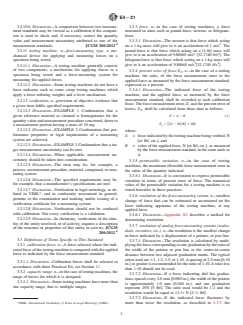
given reference material as claimed is homogeneous for the E 5 A 2 B (1)
quantityvalueandmeasurementprocedureconcerned,downto
E 5 @~A 2 B!/B# 3100
p
a measurement portion having a mass of 10 mg.
3.2.12.2 Discussion—EXAMPLE 2 Confirmation that per-
where:
formance properties or legal requirements of a measuring
A = forceindicatedbythetestingmachinebeingverified,N
system are achieved.
[or lbf, etc.], and
3.2.12.3 Discussion—EXAMPLE 3 Confirmation that a tar-
B = value of the applied force, N [or lbf, etc.], as measured
get measurement uncertainty can be met.
bytheforcemeasurementstandard,inthesameunitsas
3.2.12.4 Discussion—When applicable, measurement un- A.
certainty should be taken into consideration.
3.3.5 permissible variation, n—in the case of testing
3.2.12.5 Discussion—The item may be, for example, a
machines, the maximum allowable force measurement error in
process, measurement procedure, material, compound, or mea-
the value of the quantity indicated.
suring system.
3.3.5.1 Discussion—It is convenient to express permissible
3.2.12.6 Discussion—The specified requirements may be,
variation in terms of percent error of force. The numerical
for example, that a manufacturer’s specifications are met.
value of the permissible variation for a testing machine is so
3.2.12.7 Discussion—Verification in legal metrology, as de-
stated hereafter in these practices.
fined in VIML , and in conformity assessment in general,
3.3.6 resolution of the force-measuring system, n—smallest
pertains to the examination and marking and/or issuing of a
change of force that can be estimated or ascertained on the
verification certificate for a measuring system.
force indicating apparatus of the testing machine, at any
3.2.12.8 Discussion—Verification should not be confused
applied force.
with calibration. Not every verification is a validation.
3.3.6.1 Discussion—Appendix X1 describes a method for
3.2.12.9 Discussion—In chemistry, verification of the iden-
determining resolution.
tity of the entity involved, or of activity, requires a description
3.3.7 resolution of analog force-measuring systems (scales,
of the structure or properties of that entity or activity. JCGM
dials, recorders, etc.), n—the resolution is the smallest change
200:2012
in force indicated by a displacement of a pointer, or pen line.
3.3 Definitions of Terms Specific to This Standard:
3.3.7.1 Discussion—The resolution is calculated by multi-
3.3.1 calibration force, n—Aforce selected where the indi-
plyingtheforcecorrespondingtoonegraduationbytheratioof
catedforceofthetestingmachineiscomparedwiththeapplied
the width of the pointer or pen line to the center-to-center
force as indicated by the force measurement standard.
distance between two adjacent graduation marks. The typical
ratiosusedare1:1,1:2,1:5,or1:10.Aspacingof2.5mm[0.10
3.3.1.1 Discussion—Calibration forces shall be selected in
in.]orgreaterisrecommendedfortheratioof1:10.Aratioless
accordance with these Practices E4, see Section 11.
than 1:10 should not be used.
3.3.2 capacity range, n—inthecaseoftestingmachines,the
3.3.7.2 Discussion—If a force indicating dial has gradua-
range of forces for which it is designed.
tions spaced every 2.0 mm [0.080 in.], the width of the pointer
3.3.2.1 Discussion—Some testing machines have more than
is approximately 1.0 mm (0.040 in.), and one graduation
one capacity range, that is, multiple ranges.
represent 25N [5 lbf]. The ratio used would be 1:2 and the
1 1
resolution would be equal to 12- ⁄2 N [2- ⁄2 lbf].
3.3.7.3 Discussion—If the indicated force fluctuates by
OIML, International Vocabulary of Terms in Legal Metrology (VIML). more than twice the resolution, as described in 3.3.7, the
E4−21
resolution, expressed as a force, shall be equal to one-half the research laboratory to measure material properties, or in a
range of the fluctuation. production line to qualify a product for shipment. No matter
what the end use of the testing machine may be, it is necessary
3.3.8 resolution of digital force measuring systems
for users to know that the amount of force applied and
(numeric, displays, printouts, etc.), n—the resolution is the
indicated is traceable to the International System of Units (SI)
smallest change in force that can be displayed on the force
through a National Metrology Institute (NMI). The procedures
indicator, at any applied force.
inPracticesE4maybeusedtocalibratethesetestingmachines
3.3.8.1 Discussion—A single digit or a combination of
so that the measured forces are traceable to the SI. A key
digits may be the smallest change in force that can be
element of traceability to the SI is that the force measurement
indicated.
standards used in the calibration have known force
3.3.8.2 Discussion—If the indicated force fluctuates by
characteristics, and have been calibrated in accordance with
more than twice the resolution, as described in 3.3.8, the
Practice E74.
resolution, expressed as a force, shall be equal to one-half the
range of the fluctuation.
5.2 The procedures in Practices E4 may be used by those
3.3.9 verified range of forces, n—in the case of testing
using, manufacturing, and providing calibration service for
machines, the range of indicated forces for which the testing
testing machines and related instrumentation.
machine gives results within the permissible variations speci-
fied.
6. Elastic Force Measurement Standards
3.3.9.1 Discussion—This term is also defined in Practice
6.1 When calibrating testing machines, elastic force mea-
E74 and has a different meaning. If the term "verified range of
surement standards shall be only used within their Class A
forces" is preceded by "ClassA", the Practices E 74 definition
verified range of forces as determined by Practice E74.
shall apply.
4. Summary of Practice
7. Advantages and Limitations of Methods
4.1 Practices E4 calibration consists of comparing the indi-
7.1 Calibration by Standard Weights—Calibration by the
cated force of the testing machine (or the testing machine’s
direct application of standard weights to the weighing mecha-
applied force in the case of testing machines that do not have
nism of the testing machine, where practicable, is the most
force indicators) to a force measurement standard at various
accurate method. Its limitations are: (1) the small range of
calibration forces. These comparisons are used to establish the
forcesthatcanbecalibrated,(2)thenonportabilityofanylarge
force measurement error at each calibration force at least two
amount of standards weights, and (3) its nonapplicability to
times. The metrological requirements of these Practices E4
horizontaltestingmachinesorverticaltestingmachineshaving
intrinsically account for measurement uncertainty by limiting
weighing mechanisms that are not designed to be actuated by
the major contributions to measurement uncertainty such as
a downward force.
requirements for the force measurement standard used,
resolution, repeatability, and measurement accuracy. As a
7.2 Calibration by Equal-Arm Balance and Standard
result, the Practices E4 calibration and verification procedure Weights—The second method of calibration of testing ma-
along with the certificate and report of calibration and verifi-
chines involves measurement of the force by means of an
cation provide metrological traceability to the SI for the
equal-arm balance and standard weights. This method is
force-measuring system of the testing machine.
limited to a still smaller range of forces than the foregoing
4.1.1 Although Practices E4 do not require reporting mea-
method and is generally applicable only to certain types of
surement uncertainty of the calibration, it may be calculated
hardnesstestingmachinesinwhichtheforceisappliedthrough
and included in the certificate and report of calibration and
an internal lever system.
verification.
7.3 Calibration by Elastic Force Measurement Standards—
4.2 Practices E4 verification consists of using the force
The third method of calibration of testing machines involves
measurement errors determined along with resolution and
measurement of the elastic strain or deflection under force of a
return-to-zero readings as evidence that the force indicator(s)
ring, loop, tension or compression bar, or other elastic force
of a testing machine indicates values, or that the testing
measurementstandard.Theelasticforcemeasurementstandard
machine applies forces, that meet the requirements of these
is free from the limitations referred to in 7.1 and 7.2.
Practices E4 in terms of percent error of force, repeatability,
resolution, and return-to-zero at the calibration forces directed
8. System Calibration
by these Practices E4.
8.1 A testing machine shall be calibrated and verified as a
4.3 If the force-measuring system of the testing machine
system with the force-sensing device and force indicator (see
fails to meet any of these requirements and is adjusted, a full
1.3 and 1.5) in place and operating as in actual use.
calibration and verification in accordance with these Practices
8.1.1 If this is not technically possible, refer to Annex A1,
E4 shall be conducted after the adjustment is made.
Calibrating the Force-Measuring System out of the Test Ma-
5. Significance and Use
chine. Out of the testing machine calibrations shall be in
5.1 Testing machines that apply and indicate force are used accordance with the main body of Practices E4 and its Annex
in many industries, in many ways. They might be used in a A1.
E4−21
8.2 System calibration and verification is invalid if the or balance-arm systems, correct the force for the local value of
devices are removed and checked independently of the testing gravity and for nominal air buoyancy.
machine unless calibration is performed according to Annex
9.1.1 The force exerted by a weight in air is obtained by:
A1.
d
F 5 M 3g 1 2 (2)
S D
8.3 Many testing machines are designed to be able to
D
interchange force-sensing devices (usually these are force
where:
transducers commonly called load cells). Usually these force-
F = Force, N
sensing devices vary in capacity range. Lower capacity range
M = true mass of the weight, kg
force-sensing devices are used for better resolution and accu-
g = local acceleration due to gravity, m/s ,
racy at lower test forces and higher capacity range force-
d = air density (1.2 kg/m ), and
sensing devices are used to apply and measure higher forces.
D = density of the weight in the same units as d.
During use of a testing machine of this type, the force-sensing
devices may be routinely installed and uninstalled, which 9.1.2 For the purposes of this standard, g can be calculated
with a sufficient uncertainty using the following formula.
effectively creates multiple force-measuring systems. For such
force-sensing devices, interchangeability shall be established 2
g 5 9.7803 1 1 0.0053 sin [ 2 0.000001967h (3)
@ ~ ! #
during the original calibration and shall be reestablished after
where:
an adjustment is performed. This is accomplished by perform-
ing a Practices E4 calibration with the force-sensing device in Ø = latitude
h = elevation above sea level in metres
place as during normal use. It is advisable that orientation be
kept consistent, such as by noting the direction of the cable NOTE 1—Eq 3 corrects for the shape of the earth and the elevation
above sea level. The first term, which corrects for the shape of the earth,
connector so that when reinstalling the force-sensing device,
is a simplification of the World Geodetic System 84 Ellipsoidal Gravity
the orientation will be repeated. Remove and reinstall the
Formula. The results obtained with the simplified formula differ from
force-sensing device between the two calibration runs to
those in the full version by less than 0.0005%.The second term combines
demonstrate interchangeability. Repeat the procedure for each
a correction for altitude, the increased distance from the center of the
earth, and a correction for the counter-acting Bouguer effect of localized
interchangeable force-sensing device used in the testing ma-
increased mass of the earth. The second term assumes a rock density of
chine.
3 3
2.67 g/cm . If the rock density changed by 0.5 g/cm , an error of 0.003 %
8.3.1 Some testing machines are designed with multiple
would result.
force-sensing devices permanently mounted usually with dif-
9.2 In some cases, a mass might not be designated in
ferenttestareasforeachforcesensingdevice.Section8.3does
kilograms, for instance it might be denoted in pounds and it
not apply to such testing machines unless the force-sensing
might be desired to know the force exerted in pound-force
devices are interchanged as described in 8.3.
units. In other cases, it might be desired to know the force
8.3.2 Introduction of a new interchangeable force sensing
exerted in kilogramforce units where the mass is designated in
device(s) shall require that interchangeability be established
kilograms. In these cases, the force in non–SI units exerted by
per 8.3.
a weight in air is calculated as follows:
8.4 A Practices E4 calibration consists of at least two
M 3g d
calibrationrunsofthecalibrationforcesselectedintheverified
F 5 1 2 (4)
S D
c
9.80665 D
range(s) of forces. See 11.1 to 11.3.
where:
8.4.1 Iftheinitialcalibrationrunproducesvalueswithinthe
where:
Practices E4 requirements of Section 15, the data may be used
“as found” for calibration run one of the two required for the F = force expressed in non-SI units, such as, pound
c
force or kilogram-force,
new certificate and report of calibration and verification.
M = true mass of the weight, in the corresponding
8.4.2 Iftheinitialcalibrationrunproducesanyvalueswhich
mass units of the, F is being expressed, such as,
are outside of the Practices E4 requirements, the “as found” c
pound or kilogram,
data may be reported and may be used in accordance with
g = local acceleration due to gravity, m/s ,
applicable quality control programs. Calibration adjustments
d = air density (1.2 kg/m ),
shallbemadetotheforce-measuringsystem(s),afterwhichthe
D = density of the weight in the same units as d, and
two required calibration runs shall be conducted and reported
9.80665 = the factor converting SI units of force into non-SI
in the new certificate and report of calibration and verification.
units of force; this factor is equal to the value for
8.4.3 Calibration adjustments may be made to improve the 2
standard gravity, 9.80665 m/s .
measurement accuracy of the system. They shall be followed
If M, the mass of the weight is in pounds, the force will be
by the two required calibration runs, and issuance of a new
in pound-force units [lbf]. If M is in kilograms, the force will
certificate and report of calibration and verification and certifi-
be in kilogram-force units (kgf). These non-SI force units are
cate.
relatedtothenewton(N),theSIunitofforce,bythefollowing
relationships:
9. Gravity and Air Buoyancy Corrections
1 lbf 5 4.448222N (5)
9.1 In the calibration of testing machines, where standard
weights are used for applying forces directly or through lever 1kgf=9.80665N ~exact! (6)
E4−21
force to any given calibration force and then by decreasing the force to
9.2.1 Foruseincalibratingtestingmachines,correctionsfor
that calibration force, might not agree. Testing machines are usually used
local values of gravity and air buoyancy to standard weights
under increasing forces, but if a testing machine is to be used under
calibrated in pounds can be made with sufficient precision
decreasing forces, it should be calibrated under decreasing forces as well
using the multiplying factors from Table 1. Alternatively, the
as under increasing forces.
following formula may be used to find the multiplying factor,
10.2 Testing machines that contain a single test area and
MF.MultiplyMFtimesthemassoftheweightgiveninpounds
possess a bidirectional loading and weighing system must be
toobtainthevalueofforceinpounds-force,correctedforlocal
verified separately in both modes of weighing.
gravity and air buoyancy.
10.3 High-speed testing machines used for static testing
9.7803@1 1 0.0053 ~sin [! # 2 0.000001967h
must be verified in accordance with Practices E4. Warning—
MF 5 30.99985
9.80665
Practices E4 calibration values are not to be assumed valid for
(7)
high-speed or dynamic testing applications (see Practice
E467).
where:
Ø = latitude
NOTE 4—The force measurement error of a testing machine of the
h = elevation above sea level in metres hydraulic-ram type, in which the ram hydraulic pressure is measured,
might vary significantly with ram position. To the extent possible such
NOTE 2—Eq 7 and Table 1 correct for the shape of the earth, elevation
testing machines should be verified at the ram positions used.
abovesealevel,andairbuoyancy.Thecorrectionfortheshapeoftheearth
is a simplification of the World Geodetic System 84 Ellipsoidal Gravity
Formula. The results obtained with the simplified formula differ by less
11. Selection of Calibration Forces
than 0.0005%. The term that corrects for altitude, corrects for an
11.1 Determine the upper and lower limits of the verified
increased distance from the center of the earth and the counter-acting
Bouguer effect of localized increased mass of the earth. The formula range of forces of the testing machine to be verified. All
assumes a rock density of 2.67 g/cc. If the rock density changed by 0.5
calibrationforcesintheverifiedrangeofforcesshallbeatleast
g/cc, an error of 0.003 % would result. The largest inaccuracy to be
200 times larger than the resolution of the force-measuring
expected,duetoextremesinairpressure,temperature,andhumiditywhen
system at that calibration force.
using steel weights, is approximately 0.01%. If aluminum weights are
used, errors on the order of 0.03% can result.
11.2 If the lower limit of the verified range of forces is
9.3 Standard weights are typically denominated in a unit of greater than or equal to one-tenth of the upper limit, five or
more different calibration forces shall be selected such that the
mass. When a standard weight has been calibrated such that it
exerts a specific force under prescribed conditions, the weight difference between two adjacent calibration forces is greater
than or equal to one twentieth and less than or equal to
willexertthatforceonlyunderthoseconditions.Whenusedin
locationswheretheaccelerationofgravitydiffersfromtheone one-third the difference between the upper and lower limits of
in the calibration location, it is necessary to correct the the verified range of forces. One calibration force shall be the
calibrated force value by multiplying the force value by the lower limit of the verified range of forces and another
value for local gravity and dividing by the value of gravity for calibration force shall be the upper limit. (Fewer calibration
which the weight was calibrated. Any required air buoyancy forces are required for testing machines designed to measure
corrections must also be taken into account. onlyasmallnumberofdiscreteforces,suchascertainhardness
testing machines, creep testing machines, etc.)
10. Application of Force
11.3 If the lower limit of the verified range of forces, is less
10.1 In the calibration of a testing machine, approach the
than one-tenth the upper limit, calibration forces shall be
calibration force by increasing the force from a lower force.
selected as follows:
11.3.1 Starting with the lower limit of the verified range of
NOTE 3—For any testing machine the force measurement errors
observed at corresponding calibration forces taken first by increasing the forces, establish overlapping force decades such that the
TABLE 1 Multiplying Factor, MF, in Air at Various Latitudes, see Eq 7
Elevation Above Sea Level, h, m (ft)
Latitude, Ø,°
0 500 1000 1500 2000 2500
(0) (1640) (3280) (4920) (6560) (8200)
0 0.9972 0.9971 0.9970 0.9969 0.9968 0.9967
5 0.9972 0.9971 0.9970 0.9969 0.9968 0.9967
10 0.9973 0.9972 0.9971 0.9970 0.9969 0.9968
15 0.9975 0.9974 0.9973 0.9972 0.9971 0.9970
20 0.9978 0.9977 0.9976 0.9975 0.9974 0.9973
25 0.9981 0.9980 0.9979 0.9978 0.9977 0.9976
30 0.9985 0.9984 0.9983 0.9982 0.9981 0.9980
35 0.9989 0.9988 0.9987 0.9986 0.9985 0.9984
40 0.9993 0.9992 0.9991 0.9990 0.9989 0.9988
45 0.9998 0.9997 0.9996 0.9995 0.9994 0.9993
50 1.0003 1.0002 1.0001 1.0000 0.9999 0.9998
55 1.0007 1.0006 1.0005 1.0004 1.0003 1.0002
60 1.0011 1.0010 1.0009 1.0008 1.0007 1.0006
65 1.0015 1.0014 1.0013 1.0012 1.0011 1.0010
70 1.0018 1.0017 1.0016 1.0015 1.0014 1.0013
E4−21
maximum calibration force in each decade is ten times the machine or on trays or other supports suspended from the
lowest calibration force in the decade. The lowest calibration force-sensing device in place of the specimen. Use standard
force in the next higher decade is the same as the highest weights certified within five years to be accurate within 0.1%.
calibration force in the previous decade. The highest decade Apply the standard weights in ascending increments. If data is
might not be a complete decade. to be taken in both ascending and descending directions,
11.3.2 Five or more different calibration forces shall be remove the standard weights in reverse order. Record the
selected per decade such that the difference between two forces, corrected for gravity and air buoyancy in accordance
adjacent calibration forces is greater than or equal to one- with Section 9.
twentieth and less than or equal to one-third the difference
NOTE 7—The method of calibration by direct application of standard
between the maximum and the minimum calibration force in
weights can be used only on vertical testing machines in which the force
that decade. It is recommended that starting with the lowest
on the weighing table, hydraulic support, or other weighing device is
downward. The total force is limited by the size of the platform and the
calibration force in each decade, the ratios of the calibration
numberofstandardweightsavailable.Twenty-fivekgor[fiftylb]standard
forcestothelowestcalibrationforceinthedecadeare1:1,2:1,
weights are usually convenient to use. This method of calibration is
4:1, 7:1, 10:1 or 1:1, 2.5:1, 5:1, 7.5:1, 10:1.
confined to small testing machines and is rarely used above 5000 N [1000
11.3.3 If the highest decade is not a complete decade,
lbf].
choose calibration forces at the possible ratios and include the
13.2 Method B. Calibration of Hardness Testing Machines
upper limit of the verified range of forces. If the difference
by Equal-Arm Balance and Standard Weights:
between two adjacent calibration forces is greater than one-
13.2.1 Procedure:
third of the upper limit, add an additional calibration force.
13.2.1.1 Position the balance so that the indenter of the
NOTE 5—Example:Atesting machine has a full-scale range of 5000 N
testingmachinebeingcalibratedbearsagainstablockcentered
and the resolution of the force-measuring system is 0.0472 N. The lowest
on one pan of the equal-arm balance, the balance being in its
possible calibration force is 9.44 N (0.0472N × 200). Instead of decades
equilibrium position when the indenter is in that portion of its
starting at 9.44N, 94.4N and 944 N, three decades, starting at 10N,
travel normally occupied when making an impression. Place
100N, and 1000 N are selected to cover the verified range of forces.
Suitable calibration forces are 10N, 20N, 40N, 70N, 100N, 200N, standard weights complying with the requirements of Section
400N, 700N, 1000N, 2000N, 3000N, 4000N, 5000N. Note that the
13 on the opposite pan to balance the force exerted by the
uppermost decade is not a complete decade and is terminated with the
indenter.
upper limit of the verified range of forces. The 3000 N calibration force
wasaddedbecausethedifferencebetween2000Nand4000Nwasgreater
NOTE 8—This method can be used for the calibration of testing
than one-third of 5000N. If the alternative distribution of forces is used,
machines other than hardness-testing machines by positioning the force-
the calibration forces selected would be 10N, 25N, 50N, 75N, 100N,
applyingmemberofthetestingmachineinthesamewaythattheindenter
250N, 500N, 750N, 1000N, 2500N, 3750N, 5000N.
of a hardness-testing machine is positioned. For other methods of
calibrating hardness testing machines see the applicable ASTM test
11.4 All selected calibration forces shall be applied twice
method.
during the procedure.Applied calibration forces on the second
13.2.1.2 Since the permissible travel of the indenter of a
calibrationrunaretobeapproximatelythesameasthoseonthe
hardness-testing machine is usually very small, do not allow
first calibration run.
the balance to oscillate or swing. Instead, maintain the balance
11.5 Approximately30safterremovingthemaximumforce
in its equilibrium position through the use of an indicator such
in a range, record the return-to-zero reading of the force-
asanelectriccontact,whichshallbearrangedtoindicatewhen
measuring system. The absolute value of the return-to-zero
the reaction of the indenter force is sufficient to lift the pan
readingshallbelessthanorequaltothegreateroftheabsolute
containing the standard weights.
value of 0.1 % of the maximum force just applied or the
13.2.1.3 Using combinations of fractional standard weights,
absolute value of 1 % of the lowest calibration force in the
determine both the maximum value of the dead-weight force
verified range of forces.
that can be lifted by the testing machine indenter force during
each of ten successive trials, and the minimum value that
12. Eccentricity of Force
cannot be lifted during any one of ten successive trials. Take
12.1 For the purpose of determining the verified range of
the value of the indenting force as the average of these two
forces of the testing machine, apply all calibration forces so
values.The difference between the two values shall not exceed
that the resultant force is as nearly along the axis of a testing
0.5% of the average value.
machine as is possible.
13.3 Method C. Calibration by Elastic Force Measurement
NOTE 6—The effect of eccentric force on the measurement accuracy of
Standard:
a testing machine can be determined by calibration readings taken with
13.3.1 Temperature Equalization:
force measurement standards placed so that the resultant force is applied
13.3.1.1 When using an elastic force measurement standard
at definite distances from the axis of the testing machine, and the verified
range of forces determined for a series of eccentricities. to calibrate the force-measuring system of a testing machine,
place the elastic force measurement standard near to, or
13. Methods of Calibration
preferably in, the testing machine a sufficient length of time
before the calibration to ensure that the response of the elastic
13.1 Method A, Calibration by Standard Weights:
13.1.1 Procedure: force measurement standard is stable.
13.1.1.1 Place standard weights of suitable design, finish, 13.3.1.2 During the calibration, measure the temperature of
and adjustment on the weighing platform of the testing the elastic force measurement standards within 61°C[62°F
E4−21
] by placing a calibrated thermometer as close to the elastic 13.3.2.10 Record the indicated force of the testing machine
force measurement standard as possible. and the applied force from the elastic force measurement
standard (temperature corrected as necessary), as well as the
13.3.1.3 Elastic force measurement standards not having an
force measurement error and percent error of forces calculated
inherent temperature-compensating feature must be corrected
from the readings.
mathematicallyforthedifferencebetweenambienttemperature
13.3.2.11 Under certain conditions, setups comprising mul-
and the temperature to which its calibration is referenced.
Temperature-correction coefficients should be furnished (if tiple elastic force measurement standards may be used in
applicable) by the manufacturer of the elastic force measure- compression loading. All elastic force measurement standards
ment standard. Refer to Practice E74 for further information. to be loaded in parallel should be the same height (shims may
be used) and the testing machine’s load axis should be
13.3.2 Procedure:
coincidental with the force axis of the multiple elastic force
13.3.2.1 Place the elastic force measurement standard in the
measurement standards setup. This is necessary so that a net
testing machine so that its center line coincides with the center
moment is not applied to the testing machine loading member.
line of the heads of the testing machine. Record the Practice
Setups using multiple elastic force measurement standards are
E74 Class A verification value which establishes the lowest
not recommended unless the use of a single elastic force
limit, or force level, allowable for the elastic force measure-
measurement standard is not practicable.
ment standard’s Class A verified range of forces (see Practice
E74). Each elastic force measurement standard shall be used
14. Lever-Type Creep-Rupture Testing Machines
only within its Class A verified range of forces and identified
with the calibration forces for which it is used.
14.1 Lever-type creep-rupture testing machines, which do
13.3.2.2 Exercise the force-sensing device of the testing
not have a force-indicator, may be verified using standard
machine by applying the maximum calibration force to the
weights or elastic force measurement standard(s), or both.
testing machine and returning to zero force. Zero the force-
Standard weights used for calibration should conform to the
measuring system of the testing machine and repeat. Repeat as
requirements of 13.1. In using an elastic force measurement
necessary, allowing the force measuring system of the testing
standard, the requirements of 13.3 shall be met as applicable.
machine sufficient time to achieve stability in zero-force
14.2 Procedure:
indication.
14.2.1 Place the elastic force measurement standard in the
13.3.2.3 Exercise each elastic force measurement standard
testing machine and adjust the counterbalance (if the machine
to be used during calibration by applying the maximum
is so equipped) to compensate for the weight of the elastic
calibration force to be used with each elastic force measure-
force measurement standard.
ment standard and returning to zero force. Zero or record zero
14.2.2 Connect the lower crosshead of the testing machine
oftheelasticforcemeasurementstandardandrepeat.Repeatas
to the elastic force measurement standard, and apply forces
necessary, allowing the elastic force measurement standard
using standard weights in increments conforming to the pro-
sufficient time to achieve stability in zero-force indication.
visions of 11.1.
13.3.2.4 Eachtimethemodeofforceapplicationischanged
14.2.3 Since many lever-type creep-rupture testing ma-
duringthecalibrationfor,example,compressiontotension,the
chines do not have a provision for adjustment of the lever ratio
force-sensing device of the testing machine and the elastic
or tare, or both, it may be necessary to determine the “best fit”
force measurement standard(s) shall be re-exercised as de-
straight line through the calibration data, using the least
scribed above.
squaresmethod.Bydoingthis,theactualleverratioandtareof
13.3.2.5 There are two methods for using elastic force
each testing machine can be determined, and thus reduce force
measurement standards:
measurement errors due to small variations of lever ratios.
13.3.2.6 Follow-the-ForceMethod—Theforceontheelastic
Maximum percent error of force shall not exceed the require-
force measurement standard is followed until the f
...
This document is not an ASTM standard and is intended only to provide the user of an ASTM standard an indication of what changes have been made to the previous version. Because
it may not be technically possible to adequately depict all changes accurately, ASTM recommends that users consult prior editions as appropriate. In all cases only the current version
of the standard as published by ASTM is to be considered the official document.
Designation: E4 − 20 E4 − 21 American Association State
Highway and Transportation Officials Standards
AASHTO No: T67
Standard Practices for
Force Calibration and Verification of Testing Machines
This standard is issued under the fixed designation E4; the number immediately following the designation indicates the year of original
adoption or, in the case of revision, the year of last revision. A number in parentheses indicates the year of last reapproval. A superscript
epsilon (´) indicates an editorial change since the last revision or reapproval.
This standard has been approved for use by agencies of the U.S. Department of Defense.
1. Scope*
1.1 These practices cover procedures for the force calibration and verification, by means of force measurement standards, of
tension or compression, or both, static or quasi-static testing machines (which may, or may not, have force-indicating systems).
force-indicators). These practices are not intended to be complete purchase specifications for testing machines.
1.2 Testing machines may be verified by one of the three following methods or combination thereof. Each of the methods require
a specific uncertainty of measurement, measurement uncertainty, displaying metrological traceability to The International System
of Units (SI).
1.2.1 Use of standard weights,
1.2.2 Use of equal-arm balances and standard weights, or
1.2.3 Use of force-measuring instruments.elastic force measurement standards.
1.3 The term ’metrological traceability’ is used as defined in the JCGM 200: International vocabulary of metrology-Basic and
general concepts and associated terms (VIM).
1.3 The procedures of 1.2.1–1.2.3 apply to the calibration and verification of the force-indicatingforce-measuring systems
associated with the testing machine, including the force indicators such as a scale, dial, marked or unmarked recorder chart, digital
display, etc. In all cases the buyer/owner/user must designate the force-indicatingforce-measuring system(s) to be verified and
included in the report.certificate and report of calibration and verification.
1.4 Units—The values stated in either SI units or inch-pound units are to be regarded separately as standard. The values stated in
each system are not necessarily exact equivalents; therefore, to ensure conformance with the standard, each system shall be used
independently of the other, and values from the two systems shall not be combined.
1.4.1 Other customarynon-SI force units may be used with this standard such as the kilogram-force (kgf) which is often used with
hardness testing machines
These practices are under the jurisdiction of ASTM Committee E28 on Mechanical Testing and is the direct responsibility of Subcommittee E28.01 on Calibration of
Mechanical Testing Machines and Apparatus.
Current edition approved Jan. 1, 2020June 1, 2021. Published March 2020August 2021. Originally approved in 1923. Last previous edition approved in 20162020 as
E4 – 16.E4 – 20. DOI: 10.1520/E0004-20.10.1520/E0004-21.
*A Summary of Changes section appears at the end of this standard
Copyright © ASTM International, 100 Barr Harbor Drive, PO Box C700, West Conshohocken, PA 19428-2959. United States
E4 − 21
1.5 Forces indicated on displays/printouts of testing machine data systems—be they instantaneous, delayed, stored, or
retransmitted—which are verified with provisions of 1.2.1, 1.2.2, or 1.2.3, and are within the 61 % measurement accuracy
requirement,specifications stated in Section 15, comply with Practices E4.
1.6 The requirements of these practices limit the major components of measurement uncertainty when verifyingcalibrating testing
machines. These Standard Practices do not require the allowable force measurement error to be reduced by the amount of the
measurement uncertainty encountered during a verification.calibration. As a result, a testing machine verified using these practices
may produce a deviation from the true force greater than 61.0 % when the force measurement error is combined with the
measurement uncertaintyuncertainty.
1.7 This standard does not purport to address all of the safety concerns, if any, associated with its use. It is the responsibility
of the user of this standard to establish appropriate safety, health, and environmental practices and determine the applicability of
regulatory limitations prior to use.
1.8 This international standard was developed in accordance with internationally recognized principles on standardization
established in the Decision on Principles for the Development of International Standards, Guides and Recommendations issued
by the World Trade Organization Technical Barriers to Trade (TBT) Committee.
2. Referenced Documents
2.1 ASTM Standards:
D76/D76M Specification for Tensile Testing Machines for Textiles
E6 Terminology Relating to Methods of Mechanical Testing
E74 Practices for Calibration and Verification for Force-Measuring Instruments
E467 Practice for Verification of Constant Amplitude Dynamic Forces in an Axial Fatigue Testing System
2.2 BIPM Standard:
JCGM 100 : Evaluation of measurement data - Guide to the Expression of Uncertainty in Measurement.
JCGM 200 : International vocabulary of metrology — Basic and general concepts and associated terms (VIM).
3. Terminology
3.1 For definitions of terms used in this practice, refer to Terminology E6.
3.2 Definitions:
3.2.1 calibration, n—operation that, under specified conditions, in a first step, establishes a relation between the quantity values
with measurement uncertainties provided by measurement standards and corresponding indications with associated measurement
uncertainties and, in a second step, uses this information to establish a relation for obtaining a measurement result from an
indication.
3.2.1.1 Discussion—
A calibration may be expressed by a statement, calibration function, calibration diagram, calibration curve, or calibration table. In
some cases, it may consist of an additive or multiplicative correction of the indication with associated measurement uncertainty.
3.2.1.2 Discussion—
Calibration should not be confused with adjustment of a measuring system, often mistakenly called “self-calibration”, nor with
verification of calibration.
3.2.1.3 Discussion—
Often, the first step alone in the above definition is perceived as being calibration. JCGM 200:2012
3.2.2 elastic force measurement standard, n—system consisting of an elastic member combined with an appropriate device for
indicating the magnitude (or a quantity proportional to the magnitude) of deformation of the member under an applied force.
3.2.3 exercise, v—apply the maximum force to be used in the verificationcalibration to either a force-measuring instrument an
For referenced ASTM standards, visit the ASTM website, www.astm.org, or contact ASTM Customer Service at service@astm.org. For Annual Book of ASTM Standards
volume information, refer to the standard’s Document Summary page on the ASTM website.
Available from BIPM - Pavillon de Breteuil F-92312 Sèvres Cedex FRANCE. this document is available free-of-charge at https://www.bipm.org/en/publications/guides/
vim.html
This definition is reproduced here from JCGM 200:2012 International vocabulary of metrology – Basic and general concepts and associated terms (VIM) with permission
from the Director of BIPM. The text has been put in ASTM International’s form and style.
E4 − 21
elastic force measurement standard or the force-sensing device of a testing machine, or to both, to reestablish the hysteresis pattern
that tends to disappear during periods of disuse, or with the change of mode of force application, as from compression to tension.
3.2.4 force indicator, n—of a testing machine, a component of a force-measuring system that presents, in force units, the force
measured by the force-measuring system.
3.2.5 force measurement error, E, n—in the case of a testing machine, the difference obtained by subtracting the force indicated
by the force measurement standard from the indicated force of the testing machine.
3.2.5.1 Discussion—
In a certificate and report of calibration and verification, “force measurement error” shall be used with numerical values, for
example, “At a force of 300 kN [60 000 lbf], the force measurement error of the testing machine was + 67 N [+ 15 lbf].”
3.2.6 force measurement standard, n—a standard weight, an equal-arm balance and a standard weight, or an elastic force
measurement standard used as a reference, with associated measurement uncertainty, in compliance with these practices and
Practices E74.
3.2.6.1 Discussion—
A force measurement standard is a specific type of “measurement standard” as defined in JCGM 200: International vocabulary of
metrology — Basic and general concepts and associated terms (VIM).
3.2.7 force-measuring system, n—of a testing machine, a component of a testing machine that measures and indicates the force
applied by the testing machine.
3.2.8 force-measuring instrument,force-sensing device, n—system consisting of an elastic memberof a testing machine, combined
with an appropriate device for indicating the magnitude (or a quantity proportional to the magnitude) of deformation of the member
under an applied force.a component of the force-measuring system, that measures through deformation or other means the force
applied by the testing machine.
3.2.8.1 Discussion—
Examples of a force-sensing device include a strain-gage force transducer (commonly called a load cell) and a pressure transducer.
3.2.9 measurement accuracy, n—closeness of agreement between a measured quantity value and a true quantity value of a
measurandmeasurand.
3.2.9.1 Discussion—
The concept ‘measurement accuracy’“measurement accuracy” is not a quantity and is not given a numerical quantity value. A
measurement is said to be more accurate when it offers a smaller measurement error.
3.2.9.2 Discussion—
The term “measurement accuracy” should not be used for measurement trueness and the term “measurement precision” should not
be used for ‘measurement accuracy’, which, however, is related to both these concepts.
3.2.9.3 Discussion—
‘Measurement accuracy’“Measurement accuracy” is sometimes understood as closeness of agreement between measured quantity
values that are being attributed to the measurand. JCGM 200:2012
3.2.10 metrological traceability, n—property of a measurement result whereby the result can be related to a reference through a
documented unbroken chain of calibrations, each contributing to the measurement uncertainty.
3.2.10.1 Discussion—
For this definition, a ‘reference’“reference” can be a definition of a measurement unit through its practical realization, or a
measurement procedure including the measurement unit for a non-ordinal quantity, or a measurement standard.
3.2.10.2 Discussion—
Metrological traceability requires an established calibration hierarchy.
3.2.10.3 Discussion—
Specification of the reference must include the time at which this reference was used in establishing the calibration hierarchy, along
with any other relevant metrological information about the reference, such as when the first calibration in the calibration hierarchy
was performed.
3.2.10.4 Discussion—
For measurements with more than one input quantity in the measurement model, each of the input quantity values should itself
E4 − 21
be metrologically traceable and the calibration hierarchy involved may form a branched structure or a network. The effort involved
in establishing metrological traceability for each input quantity value should be commensurate with its relative contribution to the
measurement result.
3.2.10.5 Discussion—
Metrological traceability of a measurement result does not ensure that the measurement uncertainty is adequate for a given purpose
or that there is an absence of mistakes.
3.2.10.6 Discussion—
A comparison between two measurement standards may be viewed as a calibration if the comparison is used to check and, if
necessary, correct the quantity value and measurement uncertainty attributed to one of the measurement standards. JCGM
200:2012
3.2.11 portable testing machine (force-measuring type), testing machine, n—force-measuring type, a device specifically designed
to be moved from place to place and for applying a force (load) to a specimen.mechanical device for applying and measuring forces
on a specimen being tested.
3.2.11.1 Discussion—
A testing machine generally consists of two components, a mechanism for applying forces to a specimen being tested and a
force-measuring system for measuring the applied forces.
3.2.11.2 Discussion—
Some testing machines do not have a force indicator such as some creep testing machines which apply a force utilizing weights
and a lever mechanism.
3.2.7 testing machine (force-measuring type), n—a mechanical device for applying a force to a specimen.
3.2.12 verification, n—provision of objective evidence that a given item fulfils specified requirements.
3.2.12.1 Discussion—
EXAMPLE 1 Confirmation that a given reference material as claimed is homogeneous for the quantity value and measurement
procedure concerned, down to a measurement portion having a mass of 10 mg.
3.2.12.2 Discussion—
EXAMPLE 2 Confirmation that performance properties or legal requirements of a measuring system are achieved.
3.2.12.3 Discussion—
EXAMPLE 3 Confirmation that a target measurement uncertainty can be met.
3.2.12.4 Discussion—
When applicable, measurement uncertainty should be taken into consideration.
3.2.12.5 Discussion—
The item may be, for example, a process, measurement procedure, material, compound, or measuring system.
3.2.12.6 Discussion—
The specified requirements may be, for example, that a manufacturer’s specifications are met.
3.2.12.7 Discussion—
Verification in legal metrology, as defined in VIML[53],VIML , and in conformity assessment in general, pertains to the
examination and marking and/or issuing of a verification certificate for a measuring system.
3.2.12.8 Discussion—
Verification should not be confused with calibration. Not every verification is a validation.
3.2.12.9 Discussion—
In chemistry, verification of the identity of the entity involved, or of activity, requires a description of the structure or properties
of that entity or activity. JCGM 200:2012
3.3 Definitions of Terms Specific to This Standard:
3.3.1 calibration force, n—A force selected where the indicated force of the testing machine is compared with the applied force
as indicated by the force measurement standard.
3.3.1.1 Discussion—
Calibration forces shall be selected in accordance with these Practices E4, see Section 11.
3.3.2 capacity range, n—in the case of testing machines, the range of forces for which it is designed.
3.3.2.1 Discussion—
Some testing machines have more than one capacity range, that is, multiple ranges.
OIML, International Vocabulary of Terms in Legal Metrology (VIML).
E4 − 21
3.3.2 correction, n—in the case of a testing machine, the difference obtained by subtracting the indicated force from the correct
value of the applied force.
3.3.3 error (or the deviation from the correct value), n—in the case of a testing machine, the difference obtained by subtracting
the force indicated by the calibration device from the force indicated by the testing machine.
3.3.3.1 Discussion—
The word “error” shall be used with numerical values, for example, “At a force of 300 kN [60 000 lbf], the error of the testing
machine was + 67 N [+ 15 lbf].”
3.3.3 force, n—in the case of testing machines, a force measured in units such as pound-force, newton, or kilogram-force.
3.3.3.1 Discussion—
The newton is that force which acting on a 1-kg mass will give to it an acceleration of 1 m/s . The pound-force is that force which
2 2
acting on a [1-lb] mass will give to it an acceleration of 9.80665 m/s [32.1740 ft/s ]. The kilogram-force is that force which acting
2 2
on a 1-kg mass will give to it an acceleration of 9.80665 m/s [32.1740 ft/s ].
3.3.5 force measurement standard, n—a standard weight, an equal-arm balance and a standard weight, or a force-measuring
instrument used as a reference, with associated measurement uncertainty, in compliance with these practices and Preactices E74.
3.3.5.1 Discussion—
A force measurement standard is a specific type of “measurement standard” as defined in JCGM 200: International vocabulary of
metrology — Basic and general concepts and associated terms (VIM).
3.3.4 percent error of force, force E , n—in the case of a testing machine, the ratio, expressed as a percent, of the force
P
measurement error to the correct value of the applied force.applied force as measured by the force measurement standard,
expressed as a percent.
3.3.4.1 Discussion—
The test force, as indicated by indicated force of the testing machine, and the applied force, as computed from the readings of the
verification device, measured by the force measurement standard, shall be recorded at each test point. The calibration force. The
force measurement error, E, and the percent error of forces, E ,p, shall be calculated from these data as follows:
P
E 5 A 2 B (1)
E 5 A 2 B /B 3100
@~ ! #
p
where:
A = force indicated by machine being verified, N [or lbf], and
B = correct value of the applied force, N [or lbf], as determined by the force measurement standard.
A = force indicated by the testing machine being verified, N [or lbf, etc.], and
B = value of the applied force, N [or lbf, etc.], as measured by the force measurement standard, in the same units as A.
3.3.5 permissible variation (or tolerance), variation, n—in the case of testing machines, the maximum allowable force
measurement error in the value of the quantity indicated.
3.3.5.1 Discussion—
It is convenient to express permissible variation in terms of percentage percent error of error.force. The numerical value of the
permissible variation for a testing machine is so stated hereafter in these practices.
3.3.6 resolution of the force indicator,force-measuring system, n—smallest change of force that can be estimated or ascertained
on the force indicating apparatus of the testing machine, at any applied force.
3.3.6.1 Discussion—
Appendix X1 describes a method for determining resolution.
3.3.7 resolution of analog type force indicators force-measuring systems (scales, dials, recorders, etc.), n—the resolution is the
smallest change in force indicated by a displacement of a pointer, or pen line.
3.3.7.1 Discussion—
The resolution is calculated by multiplying the force corresponding to one graduation by the ratio of the width of the pointer or
E4 − 21
pen line to the center to center center-to-center distance between two adjacent graduation marks. The typical ratios used are 1:1,
1:2, 1:5, or 1:10. A spacing of 2.5 mm [0.10 in.] or greater is recommended for the ratio of 1:10. A ratio less than 1:10 should not
be used.
3.3.7.2 Discussion—
If a force indicating dial has graduations spaced every 2.0 mm [0.080 in.], the width of the pointer is approximately 1.0 mm (0.040
1 1
in.), and one graduation represent 25N [5 lbf]. The ratio used would be 1:2 and the resolution would be equal to 12- ⁄2 N [2- ⁄2
lbf].
3.3.7.3 Discussion—
If the indicated force indication fluctuates by more than twice the resolution, as described in 3.3.93.3.7, the resolution, expressed
as a force, shall be equal to one-half the range of the fluctuation.
3.3.8 resolution of digital type force indicators measuring systems (numeric, displays, printouts, etc.), n—the resolution is the
smallest change in force that can be displayed on the force indicator, at any applied force.
3.3.8.1 Discussion—
A single digit or a combination of digits may be the smallest change in force that can be indicated.
3.3.8.2 Discussion—
If the indicated force indication fluctuates by more than twice the resolution, as described in 3.3.103.3.8, the resolution, expressed
as a force, shall be equal to one-half the range of the fluctuation.
3.3.9 verified range of forces, n—in the case of testing machines, the range of indicated forces for which the testing machine gives
results within the permissible variations specified.
3.3.9.1 Discussion—
This term is also defined in Practice E74 and has a different meaning. If the term "verified range of forces" is preceded by "Class
A", the Practices E 74 definition shall apply.
4. Summary of Practice
4.1 Practices E4 calibration consists of comparing the indicated force of the testing machine (or the testing machine’s applied force
in the case of testing machines that do not have force indicators) to a force measurement standard at various calibration forces.
These comparisons are used to establish the force measurement error at each calibration force at least two times. The metrological
requirements of these Practices E4 intrinsically account for measurement uncertainty by limiting the major contributions to
measurement uncertainty such as requirements for the force measurement standard used, resolution, repeatability, and
measurement accuracy. As a result, the Practices E4 calibration and verification procedure along with the certificate and report of
calibration and verification provide metrological traceability to the SI for the force-measuring system of the testing machine.
4.1.1 Although Practices E4 do not require reporting measurement uncertainty of the calibration, it may be calculated and included
in the certificate and report of calibration and verification.
4.2 Practices E4 verification consists of using the force measurement errors determined along with resolution and return-to-zero
readings as evidence that the force indicator(s) of a testing machine indicates values, or that the testing machine applies forces,
that meet the requirements of these Practices E4 in terms of percent error of force, repeatability, resolution, and return-to-zero at
the calibration forces directed by these Practices E4.
4.3 If the force-measuring system of the testing machine fails to meet any of these requirements and is adjusted, a full calibration
and verification in accordance with these Practices E4 shall be conducted after the adjustment is made.
5. Significance and Use
5.1 Testing machines that apply and indicate force are used in many industries, in many ways. They maymight be used in a
research laboratory to measure material properties, andor in a production line to qualify a product for shipment. No matter what
the end use of the testing machine may be, it is necessary for users to know that the amount of force applied and indicated is
traceable to the International System of Units (SI) through a National Metrology Institute (NMI). The procedures in Practices E4
may be used to verifycalibrate these testing machines so that the indicatedmeasured forces are traceable to the SI. A key element
of traceability to the SI is that the devices force measurement standards used in the verificationcalibration have known force
characteristics, and have been calibrated in accordance with Practice E74.
E4 − 21
5.2 The procedures in Practices E4 may be used by those using, manufacturing, and providing calibration service for testing
machines and related instrumentation.
6. Force-Measuring Instruments Elastic Force Measurement Standards
6.1 When verifyingcalibrating testing machines, use force-measuring instruments only over elastic force measurement standards
shall be only used within their Class A force ranges verified range of forces as determined by Practice E74.
7. Advantages and Limitations of Methods
7.1 VerificationCalibration by Standard Weights—VerificationCalibration by the direct application of standard weights to the
weighing mechanism of the testing machine, where practicable, is the most accurate method. Its limitations are: (1) the small range
of forces that can be verified,calibrated, (2) the nonportability of any large amount of standards weights, and (3) its nonapplicability
to horizontal testing machines or vertical testing machines having weighing mechanisms that are not designed to be actuated by
a downward force.
7.2 VerificationCalibration by Equal-Arm Balance and Standard Weights—The second method of verificationcalibration of testing
machines involves measurement of the force by means of an equal-arm balance and standard weights. This method is limited to
a still smaller range of forces than the foregoing method,method and is generally applicable only to certain types of hardness testing
machines in which the force is applied through an internal lever system.
7.3 Verification by Force-measuring Instruments—Calibration by Elastic Force Measurement Standards—The third method of
verificationcalibration of testing machines involves measurement of the elastic strain or deflection under force of a ring, loop,
tension or compression bar, or other force-measuring instrument. The force-measuring instrument elastic force measurement
standard. The elastic force measurement standard is free from the limitations referred to in 6.17.1 and 6.27.2.
8. System VerificationCalibration
8.1 A testing machine shall be calibrated and verified as a system with the force sensing and indicating devicesforce-sensing
device and force indicator (see 1.41.3 and 1.61.5) in place and operating as in actual use.
8.1.1 If this is not technically possible, refer to Annex A1, VerifyingCalibrating the Force Measuring Force-Measuring System out
of the Test Machine. Out of the testtesting machine verificationscalibrations shall be in accordance with the main body of Practices
E4 and its Annex A1.
8.2 System calibration and verification is invalid if the devices are removed and checked independently of the testing machine
unless verificationcalibration is performed according to Annex A1.
8.3 Many testing machines utilize more than one force measuring device in order to obtain more accurate force indication at lower
applied forces. These devices are are designed to be able to interchange force-sensing devices (usually these are force transducers
commonly called load cells). Usually these force-sensing devices vary in capacity range. Lower capacity range force-sensing
devices are used for better resolution and accuracy at lower test forces and higher capacity range force-sensing devices are used
to apply and measure higher forces. During use of a testing machine of this type, the force-sensing devices may be routinely
installed and uninstalled in the testing machine. For such uninstalled, which effectively creates multiple force-measuring systems.
For such force-sensing devices, interchangeability shall be established during the original verificationcalibration and shall be
reestablished after an adjustment is performed. This is accomplished by performing a normal verificationPractices E4 calibration
with the force-sensing device in place as during normal use. It is advisable that orientation be kept consistent, such as by noting
the direction of the cable connector so that when reinstalling the force-sensing device, the orientation will be repeated. Remove
and reinstall the force-sensing device between the two verificationcalibration runs to demonstrate interchangeability. Repeat the
procedure for each interchangeable force measuring force-sensing device used in the testing machine.
8.3.1 Some testing machines are designed with multiple force-sensing devices permanently mounted usually with different test
areas for each force sensing device. Section 8.3 does not apply to such testing machines unless the force-sensing devices are
interchanged as described in 8.3.
E4 − 21
8.3.2 Introduction of thea new interchangeable force measuring devicessensing device(s) shall require that interchangeability be
established per 7.38.3.
8.4 A Practices E4 Verificationcalibration consists of at least two verificationcalibration runs of the calibration forces
containedselected in the forceverified range(s) selected. of forces. See 10.111.1 andto 10.311.3.
8.4.1 If the initial verificationcalibration run produces values within the Practices E4 requirements of Section 1415, the data may
be used “as found” for calibration run one of the two required for the new verification report.certificate and report of calibration
and verification.
8.4.2 If the initial verificationcalibration run produces any values which are outside of the Practices E4 requirements, the “as
found” data may be reported and may be used in accordance with applicable quality control programs. Calibration adjustments
shall be made to the force indicator force-measuring system(s), after which the two required verificationcalibration runs shall be
conducted and reported in the new verification report and certificate.certificate and report of calibration and verification.
8.4.3 Calibration adjustments may be made to improve the measurement accuracy of the system. They shall be followed by the
two required verificationcalibration runs, and issuance of a new verification report and certificate and report of calibration and
verification and certificate.
9. Gravity and Air Buoyancy Corrections
9.1 In the verificationcalibration of testing machines, where standard weights are used for applying forces directly or through lever
or balance-arm systems, correct the force for the local value of gravity and for nominal air buoyancy.
9.1.1 The force exerted by a weight in air is determinedobtained by:
d
Force 5 Mg 12 (2)
S D
D
d
F 5 M 3g 12 (2)
S D
D
where:
F = Force, N
M = true mass of the weight, kg
g = local acceleration due to gravity, m/s ,
d = air density (1.2 kg/m ), and
D = density of the weight in the same units as d.
9.1.2 For the purposes of this standard, g can be calculated with a sufficient uncertainty using the following formula.
g 5 9.7803 1 1 0.0053 sin [ 2 0.000001967h (3)
@ ~ ! #
where:
where:
Ø = latitude
h = elevation above sea level in metres
NOTE 1—Eq 3 corrects for the shape of the earth and the elevation above sea level. The first term, which corrects for the shape of the earth, is a
simplification of the World Geodetic System 84 Ellipsoidal Gravity Formula. The results obtained with the simplified formula differ from those in the
full version by less than 0.0005%. The second term combines a correction for altitude, the increased distance from the center of the earth, and a correction
for the counter-acting Bouguer effect of localized increased mass of the earth. The second term assumes a rock density of 2.67 g/cm . If the rock density
changed by 0.5 g/cm , an error of 0.003 % would result.
9.2 The force in customary units In some cases, a mass might not be designated in kilograms, for instance it might be denoted
in pounds and it might be desired to know the force exerted in pound-force units. In other cases, it might be desired to know the
force exerted in kilogramforce units where the mass is designated in kilograms. In these cases, the force in non–SI units exerted
by a weight in air is calculated as follows:
E4 − 21
Mg d
F 5 1 2 (4)
S D
c
9.80665 D
M 3g d
F 5 1 2 (4)
S D
c
9.80665 D
where:
where:
F = force expressed in customary units, that is, pound force or kilogram-force,
c
F = force expressed in non-SI units, such as, pound force or kilogram-force,
c
M = true mass of the weight, in the corresponding mass units of the, F is being expressed, such as, pound or kilogram,
c
g = local acceleration due to gravity, m/s ,
d = air density (1.2 kg/m ),
D = density of the weight in the same units as d, and
9.80665 = the factor converting SI units of force into customary units of force; this factor is equal to the value for standard
gravity, 9.80665 m/s .
9.80665 = the factor converting SI units of force into non-SI units of force; this factor is equal to the value for standard gravity,
9.80665 m/s .
If M, the mass of the weight is in pounds, the force will be in pound-force units [lbf]. If M is in kilograms, the force will be
in kilogram-force units (kgf). These customarynon-SI force units are related to the newton (N), the SI unit of force, by the
following relationships:
1 lbf5 4.448222N (5)
1 kgf =9.80665 N ~exact! (6)
9.2.1 For use in verifyingcalibrating testing machines, corrections for local values of gravity and air buoyancy to standard weights
calibrated in pounds can be made with sufficient precision using the multiplying factors from Table 1. Alternatively, the following
formula may be used to find the multiplying factor, MF. Multiply MF times the mass of the weight given in pounds to obtain the
value of force in pounds-force, corrected for local gravity and air buoyancy.
9.7803@1 1 0.0053 ~sin [! # 2 0.000001967h
MF 5 30.99985 (7)
9.80665
where:
Ø = latitude
h = elevation above sea level in metres
NOTE 2—Eq 7 and Table 1 correct for the shape of the earth, elevation above sea level, and air bouyancy.buoyancy. The correction for the shape of the
earth is a simplification of the World Geodetic System 84 Ellipsoidal Gravity Formula. The results obtained with the simplified formula differ by less
than 0.0005%.0.0005 %. The term that corrects for altitude, corrects for an increased distance from the center of the earth and the counter-acting Bouguer
effect of localized increased mass of the earth. The formula assumes a rock density of 2.67 g/cc. If the rock density changed by 0.5 g/cc, an error of 0.003
% would result. The largest inaccuracy to be expected, due to extremes in air pressure, temperature, and humidity when using steel weights, is
approximately 0.01%.0.01 %. If aluminum weigthsweights are used, errors on the order of 0.03%0.03 % can result.
TABLE 1 Multiplying Factor, MF, in Air at Various Latitudes, see Eq 7
Elevation Above Sea Level, h, m (ft)
Latitude, Ø,°
0 500 1000 1500 2000 2500
(0) (1640) (3280) (4920) (6560) (8200)
0 0.9972 0.9971 0.9970 0.9969 0.9968 0.9967
5 0.9972 0.9971 0.9970 0.9969 0.9968 0.9967
10 0.9973 0.9972 0.9971 0.9970 0.9969 0.9968
15 0.9975 0.9974 0.9973 0.9972 0.9971 0.9970
20 0.9978 0.9977 0.9976 0.9975 0.9974 0.9973
25 0.9981 0.9980 0.9979 0.9978 0.9977 0.9976
30 0.9985 0.9984 0.9983 0.9982 0.9981 0.9980
35 0.9989 0.9988 0.9987 0.9986 0.9985 0.9984
40 0.9993 0.9992 0.9991 0.9990 0.9989 0.9988
45 0.9998 0.9997 0.9996 0.9995 0.9994 0.9993
50 1.0003 1.0002 1.0001 1.0000 0.9999 0.9998
55 1.0007 1.0006 1.0005 1.0004 1.0003 1.0002
60 1.0011 1.0010 1.0009 1.0008 1.0007 1.0006
65 1.0015 1.0014 1.0013 1.0012 1.0011 1.0010
70 1.0018 1.0017 1.0016 1.0015 1.0014 1.0013
E4 − 21
9.3 Standard weights are typically denominated in a unit of mass. When a standard weight has been calibrated such that it exerts
a specific force under prescribed conditions, the weight will exert that force only under those conditions. When used in locations
where the acceleration of gravity differs from the one in the calibration location, it is necessary to correct the calibrated force value
by multiplying the force value by the value for local gravity and dividing by the value of gravity for which the weight was
calibrated. Any required air buoyancy corrections must also be taken into account.
10. Application of Force
10.1 In the verificationcalibration of a testing machine, approach the calibration force by increasing the force from a lower force.
NOTE 3—For any testing machine the force measurement errors observed at corresponding calibration forces taken first by increasing the force to any
given testcalibration force and then by decreasing the force to that testcalibration force, maymight not agree. Testing machines are usually used under
increasing forces, but if a testing machine is to be used under decreasing forces, it should be calibrated under decreasing forces as well as under increasing
forces.
10.2 Testing machines that contain a single test area and possess a bidirectional loading and weighing system must be verified
separately in both modes of weighing.
10.3 High-speed testing machines used for static testing must be verified in accordance with Practices E4. Warning— Practices
E4 verificationcalibration values are not to be assumed valid for high-speed or dynamic testing applications (see Practice E467).
NOTE 4—The force measurement error of a testing machine of the hydraulic-ram type, in which the ram hydraulic pressure is measured, maymight vary
significantly with ram position. To the extent possible such testing machines should be verified at the ram positions used.
11. Selection of VerificationCalibration Forces
11.1 Determine the upper and lower limits of the verified force range of forces of the testing machine to be verified. In no case
shallAll calibration forces in the verified force range include forces below 200 times of forces shall be at least 200 times larger
than the resolution of the force indicator.force-measuring system at that calibration force.
11.2 If the lower limit of the verified force range of forces is greater than or equal to one-tenth of the upper limit, five or more
different verificationcalibration forces shall be selected such that the difference between two adjacent verificationcalibration forces
is greater than or equal to one twentieth and less than or equal to one-third the difference between the upper and lower limits of
the verified force range. One verifiedrange of forces. One calibration force shall be the lower limit of the verified force range of
forces and another verifiedcalibration force shall be the upper limit. (Fewer verificationcalibration forces are required for testing
machines designed to measure only a small number of discrete forces, such as certain hardness testers, creep testers, testing
machines, creep testing machines, etc.)
11.3 If the lower limit of the verified force range of forces, is less than one-tenth the upper limit, verificationcalibration forces shall
be selected as follows:
11.3.1 Starting with the lower limit of the verified force range, range of forces, establish overlapping force decades such that the
maximum calibration force in each decade is ten times the lowest calibration force in the decade. The lowest calibration force in
the next higher decade is the same as the highest calibration force in the previous decade. The highest decade might not be a
complete decade.
11.3.2 Five or more different verificationcalibration forces shall be selected per decade such that the difference between two
adjacent verificationcalibration forces is greater than or equal to one-twentieth and less than or equal to one-third the difference
between the maximum and the minimum calibration force in that decade. It is recommended that starting with the lowest
calibration force in each decade, the ratioratios of the verificationcalibration forces to the lowest calibration force in the decade
are 1:1, 2:1, 4:1, 7:1, 10:1 or 1:1, 2.5:1, 5:1, 7.5:1, 10:1.
11.3.3 If the highest decade is not a complete decade, choose verificationcalibration forces at the possible ratios and include the
upper limit of the verified force range. range of forces. If the difference between two adjacent verificationcalibration forces is
greater than one-third of the upper limit, add an additional verificationcalibration force.
E4 − 21
NOTE 5—Example: A testing machine has a full-scale range of 5000 N and the resolution of the force indicatorforce-measuring system is 0.0472 N. The
lowest possible verifiedcalibration force is 9.44 N (0.0472(0.0472 N × 200). Instead of decades starting at 9.44, 94.49.44 N, 94.4 N and 944 N, three
decades, starting at 10, 100,10 N, 100 N, and 1000 N are selected to cover the verified range of forces. Suitable verification forces are 10, 20, 40, 70,
100, 200, 400, 700, 1000, 2000, 3000, 4000, 5,000.calibration forces are 10 N, 20 N, 40 N, 70 N, 100 N, 200 N, 400 N, 700 N, 1000 N, 2000 N, 3000 N,
4000 N, 5000 N. Note that the uppermost decade is not a complete decade and is terminated with the upper limit of the verified force range. range of
forces. The 3000 N reading calibration force was added because the difference between 20002000 N and 40004000 N was greater than one-third of
5000.5000 N. If the alternative distribution of forces is used, the verificationcalibration forces selected would be 10, 25, 50, 75, 100, 250, 500, 750, 1000,
2500, 3750, 5000.10 N, 25 N, 50 N, 75 N, 100 N, 250 N, 500 N, 750 N, 1000 N, 2500 N, 3750 N, 5000 N.
11.4 All selected verificationcalibration forces shall be applied twice during the verification procedure. Applied calibration forces
on the second calibration run are to be approximately the same as those on the first calibration run.
11.5 Approximately 30 s after removing the maximum force in a range, record the return to zero indicator reading. This reading
shall be 0.0 6 either the resolution, 0.1 % of the return-to-zero reading of the force-measuring system. The absolute value of the
return-to-zero reading shall be less than or equal to the greater of the absolute value of 0.1 % of the maximum force just applied,
or 1 % of the lowest verifiedapplied or the absolute value of 1 % of the lowest calibration force in the range, whichever is
greater.verified range of forces.
12. Eccentricity of Force
12.1 For the purpose of determining the verified force range of a forces of the testing machine, apply all calibration forces so that
the resultant force is as nearly along the axis of a testing machine as is possible.
NOTE 6—The effect of eccentric force on the measurement accuracy of a testing machine maycan be determined by verificationcalibration readings taken
with force measurement standards placed so that the resultant force is applied at definite distances from the axis of the testing machine, and the verified
force range of forces determined for a series of eccentricities.
13. Methods of VerificationCalibration
13.1 Method A, VerificationCalibration by Standard Weights:
13.1.1 Procedure:
13.1.1.1 Place standard metal weights of suitable design, finish, and adjustment on the weighing platform of the testing machine
or on trays or other supports suspended from the force measuring mechanism force-sensing device in place of the specimen. Use
standard weights certified within five years to be accurate within 0.1%.0.1 %. Apply the standard weights in ascending increments.
If data is to be taken in both ascending and descending directions, remove the standard weights in reverse order. Record the forces,
corrected for gravity and air buoyancy in accordance with Section 89.
NOTE 7—The method of verificationcalibration by direct application of standard weights can be used only on vertical testing machines in which the force
on the weighing table, hydraulic support, or other weighing device is downward. The total force is limited by the size of the platform and the number
of standard weights available. Twenty-five kg or [fifty lb] standard weights are usually convenient to use. This method of verificationcalibration is
confined to small testing machines and is rarely used above 5000 N [1000 lbf].
13.2 Method B. Verification OfB. Calibration of Hardness Testing Machines by Equal-Arm Balance and Standard Weights:
13.2.1 Procedure:
13.2.1.1 Position the balance so that the indenter of the testing machine being calibrated bears against a block centered on one
pan of the equal-arm balance, the balance being in its equilibrium position when the indenter is in that portion of its travel normally
occupied when making an impression. Place standard weights complying with the requirements of Section 1213 on the opposite
pan to balance the loadforce exerted by the indenter.
NOTE 8—This method maycan be used for the verificationcalibration of testing machines other than hardness-testing machines by positioning the
force-applying member of the testing machine in the same way that the indenter of a hardness-testing machine is positioned. For other methods of
verifyingcalibrating hardness testing machines see the applicable ASTM test method.
13.2.1.2 Since the permissible travel of the indenter of a hardness-testing machine is usually very small, do not allow the balance
E4 − 21
to oscillate or swing. Instead, maintain the balance in its equilibrium position through the use of an indicator such as an electric
contact, which shall be arrang
...