

ASTM E1012-19
(Practice)Standard Practice for Verification of Testing Frame and Specimen Alignment Under Tensile and Compressive Axial Force Application
General Information
- Abstract
SIGNIFICANCE AND USE
4.1 It has been shown that bending stresses that inadvertently occur due to misalignment between the applied force and the specimen axes during the application of tensile and compressive forces can affect the test results. In recognition of this effect, some test methods include a statement limiting the misalignment that is permitted. The purpose of this practice is to provide a reference for test methods and practices that require the application of tensile or compressive forces under conditions where alignment is important. The objective is to implement the use of common terminology and methods for verification of alignment of testing machines, associated components and test specimens.
4.2 Alignment verification intervals when required are specified in the methods or practices that require the alignment verification. Certain types of testing can provide an indication of the current alignment condition of a testing frame with each specimen tested. If a test method requires alignment verification, the frequency of the alignment verification should capture all the considerations that is, time interval, changes to the testing frame and when applicable, current indicators of the alignment condition through test results.
4.3 Whether or not to improve axiality should be a matter of negotiation between the interested parties.
SCOPE
1.1 Included in this practice are methods covering the determination of the amount of bending that occurs during the application of tensile and compressive forces to notched and unnotched test specimens during routine testing in the elastic range. These methods are particularly applicable to the force levels normally used for tension testing, compression testing, creep testing, and uniaxial fatigue testing. The principal objective of this practice is to assess the amount of bending exerted upon a test specimen by the ordinary components assembled into a materials testing machine, during routine tests.
1.2 This practice is valid for metallic and nonmetallic testing.
1.3 This international standard was developed in accordance with internationally recognized principles on standardization established in the Decision on Principles for the Development of International Standards, Guides and Recommendations issued by the World Trade Organization Technical Barriers to Trade (TBT) Committee.
- Status
- Published
- Publication Date
- 14-Dec-2019
- Technical Committee
- E28 - Mechanical Testing
- Drafting Committee
- E28.01 - Calibration of Mechanical Testing Machines and Apparatus
Buy Documents
ASTM E1012-19 - Standard Practice for Verification of Testing Frame and Specimen Alignment Under Tensile and Compressive Axial Force Application
REDLINE ASTM E1012-19 - Standard Practice for Verification of Testing Frame and Specimen Alignment Under Tensile and Compressive Axial Force Application
Overview
ASTM E1012-19: Standard Practice for Verification of Testing Frame and Specimen Alignment Under Tensile and Compressive Axial Force Application provides a comprehensive framework for assessing and verifying the alignment of testing machines subjected to axial tensile or compressive forces. The standard is recognized in both metallic and nonmetallic materials testing and is crucial for minimizing test inaccuracies due to unintended bending stresses resulting from misalignment. By establishing standardized terminology and methods for mechanical testing alignment verification, ASTM E1012-19 helps ensure consistent, accurate, and reproducible test results in mechanical testing environments.
Key Topics
- Alignment Significance: Bending stresses caused by misalignment between the axis of applied force and the specimen can adversely affect test outcomes. ASTM E1012-19 helps identify and limit these effects.
- Methodology: The standard specifies practices for determining and verifying the degree of bending that occurs in both notched and unnotched specimens during the application of tensile and compressive loads, particularly in the elastic range.
- Strain-Gaged Alignment Transducers: Utilizes specialized transducers to measure axial and bending strains, providing quantitative data to assess frame alignment.
- Types of Alignment: Differentiates between Type 1 (static or quasi-static testing machines) and Type 2 (dynamic testing machines with fixed configuration), each with unique verification procedures.
- Verification Frequency: Outlines considerations for the intervals of alignment checks, which are influenced by equipment changes, test frequency, and observed alignment indicators.
Applications
ASTM E1012-19 has direct applications across a range of mechanical test methods, including:
- Tensile Testing: Ensures accurate measurement of material properties by verifying alignment during tension tests of metallic and nonmetallic specimens.
- Compression Testing: Assesses and maintains alignment in compression tests, essential for evaluating compressive strength and behavior.
- Creep and Fatigue Testing: Facilitates alignment verification in long-term or cyclic loading scenarios, supporting reliability in creep and uniaxial fatigue tests.
- Test Machine Quality Assurance: Used during machine installation, after maintenance, or when anomalies are detected in test results to maintain compliance with alignment requirements.
- Comparative Testing: Enables consistent results across laboratories by standardizing alignment verification protocols.
Applying this standard improves the integrity and reliability of data generated from mechanical testing, benefiting quality control, material certification, R&D, and compliance with industry or regulatory requirements.
Related Standards
Implementing ASTM E1012-19 often requires familiarity with associated standards, including:
- ASTM E6: Terminology Relating to Methods of Mechanical Testing
- ASTM E8/E8M: Test Methods for Tension Testing of Metallic Materials
- ASTM E9: Test Methods of Compression Testing of Metallic Materials at Room Temperature
- ASTM E21: Test Methods for Elevated Temperature Tension Tests of Metallic Materials
- ASTM E83: Practice for Verification and Classification of Extensometer Systems
- ASTM E251: Test Methods for Performance Characteristics of Metallic Bonded Resistance Strain Gages
- ASTM E466: Practice for Conducting Force Controlled Constant Amplitude Axial Fatigue Tests of Metallic Materials
- ASTM E606: Test Method for Strain-Controlled Fatigue Testing
- ASTM E1237: Guide for Installing Bonded Resistance Strain Gages
In summary, ASTM E1012-19 is essential for laboratories and organizations seeking to standardize and optimize their material test frame alignment processes. Adhering to this practice mitigates errors from misalignment, secures data validity, and aligns with internationally recognized quality assurance protocols in mechanical material testing.
Relations
- Effective Date
- 01-Jan-2024
- Effective Date
- 15-Aug-2020
- Effective Date
- 01-Jun-2020
- Effective Date
- 01-May-2020
- Effective Date
- 15-Jul-2016
- Effective Date
- 01-Feb-2015
- Effective Date
- 15-Apr-2014
- Effective Date
- 15-Apr-2014
- Effective Date
- 01-Jun-2013
- Effective Date
- 01-Dec-2011
- Effective Date
- 01-Jun-2010
- Effective Date
- 01-Jan-2010
- Refers
ASTM E9-09 - Standard Test Methods of Compression Testing of Metallic Materials at Room Temperature - Effective Date
- 01-Nov-2009
- Effective Date
- 15-May-2009
- Effective Date
- 15-May-2009
Buy Documents
ASTM E1012-19 - Standard Practice for Verification of Testing Frame and Specimen Alignment Under Tensile and Compressive Axial Force Application
REDLINE ASTM E1012-19 - Standard Practice for Verification of Testing Frame and Specimen Alignment Under Tensile and Compressive Axial Force Application
Get Certified
Connect with accredited certification bodies for this standard

IMP NDT d.o.o.
Non-destructive testing services. Radiography, ultrasonic, magnetic particle, penetrant, visual inspection.
Inštitut za kovinske materiale in tehnologije
Institute of Metals and Technology. Materials testing, metallurgical analysis, NDT.
Q Techna d.o.o.
NDT and quality assurance specialist. 30+ years experience. NDT personnel certification per ISO 9712, nuclear and thermal power plant inspections, QA/
Sponsored listings
Frequently Asked Questions
ASTM E1012-19 is a standard published by ASTM International. Its full title is "Standard Practice for Verification of Testing Frame and Specimen Alignment Under Tensile and Compressive Axial Force Application". This standard covers: SIGNIFICANCE AND USE 4.1 It has been shown that bending stresses that inadvertently occur due to misalignment between the applied force and the specimen axes during the application of tensile and compressive forces can affect the test results. In recognition of this effect, some test methods include a statement limiting the misalignment that is permitted. The purpose of this practice is to provide a reference for test methods and practices that require the application of tensile or compressive forces under conditions where alignment is important. The objective is to implement the use of common terminology and methods for verification of alignment of testing machines, associated components and test specimens. 4.2 Alignment verification intervals when required are specified in the methods or practices that require the alignment verification. Certain types of testing can provide an indication of the current alignment condition of a testing frame with each specimen tested. If a test method requires alignment verification, the frequency of the alignment verification should capture all the considerations that is, time interval, changes to the testing frame and when applicable, current indicators of the alignment condition through test results. 4.3 Whether or not to improve axiality should be a matter of negotiation between the interested parties. SCOPE 1.1 Included in this practice are methods covering the determination of the amount of bending that occurs during the application of tensile and compressive forces to notched and unnotched test specimens during routine testing in the elastic range. These methods are particularly applicable to the force levels normally used for tension testing, compression testing, creep testing, and uniaxial fatigue testing. The principal objective of this practice is to assess the amount of bending exerted upon a test specimen by the ordinary components assembled into a materials testing machine, during routine tests. 1.2 This practice is valid for metallic and nonmetallic testing. 1.3 This international standard was developed in accordance with internationally recognized principles on standardization established in the Decision on Principles for the Development of International Standards, Guides and Recommendations issued by the World Trade Organization Technical Barriers to Trade (TBT) Committee.
SIGNIFICANCE AND USE 4.1 It has been shown that bending stresses that inadvertently occur due to misalignment between the applied force and the specimen axes during the application of tensile and compressive forces can affect the test results. In recognition of this effect, some test methods include a statement limiting the misalignment that is permitted. The purpose of this practice is to provide a reference for test methods and practices that require the application of tensile or compressive forces under conditions where alignment is important. The objective is to implement the use of common terminology and methods for verification of alignment of testing machines, associated components and test specimens. 4.2 Alignment verification intervals when required are specified in the methods or practices that require the alignment verification. Certain types of testing can provide an indication of the current alignment condition of a testing frame with each specimen tested. If a test method requires alignment verification, the frequency of the alignment verification should capture all the considerations that is, time interval, changes to the testing frame and when applicable, current indicators of the alignment condition through test results. 4.3 Whether or not to improve axiality should be a matter of negotiation between the interested parties. SCOPE 1.1 Included in this practice are methods covering the determination of the amount of bending that occurs during the application of tensile and compressive forces to notched and unnotched test specimens during routine testing in the elastic range. These methods are particularly applicable to the force levels normally used for tension testing, compression testing, creep testing, and uniaxial fatigue testing. The principal objective of this practice is to assess the amount of bending exerted upon a test specimen by the ordinary components assembled into a materials testing machine, during routine tests. 1.2 This practice is valid for metallic and nonmetallic testing. 1.3 This international standard was developed in accordance with internationally recognized principles on standardization established in the Decision on Principles for the Development of International Standards, Guides and Recommendations issued by the World Trade Organization Technical Barriers to Trade (TBT) Committee.
ASTM E1012-19 is classified under the following ICS (International Classification for Standards) categories: 19.060 - Mechanical testing. The ICS classification helps identify the subject area and facilitates finding related standards.
ASTM E1012-19 has the following relationships with other standards: It is inter standard links to ASTM E8/E8M-24, ASTM E1237-20, ASTM E251-20a, ASTM E251-20, ASTM E8/E8M-16, ASTM E8/E8M-15, ASTM E251-92(2014), ASTM E1237-93(2014), ASTM E8/E8M-13, ASTM E8/E8M-11, ASTM E83-10a, ASTM E83-10, ASTM E9-09, ASTM E6-09b, ASTM E6-09be1. Understanding these relationships helps ensure you are using the most current and applicable version of the standard.
ASTM E1012-19 is available in PDF format for immediate download after purchase. The document can be added to your cart and obtained through the secure checkout process. Digital delivery ensures instant access to the complete standard document.
Standards Content (Sample)
This international standard was developed in accordance with internationally recognized principles on standardization established in the Decision on Principles for the
Development of International Standards, Guides and Recommendations issued by the World Trade Organization Technical Barriers to Trade (TBT) Committee.
Designation:E1012 −19
Standard Practice for
Verification of Testing Frame and Specimen Alignment
Under Tensile and Compressive Axial Force Application
This standard is issued under the fixed designation E1012; the number immediately following the designation indicates the year of
original adoption or, in the case of revision, the year of last revision. A number in parentheses indicates the year of last reapproval. A
superscript epsilon (´) indicates an editorial change since the last revision or reapproval.
This standard has been approved for use by agencies of the U.S. Department of Defense.
1. Scope* E251 Test Methods for Performance Characteristics of Me-
tallic Bonded Resistance Strain Gages
1.1 Included in this practice are methods covering the
E466 Practice for Conducting Force Controlled Constant
determination of the amount of bending that occurs during the
Amplitude Axial Fatigue Tests of Metallic Materials
application of tensile and compressive forces to notched and
E606 Test Method for Strain-Controlled Fatigue Testing
unnotched test specimens during routine testing in the elastic
E1237 Guide for Installing Bonded Resistance Strain Gages
range. These methods are particularly applicable to the force
levels normally used for tension testing, compression testing, 2.2 Other Documents:
creep testing, and uniaxial fatigue testing. The principal objec- VAMAS Guide 42 A Procedure for the Measurement of
tive of this practice is to assess the amount of bending exerted Machine Alignment in Axial Testing
upon a test specimen by the ordinary components assembled
into a materials testing machine, during routine tests. 3. Terminology
1.2 This practice is valid for metallic and nonmetallic
3.1 Definitions of Terms Common to Mechanical Testing:
testing.
3.1.1 For definitions of terms used in this practice that are
common to mechanical testing of materials, see Terminology
1.3 This international standard was developed in accor-
E6.
dance with internationally recognized principles on standard-
ization established in the Decision on Principles for the 3.1.2 alignment, n—the condition of a testing machine that
influences the introduction of bending moments into a speci-
Development of International Standards, Guides and Recom-
mendations issued by the World Trade Organization Technical men (or alignment transducer) during the application of tensile
or compressive forces.
Barriers to Trade (TBT) Committee.
3.1.3 eccentricity [L], n—the distance between the line of
2. Referenced Documents
action of the applied force and the axis of symmetry of the
2.1 ASTM Standards:
specimen in a plane perpendicular to the longitudinal axis of
E6 Terminology Relating to Methods of Mechanical Testing
the specimen.
E8/E8M Test Methods for Tension Testing of Metallic Ma-
3.1.4 reduced parallel section A [L], n—the central portion
terials
of the specimen that has a nominally uniform cross section,
E9 Test Methods of Compression Testing of Metallic Mate-
with an optional small taper toward the center, that is smaller
rials at Room Temperature
than that of the ends that are gripped, not including the fillets.
E21 TestMethodsforElevatedTemperatureTensionTestsof
Metallic Materials 3.2 Definitions of Terms Specific to This Standard:
E83 Practice for Verification and Classification of Exten- 3.2.1 axial strain, a, n—the average of the longitudinal
someter Systems
strains measured by strain gages at the surface on opposite
sides of the longitudinal axis of symmetry of the alignment
transducer by multiple strain-sensing devices located at the
This practice is under the jurisdiction ofASTM Committee E28 on Mechanical
same longitudinal position.
Testing and is the direct responsibility of Subcommittee E28.01 on Calibration of
Mechanical Testing Machines and Apparatus.
3.2.1.1 Discussion—Thisdefinitionisonlyapplicabletothis
Current edition approved Dec. 15, 2019. Published March 2020. Originally
standard. The term is used in other contexts elsewhere in
ε1
approved in 1989. Last previous edition approved in 2014 as E1012 – 14 . DOI:
mechanical testing.
10.1520/E1012-19.
For referenced ASTM standards, visit the ASTM website, www.astm.org, or
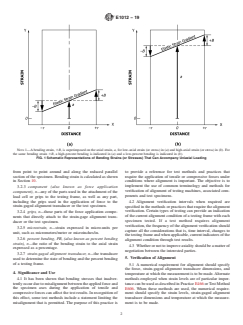
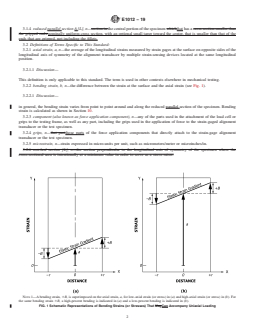
3.2.2 bending strain, b, n—the difference between the strain
contact ASTM Customer Service at service@astm.org. For Annual Book of ASTM
at the surface and the axial strain (see Fig. 1).
Standards volume information, refer to the standard’s Document Summary page on
the ASTM website. 3.2.2.1 Discussion—in general, the bending strain varies
*A Summary of Changes section appears at the end of this standard
Copyright © ASTM International, 100 Barr Harbor Drive, PO Box C700, West Conshohocken, PA 19428-2959. United States
E1012−19
NOTE 1—Abending strain, 6B, is superimposed on the axial strain, a, for low-axial strain (or stress) in (a) and high-axial strain (or stress) in (b). For
the same bending strain 6B, a high-percent bending is indicated in (a) and a low-percent bending is indicated in (b).
FIG. 1Schematic Representations of Bending Strains (or Stresses) That Can Accompany Uniaxial Loading
from point to point around and along the reduced parallel to provide a reference for test methods and practices that
section of the specimen. Bending strain is calculated as shown require the application of tensile or compressive forces under
in Section 10. conditions where alignment is important. The objective is to
implement the use of common terminology and methods for
3.2.3 component (also known as force application
verification of alignment of testing machines, associated com-
component), n—any of the parts used in the attachment of the
ponents and test specimens.
load cell or grips to the testing frame, as well as any part,
including the grips used in the application of force to the
4.2 Alignment verification intervals when required are
strain-gaged alignment transducer or the test specimen.
specified in the methods or practices that require the alignment
verification. Certain types of testing can provide an indication
3.2.4 grips, n—those parts of the force application compo-
of the current alignment condition of a testing frame with each
nents that directly attach to the strain-gage alignment trans-
specimen tested. If a test method requires alignment
ducer or the test specimen.
verification, the frequency of the alignment verification should
3.2.5 microstrain, n—strain expressed in micro-units per
capture all the considerations that is, time interval, changes to
unit, such as micrometers/meter or microinches/in.
thetestingframeandwhenapplicable,currentindicatorsofthe
3.2.6 percent bending, PB, (also known as percent bending
alignment condition through test results.
strain), n—the ratio of the bending strain to the axial strain
4.3 Whetherornottoimproveaxialityshouldbeamatterof
expressed as a percentage.
negotiation between the interested parties.
3.2.7 strain-gaged alignment transducer, n—the transducer
5. Verification of Alignment
used to determine the state of bending and the percent bending
of a testing frame.
5.1 A numerical requirement for alignment should specify
the force, strain-gaged alignment transducer dimensions, and
4. Significance and Use
temperature at which the measurement is to be made.Alternate
4.1 It has been shown that bending stresses that inadver- methods employed when strain levels are of particular impor-
tentlyoccurduetomisalignmentbetweentheappliedforceand tancecanbeusedasdescribedinPracticeE466orTestMethod
the specimen axes during the application of tensile and E606. When these methods are used, the numerical require-
compressive forces can affect the test results. In recognition of ment should specify the strain levels, strain-gaged alignment
this effect, some test methods include a statement limiting the transducer dimensions and temperature at which the measure-
misalignment that is permitted. The purpose of this practice is ment is to be made.
E1012−19
5.2 For a verification of alignment to be reported in com- allowforinterchangeabilityofwedgeinsertswithoutadversely
pliance with the current revision of E1012 a strain-gaged affectingthealignmentoftheloadingtrain.Fortestingsystems
alignment transducer shall be used. using these gripping configurations the grip wedge inserts can
be replaced with smooth wedge inserts to verify the alignment
5.2.1 When performing an alignment of a testing machine
of the testing machine during the alignment verification.
for the first time or if normally fixed components have been
adjusted or repaired, a mechanical alignment of the testing
machine should be performed. For tensile and fatigue 6. Apparatus
equipment, this step can be accomplished by means of a dial
6.1 This practice requires the use of a strain-gaged align-
indicator for concentricity alignment adjustment and with
ment transducer. In some cases it can be helpful to make an
precision shims or feeler gauges with the components brought
assessment using extensometers or alignment components
together for angularity alignment adjustment. For creep and
employing mechanical linkages (see Appendix X2), however
stress-rupture machines incorporating lever arms, this step can
these types of strain sensors do not meet the reporting
be accomplished by means of precision shims or feeler gauges,
requirements in Section 11.
and/or double knife-edge couplings, and/or suitable compo-
6.2 In general, repeated force applications to strain levels
nentsbelowthelowercrossheadofthetestingmachine.Severe
approaching yielding are not good laboratory practice because
damagecanoccurtoastrain-gagedalignmenttransducerifthis
theycanaffectthesubsequentlymeasuredresultsbydeforming
step is omitted. A mechanical alignment is a preliminary step
or fatiguing the strain-gaged alignment transducer.
but is not a substitute for a verification of alignment using a
strain-gaged alignment transducer.
6.3 Additional Testing Machine and Force Application
5.3 Strain-gaged alignment transducers shall be manufac- Component Considerations:
tured per Section 7 of this practice as closely as possible. The
6.3.1 Poorly made components and multiple interfaces in a
same strain-gaged alignment transducer can be used for suc-
loadtraincancausemajordifficultyinattemptingtoalignatest
cessive verifications. The materials and design should be such
system. All components in the load train should be machined
that only elastic strains occur at the applied forces.
within precision machining practices with attention paid to
perpendicularity, concentricity, flatness and surface finish. The
5.4 Testing Machine Alignment—Some parts of the testing
number of components should be kept to a minimum.
machine (that is, the crosshead, actuator or grip faces) can be
6.3.2 Situations can arise where acceptable alignment can-
moved or exchanged in normal day to day testing. Alignment
not be achieved for a given testing machine, set of force
verification should be conducted for the various changes to the
applicationcomponentsandstrain-gagedalignmenttransducer.
system (that is, adjusting the crosshead and actuator position)
In these cases, redesign and fabrication of any of the compo-
to demonstrate reproducibility between changing conditions.
nents could be needed to achieve acceptable alignment.
Whenever possible the alignment verification should be con-
ducted with the testing system components at a physical
7. Strain-Gaged Alignment Transducer
position that would simulate the position in which a test
specimen would be installed. The strain-gaged alignment
7.1 This practice refers to cylindrical strain-gaged align-
transducer geometry and material shall be adequately refer-
ment transducers, thick rectangular strain-gaged alignment
enced in the verification report.
transducers, and thin rectangular strain-gaged alignment trans-
ducers.The actual strain-gaged alignment transducer geometry
NOTE1—Forcreepandstressrupturemachines,theleverarmshouldbe
is dictated by the test standard to be used. These strain-gaged
in a level position when performing alignment verification.
alignment transducers are usually dog-bone shaped with a
5.4.1 For some material testing, it is not possible or feasible
reduced gauge section, although other strain-gaged alignment
to use all parts of the force application components when
transducers such as those used for compression testing may be
verifying alignment. In such cases alternative components can
used.
be used.The use of alternative components shall be adequately
NOTE 2—Since fabricating a strain-gaged alignment transducer can be
referenced in the verification report.
atimeconsumingandexpensiveprocessitisbesttohavethisstepplanned
5.4.2 For servo-hydraulic fatigue machines, it may be nec-
out well in advance of needing the strain-gaged alignment transducer.
essary to move the actuator or crosshead to install the strain-
7.2 For notched specimens, a strain-gaged alignment trans-
gaged alignment transducer and/or test specimens. This should
ducer that simulates the anticipated test specimen without the
be avoided if possible, especially the crosshead, but if it is
notch, may be used.
necessary, care should be taken to reposition the actuator and
or crosshead in the position used during the alignment. When
7.3 Quality of machining of strain-gaged alignment trans-
performing any alignment, as many of the adjustable compo-
ducers is critical. Important features include straightness,
nentsofthetestingmachineaspossibleshouldbepositionedin
concentricity, flatness, and surface finish. In particular, strain-
the final verified position. This could include adjustable reac-
gaged alignment transducers used for compression testing can
tion components (that is, crosshead) and actuators, which can
be of the type that uses two parallel plates to apply compres-
otherwise be free to rotate about the loading axis.
sion to the ends of the strain-gaged alignment transducer. In
5.4.3 Precision machined grip housings with hydraulic or these cases, the parallelism of the strain-gaged alignment
pneumatically actuated wedge inserts are commonly used in transducer ends is extremely important as described in Test
laboratory testing. These devices are specifically designed to Methods E9.
E1012−19
7.4 The design of a strain-gaged alignment transducer 7.6.1 Surface preparation for strain gage bonding can influ-
should follow the same guidelines as design of standard test ence mechanical properties. The strain-gaged alignment trans-
specimens. For static (tensile, compressive, and creep) testing, ducer should not be expected to exhibit the same mechanical
ensure the strain-gaged alignment transducer conforms to test properties as a standard test specimen would.
specimens in the appropriate test method. For fatigue testing
7.7 Configuration of Strain-Gaged Alignment Transducers:
applications,strain-gagedalignmenttransducersconformingto
7.7.1 The cross section of a strain-gaged alignment trans-
test specimens shown in Test Method E606 are appropriate.
ducer can be cylindrical, thick rectangular (those with width to
The strain-gaged alignment transducer should be similar to the
thickness ratio of less than three) or thin rectangular (those
expected test specimens so that the same force application
with width to thickness ratio of three or larger). Strain-gaged
components to be used during testing can be used during
alignment transducers should have a minimum of two sets of
alignment. During the manufacturing of the strain-gaged align-
four gages, but in some cases can have two sets of three gages.
ment transducer, it should be carefully inspected and the
A third set of strain gages can be added to provide additional
dimensions recorded prior to application of the strain gages.
information.Asingle set of gages is acceptable in some cases.
NOTE 3—It is common laboratory practice to employ an alternate
Fig.2showstheconfigurationsofthesestrain-gagedalignment
material for the strain-gaged alignment transducer in order to be able to
use the strain-gaged alignment transducer for a number of repeated
transducers.
alignmentverifications.Thealternatematerialusedshouldbesuchthatthe
strain-gaged alignment transducer maintains its elastic properties through
NOTE4—Externalspecificationsandrequirementscoulddictatespecific
the loading range of interest encountered in the alignment verification configuration for number of gages and gage spacings.
(that is, the strain-gaged alignment transducer remains below its propor-
NOTE 5—Generally the maximum bending will occur at either end of a
tionallimit).Acommonupperstrainlimitforthesestrain-gagedalignment
specimen’s reduced parallel section rather than at the center of the
transducers is 3000 microstrain maximum.
specimen. However, having three sets of gages can be helpful in
identifying a faulty gage or instrumentation, and can better characterize
7.5 Strain gages should be selected that have known stan-
the bending condition.
dardized performance characteristics as described in Test
Methods E251. Strain gage manufacturers provide detailed 7.7.2 Requirements for Cylindrical Strain-Gaged Alignment
information about the strain gages available. Strain gages with Transducers:
gauge lengths of approximately 10 % of the reduced parallel
7.7.2.1 Forstrain-gagedalignmenttransducerswithreduced
section of the alignment transducer or less should be selected.
parallel section length 12 mm (0.5 in.) or greater two sets of
The gages should be as small as practical to avoid any strain
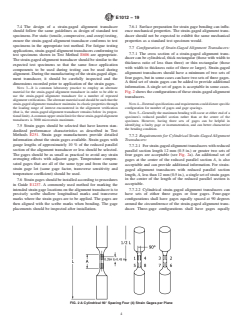
four gages are acceptable (see Fig. 2a). An additional set of
averaging effects with adjacent gages. Temperature compen-
gages at the center of the reduced parallel section A, is also
sated gages that are all of the same type and from the same
acceptable and can provide additional information. For strain-
strain gage lot (same gage factor, transverse sensitivity and
gaged alignment transducers with reduced parallel section
temperature coefficient) should be used.
length, A, less than 12 mm (0.5 in.), a single set of strain gages
in the center of the length of the reduced parallel section is
7.6 Strain gages should be installed according to procedures
acceptable.
in Guide E1237. A commonly used method for marking the
intended strain gage locations on the alignment transducer is to 7.7.2.2 Cylindrical strain-gaged alignment transducers can
precisely scribe shallow longitudinal marks and transverse have sets of either three gages or four gages. Four-gage
marks where the strain gages are to be applied. The gages are configurations shall have gages equally spaced at 90 degrees
then aligned with the scribe marks when bonding. The gage around the circumference of the strain-gaged alignment trans-
placements should be inspected after installation. ducer. Three-gage configurations shall have gages equally
FIG. 2A Cylindrical 90° Spacing Four (4) Strain Gages per Plane
E1012−19
FIG. 2B Thick Rectangular Four (4) Strain Gages per Plane (continued)
FIG. 2C Thin Rectangular Four (4) Gages per Plane (continued)
spaced at 120 degrees around the circumference of the strain- 7.7.3 Requirements for Thick Rectangular Strain-Gaged
gaged alignment transducer. Alignment Transducers:
7.7.3.1 Forstrain-gagedalignmenttransducerswithreduced
NOTE 6—With three-gage, 120 degree spaced configurations it can be
more difficult to detect a malfunctioning gage. parallel section length 12 mm (0.5 in) or greater two sets of
four gages are acceptable(see Fig. 2B). An additional set of
7.7.2.3 In a two set strain-gaged alignment transducer, the
gages at the center of the reduced parallel section A, is also
center of the gages shall be placed equidistant from longitudi-
acceptable and can provide additional information. For strain-
nal center of the reduced parallel section at a distance A =
gaged alignment transducers with a reduced parallel section
0.35A to 0.45A. In a three gage set strain-gaged reduced
length, A, less than 12 mm (0.5 in), a single set of strain gages
parallel section one set of gages shall be placed at the
in the center of the length of the reduced parallel section is
longitudinal center of the reduced parallel section and the
acceptable.Thick rectangular strain-gaged alignment transduc-
center of the other two shall be placed at a distance A = 0.35A
ers shall have gages equally positioned on all four faces of the
to 0.45A from the longitudinal center of the reduced parallel
section. strain-gaged alignment transducer.
E1012−19
FIG. 2D Thin Rectangular 3 Strain Gages per Plane (used in composites testing) (continued)
7.7.3.2 In a two gage set strain-gaged alignment transducer, gage set strain-gaged alignment transducer one set of gages
the center of the gages shall be placed equidistant from shall be placed at the longitudinal center of the of the reduced
longitudinal center of the reduced parallel section at a distance parallel section and the center of the other two shall be placed
A = 0.35A to 0.45A. In a three gage set strain-gaged of the at a distance A = 0.35A to 0.45A from the longitudinal center
3 3
reduced parallel section, one set of gages shall be placed at the of the of the reduced parallel section. In a one gage set
longitudinal center of the reduced parallel section and the strain-gaged alignment transducer, the gages shall be placed on
center of the other two shall be placed at a distance A = 0.35A the longitudinal center of the of the reduced parallel section.
to 0.45A from the longitudinal center of the reduced parallel
NOTE 8— It is recommended that the distance d that the center of the
section. In a one gage set strain-gaged alignment transducer,
gages are placed from the edge of the specimen be minimized to improve
the gages shall be placed on the longitudinal center of the
the accuracy of determining the bending strains. A typical value for d is
w/8.
strain-gaged alignment transducer.
NOTE 9—An opposing pair of shear vector oriented strain gages, as
NOTE 7—For thick rectangular strain-gaged alignment transducers, the
shown in Fig. 2C, are helpful in determining the zero rotational position
differences in adjacent dimensions of the gage section can lead to
of an actuator during alignment verification. Constraining the rotation of
differences in the sensitivities of gages on these surfaces. This in turn can
the actuator can help minimize shear strains when testing thin rectangular
lead to difficulties in making adjustments to bring a test setup into good
test specimens.
alignment.
7.7.4 Requirements for Thin Rectangular Strain-Gaged
8. Calibration and Standardization
Alignment Transducers:
8.1 Allconditioningelectronicsanddataacquisitiondevices
7.7.4.1 Forstrain-gagedalignmenttransducerswithreduced
used for the determination of testing system alignment shall be
parallel section length 12 mm (0.5 in.) or greater, two sets of
calibrated. Metrology laboratory measurement standards, cali-
either three or four gages (see Figs Fig. 2C and Fig. 2D) are
bration processes, and measurement results of these devices
acceptable. An additional set of gages at the center of the
shall be metrologically traceable to the International System of
reduced parallel section A, is also acceptable and can provide
Units (SI). Overall system expected performance shall be no
additional information. For strain-gaged alignment transducers
more than ⁄3 rd the expected Class Accuracy from Table 1.
with reduced parallel section length, A, less than 12 mm (0.5
NOTE 10—Where the 100 microstrain fixed limit criteria is invoked, the
in.),asinglesetofstraingagesinthecenterofthelengthofthe
system would have to measure strain to at least 6 33 microstrain.
reduced parallel section is acceptable.
7.7.4.2 As shown in Fig. 2C and Fig. 2D, the strain gages 8.1.1 Metrologically traceable calibration of strain-gaged
shall be placed symmetrically about the vertical and horizontal alignment transducers is not required by this practice.
centerlines of the reduced parallel section. In a two gage set However, great care should be taken in the manufacture of
strain-gage alignment transducer the center of the gages shall strain-gagealignmenttransducersusedforthedeterminationof
be placed equidistant from longitudinal center of the reduced alignment. With the exception of cases where the strain-gaged
parallel section at a distance A = 0.35A to 0.45A. In a three alignment transducer is bent, the sources of measurement error
E1012−19
due to individual gage misalignment and differences in gage 9.2.1 Inspect all components for proper mating of bearing
sensitivity can be minimized by acquiring rotational and surfaces and with the strain-gaged alignment transducer. This
repeatability data runs.
includes but is not limited to concentricity, perpendicularity
and parallelism measurements. Other measurements may be
8.2 Strain gages should conform to the requirements of Test
needed for specific types of grips. Repair or replace out of
Methods E251.
tolerance components.
9. Procedure
9.2.2 Assemble the rigid portion of the components, and
inspect the position of the components on one end of the
9.1 Temperature variations during the verification test
specimen attachment point with respect to the position of the
shouldbewithinthelimitsspecifiedinthemethodsorpractices
components on the other end of the opposite specimen attach-
which require the alignment verification.
ment point. This is often done with a dial indicator setup that
9.2 Initial Mechanical Alignment Assesment—This optional
allows the user to establish both linear (concentric or parallel)
section describes the initial alignment of the rigid parts of the
and angular differences between the centerlines of the compo-
components. Mechanical alignment is usually established
nents on each end of the specimen attachment points. Fig. 3
when setting up a particular type of rigid component configu-
illustrates linear (concentric and parallel) and angular differ-
ration on a testing machine. While it often does not change
ences between the components on the two ends of the rigid
appreciably over time, shock from catastrophic failure in the
portion of the testing machine. Special alignment components
loadtrain(withinthecomponentsortestspecimen)orwearcan
canalsobeemployed.Specifictolerancesarebeyondthescope
cause the test machine to be misaligned, it could be necessary
of this standard, but should adequate alignment be
to measure and readjust the testing machine alignment. Before
unachievable, misalignment of these components could be the
continuing with subsequent strain gage alignment verification,
a mechanical alignment check is recommended to reduce the reason. Testing machines that allow the user to adjust the
possibility of damaging the strain-gaged alignment transducer. positionofthenormallyfixedcrossheadshouldbesetupinthe
FIG. 3Illustration of Testing Machine
(A) Properly Aligned Test Frame and Rigid Fixturing
(B) With Concentric Misalignment between Top and Bottom Fixturing
(C)Angular Misalignment between Top and Bottom Fixturing
E1012−19
position that will be used during testing. Movement of the strain-gaged alignment transducer is suspected of imparting a
normally fixed crosshead during testing can affect alignment large bending effect within the alignment verification, use the
results. If moving the normally fixed crosshead during routine procedure in Annex A1 to determine the alignment transducer
testing (that is, between specimens) is needed, the inspection correction. However, the determination and use of an align-
shouldbeperformedseveraltimestoassurethatmovementcan ment transducer correction is optional.
be made and the crosshead repositioned to the same location
NOTE 12—A useful operational check for detecting faulty strain gages
without appreciably affecting alignment.
or instrumentation is to compare the average axial strain, a, for each set of
9.2.3 Adjust the position of the components on one end of
strain gages at each applied force. If any two of these averages differ by
the specimen attachment point with respect to the position of more than about two percent, a fault in the measurement system should be
suspected.
the components on the other end of the opposite specimen
attachment point to minimize the perpendicularity and the
9.3.9 Plan the force application cycle such that the maxi-
concentricity (cylindrical specimens) and parallelism (flat
mum force applied does not exceed the elastic limit of the
specimens) errors. This could require loosening the compo-
alignment transducer. The actual force level in these cases
nents of one end, tapping or shimming it into position and
should be agreed upon with the customer and documented.
retightening it.
This can be a tensile force, a compressive force, or both. The
force can be applied either manually or automatically. While
9.3 Alignments require the use of a strain-gaged alignment
several force application cycles can be helpful for system
transducer as discussed in Section 7.
checks, only a single cycle is required for recording alignment
9.3.1 The final alignment verification step for testing ma-
data.
chineswherethecomponentsarenotlockedinplacefortesting
the alignment refers to the positioning and subsequent align-
NOTE 13—Additional force cycles can help exercise the strain-gaged
ment with the strain-gaged alignment transducer and all the
alignment transducer and load train and establish hysteresis if using both
tension and compression. Strain readings from the initial cycle should be
non-rigid components in the load train.
carefully observed to prevent potential damage to the strain-gaged
9.3.2 The final alignment step for testing machines where
alignment transducer in the case of a poorly aligned testing machine.
the components are locked in place for testing alignment refers
9.3.10 Collect alignment data by applying the force in at
to the positioning and subsequent alignment with the strain-
least three discrete points through the loading range of interest
gaged alignment transducer and all the rigid components in the
These should be evenly spaced through the force cycle. During
load train and includes a step where non-rigid components
collection of the discrete data points, the force on the strain-
become rigid through a locking process.
gaged alignment transducer shall not vary by more than 1%.
9.3.3 Inspect any components not already inspected as in
For alignment verifications where both tension and compres-
9.2.1 (the non-rigid parts of the assembly). Establish the
sion are to be used, record data in a similar manner for both.
position of the strain-gaged alignment transducer for compo-
When using mechanical or hydraulic grips that lock the
nent setups with non-rigid members by assembling the in-
strain-gaged alignment transducer in place, record the strain at
spected parts of the load train. Connections, including the
zero applied force before and after the locking mechanisms
strain-gaged alignment transducer should fit smoothly together
have been engaged. This shows the influence of the locking
with no extra play. Repair or replace specific components if
mechanism on the bending of the strain-gaged alignment
necessary.
transducer.
9.3.4 Mark the position of any portion of the force applica-
9.3.11 There are three recommended practices for establish-
tion components that will be moved (that is, unthreaded or
ing the three (or more) discrete points at which alignment
otherwise repositioned) during the course of normal testing
verification data is collected:
relative to the fixed portion of the components. This is to
ensure that the components can be put together the same way 9.3.11.1 Recorddatapointsat1000,2000and3000nominal
each time. microstrain in addition to the check at zero applied force.
9.3.5 Install the strain-gaged alignment transducer into the
9.3.11.2 Record data at 10 %, 20 % and 40 % of the force
assembly with only one end attached to the set of grips. Zero transducer range or testing machine capacity in addition to the
the strain readings with no force applied. The act of gripping a
check at zero applied force.
strain-gaged alignment transducer on both ends can introduce
9.3.11.3 Record data points within a force range established
excessive bending.
by the expected yield strengths of materials to be tested on the
9.3.6 Attach the strain-gaged alignment transducer to the
testing machine in addition to the check at zero applied force.
remaining grip. The strain-gaged alignment transducer shall
9.3.12 For some types of testing systems, it can be advan-
not be re-zeroed with both grips attached.
tageous to have one test force less than the weight of the
crosshead that is “lifted” by the specimen and one test force
NOTE 11—This is typically the step that includes a load train and
that exceeds the weight of that crosshead. This can identify
specimen locking process.
faulty or out of adjustment backlash elimination systems.
9.3.7 Apply a small force to make sure all sensors are
9.3.13 It is recommended that at least one bending verifi-
reading properly and then remove the force.
cation point should be above 1000 microstrain.
9.3.8 Imperfect alignment transducer correction. All strain-
gaged alignment transducers have some imperfections, either
NOTE 14—The data point at zero applied force is intended to record the
dimensionally or in the attachment of the strain gage. If the values of the strain gages with respect to one another and refers to the
E1012−19
fixed limit in Fig. 4. There is no need to calculate percent bending at zero
A2 to separate the alignment transducer contribution and the
applied force.
testing machine alignment contribution from the overall align-
9.3.14 Remove and reposition the strain-gaged alignment
ment. However, the determination and use of a strain-gaged
transducer in the grips at additional orientations as needed. At
alignment transducer/testing machine contribution is optional.
a minimum, measure and record strains under the force cycle
9.3.16 Calculate the percent bending for the desired mea-
described in 9.3.9 in the original orientation, 180 degrees (or
surement points in the force application cycle using the
120 degrees for three gage strain-gaged alignment transducers)
formulas given in Section 10. If there are significant differ-
and again back in the original orientation, unless otherwise
ences between the verification data in the original orientation
specified in external requirements. Installing the strain-gaged
versus the 180° (120° for a three gage set) orientation, this
alignment transducer in the same orientation as it previously
condition could be due to a problem with the strain-gaged
was installed will provide information on repeatability of the
alignment transducer. If the strain-gaged alignment transducer
alignment process. Installing the strain-gaged alignment trans-
is suspected of imparting a large bending effect within the
ducer in another orientation (that is, rotating it or inverting it)
alignment verification, use the procedure outlined in AnnexA2
will further characterize the alignment of the force application
to separate the alignment transducer contribution and the
components.
testing machine alignment contribution from the overall align-
9.3.15 Strain-gaged alignment transducers always have
ment. However, the determination and use of an alignment
some eccentricity, though preparation as described in Section 7
transducer/testing machine contribution is optional.
will minimize this. Strain-gaged alignment transducers can be
9.3.17 If the calculated percent bending does not meet
damaged or bent over time and use. Careful handling and
storage will minimize this. If the strain-gaged alignment requirementsfromthetestspecification,adjustments,repairsor
transducer is suspected of imparting a large bending effect other improvements will need to be made. Refer to step 9.2 for
within the alignment verification, use the procedure in Annex guidance.
FIG. 4Graphical Representation of Alignment Classifications
E1012−19
9.3.18 Smalladjustmentscanhaveasignificanteffectonthe in 9.3.6 through 9.3.14 and perform calculations as in 9.3.16.
measurements. Adjustments are typically made at 90-degree Reassess alignment quality as in 9.3.17 and readjust again as
intervals around the strain-gaged alignment transducer. necessary.
9.3.19 Alignmenttransducersexhibitinginducedbendingin
10. Calculation and Interpretation of Results
the shape of an “S” (see Fig. 5) require adjustments to be made
to the concentricity (for cylindrical alignment transducers) or
10.1 Results of interest usually include axial strain, local
perpendicularity (for flat alignment transducers) of the force
bending strains, maximum bending strain, and percent bend-
application components.
ing. Calculate these for each plane of strain gages.
9.3.20 Alignmenttransducersexhibitinginducedbendingin
10.1.1 Local and maximum bending strains seen in an
the shape of a “C” (see Fig. 5) require adjustments to the
alignment verification could be attributed to a specimen
angularity of the force application components.
contribution, a testing machine contribution or both.
NOTE 15—Both the concentricity and angularity adjustments are often
10.2 Cylindrical Strain-Gaged Alignment Transducers:
required to achieve good alignment.
10.2.1 Three Strain Gages—For strain-gaged alignment
9.3.21 When adjustments are completed, perform force transducers of circular-cross section with planes of three strain
application cycle again as in 9.3.5, record strain information as gages equally spaced around the circumference of the gauge
FIG. 5Illustration of Strain-Gaged Alignment transducer
(A) Properly Aligned Alignment Transducer
(B) Concentric Misalignment of Alignment Transducer Creates an “S” Shape
(C) Angular Misalignment of Alignment Transducer Creates an “C” Shape
E1012−19
length, use the following equations: Calculate the axial strain, a
Calculate the axial strain, a:
~e 1e 1e 1e !
1 2 3 4
a 5 (15)
e 1e 1e 4
~ !
1 2 3
a 5 (1)
where:
where:
e and e = measuredstrainsatthecenterofthestrain-gaged
1 3
e,e , and e = measured strains at the three locations, and alignment transducer thickness on opposite
1 2 3
where e ≥ e ≥ e . faces, and
1 2 3
e and e = corresponding values for the wide faces.
2 4
Calculate the bending strains, b, as:
Calculate the bending strains b as:
b 5 e 2 a (2)
1 1
b 5 e 2 a (16)
b 5 e 2 a (3) 1 1
2 2
b 5 e 2 a (17)
b 5 e 2 a (4) 2 2
3 3
b 5 e 2 a (18)
3 3
Calculate the angular direction of maximum bending, θ,as
b 5 e 2 a (19)
measured from the highest reading strain sensor toward the
4 4
next highest reading strain sensor as:
Calculate the maximum bending strain, B, as:
2 b
b 2 b b 2 b
θ 5 tan 10.5 (5)
S D
? 1 3? ? 2 4?
FS D G
b
B 5 1 (20)
=3
2 2
Calculate percent bending, PB, as:
Calculate the maximum bending strain, B, as:
B
b
1 PB 5 3100 (21)
S D
B 5 (6) a
cos θ
10.4 Thin Rectangular Strain-Gaged Alignment
And calculate the percent bending, PB
Transducers, Four Strain Gages—For thin strain-gaged align-
B
ment transducers of rectangular cross section with strain gages
PB 5 3100 (7)
S D
a
placed as shown in Fig. 2C, use the following equations:
Calculate axial strain, a
10.2.2 Cylindrical Strain-Gaged Alignment Transducers,
Four Strain Gages—For four strain gages equally spaced
e 1e 1e 1e
~ !
1 2 3 4
a 5 (22)
around the circumference of strain-gaged alignment transduc-
ers of circular cross section, use the following equations:
where:
Calculate the axial strain a,
e,e,e , and e = measured strains at the four locations, as
1 2 3 4
e 1e 1e 1e
1 2 3 4
a 5 (8) shown in Fig. 2C.
S D
Calculatetheequivalentstrainsatthecenterofthefourfaces
where:
as:
e,e,e , and e = the measured strains at the four locations
1 2 3 4
e 1e w
~ !
1 4
and the subscript indicates the order
e 5 a 2 a 2 (23)
F GF G
e1
2 ~w 2 2d!
around the strain-gaged alignment
transducer. e 1e w
~ !
2 3
e 5 a 2 a 2 (24)
F GF G
e3
2 w 2 2d
~ !
Calculate the bending strains, b as,
~e 1e !
1 2
b 5 e 2 a (9)
1 1 e 5 (25)
e2
b 5 e 2 a (10)
2 2
e 1e
~ !
3 4
b 5 e 2 a (11) e 5 (26)
3 3 e4
b 5 e 2 a (12)
4 4
where:
Calculate maximum bending strain, B
e ,e,e , and e = the measured strains at the four loca-
1 2 3 4
1 tions as shown in Fig. 2C
2 2
B 5 =~b 2 b ! 1~b 2 b ! (13)
1 3 2 4
e and e = equivalent strains at the center of the
e1 e3
thin faces,
And calculate the percent bending, PB
e and e = equivalent strains at the center of the
e2 e4
B thick faces,
PB 5 3100 (14)
S D
w = width of the broad face, and
a
d = distance from edge of the strain-gaged
10.3 Thick Rectangular Strain-Gaged Alignment
alignment transducer to position of
Transducers, Four Strain Gages—For thick strain-gaged align-
strain sensor.
ment transducers of rectangular cross section with strain gages
placed as shown in Fig. 2B, use the following equations: Calculate the bending strains, b, as:
E1012−19
b 5 e 2 a (27) And calculate the percent bending, PB
1 e1
b 5 e 2 a (28)
B
2 e2
PB 5 3100 (43)
S D
a
b 5 e 2 a (29)
3 e3
10.6 Bending strain can be attributed in part to the align-
b 5 e 2 a (30)
4 e4
ment transducer and in part to the testing machine. If the
Calculate the maximum bending strain, B
calculated bending strain exceeds the limits required in Table 1
b 2 b b 2 b
? ? ? ?
1 3 2 4
B 5 1 (31)
2 2
TABLE 1 Classifications of Alignment Verification
And calculate the percent bending, PB
Maximum Bending Strain (B) not to exceed the greater
of
B
ASTM
the Fixed Limit or Relative Limit
PB 5 3100 (32)
S D
a
E1012
Relative Limit
Fixed
Classification
Limit
10.5 Thin Rectangular Strain-Gaged Alignment
Percent
(microstrain)
(microstrain)
Bending (PB)
Transducers, Three Strain Gages—For thin strain-gaged align-
5 100 (a) × 0.05 5%
ment transducers of rectangular cross section with three strain
8 100 (a) × 0.08 8%
gages placed as shown in Fig. 2D, use the following equations:
10 100 (a) × 0.10 10%
Calculate the axial strain a
Maximum Bending Strain (B) calculated using equation 4, 8 or 11.
Axial Strain (a) calculated using equation 1, 6, 10 or 13.
@e 1 e 1 ~2 3 e !#
1 2 3 Percent Bending (PB) calculated using equation 5, 9 or 12.
a 5 (33)
where:
e,e , and e = the measured strains at the three locations as
1 2 3
it could be helpful to perform these calculations in AnnexA2.
shown in Fig. 2D.
See Annex A2 for additional discussion and calculations.
Calculatetheequivalentstrainsatthecenterofthefourfaces
10.7 Using results from each plane of strain gages, classify
as:
the level of testing machine alignment according to Table 1.If
w
strain gage planes provide different classification numbers, use
e 5 a 2 a 2 e 3 (34)
H ~ ! F GJ
e1 1
w 2 2 d the classification that corresponds to the highest number (that
~ !
is,greatestamountofbendingstrain).VariousASTMandother
w
e 5 a 2 a 2 e 3 (35)
H ~ ! F GJ
testing standards can require a particular classification from
e3 2
w 2 2 d
~ !
Table 1.
e 1 e
~ !
1 2
e 5 (36)
e2 10.8 The crossover points between the fixed and the relative
limits for each classification level is shown in Table 2.
e 5 e (37)
e4 3
10.9 A graphical representation of the fixed and relative
where:
limits is shown in Fig. 4.
e,e , and e = the measured strains at the three locations as
1 2 3
shown in Fig. 2D,
11. Report and Record
e and e = equivalent strains at the center of the thin
e1 e3
11.1 Reports shall include the following information:
faces,
11.1.1 Model and serial numbers for the load cell, grips,
e = equivalent strain at the center of the broad
e2
alignment fixture, and test frame.
face with two strain gages on it,
11.1.2 E1012 alignment classifications and values of bend-
e = equivalent strain at the center of the broad
e4
ing strain, associated percent bending where applicable, and
face with one strain gage on it,
thecorrespondingforces(orstrains)forthetestingmachine(or
w = width of the broad face, and
for each plane of strain gages).
d = distance from edge of the strain-gaged
11.1.3 Reference to specific strain-gaged alignment trans-
alignment transducer to position of strain
ducer used.
gage.
11.1.4 Description or photograph of force application
Calculate the bending strains, b, as:
components, referencing method of grip
...
This document is not an ASTM standard and is intended only to provide the user of an ASTM standard an indication of what changes have been made to the previous version. Because
it may not be technically possible to adequately depict all changes accurately, ASTM recommends that users consult prior editions as appropriate. In all cases only the current version
of the standard as published by ASTM is to be considered the official document.
´1
Designation: E1012 − 14 E1012 − 19
Standard Practice for
Verification of Testing Frame and Specimen Alignment
Under Tensile and Compressive Axial Force Application
This standard is issued under the fixed designation E1012; the number immediately following the designation indicates the year of
original adoption or, in the case of revision, the year of last revision. A number in parentheses indicates the year of last reapproval. A
superscript epsilon (´) indicates an editorial change since the last revision or reapproval.
ε NOTE—10.5.2 was editorially corrected in May 2018.
This standard has been approved for use by agencies of the U.S. Department of Defense.
1. Scope*
1.1 Included in this practice are methods covering the determination of the amount of bending that occurs during the application
of tensile and compressive forces to notched and unnotched test specimens during routine testing in the elastic range. These
methods are particularly applicable to the force levels normally used for tension testing, compression testing, creep testing, and
uniaxial fatigue testing. The principal objective of this practice is to assess the amount of bending exerted upon a test specimen
by the ordinary components assembled into a materials testing machine, during routine tests.
1.2 This practice is valid for metallic and nonmetallic testing.
1.3 This international standard was developed in accordance with internationally recognized principles on standardization
established in the Decision on Principles for the Development of International Standards, Guides and Recommendations issued
by the World Trade Organization Technical Barriers to Trade (TBT) Committee.
2. Referenced Documents
2.1 ASTM Standards:
E6 Terminology Relating to Methods of Mechanical Testing
E8E8/E8M Test Methods for Tension Testing of Metallic Materials [Metric] E0008_E0008M
E9 Test Methods of Compression Testing of Metallic Materials at Room Temperature
E21 Test Methods for Elevated Temperature Tension Tests of Metallic Materials
E83 Practice for Verification and Classification of Extensometer Systems
E251 Test Methods for Performance Characteristics of Metallic Bonded Resistance Strain Gages
E466 Practice for Conducting Force Controlled Constant Amplitude Axial Fatigue Tests of Metallic Materials
E606 Test Method for Strain-Controlled Fatigue Testing
E1237 Guide for Installing Bonded Resistance Strain Gages
2.2 Other Documents:
VAMAS Guide 42 A Procedure for the Measurement of Machine Alignment in Axial Testing
3. Terminology
3.1 Definitions of Terms Common to Mechanical Testing:
3.1.1 For definitions of terms used in this practice that are common to mechanical testing of materials, see Terminology E6.
3.1.2 alignment, n—the condition of a testing machine that influences the introduction of bending moments into a specimen (or
alignment transducer) during the application of tensile or compressive forces.
3.1.3 eccentricity [L], n—the distance between the line of action of the applied force and the axis of symmetry of the specimen
in a plane perpendicular to the longitudinal axis of the specimen.
This practice is under the jurisdiction of ASTM Committee E28 on Mechanical Testing and is the direct responsibility of Subcommittee E28.01 on Calibration of
Mechanical Testing Machines and Apparatus.
Current edition approved July 1, 2014Dec. 15, 2019. Published August 2014March 2020. Originally approved in 1989. Last previous edition approved in 20122014 as
ε1
E1012 – 12E1012 – 14 . DOI: 10.1520/E1012-14E01.10.1520/E1012-19.
For referenced ASTM standards, visit the ASTM website, www.astm.org, or contact ASTM Customer Service at service@astm.org. For Annual Book of ASTM Standards
volume information, refer to the standard’s Document Summary page on the ASTM website.
*A Summary of Changes section appears at the end of this standard
Copyright © ASTM International, 100 Barr Harbor Drive, PO Box C700, West Conshohocken, PA 19428-2959. United States
E1012 − 19
3.1.4 reduced parallel section A [L], n—section in the central portion of the specimen whichthat has a cross section smaller than
the gripped ends.nominally uniform cross section, with an optional small taper toward the center, that is smaller than that of the
ends that are gripped, not including the fillets.
3.2 Definitions of Terms Specific to This Standard:
3.2.1 axial strain, a, n—the average of the longitudinal strains measured by strain gages at the surface on opposite sides of the
longitudinal axis of symmetry of the alignment transducer by multiple strain-sensing devices located at the same longitudinal
position.
3.2.1.1 Discussion—
This definition is only applicable to this standard. The term is used in other contexts elsewhere in mechanical testing.
3.2.2 bending strain, b, n—the difference between the strain at the surface and the axial strain (see Fig. 1).
3.2.2.1 Discussion—
in general, the bending strain varies from point to point around and along the reduced parallel section of the specimen. Bending
strain is calculated as shown in Section 10.
3.2.3 component (also known as force application component), n—any of the parts used in the attachment of the load cell or
grips to the testing frame, as well as any part, including the grips used in the application of force to the strain-gaged alignment
transducer or the test specimen.
3.2.4 grips, n—that partthose parts of the force application components that directly attach to the strain-gage alignment
transducer or the test specimen.
3.2.5 microstrain, n—strain expressed in micro-units per unit, such as micrometers/meter or microinches/in.
3.2.6 notched section [L], n—the section perpendicular to the longitudinal axis of symmetry of the specimen where the
cross-sectional area is intentionally at a minimum value in order to serve as a stress raiser.
NOTE 1—A bending strain, 6B, is superimposed on the axial strain, a, for low-axial strain (or stress) in (a) and high-axial strain (or stress) in (b). For
the same bending strain 6B, a high-percent bending is indicated in (a) and a low-percent bending is indicated in (b).
FIG. 1 Schematic Representations of Bending Strains (or Stresses) That MayCan Accompany Uniaxial Loading
E1012 − 19
3.2.6 percent bending, PB, (also known as percent bending strain), n—the ratio of the bending strain to the axial strain expressed
as a percentage.
3.2.7 strain-gaged alignment transducer, n—the transducer used to determine the state of bending and the percent bending of
a testing frame.
3.2.9 Type 1 alignment, n—the condition of a testing machine typically used for static or quasi-static testing including the
non-rigid components and the positioning of the specimen within the grips which can introduce bending moments into the
strain-gaged alignment transducer or test specimen during force application.
3.2.10 Type 2 alignment, n—the condition of a testing machine typically used for dynamic testing and all rigid parts of the load
train which can introduce bending moments into the strain-gaged alignment transducer or test specimen force application.
4. Significance and Use
4.1 It has been shown that bending stresses that inadvertently occur due to misalignment between the applied force and the
specimen axes during the application of tensile and compressive forces can affect the test results. In recognition of this effect, some
test methods include a statement limiting the misalignment that is permitted. The purpose of this practice is to provide a reference
for test methods and practices that require the application of tensile or compressive forces under conditions where alignment is
important. The objective is to implement the use of common terminology and methods for verification of alignment of testing
machines, associated components and test specimens.
4.2 Alignment verification intervals when required are specified in the methods or practices that require the alignment
verification. Certain types of testing can provide an indication of the current alignment condition of a testing frame with each
specimen tested. If a test method requires alignment verification, the frequency of the alignment verification should capture all the
considerations that is, time interval, changes to the testing frame and when applicable, current indicators of the alignment condition
through test results.
4.3 Whether or not to improve axiality should be a matter of negotiation between the material producer and the user.interested
parties.
5. Verification of Alignment
5.1 A numerical requirement for alignment should specify the force, strain-gaged alignment transducer dimensions, and
temperature at which the measurement is to be made. Alternate methods employed when strain levels are of particular importance
maycan be used as described in PracticesPractice E466 or Test Method E606. When these methods are used, the numerical
requirement should specify the strain levels, strain-gaged alignment transducer dimensions and temperature at which the
measurement is to be made.
NOTE 1—For a misaligned load train, the percent bending usually decreases with increasing applied force. (See Curves A, B, and C in Fig. 2.) However,
in some severe instances, percent bending may increase with increasing applied force. (See Curve D in Fig. 2.)
5.2 For a verification of alignment to be reported in compliance with the current revision of E1012E1012 a strain-gaged
alignment transducer shall be used. This applies to both Type 1 and Type 2 levels of alignment verification.
5.2.1 This standard defines two types of classified testing machine alignment per the classification criteria. The type of
alignment shall be noted on the report.
5.2.1 When performing an alignment of a testing machine for the first time or if normally fixed components have been adjusted
or repaired, a mechanical alignment of the testing machine should be performed. For tensile and fatigue equipment, this step can
be accomplished by means of a dial indicator for concentricity alignment adjustment and with precision shims or feeler gauges
with the components brought together for angularity alignment adjustment. For creep and stress-rupture machines incorporating
lever arms, this step maycan be accomplished by means of precision shims or feeler gauges, and/or double knife-edge couplings,
and/or suitable components below the lower crosshead of the testing machine. Severe damage maycan occur to a strain-gaged
alignment transducer if this step is omitted. A Mechanical Alignmentmechanical alignment is a preliminary step,step but is not a
substitute for a verification of alignment using a strain-gaged alignment transducer.
5.3 Strain-gaged alignment transducers shall be manufactured per Section 7 of this practice as closely as possible. The same
strain-gaged alignment transducer can be used for successive verifications. The materials and design should be such that only
elastic strains occur at the applied forces.
5.4 Testing Machine Alignment Type 1—Alignment—A general alignment verification of the defined load train components. It
is understood that some Some parts of the testing machine (that is, the crosshead, actuator or grip faces) maycan be moved or
exchanged in normal day to day testing. This alignment Alignment verification should be conducted for the various changes to the
system (that is, adjusting the crosshead and actuator position) to demonstrate reproducibility between changing conditions.
Whenever possible the alignment verification should be conducted with the testing system components at a physical position that
would simulate the position in which a test specimen would be installed. The strain-gaged alignment transducer geometry and
material shall be adequately referenced in the verification report.
NOTE 2—Type 1 typically refers to static test equipment, such as tensile, stress rupture, or creep machines.
E1012 − 19
NOTE 1—For creep and stress rupture machines, the lever arm should be in a level position when performing alignment verification.
5.4.1 For some material testing, it is not possible or feasible to use all parts of the force application components when verifying
alignment. In such cases alternative components maycan be used. The use of alternative components shall be adequately referenced
in the verification report.
5.4.2 For servo-hydraulic fatigue machines, it may be necessary to move the actuator or crosshead to install the strain-gaged
alignment transducer and/or test specimens. This should be avoided if possible, especially the crosshead, but if it is necessary, care
should be taken to reposition the actuator and or crosshead in the position used during the alignment. When performing any
alignment, as many of the adjustable components of the testing machine as possible should be positioned in the final verified
position. This could include adjustable reaction components (that is, crosshead) and actuators, which can otherwise be free to rotate
about the loading axis.
5.4.3 Precision machined grip housings with hydraulic or pneumatically actuated wedge inserts are commonly used in
laboratory testing. These devices are specifically designed to allow for interchangeability of wedge inserts without adversely
affecting the alignment of the loading train. For testing systems using these gripping configurations the grip wedge inserts can be
replaced with smooth wedge inserts to verify the alignment of the testing machine during the alignment verification.
5.4 Testing Machine Alignment Type 2—Grip-to-grip alignment verification, where the testing machine mechanical configura-
tion is fixed and will not be changed or adjusted during the testing period. However, when testing some specimen geometries, it
may be necessary to move the actuator or crosshead to install the strain-gaged alignment transducer and/or test specimens. This
should be avoided if possible, but if it is necessary, care should be taken to reposition the actuator and or crosshead in the position
used during the alignment. Any removable components specific to the test specimen should be assembled within the aligned grip
set and a strain-gaged alignment transducer used for verification of compliance to E1012.
5.4.1 Precision machined grip housings with hydraulic or pneumatically actuated wedge inserts are commonly used in
laboratory testing. These devices are specifically designed to allow for interchangeability of wedge inserts without adversely
affecting the alignment of the loading train. For testing systems using these gripping configurations, grip wedge inserts may be
replaced with smooth wedge inserts to assess the alignment of the testing machine under a Type 2 alignment assessment.
NOTE 4—Type 2 typically refers to dynamic test equipment, such as fatigue testing machines.
NOTE 5—Type 2 alignment requires as many of the adjustable components of the testing machine as possible to be positioned in the final verified
position. This could include adjustable reaction components (that is, crosshead) and actuators, which may otherwise be free to rotate about the loading
axis.
5.5 Strain-gaged alignment transducers shall be manufactured per Section 7 of this standard. The strain-gaged alignment
transducer is to be manufactured per section 7.4 as closely as possible, except that any notches may be eliminated. The same
strain-gaged alignment transducer may be used for successive verifications. The materials and design should be such that only
elastic strains occur at the applied forces.
5.5.1 Strain-gaged alignment transducers shall be used for both Type 1 and Type 2 Testing Machine Alignment.
6. Apparatus
6.1 This standardpractice requires the use of a strain-gaged alignment transducer. In some cases it maycan be helpful to make
an assessment using extensometers or alignment components employing mechanical linkages (see Appendix X2), however these
types of strain sensors do not meet the reporting requirements in Section 11.
6.2 In general, repeated force applications to strain levels approaching yielding are not good laboratory practice because they
maycan affect the subsequently measured results by deforming or fatiguing the strain-gaged alignment transducer.
6.3 Additional Testing Machine and Force Application Component Considerations:
6.3.1 Poorly made components and multiple interfaces in a load train can cause major difficulty in attempting to align a test
system. All components in the load train should be machined within precision machining practices with attention paid to
perpendicularity, concentricity, flatness and surface finish. The number of components should be kept to a minimum.
6.3.2 Situations can arise where acceptable alignment cannot be achieved for a given testing machine, set of force application
components and strain-gaged alignment transducer. In these cases, redesign and fabrication of any of the components maycould
be needed to achieve acceptable alignment.
7. Strain-Gaged Alignment Transducer
7.1 This practice refers to cylindrical strain-gaged alignment transducers, thick rectangular strain-gaged alignment transducers,
and thin rectangular strain-gaged alignment transducers. The actual strain-gaged alignment transducer geometry is dictated by the
test standard to be used. These strain-gaged alignment transducers are usually dog-bone shaped with a reduced gauge section,
although other strain-gaged alignment transducers such as those used for compression testing are acceptable.may be used.
NOTE 2—Since fabricating a strain-gaged alignment transducer can be a time consuming and expensive process it is best to have this step planned out
well in advance of needing the strain-gaged alignment transducer.
NOTE 7—For notched specimens, it is acceptable to use a strain-gaged alignment transducer that simulates the anticipated test specimen without the
notch.
E1012 − 19
7.2 This practice is valid for metallic and nonmetallic testing.For notched specimens, a strain-gaged alignment transducer that
simulates the anticipated test specimen without the notch, may be used.
7.3 Quality of machining of strain-gaged alignment transducers is critical. Important features include straightness, concentricity,
flatness, and surface finish. In particular, strain-gaged alignment transducers used for compression testing maycan be of the type
that uses two parallel plates to apply compression to the ends of the strain-gaged alignment transducer. In these cases, the
parallelism of the strain-gaged alignment transducer ends is extremely important as described in Test Methods E9.
7.4 The design of a strain-gaged alignment transducer should follow the same guidelines as design of standard test specimens.
For static (tensile, compressive, and creep) testing, ensure the strain-gaged alignment transducers conformingtransducer conforms
to test specimens shown in Test Methodsthe appropriate E8 are appropriate. test method. For fatigue testing applications,
strain-gaged alignment transducers conforming to test specimens shown in Practice Test Method E606 are appropriate. The
strain-gaged alignment transducer should be as close dimensionally similar to the expected test specimens as possible so that the
same force application components to be used during testing willcan be used during alignment. The material used for the
strain-gaged alignment transducer should be as close as possible to expected test specimen materials. If the expected test material
is not known, it is acceptable to use a strain-gaged alignment transducer of a common material that has similar elastic properties
to expected test materials. The alignment transducer During the manufacturing of the strain-gaged alignment transducer, it should
be carefully inspected and the dimensions recorded prior to application of the strain gages.
NOTE 3—It is common laboratory practice to employ an alternate material for the strain-gaged alignment transducer in order to be able to use the
strain-gaged alignment transducer for a number of repeated alignment verifications. The alternate material used should be such that the strain-gaged
alignment transducer maintains its elastic properties through the loading range of interest encountered in the alignment verification (that is, the
strain-gaged alignment transducer remains below its proportional limit). A common upper strain limit for these strain-gaged alignment transducers is 3000
microstrain maximum.
7.5 Strain Gagesgages should be selected that have known standardized performance characteristics as described in Test
Methods E251. Strain gage manufacturers provide detailed information about the strain gages available. Gages Strain gages with
gauge lengths of approximately 10 % of the reduced parallel section of the alignment transducer or less should be selected. The
gages should be as small as practical to avoid any strain averaging effects with adjacent gages. Temperature compensated gages
that are all of the same type and from the same batch strain gage lot (same gage factor, transverse sensitivity and temperature
coefficient) should be used.
7.6 Strain gages should be installed according to procedures in Guide E1237. A commonly used method for marking the
intended strain gage locations on the alignment transducer is to precisely scribe shallow longitudinal marks and transverse marks
where the strain gages are to be applied. The gages are then aligned with the scribe marks when bonding. The gage placements
canshould be inspected after installation.
7.6.1 Surface preparation for strain gage bonding can influence mechanical properties. The strain-gaged alignment transducer
should not be expected to exhibit the same mechanical properties as a standard test specimen would.
7.7 Configuration of Strain-Gaged Alignment Transducers:
NOTE 9—External specifications and requirements may dictate specific configuration for number of gages and gage spacings.
NOTE 10—Generally the maximum bending will occur at either end of a specimen’s reduced section rather at the center of the specimen. However,
having three sets of gages can be helpful in identifying a faulty gage or instrumentation, and can better characterize the bending condition.
7.7.1 The cross section of a strain-gaged alignment transducer maycan be cylindrical, thick rectangular (those with width to
thickness ratio of less than three) or thin rectangular (those with width to thickness ratio of three or larger). Strain-gaged alignment
transducers should have a minimum of two sets of four gages, but in some cases maycan have two sets of three gages. A third set
of strain gages maycan be added to provide additional information. A single set of gages is acceptable in some cases. Fig. 32 shows
the configurations of these strain-gaged alignment transducers.
NOTE 4—External specifications and requirements could dictate specific configuration for number of gages and gage spacings.
NOTE 5—Generally the maximum bending will occur at either end of a specimen’s reduced parallel section rather than at the center of the specimen.
However, having three sets of gages can be helpful in identifying a faulty gage or instrumentation, and can better characterize the bending condition.
7.7.2 Requirements for Cylindrical Strain-Gaged Alignment Transducers:
7.7.2.1 For strain-gaged alignment transducers with reduced parallel section length 12 mm (0.5 in)in.) or greater two sets of four
gages are acceptable. acceptable (see Fig. 2a). An additional set of gages at the center of the reduced parallel section A, is also
acceptable and can provide additional information. For strain-gaged alignment transducers with reduced parallel section length, A,
less than 12 mm (0.5 in),in.), a single set of strain gages in the center of the length of the reduced parallel section is acceptable.
7.7.2.2 Cylindrical strain-gaged alignment transducers maycan have sets of either three gages or four gages. Four-gage
configurations shall have gages equally spaced at 90 degrees around the circumference of the strain-gaged alignment transducer.
Three-gage configurations shall have gages equally spaced at 120 degrees around the circumference of the strain-gaged alignment
transducer.
NOTE 6—With three-gage, 120 degree spaced configurations it can be more difficult to detect a malfunctioning gage.
E1012 − 19
FIG. 32 A Cylindrical 90° Spacing Four (4) Strain Gages per Plane
FIG. 32 B Thick Rectangular Four (4) Strain Gages per Plane (continued)
7.7.2.3 In a two set strain-gaged alignment transducer, the center of the gages shall be placed equidistant from longitudinal
center of the reduced parallel section at a distance A = 0.35A to 0.45A. In a three gage set strain-gaged alignment transducer
reduced parallel section one set of gages shall be placed at the longitudinal center of the alignment transducer reduced parallel
section and the center of the other two shall be placed at a distance A = 0.35A to 0.45A from the longitudinal center of the
alignment transducer.reduced parallel section.
7.7.3 Requirements for Thick Rectangular Strain-Gaged Alignment Transducers:
7.7.3.1 For strain-gaged alignment transducers with reduced parallel section length 12 mm (0.5 in) or greater two sets of four
gages are acceptable.acceptable(see Fig. 2B). An additional set of gages at the center of the reduced parallel section A, is also
acceptable and can provide additional information. For strain-gaged alignment transducers with a reduced parallel section length,
A, less than 12 mm (0.5 in), a single set of strain gages in the center of the length of the reduced parallel section is acceptable.
Thick rectangular strain-gaged alignment transducers shall have gages equally positioned on all four faces of the strain-gaged
alignment transducer.
7.7.3.2 In a two gage set strain-gaged alignment transducer, the center of the gages shall be placed equidistant from longitudinal
center of the reduced parallel section at a distance A = 0.35A to 0.45A. In a three gage set strain-gaged alignment transducer, of
the reduced parallel section, one set of gages shall be placed at the longitudinal center of the alignment transducer reduced parallel
section and the center of the other two shall be placed at a distance A = 0.35A to 0.45A from the longitudinal center of the
alignment transducer. reduced parallel section. In a one gage set strain-gaged alignment transducer, the gages shall be placed on
the longitudinal center of the strain-gaged alignment transducer.
E1012 − 19
FIG. 32 C Thin Rectangular Four (4) Gages per Plane (continued)
FIG. 32 D Thin Rectangular 3 Strain Gages per Plane (used in composites testing) (continued)
NOTE 7—For thick rectangular strain-gaged alignment transducers, the differences in adjacent dimensions of the gage section can lead to differences
in the sensitivities of gages on these surfaces. This in turn can lead to difficulties in making adjustments to bring a test setup into good alignment.
7.7.4 Requirements for Thin Rectangular Strain-Gaged Alignment Transducers:
7.7.4.1 For strain-gaged alignment transducers with reduced parallel section length 12 mm (0.5 in.) or greater, two sets of either
three or four gages (see Figs Fig. 32C and Fig. 32D) are acceptable. An additional set of gages at the center of the reduced parallel
section A, is also acceptable and can provide additional information. For strain-gaged alignment transducers with reduced parallel
section length, A, less than 12 mm (0.5 in.), a single set of strain gages in the center of the length of the reduced parallel section
is acceptable.
E1012 − 19
7.7.4.2 As shown in Fig. 32C and Fig. 32D, the strain gages shall be placed symmetrically about the vertical and horizontal
centerlines. centerlines of the reduced parallel section. In a two gage set strain-gage alignment transducer the center of the gages
shall be placed equidistant from longitudinal center of the reduced parallel section at a distance A = 0.35A to 0.45A. In a three
gage set strain-gaged alignment transducer one set of gages shall be placed at the longitudinal center of the alignment transducer
and of the reduced parallel section and the center of the other two shall be placed at a distance A = 0.35A to 0.45A from the
longitudinal center of the alignment transducer. of the reduced parallel section. In a one gage set strain-gaged alignment transducer,
the gages shall be placed on the longitudinal center of the strain-gaged alignment transducer.of the reduced parallel section.
NOTE 8— It is recommended that the distance d that the center of the gages are placed from the edge of the specimen be minimized to improve the
accuracy of determining the bending strains. A typical value for d is w/8.
NOTE 9—An opposing pair of shear vector oriented strain gages, as shown in Fig. 32C, are helpful in determining the zero rotational position of an
actuator during alignment verification. Constraining the rotation of the actuator may be a consideration can help minimize shear strains when testing thin
rectangular test specimens to minimize shear strains.specimens.
8. Calibration and Standardization
8.1 All conditioning electronics and data acquisition devices used for the determination of testing system alignment shall be
calibrated where applicable. The calibration results shall be calibrated. Metrology laboratory measurement standards, calibration
processes, and measurement results of these devices shall be metrologically traceable to the National Institute of Standards and
Technology (NIST) or another recognized National Metrology Institute. International System of Units (SI). Overall system
expected performance shouldshall be no more than 1/3rd ⁄3 rd the Expectedexpected Class Accuracy from Table 1.
NOTE 10—Where the 100 microstrain fixed limit criteria is invoked, the system would have to measure strain to at least 6 33 microstrain.
8.1.1 Calibration Metrologically traceable calibration of strain-gaged alignment transducers is not required by this standard.
Traceable national standards do not generally exist for such calibrations. practice. However, great care should be taken in the
manufacture of strain-gage alignment transducers used for the determination of alignment. With the exception of cases where the
strain-gaged alignment transducer is bent, the sources of measurement error due to individual gage misalignment and differences
in gage sensitivity can be minimized by acquiring rotational and repeatability data runs.
8.2 Strain gages should conform to the requirements of Test Methods E251.
9. Procedure
9.1 Temperature variations during the verification test should be within the limits specified in the methods or practices which
require the alignment verification.
9.2 Initial Mechanical Alignment—Alignment Assesment—This optional section describes the initial alignment of the rigid parts
of the components. Mechanical alignment is usually established when setting up a particular type of rigid component configuration
on a testing machine. While it often does not change appreciably over time, shock from catastrophic failure in the load train (within
the components or test specimen) or wear may establish the need to can cause the test machine to be misaligned, it could be
necessary to measure and readjust the testing machine alignment. Before continuing with subsequent Type 1 and Type 2 strain gage
alignment verification, thea mechanical alignment should be checked to ensure that it is acceptable.check is recommended to
reduce the possibility of damaging the strain-gaged alignment transducer.
9.2.1 Inspect all components for proper mating of bearing surfaces and with the strain-gaged alignment transducer. This includes
but is not limited to concentricity, perpendicularity and parallelism measurements. Other measurements may be needed for specific
types of grips. Re-machine Repair or replace out of tolerance components.
9.2.2 Assemble the rigid portion of the components, and inspect the position of the components on one end of the specimen
attachment point with respect to the position of the components on the other end of the opposite specimen attachment point. This
is often done with a dial indicator setup that allows the user to establish both linear (concentric or parallel) and angular differences
between the centerlines of the components on each end of the specimen attachment points. Fig. 43 illustrates linear (concentric
and parallel) and angular differences between the components on the two ends of the rigid portion of the testing machine. Special
alignment components maycan also be employed. Specific tolerances are beyond the scope of this standard, but should adequate
alignment be unachievable, misalignment of these components maycould be the reason. Testing machines that allow the user to
adjust the position of the normally fixed crosshead should be set up in the position that will be used during testing. Movement of
the normally fixed crosshead during testing can affect alignment results. If moving the normally fixed crosshead during routine
testing (that is, between specimens) is needed, the inspection should be performed several times to assure that movement can be
made and the crosshead repositioned to the same location without appreciably affecting alignment.
9.2.3 Adjust the position of the components on one end of the specimen attachment point with respect to the position of the
components on the other end of the opposite specimen attachment point to minimize the perpendicularity and the concentricity
(cylindrical specimens) and parallelism (flat specimens) errors. This maycould require loosening the components of one end,
tapping or shimming it into position and retightening it.
9.3 Both Type 1 and Type 2 Alignments require the use of a strain-gaged alignment transducer. The strain-gaged alignment
transducer istransducer as discussed in Section 7.
E1012 − 19
FIG. 43 Illustration of Testing Machine
(A) Properly Aligned Test Frame and Rigid Fixturing
(B) With Concentric Misalignment between Top and Bottom Fixturing
(C)Angular Misalignment between Top and Bottom Fixturing
9.3.1 Type 1 Alignment—Type 1 alignment The final alignment verification step for testing machines where the components are
not locked in place for testing the alignment refers to the positioning and subsequent alignment with the strain-gaged alignment
transducer and all the non-rigid components in the load train. This is the final alignment verification step for testing machines
where the components are not locked in place for testing.
9.3.2 Type 2 Alignment—Type 2 alignment The final alignment step for testing machines where the components are locked in
place for testing alignment refers to the positioning and subsequent alignment with the strain-gaged alignment transducer and all
the rigid components in the load train and includes a step where non rigid non-rigid components become rigid through a locking
process. This is the final alignment step for testing machines where the components are locked in place for testing.
9.3.3 Inspect any components not already inspected as in 9.2.1 (the non-rigid parts of the assembly). Establish the position of
the strain-gaged alignment transducer for component setups with non-rigid members by assembling the inspected parts of the load
train. Connections, including the strain-gaged alignment transducer should fit smoothly together with no extra play. Re-machine
specific parts Repair or replace specific components if necessary.
9.3.4 Mark the position of any portion of the force application components that will be moved (that is, unthreaded or otherwise
repositioned) during the course of normal testing relative to the fixed portion of the components. This is to assureensure that the
components can be put together the same way each time.
9.3.5 Install the strain-gaged alignment transducer into the assembly with only one end attached to the set of grips. Zero the
strain readings with no force applied. The act of gripping a strain-gaged alignment transducer on both ends can introduce excessive
bending.
9.3.6 Attach the strain-gaged alignment transducer to the remaining grip. The strain-gaged alignment transducer shall not be
re-zeroed with both grips attached.
NOTE 11—This is typically the step where Type 2 Alignment Verifications include that includes a load train and specimen locking process.
9.3.7 Apply a small force to make sure all sensors are reading properly and then remove the force.
E1012 − 19
9.3.8 Imperfect alignment transducer correction. All strain-gaged alignment transducers have some imperfections, either
dimensionally or in the attachment of the strain gage. If the strain-gaged alignment transducer is suspected of imparting a large
bending effect within the alignment verification, use the procedure in Annex A1 to determine the alignment transducer correction.
However, the determination and use of an alignment transducer correction is optional.
NOTE 12—A useful operational check for detecting faulty strain gages or instrumentation is to compare the average axial strain, a, for each set of strain
gages at each applied force. If any two of these averages differ by more than about two percent, a fault in the measurement system should be suspected.
9.3.9 Plan the force application cycle such that the maximum force applied does not exceed the elastic limit of the alignment
transducer. The actual force level in these cases should be agreed upon with the customer and documented. This maycan be a
tensile force, a compressive force, or both. The force maycan be applied either manually or automatically. While several force
application cycles maycan be helpful for system checks, only a single cycle is required for recording alignment data.
NOTE 13—Additional force cycles can help exercise the strain-gaged alignment transducer and load train and establish hysteresis if using both tension
and compression. Strain readings from the initial cycle should be carefully observed to prevent potential damage to the strain-gaged alignment transducer
in the case of a poorly aligned testing machine.
9.3.10 Collect alignment data by applying the force in at least three discrete points through the loading range of interest These
should be evenly spaced through the force cycle. During collection of the discrete data points, the force on the strain-gaged
alignment transducer shall not vary by more than 1%. For Type 2 alignment verificationverifications where both tension and
compression are to be used, record data in a similar manner for both. When using mechanical or hydraulic grips that lock the
strain-gaged alignment transducer in place, record the strain at zero applied force before and after the locking mechanisms have
been engaged. This shows the influence of the locking mechanism on the bending of the strain-gaged alignment transducer.
NOTE 19—There are three recommended practices for establishing the three (or more) discrete points at which alignment verification data is collected:
(1) record data points at 1000, 2000 and 3000 nominal microstrain in addition to the check at zero applied force (typically used for Type 2 verifications);
(2) record data at 10%, 20% and 40% of the force transducer range or testing machine capacity in addition to the check at zero applied force (typically
used for Type 1 verifications);
(3) record data points within a force range established by the expected yield strengths of materials to be tested on the testing machine in addition to
the check at zero applied force (also typically used for Type 1 verifications).
(4) For some types of testing systems, it can be advantageous to have one test force less than the weight of the crosshead that is “lifted” by the specimen
and one test force that exceeds the weight of that crosshead. This can identify faulty or out-of adjustment backlash elimination systems.
(5) It is recommended that at least one bending verification point should be above 1000 microstrain.
9.3.11 There are three recommended practices for establishing the three (or more) discrete points at which alignment verification
data is collected:
9.3.11.1 Record data points at 1000, 2000 and 3000 nominal microstrain in addition to the check at zero applied force.
9.3.11.2 Record data at 10 %, 20 % and 40 % of the force transducer range or testing machine capacity in addition to the check
at zero applied force.
9.3.11.3 Record data points within a force range established by the expected yield strengths of materials to be tested on the
testing machine in addition to the check at zero applied force.
9.3.12 For some types of testing systems, it can be advantageous to have one test force less than the weight of the crosshead
that is “lifted” by the specimen and one test force that exceeds the weight of that crosshead. This can identify faulty or out of
adjustment backlash elimination systems.
9.3.13 It is recommended that at least one bending verification point should be above 1000 microstrain.
NOTE 14—The data point at zero applied force is intended to record the values of the strain gages with respect to one another and refers to the fixed
limit in Fig. 54. There is no need to calculate percent bending at zero applied force.
9.3.14 Remove and reposition the strain-gaged alignment transducer in the grips at additional orientations as needed. At a
minimum, measure and record strains under the force cycle described in 9.3.9 in the original orientation, 180 degrees (or 120
degrees for three gage strain-gaged alignment transducers) and again back in the original orientation, unless otherwise specified
in external requirements. Installing the strain-gaged alignment transducer in the same orientation as it previously was installed will
provide information on repeatability of the strain-gaged alignment transducer.process. Installing the strain-gaged alignment
transducer in another orientation (that is, rotating it or inverting it) will further characterize the alignment of the force application
components. Strain-gaged alignment transducers always have some eccentricity, though preparation as described in Section 7 will
minimize this. Strain-gaged alignment transducers can be damaged or bent over time and use. Careful handling and storage will
minimize this. If the strain-gaged alignment transducer is suspected of imparting a large bending effect within the alignment
verification, use the procedure in Annex A2 to separate the alignment transducer contribution and the testing machine alignment
contribution from the overall alignment. However, the determination and use of an alignment transducer/testing machine
contribution is optional.
9.3.15 Strain-gaged alignment transducers always have some eccentricity, though preparation as described in Section 7 will
minimize this. Strain-gaged alignment transducers can be damaged or bent over time and use. Careful handling and storage will
minimize this. If the strain-gaged alignment transducer is suspected of imparting a large bending effect within the alignment
E1012 − 19
FIG. 54 Graphical Representation of Alignment Classifications
verification, use the procedure in Annex A2 to separate the alignment transducer contribution and the testing machine alignment
contribution from the overall alignment. However, the determination and use of a strain-gaged alignment transducer/testing
machine contribution is optional.
9.3.16 Calculate the percent bending for the desired measurement points in the force application cycle using the formulas given
in Section 10. If there are significant differences between the verification data in the original orientation versus the 180° (120° for
a three gage set) orientation, this condition maycould be due to a problem with the strain-gaged alignment transducer. If the
strain-gaged alignment transducer is suspected of imparting a large bending effect within the alignment verification, use the
procedure outlined in Annex A2 to separate the alignment transducer contribution and the testing machine alignment contribution
from the overall alignment. However, the determination and use of an alignment transducer/testing mach
...