

ASTM E2255/E2255M-22
(Practice)Standard Practice for Conducting Visual Assessments for Lead Hazards in Buildings
General Information
- Abstract
SIGNIFICANCE AND USE
4.1 This practice supports lead poisoning prevention activities by providing standardized procedures for conducting visual assessments.
4.2 This practice is intended to be used with other ASTM standards, as appropriate, for conducting lead-hazard assessments.
4.3 This practice is intended for use by individuals trained to conduct visual assessments associated with lead-hazard activities and in reporting their results. This practice is also applicable for use by others interested in visual assessment of properties for lead hazards, such as building code officials, building operators, homeowners, and insurers.
SCOPE
1.1 This practice describes procedures for conducting visual assessments in buildings to visually identify the type and location of potential lead hazards. These potential hazards are associated with deteriorated leaded paint, lead in dust, or lead in soil.
1.2 This practice addresses visual assessment procedures for lead-hazard activities such as: lead risk (hazard) assessment (Guide E2115), clearance examination (Practices E2271/E2271M and E3074/E3074M), assessment of paint condition, and re-evaluation inspection. It also can be applied to visual assessments following paint maintenance or renovation or repainting activities, or combinations thereof.
1.3 Because there is considerable overlap among the requirements for lead-hazard activities, this standard first describes a generic visual assessment procedure, and then defines a specific procedure for each assessment type in terms of additions to, or deletions from, the generic procedure.
1.4 This practice does not address testing needed to confirm the presence of lead hazards.
1.5 This practice contains notes, which are explanatory and are not part of the mandatory requirements of this standard.
1.6 The values stated in either SI units or inch-pound units are to be regarded separately as standard. The values stated in each system are not necessarily exact equivalents; therefore, to ensure conformance with the standard, each system shall be used independently of the other, and values from the two systems shall not be combined.
1.7 This standard does not purport to address all of the safety concerns, if any, associated with its use. It is the responsibility of the user of this standard to establish appropriate safety, health, and environmental practices and determine the applicability of regulatory limitations prior to use.
1.8 This international standard was developed in accordance with internationally recognized principles on standardization established in the Decision on Principles for the Development of International Standards, Guides and Recommendations issued by the World Trade Organization Technical Barriers to Trade (TBT) Committee.
- Status
- Published
- Publication Date
- 28-Feb-2022
- Technical Committee
- D22 - Air Quality
- Drafting Committee
- D22.12 - Sampling and Analysis of Lead for Exposure and Risk Assessment
Buy Documents
ASTM E2255/E2255M-22 - Standard Practice for Conducting Visual Assessments for Lead Hazards in Buildings
REDLINE ASTM E2255/E2255M-22 - Standard Practice for Conducting Visual Assessments for Lead Hazards in Buildings
Overview
ASTM E2255/E2255M-22: Standard Practice for Conducting Visual Assessments for Lead Hazards in Buildings provides comprehensive procedures for identifying potential lead hazards in buildings through systematic visual inspections. Developed by ASTM International, this standard supports lead poisoning prevention efforts by guiding trained professionals and other stakeholders in visually evaluating buildings for deteriorated lead-based paint, lead in dust, and lead in soil. The standard is designed to complement other ASTM standards related to lead-hazard assessment and is applicable to a wide range of facility types, including homes, apartments, child-occupied facilities, and commercial buildings.
Key Topics
- Visual Identification of Lead Hazards:
- Systematic procedures for detecting deteriorated leaded paint, dust with visible lead contamination, and bare soil that may pose exposure risks.
- Use of data recording forms such as site plans, building face sketches, and floor plans to ensure accurate documentation of findings.
- Building Component Assessment:
- Identification and recording of conditions of exterior and interior surfaces, including paint, friction surfaces (e.g., window sills, doors), impact surfaces (e.g., baseboards), and chewable surfaces.
- Assessment includes evaluating component deterioration and likely causes.
- Surface Dust, Debris, and Soil:
- Guidelines for identifying and recording accumulations of dust, paint chips, and painted debris on surfaces and grounds.
- Focus on horizontal surfaces, entryways, and play areas most likely to be accessed by children.
- Reporting and Record Keeping:
- Requirements for preparing visual assessment reports covering project information, inspection dates, professional credentials, building descriptions, and detailed findings.
- Reference to best practices for record keeping in lead hazard activities.
- Safety, Health, and Environmental Practices:
- Guidance for establishing safe procedures compliant with health and environmental regulations.
- Emphasis on user responsibility to address safety and regulatory concerns during assessments.
Applications
The standard practice is applicable in various settings and for numerous purposes, including:
- Lead Hazard Risk Assessments: For identifying and documenting potential lead sources before occupancy, during ownership transfers, or for regulatory compliance.
- Clearance Examinations: To verify the absence of visible lead hazards after lead abatement, renovation, or maintenance activities, as part of project close-out procedures.
- Paint Condition Surveys: For ongoing maintenance programs and evaluation of painted surfaces, especially in older buildings.
- Re-evaluation Inspections: Scheduled repeat assessments to determine the effectiveness of lead hazard controls and to check for the emergence of new hazards over time.
- Property Transactions and Insurance: Visual lead assessments are often required for real estate transactions, rental compliance, and insurance underwriting.
This standard is intended for use by certified or trained professionals, building officials, property managers, homeowners, and insurers who need to understand and manage lead hazard risks in buildings.
Related Standards
- ASTM E2115: Guide for Conducting Lead Hazard Assessments of Dwellings and Child-Occupied Facilities
- ASTM E2271/E2271M: Practice for Clearance Examinations Following Lead Hazard Reduction in Multifamily Dwellings
- ASTM E3074/E3074M: Practice for Clearance Examinations Following Lead Hazard Reduction in Single Family Dwellings and Other Child-Occupied Facilities
- ASTM E2239: Practice for Record Keeping and Record Preservation for Lead Hazard Activities
- ASTM D1356 & E1605: Terminology relating to sampling, analysis, and lead in buildings
Keywords: lead hazards, visual assessment, ASTM E2255, clearance examination, building inspection, deteriorated paint, risk assessment, lead poisoning prevention, lead in dust, lead in soil
By adopting ASTM E2255/E2255M-22, organizations and individuals benefit from a consistent, industry-recognized approach to visual lead hazard assessments, helping to ensure safer indoor environments and support compliance with regulatory requirements.
Relations
- Effective Date
- 01-Apr-2024
- Effective Date
- 01-Mar-2024
- Effective Date
- 01-Sep-2020
- Effective Date
- 15-Mar-2020
- Effective Date
- 15-Dec-2018
- Effective Date
- 01-Oct-2018
- Effective Date
- 01-Sep-2018
- Effective Date
- 15-Oct-2015
- Effective Date
- 01-Jul-2015
- Effective Date
- 01-May-2015
- Effective Date
- 01-Dec-2014
- Effective Date
- 01-May-2014
- Effective Date
- 15-Jan-2014
- Effective Date
- 15-Jul-2012
- Effective Date
- 15-Jul-2012
Buy Documents
ASTM E2255/E2255M-22 - Standard Practice for Conducting Visual Assessments for Lead Hazards in Buildings
REDLINE ASTM E2255/E2255M-22 - Standard Practice for Conducting Visual Assessments for Lead Hazards in Buildings
Get Certified
Connect with accredited certification bodies for this standard

DIBt (Deutsches Institut für Bautechnik)
German Institute for Building Technology.
DIN CERTCO
DIN Group product certification.

Aboma Certification B.V.
Specialized in construction, metal, and transport sectors.
Sponsored listings
Frequently Asked Questions
ASTM E2255/E2255M-22 is a standard published by ASTM International. Its full title is "Standard Practice for Conducting Visual Assessments for Lead Hazards in Buildings". This standard covers: SIGNIFICANCE AND USE 4.1 This practice supports lead poisoning prevention activities by providing standardized procedures for conducting visual assessments. 4.2 This practice is intended to be used with other ASTM standards, as appropriate, for conducting lead-hazard assessments. 4.3 This practice is intended for use by individuals trained to conduct visual assessments associated with lead-hazard activities and in reporting their results. This practice is also applicable for use by others interested in visual assessment of properties for lead hazards, such as building code officials, building operators, homeowners, and insurers. SCOPE 1.1 This practice describes procedures for conducting visual assessments in buildings to visually identify the type and location of potential lead hazards. These potential hazards are associated with deteriorated leaded paint, lead in dust, or lead in soil. 1.2 This practice addresses visual assessment procedures for lead-hazard activities such as: lead risk (hazard) assessment (Guide E2115), clearance examination (Practices E2271/E2271M and E3074/E3074M), assessment of paint condition, and re-evaluation inspection. It also can be applied to visual assessments following paint maintenance or renovation or repainting activities, or combinations thereof. 1.3 Because there is considerable overlap among the requirements for lead-hazard activities, this standard first describes a generic visual assessment procedure, and then defines a specific procedure for each assessment type in terms of additions to, or deletions from, the generic procedure. 1.4 This practice does not address testing needed to confirm the presence of lead hazards. 1.5 This practice contains notes, which are explanatory and are not part of the mandatory requirements of this standard. 1.6 The values stated in either SI units or inch-pound units are to be regarded separately as standard. The values stated in each system are not necessarily exact equivalents; therefore, to ensure conformance with the standard, each system shall be used independently of the other, and values from the two systems shall not be combined. 1.7 This standard does not purport to address all of the safety concerns, if any, associated with its use. It is the responsibility of the user of this standard to establish appropriate safety, health, and environmental practices and determine the applicability of regulatory limitations prior to use. 1.8 This international standard was developed in accordance with internationally recognized principles on standardization established in the Decision on Principles for the Development of International Standards, Guides and Recommendations issued by the World Trade Organization Technical Barriers to Trade (TBT) Committee.
SIGNIFICANCE AND USE 4.1 This practice supports lead poisoning prevention activities by providing standardized procedures for conducting visual assessments. 4.2 This practice is intended to be used with other ASTM standards, as appropriate, for conducting lead-hazard assessments. 4.3 This practice is intended for use by individuals trained to conduct visual assessments associated with lead-hazard activities and in reporting their results. This practice is also applicable for use by others interested in visual assessment of properties for lead hazards, such as building code officials, building operators, homeowners, and insurers. SCOPE 1.1 This practice describes procedures for conducting visual assessments in buildings to visually identify the type and location of potential lead hazards. These potential hazards are associated with deteriorated leaded paint, lead in dust, or lead in soil. 1.2 This practice addresses visual assessment procedures for lead-hazard activities such as: lead risk (hazard) assessment (Guide E2115), clearance examination (Practices E2271/E2271M and E3074/E3074M), assessment of paint condition, and re-evaluation inspection. It also can be applied to visual assessments following paint maintenance or renovation or repainting activities, or combinations thereof. 1.3 Because there is considerable overlap among the requirements for lead-hazard activities, this standard first describes a generic visual assessment procedure, and then defines a specific procedure for each assessment type in terms of additions to, or deletions from, the generic procedure. 1.4 This practice does not address testing needed to confirm the presence of lead hazards. 1.5 This practice contains notes, which are explanatory and are not part of the mandatory requirements of this standard. 1.6 The values stated in either SI units or inch-pound units are to be regarded separately as standard. The values stated in each system are not necessarily exact equivalents; therefore, to ensure conformance with the standard, each system shall be used independently of the other, and values from the two systems shall not be combined. 1.7 This standard does not purport to address all of the safety concerns, if any, associated with its use. It is the responsibility of the user of this standard to establish appropriate safety, health, and environmental practices and determine the applicability of regulatory limitations prior to use. 1.8 This international standard was developed in accordance with internationally recognized principles on standardization established in the Decision on Principles for the Development of International Standards, Guides and Recommendations issued by the World Trade Organization Technical Barriers to Trade (TBT) Committee.
ASTM E2255/E2255M-22 is classified under the following ICS (International Classification for Standards) categories: 87.040 - Paints and varnishes; 91.040.30 - Residential buildings. The ICS classification helps identify the subject area and facilitates finding related standards.
ASTM E2255/E2255M-22 has the following relationships with other standards: It is inter standard links to ASTM E3074/E3074M-24, ASTM E2239-24, ASTM D1356-20a, ASTM D1356-20, ASTM E1605-18b, ASTM E1605-18a, ASTM E1605-18, ASTM D1356-15a, ASTM D1356-15, ASTM E2115-15, ASTM D1356-14b, ASTM D1356-14a, ASTM D1356-14, ASTM E1605-04(2012), ASTM E2239-12. Understanding these relationships helps ensure you are using the most current and applicable version of the standard.
ASTM E2255/E2255M-22 is available in PDF format for immediate download after purchase. The document can be added to your cart and obtained through the secure checkout process. Digital delivery ensures instant access to the complete standard document.
Standards Content (Sample)
This international standard was developed in accordance with internationally recognized principles on standardization established in the Decision on Principles for the
Development of International Standards, Guides and Recommendations issued by the World Trade Organization Technical Barriers to Trade (TBT) Committee.
Designation: E2255/E2255M − 22
Standard Practice for
Conducting Visual Assessments for Lead Hazards in
Buildings
ThisstandardisissuedunderthefixeddesignationE2255/E2255M;thenumberimmediatelyfollowingthedesignationindicatestheyear
of original adoption or, in the case of revision, the year of last revision. A number in parentheses indicates the year of last reapproval.
A superscript epsilon (´) indicates an editorial change since the last revision or reapproval.
1. Scope 1.8 This international standard was developed in accor-
dance with internationally recognized principles on standard-
1.1 This practice describes procedures for conducting visual
ization established in the Decision on Principles for the
assessments in buildings to visually identify the type and
Development of International Standards, Guides and Recom-
location of potential lead hazards. These potential hazards are
mendations issued by the World Trade Organization Technical
associated with deteriorated leaded paint, lead in dust, or lead
Barriers to Trade (TBT) Committee.
in soil.
1.2 Thispracticeaddressesvisualassessmentproceduresfor
2. Referenced Documents
lead-hazard activities such as: lead risk (hazard) assessment
2.1 ASTM Standards:
(Guide E2115), clearance examination (Practices E2271/
D1356 Terminology Relating to Sampling and Analysis of
E2271M and E3074/E3074M), assessment of paint condition,
Atmospheres
and re-evaluation inspection. It also can be applied to visual
E1605 Terminology Relating to Lead in Buildings
assessments following paint maintenance or renovation or
E2115 Guide for Conducting Lead Hazard Assessments of
repainting activities, or combinations thereof.
Dwellings and of Other Child-Occupied Facilities
1.3 Because there is considerable overlap among the re-
E2239 PracticeforRecordKeepingandRecordPreservation
quirements for lead-hazard activities, this standard first de-
for Lead Hazard Activities
scribes a generic visual assessment procedure, and then defines
E2271/E2271M Practice for Clearance Examinations Fol-
a specific procedure for each assessment type in terms of
lowing Lead Hazard Reduction Activities in Multifamily
additions to, or deletions from, the generic procedure.
Dwellings
E3074/E3074M Practice for Clearance Examinations Fol-
1.4 This practice does not address testing needed to confirm
lowing Lead Hazard Reduction Activities in Single Fam-
the presence of lead hazards.
ily Dwellings, in Individual Units of Multifamily
1.5 This practice contains notes, which are explanatory and
Dwellings, and in Other Child-Occupied Facilities
are not part of the mandatory requirements of this standard.
1.6 The values stated in either SI units or inch-pound units 3. Terminology
are to be regarded separately as standard. The values stated in
3.1 For definitions of terms not appearing here, refer to
each system are not necessarily exact equivalents; therefore, to
Terminologies D1356 and E1605.
ensure conformance with the standard, each system shall be
3.2 Definitions of Terms Specific to This Standard:
used independently of the other, and values from the two
3.2.1 leaded dust hazard, n—a condition that might result in
systems shall not be combined.
adverse human health effects due to lead in surface dust.
1.7 This standard does not purport to address all of the
3.2.1.1 Discussion—Authorities having jurisdiction may is-
safety concerns, if any, associated with its use. It is the
sue guidance or promulgate requirements defining the mini-
responsibility of the user of this standard to establish appro-
mum mass per area content of lead in dust that is considered to
priate safety, health, and environmental practices and deter-
constitute a hazard.
mine the applicability of regulatory limitations prior to use.
3.2.2 leaded paint hazard, n—a condition that might result
in adverse human health effects due to lead in deteriorated
This practice is under the jurisdiction ofASTM Committee D22 on Air Quality
and is the direct responsibility of Subcommittee D22.12 on Sampling andAnalysis
of Lead for Exposure and Risk Assessment. For referenced ASTM standards, visit the ASTM website, www.astm.org, or
Current edition approved March 1, 2022. Published May 2022. Originally contact ASTM Customer Service at service@astm.org. For Annual Book of ASTM
approved in 2003. Last previous edition approved in 2018 as E2255/E2255M – 18a. Standards volume information, refer to the standard’s Document Summary page on
DOI: 10.1520/E2255_E2255M-22. the ASTM website.
Copyright © ASTM International, 100 Barr Harbor Drive, PO Box C700, West Conshohocken, PA 19428-2959. United States
E2255/E2255M − 22
paint on all building surfaces, lead in paint on chewable 7. Procedure for Conducting the Generic Visual
surfaces, impact surfaces, or dust-producing friction surfaces. Assessment
3.2.2.1 Discussion—Levels of lead in deteriorated paint,
7.1 General Visual Assessment Requirements—The follow-
lead in paint on chewable surfaces, dust-producing friction
ing requirements apply to the conduct of visual assessments:
surfaces, and impact surfaces that might adversely affect
7.1.1 Reporting:
human health may be stated in requirements promulgated by
7.1.1.1 Use a recording system that uniquely identifies the
authorities having jurisdiction.
typeandlocationofeachhazardandeachincidenceofbuilding
3.2.3 leaded soil hazard, n—a condition that might result in
component deterioration.At a minimum, the recording system
adverse human health effects due to lead in bare soil.
must allow a reasonably educated person, when provided with
3.2.3.1 Discussion—Authorities having jurisdiction may is-
all the records generated from a visual assessment, to deter-
sue guidance or promulgate requirements defining the mini-
mine what hazards and incidences of building component
mum amount of lead in soil by percent by mass that is
deterioration were identified and where each was found. This
considered to constitute a hazard.
practice provides the individual conducting the visual assess-
ment with the flexibility to use personal choices for some
4. Significance and Use
recording needs.
7.1.1.2 Examples of forms (site plans, building face
4.1 This practice supports lead poisoning prevention activi-
sketches, floor plans, building component condition, paint/
ties by providing standardized procedures for conducting
dust/debris, and grounds) for recording information are shown
visual assessments.
in Appendix X1.An example of using these forms is presented
4.2 This practice is intended to be used with other ASTM
in Appendix X2.
standards, as appropriate, for conducting lead-hazard assess-
7.1.1.3 Alternate forms are acceptable provided that they
ments.
allow unique identification of all hazards and incidences of
4.3 This practice is intended for use by individuals trained
building component deterioration.
to conduct visual assessments associated with lead-hazard
7.1.1.4 Information recorded on any particular form can be
activities and in reporting their results. This practice is also
limited to only those areas where potential hazards are found.
applicable for use by others interested in visual assessment of
The example floor-plan shown in Appendix X2 includes detail
properties for lead hazards, such as building code officials,
for the living room, dining room and porch only because
building operators, homeowners, and insurers.
potential hazards were not identified in other rooms. However,
the individuals conducting visual assessments are cautioned
5. Requirements for Individuals Conducting Visual
against overly sparse records when no potential hazards are
Assessments
found.Lackofpotentialhazardsfoundneedstobedocumented
along with any exceptions taken during the visual assessment
5.1 Persons conducting visual assessments need a range of
such as, areas not assessed due to access limitations. Lack of
expertise, including the ability to identify the type, extent, and
records may be viewed as a potential indicator that portions of
cause of coating deterioration and component deterioration,
the assessed area were not inspected.
and to determine the presence of surface dust, debris, and bare
7.1.1.5 Use of a camera or video recorder, or both, to
soil. Users of visual assessment services should review their
photographically capture the structures and grounds included
credentials and experience to determine whether they are
within the boundaries of the assessment area provides a means
qualified to conduct the work.
of complementing forms.
5.1.1 Visual assessments conducted as part of a lead-based
7.1.2 Symbols and Codes—Use of symbols and codes is not
paint activity within the scope of regulations promulgated by
required but is recommended to reduce the effort needed to
authorities having jurisdiction shall be conducted by appropri-
record building and grounds locations and observations of
ately certified or licensed individuals.
hazards and component deterioration. The symbols and codes,
if used, shall be sufficiently defined to identify the items to
6. Materials and Supplies
whichtheyrefer.Thecodesprovidedinvarioussectionsofthis
6.1 Copies of Forms, (see Appendix X1).
standard, such as in Tables 1-3, are exemplary; others may be
6.2 Clipboard, for holding forms.
used depending on the needs of the person conducting the
visual assessment.
6.3 Pencil and Sharpener.
7.2 Existing Information—Review historic lead-hazard
6.4 Indelible Ink Pen or Permanent Marker.
evaluation, hazard reduction and clearance reports and other
6.5 Flashlight, or other self-powered portable light source,
information describing ongoing maintenance activities, and
as needed, for making visual observations in low light level
relevant building operations to identify changes from previous
areas.
conditions and locations of renovation, remodeling, construc-
6.6 Camera (optional), with supporting equipment needed tion or abatement activity. Use this review to help define the
boundaries of the assessment area.
to create photographs that can be labeled.
6.7 Video recorder (suggested), for both visual and audio 7.3 Multifamily Housing—Units to be assessed shall be
documentation of current property conditions. determined using appropriate statistical procedures.
E2255/E2255M − 22
TABLE 1 Description of Paint Condition
A
Hazard Hazard Code Description Observed Condition
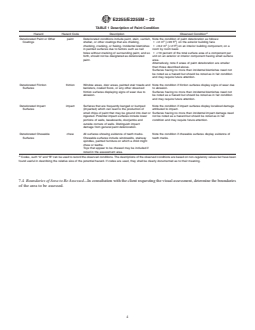
Deteriorated Paint or Other paint Deteriorated conditions include paint, stain, varnish, Note the condition of paint deterioration as follows:
2 2
Coatings shellac, or other coatings that are chalking, • $2m [$20 ft ] on the exterior building face
2 2
checking, cracking, or flaking. Incidental blemishes • $0.2 m [$2ft ] on an interior building component, on a
in painted surfaces due to factors such as nail room by room basis
holes without cracking of surrounding paint, and so • $10 percent of the total surface area of a component per
forth, should not be designated as deteriorated unit on an exterior or interior component having small surface
paint. area.
Alternatively, note if areas of paint deterioration are smaller
than those described above.
Surfaces having no more than incidental blemishes need not
be noted as a hazard but should be noted as in fair condition
and may require future attention.
Deteriorated Friction friction Window areas, door areas, painted stair treads and Note the condition if friction surfaces display signs of wear due
Surfaces banisters, coated floors, or any other observed to abrasion.
friction surfaces displaying signs of wear due to Surfaces having no more than incidental blemishes need not
abrasion. be noted as a hazard but should be noted as in fair condition
and may require future attention.
Deteriorated Impact impact Surfaces that are frequently banged or bumped Note the condition if impact surfaces display localized damage
Surfaces (impacted) which can lead to the production of attributed to impact.
small chips of paint that may be ground into dust or Surfaces having no more than incidental impact damage need
ingested. Potential impact surfaces include lower not be noted as a hazard but should be noted as in fair
portions of walls, baseboards, doorjambs and condition and may require future attention.
outside corners of walls. Distinguish impact
damage from general paint deterioration.
Deteriorated Chewable chew All surfaces showing evidence of teeth marks. Note the condition if chewable surfaces display evidence of
Surfaces Chewable surfaces include windowsills, stairway teeth marks.
spindles, painted furniture on which a child might
chew or teethe.
Toys that appear to be chewed may be included if
noted in the assessment area.
A
Codes, such “A” and “B” can be used to record the observed conditions. The descriptions of the observed conditions are based on non-regulatory values but have been
found useful in describing the relative size of the potential hazard. If codes are used, they shall be clearly documented as to their meaning.
TABLE 2 Description of Interior Surface Dust, Paint Chips, and Debris
Hazard Hazard Code Description
General Surface Dust dust Permanent horizontal surface areas having visible surface dust. Surface areas prone to dust accumulation
Accumulation include:
• Floors;
• Window sills and troughs;
• Along baseboard moldings;
• Room corners;
• Door thresholds and other entries;
• Beneath radiators and air conditioners;
• On and under the edges of carpets/rugs/upholstery/furniture/appliances/and other resident belongings;
• Surfaces near or under those having leaded paint hazards; and
• Entryways
Paint Chip Accumulation chip Permanent horizontal surface areas having paint chips. Areas prone to paint chip accumulation include:
• Floors;
• Window sills and troughs;
• Along baseboard moldings;
• Room corners;
• Door thresholds and other entries;
• Beneath radiators and air conditioners;
• On and under the edges of carpets/rugs/upholstery; and,
• Surfaces near or under those having leaded paint hazards.
Construction and Other debris Permanent horizontal surface areas having construction or other debris.
Debris
7.4 Boundaries of Area to Be Assessed—In consultation boundaries of the area to be assessed.
with the client requesting the visual assessment, determine the
E2255/E2255M − 22
TABLE 3 Description of Ground Conditions
A
Hazard Hazard Code Description Observed Condition
Bare Soil—Play Area bare play All areas of bare soil on each side of the building where Note any observations of bare soil area as follows:
2 2
children might play. • Greater than approximately 0.1 m [1 ft ]
2 2
• Less than approximately 0.1 m [1 ft ]
Bare Soil—Yard bare yard All areas of bare soil on each side of the building Note any observations of bare soil area as follows:
2 2
including out buildings, gardens, and under porches, • Greater than approximately 1 m [10 ft ]
2 2
excluding children’s play areas. • Less than approximately 1 m [10 ft ]
Paint Chip Accumulation chip All ground areas having paint chips. Areas prone to paint
chip accumulation include:
• bare soil;
• driplines;
• construction debris and resident storage and
disposal areas; and
• neighboring properties in close proximity to the
subject property.
Construction and Other debris All ground areas having construction or other debris.
Debris
A
Codes, such “A” and “B” can be used to record the observed conditions. The descriptions of the observed conditions are based on non-regulatory values but have been
found useful in describing the relative size of the potential hazard. If codes are used, they shall be clearly documented as to their meaning.
NOTE 1—When combined with building face sketches, the site-plan
7.5 Walk-Through—Walk through the area to be assessed to
provides an unambiguous method of identifying exterior building com-
become familiar with the site and verify the boundaries of the
ponents and site features.
area to be assessed, if the entire structure is not to be assessed.
Portions of the property excluded from the visual assessment 7.8.2.2 The address or location of the structure, the name of
the person conducting the assessment, the date of the
shall be documented and reported.
assessment, and the approximate north compass direction.
7.6 Component Replacement—In consultation with the cli-
7.8.2.3 Driveways, and play areas, the exterior walls of the
ent requesting the visual assessment, determine whether any
buildings, a unique label for each structure, and a wall
windows or doors penetrating the exterior walls in the assess-
identifier to provide a point of reference for labeling exterior
ment area have been replaced. In cases where such a window
walls. If using the Site-Plan Form in Appendix X1, place the
or door has been replaced, the visual assessment shall include
primary structure’s main entryway facing the bottom edge of
both the interior and exterior of the adjacent walls. In addition,
theformandlabelthebottomedgeoftheformwithawallcode
the assessment shall include any horizontal surfaces and the
(for example, wall A or wall 1).
ground beneath the replaced windows or doors.
7.8.2.4 Labels for the remaining exterior walls of the
7.7 Access to Area to Be Assessed—Determine whether all
structure.IfusingtheSite-PlanForminAppendixX1,labelthe
areas and surfaces to be assessed are accessible and whether
remaining exterior walls of the structure in a clockwise
movable building components such as windows and doors in
sequentially increasing order. (See the example shown in
the areas to be assessed are functional. Resolve, to the extent
Appendix X2 for a structure with 13 designated walls.)
possible, problems and questions associated with access to
7.8.2.5 Approximate dimensions of the structures.
assessment areas and functionality prior to conducting the
visual assessment. Record incidences of unresolved access
7.9 Building Face Sketches:
issues and lack of functionality that inhibit the ability to make
7.9.1 If the area to be assessed includes any building faces
a visual assessment of those areas or components.
(exterior sides of buildings) or portions thereof, prepare
7.7.1 Site-Safety Conditions—During the walkthrough
building-face sketches for use in recording findings (see the
inspection, identify potential problems associated with site
Building-Face Sketch Form in Appendix X1 and see Note 2).
safety. Resolve, to the extent possible, such problems that may
An alternative to the building sketch form is to take photo-
impact the assessment. Record incidences of potential site-
graphs or record videos of the building-faces and process these
safety conditions.
so that they can be labeled.
7.8 Site-Plan:
NOTE2—Thepurposeofthebuildingfacesketchistouniquelyidentify
7.8.1 If the area to be assessed includes any exterior
the location of exterior features, particularly windows and doors, and
portions of a unit or structure, prepare a site-plan for use in
assign labels to these features for recording observations. Thus, a detailed
recording findings (see the Site-Plan Form in Appendix X1).
building face
...
This document is not an ASTM standard and is intended only to provide the user of an ASTM standard an indication of what changes have been made to the previous version. Because
it may not be technically possible to adequately depict all changes accurately, ASTM recommends that users consult prior editions as appropriate. In all cases only the current version
of the standard as published by ASTM is to be considered the official document.
Designation: E2255/E2255M − 18a E2255/E2255M − 22
Standard Practice for
Conducting Visual Assessments for Lead Hazards in
Buildings
This standard is issued under the fixed designation E2255/E2255M; the number immediately following the designation indicates the year
of original adoption or, in the case of revision, the year of last revision. A number in parentheses indicates the year of last reapproval.
A superscript epsilon (´) indicates an editorial change since the last revision or reapproval.
1. Scope
1.1 This practice describes procedures for conducting visual assessments in buildings to visually identify the type and location of
potential lead hazards. These potential hazards are associated with deteriorated leaded paint, lead in dust, or lead in soil.
1.2 This practice addresses visual assessment procedures for lead-hazard activities such as: lead risk (hazard) assessment (Guide
E2115), clearance examination (Practices E2271/E2271M and E3074/E3074M), assessment of paint condition, and re-evaluation
inspection. It also can be applied to visual assessments following paint maintenance or renovation or repainting activities, or
combinations thereof.
1.3 Because there is considerable overlap among the requirements for lead-hazard activities, this standard first describes a generic
visual assessment procedure, and then defines a specific procedure for each assessment type in terms of additions to, or deletions
from, the generic procedure.
1.4 This practice does not address testing needed to confirm the presence of lead hazards.
1.5 This practice contains notes, which are explanatory and are not part of the mandatory requirements of this standard.
1.6 The values stated in either SI units or inch-pound units are to be regarded separately as standard. The values stated in each
system are not necessarily exact equivalents; therefore, to ensure conformance with the standard, each system shall be used
independently of the other, and values from the two systems shall not be combined.
1.7 This standard does not purport to address all of the safety concerns, if any, associated with its use. It is the responsibility
of the user of this standard to establish appropriate safety, health, and environmental practices and determine the applicability of
regulatory limitations prior to use.
1.8 This international standard was developed in accordance with internationally recognized principles on standardization
established in the Decision on Principles for the Development of International Standards, Guides and Recommendations issued
by the World Trade Organization Technical Barriers to Trade (TBT) Committee.
This practice is under the jurisdiction of ASTM Committee D22 on Air Quality and is the direct responsibility of Subcommittee D22.12 on Sampling and
Analysis,Analysis of Lead,Lead for Exposure and Risk Assessment.
Current edition approved July 1, 2018March 1, 2022. Published August 2018May 2022. Originally approved in 2003. Last previous edition approved in 2018 as
E2255/E2255ME2255/E2255M – 18a.–18. DOI: 10.1520/E2255_E2255M–18A.10.1520/E2255_E2255M-22.
Copyright © ASTM International, 100 Barr Harbor Drive, PO Box C700, West Conshohocken, PA 19428-2959. United States
E2255/E2255M − 22
2. Referenced Documents
2.1 ASTM Standards:
D1356 Terminology Relating to Sampling and Analysis of Atmospheres
E1605 Terminology Relating to Lead in Buildings
E2115 Guide for Conducting Lead Hazard Assessments of Dwellings and of Other Child-Occupied Facilities
E2239 Practice for Record Keeping and Record Preservation for Lead Hazard Activities
E2271/E2271M Practice for Clearance Examinations Following Lead Hazard Reduction Activities in Multifamily Dwellings
E3074/E3074M Practice for Clearance Examinations Following Lead Hazard Reduction Activities in Single Family Dwellings,
in Individual Units of Multifamily Dwellings, and in Other Child-Occupied Facilities
3. Terminology
3.1 For definitions of terms not appearing here, refer to TerminologyTerminologies D1356 and E1605.
3.2 Definitions of Terms Specific to This Standard:
3.2.1 leaded dust hazard, n—a condition that might result in adverse human health effects due to lead in surface dust.
3.2.1.1 Discussion—
Authorities having jurisdiction may issue guidance or promulgate requirements defining the minimum mass per area content of
lead in dust that is considered to constitute a hazard.
3.2.2 leaded paint hazard, n—a condition that might result in adverse human health effects due to lead in deteriorated paint on
all building surfaces, lead in paint on chewable surfaces, impact surfaces, or dust-producing friction surfaces.
3.2.2.1 Discussion—
Levels of lead in deteriorated paint, lead in paint on chewable surfaces, dust-producing friction surfaces, and impact surfaces that
might adversely affect human health may be stated in requirements promulgated by authorities having jurisdiction.
3.2.3 leaded soil hazard, n—a condition that might result in adverse human health effects due to lead in bare soil.
3.2.3.1 Discussion—
Authorities having jurisdiction may issue guidance or promulgate requirements defining the minimum amount of lead in soil by
percent by mass that is considered to constitute a hazard.
4. Significance and Use
4.1 This practice supports lead poisoning prevention activities by providing standardized procedures for conducting visual
assessments.
4.2 This practice is intended to be used with other ASTM standards, as appropriate, for conducting lead-hazard assessments.
4.3 This practice is intended for use by individuals trained to conduct visual assessments associated with lead-hazard activities and
in reporting their results. This practice is also applicable for use by others interested in visual assessment of properties for lead
hazards, such as building code officials, building operators, homeowners, and insurers.
5. Requirements for Individuals Conducting Visual Assessments
5.1 Persons conducting visual assessments need a range of expertise, including the ability to identify the type, extent, and cause
of coating deterioration and component deterioration, and to determine the presence of surface dust, debris, and bare soil. Users
of visual assessment services should review their credentials and experience to determine whether they are qualified to conduct
the work.
5.1.1 Visual assessments conducted as part of a lead-based paint activity within the scope of regulations promulgated by
authorities having jurisdiction shall be conducted by appropriately certified or licensed individuals.
For referenced ASTM standards, visit the ASTM website, www.astm.org, or contact ASTM Customer Service at service@astm.org. For Annual Book of ASTM Standards
volume information, refer to the standard’s Document Summary page on the ASTM website.
E2255/E2255M − 22
6. Materials and Supplies
6.1 Copies of Forms, (see Appendix X1).
6.2 Clipboard, for holding forms.
6.3 Pencil and Sharpener.
6.4 Indelible Ink Pen or Permanent Marker.
6.5 Flashlight, or other self-powered portable light source, as needed, for making visual observations in low light level areas.
6.6 Camera (optional), with supporting equipment needed to create photographs that can be labeled.
6.7 Video recorder (suggested), for both visual and audio documentation of current property conditions.
7. Procedure for Conducting the Generic Visual Assessment
7.1 General Visual Assessment Requirements—The following requirements apply to the conduct of visual assessments:
7.1.1 Reporting:
7.1.1.1 Use a recording system that uniquely identifies the type and location of each hazard and each incidence of building
component deterioration. At a minimum, the recording system must allow a reasonably educated person, when provided with all
the records generated from a visual assessment, to determine what hazards and incidences of building component deterioration
were identified and where each was found. This practice provides the individual conducting the visual assessment with the
flexibility to use personal choices for some recording needs.
7.1.1.2 Examples of forms (site plans, building face sketches, floor plans, building component condition, paint/dust/debris, and
grounds) for recording information are shown in Appendix X1. An example of using these forms is presented in Appendix X2.
7.1.1.3 Alternate forms are acceptable provided that they allow unique identification of all hazards and incidences of building
component deterioration.
7.1.1.4 Information recorded on any particular form can be limited to only those areas where potential hazards are found. The
example floor-plan shown in Appendix X2 includes detail for the living room, dining room and porch only because potential
hazards were not identified in other rooms. However, the individuals conducting visual assessments are cautioned against overly
sparse records when no potential hazards are found. Lack of potential hazards found needs to be documented along with any
exceptions taken during the visual assessment such as, areas not assessed due to access limitations. Lack of records may be viewed
as a potential indicator that portions of the assessed area were not inspected.
7.1.1.5 Use of a camera or video recorder, or both, to photographically capture the structures and grounds included within the
boundaries of the assessment area provides a means of complementing forms.
7.1.2 Symbols and Codes—Use of symbols and codes is not required but is recommended to reduce the effort needed to record
building and grounds locations and observations of hazards and component deterioration. The symbols and codes, if used, shall
be sufficiently defined to identify the items to which they refer. The codes provided in various sections of this standard, such as
in Tables 1-3, are exemplary; others may be used depending on the needs of the person conducting the visual assessment.
7.2 Existing Information—Review historic lead-hazard evaluation, hazard reduction and clearance reports and other information
describing ongoing maintenance activities, and relevant building operations to identify changes from previous conditions and
locations of renovation, remodeling, construction or abatement activity. Use this review to help define the boundaries of the
assessment area.
7.3 Multifamily Housing—Units to be assessed shall be determined using appropriate statistical procedures.
E2255/E2255M − 22
TABLE 1 Description of Paint Condition
A
Hazard Hazard Code Description Observed Condition
Deteriorated Paint or Other paint Deteriorated conditions include paint, stain, varnish, Note the condition of paint deterioration as follows:
2 2
Coatings shellac, or other coatings that are chalking, • $2 m [$20 ft ] on the exterior building face
2 2
checking, cracking, or flaking. Incidental blemishes • $0.2 m [$2 ft ] on an interior building component, on a
in painted surfaces due to factors such as nail room by room basis
holes without cracking of surrounding paint, and so • $10 percent of the total surface area of a component per
forth, should not be designated as deteriorated unit on an exterior or interior component having small surface
paint. area.
Alternatively, note if areas of paint deterioration are smaller
than those described above.
Surfaces having no more than incidental blemishes need not
be noted as a hazard but should be noted as in fair condition
and may require future attention.
Deteriorated Friction friction Window areas, door areas, painted stair treads and Note the condition if friction surfaces display signs of wear due
Surfaces banisters, coated floors, or any other observed to abrasion.
friction surfaces displaying signs of wear due to Surfaces having no more than incidental blemishes need not
abrasion. be noted as a hazard but should be noted as in fair condition
and may require future attention.
Deteriorated Impact impact Surfaces that are frequently banged or bumped Note the condition if impact surfaces display localized damage
Surfaces (impacted) which can lead to the production of attributed to impact.
small chips of paint that may be ground into dust or Surfaces having no more than incidental impact damage need
ingested. Potential impact surfaces include lower not be noted as a hazard but should be noted as in fair
portions of walls, baseboards, doorjambs and condition and may require future attention.
outside corners of walls. Distinguish impact
damage from general paint deterioration.
Deteriorated Chewable chew All surfaces showing evidence of teeth marks. Note the condition if chewable surfaces display evidence of
Surfaces Chewable surfaces include windowsills, stairway teeth marks.
spindles, painted furniture on which a child might
chew or teethe.
Toys that appear to be chewed may be included if
noted in the assessment area.
A
Codes, such “A” and “B” can be used to record the observed conditions. The descriptions of the observed conditions are based on non-regulatory values but have been
found useful in describing the relative size of the potential hazard. If codes are used, they shall be clearly documented as to their meaning.
7.4 Boundaries of Area to Be Assessed—In consultation with the client requesting the visual assessment, determine the boundaries
of the area to be assessed.
E2255/E2255M − 22
TABLE 2 Description of Interior Surface Dust, Paint Chips, and Debris
Hazard Hazard Code Description
General Surface Dust dust Permanent horizontal surface areas having visible surface dust. Surface areas prone to dust accumulation
Accumulation include:
• Floors;
• Window sills and troughs;
• Along baseboard moldings;
• Room corners;
• Door thresholds and other entries;
• Beneath radiators and air conditioners;
• On and under the edges of carpets/ rugs/ upholstery/furniture/appliances/and other resident belongings;
• Surfaces near or under those having leaded paint hazards; and
• Entryways
General Surface Dust dust Permanent horizontal surface areas having visible surface dust. Surface areas prone to dust accumulation
Accumulation include:
• Floors;
• Window sills and troughs;
• Along baseboard moldings;
• Room corners;
• Door thresholds and other entries;
• Beneath radiators and air conditioners;
• On and under the edges of carpets/rugs/upholstery/furniture/appliances/and other resident belongings;
• Surfaces near or under those having leaded paint hazards; and
• Entryways
Paint Chip Accumulation chip Permanent horizontal surface areas having paint chips. Areas prone to paint chip accumulation include:
• Floors;
• Window sills and troughs;
• Along baseboard moldings;
• Room corners;
• Door thresholds and other entries;
• Beneath radiators and air conditioners;
• On and under the edges of carpets/ rugs/ upholstery; and,
• Surfaces near or under those having leaded paint hazards.
Paint Chip Accumulation chip Permanent horizontal surface areas having paint chips. Areas prone to paint chip accumulation include:
• Floors;
• Window sills and troughs;
• Along baseboard moldings;
• Room corners;
• Door thresholds and other entries;
• Beneath radiators and air conditioners;
• On and under the edges of carpets/rugs/upholstery; and,
• Surfaces near or under those having leaded paint hazards.
Construction and Other debris Permanent horizontal surface areas having construction or other debris.
Debris
TABLE 3 Description of Ground Conditions
A
Hazard Hazard Code Description Observed Condition
Bare Soil—Play Area bare play All areas of bare soil on each side of the building where Note any observations of bare soil area as follows:
2 2
children might play. • Greater than approximately 0.1 m [1 ft ]
2 2
• Less than approximately 0.1 m [1 ft ]
Bare Soil—Yard bare yard All areas of bare soil on each side of the building Note any observations of bare soil area as follows:
2 2
including out buildings, gardens, and under porches, • Greater than approximately 1 m [10 ft ]
2 2
excluding children’s play areas. • Less than approximately 1 m [10 ft ]
Paint Chip Accumulation chip All ground areas having paint chips. Areas prone to paint
chip accumulation include:
• bare soil;
• driplines;
• construction debris and resident storage and
disposal areas; and
• neighboring properties in close proximity to the
subject property.
Construction and Other debris All ground areas having construction or other debris.
Debris
A
Codes, such “A” and “B” can be used to record the observed conditions. The descriptions of the observed conditions are based on non-regulatory values but have been
found useful in describing the relative size of the potential hazard. If codes are used, they shall be clearly documented as to their meaning.
E2255/E2255M − 22
7.5 Walk-Through—Walk through the area to be assessed to become familiar with the site and verify the boundaries of the area
to be assessed, if the entire structure is not to be assessed. Portions of the property excluded from the visual assessment shall be
documented and reported.
7.6 Component Replacement—In consultation with the client requesting the visual assessment, determine whether any windows
or doors penetrating the exterior walls in the assessment area have been replaced. In cases where such a window or door has been
replaced, the visual assessment shall include both the interior and exterior of the adjacent walls. In addition, the assessment shall
include any horizontal surfaces and the ground beneath the replaced windows or doors.
7.7 Access to Area to Be Assessed—Determine whether all areas and surfaces to be assessed are accessible and whether movable
building components such as windows and doors in the areas to be assessed are functional. Resolve, to the extent possible,
problems and questions associated with access to assessment areas and functionality prior to conducting the visual assessment.
Record incidences of unresolved access issues and lack of functionality that inhibit the ability to make a visual assessment of those
areas or components.
7.7.1 Site-Safety Conditions—During the walkthrough inspection, identify potential problems associated with site safety. Resolve,
to the extent possible, such problems that may impact the assessment. Record incidences of potential site-safety conditions.
7.8 Site-Plan:
7.8.1 If the area to be assessed includes any exterior portions of a unit or structure, prepare a site-plan for use in recording findings
(see the Site-Plan Form in Appendix X1).
7.8.1.1 If a pencil is used for sketching the Site-Plan Form, make the sketch permanent by overwriting it with an indelible marker.
7.8.2 Show on the Site Plan:
7.8.2.1 The relative position and shape of the buildings on the property being assessed and designate the primary structure
undergoing visual assessment (see Note 1).
NOTE 1—When combined with building face sketches, the site-plan provides an unambiguous method of identifying exterior building components and
site features.
7.8.2.2 The address or location of the structure, the name of the person conducting the assessment, the date of the assessment, and
the approximate north compass direction.
7.8.2.3 Driveways, and play areas, the exterior walls of the buildings, a unique label for each structure, and a wall identifier to
provide a point of reference for labeling exterior walls. If using the Site-Plan Form in Appendix X1, place the primary structure’s
main entryway facing the bottom edge of the form and label the bottom edge of the form with a wall code (for example, wall A
or wall 1).
7.8.2.4 Labels for the remaining exterior walls of the structure. If using the Site-Plan Form in Appendix X1, label the remaining
exterior walls of the structure in a clockwise sequentia
...