

ASTM D4860-22
(Test Method)Standard Test Method for Free Water and Particulate Contamination in Middle Distillate Fuels (Clear and Bright Numerical Rating)
General Information
- Abstract
SIGNIFICANCE AND USE
5.1 The test provides a field test to evaluate visually a fuel sample for particulate matter and free water similar to Test Method D4176 plus a numerical rating for free water. High numerical ratings indicate that the fuel is relatively free of free water. The degree of water and particulate contamination can be measured using other methods such as Test Methods D2276, D2709, and D6304.
Note 2: Clean and bright is sometimes used in place of clear and bright. The meaning is identical.
5.2 The color of the sample does not affect the measurement. Limited laboratory evaluations of samples have determined the degree of free water can be rated in fuels with dark opaque color having a darker rating than five in Test Method D1500.
SCOPE
1.1 This test method covers a rapid, portable means for field and laboratory use to inspect visually for particulate matter and numerically rate free water in aviation turbine and distillate fuels.
1.2 The values stated in SI units are to be regarded as standard. No other units of measurement are included in this standard.
1.3 This standard does not purport to address all of the safety concerns, if any, associated with its use. It is the responsibility of the user of this standard to establish appropriate safety, health, and environmental practices and determine the applicability of regulatory limitations prior to use. For specific warning statements, see 11.2.3 and Annex A1.
1.4 This international standard was developed in accordance with internationally recognized principles on standardization established in the Decision on Principles for the Development of International Standards, Guides and Recommendations issued by the World Trade Organization Technical Barriers to Trade (TBT) Committee.
- Status
- Published
- Publication Date
- 30-Jun-2022
- Technical Committee
- D02 - Petroleum Products, Liquid Fuels, and Lubricants
- Drafting Committee
- D02.14 - Stability, Cleanliness and Compatibility of Liquid Fuels
Buy Documents
ASTM D4860-22 - Standard Test Method for Free Water and Particulate Contamination in Middle Distillate Fuels (Clear and Bright Numerical Rating)
REDLINE ASTM D4860-22 - Standard Test Method for Free Water and Particulate Contamination in Middle Distillate Fuels (Clear and Bright Numerical Rating)
Overview
ASTM D4860-22: Standard Test Method for Free Water and Particulate Contamination in Middle Distillate Fuels (Clear and Bright Numerical Rating) provides a rapid, field-applicable and laboratory-capable test method. This standard is essential for visually detecting particulate matter and assigning a numerical rating to free water in middle distillate fuels, including aviation turbine fuel. The test offers a portable solution for on-site fuel quality assessment, helping ensure fuel cleanliness and minimizing operational risk caused by contamination.
Developed by ASTM International, this method enhances the traditional visual clear and bright inspection by introducing quantitative results. It is internationally recognized in accordance with the World Trade Organization’s principles for the development of international standards.
Key Topics
- Visual and Numerical Assessment: The method combines a traditional “clear and bright” visual inspection with a numerical rating for free water content, supporting more consistent field decisions.
- Types of Contaminants: Focuses on two main contamination types:
- Free Water: Water not dissolved in the fuel, visible as haze, droplets, or a water layer.
- Particulate Matter: Solid or semi-solid particles such as dust, corrosion by-products, and degradation products.
- Test Instrumentation: Utilizes a portable Micro-Separometer device, which is capable of both battery and AC operation. The test employs single-use accessories to avoid cross-contamination.
- Result Interpretation: Higher numerical ratings (on a 50-100 scale) indicate lower levels of free water, supporting quick decision-making in field fuel quality control.
- Sample Color Independence: The color of the fuel does not affect the measurement, making the method suitable for both clear and darker, more opaque fuel types.
Applications
ASTM D4860-22 is widely used in industries where fuel quality is critical for safety and performance. Key applications include:
- Aviation Fuel Quality Control: Ensures the cleanliness of aviation turbine fuels before use, reducing risk of engine problems and operational failures due to fuel contamination.
- Field Inspections and Tank Farm Management: Enables rapid, on-site assessment of middle distillate fuels at storage and distribution points.
- Routine Fuel Handling: Supports regular quality monitoring for diesel and other middle distillate fuels in transportation, military, and industrial sectors.
- Pre-delivery Verification: Used by fuel suppliers and purchasers to verify fuel quality at the point of transfer, minimizing disputes and ensuring regulatory compliance.
This standard allows for immediate investigation and decision-making during fuel transfers, sampling, or storage, significantly reducing unplanned downtime and equipment maintenance.
Related Standards
ASTM D4860-22 references and complements several other important standards in fuel analysis, including:
- ASTM D4176 - Visual Inspection for Free Water and Particulate Contamination in Distillate Fuels
- ASTM D2276 - Determination of Particulate Contaminant in Aviation Fuel by Line Sampling
- ASTM D2709 - Determination of Water and Sediment in Middle Distillate Fuels by Centrifuge
- ASTM D6304 - Determination of Water in Petroleum Products by Coulometric Karl Fischer Titration
- ASTM D1500 - ASTM Color of Petroleum Products (Color Scale)
- ASTM D4057 - Manual Sampling of Petroleum and Petroleum Products
- ASTM D4175 - Terminology Relating to Petroleum Products, Liquid Fuels, and Lubricants
By integrating ASTM D4860-22 into fuel management protocols, organizations benefit from reliable, rapid detection of contamination-critical to ensuring safe, efficient operations and compliance with industry guidelines.
Keywords: ASTM D4860-22, free water, particulate contamination, clear and bright rating, aviation fuel testing, middle distillate fuels, Micro-Separometer, fuel quality control, field fuel inspection, distillate fuel cleanliness.
Relations
- Effective Date
- 01-Mar-2024
- Refers
ASTM D4175-23a - Standard Terminology Relating to Petroleum Products, Liquid Fuels, and Lubricants - Effective Date
- 15-Dec-2023
- Refers
ASTM D4175-23e1 - Standard Terminology Relating to Petroleum Products, Liquid Fuels, and Lubricants - Effective Date
- 01-Jul-2023
- Effective Date
- 01-Dec-2012
- Refers
ASTM D4057-06(2011) - Standard Practice for Manual Sampling of Petroleum and Petroleum Products - Effective Date
- 01-Jun-2011
- Effective Date
- 01-May-2011
- Effective Date
- 01-Jun-2009
- Effective Date
- 01-Dec-2007
- Effective Date
- 15-Jul-2007
- Refers
ASTM D2276-06 - Standard Test Method for Particulate Contaminant in Aviation Fuel by Line Sampling - Effective Date
- 01-Dec-2006
- Effective Date
- 01-May-2006
- Refers
ASTM D2276-05 - Standard Test Method for Particulate Contaminant in Aviation Fuel by Line Sampling - Effective Date
- 01-Dec-2005
- Effective Date
- 01-Nov-2004
- Effective Date
- 01-Nov-2004
- Effective Date
- 01-Nov-2004
Buy Documents
ASTM D4860-22 - Standard Test Method for Free Water and Particulate Contamination in Middle Distillate Fuels (Clear and Bright Numerical Rating)
REDLINE ASTM D4860-22 - Standard Test Method for Free Water and Particulate Contamination in Middle Distillate Fuels (Clear and Bright Numerical Rating)
Get Certified
Connect with accredited certification bodies for this standard

Element Materials Technology
Materials testing and product certification.

ABS Group Brazil
ABS Group certification services in Brazil.

ABS Quality Evaluations Inc.
American Bureau of Shipping quality certification.
Sponsored listings
Frequently Asked Questions
ASTM D4860-22 is a standard published by ASTM International. Its full title is "Standard Test Method for Free Water and Particulate Contamination in Middle Distillate Fuels (Clear and Bright Numerical Rating)". This standard covers: SIGNIFICANCE AND USE 5.1 The test provides a field test to evaluate visually a fuel sample for particulate matter and free water similar to Test Method D4176 plus a numerical rating for free water. High numerical ratings indicate that the fuel is relatively free of free water. The degree of water and particulate contamination can be measured using other methods such as Test Methods D2276, D2709, and D6304. Note 2: Clean and bright is sometimes used in place of clear and bright. The meaning is identical. 5.2 The color of the sample does not affect the measurement. Limited laboratory evaluations of samples have determined the degree of free water can be rated in fuels with dark opaque color having a darker rating than five in Test Method D1500. SCOPE 1.1 This test method covers a rapid, portable means for field and laboratory use to inspect visually for particulate matter and numerically rate free water in aviation turbine and distillate fuels. 1.2 The values stated in SI units are to be regarded as standard. No other units of measurement are included in this standard. 1.3 This standard does not purport to address all of the safety concerns, if any, associated with its use. It is the responsibility of the user of this standard to establish appropriate safety, health, and environmental practices and determine the applicability of regulatory limitations prior to use. For specific warning statements, see 11.2.3 and Annex A1. 1.4 This international standard was developed in accordance with internationally recognized principles on standardization established in the Decision on Principles for the Development of International Standards, Guides and Recommendations issued by the World Trade Organization Technical Barriers to Trade (TBT) Committee.
SIGNIFICANCE AND USE 5.1 The test provides a field test to evaluate visually a fuel sample for particulate matter and free water similar to Test Method D4176 plus a numerical rating for free water. High numerical ratings indicate that the fuel is relatively free of free water. The degree of water and particulate contamination can be measured using other methods such as Test Methods D2276, D2709, and D6304. Note 2: Clean and bright is sometimes used in place of clear and bright. The meaning is identical. 5.2 The color of the sample does not affect the measurement. Limited laboratory evaluations of samples have determined the degree of free water can be rated in fuels with dark opaque color having a darker rating than five in Test Method D1500. SCOPE 1.1 This test method covers a rapid, portable means for field and laboratory use to inspect visually for particulate matter and numerically rate free water in aviation turbine and distillate fuels. 1.2 The values stated in SI units are to be regarded as standard. No other units of measurement are included in this standard. 1.3 This standard does not purport to address all of the safety concerns, if any, associated with its use. It is the responsibility of the user of this standard to establish appropriate safety, health, and environmental practices and determine the applicability of regulatory limitations prior to use. For specific warning statements, see 11.2.3 and Annex A1. 1.4 This international standard was developed in accordance with internationally recognized principles on standardization established in the Decision on Principles for the Development of International Standards, Guides and Recommendations issued by the World Trade Organization Technical Barriers to Trade (TBT) Committee.
ASTM D4860-22 is classified under the following ICS (International Classification for Standards) categories: 75.160.20 - Liquid fuels. The ICS classification helps identify the subject area and facilitates finding related standards.
ASTM D4860-22 has the following relationships with other standards: It is inter standard links to ASTM D1500-24, ASTM D4175-23a, ASTM D4175-23e1, ASTM D1500-12, ASTM D4057-06(2011), ASTM D2709-96(2011)e1, ASTM D4176-04(2009), ASTM D1500-07, ASTM D6304-07, ASTM D2276-06, ASTM D2709-96(2006), ASTM D2276-05, ASTM D4176-04e1, ASTM D1500-04a, ASTM D4176-04. Understanding these relationships helps ensure you are using the most current and applicable version of the standard.
ASTM D4860-22 is available in PDF format for immediate download after purchase. The document can be added to your cart and obtained through the secure checkout process. Digital delivery ensures instant access to the complete standard document.
Standards Content (Sample)
This international standard was developed in accordance with internationally recognized principles on standardization established in the Decision on Principles for the
Development of International Standards, Guides and Recommendations issued by the World Trade Organization Technical Barriers to Trade (TBT) Committee.
Designation: D4860 − 22
Standard Test Method for
Free Water and Particulate Contamination in Middle
Distillate Fuels (Clear and Bright Numerical Rating)
This standard is issued under the fixed designation D4860; the number immediately following the designation indicates the year of
original adoption or, in the case of revision, the year of last revision. A number in parentheses indicates the year of last reapproval. A
superscript epsilon (´) indicates an editorial change since the last revision or reapproval.
1. Scope* D4175 Terminology Relating to Petroleum Products, Liquid
Fuels, and Lubricants
1.1 This test method covers a rapid, portable means for field
D4176 Test Method for FreeWater and Particulate Contami-
and laboratory use to inspect visually for particulate matter and
nation in Distillate Fuels (Visual Inspection Procedures)
numerically rate free water in aviation turbine and distillate
D6304 Test Method for Determination of Water in Petro-
fuels.
leum Products, Lubricating Oils, and Additives by Cou-
1.2 The values stated in SI units are to be regarded as
lometric Karl Fischer Titration
standard. No other units of measurement are included in this
standard.
3. Terminology
1.3 This standard does not purport to address all of the
3.1 Definitions:
safety concerns, if any, associated with its use. It is the
3.1.1 For definitions of terms used in this test method, refer
responsibility of the user of this standard to establish appro-
to Terminology D4175.
priate safety, health, and environmental practices and deter-
3.1.2 clear-and-bright (clean-and-bright), adj—a condition
mine the applicability of regulatory limitations prior to use.
in which the liquid sample (fuel) contains no visible water
For specific warning statements, see 11.2.3 and Annex A1.
drops or particulates and is free of haze or cloudiness.
1.4 This international standard was developed in accor-
3.1.3 free water, n—water in excess of that soluble in the
dance with internationally recognized principles on standard-
liquid sample (fuel) at the temperature of the test and usually
ization established in the Decision on Principles for the
appearing in the liquid sample (fuel) as a haze (cloudiness),
Development of International Standards, Guides and Recom-
droplets, or water layer.
mendations issued by the World Trade Organization Technical
3.1.4 solid particulate, n—in liquid fuels, small solid or
Barriers to Trade (TBT) Committee.
semi-solid particles, sometimes referred to as silt or sediment,
present in fuel.
2. Referenced Documents
3.1.4.1 Discussion—Some examples of solid particulates
2.1 ASTM Standards:
are air-blown dust, corrosion by-products, internal protective-
D1500 Test Method forASTM Color of Petroleum Products
coating deterioration, and products of fuel degradation and
(ASTM Color Scale)
microbial growth.
D2276 Test Method for Particulate Contaminant in Aviation
3.2 Definitions of Terms Specific to This Standard:
Fuel by Line Sampling
3 3
3.2.1 Micro-Separometer clear-and-bright (MSEP–C&B ),
D2709 Test Method for Water and Sediment in Middle
n—a numerical rating indicating the presence and ease of
Distillate Fuels by Centrifuge
removal of free water and particulate contamination by filtra-
D4057 Practice for Manual Sampling of Petroleum and
tion.
Petroleum Products
4. Summary of Test Method
This test method is under the jurisdiction of ASTM Committee D02 on
4.1 Visual inspection of the fuel sample for free water and
Petroleum Products, Liquid Fuels, and Lubricants and is the direct responsibility of
particulate matter is performed immediately when the sample
Subcommittee D02.14 on Stability, Cleanliness and Compatibility of Liquid
is taken. A glass container is used to view for water haze, and
FuelsStability and Cleanliness of Liquid Fuels.
Current edition approved July 1, 2022. Published August 2022. Originally
the fuel sample is swirled to create a vortex to detect the
approved in 1988. Last previous edition approved in 2021 as D4860 – 21. DOI:
presence of particulate matter.
10.1520/D4860-22.
For referenced ASTM standards, visit the ASTM website, www.astm.org, or
contact ASTM Customer Service at service@astm.org. For Annual Book of ASTM
Standards volume information, refer to the standard’s Document Summary page on ‘MSEP’and ‘Micro-Separometer’are trademarks of EMCEE Electronics, Inc.,
the ASTM website. 520 Cypress Ave., Venice, FL 34285.
*A Summary of Changes section appears at the end of this standard
Copyright © ASTM International, 100 Barr Harbor Drive, PO Box C700, West Conshohocken, PA 19428-2959. United States
D4860 − 22
4.2 Anumerical rating for free water is obtained by filtering 7.1.1.1 The Micro-Separometer Mark V Deluxe model and
aportionofthefuelsampleataprogrammedrate(50 mL⁄45 s) associated control panel are shown in Fig. 1.
through a standard fiberglass coalescer/filter. A portion of the 7.1.1.2 The Micro-Separometer Mark X model and associ-
effluent is used to establish a reference (100) level by a light ated control panel are shown in Fig. 2.
transmittance measurement. Another portion of the unpro-
NOTE 3—An extensive study was performed to verify that the Mark X
cessed (unfiltered) fuel sample is then compared to the 100
Micro-Separometer gives equivalent results to the Mark V Deluxe
reference level. The results are reported on a 50 to 100 scale to
Micro-Separometer. See Research Report RR:D02-1647.
the nearest whole number.Atest can be performed in 5 min to
7.1.2 The emulsifier is on the right side of the raised panel
10 min.
andthesyringedrivemechanismisontheleftside.Thecontrol
panel containing the operating controls is mounted on the fixed
NOTE 1—The standard fiberglass coalescer/filter consists of a precision-
machined aluminum housing containing fiber-glass material that has been
panel in the left side of the case.
selected to specific air flow characteristics. These criteria have a direct
7.1.3 All of the controls are located in a push-button array
bearing on the test results.
on the control panel. The push buttons illuminate when
depressed, thus indicating operational status. A circuit breaker
5. Significance and Use
located on the control panel provides protection for the ac
5.1 The test provides a field test to evaluate visually a fuel
power circuit.
sample for particulate matter and free water similar to Test
7.1.4 By depressing the ON push button, the electronic
Method D4176 plus a numerical rating for free water. High
circuits are energized. The ON push button light pulses on and
numerical ratings indicate that the fuel is relatively free of free
off when the instrument is being operated by an ac source and
water. The degree of water and particulate contamination can
constantly remains on when the battery (dc) pack is used. The
bemeasuredusingothermethodssuchasTestMethodsD2276,
push buttons sequentially illuminate on and off indicating
D2709, and D6304.
ready operational status.
NOTE 2—Clean and bright is sometimes used in place of clear and
NOTE 4—For the Mark V Deluxe—Of the lettered (A-G) push buttons,
bright. The meaning is identical.
only the C push button is applicable to this test method.
For the Mark X—Only test mode Clear/Bright is applicable to this test
5.2 The color of the sample does not affect the measure-
method.
ment. Limited laboratory evaluations of samples have deter-
7.1.5 The RESET push button can be depressed at any time
mined the degree of free water can be rated in fuels with dark
to cancel the test in progress and restore the program to the
opaque color having a darker rating than five in Test Method
initial start mode. The lettered push buttons commence to
D1500.
illuminate sequentially, thus indicating a ready operational
status enabling test mode selection.
6. Interferences
7.1.6 Testmodeselectionisaccomplishedbydepressingthe
6.1 When a fuel is visually inspected at or below the cloud
applicable push button—letter (C) on the MarkVand CLEAR/
point temperature of the fuel, small amounts of solid wax
BRIGHT on the Mark X. The depressed push button illumi-
particles can be confused with a water-induced haze or
nates and the sequential illumination of the other lettered push
cloudiness.
buttons ceases. The START push button on the Mark V and the
6.2 The presence of free water or particulate can be ob-
RUN push button on the Mark X also illuminate and the
scured and missed during visual inspection of the fuel, if the
syringe drive mechanism moves to the UP position.
ASTM color rating is greater than five.
7.1.7 The automatic program for the Clear/Bright test is
initiated by depressing the START push button on the Mark V
7. Apparatus
and the RUN push button on the Mark X.
7.1.8 The turbidimeter is located under the main control
7.1 Micro-Separometer Instrument, Mark VDeluxe or Mark
panel and consists of a well in which the sample vial is placed,
X:
a light source, and a photocell.Amark on the panel in front of
7.1.1 The Micro-Separometer is a completely portable and
the turbidimeter well is used to align the sample vial.
self contained unit capable of operating on an internal re-
7.1.9 By depressing the appropriate arrow push button on
chargeable battery pack (optional) or being connected to an ac
the Mark V, the displayed value on the meter can be increased/
power source using power cords that are furnished for various
decreased, as required, to establish the 100 reference level for
voltages. Connection to an ac power source provides power to
the vial of filtered fuel sample in the turbidimeter. The 100
the unit and effects battery recharge.The accessories as well as
reference level is automatically set on the Mark X.
the expendable materials for six tests can be packed in the
cover of the lockable case.
7.2 Accessory equipment and expendable materials needed
to perform the test are shown in Fig. 3 and consist of the
following:
The sole source of supply of the apparatus (Model 1140 Micro-Separometer,
Mark V Deluxe and Mark X) known to the committee at this time is EMCEE
Electronics, Inc., 520 CypressAve.,Venice, FL34285 www.emcee-electronics.com.
If you are aware of alternative suppliers, please provide this information to ASTM Supporting data have been filed at ASTM International Headquarters and may
International Headquarters. Your comments will receive careful consideration at a beobtainedbyrequestingResearchReportRR:D02-1647.ContactASTMCustomer
meeting of the responsible technical committee, which you may attend. Service at service@astm.org.
D4860 − 22
FIG. 1 Mark V Deluxe Micro-Separometer and Control Panel
FIG. 2 Mark X Micro-Separometer and Control Panel
7.2.1 Syringe Plug (A)—A plastic plug used to stopper the 7.2.2 Syringe Barrel (B) and Syringe Plunger (C)—A dis-
syringe. posable plastic syringe.
D4860 − 22
8.2.1 Be sure the sampling valve is free of loose solid
contaminants. If rust or other loose encrustations are present,
remove with a cloth; then flush the sampling valve before
taking the actual sample.
8.2.2 Rinse a clean sample container thoroughly with the
fuel being sampled.
8.2.3 Draw approximately 700 mL of fuel into the sample
container(atleast ⁄4full)asrapidlyaspossible.Useafullflush
rather than permitting the fuel sample to trickle out.
8.2.4 Alid shall be placed on the container to prevent water
absorptionorlossfromthesampletotheambientenvironment,
especially if the test is performed under different environmen-
tal conditions than those of the sample site or at a later time.
9. Preparation of Apparatus
9.1 Locate the Micro-Separometer on a clean workbench in
an area in which the temperature is within the operating limits
of the instrument, 0 °C to 50 °C.
9.2 Openthecaseandremovethesix-packboxfromthelid.
A BCDE
Raise the right panel until completely vertical and locked in
FIG. 3 Test Supplies
place.When ac power is available, connect the power cord and
turn the instrument on; otherwise operate using battery power.
9.3 Depress the switch (push button) marked ON.
7.2.3 Vials(D)—25 mmoutsidediametervialpremarkedfor
NOTE 6—Flickering of the power indicator light during any portion of
proper alignment in the turbidimeter.
a test sequence being performed when using battery power indicates that
7.2.4 Clear and Bright Coalescer/Filter (E) —An
recharging is necessary.
expendable, precalibrated aluminum coalescer/filter cell with a
9.4 Have ready a supply of syringes, syringe plugs, vials,
tapered end to fit the syringe. It is labeled in blue background
and Clear and Bright coalescer/filters. In addition, have the
with black lettering:
catch pan positioned under the syringe drive mechanism to
Clear and Bright, D4860
accept the spent fuel.
7.2.5 Beaker, catch pan or the
...
This document is not an ASTM standard and is intended only to provide the user of an ASTM standard an indication of what changes have been made to the previous version. Because
it may not be technically possible to adequately depict all changes accurately, ASTM recommends that users consult prior editions as appropriate. In all cases only the current version
of the standard as published by ASTM is to be considered the official document.
Designation: D4860 − 21 D4860 − 22
Standard Test Method for
Free Water and Particulate Contamination in Middle
Distillate Fuels (Clear and Bright Numerical Rating)
This standard is issued under the fixed designation D4860; the number immediately following the designation indicates the year of
original adoption or, in the case of revision, the year of last revision. A number in parentheses indicates the year of last reapproval. A
superscript epsilon (´) indicates an editorial change since the last revision or reapproval.
1. Scope*
1.1 This test method covers a rapid, portable means for field and laboratory use to inspect visually for particulate matter and
numerically rate free water in aviation turbine and distillate fuels.
1.2 The values stated in SI units are to be regarded as standard. No other units of measurement are included in this standard.
1.3 This standard does not purport to address all of the safety concerns, if any, associated with its use. It is the responsibility
of the user of this standard to establish appropriate safety, health, and environmental practices and determine the applicability of
regulatory limitations prior to use. For specific warning statements, see 11.2.3 and Annex A1.
1.4 This international standard was developed in accordance with internationally recognized principles on standardization
established in the Decision on Principles for the Development of International Standards, Guides and Recommendations issued
by the World Trade Organization Technical Barriers to Trade (TBT) Committee.
2. Referenced Documents
2.1 ASTM Standards:
D1500 Test Method for ASTM Color of Petroleum Products (ASTM Color Scale)
D2276 Test Method for Particulate Contaminant in Aviation Fuel by Line Sampling
D2709 Test Method for Water and Sediment in Middle Distillate Fuels by Centrifuge
D4057 Practice for Manual Sampling of Petroleum and Petroleum Products
D4175 Terminology Relating to Petroleum Products, Liquid Fuels, and Lubricants
D4176 Test Method for Free Water and Particulate Contamination in Distillate Fuels (Visual Inspection Procedures)
D6304 Test Method for Determination of Water in Petroleum Products, Lubricating Oils, and Additives by Coulometric Karl
Fischer Titration
3. Terminology
3.1 Definitions:
3.1.1 For definitions of terms used in this test method, refer to Terminology D4175.
3.1.2 clear-and-bright (also termed(clean-and-bright),n—adj—a condition in which the fuel liquid sample (fuel) contains no
visible water drops or particulates and is free of haze or cloudiness.
This test method is under the jurisdiction of ASTM Committee D02 on Petroleum Products, Liquid Fuels, and Lubricants and is the direct responsibility of Subcommittee
D02.14 on Stability, Cleanliness and Compatibility of Liquid FuelsStability and Cleanliness of Liquid Fuels.
Current edition approved Dec. 1, 2021July 1, 2022. Published January 2022August 2022. Originally approved in 1988. Last previous edition approved in 20192021 as
D4860 – 14 (2019).D4860 – 21. DOI: 10.1520/D4860-21.10.1520/D4860-22.
For referenced ASTM standards, visit the ASTM website, www.astm.org, or contact ASTM Customer Service at service@astm.org. For Annual Book of ASTM Standards
volume information, refer to the standard’s Document Summary page on the ASTM website.
*A Summary of Changes section appears at the end of this standard
Copyright © ASTM International, 100 Barr Harbor Drive, PO Box C700, West Conshohocken, PA 19428-2959. United States
D4860 − 22
3.1.3 free water, n—water in excess of that soluble in the liquid sample (fuel) at the temperature of the test and usually appearing
in the liquid sample (fuel) as a haze (cloudiness), droplets, or water layer.
3.1.4 solid particulate, n—in liquid fuels, small solid or semi-solid particles, sometimes referred to as silt or sediment, present in
fuel.
3.1.4.1 Discussion—
Some examples of solid particulates are air-blown dust, corrosion by-products, internal protective-coating deterioration, and
products of fuel degradation and microbial growth.
3.2 Definitions of Terms Specific to This Standard:
3 3
3.2.1 Micro-Separometer clear-and-bright (MSEP–C&B ),n—a numerical rating indicating the presence and ease of removal of
free water and particulate contamination by filtration.
4. Summary of Test Method
4.1 Visual inspection of the fuel sample for free water and particulate matter is performed immediately when the sample is taken.
A glass container is used to view for water haze, and the fuel sample is swirled to create a vortex to detect the presence of
particulate matter.
4.2 A numerical rating for free water is obtained by filtering a portion of the fuel sample at a programmed rate (50 mL ⁄45 s)
through a standard fiberglass coalescer/filter. A portion of the effluent is used to establish a reference (100) level by a light
transmittance measurement. Another portion of the unprocessed (unfiltered) fuel sample is then compared to the 100 reference
level. The results are reported on a 50 to 100 scale to the nearest whole number. A test can be performed in 5 min to 10 min.
NOTE 1—The standard fiberglass coalescer/filter consists of a precision-machined aluminum housing containing fiber-glass material that has been selected
to specific air flow characteristics. These criteria have a direct bearing on the test results.
5. Significance and Use
5.1 The test provides a field test to evaluate visually a fuel sample for particulate matter and free water similar to Test Method
D4176 plus a numerical rating for free water. High numerical ratings indicate that the fuel is relatively free of free water. The
degree of water and particulate contamination can be measured using other methods such as Test Methods D2276, D2709, and
D6304.
NOTE 2—Clean and bright is sometimes used in place of clear and bright. The meaning is identical.
5.2 The color of the sample does not affect the measurement. Limited laboratory evaluations of samples have determined the
degree of free water can be rated in fuels with dark opaque color having a darker rating than five in Test Method D1500.
6. Interferences
6.1 When a fuel is visually inspected at or below the cloud point temperature of the fuel, small amounts of solid wax particles
can be confused with a water-induced haze or cloudiness.
6.2 The presence of free water or particulate can be obscured and missed during visual inspection of the fuel, if the ASTM color
rating is greater than five.
7. Apparatus
7.1 Micro-Separometer Instrument, Mark V Deluxe or Mark X:
‘MSEP’ and ‘Micro-Separometer’ are trademarks of EMCEE Electronics, Inc., 520 Cypress Ave., Venice, FL 34285.
The sole source of supply of the apparatus (Model 1140 Micro-Separometer, Mark V Deluxe and Mark X) known to the committee at this time is EMCEE Electronics,
Inc., 520 Cypress Ave., Venice, FL 34285 www.emcee-electronics.com. If you are aware of alternative suppliers, please provide this information to ASTM International
Headquarters. Your comments will receive careful consideration at a meeting of the responsible technical committee, which you may attend.
D4860 − 22
7.1.1 The Micro-Separometer is a completely portable and self contained unit capable of operating on an internal rechargeable
battery pack (optional) or being connected to an ac power source using power cords that are furnished for various voltages.
Connection to an ac power source provides power to the unit and effects battery recharge. The accessories as well as the expendable
materials for six tests can be packed in the cover of the lockable case.
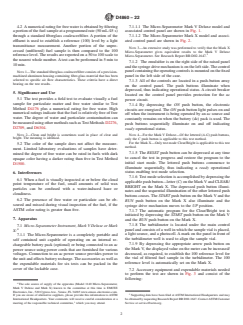
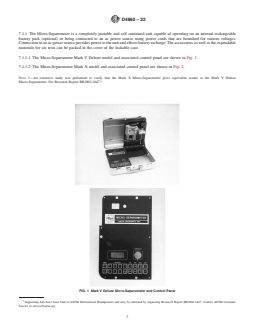
7.1.1.1 The Micro-Separometer Mark V Deluxe model and associated control panel are shown in Fig. 1.
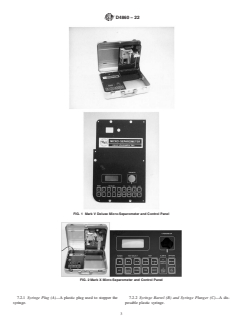
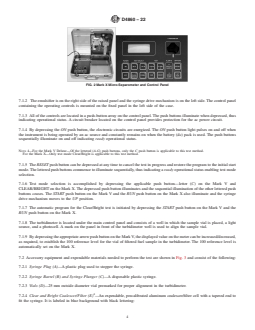
7.1.1.2 The Micro-Separometer Mark X model and associated control panel are shown in Fig. 2.
NOTE 3—An extensive study was performed to verify that the Mark X Micro-Separometer gives equivalent results to the Mark V Deluxe
Micro-Separometer. See Research Report RR:D02-1647.
FIG. 1 Mark V Deluxe Micro-Separometer and Control Panel
Supporting data have been filed at ASTM International Headquarters and may be obtained by requesting Research Report RR:D02-1647. Contact ASTM Customer
Service at service@astm.org.
D4860 − 22
FIG. 2 Mark X Micro-Separometer and Control Panel
7.1.2 The emulsifier is on the right side of the raised panel and the syringe drive mechanism is on the left side. The control panel
containing the operating controls is mounted on the fixed panel in the left side of the case.
7.1.3 All of the controls are located in a push-button array on the control panel. The push buttons illuminate when depressed, thus
indicating operational status. A circuit breaker located on the control panel provides protection for the ac power circuit.
7.1.4 By depressing the ON push button, the electronic circuits are energized. The ON push button light pulses on and off when
the instrument is being operated by an ac source and constantly remains on when the battery (dc) pack is used. The push buttons
sequentially illuminate on and off indicating ready operational status.
NOTE 4—For the Mark V Deluxe—Of the lettered (A-G) push buttons, only the C push button is applicable to this test method.
For the Mark X—Only test mode Clear/Bright is applicable to this test method.
7.1.5 The RESET push button can be depressed at any time to cancel the test in progress and restore the program to the initial start
mode. The lettered push buttons commence to illuminate sequentially, thus indicating a ready operational status enabling test mode
selection.
7.1.6 Test mode selection is accomplished by depressing the applicable push button—letter (C) on the Mark V and
CLEAR/BRIGHT on the Mark X. The depressed push button illuminates and the sequential illumination of the other lettered push
buttons ceases. The START push button on the Mark V and the RUN push button on the Mark X also illuminate and the syringe
drive mechanism moves to the UP position.
7.1.7 The automatic program for the Clear/Bright test is initiated by depressing the START push button on the Mark V and the
RUN push button on the Mark X.
7.1.8 The turbidimeter is located under the main control panel and consists of a well in which the sample vial is placed, a light
source, and a photocell. A mark on the panel in front of the turbidimeter well is used to align the sample vial.
7.1.9 By depressing the appropriate arrow push button on the Mark V, the displayed value on the meter can be increased/decreased,
as required, to establish the 100 reference level for the vial of filtered fuel sample in the turbidimeter. The 100 reference level is
automatically set on the Mark X.
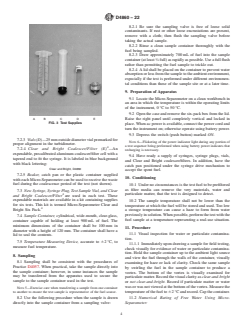
7.2 Accessory equipment and expendable materials needed to perform the test are shown in Fig. 3 and consist of the following:
7.2.1 Syringe Plug (A)—A plastic plug used to stopper the syringe.
7.2.2 Syringe Barrel (B) and Syringe Plunger (C)—A disposable plastic syringe.
7.2.3 Vials (D)—25 mm outside diameter vial premarked for proper alignment in the turbidimeter.
7.2.4 Clear and Bright Coalescer/Filter (E) —An expendable, precalibrated aluminum coalescer/filter cell with a tapered end to
fit the syringe. It is labeled in blue background with black lettering:
D4860 − 22
A B C D E
FIG. 3 Test Supplies
Clear and Bright, D4860
7.2.5 Beaker, catch pan or the plastic container supplied with each Micro-Separometer can be used to receive the waste fuel during
the coalescence period of the test (not shown).
7.3 New Syringe, Syringe Plug, Test Sample Vial, and Clear and Bright Coalescer/Filter are used in each test. These expendable
materials are available in a kit containing supplies for six tests. This kit is termed Micro-Separometer Clear and Bright Six Pack.
7.4 Sample Container, cylindrical, wide-mouth, clear-glass, container capable of holding at least 900 mL of fuel. The minimum
dimensions of the container shall be 100 mm in diameter with a height of 120 mm. The container shall have a lid to seal the
contents.
7.5 Temperature Measuring Device, accurate to 62 °C, to measure fuel temperature.
8. Sampling
8.1 Sampling shall be consistent with the procedures of Practice D4057. When practical, take the sample directly into the sample
container; however, in some instances the sample may be transferred from the apparatus used to secure the sample to the sample
container used in the test.
NOTE 5—Exercise care when transferring a sample from one container to another to ensure the test sample is representative of the fuel source.
8.2 Use the following procedure when the sample is drawn directly into the sample container from a sampling valve:
8.2.1 Be sure the sampling valve is free of loose solid contaminants. If rust or other loose encrustations are present, remove with
a cloth; then flush the sampling valve before taking the actual sample.
8.2.2 Ri
...