


ASTM D1003-21
(Test Method)Standard Test Method for Haze and Luminous Transmittance of Transparent Plastics
Standard Test Method for Haze and Luminous Transmittance of Transparent Plastics
SIGNIFICANCE AND USE
4.1 Light that is scattered upon passing through a film or sheet of a material can produce a hazy or smoky field when objects are viewed through the material. Another effect can be veiling glare, as occurs in an automobile windshield when driving into the sun.
4.2 Although haze measurements are made most commonly by the use of a hazemeter, a spectrophotometer may be used, provided that it meets the geometric and spectral requirements of Section 5. The use of a spectrophotometer for haze measurement of plastics can provide valuable diagnostic data on the origin of the haze,4 and Procedure B is devoted to the use of a spectrophotometer.
4.2.1 Procedure A (hazemeter) test values are normally slightly higher and less variable than Procedure B (spectrophotometer) test values.
4.3 Regular luminous transmittance is obtained by placing a clear specimen at some distance from the entrance port of the integrating sphere. However, when the specimen is hazy, the total hemispherical luminous transmittance must be measured by placing the specimen at the entrance port of the sphere. The measured total hemispherical luminous transmittance will be greater than the regular luminous transmittance, depending on the optical properties of the sample. With this test method, the specimen is necessarily placed at the entrance port of the sphere in order to measure haze and total hemispherical luminous transmittance.
4.4 Haze data representative of the material may be obtained by avoiding heterogeneous surface or internal defects not characteristic of the material.
4.5 Haze and luminous-transmittance data are especially useful for quality control and specification purposes.
4.6 Before proceeding with this test method, reference should be made to the specification of the material being tested. Any test specimen preparation, conditioning, dimensions, or testing parameters, or combination thereof, covered in the materials specification shall take precedence over those mentioned...
SCOPE
1.1 This test method covers the evaluation of specific light-transmitting and wide-angle-light-scattering properties of planar sections of materials such as essentially transparent plastic. Two procedures are provided for the measurement of luminous transmittance and haze. Procedure A uses a hazemeter as described in Section 5 and Procedure B uses a spectrophotometer as described in Section 8. Material having a haze value greater than 30 % is considered diffusing and should be tested in accordance with Practice E2387.
1.2 The values stated in SI units are to be regarded as standard.
Note 1: For greater discrimination among materials that scatter a high percent of light within a narrow forward angle, such as is the case with abraded transparent plastics, adjust the hazemeter and perform measurements in accordance with Test Method D1044.
1.3 This standard does not purport to address all of the safety concerns, if any, associated with its use. It is the responsibility of the user of this standard to establish appropriate safety, health, and environmental practices and determine the applicability of regulatory limitations prior to use.
Note 2: This test method is not equivalent to ISO 13468-1 and ISO/DIS 14782.
1.4 This international standard was developed in accordance with internationally recognized principles on standardization established in the Decision on Principles for the Development of International Standards, Guides and Recommendations issued by the World Trade Organization Technical Barriers to Trade (TBT) Committee.
General Information
- Status
- Published
- Publication Date
- 30-Apr-2021
- Technical Committee
- D20 - Plastics
- Drafting Committee
- D20.40 - Optical Properties
Relations
- Effective Date
- 01-Feb-2024
- Effective Date
- 01-Nov-2023
- Effective Date
- 01-Jan-2020
- Effective Date
- 01-Nov-2019
- Effective Date
- 01-Sep-2019
- Effective Date
- 01-Aug-2019
- Effective Date
- 15-Apr-2019
- Effective Date
- 01-Feb-2019
- Effective Date
- 01-Dec-2018
- Effective Date
- 01-Nov-2018
- Refers
ASTM E2935-17 - Standard Practice for Conducting Equivalence Testing in Laboratory Applications - Effective Date
- 01-Oct-2017
- Effective Date
- 15-Aug-2017
- Refers
ASTM E2935-16 - Standard Practice for Conducting Equivalence Testing in Laboratory Applications - Effective Date
- 15-Nov-2016
- Effective Date
- 01-Nov-2015
- Refers
ASTM E2935-15 - Standard Practice for Conducting Equivalence Testing in Laboratory Applications - Effective Date
- 01-Oct-2015
Overview
ASTM D1003-21 is a widely recognized standard test method developed by ASTM International for evaluating the haze and luminous transmittance (clarity) of transparent plastics. It outlines two procedures for determining key optical properties of plastics that affect how clearly objects can be seen through them and how much light is transmitted. These measurements are crucial in quality control, specification, and product development for a broad range of industries reliant on transparent plastic materials.
Key Topics
- Haze Measurement: Haze refers to the scattering of light as it passes through plastic, which reduces clarity and can create a hazy or smoky appearance. Excessive haze may also cause undesirable effects like veiling glare.
- Luminous Transmittance: This measures the amount of visible light passing directly through a material, indicating its transparency. High luminous transmittance is often desirable for optical or display applications.
- Test Procedures:
- Procedure A utilizes a hazemeter, offering results that are typically slightly higher and less variable.
- Procedure B uses a spectrophotometer, which can yield valuable insights into the cause of haze and supports diagnostic analysis.
- Material Classification: Plastics with a haze value exceeding 30% are considered "diffusing" and require different testing practices.
- Sample Preparation & Conditioning: The standard emphasizes strict requirements for specimen preparation, cleanliness, and conditioning to ensure representative and repeatable test results.
- Precision and Reproducibility: Includes guidelines for ensuring test repeatability within and between laboratories.
Applications
This standard is essential for manufacturers, suppliers, and quality assurance professionals involved in the production and assessment of transparent plastic materials. Typical applications and use cases include:
- Quality Control: Routine testing to verify that materials meet established haze and light transmission criteria for consistent product quality.
- Specification Compliance: Ensuring materials comply with client or regulatory demands for optical clarity, such as in automotive windshields, packaging films, glazing, and electronic displays.
- Product Development: Assessing new materials, coatings, or processing methods to control and improve optical transparency and minimize unwanted haze.
- Root Cause Analysis: Identifying underlying causes of optical defects, like surface abrasion, contamination, or internal inclusions, by using both test methods for deep diagnostic insight.
- Performance Categorization: Segregating materials into categories such as "clear," "translucent," or "diffusing" based on quantitative haze values.
Related Standards
In conjunction with ASTM D1003-21, the following standards offer complementary procedures and definitions for optical testing of plastics:
- ASTM D618: Practice for Conditioning Plastics for Testing
- ASTM D883: Terminology Relating to Plastics
- ASTM D1044: Test Method for Resistance of Transparent Plastics to Surface Abrasion by the Taber Abraser
- ASTM E284: Terminology of Appearance
- ASTM E691: Practice for Conducting an Interlaboratory Study to Determine the Precision of a Test Method
- ASTM E2387: Practice for Goniometric Optical Scatter Measurements (specifically for high-haze/diffusing materials)
- ISO 13468-1: Plastics - Determination of Total Luminous Transmittance of Transparent Materials
- ISO 14782: Plastics - Determination of Haze of Transparent Materials
By adhering to ASTM D1003-21, stakeholders ensure accurate, consistent quantification of the optical performance of transparent plastics, supporting product reliability, regulatory compliance, and innovation in sectors where optimal visual quality is essential. This standard remains a cornerstone of optical plastics testing in international commerce and manufacturing.
Buy Documents
ASTM D1003-21 - Standard Test Method for Haze and Luminous Transmittance of Transparent Plastics
REDLINE ASTM D1003-21 - Standard Test Method for Haze and Luminous Transmittance of Transparent Plastics
Get Certified
Connect with accredited certification bodies for this standard

Smithers Quality Assessments
US management systems and product certification.

DIN CERTCO
DIN Group product certification.
Sponsored listings
Frequently Asked Questions
ASTM D1003-21 is a standard published by ASTM International. Its full title is "Standard Test Method for Haze and Luminous Transmittance of Transparent Plastics". This standard covers: SIGNIFICANCE AND USE 4.1 Light that is scattered upon passing through a film or sheet of a material can produce a hazy or smoky field when objects are viewed through the material. Another effect can be veiling glare, as occurs in an automobile windshield when driving into the sun. 4.2 Although haze measurements are made most commonly by the use of a hazemeter, a spectrophotometer may be used, provided that it meets the geometric and spectral requirements of Section 5. The use of a spectrophotometer for haze measurement of plastics can provide valuable diagnostic data on the origin of the haze,4 and Procedure B is devoted to the use of a spectrophotometer. 4.2.1 Procedure A (hazemeter) test values are normally slightly higher and less variable than Procedure B (spectrophotometer) test values. 4.3 Regular luminous transmittance is obtained by placing a clear specimen at some distance from the entrance port of the integrating sphere. However, when the specimen is hazy, the total hemispherical luminous transmittance must be measured by placing the specimen at the entrance port of the sphere. The measured total hemispherical luminous transmittance will be greater than the regular luminous transmittance, depending on the optical properties of the sample. With this test method, the specimen is necessarily placed at the entrance port of the sphere in order to measure haze and total hemispherical luminous transmittance. 4.4 Haze data representative of the material may be obtained by avoiding heterogeneous surface or internal defects not characteristic of the material. 4.5 Haze and luminous-transmittance data are especially useful for quality control and specification purposes. 4.6 Before proceeding with this test method, reference should be made to the specification of the material being tested. Any test specimen preparation, conditioning, dimensions, or testing parameters, or combination thereof, covered in the materials specification shall take precedence over those mentioned... SCOPE 1.1 This test method covers the evaluation of specific light-transmitting and wide-angle-light-scattering properties of planar sections of materials such as essentially transparent plastic. Two procedures are provided for the measurement of luminous transmittance and haze. Procedure A uses a hazemeter as described in Section 5 and Procedure B uses a spectrophotometer as described in Section 8. Material having a haze value greater than 30 % is considered diffusing and should be tested in accordance with Practice E2387. 1.2 The values stated in SI units are to be regarded as standard. Note 1: For greater discrimination among materials that scatter a high percent of light within a narrow forward angle, such as is the case with abraded transparent plastics, adjust the hazemeter and perform measurements in accordance with Test Method D1044. 1.3 This standard does not purport to address all of the safety concerns, if any, associated with its use. It is the responsibility of the user of this standard to establish appropriate safety, health, and environmental practices and determine the applicability of regulatory limitations prior to use. Note 2: This test method is not equivalent to ISO 13468-1 and ISO/DIS 14782. 1.4 This international standard was developed in accordance with internationally recognized principles on standardization established in the Decision on Principles for the Development of International Standards, Guides and Recommendations issued by the World Trade Organization Technical Barriers to Trade (TBT) Committee.
SIGNIFICANCE AND USE 4.1 Light that is scattered upon passing through a film or sheet of a material can produce a hazy or smoky field when objects are viewed through the material. Another effect can be veiling glare, as occurs in an automobile windshield when driving into the sun. 4.2 Although haze measurements are made most commonly by the use of a hazemeter, a spectrophotometer may be used, provided that it meets the geometric and spectral requirements of Section 5. The use of a spectrophotometer for haze measurement of plastics can provide valuable diagnostic data on the origin of the haze,4 and Procedure B is devoted to the use of a spectrophotometer. 4.2.1 Procedure A (hazemeter) test values are normally slightly higher and less variable than Procedure B (spectrophotometer) test values. 4.3 Regular luminous transmittance is obtained by placing a clear specimen at some distance from the entrance port of the integrating sphere. However, when the specimen is hazy, the total hemispherical luminous transmittance must be measured by placing the specimen at the entrance port of the sphere. The measured total hemispherical luminous transmittance will be greater than the regular luminous transmittance, depending on the optical properties of the sample. With this test method, the specimen is necessarily placed at the entrance port of the sphere in order to measure haze and total hemispherical luminous transmittance. 4.4 Haze data representative of the material may be obtained by avoiding heterogeneous surface or internal defects not characteristic of the material. 4.5 Haze and luminous-transmittance data are especially useful for quality control and specification purposes. 4.6 Before proceeding with this test method, reference should be made to the specification of the material being tested. Any test specimen preparation, conditioning, dimensions, or testing parameters, or combination thereof, covered in the materials specification shall take precedence over those mentioned... SCOPE 1.1 This test method covers the evaluation of specific light-transmitting and wide-angle-light-scattering properties of planar sections of materials such as essentially transparent plastic. Two procedures are provided for the measurement of luminous transmittance and haze. Procedure A uses a hazemeter as described in Section 5 and Procedure B uses a spectrophotometer as described in Section 8. Material having a haze value greater than 30 % is considered diffusing and should be tested in accordance with Practice E2387. 1.2 The values stated in SI units are to be regarded as standard. Note 1: For greater discrimination among materials that scatter a high percent of light within a narrow forward angle, such as is the case with abraded transparent plastics, adjust the hazemeter and perform measurements in accordance with Test Method D1044. 1.3 This standard does not purport to address all of the safety concerns, if any, associated with its use. It is the responsibility of the user of this standard to establish appropriate safety, health, and environmental practices and determine the applicability of regulatory limitations prior to use. Note 2: This test method is not equivalent to ISO 13468-1 and ISO/DIS 14782. 1.4 This international standard was developed in accordance with internationally recognized principles on standardization established in the Decision on Principles for the Development of International Standards, Guides and Recommendations issued by the World Trade Organization Technical Barriers to Trade (TBT) Committee.
ASTM D1003-21 is classified under the following ICS (International Classification for Standards) categories: 83.140.99 - Other rubber and plastics products. The ICS classification helps identify the subject area and facilitates finding related standards.
ASTM D1003-21 has the following relationships with other standards: It is inter standard links to ASTM D883-24, ASTM D883-23, ASTM D883-20, ASTM E2387-19, ASTM D1044-19, ASTM D883-19c, ASTM D883-19a, ASTM D883-19, ASTM D883-18a, ASTM D883-18, ASTM E2935-17, ASTM D883-17, ASTM E2935-16, ASTM E259-06(2015), ASTM E2935-15. Understanding these relationships helps ensure you are using the most current and applicable version of the standard.
ASTM D1003-21 is available in PDF format for immediate download after purchase. The document can be added to your cart and obtained through the secure checkout process. Digital delivery ensures instant access to the complete standard document.
Standards Content (Sample)
This international standard was developed in accordance with internationally recognized principles on standardization established in the Decision on Principles for the
Development of International Standards, Guides and Recommendations issued by the World Trade Organization Technical Barriers to Trade (TBT) Committee.
Designation: D1003 − 21
Standard Test Method for
Haze and Luminous Transmittance of Transparent Plastics
This standard is issued under the fixed designation D1003; the number immediately following the designation indicates the year of
original adoption or, in the case of revision, the year of last revision.Anumber in parentheses indicates the year of last reapproval.A
superscript epsilon (´) indicates an editorial change since the last revision or reapproval.
This standard has been approved for use by agencies of the U.S. Department of Defense.
This test method replaces Method 3022 of Federal Test Method Standard 406.
1. Scope* D883Terminology Relating to Plastics
D1044TestMethodforResistanceofTransparentPlasticsto
1.1 This test method covers the evaluation of specific
Surface Abrasion by the Taber Abraser
light-transmitting and wide-angle-light-scattering properties of
E259Practice for Preparation of Pressed Powder White
planar sections of materials such as essentially transparent
Reflectance Factor Transfer Standards for Hemispherical
plastic. Two procedures are provided for the measurement of
and Bi-Directional Geometries
luminous transmittance and haze. ProcedureAuses a hazeme-
E284Terminology of Appearance
ter as described in Section 5 and Procedure B uses a spectro-
E691Practice for Conducting an Interlaboratory Study to
photometer as described in Section 8. Material having a haze
Determine the Precision of a Test Method
value greater than 30% is considered diffusing and should be
E2387Practice for Goniometric Optical Scatter Measure-
tested in accordance with Practice E2387.
ments
1.2 The values stated in SI units are to be regarded as
E2935Practice for Conducting Equivalence Tests for Com-
standard.
paring Testing Processes
NOTE1—Forgreaterdiscriminationamongmaterialsthatscatterahigh 3
2.2 ISO Standards:
percent of light within a narrow forward angle, such as is the case with
ISO 13468-1Plastics—Determination of the Total Lumi-
abraded transparent plastics, adjust the hazemeter and perform measure-
nous Transmittance of Transparent Materials
ments in accordance with Test Method D1044.
ISO/DIS 14782Plastics—Determination of Haze of Trans-
1.3 This standard does not purport to address all of the
parent Materials
safety concerns, if any, associated with its use. It is the
responsibility of the user of this standard to establish appro-
3. Terminology
priate safety, health, and environmental practices and deter-
3.1 Definitions—Terms applicable to this test method are
mine the applicability of regulatory limitations prior to use.
defined in Terminologies D883 and E284.
NOTE 2—This test method is not equivalent to ISO 13468-1 and
3.2 Definitions of Terms Specific to This Standard:
ISO/DIS 14782.
3.2.1 haze, n—in transmission, the scattering of light by a
1.4 This international standard was developed in accor-
specimen responsible for the reduction in contrast of objects
dance with internationally recognized principles on standard-
viewed through it. The percent of transmitted light that is
ization established in the Decision on Principles for the
scattered so that its direction deviates more than a specified
Development of International Standards, Guides and Recom-
angle from the direction of the incident beam.
mendations issued by the World Trade Organization Technical
3.2.1.1 Discussion—In this test method, the specified angle
Barriers to Trade (TBT) Committee.
is 0.044 rad (2.5°).
2. Referenced Documents
3.2.2 luminous, adj—weighted according to the spectral
2.1 ASTM Standards: luminous efficiency function V(λ) of the CIE (1987).
D618Practice for Conditioning Plastics for Testing
3.2.3 luminous transmittance, n—the ratio of the luminous
flux transmitted by a body to the flux incident upon it.
ThistestmethodisunderthejurisdictionofASTMCommitteeD20onPlastics
4. Significance and Use
and is the direct responsibility of Subcommittee D20.40 on Optical Properties.
Current edition approved May 1, 2021. Published June 2021. Originally
4.1 Light that is scattered upon passing through a film or
approved in 1949. Last previous edition approved in 2013 as D1003-13. DOI:
sheet of a material can produce a hazy or smoky field when
10.1520/D1003-21.
For referenced ASTM standards, visit the ASTM website, www.astm.org, or
contact ASTM Customer Service at service@astm.org. For Annual Book of ASTM
Standards volume information, refer to the standard’s Document Summary page on Available fromAmerican National Standards Institute (ANSI), 25 W. 43rd St.,
the ASTM website. 4th Floor, New York, NY 10036, http://www.ansi.org.
*A Summary of Changes section appears at the end of this standard
Copyright ©ASTM International, 100 Barr Harbor Drive, PO Box C700, West Conshohocken, PA19428-2959. United States
D1003 − 21
objects are viewed through the material.Another effect can be 5.3 Prepare three specimens to test each sample of a given
veiling glare, as occurs in an automobile windshield when material unless specified otherwise in the applicable material
driving into the sun. specification.
NOTE 3—Specimen type and preparation can influence the actual haze
4.2 Althoughhazemeasurementsaremademostcommonly
of the materials being tested.
by the use of a hazemeter, a spectrophotometer may be used,
provided that it meets the geometric and spectral requirements
6. Conditioning
of Section 5. The use of a spectrophotometer for haze mea-
6.1 Conditioning—Unless otherwise required in the appro-
surement of plastics can provide valuable diagnostic data on
priate materials specification or agreed between customer/
the origin of the haze, and Procedure B is devoted to the use
supplier, condition the test specimens at 23 6 2°C (73.4 6
of a spectrophotometer.
3.6°F) and 50 6 10% relative humidity for not less than 40 h
4.2.1 Procedure A (hazemeter) test values are normally
priortotest,inaccordancewithProcedureAofPracticeD618.
slightlyhigherandlessvariablethanProcedureB(spectropho-
In case of disagreements, the tolerances shall be 61°C (1.8°F)
tometer) test values.
and 65% relative humidity.
4.3 Regularluminoustransmittanceisobtainedbyplacinga
6.2 Test Conditions—Set up the test apparatus in an atmo-
clear specimen at some distance from the entrance port of the
sphere maintained at 23 6 2°C (73.4 6 3.6°F) and 50 6 10%
integrating sphere. However, when the specimen is hazy, the
relative humidity.
total hemispherical luminous transmittance must be measured
byplacingthespecimenattheentranceportofthesphere.The
7. Procedure A—Hazemeter
measured total hemispherical luminous transmittance will be
7.1 Apparatus:
greater than the regular luminous transmittance, depending on
7.1.1 The instrument used for measurement shall meet the
the optical properties of the sample. With this test method, the
5,6
geometric and spectral requirements of this section.
specimen is necessarily placed at the entrance port of the
7.1.2 A light source and a photodetector shall be supplied,
sphere in order to measure haze and total hemispherical
and the combination shall be filtered to provide an output
luminous transmittance.
corresponding to the luminosity response of the 1931 CIE
4.4 Haze data representative of the material may be ob- Standard Colorimetric Observer with CIE Standard Illuminant
C or, alternatively, Illuminant A. The output shall be propor-
tained by avoiding heterogeneous surface or internal defects
not characteristic of the material. tional to within 1% to the incident flux over the range of flux
used.Thephotometricstabilityforsourceanddetectormustbe
4.5 Haze and luminous-transmittance data are especially
constant throughout the test of each specimen.
useful for quality control and specification purposes.
7.1.3 Use an integrating sphere to collect transmitted flux;
4.6 Before proceeding with this test method, reference the sphere may be of any diameter as long as the total port
areas do not exceed 4.0% of the internal reflecting area of the
shouldbemadetothespecificationofthematerialbeingtested.
Any test specimen preparation, conditioning, dimensions, or sphere. The entrance and exit ports shall be centered on the
same great circle of the sphere, and there shall be at least 2.97
testing parameters, or combination thereof, covered in the
materials specification shall take precedence over those men- rad (170°) of arc between centers. The exit port shall subtend
anangleof0.14rad(8°)atthecenteroftheentranceport.With
tioned in this test method. If there are no material
specifications, then the default conditions apply. the light trap in position, without the specimen, the axis of the
irradiating beam shall pass through the centers of the entrance
and exit ports. For a hazemeter, position the photocell or
5. Test Specimens
photocells on the sphere 1.57 6 0.17 rad (90 6 10°) from the
5.1 Sampling shall be statistically adequate to ensure that
entrance port and baffle it from direct exposure to the entrance
the specimens were obtained and produced by a process in
port. In the pivotable modification where the interior wall
statisticalcontrol.Obtainspecimensthatarefreeofdefectsnot
adjacenttotheexitportisusedasthereflectancereference,the
characteristic of the material unless such defects constitute
angle of rotation of the sphere shall be 0.140 6 0.008 rad (8.0
variables under study.
6 0.5°).
7.1.4 Illuminate the specimen by a substantially unidirec-
5.2 Cut each test specimen to a size large enough to cover
tionalbeam;themaximumanglethatanyrayofthisbeammay
the entrance port of the sphere. A disk 50 mm (2 in.) in
make with the beam axis shall not exceed 0.05 rad (3°). This
diameter, or a square with sides of the same dimensions, is
beam shall not be vignetted at either port of the sphere.
suggested.Thespecimenshallhavesubstantiallyplane-parallel
7.1.5 Whenthespecimenisplacedagainsttheentranceport
surfaces free of dust, grease, scratches, and blemishes, and it
of the integrating sphere, the angle between the perpendicular
shall be free of visibly distinct internal voids and particles,
unless it is specifically desired to measure the contribution to
haze due to these imperfections.
Thesolesourceofsupplyofthehazemeterknowntothecommitteeatthistime
is BYK-Gardner USA 9104 Guilford Road Columbia, MD 21046.
If you are aware of alternative suppliers, please provide this information to
Billmeyer, F. W., Jr., and Chen, Y., “On the Measurement of Haze,” Color ASTM International Headquarters. Your comments will receive careful consider-
Research and Application, Vol 10, 1985, pp. 219–224. ation at a meeting of the responsible technical committee, which you may attend.
D1003 − 21
7.2 Procedure:
7.2.1 Determine the following four readings:
Reflectance
Reading Specimen Light Trap
Standard Quantity Represented
Designation in Position in Position
in Position
T no no yes incident light
T yes no yes total light transmitted by
specimen
T no yes no light scattered by instru-
ment
T yes yes no light scattered by instru-
ment and specimen
7.2.2 Repeat readings for T ,T ,T , and T with additional
1 2 3 4
specified positions of the specimen to determine uniformity.
7.3 Calculation :
7.3.1 Calculate total transmittance, T (Note 6), equal to
t
T /T .
2 1
FIG. 1 Schematic of Hazemeter
7.3.2 Calculate diffuse transmittance, T (Note 6), as fol-
d
lows:
to the specimen and a line connecting the centers of entrance
T 5 @T 2 T ~T /T !#/T (1)
d 4 3 2 1 1
and exit ports shall not exceed 0.14 rad (8°).
7.3.3 Calculate percent haze as follows:
7.1.6 When the beam is unobstructed by a specimen, its
haze 5 T /T 3100 (2)
cross section at the exit port shall be approximately circular, d t
NOTE 6—To obtain the greatest accuracy in luminous transmittance
sharply defined, and concentric within the exit port, leaving an
measurement when using a single-beam instrument, it is necessary to use
annulus of 0.023 6 0.002 rad (1.3 6 0.1°) subtended at the
astandard,calibratedwithadouble-beaminstrument,becauseinsertionof
entrance port.
the sample in the single-beam instrument changes the efficiency of the
sphere. This change may result in spuriously high readings for clear,
NOTE 4—It is important to verify whether the unobstructed-beam
colorlesssamplesandsignificanterrorsfordarkorhighlysaturatedcolors.
diameter and centering at the exit port are maintained, especially if the
In these cases, the photometer should be used as a comparison instrument
source aperture and focus are changed.
with a standard of known transmittance similar to that of the specimen.
NOTE 5—The tolerance stated on the annulus of 0.002 rad (0.1°)
For greatest accuracy of luminous transmittance measurement, compare
corresponds to an uncertainty of 60.6% in a haze reading. This is
the transmittance of the specimen with that of a calibrated standard of
relevant for assessing the precision and bias of this test method.
similar luminous transmittance.
7.1.7 The surfaces of the interior of the integrating sphere,
7.4 Report:
baffles, and reflectance standard, if used, shall be of equal
7.4.1 Report the following data:
reflectance, matte, and highly reflecting throughout the visible
7.4.1.1 Source and identity of specimen,
spectrum.
7.4.1.2 Nominalthicknessofspecimentothenearest0.0025
7.1.8 Alighttrapshallbeprovidedthatwillabsorbthebeam
mmorbetterforspecimenslessthan0.25mminthicknessand
completely when no specimen is present, or the instrument
to the nearest 0.025 mm or better for specimens greater than
design shall obviate the need for a light trap.
0.25 mm in thickness,
7.1.9 Aschematicdrawingoftheopticsofahazemeterwith
7.4.1.3 Total luminous transmittance, T, to the nearest
t
unidirectional illumination and diffuse viewing is shown in
0.1%(indicatetheaveragewhenreportingaveragevaluesand
Fig. 1.
specify whether CIE Illuminant C or A is used),
7.1.10 A series of calibrated haze standards is required for
7.4.1.4 Diffuse luminous transmittance, T , to the nearest
d
periodic verification of the accuracy of instrumental response.
0.1% (indicate the average when reporting average values),
Ideally, if the haze of narrow-angle-scattering specimens (such
and
as plastic films) is to be measured, narrow-angle-scattering
7.4.1.5 Percent haze, to the nearest 0.1% (indicate the
5,7
glass standards should be used; however, these are not
average when reporting average values).
known to be commercially available. In their absence, wide-
9,6
7.5 Precision and Bias—Hazemeter:
angle-plastic standards may be used, but these are less
7.5.1 Precision :
sensitive to the size and centering of the annulus described by
4 8
7.5.1.1 Table 1 and Table 2 are based on a round robin
Billmeyer and Chen and Weidner and Hsia, and particular
conducted in 1985, in accordance with Practice E691, involv-
attention should be paid to Note 1 when only plastic haze
ing six film materials tested by 11 laboratories. In the round
standards are used.
robin, each laboratory that measured a property made eight
replicate measurements of the property for each of the six
Weidner, V. R., and Hsia, J. J., “NBS Reference Hazemeter: Its Development
materials listed as 1 to 6 in Table 1 and Table 2.
and Testing,” Applied Optics, Vol 18, 1979, pp. 1619–1626.
Highly reflective matte barium sulfate paint or pressed polytetrafluoroethylene
powder are excellent for this purpose. See Practice E259.
9 10
The sole source of supply of the calibrated plastic haze standards known to the See Appendix X1 for derivation of formulas.
committee at this time is BYK-Gardner USA 9104 Guilford Road Columbia, MD Suppor
...
This document is not an ASTM standard and is intended only to provide the user of an ASTM standard an indication of what changes have been made to the previous version. Because
it may not be technically possible to adequately depict all changes accurately, ASTM recommends that users consult prior editions as appropriate. In all cases only the current version
of the standard as published by ASTM is to be considered the official document.
Designation: D1003 − 13 D1003 − 21
Standard Test Method for
Haze and Luminous Transmittance of Transparent Plastics
This standard is issued under the fixed designation D1003; the number immediately following the designation indicates the year of
original adoption or, in the case of revision, the year of last revision. A number in parentheses indicates the year of last reapproval. A
superscript epsilon (´) indicates an editorial change since the last revision or reapproval.
This standard has been approved for use by agencies of the U.S. Department of Defense.
This test method replaces Method 3022 of Federal Test Method Standard 406.
1. Scope*
1.1 This test method covers the evaluation of specific light-transmitting and wide-angle-light-scattering properties of planar
sections of materials such as essentially transparent plastic. Two procedures are provided for the measurement of luminous
transmittance and haze. Procedure A uses a hazemeter as described in Section 5 and Procedure B uses a spectrophotometer as
described in Section 8. Material having a haze value greater than 30 % is considered diffusing and should be tested in accordance
with Practice E2387.
1.2 The values stated in SI units are to be regarded as standard.
NOTE 1—For greater discrimination among materials that scatter a high percent of light within a narrow forward angle, such as is the case with abraded
transparent plastics, adjust the hazemeter and perform measurements in accordance with Test Method D1044.
1.3 This standard does not purport to address all of the safety concerns, if any, associated with its use. It is the responsibility
of the user of this standard to establish appropriate safety safety, health, and healthenvironmental practices and determine the
applicability of regulatory limitations prior to use.
NOTE 2—This test method is not equivalent to ISO 13468-1 and ISO/DIS 14782.
1.4 This international standard was developed in accordance with internationally recognized principles on standardization
established in the Decision on Principles for the Development of International Standards, Guides and Recommendations issued
by the World Trade Organization Technical Barriers to Trade (TBT) Committee.
2. Referenced Documents
2.1 ASTM Standards:
D618 Practice for Conditioning Plastics for Testing
D883 Terminology Relating to Plastics
D1044 Test Method for Resistance of Transparent Plastics to Surface Abrasion by the Taber Abraser
E259 Practice for Preparation of Pressed Powder White Reflectance Factor Transfer Standards for Hemispherical and
Bi-Directional Geometries
E284 Terminology of Appearance
E691 Practice for Conducting an Interlaboratory Study to Determine the Precision of a Test Method
E2387 Practice for Goniometric Optical Scatter Measurements
This test method is under the jurisdiction of ASTM Committee D20 on Plastics and is the direct responsibility of Subcommittee D20.40 on Optical Properties.
Current edition approved Nov. 15, 2013May 1, 2021. Published November 2013June 2021. Originally approved in 1949. Last previous edition approved in 20112013 as
ε1
D1003 - 11D1003 - 13. . DOI: 10.1520/D1003-13.10.1520/D1003-21.
For referenced ASTM standards, visit the ASTM website, www.astm.org, or contact ASTM Customer Service at service@astm.org. For Annual Book of ASTM Standards
volume information, refer to the standard’s Document Summary page on the ASTM website.
*A Summary of Changes section appears at the end of this standard
Copyright © ASTM International, 100 Barr Harbor Drive, PO Box C700, West Conshohocken, PA 19428-2959. United States
D1003 − 21
E2935 Practice for Conducting Equivalence Tests for Comparing Testing Processes
2.2 ISO Standards:
ISO 13468-1 Plastics—Determination of the Total Luminous Transmittance of Transparent Materials
ISO/DIS 14782 Plastics—Determination of Haze of Transparent Materials
3. Terminology
3.1 Definitions—Terms applicable to this test method are defined in Terminologies D883 and E284.
3.2 Definitions of Terms Specific to This Standard:
3.2.1 haze, n—in transmission, the scattering of light by a specimen responsible for the reduction in contrast of objects viewed
through it. The percent of transmitted light that is scattered so that its direction deviates more than a specified angle from the
direction of the incident beam.
3.2.1.1 Discussion—
In this test method, the specified angle is 0.044 rad (2.5°).
3.2.2 luminous, adj—weighted according to the spectral luminous efficiency function V()V(λ) of the CIE (1987).
3.2.3 luminous transmittance, n—the ratio of the luminous flux transmitted by a body to the flux incident upon it.
4. Significance and Use
4.1 Light that is scattered upon passing through a film or sheet of a material can produce a hazy or smoky field when objects are
viewed through the material. Another effect can be veiling glare, as occurs in an automobile windshield when driving into the sun.
4.2 Although haze measurements are made most commonly by the use of a hazemeter, a spectrophotometer may be used, provided
that it meets the geometric and spectral requirements of Section 5. The use of a spectrophotometer for haze measurement of plastics
can provide valuable diagnostic data on the origin of the haze, and Procedure B is devoted to the use of a spectrophotometer.
4.2.1 Procedure A (hazemeter) test values are normally slightly higher and less variable than Procedure B (spectrophotometer) test
values.
4.3 Regular luminous transmittance is obtained by placing a clear specimen at some distance from the entrance port of the
integrating sphere. However, when the specimen is hazy, the total hemispherical luminous transmittance must be measured by
placing the specimen at the entrance port of the sphere. The measured total hemispherical luminous transmittance will be greater
than the regular luminous transmittance, depending on the optical properties of the sample. With this test method, the specimen
is necessarily placed at the entrance port of the sphere in order to measure haze and total hemispherical luminous transmittance.
4.4 Haze data representative of the material may be obtained by avoiding heterogeneous surface or internal defects not
characteristic of the material.
4.5 Haze and luminous-transmittance data are especially useful for quality control and specification purposes.
4.6 Before proceeding with this test method, reference should be made to the specification of the material being tested. Any test
specimen preparation, conditioning, dimensions, or testing parameters, or combination thereof, covered in the materials
specification shall take precedence over those mentioned in this test method. If there are no material specifications, then the default
conditions apply.
5. Test Specimens
5.1 Sampling shall be statistically adequate to ensure that the specimens were obtained and produced by a process in statistical
control. Obtain specimens that are free of defects not characteristic of the material unless such defects constitute variables under
study.
Available from American National Standards Institute (ANSI), 25 W. 43rd St., 4th Floor, New York, NY 10036, http://www.ansi.org.
Billmeyer, F. W., Jr., and Chen, Y., “On the Measurement of Haze,” Color Research and Application, Vol 10, 1985, pp. 219–224.
D1003 − 21
5.2 Cut each test specimen to a size large enough to cover the entrance port of the sphere. A disk 50 mm (2 in.) in diameter, or
a square with sides of the same dimensions, is suggested. The specimen shall have substantially plane-parallel surfaces free of dust,
grease, scratches, and blemishes, and it shall be free of visibly distinct internal voids and particles, unless it is specifically desired
to measure the contribution to haze due to these imperfections.
5.3 Prepare three specimens to test each sample of a given material unless specified otherwise in the applicable material
specification.
NOTE 3—Specimen type and preparation can influence the actual haze of the materials being tested.
6. Conditioning
6.1 Conditioning—Unless otherwise required in the appropriate materials specification or agreed between customer/supplier,
condition the test specimens at 23 6 2°C (73.4 6 3.6°F) and 50 6 10 % relative humidity for not less than 40 h prior to test, in
accordance with Procedure A of Practice D618. In case of disagreements, the tolerances shall be 61°C (1.8°F) and 65 % relative
humidity.
6.2 Test Conditions—Set up the test apparatus in an atmosphere maintained at 23 6 2°C (73.4 6 3.6°F) and 50 6 10 % relative
humidity.
7. Procedure A—Hazemeter
7.1 Apparatus:
5,6
7.1.1 The instrument used for measurement shall meet the geometric and spectral requirements of this section.
7.1.2 A light source and a photodetector shall be supplied, and the combination shall be filtered to provide an output corresponding
to the luminosity response of the 1931 CIE Standard Colorimetric Observer with CIE Standard Illuminant C or, alternatively,
Illuminant A. The output shall be proportional to within 1 % to the incident flux over the range of flux used. The photometric
stability for source and detector must be constant throughout the test of each specimen.
7.1.3 Use an integrating sphere to collect transmitted flux; the sphere may be of any diameter as long as the total port areas do
not exceed 4.0 % of the internal reflecting area of the sphere. The entrance and exit ports shall be centered on the same great circle
of the sphere, and there shall be at least 2.97 rad (170°) of arc between centers. The exit port shall subtend an angle of 0.14 rad
(8°) at the center of the entrance port. With the light trap in position, without the specimen, the axis of the irradiating beam shall
pass through the centers of the entrance and exit ports. For a hazemeter, position the photocell or photocells on the sphere 1.57
6 0.17 rad (90 6 10°) from the entrance port and baffle it from direct exposure to the entrance port. In the pivotable modification
where the interior wall adjacent to the exit port is used as the reflectance reference, the angle of rotation of the sphere shall be 0.140
6 0.008 rad (8.0 6 0.5°).
7.1.4 Illuminate the specimen by a substantially unidirectional beam; the maximum angle that any ray of this beam may make with
the beam axis shall not exceed 0.05 rad (3°). This beam shall not be vignetted at either port of the sphere.
7.1.5 When the specimen is placed against the entrance port of the integrating sphere, the angle between the perpendicular to the
specimen and a line connecting the centers of entrance and exit ports shall not exceed 0.14 rad (8°).
7.1.6 When the beam is unobstructed by a specimen, its cross section at the exit port shall be approximately circular, sharply
defined, and concentric within the exit port, leaving an annulus of 0.023 6 0.002 rad (1.3 6 0.1°) subtended at the entrance port.
NOTE 4—It is important to verify whether the unobstructed-beam diameter and centering at the exit port are maintained, especially if the source aperture
and focus are changed.
The sole source of supply of the hazemeter known to the committee at this time is BYK-Gardner USA 9104 Guilford Road Columbia, MD 21046.
If you are aware of alternative suppliers, please provide this information to ASTM International Headquarters. Your comments will receive careful consideration at a
meeting of the responsible technical committee, which you may attend.
D1003 − 21
FIG. 1 Schematic of Hazemeter
NOTE 5—The tolerance stated on the annulus of 0.002 rad (0.1°) corresponds to an uncertainty of 60.6 % in a haze reading. This is relevant for assessing
the precision and bias of this test method.
7.1.7 The surfaces of the interior of the integrating sphere, baffles, and reflectance standard, if used, shall be of equal reflectance,
matte, and highly reflecting throughout the visible spectrum.
7.1.8 A light trap shall be provided that will absorb the beam completely when no specimen is present, or the instrument design
shall obviate the need for a light trap.
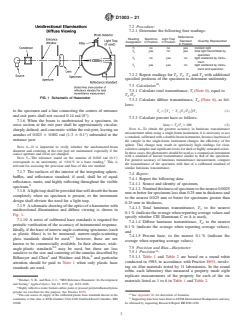
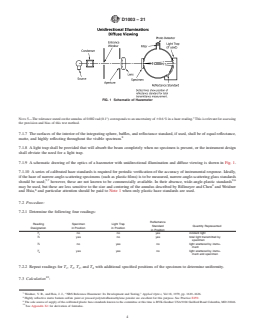
7.1.9 A schematic drawing of the optics of a hazemeter with unidirectional illumination and diffuse viewing is shown in Fig. 1.
7.1.10 A series of calibrated haze standards is required for periodic verification of the accuracy of instrumental response. Ideally,
if the haze of narrow-angle-scattering specimens (such as plastic films) is to be measured, narrow-angle-scattering glass standards
5,7 9,6
should be used; however, these are not known to be commercially available. In their absence, wide-angle-plastic standards
may be used, but these are less sensitive to the size and centering of the annulus described by Billmeyer and Chen and Weidner
and Hsia, and particular attention should be paid to Note 1 when only plastic haze standards are used.
7.2 Procedure:
7.2.1 Determine the following four readings:
Reflectance
Reading Specimen Light Trap
Standard Quantity Represented
Designation in Position in Position
in Position
T no no yes incident light
T yes no yes total light transmitted by
specimen
T no yes no light scattered by instru-
ment
T yes yes no light scattered by instru-
ment and specimen
7.2.2 Repeat readings for T , T , T , and T with additional specified positions of the specimen to determine uniformity.
1 2 3 4
7.3 Calculation :
Weidner, V. R., and Hsia, J. J., “NBS Reference Hazemeter: Its Development and Testing,” Applied Optics, Vol 18, 1979, pp. 1619–1626.
Highly reflective matte barium sulfate paint or pressed polytetrafluoroethylene powder are excellent for this purpose. See Practice E259.
The sole source of supply of the calibrated plastic haze standards known to the committee at this time is BYK-Gardner USA 9104 Guilford Road Columbia, MD 21046.
See Appendix X1 for derivation of formulas.
D1003 − 21
TABLE 1 Summary of 1985 Procedure A (Hazemeter) Total Haze
Round Robin Involving Eleven Laboratories
Material Average S(r) S(R) r R
3 3.8 0.10 0.33 0.28 0.94
1 8.7 0.18 0.42 0.50 1.18
2 13.5 0.08 0.40 0.23 1.12
4 18.0 0.27 0.61 0.76 1.72
5 21.0 0.41 1.68 1.16 4.74
6 26.5 0.35 1.13 0.98 3.19
7.3.1 Calculate total transmittance, T (Note 6), equal to
t
T /T .
2 1
7.3.2 Calculate diffuse transmittance, T (Note 6), as follows:
d
T 5 @T 2 T ~T /T !#/T (1)
d 4 3 2 1 1
7.3.3 Calculate percent haze as follows:
haze 5 T /T 3100 (2)
d t
NOTE 6—To obtain the greatest accuracy in luminous transmittance measurement when using a single-beam instrument, it is necessary to use a standard,
calibrated with a double-beam instrument, because insertion of the sample in the single-beam instrument changes the efficiency of the sphere. This change
may result in spuriously high readings for clear, colorless samples and significant errors for dark or highly saturated colors. In these cases, the photometer
should be used as a comparison instrument with a standard of known transmittance similar to that of the specimen. For greatest accuracy of luminous
transmittance measurement, compare the transmittance of the specimen with that of a calibrated standard of similar luminous transmittance.
7.4 Report:
7.4.1 Report the following data:
7.4.1.1 Source and identity of specimen,
7.4.1.2 Nominal thickness of specimen to the nearest 0.0025 mm or better for specimens less than 0.25 mm in thickness and to
the nearest 0.025 mm or better for specimens greater than 0.25 mm in thickness,
7.4.1.3 Total luminous transmittance, T , to the nearest 0.1 % (indicate the average when reporting average values and specify
t
whether CIE Illuminant C or A is used),
7.4.1.4 Diffuse luminous transmittance, T , to the nearest 0.1 % (indicate the average when reporting average values), and
d
7.4.1.5 Percent haze, to the nearest 0.1 % (indicate the average when reporting average values).
7.5 Precision and Bias—Hazemeter:
7.5.1 Precision :
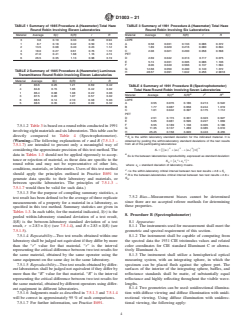
7.5.1.1 Table 1 and Table 2 are based on a round robin conducted in 1985, in accordance with Practice E691, involving six film
materials tested by 11 laboratories. In the round robin, each laboratory that measured a property made eight replicate measurements
of the property for each of the six mater
...
Questions, Comments and Discussion
Ask us and Technical Secretary will try to provide an answer. You can facilitate discussion about the standard in here.
Loading comments...