

ASTM D6562-20
(Test Method)Standard Test Method for Determination of Gaseous Hexamethylene Diisocyanate (HDI) in Air with 9-(N-methylaminomethyl) Anthracene Method (MAMA) in the Workplace
General Information
- Abstract
SIGNIFICANCE AND USE
5.1 HDI is mostly used in the preparation of paints. The use of isocyanates and their industrial needs have been in constant growth.
5.2 Diisocyanates and polyisocyanates are irritants to skin, eyes, and mucous membranes. They are recognized to cause respiratory allergic sensitization, asthmatic bronchitis, and acute respiratory intoxication (4-7).
5.3 The American Conference of Governmental Industrial Hygienists (ACGIH) has adopted a threshold limit value – time weighted average (TLV – TWA) of 0.005 ppm (V) or 0.034 mg/m3 (8). The Occupational Safety and Health Administration of the U.S. Department of Labor (OSHA) has not listed a permissible exposure limit (PEL) for HDI (9).
5.4 In any case, there are not separate exposure standards for vapor and aerosol. Therefore, in comparing the results for isocyanate against a standard, results from the two fractions should be combined to give a single total value.
5.5 Due to its low LOD and low required volume (15 L), this test method is well suited for monitoring of respiratory and other problems related to diisocyanates and polyisocyanates. Its short sampling times are compatible with the duration of many industrial processes, and its low detection limit with the concentrations often found in the working area.
SCOPE
1.1 This test method covers the determination of gaseous hexamethylene diisocyanate (HDI) in air samples collected from workplace and ambient atmospheres. The method described in this test method collects separate fractions. One fraction will be dominated by vapor, and the other fraction will be dominated by aerosol. The results obtained from the analysis of the separate fractions do not necessarily represent the true partition of the measured HDI physical phases, and should only be considered a representation of the general trend in the physical phase partition within samples. The analyses of the two fractions are different, and are provided in separate, linked, standards to avoid confusion. This test method is principally used to determine short term exposure (15 min) of HDI in workplace environments for personal monitoring or in ambient air. The analysis of the aerosol fraction is performed separately, as described in Test Method D6561.
1.2 Differential air sampling is performed with a segregating device. The vapor fraction is collected on a glass fiber filter (GFF) impregnated with 9-(N-methylaminomethyl) anthracene (MAMA).
1.3 The range of application of this test method has been validated from 0.006 to 1.12 μg of monomeric HDI/2.0 mL of desorption solution, which corresponds to concentrations equivalent to 0.0004 to 0.075 mg/m3 of HDI based on a 15 L air sample. Those concentrations correspond to a range of vapor phase concentrations from 0.06 ppb(V) to 11 ppb(V) and cover the established threshold limit value (TLV) value of 5 ppb(V).
1.4 The quantification limit for the monomeric HDI, using the UV detection, has been established as 0.012 μg/2 mL of desorption solution and as 0.008 μg/2 mL, using the fluorescence detector. These limits correspond to 0.0008 mg/m3 and 0.0005 mg/m3 respectively for an air sampled volume of 15 L. These values are equal to ten times the standard deviation (SD) obtained from ten measurements carried out on a standard solution in contact with the GFF, whose concentration of 0.02 μg/2 mL is close to the expected detection limit.
1.5 The values stated in SI units are to be regarded as standard. No other units of measurement are included in this standard.
1.6 This standard does not purport to address all of the safety concerns, if any, associated with its use. It is the responsibility of the user of this standard to establish appropriate safety, health, and environmental practices and determine the applicability of regulatory limitations prior to use. See Section 9 for additional hazards.
1.7 This international standard was developed in accordance with internationally recogniz...
- Status
- Published
- Publication Date
- 29-Feb-2020
- Technical Committee
- D22 - Air Quality
- Drafting Committee
- D22.04 - Workplace Air Quality
Buy Documents
ASTM D6562-20 - Standard Test Method for Determination of Gaseous Hexamethylene Diisocyanate (HDI) in Air with 9-(N-methylaminomethyl) Anthracene Method (MAMA) in the Workplace
REDLINE ASTM D6562-20 - Standard Test Method for Determination of Gaseous Hexamethylene Diisocyanate (HDI) in Air with 9-(N-methylaminomethyl) Anthracene Method (MAMA) in the Workplace
Overview
ASTM D6562-20, "Standard Test Method for Determination of Gaseous Hexamethylene Diisocyanate (HDI) in Air with 9-(N-methylaminomethyl) Anthracene Method (MAMA) in the Workplace," is a widely recognized standard for assessing airborne HDI concentrations in workplace and ambient environments. Developed by ASTM International, this method is intended for industrial hygiene professionals concerned with the monitoring and control of HDI, a chemical primarily used in the manufacture of paints and coatings. The standard focuses on the collection and quantification of HDI vapor in air samples, supporting workplace safety and regulatory compliance.
Key Topics
- Exposure Monitoring: Enables short-term (15-minute) monitoring of HDI concentrations, critical for assessing acute and chronic occupational exposure.
- Sampling and Analysis:
- Differential air sampling using a segregating device separates vapor and aerosol fractions.
- Gaseous HDI is collected on a glass fiber filter (GFF) impregnated with 9-(N-methylaminomethyl) anthracene (MAMA).
- Analysis is performed by high-performance liquid chromatography (HPLC) with both UV and fluorescence detection.
- Limit of Detection: Validated for low HDI concentrations, with limits suitable for comparison to established threshold limit values (TLVs).
- Combined Exposure Assessment: This method, in conjunction with ASTM D6561 for aerosols, provides a total HDI exposure value since regulatory standards do not distinguish between vapor and aerosol phases.
- Health & Safety Considerations: Highlights the irritant properties of diisocyanates and underscores the need for appropriate laboratory safety procedures.
Applications
- Occupational Hygiene: The test method is extensively used by industrial hygienists for personal monitoring of workers, especially those engaged in paint manufacturing or application.
- Regulatory Compliance: Supports compliance with recommendations from organizations such as the American Conference of Governmental Industrial Hygienists (ACGIH), which specifies a TLV–TWA for HDI.
- Process Monitoring: Suitable for evaluating exposure risks in a range of industrial environments with short sampling times and low sample volumes.
- Exposure Control: Provides actionable data to help organizations implement engineering controls, personal protective equipment, and other safety measures for minimizing isocyanate exposure.
- Research and Development: Used in studies involving the characterization of air pollutants, HDI distribution (vapor/aerosol), and development of safer industrial processes.
Related Standards
- ASTM D6561: Test Method for Determination of Aerosol Monomeric and Oligomeric Hexamethylene Diisocyanate (HDI) in Air
- ASTM D1193: Specification for Reagent Water
- ASTM D1356: Terminology Relating to Sampling and Analysis of Atmospheres
- ASTM D1357: Practice for Planning the Sampling of the Ambient Atmosphere
- ASTM D4840: Guide for Sample Chain-of-Custody Procedures
- ASTM D5337: Practice for Flow Rate Adjustment of Personal Sampling Pumps
Practical Value
The ASTM D6562-20 method is a practical, validated approach for air monitoring of HDI in the workplace, supporting worker health protection and compliance with occupational exposure limits. With its robust chain-of-custody, high sensitivity, and compatibility with routine industrial processes, it is an essential tool for any industrial hygiene or occupational health and safety program focused on monitoring isocyanate exposures.
Keywords: ASTM D6562, hexamethylene diisocyanate, HDI, workplace air monitoring, isocyanates, HPLC, industrial hygiene, occupational exposure, MAMA method, TLV, air sampling, ASTM air quality standards.
Relations
- Effective Date
- 01-Mar-2020
- Effective Date
- 01-Sep-2020
- Effective Date
- 15-Mar-2020
- Effective Date
- 01-Aug-2019
- Effective Date
- 15-Aug-2018
- Effective Date
- 01-Nov-2016
- Effective Date
- 15-Oct-2015
- Effective Date
- 01-Jul-2015
- Effective Date
- 01-Dec-2014
- Effective Date
- 01-May-2014
- Effective Date
- 15-Jan-2014
- Effective Date
- 15-Nov-2011
- Effective Date
- 01-Oct-2011
- Effective Date
- 01-Oct-2011
- Effective Date
- 01-Apr-2010
Buy Documents
ASTM D6562-20 - Standard Test Method for Determination of Gaseous Hexamethylene Diisocyanate (HDI) in Air with 9-(N-methylaminomethyl) Anthracene Method (MAMA) in the Workplace
REDLINE ASTM D6562-20 - Standard Test Method for Determination of Gaseous Hexamethylene Diisocyanate (HDI) in Air with 9-(N-methylaminomethyl) Anthracene Method (MAMA) in the Workplace
Get Certified
Connect with accredited certification bodies for this standard

CIS Institut d.o.o.
Personal Protective Equipment (PPE) certification body. Notified Body NB-2890 for EU Regulation 2016/425 PPE.

Kiwa BDA Testing
Building and construction product certification.
Kmetijski inštitut Slovenije
Agricultural Institute of Slovenia. Soil testing, plant health, agricultural product analysis.
Sponsored listings
Frequently Asked Questions
ASTM D6562-20 is a standard published by ASTM International. Its full title is "Standard Test Method for Determination of Gaseous Hexamethylene Diisocyanate (HDI) in Air with 9-(N-methylaminomethyl) Anthracene Method (MAMA) in the Workplace". This standard covers: SIGNIFICANCE AND USE 5.1 HDI is mostly used in the preparation of paints. The use of isocyanates and their industrial needs have been in constant growth. 5.2 Diisocyanates and polyisocyanates are irritants to skin, eyes, and mucous membranes. They are recognized to cause respiratory allergic sensitization, asthmatic bronchitis, and acute respiratory intoxication (4-7). 5.3 The American Conference of Governmental Industrial Hygienists (ACGIH) has adopted a threshold limit value – time weighted average (TLV – TWA) of 0.005 ppm (V) or 0.034 mg/m3 (8). The Occupational Safety and Health Administration of the U.S. Department of Labor (OSHA) has not listed a permissible exposure limit (PEL) for HDI (9). 5.4 In any case, there are not separate exposure standards for vapor and aerosol. Therefore, in comparing the results for isocyanate against a standard, results from the two fractions should be combined to give a single total value. 5.5 Due to its low LOD and low required volume (15 L), this test method is well suited for monitoring of respiratory and other problems related to diisocyanates and polyisocyanates. Its short sampling times are compatible with the duration of many industrial processes, and its low detection limit with the concentrations often found in the working area. SCOPE 1.1 This test method covers the determination of gaseous hexamethylene diisocyanate (HDI) in air samples collected from workplace and ambient atmospheres. The method described in this test method collects separate fractions. One fraction will be dominated by vapor, and the other fraction will be dominated by aerosol. The results obtained from the analysis of the separate fractions do not necessarily represent the true partition of the measured HDI physical phases, and should only be considered a representation of the general trend in the physical phase partition within samples. The analyses of the two fractions are different, and are provided in separate, linked, standards to avoid confusion. This test method is principally used to determine short term exposure (15 min) of HDI in workplace environments for personal monitoring or in ambient air. The analysis of the aerosol fraction is performed separately, as described in Test Method D6561. 1.2 Differential air sampling is performed with a segregating device. The vapor fraction is collected on a glass fiber filter (GFF) impregnated with 9-(N-methylaminomethyl) anthracene (MAMA). 1.3 The range of application of this test method has been validated from 0.006 to 1.12 μg of monomeric HDI/2.0 mL of desorption solution, which corresponds to concentrations equivalent to 0.0004 to 0.075 mg/m3 of HDI based on a 15 L air sample. Those concentrations correspond to a range of vapor phase concentrations from 0.06 ppb(V) to 11 ppb(V) and cover the established threshold limit value (TLV) value of 5 ppb(V). 1.4 The quantification limit for the monomeric HDI, using the UV detection, has been established as 0.012 μg/2 mL of desorption solution and as 0.008 μg/2 mL, using the fluorescence detector. These limits correspond to 0.0008 mg/m3 and 0.0005 mg/m3 respectively for an air sampled volume of 15 L. These values are equal to ten times the standard deviation (SD) obtained from ten measurements carried out on a standard solution in contact with the GFF, whose concentration of 0.02 μg/2 mL is close to the expected detection limit. 1.5 The values stated in SI units are to be regarded as standard. No other units of measurement are included in this standard. 1.6 This standard does not purport to address all of the safety concerns, if any, associated with its use. It is the responsibility of the user of this standard to establish appropriate safety, health, and environmental practices and determine the applicability of regulatory limitations prior to use. See Section 9 for additional hazards. 1.7 This international standard was developed in accordance with internationally recogniz...
SIGNIFICANCE AND USE 5.1 HDI is mostly used in the preparation of paints. The use of isocyanates and their industrial needs have been in constant growth. 5.2 Diisocyanates and polyisocyanates are irritants to skin, eyes, and mucous membranes. They are recognized to cause respiratory allergic sensitization, asthmatic bronchitis, and acute respiratory intoxication (4-7). 5.3 The American Conference of Governmental Industrial Hygienists (ACGIH) has adopted a threshold limit value – time weighted average (TLV – TWA) of 0.005 ppm (V) or 0.034 mg/m3 (8). The Occupational Safety and Health Administration of the U.S. Department of Labor (OSHA) has not listed a permissible exposure limit (PEL) for HDI (9). 5.4 In any case, there are not separate exposure standards for vapor and aerosol. Therefore, in comparing the results for isocyanate against a standard, results from the two fractions should be combined to give a single total value. 5.5 Due to its low LOD and low required volume (15 L), this test method is well suited for monitoring of respiratory and other problems related to diisocyanates and polyisocyanates. Its short sampling times are compatible with the duration of many industrial processes, and its low detection limit with the concentrations often found in the working area. SCOPE 1.1 This test method covers the determination of gaseous hexamethylene diisocyanate (HDI) in air samples collected from workplace and ambient atmospheres. The method described in this test method collects separate fractions. One fraction will be dominated by vapor, and the other fraction will be dominated by aerosol. The results obtained from the analysis of the separate fractions do not necessarily represent the true partition of the measured HDI physical phases, and should only be considered a representation of the general trend in the physical phase partition within samples. The analyses of the two fractions are different, and are provided in separate, linked, standards to avoid confusion. This test method is principally used to determine short term exposure (15 min) of HDI in workplace environments for personal monitoring or in ambient air. The analysis of the aerosol fraction is performed separately, as described in Test Method D6561. 1.2 Differential air sampling is performed with a segregating device. The vapor fraction is collected on a glass fiber filter (GFF) impregnated with 9-(N-methylaminomethyl) anthracene (MAMA). 1.3 The range of application of this test method has been validated from 0.006 to 1.12 μg of monomeric HDI/2.0 mL of desorption solution, which corresponds to concentrations equivalent to 0.0004 to 0.075 mg/m3 of HDI based on a 15 L air sample. Those concentrations correspond to a range of vapor phase concentrations from 0.06 ppb(V) to 11 ppb(V) and cover the established threshold limit value (TLV) value of 5 ppb(V). 1.4 The quantification limit for the monomeric HDI, using the UV detection, has been established as 0.012 μg/2 mL of desorption solution and as 0.008 μg/2 mL, using the fluorescence detector. These limits correspond to 0.0008 mg/m3 and 0.0005 mg/m3 respectively for an air sampled volume of 15 L. These values are equal to ten times the standard deviation (SD) obtained from ten measurements carried out on a standard solution in contact with the GFF, whose concentration of 0.02 μg/2 mL is close to the expected detection limit. 1.5 The values stated in SI units are to be regarded as standard. No other units of measurement are included in this standard. 1.6 This standard does not purport to address all of the safety concerns, if any, associated with its use. It is the responsibility of the user of this standard to establish appropriate safety, health, and environmental practices and determine the applicability of regulatory limitations prior to use. See Section 9 for additional hazards. 1.7 This international standard was developed in accordance with internationally recogniz...
ASTM D6562-20 is classified under the following ICS (International Classification for Standards) categories: 13.040.30 - Workplace atmospheres. The ICS classification helps identify the subject area and facilitates finding related standards.
ASTM D6562-20 has the following relationships with other standards: It is inter standard links to ASTM D6562-12, ASTM D1356-20a, ASTM D1356-20, ASTM D1357-95(2019), ASTM D4840-99(2018)e1, ASTM D6561-06(2016), ASTM D1356-15a, ASTM D1356-15, ASTM D1356-14b, ASTM D1356-14a, ASTM D1356-14, ASTM D5337-11, ASTM D1357-95(2011), ASTM D6561-06(2011), ASTM D1356-05(2010). Understanding these relationships helps ensure you are using the most current and applicable version of the standard.
ASTM D6562-20 is available in PDF format for immediate download after purchase. The document can be added to your cart and obtained through the secure checkout process. Digital delivery ensures instant access to the complete standard document.
Standards Content (Sample)
This international standard was developed in accordance with internationally recognized principles on standardization established in the Decision on Principles for the
Development of International Standards, Guides and Recommendations issued by the World Trade Organization Technical Barriers to Trade (TBT) Committee.
Designation: D6562 − 20
Standard Test Method for
Determination of Gaseous Hexamethylene Diisocyanate
(HDI) in Air with 9-(N-methylaminomethyl) Anthracene
Method (MAMA) in the Workplace
This standard is issued under the fixed designation D6562; the number immediately following the designation indicates the year of
original adoption or, in the case of revision, the year of last revision. A number in parentheses indicates the year of last reapproval. A
superscript epsilon (´) indicates an editorial change since the last revision or reapproval.
1. Scope 0.0005 mg/m respectively for an air sampled volume of 15 L.
These values are equal to ten times the standard deviation (SD)
1.1 This test method covers the determination of gaseous
obtained from ten measurements carried out on a standard
hexamethylene diisocyanate (HDI) in air samples collected
solution in contact with the GFF, whose concentration of 0.02
from workplace and ambient atmospheres. The method de-
µg/2 mL is close to the expected detection limit.
scribed in this test method collects separate fractions. One
fraction will be dominated by vapor, and the other fraction will 1.5 The values stated in SI units are to be regarded as
be dominated by aerosol. The results obtained from the standard. No other units of measurement are included in this
analysis of the separate fractions do not necessarily represent standard.
the true partition of the measured HDI physical phases, and
1.6 This standard does not purport to address all of the
should only be considered a representation of the general trend
safety concerns, if any, associated with its use. It is the
in the physical phase partition within samples. The analyses of
responsibility of the user of this standard to establish appro-
the two fractions are different, and are provided in separate,
priate safety, health, and environmental practices and deter-
linked, standards to avoid confusion. This test method is
mine the applicability of regulatory limitations prior to use.
principally used to determine short term exposure (15 min) of
See Section 9 for additional hazards.
HDI in workplace environments for personal monitoring or in
1.7 This international standard was developed in accor-
ambient air. The analysis of the aerosol fraction is performed
dance with internationally recognized principles on standard-
separately, as described in Test Method D6561.
ization established in the Decision on Principles for the
Development of International Standards, Guides and Recom-
1.2 Differential air sampling is performed with a segregat-
mendations issued by the World Trade Organization Technical
ing device.The vapor fraction is collected on a glass fiber filter
Barriers to Trade (TBT) Committee.
(GFF) impregnated with 9-(N-methylaminomethyl) anthracene
(MAMA).
2. Referenced Documents
1.3 The range of application of this test method has been
2.1 ASTM Standards:
validated from 0.006 to 1.12 µg of monomeric HDI/2.0 mL of
D1193 Specification for Reagent Water
desorption solution, which corresponds to concentrations
D1356 Terminology Relating to Sampling and Analysis of
equivalent to 0.0004 to 0.075 mg/m of HDI based on a 15 L
Atmospheres
air sample. Those concentrations correspond to a range of
D1357 Practice for Planning the Sampling of the Ambient
vapor phase concentrations from 0.06 ppb(V) to 11 ppb(V) and
Atmosphere
cover the established threshold limit value (TLV) value of 5
D4840 Guide for Sample Chain-of-Custody Procedures
ppb(V).
D5337 Practice for Flow RateAdjustment of Personal Sam-
1.4 The quantification limit for the monomeric HDI, using
pling Pumps
the UV detection, has been established as 0.012 µg/2 mL of
D6561 Test Method for Determination of Aerosol Mono-
desorption solution and as 0.008 µg/2 mL, using the fluores-
mericandOligomericHexamethyleneDiisocyanate(HDl)
cence detector. These limits correspond to 0.0008 mg/m and
inAir with (Methoxy-2–phenyl-1) Piperazine (MOPIP) in
the Workplace
This test method is under the jurisdiction of ASTM Committee D22 on Air
Quality and is the direct responsibility of Subcommittee D22.04 on Workplace Air
Quality. For referenced ASTM standards, visit the ASTM website, www.astm.org, or
Current edition approved March 1, 2020. Published June 2020. Originally contact ASTM Customer Service at service@astm.org. For Annual Book of ASTM
approved in 2000. Last previous edition approved in 2012 as D6562 – 12. DOI: Standards volume information, refer to the standard’s Document Summary page on
10.1520/D6562-20. the ASTM website.
Copyright © ASTM International, 100 Barr Harbor Drive, PO Box C700, West Conshohocken, PA 19428-2959. United States
D6562 − 20
5.5 Due to its low LOD and low required volume (15 L),
thistestmethodiswellsuitedformonitoringofrespiratoryand
other problems related to diisocyanates and polyisocyanates.
Its short sampling times are compatible with the duration of
FIG. 1
many industrial processes, and its low detection limit with the
concentrations often found in the working area.
3. Terminology
6. Interferences
3.1 For definitions of terms used in this test method, refer to
6.1 Any substances, including strong oxidizing agents, that
Terminology D1356.
canreactwiththeMAMAreagentimpregnatedontheGFFcan
4. Summary of Test Method
affect the sampling efficiency.
4.1 Vapor and aerosol fractions are sampled simultaneously 6.2 Any compound that has the same retention time as the
by using a segregating sampling device. The aerosols are
hexamethylenediisocyanate9-(N-methylaminomethyl)anthra-
collected on a polyterafluoroethylene (PTFE) filter while the cene (HDIU) derivative and contributes to the UV signal is an
gaseous fraction is being adsorbed on the second filter made of
interference. Chromatographic conditions can sometimes be
glass fiber impregnated with MAMA. changed to eliminate an interference. The response factor (RF)
ratio from the UV and fluorescence detectors gives a good
4.2 The analysis of the oligomer in the aerosol fraction is
indication to the analyst about the possibility of an interfer-
performed separately in accordance with the procedure de-
ence.
scribed in Test Method D6561.
4.3 Diisocyanates present as vapors react with the second-
7. Apparatus
ary amine function of the MAMA, impregnated on the GFF to
7.1 Sampling Equipment:
form a urea derivative (1, 2) as shown in Fig. 1.
7.1.1 Personal Sampling Pump, or a constant-flow device
DesorptionoftheGFFisdonebyusingasolutionmixtureof
capable of drawing 1.0 L/min through the sampling device for
67 % N,N-dimethylformamide and 33 % of a 30:70 buffer-
a period of at least 4 h.
acetonitrile mixture. Monomeric and oligomeric diisocyanates
7.1.2 Double Filter Sampling Device, 37 mm in diameter,
are separated by using a reversed phase HPLC column,
three-piece personal monitor, plastic holder loaded with a
followed by UV (254 nm) and fluorescence detectors (254 nm
PTFEfilterclosetothemouth,followedbyaGFFimpregnated
excitation and 412-nm emission) in series (3). An ultra high
with MAMA and by a plastic back-up pad. The GFF is
performance liquid chromatograph (UPLC) can also be used,
impregnated with an amount of MAMAin the range from 0.07
provided that its performance is equivalent to what is stated in
to 0.25 mg.
this standard.
7.1.3 Flow Measuring Device, used in accordance with
4.4 Concentration of urea derivative contained in the
Practice D5337.
samples is calculated by using an external standard of the
7.2 Analytical Equipment:
appropriate urea derivative.
7.2.1 Liquid Chromatograph, an HPLC, equipped with a
UV (254 nm wavelength) and fluorescence detectors (412 nm
5. Significance and Use
emission and 254 nm excitation) and equipped with an
5.1 HDI is mostly used in the preparation of paints. The use
automatic or manual sampling port injection. A second UV
of isocyanates and their industrial needs have been in constant
wavelength is recommended for identify confirmation if no
growth.
fluorescence detector is utilized. An ultra high performance
5.2 Diisocyanates and polyisocyanates are irritants to skin, liquid chromatograph (UPLC) providing at least the same or
equivalent performance of HPLC can be also used.
eyes, and mucous membranes. They are recognized to cause
respiratory allergic sensitization, asthmatic bronchitis, and 7.2.2 Liquid Chromatographic Column, an HPLC stainless
acute respiratory intoxication (4-7). steel column, capable of separating the urea derivatives. This
test method recommends a 150 mm by 3.2 mm internal
5.3 The American Conference of Governmental Industrial
diameter stainless steel column packed with 3 µm C-18, or an
Hygienists(ACGIH)hasadoptedathresholdlimitvalue–time
equivalent column.
weighted average (TLV – TWA) of 0.005 ppm (V) or 0.034
3 7.2.3 Electronic Integrator, or any other effective method
mg/m (8).TheOccupationalSafetyandHealthAdministration
for determining peak area counts.
of the U.S. Department of Labor (OSHA) has not listed a
7.2.4 Analytical Balance, with a precision of 6 0.0001 g.
permissible exposure limit (PEL) for HDI (9).
7.2.5 Microsyringes and Pipets—Microsyringes are used in
5.4 In any case, there are not separate exposure standards
the preparation of urea derivatives and standards.An automatic
for vapor and aerosol. Therefore, in comparing the results for
pipet, or any equivalent equipment, is required for sample
isocyanate against a standard, results from the two fractions
preparation.
should be combined to give a single total value.
7.2.6 pH Meter, or any equivalent device capable of assay-
ing a pH range between 2.5 and 7.
7.2.7 Three-neck Flask, for the synthesis of the HDIU
The boldface numbers in parentheses refer to the list of references at the end of
this standard. standard (see 8.13).
D6562 − 20
7.2.8 Magnetic Stirrer, or any other equivalent device. 8.13 Hexamethylene Diisocyanate 9-(N-
methylaminomethyl) Anthracene Derivative (HDIU) (see
7.2.9 Glass Jars, 30 mL, and lids, capable of receiving 37
11.1.1).
mm filters, used for sample desorption.
7.2.10 Reciprocating Shaker,oranyotherequivalentdevice.
8.14 Triethylamine, purity 98 % min.
7.2.11 Vacuum Filtration System, filter with 0.22 µm pore
size polyamide filters, or any equivalent method.
9. Hazards
7.2.12 Syringe Operated Filter Unit, syringes with polyvi-
9.1 Warning—Diisocyanates are hazardous chemicals and
nylidene fluoride 0.22 µm pore size filter unit, or any equiva-
are extremely reactive. Refer to safety data sheets (SDS) for
lent method.
reagents.
7.2.13 Injection Vials, 1.5 mL vials with PTFE-coated
septums. 9.2 Warning—Avoid exposure to diisocyanate and sol-
7.2.14 Bottle, amber bottle with cap and PTFE coated vents. Sample and standard preparations should be done in an
efficient operating hood. For remedial statement, see Ref (10).
septum for conservation of stock and standard solutions of
HDIU, or any equivalent equipment.
9.3 Warning—Avoid skin contact with isocyanates and all
solvents. N,N-Dimethylformamide is highly toxic. Chronic
8. Reagents and Materials
effects include damage to liver and kidneys. See Ref (11).
8.1 Purity of Reagents—Reagent grade chemicals shall be
9.4 Warning—Wear safety glasses at all times and other
usedinalltests.Allreagentsshallconformtothespecifications
laboratory protective equipment if necessary.
of the Committee on Analytical Reagents of the American
Chemical Society where such specifications are available.
10. Sampling
Other grades may be used, provided it is first ascertained that
10.1 Refer to Practices D1357 and D5337 for general
the reagent is of sufficiently high purity to permit its use
information on sampling.
without lessening the accuracy of the determination.
10.2 Adjust the personal sampling pumps (see 7.1.1)tothe
8.2 Purity of Water—Unlessotherwiseindicated,watershall
recommended flow rate with an assembled cassette (see 7.1.2)
be reagent water as defined by Type 2 of Specification D1193,
between the pump and the flow-measuring device in accor-
HPLC grade.
dance to Practice D5337. After the sampling, perform a post
8.3 Acetonitrile (CH CN), HPLC grade.
sampling flow rate verification. If the post sampling flow rate
8.4 Buffer—Transfer 30 mL of triethylamine (see 8.14) into varies more than 65 % from the recommended flow rate,
a 1 L volumetric flask, and dilute to volume with HPLC grade
invalidate the sample.
water. Acidify the solution to pH = 3 with phosphoric acid
10.3 This test method recommends sampling in accordance
(H PO ) (see 8.11). Filter the buffer under vacuum with a 0.22
3 4
with the method described in the Refs (10, 12, 13).
µm pore size filter.
10.4 Equip the worker, whose exposure is to be evaluated,
8.5 Desorption Solution, a solvent mixture of 67 % (v/v) of
with a filter holder connected to a belt-supported sampling
dimethylformamide (see 8.7) and 33 % (v/v) mobile phase (see
pump. Place the filter holder pointing downward, if possible, at
8.10).
an optimum angle of 45° from horizontal in the breathing zone
8.6 Dichloromethane, reagent grade.
of the worker. Draw air through the sampling device and
collect 15 L at a rate of approximately 1.0 L/min.
8.7 N,N-Dimethylformamide, reagent grade.
10.5 For stationary monitoring, use a tripod or any other
8.8 Helium (He), high purity.
support to locate the sampler in a general room area at a height
8.9 9-(N-Methylaminomethyl) Anthracene (MAMA) (F.W.
equivalent to the breathing zone.
221.31), 99 % purity.
10.6 A field blank is used to monitor contaminat
...
This document is not an ASTM standard and is intended only to provide the user of an ASTM standard an indication of what changes have been made to the previous version. Because
it may not be technically possible to adequately depict all changes accurately, ASTM recommends that users consult prior editions as appropriate. In all cases only the current version
of the standard as published by ASTM is to be considered the official document.
Designation: D6562 − 12 D6562 − 20
Standard Test Method for
Determination of Gaseous Hexamethylene Diisocyanate
(HDI) in Air with 9-(N-methylaminomethyl) Anthracene
Method (MAMA) in the Workplace
This standard is issued under the fixed designation D6562; the number immediately following the designation indicates the year of
original adoption or, in the case of revision, the year of last revision. A number in parentheses indicates the year of last reapproval. A
superscript epsilon (´) indicates an editorial change since the last revision or reapproval.
1. Scope
1.1 This test method covers the determination of gaseous hexamethylene diisocyanate (HDI) in air samples collected from
workplace and ambient atmospheres. The method described in this test method collects separate fractions. One fraction will be
dominated by vapor, and the other fraction will be dominated by aerosol. It is not known at the present time whether this represents
a perfect separation of vapor and aerosol, and in any case, there are not separate exposure standards for vapor and aerosol.
Therefore, in comparing the results for isocyanate against a standard, results from the two fractions should be combined to give
a single total value. The reason for splitting the sample into two fractions is to increase analytic sensitivity for the vapor fraction
and also to give the hygienist or ventilation engineer some information concerning the likely state of the isocyanate species. The
results obtained from the analysis of the separate fractions do not necessarily represent the true partition of the measured HDI
physical phases, and should only be considered a representation of the general trend in the physical phase partition within samples.
The analyses of the two fractions are different, and are provided in separate, linked, standards to avoid confusion. This test method
is principally used to determine short term exposure (15 min) of HDI in workplace environments for personal monitoring or in
ambient air. The analysis of the aerosol fraction is performed separately, as described in Test Method D6561.
1.2 Differential air sampling is performed with a segregating device. The vapor fraction is collected on a glass fiber filter (GFF)
impregnated with 9-(N-methylaminomethyl) anthracene (MAMA).
1.3 The analysis of the gaseous fraction is performed with a high performance liquid chromatograph (HPLC) equipped with
ultraviolet (UV) and fluorescence detectors.
1.3 The range of application of this test method, using UV and fluorescence detectors both connected in serial, method has been
validated from 0.006 to 1.12 μg of monomeric HDI/2.0 mL of desorption solution, which corresponds to concentrations equivalent
to 0.0004 to 0.075 mg/m of HDI based on a 15-L 15 L air sample. Those concentrations correspond to a range of vapor phase
concentrations from 0.06 ppb(V) to 11 ppb(V) and cover the established threshold limit value (TLV) value of 5 ppb(V).
1.4 The quantification limit for the monomeric HDI, using the UV detection, has been established as 0.012 μg/2 mL of
desorption solution and as 0.008 μg/2 mL, using the fluorescence detector. These limits correspond to 0.0008 mg/m and 0.0005
mg/m respectively for an air sampled volume of 15 L. These values are equal to ten times the standard deviation (SD) obtained
from ten measurements carried out on a standard solution in contact with the GFF, whose concentration of 0.02 μg/2 mL is close
to the expected detection limit.
1.5 The values stated in SI units are to be regarded as standard. No other units of measurement are included in this standard.
1.6 This standard does not purport to address all of the safety concerns, if any, associated with its use. It is the responsibility
of the user of this standard to establish appropriate safety safety, health, and healthenvironmental practices and determine the
applicability of regulatory limitations prior to use. See Section 9 for additional hazards.
1.7 This international standard was developed in accordance with internationally recognized principles on standardization
established in the Decision on Principles for the Development of International Standards, Guides and Recommendations issued
by the World Trade Organization Technical Barriers to Trade (TBT) Committee.
This test method is under the jurisdiction of ASTM Committee D22 on Air Quality and is the direct responsibility of Subcommittee D22.04 on Workplace Air Quality.
Current edition approved April 1, 2012March 1, 2020. Published May 2012June 2020. Originally approved in 2000. Last previous edition approved in 20112012 as
D6562 – 06 (2011).D6562 – 12. DOI: 10.1520/D6562-12.10.1520/D6562-20.
Copyright © ASTM International, 100 Barr Harbor Drive, PO Box C700, West Conshohocken, PA 19428-2959. United States
D6562 − 20
FIG. 1
2. Referenced Documents
2.1 ASTM Standards:
D1193 Specification for Reagent Water
D1356 Terminology Relating to Sampling and Analysis of Atmospheres
D1357 Practice for Planning the Sampling of the Ambient Atmosphere
D4840 Guide for Sample Chain-of-Custody Procedures
D5337 Practice for Flow Rate Adjustment of Personal Sampling Pumps
D6561 Test Method for Determination of Aerosol Monomeric and Oligomeric Hexamethylene Diisocyanate (HDl) in Air with
(Methoxy-2–phenyl-1) Piperazine (MOPIP) in the Workplace
2.2 Other Standard:
Sampling Guide for Air Contaminants in the Workplace
3. Terminology
3.1 For definitions of terms used in this test method, refer to Terminology D1356.
4. Summary of Test Method
4.1 Vapor and aerosol fractions are sampled simultaneously by using a segregating sampling device. The aerosols are collected
on a polyterafluoroethylene (PTFE) filter while the gaseous fraction is being adsorbed on the second filter made of glass fiber
impregnated with MAMA.
4.2 The analysis of the oligomer in the aerosol fraction is performed separately in accordance with the procedure described in
Test Method D6561.
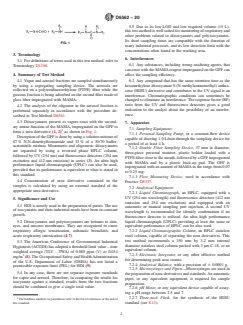
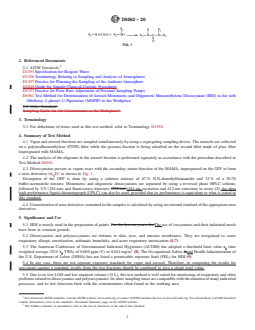
4.3 Diisocyanates present as vapors react with the secondary amine function of the MAMA, impregnated on the GFF to form
a urea derivative (1, 2) as shown in Fig. 1.
Desorption of the GFF is done by using a solution mixture of 67 % N,N-dimethylformamide and 33 % of a 30:70
buffer-acetonitrile mixture. Monomeric and oligomeric diisocyanates are separated by using a reversed phase HPLC column,
followed by UV (254 nm) and fluorescence detectors (254-nm (254 nm excitation and 412-nm emission) in series (3). An ultra
high performance liquid chromatograph (UPLC) can also be used, provided that its performance is equivalent to what is stated in
this standard.
4.4 Concentration of urea derivative contained in the samples is calculated by using an external standard of the appropriate urea
derivative.
5. Significance and Use
5.1 HDI is mostly used in the preparation of paints. For the last ten years, the The use of isocyanates and their industrial needs
have been in constant growth.
5.2 Diisocyanates and polyisocyanates are irritants to skin, eyes, and mucous membranes. They are recognized to cause
respiratory allergic sensitization, asthmatic bronchitis, and acute respiratory intoxication (4-7).
5.3 The American Conference of Governmental Industrial Hygienists (ACGIH) has adopted a threshold limit value -– time
weighted average (TLV -– TWA) of 0.005 ppm (V) or 0.034 mg/m (8). The Occupational Safety &and Health Administration of
the U.S. Department of Labor (OSHA) has not listed a permissible exposure limit (PEL) for HDI (9).
5.4 In any case, there are not separate exposure standards for vapor and aerosol. Therefore, in comparing the results for
isocyanate against a standard, results from the two fractions should be combined to give a single total value.
5.5 Due to its low LOD and low required volume (15 L), this test method is well suited for monitoring of respiratory and other
problems related to diisocyanates and polyisocyanates. Its short sampling times are compatible with the duration of many industrial
processes, and its low detection limit with the concentrations often found in the working area.
For referenced ASTM standards, visit the ASTM website, www.astm.org, or contact ASTM Customer Service at service@astm.org. For Annual Book of ASTM Standards
volume information, refer to the standard’s Document Summary page on the ASTM website.
The boldface numbers in parentheses refer to the list of references at the end of this standard.
D6562 − 20
6. Interferences
6.1 Any substances, including strong oxidizing agents, that can react with the MAMA reagent impregnated on the GFF can
affect the sampling efficiency.
6.2 Any compound that has the same retention time as the hexamethylene diisocyanate 9-(N-methylaminomethyl) anthracene
(HDIU) derivative and contributes to the UV signal is an interference. Chromatographic conditions can sometimes be changed to
eliminate an interference. The response factor (RF) ratio from the UV and fluorescence detectors gives a good indication to the
analyst about the possibility of an interference.
7. Apparatus
7.1 Sampling Equipment:
7.1.1 Personal Sampling Pump—Pump, Equipped with a flow-monitoring device (rotameter, critical orifice) or a constant-flow
device capable of drawing 1.0 L/min through the sampling device for a period of at least 4 h.
7.1.2 Double Filter Sampling Device, 37 mm in diameter, three-piece personal monitor, plastic holder loaded with a PTFE filter
close to the mouth, followed by a GFF impregnated with MAMA and by a plastic back-up pad. The GFF is impregnated with an
amount of MAMA in the range from 0.07 to 0.25 mg.
7.1.3 Flow Measuring Device, used in accordance with Practice D5337.
7.2 Analytical Equipment:
7.2.1 Liquid Chromatograph, Liquid Chromatograph, an HPLC, equipped with a UV (254-nm (254 nm wavelength) and
fluorescence detectors (412-nm (412 nm emission and 254-nm 254 nm excitation) and equipped with an automatic or manual
sampling port injection. A second UV wavelength is recommended for identify confirmation if no fluorescence detector is utilized.
An ultra high performance liquid chromatograph (UPLC) providing at least the same or equivalent performance of HPLC can be
also used.
7.2.2 Liquid Chromatographic Column, an HPLC stainless steel column, capable of separating the urea derivatives. This test
method recommends a 150 mm by 3.2-mm 3.2 mm internal diameter stainless steel column packed with 3 μm C-18, or an
equivalent column.
7.2.3 Electronic Integrator, or any other effective method for determining peak area counts.
7.2.4 Analytical Balance, with a precision of 6 0.0001 g.
7.2.5 Microsyringes and Pipets—Microsyringes are used in the preparation of urea derivatives and standards. An automatic
pipet, or any equivalent equipment, is required for sample preparation.
7.2.6 pH Meter, or any equivalent device capable of assaying a pH range between 2.5 and 7.
7.2.7 Three-neck Flask, for the synthesis of the HDIU standard (see 8.13).
7.2.8 Magnetic Stirrer, or any other equivalent device.
7.2.9 Glass Jars, 30 mL, and lids, capable of receiving 37 mm filters, used for sample desorption.
7.2.10 Reciprocating Shaker, or any other equivalent device.
7.2.11 Vacuum Filtration System, filter with 0.22-μm 0.22 μm pore size polyamide filters, or any equivalent method.
7.2.12 Syringe Operated Filter Unit, syringes with polyvinylidene fluoride 0.22-μm 0.22 μm pore size filter unit, or any
equivalent method.
7.2.13 Injection Vials, 1.5 mL vials with PTFE-coated septums.
7.2.14 Bottle, amber bottle with cap and PTFE coated septum for conservation of stock and standard solutions of HDIU, or any
equivalent equipment.
8. Reagents and Materials
8.1 Purity of Reagents—Reagent grade chemicals shall be used in all tests. All reagents shall conform to the specifications of
the Committee on Analytical Reagents of the American Chemical Society where such specifications are available. Other grades
may be used, provided it is first ascertained that the reagent is of sufficiently high purity to permit its use without lessening the
accuracy of the determination.
8.2 Purity of Water—Unless otherwise indicated, water shall be reagent water as defined by Type 2 of Specification D1193,
HPLC grade.
8.3 Acetonitrile (CH CN), HPLC grade.
8.4 Buffer—Transfer 30 mL of triethylamine (see 8.14) into a 1-L 1 L volumetric flask, and dilute to volume with HPLC grade
water. Acidify the solution to pH = 3 with phosphoric acid (H PO ) (see 8.11). Filter the buffer under vacuum with a 0.22-μm 0.22
3 4
μm pore size filter.
Reagent Chemicals, American Chemical Society Specifications,ACS Reagent Chemicals, Specifications and Procedures for Reagents and Standard-Grade Reference
Materials, American Chemical Society, Washington, D.C.DC. For suggestions on the testing of reagents not listed by the American Chemical Society, see Analar Standards
for Laboratory Chemicals, BDH Ltd., Poole, Dorset, U.K., and the United States Pharmacopeia and National Formulary, U.S. Pharmacopeial Convention, Inc. (USPC),
Rockville, MD.
D6562 − 20
8.5 Desorption Solution, a solvent mixture of 67 % (v/v) of dimethylformamide (see 8.7) and 33 % (v/v) mobile phase (see
8.10).
8.6 Dichloromethane, reagent grade.
8.7 N,N-Dimethylformamide, reagent grade.
8.8 Helium (He), high purity.
8.9 9-(N-Methylaminomethyl) Anthracene (MAMA) (F.W. 221.31), 99 % purity.
8.10 Mobile Phase, a solvent mixture of 75 % (v/v) of acetonitrile (CH CN) (see 8.3) and 25 % (v/v) of buffer (see 8.4).
8.11 Phosphoric Acid (H PO ), reagent grade
3 4
8.12 Hexamethylene Diisocyanate (HDI), (HDI) (F.W. 168), (F.W. 168), 98 % purity.
8.13 Hexamethylene Diisocyanate 9-(N-methylaminomethyl) Anthracene Derivative (HDIU) (see 11.2.111.1.1).
8.14 Triethylamine, purity 98 % min.
9. Hazards
9.1 Warning—Diisocyanates are potentially hazardous chemicals and are extremely reactive. Refer to material safety data
sheets (SDS) for reagents.
9.2 Warning—Avoid exposure to diisocyanate and solvents. Sample and standard preparations should be done in an efficient
operating hood. For remedial statement, see Ref (1110).
9.3 Warning—Avoid skin contact with isocyanates and all solvents. N,N-Dimethylformamide is highly toxic. Chronic effects
include damage to liver and kidneys. See Ref (1211).
9.4 Warning—Wear safety glasses at all times and other laboratory protective equipment if necessary.
10. Sampling
10.1 Refer to Practices D1357 and D5337 for general information on sampling.
10.2 Adjust the personal sampling pumps (see 7.1.1) to the recommended flow rate with an assembled cassette (see 7.1.2)
between the pump and the flow-measuring device in accordance to Practice D5337. After the sampling, perform a post sampling
flow rate verification. If the post sampling flow rate varies more than 65 % from the recommended flow rate, invalidate the sample.
10.3 This test method recommends sampling in accordance with the method described in the RefRefs (10, 1112, 13).
10.4 Equip the worker, whose exposure is to be evaluated, with a filter holder connected to a belt-supported sampling pump.
Place the filter holder pointing downward, if possible, at an
...