

ASTM A987/A987M-19
(Practice)Standard Practice for Measuring Shape Characteristics of Tin Mill Products
General Information
- Abstract
SIGNIFICANCE AND USE
4.1 The definitions and procedures for measuring shape characteristics of tin mill products are provided so that purchasers and suppliers have common measuring procedures and definitions of shape characteristics. These procedures provide definitions and measuring techniques of shape characteristics. The intention of these definitions and measuring practices is not to provide a dimensional specification for shape characteristics, but rather common procedure(s) for quantifying shape anomalies.
SCOPE
1.1 Shape is a significant quality characteristic for tin mill products. Plate-shape is affected by mill process factors plus the temper, thickness, and width of the material supplied. It is the purpose of this practice to define accurately the different plate shape characteristics and to describe the practice(s) most commonly used to measure particular characteristics.
1.2 Quantitative limits are not addressed and should be established on an individual producer and user basis, where appropriate.
1.3 Units—The values stated in either SI units or inch-pound units are to be regarded separately as standard. The values stated in each system are not necessarily exact equivalents; therefore, to ensure conformance with the standard, each system shall be used independently of the other, and values from the two systems shall not be combined.
1.4 This standard does not purport to address all of the safety concerns, if any, associated with its use. It is the responsibility of the user of this standard to establish appropriate safety, health, and environmental practices and determine the applicability of regulatory limitations prior to use.
1.5 This international standard was developed in accordance with internationally recognized principles on standardization established in the Decision on Principles for the Development of International Standards, Guides and Recommendations issued by the World Trade Organization Technical Barriers to Trade (TBT) Committee.
- Status
- Published
- Publication Date
- 31-Oct-2019
- Technical Committee
- A01 - Steel, Stainless Steel and Related Alloys
- Drafting Committee
- A01.20 - Tin Mill Products
Buy Documents
ASTM A987/A987M-19 - Standard Practice for Measuring Shape Characteristics of Tin Mill Products
REDLINE ASTM A987/A987M-19 - Standard Practice for Measuring Shape Characteristics of Tin Mill Products
Overview
ASTM A987/A987M-19: Standard Practice for Measuring Shape Characteristics of Tin Mill Products defines procedures for assessing and quantifying the shape qualities of tin mill products. Developed by ASTM International, this standard provides clear definitions and standardized measurement practices to ensure consistent evaluation of plate shapes and anomalies. By establishing common terminology and measurement methodology, it facilitates clear communication between producers and purchasers regarding the shape characteristics of tin-coated and related cold-rolled steel sheet products.
Shape is a significant quality characteristic for tin mill products, affected by the manufacturing process, temper, thickness, and width of the material. While ASTM A987/A987M-19 does not establish dimensional specification limits, it ensures that both suppliers and users apply equivalent procedures when quantifying and describing shape anomalies.
Key Topics
Shape Characteristics Defined: The standard provides terminology and definitions for various plate shape types, including:
- Wavy edge
- Ridge buckle, quarter buckle, and center buckle
- Full center
- Edge lift
- Coil set and reverse coil set
- Twist
- Crossbow
- Camber
- Lateral weave
Standardized Measurement Practices: For each anomaly, the document specifies:
- Sample preparation and size requirements
- Preferred measuring equipment (e.g., stepblock gauges, tapered gauges, rulers, straight-edges, computer-based instruments)
- Measurement setup (e.g., flat surface requirements, clamping techniques)
- Measurement procedures for obtaining consistent, reproducible results
Units of Measurement: Values may be stated in either SI (metric) or inch-pound units, but the systems are not to be mixed to ensure conformity.
Safety and Good Practice: Users are responsible for applying appropriate safety, health, and environmental practices, considering any regulatory limitations applicable to their operations.
Applications
ASTM A987/A987M-19 is valuable for:
- Steel Manufacturers and Tinplate Producers: Enables consistent measurement and reporting of plate shape characteristics, assisting in production control and quality assurance.
- Purchasers and End Users: Ensures transparent communication regarding shape irregularities for acceptance, evaluation, or resolution of disputes.
- Quality Control and Inspection: Standardizes shape assessment procedures within labs or on production lines, minimizing subjective judgments and supporting process optimization.
- Research and Development: Assists in process improvements by providing detailed measurement methodologies for evaluating the impact of various manufacturing conditions on plate shape.
This standard is particularly important for sectors such as packaging, automotive, and manufacturing where tin mill products are used, and flatness or shape consistency is critical to downstream processing and final product quality.
Related Standards
ASTM A987/A987M-19 references and complements multiple related ASTM standards for tin mill products, including:
- ASTM A599/A599M - Electrolytic Tin-Coated, Cold-Rolled Sheet
- ASTM A623 / A623M - General Requirements for Tin Mill Products
- ASTM A624/A624M - Electrolytic Tin Plate, Single Reduced
- ASTM A625/A625M - Black Plate, Single-Reduced
- ASTM A626/A626M - Electrolytic Tin Plate, Double Reduced
- ASTM A650/A650M - Black Plate, Double Reduced
- ASTM A657/A657M - Black Plate Electrolytic Chromium-Coated, Single and Double Reduced
By using ASTM A987/A987M-19 alongside these product-specific and general requirements standards, organizations can ensure comprehensive compliance, quality, and reliability in the specification and use of tin mill products.
Keywords: ASTM A987, tin mill products, shape characteristics, steel sheet, shape measurement, plate shape anomalies, quality control, standard practice, wavy edge, camber, tinplate.
Relations
- Effective Date
- 01-Nov-2019
- Effective Date
- 01-Mar-2024
- Refers
ASTM A650/A650M-18(2024) - Standard Specification for Tin Mill Products, Black Plate, Double Reduced - Effective Date
- 01-Mar-2024
- Refers
ASTM A625/A625M-13(2024) - Standard Specification for Tin Mill Products, Black Plate, Single-Reduced - Effective Date
- 01-Mar-2024
- Effective Date
- 01-Oct-2013
- Effective Date
- 01-Oct-2013
- Refers
ASTM A650/A650M-13 - Standard Specification for Tin Mill Products, Black Plate, Double Reduced - Effective Date
- 01-Oct-2013
- Effective Date
- 01-Oct-2013
- Refers
ASTM A625/A625M-13 - Standard Specification for Tin Mill Products, Black Plate, Single-Reduced - Effective Date
- 01-Oct-2013
- Effective Date
- 01-Mar-2012
- Effective Date
- 01-Oct-2011
- Effective Date
- 01-Oct-2011
- Effective Date
- 01-Oct-2010
- Effective Date
- 01-Oct-2010
- Effective Date
- 01-Oct-2009
Buy Documents
ASTM A987/A987M-19 - Standard Practice for Measuring Shape Characteristics of Tin Mill Products
REDLINE ASTM A987/A987M-19 - Standard Practice for Measuring Shape Characteristics of Tin Mill Products
Get Certified
Connect with accredited certification bodies for this standard

Element Materials Technology
Materials testing and product certification.

Inštitut za kovinske materiale in tehnologije
Institute of Metals and Technology. Materials testing, metallurgical analysis, NDT.
Sponsored listings
Frequently Asked Questions
ASTM A987/A987M-19 is a standard published by ASTM International. Its full title is "Standard Practice for Measuring Shape Characteristics of Tin Mill Products". This standard covers: SIGNIFICANCE AND USE 4.1 The definitions and procedures for measuring shape characteristics of tin mill products are provided so that purchasers and suppliers have common measuring procedures and definitions of shape characteristics. These procedures provide definitions and measuring techniques of shape characteristics. The intention of these definitions and measuring practices is not to provide a dimensional specification for shape characteristics, but rather common procedure(s) for quantifying shape anomalies. SCOPE 1.1 Shape is a significant quality characteristic for tin mill products. Plate-shape is affected by mill process factors plus the temper, thickness, and width of the material supplied. It is the purpose of this practice to define accurately the different plate shape characteristics and to describe the practice(s) most commonly used to measure particular characteristics. 1.2 Quantitative limits are not addressed and should be established on an individual producer and user basis, where appropriate. 1.3 Units—The values stated in either SI units or inch-pound units are to be regarded separately as standard. The values stated in each system are not necessarily exact equivalents; therefore, to ensure conformance with the standard, each system shall be used independently of the other, and values from the two systems shall not be combined. 1.4 This standard does not purport to address all of the safety concerns, if any, associated with its use. It is the responsibility of the user of this standard to establish appropriate safety, health, and environmental practices and determine the applicability of regulatory limitations prior to use. 1.5 This international standard was developed in accordance with internationally recognized principles on standardization established in the Decision on Principles for the Development of International Standards, Guides and Recommendations issued by the World Trade Organization Technical Barriers to Trade (TBT) Committee.
SIGNIFICANCE AND USE 4.1 The definitions and procedures for measuring shape characteristics of tin mill products are provided so that purchasers and suppliers have common measuring procedures and definitions of shape characteristics. These procedures provide definitions and measuring techniques of shape characteristics. The intention of these definitions and measuring practices is not to provide a dimensional specification for shape characteristics, but rather common procedure(s) for quantifying shape anomalies. SCOPE 1.1 Shape is a significant quality characteristic for tin mill products. Plate-shape is affected by mill process factors plus the temper, thickness, and width of the material supplied. It is the purpose of this practice to define accurately the different plate shape characteristics and to describe the practice(s) most commonly used to measure particular characteristics. 1.2 Quantitative limits are not addressed and should be established on an individual producer and user basis, where appropriate. 1.3 Units—The values stated in either SI units or inch-pound units are to be regarded separately as standard. The values stated in each system are not necessarily exact equivalents; therefore, to ensure conformance with the standard, each system shall be used independently of the other, and values from the two systems shall not be combined. 1.4 This standard does not purport to address all of the safety concerns, if any, associated with its use. It is the responsibility of the user of this standard to establish appropriate safety, health, and environmental practices and determine the applicability of regulatory limitations prior to use. 1.5 This international standard was developed in accordance with internationally recognized principles on standardization established in the Decision on Principles for the Development of International Standards, Guides and Recommendations issued by the World Trade Organization Technical Barriers to Trade (TBT) Committee.
ASTM A987/A987M-19 is classified under the following ICS (International Classification for Standards) categories: 77.140.50 - Flat steel products and semi-products. The ICS classification helps identify the subject area and facilitates finding related standards.
ASTM A987/A987M-19 has the following relationships with other standards: It is inter standard links to ASTM A987/A987M-09(2014), ASTM A657/A657M-18(2024), ASTM A650/A650M-18(2024), ASTM A625/A625M-13(2024), ASTM A626/A626M-13, ASTM A657/A657M-13, ASTM A650/A650M-13, ASTM A624/A624M-13, ASTM A625/A625M-13, ASTM A599/A599M-07(2012), ASTM A623-11, ASTM A623M-11, ASTM A623M-10, ASTM A623-10, ASTM A623-09. Understanding these relationships helps ensure you are using the most current and applicable version of the standard.
ASTM A987/A987M-19 is available in PDF format for immediate download after purchase. The document can be added to your cart and obtained through the secure checkout process. Digital delivery ensures instant access to the complete standard document.
Standards Content (Sample)
This international standard was developed in accordance with internationally recognized principles on standardization established in the Decision on Principles for the
Development of International Standards, Guides and Recommendations issued by the World Trade Organization Technical Barriers to Trade (TBT) Committee.
Designation: A987/A987M − 19
Standard Practice for
Measuring Shape Characteristics of Tin Mill Products
This standard is issued under the fixed designationA987/A987M; the number immediately following the designation indicates the year
of original adoption or, in the case of revision, the year of last revision. A number in parentheses indicates the year of last reapproval.
A superscript epsilon (´) indicates an editorial change since the last revision or reapproval.
1. Scope* A623M Specification for Tin Mill Products, General Re-
quirements [Metric]
1.1 Shape is a significant quality characteristic for tin mill
A624/A624M Specification for Tin Mill Products, Electro-
products. Plate-shape is affected by mill process factors plus
lytic Tin Plate, Single Reduced
the temper, thickness, and width of the material supplied. It is
A625/A625M Specification for Tin Mill Products, Black
the purpose of this practice to define accurately the different
Plate, Single-Reduced
plate shape characteristics and to describe the practice(s) most
A626/A626M Specification for Tin Mill Products, Electro-
commonly used to measure particular characteristics.
lytic Tin Plate, Double Reduced
1.2 Quantitative limits are not addressed and should be
A650/A650M Specification for Tin Mill Products, Black
established on an individual producer and user basis, where
Plate, Double Reduced
appropriate.
A657/A657M Specification for Tin Mill Products, Black
Plate Electrolytic Chromium-Coated, Single and Double
1.3 Units—The values stated in either SI units or inch-
pound units are to be regarded separately as standard. The Reduced
values stated in each system are not necessarily exact equiva-
lents; therefore, to ensure conformance with the standard, each 3. Classification
system shall be used independently of the other, and values
3.1 The substrate shall conform to all the requirements of
from the two systems shall not be combined.
the appropriate specifications as follows: Specifications A623,
1.4 This standard does not purport to address all of the
A623M, A599/A599M, A624/A624M, A625/A625M, A626/
safety concerns, if any, associated with its use. It is the
A626M, A650/A650M, and A657/A657M.
responsibility of the user of this standard to establish appro-
priate safety, health, and environmental practices and deter-
4. Significance and Use
mine the applicability of regulatory limitations prior to use.
4.1 The definitions and procedures for measuring shape
1.5 This international standard was developed in accor-
characteristics of tin mill products are provided so that pur-
dance with internationally recognized principles on standard-
chasers and suppliers have common measuring procedures and
ization established in the Decision on Principles for the
definitions of shape characteristics. These procedures provide
Development of International Standards, Guides and Recom-
definitions and measuring techniques of shape characteristics.
mendations issued by the World Trade Organization Technical
The intention of these definitions and measuring practices is
Barriers to Trade (TBT) Committee.
not to provide a dimensional specification for shape
2. Referenced Documents characteristics, but rather common procedure(s) for quantify-
ing shape anomalies.
2.1 ASTM Standards:
A599/A599M Specification for Tin Mill Products, Electro-
5. Interferences
lytic Tin-Coated, Cold-Rolled Sheet
A623 Specification for Tin Mill Products, General Require-
5.1 Measurementofshapeoftenhasbeensubjective,atbest.
ments Successful measurement of various shape anomalies on quan-
titative terms requires recognition of several factors that can
This practice is under the jurisdiction of ASTM Committee A01 on Steel, interfere with accurate measurements.
Stainless Steel and Related Alloys and is the direct responsibility of Subcommittee
5.1.1 Flat surfaces are required. Measurement of several
A01.20 on Tin Mill Products.
anomalies require laying of the sample on a flat surface. A
Current edition approved Nov. 1, 2019. Published November 2019. Originally
machined flat surface is recommended. Laying a sample on a
approved in 1998. Last previous edition approved in 2014 as A987/
A987M – 09(2014). DOI: 10.1520/A0987_A0987M-19.
floor may introduce error due to areas on a floor that are not
For referenced ASTM standards, visit the ASTM website, www.astm.org, or
flat.
contact ASTM Customer Service at service@astm.org. For Annual Book of ASTM
5.1.2 Several anomalies are measured by hanging the sheet.
Standards volume information, refer to the standard’s Document Summary page on
the ASTM website. Hanging by holding the sample with a hand can introduce error
*A Summary of Changes section appears at the end of this standard
Copyright © ASTM International, 100 Barr Harbor Drive, PO Box C700, West Conshohocken, PA 19428-2959. United States
A987/A987M − 19
from pressures exerted by fingers. A mechanical single device with a tapered gauge or a stepblock gauge. Also measure the
clamp to help hold these samples is recommended. cycle length (B) from peak to peak of each wave with a ruler
5.1.3 Stepblock gauges or tapered gauges should be or tape measure.
checked regularly with a calibrated hand micrometer. Wear or 7.1.2.2 Measure using a computer-based shape measuring
dirt build up could affect accuracy. instrument or other instrument of appropriate design.
5.1.4 Computer-basedshapemeasuringinstrumentsmustbe
7.2 Ridge Buckle, Quarter Buckle, Center Buckle (see Fig.
clean, and the sensors must be in good condition. The sheet
5):
sample must be damage free.
7.2.1 Definition—These buckles are continuous deviations
from a recognized flat surface occurring usually in narrow
6. Apparatus
width areas parallel to the rolling direction other than at the
6.1 Appropriate tools to measure shape anomalies are de-
sheet edges.
scribed along with drawings (attached) as required.
7.2.2 Measuring Practices:
6.1.1 Flat Surfaces—Accurate measurements of shape
7.2.2.1 Asheet sample of approximately 3 ft [0.9 m] by coil
anomalies require a flat surface, machined flat preferred.
width is placed on a flat table. Push material diagonally along
6.1.2 Machined Stepblock Gauge—See Fig. 1, typically,
the sample using a push block to within 4 in. [10 cm] of the
steps are in ⁄16 in. increments.
selected corner and measure the vertical uplift using a tapered
6.1.3 Tapered Gauge—See Fig. 2.
gauge, a stepblock gauge, or a standard ruler.
6.1.4 Standard Ruler or Tape Measure.
7.2.2.2 Shear through the center line of the shape anomaly
6.1.5 Hand Micrometer.
and measure as an edge wave using a tapered gauge or a
6.1.6 Shape Test Jig—Fig. 3, or other shape test jigs of
stepblock gauge.
appropriate design.
7.2.2.3 Measure using a computer-based shape measuring
6.1.7 Light-Weight Straight-Edge.
instrument or other instrument of appropriate design.
6.1.8 Computer-based Shape Measuring Instruments are
7.3 Full Center (see Fig. 6):
designed for flatness measurements on samples of cold rolled
7.3.1 Definition—Any overall deviation of a sheet from a
sheet products or tin mill products.
recognized flat surface occurring over a major portion of the
6.1.9 Push Block—Wooden block with approximate dimen-
sheet width parallel to the rolling direction other than at the
sions of 1.5 in. thick x 3.5 in. wide x 6 in. long; preferably felt
sheet edges.
covered.
7.3.2 Measuring Practices:
7.3.2.1 Asheet sample of approximately 3 ft [0.9 m] by coil
7. Procedure
width is placed on a flat table. Push material diagonally along
Definitions and Measuring Practices of Shape Anomalies the sample using a push block to within 4 in. [10 cm] of the
selected corner and measure the vertical uplift using a tapered
7.1 Wavy Edge (See Fig. 4):
gauge, a stepblock gauge, or a standard ruler.
7.1.1 Definition—A series of rolling direction edge devia-
7.3.2.2 Shear through the center line of the shape anomaly
tions from a recognized flat surface. When a sample is placed
and measure as an edge wave using a tapered gauge or a
on a recognized flat table, wavy edges will appear as undula-
stepblock gauge.
tions along the edge, having the height (A) and a measurable
7.3.2.3 Measure using a computer-based shape measuring
cycle (B). This defect can be quantified using the “I” unit (see
instrument or other instrument of appropriate design.
Section 8) or steepness calculations.
7.1.2 Measuring Practices: 7.4 Edge Lift (see Fig. 7):
7.1.2.1 Asample of approximately 3 ft [0.9 m] in length by 7.4.1 Definition—Any deviation of one sheet edge other
coil width is placed on a flat table. Measure the height (A)at than a wavy edge. This edge lift is parallel to the rolling
the peak point of each wave from the recognized flat surface direction and rises when placed on a recognized flat surface.
NOTE 1—This is a stepblock gauge for all thicknesses and sizes of cut sheets.
NOTE 2—Dimensions given are approximate overa
...
This document is not an ASTM standard and is intended only to provide the user of an ASTM standard an indication of what changes have been made to the previous version. Because
it may not be technically possible to adequately depict all changes accurately, ASTM recommends that users consult prior editions as appropriate. In all cases only the current version
of the standard as published by ASTM is to be considered the official document.
Designation: A987/A987M − 09 (Reapproved 2014) A987/A987M − 19
Standard Practice for
Measuring Shape Characteristics of Tin Mill Products
This standard is issued under the fixed designation A987/A987M; the number immediately following the designation indicates the year
of original adoption or, in the case of revision, the year of last revision. A number in parentheses indicates the year of last reapproval.
A superscript epsilon (´) indicates an editorial change since the last revision or reapproval.
1. Scope*
1.1 Shape is a significant quality characteristic for tin mill products. Plate-shape is affected by mill process factors plus the
temper, thickness, and width of the material supplied. It is the purpose of this practice to define accurately the different plate shape
characteristics and to describe the practice(s) most commonly used to measure particular characteristics.
1.2 Quantitative limits are not addressed and should be established on an individual producer and user basis, where appropriate.
1.3 Units—The values stated in either in-pound or SI units or inch-pound units are to be regarded as standard. Within the text,
the SI units are shown in brackets. separately as standard. The values stated in each system must are not necessarily exact
equivalents; therefore, to ensure conformance with the standard, each system shall be used independently of the other.
Combiningother, and values from the two systems may result in nonconformance with this specification.shall not be combined.
1.4 This standard does not purport to address all of the safety concerns, if any, associated with its use. It is the responsibility
of the user of this standard to establish appropriate safety safety, health, and healthenvironmental practices and to determine the
applicability of regulatory limitations prior to use.
1.5 This international standard was developed in accordance with internationally recognized principles on standardization
established in the Decision on Principles for the Development of International Standards, Guides and Recommendations issued
by the World Trade Organization Technical Barriers to Trade (TBT) Committee.
2. Referenced Documents
2.1 ASTM Standards:
A599/A599M Specification for Tin Mill Products, Electrolytic Tin-Coated, Cold-Rolled Sheet
A623 Specification for Tin Mill Products, General Requirements
A623M Specification for Tin Mill Products, General Requirements [Metric]
A624/A624M Specification for Tin Mill Products, Electrolytic Tin Plate, Single Reduced
A625/A625M Specification for Tin Mill Products, Black Plate, Single-Reduced
A626/A626M Specification for Tin Mill Products, Electrolytic Tin Plate, Double Reduced
A650/A650M Specification for Tin Mill Products, Black Plate, Double Reduced
A657/A657M Specification for Tin Mill Products, Black Plate Electrolytic Chromium-Coated, Single and Double Reduced
3. Classification
3.1 The substrate shall conform to all the requirements of the appropriate specifications as follows: Specifications A623,
A623M, A599/A599M, A624/A624M, A625/A625M, A626/A626M, A650/A650M, and A657/A657M.
4. Significance and Use
4.1 The definitions and procedures for measuring shape characteristics of tin mill products are provided so that purchasers and
suppliers have common measuring procedures and definitions of shape characteristics. These procedures provide definitions and
measuring techniques of shape characteristics. The intention of these definitions and measuring practices is not to provide a
dimensional specification for shape characteristics, but rather common procedure(s) for quantifying shape anomalies.
This practice is under the jurisdiction of ASTM Committee A01 on Steel, Stainless Steel and Related Alloys and is the direct responsibility of Subcommittee A01.20
on Tin Mill Products.
Current edition approved Oct. 1, 2014Nov. 1, 2019. Published November 2014November 2019. Originally approved in 1998. Last previous edition approved in 20092014
as A987 - 09.A987/A987M – 09(2014). DOI: 10.1520/A0987_A0987M-09R14.10.1520/A0987_A0987M-19.
For referenced ASTM standards, visit the ASTM website, www.astm.org, or contact ASTM Customer Service at service@astm.org. For Annual Book of ASTM Standards
volume information, refer to the standard’s Document Summary page on the ASTM website.
*A Summary of Changes section appears at the end of this standard
Copyright © ASTM International, 100 Barr Harbor Drive, PO Box C700, West Conshohocken, PA 19428-2959. United States
A987/A987M − 19
5. Interferences
5.1 Measurement of shape often has been subjective, at best. Successful measurement of various shape anomalies on
quantitative terms requires recognition of several factors that can interfere with accurate measurements.
5.1.1 Flat surfaces are required. Measurement of several anomalies require laying of the sample on a flat surface. A machined
flat surface is recommended. Laying a sample on a floor may introduce error due to areas on a floor that are not flat.
5.1.2 Several anomalies are measured by hanging the sheet. Hanging by holding the sample with a hand can introduce error
from pressures exerted by fingers. A mechanical single device clamp to help hold these samples is recommended.
5.1.3 Stepblock gauges or tapered gauges should be checked regularly with a calibrated hand micrometer. Wear or dirt build up
could affect accuracy.
5.1.4 Computer-based shape measuring instruments must be clean, and the sensors must be in good condition. The sheet sample
must be damage free.
6. Apparatus
6.1 Appropriate tools to measure shape anomalies are described along with drawings (attached) as required.
6.1.1 Flat Surfaces—Accurate measurements of shape anomalies require a flat surface, machined flat preferred.
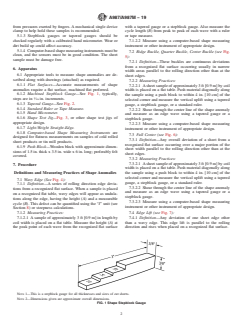
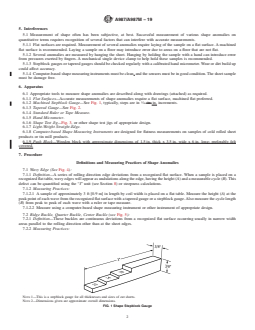
6.1.2 Machined Stepblock Gauge—See Fig. 1, typically, steps are in ⁄16-in. in. increments.
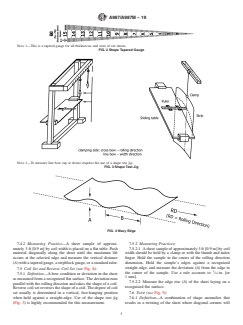
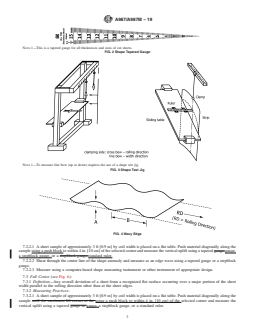
6.1.3 Tapered Gauge—See Fig. 2.
6.1.4 Standard Ruler or Tape Measure.
6.1.5 Hand Micrometer.
6.1.6 Shape Test Jig—Fig. 3, or other shape test jigs of appropriate design.
6.1.7 Light-Weight Straight-Edge.
6.1.8 Computer-based Shape Measuring Instruments are designed for flatness measurements on samples of cold rolled sheet
products or tin mill products.
6.1.9 Push Block—Wooden block with approximate dimensions of 1.5 in. thick x 3.5 in. wide x 6 in. long; preferably felt
covered.
7. Procedure
Definitions and Measuring Practices of Shape Anomalies
7.1 Wavy Edge (See Fig. 4):
7.1.1 Definition—A series of rolling direction edge deviations from a recognized flat surface. When a sample is placed on a
recognized flat table, wavy edges will appear as undulations along the edge, having the height (A) and a measurable cycle (B). This
defect can be quantified using the “I” unit (see Section 8) or steepness calculations.
7.1.2 Measuring Practices:
7.1.2.1 A sample of approximately 3 ft [0.9 m] in length by coil width is placed on a flat table. Measure the height (A) at the
peak point of each wave from the recognized flat surface with a tapered gauge or a stepblock gauge. Also measure the cycle length
(B) from peak to peak of each wave with a ruler or tape measure.
7.1.2.2 Measure using a computer-based shape measuring instrument or other instrument of appropriate design.
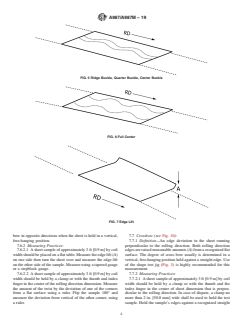
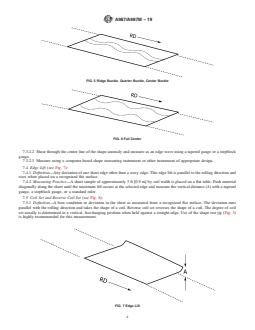
7.2 Ridge Buckle, Quarter Buckle, Center Buckle (see Fig. 5):
7.2.1 Definition—These buckles are continuous deviations from a recognized flat surface occurring usually in narrow width
areas parallel to the rolling direction other than at the sheet edges.
7.2.2 Measuring Practices:
NOTE 1—This is a stepblock gauge for all thicknesses and sizes of cut sheets.
NOTE 2—Dimensions given are approximate overall dimensions.
FIG. 1 Shape Stepblock Gauge
A987/A987M − 19
NOTE 1—This is a tapered gauge for all thicknesses and sizes of cut sheets.
FIG. 2 Shape Tapered Gauge
NOTE 1—To measure line bow (up or down) requires the use of a shape test jig.
FIG. 3 Shape Test Jig
FIG. 4 Wavy Edge
7.2.2.1 A sheet sample of approximately 3 ft [0.9 m] by coil width is placed on a flat table. Push material diagonally along the
sample using a push block to within 4 in. [10 cm] of the selected corner and measure the vertical uplift using a tapered gauge gauge,
a stepblock gauge, or a stepblock gauge.standard ruler.
7.2.2.2 Shear through the center line of the shape anomaly and measure as an edge wave using a tapered gauge or a stepblock
gauge.
7.2.2.3 Measure using a computer-based shape measuring instrument or other instrument of appropriate design.
7.3 Full Center (see Fig. 6):
7.3.1 Definition—Any overall deviation of a sheet from a recognized flat surface occurring over a major portion of the sheet
width parallel to the rolling direction other than at the sheet edges.
7.3.2 Measuring Practices:
7.3.2.1 A sheet sample of approximately 3 ft [0.9 m] by coil width is placed on a flat table. Push material diagonally along the
sample until the maximum lift occurs at the using a push block to within 4 in. [10 cm] of the selected corner and measure the
vertical uplift using a tapered gauge or gauge, a stepblock ga
...