


ASTM D7833-20
(Test Method)Standard Test Method for Determination of Hydrocarbons and Non-Hydrocarbon Gases in Gaseous Mixtures by Gas Chromatography
Standard Test Method for Determination of Hydrocarbons and Non-Hydrocarbon Gases in Gaseous Mixtures by Gas Chromatography
SIGNIFICANCE AND USE
5.1 The hydrocarbon component distribution of gaseous mixtures is often required for end-use sale of this material. Applications such as chemical feedstock or fuel require precise compositional data to ensure uniform quality. Trace amounts of some hydrocarbon impurities in these materials can have adverse effects on their use and processing. Certain regulations may require use of such method.
5.2 The component distribution data of gaseous mixtures can be used to calculate physical properties such as relative density, vapor pressure, and heating value calculations found in Practice D3588. Precision and accuracy of compositional data is extremely important when this data is used to calculate various properties of petroleum products.
SCOPE
1.1 This test method is intended to quantitatively determine the non-condensed hydrocarbon gases with carbon numbers from C1 to C5+ and non-hydrocarbon gases, such as H2, CO2, O2, N2, and CO, in gaseous samples. This test method is a companion standard test method to Test Method D1945 and Practice D1946, differing in that it incorporates use of capillary columns instead of packed columns and allows other technological differences.
1.2 Hydrogen sulfide can be detected but may not be accurately determined by this procedure due to loss in sample containers or sample lines and possible reactions unless special precautions are taken.
1.3 Non-hydrocarbon gases have a lower detection limit in the concentration range of 0.03 to 100 mole percent using a thermal conductivity detector (TCD), and C1 to C6 hydrocarbons have a lower detection limit in the range of 0.005 to 100 mole percent using a flame ionization detector (FID); using a TCD may increase the lower detection limit to approximately 0.03 mole percent.
1.3.1 Hydrocarbon detection limits can be reduced with the use of pre-concentration techniques or cryogenic trapping, or both.
1.4 This test method does not fully determine individual hydrocarbons heavier than benzene, which are grouped together as C7+. When detailed analysis is not required, the compounds with carbon number greater than C5 may be grouped as either C6+ or C7+. Accurate analysis of C5+ components depends on proper vaporization of these compounds during sampling at process unit sources as well as in the sample introduction into the analyzer in the laboratory.
1.5 Water vapor may interfere with the C6+ analysis if a TCD detector is used.
1.6 Helium and argon may interfere with the determination of hydrogen and oxygen respectively. Depending on the analyzer used, pentenes, if present, may either be separated or grouped with the C6+ components.
1.7 Units—The values stated in SI units are to be regarded as standard. No other units of measurement are included in this standard.
1.8 This standard does not purport to address all of the safety concerns, if any, associated with its use. It is the responsibility of the user of this standard to establish appropriate safety, health, and environmental practices and determine the applicability of regulatory limitations prior to use.
1.9 This international standard was developed in accordance with internationally recognized principles on standardization established in the Decision on Principles for the Development of International Standards, Guides and Recommendations issued by the World Trade Organization Technical Barriers to Trade (TBT) Committee.
General Information
- Status
- Published
- Publication Date
- 31-May-2020
- Technical Committee
- D03 - Gaseous Fuels
Relations
- Effective Date
- 01-Apr-2020
- Effective Date
- 01-Nov-2015
- Effective Date
- 01-Jun-2013
- Effective Date
- 01-Nov-2011
- Effective Date
- 01-Nov-2011
- Effective Date
- 01-Jan-2010
- Effective Date
- 01-Apr-2007
- Effective Date
- 01-Mar-2007
- Effective Date
- 01-Jun-2006
- Effective Date
- 01-Feb-2005
- Effective Date
- 10-May-2003
- Effective Date
- 10-May-2003
- Effective Date
- 10-Oct-2002
- Effective Date
- 01-Jan-2001
- Effective Date
- 01-Jan-2001
Overview
ASTM D7833-20: Standard Test Method for Determination of Hydrocarbons and Non-Hydrocarbon Gases in Gaseous Mixtures by Gas Chromatography is a critical standard developed by ASTM International. This method outlines procedures for the quantitative analysis of non-condensed hydrocarbon gases (C1 to C5+) and non-hydrocarbon gases (such as H₂, CO₂, O₂, N₂, and CO) within gaseous samples using gas chromatography, primarily with capillary columns. The standard serves industries that require accurate compositional data for end-use, sale, regulatory compliance, fuel or chemical feedstock quality control, and physical property calculations.
Key Topics
- Component Determination: Quantitative analysis of light hydrocarbon and non-hydrocarbon gases typically found in natural gas, processed gas, or chemical feedstocks.
- Detection Methods: Utilizes flame ionization detectors (FID) for hydrocarbons and thermal conductivity detectors (TCD) for non-hydrocarbon gases. Detection limits vary depending on the detector and pre-concentration techniques used.
- Sample Handling: Emphasizes representative sampling practices, appropriate sample containers, and handling procedures to ensure accuracy, especially for heavier hydrocarbons (e.g., C5+ components).
- Calibration: The method requires rigorous calibration using reference standards to ensure both precision and accuracy for component identification and quantification.
- Group Components: For heavier hydrocarbons (greater than benzene), compounds can be grouped (e.g., C6+ or C7+) unless a detailed breakdown is required.
- Interference Management: Details potential interferences, such as water vapor, helium, or argon, and stipulates requirements for sample line materials and system conditioning.
Applications
The ASTM D7833-20 test method is highly valuable in various industrial and regulatory contexts:
- Natural Gas Industry: Quality assurance for custody transfer, sales, and regulatory compliance. Ensures that natural gas composition meets specified criteria and contains negligible contaminants that may affect processing or end use.
- Chemical and Petrochemical Plants: Monitors feedstock purity and guard against impurities that could disrupt chemical reactions, catalyst lifespans, or product consistency.
- Fuel Gas Analysis: Assists in calculating key physical properties such as heating value, vapor pressure, and relative density, essential for process optimization and energy content assessment.
- Regulatory Compliance: Provides a standardized approach for determining gaseous composition as required by governmental or industry regulations.
- Research and Development: Supports analytical laboratories in developing and validating processes for new gas mixtures or quality management systems.
Related Standards
ASTM D7833-20 is designed to complement multiple widely recognized standards and practices:
- ASTM D1945: Test Method for Analysis of Natural Gas by Gas Chromatography
- ASTM D1946: Practice for Analysis of Reformed Gas by Gas Chromatography
- ASTM D3588: Practice for Calculating Heat Value, Compressibility Factor, and Relative Density of Gaseous Fuels
- ASTM E355: Practice for Gas Chromatography Terms and Relationships
- ASTM E1510: Practice for Installing Fused Silica Open Tubular Capillary Columns in Gas Chromatographs
- ASTM F307: Practice for Sampling Pressurized Gas for Gas Analysis
- API MPMS 14.1: Manual of Petroleum Measurement Standards - Collecting and Handling of Natural Gas Samples for Custody Transfer
These related documents provide additional guidance and technical details for sampling, analysis, quality control, and calculation procedures connected to gaseous mixtures.
Practical Value
Implementing ASTM D7833-20 allows organizations to:
- Ensure Consistent Gas Quality: By providing reliable compositional data, this standard supports consistent product quality for fuels and feedstocks.
- Improve Process Efficiency: Enables accurate physical calculations, ensuring optimal operation in processing facilities.
- Meet Regulatory Demands: Offers defensible, standardized procedures for reporting and compliance.
- Reduce Risks: Detects trace impurities that may impact end-use applications or cause equipment and process issues.
By following this standard, laboratories and facilities can achieve high-quality analytical results, foster regulatory compliance, and enhance operational efficiency in gas analysis and processing.
Buy Documents
ASTM D7833-20 - Standard Test Method for Determination of Hydrocarbons and Non-Hydrocarbon Gases in Gaseous Mixtures by Gas Chromatography
REDLINE ASTM D7833-20 - Standard Test Method for Determination of Hydrocarbons and Non-Hydrocarbon Gases in Gaseous Mixtures by Gas Chromatography
Get Certified
Connect with accredited certification bodies for this standard

ABS Quality Evaluations Inc.
American Bureau of Shipping quality certification.

Element Materials Technology
Materials testing and product certification.

ABS Group Brazil
ABS Group certification services in Brazil.
Sponsored listings
Frequently Asked Questions
ASTM D7833-20 is a standard published by ASTM International. Its full title is "Standard Test Method for Determination of Hydrocarbons and Non-Hydrocarbon Gases in Gaseous Mixtures by Gas Chromatography". This standard covers: SIGNIFICANCE AND USE 5.1 The hydrocarbon component distribution of gaseous mixtures is often required for end-use sale of this material. Applications such as chemical feedstock or fuel require precise compositional data to ensure uniform quality. Trace amounts of some hydrocarbon impurities in these materials can have adverse effects on their use and processing. Certain regulations may require use of such method. 5.2 The component distribution data of gaseous mixtures can be used to calculate physical properties such as relative density, vapor pressure, and heating value calculations found in Practice D3588. Precision and accuracy of compositional data is extremely important when this data is used to calculate various properties of petroleum products. SCOPE 1.1 This test method is intended to quantitatively determine the non-condensed hydrocarbon gases with carbon numbers from C1 to C5+ and non-hydrocarbon gases, such as H2, CO2, O2, N2, and CO, in gaseous samples. This test method is a companion standard test method to Test Method D1945 and Practice D1946, differing in that it incorporates use of capillary columns instead of packed columns and allows other technological differences. 1.2 Hydrogen sulfide can be detected but may not be accurately determined by this procedure due to loss in sample containers or sample lines and possible reactions unless special precautions are taken. 1.3 Non-hydrocarbon gases have a lower detection limit in the concentration range of 0.03 to 100 mole percent using a thermal conductivity detector (TCD), and C1 to C6 hydrocarbons have a lower detection limit in the range of 0.005 to 100 mole percent using a flame ionization detector (FID); using a TCD may increase the lower detection limit to approximately 0.03 mole percent. 1.3.1 Hydrocarbon detection limits can be reduced with the use of pre-concentration techniques or cryogenic trapping, or both. 1.4 This test method does not fully determine individual hydrocarbons heavier than benzene, which are grouped together as C7+. When detailed analysis is not required, the compounds with carbon number greater than C5 may be grouped as either C6+ or C7+. Accurate analysis of C5+ components depends on proper vaporization of these compounds during sampling at process unit sources as well as in the sample introduction into the analyzer in the laboratory. 1.5 Water vapor may interfere with the C6+ analysis if a TCD detector is used. 1.6 Helium and argon may interfere with the determination of hydrogen and oxygen respectively. Depending on the analyzer used, pentenes, if present, may either be separated or grouped with the C6+ components. 1.7 Units—The values stated in SI units are to be regarded as standard. No other units of measurement are included in this standard. 1.8 This standard does not purport to address all of the safety concerns, if any, associated with its use. It is the responsibility of the user of this standard to establish appropriate safety, health, and environmental practices and determine the applicability of regulatory limitations prior to use. 1.9 This international standard was developed in accordance with internationally recognized principles on standardization established in the Decision on Principles for the Development of International Standards, Guides and Recommendations issued by the World Trade Organization Technical Barriers to Trade (TBT) Committee.
SIGNIFICANCE AND USE 5.1 The hydrocarbon component distribution of gaseous mixtures is often required for end-use sale of this material. Applications such as chemical feedstock or fuel require precise compositional data to ensure uniform quality. Trace amounts of some hydrocarbon impurities in these materials can have adverse effects on their use and processing. Certain regulations may require use of such method. 5.2 The component distribution data of gaseous mixtures can be used to calculate physical properties such as relative density, vapor pressure, and heating value calculations found in Practice D3588. Precision and accuracy of compositional data is extremely important when this data is used to calculate various properties of petroleum products. SCOPE 1.1 This test method is intended to quantitatively determine the non-condensed hydrocarbon gases with carbon numbers from C1 to C5+ and non-hydrocarbon gases, such as H2, CO2, O2, N2, and CO, in gaseous samples. This test method is a companion standard test method to Test Method D1945 and Practice D1946, differing in that it incorporates use of capillary columns instead of packed columns and allows other technological differences. 1.2 Hydrogen sulfide can be detected but may not be accurately determined by this procedure due to loss in sample containers or sample lines and possible reactions unless special precautions are taken. 1.3 Non-hydrocarbon gases have a lower detection limit in the concentration range of 0.03 to 100 mole percent using a thermal conductivity detector (TCD), and C1 to C6 hydrocarbons have a lower detection limit in the range of 0.005 to 100 mole percent using a flame ionization detector (FID); using a TCD may increase the lower detection limit to approximately 0.03 mole percent. 1.3.1 Hydrocarbon detection limits can be reduced with the use of pre-concentration techniques or cryogenic trapping, or both. 1.4 This test method does not fully determine individual hydrocarbons heavier than benzene, which are grouped together as C7+. When detailed analysis is not required, the compounds with carbon number greater than C5 may be grouped as either C6+ or C7+. Accurate analysis of C5+ components depends on proper vaporization of these compounds during sampling at process unit sources as well as in the sample introduction into the analyzer in the laboratory. 1.5 Water vapor may interfere with the C6+ analysis if a TCD detector is used. 1.6 Helium and argon may interfere with the determination of hydrogen and oxygen respectively. Depending on the analyzer used, pentenes, if present, may either be separated or grouped with the C6+ components. 1.7 Units—The values stated in SI units are to be regarded as standard. No other units of measurement are included in this standard. 1.8 This standard does not purport to address all of the safety concerns, if any, associated with its use. It is the responsibility of the user of this standard to establish appropriate safety, health, and environmental practices and determine the applicability of regulatory limitations prior to use. 1.9 This international standard was developed in accordance with internationally recognized principles on standardization established in the Decision on Principles for the Development of International Standards, Guides and Recommendations issued by the World Trade Organization Technical Barriers to Trade (TBT) Committee.
ASTM D7833-20 is classified under the following ICS (International Classification for Standards) categories: 75.160.30 - Gaseous fuels. The ICS classification helps identify the subject area and facilitates finding related standards.
ASTM D7833-20 has the following relationships with other standards: It is inter standard links to ASTM F307-13(2020), ASTM D1946-90(2015)e1, ASTM F307-13, ASTM D3588-98(2011), ASTM D1946-90(2011), ASTM D1945-03(2010), ASTM F307-02(2007), ASTM E355-96(2007), ASTM D1946-90(2006), ASTM E1510-95(2005), ASTM D3588-98(2003), ASTM D1945-03, ASTM F307-02, ASTM D1945-96(2001), ASTM E355-96. Understanding these relationships helps ensure you are using the most current and applicable version of the standard.
ASTM D7833-20 is available in PDF format for immediate download after purchase. The document can be added to your cart and obtained through the secure checkout process. Digital delivery ensures instant access to the complete standard document.
Standards Content (Sample)
This international standard was developed in accordance with internationally recognized principles on standardization established in the Decision on Principles for the
Development of International Standards, Guides and Recommendations issued by the World Trade Organization Technical Barriers to Trade (TBT) Committee.
Designation: D7833 − 20
Standard Test Method for
Determination of Hydrocarbons and Non-Hydrocarbon
Gases in Gaseous Mixtures by Gas Chromatography
This standard is issued under the fixed designation D7833; the number immediately following the designation indicates the year of
original adoption or, in the case of revision, the year of last revision. A number in parentheses indicates the year of last reapproval. A
superscript epsilon (´) indicates an editorial change since the last revision or reapproval.
1. Scope 1.6 Helium and argon may interfere with the determination
of hydrogen and oxygen respectively. Depending on the
1.1 This test method is intended to quantitatively determine
analyzer used, pentenes, if present, may either be separated or
the non-condensed hydrocarbon gases with carbon numbers
grouped with the C + components.
from C to C + and non-hydrocarbon gases, such as H , CO ,
1 5 2 2
1.7 Units—The values stated in SI units are to be regarded
O , N , and CO, in gaseous samples. This test method is a
2 2
as standard. No other units of measurement are included in this
companion standard test method to Test Method D1945 and
standard.
Practice D1946, differing in that it incorporates use of capillary
columns instead of packed columns and allows other techno-
1.8 This standard does not purport to address all of the
logical differences.
safety concerns, if any, associated with its use. It is the
responsibility of the user of this standard to establish appro-
1.2 Hydrogen sulfide can be detected but may not be
priate safety, health, and environmental practices and deter-
accurately determined by this procedure due to loss in sample
mine the applicability of regulatory limitations prior to use.
containers or sample lines and possible reactions unless special
1.9 This international standard was developed in accor-
precautions are taken.
dance with internationally recognized principles on standard-
1.3 Non-hydrocarbon gases have a lower detection limit in
ization established in the Decision on Principles for the
the concentration range of 0.03 to 100 mole percent using a
Development of International Standards, Guides and Recom-
thermal conductivity detector (TCD), and C to C hydrocar-
1 6 mendations issued by the World Trade Organization Technical
bons have a lower detection limit in the range of 0.005 to 100
Barriers to Trade (TBT) Committee.
mole percent using a flame ionization detector (FID); using a
2. Referenced Documents
TCD may increase the lower detection limit to approximately
0.03 mole percent.
2.1 ASTM Standards:
1.3.1 Hydrocarbon detection limits can be reduced with the D1945 Test Method for Analysis of Natural Gas by Gas
use of pre-concentration techniques or cryogenic trapping, or Chromatography
both. D1946 Practice for Analysis of Reformed Gas by Gas
Chromatography
1.4 This test method does not fully determine individual
D3588 Practice for Calculating Heat Value, Compressibility
hydrocarbons heavier than benzene, which are grouped to-
Factor, and Relative Density of Gaseous Fuels
gether as C +. When detailed analysis is not required, the
E355 Practice for Gas Chromatography Terms and Relation-
compounds with carbon number greater than C may be
ships
grouped as either C + or C +. Accurate analysis of C +
6 7 5
E1510 Practice for Installing Fused Silica Open Tubular
components depends on proper vaporization of these com-
Capillary Columns in Gas Chromatographs
pounds during sampling at process unit sources as well as in
F307 Practice for Sampling Pressurized Gas for Gas Analy-
the sample introduction into the analyzer in the laboratory.
sis
1.5 Water vapor may interfere with the C + analysis if a 2.2 ASTM Publication:
TCD detector is used.
ASTM DS 4B, 1991 Physical Constants of Hydrocarbon and
Non-Hydrocarbon Compounds
1 2
This test method is under the jurisdiction of ASTM Committee D03 on Gaseous For referenced ASTM standards, visit the ASTM website, www.astm.org, or
Fuels and is the direct responsibility of Subcommittee D03.06.01 on Analysis of contact ASTM Customer Service at service@astm.org. For Annual Book of ASTM
Major Constituents by Gas Chromatography. Standards volume information, refer to the standard’s Document Summary page on
Current edition approved June 1, 2020. Published June 2020. Originally the ASTM website.
approved in 2012. Last previous edition approved in 2014 as D7833 – 14. DOI: Available from the ASTM website, www.astm.org, or contact ASTM Customer
10.1520/D7833-20. Service at service@astm.org
Copyright © ASTM International, 100 Barr Harbor Drive, PO Box C700, West Conshohocken, PA 19428-2959. United States
D7833 − 20
2.3 Other Document: 6.1.1 Detector—The type and number of detectors em-
API MPMS 14.1 Manual of Petroleum Measurement Stan- ployed is dependent on gas analyzer model and vendor used.
dards Chapter 14-Natural Gas Fluids Measurement Sec- Detectors that can be used include, but are not limited to FID,
tion 1-Collecting and Handling of Natural Gas Samples TCD, AED (Atomic Emission Detector), HID (Helium Ioniza-
for Custody Transfer tion Detector), and MS(Mass Spectrometer). Many systems use
a 3 detector system:
3. Terminology
(1) One FID (Flame Ionization Detector) for the determi-
nation of the hydrocarbon gases for the compounds listed in
3.1 Terminology related to the practice of gas chromatog-
Table 1,
raphy can be found in Practice E355.
(2) One TCD (Thermal Conductivity Detector) dedicated
3.2 Definitions:
to the determination of hydrogen utilizing nitrogen or argon as
3.2.1 sample set, n—a collection of samples taken from the
a carrier gas, and
same source or at similar component composition and concen-
(3) One TCD for the determination of all other required
trations.
non-hydrocarbon gases using helium as the carrier gas.
6.1.2 A TCD may also be used for the analysis of the
4. Summary of Test Method
hydrocarbon gases (replacing the FID) when high sensitivity
4.1 Components in a representative sample are physically
(< 0.03 mole percent) for trace analysis is not required.
separated by gas chromatography (GC) and compared to
6.1.3 Other detectors or combination of detectors may be
calibration data obtained under identical operating conditions
used provided that they have sufficient response, linearity, and
from a reference standard mixture of known composition. The
sensitivity to measure the components of interest at the
numerous heavy-end components of a sample can be grouped
concentration levels required for this application and meeting
into irregular peaks by reversing the direction of the carrier gas
all of the quality controls specified in this method. Some
through the column at such time as to group the heavy ends
analyzers, such as micro-analyzers, may contain up to
either as C and heavier, C and heavier, or C and heavier or
5 6 7
4-channels and separation systems to accomplish the analysis
alternatively elute them in the non-backflushed mode and
described in this method.
summed accordingly. The composition of the sample is calcu-
6.2 Data Acquisition—Any commercial computerized data
lated by comparing the peak areas with the corresponding
acquisition system may be used for display of the chromato-
values obtained with the reference standard.
graphic detector signal and peak area integration from all of the
detectors used in the analysis. The device should be capable of
5. Significance and Use
generating and storing a calibration and reporting the final
5.1 The hydrocarbon component distribution of gaseous
corrected response factor results.
mixtures is often required for end-use sale of this material.
6.3 Sample Introduction and System Configurations—
Applications such as chemical feedstock or fuel require precise
Sample introduction is typically performed with automated
compositional data to ensure uniform quality. Trace amounts of
valves containing sampling ‘loops’ of appropriate sizes. Fig. 1
some hydrocarbon impurities in these materials can have
adverse effects on their use and processing. Certain regulations
may require use of such method.
TABLE 1 List of Components Typically Analyzed
5.2 The component distribution data of gaseous mixtures
Component FID TCD
can be used to calculate physical properties such as relative
C olefin / C + composite X X
5 6
density, vapor pressure, and heating value calculations found in oxygen/argon composite X
hydrogen X
Practice D3588. Precision and accuracy of compositional data
carbon dioxide X
is extremely important when this data is used to calculate
hydrogen sulfide X
various properties of petroleum products. nitrogen X
carbon monoxide X
methane X X
6. Apparatus
ethane X X
ethylene X X
6.1 Gas Chromatograph (GC)—This method allows the use
propane X X
of most gas chromatographic analyzers designed for gas
propylene X X
analysis. Generally, any gas chromatographic instrument with acetylene X X
isobutane X X
a linear temperature programmable column oven or adequate
propadiene X X
temperature control to provide the required separation of
n-butane X X
gaseous compounds being analyzed may be used. The tem- trans-2-butene X X
1-butene X X
perature control must be capable of obtaining retention time
isobutylene X X
repeatability within 5 % of the retention time for each compo-
cis-2-butene X X
nent throughout the scope of this analysis for hydrocarbon and neopentane X X
cyclopentane X X
non-hydrocarbon gas analyses.
isopentane X X
methyl acetylene X X
n-pentane X X
Available from IHS, 15 Inverness Way East, Englewood, CO 80112, http:// 1,3-butadiene X X
www.global.ihs.com.
D7833 − 20
FIG. 1 Example of a Three Detector System for Analysis of Hydrocarbons and Non-Hydrocarbon Gases
FIG. 2 Example Chromatogram of Non-Hydrocarbon and Light Hydrocarbon Gases from System Configuration in Fig. 1
gives a suggested configuration, although systems may vary injection size or splitting inlet ratio, or both, must be selected
slightly among gas analyzers. The combination of valve such that the required sensitivity for the application is achieved
D7833 − 20
NOTE 1—For the hydrocarbon analysis, the Al O PLOT was used.
2 3
FIG. 3 Example Chromatogram of Hydrocarbons from System Configuration in Fig. 1
and also that no component concentration in a sample is greater may be possible as long as sample sizes are adjusted
than the detector upper linearity limit. The sample inlet system accordingly, the calibrations are linear in the range of interest,
shall be constructed of materials that are inert and non-
and the required resolution of the compounds of interest is
adsorptive with respect to the components in the sample. The maintained. When using a split injection, split ratios in the
preferred material of construction is stainless steel. Copper,
range of 5:1 to 200:1, with a typical value of 100:1, have been
brass, and other copper-bearing alloys are unacceptable. The used successfully depending upon the sample injection volume
sample size limitation of 0.5 mL or smaller is selected relative
and sensitivity required.
to the linearity of the detector response, and efficiency of
6.3.3 With Pre-concentrator or Cryogenic Trapping, or
column separation. Larger samples may be used to determine
Both—Pre-concentrator or cryogenic trapping, or both, can be
low-quantity components to increase measurement accuracy.
used prior to sample introduction into the gas chromatograph.
Sample sizes may be determined by experimentation or as
These items may enable lower detection limits on the compo-
recommended by analyzer vendors.
nents detailed by the manufacturer to be concentrated.
6.3.1 Hydrogen Sulfide and Other Reactive Gases—
6.4 Hydrogen Gas Analysis (Thermal Conductivity
Samples containing hydrogen sulfide and trace reactive gases
Detector)—A 10-port gas-sampling valve or equivalent may be
may benefit from use of surface treated metal surfaces, such as
5 6
used with nitrogen or argon carrier gas. Nitrogen or argon
Silcosteel or Sulfinert processes. Such specially treated
carrier gas is used to ensure that the hydrogen ‘peak’ remains
surfaces are also recommended for sample containers that may
positive over the concentration range of interest. Any column
contain such reactive species.
or multiple columns may be used, as long as helium and
6.3.2 With Capillary Columns—The gas chromatograph
hydrogen are separated and also separated from the other
must include a heated splitting type inlet that is operated
components. Typically, a dedicated TCD is used for this
isothermally, or if appropriate, direct connection to the valve
analysis. The gas-sampling valve shall provide a repeatability
of at least 6 2 % relative to the sample volume introduction for
Silcosteel has been found satisfactory for this purpose. It is a trademark of
major compounds present at >5 vol%.
SilcoTek, 112 Benner Circle, Bellefonte, PA 16823.
Sulfinert has been found satisfactory for this purpose. It is a trademark of NOTE 1—When helium is not expected to be present in samples the
Restek Corporation, 110 Benner Circle, Bellefonte, PA 16823. resolution of hydrogen from helium is not critical.
D7833 − 20
6.5 Non-Hydrocarbon and Light Hydrocarbon Gas Analysis butadiene when such compounds need to be determined. This
(Except Hydrogen) (Thermal Conductivity Detector)—A 10- condition can exist depending upon the degree of column
port gas sampling valve in combination with a 6-port switching deactivation.
valve or equivalent is used with helium or hydrogen carrier to
6.10.1 Routine re-conditioning of the alumina PLOT col-
analyze for CO , O , N , CH4, C H , and CO and in some
2 2 2 2 6 umn may be required to maintain column performance. It is
cases H S. Any column or multiple columns may be used as
recommended that a standby method be used when the system
long as the desired components are well separated. A TCD may
is idle to maintain the PLOT column at a temperature of at least
also be used for the analysis of the hydrocarbon gases
130 ºC or as recommended by the manufacturer.
(replacing the FID) when high sensitivity (<300 ppm) for trace
6.10.2 Alternatively, any column or combination of col-
analysis is not required. The gas-sampling valve shall provide
umns that provides the appropriate component C -C separa-
1 5
a repeatability of at least 6 2 % relative to the sample volume
tions may be used.
introduction for major compounds present at >5 vol%.
6.11 Pre-column for Hydrocarbon Gas Analysis—When
6.6 Hydrocarbon Gas Analysis (Flame Ionization
using the alumina PLOT column, if an initial backflush of the
Detector)—A 6-port gas-sampling valve in combination with a
C +/C + components through the use of the sequence reversal/
5 6
6-port pre-column switching valve (backflush) for the C + or
backflush valve is desired, a second column is required. Any
C + hydrocarbons is typically used. These valves shall be
pre-column that provides separation between the components
contained in a heated enclosure and operated at a sufficiently
of interest and the composite heavier components may be used.
high temperature, and within the limits of the valve operating
Choices may include lengths of column such as a 10 to 30 m
temperature as specified by manufacturer, to prevent conden-
section of 0.53 mm (I.D.) 3 μm film thickness dimethyl
sation of the C + components in the sample. The use of a frit
polysiloxane or a 9 to 15 cm section of the same column
or packed-screen type filter ahead of the sample introduction
material as the analytical column or any pre-column that
port is recommended with use of PLOT columns. The gas-
provides the desired retention of pentenes, hexanes, and
sampling valve shall provide a repeatability of at least 6 2 %
heavier components. This pre-column acts to keep the heavier
relative to the sample volume introduction for major com-
components away from the analytical alumina PLOT column
pounds present at >5 vol%.
and to backflush the heavier components as a composite peak
to the detector for quantification. If analysis of individual
6.7 Column Series/Reversal Switching Valve—If desired, a
C -C components is required, extend the backflush valve time
multi-port valve may be used to provide the C olefin/C + or 6 7
5 6
until the desired components have eluted and prior to
C + determination for this analysis. Other switching valve
backflushing the remaining heavier compounds.
configurations may be used to allow the elution of the gaseous
compounds. Consult instrument manufacturer for optimum
6.12 Analytical Columns for Hydrogen Analysis—
configuration.
Generally, hydrogen analysis consists of a pre-column to
NOTE 2—If a dimethylsilicone capillary column or equivalent is used
remove most of the hydrocarbons, H S and CO and a
2 2
for the hydrocarbon analysis, then the capillary column may be used in the
Molecular Sieve 5A or equivalent for separation of hydrogen
foreflush mode (no-backflush) until all of the hydrocarbons have eluted
from oxygen and nitrogen. Follow vendor’s recommendations.
using temperature programming or equivalent.
6.8 Gas Controls—The gas chromatograph shall be pro- 6.13 Analytical Columns for Other Non-Hydrocarbon
Gases—Generally, a series-bypass two-valve configuration is
vided with suitable facilities for delivery and control of carrier
gases and detector gases. This will consist of the appropriate used, consisting of porous polymer-molecular sieve 5A or 13X
combination. Follow vendor’s recommendations.
gas supply, down-stream regulators, and supply tubing as well
as the mass or pressure controls for the precise regulation of the
instrument operation. 7. Reagents and Materials
NOTE 3—Most gas chromatograph suppliers will provide these devices
7.1 All chemicals are reagent grade unless specified
or recommend the proper suppliers. Ensure that the analyzer, when heated
otherwise, and all water used is distilled or deionized.
and in-use, does not run out of carrier gases. In addition, running out of
carrier gas will require flushing out any air introduced into the sample inlet Warning—Hydrogen sulfide contained in calibration stan-
system, column, or detector, or a combination thereof.
dards may be flammable and harmful or fatal if ingested or
inhaled. Calibration standards or samples containing hydrogen
6.9 Columns—Condition all columns used according to the
sulfide should be handled in well ventilated locations away
manufacturer’s suggestions prior to putting the system in
from sparks and flames.
service.
7.2 Carrier Gases—For carrier gases, it is strongly recom-
6.10 Analytical Column for Hydrocarbon Analysis—A rec-
mended to install commercial active oxygen scrubbers and
ommended analytical column for the hydrocarbon analysis in
water dryers, such as molecular sieves, ahead of the instrument
Fig. 1 is a 50 m × 0.53 mm (I.D.) deactivated alumina (Al O )
2 3
to protect the chromatographic columns. Follow supplier
porous layer open tubular (PLOT) column used with a FID
instructions in the use of such gas purifiers and replace as
detector for lowest detection limits. Relative retention order for
necessary.
the alumina PLOT column is dependent upon the deactivation
method for the column and moisture content. Caution— 7.2.1 Chromatographic Grade Hydrogen, 99.995 % mini-
Specifically test the alumina PLOT column to ensure that the mum purity, <0.1 ppm H O. The use of appropriate scrubbers
column does not adsorb propadiene, methyl acetylene, and may be sufficient to obtain the desired purity.
D7833 − 20
7.2.2 Chromatographic Grade Helium, 99.995 % minimum that the bake out temperature does not exceed the maximum
purity, <0.1 ppm H O. The use of appropriate scrubbers may allowable temperature of any of the other columns.
be sufficient to obtain the desired purity.
8.3 Set the GC instrument to the operating parameters.
7.2.3 Chromatographic Grade Nitrogen, 99.995 % mini-
Allow the instrument to stabilize before proceeding with
mum purity, <0.1 ppm H O. The use of appropriate scrubbers
2 calibration and sample injections. When using an alumina
may be sufficient to obtain the desired purity. Warning—
PLOT column, recommended operating conditions are listed in
Improper handling of compressed gas cylinders containing air,
Appendix X1. However, conditions may vary if other column
nitrogen, hydrogen, or helium can result in an explosion. Rapid
systems are used or if tubing is different.
release of nitrogen or helium can result in asphyxiation.
8.4 Gas Sampling Valves—Set valve on and off times to
7.3 FID Detector Gases: comply with manufacturer’s instructions. When using a three
detector system, sample introduction into the analyzer for
7.3.1 Chromatographic Grade Hydrogen, 99.995 % mini-
hydrogen, non-hydrocarbon gases, and hydrocarbons may be
mum purity. The use of appropriate scrubbers may be sufficient
accomplished using valve injections that are synchronized such
to obtain the desired purity.
that samples are injected simultaneously into the system using
7.3.2 Chromatographic Grade Air, less than 10 ppm-mol
computer controlled valves. Other sample introduction may be
each of total hydrocarbons and water. The use of appropriate
used as long as the repeatability for these systems meets or
scrubbers may be sufficient to obtain the desired purity.
exceeds those stated in this method. Calibration st
...
This document is not an ASTM standard and is intended only to provide the user of an ASTM standard an indication of what changes have been made to the previous version. Because
it may not be technically possible to adequately depict all changes accurately, ASTM recommends that users consult prior editions as appropriate. In all cases only the current version
of the standard as published by ASTM is to be considered the official document.
Designation: D7833 − 14 D7833 − 20
Standard Test Method for
Determination of Hydrocarbons and Non-Hydrocarbon
Gases in Gaseous Mixtures by Gas Chromatography
This standard is issued under the fixed designation D7833; the number immediately following the designation indicates the year of
original adoption or, in the case of revision, the year of last revision. A number in parentheses indicates the year of last reapproval. A
superscript epsilon (´) indicates an editorial change since the last revision or reapproval.
1. Scope
1.1 This test method is intended to quantitatively determine the non-condensed hydrocarbon gases with carbon numbers from
C to C + and non-hydrocarbon gases, such as H , CO , O , N , and CO, in gaseous samples. This test method is a companion
1 5 2 2 2 2
standard test method to Test Method D1945 and Practice D1946, differing in that it incorporates use of capillary columns instead
of packed columns and allows other technological differences.
1.2 Hydrogen sulfide can be detected but may not be accurately determined by this procedure due to loss in sample containers
or sample lines and possible reactions unless special precautions are taken.
1.3 Non-hydrocarbon gases have a lower detection limit in the concentration range of 0.03 to 100 mole percent using a thermal
conductivity detector (TCD)(TCD), and C to C hydrocarbons have a lower detection limit in the range of 0.005 to 100 mole
1 6
percent using a flame ionization detector (FID); using a TCD may increase the lower detection limit to approximately 0.03 mole
percent.
1.3.1 Hydrocarbon detection limits can be reduced with the use of pre-concentration techniques and/or cryogenic trapping.or
cryogenic trapping, or both.
1.4 This test method does not fully determine individual hydrocarbons heavier than benzene, which are grouped together as
C ++. When detailed analysis is not required, the compounds with carbon number greater than C may be grouped as either C +,+
7 5 6
or C +. Accurate analysis of C + components depends on proper vaporization of these compounds during sampling at process unit
7 5
sources as well as in the sample introduction into the analyzer in the laboratory.
1.5 Water vapor may interfere with the C + analysis if a TCD detector is used.
1.6 Helium and argon may interfere with the determination of hydrogen and oxygen respectively. Depending on the analyzer
used, pentenes, if present, may either be separated or grouped with the C + components.
1.7 Units—The values stated in SI units are to be regarded as standard. No other units of measurement are included in this
standard.
1.8 This standard does not purport to address all of the safety concerns, if any, associated with its use. It is the responsibility
of the user of this standard to establish appropriate safety safety, health, and healthenvironmental practices and determine the
applicability of regulatory limitations prior to use.
1.9 This international standard was developed in accordance with internationally recognized principles on standardization
established in the Decision on Principles for the Development of International Standards, Guides and Recommendations issued
by the World Trade Organization Technical Barriers to Trade (TBT) Committee.
2. Referenced Documents
2.1 ASTM Standards:
D1945 Test Method for Analysis of Natural Gas by Gas Chromatography
D1946 Practice for Analysis of Reformed Gas by Gas Chromatography
D3588 Practice for Calculating Heat Value, Compressibility Factor, and Relative Density of Gaseous Fuels
This test method is under the jurisdiction of ASTM Committee D03 on Gaseous Fuels and is the direct responsibility of Subcommittee D03.07 on Analysis of Chemical
Composition of Gaseous Fuels.
Current edition approved June 1, 2014June 1, 2020. Published June 2014June 2020. Originally approved in 2012. Last previous edition approved in 20122014 as
D7833D7833 – 14.-12. DOI: 10.1520/D7833-14.10.1520/D7833-20.
For referenced ASTM standards, visit the ASTM website, www.astm.org, or contact ASTM Customer Service at service@astm.org. For Annual Book of ASTM Standards
volume information, refer to the standard’s Document Summary page on the ASTM website.
Copyright © ASTM International, 100 Barr Harbor Drive, PO Box C700, West Conshohocken, PA 19428-2959. United States
D7833 − 20
E355 Practice for Gas Chromatography Terms and Relationships
E1510 Practice for Installing Fused Silica Open Tubular Capillary Columns in Gas Chromatographs
F307 Practice for Sampling Pressurized Gas for Gas Analysis
2.2 ASTM Publication:
ASTM DS 4B, 1991 Physical Constants of Hydrocarbon and Non-Hydrocarbon Compounds
2.3 Other Document:
API MPMS 14.1 Manual of Petroleum Measurement Standards Chapter 14-Natural Gas Fluids Measurement Section
1-Collecting and Handling of Natural Gas Samples for Custody Transfer
3. Terminology
3.1 Terminology related to the practice of gas chromatography can be found in Practice E355.
3.2 Definitions:
3.2.1 sample set—set, n—a collection of samples taken from the same source or at similar component composition and
concentrations.
4. Summary of Test Method
4.1 Components in a representative sample are physically separated by gas chromatography (GC) and compared to calibration
data obtained under identical operating conditions from a reference standard mixture of known composition. The numerous
heavy-end components of a sample can be grouped into irregular peaks by reversing the direction of the carrier gas through the
column at such time as to group the heavy ends either as C and heavier, C and heavier, or C and heavier or alternatively elute
5 6 7
them in the non-backflushed mode and summed accordingly. The composition of the sample is calculated by comparing the peak
areas with the corresponding values obtained with the reference standard.
5. Significance and Use
5.1 The hydrocarbon component distribution of gaseous mixtures is often required for end-use sale of this material. Applications
such as chemical feedstock or fuel require precise compositional data to ensure uniform quality. Trace amounts of some
hydrocarbon impurities in these materials can have adverse effects on their use and processing. Certain regulations may require
use of such method.
5.2 The component distribution data of gaseous mixtures can be used to calculate physical properties such as relative density,
vapor pressure, and heating value calculations found in Practice D3588. Precision and accuracy of compositional data is extremely
important when this data is used to calculate various properties of petroleum products.
6. Apparatus
6.1 Gas Chromatograph (GC)—This method allows the use of most gas chromatographic analyzers designed for gas analysis.
Generally, any gas chromatographic instrument with a linear temperature programmable column oven or adequate temperature
control to provide the required separation of gaseous compounds being analyzed may be used. The temperature control must be
capable of obtaining retention time repeatability within 5%5 % of the retention time for each component throughout the scope of
this analysis for hydrocarbon and non-hydrocarbon gas analyses.
6.1.1 Detector—The type and number of detectors employed is dependent on gas analyzer model and vendor used. Detectors
that can be used include, but are not limited to FID, TCD, AED (Atomic Emission Detector), HID (Helium Ionization Detector),
and MS(Mass Spectrometer). Many systems use a 3 detector system:
(1) One FID (Flame Ionization Detector) for the determination of the hydrocarbon gases for the compounds listed in Table 1,
(2) One TCD (Thermal Conductivity Detector) dedicated to the determination of hydrogen utilizing nitrogen or argon as a
carrier gas, and
(3) One TCD for the determination of all other required non-hydrocarbon gases using helium as the carrier gas.
6.1.2 A TCD may also be used for the analysis of the hydrocarbon gases (replacing the FID) when high sensitivity (< 0.03
(< 0.03 mole percent) for trace analysis is not required.
6.1.3 Other detectors or combination of detectors may be used provided that they have sufficient response, linearity, and
sensitivity to measure the components of interest at the concentration levels required for this application and meeting all of the
quality controls specified in this method. Some analyzers, such as micro-analyzers, may contain up to 4-channels and separation
systems to accomplish the analysis described in this method.
6.2 Data Acquisition—Any commercial computerized data acquisition system may be used for display of the chromatographic
detector signal and peak area integration from all of the detectors used in the analysis. The device should be capable of generating
and storing a calibration and reporting the final corrected response factor results.
Available from the ASTM website, www.astm.org, or contact ASTM Customer Service at service@astm.org
Available from IHS, 15 Inverness Way East, Englewood, CO 80112, http://www.global.ihs.com.
D7833 − 20
TABLE 1 List of Components Typically Analyzed
Component FID TCD
C olefin / C + composite X X
5 6
oxygen/argon composite X
hydrogen X
carbon dioxide X
hydrogen sulfide X
nitrogen X
carbon monoxide X
methane X X
ethane X X
ethylene X X
propane X X
propylene X X
acetylene X X
isobutane X X
propadiene X X
n-butane X X
trans-2-butene X X
1-butene X X
isobutylene X X
cis-2-butene X X
neopentane X X
cyclopentane X X
isopentane X X
methyl acetylene X X
n-pentane X X
1,3-butadiene X X
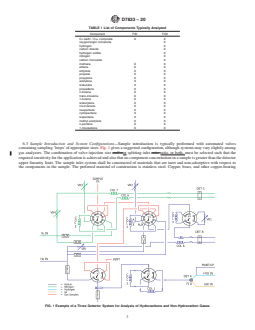
6.3 Sample Introduction and System Configurations—Sample introduction is typically performed with automated valves
containing sampling ‘loops’ of appropriate sizes. Fig. 1 gives a suggested configuration, although systems may vary slightly among
gas analyzers. The combination of valve injection size and/oror splitting inlet ratio ratio, or both, must be selected such that the
required sensitivity for the application is achieved and also that no component concentration in a sample is greater than the detector
upper linearity limit. The sample inlet system shall be constructed of materials that are inert and non-adsorptive with respect to
the components in the sample. The preferred material of construction is stainless steel. Copper, brass, and other copper-bearing
FIG. 1 Example of a Three Detector System for Analysis of Hydrocarbons and Non-Hydrocarbon Gases
D7833 − 20
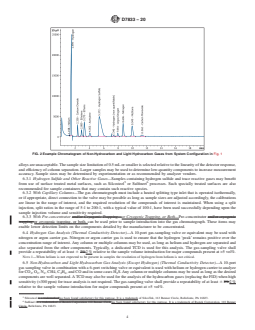
FIG. 2 Example Chromatogram of Non-Hydrocarbon and Light Hydrocarbon Gases from System Configuration in Fig. 1
alloys are unacceptable. The sample size limitation of 0.5 mL or smaller is selected relative to the linearity of the detector response,
and efficiency of column separation. Larger samples may be used to determine low-quantity components to increase measurement
accuracy. Sample sizes may be determined by experimentation or as recommended by analyzer vendors.
6.3.1 Hydrogen Sulfide and Other Reactive Gases—Samples containing hydrogen sulfide and trace reactive gases may benefit
5 6
from use of surface treated metal surfaces, such as Silcosteel or Sulfinert processes. Such specially treated surfaces are also
recommended for sample containers that may contain such reactive species.
6.3.2 With Capillary Columns—The gas chromatograph must include a heated splitting type inlet that is operated isothermally,
or if appropriate, direct connection to the valve may be possible as long as sample sizes are adjusted accordingly, the calibrations
are linear in the range of interest, and the required resolution of the compounds of interest is maintained. When using a split
injection, split ratios in the range of 5:1 to 200:1, with a typical value of 100:1, have been used successfully depending upon the
sample injection volume and sensitivity required.
6.3.3 With Pre-concentrator and/or Cryogenic Trapping—or Cryogenic Trapping, or Both—Pre-concentrator and/or cryogenic
trapping or cryogenic trapping, or both, can be used prior to sample introduction into the gas chromatograph. These items may
enable lower detection limits on the components detailed by the manufacturer to be concentrated.
6.4 Hydrogen Gas Analysis (Thermal Conductivity Detector)—A 10-port gas-sampling valve or equivalent may be used with
nitrogen or argon carrier gas. Nitrogen or argon carrier gas is used to ensure that the hydrogen ‘peak’ remains positive over the
concentration range of interest. Any column or multiple columns may be used, as long as helium and hydrogen are separated and
also separated from the other components. Typically, a dedicated TCD is used for this analysis. The gas-sampling valve shall
provide a repeatability of at least 6 2%2 % relative to the sample volume introduction for major compounds present at >5 vol%.
NOTE 1—When helium is not expected to be present in samples the resolution of hydrogen from helium is not critical.
6.5 Non-Hydrocarbon and Light Hydrocarbon Gas Analysis (Except Hydrogen) (Thermal Conductivity Detector)—A 10-port
gas sampling valve in combination with a 6-port switching valve or equivalent is used with helium or hydrogen carrier to analyze
for CO , O , N , CH4, C H , and CO and in some cases H S. Any column or multiple columns may be used as long as the desired
2 2 2 2 6 2
components are well separated. A TCD may also be used for the analysis of the hydrocarbon gases (replacing the FID) when high
sensitivity (<300 ppm) for trace analysis is not required. The gas-sampling valve shall provide a repeatability of at least 6 2%2 %
relative to the sample volume introduction for major compounds present at >5 vol%.
Silcosteel is a trademarkedhas been found satisfactory for this purpose. It is a trademark of SilcoTek, 112 Benner Circle, Bellefonte, PA 16823.
Sulfinert is a trademarked of Restek Corporation 110 Benner Circlehas been found satisfactory for this purpose. It is a trademark of Restek Corporation, 110 Benner
Circle, Bellefonte, PA 16823.
D7833 − 20
NOTE 1—For the hydrocarbon analysis, the Al O PLOT was used.
2 3
FIG. 3 Example Chromatogram of Hydrocarbons from System Configuration in Fig. 1
6.6 Hydrocarbon Gas Analysis (Flame Ionization Detector)—A 6-port gas-sampling valve in combination with a 6-port
pre-column switching valve (backflush) for the C + or C + hydrocarbons is typically used. These valves shall be contained in a
6 7
heated enclosure and operated at a sufficiently high temperature, and within the limits of the valve operating temperature as
specified by manufacturer, to prevent condensation of the C + components in the sample. The use of a frit or packed-screen type
filter ahead of the sample introduction port is recommended with use of PLOT columns. The gas-sampling valve shall provide a
repeatability of at least 6 2%2 % relative to the sample volume introduction for major compounds present at >5 vol%.
6.7 Column Series/Reversal Switching Valve—If desired, a multi-port valve may be used to provide the C olefin/C + or C +
5 6 7
determination for this analysis. Other switching valve configurations may be used to allow the elution of the gaseous compounds.
Consult instrument manufacturer for optimum configuration.
NOTE 2—If a dimethylsilicone capillary column or equivalent is used for the hydrocarbon analysis, then the capillary column may be used in the
foreflush mode (no-backflush) until all of the hydrocarbons have eluted using temperature programming or equivalent.
6.8 Gas Controls—The gas chromatograph shall be provided with suitable facilities for delivery and control of carrier gases and
detector gases. This will consist of the appropriate gas supply, down-stream regulators, and supply tubing as well as the mass or
pressure controls for the precise regulation of the instrument operation.
NOTE 3—Most gas chromatograph suppliers will provide these devices or recommend the proper suppliers. Ensure that the analyzer, when heated and
in-usein-use, does not run out of carrier gases. In addition, running out of carrier gas will require flushing out any air introduced into the sample inlet
system, column and/or detector.column, or detector, or a combination thereof.
6.9 Columns—Condition all columns used according to the manufacturer’s suggestions prior to putting the system in service.
6.10 Analytical Column for Hydrocarbon Analysis—A recommended analytical column for the hydrocarbon analysis in Fig. 1
is a 50 m × 0.53 mm (I.D.) deactivated alumina (Al O ) porous layer open tubular (PLOT) column used with a FID detector for
2 3
lowest detection limits. Relative retention order for the alumina PLOT column is dependent upon the deactivation method for the
column and moisture content. Warning—Specifically test the alumina PLOT column to ensure that the column does not adsorb
propadiene, methyl acetylene, and butadiene when such compounds need to be determined. This condition can exist depending
upon the degree of column deactivation.Caution—Specifically test the alumina PLOT column to ensure that the column does not
D7833 − 20
adsorb propadiene, methyl acetylene, and butadiene when such compounds need to be determined. This condition can exist
depending upon the degree of column deactivation.
6.10.1 Routine re-conditioning of the alumina PLOT column may be required to maintain column performance. It is
recommended that a standby method be used when the system is idle to maintain the PLOT column at a temperature of at least
130ºC130 ºC or as recommended by the manufacturer.
6.10.2 Alternatively, any column or combination of columns that provides the appropriate component C -C separations may
1 5
be used.
6.11 Pre-column for Hydrocarbon Gas Analysis—When using the alumina PLOT column, if an initial backflush of the C +/C +
5 6
components through the use of the sequence reversal/backflush valve is desired, a second column is required. Any pre-column that
provides separation between the components of interest and the composite heavier components may be used. Choices may include
lengths of column such as a 10 to 30 m section of 0.53 mm (I.D.) 3-μm3 μm film thickness dimethyl polysiloxane or a 9 to 15
cm section of the same column material as the analytical column or any pre-column that provides the desired retention of pentenes,
hexanes, and heavier components. This pre-column acts to keep the heavier components away from the analytical alumina PLOT
column and to backflush the heavier components as a composite peak to the detector for quantification. If analysis of individual
C -C components is required, extend the backflush valve time until the desired components have eluted and prior to backflushing
6 7
the remaining heavier compounds.
6.12 Analytical Columns for Hydrogen Analysis—Generally, hydrogen analysis consists of a pre-column to remove most of the
hydrocarbons, H S and CO and a Molecular Sieve 5A or equivalent for separation of hydrogen from oxygen and nitrogen. Follow
2 2
vendor’s recommendations.
6.13 Analytical Columns for Other Non-Hydrocarbon Gases—Generally, a series-bypass two-valve configuration is used,
consisting of porous polymer-molecular sieve 5A or 13X combination. Follow vendor’s recommendations.
7. Reagents and Materials
7.1 All chemicals are reagent grade unless specified otherwise, and all water used is distilled or deionized. Warning—Hydrogen
sulfide contained in calibration standards may be flammable and harmful or fatal if ingested or inhaled. Calibration standards or
samples containing hydrogen sulfide should be handled in well ventilated locations away from sparks and flames.
7.2 Carrier Gases—For carrier gases, it is strongly recommended to install commercial active oxygen scrubbers and water
dryers, such as molecular sieves, ahead of the instrument to protect the chromatographic columns. Follow supplier instructions in
the use of such gas purifiers and replace as necessary.
7.2.1 Chromatographic Grade Hydrogen, Chromatographic Grade Hydrogen, 99.995% 99.995 % minimum purity, <0.1 ppm
H O. The use of appropriate scrubbers may be sufficient to obtain the desired purity.
7.2.2 Chromatographic Grade Helium, Chromatographic Grade Helium, 99.995 % 99.995 % minimum purity, <0.1 ppm
<0.1 ppm H O. The use of appropriate scrubbers may be sufficient to obtain the desired purity.
7.2.3 Chromatographic Grade Nitrogen, Chromatographic Grade Nitrogen, 99.995 % 99.995 % minimum purity,
<0.1ppm<0.1 ppm H O. The use of appropriate scrubbers may be sufficient to obtain the desired purity. Warning—Improper
handling of compressed gas cylinders containing air, nitrogen, hydrogen, or helium can result in an explosion. Rapid release of
nitrogen or helium can result in asphyxiation.
7.3 FID Detector Gases:
7.3.1 Chromatographic Grade Hydrogen, Chromatographic Grade Hydrogen, 99.995 % minimum purity. The use of appropriate
scrubbers may be sufficient to obtain the desired purity.
7.3.2 Chromatographic Grade Air, Chromatographic Grade Air, less than 10 ppm-mol each of total hydrocarbons and water. The
use of appropriate scrubbers may be sufficient to obtain the desired purity. Warning—Compressed air supports combustion.
7.4 Reference Standards:
7.4.1 Purity of Reagents—Reagent grade chemicals shall be used in all tests. Unless otherwise indicated, all reagents should
conform to the specifications of the Committee on Analytical Reagents of the American Chemical Society where such
specifications are available. Other grades may be used, provided it is first ascertained that the reagent is of sufficiently high purity
to permit its use without lessening the accuracy of the determination.
7.4.2 Calibration Standards—Individual and mixed component reference materials are commercially available and may be used
to establish qualitative and quantitative calibration. The calibration standard mixture should be gravimetrically prepared, supplied
with both gravimetric and calculated volumetric and mole% concentrations, and at least NIST traceable or Van Swinden
Laboratorium, National Metrology Institute of the Netherlands (VSL) certified. The calibration standard mixture should have
anal
...
Questions, Comments and Discussion
Ask us and Technical Secretary will try to provide an answer. You can facilitate discussion about the standard in here.
Loading comments...