

ASTM D4150-23a
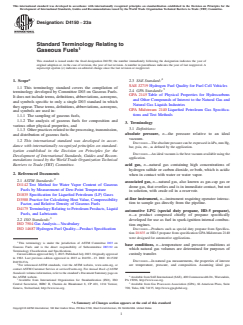
(Terminology)Standard Terminology Relating to Gaseous Fuels
General Information
- Abstract
SCOPE
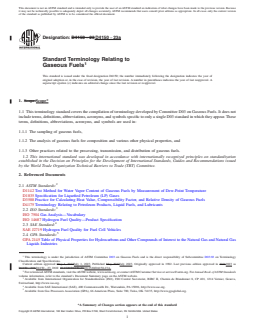
1.1 This terminology standard covers the compilation of terminology developed by Committee D03 on Gaseous Fuels. It does not include terms, definitions, abbreviations, acronyms, and symbols specific to only a single D03 standard in which they appear. These terms, definitions, abbreviations, acronyms, and symbols are used in:
1.1.1 The sampling of gaseous fuels,
1.1.2 The analysis of gaseous fuels for composition and various other physical properties, and
1.1.3 Other practices related to the processing, transmission, and distribution of gaseous fuels.
1.2 This international standard was developed in accordance with internationally recognized principles on standardization established in the Decision on Principles for the Development of International Standards, Guides and Recommendations issued by the World Trade Organization Technical Barriers to Trade (TBT) Committee.
- Status
- Published
- Publication Date
- 30-Jun-2023
- Technical Committee
- D03 - Gaseous Fuels
- Drafting Committee
- D03.92 - Terminology and Editorial
Overview
ASTM D4150-23a - Standard Terminology Relating to Gaseous Fuels is an international standard developed by ASTM Committee D03. The primary purpose of this compilation is to provide unified terminology for industries working with gaseous fuels. It covers general terms, definitions, abbreviations, acronyms, and symbols that are commonly used across various ASTM D03 standards involving gaseous fuels. This standard plays a crucial role in ensuring consistency and clarity in communication, documentation, and technical operations involving the sampling, analysis, processing, transmission, and distribution of gaseous fuels.
Key Topics
ASTM D4150-23a addresses a wide range of terminology relevant to gaseous fuels, supporting professionals and organizations in standardizing their documentation and technical language. Key subject areas include:
Sampling and Analysis of Gaseous Fuels
- Terms covering sampling techniques (e.g., direct sampling, at-line instrument, gas sampling chamber)
- Analytical procedures for determining gas composition and physical properties
Properties and Measurement
- Definitions for physical and chemical properties (e.g., absolute pressure, compressibility, calorimeter, dew point, relative density)
- Standard conditions for temperature and pressure (STP), base conditions, and standard volume of gas
Composition and Types of Fuels
- Terms describing various gaseous fuels (e.g., natural gas, biogas, renewable natural gas, liquefied petroleum gas, compressed natural gas)
- Definitions for gas quality indicators such as the Wobbe index, methane number, gross and net heating value
Quality Control and Calibration
- Terms related to quality assurance in gas measurement and analysis (e.g., calibration gas mixture, continuing calibration verification)
- Instrument-specific terminology (e.g., detector tube, calorimeter, continuous fuel monitor)
Safety, Handling, and Environmental Impact
- Definitions for contaminants, odorants, acid gas, sour gas, and sweet gas
- Terms aiding in environmental compliance and risk management
Abbreviations and Acronyms
- Comprehensive lists of industry acronyms and abbreviations (e.g., LPG, LNG, CNG, RNG, BTU, HHV, LHV, FID, PID)
Applications
The unified terminology provided by ASTM D4150-23a is essential across numerous practical applications:
Laboratory Testing and Reporting
- Ensures precise and consistent interpretation of analytical results and technical reports across different labs and agencies
Regulatory Compliance
- Supports organizations in meeting international and regional regulations by harmonizing language with referenced documents such as ISO and SAE standards
System Design and Operation
- Facilitates effective design, operation, and maintenance of gas processing, transmission, and distribution systems by using standardized terms
Procurement and Quality Assurance
- Clarifies specifications and requirements during procurement of gaseous fuels and associated systems, minimizing ambiguity in contracts and documentation
Training and Documentation
- Provides a foundation for technical training materials and operational manuals, especially for international teams or non-native English speakers
Related Standards
ASTM D4150-23a cross-references several key standards for broader context and application:
- ASTM D1142 - Test Method for Water Vapor Content of Gaseous Fuels by Measurement of Dew-Point Temperature
- ASTM D1835 - Specification for Liquefied Petroleum (LP) Gases
- ASTM D3588 - Practice for Calculating Heat Value, Compressibility Factor, and Relative Density of Gaseous Fuels
- ASTM D4175 - Terminology Relating to Petroleum Products, Liquid Fuels, and Lubricants
- ISO 7504 - Gas Analysis - Vocabulary
- ISO 14687 - Hydrogen Fuel Quality - Product Specification
- SAE J2719 - Hydrogen Fuel Quality for Fuel Cell Vehicles
- GPA 2145 - Table of Physical Properties for Hydrocarbons and Other Compounds of Interest to the Natural Gas and Natural Gas Liquids Industries
By referencing ASTM D4150-23a, stakeholders in the gaseous fuels sector can ensure their technical documentation, processes, and communications are globally recognized and adhere to best practices. This standard is a foundational tool for maintaining clarity, quality, and interoperability in the ever-evolving natural gas and energy industry.
Relations
- Refers
ASTM D4175-23a - Standard Terminology Relating to Petroleum Products, Liquid Fuels, and Lubricants - Effective Date
- 15-Dec-2023
- Refers
ASTM D4175-23e1 - Standard Terminology Relating to Petroleum Products, Liquid Fuels, and Lubricants - Effective Date
- 01-Jul-2023
- Effective Date
- 01-May-2013
- Effective Date
- 01-Dec-2012
- Effective Date
- 01-Nov-2011
- Effective Date
- 01-May-2011
- Effective Date
- 01-Jun-2006
- Effective Date
- 01-Apr-2005
- Effective Date
- 01-Nov-2003
- Effective Date
- 10-May-2003
- Effective Date
- 10-May-2003
- Effective Date
- 01-Jan-2000
- Effective Date
- 10-May-1998
- Effective Date
- 10-Nov-1997
Get Certified
Connect with accredited certification bodies for this standard

Element Materials Technology
Materials testing and product certification.

ABS Group Brazil
ABS Group certification services in Brazil.

ABS Quality Evaluations Inc.
American Bureau of Shipping quality certification.
Sponsored listings
Frequently Asked Questions
ASTM D4150-23a is a standard published by ASTM International. Its full title is "Standard Terminology Relating to Gaseous Fuels". This standard covers: SCOPE 1.1 This terminology standard covers the compilation of terminology developed by Committee D03 on Gaseous Fuels. It does not include terms, definitions, abbreviations, acronyms, and symbols specific to only a single D03 standard in which they appear. These terms, definitions, abbreviations, acronyms, and symbols are used in: 1.1.1 The sampling of gaseous fuels, 1.1.2 The analysis of gaseous fuels for composition and various other physical properties, and 1.1.3 Other practices related to the processing, transmission, and distribution of gaseous fuels. 1.2 This international standard was developed in accordance with internationally recognized principles on standardization established in the Decision on Principles for the Development of International Standards, Guides and Recommendations issued by the World Trade Organization Technical Barriers to Trade (TBT) Committee.
SCOPE 1.1 This terminology standard covers the compilation of terminology developed by Committee D03 on Gaseous Fuels. It does not include terms, definitions, abbreviations, acronyms, and symbols specific to only a single D03 standard in which they appear. These terms, definitions, abbreviations, acronyms, and symbols are used in: 1.1.1 The sampling of gaseous fuels, 1.1.2 The analysis of gaseous fuels for composition and various other physical properties, and 1.1.3 Other practices related to the processing, transmission, and distribution of gaseous fuels. 1.2 This international standard was developed in accordance with internationally recognized principles on standardization established in the Decision on Principles for the Development of International Standards, Guides and Recommendations issued by the World Trade Organization Technical Barriers to Trade (TBT) Committee.
ASTM D4150-23a is classified under the following ICS (International Classification for Standards) categories: 01.040.75 - Petroleum and related technologies (Vocabularies); 75.160.30 - Gaseous fuels. The ICS classification helps identify the subject area and facilitates finding related standards.
ASTM D4150-23a has the following relationships with other standards: It is inter standard links to ASTM D4175-23a, ASTM D4175-23e1, ASTM D1835-13, ASTM D1835-12, ASTM D3588-98(2011), ASTM D1835-11, ASTM D1142-95(2006), ASTM D1835-05, ASTM D1835-03a, ASTM D1835-03, ASTM D3588-98(2003), ASTM D1142-95(2000), ASTM D3588-98, ASTM D1835-97. Understanding these relationships helps ensure you are using the most current and applicable version of the standard.
ASTM D4150-23a is available in PDF format for immediate download after purchase. The document can be added to your cart and obtained through the secure checkout process. Digital delivery ensures instant access to the complete standard document.
Standards Content (Sample)
This international standard was developed in accordance with internationally recognized principles on standardization established in the Decision on Principles for the
Development of International Standards, Guides and Recommendations issued by the World Trade Organization Technical Barriers to Trade (TBT) Committee.
Designation: D4150 − 23a
Standard Terminology Relating to
Gaseous Fuels
This standard is issued under the fixed designation D4150; the number immediately following the designation indicates the year of
original adoption or, in the case of revision, the year of last revision. A number in parentheses indicates the year of last reapproval. A
superscript epsilon (´) indicates an editorial change since the last revision or reapproval.
1. Scope* 2.3 SAE Standard:
SAE J2719 Hydrogen Fuel Quality for Fuel Cell Vehicles
1.1 This terminology standard covers the compilation of
2.4 GPA Standards:
terminology developed by Committee D03 on Gaseous Fuels.
GPA 2145 Table of Physical Properties for Hydrocarbons
It does not include terms, definitions, abbreviations, acronyms,
and Other Compounds of Interest to the Natural Gas and
and symbols specific to only a single D03 standard in which
Natural Gas Liquids Industries
they appear. These terms, definitions, abbreviations, acronyms,
GPA Midstream 2140 Liquefied Petroleum Gas Specifica-
and symbols are used in:
tions and Test Methods
1.1.1 The sampling of gaseous fuels,
1.1.2 The analysis of gaseous fuels for composition and
3. Terminology
various other physical properties, and
3.1 Definitions:
1.1.3 Other practices related to the processing, transmission,
absolute pressure, n—the pressure relative to an ideal
and distribution of gaseous fuels.
vacuum.
1.2 This international standard was developed in accor-
DISCUSSION—The absolute pressure can be expressed in kPa, mm Hg,
dance with internationally recognized principles on standard-
bar, psia, etc., as defined by the application.
ization established in the Decision on Principles for the
DISCUSSION—An ideal vacuum is the best vacuum available using the
Development of International Standards, Guides and Recom-
application.
mendations issued by the World Trade Organization Technical
Barriers to Trade (TBT) Committee. acid gas, n—natural gas containing high concentrations of
hydrogen sulfide or carbon dioxide, or both, which is acidic
2. Referenced Documents
when in contact with water or water vapor.
2.1 ASTM Standards:
associated gas, n—natural gas, also known as gas-cap gas or
D1142 Test Method for Water Vapor Content of Gaseous
dome gas, that overlies and is in immediate contact, but not
Fuels by Measurement of Dew-Point Temperature
in solution, with crude oil in a reservoir.
D1835 Specification for Liquefied Petroleum (LP) Gases
at-line instrument, n—instrument requiring operator interac-
D3588 Practice for Calculating Heat Value, Compressibility
tion to sample gas directly from the pipeline.
Factor, and Relative Density of Gaseous Fuels
D4175 Terminology Relating to Petroleum Products, Liquid
automotive LPG (special duty propane, HD-5 propane),
Fuels, and Lubricants
n—a product composed chiefly of propane specifically
2.2 ISO Standards:
developed for use as fuel in spark-ignition internal combus-
ISO 7504 Gas Analysis—Vocabulary
tion engines.
ISO 14687 Hydrogen Fuel Quality—Product Specification DISCUSSION—Products such as special duty propane from Specifica-
tion D1835 or HD-5 propane from specification GPA Midstream 2140
were designed for automotive applications.
This terminology is under the jurisdiction of ASTM Committee D03 on
base conditions, n—temperature and pressure conditions at
Gaseous Fuels and is the direct responsibility of Subcommittee D03.92 on
which natural gas volumes are determined for purposes of
Terminology Classification and Specifications.
Current edition approved July 1, 2023. Published July 2023. Originally approved custody transfer.
in 1982. Last previous edition approved in 2023 as D4150 – 23. DOI: 10.1520/
DISCUSSION—In natural gas measurements, the properties of interest
D4150-23A.
For referenced ASTM standards, visit the ASTM website, www.astm.org, or are temperature, pressure, and composition. Assuming ideal gas
contact ASTM Customer Service at service@astm.org. For Annual Book of ASTM
Standards volume information, refer to the standard’s Document Summary page on
the ASTM website. Available from SAE International (SAE), 400 Commonwealth Dr., Warrendale,
Available from International Organization for Standardization (ISO), ISO PA 15096, http://www.sae.org.
Central Secretariat, BIBC II, Chemin de Blandonnet 8, CP 401, 1214 Vernier, Available from Gas Processors Association (GPA), 66 American Plaza, Suite
Geneva, Switzerland, http://www.iso.org. 700, Tulsa, OK 74135, http://www.gpaglobal.org.
*A Summary of Changes section appears at the end of this standard
Copyright © ASTM International, 100 Barr Harbor Drive, PO Box C700, West Conshohocken, PA 19428-2959. United States
D4150 − 23a
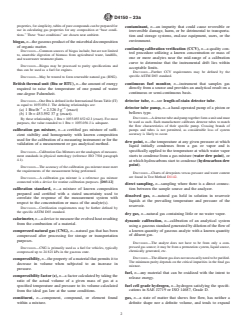
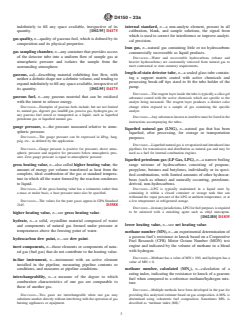
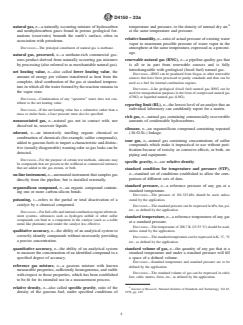
properties, for simplicity, tables of pure compounds can be prepared for
contaminant, n—an impurity that could cause reversible or
use in calculating gas properties for any composition at “base condi-
irreversible damage, harm, or be detrimental to transporta-
tions.” These “base conditions” are chosen near ambient.
tion and storage systems, end-use equipment, users, or the
environment.
biogas, n—the gaseous product of the microbial decomposition
of organic matter.
continuing calibration verification (CCV), n—a quality con-
DISCUSSION—Common sources of biogas include, but are not limited
trol procedure utilizing a known concentration or mass of
to, anaerobic digestion of biomass from agricultural waste, landfills,
one or more analytes near the mid-range of a calibration
and wastewater treatment plants.
curve to determine that the instrumental drift lies within
DISCUSSION—Biogas may be processed to purity specifications and
acceptable limits.
thus can be used as a fuel for engines.
DISCUSSION—Further CCV requirements may be defined by the
specific ASTM D03 standard.
DISCUSSION—May be treated to form renewable natural gas (RNG).
continuous fuel monitor, n—instrument that samples gas
British thermal unit (Btu or BTU), n—the amount of energy
directly from a source and provides an analytical result on a
required to raise the temperature of one pound of water
continuous or semi-continuous basis.
one-degree Fahrenheit.
detector tube, n—see length-of-stain detector tube.
DISCUSSION—One Btu is defined in the International Steam Table (IT)
as equal to 1055.056 J. The defining relationships are:
−1 −1 detector tube pump, n—a hand-operated pump of a piston or
(a) 1 Btu·lb = 2.326 J·g (exact)
bellows type.
(b) 1 lb = 453.592 37 g (exact).
DISCUSSION—A detector tube and pump together form a unit and must
By these relationships, 1 Btu = 1055.055 852 62 J (exact). For most
be used as such. Each manufacturer calibrates detector tubes to match
purposes, the value rounded to 1 Btu = 1055.056 J is adequate.
the flow characteristics of their specific pump. Crossing brands of
calibration gas mixture, n—a certified gas mixture of suffi- pumps and tubes is not permitted, as considerable loss of system
accuracy is likely to occur.
cient stability and homogeneity with known composition
used for the calibration of a measuring instrument or for the
dew point, n—the temperature at any given pressure at which
validation of a measurement or gas analytical method.
liquid initially condenses from a gas or vapor and is
specifically applied to the temperature at which water vapor
DISCUSSION—Calibration Gas Mixtures are the analogues of measure-
ment standards in physical metrology (reference ISO 7504 paragraph
starts to condense from a gas mixture (water dew point), or
4.1).
at which hydrocarbons start to condense (hydrocarbon dew
point).
DISCUSSION—The accuracy of the calibration gas mixture must meet
the requirements of the measurement being performed.
DISCUSSION—Charts of dewpoints versus pressure and water content
are found in Test Method D1142.
DISCUSSION—A calibration gas mixture is a reference gas mixture
connected with a device for routine calibration purposes. [D03.12]
direct sampling, n—sampling where there is a direct connec-
calibration standard, n—a mixture of known composition tion between the sample source and the analyzer.
prepared and certified with a stated uncertainty used to
dissolved gas, n—natural gas held in solution in reservoir
correlate the response of the measurement system with
liquids at the prevailing temperature and pressure of the
respect to the concentration or mass of the analyte(s).
reservoir.
DISCUSSION—Certification requirements may be further defined by
the specific ASTM D03 standard.
dry gas, n—natural gas containing little or no water vapor.
calorimeter, n—a device to measure the evolved heat resulting
dynamic calibration, n—calibration of an analytical system
from the combustion of a material.
using a gaseous standard generated by dilution of the flow of
a known quantity of gaseous analyte with a known quantity
compressed natural gas (CNG), n—natural gas that has been
of diluent gas.
compressed after processing for storage or transportation
purposes.
DISCUSSION—The analyte does not have to be from only a com-
pressed gas source; it may be from a permeation system, liquid source,
DISCUSSION—CNG is primarily used as a fuel for vehicles, typically
chemically generated, etc.
compressed up to 24 821 kPa in the gaseous state.
DISCUSSION—The diluent gas does not necessarily need to be purified.
compressibility, n—the property of a material that permits it to
The minimum purity depends on the critical impurities in the final gas
decrease in volume when subjected to an increase in
mixture.
pressure.
fuel, n—any material that can be oxidized with the intent to
compressibility factor (z), n—a factor calculated by taking the
release energy.
ratio of the actual volume of a given mass of gas at a
specified temperature and pressure to its volume calculated fuel cell grade hydrogen, n—hydrogen satisfying the specifi-
cations in SAE J2719 or ISO 14687, Grade D.
from the ideal gas law at the same conditions.
constituent, n—component, compound, or element found gas, n—a state of matter that shows free flow, has neither a
within a mixture. definite shape nor a definite volume, and tends to expand
D4150 − 23a
indefinitely to fill any space available, irrespective of its internal standard, n—a non-analyte element, present in all
quantity. [D02.95] D4175 calibration, blank, and sample solutions, the signal from
which is used to correct for interference or improve analyti-
gas quality, n—quality of gaseous fuel, which is defined by its
cal precision.
composition and its physical properties.
lean gas, n—natural gas containing little or no hydrocarbons
gas sampling chamber, n—any container that provides access
commercially recoverable as liquid products.
of the detector tube into a uniform flow of sample gas at
DISCUSSION—Water and recoverable hydrocarbons (ethane and
heavier hydrocarbons) are customarily removed from natural gas to
atmospheric pressure and isolates the sample from the
meet contractual or state statutory requirements.
surrounding atmosphere.
length-of-stain detector tube, n—a sealed glass tube contain-
gaseous, adj—describing material exhibiting free flow, with
ing a support matrix coated with active chemicals and
neither a definite shape nor a definite volume, and tending to
possessing break-off tips sized to fit the tube holder of the
expand indefinitely to fill any space available, irrespective of
pump.
its quantity. [D02.95] D4175
DISCUSSION—The reagent layer inside the tube is typically a silica gel
gaseous fuel, n—any gaseous material that can be oxidized
substance coated with the active chemicals which are specific to the
with the intent to release energy.
analyte being measured. The reagent layer produces a distinct color
change when exposed to a sample of gas containing the specific
DISCUSSION—Examples of gaseous fuels include, but are not limited
analyte.
to, natural gas, digester gas, landfill gas, process gas, hydrogen gas, or
any gaseous fuel stored or transported as a liquid, such as liquefied
DISCUSSION—Any substances known to interfere must be listed in the
petroleum gas or liquefied natural gas.
instructions accompanying the tubes.
gauge pressure, n—the pressure measured relative to atmo-
liquefied natural gas (LNG), n—natural gas that has been
spheric pressure.
liquefied, after processing, for storage or transportation
DISCUSSION—The gauge pressure can be expressed in kPag, barg,
purposes.
psig, etc., as defined by the application.
DISCUSSION—Liquefied natural gas is revaporized and introduced into
DISCUSSION—Gauge pressure is positive for pressures above atmo-
pipelines for transmission and distribution as natural gas and may be
spheric pressure and negative for pressures below atmospheric pres-
used as a fuel for internal combustion engines.
sure. Zero gauge pressure is equal to atmospheric pressure.
liquefied petroleum gas (LP Gas, LPG), n—a narrow boiling
gross heating value, n—also called higher heating value, the
range mixture of hydrocarbons consisting of propane,
amount of energy per volume transferred as heat from the
propylene, butanes and butylenes, individually or in speci-
complete, ideal combustion of the gas at standard tempera-
fied combinations, with limited amounts of other hydrocar-
ture in which all the water formed by the reaction condenses
bons (such as ethane) and naturally occurring, petroleum-
to liquid.
derived, non-hydrocarbons.
DISCUSSION—LPG is typically maintained in a liquid state by
DISCUSSION—If the gross heating value has a volumetric rather than
containing it within a closed container or storage tank that can
a mass or molar basis, a base pressure must also be specified.
withstand the vapor pressure of the LPG at ambient temperature, or at
DISCUSSION—The values for the pure gases appear in GPA Standard
a low temperature in refrigerated storage.
2145. D3588
DISCUSSION—In many jurisdictions, LPG for fuel purposes is required
to be odorized with a stenching agent such as ethyl mercaptan.
higher heating value, n—see gross heating value.
[D02.H0] D1835
hydrate, n—a solid, crystalline material composed of water
lower heating value, n—see net heating value.
and components of natural gas formed under pressure at
temperatures above the freezing point of water.
methane number (MN), n—an experimental determination of
a gaseous fuel’s resistance to knock based on a Cooperative
hydrocarbon dew point, n—see dew point.
Fuel Research (CFR) Motor Octane Number (MON) test
engine and indicated by the volume of methane in a blend
inert components, n—those elements or components of natu-
with hydrogen.
ral gas (fuel gas) that do not contribute to the heating value.
DISCUSSION—Methane has a value of MN = 100, and hydrogen has a
in-line instrument, n—instrument with an active element
value of MN = 0.
installed in the pipeline, measuring pipeline contents or
conditions, and measures at pipeline conditions. methane number, calculated (MN ), n—calculation of a
c
rating index, indicating the resistance to knock of a gaseous
interchangeability, n—a measure of the degree to which
fuel when compared to a reference methane/hydrogen mix-
combustion characteristics of one gas are comparable to
ture.
those of another gas.
DISCUSSION—Multiple methods have been developed in the past for
DISCUSSION—Two gases are interchangeable when one gas may providing this analytical estimate based on gas composition. A MN is
c
substitute another directly without interfering with the operation of gas determined using volumetric fuel composition. Sometimes MN is
c
burning appliances or equipment. described as “methane index (MI).”
D4150 − 23a
natural gas, n—a naturally occurring mixture of hydrocarbon temperature and pressure, to the density of normal dry air,
and nonhydrocarbon gases found in porous geological for- at the same temperature and pressure.
mations (reservoirs) beneath the earth’s surface, often in
relative humidity, n—ratio of actual pressure of existing water
association with petroleum.
vapor to maximum possible pressure of water vapor in the
DISCUSSION—The principal constituent of natural gas is methane. atmosphere at the same temperature, expressed as a percent-
age.
natural gas, processed, n—a methane-rich commercial gas-
eous product derived from naturally occurring gas mixtures renewable natural gas (RNG), n—a pipeline-quality gas that
by processing (also referred to as merchantable natural gas).
is all or in part from renewable sources and is fully
interchangeable with geological (fossil fuel) natural gas.
net heating value, n—also called lower heating value, the
DISCUSSION—RNG can be produced from biogas or other renewable
amount of energy per volume transferred as heat from the
sources that have been processed to purity standards and thus can be
complete, ideal combustion of the gas at standard tempera-
used as a fuel for internal combustion engines.
ture in which all the water formed by the reaction remains in
DISCUSSION—Like geological (fossil fuel) natural gas, RNG can be
the vapor state.
used for transportation purposes in the form of compressed natural gas
(CNG) or liquefied natural gas (LNG).
DISCUSSION—Condensation of any “spectator” water does not con-
tribute to the net heating value.
reporting limit (RL), n—the lowest level of an analyte that an
individual laboratory can confidently report for a matrix.
DISCUSSION—If the net heating value has a volumetric rather than a
mass or molar basis, a base pressure must also be specified.
rich gas, n—natural gas containing commercially recoverable
nonassociated gas, n—natural gas not in contact with, nor
amounts of condensable hydrocarbons.
dissolved in, reservoir liquids.
siloxane, n—an organosilicon compound containing repeated
odorant, n—an intensively smelling organic chemical or (-Si-O-Si-) linkage.
combination of chemicals (for example, sulfur compounds),
sour gas, n—natural gas containing concentrations of sulfur
added to gaseous fuels to impart a characteristic and distinc-
compounds which make it impractical to use without puri-
tive (usually disagreeable) warning odor so gas leaks can be
fication because of toxicity or corrosive effects, or both, on
detected.
piping and equipment.
DISCUSSION—For the purpose of certain test methods, odorants may
specific gravity, n—see relative density.
be compounds that are present at the wellhead or commercial mixtures
that are added to the gas stream, or both.
standard condition for temperature and pressure (STP),
n—standard set of conditions established to allow the com-
on-line instrument, n—automated instrument that samples gas
parison of different sets of data.
directly from the pipeline, but is installed externally.
standard pressure, n—a reference pressure of any gas at a
organosilicon compound, n—an organic compound contain-
standard temperature.
ing one or more carbon-silicon bonds.
DISCUSSION—The pressure of 101.325 kPa should be used, unless
poisoning, v—refers to the partial or total deactivation of a stated by the application.
catalyst by a chemical compound.
DISCUSSION—The standard pressure can be expressed in kPa, bar, psi,
etc., as defined by the application.
DISCUSSION—For fuel cells and internal combustion engine aftertreat-
ment systems, substances such as hydrogen sulfide or other sulfur
standard temperature, n—a reference temperature of any gas
compounds can bind to a component in the catalyst (such as a noble
at a standard pressure.
metal like platinum) and render the catalyst less effective.
DISCUSSION—The temperature of 288.7 K (15.55 °C) should be used,
unless stated by the application.
qualitative accuracy, n—the ability of an analytical system to
correctly identify compounds without necessarily providing
DISCUSSION—The standard temperature can be expressed in K, °C, °F,
a precise concentration.
etc., as defined by the application.
quantitative accuracy, n—the ability of an analytical system standard volume of gas, n—the quantity of any gas that at a
to measure the concentration of an identified compound to a standard temperature and under a standard pressure will fill
specified degree of accuracy. a space of a defined volume.
DISCUSSION—Standard temperature and standard pressure are to be
reference gas mixture, n—a gaseous mixture with known
defined by the application.
measurable properties, sufficiently homogeneous, and stable
DISCUSSION—The standard volume of gas can be expressed in cubic
with respect to those properties, which has been established
feet, cubic meters, liters, etc., as defined by the application.
to be fit for its intended use in a measurement process.
relative density, n—also called specific gravity, ratio of the 6
Journ
...
This document is not an ASTM standard and is intended only to provide the user of an ASTM standard an indication of what changes have been made to the previous version. Because
it may not be technically possible to adequately depict all changes accurately, ASTM recommends that users consult prior editions as appropriate. In all cases only the current version
of the standard as published by ASTM is to be considered the official document.
Designation: D4150 − 23 D4150 − 23a
Standard Terminology Relating to
Gaseous Fuels
This standard is issued under the fixed designation D4150; the number immediately following the designation indicates the year of
original adoption or, in the case of revision, the year of last revision. A number in parentheses indicates the year of last reapproval. A
superscript epsilon (´) indicates an editorial change since the last revision or reapproval.
1. Scope Scope*
1.1 This terminology standard covers the compilation of terminology developed by Committee D03 on Gaseous Fuels. It does not
include terms, definitions, abbreviations, acronyms, and symbols specific to only a single D03 standard in which they appear. These
terms, definitions, abbreviations, acronyms, and symbols are used in:
1.1.1 The sampling of gaseous fuels,
1.1.2 The analysis of gaseous fuels for composition and various other physical properties, and
1.1.3 Other practices related to the processing, transmission, and distribution of gaseous fuels.
1.2 This international standard was developed in accordance with internationally recognized principles on standardization
established in the Decision on Principles for the Development of International Standards, Guides and Recommendations issued
by the World Trade Organization Technical Barriers to Trade (TBT) Committee.
2. Referenced Documents
2.1 ASTM Standards:
D1142 Test Method for Water Vapor Content of Gaseous Fuels by Measurement of Dew-Point Temperature
D1835 Specification for Liquefied Petroleum (LP) Gases
D3588 Practice for Calculating Heat Value, Compressibility Factor, and Relative Density of Gaseous Fuels
D4175 Terminology Relating to Petroleum Products, Liquid Fuels, and Lubricants
2.2 ISO Standards:
ISO 7504 Gas Analysis—Vocabulary
ISO 14687 Hydrogen Fuel Quality—Product Specification
2.3 SAE Standard:
SAE J2719 Hydrogen Fuel Quality for Fuel Cell Vehicles
2.4 GPA Standards:
GPA 2145 Table of Physical Properties for Hydrocarbons and Other Compounds of Interest to the Natural Gas and Natural Gas
Liquids Industries
This terminology is under the jurisdiction of ASTM Committee D03 on Gaseous Fuels and is the direct responsibility of Subcommittee D03.92 on Terminology
Classification and Specifications.
Current edition approved May 1, 2023July 1, 2023. Published May 2023July 2023. Originally approved in 1982. Last previous edition approved in 20212023 as
D4150 – 21b.D4150 – 23. DOI: 10.1520/D4150-23.10.1520/D4150-23A.
For referenced ASTM standards, visit the ASTM website, www.astm.org, or contact ASTM Customer Service at service@astm.org. For Annual Book of ASTM Standards
volume information, refer to the standard’s Document Summary page on the ASTM website.
Available from International Organization for Standardization (ISO), ISO Central Secretariat, BIBC II, Chemin de Blandonnet 8, CP 401, 1214 Vernier, Geneva,
Switzerland, http://www.iso.org.
Available from SAE International (SAE), 400 Commonwealth Dr., Warrendale, PA 15096, http://www.sae.org.
Available from Gas Processors Association (GPA), 66 American Plaza, Suite 700, Tulsa, OK 74135, http://www.gpaglobal.org.
*A Summary of Changes section appears at the end of this standard
Copyright © ASTM International, 100 Barr Harbor Drive, PO Box C700, West Conshohocken, PA 19428-2959. United States
D4150 − 23a
GPA Midstream 2140 Liquefied Petroleum Gas Specifications and Test Methods
3. Terminology
3.1 Definitions:
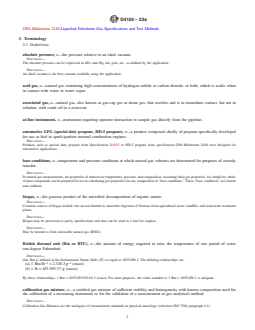
absolute pressure, n—the pressure relative to an ideal vacuum.
DISCUSSION—
The absolute pressure can be expressed in kPa, mm Hg, bar, psia, etc., as defined by the application.
DISCUSSION—
An ideal vacuum is the best vacuum available using the application.
acid gas, n—natural gas containing high concentrations of hydrogen sulfide or carbon dioxide, or both, which is acidic when
in contact with water or water vapor.
associated gas, n—natural gas, also known as gas-cap gas or dome gas, that overlies and is in immediate contact, but not in
solution, with crude oil in a reservoir.
at-line instrument, n—instrument requiring operator interaction to sample gas directly from the pipeline.
automotive LPG (special duty propane, HD-5 propane), n—a product composed chiefly of propane specifically developed
for use as fuel in spark-ignition internal combustion engines.
DISCUSSION—
Products such as special duty propane from Specification D1835 or HD-5 propane from specification GPA Midstream 2140 were designed for
automotive applications.
base conditions, n—temperature and pressure conditions at which natural gas volumes are determined for purposes of custody
transfer.
DISCUSSION—
In natural gas measurements, the properties of interest are temperature, pressure, and composition. Assuming ideal gas properties, for simplicity, tables
of pure compounds can be prepared for use in calculating gas properties for any composition at “base conditions.” These “base conditions” are chosen
near ambient.
biogas, n—the gaseous product of the microbial decomposition of organic matter.
DISCUSSION—
Common sources of biogas include, but are not limited to, anaerobic digestion of biomass from agricultural waste, landfills, and wastewater treatment
plants.
DISCUSSION—
Biogas may be processed to purity specifications and thus can be used as a fuel for engines.
DISCUSSION—
May be treated to form renewable natural gas (RNG).
British thermal unit (Btu or BTU), n—the amount of energy required to raise the temperature of one pound of water
one-degree Fahrenheit.
DISCUSSION—
One Btu is defined in the International Steam Table (IT) as equal to 1055.056 J. The defining relationships are:
−1 −1
(a) 1 Btu·lb = 2.326 J·g (exact)
(b) 1 lb = 453.592 37 g (exact).
By these relationships, 1 Btu = 1055.055 852 62 J (exact). For most purposes, the value rounded to 1 Btu = 1055.056 J is adequate.
calibration gas mixture, n—a certified gas mixture of sufficient stability and homogeneity with known composition used for
the calibration of a measuring instrument or for the validation of a measurement or gas analytical method.
DISCUSSION—
Calibration Gas Mixtures are the analogues of measurement standards in physical metrology (reference ISO 7504 paragraph 4.1).
D4150 − 23a
DISCUSSION—
The accuracy of the calibration gas mixture must meet the requirements of the measurement being performed.
DISCUSSION—
A calibration gas mixture is a reference gas mixture connected with a device for routine calibration purposes. [D03.12]
calibration standard, n—a mixture of known composition prepared and certified with a stated uncertainty used to correlate the
response of the measurement system with respect to the concentration or mass of the analyte(s).
DISCUSSION—
Certification requirements may be further defined by the specific ASTM D03 standard.
calorimeter, n—a device to measure the evolved heat resulting from the combustion of a material.
compressed natural gas (CNG), n—natural gas that has been compressed after processing for storage or transportation
purposes.
DISCUSSION—
CNG is primarily used as a fuel for vehicles, typically compressed up to 24 821 kPa in the gaseous state.
compressibility, n—the property of a material that permits it to decrease in volume when subjected to an increase in pressure.
compressibility factor (z), n—a factor calculated by taking the ratio of the actual volume of a given mass of gas at a specified
temperature and pressure to its volume calculated from the ideal gas law at the same conditions.
constituent, n—component, compound, or element found within a mixture.
contaminant, n—an impurity that could cause reversible or irreversible damage, harm, or be detrimental to transportation and
storage systems, end-use equipment, users, or the environment.
continuing calibration verification (CCV), n—a quality control procedure utilizing a known concentration or mass of one or
more analytes near the mid-range of a calibration curve to determine that the instrumental drift lies within acceptable limits.
DISCUSSION—
Further CCV requirements may be defined by the specific ASTM D03 standard.
continuous fuel monitor, n—instrument that samples gas directly from a source and provides an analytical result on a
continuous or semi-continuous basis.
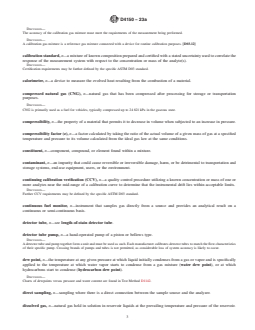
detector tube, n—see length-of-stain detector tube.
detector tube pump, n—a hand-operated pump of a piston or bellows type.
DISCUSSION—
A detector tube and pump together form a unit and must be used as such. Each manufacturer calibrates detector tubes to match the flow characteristics
of their specific pump. Crossing brands of pumps and tubes is not permitted, as considerable loss of system accuracy is likely to occur.
dew point, n—the temperature at any given pressure at which liquid initially condenses from a gas or vapor and is specifically
applied to the temperature at which water vapor starts to condense from a gas mixture (water dew point), or at which
hydrocarbons start to condense (hydrocarbon dew point).
DISCUSSION—
Charts of dewpoints versus pressure and water content are found in Test Method D1142.
direct sampling, n—sampling where there is a direct connection between the sample source and the analyzer.
dissolved gas, n—natural gas held in solution in reservoir liquids at the prevailing temperature and pressure of the reservoir.
D4150 − 23a
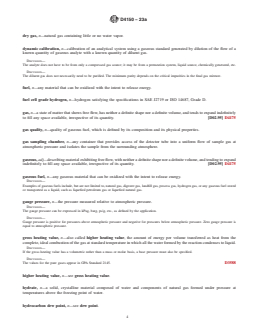
dry gas, n—natural gas containing little or no water vapor.
dynamic calibration, n—calibration of an analytical system using a gaseous standard generated by dilution of the flow of a
known quantity of gaseous analyte with a known quantity of diluent gas.
DISCUSSION—
The analyte does not have to be from only a compressed gas source; it may be from a permeation system, liquid source, chemically generated, etc.
DISCUSSION—
The diluent gas does not necessarily need to be purified. The minimum purity depends on the critical impurities in the final gas mixture.
fuel, n—any material that can be oxidized with the intent to release energy.
fuel cell grade hydrogen, n—hydrogen satisfying the specifications in SAE J2719 or ISO 14687, Grade D.
gas, n—a state of matter that shows free flow, has neither a definite shape nor a definite volume, and tends to expand indefinitely
to fill any space available, irrespective of its quantity. [D02.95] D4175
gas quality, n—quality of gaseous fuel, which is defined by its composition and its physical properties.
gas sampling chamber, n—any container that provides access of the detector tube into a uniform flow of sample gas at
atmospheric pressure and isolates the sample from the surrounding atmosphere.
gaseous, adj—describing material exhibiting free flow, with neither a definite shape nor a definite volume, and tending to expand
indefinitely to fill any space available, irrespective of its quantity. [D02.95] D4175
gaseous fuel, n—any gaseous material that can be oxidized with the intent to release energy.
DISCUSSION—
Examples of gaseous fuels include, but are not limited to, natural gas, digester gas, landfill gas, process gas, hydrogen gas, or any gaseous fuel stored
or transported as a liquid, such as liquefied petroleum gas or liquefied natural gas.
gauge pressure, n—the pressure measured relative to atmospheric pressure.
DISCUSSION—
The gauge pressure can be expressed in kPag, barg, psig, etc., as defined by the application.
DISCUSSION—
Gauge pressure is positive for pressures above atmospheric pressure and negative for pressures below atmospheric pressure. Zero gauge pressure is
equal to atmospheric pressure.
gross heating value, n—also called higher heating value, the amount of energy per volume transferred as heat from the
complete, ideal combustion of the gas at standard temperature in which all the water formed by the reaction condenses to liquid.
DISCUSSION—
If the gross heating value has a volumetric rather than a mass or molar basis, a base pressure must also be specified.
DISCUSSION—
The values for the pure gases appear in GPA Standard 2145. D3588
higher heating value, n—see gross heating value.
hydrate, n—a solid, crystalline material composed of water and components of natural gas formed under pressure at
temperatures above the freezing point of water.
hydrocarbon dew point, n—see dew point.
D4150 − 23a
inert components, n—those elements or components of natural gas (fuel gas) that do not contribute to the heating value.
in-line instrument, n—instrument with an active element installed in the pipeline, measuring pipeline contents or conditions,
and measures at pipeline conditions.
interchangeability, n—a measure of the degree to which combustion characteristics of one gas are comparable to those of
another gas.
DISCUSSION—
Two gases are interchangeable when one gas may substitute another directly without interfering with the operation of gas burning appliances or
equipment.
internal standard, n—a non-analyte element, present in all calibration, blank, and sample solutions, the signal from which is
used to correct for interference or improve analytical precision.
lean gas, n—natural gas containing little or no hydrocarbons commercially recoverable as liquid products.
DISCUSSION—
Water and recoverable hydrocarbons (ethane and heavier hydrocarbons) are customarily removed from natural gas to meet contractual or state statutory
requirements.
length-of-stain detector tube, n—a sealed glass tube containing a support matrix coated with active chemicals and possessing
break-off tips sized to fit the tube holder of the pump.
DISCUSSION—
The reagent layer inside the tube is typically a silica gel substance coated with the active chemicals which are specific to the analyte being measured.
The reagent layer produces a distinct color change when exposed to a sample of gas containing the specific analyte.
DISCUSSION—
Any substances known to interfere must be listed in the instructions accompanying the tubes.
liquefied natural gas (LNG), n—natural gas that has been liquefied, after processing, for storage or transportation purposes.
DISCUSSION—
Liquefied natural gas is revaporized and introduced into pipelines for transmission and distribution as natural gas and may be used as a fuel for internal
combustion engines.
liquefied petroleum gas (LP Gas, LPG), n—a narrow boiling range mixture of hydrocarbons consisting of propane, propylene,
butanes and butylenes, individually or in specified combinations, with limited amounts of other hydrocarbons (such as ethane)
and naturally occurring, petroleum-derived, non-hydrocarbons.
DISCUSSION—
LPG is typically maintained in a liquid state by containing it within a closed container or storage tank that can withstand the vapor pressure of the
LPG at ambient temperature, or at a low temperature in refrigerated storage.
DISCUSSION—
In many jurisdictions, LPG for fuel purposes is required to be odorized with a stenching agent such as ethyl mercaptan. [D02.H0] D1835
lower heating value, n—see net heating value.
methane number (MN), n—an experimental determination of a gaseous fuel’s resistance to knock based on a Cooperative Fuel
Research (CFR) Motor Octane Number (MON) test engine and indicated by the volume of methane in a blend with hydrogen.
DISCUSSION—
Methane has a value of MN = 100, and hydrogen has a value of MN = 0.
methane number, calculated (MN ), n—calculation of a rating index, indicating the resistance to knock of a gaseous fuel when
c
compared to a reference methane/hydrogen mixture.
D4150 − 23a
DISCUSSION—
Multiple methods have been developed in the past for providing this analytical estimate based on gas composition. A MN is determined using
c
volumetric fuel composition. Sometimes MN is described as “methane index (MI).”
c
natural gas, n—a naturally occurring mixture of hydrocarbon and nonhydrocarbon gases found in porous geological formations
(reservoirs) beneath the earth’s surface, often in association with petroleum.
DISCUSSION—
The principal constituent of natural gas is methane.
natural gas, processed, n—a methane-rich commercial gaseous product derived from naturally occurring gas mixtures by
processing (also referred to as merchantable natural gas).
net heating value, n—also called lower heating value, the amount of energy per volume transferred as heat from the complete,
ideal combustion of the gas at standard temperature in which all the water formed by the reaction remains in the vapor state.
DISCUSSION—
Condensation of any “spectator” water does not contribute to the net heating value.
DISCUSSION—
If the net heating value has a volumetric rather than a mass or molar basis, a base pressure must also be specified.
nonassociated gas, n—natural gas not in contact with, nor dissolved in, reservoir liquids.
odorant, n—an intensively smelling organic chemical or combination of chemicals (for example, sulfur compounds), added to
gaseous fuels to impart a characteristic and distinctive (usually disagreeable) warning odor so gas leaks can be detected.
DISCUSSION—
For the purpose of certain test methods, odorants may be compounds that are present at the wellhead or commercial mixtures that are added to the
gas stream, or both.
on-line instrument, n—automated instrument that samples gas directly from the pipeline, but is installed externally.
organosilicon compound, n—an organic compound containing one or more carbon-silicon bonds.
poisoning, v—refers to the partial or total deactivation of a catalyst by a chemical compound.
DISCUSSION—
For fuel cells and internal combustion engine aftertreatment systems, substances such as hydrogen sulfide or other sulfur compounds can bind to a
component in the catalyst (such as a noble metal like platinum) and render the catalyst less effective.
qualitative accuracy, n—the ability of an analytical system to correctly identify compounds without necessarily providing a
precise concentration.
quantitative accuracy, n—the ability of an analytical system to measure the concentration of an identified compound to a
specified degree of accuracy.
reference gas mixture, n—a gaseous mixture with known measurable properties, sufficiently homogeneous, and stable with
respect to those properties, which has been established to be fit for its intended use in a measurement process.
relative density, n—also called specific gravity, ratio of the density of the gaseous fuel, under specified conditions of
temperature and pressure, to the density of normal dry air, at the same temperature and pressure.
Journal of Research, National Institute of Standards and Technology, Vol 83, 1978, pp. 419.
D4150 − 23a
relative humidity, n—ratio of actual pressure of existing water vapor to maximum possible pressure of water vapor in the
atmosphere at the same temperature, expressed as a percentage.
renewable natural gas (RNG), n—a pipeline-quality gas that is all or in part from renewable sources and is fully
interchangeable with geological (fossil fuel) natural gas.
DISCUSSION—
RNG can be produced from biogas or other renewable sources that have been processed to purity standards and thus can be used as a fuel for internal
combustion engines.
DISCUSSION—
Like geological (fossil fuel) natural gas, RNG can be used for transportation purposes in the form of compressed natural gas (CNG) or liquefied natural
gas (LNG).
reporting limit (RL), n—the lowest level of an analyte that an individual laboratory can confidently report for a matrix.
rich gas, n—natural gas containing commercially recoverable amounts of condensable hydrocarbons.
siloxane, n—an organosilicon compound containing repeated (-Si-O-Si-) linkage.
sour gas, n—natural gas containing concentrations of sulfur compounds which make it impractical to use without purification
because of toxicity or corrosive effects, or both, on piping and equipment.
specific gravity, n—see relative density.
standard condition for temperature and pressure (STP), n—standard set of conditions established to allow the comparison
of different sets of data.
standard pressure, n—a reference pressure of any gas at a standard temperature.
DISCUSSION—
The pressure of 101.325 kPa should be used, unless stated by the application.
DISCUSSION—
The standard pressure can be expressed in kPa, bar, psi, etc., as defined by the application.
standard temperature, n—a reference temperature of any gas at a standard pressure.
DISCUSSION—
The temperature of 288.7 K (15.55 °C) should be used, unless stated by the application.
DISCUSSION—
The standard temperature can be expressed in K, °C, °F, etc., as defined by the application.
standard volume of gas, n—the quantity of any gas that at a standard temperature and under a standard pressure will fill a
...