

ASTM D7941/D7941M-23
(Test Method)Standard Test Method for Hydrogen Purity Analysis Using a Continuous Wave Cavity Ring-Down Spectroscopy Analyzer
General Information
- Abstract
SIGNIFICANCE AND USE
5.1 Proton exchange membranes (PEM) used in fuel cells are susceptible to contamination from a number of species that can be found in hydrogen. It is critical that these contaminants be measured and verified to be present at or below the amounts stated in SAE J2719 and ISO 14687 to ensure both fuel cell longevity and optimum efficiency. Contaminant concentrations as low as single-figure ppb(v) for some species can seriously compromise the life span and efficiency of PEM fuel cells. The presence of contaminants in fuel-cell-grade hydrogen can, in some cases, have a permanent adverse impact on fuel cell efficiency and usability. It is critical to monitor the concentration of key contaminants in hydrogen during the production phase through to delivery of the fuel to a fuel cell vehicle or other PEM fuel cell application. In ISO 14687, the upper limits for the contaminants are specified. Refer to SAE J2719 (see 2.3) for specific national and regional requirements. For hydrogen fuel that is transported and delivered as a cryogenic liquid, there is additional risk of introducing impurities during transport and delivery operations. For instance, moisture can build up over time in liquid transfer lines, critical control components, and long-term storage facilities, which can lead to ice buildup within the system and subsequent blockages that pose a safety risk or the introduction of contaminants into the gas stream upon evaporation of the liquid. Users are reminded to consult Practice D7265 for critical thermophysical properties such as the ortho/para hydrogen spin isomer inversion that can lead to additional hazards in liquid hydrogen usage.
SCOPE
1.1 This test method describes contaminant determination in fuel cell grade hydrogen as specified in relevant ASTM and ISO standards using cavity ring-down spectroscopy (CRDS). This standard test method is for the measurement of one or multiple contaminants including, but not limited to, water (H2O), oxygen (O2), methane (CH4), carbon dioxide (CO2), carbon monoxide (CO), ammonia (NH3), and formaldehyde (H2CO), henceforth referred to as “analyte.”
1.2 This test method applies to CRDS analyzers with one or multiple sensor modules (see 6.2 for definition). This test method describes sampling apparatus design, operating procedures, and quality control procedures required to obtain the stated levels of precision and accuracy.
1.3 The values stated in either SI units or inch-pound units are to be regarded separately as standard. The values stated in each system are not necessarily exact equivalents; therefore, to ensure conformance with the standard, each system shall be used independently of the other, and values from the two systems shall not be combined.
1.4 This standard does not purport to address all of the safety concerns, if any, associated with its use. It is the responsibility of the user of this standard to establish appropriate safety, health, and environmental practices and determine the applicability of regulatory limitations prior to use.
1.5 This international standard was developed in accordance with internationally recognized principles on standardization established in the Decision on Principles for the Development of International Standards, Guides and Recommendations issued by the World Trade Organization Technical Barriers to Trade (TBT) Committee.
- Status
- Published
- Publication Date
- 14-Jan-2023
- Technical Committee
- D03 - Gaseous Fuels
- Drafting Committee
- D03.14 - Hydrogen and Fuel Cells
Buy Documents
ASTM D7941/D7941M-23 - Standard Test Method for Hydrogen Purity Analysis Using a Continuous Wave Cavity Ring-Down Spectroscopy Analyzer
REDLINE ASTM D7941/D7941M-23 - Standard Test Method for Hydrogen Purity Analysis Using a Continuous Wave Cavity Ring-Down Spectroscopy Analyzer
Overview
ASTM D7941/D7941M-23: Standard Test Method for Hydrogen Purity Analysis Using a Continuous Wave Cavity Ring-Down Spectroscopy Analyzer establishes a method to determine trace contaminants in fuel cell grade hydrogen. Developed by ASTM Committee D03 on Gaseous Fuels, this standard supports the growing hydrogen economy by ensuring hydrogen quality meets critical thresholds for use in Proton Exchange Membrane (PEM) fuel cells. Maintaining hydrogen purity is essential for fuel cell longevity, performance, and compliance with international requirements such as SAE J2719 and ISO 14687.
Key Topics
- Hydrogen Purity and Fuel Cell Applications: Fuel cells, especially those using PEM technology, are highly sensitive to impurities. Even contaminant levels as low as parts per billion by volume can negatively impact a cell’s efficiency and lifespan.
- Contaminant Measurement: This standard details procedures for identifying and quantifying key analytes in hydrogen, including water (H₂O), oxygen (O₂), methane (CH₄), carbon dioxide (CO₂), carbon monoxide (CO), ammonia (NH₃), and formaldehyde (H₂CO).
- CRDS Technology: Continuous Wave Cavity Ring-Down Spectroscopy is an optical technique that measures how quickly light intensity decays within a reflective cavity when exposed to a gas sample. CRDS analyzers offer high sensitivity and precision for trace detection, making them ideal for hydrogen purity testing.
- Sampling and Analysis Procedures: The document specifies best practices for the design of sampling apparatus, handling of gas lines, use of appropriate purge gases, and the necessary quality control steps to ensure precision and accuracy in measurements.
- Safety Considerations: The test method emphasizes appropriate handling of high-pressure gases and hydrogen’s flammable nature, highlighting the importance of safety, environmental, and regulatory conformance during analysis and sampling.
Applications
- Fuel Cell Vehicle Hydrogen Infrastructure: Ensuring hydrogen purity from production through to delivery is crucial for automotive and stationary fuel cell systems to comply with specifications (e.g., SAE J2719, ISO 14687).
- Industrial and Research Laboratories: The standard provides a framework for laboratories to use CRDS analyzers in routine hydrogen quality certification and R&D.
- Hydrogen Production and Distribution: Producers and distributors of hydrogen fuel use this method to monitor and validate fuel-cell-grade hydrogen during storage and transport, especially to avoid contamination risks associated with cryogenic delivery and long-term storage.
- Regulatory Compliance: Adhering to ASTM D7941/D7941M-23 helps meet both national and international quality protocols for hydrogen as an alternative energy source.
Related Standards
Understanding hydrogen purity often requires familiarity with several interconnected standards:
- SAE J2719: Hydrogen Fuel Quality for Fuel Cell Vehicles - defines maximum impurity levels for hydrogen used in transportation.
- ISO 14687: Specifies the quality requirements for hydrogen fuel for PEM fuel cell applications, with explicit contaminant limits.
- ASTM D7265: Specification for Hydrogen Thermophysical Property Tables - recommended when considering properties critical to liquid hydrogen handling.
- ASTM D4150: Terminology Relating to Gaseous Fuels.
- ASTM D5287, D7606: Best practices for sampling gaseous fuels and high-pressure hydrogen.
- ASTM D7653, D7649: Alternative methods for determining trace gaseous contaminants in hydrogen fuel.
Practical Value
ASTM D7941/D7941M-23 supports safe and efficient deployment of hydrogen as a clean energy vector by:
- Providing a robust, traceable method for impurity monitoring using advanced CRDS technology.
- Assisting hydrogen producers, laboratories, and fuel cell operators in complying with strict purity guidelines.
- Enhancing fuel cell system reliability, longevity, and safety by reducing contamination risks.
- Enabling global interoperability and credibility in hydrogen fuel quality testing.
Keywords: ASTM D7941, hydrogen purity, fuel cell hydrogen, cavity ring-down spectroscopy, CRDS analyzer, trace contaminants, PEM fuel cell, SAE J2719, ISO 14687, hydrogen fuel quality testing, hydrogen contaminant analysis, hydrogen infrastructure standards.
Relations
- Effective Date
- 01-Nov-2023
- Effective Date
- 15-Dec-2019
- Effective Date
- 01-Apr-2018
- Effective Date
- 01-Nov-2017
- Effective Date
- 01-Jul-2016
- Refers
ASTM D5287-08(2015) - Standard Practice for Automatic Sampling of Gaseous Fuels (Withdrawn 2024) - Effective Date
- 01-Jun-2015
- Effective Date
- 01-May-2014
- Effective Date
- 01-May-2013
- Effective Date
- 01-May-2013
- Effective Date
- 01-Nov-2012
- Effective Date
- 01-Nov-2011
- Effective Date
- 01-Mar-2011
- Effective Date
- 01-Oct-2010
- Effective Date
- 01-Dec-2008
- Effective Date
- 01-Dec-2008
Buy Documents
ASTM D7941/D7941M-23 - Standard Test Method for Hydrogen Purity Analysis Using a Continuous Wave Cavity Ring-Down Spectroscopy Analyzer
REDLINE ASTM D7941/D7941M-23 - Standard Test Method for Hydrogen Purity Analysis Using a Continuous Wave Cavity Ring-Down Spectroscopy Analyzer
Get Certified
Connect with accredited certification bodies for this standard

DNV
DNV is an independent assurance and risk management provider.

Lloyd's Register
Lloyd's Register is a global professional services organisation specialising in engineering and technology.
DNV Energy Systems
Energy and renewable energy certification.
Sponsored listings
Frequently Asked Questions
ASTM D7941/D7941M-23 is a standard published by ASTM International. Its full title is "Standard Test Method for Hydrogen Purity Analysis Using a Continuous Wave Cavity Ring-Down Spectroscopy Analyzer". This standard covers: SIGNIFICANCE AND USE 5.1 Proton exchange membranes (PEM) used in fuel cells are susceptible to contamination from a number of species that can be found in hydrogen. It is critical that these contaminants be measured and verified to be present at or below the amounts stated in SAE J2719 and ISO 14687 to ensure both fuel cell longevity and optimum efficiency. Contaminant concentrations as low as single-figure ppb(v) for some species can seriously compromise the life span and efficiency of PEM fuel cells. The presence of contaminants in fuel-cell-grade hydrogen can, in some cases, have a permanent adverse impact on fuel cell efficiency and usability. It is critical to monitor the concentration of key contaminants in hydrogen during the production phase through to delivery of the fuel to a fuel cell vehicle or other PEM fuel cell application. In ISO 14687, the upper limits for the contaminants are specified. Refer to SAE J2719 (see 2.3) for specific national and regional requirements. For hydrogen fuel that is transported and delivered as a cryogenic liquid, there is additional risk of introducing impurities during transport and delivery operations. For instance, moisture can build up over time in liquid transfer lines, critical control components, and long-term storage facilities, which can lead to ice buildup within the system and subsequent blockages that pose a safety risk or the introduction of contaminants into the gas stream upon evaporation of the liquid. Users are reminded to consult Practice D7265 for critical thermophysical properties such as the ortho/para hydrogen spin isomer inversion that can lead to additional hazards in liquid hydrogen usage. SCOPE 1.1 This test method describes contaminant determination in fuel cell grade hydrogen as specified in relevant ASTM and ISO standards using cavity ring-down spectroscopy (CRDS). This standard test method is for the measurement of one or multiple contaminants including, but not limited to, water (H2O), oxygen (O2), methane (CH4), carbon dioxide (CO2), carbon monoxide (CO), ammonia (NH3), and formaldehyde (H2CO), henceforth referred to as “analyte.” 1.2 This test method applies to CRDS analyzers with one or multiple sensor modules (see 6.2 for definition). This test method describes sampling apparatus design, operating procedures, and quality control procedures required to obtain the stated levels of precision and accuracy. 1.3 The values stated in either SI units or inch-pound units are to be regarded separately as standard. The values stated in each system are not necessarily exact equivalents; therefore, to ensure conformance with the standard, each system shall be used independently of the other, and values from the two systems shall not be combined. 1.4 This standard does not purport to address all of the safety concerns, if any, associated with its use. It is the responsibility of the user of this standard to establish appropriate safety, health, and environmental practices and determine the applicability of regulatory limitations prior to use. 1.5 This international standard was developed in accordance with internationally recognized principles on standardization established in the Decision on Principles for the Development of International Standards, Guides and Recommendations issued by the World Trade Organization Technical Barriers to Trade (TBT) Committee.
SIGNIFICANCE AND USE 5.1 Proton exchange membranes (PEM) used in fuel cells are susceptible to contamination from a number of species that can be found in hydrogen. It is critical that these contaminants be measured and verified to be present at or below the amounts stated in SAE J2719 and ISO 14687 to ensure both fuel cell longevity and optimum efficiency. Contaminant concentrations as low as single-figure ppb(v) for some species can seriously compromise the life span and efficiency of PEM fuel cells. The presence of contaminants in fuel-cell-grade hydrogen can, in some cases, have a permanent adverse impact on fuel cell efficiency and usability. It is critical to monitor the concentration of key contaminants in hydrogen during the production phase through to delivery of the fuel to a fuel cell vehicle or other PEM fuel cell application. In ISO 14687, the upper limits for the contaminants are specified. Refer to SAE J2719 (see 2.3) for specific national and regional requirements. For hydrogen fuel that is transported and delivered as a cryogenic liquid, there is additional risk of introducing impurities during transport and delivery operations. For instance, moisture can build up over time in liquid transfer lines, critical control components, and long-term storage facilities, which can lead to ice buildup within the system and subsequent blockages that pose a safety risk or the introduction of contaminants into the gas stream upon evaporation of the liquid. Users are reminded to consult Practice D7265 for critical thermophysical properties such as the ortho/para hydrogen spin isomer inversion that can lead to additional hazards in liquid hydrogen usage. SCOPE 1.1 This test method describes contaminant determination in fuel cell grade hydrogen as specified in relevant ASTM and ISO standards using cavity ring-down spectroscopy (CRDS). This standard test method is for the measurement of one or multiple contaminants including, but not limited to, water (H2O), oxygen (O2), methane (CH4), carbon dioxide (CO2), carbon monoxide (CO), ammonia (NH3), and formaldehyde (H2CO), henceforth referred to as “analyte.” 1.2 This test method applies to CRDS analyzers with one or multiple sensor modules (see 6.2 for definition). This test method describes sampling apparatus design, operating procedures, and quality control procedures required to obtain the stated levels of precision and accuracy. 1.3 The values stated in either SI units or inch-pound units are to be regarded separately as standard. The values stated in each system are not necessarily exact equivalents; therefore, to ensure conformance with the standard, each system shall be used independently of the other, and values from the two systems shall not be combined. 1.4 This standard does not purport to address all of the safety concerns, if any, associated with its use. It is the responsibility of the user of this standard to establish appropriate safety, health, and environmental practices and determine the applicability of regulatory limitations prior to use. 1.5 This international standard was developed in accordance with internationally recognized principles on standardization established in the Decision on Principles for the Development of International Standards, Guides and Recommendations issued by the World Trade Organization Technical Barriers to Trade (TBT) Committee.
ASTM D7941/D7941M-23 is classified under the following ICS (International Classification for Standards) categories: 27.075 - Hydrogen technologies; 75.160.30 - Gaseous fuels. The ICS classification helps identify the subject area and facilitates finding related standards.
ASTM D7941/D7941M-23 has the following relationships with other standards: It is inter standard links to ASTM D7265-23, ASTM D4150-19, ASTM D7265-12(2018), ASTM D7606-17, ASTM D4150-08(2016), ASTM D5287-08(2015), ASTM E177-14, ASTM E177-13, ASTM E691-13, ASTM D7265-12, ASTM E691-11, ASTM D7606-11, ASTM E177-10, ASTM D4150-08, ASTM D5287-08. Understanding these relationships helps ensure you are using the most current and applicable version of the standard.
ASTM D7941/D7941M-23 is available in PDF format for immediate download after purchase. The document can be added to your cart and obtained through the secure checkout process. Digital delivery ensures instant access to the complete standard document.
Standards Content (Sample)
This international standard was developed in accordance with internationally recognized principles on standardization established in the Decision on Principles for the
Development of International Standards, Guides and Recommendations issued by the World Trade Organization Technical Barriers to Trade (TBT) Committee.
Designation: D7941/D7941M − 23
Standard Test Method for
Hydrogen Purity Analysis Using a Continuous Wave Cavity
Ring-Down Spectroscopy Analyzer
This standard is issued under the fixed designation D7941/D7941M; the number immediately following the designation indicates the
year of original adoption or, in the case of revision, the year of last revision. A number in parentheses indicates the year of last
reapproval. A superscript epsilon (´) indicates an editorial change since the last revision or reapproval.
1. Scope mendations issued by the World Trade Organization Technical
Barriers to Trade (TBT) Committee.
1.1 This test method describes contaminant determination in
fuel cell grade hydrogen as specified in relevant ASTM and
2. Referenced Documents
ISO standards using cavity ring-down spectroscopy (CRDS).
2.1 ASTM Standards:
This standard test method is for the measurement of one or
D4150 Terminology Relating to Gaseous Fuels
multiple contaminants including, but not limited to, water
D5287 Practice for Automatic Sampling of Gaseous Fuels
(H O), oxygen (O ), methane (CH ), carbon dioxide (CO ),
2 2 4 2
D7265 Specification for Hydrogen Thermophysical Property
carbon monoxide (CO), ammonia (NH ), and formaldehyde
Tables
(H CO), henceforth referred to as “analyte.”
D7606 Practice for Sampling of High Pressure Hydrogen
1.2 This test method applies to CRDS analyzers with one or
and Related Fuel Cell Feed Gases
multiple sensor modules (see 6.2 for definition). This test
E177 Practice for Use of the Terms Precision and Bias in
method describes sampling apparatus design, operating
ASTM Test Methods
procedures, and quality control procedures required to obtain
E691 Practice for Conducting an Interlaboratory Study to
the stated levels of precision and accuracy.
Determine the Precision of a Test Method
1.3 The values stated in either SI units or inch-pound units
2.2 ISO Standards:
are to be regarded separately as standard. The values stated in
ISO/DIS 14687-2 Hydrogen fuel—Product specification—
each system are not necessarily exact equivalents; therefore, to
Part 2: Proton exchange membrane (PEM) fuel cell
ensure conformance with the standard, each system shall be
applications for road vehicles
used independently of the other, and values from the two
ISO/DIS 14687-3 Hydrogen fuel—Product Specification—
systems shall not be combined.
Part 3: Proton exchange membrane (PEM) fuel cell
1.4 This standard does not purport to address all of the applications for stationary appliances
ISO 21087 Gas analysis—Analytical methods for hydrogen
safety concerns, if any, associated with its use. It is the
responsibility of the user of this standard to establish appro- fuel—Proton exchange membrane (PEM) fuel cell appli-
cations for road vehicles
priate safety, health, and environmental practices and deter-
mine the applicability of regulatory limitations prior to use.
2.3 U.S.-Specific Standards:
1.5 This international standard was developed in accor-
SAE J2719-2020 (2020) Hydrogen Fuel Quality for Fuel
dance with internationally recognized principles on standard-
Cell Vehicles
ization established in the Decision on Principles for the
Development of International Standards, Guides and Recom-
For referenced ASTM standards, visit the ASTM website, www.astm.org, or
contact ASTM Customer Service at service@astm.org. For Annual Book of ASTM
This test method is under the jurisdiction of ASTM Committee D03 on Gaseous Standards volume information, refer to the standard’s Document Summary page on
Fuels and is the direct responsibility of Subcommittee D03.14 on Hydrogen and the ASTM website.
Fuel Cells. Available from International Organization for Standardization (ISO), 1, ch. de
Current edition approved Jan. 15, 2023. Published February 2023. Originally la Voie-Creuse, CP 56, CH-1211 Geneva 20, Switzerland, http://www.iso.org.
approved in 2014. Last previous edition approved in 2014 as D7941/D7941M – 14. Available from SAE International (SAE), 400 Commonwealth Dr., Warrendale,
DOI: 10.1520/D7941_D7941M-23. PA 15096-0001, http://www.sae.org.
Copyright © ASTM International, 100 Barr Harbor Drive, PO Box C700, West Conshohocken, PA 19428-2959. United States
D7941/D7941M − 23
2.3.7 California Code of Regulations, Title 4, Division 9, transport and delivery operations. For instance, moisture can
Chapter 6, Article 8, Sections 4180-4181 – Hydrogen fuel build up over time in liquid transfer lines, critical control
quality requirements components, and long-term storage facilities, which can lead to
Environmental Protection Agency 40 CFR: Protection of the ice buildup within the system and subsequent blockages that
Environment, Appendix B to Part 136 – Definition and pose a safety risk or the introduction of contaminants into the
Procedure for the Determination of the Method Detection gas stream upon evaporation of the liquid. Users are reminded
Limit to consult Practice D7265 for critical thermophysical proper-
ties such as the ortho/para hydrogen spin isomer inversion that
3. Terminology
can lead to additional hazards in liquid hydrogen usage.
3.1 Definitions:
3.1.1 For definitions of general terms used in D03 Gaseous 6. Apparatus
Fuels standards, refer to Terminology D4150.
6.1 The analyzers used to measure impurities with reference
3.2 Abbreviations:
to the development of this test method are based on CRDS.
3.2.1 CRDS, n—cavity ring-down spectroscopy
CRDS is an optical spectroscopic technique that enables
3.2.2 PEM, n—proton exchange membrane
measurement of absolute optical extinction by samples that
scatter and absorb light. Based upon the optical extinction or
3.2.3 SDS, n—safety data sheet
“ring-down” rate, a determination of the analyte concentration
3.2.4 slpm, n—standard liters per minute
can be made. See Appendix X1 for a detailed explanation on
3.3 Additional Definitions—The “sensor module” consists
the principles upon which CRDS is based.
of the optical system (CRDS mirrors, reference cell, one or
6.2 Sensor Module—The sensor module consists of the
more lasers, and other optical components), the detector, and
optical system (CRDS mirrors, reference cell, one or more
the internal gas handling components (gas lines, filters, and
lasers, and other optical components), the light detector, and
regulators). The complete instrument, including control
the internal gas handling components (gas lines, filters, and
electronics, can contain a single sensor module or multiple
regulators). The complete instrument, including control
sensor modules.
electronics, can contain a single sensor module or multiple
sensor modules.
4. Summary of Test Method
4.1 This test method provides a procedure for the sampling
6.3 Measurement Sequence:
of trace contaminants contained in fuel cell grade hydrogen and
6.3.1 A tunable laser emits a directed beam of light energy
subsequent measurement using cavity ring-down spectroscopy
through an ultra-high reflectivity mirror into the absorption cell
(CRDS). Instrument, sampling system configuration and sam-
(cavity). The sample gas passes through this cell by providing
pling conditions for typical samples of fuel-cell-grade hydro-
a pressurized gas supply. A vacuum pump is needed at the
gen are described.
outlet if sufficient sample pressure to sustain positive flow
cannot be provided.
5. Significance and Use
6.3.2 High sensitivity is attained by reflecting the laser light
5.1 Proton exchange membranes (PEM) used in fuel cells
many times through a sample gas contained between two or
are susceptible to contamination from a number of species that
more highly reflective mirrors; thereby, an absorption path
can be found in hydrogen. It is critical that these contaminants
length of many kilometers through the sample is obtained.
be measured and verified to be present at or below the amounts
6.3.3 A detector such as a photodiode senses the initial
stated in SAE J2719 and ISO 14687 to ensure both fuel cell
photon flux at the output of the cavity. Once a preset level of
longevity and optimum efficiency. Contaminant concentrations
light intensity is detected, the light source is shuttered or
as low as single-figure ppb(v) for some species can seriously
diverted from the cavity, and the light intensity is measured
compromise the life span and efficiency of PEM fuel cells. The
over time.
presence of contaminants in fuel-cell-grade hydrogen can, in
6.3.4 On each successive pass through the cell, a small
some cases, have a permanent adverse impact on fuel cell
amount of light or ring-down signal emits through one of the
efficiency and usability. It is critical to monitor the concentra-
mirrors, and its intensity is measured by the photodiode
tion of key contaminants in hydrogen during the production
detector.
phase through to delivery of the fuel to a fuel cell vehicle or
6.3.5 Once the light “rings down,” the detector achieves a
other PEM fuel cell application. In ISO 14687, the upper limits
point of zero light intensity within a few hundred microseconds
for the contaminants are specified. Refer to SAE J2719 (see
and the measurement is complete.
2.3) for specific national and regional requirements. For
6.3.6 A sequence of two measurements is required to effect
hydrogen fuel that is transported and delivered as a cryogenic
a measurement of concentration:
liquid, there is additional risk of introducing impurities during
6.3.6.1 On-peak Measurement—The laser is tuned to a
wavelength at which the analyte absorbs light. The wavelength
Available from the California Office of Administrative Law, 300 Capitol Mall,
of choice depends on the analyte, the targeted concentration
Suite 1250, Sacramento, CA 95814, http://www.oal.ca.gov/ccr.htm.
range, and potential interference from other molecules present
Available from United States Environmental Protection Agency (EPA), William
in the sample. Suitable wavelengths for certain molecule can
Jefferson Clinton Bldg., 1200 Pennsylvania Ave., NW, Washington, DC 20004,
http://www.epa.gov. commonly be determined by using spectroscopic databases
D7941/D7941M − 23
such as HITRAN. The exact wavelength used for each analyte 9. Sampling, Test Specimens, and Test Units
is generally considered a trade secret by the manufacturer.
9.1 Sampling:
6.3.6.2 Off-peak Measurement—The laser is tuned to a
9.1.1 Samples in excess of the manufacturer’s maximum
wavelength at which the analyte does not absorb light. The
pressure specifications need to be regulated to a pressure within
wavelength of choice depends on the analyte, the targeted
the allowed range for the CRDS instrument. Consult the
concentration range, and potential interference from other
manufacturer for required sample pressure conditions.
molecules present in the sample. As before, suitable wave-
9.1.2 Commonly available CRDS instruments contain ap-
lengths can be determined by consulting spectroscopic data-
propriate particle filtration inside the internal gas handling
bases such as HITRAN. The exact wavelength used for the
components; further filtration is generally not required unless
off-peak measurement of each analyte is considered a trade
specified by the manufacturer for special analytes and sample
secret by the manufacturer, but it is generally in close proxim-
conditions.
ity to the on-peak wavelength. In a gas of consistent analyte
9.1.3 To connect gas lines to the instrument, vacuum cou-
concentration, an off-peak measurement is required only occa-
pling radiation (VCR) fittings are recommended. When making
sionally; however, it is recommended that an off-peak mea-
connections, always use a new gasket (nickel or stainless steel
surement is performed at least once per month. In samples with
gaskets are recommended).
rapidly changing gas composition or analyte concentrations, an
9.1.4 For the measurement of most common analytes (for
off-peak measurement may be performed as frequently as
example, H O), sample lines and wetted components shall be
every few minutes.
of stainless steel construction, ideally with electro-polished
6.3.7 The on-peak and off-peak measurements are used to
surface finish, free from particulate and other contamination
calculate the concentration of the analyte in the sample gas as
such as oils and other hydrocarbons. Certain analytes may
per a variation of the Beer-Lambert Law relating the extinction
require alternative materials or surface treatments, or both, to
of light to the absorbance of the material through which the
optimize sampling conditions. Contact an appropriate vendor
light is travelling.
for further advice.
9.1.5 Switching valves shall be constructed with a stainless
6.4 Details concerning specific instrument configurations
steel diaphragm and with the surface area of valves and other
for a range of sample pressures can be found in Section 9.
wetted components kept to a minimum, avoiding any dead
6.5 A full description of the CRDS technique can be found
volume. Surface treatments for the wetted surfaces when
in Appendix X1.
available to minimize the absorption of impurities should be
used. Contact an appropriate vendor for further advice. Sample
7. Hazards
line length should be minimized and “dead-legs” avoided,
preventing diffusion of contamination from unswept surfaces.
7.1 High-pressure gases—Warning—Improper handling of
Refer to Practices D5287 and D7606 for further sampling
compressed gas cylinders containing air, hydrogen, or inert
guidance.
gases such as nitrogen or helium can result in explosion. Rapid
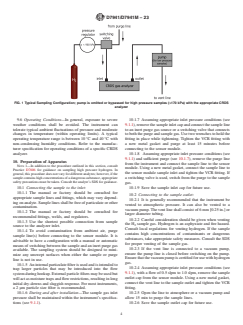
9.1.6 Sampling Setup—A schematic of the sampling setup is
release of hydrogen or inert gases can result in asphyxiation.
shown in Fig. 1.
Hydrogen is a potential fire hazard. Compressed air supports
combustion.
9.2 Test Specimens—Test specimens may be samples of
fuel-cell-grade hydrogen ranging from ambient to high pres-
7.2 Hydrogen
sure with an instrument hardware and software configuration
7.2.1 Potential fire and explosion hazard.
defined accordingly. Additional pressure regulation will be
7.2.2 Purge with inert gas before oxygen service.
required for samples exceeding the maximum allowed pressure
(see 9.1.1). Refer to Practice D7606 for guidance on this
8. Equipment, Materials, and Supplies
matter.
8.1 Equipment:
9.3 Method Blank—A CRDS instrument uses a spectro-
8.1.1 CRDS analyzer consisting of one or more sensor
scopic zero (see 6.3.6.2) to determine the measurement zero or
modules (see 6.2) and control electronics.
baseline. A blank sample is therefore not required.
8.1.2 Electrical and fiber optic cables to connect the control
9.4 Test Units—The test unit considered for the preparation
electronics and the laser source with each sensor module, if the
of this test method is a commonly available CRDS instrument.
sensor modules are provided as separate units.
The configuration of the internal sampling system will vary
8.1.3 Gas sample lines made from appropriate material
depending on the available sample pressure.
(stainless steel recommended) with a diameter of at least 6 mm
9.5 Instrument and Analytes—The general setup of the
[0.25 in.] from the sample extraction point to the analyzer inlet
CRDS instrument is independent of the analyte to be measured;
and the analyzer outlet to the vent or vacuum pump.
however, some components of the sensor module such as the
8.1.4 A vacuum pump with a specified ultimate vacuum of
laser source and the cavity mirrors are specific to the analyte(s)
10 Torr or less, if a pressurized sample cannot be provided.
and the measurement range(s) specified by the manufacturer
8.2 Materials and Supplies—Dry inert gas (for example, for the particular sensor. A CRDS analyzer sensor module shall
nitrogen or clean dry air) as purge gas for installation of the only be used for the analyte(s) and measurement range(s) for
analyzer. which it was designed.
D7941/D7941M − 23
FIG. 1 Typical Sampling Configuration; pump is omitted or bypassed for high pressure samples (>170 kPa) with the appropriate CRDS
analyzer
9.6 Operating Conditions—In general, exposure to severe 10.1.7 Assuming appropriate inlet pressure conditions (see
weather conditions shall be avoided. The instrument can 9.1.1), remove the sample inlet cap and connect the sample line
tolerate typical ambient fluctuations of pressure and moderate to an inert purge gas source or a switching valve that connects
changes in temperature (within operating limits). A typical to both the purge and sample gas. Use two wrenches to hold the
operating temperature range is between 10 °C and 40 °C with fitting in place while tightening. Tighten the VCR fitting with
non-condensing humidity conditions. Refer to the manufac- a new metal gasket and purge at least 15 minutes before
turer specification for operating conditions of a specific CRDS connecting to the sensor module.
analyzer.
10.1.8 Assuming appropriate inlet pressure conditions (see
9.1.1) and sufficient purge (see 10.1.7), remove the purge line
10. Preparation of Apparatus
from the instrument and connect the sample line to the sensor
NOTE 1—In addition to the procedure outlined in this section, consult
module. Using a new metal gasket, connect the sample line to
Practice D7606 for guidance on sampling high pressure hydrogen. In
the sensor module sample inlet and tighten the VCR fitting. If
general, this procedure does not vary for different analytes; however, if the
a switching valve is used, switch from the purge to the sample
sample contains high concentrations of a dangerous substance, appropriate
safety precautions must be taken. Consult the analyte’s SDS for guidance.
gas.
10.1.9 Save the sample inlet cap for future use.
10.1 Connecting the sample to the inlet:
10.1.1 The manual or factory should be consulted for
10.2 Connecting to the sample outlet:
appropriate sample lines and fittings, which may vary depend-
10.2.1 It is generally recommended that the instrument be
ing on analyte. Sample lines shall be free of particulate or other
vented to atmospheric pressure. It can also be vented to a
contamination.
vacuum pump. The vent line shall consist of 6 mm [0.25 in.] or
10.1.2 The manual or factory should be consulted for
larger diameter tubing.
recommended fittings, welds, and regulators.
10.2.2 Careful consideration should be given when venting
10.1.3 Use the shortest possible connection from sample
the H sample gas. Hydrogen is an asphyxiate and fire hazard.
source to the analyzer inlet.
Consult local regulations for venting hydrogen. If the sample
10.1.4 To avoid contamination from ambient air, purge
contains high concentrations of contaminants or dangerous
sample line(s) before connecting to the sensor module. It is
substances, take appropriate safety measures. Consult the SDS
advisable to have a configuration with a manual or automatic
for proper venting of the sample gas.
means of switching between the sample and an inert purge gas
10.2.3 If the vent line is connected to a vacuum pump,
available. The sampling system should be designed to mini-
ensure the pump line is closed before switching on the pump.
mize any unswept surfaces when either the sample or purge
Ensure that the vacuum pump is certified for use with hydrogen
line is not in use.
gas.
10.1.5 An internal particulate filter is used and is intended to
10.2.4 Assuming appropriate inlet pressure conditions (see
trap larger particles that may be introduced into the flow
9.1.1), with a flow of 0.5 slpm to 1.0 slpm, remove the sample
system during hookup. External particle filters may be used but
outlet cap from the sensor module. Using a new metal gasket,
will act as moisture traps and flow restrictions, resulting in long
connect the vent line to the sample outlet and tighten the VCR
initial dry-downs and sluggish response. For most instruments,
fitting.
a 2 μm particle size filter is recommended.
10.2.5 Open the line to atmosphere or a vacuum pump and
10.1.6 During and after installation—The sample gas inlet
allow 15 min to purge the sample lines.
pressure shall be maintained within the instrument’s specifica-
tions (see 9.1.1). 10.2.6 Save the sample outlet cap for future use.
D7941/D7941M − 23
11. Calibration and Standardization mixtures of 200 ppm(v) of CO in H , 500 ppm(v) of H O in
2 2 2
H (100 times the maximum concentration in SAE J2719), and
11.1 Calibration—CRDS analyzers do not require user
1000 ppm(v) CH in H (10 times the maximum concentration
4 2
calibration with respect to the absorption measurement or the
in SAE J2719) shall be prepared and analyzed. The gas
instrument’s zero. Calibration standards are used during manu-
mixtures shall contain as little as possible of the analyzer’s
facturing to establish calibration and traceability. CRDS ana-
target analyte(s), but no more than allowed by SAE J2719 (see
lyzers are based on fundamental physical principles and should
Table 1). Interference tests are to be performed for each analyte
not require periodic recalibration; however, a known gas
measured by the CRDS instrument, either simultaneously or
standard may be required for verification (see 18.1.1) in some
separately. Every analyte shall be tested for interference with
applications. CRDS analyzers measure the time (typically in
all prepared sample gas mixtures, unless one of them is the
microseconds) for light to decay (“ring down”) inside an
target analyte itself (for example, if CO is the analyte,
optical cavity, consisting of two or more highly reflective
interference testing for CO is obviously not applicable).
mirrors. The optical losses in the cavity reduce the amount of
11.5.3 Negative Readings—If the CRDS instrument has any
light with each pass which defines a “ring-down time.” When
setting that–if enabled–would prevent the analyzer from show-
target molecules are present in the gas flowing through the
ing negative concentration readings, this feature has to be
cavity, they absorb light shortens this ring-down time. A full
disabled for the interference tests.
description of CRDS can be found in Appendix X1. In practice,
11.5.4 Settling and Measurement Times—After connecting
the two critical parameters that shall be controlled are the laser
each sample gas, allow for sufficient time to achieve stable
frequencies that correspond to a zero point (Tau Zero) and a
readings (typically 5 min to 10 min). Longer settling and
point of peak or maximum absorption (Tau Peak). These are
measurement times may be required for “sticky” molecules
controlled as follows:
such as H O.
11.2 Reference Cell—A commonly available CRDS instru-
11.5.5 Determination of Maximum Interference Bias—To
ment contains a spectroscopic reference cell that automatically
determine the maximum bias due to interference for analyte i,
recenters the laser frequency during measurements to coincide
follow these steps for each analyte:
with the analyte’s peak absorption frequency. The reference
11.5.5.1 Calculate the mean concentration reading C of
ij
cell is a small, permanently sealed container of the target
analyte i when run with sample j (with j being one of the three
analyte. A very small percentage of the laser light is sent to the
sample gas mixtures of CO , H O, or CH , described in
2 2 4
reference cell, which continuously verifies that the laser
11.5.2).
remains at the correct wavelength without change due to
11.5.5.2 Calculate POS 5ΣC for all C >0
i ij ij
j
changes in ambient temperature or pressure.
and
11.3 Tune—The tune-Tau Zero mode is used to determine
NEG = Σ|C | for all C <0.
i ij ij
j
the off-peak ring-down time of the system. This measurement
i
11.5.5.3 The maximum bias B is then determined by
is used in calculating the final concentration and is run in the
max
i 21
same sample gas and und
...
This document is not an ASTM standard and is intended only to provide the user of an ASTM standard an indication of what changes have been made to the previous version. Because
it may not be technically possible to adequately depict all changes accurately, ASTM recommends that users consult prior editions as appropriate. In all cases only the current version
of the standard as published by ASTM is to be considered the official document.
Designation: D7941/D7941M − 14 D7941/D7941M − 23
Standard Test Method for
Hydrogen Purity Analysis Using a Continuous Wave Cavity
Ring-Down Spectroscopy Analyzer
This standard is issued under the fixed designation D7941/D7941M; the number immediately following the designation indicates the
year of original adoption or, in the case of revision, the year of last revision. A number in parentheses indicates the year of last
reapproval. A superscript epsilon (´) indicates an editorial change since the last revision or reapproval.
1. Scope
1.1 This test method describes contaminant determination in fuel-cell-grade fuel cell grade hydrogen as specified in relevant
ASTM and ISO standards using cavity ring-down spectroscopy (CRDS). This standard test method is for the measurement of one
or multiple contaminants including, but not limited to, water (H O), oxygen (O ), methane (CH ), carbon dioxide (CO ), carbon
2 2 4 2
monoxide (CO), ammonia (NH ), and formaldehyde (H CO), henceforth referred to as “analyte.”
3 2
1.2 This test method applies to CRDS analyzers with one or multiple sensor modules (see 3.36.2 for definition), each of which
is designed for a specific analyte. definition). This test method describes sampling apparatus design, operating procedures, and
quality control procedures required to obtain the stated levels of precision and accuracy.
1.3 The values stated in either SI units or inch-pound units are to be regarded separately as standard. The values stated in each
system are not necessarily exact equivalents; therefore, to ensure conformance with the standard, each system shall be used
independently of the other, and values from the two systems shall not be combined.
1.4 This standard does not purport to address all of the safety concerns, if any, associated with its use. It is the responsibility
of the user of this standard to establish appropriate safety and healthsafety, health, and environmental practices and determine
the applicability of regulatory limitations prior to use.
1.5 This international standard was developed in accordance with internationally recognized principles on standardization
established in the Decision on Principles for the Development of International Standards, Guides and Recommendations issued
by the World Trade Organization Technical Barriers to Trade (TBT) Committee.
2. Referenced Documents
2.1 ASTM Standards:
D4150 Terminology Relating to Gaseous Fuels
D5287 Practice for Automatic Sampling of Gaseous Fuels
D7265 Specification for Hydrogen Thermophysical Property Tables
D7606 Practice for Sampling of High Pressure Hydrogen and Related Fuel Cell Feed Gases
D7649E177 Test Method for Determination of Trace Carbon Dioxide, Argon, Nitrogen, Oxygen and Water in Hydrogen Fuel
by Jet Pulse Injection and Gas Chromatography/Mass Spectrometer AnalysisPractice for Use of the Terms Precision and Bias
in ASTM Test Methods
This test method is under the jurisdiction of ASTM Committee D03 on Gaseous Fuels and is the direct responsibility of Subcommittee D03.14 on Hydrogen and Fuel
Cells.
Current edition approved June 1, 2014Jan. 15, 2023. Published July 2014February 2023. Originally approved in 2014. Last previous edition approved in 2014 as
D7941/D7941MDOI: 10.1520/D7941_D7941M-14 – 14. DOI: 10.1520/D7941_D7941M-23.
For referenced ASTM standards, visit the ASTM website, www.astm.org, or contact ASTM Customer Service at service@astm.org. For Annual Book of ASTM Standards
volume information, refer to the standard’s Document Summary page on the ASTM website.
Copyright © ASTM International, 100 Barr Harbor Drive, PO Box C700, West Conshohocken, PA 19428-2959. United States
D7941/D7941M − 23
D7653E691 Test Method for Determination of Trace Gaseous Contaminants in Hydrogen Fuel by Fourier Transform Infrared
(FTIR) SpectroscopyPractice for Conducting an Interlaboratory Study to Determine the Precision of a Test Method
2.2 ISO Standards:
ISO/DIS 14687-2 Hydrogen fuel—Product specification—Part 2: Proton exchange membrane (PEM) fuel cell applications for
road vehicles
ISO/DIS 14687-3 Hydrogen fuel—Product Specification—Part 3: Proton exchange membrane (PEM) fuel cell applications for
stationary appliances
ISO 21087 Gas analysis—Analytical methods for hydrogen fuel—Proton exchange membrane (PEM) fuel cell applications for
road vehicles
2.3 U.S.-Specific Standards:
SAE J2719-2011 (2011)J2719-2020 (2020) Hydrogen Fuel Quality for Fuel Cell Vehicles
2.3.7 California Code of Regulations, Title 4, Division 9, Chapter 6, Article 8, Sections 4180-4181 – Hydrogen fuel quality
requirements
Environmental Protection Agency 40 CFR: Protection of the Environment, Appendix B to Part 136 – Definition and Procedure
for the Determination of the Method Detection Limit
3. Terminology
3.1 Definitions:
3.1.1 For definitions of general terms used in this test method, D03 Gaseous Fuels standards, refer to Terminology D4150.
3.2 Acronyms:Abbreviations:
3.2.1 AIST, n—National Institute of Advanced Industrial Science and Technology
3.2.1 CRDS, n—cavity ring-down spectroscopy
3.2.2 IR,PEM, n—infraredproton exchange membrane
3.2.3 kPa,SDS, n—kilopascalsafety data sheet
3.2.5 LDL, n—lower detection limit
3.2.6 MSDS, n—material safety data sheet
3.2.7 NIST, n—National Institute of Standards and Technology
3.2.8 NPL, n—National Physical Laboratory
3.2.9 ppb, n—parts per billion v/v
3.2.10 ppm, n—parts per million v/v
3.2.11 PTB, n—Physikalisch-Technische Bundesanstalt
3.2.12 psig, n—pounds per square inch (gauge)
3.2.4 slpm, n—standard liters per minute
3.2.14 v/v, n—volume/volume ratio
Available from International Organization for Standardization (ISO), 1, ch. de la Voie-Creuse, CP 56, CH-1211 Geneva 20, Switzerland, http://www.iso.org.
Available from SAE International (SAE), 400 Commonwealth Dr., Warrendale, PA 15096-0001, http://www.sae.org.
Available from the California Office of Administrative Law, 300 Capitol Mall, Suite 1250, Sacramento, CA 95814, http://www.oal.ca.gov/ccr.htm.
Available from United States Environmental Protection Agency (EPA), William Jefferson Clinton Bldg., 1200 Pennsylvania Ave., NW, Washington, DC 20004,
http://www.epa.gov.
D7941/D7941M − 23
3.2.15 VCR, n—a type of compression gas fitting
3.3 Additional Definitions—The “sensor module” consists of the optical system (CRDS mirrors, reference cell, one or more lasers,
and other optical components), the detector, and the internal gas handling components (gas lines, filters, and regulators). The
complete instrument, including control electronics, can contain a single sensor module or multiple sensor modules.
4. Summary of Test Method
4.1 This test method provides a procedure for the sampling of trace contaminants contained in fuel-cell-grade fuel cell grade
hydrogen and subsequent measurement using cavity ring-down spectroscopy (CRDS). Instrument and sampling system
configurations for sample pressures ranging from ambient to high pressure (defined as >960 kPa [>125 psig]) Instrument, sampling
system configuration and sampling conditions for typical samples of fuel-cell-grade hydrogen are described.
5. Significance and Use
5.1 Proton exchange membranes (PEM) used in fuel cells are susceptible to contamination from a number of species that can be
found in hydrogen. It is critical that these contaminants be measured and verified to be present at or below the amounts stated in
SAE J2719, ISO 14687-2 J2719 and ISO 14687-314687 to ensure both fuel cell longevity and optimum efficiency. Contaminant
concentrations as low as single-figure ppbppb(v) for some species can seriously compromise the life span and efficiency of PEM
fuel cells. The presence of contaminants in fuel-cell-grade hydrogen can, in some cases, have a permanent adverse impact on fuel
cell efficiency and usability. It is critical to monitor the concentration of key contaminants in hydrogen during the production phase
through to delivery of the fuel to a fuel cell vehicle or other PEM fuel cell application. In ISO 14687-2 and ISO 14687-3, 14687,
the upper limits for the aforementioned contaminants are specified. Refer to SAE J2719 and the California Code of Regulations
(see 2.3) for example specific national and regional requirements. For hydrogen fuel that is transported and delivered as a cryogenic
liquid, there is additional risk of introducing impurities during transport and delivery operations. For instance, moisture can build
up over time in liquid transfer lines, critical control components, and long-term storage facilities, which can lead to icing upice
buildup within the system and subsequent blockages that pose a safety risk or the introduction of contaminants into the gas stream
upon evaporation of the liquid. Users are reminded to consult Practice D7265 for critical thermophysical propertyproperties such
as the ortho/para hydrogen spin isomer inversion that can lead to additional hazards in liquid hydrogen usage. In addition to this
test method employing CRDS, test methods such as D7649 (carbon dioxide, argon, nitrogen, oxygen and water) and D7653 (IR
active species) are used to measure impurities in hydrogen fuel.
6. Apparatus
6.1 The analyzers used to measure impurities with reference to the development of this test method are based on CRDS. CRDS
is an optical spectroscopic technique that enables measurement of absolute optical extinction by samples that scatter and absorb
light. Based upon the optical extinction or “ring-down” rate, a determination of the analyte concentration can be made. See
Appendix X1 for a detailed explanation on the principles upon which CRDS is based.
6.2 Sensor Module—The sensor module consists of the optical system (CRDS mirrors, reference cell, one or more lasers, and other
optical components), the light detector, and the internal gas handling components (gas lines, filters, and regulators). The complete
instrument, including control electronics, can contain a single sensor module or multiple sensor modules.
6.3 Measurement Sequence—Sequence:
6.3.1 A tunable laser emits a directed beam of light energy through an ultra-high reflectivity mirror into the absorption cell
(cavity). The sample gas passes through this cell either via the use of a vacuum pump for samples under 170 kPa [10 psig] or under
pressure from sources in excess of 170 kPa [10 psig], regulated to between 170 and 960 kPa [10 and 125 psig].by providing a
pressurized gas supply. A vacuum pump is needed at the outlet if sufficient sample pressure to sustain positive flow cannot be
provided.
6.3.2 High sensitivity is attained by reflecting the laser light many times through a sample gas contained between two or more
highly reflective mirrors; thereby, a an absorption path length as high as of many kilometers through the sample is obtained.
6.3.3 A detector such as a photodiode senses the initial photon flux at the output of the cavity. Once a preset level of light intensity
is detected, the light source is shuttered or diverted from the cavity, and the light intensity is measured over time.
D7941/D7941M − 23
6.3.4 On each successive pass through the cell, a small amount of light or ring-down signal emits through the second mirror and
one of the mirrors, and its intensity is measured by the photodiode detector.
6.3.5 Once the light “rings down,” the detector achieves a point of zero light intensity within a few hundred microseconds and
the measurement is complete.
6.3.6 Two measurement sequences are A sequence of two measurements is required to effect a measurement of concentration:
6.3.6.1 On-peak Measurement—The laser is tuned to a wavelength at which the analyte absorbs light. The wavelength of choice
depends on the analyte, the targeted concentration range, and potential interference from other molecules present in the sample.
Suitable wavelengths for certain molecule can commonly be determined by using spectroscopic databases such as HITRAN. The
exact wavelength used for each analyte is generally considered a trade secret by the manufacturer.
6.3.6.2 Off-peak Measurement—The laser is tuned to a wavelength at which the analyte does not absorb light. The wavelength of
choice depends on the analyte, the targeted concentration range, and potential interference from other molecules present in the
sample. As before, suitable wavelengths can be determined by consulting spectroscopic databases such as HITRAN. The exact
wavelength used for the off-peak measurement of each analyte is considered a trade secret by the manufacturer, but it is generally
in close proximity to the on-peak wavelength. In a gas of consistent analyte concentration, an off-peak measurement is required
only occasionally; however, it is recommended that an off-peak measurement is performed at least once per month. In samples with
rapidly changing gas composition or analyte concentrations, an off-peak measurement may be performed as frequently as every
few minutes. The frequency of off-peak measurement does not affect the accuracy of the final measurement.
6.3.7 The on-peak and off-peak measurements are used to calculate the concentration of the analyte in the sample gas as per a
variation of the Beer-Lambert Law relating the extinction of light to the absorbance of the material through which the light is
travelling.
6.4 Details concerning specific instrument configurations for a range of sample pressures can be found in Section 99.
6.5 A full description of the CRDS technique can be found in Appendix X1.
7. Hazards
7.1 High-pressure gases.High-pressure gases—
Warning—WARNING– Improper handling of compressed gas cylinders containing air, hydrogen, or inert gases such as
nitrogen or helium can result in explosion. Rapid release of hydrogen or inert gases can result in asphyxiation. Hydrogen is a
potential fire hazard. Compressed air supports combustion.
7.2 Hydrogen
7.2.1 Potential fire and explosion hazard.
7.2.2 Purge with inert gas before oxygen service.
8. Equipment, Materials, and Supplies
8.1 Equipment—Equipment:
8.1.1 CRDS analyzer consisting of laser source(s), sample cavity, photodiode detector, reference gas cell, and internal gas handling
components (gas lines, particle filters, and regulators to maintain a constant pressure), which constitute each sensor module, asone
or more sensor modules (see 6.2well as) and control electronics.
8.1.2 Electrical and fiber optic cables to connect the control electronics and the laser source with each sensor module, if the
sensingsensor modules are provided as separate units.
8.1.3 Gas sample lines made from appropriate material (stainless steel recommended) with a diameter of at least 6 mm [0.25 in.]
from the sample extraction point to the analyzer inlet and the analyzer outlet to the vent or vacuum pump.
D7941/D7941M − 23
8.1.4 A vacuum pump for low pressure samples (seewith a specified ultimate vacuum 9.1.1) which can reach a pressure of
approximately 1 Torr or less.of 10 Torr or less, if a pressurized sample cannot be provided.
8.2 Materials and Supplies—Dry inert gas (e.g. (for example, nitrogen or clean dry air) as purge gas for installation of the analyzer.
9. Sampling, Test Specimens, and Test Units
9.1 Sampling—Sampling:
9.1.1 For those CRDS instruments that can accept sample pressures from ambient up to 960 kPa [125 psig], a vacuum pump is
required for sample pressures below 170 kPa [10 psig]. The analyzer may be used in the absence of a vacuum pump for sample
pressures between 170 and 960 kPa [10 and 125 psig]. Samples with a pressure Samples in excess of 960 kPa [125 psig] shall be
regulated down the manufacturer’s maximum pressure specifications need to be regulated to a pressure acceptable for the CRDS
instrument before introduction to the inlet. Exceeding the maximum allowable pressure may damage the within the allowed range
for the CRDS instrument. Consult the manufacturer for required sample pressure conditions. CRDS analyzers configured
exclusively for use at pressures above 170 kPa [10 psig] cannot be used for lower pressure samples even with addition of a vacuum
pump.
9.1.2 Commonly available CRDS instruments contain appropriate particle filtration inside the internal gas handling components;
further filtration is generally not required unless specified by the manufacturer for special analytes and sample conditionscondi-
tions.
9.1.3 To connect gas lines to the instrument, VCR vacuum coupling radiation (VCR) fittings are recommended. When making
connections, always use a new gasket (nickel or stainless steel gaskets are recommended).
9.1.4 For the measurement of most common analytes (e.g. (for example, H O), sample lines and wetted components shall be of
stainless steel construction, ideally with electro-polished surface finish, free from particulate and other contamination such as oils
and other hydrocarbons. Certain analytes may require alternative materials or surface treatments, or both, to optimize sampling
conditions. Contact an appropriate vendor for further advice.
9.1.5 Switching valves shall be constructed with a stainless steel diaphragm type and with the surface area of valves and other
wetted components kept to a minimum, avoiding any dead volume. Surface treatments for the wetted surfaces when available to
minimize the absorption of impurities. impurities should be used. Contact an appropriate vendor for further advice. Sample line
length should be minimized and “dead-legs” avoided, preventing diffusion of contamination from unswept surfaces. Refer to
Practices D5287 and D7606 for further sampling guidance.
9.1.6 Sampling Setup—A schematic of the sampling setup is shown in Fig. 1.
FIG. 1 Typical Sampling Configuration; pump is omitted or bypassed for high pressure samples (>170 kPa) with the appropriate CRDS
analyzer
D7941/D7941M − 23
9.2 Test Specimens—Test specimens may be samples of fuel-cell-grade hydrogen ranging from ambient to high pressure with an
instrument hardware and software configuration defined accordingly. Additional pressure regulation will be required for samples
exceeding the maximum allowed pressure (see 9.1.1). Refer to Practice D7606 for guidance on this matter.
9.3 Method Blank—A CRDS instrument uses a spectroscopic zero (see 6.2.6.26.3.6.2) to determine the measurement zero or
baseline. A blank sample is therefore not required.
9.4 Test Units—The test unit considered for the preparation of this test method is a commonly available CRDS instrument. The
configuration of the internal sampling system will vary depending on the available sample pressure.
9.5 Instrument and Analytes—The general setup of the CRDS instrument is independent of the analyte to be measured; however,
some components of the sensor module such as the laser source and the cavity mirrors are specific to the analyteanalyte(s) and the
measurement rangerange(s) specified by the manufacturer for the particular sensor. A CRDS analyzer sensor module shall only be
used for the analyteanalyte(s) and measurement rangerange(s) for which it was designed.
9.6 Operating Conditions—In general, exposure to severe weather conditions shall be avoided. The instrument is able to can
tolerate typical ambient fluctuations of pressure and moderate changes in temperature (within operating limits). A typical operating
temperature range is between 10°C and 40°C10 °C and 40 °C with non-condensing humidity conditions. Refer to the manufacturer
specification for operating conditions of a specific CRDS analyzer.
10. Preparation of Apparatus
NOTE 1—In addition to the procedure outlined in this section, consult Practice D7606 for guidance on sampling high pressure hydrogen. In general, this
procedure does not vary for different analytes; however, if the sample contains high concentrations of a dangerous substance, appropriate safety
precautions must be taken. Consult the analyte’s MSDSSDS for guidance.
10.1 Connecting the sample to the inlet:
10.1.1 The manual or factory should be consulted for appropriate sample lines and fittings, which may vary depending on analyte.
Sample lines shall be free of particulate or other contamination.
10.1.2 The manual or factory should be consulted for recommended fittings, welds, and regulators.
10.1.3 Use the shortest possible connection from sample source to the analyzer inlet.
10.1.4 To avoid contamination from ambient air, purge sample line(s) before connecting to the sensor module. It is advisable to
have an arrangement wherebya configuration with a manual or automatic means of switching between the sample and an inert
purge gas is available. The sampling system should be designed so as to minimize any unswept surfaces when either the sample
or purge line is not in use.
10.1.5 An internal particleparticulate filter is used and is intended to trap larger particles that may be introduced into the flow
system during hookup. External particle filters may be connectedused but will act as moisture traps and flow restrictions, resulting
in long initial dry-downs and sluggish response. For this particular instrument, most instruments, a 2 μm particle size filter is
recommended.
10.1.6 During and after installation—The sample gas inlet pressure shall be maintained within the instrument’s specifications (see
9.1.1).
10.1.7 Assuming appropriate inlet pressure conditions (see 9.1.1), remove the sample inlet cap and connect the sample line to an
inert purge gas source or a switching valve that connects to both the purge and sample gas. Use two wrenches to hold the fitting
in place while tightening. Tighten the VCR fitting with a new metal gasket and purge at least 15 minutes before connecting to the
sensor module.
10.1.8 Assuming appropriate inlet pressure conditions (see 9.1.1) and sufficient purge (see 10.1.7), remove the purge line from
D7941/D7941M − 23
the instrument and connect the sample line to the sensor module. WithUsing a new metal gasket, immediately connect the sample
line to the sensor module sample inlet and tighten the VCR fitting. If a switching valve is used, switch from the purge to the sample
gas.
10.1.9 Save the sample inlet cap for future use.
10.2 Connecting to the sample outlet:
10.2.1 It is generally recommended that the instrument be vented to atmospheric pressure. It can also be vented to a vacuum pump.
The vent line shall consist of 6-mm [0.25-in.]6 mm [0.25 in.] or larger diameter tubing.
10.2.2 Careful consideration should be given when venting the H sample gas. Hydrogen is an asphyxiate and fire hazard. Also,
consult Consult local regulations for venting hydrogen. If the sample contains high concentrations of contaminants ofor dangerous
substances, take appropriate safety measures. Consult the MSDSSDS for proper venting of the sample gas.
10.2.3 If the vent line is connected to a vacuum pump, ensure the pump line is closed before switching on the pump. Ensure that
the vacuum pump is certified for use with hydrogen gas.
10.2.4 Assuming appropriate inlet pressure conditions (see 9.1.1), with a flow of 0.5 to 1.0 slpm, 0.5 slpm to 1.0 slpm, remove
the sample outlet cap from the sensor module. WithUsing a new metal gasket, immediately connect the vent line to the sample
outlet and tighten the VCR fitting.
10.2.5 Open the line to atmosphere or a vacuum pump and allow 15 min to purge the sample lines.
10.2.6 Save the sample outlet cap for future use.
11. Calibration and Standardization
11.1 Calibration—CRDS analyzers are essentially “self-calibrating” do not require user calibration with respect to the absorption
measurement. Although calibration measurement or the instrument’s zero. Calibration standards are used during manufacturing for
the purpose of traceability,to establish calibration and traceability. CRDS analyzers are based on fundamental physical principles
and doshould not require periodic recalibration. recalibration; however, a known gas standard may be required for verification (see
18.1.1) in some applications. CRDS analyzers measure the time (typically in microseconds) for light to decay (“ring down”) inside
an optical cavity, typically consisting of two or more highly reflective mirrors. The optical losses in the cavity reduce the amount
of light with each pass, allowing for the measurement of pass which defines a “ring-down time.” When a number of target
molecules are present in the gas flowing through the cavity, they absorb light, therefore shortening the light shortens this ring-down
time. A full description of CRDS can be found in Appendix X1. In practice, the two critical parameters that shall be controlled
are the laser frequencies that correspond to a zero point (Tau Zero) and a point of peak or maximum absorption (Tau Peak). These
are controlled as follows:
11.2 Reference cell—Cell—A commonly available CRDS instrument contains a spectroscopic reference cell that automatically
re-centersrecenters the laser frequency during measurements to coincide with the analyte’s peak absorption frequency. The
reference cell itself is a small, permanently sealed container of the target analyte. A very small percentage of the laser light is sent
to the reference cell, which continuously verifies that the laser remains at the correct wavelength, which does not change with
wavelength without change due to changes in ambient temperature or pressure.
11.3 Tune—The tune-Tau Zero mode is used to determine the off-peak ring-down time of the system. This measurement is used
in calculating the final concentration and is run in the same sample gas and under the same sample conditions as the analyte
measurement itself. measurement. Running a tune-Tau Zero cycle at least every month is recommended to ensure accurate
contaminant concentration. concentration measurements. This may be done manually via the appropriate menu, or the process can
be automated to a designated schedule. For one typical manufacturer, the tune-Tau Zero cycle runs for approximately two minutes
during which time the instrument is not delivering measurement data.
11.4 Laser optimization—Optimization—Over time, the laser may drift off the analyte’s absorption peak. The software adjusts the
laser current to keep the laser “on peak.” Laser optimization is recommended at least once per year to ensure the unit is operating
optimally.
D7941/D7941M − 23
11.5 Avoidance of interferences—Interferences—When multiple analytes are present in the sample, biased readings can occur due
to spectral interference. Before installation, the analyzer shall be tested for common interferences to ensure correct concentration
readings.
11.5.1 Non-interfering species—Species—In any CRDS instrument, nitrogen, hydrogen, oxygen, and noble gases do not interfere
with the measurement regardless of their concentration. Interference testing for these species is therefore not required.
11.5.2 Samples and analytes for interference testing—Analytes for Interference Testing—CO , H O and CH c
...