

ASTM D4468-23
(Test Method)Standard Test Method for Total Sulfur in Gaseous Fuels by Hydrogenolysis and Rateometric Colorimetry
General Information
- Abstract
SIGNIFICANCE AND USE
5.1 This test method can be used to determine specification, or regulatory compliance to requirements, for total sulfur in gaseous fuels. In gas processing plants, sulfur can be a contaminant and must be removed before gas is introduced into gas pipelines. In petrochemical plants, sulfur is a poison for many catalysts and must be reduced to acceptable levels, usually in the range from 0.01 ppm/v to 1 ppm/v. This test method may also be used as a quality-control tool for sulfur determination in finished products, such as propane, butane, ethane, and ethylene.
SCOPE
1.1 This test method covers the determination of sulfur gaseous fuels in the range from 0.001 to 20 parts per million by volume (ppm/v).
1.2 This test method may be extended to higher concentration by dilution.
1.3 The values stated in SI units are to be regarded as standard. No other units of measurement are included in this standard.
1.4 This standard may involve hazardous materials, operations, and equipment. This standard does not purport to address all of the safety concerns, if any, associated with its use. It is the responsibility of the user of this standard to establish appropriate safety, health, and environmental practices and determine the applicability of regulatory limitations prior to use. Specific precautionary statements are given in 7.7, 7.8, and 8.3.
1.5 This international standard was developed in accordance with internationally recognized principles on standardization established in the Decision on Principles for the Development of International Standards, Guides and Recommendations issued by the World Trade Organization Technical Barriers to Trade (TBT) Committee.
- Status
- Published
- Publication Date
- 31-May-2023
- Technical Committee
- D03 - Gaseous Fuels
Buy Documents
ASTM D4468-23 - Standard Test Method for Total Sulfur in Gaseous Fuels by Hydrogenolysis and<brk/> Rateometric Colorimetry
REDLINE ASTM D4468-23 - Standard Test Method for Total Sulfur in Gaseous Fuels by Hydrogenolysis and<brk/> Rateometric Colorimetry
Overview
ASTM D4468-23 outlines the standard test method for determining total sulfur in gaseous fuels through hydrogenolysis and rateometric colorimetry. This method is essential for assessing sulfur content at extremely low concentrations, specifically within the range of 0.001 to 20 parts per million by volume (ppm/v). Used predominantly in the energy and petrochemical industries, the method ensures compliance with specifications and regulatory requirements for sulfur levels in gas processing, pipeline distribution, and finished petrochemical products. Removing sulfur from gaseous fuels is critical to prevent equipment corrosion, catalyst poisoning, and to meet environmental and quality standards.
Key Topics
- Scope: Measurement of total sulfur in gaseous fuels, with applicability from 0.001 to 20 ppm/v. Higher concentrations may be accommodated through sample dilution.
- Test Method Summary: The gaseous sample is introduced into a hydrogenolysis apparatus, pyrolyzed at high temperature (≥1000°C) to convert sulfur compounds into hydrogen sulfide (H₂S), which is then detected through its colorimetric reaction with lead acetate.
- Units of Measurement: Only SI units are used, ensuring global consistency and comparability.
- Significance & Use:
- Critical for regulatory compliance before gas enters pipelines
- Protects catalysts in petrochemical operations by maintaining low sulfur levels (down to 0.01 ppm/v)
- Functions as a quality control tool for products like propane, butane, ethane, and ethylene
- Safety Considerations: The procedure involves hazardous chemicals and operations; users must establish appropriate safety, health, and environmental practices in accordance with local regulations.
Applications
- Natural Gas Processing: Ensures removal of sulfur contaminants before distribution, safeguarding pipelines from corrosion and maintaining gas quality.
- Petrochemical Production: Vital for protecting catalysts that are sensitive to sulfur, facilitating the production of high-quality chemicals from gaseous feedstocks.
- Quality Assurance: Used for batch and continuous monitoring of sulfur content in LPGs (liquefied petroleum gases) such as propane, butane, and industrial feedstocks like ethane and ethylene.
- Regulatory Compliance: Assists organizations in meeting national and international environmental standards and sulfur emission mandates.
- Calibration and Instrumentation: Provides clear procedures for preparing calibration standards, standardizing instrumentation, and performing accurate and repeatable sulfur analyses.
Related Standards
- ASTM D1193 - Specification for Reagent Water: Ensures the purity of water used during testing.
- ASTM D1914 - Practice for Conversion Units and Factors Relating to Sampling and Analysis of Atmospheres: Aids in unit conversions relevant to gaseous fuel analyses.
- ASTM D4045 - Test Method for Sulfur in Petroleum Products by Hydrogenolysis and Rateometric Colorimetry: Closely related test method for petroleum-based liquids.
- ASTM D4150 - Terminology Relating to Gaseous Fuels: Provides definitions for terms used in D03 Gaseous Fuels standards.
Practical Value
- Highly Sensitive Detection: Enables detection and quantification of sulfur down to 0.001 ppm/v, which is essential in processes with stringent sulfur limits.
- Industry Versatility: Applicable in laboratories, refineries, and gas processing facilities.
- Enhanced Reliability: The method describes robust calibration and quality control steps, supporting consistent measurement results.
By employing ASTM D4468-23, organizations in the natural gas and petrochemical sectors ensure their products meet compliance and quality targets, protecting assets and reducing environmental impact through reliable sulfur control in gaseous fuels.
Relations
- Effective Date
- 15-Dec-2019
- Effective Date
- 01-Jul-2016
- Effective Date
- 01-Apr-2015
- Effective Date
- 01-May-2010
- Effective Date
- 01-Apr-2010
- Effective Date
- 01-Dec-2008
- Effective Date
- 01-Mar-2006
- Effective Date
- 01-Oct-2004
- Effective Date
- 01-May-2004
- Effective Date
- 10-Aug-2003
- Effective Date
- 10-Jun-2000
- Effective Date
- 10-Sep-1999
- Effective Date
- 10-Feb-1999
- Effective Date
- 10-Feb-1999
- Effective Date
- 10-Jan-1999
Buy Documents
ASTM D4468-23 - Standard Test Method for Total Sulfur in Gaseous Fuels by Hydrogenolysis and<brk/> Rateometric Colorimetry
REDLINE ASTM D4468-23 - Standard Test Method for Total Sulfur in Gaseous Fuels by Hydrogenolysis and<brk/> Rateometric Colorimetry
Get Certified
Connect with accredited certification bodies for this standard

Element Materials Technology
Materials testing and product certification.

ABS Group Brazil
ABS Group certification services in Brazil.

ABS Quality Evaluations Inc.
American Bureau of Shipping quality certification.
Sponsored listings
Frequently Asked Questions
ASTM D4468-23 is a standard published by ASTM International. Its full title is "Standard Test Method for Total Sulfur in Gaseous Fuels by Hydrogenolysis and<brk/> Rateometric Colorimetry". This standard covers: SIGNIFICANCE AND USE 5.1 This test method can be used to determine specification, or regulatory compliance to requirements, for total sulfur in gaseous fuels. In gas processing plants, sulfur can be a contaminant and must be removed before gas is introduced into gas pipelines. In petrochemical plants, sulfur is a poison for many catalysts and must be reduced to acceptable levels, usually in the range from 0.01 ppm/v to 1 ppm/v. This test method may also be used as a quality-control tool for sulfur determination in finished products, such as propane, butane, ethane, and ethylene. SCOPE 1.1 This test method covers the determination of sulfur gaseous fuels in the range from 0.001 to 20 parts per million by volume (ppm/v). 1.2 This test method may be extended to higher concentration by dilution. 1.3 The values stated in SI units are to be regarded as standard. No other units of measurement are included in this standard. 1.4 This standard may involve hazardous materials, operations, and equipment. This standard does not purport to address all of the safety concerns, if any, associated with its use. It is the responsibility of the user of this standard to establish appropriate safety, health, and environmental practices and determine the applicability of regulatory limitations prior to use. Specific precautionary statements are given in 7.7, 7.8, and 8.3. 1.5 This international standard was developed in accordance with internationally recognized principles on standardization established in the Decision on Principles for the Development of International Standards, Guides and Recommendations issued by the World Trade Organization Technical Barriers to Trade (TBT) Committee.
SIGNIFICANCE AND USE 5.1 This test method can be used to determine specification, or regulatory compliance to requirements, for total sulfur in gaseous fuels. In gas processing plants, sulfur can be a contaminant and must be removed before gas is introduced into gas pipelines. In petrochemical plants, sulfur is a poison for many catalysts and must be reduced to acceptable levels, usually in the range from 0.01 ppm/v to 1 ppm/v. This test method may also be used as a quality-control tool for sulfur determination in finished products, such as propane, butane, ethane, and ethylene. SCOPE 1.1 This test method covers the determination of sulfur gaseous fuels in the range from 0.001 to 20 parts per million by volume (ppm/v). 1.2 This test method may be extended to higher concentration by dilution. 1.3 The values stated in SI units are to be regarded as standard. No other units of measurement are included in this standard. 1.4 This standard may involve hazardous materials, operations, and equipment. This standard does not purport to address all of the safety concerns, if any, associated with its use. It is the responsibility of the user of this standard to establish appropriate safety, health, and environmental practices and determine the applicability of regulatory limitations prior to use. Specific precautionary statements are given in 7.7, 7.8, and 8.3. 1.5 This international standard was developed in accordance with internationally recognized principles on standardization established in the Decision on Principles for the Development of International Standards, Guides and Recommendations issued by the World Trade Organization Technical Barriers to Trade (TBT) Committee.
ASTM D4468-23 is classified under the following ICS (International Classification for Standards) categories: 75.160.30 - Gaseous fuels. The ICS classification helps identify the subject area and facilitates finding related standards.
ASTM D4468-23 has the following relationships with other standards: It is inter standard links to ASTM D4150-19, ASTM D4150-08(2016), ASTM D4045-15, ASTM D4045-04(2010), ASTM D1914-95(2010), ASTM D4150-08, ASTM D1193-06, ASTM D1914-95(2004)e1, ASTM D4045-04, ASTM D4150-03, ASTM D4150-00, ASTM D1914-95(1999), ASTM D1193-99, ASTM D1193-99e1, ASTM D4045-99. Understanding these relationships helps ensure you are using the most current and applicable version of the standard.
ASTM D4468-23 is available in PDF format for immediate download after purchase. The document can be added to your cart and obtained through the secure checkout process. Digital delivery ensures instant access to the complete standard document.
Standards Content (Sample)
This international standard was developed in accordance with internationally recognized principles on standardization established in the Decision on Principles for the
Development of International Standards, Guides and Recommendations issued by the World Trade Organization Technical Barriers to Trade (TBT) Committee.
Designation: D4468 − 23
Standard Test Method for
Total Sulfur in Gaseous Fuels by Hydrogenolysis and
Rateometric Colorimetry
This standard is issued under the fixed designation D4468; the number immediately following the designation indicates the year of
original adoption or, in the case of revision, the year of last revision. A number in parentheses indicates the year of last reapproval. A
superscript epsilon (´) indicates an editorial change since the last revision or reapproval.
1. Scope 3. Terminology
1.1 This test method covers the determination of sulfur 3.1 For definitions of general terms used in D03 Gaseous
gaseous fuels in the range from 0.001 to 20 parts per million by Fuels standards, refer to Terminology D4150.
volume (ppm/v).
4. Summary of Test Method
1.2 This test method may be extended to higher concentra-
tion by dilution. 4.1 The sample is introduced at a constant rate into a
flowing hydrogen stream in a hydrogenolysis apparatus. The
1.3 The values stated in SI units are to be regarded as
sample and hydrogen are pyrolyzed at a temperature of
standard. No other units of measurement are included in this
1000 °C or above, to convert sulfur compounds to hydrogen
standard.
sulfide (H S). Readout is by the rateometric detection of the
1.4 This standard may involve hazardous materials,
colorimetric reaction of H S with lead acetate. Units used are
operations, and equipment. This standard does not purport to
ppm/v, which is equivalent to micromoles/mole.
address all of the safety concerns, if any, associated with its
use. It is the responsibility of the user of this standard to
5. Significance and Use
establish appropriate safety, health, and environmental prac-
5.1 This test method can be used to determine specification,
tices and determine the applicability of regulatory limitations
or regulatory compliance to requirements, for total sulfur in
prior to use. Specific precautionary statements are given in 7.7,
gaseous fuels. In gas processing plants, sulfur can be a
7.8, and 8.3.
contaminant and must be removed before gas is introduced into
1.5 This international standard was developed in accor-
gas pipelines. In petrochemical plants, sulfur is a poison for
dance with internationally recognized principles on standard-
many catalysts and must be reduced to acceptable levels,
ization established in the Decision on Principles for the
usually in the range from 0.01 ppm ⁄v to 1 ppm ⁄v. This test
Development of International Standards, Guides and Recom-
method may also be used as a quality-control tool for sulfur
mendations issued by the World Trade Organization Technical
determination in finished products, such as propane, butane,
Barriers to Trade (TBT) Committee.
ethane, and ethylene.
2. Referenced Documents
6. Apparatus
2.1 ASTM Standards:
6.1 Pyrolysis Furnace—A furnace that can provide an
D1193 Specification for Reagent Water
adjustable temperature of 900 °C to 1300 °C in a quartz or
D1914 Practice for Conversion Units and Factors Relating to
ceramic tube of 5 mm or larger tube (ID) is required for
Sampling and Analysis of Atmospheres
pyrolysis of the sample. (See Fig. 1.) The flow system is to be
D4045 Test Method for Sulfur in Petroleum Products by
a fluorocarbon or other material inert to H S and other sulfur
Hydrogenolysis and Rateometric Colorimetry
compounds. (See Fig. 1.)
D4150 Terminology Relating to Gaseous Fuels
6.2 Rateometric H S Readout—Hydrogenolysis products
contain H S in proportion to sulfur in the sample. The H S
2 2
This test method is under the jurisdiction of ASTM Committee D03 on Gaseous
concentration is determined by measuring rate of change of
Fuels and is the direct responsibility of Subcommittee D03.06.03 on Analysis by
Spectroscopy.
reflectance of a tape impregnated with lead acetate caused by
Current edition approved June 1, 2023. Published June 2023. Originally
darkening when lead sulfide is formed. Rateometric
approved in 1985. Last previous edition approved in 2015 as D4468 – 85 (2015).
electronics, adapted to provide first derivative output, allows
DOI: 10.1520/D4468-23.
For referenced ASTM standards, visit the ASTM website, www.astm.org, or sufficient sensitivity to measure to 0.001 ppm/v. (See Fig. 2.)
contact ASTM Customer Service at service@astm.org. For Annual Book of ASTM
6.3 Recorder—A suitable chart recorder may be used for a
Standards volume information, refer to the standard’s Document Summary page on
the ASTM website. permanent record of analysis.
Copyright © ASTM International, 100 Barr Harbor Drive, PO Box C700, West Conshohocken, PA 19428-2959. United States
D4468 − 23
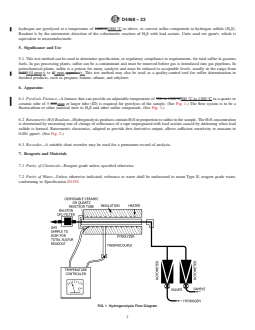
FIG. 1 Hydrogenolysis Flow Diagram
7. Reagents and Materials 7.9 Carrier Gas for Calibration Standards—Use sulfur-free
laboratory grade bottled gas of the same type or similar density
7.1 Purity of Chemicals—Reagent grade unless specified
as the gas to be analyzed or calibrate the flowmeter to establish
otherwise.
correct flow setting for an available carrier gas. Test, as in 8.5,
7.2 Purity of Water—Unless otherwise indicated, reference
adding the carrier gas flow to the hydrogen flow.
to water shall be understood to mean Type II, reagent grade
7.10 Purge Gas—Sulfur-free purge gas, nitrogen, CO , or
water, conforming to Specification D1193.
other inert gas. Commercial grade cylinder gas is satisfactory.
7.3 Sensing Tape—Lead acetate impregnated analytical
quality filter paper shall be used.
8. Preparation of Apparatus
7.4 Acetic Acid (5 %)—Mix 1 part by volume reagent grade
8.1 Turn on the furnace and allow temperature to stabilize at
glacial acetic acid with 19 parts water to prepare 5 % acetic
1000 °C. If thiophenic sulfur could be present, use 1300 °C
acid solution.
temperature setting.
7.5 Gastight Syringe—A gastight 0.1-mL and 0.5-mL sy-
NOTE 1—Reduced operating temperature extends furnace life. Thio-
ringe for preparing calibration standard. Volumetric measure-
phenic compound conversion increases from about 60 % at 1000 °C to
ment accuracy of the syringe shall be 1 % or better.
100 % at 1300 °C.
7.6 Piston Cylinder—Use a 10-L acrylic cylinder with a free 8.2 Connect all flow tubing between components and fill
moving piston and silicone rubber “O” ring lubricated with a humidifier inside the cabinet to 30 mL with a 5 % by volume
free-flowing silicone lubricant. This cylinder is used to prepare acetic acid solution. Purge all flow systems with inert gas then
ppm/v calibration samples volumetrically. close valve. Check all connections for leaks with soap solution
and repair any leaks. Connect hydrogen and set flow at 200
7.7 Carbonyl Sulfide (COS)—A lecture bottle of COS, 99 %
mL/min and allow temperature to stabilize. Sample flow must
purity, with a needle valve connected to the lecture bottle
be ⁄3 or less of the H flow. Total flow can be up to 500
outlet. Connect 2 ft of tygon tubing to allow insertion of a
mL/min, except when the sample has thiophenic compounds
hypodermic syringe to withdraw pure COS while tubing is
that require 200 mL/min of H flow for conversion. Make final
purged from the lecture bottle. Other sulfur compounds can be
temperature adjustment to 1000 °C 6 15 °C or a minimum
used with adequate odor control. If the sulfur compound has
1300 °C if the sample contains thiophenic sulfur compounds.
two sulfur atoms per molecule, reduce the volume by one half.
(Warning—Work with COS should be done in a well- 8.3 Install sensing tape and turn H S readout analyzer on.
ventilated area, or under a fume hood.) Use adequate safety precautions in handling lead acetate tape.
7.8 Hydrogen Gas—Use sulfur-free hydrogen of laboratory 8.4 Adjust the zero of the analyzer indicator meter (and
grade. (Warning—Hydrogen has wide explosive limits when recorder if used) to desired position with no flow. This should
mixed with air. See 1.4 regarding precautions.) be
...
This document is not an ASTM standard and is intended only to provide the user of an ASTM standard an indication of what changes have been made to the previous version. Because
it may not be technically possible to adequately depict all changes accurately, ASTM recommends that users consult prior editions as appropriate. In all cases only the current version
of the standard as published by ASTM is to be considered the official document.
Designation: D4468 − 85 (Reapproved 2015) D4468 − 23
Standard Test Method for
Total Sulfur in Gaseous Fuels by Hydrogenolysis and
Rateometric Colorimetry
This standard is issued under the fixed designation D4468; the number immediately following the designation indicates the year of
original adoption or, in the case of revision, the year of last revision. A number in parentheses indicates the year of last reapproval. A
superscript epsilon (´) indicates an editorial change since the last revision or reapproval.
1. Scope
1.1 This test method covers the determination of sulfur gaseous fuels in the range from 0.001 to 20 parts per million by volume
(ppm/v).
1.2 This test method may be extended to higher concentration by dilution.
1.3 The values stated in SI units are to be regarded as standard. No other units of measurement are included in this standard.
1.4 This standard may involve hazardous materials, operations, and equipment. This standard does not purport to address all
of the safety concerns concerns, if any, associated with its use. It is the responsibility of the user of this standard to establish
appropriate safety and healthsafety, health, and environmental practices and determine the applicability of regulatory limitations
prior to use. Specific precautionary statements are given in 6.77.7, 6.87.8, and 7.38.3.
1.5 This international standard was developed in accordance with internationally recognized principles on standardization
established in the Decision on Principles for the Development of International Standards, Guides and Recommendations issued
by the World Trade Organization Technical Barriers to Trade (TBT) Committee.
2. Referenced Documents
2.1 ASTM Standards:
D1193 Specification for Reagent Water
D1914 Practice for Conversion Units and Factors Relating to Sampling and Analysis of Atmospheres
D4045 Test Method for Sulfur in Petroleum Products by Hydrogenolysis and Rateometric Colorimetry
D4150 Terminology Relating to Gaseous Fuels
3. Terminology
3.1 For definitions of general terms used in D03 Gaseous Fuels standards, refer to Terminology D4150.
4. Summary of Test Method
4.1 The sample is introduced at a constant rate into a flowing hydrogen stream in a hydrogenolysis apparatus. The sample and
This test method is under the jurisdiction of ASTM Committee D03 on Gaseous Fuels and is the direct responsibility of Subcommittee D03.05 on Determination of
Special Constituents of Gaseous Fuels.
Current edition approved Nov. 1, 2015June 1, 2023. Published December 2015June 2023. Originally approved in 1985. Last previous edition approved in 20112015 as
D4468–85D4468 – 85 (2015). (2011). DOI: 10.1520/D4468-85R15.10.1520/D4468-23.
For referenced ASTM standards, visit the ASTM website, www.astm.org, or contact ASTM Customer Service at service@astm.org. For Annual Book of ASTM Standards
volume information, refer to the standard’s Document Summary page on the ASTM website.
Copyright © ASTM International, 100 Barr Harbor Drive, PO Box C700, West Conshohocken, PA 19428-2959. United States
D4468 − 23
hydrogen are pyrolyzed at a temperature of 1000°C1000 °C or above, to convert sulfur compounds to hydrogen sulfide (H S).
Readout is by the rateometric detection of the colorimetric reaction of H S with lead acetate. Units used are ppm/v, which is
equivalent to micromoles/mole.
5. Significance and Use
5.1 This test method can be used to determine specification, or regulatory compliance to requirements, for total sulfur in gaseous
fuels. In gas processing plants, sulfur can be a contaminant and must be removed before gas is introduced into gas pipelines. In
petrochemical plants, sulfur is a poison for many catalysts and must be reduced to acceptable levels, usually in the range from
0.010.01 ppm ⁄v to 11 ppm ppm/v. ⁄v. This test method may also be used as a quality-control tool for sulfur determination in
finished products, such as propane, butane, ethane, and ethylene.
6. Apparatus
6.1 Pyrolysis Furnace—A furnace that can provide an adjustable temperature of 900 to 1300°C900 °C to 1300 °C in a quartz or
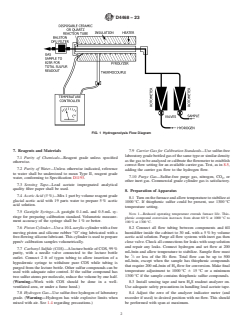
ceramic tube of 5 mm mm or larger tube (ID) is required for pyrolysis of the sample. (See Fig. 1.) The flow system is to be a
fluorocarbon or other material inert to H S and other sulfur compounds. (See Fig. 1.)
6.2 Rateometric H S Readout—Hydrogenolysis products contain H S in proportion to sulfur in the sample. The H S concentration
2 2 2
is determined by measuring rate of change of reflectance of a tape impregnated with lead acetate caused by darkening when lead
sulfide is formed. Rateometric electronics, adapted to provide first derivative output, allows sufficient sensitivity to measure to
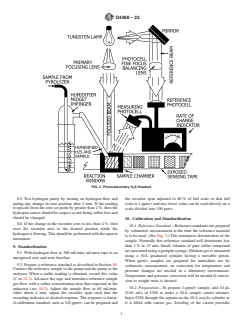
0.001 ppm/v. (See Fig. 2.)
6.3 Recorder—A suitable chart recorder may be used for a permanent record of analysis.
7. Reagents and Materials
7.1 Purity of Chemicals—Reagent grade unless specified otherwise.
7.2 Purity of Water—Unless otherwise indicated, reference to water shall be understood to mean Type II, reagent grade water,
conforming to Specification D1193.
FIG. 1 Hydrogenolysis Flow Diagram
D4468 − 23
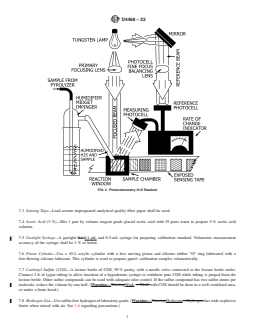
FIG. 2 Photorateometry H S Readout
7.3 Sensing Tape—Lead acetate impregnated analytical quality filter paper shall be used.
7.4 Acetic Acid (5 %)—Mix 1 part by volume reagent grade glacial acetic acid with 19 parts water to prepare 5 % acetic acid
solution.
7.5 Gastight Syringe—A gastight 0.1-0.1-mL and 0.5-mL syringe for preparing calibration standard. Volumetric measurement
accuracy of the syringe shall be 1 % or better.
7.6 Piston Cylinder—Use a 10-L acrylic cylinder with a free moving piston and silicone rubber “O” ring lubricated with a
free-flowing silicone lubricant. This cylinder is used to prepare ppm/v calibration samples volumetrically.
7.7 Carbonyl Sulfide (COS)—A lecture bottle of COS, 99 % purity, with a needle valve connected to the lecture bottle outlet.
Connect 2 ft of tygon tubing to allow insertion of a hypodermic syringe to withdraw pure COS while tubing is purged from the
lecture bottle. Other sulfur compounds can be used with adequate odor control. If the sulfur compound has two sulfur atoms per
molecule, reduce the volume by one half. (Warning—WarningWork —Work with COS should be done in a well-ventilated area,
or under a fume hood.)
7.8 Hydrogen Gas—Use sulfur-free hydrogen of laboratory grade. (Warning—WarningHydrogen—Hydrogen has wide explosive
limits when mixed with air. See 1.4 regarding precautions.)
D4468 − 23
7.9 Carrier Gas for Calibration Standards—Use sulfur-free laboratory grade bottled gas of the same type or similar density as the
gas to be analyzed or calibrate the flowmeter to establish correct flow setting for an available carrier gas. Test, as in 7.58.5, adding
the carrier gas flow to the hydrogen flow.
7.10 Purge Gas—Sulfur-free purge gas, nitrogen, CO , or other inert gas. Commercial grade cylinder gas is satisfactory.
8. Preparation of Apparatus
8.1 Turn on the furnace and allow temperature to stabilize at 1000°C.1000 °C. If thiophenic sulfur could be present, use
1300°C1300 °C temperature setting.
NOTE 1—Reduced operating temperature extends furnace life. Thiophenic compound conversion increases from about 60 % at 1000°C1000 °C to 100 %
at 1300°C.1300 °C.
8.2 Connect all flow tubing between components and fill humidifier inside the cabinet to 30 mL with a 5 % by volume acetic acid
solution. Purge all flow systems with inert gas then close valve. Check all connections for leaks with soap solution and repair any
leaks. Connect hydrogen and set flow at 200 mL/min and allow temperature to stabilize. Sample flow must be ⁄3 or less of the
H flow. Total flow can be up to 500 mL/min, except when the sample has thiophenic compounds that require 200 mL/min of H
2 2
flow for conversion. Make final temperature adjustment to 1000 6 15°C1000 °C 6 15 °C or a minimum 1300°C1300 °C i
...