

ASTM D6033-16
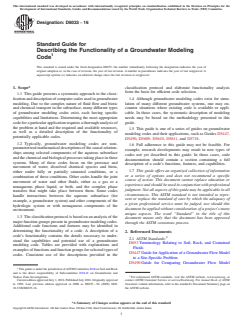
(Guide)Standard Guide for Describing the Functionality of a Groundwater Modeling Code
General Information
- Abstract
SIGNIFICANCE AND USE
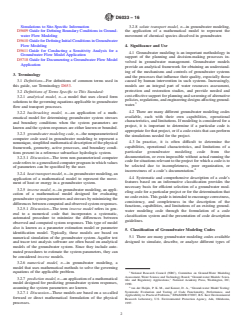
4.1 Groundwater modeling is an important methodology in support of the planning and decision-making processes involved in groundwater management. Groundwater models provide an analytical framework for obtaining an understanding of the mechanisms and controls of groundwater systems and the processes that influence their quality, especially those caused by human intervention in such systems. Increasingly, models are an integral part of water resources assessment, protection and restoration studies, and provide needed and cost-effective support for planning and screening of alternative policies, regulations, and engineering designs affecting groundwater.3
4.2 There are many different groundwater modeling codes available, each with their own capabilities, operational characteristics, and limitations. If modeling is considered for a project, it is important to determine if a particular code is appropriate for that project, or if a code exists that can perform the simulations needed for the project.
4.3 In practice, it is often difficult to determine the capabilities, operational characteristics, and limitations of a particular groundwater modeling code from the documentation, or even impossible without actual running the code for situations relevant to the project for which a code is to be selected due to incompleteness, poor organization, or incorrectness of a code's documentation.4
4.4 Systematic and comprehensive description of a code's features based on an informative classification provides the necessary basis for efficient selection of a groundwater modeling code for a particular project or for the determination that no code exists. This guide is intended to encourage correctness, consistency, and completeness in the description of the functions, capabilities, and limitations of an existing groundwater modeling code through the formulation of a code classification system and the presentation of code description guidelines.
SCOPE
1.1 This guide presents a systematic approach to the classification and description of computer codes used in groundwater modeling. Due to the complex nature of fluid flow and biotic and chemical transport in the subsurface, many different types of groundwater modeling codes exist, each having specific capabilities and limitations. Determining the most appropriate code for a particular application requires a thorough analysis of the problem at hand and the required and available resources, as well as a detailed description of the functionality of potentially applicable codes.
1.2 Typically, groundwater modeling codes are non-parameterized mathematical descriptions of the causal relationships among selected components of the aqueous subsurface and the chemical and biological processes taking place in these systems. Many of these codes focus on the presence and movement of water, dissolved chemical species and biota, either under fully or partially saturated conditions, or a combination of these conditions. Other codes handle the joint movement of water and other fluids, either as a gas or a nonaqueous phase liquid, or both, and the complex phase transfers that might take place between them. Some codes handle interactions between the aqueous subsurface (for example, a groundwater system) and other components of the hydrologic system or with nonaqueous components of the environment.
1.3 The classification protocol is based on an analysis of the major function groups present in groundwater modeling codes. Additional code functions and features may be identified in determining the functionality of a code. A description of a code’s functionality contains the details necessary to understand the capabilities and potential use of a groundwater modeling code. Tables are provided with explanations and examples of functions and function groups for selected types of codes. Consistent use of the descriptions provided in the classification protocol and elaborate fun...
- Status
- Published
- Publication Date
- 30-Jun-2016
- Technical Committee
- D18 - Soil and Rock
- Drafting Committee
- D18.21 - Groundwater and Vadose Zone Investigations
Overview
ASTM D6033-16, Standard Guide for Describing the Functionality of a Groundwater Modeling Code, provides a systematic framework for classifying and describing computer codes used in groundwater modeling. This guide is crucial for professionals involved in groundwater management, environmental engineering, and water resources planning. Groundwater models play a key role in analyzing subsurface fluid flow, biotic and chemical transport, and evaluating the impacts of human activities on groundwater systems. The standard addresses the need for clear and comprehensive documentation of groundwater modeling codes, facilitating their selection and application in various projects.
Key Topics
- Groundwater Modeling Fundamentals: Outlines the applications of modeling in understanding groundwater mechanisms, assessing water quality, and supporting policy or engineering decisions.
- Classification Protocol: Establishes a structured approach to describe and compare groundwater modeling software, focusing on three main aspects:
- Code design objectives (screening, prediction, optimization, etc.)
- Nature of the groundwater system (hydrogeologic setting, fluid types, physical, chemical, and biological processes)
- Mathematical framework (empirical vs. mechanistic models, deterministic vs. stochastic)
- Code Functionality Description: Emphasizes the importance of detailing code features such as simulation capabilities, operational characteristics, and limitations. This includes information on supported platforms, simulation methods, boundary condition handling, and solution techniques.
- Types of Modeling Codes: Covers analytical, numerical, inverse, solute transport, heat transport, and multiphase flow models, each with distinct capabilities for simulating groundwater scenarios.
- Boundary and Initial Conditions: Addresses different types, such as Dirichlet (first kind), Neumann (second kind), and Cauchy (third kind/mixed), which are fundamental for accurate simulation results.
- Interaction with External Systems: Discusses model capabilities for coupling groundwater with surface water, atmosphere, and biota uptake processes.
Applications
- Groundwater Management: Assists in planning, assessment, protection, and restoration efforts by providing robust analysis tools for groundwater systems.
- Environmental Impact Assessment: Supports evaluation of the effects of engineering designs or regulations on groundwater quantity and quality.
- Remediation Strategy Design: Guides the selection of modeling codes for design and prediction of groundwater remediation systems.
- Regulatory and Policy Analysis: Provides a scientific framework for screening and comparing alternative groundwater management policies.
- Engineering Design: Helps in the design of water supply systems, well fields, aquifer storage and recovery projects, and contaminant transport control measures.
- Research and Education: Facilitates testing new theories, teaching hydrological concepts, and demonstrating the principles of groundwater flow and transport.
Related Standards
- ASTM D653 - Terminology Relating to Soil, Rock, and Contained Fluids
- ASTM D5447 - Application of a Groundwater Flow Model to a Site-Specific Problem
- ASTM D5490 - Comparing Groundwater Flow Model Simulations to Site-Specific Information
- ASTM D5609 - Defining Boundary Conditions in Groundwater Flow Modeling
- ASTM D5610 - Defining Initial Conditions in Groundwater Flow Modeling
- ASTM D5611 - Conducting a Sensitivity Analysis for a Groundwater Flow Model Application
- ASTM D5718 - Documenting a Groundwater Flow Model Application
Conclusion
ASTM D6033-16 is an essential reference for professionals selecting or describing groundwater modeling codes. By ensuring correctness, consistency, and completeness in code documentation, the standard streamlines the selection process and enhances the reliability of groundwater assessments. Application of this guide lays a solid foundation for scientifically sound and efficient groundwater modeling across diverse hydrogeologic, engineering, and regulatory contexts. For optimal results, professionals are encouraged to use this guide in conjunction with their expertise and related ASTM standards.
Relations
- Replaces
ASTM D6033-96(2008) - Standard Guide for Describing the Functionality of a Groundwater Modeling Code - Effective Date
- 01-Jul-2016
- Effective Date
- 01-Mar-2016
- Effective Date
- 01-Jan-2016
- Effective Date
- 01-Aug-2014
- Effective Date
- 01-May-2012
- Effective Date
- 01-Sep-2011
- Effective Date
- 01-Aug-2010
- Effective Date
- 01-Jan-2009
- Effective Date
- 01-Dec-2008
- Effective Date
- 01-Nov-2008
- Refers
ASTM D5609-94(2008) - Standard Guide for Defining Boundary Conditions in Groundwater Flow Modeling - Effective Date
- 15-Sep-2008
- Refers
ASTM D5609-94(2015)e1 - Standard Guide for Defining Boundary Conditions in Groundwater Flow Modeling - Effective Date
- 15-Sep-2008
- Effective Date
- 15-Sep-2008
- Effective Date
- 15-Sep-2008
- Refers
ASTM D5610-94(2008) - Standard Guide for Defining Initial Conditions in Groundwater Flow Modeling - Effective Date
- 15-Sep-2008
Get Certified
Connect with accredited certification bodies for this standard

CIS Institut d.o.o.
Personal Protective Equipment (PPE) certification body. Notified Body NB-2890 for EU Regulation 2016/425 PPE.

Kiwa BDA Testing
Building and construction product certification.
Kmetijski inštitut Slovenije
Agricultural Institute of Slovenia. Soil testing, plant health, agricultural product analysis.
Sponsored listings
Frequently Asked Questions
ASTM D6033-16 is a guide published by ASTM International. Its full title is "Standard Guide for Describing the Functionality of a Groundwater Modeling Code". This standard covers: SIGNIFICANCE AND USE 4.1 Groundwater modeling is an important methodology in support of the planning and decision-making processes involved in groundwater management. Groundwater models provide an analytical framework for obtaining an understanding of the mechanisms and controls of groundwater systems and the processes that influence their quality, especially those caused by human intervention in such systems. Increasingly, models are an integral part of water resources assessment, protection and restoration studies, and provide needed and cost-effective support for planning and screening of alternative policies, regulations, and engineering designs affecting groundwater.3 4.2 There are many different groundwater modeling codes available, each with their own capabilities, operational characteristics, and limitations. If modeling is considered for a project, it is important to determine if a particular code is appropriate for that project, or if a code exists that can perform the simulations needed for the project. 4.3 In practice, it is often difficult to determine the capabilities, operational characteristics, and limitations of a particular groundwater modeling code from the documentation, or even impossible without actual running the code for situations relevant to the project for which a code is to be selected due to incompleteness, poor organization, or incorrectness of a code's documentation.4 4.4 Systematic and comprehensive description of a code's features based on an informative classification provides the necessary basis for efficient selection of a groundwater modeling code for a particular project or for the determination that no code exists. This guide is intended to encourage correctness, consistency, and completeness in the description of the functions, capabilities, and limitations of an existing groundwater modeling code through the formulation of a code classification system and the presentation of code description guidelines. SCOPE 1.1 This guide presents a systematic approach to the classification and description of computer codes used in groundwater modeling. Due to the complex nature of fluid flow and biotic and chemical transport in the subsurface, many different types of groundwater modeling codes exist, each having specific capabilities and limitations. Determining the most appropriate code for a particular application requires a thorough analysis of the problem at hand and the required and available resources, as well as a detailed description of the functionality of potentially applicable codes. 1.2 Typically, groundwater modeling codes are non-parameterized mathematical descriptions of the causal relationships among selected components of the aqueous subsurface and the chemical and biological processes taking place in these systems. Many of these codes focus on the presence and movement of water, dissolved chemical species and biota, either under fully or partially saturated conditions, or a combination of these conditions. Other codes handle the joint movement of water and other fluids, either as a gas or a nonaqueous phase liquid, or both, and the complex phase transfers that might take place between them. Some codes handle interactions between the aqueous subsurface (for example, a groundwater system) and other components of the hydrologic system or with nonaqueous components of the environment. 1.3 The classification protocol is based on an analysis of the major function groups present in groundwater modeling codes. Additional code functions and features may be identified in determining the functionality of a code. A description of a code’s functionality contains the details necessary to understand the capabilities and potential use of a groundwater modeling code. Tables are provided with explanations and examples of functions and function groups for selected types of codes. Consistent use of the descriptions provided in the classification protocol and elaborate fun...
SIGNIFICANCE AND USE 4.1 Groundwater modeling is an important methodology in support of the planning and decision-making processes involved in groundwater management. Groundwater models provide an analytical framework for obtaining an understanding of the mechanisms and controls of groundwater systems and the processes that influence their quality, especially those caused by human intervention in such systems. Increasingly, models are an integral part of water resources assessment, protection and restoration studies, and provide needed and cost-effective support for planning and screening of alternative policies, regulations, and engineering designs affecting groundwater.3 4.2 There are many different groundwater modeling codes available, each with their own capabilities, operational characteristics, and limitations. If modeling is considered for a project, it is important to determine if a particular code is appropriate for that project, or if a code exists that can perform the simulations needed for the project. 4.3 In practice, it is often difficult to determine the capabilities, operational characteristics, and limitations of a particular groundwater modeling code from the documentation, or even impossible without actual running the code for situations relevant to the project for which a code is to be selected due to incompleteness, poor organization, or incorrectness of a code's documentation.4 4.4 Systematic and comprehensive description of a code's features based on an informative classification provides the necessary basis for efficient selection of a groundwater modeling code for a particular project or for the determination that no code exists. This guide is intended to encourage correctness, consistency, and completeness in the description of the functions, capabilities, and limitations of an existing groundwater modeling code through the formulation of a code classification system and the presentation of code description guidelines. SCOPE 1.1 This guide presents a systematic approach to the classification and description of computer codes used in groundwater modeling. Due to the complex nature of fluid flow and biotic and chemical transport in the subsurface, many different types of groundwater modeling codes exist, each having specific capabilities and limitations. Determining the most appropriate code for a particular application requires a thorough analysis of the problem at hand and the required and available resources, as well as a detailed description of the functionality of potentially applicable codes. 1.2 Typically, groundwater modeling codes are non-parameterized mathematical descriptions of the causal relationships among selected components of the aqueous subsurface and the chemical and biological processes taking place in these systems. Many of these codes focus on the presence and movement of water, dissolved chemical species and biota, either under fully or partially saturated conditions, or a combination of these conditions. Other codes handle the joint movement of water and other fluids, either as a gas or a nonaqueous phase liquid, or both, and the complex phase transfers that might take place between them. Some codes handle interactions between the aqueous subsurface (for example, a groundwater system) and other components of the hydrologic system or with nonaqueous components of the environment. 1.3 The classification protocol is based on an analysis of the major function groups present in groundwater modeling codes. Additional code functions and features may be identified in determining the functionality of a code. A description of a code’s functionality contains the details necessary to understand the capabilities and potential use of a groundwater modeling code. Tables are provided with explanations and examples of functions and function groups for selected types of codes. Consistent use of the descriptions provided in the classification protocol and elaborate fun...
ASTM D6033-16 is classified under the following ICS (International Classification for Standards) categories: 13.060.10 - Water of natural resources. The ICS classification helps identify the subject area and facilitates finding related standards.
ASTM D6033-16 has the following relationships with other standards: It is inter standard links to ASTM D6033-96(2008), ASTM D5609-16, ASTM D5611-94(2016), ASTM D653-14, ASTM D5718-95(2012), ASTM D653-11, ASTM D5447-04(2010), ASTM D653-09, ASTM D653-08a, ASTM D653-08, ASTM D5609-94(2008), ASTM D5609-94(2015)e1, ASTM D5490-93(2008), ASTM D5611-94(2008), ASTM D5610-94(2008). Understanding these relationships helps ensure you are using the most current and applicable version of the standard.
ASTM D6033-16 is available in PDF format for immediate download after purchase. The document can be added to your cart and obtained through the secure checkout process. Digital delivery ensures instant access to the complete standard document.
Standards Content (Sample)
This international standard was developed in accordance with internationally recognized principles on standardization established in the Decision on Principles for the
Development of International Standards, Guides and Recommendations issued by the World Trade Organization Technical Barriers to Trade (TBT) Committee.
Designation: D6033 − 16
Standard Guide for
Describing the Functionality of a Groundwater Modeling
Code
This standard is issued under the fixed designation D6033; the number immediately following the designation indicates the year of
original adoption or, in the case of revision, the year of last revision. A number in parentheses indicates the year of last reapproval. A
superscript epsilon (´) indicates an editorial change since the last revision or reapproval.
1. Scope* classification protocol and elaborate functionality analysis
form the basis for efficient code selection.
1.1 This guide presents a systematic approach to the classi-
ficationanddescriptionofcomputercodesusedingroundwater 1.4 Although groundwater modeling codes exist for simu-
modeling. Due to the complex nature of fluid flow and biotic lation of many different groundwater systems, one may en-
and chemical transport in the subsurface, many different types counter situations where existing code is available or appli-
of groundwater modeling codes exist, each having specific cable. In those cases, the systematic description of modeling
capabilities and limitations. Determining the most appropriate needs may be based on the methodology presented in this
codeforaparticularapplicationrequiresathoroughanalysisof guide.
the problem at hand and the required and available resources,
1.5 This guide is one of a series of guides on groundwater
as well as a detailed description of the functionality of
modeling codes and their applications, such as Guides D5447,
potentially applicable codes.
D5490, D5609, D5610, D5611, and D5718.
1.2 Typically, groundwater modeling codes are non-
1.6 Full adherence to this guide may not be feasible. For
parameterizedmathematicaldescriptionsofthecausalrelation-
example, research developments may result in new types of
ships among selected components of the aqueous subsurface
codes not yet described in this guide. In those cases, code
and the chemical and biological processes taking place in these
documentation should contain a section containing a full
systems. Many of these codes focus on the presence and
description of a code’s functions, features, and capabilities.
movement of water, dissolved chemical species and biota,
1.7 This guide offers an organized collection of information
either under fully or partially saturated conditions, or a
or a series of options and does not recommend a specific
combination of these conditions. Other codes handle the joint
course of action. This document cannot replace education or
movement of water and other fluids, either as a gas or a
experience and should be used in conjunction with professional
nonaqueous phase liquid, or both, and the complex phase
judgment. Not all aspects of this guide may be applicable in all
transfers that might take place between them. Some codes
circumstances. This ASTM standard is not intended to repre-
handle interactions between the aqueous subsurface (for
sent or replace the standard of care by which the adequacy of
example, a groundwater system) and other components of the
a given professional service must be judged, nor should this
hydrologic system or with nonaqueous components of the
document be applied without consideration of a project’s many
environment.
unique aspects. The word “Standard” in the title of this
1.3 The classification protocol is based on an analysis of the
document means only that the document has been approved
major function groups present in groundwater modeling codes.
through the ASTM consensus process.
Additional code functions and features may be identified in
determining the functionality of a code. A description of a
2. Referenced Documents
code’s functionality contains the details necessary to under-
2.1 ASTM Standards:
stand the capabilities and potential use of a groundwater
D653 Terminology Relating to Soil, Rock, and Contained
modeling code. Tables are provided with explanations and
Fluids
examplesoffunctionsandfunctiongroupsforselectedtypesof
D5447 Guide forApplication of a Groundwater Flow Model
codes. Consistent use of the descriptions provided in the
to a Site-Specific Problem
D5490 Guide for Comparing Groundwater Flow Model
This guide is under the jurisdiction ofASTM Committee D18 on Soil and Rock
and is the direct responsibility of Subcommittee D18.21 on Groundwater and
Vadose Zone Investigations. For referenced ASTM standards, visit the ASTM website, www.astm.org, or
Current edition approved July 1, 2016. Published July 2016. Originally approved contact ASTM Customer Service at service@astm.org. For Annual Book of ASTM
in 1996. Last previous edition approved in 2008 as D6033 – 96 (2008) DOI: Standards volume information, refer to the standard’s Document Summary page on
10.1520/D6033-16. the ASTM website.
*A Summary of Changes section appears at the end of this standard
Copyright © ASTM International, 100 Barr Harbor Drive, PO Box C700, West Conshohocken, PA 19428-2959. United States
D6033 − 16
Simulations to Site-Specific Information 3.2.8 solute transport model, n—in groundwater modeling,
D5609 Guide for Defining Boundary Conditions in Ground- the application of a mathematical model to represent the
water Flow Modeling movement of chemical species dissolved in groundwater.
D5610 GuideforDefiningInitialConditionsinGroundwater
Flow Modeling
4. Significance and Use
D5611 Guide for Conducting a Sensitivity Analysis for a
4.1 Groundwater modeling is an important methodology in
Groundwater Flow Model Application
support of the planning and decision-making processes in-
D5718 Guide for Documenting a Groundwater Flow Model
volved in groundwater management. Groundwater models
Application
provide an analytical framework for obtaining an understand-
ing of the mechanisms and controls of groundwater systems
3. Terminology
and the processes that influence their quality, especially those
3.1 Definitions—For definitions of common terms used in caused by human intervention in such systems. Increasingly,
this guide, see Terminology D653. models are an integral part of water resources assessment,
protection and restoration studies, and provide needed and
3.2 Definitions of Terms Specific to This Standard:
cost-effective support for planning and screening of alternative
3.2.1 analytical model, n—a model that uses closed form
policies,regulations,andengineeringdesignsaffectingground-
solutions to the governing equations applicable to groundwater
water.
flow and transport processes.
4.2 There are many different groundwater modeling codes
3.2.2 backtracking model, n—an application of a math-
available, each with their own capabilities, operational
ematical model for determining groundwater system stresses
characteristics, and limitations. If modeling is considered for a
and boundary conditions when the system parameters are
project, it is important to determine if a particular code is
known and the system responses are either known or bounded.
appropriate for that project, or if a code exists that can perform
3.2.3 groundwater modeling code, n—the nonparameterized
the simulations needed for the project.
computer code used in groundwater modeling to represent a
4.3 In practice, it is often difficult to determine the
nonunique, simplified mathematical description of the physical
capabilities, operational characteristics, and limitations of a
framework, geometry, active processes, and boundary condi-
particular groundwater modeling code from the
tions present in a reference subsurface hydrologic system.
documentation, or even impossible without actual running the
3.2.3.1 Discussion—The term non-parameterized computer
code for situations relevant to the project for which a code is to
code refers to a generalized computer program in which values
be selected due to incompleteness, poor organization, or
of parameters can be specified by the user.
incorrectness of a code’s documentation.
3.2.4 heat transport model, n—ingroundwatermodeling,an
4.4 Systematic and comprehensive description of a code’s
application of a mathematical model to represent the move-
features based on an informative classification provides the
ment of heat or energy in a groundwater system.
necessary basis for efficient selection of a groundwater mod-
3.2.5 inverse model, n—in groundwater modeling, an appli-
eling code for a particular project or for the determination that
cation of a mathematical model designed for evaluating
nocodeexists.Thisguideisintendedtoencouragecorrectness,
groundwatersystemparametersandstressesbyminimizingthe
consistency, and completeness in the description of the
differences between computed and observed system responses.
functions, capabilities, and limitations of an existing ground-
3.2.5.1 Discussion—The term inverse model refers in gen-
water modeling code through the formulation of a code
eral to a numerical code that incorporates a systematic,
classification system and the presentation of code description
automated procedure to minimize the differences between
guidelines.
observed and computed system responses. This type of model
also is known as a parameter estimation model or parameter
5. Classification of Groundwater Modeling Codes
identification model. Typically, these models are based on
5.1 There are many groundwater modeling codes available
numerical simulation of the groundwater system. Aquifer test
designed to simulate, describe, or analyze different types of
and tracer test analysis software are often based on analytical
models of the groundwater system. Since they include auto-
mated procedures to estimate the system parameters, they can
be considered inverse models.
3.2.6 numerical model, n—in groundwater modeling, a
model that uses mathematical methods to solve the governing
equations of the applicable problem.
National Research Council (NRC), Committee on Ground-Water Modeling
Assessment, Water Science and Technology Board, “Ground-water Models: Scien-
3.2.7 prediction model, n—an application of a mathematical
tific and Regulatory Applications,” National Academy Press, Washington, DC,
model designed for predicting groundwater system responses,
1990.
van der Heijde, P. K. M., and Kanzer, D. A., “Ground-water Model Testing:
assuming the system parameters are known.
Systematic Evaluation and Testing of Code Functionality, Performance, and
3.2.7.1 Discussion—These models are based on a so-called
Applicability to Practical Problems,” EPA/600/R-97/007, R.S. Kerr Environmental
forward or direct mathematical formulation of the physical
Research Laboratory, U.S. Environmental Protection Agency, Ada, Oklahoma,
processes. 1997.
D6033 − 16
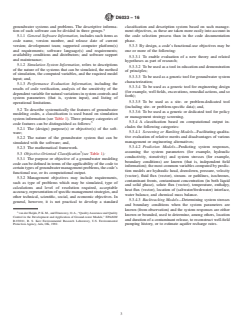
groundwater systems and problems. The descriptive informa- classification and description system based on such manage-
tion of such software can be divided in three groups. ment objectives, as these are taken more easily into account in
5.1.1 General Software Information, includes such items as the code selection process than in the code documentation
code name, version number, and release date of current phase.
version; development team; supported computer platform(s)
5.3.3 By design, a code’s functional-use objectives may be
and requirements; software language(s) and requirements;
one or more of the following:
availability conditions and distributors; and software support
5.3.3.1 To enable evaluation of a new theory and related
and maintenance;
hypotheses as part of research;
5.1.2 Simulation System Information, refers to descriptions
5.3.3.2 To be used as a tool in education and demonstration
of the nature of the systems that can be simulated, the method
of principles;
of simulation, the computed variables, and the required model
5.3.3.3 To be used as a generic tool for groundwater system
input; and,
characterization;
5.1.3 Performance Evaluation Information, including the
5.3.3.4 To be used as a generic tool for engineering design
results of code verification, analysis of the sensitivity of the
(for example, well fields, excavations, remedial actions, and so
dependentvariablefornaturalvariationsinsystemcontrolsand
forth);
system parameters (that is, system input), and listing of
5.3.3.5 To be used as a site- or problem-dedicated tool
operational limitations.
(including site- or problem-specific data); and,
5.2 To describe systematically the features of groundwater
5.3.3.6 To be used as a generic or dedicated tool for policy
modeling codes, a classification is used based on simulation
or management strategy screening.
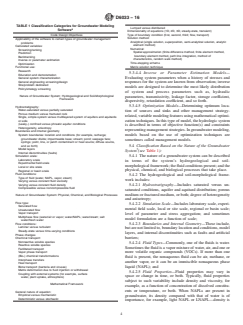
system information (see Table 1). Three primary categories of
5 5.3.4 A classification based on computational output in-
code features can be distinguished as follows:
cludes the following categories:
5.2.1 The (design) purpose(s) or objective(s) of the soft-
5.3.4.1 Screening or Ranking Models—Facilitating qualita-
ware;
tive evaluation of relative merits and disadvantages of various
5.2.2 The nature of the groundwater system that can be
management or engineering alternatives;
simulated with the software; and,
5.3.4.2 Prediction Models—Predicting system responses,
5.2.3 The mathematical framework.
5 assuming the system parameters (for example, hydraulic
5.3 Objective-Oriented Classification (see Table 1):
conductivity, storativity) and system stresses (for example,
5.3.1 The purpose or objective of a groundwater modeling
boundary conditions) are known (that is, independent field
code can be defined in terms of the applicability of the code to
information); the most common variables computed by predic-
certaintypesofgroundwatermanagementproblems,thecode’s
tion models are hydraulic head, drawdown, pressure, velocity
functional use, or its computational output.
(vector), fluid flux (vector), stream- or pathlines, isochrones,
5.3.2 Management objectives may include requirements,
contaminant fronts, contaminant concentration (in both liquid
such as type of problems which may be simulated, type of
and solid phase), solute flux (vector), temperature, enthalpy,
calculations and level of resolution required, acceptable
heat flux (vector), location of (saltwater/freshwater) interface,
accuracy,representationofspecificmanagementstrategies,and
water balance, and chemical mass balance.
other technical, scientific, social, and economic objectives. In
5.3.4.3 Backtracking Models—Determining system stresses
general, however, it is not practical to develop a standard
and boundary conditions when the system parameters are
known (from observation) and the system responses are either
vanderHeijde,P.K.M.,andElnawawy,O.A.,“QualityAssuranceandQuality
known or bounded, used to determine, among others, location
Control in the Development and Application of Ground-water Models,” EPA/600/
and duration of a contaminant release, to reconstruct well-field
R-93/011, R. S. Kerr Environmental Research Laboratory, U.S. Environmental
Protection Agency, Ada, OK, 1992. pumping history, or to estimate aquifer recharge rates.
D6033 − 16
TABLE 1 Classification Categories for Groundwater Modeling
Lumped versus distributed
Software
Dimensionality of equations (1D, 2D, 3D, steady-state, transient)
Type of boundary condition (first, second, third; flow, transport)
Code Design Objectives
Solution method:
Applicability of the software to certain types of groundwater management
Analytical (single solution, superposition, semi-analytical solution, analytic
problems
element method)
Calculated variables:
Numerical:
Screening/ranking
Spatial approximation (finite difference method, finite element method,
Prediction
boundary element method, path line integration, method of
Backtracking
characteristics, random walk method)
Inverse or parameter estimation
Time-stepping scheme
Optimization
Matrix solution technique
Functional use:
Research
5.3.4.4 Inverse or Parameter Estimation Models—
Education and demonstration
Evaluating system parameters when a history of stresses and
General system characterization
General engineering screening/design
responses for the system are known from observation; inverse
Site/problem dedicated
models are designed to determine the most likely distribution
Policy/strategy screening
of system and process parameters such as, hydraulic
Nature of Groundwater System: Hydrogeological and Soil-Morphological
parameters, transmissivity, leakage factor, storage coefficient,
Framework
dispersivity, retardation coefficient, and so forth.
Hydrostratigraphy: 5.3.4.5 Optimization Models—Determining optimum loca-
Water-saturated versus partially saturated
tion of sources and sinks and other management strategy-
Porous medium versus fractured rock
related, variable modeling features using mathematical optimi-
Single, simple system versus multilayered system of aquifers and aquitards
zation techniques. In this type of model, the hydrologic system
or soils
(Leaky-) confined versus phreatic aquifer conditions
is described in terms of objective function(s) and constraints
Heterogeneity, anisotropy
representing management strategies. In groundwater modeling,
Boundaries and internal geometry
System boundaries: location and conditions (for example, recharge; models based on the use of optimization techniques are
groundwater divide; impermeable base; stream; pond; seepage face;
sometimes called management models.
springs; point, line, or patch contaminant or heat source; diffuse source,
and so forth)
5.4 Classification Based on the Nature of the Groundwater
Model layers 5
System (see Table 1):
Internal discontinuities (faults)
5.4.1 The nature of a groundwater system can be described
Simulation scale:
Laboratory scale
in terms of the system’s hydrogeological and soil-
Experimental field scale
morphologicalframework;thefluidconditionspresent;andthe
Local or site scale
Regional or basin scale physical, chemical, and biological processes that take place.
Fluid conditions:
5.4.2 The hydrogeological and soil-morphological frame-
Type of fluid (water, NAPL, vapor, steam)
work includes:
Varying versus constant fluid viscosity
Varying versus constant fluid density
5.4.2.1 Hydrostratigraphy—Includes saturated versus un-
Compressible versus noncompressible fluid
saturated conditions, aquifer and aquitard distribution; porous
medium or fractured medium, or both; degree of heterogeneity
Nature of Groundwater System: Physical, Chemical, and Biological Processes
and anisotropy;
Flow type:
5.4.2.2 Simulation Scale—Includes laboratory scale, experi-
Saturated flow
mental field scale, local or site scale, regional or basin scale;
Unsaturated flow
Vapor transport
level of parameter and stress aggregation; and sometimes
Multiphase flow (water/air or vapor; water/NAPL; water/steam; salt
model formulation are a function of scale;
water/fresh water
Flow conditions: 5.4.2.3 Boundaries and Internal Geometry—These include,
Laminar versus turbulent
but are not limited to, boundary location and conditions, model
Steady-state versus time-varying conditions
layers, and internal discontinuities such as faults and artificial
Phase changes
barriers;
Chemical transport:
Nonreactive soluble species
5.4.2.4 Fluid Types—Commonly, one of the fluids is water.
Reactive soluble species
Sometimes the fluid is a vapor mixture of water, air, and one or
Facilitated transport
Vapor phase transport more volatile organic compounds (VOCs). If more than one
(Bio-) chemical transformations
fluid is present, the nonaqueous fluid can be air, methane, or
Interphase transfers
another vapor, or it can be an immiscible nonaqueous phase
Heat transport
Biota transport (bacteria and viruses) liquid (NAPL); and
Matrix deformation due to fluid injection or withdrawal
5.4.2.5 Fluid Properties—Fluid properties may vary in
Coupling with external systems (for example, surface
space or change in time, or both. Typically, fluid properties
water, plant uptake, atmosphere)
subject to such variability include density and viscosity, for
Mathematical Framework
example, as a function of concentration of dissolved constitu-
ents or temperature, or both. When NAPLs are present in
General nature of equation:
Empirical versus mechanistic
groundwater, its density compared with that of water is of
Deterministic versus stochastic
importance, for example, light NAPL or LNAPL—density is
D6033 − 16
less than that of water; dense NAPL or DNAPL—density is 5.4.4.2 When, in addition to water, when other immiscible
more than that of water. A further distinction can be made in fluids are present, the system may be modeled as a multi-phase
the modeling of condensable gases, for example, water vapor,
flow or multi-fluid flow problem (for example, flow of water
and noncondensable gases, for example, air. and air or vapor, flow of water and NAPL). The term
5.4.3 Relevant processes in groundwater modeling include
multi-phaseflowalsoapplieswhenwatermovesintwodistinct
the following (see Table 2 for details):
phases, especially in liquid form and steam or vapor.
5.4.3.1 Fluid flow (flow type and flow conditions);
5.4.4.3 A special case of multifluid flow is encountered in
5.4.3.2 Phase changes;
sea-water intrusion modeling. In this case, the properties
5.4.3.3 Chemical transport;
(density and viscosity) of a single fluid flow (water) may vary
5.4.3.4 (Bio-)chemical transformations;
spatially. For example, such a situation is present when layers
5.4.3.5 Heat transport;
of water of distinct density are separated by a relatively small
5.4.3.6 Biota transport (bacteria and viruses);
transition zone (salt/fresh water interface) and do not mix on
5.4.3.7 Matrix deformation; and
thetimescaleofthesimulation.Theflowinthetwolayersmay
5.4.3.8 Interaction processes with external systems, for
be simulated separately, coupled by boundary conditions at the
example, atmosphere, plants, surface water.
interface. Occasionally, one of the layers (or fluids) may be
5.4.4 Fluid Flow—refers to the movement of one or more
considered stagnant, typically, the denser layer.
fluids in porous or fractured rock:
5.4.4.4 Some modeling codes are designed specifically for
5.4.4.1 Incasethemodelfluidiswater,adistinctionismade
simulation of vapor transport problems, for example, for use in
between flow in a fully water saturated medium, that is,
the design of vapor extraction systems. These models concern
saturatedflow,andflowinamediumthatisonlypartiallyfilled
the flow of a single, some times highly compressible fluid.
with water, that is, unsaturated flow or variably saturated flow.
5.4.4.5 In some cases, spatial and temporal differences in
Some models can handle the change in time from fully
fluid properties have a significant effect on the distribution of
saturated to partially saturated conditions and the reverse.
the computed variables. This may be the result of changes in
the distribution of chemical species or heat. The fluid proper-
ties affected include density, viscosity, and compressibility. In
codes designed for such problems, the mathematical solution
TABLE 2 Important Physical and Chemical Processes in
Groundwater Systems
of the flow and transport equations are coupled.
Flow Processes:
5.4.5 Phase Changes—Under certain conditions, a fluid
may exist within the model domain in more than one phase. In
Single fluid flow
Multifluid flow: groundwater modeling, this is particularly the case when the
Multicomponent
fluid is water, which can be in the solid phase (ice), the liquid
Multiphase
phase (water), and the gas phase (vapor or steam).
Laminar flow:
Linear/Darcian
Occasionally, a phase change takes place at the same time
Nonlinear/non-Darcian
throughout the model domain. More often, different phases
Turbulent flow
coexist within the model domain and distinct boundaries exist
Transport Processes:
between the phases. Across such (possibly moving) phase
Advection/convection
boundariesachangeofstatetakesplace,forexample,freezing,
Conduction (heat)
thawing, evaporation, condensation, sublimation, melting, and
Mechanical/thermal dispersion
Molecular diffusion
so forth. Typically, these types of physical phenomena are
Radiation (heat)
encountered when simulating geothermal reservoirs or flow
and transport in soils subject to low temperatures. The recent
Transformation Processes:
Hydrolysis/substitution
interest in steam injection for remediation makes it a major
Dissolution/precipitation
application of the multiphase model with explicit phase tran-
Oxidation/reduction
Complexation sitions.
Radioactive decay
5.4.6 Chemical Transport—The distribution of chemicals in
Microbial decay/biotransformation
groundwater is dependent on such factors as source history,
Interphase Transfers:
Solid←→gas-(vapor) sorption
background distribution, transport and transformation
Solid←→liquid:-sorption ion exchange
processes, phase changes, and interphase transfer of chemical
Liquid←→gas-volatilization:
compounds, for example, sorption between liquid and solid
Condensation
Sublimation
phase and between gas and solid phase. Various types of
modeling approaches are used to evaluate the distribution of
Phase Changes:
Freezing/thawing chemicals in groundwater.
Vaporization (evaporation)/condensation
5.4.6.1 Solute Transport Models—Spatially distributed
simulation of physical transport of (in water) dissolved chemi-
Matrix Deformation:
Compaction
cals or solutes; they also are referred to as mass transport
Expansion
models or solute migration models. Typically, such models
Fracturization
compute the spatial and temporal distribution of one or more
D6033 − 16
chemical species. A solute transport model requires velocities during the transport of a chemical compound or analysis of the
for the calculation of advective displacement and spreading by interaction of multiple chemical compounds in a moving fluid
system.
dispersion.
5.4.6.10 Coupled simulation of distributed transport and
5.4.6.2 The spatially distributed simulation of physical
interphase transfer processes and locally lumped biotransfor-
transport of nonreactive dissolved chemicals or solutes is
mation and biodegradation processes facilitate detailed analy-
subject to conservation of mass in the dissolved phase only,
sis of the chemical transformations taking place during the
that is, conservative solute transport. Typically, such models
transportofachemicalcompoundduetomicrobialactivityand
include a mathematical representation of fluid flow related
analysis of the influence of supporting chemical compounds on
movement (advective transport), mechanical dispersion, and
the efficiency of the transformation processes.
molecular diffusion.
5.4.7 Heat transport models—concern with the displace-
5.4.6.3 In the spatially distributed simulation of transport of
ment of energy or heat in the subsurface.There are three major
reactive solutes, that is, nonconservative solute transport, a
types of heat transport models in the subsurface:
single equation represents the conservation of mass in the
5.4.7.1 Transport through the fluid phase of the subsurface
dissolved phase; fluid-flow-related movement (advective trans-
only, for example, water or air;
port); mechanical dispersion; molecular diffusion; and the
5.4.7.2 Transport through the solid phase of the subsurface
effects of interphase transfers (adsorption), transformation
only, for example, in dry rock; and,
(first-order decay); and zero-order production (source/sink
5.4.7.3 Transport through both the fluid and solid phases of
term).The inclusion of transformation processes often is based
the subsurface.
on the assumption that the reaction proceeds instantaneously to
5.4.7.4 In groundwater modeling only model types 5.4.7.1
equilibrium conditions.
and 5.4.7.2 are used. Within each of these two groups of
5.4.6.4 Hydrogeochemical Specification Models or Local
models one can distinguish four subtypes:
Thermodynamic Equilibrium (LTE) Models—Spatially lumped
(a) Low-temperature, single-phase heat transport without
simulation of chemical processes occurring in groundwater,
phase change, for example, to evaluate heat-pump efficiencies;
that is, equilibrium-based or kinetics-controlled processes,
(b) Low-temperature, dual-phase heat transport with two
including transformation processes and interphase transfers.
fluids (water and vapor, for example, in soil
...
This document is not an ASTM standard and is intended only to provide the user of an ASTM standard an indication of what changes have been made to the previous version. Because
it may not be technically possible to adequately depict all changes accurately, ASTM recommends that users consult prior editions as appropriate. In all cases only the current version
of the standard as published by ASTM is to be considered the official document.
Designation: D6033 − 96 (Reapproved 2008) D6033 − 16
Standard Guide for
Describing the Functionality of a Groundwater Modeling
Code
This standard is issued under the fixed designation D6033; the number immediately following the designation indicates the year of
original adoption or, in the case of revision, the year of last revision. A number in parentheses indicates the year of last reapproval. A
superscript epsilon (´) indicates an editorial change since the last revision or reapproval.
1. Scope Scope*
1.1 This guide presents a systematic approach to the classification and description of computer codes used in groundwater
modeling. Due to the complex nature of fluid flow and biotic and chemical transport in the subsurface, many different types of
groundwater modeling codes exist, each having specific capabilities and limitations. Determining the most appropriate code for
a particular application requires a thorough analysis of the problem at hand and the required and available resources, as well as
a detailed description of the functionality of potentially applicable codes.
1.2 Typically, groundwater modeling codes are nonparameterizednon-parameterized mathematical descriptions of the causal
relationships among selected components of the aqueous subsurface and the chemical and biological processes taking place in
these systems. Many of these codes focus on the presence and movement of water, dissolved chemical species and biota, either
under fully or partially saturated conditions, or a combination of these conditions. Other codes handle the joint movement of water
and other fluids, either as a gas or a nonaqueous phase liquid, or both, and the complex phase transfers that might take place
between them. Some codes handle interactions between the aqueous subsurface (for example, a groundwater system) and other
components of the hydrologic system or with nonaqueous components of the environment.
1.3 The classification protocol is based on an analysis of the major function groups present in groundwater modeling codes.
Additional code functions and features may be identified in determining the functionality of a code. A complete description of a
code’scode’s functionality contains the details necessary to understand the capabilities and potential use of a groundwater modeling
code. Tables are provided with explanations and examples of functions and function groups for selected types of codes. Consistent
use of the descriptions provided in the classification protocol and elaborate functionality analysis form the basis for efficient code
selection.
1.4 Although groundwater modeling codes exist for simulation of many different groundwater systems, one may encounter
situations in which no where existing code is available or applicable. In those cases, the systematic description of modeling needs
may be based on the methodology presented in this guide.
1.5 This guide is one of a series of guides on groundwater modeling codes and their applications, such as Guides D5447, D5490,
D5609, D5610, D5611, and D5718.
1.6 CompleteFull adherence to this guide may not be feasible. For example, research developments may result in new types of
codes not yet described in this guide. In any case,those cases, code documentation should contain a section containing a
completefull description of a code’scode’s functions, features, and capabilities.
1.7 This guide offers an organized collection of information or a series of options and does not recommend a specific course
of action. This document cannot replace education or experience and should be used in conjunction with professional judgment.
Not all aspects of this guide may be applicable in all circumstances. This ASTM standard is not intended to represent or replace
the standard of care by which the adequacy of a given professional service must be judged, nor should this document be applied
without consideration of a project’s many unique aspects. The word “Standard” in the title of this document means only that the
document has been approved through the ASTM consensus process.
This guide is under the jurisdiction of ASTM Committee D18 on Soil and Rock and is the direct responsibility of Subcommittee D18.21 on Groundwater and Vadose
Zone Investigations.
Current edition approved Sept. 15, 2008July 1, 2016. Published November 2008July 2016. Originally approved in 1996. Last previous edition approved in 20022008 as
D6033 – 96 (2008) (2002) DOI: 10.1520/D6033-96R08.10.1520/D6033-16.
*A Summary of Changes section appears at the end of this standard
Copyright © ASTM International, 100 Barr Harbor Drive, PO Box C700, West Conshohocken, PA 19428-2959. United States
D6033 − 16
2. Referenced Documents
2.1 ASTM Standards:
D653 Terminology Relating to Soil, Rock, and Contained Fluids
D5447 Guide for Application of a Groundwater Flow Model to a Site-Specific Problem
D5490 Guide for Comparing Groundwater Flow Model Simulations to Site-Specific Information
D5609 Guide for Defining Boundary Conditions in Groundwater Flow Modeling
D5610 Guide for Defining Initial Conditions in Groundwater Flow Modeling
D5611 Guide for Conducting a Sensitivity Analysis for a Groundwater Flow Model Application
D5718 Guide for Documenting a Groundwater Flow Model Application
3. Terminology
3.1 Definitions—For definitions of common terms used in this guide, see Terminology D653.
3.2 Definitions of Terms Specific to This Standard:
3.2.1 analytical model, n—a model that uses closed form solutions to the governing equations applicable to groundwater flow
and transport processes.
3.2.2 backtracking model, n—an application of a mathematical model for determining groundwater system stresses and
boundary conditions when the system parameters are known and the system responses are either known or bounded.
3.2.3 finite difference model, n—a type of approximate, numerical model that uses a discrete technique for solving the governing
partial differential equation (PDE) consisting of replacing the continuous domain of interest by a finite number of regular-spaced
mesh or grid points (that is, nodes) representing volume-averaged subdomain properties, approximating the derivatives of the PDE
for each of these points using finite differences, and solving the resulting set of linear or nonlinear algebraic equations using direct
or iterative matrix solving techniques.
3.2.4 finite element model, n—a type of approximate, numerical model that uses a discrete technique for solving the governing
partial differential equation (PDE) wherein the domain of interest is represented by a finite number of mesh or grid points (that
is, nodes), and information between these points is obtained by interpolation using piecewise continuous polynomials. The
resulting set of linear or nonlinear algebraic equations is solved using direct or iterative matrix solving techniques.
3.2.5 functionality, n—of a groundwater modeling code, the set of functions and features the code offers the user in terms of
model framework geometry, simulated processes, boundary conditions, and analytical and operational capabilities.
3.2.6 groundwater flow model, n—an application of a mathematical model to represent a regional or site-specific groundwater
flow system.
3.2.3 groundwater modeling code, n—the nonparameterized computer code used in groundwater modeling to represent a
nonunique, simplified mathematical description of the physical framework, geometry, active processes, and boundary conditions
present in a reference subsurface hydrologic system.
For referenced ASTM standards, visit the ASTM website, www.astm.org, or contact ASTM Customer Service at service@astm.org. For Annual Book of ASTM Standards
volume information, refer to the standard’s Document Summary page on the ASTM website.
3.2.3.1 Discussion—
The term non-parameterized computer code refers to a generalized computer program in which values of parameters can be
specified by the user.
3.2.4 heat transport model, n—in groundwater modeling, an application of a mathematical model to represent the movement
of heat or energy in a groundwater system.
3.2.5 inverse model, n—in groundwater modeling, an application of a mathematical model designed for evaluating groundwater
system parameters and stresses by minimizing the differences between computed and observed system responses.
3.2.5.1 Discussion—
The term inverse model refers in general to a numerical code that incorporates a systematic, automated procedure to minimize the
differences between observed and computed system responses. This type of model also is known as a parameter estimation model
or parameter identification model. Typically, these models are based on numerical simulation of the groundwater system. Aquifer
test and tracer test analysis software are often based on analytical models of the groundwater system. Since they include automated
procedures to estimate the system parameters, they can be considered inverse models.
3.2.6 numerical model, n—in groundwater modeling, a model that uses numericalmathematical methods to solve the governing
equations of the applicable problem.
D6033 − 16
3.2.7 prediction model, n—an application of a mathematical model designed for predicting groundwater system responses,
assuming the system parameters are known. These models are based on a so-called forward or direct mathematical formulation
of the physical processes.
3.2.7.1 Discussion—
These models are based on a so-called forward or direct mathematical formulation of the physical processes.
3.2.8 solute transport model, n—an in groundwater modeling, the application of a mathematical model to represent the
movement of chemical species dissolved in groundwater.
4. Significance and Use
4.1 Groundwater modeling has become is an important methodology in support of the planning and decision-making processes
involved in groundwater management. Groundwater models provide an analytical framework for obtaining an understanding of the
mechanisms and controls of groundwater systems and the processes that influence their quality, especially those caused by human
intervention in such systems. Increasingly, models are an integral part of water resources assessment, protection and restoration
studies, and provide essentialneeded and cost-effective support for planning and screening of alternative policies, regulations, and
engineering designs affecting groundwater.
4.2 There are many different groundwater modeling codes available, each with their own capabilities, operational
characteristics, and limitations. If modeling is considered for a project, it is important to determine if a particular code is
appropriate for that project, or if a code exists that can perform the simulations required inneeded for the project.
4.3 In practice, it is often difficult to determine the capabilities, operational characteristics, and limitations of a particular
groundwater modeling code from the documentation, or even impossible without actual running the code for situations relevant
to the project for which a code is to be selected due to incompleteness, poor organization, or incorrectness of a code’s
documentation.
4.4 Systematic and comprehensive description of a code’s features based on an informative classification provides the necessary
basis for efficient selection of a groundwater modeling code for a particular project or for the determination that no such code
exists. This guide is intended to encourage correctness, consistency, and completeness in the description of the functions,
capabilities, and limitations of an existing groundwater modeling code through the formulation of a code classification system and
the presentation of code description guidelines.
5. Classification of Groundwater Modeling Codes
5.1 There are many groundwater modeling codes available designed to simulate, describe, or analyze different types of
groundwater systems and problems. The descriptive information of such software can be divided in three groups.
5.1.1 General Software Information , Information, includes such items as code name, version number, and release date of
current version; development team; supported computer platform(s) and requirements; software language(s) and requirements;
availability conditions and distributors; and software support and maintenance;
5.1.2 Simulation System Information , Information, refers to descriptions of the nature of the systems that can be simulated, the
method of simulation, the computed variables, and the required model input; and,
5.1.3 Performance Evaluation Information, including the results of code verification, analysis of the sensitivity of the dependent
variable for natural variations in system controls and system parameters (that is, system input), and listing of operational
limitations.
5.2 To describe systematically the features of groundwater modeling codes, a classification is used based on simulation system
information (see Table 1). Three primary categories of code features can be distinguished as follows:
5.2.1 The (design) purpose(s) or objective(s) of the software;
5.2.2 The nature of the groundwater system that can be simulated with the software; and,
5.2.3 The mathematical framework.
5.3 Objective-Oriented Classification (see Table 1):
5.3.1 The purpose or objective of a groundwater modeling code can be defined in terms of the applicability of the code to certain
types of groundwater management problems, the code’s functional use, or its computational output.
National Research Council (NRC), Committee on Ground-Water Modeling Assessment, Water Science and Technology Board, “Ground-water Models: Scientific and
Regulatory Applications,” National Academy Press, Washington, DC, 1990.
van der Heijde, P. K. M., and Kanzer, D. A., “Ground-water Model Testing: Systematic Evaluation and Testing of Code Functionality, Performance, and Applicability
to Practical Problems,” EPA/600/R-97/007, R.S. Kerr Environmental Research Laboratory, U.S. Environmental Protection Agency, Ada, Oklahoma, 1996.1997.
van der Heijde, P. K. M., and Elnawawy, O. A., “Quality Assurance and Quality Control in the Development and Application of Ground-water Models,”
EPA/600/R-93/011, R. S. Kerr Environmental Research Laboratory, U.S. Environmental Protection Agency, Ada, OK, 1992.
D6033 − 16
5.3.2 Management objectives may include requirements, such as type of problems which may be simulated, type of calculations
and level of resolution required, acceptable accuracy, representation of specific management strategies, and other technical,
scientific, social, and economic objectives. In general, however, it is not practical to develop a standard classification and
description system based on such management objectives, as these are taken more easily into account in the code selection process
than in the code documentation phase.
5.3.3 By design, a code’s functional-use objectives may be one or more of the following:
5.3.3.1 To enable evaluation of a new theory and related hypotheses as part of research;
5.3.3.2 To be used as a tool in education and demonstration of principles;
5.3.3.3 To be used as a generic tool for groundwater system characterization;
5.3.3.4 To be used as a generic tool for engineering design (for example, well fields, excavations, remedial actions, and so forth);
5.3.3.5 To be used as a site- or problem-dedicated tool (including site- or problem-specific data); and,
5.3.3.6 To be used as a generic or dedicated tool for policy or management strategy screening.
5.3.4 A classification based on computational output includes the following categories:
5.3.4.1 Screening or Ranking Models—Facilitating qualitative evaluation of relative merits and disadvantages of various
management or engineering alternatives;
5.3.4.2 Prediction Models—Predicting system responses, assuming the system parameters (for example, hydraulic conductivity,
storativity) and system stresses (for example, boundary conditions) are known (that is, independent field information); the most
common variables computed by prediction models are hydraulic head, drawdown, pressure, velocity (vector), fluid flux (vector),
stream- or pathlines, isochrones, contaminant fronts, contaminant concentration (in both liquid and solid phase), solute flux
(vector), temperature, enthalpy, heat flux (vector), location of (saltwater/freshwater) interface, water balance, and chemical mass
balance.
5.3.4.3 Backtracking Models—Determining system stresses and boundary conditions when the system parameters are known
(from observation) and the system responses are either known or bounded, used to determine, among others, location and duration
of a contaminant release, to reconstruct well-field pumping history, or to estimate aquifer recharge rates.
D6033 − 16
TABLE 1 Classification Categories for Groundwater Modeling Software
Code Design Objectives
Applicability of the software to certain types of groundwater management
problems
Calculated variables:
Screening/ranking
Prediction
Backtracking
Inverse or parameter estimation
Optimization
Functional use:
Research
Education and demonstration
General system characterization
General engineering screening/design
Site/problem dedicated
Policy/strategy screening
Nature of Groundwater System: Hydrogeological and Soil-Morphological
Framework
Hydrostratigraphy:
Water-saturated versus partially saturated
Porous medium versus fractured rock
Single, simple system versus multilayered system of aquifers and aquitards
or soils
(Leaky-) confined versus phreatic aquifer conditions
Heterogeneity, anisotropy
Boundaries and internal geometry
System boundaries: location and conditions (for example, recharge;
groundwater divide; impermeable base; stream; pond; seepage face;
springs; point, line, or patch contaminant or heat source; diffuse source,
and so forth)
Model layers
Internal discontinuities (faults)
Simulation scale:
Laboratory scale
Experimental field scale
Local or site scale
Regional or basin scale
Fluid conditions:
Type of fluid (water, NAPL, vapor, steam)
Varying versus constant fluid viscosity
Varying versus constant fluid density
Compressible versus noncompressible fluid
Nature of Groundwater System: Physical, Chemical, and Biological Processes
Flow type:
Saturated flow
Unsaturated flow
Vapor transport
Multiphase flow (water/air or vapor; water/NAPL; water/steam; salt
water/fresh water
Flow conditions:
Laminar versus turbulent
Steady-state versus time-varying conditions
Phase changes
Chemical transport:
Nonreactive soluble species
Reactive soluble species
Facilitated transport
Vapor phase transport
(Bio-) chemical transformations
Interphase transfers
Heat transport
Biota transport (bacteria and viruses)
Matrix deformation due to fluid injection or withdrawal
Coupling with external systems (for example, surface
water, plant uptake, atmosphere)
Mathematical Framework
General nature of equation:
Empirical versus mechanistic
Deterministic versus stochastic
Lumped versus distributed
D6033 − 16
Dimensionality of equations (1D, 2D, 3D, steady-state, transient)
Type of boundary condition (first, second, third; flow, transport)
Solution method:
Analytical (single solution, superposition, semi-analytical solution, analytic
element method)
Numerical:
Spatial approximation (finite difference method, finite element method,
boundary element method, path line integration, method of
characteristics, random walk method)
Time-stepping scheme
Matrix solution technique
5.3.4.4 Inverse or Parameter Estimation Models—Evaluating system parameters when a history of stresses and responses for
the system are known from observation; inverse models are designed to determine the most likely distribution of system and
process parameters such as, hydraulic parameters, transmissivity, leakage factor, storage coefficient, dispersivity, retardation
coefficient, and so forth.
5.3.4.5 Optimization Models—Determining optimum location of sources and sinks and other management strategy-related,
variable modeling features using mathematical optimization techniques. In this type of model, the hydrologic system is described
in terms of objective function(s) and constraints representing management strategies. In groundwater modeling, models based on
the use of optimization techniques are sometimes called management models.
5.4 Classification Based on the Nature of the Groundwater System (see Table 1):
5.4.1 The nature of a groundwater system can be described in terms of the system’s hydrogeological and soil-morphological
framework; the fluid conditions present; and the physical, chemical, and biological processes that take place.
5.4.2 The hydrogeological and soil-morphological framework includes:
5.4.2.1 Hydrostratigraphy—Includes saturated versus unsaturated conditions, aquifer and aquitard distribution; porous medium
or fractured medium, or both; degree of heterogeneity and anisotropy;
5.4.2.2 Simulation Scale—Includes laboratory scale, experimental field scale, local or site scale, regional or basin scale; level
of parameter and stress aggregation; and sometimes model formulation are a function of scale;
5.4.2.3 Boundaries and Internal Geometry—These include, but are not limited to, boundary location and conditions, model
layers, and internal discontinuities such as faults and artificial barriers;
5.4.2.4 Fluid Types—Commonly, one of the fluids is water. Sometimes the fluid is a vapor mixture of water, air, and one or more
volatile organic compounds (VOCs). If more than one fluid is present, the nonaqueous fluid can be air, methane, or another vapor,
or it can be an immiscible nonaqueous phase liquid (NAPL); and
5.4.2.5 Fluid Properties—Fluid properties may vary in space or change in time, or both. Typically, fluid properties subject to
such variability include density and viscosity, for example, as a function of concentration of dissolved constituents or temperature,
or both. When NAPLs are present in groundwater, its density compared with that of water is of importance, for example, light
NAPL or LNAPL—density is less than that of water; dense NAPL or DNAPL—density is more than that of water. A further
distinction can be made in the modeling of condensable gases, for example, water vapor, and noncondensable gases, for example,
air.
5.4.3 Relevant processes in groundwater modeling include the following (see Table 2 for details):
5.4.3.1 Fluid flow (flow type and flow conditions);
5.4.3.2 Phase changes;
5.4.3.3 Chemical transport;
5.4.3.4 (Bio-)chemical transformations;
5.4.3.5 Heat transport;
5.4.3.6 Biota transport (bacteria and viruses);
5.4.3.7 Matrix deformation; and
5.4.3.8 Interaction processes with external systems, for example, atmosphere, plants, surface water.
5.4.4 Fluid Flow—refers to the movement of one or more fluids in porous or fractured rock:
5.4.4.1 In case the model fluid is water, a distinction is made between flow in a fully water saturated medium, that is, saturated
flow, and flow in a medium that is only partially filled with water, that is, unsaturated flow or variably saturated flow. Some models
can handle the change in time from fully saturated to partially saturated conditions and the reverse.
5.4.4.2 When, in addition to water, when other immiscible fluids are present, the system may be modeled as a multi-phase flow
or multi-fluid flow problem (for example, flow of water and air or vapor, flow of water and NAPL). The term multi-phase flow
also applies when water moves in two distinct phases, especially in liquid form and steam or vapor.
5.4.4.3 A special case of multifluid flow is encountered in sea-water intrusion modeling. In this case, the properties (density and
viscosity) of a single fluid flow (water) may vary spatially. For example, such a situation is present when layers of water of distinct
density are separated by a relatively small transition zone (salt/fresh water interface) and do not mix on the time scale of the
simulation. The flow in the two layers may be simulated separately, coupled by boundary conditions at the interface. Occasionally,
one of the layers (or fluids) may be considered stagnant, typically, the denser layer.
D6033 − 16
TABLE 2 Important Physical and Chemical Processes in
Groundwater Systems
Flow Processes:
Single fluid flow
Multifluid flow:
Multicomponent
Multiphase
Laminar flow:
Linear/Darcian
Nonlinear/non-Darcian
Turbulent flow
Transport Processes:
Advection/convection
Conduction (heat)
Mechanical/thermal dispersion
Molecular diffusion
Radiation (heat)
Transformation Processes:
Hydrolysis/substitution
Dissolution/precipitation
Oxidation/reduction
Complexation
Radioactive decay
Microbial decay/biotransformation
Interphase Transfers:
Solid←→gas-(vapor) sorption
Solid←→liquid:-sorption ion exchange
Liquid←→gas-volatilization:
Condensation
Sublimation
Phase Changes:
Freezing/thawing
Vaporization (evaporation)/condensation
Matrix Deformation:
Compaction
Expansion
Fracturization
5.4.4.4 Some modeling codes are designed specifically for simulation of vapor transport problems, for example, for use in the
design of vapor extraction systems. These models concern the flow of a single, some times highly compressible fluid.
5.4.4.5 In some cases, spatial and temporal differences in fluid properties have a significant effect on the distribution of the
computed variables. This may be the result of changes in the distribution of chemical species or heat. The fluid properties affected
include density, viscosity, and compressibility. In codes designed for such problems, the mathematical solution of the flow and
transport equations are coupled.
5.4.5 Phase Changes—Under certain conditions, a fluid may exist within the model domain in more than one phase. In
groundwater modeling, this is particularly the case when the fluid is water, which can be in the solid phase (ice), the liquid phase
(water), and the gas phase (vapor or steam). Occasionally, a phase change takes place at the same time throughout the model
domain. More often, different phases coexist within the model domain and distinct boundaries exist between the phases. Across
such (possibly moving) phase boundaries a change of state takes place, for example, freezing, thawing, evaporation, condensation,
sublimation, melting, and so forth. Typically, these types of physical phenomena are encountered when simulating geothermal
reservoirs or flow and transport in soils subject to low temperatures. The recent interest in steam injection for remediation makes
it a major application of the multiphase model with explicit phase transitions.
5.4.6 Chemical Transport—The distribution of chemicals in groundwater is dependent on such factors as source history,
background distribution, transport and transformation processes, phase changes, and interphase transfer of chemical compounds,
for example, sorption between liquid and solid phase and between gas and solid phase. Various types of modeling approaches are
used to evaluate the distribution of chemicals in groundwater.
5.4.6.1 Solute Transport Models—Spatially distributed simulation of physical transport of (in water) dissolved chemicals or
solutes; they also are referred to as mass transport models or solute migration models. Typically, such models compute the spatial
and temporal distribution of one or more chemical species. A solute transport model requires velocities for the calculation of
advective displacement and spreading by dispersion.
5.4.6.2 The spatially distributed simulation of physical transport of nonreactive dissolved chemicals or solutes is subject to
conservation of mass in the dissolved phase only, that is, conservative solute transport. Typically, such models include a
mathematical representation of fluid flow related movement (advective transport), mechanical dispersion, and molecular diffusion.
D6033 − 16
5.4.6.3 In the spatially distributed simulation of transport of reactive solutes, that is, nonconservative solute transport, a single
equation represents the conservation of mass in the dissolved phase; fluid-flow-related movement (advective transport); mechanical
dispersion; molecular diffusion; and the effects of interphase transfers (adsorption), transformation (first-order decay); and
zero-order production (source/sink term). The inclusion of transformation processes often is based on the assumption that the
reaction proceeds instantaneously to equilibrium conditions.
5.4.6.4 Hydrogeochemical Specification Models or Local Thermodynamic Equilibrium (LTE) Models—Spatially lumped
simulation of chemical processes occurring in groundwater, that is, equilibrium-based or kinetics-controlled processes, including
transformation processes and interphase transfers. The mathematical formulation does not include spatial distribution aspects and
assumes complete and instantaneous mixing of reactive compounds within the simulated volume.
5.4.6.5 These models, which are general in nature and often used for both groundwater and surface water, simulate chemical
processes in the liquid phase and sometimes between the liquid and solid phase (precipitation-dissolution and sorption) that
regulate the concentration of dissolved constituents. They can be used to identify the effects of temperature, speciation, sorption,
and solubility on the concentrations of dissolved constituents.
5.4.6.6 Biotransformation or Biodegradation Models—Spatially lumped or distributed simulation of biochemical processes
(aerobic and anaerobic), including chemical transformation and pollutant degradation processes. These models sometimes include
the simulation of biota population dynamics. They are used to identify the effects of microbial processes and relevant
environmental conditions on the concentrations of dissolved constituents.
5.4.6.7 Some chemical compounds are hydrophobic and are transported primarily in conjunction with carriers, such as colloids,
that is, facilitated transport.
5.4.6.8 Vap
...