

ASTM E1354-23
(Test Method)Standard Test Method for Heat and Visible Smoke Release Rates for Materials and Products Using an Oxygen Consumption Calorimeter
General Information
- Abstract
SIGNIFICANCE AND USE
5.1 This test method is used primarily to determine the heat evolved in, or contributed to, a fire involving products of the test material. Also included is a determination of the effective heat of combustion, mass loss rate, the time to sustained flaming, and smoke production. These properties are determined on small size specimens that are representative of those in the intended end use.
5.2 This test method is applicable to various categories of products and is not limited to representing a single fire scenario. Additional guidance for testing is given in X1.2.3 and X1.11.
5.3 This test method is not applicable to end-use products that do not have planar, or nearly planar, external surfaces.
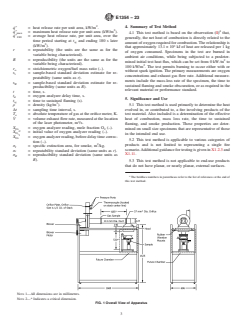
FIG. 1 Overall View of Apparatus
Note 1: All dimensions are in millimetres.
Note 2: * Indicates a critical dimension.
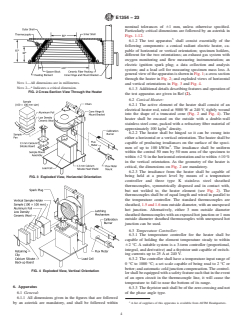
FIG. 2 Cross-Section View Through the Heater
Note 1: All dimensions are in millimetres.
Note 2: * Indicates a critical dimension.
FIG. 3 Exploded View, Horizontal Orientation
FIG. 4 Exploded View, Vertical Orientation
FIG. 5 Exhaust System
Note 1: All dimensions are in millimetres (not to scale).
FIG. 6 Horizontal Specimen Holder
Note 1: All dimensions are in millimetres.
Note 2: * Indicates a critical dimension.
FIG. 7 Vertical Specimen Holder
Note 1: All dimensions are in millimetres except where noted.
Note 2: * Indicates a critical dimension.
FIG. 8 Optional Wire Grid (For Horizontal or Vertical Orientation)
Note 1: All dimensions are in millimetres.
FIG. 9 Gas Analyzer Instrumentation
Note 1: Rotameter is on outlet of the oxygen (O2) analyzer.
FIG. 10 Smoke Obscuration Measuring System
FIG. 11 Calibration Burner
Note 1: All dimensions are in millimetres except where noted.
FIG. 12 Optional Retainer Frame for Horizontal Orientation Testing
Note 1: All dimensions are in millimetres.
Note 2: * Indicates a critical dimension.
SCOPE
1.1 This fire-test-response standard provides for measuring the response of materials exposed to controlled levels of radiant heating with or without an external ignitor.
1.2 This test method is used to determine the ignitability, heat release rates, mass loss rates, effective heat of combustion, and visible smoke development of materials and products.
1.3 The rate of heat release is determined by measurement of the oxygen consumption as determined by the oxygen concentration and the flow rate in the exhaust product stream. The effective heat of combustion is determined from a concomitant measurement of specimen mass loss rate, in combination with the heat release rate. Smoke development is measured by obscuration of light by the combustion product stream.
1.4 Specimens shall be exposed to initial test heat fluxes in the range of 0 kW/m2 to 100 kW/m2. External ignition, when used, shall be by electric spark. The value of the initial test heat flux and the use of external ignition are to be as specified in the relevant material or performance standard (see X1.2). The normal specimen testing orientation is horizontal, independent of whether the end-use application involves a horizontal or a vertical orientation. The apparatus also contains provisions for vertical orientation testing; this is used for exploratory or diagnostic studies only.
1.5 Ignitability is determined as a measurement of time from initial exposure to time of sustained flaming.
1.6 This test method has been developed for use for material and product evaluations, mathematical modeling, design purposes, or development and research. Examples of material specimens include portions of an end-use product or the various components used in the end-use product.
1.7 Units—The values stated in SI units are to be regarded as standard. No other units of measurement are included in this standard.
1.8 This standard is used to measure and describe the response of materials, products, or assemblies to heat and flame un...
- Status
- Published
- Publication Date
- 28-Feb-2023
- Technical Committee
- E05 - Fire Standards
- Drafting Committee
- E05.21 - Smoke and Combustion Products
Buy Documents
ASTM E1354-23 - Standard Test Method for Heat and Visible Smoke Release Rates for Materials and Products Using an Oxygen Consumption Calorimeter
REDLINE ASTM E1354-23 - Standard Test Method for Heat and Visible Smoke Release Rates for Materials and Products Using an Oxygen Consumption Calorimeter
Overview
ASTM E1354-23: Standard Test Method for Heat and Visible Smoke Release Rates for Materials and Products Using an Oxygen Consumption Calorimeter describes a widely regarded fire-test-response method used to measure the reaction of materials and products to controlled levels of radiant heat, with or without an external ignitor. Developed by ASTM International, this standard specifies procedures for quantifying ignitability, heat release rate, mass loss rate, effective heat of combustion, and visible smoke production of test samples under rigorously controlled laboratory conditions.
The test is essential for evaluating fire properties of small-scale specimens that mimic the intended end use, providing data to inform product development, fire modeling, regulatory compliance, and safety assessment. It is recognized for its ability to deliver reliable, comparable data across a broad range of material categories, though it is best suited for planar or nearly planar products.
Key Topics
- Ignitability Measurement: Assessment of the time to sustained flaming from initial exposure to the test heat flux, critical for understanding ignition propensity.
- Heat and Smoke Release: Quantification of heat release rates by directly measuring oxygen consumption in the exhaust of burning specimens-a correlation central to fire hazard analysis.
- Effective Heat of Combustion: Determined by measuring both mass loss and heat released by the specimen during combustion.
- Mass Loss Rate: Calculation of the specimen mass lost during burning, important for modeling fire growth and material consumption.
- Visible Smoke Development: Evaluation through light obscuration techniques to quantify the degree of smoke generated, contributing to smoke hazard assessment.
- Specific Testing Conditions: The standard covers initial heat fluxes from 0 kW/m² up to 100 kW/m², specimen orientations (mainly horizontal, with vertical for exploratory purposes), and defines precise apparatus setup requirements.
Applications
The ASTM E1354-23 oxygen consumption calorimeter test method is applicable for:
- Material Selection and Research: Supporting manufacturers and designers in evaluating and improving the fire safety characteristics of new materials or assemblies.
- Regulatory Compliance: Assisting in meeting national and international fire test requirements for building materials, furnishings, transportation components, and consumer goods.
- Product Development: Enabling comparison of fire performance characteristics during innovation and development phases for a wide assortment of products.
- Fire Modeling and Safety Analysis: Serving as a key input for fire growth modeling, risk assessment, and predictive simulation of full-scale fire scenarios.
- Quality Assurance: Providing consistent and repeatable metrics for routine product certification and third-party validation.
- Comparative Testing: Allowing benchmarking of different materials’ fire reaction properties under similar laboratory conditions.
Related Standards
For a comprehensive approach to fire testing and material assessment, ASTM E1354-23 is often used alongside the following standards:
- ASTM E176: Terminology of Fire Standards
- ASTM E662: Specific Optical Density of Smoke Generated by Solid Materials
- ASTM E603: Guide for Room Fire Experiments
- ASTM D5865: Gross Calorific Value of Coal and Coke
- ASTM E906: Heat and Visible Smoke Release Rates Using a Thermopile Method
- ISO 5660-1: Reaction-to-fire tests - Heat release, smoke production, and mass loss rate (cone calorimeter method)
- ISO 9705: Reaction to fire tests - Room corner tests for wall and ceiling linings
By implementing ASTM E1354-23, laboratories, manufacturers, and regulators gain a trusted methodology for assessing the heat and smoke output of products, promoting fire safety in a manner that is repeatable, comparable, and internationally recognized.
Relations
- Effective Date
- 01-Jan-2024
- Effective Date
- 15-Dec-2018
- Effective Date
- 01-Dec-2018
- Effective Date
- 01-Mar-2018
- Effective Date
- 01-Jul-2017
- Effective Date
- 01-Feb-2017
- Effective Date
- 01-Nov-2015
- Effective Date
- 01-Aug-2015
- Effective Date
- 01-Aug-2015
- Effective Date
- 01-Apr-2015
- Effective Date
- 01-Feb-2015
- Effective Date
- 01-Oct-2014
- Effective Date
- 15-Aug-2014
- Effective Date
- 01-Aug-2014
- Effective Date
- 01-Aug-2014
Buy Documents
ASTM E1354-23 - Standard Test Method for Heat and Visible Smoke Release Rates for Materials and Products Using an Oxygen Consumption Calorimeter
REDLINE ASTM E1354-23 - Standard Test Method for Heat and Visible Smoke Release Rates for Materials and Products Using an Oxygen Consumption Calorimeter
Get Certified
Connect with accredited certification bodies for this standard

BSMI (Bureau of Standards, Metrology and Inspection)
Taiwan's standards and inspection authority.
Sponsored listings
Frequently Asked Questions
ASTM E1354-23 is a standard published by ASTM International. Its full title is "Standard Test Method for Heat and Visible Smoke Release Rates for Materials and Products Using an Oxygen Consumption Calorimeter". This standard covers: SIGNIFICANCE AND USE 5.1 This test method is used primarily to determine the heat evolved in, or contributed to, a fire involving products of the test material. Also included is a determination of the effective heat of combustion, mass loss rate, the time to sustained flaming, and smoke production. These properties are determined on small size specimens that are representative of those in the intended end use. 5.2 This test method is applicable to various categories of products and is not limited to representing a single fire scenario. Additional guidance for testing is given in X1.2.3 and X1.11. 5.3 This test method is not applicable to end-use products that do not have planar, or nearly planar, external surfaces. FIG. 1 Overall View of Apparatus Note 1: All dimensions are in millimetres. Note 2: * Indicates a critical dimension. FIG. 2 Cross-Section View Through the Heater Note 1: All dimensions are in millimetres. Note 2: * Indicates a critical dimension. FIG. 3 Exploded View, Horizontal Orientation FIG. 4 Exploded View, Vertical Orientation FIG. 5 Exhaust System Note 1: All dimensions are in millimetres (not to scale). FIG. 6 Horizontal Specimen Holder Note 1: All dimensions are in millimetres. Note 2: * Indicates a critical dimension. FIG. 7 Vertical Specimen Holder Note 1: All dimensions are in millimetres except where noted. Note 2: * Indicates a critical dimension. FIG. 8 Optional Wire Grid (For Horizontal or Vertical Orientation) Note 1: All dimensions are in millimetres. FIG. 9 Gas Analyzer Instrumentation Note 1: Rotameter is on outlet of the oxygen (O2) analyzer. FIG. 10 Smoke Obscuration Measuring System FIG. 11 Calibration Burner Note 1: All dimensions are in millimetres except where noted. FIG. 12 Optional Retainer Frame for Horizontal Orientation Testing Note 1: All dimensions are in millimetres. Note 2: * Indicates a critical dimension. SCOPE 1.1 This fire-test-response standard provides for measuring the response of materials exposed to controlled levels of radiant heating with or without an external ignitor. 1.2 This test method is used to determine the ignitability, heat release rates, mass loss rates, effective heat of combustion, and visible smoke development of materials and products. 1.3 The rate of heat release is determined by measurement of the oxygen consumption as determined by the oxygen concentration and the flow rate in the exhaust product stream. The effective heat of combustion is determined from a concomitant measurement of specimen mass loss rate, in combination with the heat release rate. Smoke development is measured by obscuration of light by the combustion product stream. 1.4 Specimens shall be exposed to initial test heat fluxes in the range of 0 kW/m2 to 100 kW/m2. External ignition, when used, shall be by electric spark. The value of the initial test heat flux and the use of external ignition are to be as specified in the relevant material or performance standard (see X1.2). The normal specimen testing orientation is horizontal, independent of whether the end-use application involves a horizontal or a vertical orientation. The apparatus also contains provisions for vertical orientation testing; this is used for exploratory or diagnostic studies only. 1.5 Ignitability is determined as a measurement of time from initial exposure to time of sustained flaming. 1.6 This test method has been developed for use for material and product evaluations, mathematical modeling, design purposes, or development and research. Examples of material specimens include portions of an end-use product or the various components used in the end-use product. 1.7 Units—The values stated in SI units are to be regarded as standard. No other units of measurement are included in this standard. 1.8 This standard is used to measure and describe the response of materials, products, or assemblies to heat and flame un...
SIGNIFICANCE AND USE 5.1 This test method is used primarily to determine the heat evolved in, or contributed to, a fire involving products of the test material. Also included is a determination of the effective heat of combustion, mass loss rate, the time to sustained flaming, and smoke production. These properties are determined on small size specimens that are representative of those in the intended end use. 5.2 This test method is applicable to various categories of products and is not limited to representing a single fire scenario. Additional guidance for testing is given in X1.2.3 and X1.11. 5.3 This test method is not applicable to end-use products that do not have planar, or nearly planar, external surfaces. FIG. 1 Overall View of Apparatus Note 1: All dimensions are in millimetres. Note 2: * Indicates a critical dimension. FIG. 2 Cross-Section View Through the Heater Note 1: All dimensions are in millimetres. Note 2: * Indicates a critical dimension. FIG. 3 Exploded View, Horizontal Orientation FIG. 4 Exploded View, Vertical Orientation FIG. 5 Exhaust System Note 1: All dimensions are in millimetres (not to scale). FIG. 6 Horizontal Specimen Holder Note 1: All dimensions are in millimetres. Note 2: * Indicates a critical dimension. FIG. 7 Vertical Specimen Holder Note 1: All dimensions are in millimetres except where noted. Note 2: * Indicates a critical dimension. FIG. 8 Optional Wire Grid (For Horizontal or Vertical Orientation) Note 1: All dimensions are in millimetres. FIG. 9 Gas Analyzer Instrumentation Note 1: Rotameter is on outlet of the oxygen (O2) analyzer. FIG. 10 Smoke Obscuration Measuring System FIG. 11 Calibration Burner Note 1: All dimensions are in millimetres except where noted. FIG. 12 Optional Retainer Frame for Horizontal Orientation Testing Note 1: All dimensions are in millimetres. Note 2: * Indicates a critical dimension. SCOPE 1.1 This fire-test-response standard provides for measuring the response of materials exposed to controlled levels of radiant heating with or without an external ignitor. 1.2 This test method is used to determine the ignitability, heat release rates, mass loss rates, effective heat of combustion, and visible smoke development of materials and products. 1.3 The rate of heat release is determined by measurement of the oxygen consumption as determined by the oxygen concentration and the flow rate in the exhaust product stream. The effective heat of combustion is determined from a concomitant measurement of specimen mass loss rate, in combination with the heat release rate. Smoke development is measured by obscuration of light by the combustion product stream. 1.4 Specimens shall be exposed to initial test heat fluxes in the range of 0 kW/m2 to 100 kW/m2. External ignition, when used, shall be by electric spark. The value of the initial test heat flux and the use of external ignition are to be as specified in the relevant material or performance standard (see X1.2). The normal specimen testing orientation is horizontal, independent of whether the end-use application involves a horizontal or a vertical orientation. The apparatus also contains provisions for vertical orientation testing; this is used for exploratory or diagnostic studies only. 1.5 Ignitability is determined as a measurement of time from initial exposure to time of sustained flaming. 1.6 This test method has been developed for use for material and product evaluations, mathematical modeling, design purposes, or development and research. Examples of material specimens include portions of an end-use product or the various components used in the end-use product. 1.7 Units—The values stated in SI units are to be regarded as standard. No other units of measurement are included in this standard. 1.8 This standard is used to measure and describe the response of materials, products, or assemblies to heat and flame un...
ASTM E1354-23 is classified under the following ICS (International Classification for Standards) categories: 17.200.10 - Heat. Calorimetry. The ICS classification helps identify the subject area and facilitates finding related standards.
ASTM E1354-23 has the following relationships with other standards: It is inter standard links to ASTM E176-24, ASTM E176-18a, ASTM E662-18, ASTM E176-18, ASTM E662-17a, ASTM E662-17, ASTM E662-15a, ASTM E176-15a, ASTM E176-15ae1, ASTM E662-15, ASTM E176-15, ASTM E176-14c, ASTM E176-14b, ASTM E176-14a, ASTM E662-14. Understanding these relationships helps ensure you are using the most current and applicable version of the standard.
ASTM E1354-23 is available in PDF format for immediate download after purchase. The document can be added to your cart and obtained through the secure checkout process. Digital delivery ensures instant access to the complete standard document.
Standards Content (Sample)
This international standard was developed in accordance with internationally recognized principles on standardization established in the Decision on Principles for the
Development of International Standards, Guides and Recommendations issued by the World Trade Organization Technical Barriers to Trade (TBT) Committee.
Designation: E1354 − 23 An American National Standard
Standard Test Method for
Heat and Visible Smoke Release Rates for Materials and
Products Using an Oxygen Consumption Calorimeter
This standard is issued under the fixed designation E1354; the number immediately following the designation indicates the year of
original adoption or, in the case of revision, the year of last revision. A number in parentheses indicates the year of last reapproval. A
superscript epsilon (´) indicates an editorial change since the last revision or reapproval.
1. Scope* 1.8 This standard is used to measure and describe the
response of materials, products, or assemblies to heat and
1.1 This fire-test-response standard provides for measuring
flame under controlled conditions, but does not by itself
the response of materials exposed to controlled levels of
incorporate all factors required for fire hazard or fire risk
radiant heating with or without an external ignitor.
assessment of the materials, products, or assemblies under
1.2 This test method is used to determine the ignitability,
actual fire conditions.
heat release rates, mass loss rates, effective heat of combustion,
1.9 This standard does not purport to address all of the
and visible smoke development of materials and products.
safety concerns, if any, associated with its use. It is the
1.3 The rate of heat release is determined by measurement
responsibility of the user of this standard to establish appro-
of the oxygen consumption as determined by the oxygen
priate safety, health, and environmental practices and deter-
concentration and the flow rate in the exhaust product stream.
mine the applicability of regulatory limitations prior to use.
The effective heat of combustion is determined from a con-
For specific hazard statements, see Section 7.
comitant measurement of specimen mass loss rate, in combi-
1.10 Fire testing is inherently hazardous. Adequate safe-
nation with the heat release rate. Smoke development is
guards for personnel and property shall be employed in
measured by obscuration of light by the combustion product
conducting these tests.
stream.
1.11 This international standard was developed in accor-
1.4 Specimens shall be exposed to initial test heat fluxes in
dance with internationally recognized principles on standard-
2 2
the range of 0 kW ⁄m to 100 kW/m . External ignition, when
ization established in the Decision on Principles for the
used, shall be by electric spark. The value of the initial test heat
Development of International Standards, Guides and Recom-
flux and the use of external ignition are to be as specified in the
mendations issued by the World Trade Organization Technical
relevant material or performance standard (see X1.2). The
Barriers to Trade (TBT) Committee.
normal specimen testing orientation is horizontal, independent
of whether the end-use application involves a horizontal or a
2. Referenced Documents
vertical orientation. The apparatus also contains provisions for
2.1 ASTM Standards:
vertical orientation testing; this is used for exploratory or
D5865 Test Method for Gross Calorific Value of Coal and
diagnostic studies only.
Coke
1.5 Ignitability is determined as a measurement of time
E176 Terminology of Fire Standards
from initial exposure to time of sustained flaming.
E177 Practice for Use of the Terms Precision and Bias in
ASTM Test Methods
1.6 This test method has been developed for use for material
E603 Guide for Room Fire Experiments
and product evaluations, mathematical modeling, design
E662 Test Method for Specific Optical Density of Smoke
purposes, or development and research. Examples of material
Generated by Solid Materials
specimens include portions of an end-use product or the
E691 Practice for Conducting an Interlaboratory Study to
various components used in the end-use product.
Determine the Precision of a Test Method
1.7 Units—The values stated in SI units are to be regarded
E906 Test Method for Heat and Visible Smoke Release
as standard. No other units of measurement are included in this
Rates for Materials and Products Using a Thermopile
standard.
Method
This test method is under the jurisdiction of ASTM Committee E05 on Fire
Standards and is the direct responsibility of Subcommittee E05.21 on Smoke and
Combustion Products. For referenced ASTM standards, visit the ASTM website, www.astm.org, or
Current edition approved March 1, 2023. Published April 2023. Originally contact ASTM Customer Service at service@astm.org. For Annual Book of ASTM
approved in 1990. Last previous edition approved in 2022 as E1354 – 22c. DOI: Standards volume information, refer to the standard’s Document Summary page on
10.1520/E1354-23. the ASTM website.
*A Summary of Changes section appears at the end of this standard
Copyright © ASTM International, 100 Barr Harbor Drive, PO Box C700, West Conshohocken, PA 19428-2959. United States
E1354 − 23
2.2 ISO Standards: 3.1.4 ignitability, n—the propensity for ignition, as mea-
ISO 5657-1986(E) Fire Tests—reaction to fire—ignitability sured by the time to sustained flaming, in seconds, at a
of building materials specified heating flux.
ISO 5660-1(2015) Reaction-to-fire tests – Heat release,
3.1.5 initial test heat flux, n—the heat flux set on the test
smoke production and mass loss rate – Part 1: Heat release
apparatus at the initiation of the test (see also heat flux).
rate (cone calorimeter method) and smoke production rate
3.1.5.1 Discussion—The initial test heat flux is the heat flux
(dynamic measurement)
value commonly used when describing or setting test condi-
ISO 5725-2 (1994) Accuracy (trueness and precision) of
tions.
measurement methods and results — Part 2: Basic method
3.1.6 oxygen consumption principle, n—the expression of
for the determination of repeatability and reproducibility
the relationship between the mass of oxygen consumed during
of a standard measurement method
combustion and the heat released.
ISO 9705-1 (2016) Reaction to fire tests – Room corner test
3.1.7 smoke obscuration, n—reduction of light transmission
for wall and ceiling lining products – Part 1: Test method
by smoke, as measured by light attenuation.
for a small room configuration
3.2 Definitions of Terms Specific to This Standard:
3. Terminology
3.2.1 critical heat flux for ignition, n—the midpoint within
the range of heat fluxes between the maximum (highest) heat
3.1 Definitions—For definitions of terms used in this test
flux that produces no ignition and the minimum (lowest) heat
method, refer to Terminology E176.
flux that produces ignition, for a specified exposure time.
3.1.1 effective heat of combustion, n—the amount of heat
3.2.2 heat release rate (in bench-scale heat release tests),
generated per unit mass lost by a material, product or assembly,
n—the heat evolved from the specimen, per unit of time and
when exposed to specific fire test conditions (contrast gross
area.
heat of combustion).
3.2.2.1 Discussion—The heat release rate measured in this
3.1.1.1 Discussion—The effective heat of combustion de-
test method is expressed in units of kW/m and not in units of
pends on the test method and is determined by dividing the
kW.
measured heat release by the mass loss during a specified
period of time under the specified test conditions. Typically, the 3.2.3 net heat of combustion, n—the oxygen bomb (see Test
specified fire test conditions are provided by the specifications Method D5865) value for the heat of combustion, corrected for
of the fire test standard that cites effective heat of combustion gaseous state of product water.
as a quantity to be measured. For certain fire test conditions,
3.2.3.1 Discussion—The net heat of combustion differs
involving very high heat and high oxygen concentrations under from the gross heat of combustion in that the former assesses
high pressure, the effective heat of combustion will approxi-
the heat per unit mass generated from a combustion process
mate the gross heat of combustion. More often, the fire test that ends with water in the gaseous state while the latter ends
conditions will represent or approximate certain real fire
with water in the liquid state.
exposure conditions, and the effective heat of combustion is the
3.2.4 orientation, n—the plane in which the exposed face of
appropriate measure. Typical units are kJ/g or MJ/kg.
the specimen is located during testing, either vertical or
horizontal facing up.
3.1.2 gross heat of combustion, n—the maximum amount of
heat per unit mass that theoretically can be released by the
3.2.5 sustained flaming, n—existence of flame on or over
combustion of a material, product, or assembly; it can be
most of the specimen surface for periods of at least 4 s.
determined experimentally and only under conditions of high
3.2.5.1 Discussion—Flaming of less than 4 s duration is
pressure and in pure oxygen (contrast effective heat of com-
identified as flashing or transitory flaming.
bustion).
3.3 Symbols:
3.1.3 heat flux, n—heat transfer to a surface per unit area,
A = nominal specimen exposed surface area, 0.01 m .
per unit time (see also initial test heat flux). s
C = calibration constant for oxygen consumption
3.1.3.1 Discussion—The heat flux from an energy source,
1/2 1/2 1/2
analysis, m − kg − K .
such as a radiant heater, can be measured at the initiation of a
∆h = net heat of combustion, kJ/kg.
c
test (such as Test Method E1354 or Test Method E906) and
∆ h = effective heat of combustion, kJ/kg.
c,eff
then reported as the initial test heat flux, with the understanding
I = actual beam intensity.
that the burning of the test specimen can generate additional
I = beam intensity with no smoke.
o
−1
heat flux to the specimen surface. The heat flux can also be
k = smoke extinction coefficient, m .
measured at any time during a fire test, for example as
L = extinction beam path length, m.
described in Guide E603, on any surface, and with measure-
m = specimen mass, kg.
ment devices responding to radiative and convective fluxes. m = final specimen mass, kg.
f
2 2 2
Typical units are kW/m , W/cm , or BTU/(s ft ). m = initial specimen mass, kg.
i
m = specimen mass loss rate, kg/s.
∆P = orifice meter pressure differential, Pa.
q" = total heat released, kJ/m (Note that kJ ≡ kW·s).
tot
Available from American National Standards Institute (ANSI), 25 W. 43rd St.,
q˙ = heat release rate, kW.
4th Floor, New York, NY 10036, http://www.ansi.org.
E1354 − 23
4. Summary of Test Method
q˙" = heat release rate per unit area, kW/m .
q˙" = maximum heat release rate per unit area (kW/m ).
max
4.1 This test method is based on the observation (1) that,
q˙" = average heat release rate, per unit area, over the
generally, the net heat of combustion is directly related to the
time period starting at t and ending 180 s later
ig
amount of oxygen required for combustion. The relationship is
(kW/m ).
that approximately 13.1 × 10 kJ of heat are released per 1 kg
r = repeatability (the units are the same as for the
of oxygen consumed. Specimens in the test are burned in
variable being characterized).
ambient air conditions, while being subjected to a predeter-
R = reproducibility (the units are the same as for the 2
mined initial test heat flux, which can be set from 0 kW ⁄m to
variable being characterized).
100 kW/m . The test permits burning to occur either with or
r = stoichiometric oxygen/fuel mass ratio (–).
o
without spark ignition. The primary measurements are oxygen
s = sample-based standard deviation estimate for re-
r
concentrations and exhaust gas flow rate. Additional measure-
peatability (same units as r).
ments include the mass-loss rate of the specimen, the time to
s = sample-based standard deviation estimate for re-
R
sustained flaming and smoke obscuration, or as required in the
producibility (same units as R).
relevant material or performance standard.
t = time, s.
t = oxygen analyzer delay time, s.
d
5. Significance and Use
t = time to sustained flaming (s).
ig
5.1 This test method is used primarily to determine the heat
ρ = density (kg/m ).
∆t = sampling time interval, s. evolved in, or contributed to, a fire involving products of the
T = absolute temperature of gas at the orifice meter, K. test material. Also included is a determination of the effective
e
˙
V = volume exhaust flow rate, measured at the location
heat of combustion, mass loss rate, the time to sustained
of the laser photometer, m /s.
flaming, and smoke production. These properties are deter-
X = oxygen analyzer reading, mole fraction O (–).
O 2 mined on small size specimens that are representative of those
X = initial value of oxygen analyzer reading (–).
O in the intended end use.
X = oxygen analyzer reading, before delay time correc-
O
5.2 This test method is applicable to various categories of
tion (–).
products and is not limited to representing a single fire
σ = specific extinction area, for smoke, m /kg.
f
scenario. Additional guidance for testing is given in X1.2.3 and
σ = repeatability standard deviation (same units as r).
r
X1.11.
σ = reproducibility standard deviation (same units as
R
R).
5.3 This test method is not applicable to end-use products
that do not have planar, or nearly planar, external surfaces.
The boldface numbers in parentheses refer to the list of references at the end of
this test method.
NOTE 1—All dimensions are in millimetres.
NOTE 2—* Indicates a critical dimension.
FIG. 1 Overall View of Apparatus
E1354 − 23
nominal tolerances of 61 mm, unless otherwise specified.
Particularly critical dimensions are followed by an asterisk in
Figs. 1-12.
6.1.2 The test apparatus shall consist essentially of the
following components: a conical radiant electric heater, ca-
pable of horizontal or vertical orientation; specimen holders,
different for the two orientations; an exhaust gas system with
oxygen monitoring and flow measuring instrumentation; an
electric ignition spark plug; a data collection and analysis
system; and a load cell for measuring specimen mass loss. A
general view of the apparatus is shown in Fig. 1; a cross section
through the heater in Fig. 2; and exploded views of horizontal
NOTE 1—All dimensions are in millimetres.
and vertical orientations in Fig. 3 and Fig. 4.
NOTE 2—* Indicates a critical dimension.
6.1.3 Additional details describing features and operation of
FIG. 2 Cross-Section View Through the Heater
the test apparatus are given in Ref (2).
6.2 Conical Heater:
6.2.1 The active element of the heater shall consist of an
electrical heater rod, rated at 5000 W at 240 V, tightly wound
into the shape of a truncated cone (Fig. 2 and Fig. 4). The
heater shall be encased on the outside with a double-wall
stainless steel cone, packed with a refractory fiber material of
approximately 100 kg/m density.
6.2.2 The heater shall be hinged so it can be swung into
either a horizontal or a vertical orientation. The heater shall be
capable of producing irradiances on the surface of the speci-
men of up to 100 kW/m . The irradiance shall be uniform
within the central 50 mm by 50 mm area of the specimen to
within 62 % in the horizontal orientation and to within 610 %
in the vertical orientation. As the geometry of the heater is
critical, the dimensions on Fig. 2 are mandatory.
6.2.3 The irradiance from the heater shall be capable of
being held at a preset level by means of a temperature
FIG. 3 Exploded View, Horizontal Orientation
controller and three type K stainless steel sheathed
thermocouples, symmetrically disposed and in contact with,
but not welded to, the heater element (see Fig. 2). The
thermocouples shall be of equal length and wired in parallel to
the temperature controller. The standard thermocouples are
sheathed, 1.5 and 1.6 mm outside diameter, with an unexposed
hot junction. Alternatively, either 3 mm outside diameter
sheathed thermocouples with an exposed hot junction or 1 mm
outside diameter sheathed thermocouples with unexposed hot
junction can be used.
6.3 Temperature Controller:
6.3.1 The temperature controller for the heater shall be
capable of holding the element temperature steady to within
62 °C. A suitable system is a 3-term controller (proportional,
integral, and derivative) and a thyristor unit capable of switch-
ing currents up to 25 A at 240 V.
6.3.2 The controller shall have a temperature input range of
0 °C to 1000 °C; a set scale capable of being read to 2 °C or
better; and automatic cold junction compensation. The control-
FIG. 4 Exploded View, Vertical Orientation
ler shall be equipped with a safety feature such that in the event
of an open circuit in the thermocouple line, it will cause the
temperature to fall to near the bottom of its range.
6. Apparatus
6.3.3 The thyristor unit shall be of the zero crossing and not
of the phase angle type.
6.1 General:
6.1.1 All dimensions given in the figures that are followed
by an asterisk are mandatory, and shall be followed within A list of suppliers of this apparatus is available from ASTM Headquarters.
E1354 − 23
NOTE 1—All dimensions are in millimetres (not to scale).
FIG. 5 Exhaust System
NOTE 1—All dimensions are in millimetres.
NOTE 2—* Indicates a critical dimension.
FIG. 6 Horizontal Specimen Holder
E1354 − 23
NOTE 1—All dimensions are in millimetres except where noted.
NOTE 2—* Indicates a critical dimension.
FIG. 7 Vertical Specimen Holder
6.3.4 The heater temperature shall be monitored by a meter sampler shall contain twelve holes to average the stream
capable of being read to 62 °C, or better. It shall be permitted composition with the holes facing away from the flow to avoid
to be incorporated into the temperature controller.
soot clogging.
6.4.4 The temperature of the gas stream shall be measured
6.4 Exhaust System:
6.4.1 The exhaust-gas system shall consist of a high tem- using a 1.0 mm to 1.6 mm outside diameter sheathed-junction
perature centrifugal exhaust fan, a hood, intake and exhaust thermocouple or a 3 mm outside diameter exposed junction
ducts for the fan, and an orifice plate flowmeter (Fig. 5). The
thermocouple positioned in the exhaust stack on the centerline
exhaust system shall be capable of developing flows from
and 100 mm upstream from the measuring orifice plate.
3 3
0.012 m /s to 0.035 m /s.
6.4.5 The flow rate shall be determined by measuring the
6.4.2 A restrictive orifice (57 mm inside diameter) shall be
differential pressure across a sharp-edged orifice (57 mm inside
located between the hood and the duct to promote mixing.
diameter) in the exhaust stack, at least 350 mm downstream
6.4.3 A ring sampler shall be located in the fan intake duct
from the fan when the latter is located as shown in Fig. 5.
for gas sampling, 685 mm from the hood (Fig. 1). The ring
E1354 − 23
6.6.1 The horizontal specimen holder is shown in Fig. 6.
The bottom shall be constructed of 2.4 mm nominal stainless
steel and it shall have outside dimensions of 106 mm by 106
mm by a 25 mm height (tolerance in dimensions: 62 mm).
6.6.1.1 An open stainless steel square, 59 mm in inside
dimensions, shall be spot welded to the underside of the
horizontal specimen holder, to facilitate the centering of the
specimen under the cone heater. The leading edge of the open
square underneath the specimen holder, which is the one
opposite the handle, is optional. The open square on the bottom
of the specimen holder shall be designed to seat with the
sample mount assembly located at the top of the load cell
ensuring that the specimen holder is centered with respect to
the cone heater.
6.6.2 The bottom of the horizontal specimen holder shall be
lined with a layer of low density (nominal density 65 kg/m )
refractory fiber blanket with a thickness of at least 13 mm. The
distance between the bottom surface of the cone heater and the
top of the specimen shall be adjusted to be 25 mm except as
indicated in 6.6.2.1. For mechanisms constructed according to
the drawing in Fig. 2, this is accomplished by using the sliding
cone height adjustment.
6.6.2.1 Intumescent Materials—Materials that intumesce or
deform to such an extent that they make physical contact with
either (a) the spark plug before ignition or (b) the underside of
NOTE 1—All dimensions are in millimetres.
the cone heater after ignition shall be tested by adjusting the
FIG. 8 Optional Wire Grid (For Horizontal or Vertical Orientation)
distance between the bottom surface of the cone heater and the
top of the specimen to 60 mm, or as described in 6.6.4.
6.6.2.2 If a test is conducted in accordance with the speci-
men mounting in 6.6.2.1 (a 60 mm distance), the heat flux
calibration shall be performed with the heat flux meter posi-
tioned 60 mm below the cone heater base plate (see 10.1.1 and
10.1.2).
6.6.2.3 If a test is conducted in accordance with the speci-
men mounting in 6.6.2.1 (a 60 mm distance) and the test
specimen intumesces or deforms to such an extent that it makes
physical contact with either (a) the spark plug, before ignition,
or (b) the underside of the cone heater after ignition, that test
NOTE 1—Rotameter is on outlet of the oxygen (O ) analyzer.
shall be deemed invalid. The material shall be retested as
FIG. 9 Gas Analyzer Instrumentation
indicated in 6.6.4.1, in 6.6.4.2, or in 6.6.4.4.
6.6.2.4 If a test has been conducted with a distance of 25
mm and the type of physical contact described in 6.6.2.1 has
6.4.6 In other details, the geometry of the exhaust system is
occurred, that test shall be deemed invalid and additional
not critical. Where necessary, small deviations from the rec-
testing shall be conducted in accordance with 6.6.2.1.
ommended dimensions given in Fig. 5 shall be permitted to be
6.6.3 The vertical specimen holder is shown in Fig. 7 and
made. The inner diameter of the duct and the orifice plates is
includes a small drip tray to contain a limited amount of molten
not a critical dimension. Also the fan does not need to be at the
material. A specimen shall be installed in the vertical specimen
exact location as indicated on Fig. 5, but shall be permitted to
holder by backing it with a layer of refractory fiber blanket
be further downstream, allowing for a more common type of
(nominal density 65 kg/m ), the thickness of which depends on
fan to be used. In this case, sufficient undisturbed inflow
specimen thickness, but shall be at least 13 mm thick. A layer
distances to the gas sampling probe and the measuring orifice
of rigid, ceramic fiber millboard shall be placed behind the
shall be provided for the flow to be uniformly mixed.
fiber blanket layer. The millboard thickness shall be such that
6.5 Load Cell—The general arrangement of the specimen
the entire assembly is rigidly bound together once the retaining
holders on the load cell is indicated in Fig. 3 and Fig. 4. The
spring clip is inserted behind the millboard. In the vertical
load cell shall have an accuracy of 0.1 g, and shall have a total
orientation, the cone heater height is set so the center lines up
weighing range of at least 3.5 kg of which at least 500 g shall
with the specimen center.
be available for direct monitoring during any single test.
6.6.4 Intumescent Materials—The testing technique to be
6.6 Specimen Mounting: used when testing intumescing specimens in the horizontal
E1354 − 23
FIG. 10 Smoke Obscuration Measuring System
NOTE 1—All dimensions are in millimetres except where noted.
FIG. 11 Calibration Burner
E1354 − 23
NOTE 3—The time to ignition measured with the 60 mm separation is
not comparable to that measured with the standard separation of 25 mm.
6.6.4.4 Use a special mounting procedure suitable for the
specimen to be tested.
6.6.5 Materials that warp or shrink so that the exposed
surface of the test specimen is not flat during testing shall be
restrained to maintain the surface in a flat orientation. This
shall be accomplished either with four tie wires, as described in
6.6.5.1 through 6.6.5.4, or with the fine wire grid described in
6.6.7 and Fig. 13.
6.6.5.1 The four tie wires shall be metal wires, 1.0 mm 6
0.1 mm in diameter and at least 350 mm long.
6.6.5.2 The test specimen shall be prepared as described in
Section 8 and then tied with the metal wires.
6.6.5.3 A tie wire shall be looped around the specimen
holder assembly so that it is parallel to and 20 mm 6 2 mm
away from any of the four sides of the assembly. The ends of
the tie wire shall be twisted together such that the wire is pulled
firmly against the specimen holder assembly. Trim excess wire
from the twisted section before testing.
6.6.5.4 Fit the other three tie wires around the specimen
holder assembly in a similar manner, so that each one is
parallel to one of the sides of the assembly.
6.6.6 Melting Materials:
6.6.6.1 Materials that melt and overflow the aluminum foil
wrapping (see 8.1.1) during testing shall be tested using
aluminum foil that extends above the specimen surface level.
The aluminum foil extension above the specimen surface
shall be such that melt overflow is contained, without interfer-
ing with the combustion process. A height of 2-3 mm is
recommended.
NOTE 1—All dimensions are in millimetres.
NOTE 2—* Indicates a critical dimension.
FIG. 12 Optional Retainer Frame for Horizontal Orientation Test-
ing
orientation shall be documented in the test report. Options
include those shown in 6.6.4.1 through 6.6.4.4.
6.6.4.1 Use a retainer frame or edge frame (Fig. 12) in the
horizontal orientation.
NOTE 1—The edge frame is used to reduce unrepresentative edge
burning of specimens.
6.6.4.2 Use a wire grid (Fig. 8), whether testing is con-
ducted in the horizontal or in the vertical orientations.
NOTE 2—The wire grid is used for retaining specimens prone to
delamination and is suitable for several types of intumescent specimens.
6.6.4.3 Use a separation distance between the cone base
plate and the upper specimen surface of 60 mm instead of 25
mm. Use this technique for those dimensionally unstable
materials that have the potential to intumesce or deform to such
an extent that they are likely to make physical contact with
either (a) the spark plug before ignition or (b) the underside of
the cone heater after ignition. In this configuration, the spark
igniter will be located 48 mm 6 2 mm above the center of the
Dimensions in mm
specimen. FIG. 13 Fine Wire Grid for Materials That Distort Extensively
E1354 − 23
6.6.6.2 If a test has been conducted as indicated in 8.1.1 than 650 ppm of oxygen over a period of 30 min, and noise of
without using the special technique described in 6.6.6.1 and not more than 50 ppm of oxygen (root-mean-square value)
melt overflow has occurred, that test shall be deemed invalid
during this same 30-min period. Since oxygen analyzers are
and the technique in 6.6.6.1 shall be used for future tests.
sensitive to stream pressures, the stream pressure shall be
6.6.7 Materials that Distort Extensively—Materials that dis-
regulated (upstream of the analyzer) to allow for flow
tort so extensively that they cannot be held by four wires (as
fluctuations, and the readings from the analyzer compensated
described in 6.6.5) shall be permitted to be tested using the fine
with an absolute pressure regulator to allow for atmospheric
wire grid made of 0.8 mm 6 0.1 mm wire with spacing of 20
pressure variations. The analyzer and the absolute pressure
mm 6 2 mm shown in Fig. 13).
regulator shall be located in a constant-temperature environ-
ment. The oxygen analyzer shall have a 10 % to 90 % response
6.7 Radiation Shield—The cone heater shall be provided
time of less than 12 s.
with a removable radiation shield to protect the specimen from
the initial test heat flux prior to the start of a test. The shield
6.12 Smoke Obscuration Measuring System—The smoke
shall be made of noncombustible material with a total thickness
measuring system (Fig. 10) comprises a helium-neon laser,
not to exceed 12 mm. The shield shall be one of the following:
silicon photodiodes as main beam and reference detectors, and
(a) water cooled and coated with a durable matte black
appropriate electronics to derive the extinction coefficient and
finish of surface emissivity e = 0.95 6 0.05 or
to set the zero reading. The system is designed to be resiliently
(b) not water cooled with a metallic reflective top surface
attached to the exhaust duct by means of refractory gasketing,
to minimize radiation transfer.
at the location shown in Fig. 5. This shall be achieved by one
(c) not water-cooled, with a ceramic, non-metallic, surface
of the following options: (a) the use of an optical bench, or (b)
that minimizes radiation transfer to the specimen surface.
the use of a split yoke mounting comprising two pieces that are
The shield shall be equipped with a handle or other suitable
rigidly screwed together. The meter is located in place by
means for quick insertion and removal. The cone heater base
means of two small-diameter tubes welded onto each side of
plate shall be equipped with the means for holding the shield in
the exhaust duct. These serve as part of the light baffling for the
position and allowing its easy and quick removal.
air purging and also serve to aid in the desposition on the tube
6.8 Ignition Circuit—External ignition is accomplished by a
walls of any smoke that enters despite the purge flow, so that
10-kV discharge across a 3-mm spark gap located 13 mm 6 2
it does not reach the optical elements.
mm above the center of the specimen in the horizontal
orientation; in the vertical orientation the gap is located in the
6.13 Heat Flux Meter:
specimen face plane and 5 mm above the top of the holder. A
6.13.1 The total heat fluxmeter shall be of the Gardon (foil)
suitable power source is a transformer designed for spark-
or Schmidt-Boelter (thermopile) type with a design range of
ignition use or a spark generator. The high voltage connections 2
about 100 kW/m . The sensing surface of the fluxmeter shall be
to the spark electrodes shall not be grounded to the chassis in
flat, circular, approximately 12.5 mm in diameter, and coated
order to minimize interference with the data-transmission lines.
with a durable matte-black finish. The fluxmeter shall be water
For testing with electric spark ignition, spark discharge shall be
cooled. Radiation shall not pass through any window before
continuously operating at 50 Hz to 60 Hz until sustained
reaching the sensing surface. The instrument shall be robust,
flaming is achieved. The ignitor shall be removed when
simple to set up and use, and stable in calibration. The
sustained flaming is achieved.
instrument shall have an accuracy of within 63 %.
6.9 Ignition Timer—The timing device for measuring time
6.13.2 The calibration of the heat fluxmeter shall be checked
to sustained flaming shall be capable of recording elapsed time
whenever a recalibration of the apparatus is carried out by
to the nearest second and shall be accurate to within 1 s in 1 h.
comparison with an instrument (of the same type as the
6.10 Gas Sampling—Gas sampling arrangements are shown
working heat fluxmeter and of similar range) held as a
in Fig. 9. They shall incorporate a pump, a filter to prevent
reference standard and not used for any other purpose. The
entry of soot, a cold trap to remove most of the moisture, a
reference standard shall be fully calibrated at a standardizing
bypass system set to divert all flow except that required for the
laboratory at yearly intervals.
oxygen analyzer, a further moisture trap, and a trap for carbon
6.13.3 This meter shall be used to calibrate the heater
dioxide (CO ) removal; the latter if CO is not measured.
2 2
temperature controller (Fig. 3 and Fig. 4). It shall be positioned
When a CO trap is used, the sample stream entering the
at a location equivalent to the center of the specimen face in
oxygen analyzer must be fully dry; some designs of CO traps
either orientation during this calibration.
require an additional moisture trap downstream of the CO
trap.
6.14 Calibration Burner—To calibrate the rate of heat
release apparatus, a burner is used (Fig. 3 and Fig. 4). The
NOTE 4—If an optional CO analyzer is used instead of removing CO
2 2
burner is constructed from a square-section brass tube with a
from the oxygen analyzer stream, the equations to calculate the rate of
heat release will be different from those for the standard case (Section 12) square orifice covered with wire gauze through which the
and are, instead, given in Annex A1.
methane diffuses (Fig. 11). The tube is packed with ceramic
6.11 Oxygen Analyzer—The analyzer shall be of the para- fiber to improve uniformity of flow. The calibration burner is
suitably connected to a metered supply of methane of at least
magnetic type with a range from 0 % to 25 % oxygen. The
analyzer shall exhibit a linear response and drift of not more 99.5 % purity.
E1354 − 23
6.15 Optical Calibration Filters—Glass neutral density the exposed surface. The influence of the underlying layers
filters, of at least two different values accurately calibrated at must be understood and care taken to ensure that the test result
the laser wavelength of 0.6328 μm, are required. obtained on any assembly is relevant to its use in practice.
When the product is a material or composite that is normally
6.16 Digital Data Collection—The data collection system
attached to a well defined substrate, it shall be tested in
used must have facilities for the recording of the output from
conjunction with that substrate, using the recommended fixing
the oxygen analyzer, the orifice meter, the thermocouples, the
technique, for example, bonded with the appropriate adhesive
load cell, and the smoke measuring system. The data collection
or mechanically fixed.
system shall have an accuracy corresponding to at least 50 ppm
8.1.5 Products that are thinner than 6 mm shall be tested
oxygen for the oxygen channel, 0.5 °C for the temperature
with a substrate representative of end use conditions, such that
measuring channels, and 0.01 % of full-scale instrument output
the total specimen thickness is 6 mm or more. In the case of
for all other instrument channels. The system shall be capable
specimens of less than 6 mm in thickness and that are used with
of recording data at intervals not exceeding 5 s.
an air space adjacent to the unexposed face, the specimens
7. Hazards shall be mounted so that there is an air space of at least 12 mm
between its unexposed face and the refractory fibre blanket.
7.1 The test procedures involve high temperatures and
This is achieved by the use of a metal spacer frame.
combustion processes. Therefore, hazards exist for burns,
8.1.6 Asymmetrical Products—A sample submitted for this
ignition of extraneous objects or clothing, and for inhalation of
test is permitted to have faces which differ from each other, or
combustion products. The operator shall use protective gloves
contain laminations of different materials arranged in a differ-
for insertion and removal of test specimens. Neither the cone
ent order in relation to the two faces. If either of the faces is
heater nor the associated fixtures shall be touched while hot
potentially exposed to a fire in use within a room, cavity or
except with the use of protective gloves. The possibility of the
void, then both faces shall be tested.
violent ejection of molten hot material or sharp fragments from
8.2 Conditioning—Specimens shall be conditioned to mois-
some kinds of specimens when irradiated cannot totally be
ture equilibrium (constant weight) at an ambient temperature of
discounted and eye protection shall be worn.
23 °C 6 3 °C and a relative humidity of 50 % 6 5 %.
7.2 The exhaust system shall be checked for proper opera-
tion before testing and must discharge into a building exhaust
9. Test Environment
system with adequate capacity. Provision shall be made for
9.1 The apparatus shall be located in a draft-free environ-
collecting and venting any combustion products that are not
ment in an atmosphere of relative humidity of between 20 %
collected by the normal exhaust system of the apparatus.
and 80 % and a temperature between 15 °C and 30 °C.
8. Test Specimens
10. Calibration of Apparatus
8.1 Size and Preparation:
10.1 Heater Flux Calibration—Set the temperature control-
8.1.1 Test specimens shall be 100 mm by 100 mm in area,
ler to the required flux by using the heat fluxmeter at the start
up to 50 mm thick, and cut to be representative of the
of the test day, after changing to a new flux level, or when the
construction of the end-use product. For products of normal
cone-heater orientation or the distance between the cone heater
thickness greater than 50 mm, the requisite specimens shall be
and the top of the specimen is changed. Do not use a specimen
obtained by cutting away the unexposed face to reduce the
holder when the heat fluxmeter is inserted into the calibration
thickness to 50 mm. For testing, wrap specimens in a single
position. Operate the cone heater for at least 10 min and ensure
layer of aluminum foil, shiny side toward the specimen,
that the controller is within its proportional band before
covering the sides and bottom. Foil thickness shall be 0.025
beginning this calibration.
mm to 0.04 mm.
10.1.1 Calibrate the heat flux by placing the heat fluxmeter
8.1.2 Expose composite specimens in a manner typical of
at the same distance from the base plate of the cone heater as
the end-use condition. Prepare them so the sides are covered
the upper surface of the specimen will be placed during testing.
with the outer layer(s) or otherwise protected.
This will normally be a distance of 25 mm. However, under
8.1.3 Some materials, including composites, intumescing
certain circumstances, this distance will be different, depending
materials, other dimensionally unstable materials, materials
on the specimen mounting (see 6.6).
that warp during testing and materials that melt and overflow
10.1.2 Note that times to sustained flaming measured with
the aluminum foil (8.1.1) during testing, require special mount-
different distances between the base plate of the cone heater
ing and retaining techniques to retain them adequately within
and the upper surface of the specimen are likely to be different.
the specimen holder during combustion. Section 6.6 describes
some of the key techniques. The exact mounting and retaining 10.2 Oxygen Analyzer Calibration:
method used shall be specified in the test report. Additional 10.2.1 Preliminary Calibrations:
specialized guidance to the operator is provided in Ref (2). 10.2.1.1 The oxygen analyzer delay time must be deter-
8.1.4 Assemblies shall be tested as specified in 8.1.2 or 8.1.3 mined. This is done by arranging for a methane flow rate
as appropriate. However, where thin materials or composites equivalent to 5 kW to the calibration burner. The heater shall
are used in the fabrication of an assembly, the presence of an not be turned on for this calibration. The exhaust flow shall be
3 3
air gap or the nature of any underlying construction often set to 0.024 m /s 6 0.002 m /s for this calibration. Record the
significantly affects the ignition and burning characteristics of output of the analyzer as the methane supply, turned on and
E1354 − 23
ignited, reaches a steady value for a period of 300 s, and then 10.3.1.4 It shall be permitted for calibration to be performed
returns to baseline after the supply is cut off. Record the with the cone heater operating or not, but calibration shall not
temperature for the exhaust-orifice meter at the same time. be performed during heater warm up.
Determine the turn-on delay as the time difference between the
10.4 Load Cell Calibration—The load cell shall be cali-
time when the temperature reading increases by more than 8 °C
brated with standard weights in the range of test specimen
and the time when the oxygen volume percentage reading
weight each day of testing or when the load cell mechanical
decreases by more than 0.75 % (the time when the O reading
zero needs to be adjusted. Adjust the load cell mechanical zero
falls below 20.20 %, if the reference value is 20.95 %).
if necessary due to different specimen holder tare weights after
Determine the turn-off delay similarly at turn-off. Take the
changing orientation.
delay time as the average of the turn-on delay and turn-off
10.5 Smoke Meter Calibration—The smoke meter is ini-
delay. Use this value, t , subsequently to time-shift all the
d
tially calibrated to read correctly for two different value neutral
oxygen readings. The reference temperature and oxygen value
density filters, and also at 100 % transmission. Once this
used for the turn-on and turn-off delay is the average value over
calibration is set, only the zero value of extinction coefficient
the 30-s period just before the burner ignites or is turned off.
(100 % transmission) normally needs to be verified prior to
The temperature reading during this 30-s period shall not have
each test.
a standard deviation of more than 2 °C and oxygen reading
shall not have a standard deviation of more than 0.01 % (100
11. Procedure
ppm).
10.2.1.2 If the oxygen analyzer is equipped with an electric
11.1 Preparation:
response-time adjustment, set it so that at turn-off there is just
11.1.1 Check the CO trap and the final moisture trap.
a trace of overshoot when switching rapidly between two
Replace the sorbents if necessary. Drain any accumulated
different calibration gases.
water in the cold trap separation chamber. Normal operating
10.2.1.3 The timing of the scans by the data collection
temperature of the cold trap shall be the lowest temperature at
system shall be calibrated with a timer accurate to within 1 s in
which trap freezing does not occur (approximately 0 °C).
1 h. The data output shall show event times correct to 1 s.
NOTE 6—If any of the traps or filters in the gas sampling line have been
10.2.2 Operating Calibrations—At the start of testing each
opened during the check, the gas sampling system shall be checked for
day, the oxygen analyzer shall be zeroed and calibrated. For
leaks, for example, by introducing pure nitrogen, at the same flow rate and
zeroing, the analyzer shall be fed with nitrogen gas with the
pressure as for the sample gases, from a nitrogen source connected as
same flow rate and pressure as for the sample gases. Calibra-
close as possible to the ring sampler. The oxygen analyzer must then read
zero.
tion shall be similarly achieved using ambient air and adjusting
for a response of 20.95 %. Analyzer flow rates shall be
11.1.2 Turn on power to the cone heater and the exhaust
carefully monitored and set to be equal to the flow rate used
blower. (Power to the oxygen analyzer, load cell, and pressure
when testing specimens. After each specimen has been tested,
transducer is not to be turned off on a daily basis.)
ensure that a response level of 20.95 % is obtained using 3 3
11.1.3 Set an exhaust flow rate of 0.024 m /s 6 0.002 m /s.
ambient air.
(Under room temperature conditions this corresponds to ap-
10.3 Heat Release Rate Calibration: proximately 30 g/s.)
10.3.1 The heat release calibration shall be performed at the 11.1.4 Perform the required calibration procedures specified
start of testing each day. Methane (purity of at least 99.5 %)
in Section 9. In the horizontal orientation, put an empty
shall be introduced into the calibration burner at a flow rate of specimen holder (with refractory blanket) in place during
8.39 SLPM (referenced to 760 mm HG and 0 ºC), which
warm-up and in between tests to avoid excessive heat trans-
corresponds to 5 kW based on the net heat of combustion of mission to the load cell.
methane (50.0 × 10 kJ/kg) using a calibrated flowmeter.
11.1.5 If external ignition is used, position the spark plug
10.3.1.1 The accuracy of the gas mass flow measurement
holder in the location appropriate to the orientation being used.
shall be within 62 % of the flow corresponding to a heat
11.2 Procedure:
release rate of 5 kW. The exhaust fan shall be set to the speed
11.2.1 When ready to test, if testing in the horizontal
to be used for subsequent testing.
orientation, first remove the empty specimen holder.
10.3.1.2 Discussion—The gas flow rate is the normal basis
of da
...
This document is not an ASTM standard and is intended only to provide the user of an ASTM standard an indication of what changes have been made to the previous version. Because
it may not be technically possible to adequately depict all changes accurately, ASTM recommends that users consult prior editions as appropriate. In all cases only the current version
of the standard as published by ASTM is to be considered the official document.
Designation: E1354 − 22c E1354 − 23 An American National Standard
Standard Test Method for
Heat and Visible Smoke Release Rates for Materials and
Products Using an Oxygen Consumption Calorimeter
This standard is issued under the fixed designation E1354; the number immediately following the designation indicates the year of
original adoption or, in the case of revision, the year of last revision. A number in parentheses indicates the year of last reapproval. A
superscript epsilon (´) indicates an editorial change since the last revision or reapproval.
1. Scope*
1.1 This fire-test-response standard provides for measuring the response of materials exposed to controlled levels of radiant
heating with or without an external ignitor.
1.2 This test method is used to determine the ignitability, heat release rates, mass loss rates, effective heat of combustion, and
visible smoke development of materials and products.
1.3 The rate of heat release is determined by measurement of the oxygen consumption as determined by the oxygen concentration
and the flow rate in the exhaust product stream. The effective heat of combustion is determined from a concomitant measurement
of specimen mass loss rate, in combination with the heat release rate. Smoke development is measured by obscuration of light by
the combustion product stream.
2 2
1.4 Specimens shall be exposed to initial test heat fluxes in the range of 0 kW ⁄m to 100 kW/m . External ignition, when used,
shall be by electric spark. The value of the initial test heat flux and the use of external ignition are to be as specified in the relevant
material or performance standard (see X1.2). The normal specimen testing orientation is horizontal, independent of whether the
end-use application involves a horizontal or a vertical orientation. The apparatus also contains provisions for vertical orientation
testing; this is used for exploratory or diagnostic studies only.
1.5 Ignitability is determined as a measurement of time from initial exposure to time of sustained flaming.
1.6 This test method has been developed for use for material and product evaluations, mathematical modeling, design purposes,
or development and research. Examples of material specimens include portions of an end-use product or the various components
used in the end-use product.
1.7 Units—The values stated in SI units are to be regarded as standard. No other units of measurement are included in this
standard.
1.8 This standard is used to measure and describe the response of materials, products, or assemblies to heat and flame under
controlled conditions, but does not by itself incorporate all factors required for fire hazard or fire risk assessment of the materials,
products, or assemblies under actual fire conditions.
This test method is under the jurisdiction of ASTM Committee E05 on Fire Standards and is the direct responsibility of Subcommittee E05.21 on Smoke and Combustion
Products.
Current edition approved Nov. 1, 2022March 1, 2023. Published December 2022April 2023. Originally approved in 1990. Last previous edition approved in 2022 as
E1354 – 22b.E1354 – 22c. DOI: 10.1520/E1354-22C.10.1520/E1354-23.
*A Summary of Changes section appears at the end of this standard
Copyright © ASTM International, 100 Barr Harbor Drive, PO Box C700, West Conshohocken, PA 19428-2959. United States
E1354 − 23
1.9 This standard does not purport to address all of the safety concerns, if any, associated with its use. It is the responsibility
of the user of this standard to establish appropriate safety, health, and environmental practices and determine the applicability of
regulatory limitations prior to use. For specific hazard statements, see Section 7.
1.10 Fire testing is inherently hazardous. Adequate safeguards for personnel and property shall be employed in conducting these
tests.
1.11 This international standard was developed in accordance with internationally recognized principles on standardization
established in the Decision on Principles for the Development of International Standards, Guides and Recommendations issued
by the World Trade Organization Technical Barriers to Trade (TBT) Committee.
2. Referenced Documents
2.1 ASTM Standards:
D5865 Test Method for Gross Calorific Value of Coal and Coke
E176 Terminology of Fire Standards
E177 Practice for Use of the Terms Precision and Bias in ASTM Test Methods
E603 Guide for Room Fire Experiments
E662 Test Method for Specific Optical Density of Smoke Generated by Solid Materials
E691 Practice for Conducting an Interlaboratory Study to Determine the Precision of a Test Method
E906 Test Method for Heat and Visible Smoke Release Rates for Materials and Products Using a Thermopile Method
2.2 ISO Standards:
ISO 5657-1986(E) Fire Tests—reaction to fire—ignitability of building materials
ISO 5660-1(2015) Reaction-to-fire tests – Heat release, smoke production and mass loss rate – Part 1: Heat release rate (cone
calorimeter method) and smoke production rate (dynamic measurement)
ISO 5725-2 (1994) Accuracy (trueness and precision) of measurement methods and results — Part 2: Basic method for the
determination of repeatability and reproducibility of a standard measurement method
ISO 9705-1 (2016) Reaction to fire tests – Room corner test for wall and ceiling lining products – Part 1: Test method for a small
room configuration
3. Terminology
3.1 Definitions—For definitions of terms used in this test method, refer to Terminology E176.
3.1.1 effective heat of combustion, n—the amount of heat generated per unit mass lost by a material, product or assembly, when
exposed to specific fire test conditions (contrast gross heat of combustion).
3.1.1.1 Discussion—
The effective heat of combustion depends on the test method and is determined by dividing the measured heat release by the mass
loss during a specified period of time under the specified test conditions. Typically, the specified fire test conditions are provided
by the specifications of the fire test standard that cites effective heat of combustion as a quantity to be measured. For certain fire
test conditions, involving very high heat and high oxygen concentrations under high pressure, the effective heat of combustion will
approximate the gross heat of combustion. More often, the fire test conditions will represent or approximate certain real fire
exposure conditions, and the effective heat of combustion is the appropriate measure. Typical units are kJ/g or MJ/kg.
3.1.2 gross heat of combustion, n—the maximum amount of heat per unit mass that theoretically can be released by the combustion
of a material, product, or assembly; it can be determined experimentally and only under conditions of high pressure and in pure
oxygen (contrast effective heat of combustion).
3.1.3 heat flux, n—heat transfer to a surface per unit area, per unit time (see also initial test heat flux).
3.1.3.1 Discussion—
The heat flux from an energy source, such as a radiant heater, can be measured at the initiation of a test (such as Test Method E1354
or Test Method E906) and then reported as the initial test heat flux, with the understanding that the burning of the test specimen
can generate additional heat flux to the specimen surface. The heat flux can also be measured at any time during a fire test, for
example as described in Guide E603, on any surface, and with measurement devices responding to radiative and convective fluxes.
2 2 2
Typical units are kW/m , W/cm , or BTU/(s ft ).
For referenced ASTM standards, visit the ASTM website, www.astm.org, or contact ASTM Customer Service at service@astm.org. For Annual Book of ASTM Standards
volume information, refer to the standard’s Document Summary page on the ASTM website.
Available from American National Standards Institute (ANSI), 25 W. 43rd St., 4th Floor, New York, NY 10036, http://www.ansi.org.
E1354 − 23
3.1.4 ignitability, n—the propensity for ignition, as measured by the time to sustained flaming, in seconds, at a specified heating
flux.
3.1.5 initial test heat flux, n—the heat flux set on the test apparatus at the initiation of the test (see also heat flux).
3.1.5.1 Discussion—
The initial test heat flux is the heat flux value commonly used when describing or setting test conditions.
3.1.6 oxygen consumption principle, n—the expression of the relationship between the mass of oxygen consumed during
combustion and the heat released.
3.1.7 smoke obscuration, n—reduction of light transmission by smoke, as measured by light attenuation.
3.2 Definitions of Terms Specific to This Standard:
3.2.1 critical heat flux for ignition, n—the midpoint within the range of heat fluxes between the maximum (highest) heat flux that
produces no ignition and the minimum (lowest) heat flux that produces ignition, for a specified exposure time.
3.2.2 heat release rate, rate (in bench-scale heat release tests), n—the heat evolved from the specimen, per unit of time.time and
area.
3.2.2.1 Discussion—
The heat release rate measured in this test method is expressed in units of kW/m and not in units of kW.
3.2.3 net heat of combustion, n—the oxygen bomb (see Test Method D5865) value for the heat of combustion, corrected for
gaseous state of product water.
3.2.3.1 Discussion—
The net heat of combustion differs from the gross heat of combustion in that the former assesses the heat per unit mass generated
from a combustion process that ends with water in the gaseous state while the latter ends with water in the liquid state.
3.2.4 orientation, n—the plane in which the exposed face of the specimen is located during testing, either vertical or horizontal
facing up.
3.2.5 sustained flaming, n—existence of flame on or over most of the specimen surface for periods of at least 4 s.4 s.
3.2.5.1 Discussion—
Flaming of less than 4 s 4 s duration is identified as flashing or transitory flaming.
3.3 Symbols:
A = nominal specimen exposed surface area, 0.01 m .
s
1/2 1/2 1/2
C = calibration constant for oxygen consumption analysis, m − kg − K .
∆h = net heat of combustion, kJ/kg.
c
∆ h = effective heat of combustion, kJ/kg.
c,eff
I = actual beam intensity.
I = beam intensity with no smoke.
o
−1
k = smoke extinction coefficient, m .
L = extinction beam path length, m.
m = specimen mass, kg.
m = final specimen mass, kg.
f
m = initial specimen mass, kg.
i
m = specimen mass loss rate, kg/s.
∆P = orifice meter pressure differential, Pa.
q" = total heat released, kJ/m (Note that kJ ≡ kW·s).
tot
q˙ = heat release rate, kW.
q˙" = heat release rate per unit area, kW/m .
q˙" = maximum heat release rate per unit area (kW/m ).
max
q˙" = average heat release rate, per unit area, over the time period starting at t and ending 180 s later (kW/m ).
180 ig
r = repeatability (the units are the same as for the variable being characterized).
R = reproducibility (the units are the same as for the variable being characterized).
E1354 − 23
r = stoichiometric oxygen/fuel mass ratio (–).
o
s = sample-based standard deviation estimate for repeatability (same units as r).
r
s = sample-based standard deviation estimate for reproducibility (same units as R).
R
t = time, s.
t = oxygen analyzer delay time, s.
d
t = time to sustained flaming (s).
ig
ρ = density (kg/m ).
∆t = sampling time interval, s.
T = absolute temperature of gas at the orifice meter, K.
e
V˙ = volume exhaust flow rate, measured at the location of the laser photometer, m /s.
X = oxygen analyzer reading, mole fraction O (–).
O 2
X = initial value of oxygen analyzer reading (–).
O
X = oxygen analyzer reading, before delay time correction (–).
O
σ = specific extinction area, for smoke, m /kg.
f
σ = repeatability standard deviation (same units as r).
r
σ = reproducibility standard deviation (same units as R).
R
4. Summary of Test Method
4.1 This test method is based on the observation (1) that, generally, the net heat of combustion is directly related to the amount
of oxygen required for combustion. The relationship is that approximately 13.1 × 10 kJ of heat are released per 1 kg of oxygen
consumed. Specimens in the test are burned in ambient air conditions, while being subjected to a predetermined initial test heat
2 2
flux, which can be set from 0 kW ⁄m to 100 kW/m . The test permits burning to occur either with or without spark ignition. The
primary measurements are oxygen concentrations and exhaust gas flow rate. Additional measurements include the mass-loss rate
of the specimen, the time to sustained flaming and smoke obscuration, or as required in the relevant material or performance
standard.
5. Significance and Use
5.1 This test method is used primarily to determine the heat evolved in, or contributed to, a fire involving products of the test
material. Also included is a determination of the effective heat of combustion, mass loss rate, the time to sustained flaming, and
smoke production. These properties are determined on small size specimens that are representative of those in the intended end
use.
5.2 This test method is applicable to various categories of products and is not limited to representing a single fire scenario.
Additional guidance for testing is given in X1.2.3 and X1.11.
5.3 This test method is not applicable to end-use products that do not have planar, or nearly planar, external surfaces.
6. Apparatus
6.1 General:
6.1.1 All dimensions given in the figures that are followed by an asterisk are mandatory, and shall be followed within nominal
tolerances of 61 mm, unless otherwise specified. Particularly critical dimensions are followed by an asterisk in Figs. 1-12.
6.1.2 The test apparatus shall consist essentially of the following components: a conical radiant electric heater, capable of
horizontal or vertical orientation; specimen holders, different for the two orientations; an exhaust gas system with oxygen
monitoring and flow measuring instrumentation; an electric ignition spark plug; a data collection and analysis system; and a load
cell for measuring specimen mass loss. A general view of the apparatus is shown in Fig. 1; a cross section through the heater in
Fig. 2; and exploded views of horizontal and vertical orientations in Fig. 3 and Fig. 4.
6.1.3 Additional details describing features and operation of the test apparatus are given in Ref (2).
6.2 Conical Heater:
The boldface numbers in parentheses refer to the list of references at the end of this test method.
A list of suppliers of this apparatus is available from ASTM Headquarters.
E1354 − 23
NOTE 1—All dimensions are in millimetres.
NOTE 2—* Indicates a critical dimension.
FIG. 1 Overall View of Apparatus
NOTE 1—All dimensions are in millimetres.
NOTE 2—* Indicates a critical dimension.
FIG. 2 Cross-Section View Through the Heater
6.2.1 The active element of the heater shall consist of an electrical heater rod, rated at 5000 W at 240 V, tightly wound into the
shape of a truncated cone (Fig. 2 and Fig. 4). The heater shall be encased on the outside with a double-wall stainless steel cone,
packed with a refractory fiber material of approximately 100 kg/m density.
6.2.2 The heater shall be hinged so it can be swung into either a horizontal or a vertical orientation. The heater shall be capable
of producing irradiances on the surface of the specimen of up to 100 kW/m . The irradiance shall be uniform within the central
50 mm by 50 mm area of the specimen to within 62 % in the horizontal orientation and to within 610 % in the vertical orientation.
As the geometry of the heater is critical, the dimensions on Fig. 2 are mandatory.
6.2.3 The irradiance from the heater shall be capable of being held at a preset level by means of a temperature controller and three
type K stainless steel sheathed thermocouples, symmetrically disposed and in contact with, but not welded to, the heater element
(see Fig. 2). The thermocouples shall be of equal length and wired in parallel to the temperature controller. The standard
thermocouples are sheathed, 1.5 and 1.6 mm outside diameter, with an unexposed hot junction. Alternatively, either 3 mm outside
diameter sheathed thermocouples with an exposed hot junction or 1 mm outside diameter sheathed thermocouples with unexposed
hot junction can be used.
6.3 Temperature Controller:
E1354 − 23
FIG. 3 Exploded View, Horizontal Orientation
FIG. 4 Exploded View, Vertical Orientation
6.3.1 The temperature controller for the heater shall be capable of holding the element temperature steady to within 62 °C. A
suitable system is a 3-term controller (proportional, integral, and derivative) and a thyristor unit capable of switching currents up
to 25 A at 240 V.
6.3.2 The controller shall have a temperature input range of 0 °C to 1000 °C; a set scale capable of being read to 2 °C or better;
and automatic cold junction compensation. The controller shall be equipped with a safety feature such that in the event of an open
circuit in the thermocouple line, it will cause the temperature to fall to near the bottom of its range.
6.3.3 The thyristor unit shall be of the zero crossing and not of the phase angle type.
6.3.4 The heater temperature shall be monitored by a meter capable of being read to 62 °C, or better. It shall be permitted to be
incorporated into the temperature controller.
6.4 Exhaust System:
6.4.1 The exhaust-gas system shall consist of a high temperature centrifugal exhaust fan, a hood, intake and exhaust ducts for the
3 3
fan, and an orifice plate flowmeter (Fig. 5). The exhaust system shall be capable of developing flows from 0.012 m /s to 0.035 m /s.
6.4.2 A restrictive orifice (57 mm inside diameter) shall be located between the hood and the duct to promote mixing.
E1354 − 23
NOTE 1—All dimensions are in millimetres (not to scale).
FIG. 5 Exhaust System
NOTE 1—All dimensions are in millimetres.
NOTE 2—* Indicates a critical dimension.
FIG. 6 Horizontal Specimen Holder
E1354 − 23
NOTE 1—All dimensions are in millimetres except where noted.
NOTE 2—* Indicates a critical dimension.
FIG. 7 Vertical Specimen Holder
6.4.3 A ring sampler shall be located in the fan intake duct for gas sampling, 685 mm from the hood (Fig. 1). The ring sampler
shall contain twelve holes to average the stream composition with the holes facing away from the flow to avoid soot clogging.
6.4.4 The temperature of the gas stream shall be measured using a 1.0 mm to 1.6 mm outside diameter sheathed-junction
thermocouple or a 3 mm outside diameter exposed junction thermocouple positioned in the exhaust stack on the centerline and 100
mm upstream from the measuring orifice plate.
6.4.5 The flow rate shall be determined by measuring the differential pressure across a sharp-edged orifice (57 mm inside
diameter) in the exhaust stack, at least 350 mm downstream from the fan when the latter is located as shown in Fig. 5.
6.4.6 In other details, the geometry of the exhaust system is not critical. Where necessary, small deviations from the recommended
dimensions given in Fig. 5 shall be permitted to be made. The inner diameter of the duct and the orifice plates is not a critical
dimension. Also the fan does not need to be at the exact location as indicated on Fig. 5, but shall be permitted to be further
E1354 − 23
NOTE 1—All dimensions are in millimetres.
FIG. 8 Optional Wire Grid (For Horizontal or Vertical Orientation)
NOTE 1—Rotameter is on outlet of the oxygen (O ) analyzer.
FIG. 9 Gas Analyzer Instrumentation
downstream, allowing for a more common type of fan to be used. In this case, sufficient undisturbed inflow distances to the gas
sampling probe and the measuring orifice shall be provided for the flow to be uniformly mixed.
6.5 Load Cell—The general arrangement of the specimen holders on the load cell is indicated in Fig. 3 and Fig. 4. The load cell
shall have an accuracy of 0.1 g, and shall have a total weighing range of at least 3.5 kg of which at least 500 g shall be available
for direct monitoring during any single test.
6.6 Specimen Mounting:
6.6.1 The horizontal specimen holder is shown in Fig. 6. The bottom shall be constructed of 2.4 mm nominal stainless steel and
it shall have outside dimensions of 106 mm by 106 mm by a 25 mm height (tolerance in dimensions: 62 mm).
6.6.1.1 An open stainless steel square, 59 mm in inside dimensions, shall be spot welded to the underside of the horizontal
specimen holder, to facilitate the centering of the specimen under the cone heater. The leading edge of the open square underneath
the specimen holder, which is the one opposite the handle, is optional. The open square on the bottom of the specimen holder shall
be designed to seat with the sample mount assembly located at the top of the load cell ensuring that the specimen holder is centered
with respect to the cone heater.
E1354 − 23
FIG. 10 Smoke Obscuration Measuring System
NOTE 1—All dimensions are in millimetres except where noted.
FIG. 11 Calibration Burner
E1354 − 23
NOTE 1—All dimensions are in millimetres.
NOTE 2—* Indicates a critical dimension.
FIG. 12 Optional Retainer Frame for Horizontal Orientation Testing
6.6.2 The bottom of the horizontal specimen holder shall be lined with a layer of low density (nominal density 65 kg/m )
refractory fiber blanket with a thickness of at least 13 mm. The distance between the bottom surface of the cone heater and the
top of the specimen shall be adjusted to be 25 mm except as indicated in 6.6.2.1. For mechanisms constructed according to the
drawing in Fig. 2, this is accomplished by using the sliding cone height adjustment.
6.6.2.1 Intumescent Materials—Materials that intumesce or deform to such an extent that they make physical contact with either
(a) the spark plug before ignition or (b) the underside of the cone heater after ignition shall be tested by adjusting the distance
between the bottom surface of the cone heater and the top of the specimen to 60 mm, or as described in 6.6.4.
6.6.2.2 If a test is conducted in accordance with the specimen mounting in 6.6.2.1 (a 60 mm distance), the heat flux calibration
shall be performed with the heat flux meter positioned 60 mm below the cone heater base plate (see 10.1.1 and 10.1.2).
6.6.2.3 If a test is conducted in accordance with the specimen mounting in 6.6.2.1 (a 60 mm distance) and the test specimen
intumesces or deforms to such an extent that it makes physical contact with either (a) the spark plug, before ignition, or (b) the
underside of the cone heater after ignition, that test shall be deemed invalid. The material shall be retested as indicated in 6.6.4.1,
in 6.6.4.2, or in 6.6.4.4.
6.6.2.4 If a test has been conducted with a distance of 25 mm and the type of physical contact described in 6.6.2.1 has occurred,
that test shall be deemed invalid and additional testing shall be conducted in accordance with 6.6.2.1.
E1354 − 23
6.6.3 The vertical specimen holder is shown in Fig. 7 and includes a small drip tray to contain a limited amount of molten material.
A specimen shall be installed in the vertical specimen holder by backing it with a layer of refractory fiber blanket (nominal density
65 kg/m ), the thickness of which depends on specimen thickness, but shall be at least 13 mm thick. A layer of rigid, ceramic fiber
millboard shall be placed behind the fiber blanket layer. The millboard thickness shall be such that the entire assembly is rigidly
bound together once the retaining spring clip is inserted behind the millboard. In the vertical orientation, the cone heater height
is set so the center lines up with the specimen center.
6.6.4 Intumescent Materials—The testing technique to be used when testing intumescing specimens in the horizontal orientation
shall be documented in the test report. Options include those shown in 6.6.4.1 through 6.6.4.4.
6.6.4.1 Use a retainer frame or edge frame (Fig. 12) in the horizontal orientation.
NOTE 1—The edge frame is used to reduce unrepresentative edge burning of specimens.
6.6.4.2 Use a wire grid (Fig. 8), whether testing is conducted in the horizontal or in the vertical orientations.
NOTE 2—The wire grid is used for retaining specimens prone to delamination and is suitable for several types of intumescent specimens.
6.6.4.3 Use a separation distance between the cone base plate and the upper specimen surface of 60 mm instead of 25 mm. Use
this technique for those dimensionally unstable materials that have the potential to intumesce or deform to such an extent that they
are likely to make physical contact with either (a) the spark plug before ignition or (b) the underside of the cone heater after
ignition. In this configuration, the spark igniter will be located 48 mm 6 2 mm above the center of the specimen.
NOTE 3—The time to ignition measured with the 60 mm separation is not comparable to that measured with the standard separation of 25 mm.
6.6.4.4 Use a special mounting procedure suitable for the specimen to be tested.
6.6.5 Materials that warp or shrink so that the exposed surface of the test specimen is not flat during testing shall be restrained
to maintain the surface in a flat orientation. This shall be accomplished either with four tie wires, as described in 6.6.5.1 through
6.6.5.4, or with the fine wire grid described in 6.6.7 and Fig. 13.
6.6.5.1 The four tie wires shall be metal wires, 1.0 mm 6 0.1 mm in diameter and at least 350 mm long.
6.6.5.2 The test specimen shall be prepared as described in Section 8 and then tied with the metal wires.
6.6.5.3 A tie wire shall be looped around the specimen holder assembly so that it is parallel to and 20 mm 6 2 mm away from
any of the four sides of the assembly. The ends of the tie wire shall be twisted together such that the wire is pulled firmly against
the specimen holder assembly. Trim excess wire from the twisted section before testing.
6.6.5.4 Fit the other three tie wires around the specimen holder assembly in a similar manner, so that each one is parallel to one
of the sides of the assembly.
6.6.6 Melting Materials:
6.6.6.1 Materials that melt and overflow the aluminum foil wrapping (see 8.1.1) during testing shall be tested using aluminum foil
that extends above the specimen surface level.
The aluminum foil extension above the specimen surface shall be such that melt overflow is contained, without interfering with
the combustion process. A height of 2-3 mm is recommended.
6.6.6.2 If a test has been conducted as indicated in 8.1.1 without using the special technique described in 6.6.6.1 and melt overflow
has occurred, that test shall be deemed invalid and the technique in 6.6.6.1 shall be used for future tests.
6.6.7 Materials that Distort Extensively—Materials that distort so extensively that they cannot be held by four wires (as described
in 6.6.5) shall be permitted to be tested using the fine wire grid made of 0.8 mm 6 0.1 mm wire with spacing of 20 mm 6 2 mm
shown in Fig. 13).
E1354 − 23
Dimensions in mm
FIG. 13 Fine Wire Grid for Materials That Distort Extensively
6.7 Radiation Shield—The cone heater shall be provided with a removable radiation shield to protect the specimen from the initial
test heat flux prior to the start of a test. The shield shall be made of noncombustible material with a total thickness not to exceed
12 mm. The shield shall be one of the following:
(a) water cooled and coated with a durable matte black finish of surface emissivity e = 0.95 6 0.05 or
(b) not water cooled with a metallic reflective top surface to minimize radiation transfer.
(c) not water-cooled, with a ceramic, non-metallic, surface that minimizes radiation transfer to the specimen surface.
The shield shall be equipped with a handle or other suitable means for quick insertion and removal. The cone heater base plate
shall be equipped with the means for holding the shield in position and allowing its easy and quick removal.
6.8 Ignition Circuit—External ignition is accomplished by a 10-kV discharge across a 3-mm spark gap located 13 mm 6 2 mm
above the center of the specimen in the horizontal orientation; in the vertical orientation the gap is located in the specimen face
plane and 5 mm above the top of the holder. A suitable power source is a transformer designed for spark-ignition use or a spark
generator. The high voltage connections to the spark electrodes shall not be grounded to the chassis in order to minimize
interference with the data-transmission lines. For testing with electric spark ignition, spark discharge shall be continuously
operating at 50 Hz to 60 Hz until sustained flaming is achieved. The ignitor shall be removed when sustained flaming is achieved.
6.9 Ignition Timer—The timing device for measuring time to sustained flaming shall be capable of recording elapsed time to the
nearest second and shall be accurate to within 1 s in 1 h.
6.10 Gas Sampling—Gas sampling arrangements are shown in Fig. 9. They shall incorporate a pump, a filter to prevent entry of
soot, a cold trap to remove most of the moisture, a bypass system set to divert all flow except that required for the oxygen analyzer,
a further moisture trap, and a trap for carbon dioxide (CO ) removal; the latter if CO is not measured. When a CO trap is used,
2 2 2
the sample stream entering the oxygen analyzer must be fully dry; some designs of CO traps require an additional moisture trap
downstream of the CO trap.
NOTE 4—If an optional CO analyzer is used instead of removing CO from the oxygen analyzer stream, the equations to calculate the rate of heat release
2 2
will be different from those for the standard case (Section 12) and are, instead, given in Annex A1.
6.11 Oxygen Analyzer—The analyzer shall be of the paramagnetic type with a range from 0 % to 25 % oxygen. The analyzer shall
E1354 − 23
exhibit a linear response and drift of not more than 650 ppm of oxygen over a period of 30 min, and noise of not more than 50
ppm of oxygen (root-mean-square value) during this same 30-min period. Since oxygen analyzers are sensitive to stream pressures,
the stream pressure shall be regulated (upstream of the analyzer) to allow for flow fluctuations, and the readings from the analyzer
compensated with an absolute pressure regulator to allow for atmospheric pressure variations. The analyzer and the absolute
pressure regulator shall be located in a constant-temperature environment. The oxygen analyzer shall have a 10 % to 90 % response
time of less than 12 s.
6.12 Smoke Obscuration Measuring System—The smoke measuring system (Fig. 10) comprises a helium-neon laser, silicon
photodiodes as main beam and reference detectors, and appropriate electronics to derive the extinction coefficient and to set the
zero reading. The system is designed to be resiliently attached to the exhaust duct by means of refractory gasketing, at the location
shown in Fig. 5. This shall be achieved by one of the following options: (a) the use of an optical bench, or (b) the use of a split
yoke mounting comprising two pieces that are rigidly screwed together. The meter is located in place by means of two
small-diameter tubes welded onto each side of the exhaust duct. These serve as part of the light baffling for the air purging and
also serve to aid in the desposition on the tube walls of any smoke that enters despite the purge flow, so that it does not reach the
optical elements.
6.13 Heat Flux Meter:
6.13.1 The total heat fluxmeter shall be of the Gardon (foil) or Schmidt-Boelter (thermopile) type with a design range of about
100 kW/m . The sensing surface of the fluxmeter shall be flat, circular, approximately 12.5 mm in diameter, and coated with a
durable matte-black finish. The fluxmeter shall be water cooled. Radiation shall not pass through any window before reaching the
sensing surface. The instrument shall be robust, simple to set up and use, and stable in calibration. The instrument shall have an
accuracy of within 63 %.
6.13.2 The calibration of the heat fluxmeter shall be checked whenever a recalibration of the apparatus is carried out by
comparison with an instrument (of the same type as the working heat fluxmeter and of similar range) held as a reference standard
and not used for any other purpose. The reference standard shall be fully calibrated at a standardizing laboratory at yearly intervals.
6.13.3 This meter shall be used to calibrate the heater temperature controller (Fig. 3 and Fig. 4). It shall be positioned at a location
equivalent to the center of the specimen face in either orientation during this calibration.
6.14 Calibration Burner—To calibrate the rate of heat release apparatus, a burner is used (Fig. 3 and Fig. 4). The burner is
constructed from a square-section brass tube with a square orifice covered with wire gauze through which the methane diffuses
(Fig. 11). The tube is packed with ceramic fiber to improve uniformity of flow. The calibration burner is suitably connected to a
metered supply of methane of at least 99.5 % purity.
6.15 Optical Calibration Filters—Glass neutral density filters, of at least two different values accurately calibrated at the laser
wavelength of 0.6328 μm, are required.
6.16 Digital Data Collection—The data collection system used must have facilities for the recording of the output from the oxygen
analyzer, the orifice meter, the thermocouples, the load cell, and the smoke measuring system. The data collection system shall have
an accuracy corresponding to at least 50 ppm oxygen for the oxygen channel, 0.5 °C for the temperature measuring channels, and
0.01 % of full-scale instrument output for all other instrument channels. The system shall be capable of recording data at intervals
not exceeding 5 s.
7. Hazards
7.1 The test procedures involve high temperatures and combustion processes. Therefore, hazards exist for burns, ignition of
extraneous objects or clothing, and for inhalation of combustion products. The operator shall use protective gloves for insertion
and removal of test specimens. Neither the cone heater nor the associated fixtures shall be touched while hot except with the use
of protective gloves. The possibility of the violent ejection of molten hot material or sharp fragments from some kinds of specimens
when irradiated cannot totally be discounted and eye protection shall be worn.
7.2 The exhaust system shall be checked for proper operation before testing and must discharge into a building exhaust system
with adequate capacity. Provision shall be made for collecting and venting any combustion products that are not collected by the
normal exhaust system of the apparatus.
E1354 − 23
8. Test Specimens
8.1 Size and Preparation:
8.1.1 Test specimens shall be 100 mm by 100 mm in area, up to 50 mm thick, and cut to be representative of the construction of
the end-use product. For products of normal thickness greater than 50 mm, the requisite specimens shall be obtained by cutting
away the unexposed face to reduce the thickness to 50 mm. For testing, wrap specimens in a single layer of aluminum foil, shiny
side toward the specimen, covering the sides and bottom. Foil thickness shall be 0.025 mm to 0.04 mm.
8.1.2 Expose composite specimens in a manner typical of the end-use condition. Prepare them so the sides are covered with the
outer layer(s) or otherwise protected.
8.1.3 Some materials, including composites, intumescing materials, other dimensionally unstable materials, materials that warp
during testing and materials that melt and overflow the aluminum foil (8.1.1) during testing, require special mounting and retaining
techniques to retain them adequately within the specimen holder during combustion. Section 6.6 describes some of the key
techniques. The exact mounting and retaining method used shall be specified in the test report. Additional specialized guidance to
the operator is provided in Ref (2).
8.1.4 Assemblies shall be tested as specified in 8.1.2 or 8.1.3 as appropriate. However, where thin materials or composites are used
in the fabrication of an assembly, the presence of an air gap or the nature of any underlying construction often significantly affects
the ignition and burning characteristics of the exposed surface. The influence of the underlying layers must be understood and care
taken to ensure that the test result obtained on any assembly is relevant to its use in practice. When the product is a material or
composite that is normally attached to a well defined substrate, it shall be tested in conjunction with that substrate, using the
recommended fixing technique, for example, bonded with the appropriate adhesive or mechanically fixed.
8.1.5 Products that are thinner than 6 mm shall be tested with a substrate representative of end use conditions, such that the total
specimen thickness is 6 mm or more. In the case of specimens of less than 6 mm in thickness and that are used with an air space
adjacent to the unexposed face, the specimens shall be mounted so that there is an air space of at least 12 mm between its
unexposed face and the refractory fibre blanket. This is achieved by the use of a metal spacer frame.
8.1.6 Asymmetrical Products—A sample submitted for this test is permitted to have faces which differ from each other, or contain
laminations of different materials arranged in a different order in relation to the two faces. If either of the faces is potentially
exposed to a fire in use within a room, cavity or void, then both faces shall be tested.
8.2 Conditioning—Specimens shall be conditioned to moisture equilibrium (constant weight) at an ambient temperature of 23 °C
6 3 °C and a relative humidity of 50 % 6 5 %.
9. Test Environment
9.1 The apparatus shall be located in a draft-free environment in an atmosphere of relative humidity of between 20 % and 80 %
and a temperature between 15 °C and 30 °C.
10. Calibration of Apparatus
10.1 Heater Flux Calibration—Set the temperature controller to the required flux by using the heat fluxmeter at the start of the
test day, after changing to a new flux level, or when the cone-heater orientation or the distance between the cone heater and the
top of the specimen is changed. Do not use a specimen holder when the heat fluxmeter is inserted into the calibration position.
Operate the cone heater for at least 10 min and ensure that the controller is within its proportional band before beginning this
calibration.
10.1.1 Calibrate the heat flux by placing the heat fluxmeter at the same distance from the base plate of the cone heater as the upper
surface of the specimen will be placed during testing. This will normally be a distance of 25 mm. However, under certain
circumstances, this distance will be different, depending on the specimen mounting (see 6.6).
10.1.2 Note that times to sustained flaming measured with different distances between the base plate of the cone heater and the
upper surface of the specimen are likely to be different.
10.2 Oxygen Analyzer Calibration:
E1354 − 23
10.2.1 Preliminary Calibrations:
10.2.1.1 The oxygen analyzer delay time must be determined. This is done by arranging for a methane flow rate equivalent to 5
kW to the calibration burner. The heater shall not be turned on for this calibration. The exhaust flow shall be set to 0.024 m /s 6
0.002 m /s for this calibration. Record the output of the analyzer as the methane supply, turned on and ignited, reaches a steady
value for a period of 300 s, and then returns to baseline after the supply is cut off. Record the temperature for the exhaust-orifice
meter at the same time. Determine the turn-on delay as the time difference between the time when the temperature reading
increases by more than 8 °C and the time when the oxygen volume percentage reading decreases by more than 0.75 % (the time
when the O reading falls below 20.20 %, if the reference value is 20.95 %). Determine the turn-off delay similarly at turn-off.
Take the delay time as the average of the turn-on delay and turn-off delay. Use this value, t , subsequently to time-shift all the
d
oxygen readings. The reference temperature and oxygen value used for the turn-on and turn-off delay is the average value over
the 30-s period just before the burner ignites or is turned off. The temperature reading during this 30-s period shall not have a
standard deviation of more than 2 °C and oxygen reading shall not have a standard deviation of more than 0.01 % (100 ppm).
10.2.1.2 If the oxygen analyzer is equipped with an electric response-time adjustment, set it so that at turn-off there is just a trace
of overshoot when switching rapidly between two different calibration gases.
10.2.1.3 The timing of the scans by the data collection system shall be calibrated with a timer accurate to within 1 s in 1 h. The
data output shall show event times correct to 1 s.
10.2.2 Operating Calibrations—At the start of testing each day, the oxygen analyzer shall be zeroed and calibrated. For zeroing,
the analyzer shall be fed with nitrogen gas with the same flow rate and pressure as for the sample gases. Calibration shall be
similarly achieved using ambient air and adjusting for a response of 20.95 %. Analyzer flow rates shall be carefully monitored and
set to be equal to the flow rate used when testing specimens. After each specimen has been tested, ensure that a response level of
20.95 % is obtained using ambient air.
10.3 Heat Release Rate Calibration:
10.3.1 The heat release calibration shall be performed at the start of testing each day. Methane (purity of at least 99.5 %) shall
be introduced into the calibration burner at a flow rate of 8.39 SLPM (referenced to 760 mm HG and 0 ºC), which corresponds
to 5 kW based on the net heat of combustion of methane (50.0 × 10 kJ/kg) using a calibrated flowmeter.
10.3.1.1 The accuracy of the gas mass flow measurement shall be within 62 % of the flow corresponding to a heat release rate
of 5 kW. The exhaust fan shall be set to the speed to be used for subsequent testing.
10.3.1.2 Discussion—The gas flow rate is the normal basis of daily heat release rate calibration. Any errors in the determination
of gas flow measurement during this calibration contribute a direct linear error the C-factor and to subsequent heat release
measurements of specimens tested.
10.3.1.3 The accuracy of the flow meter shall be verified annually by comparing it to a calibrated reference meter. The accuracy
of the reference flow meter shall be verified annually by calibration to Traceable Standards and in compliance with the
manufacturer of the instrument’s instructions.
NOTE 5—Wet/dry test meters with an accuracy of 1 % to 2 % were historically used to measure gas flow for the methane calibration
10.3.1.4 It shall be permitted for calibration to be performed with the cone heater operating or not, but calibration shall not be
performed during heater warm up.
10.4 Load Cell Calibration—The load cell shall be calibrated with standard weights in the range of test specimen weight each day
of testing or when the load cell mechanical zero needs to be adjusted. Adjust the load cell mechanical zero if necessary due to
different specimen holder tare weights after changing orientation.
10.5 Smoke Meter Calibration—The smoke meter is initially calibrated to read correctly for two different value neutral density
filters, and also at 100 % transmission. Once this calibration is set, only the zero value of extinction coefficient (100 %
transmission) normally needs to be verified prior to each test.
E1354 − 23
11. Procedure
11.1 Preparation:
11.1.1 Check the CO trap and the final moisture trap. Replace the sorbents if necessary. Drain any accumulated water in the cold
trap separation chamber. Normal operating temperature of the cold trap shall be the lowest temperature at which trap freezing does
not occur (approximately 0 °C).
NOTE 6—If any of the traps or filters in the gas sampling line ha
...