

ASTM F3329-18
(Specification)Standard Specification for Carbon and Alloy Steel Metric Rivets
General Information
- Abstract
SCOPE
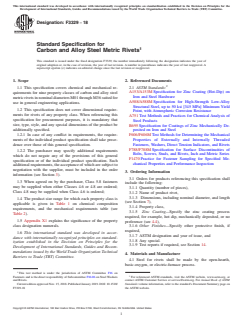
1.1 This specification covers chemical and mechanical requirements for nine property classes of carbon and alloy steel metric rivets in nominal diameters M01 through M36 suited for use in general engineering applications.
1.2 This specification does not cover dimensional requirements for rivets of any property class. When referencing this specification for procurement purposes, it is mandatory that size, type, style, and any special dimensions of the product be additionally specified.
1.2.1 In case of any conflict in requirements, the requirements of the individual product specification shall take precedence over those of this general specification.
1.2.2 The purchaser may specify additional requirements which do not negate any of the provisions of this general specification or of the individual product specification. Such additional requirements, the acceptance of which are subject to negotiation with the supplier, must be included in the order information (see Section 3).
1.3 When agreed on by the purchaser, Class 5.8 fasteners may be supplied when either Classes 4.6 or 4.8 are ordered; Class 4.8 may be supplied when Class 4.6 is ordered;
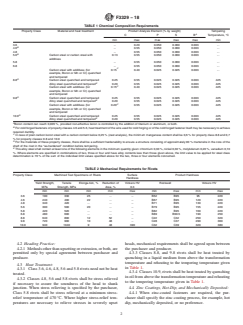
1.4 The product size range for which each property class is applicable is given in Table 1 on chemical composition requirements, and the mechanical requirements table (see Table 2).
1.5 Appendix X1 explains the significance of the property class designation numerals.
1.6 This international standard was developed in accordance with internationally recognized principles on standardization established in the Decision on Principles for the Development of International Standards, Guides and Recommendations issued by the World Trade Organization Technical Barriers to Trade (TBT) Committee.
- Status
- Published
- Publication Date
- 14-Nov-2018
- Technical Committee
- F16 - Fasteners
- Drafting Committee
- F16.06 - Steel Washers and Rivets

Overview
ASTM F3329-18: Standard Specification for Carbon and Alloy Steel Metric Rivets is an internationally recognized standard developed by ASTM. This specification outlines the chemical and mechanical requirements for nine property classes of carbon and alloy steel metric rivets, suitable for general engineering applications. The standard covers rivets in nominal diameters from M01 through M36 and is applicable across industries requiring reliable, high-performance fasteners. While ASTM F3329-18 addresses material and performance characteristics, it does not specify dimensions, which must be detailed separately during procurement.
Key Topics
- Scope: Applies to carbon and alloy steel metric rivets in sizes M01-M36 for general engineering applications.
- Property Classes: Covers nine property classes (such as 3.6, 4.6, 4.8, 5.6, 5.8, 6.8, 8.8, 9.8, and 10.9) with increasing mechanical strength and specific chemical composition requirements.
- Chemical Requirements: Specifies content limits for elements like carbon, phosphorus, sulfur, boron, and requirements for minimum hardenability and alloy content in certain classes.
- Mechanical Properties: Defines minimum requirements for tensile strength, yield strength, elongation, reduction of area, and hardness based on property class.
- Heat Treatment: Details when heat treatments such as quenching, tempering, or stress-relieving are required based on rivet property class.
- Coatings and Finishes: Includes guidance for protective finishes, such as zinc coatings (hot-dip or mechanically deposited) and other finishes as specified.
- Product Marking: Rivet property class must be permanently and clearly marked at the extreme end of the rivet.
- Testing and Inspection: Establishes lot definition, testing frequency, and quality assurance processes to ensure compliance with mechanical and chemical specifications.
- Ordering Information: Details required order information including quantity, product type, dimensions, property class, coatings, finishes, ASTM designation, and testing/reporting needs.
Applications
ASTM F3329-18 metric rivets are used in a wide range of general engineering projects where high reliability and standardized mechanical properties are critical. Applications include:
- Automotive and Transportation: Assembly of vehicle frames, structural and safety components.
- Construction and Infrastructure: Bridges, heavy equipment, and steel structures requiring durable and consistent fastener performance.
- Machinery and Equipment: Industrial manufacturing equipment and machinery assembly.
- Energy Sector: Power plants, renewable energy installations, and oil & gas infrastructure.
- General Manufacturing: Appliances, electronics, and consumer goods needing robust metric fasteners.
- International Projects: Compliance with internationally harmonized standards supports cross-border procurement and project requirements.
Custom requirements, such as special finishes, additional testing, or specific marking, can be negotiated and must be clearly stated in the procurement documentation to ensure product suitability and compliance.
Related Standards
ASTM F3329-18 references several related ASTM standards to support standardized testing, coatings, and performance, including:
- ASTM A153/A153M: Specification for Zinc Coating (Hot-Dip) on Iron and Steel Hardware
- ASTM B695: Specification for Mechanically Deposited Zinc Coatings on Iron and Steel
- ASTM A751: Test Methods and Practices for Chemical Analysis of Steel Products
- ASTM F606/F606M: Test Methods for Determining Mechanical Properties of Fasteners and Rivets
- ASTM F788/F788M: Specification for Surface Discontinuities of Bolts, Screws, Studs, and Rivets
- ASTM F1470: Practice for Fastener Sampling for Mechanical Properties and Performance Inspection
These supporting standards ensure comprehensive coverage of analysis methods, coating requirements, sampling practices, and inspection criteria, furthering quality assurance and international applicability.
Keywords: ASTM F3329-18, carbon steel rivets, alloy steel rivets, metric rivets, mechanical requirements, fastener standard, zinc coating, heat treatment, general engineering applications, international standard.
Relations
- Effective Date
- 01-Jan-2024
- Effective Date
- 01-Feb-2018
- Effective Date
- 01-Sep-2016
- Effective Date
- 01-Nov-2014
- Effective Date
- 01-Mar-2014
- Effective Date
- 15-Nov-2012
- Effective Date
- 01-Sep-2010
- Effective Date
- 01-Sep-2009
- Effective Date
- 01-Jan-2009
- Effective Date
- 01-Nov-2008
- Effective Date
- 01-Oct-2008
- Effective Date
- 15-Nov-2007
- Effective Date
- 01-Jun-2007
- Effective Date
- 01-Apr-2007
- Effective Date
- 01-Jun-2006
Frequently Asked Questions
ASTM F3329-18 is a technical specification published by ASTM International. Its full title is "Standard Specification for Carbon and Alloy Steel Metric Rivets". This standard covers: SCOPE 1.1 This specification covers chemical and mechanical requirements for nine property classes of carbon and alloy steel metric rivets in nominal diameters M01 through M36 suited for use in general engineering applications. 1.2 This specification does not cover dimensional requirements for rivets of any property class. When referencing this specification for procurement purposes, it is mandatory that size, type, style, and any special dimensions of the product be additionally specified. 1.2.1 In case of any conflict in requirements, the requirements of the individual product specification shall take precedence over those of this general specification. 1.2.2 The purchaser may specify additional requirements which do not negate any of the provisions of this general specification or of the individual product specification. Such additional requirements, the acceptance of which are subject to negotiation with the supplier, must be included in the order information (see Section 3). 1.3 When agreed on by the purchaser, Class 5.8 fasteners may be supplied when either Classes 4.6 or 4.8 are ordered; Class 4.8 may be supplied when Class 4.6 is ordered; 1.4 The product size range for which each property class is applicable is given in Table 1 on chemical composition requirements, and the mechanical requirements table (see Table 2). 1.5 Appendix X1 explains the significance of the property class designation numerals. 1.6 This international standard was developed in accordance with internationally recognized principles on standardization established in the Decision on Principles for the Development of International Standards, Guides and Recommendations issued by the World Trade Organization Technical Barriers to Trade (TBT) Committee.
SCOPE 1.1 This specification covers chemical and mechanical requirements for nine property classes of carbon and alloy steel metric rivets in nominal diameters M01 through M36 suited for use in general engineering applications. 1.2 This specification does not cover dimensional requirements for rivets of any property class. When referencing this specification for procurement purposes, it is mandatory that size, type, style, and any special dimensions of the product be additionally specified. 1.2.1 In case of any conflict in requirements, the requirements of the individual product specification shall take precedence over those of this general specification. 1.2.2 The purchaser may specify additional requirements which do not negate any of the provisions of this general specification or of the individual product specification. Such additional requirements, the acceptance of which are subject to negotiation with the supplier, must be included in the order information (see Section 3). 1.3 When agreed on by the purchaser, Class 5.8 fasteners may be supplied when either Classes 4.6 or 4.8 are ordered; Class 4.8 may be supplied when Class 4.6 is ordered; 1.4 The product size range for which each property class is applicable is given in Table 1 on chemical composition requirements, and the mechanical requirements table (see Table 2). 1.5 Appendix X1 explains the significance of the property class designation numerals. 1.6 This international standard was developed in accordance with internationally recognized principles on standardization established in the Decision on Principles for the Development of International Standards, Guides and Recommendations issued by the World Trade Organization Technical Barriers to Trade (TBT) Committee.
ASTM F3329-18 is classified under the following ICS (International Classification for Standards) categories: 21.060.40 - Rivets. The ICS classification helps identify the subject area and facilitates finding related standards.
ASTM F3329-18 has the following relationships with other standards: It is inter standard links to ASTM F1470-24, ASTM F1470-18, ASTM F606/F606M-16, ASTM F606/F606M-14a, ASTM A751-14, ASTM F1470-12, ASTM A588/A588M-10, ASTM B695-04(2009), ASTM F1470-09, ASTM F788/F788M-08, ASTM A751-08, ASTM F788/F788M-07, ASTM A751-07a, ASTM A751-07, ASTM F788/F788M-06. Understanding these relationships helps ensure you are using the most current and applicable version of the standard.
ASTM F3329-18 is available in PDF format for immediate download after purchase. The document can be added to your cart and obtained through the secure checkout process. Digital delivery ensures instant access to the complete standard document.
Standards Content (Sample)
This international standard was developed in accordance with internationally recognized principles on standardization established in the Decision on Principles for the
Development of International Standards, Guides and Recommendations issued by the World Trade Organization Technical Barriers to Trade (TBT) Committee.
Designation:F3329 −18
Standard Specification for
Carbon and Alloy Steel Metric Rivets
This standard is issued under the fixed designation F3329; the number immediately following the designation indicates the year of
original adoption or, in the case of revision, the year of last revision. A number in parentheses indicates the year of last reapproval. A
superscript epsilon (´) indicates an editorial change since the last revision or reapproval.
1. Scope 2. Referenced Documents
2.1 ASTM Standards:
1.1 This specification covers chemical and mechanical re-
A153/A153M Specification for Zinc Coating (Hot-Dip) on
quirements for nine property classes of carbon and alloy steel
Iron and Steel Hardware
metricrivetsinnominaldiametersM01throughM36suitedfor
A588/A588M Specification for High-Strength Low-Alloy
use in general engineering applications.
Structural Steel, up to 50 ksi [345 MPa] Minimum Yield
1.2 This specification does not cover dimensional require-
Point, with Atmospheric Corrosion Resistance
ments for rivets of any property class. When referencing this
A751 Test Methods and Practices for Chemical Analysis of
specification for procurement purposes, it is mandatory that
Steel Products
size, type, style, and any special dimensions of the product be
B695 Specification for Coatings of Zinc Mechanically De-
additionally specified.
posited on Iron and Steel
F606/F606M Test Methods for Determining the Mechanical
1.2.1 In case of any conflict in requirements, the require-
ments of the individual product specification shall take prece- Properties of Externally and Internally Threaded
Fasteners, Washers, Direct Tension Indicators, and Rivets
dence over those of this general specification.
F788/F788M Specification for Surface Discontinuities of
1.2.2 The purchaser may specify additional requirements
Bolts, Screws, Studs, and Rivets, Inch and Metric Series
which do not negate any of the provisions of this general
F1470 Practice for Fastener Sampling for Specified Me-
specification or of the individual product specification. Such
chanical Properties and Performance Inspection
additional requirements, the acceptance of which are subject to
negotiation with the supplier, must be included in the order
3. Ordering Information
information (see Section 3).
3.1 Orders for products referencing this specification shall
1.3 When agreed on by the purchaser, Class 5.8 fasteners
include the following:
may be supplied when either Classes 4.6 or 4.8 are ordered;
3.1.1 Quantity (number of pieces),
Class 4.8 may be supplied when Class 4.6 is ordered;
3.1.2 Name of product rivet,
3.1.3 Dimensions, including nominal diameter, and length
1.4 The product size range for which each property class is
(see Section 7),
applicable is given in Table 1 on chemical composition
3.1.4 Property class,
requirements, and the mechanical requirements table (see
3.1.5 Zinc Coating—Specify the zinc coating process
Table 2).
required, for example, hot dip, mechanically deposited, or no
1.5 Appendix X1 explains the significance of the property
preference (see 4.4),
class designation numerals.
3.1.6 Other Finishes—Specify other protective finish, if
required,
1.6 This international standard was developed in accor-
3.1.7 ASTM designation and year of issue, and
dance with internationally recognized principles on standard-
3.1.8 Any special.
ization established in the Decision on Principles for the
3.1.9 Test reports if required, see Section 14.
Development of International Standards, Guides and Recom-
mendations issued by the World Trade Organization Technical
4. Materials and Manufacture
Barriers to Trade (TBT) Committee.
4.1 Steel for rivets shall be made by the open-hearth,
basic-oxygen, or electric-furnace process.
This test method is under the jurisdiction of ASTM Committee F16 on
Fasteners and is the direct responsibility of Subcommittee F16.06 on Steel Washers For referenced ASTM standards, visit the ASTM website, www.astm.org, or
and Rivets. contact ASTM Customer Service at service@astm.org. For Annual Book of ASTM
Current edition approved Nov. 15, 2018. Published January 2019. DOI: 10.1520/ Standards volume information, refer to the standard’s Document Summary page on
F3329-18 the ASTM website.
Copyright © ASTM International, 100 Barr Harbor Drive, PO Box C700, West Conshohocken, PA 19428-2959. United States
F3329−18
TABLE 1 Chemical Composition Requirements
Property Class Material and heat treatment Product Analysis Element (% by weight) Tempering
A
CP S B Temperature, °C
min max max max max min
3.6 . 0.20 0.050 0.060 0.003 .
B
4.6 . 0.55 0.050 0.060 0.003 .
4.8 . 0.55 0.050 0.060 0.003 .
B
5.6 Carbon steel or carbon steel with 0.13 0.55 0.050 0.060 0.003 .
additives
5.8 . 0.55 0.050 0.060 0.003 .
6.8 . 0.55 0.050 0.060 0.003 .
C
Carbon steel with additives (for 0.15 0.40 0.025 0.025 0.003 .
example, Boron or Mn or Cr) quenched
and tempered
D
8.8 Carbon steel quenched and tempered 0.25 0.55 0.025 0.025 0.003 425
E
Alloy steel quenched and tempered 0.20 0.55 0.025 0.025 0.003 425
C
Carbon steel with additives (for 0.15 0.40 0.025 0.025 0.003 425
example, Boron or Mn or Cr) quenched
and tempered
D
9.8 Carbon steel quenched and tempered 0.25 0.55 0.025 0.025 0.003 425
E
Alloy steel quenched and tempered 0.20 0.55 0.025 0.025 0.003 425
C
Carbon steel with additives (for 0.20 0.55 0.025 0.025 0.003 425
example, Boron or Mn or Cr) quenched
and tempered
D
10.9 Carbon steel quenched and tempered 0.25 0.55 0.025 0.025 0.003 425
E
Alloy steel quenched and tempered 0.20 0.55 0.025 0.025 0.003 425
A
Boron content can reach 0,005 %, provided non-effective boron is controlled by the addition of titanium or aluminum, or both.
B
For cold forged fasteners of property classes 4.6 and 5.6, heat treatment of the wire used for cold forging or of the cold forged fastener itself may be necessary to achieve
required ductility.
C
In case of plain carbon boron steel with a carbon content below 0,25 % (cast analysis), the minimum manganese content shall be 0,6 % for property class 8.8 and 0,7
% for property classes 9.8 and 10.9
D
For the materials of these property classes, there shall be a sufficient hardenability to ensure a structure consisting of approximately 90 % martensite in the core of the
shaft of the rivet in the “as-hardened” condition before tempering.
E
This alloy steel shall contain at least one of the following elements in the minimum quantity given: chromium 0,30 %, nickel 0,30 %, molybdenum 0,20 %, vanadium 0,10
%. Where elements are specified in combinations of two, three or four and have alloy contents less than those given above, the limit value to be applied for steel class
determination is 70 % of the sum of the individual limit values specified above for the two, three or four elements concerned.
TABLE 2 Mechanical Requirements for Rivets
Property Class Machined Test Specimens of Rivets Surface Product Hardness
Hardness
Yield Strength, Tensile Elonga-tion, % Reduction of Vickers HV Rockwell Vickers HV
MPa Strength, MPa Area, % 0.3
min min min min max min max min max
3.6 190 330 25 . . B52 B95 95 220
4.6 240 400 22 . . B67 B95 120 220
4.8 340 420 . . . B71 B95 130 220
5.6 300 500 20 . . B79 B95 155 220
5.8 420 520 . . . B82 B95 160 220
6.8 480 600 . . . B89 B99.5 190 250
8.8 640 800 12 52 . C22 C32 250 320
9.8 720 900 10 48 . C28 C37 290 360
10.9 940 1040 9 48 390 C32 C39 320 380
4.2 Heading Practice: heads, mechanical requirements shall be agreed upon between
4.2.1 Methods other than upsetting or extrusion, or both, are the purchaser and producer.
permitted only by special agreement between purchaser and 4.3.3 Classes 8.8, and 9.8 rivets shall be heat treated by
producer. quenching in a liquid medium from above the transformation
temperature and reheating to the tempering temperature given
4.3 Heat Treatment:
in Table 1.
4.3.1 Class 3.6, 4.6, 4.8, 5.6 and 5.8 rivets need not be heat
4.3.4 Classes 10.9, rivets shall be heat treated by quenching
treated.
in oil from above the transformation temperature and reheating
4.3.2 Classes 4.8, 5.6 and 5.8 rivets shall be stress relieved
to the tempering temperature given in Table 1.
if necessary to assure the soundness of the head to shank
junction. When stress relieving is specified by the purchaser, 4.4 Zinc Coatings, Hot-Dip, and Mechanically Deposited:
Class 5.8 rivets shall be stress relieved at a minimum stress- 4.4.1 When zinc-coated fasteners are required, the pur-
relief temperature of 470 °C. Where higher stress-relief tem- chaser shall specify the zinc coating process, for example, hot
peratures are necessary to relieve stresses in severely upset dip, mechanically deposited, or no preference.
F3329−18
4.4.2 When hot-dip is specified, the fasteners shall be zinc 8.4 Lot Definition:
coated by the hot-dip process in accordan
...