

ASTM F2530-13(2020)
(Specification)Standard Specification for Protective Headgear with Faceguard Used in Bull Riding
General Information
- Abstract
ABSTRACT
This specification covers performance requirements and describes test methods for protective headgear with faceguards for use in bull riding. The purpose of this specification is to provide reliable and repeatable test methods for the evaluation of headgear with faceguards. Satisfaction of this specification is intended to reduce forces reaching the head in some of the impacts that may occur in bull riding and to limit contact with the facial features of the rider. Reference or full-facial headform shall be subjected to standard drop test method, using equipment used in evaluating the performance characteristics of a protective headgear. The simulated horn to be used is a rigid steel rod representative of a bull's horn. The headgear shall be subject to retention system testing involving positional stability testing and dynamic strength retention testing.
SCOPE
1.1 This specification covers performance requirements and describes test methods for protective headgear with faceguards for use in bull riding.
1.2 All testing and requirements of this specification shall be in accordance with Test Methods F1446, except where noted herein.
1.3 Partial utilization of this specification is prohibited. Any statement of compliance with this specification shall be a certification that the headgear with faceguard meets all of the requirements of the specification in their entirety. A headgear with faceguard that fails to meet any one of the requirements of this specification is considered to have failed the specification, and shall not be sold with any indication that it meets parts of the specification.
1.4 Headgear with faceguards designed to comply with this and other standards may proclaim uses as certified by the manufacturer.
1.5 The values stated in SI units are to be regarded as standard.
1.6 This standard does not purport to address all of the safety concerns, if any, associated with its use. It is the responsibility of the user of this standard to establish appropriate safety, health, and environmental practices and determine the applicability of regulatory limitations prior to use.
1.7 This international standard was developed in accordance with internationally recognized principles on standardization established in the Decision on Principles for the Development of International Standards, Guides and Recommendations issued by the World Trade Organization Technical Barriers to Trade (TBT) Committee.
- Status
- Published
- Publication Date
- 31-Mar-2020
- Technical Committee
- F08 - Sports Equipment, Playing Surfaces, and Facilities
- Drafting Committee
- F08.53 - Headgear and Helmets
Overview
ASTM F2530-13(2020), developed by ASTM International, specifies comprehensive performance requirements and test methods for protective headgear with faceguards used specifically in bull riding. The standard aims to enhance the safety of bull riders by reducing the forces transmitted to the head during impacts and minimizing facial contact in the event of an accident. By following reliable and repeatable testing protocols, manufacturers and regulatory bodies can assess whether a protective helmet with a faceguard delivers the intended safety benefits in the unique and hazardous context of bull riding.
Key Topics
- Performance Requirements: The standard defines essential criteria for protective headgear, including the capacity to reduce head acceleration and to protect facial features from direct impacts.
- Testing Methods: All tests referenced align with ASTM F1446, with adaptations particular to bull riding scenarios. This includes drop tests using simulated horns (rigid steel rods representing bull horns) to measure resistance to penetration and facial contact.
- Retention System Evaluations: Headgear is assessed for its positional stability and dynamic retention strength to ensure that the helmet remains securely on the rider’s head throughout bull riding activities.
- Headform and Measurement: The use of reference or full-facial headforms is specified, with precise marking and testing protocols to simulate realistic impact conditions.
- Labeling and Certification: Compliance with the standard requires complete adherence to all requirements. Headgear must carry proper labels, including warnings and instructions, and may be self-certified by manufacturers, though independent laboratory verification is recommended.
Applications
ASTM F2530-13(2020) is designed for use by:
- Manufacturers of rodeo and bull riding protective equipment, ensuring their products meet rigorous safety criteria.
- Rodeo organizations and event managers who specify helmet requirements to minimize risk to participants.
- Riders and athletes seeking assurance that their headgear offers verified protection against both head and facial injuries typical in bull riding.
- Compliance and regulatory bodies responsible for verifying and certifying the use of suitable bull riding headgear.
The standard provides practical benchmarks for product development, compliance, and quality assurance in environments where rider safety is paramount. It addresses critical scenarios such as high- and low-energy impacts, retention during violent movement, and removable features for emergency response.
Related Standards
- ASTM F1446 - Test Methods for Equipment and Procedures Used in Evaluating the Performance Characteristics of Protective Headgear, referenced for general testing protocols.
- ASTM F1163 - Specification for Protective Headgear Used in Horse Sports and Horseback Riding, relevant for parts of headgear and test equipment.
- ASTM F2220 - Specification for Headforms, outlining the requirements for headforms used in helmet impact tests.
- CSA Z262.6 - Specification for facially featured headforms, supplying additional technical reference for accurate simulation during testing.
Practical Value
Adhering to ASTM F2530-13(2020) supports the ongoing advancement of bull riding safety, providing standardized methods for testing protective headgear with faceguards. These practices deliver confidence to users, event organizers, and manufacturers that equipment subjected to this standard offers meaningful protection, helping to reduce the risks associated with this high-impact sport.
Keywords: bull riding headgear, protective helmets, faceguard, ASTM F2530, rodeo safety, impact testing, head protection standard, helmet certification.
Relations
- Replaces
ASTM F2530-13 - Standard Specification for Protective Headgear with Faceguard Used in Bull Riding - Effective Date
- 01-Apr-2020
- Effective Date
- 01-Nov-2014
- Effective Date
- 01-Mar-2013
- Effective Date
- 01-Nov-2012
- Effective Date
- 01-Apr-2011
- Effective Date
- 01-Mar-2011
- Effective Date
- 01-Feb-2009
- Effective Date
- 01-Dec-2004
- Effective Date
- 01-Jun-2004
- Effective Date
- 10-Dec-2002
- Effective Date
- 10-Jan-2000
- Effective Date
- 10-Jan-2000
Get Certified
Connect with accredited certification bodies for this standard

CIS Institut d.o.o.
Personal Protective Equipment (PPE) certification body. Notified Body NB-2890 for EU Regulation 2016/425 PPE.

Kiwa BDA Testing
Building and construction product certification.
Kmetijski inštitut Slovenije
Agricultural Institute of Slovenia. Soil testing, plant health, agricultural product analysis.
Sponsored listings
Frequently Asked Questions
ASTM F2530-13(2020) is a technical specification published by ASTM International. Its full title is "Standard Specification for Protective Headgear with Faceguard Used in Bull Riding". This standard covers: ABSTRACT This specification covers performance requirements and describes test methods for protective headgear with faceguards for use in bull riding. The purpose of this specification is to provide reliable and repeatable test methods for the evaluation of headgear with faceguards. Satisfaction of this specification is intended to reduce forces reaching the head in some of the impacts that may occur in bull riding and to limit contact with the facial features of the rider. Reference or full-facial headform shall be subjected to standard drop test method, using equipment used in evaluating the performance characteristics of a protective headgear. The simulated horn to be used is a rigid steel rod representative of a bull's horn. The headgear shall be subject to retention system testing involving positional stability testing and dynamic strength retention testing. SCOPE 1.1 This specification covers performance requirements and describes test methods for protective headgear with faceguards for use in bull riding. 1.2 All testing and requirements of this specification shall be in accordance with Test Methods F1446, except where noted herein. 1.3 Partial utilization of this specification is prohibited. Any statement of compliance with this specification shall be a certification that the headgear with faceguard meets all of the requirements of the specification in their entirety. A headgear with faceguard that fails to meet any one of the requirements of this specification is considered to have failed the specification, and shall not be sold with any indication that it meets parts of the specification. 1.4 Headgear with faceguards designed to comply with this and other standards may proclaim uses as certified by the manufacturer. 1.5 The values stated in SI units are to be regarded as standard. 1.6 This standard does not purport to address all of the safety concerns, if any, associated with its use. It is the responsibility of the user of this standard to establish appropriate safety, health, and environmental practices and determine the applicability of regulatory limitations prior to use. 1.7 This international standard was developed in accordance with internationally recognized principles on standardization established in the Decision on Principles for the Development of International Standards, Guides and Recommendations issued by the World Trade Organization Technical Barriers to Trade (TBT) Committee.
ABSTRACT This specification covers performance requirements and describes test methods for protective headgear with faceguards for use in bull riding. The purpose of this specification is to provide reliable and repeatable test methods for the evaluation of headgear with faceguards. Satisfaction of this specification is intended to reduce forces reaching the head in some of the impacts that may occur in bull riding and to limit contact with the facial features of the rider. Reference or full-facial headform shall be subjected to standard drop test method, using equipment used in evaluating the performance characteristics of a protective headgear. The simulated horn to be used is a rigid steel rod representative of a bull's horn. The headgear shall be subject to retention system testing involving positional stability testing and dynamic strength retention testing. SCOPE 1.1 This specification covers performance requirements and describes test methods for protective headgear with faceguards for use in bull riding. 1.2 All testing and requirements of this specification shall be in accordance with Test Methods F1446, except where noted herein. 1.3 Partial utilization of this specification is prohibited. Any statement of compliance with this specification shall be a certification that the headgear with faceguard meets all of the requirements of the specification in their entirety. A headgear with faceguard that fails to meet any one of the requirements of this specification is considered to have failed the specification, and shall not be sold with any indication that it meets parts of the specification. 1.4 Headgear with faceguards designed to comply with this and other standards may proclaim uses as certified by the manufacturer. 1.5 The values stated in SI units are to be regarded as standard. 1.6 This standard does not purport to address all of the safety concerns, if any, associated with its use. It is the responsibility of the user of this standard to establish appropriate safety, health, and environmental practices and determine the applicability of regulatory limitations prior to use. 1.7 This international standard was developed in accordance with internationally recognized principles on standardization established in the Decision on Principles for the Development of International Standards, Guides and Recommendations issued by the World Trade Organization Technical Barriers to Trade (TBT) Committee.
ASTM F2530-13(2020) is classified under the following ICS (International Classification for Standards) categories: 13.340.20 - Head protective equipment. The ICS classification helps identify the subject area and facilitates finding related standards.
ASTM F2530-13(2020) has the following relationships with other standards: It is inter standard links to ASTM F2530-13, ASTM F2220-14, ASTM F1163-13, ASTM F2220-12, ASTM F2220-11, ASTM F1163-04a(2011), ASTM F2220-02(2009), ASTM F1163-04a, ASTM F1163-04, ASTM F2220-02, ASTM F1163-00, ASTM F1163-01. Understanding these relationships helps ensure you are using the most current and applicable version of the standard.
ASTM F2530-13(2020) is available in PDF format for immediate download after purchase. The document can be added to your cart and obtained through the secure checkout process. Digital delivery ensures instant access to the complete standard document.
Standards Content (Sample)
This international standard was developed in accordance with internationally recognized principles on standardization established in the Decision on Principles for the
Development of International Standards, Guides and Recommendations issued by the World Trade Organization Technical Barriers to Trade (TBT) Committee.
Designation:F2530 −13 (Reapproved 2020) An American National Standard
Standard Specification for
Protective Headgear with Faceguard Used in Bull Riding
This standard is issued under the fixed designation F2530; the number immediately following the designation indicates the year of
original adoption or, in the case of revision, the year of last revision. A number in parentheses indicates the year of last reapproval. A
superscript epsilon (´) indicates an editorial change since the last revision or reapproval.
INTRODUCTION
Bull riding is a sport with intrinsic hazards. It is recognized that it is not possible to write a
protective headgear with faceguard standard specification that will result in headgear with faceguards
that can protect against injury or death in all accidents. Because of complex interactions of variables
such as bull motion, bull size and weight, rider size, direction and point of impact, and individual
differences in reaction to impact forces, it must be kept in mind that injuries are still possible. It is also
recognized that serious injury or death can result from both low-energy and high-energy impacts, even
when protective headgear with faceguard is worn. It is further recognized that protective headgear
with faceguards must be acceptable to the user and to the regulating associations or agencies requiring
its use.
In bull riding, where the force of impact between the bull and the face of the rider can cause head
and facial injury, there is a need for both head and facial protection.After careful consideration of the
mechanisms and forces involved in this context, this standard specification for headgear with
faceguards has been prepared, using resources in medical, scientific, mechanical engineering, human
factors, and biomechanical fields.
This specification is a series of laboratory tests of the protective headgear with faceguard. The
headgear testing measures its ability to reduce head acceleration when impacting various shaped
objects. The faceguard testing checks its ability to limit contact with the user face to reduce the
potential for facial injuries.
This specification incorporates many aspects of other recognized headgear standard specifications.
Other intentions that were not amenable to testing or inspection are offered as guidelines:
(1) The chin strap should be attached in a manner to enable the headgear with faceguard to remain
in its normal position on the wearer’s head during bull riding and impact conditions;
(2) The physical characteristics of materials used in construction of the headgear with faceguard
should retain their shock-absorbing characteristics under the influence of aging, use, or exposure to
typical environmental conditions;
(3) The faceguard should not significantly interfere with the vision of the wearer; and
(4) In the event of injury, the headgear with faceguard should be removable without causing
movement to the cervical spine. The access provided shall be sufficient for the administration of
cardiopulmonary resuscitation to the wearer.
1. Scope 1.2 All testing and requirements of this specification shall
beinaccordancewithTestMethodsF1446,exceptwherenoted
1.1 This specification covers performance requirements and
herein.
describes test methods for protective headgear with faceguards
for use in bull riding. 1.3 Partial utilization of this specification is prohibited.Any
statement of compliance with this specification shall be a
certification that the headgear with faceguard meets all of the
requirements of the specification in their entirety. A headgear
This specification is under the jurisdiction ofASTM Committee F08 on Sports
Equipment, Playing Surfaces, and Facilities and is the direct responsibility of
withfaceguardthatfailstomeetanyoneoftherequirementsof
Subcommittee F08.53 on Headgear and Helmets.
this specification is considered to have failed the specification,
Current edition approved April 1, 2020. Published April 2020. Originally
and shall not be sold with any indication that it meets parts of
approved in 2005. Last previous edition approved in 2013 as F2530 – 13. DOI:
10.1520/F2530-13R20. the specification.
Copyright © ASTM International, 100 Barr Harbor Drive, PO Box C700, West Conshohocken, PA 19428-2959. United States
F2530−13 (2020)
FIG. 1Simulated Horn
1.4 Headgear with faceguards designed to comply with this 4. Significance and Use
and other standards may proclaim uses as certified by the
4.1 The purpose of this specification is to provide reliable
manufacturer.
andrepeatabletestmethodsfortheevaluationofheadgearwith
1.5 The values stated in SI units are to be regarded as faceguards for bull riding. Headgear with faceguards satisfying
standard. this specification are intended to reduce forces reaching the
head in some of the impacts that may occur in bull riding and
1.6 This standard does not purport to address all of the
to limit contact with the facial features of the rider.
safety concerns, if any, associated with its use. It is the
responsibility of the user of this standard to establish appro-
5. Certification
priate safety, health, and environmental practices and deter-
mine the applicability of regulatory limitations prior to use. 5.1 This specification permits self-certification. It is recom-
mended that each manufacturer employ an independent test
1.7 This international standard was developed in accor-
dance with internationally recognized principles on standard- laboratory at least annually to test each model and size of
headgear with faceguard offered for sale.
ization established in the Decision on Principles for the
Development of International Standards, Guides and Recom-
6. Apparatus
mendations issued by the World Trade Organization Technical
Barriers to Trade (TBT) Committee.
6.1 Apparatus used for this testing shall be in accordance
with Test Methods F1446 except as noted below.
2. Referenced Documents
6.2 Impact, Other (Reference) or Full-Facial Headform to
2.1 ASTM Standards:
be used shall be as specified in:
F1163 Specification for Protective Headgear Used in Horse
6.2.1 The sections on Impact and Other (Reference) Head-
Sports and Horseback Riding
forms of Specification F2220.
F1446 Test Methods for Equipment and Procedures Used in
6.2.2 Full-facial headforms of CSA Z262.6.
Evaluating the Performance Characteristics of Protective
Headgear
F2220 Specification for Headforms 2
For referenced ASTM standards, visit the ASTM website, www.astm.org, or
contact ASTM Customer Service at service@astm.org. For Annual Book of ASTM
2.2 CSA Document:
Standards volume information, refer to the standard’s Document Summary page on
CSA Z262.6 Specification for facially featured headforms
the ASTM website.
Available from Canadian Standards Association (CSA), 5060 Spectrum Way,
3. Terminology Mississauga, ON L4W 5N6, Canada, http://www.csa.ca.
The sole source of supply of the headforms known to the committee at this time
3.1 Definitions as identified in Test Methods F1446.
is Canadian Standards Association (CSA), 5060 Spectrum Way, Mississauga, ON
L4W 5N6, Canada, http://www.csa.ca. If you are aware of alternative suppliers,
3.2 Definitions of Terms Specific to This Standard:
please provide this information to ASTM International Headquarters. Your com-
3.2.1 simulated horn—a rigid metal rod that is a conserva-
ments will receive careful consideration at a meeting of the responsible technical
tive representation of a bull’s horn. committee, which you may attend.
F2530−13 (2020)
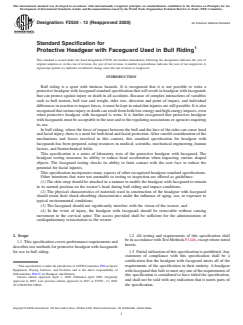
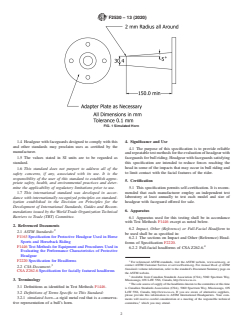
6.3 Simulated Horn—A rigid steel rod representative of a
bull’s horn, Fig. 1. The end of the rod is 30.4 mm (1.20 in.) in
diameter, flat, and perpendicular to the axis of the rod with a 2
mm (0.08 in.) radius round.There is a 5° taper along the length
of the rod with the diameter increasing. The overall length of
the rod shall be at least 15 cm (6.0 in.) long. The hardness of
the rod shall be Brinell Hardness 200 or greater.
6.4 Simulated Horn Striker—A5 kg (11 lb) striker as iden-
tified in the chin bar rigidity test of Test Methods F1446 that
has been modified by attaching the simulated horn to the
impact face of the striker. The longitudinal axis of the
simulated horn shall be perpendicular to the face of the striker.
TEST METHODS
7. Number of Samples
7.1 A minimum of four headgear with faceguards are
required for testing for each shell/liner combination. Damage
to the faceguard and its attachment to the headgear may occur
during testing. This damage is not considered a failure unless
the performance criteria are not met.
7.1.1 A minimum of twenty faceguards are required for
faceguard testing with each shell/liner combination.
7.2 Headgearwithfaceguardshallbetestedcomplete,inthe
conditionasofferedforsale.Theheadgearwithfaceguardmust
satisfy all testing requirements of this specification with the
faceguard attached.
FIG. 2Headform Basic Data and Test Line
8. Selection of Headform
8.1 The appropriate size headform shall be selected based
on the headform size selection terminology of Test Methods
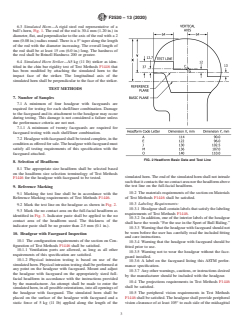
simulated horn.The end of the simulated horn shall not intrude
F1446 for the headgear with faceguard to be tested.
suchthatitcontactsthenocontactareanortheheadformabove
the test line on the full-facial headform.
9. Reference Marking
10.2 The materials requirements of the section on Materials
9.1 Marking the test line shall be in accordance with the
of Test Methods F1446 shall be satisfied.
Reference Marking requirements of Test Methods F1446.
10.3 Labeling Requirements:
9.2 Mark the test line on the headgear as shown i
...