

ASTM D4449-15(2021)
(Test Method)Standard Test Method for Visual Evaluation of Gloss Differences Between Surfaces of Similar Appearance
General Information
- Abstract
SIGNIFICANCE AND USE
5.1 Gloss3 is associated with the capacity of a surface to reflect more light in some directions than in others. The directions associated with mirror (or specular) reflection normally have the highest reflectances. Gloss is best seen and analyzed when the surfaces studied are illuminated by a light source that provides strong contrasting patterns of light and dark. Such a light source is described in this test method.
5.2 The simplest concept of gloss is that it corresponds to the mirror-like reflectances of surfaces. However, the distributions and intensities of this surface-reflected light are (for real materials) highly variable and affected by a variety of factors: surface smoothness and contour, refractive index, absorptance, angle of incidence, and (to a generally small extent) wavelength. From the great variety of surface-reflection patterns met in materials of commerce, it has been possible to identify seven surface-reflection criteria or “types of gloss” regularly used by skilled technologists for intercomparing and rating their products for gloss. Six of the seven criteria, or “types of gloss,” are identified in the section on definitions. The seventh, luster or contrast gloss, is seldom of concern to the coatings industry.
SCOPE
1.1 This test method covers the visual evaluation of gloss differences of coating surfaces, using special types of lamps for illumination. It identifies six aspects or types of gloss that one may look for when using the lamp to assess gloss differences between surfaces. It describes the conditions for using the lamps to best identify small differences in each of the six types of gloss. Four levels of visual gloss differences are distinguished.
1.2 While this technique is useful for both weathered and unweathered specimens, it has not been applied to metallics.
1.3 The values stated in inch-pound units are to be regarded as standard. The values given in parentheses are mathematical conversions to SI units that are provided for information only and are not considered standard.
1.4 This standard does not purport to address all of the safety concerns, if any, associated with its use. It is the responsibility of whoever uses this standard to consult and establish appropriate safety, health, and environmental practices and determine the applicability of regulatory limitations prior to use.
1.5 This international standard was developed in accordance with internationally recognized principles on standardization established in the Decision on Principles for the Development of International Standards, Guides and Recommendations issued by the World Trade Organization Technical Barriers to Trade (TBT) Committee.
- Status
- Published
- Publication Date
- 31-May-2021
- Technical Committee
- E12 - Color and Appearance
- Drafting Committee
- E12.11 - Visual Methods
Overview
ASTM D4449-15(2021), Standard Test Method for Visual Evaluation of Gloss Differences Between Surfaces of Similar Appearance, is an internationally recognized standard developed by ASTM International. This test method provides a systematic approach for visually evaluating gloss differences between coating surfaces that appear similar, using specific lamp types for controlled illumination. Gloss, often associated with the mirror-like reflection of light from a surface, can significantly impact the perceived quality and aesthetics of coatings in industries such as automotive, construction, and manufacturing. The standard outlines procedures to identify and distinguish six types of gloss and provides a method to rate gloss differences on a defined scale.
Key Topics
- Gloss Definition and Types: The standard covers multiple aspects of gloss, including specular gloss, distinctness-of-image, reflection haze, sheen, directionality, and texture. Each type describes a specific way that light interacts with and is reflected from a surface.
- Visual Evaluation Techniques: The method utilizes two specialized lamp setups (fluorescent desk lamp with mesh and incandescent filament lamp) for optimal illumination patterns that reveal gloss characteristics.
- Gloss Difference Rating: Gloss differences are categorized into four levels: none, very slight, moderate, and considerable, enabling qualitative gloss comparison.
- Preparation and Conditions: Proper specimen preparation, cleanliness, and appropriate lamp/specimen positioning are emphasized to ensure reliable results.
- Repeatability and Observer Variation: The method recognizes the visual assessment's subjective nature and provides guidance to mitigate bias by interchanging specimen positions and using defined evaluation conditions.
- Limitations: The technique is suitable for both weathered and unweathered non-metallic specimens and is not intended for metallic coatings.
Applications
The ASTM D4449-15(2021) standard finds practical use in:
- Quality Control in Coatings: Visual gloss evaluation is critical for paint and coatings manufacturers to ensure batch-to-batch consistency and meet customer specifications for finish and appearance.
- Product Development: R&D teams utilize this method when developing new coatings or surface treatments, comparing gloss attributes during formulation and testing stages.
- Surface and Material Inspection: Construction, furniture, and appliance industries employ this test method to visually assess and compare gloss levels on coated surfaces for both aesthetic and functional purposes.
- Troubleshooting and Defect Analysis: Identifying gloss differences helps detect and address issues like uneven application, contamination, or surface irregularities in finished products.
Related Standards
For a comprehensive approach to gloss measurement and appearance evaluation, users of ASTM D4449-15(2021) may also consider:
- ASTM D3964: Practice for Selection of Coating Specimens for Appearance Measurements - outlines specimen selection methods for accurate appearance evaluation.
- ASTM E284: Terminology of Appearance - provides standardized terminology for appearance measurement, including gloss-related definitions.
- ISO 2813: Paints and varnishes - Determination of gloss value at 20°, 60°, and 85° - covers instrumental gloss measurement techniques.
- ASTM D523: Standard Test Method for Specular Gloss - describes quantitative gloss measurement using glossmeters.
Practical Value
By implementing ASTM D4449-15(2021), organizations enhance their ability to visually differentiate and rate gloss differences, leading to:
- Improved product quality and consistency
- Objective communication of visual attributes with clients and stakeholders
- Early detection of surface finish issues before product release
Proper use of this standard supports quality assurance objectives and reinforces manufacturing credibility in markets where surface appearance is a key differentiator.
Keywords: gloss evaluation, visual gloss, ASTM D4449, coating appearance, surface finish, distinctness-of-image, reflection haze, sheen, specular gloss, quality control, paint coatings, visual inspection standards.
Relations
- Effective Date
- 01-Jun-2020
- Effective Date
- 01-Nov-2013
- Effective Date
- 01-Jun-2013
- Effective Date
- 01-Jan-2013
- Effective Date
- 01-Jul-2012
- Refers
ASTM D3964-10 - Standard Practice for Selection of Coating Specimens for Appearance Measurements - Effective Date
- 01-Jun-2010
- Effective Date
- 01-Jun-2009
- Effective Date
- 01-Jan-2009
- Effective Date
- 01-Aug-2008
- Effective Date
- 15-Jul-2007
- Effective Date
- 01-Dec-2006
- Effective Date
- 15-Jul-2006
- Effective Date
- 15-Feb-2006
- Effective Date
- 15-Jun-2005
- Effective Date
- 01-Feb-2005
Frequently Asked Questions
ASTM D4449-15(2021) is a standard published by ASTM International. Its full title is "Standard Test Method for Visual Evaluation of Gloss Differences Between Surfaces of Similar Appearance". This standard covers: SIGNIFICANCE AND USE 5.1 Gloss3 is associated with the capacity of a surface to reflect more light in some directions than in others. The directions associated with mirror (or specular) reflection normally have the highest reflectances. Gloss is best seen and analyzed when the surfaces studied are illuminated by a light source that provides strong contrasting patterns of light and dark. Such a light source is described in this test method. 5.2 The simplest concept of gloss is that it corresponds to the mirror-like reflectances of surfaces. However, the distributions and intensities of this surface-reflected light are (for real materials) highly variable and affected by a variety of factors: surface smoothness and contour, refractive index, absorptance, angle of incidence, and (to a generally small extent) wavelength. From the great variety of surface-reflection patterns met in materials of commerce, it has been possible to identify seven surface-reflection criteria or “types of gloss” regularly used by skilled technologists for intercomparing and rating their products for gloss. Six of the seven criteria, or “types of gloss,” are identified in the section on definitions. The seventh, luster or contrast gloss, is seldom of concern to the coatings industry. SCOPE 1.1 This test method covers the visual evaluation of gloss differences of coating surfaces, using special types of lamps for illumination. It identifies six aspects or types of gloss that one may look for when using the lamp to assess gloss differences between surfaces. It describes the conditions for using the lamps to best identify small differences in each of the six types of gloss. Four levels of visual gloss differences are distinguished. 1.2 While this technique is useful for both weathered and unweathered specimens, it has not been applied to metallics. 1.3 The values stated in inch-pound units are to be regarded as standard. The values given in parentheses are mathematical conversions to SI units that are provided for information only and are not considered standard. 1.4 This standard does not purport to address all of the safety concerns, if any, associated with its use. It is the responsibility of whoever uses this standard to consult and establish appropriate safety, health, and environmental practices and determine the applicability of regulatory limitations prior to use. 1.5 This international standard was developed in accordance with internationally recognized principles on standardization established in the Decision on Principles for the Development of International Standards, Guides and Recommendations issued by the World Trade Organization Technical Barriers to Trade (TBT) Committee.
SIGNIFICANCE AND USE 5.1 Gloss3 is associated with the capacity of a surface to reflect more light in some directions than in others. The directions associated with mirror (or specular) reflection normally have the highest reflectances. Gloss is best seen and analyzed when the surfaces studied are illuminated by a light source that provides strong contrasting patterns of light and dark. Such a light source is described in this test method. 5.2 The simplest concept of gloss is that it corresponds to the mirror-like reflectances of surfaces. However, the distributions and intensities of this surface-reflected light are (for real materials) highly variable and affected by a variety of factors: surface smoothness and contour, refractive index, absorptance, angle of incidence, and (to a generally small extent) wavelength. From the great variety of surface-reflection patterns met in materials of commerce, it has been possible to identify seven surface-reflection criteria or “types of gloss” regularly used by skilled technologists for intercomparing and rating their products for gloss. Six of the seven criteria, or “types of gloss,” are identified in the section on definitions. The seventh, luster or contrast gloss, is seldom of concern to the coatings industry. SCOPE 1.1 This test method covers the visual evaluation of gloss differences of coating surfaces, using special types of lamps for illumination. It identifies six aspects or types of gloss that one may look for when using the lamp to assess gloss differences between surfaces. It describes the conditions for using the lamps to best identify small differences in each of the six types of gloss. Four levels of visual gloss differences are distinguished. 1.2 While this technique is useful for both weathered and unweathered specimens, it has not been applied to metallics. 1.3 The values stated in inch-pound units are to be regarded as standard. The values given in parentheses are mathematical conversions to SI units that are provided for information only and are not considered standard. 1.4 This standard does not purport to address all of the safety concerns, if any, associated with its use. It is the responsibility of whoever uses this standard to consult and establish appropriate safety, health, and environmental practices and determine the applicability of regulatory limitations prior to use. 1.5 This international standard was developed in accordance with internationally recognized principles on standardization established in the Decision on Principles for the Development of International Standards, Guides and Recommendations issued by the World Trade Organization Technical Barriers to Trade (TBT) Committee.
ASTM D4449-15(2021) is classified under the following ICS (International Classification for Standards) categories: 87.040 - Paints and varnishes. The ICS classification helps identify the subject area and facilitates finding related standards.
ASTM D4449-15(2021) has the following relationships with other standards: It is inter standard links to ASTM D3964-10(2020), ASTM E284-13b, ASTM E284-13a, ASTM E284-13, ASTM E284-12, ASTM D3964-10, ASTM E284-09a, ASTM E284-09, ASTM E284-08, ASTM E284-07, ASTM E284-06b, ASTM E284-06a, ASTM E284-06, ASTM E284-05a, ASTM E284-05. Understanding these relationships helps ensure you are using the most current and applicable version of the standard.
ASTM D4449-15(2021) is available in PDF format for immediate download after purchase. The document can be added to your cart and obtained through the secure checkout process. Digital delivery ensures instant access to the complete standard document.
Standards Content (Sample)
This international standard was developed in accordance with internationally recognized principles on standardization established in the Decision on Principles for the
Development of International Standards, Guides and Recommendations issued by the World Trade Organization Technical Barriers to Trade (TBT) Committee.
Designation:D4449 −15 (Reapproved 2021)
Standard Test Method for
Visual Evaluation of Gloss Differences Between Surfaces of
Similar Appearance
This standard is issued under the fixed designation D4449; the number immediately following the designation indicates the year of
original adoption or, in the case of revision, the year of last revision. A number in parentheses indicates the year of last reapproval. A
superscript epsilon (´) indicates an editorial change since the last revision or reapproval.
1. Scope E284 Terminology of Appearance
1.1 This test method covers the visual evaluation of gloss
3. Terminology
differencesofcoatingsurfaces,usingspecialtypesoflampsfor
illumination. It identifies six aspects or types of gloss that one 3.1 Definitions—For definitions of terms used in this
may look for when using the lamp to assess gloss differences method, see Terminology E284.
between surfaces. It describes the conditions for using the
3.2 Definitions of Terms Specific to This Standard:
lamps to best identify small differences in each of the six types
3.2.1 directionality of surface, n—perceived change of
of gloss. Four levels of visual gloss differences are distin-
glossyappearanceofasurfacewithrotationofthesurfaceinits
guished.
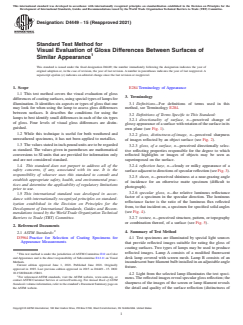
own plane (see Fig. 1).
1.2 While this technique is useful for both weathered and
3.2.2 gloss, distinctness-of-image, n—perceived sharpness
unweathered specimens, it has not been applied to metallics.
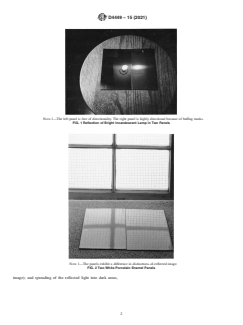
of images reflected by an object surface (see Fig. 2).
1.3 The values stated in inch-pound units are to be regarded
3.2.3 gloss, of a surface, n—perceived directionally selec-
as standard. The values given in parentheses are mathematical
tive reflecting properties responsible for the degree to which
conversions to SI units that are provided for information only
reflected highlights or images of objects may be seen as
and are not considered standard.
superimposed on the surface.
1.4 This standard does not purport to address all of the
3.2.4 reflection haze, n—cloudy or milky appearance of a
safety concerns, if any, associated with its use. It is the
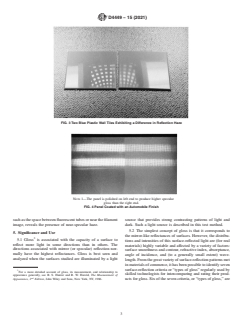
surfaceadjacenttodirectionsofspecularreflection(seeFig.3).
responsibility of whoever uses this standard to consult and
3.2.5 sheen, n—perceived shininess at a near-grazing angle
establish appropriate safety, health, and environmental prac-
of incidence for an otherwise matte specimen (difficult to
tices and determine the applicability of regulatory limitations
photograph).
prior to use.
3.2.6 specular gloss, n—the relative luminous reflectance
1.5 This international standard was developed in accor-
factor of a specimen in the specular direction. The luminous
dance with internationally recognized principles on standard-
reflectance factor is the ratio of the luminous flux reflected
ization established in the Decision on Principles for the
from, to that incident on, a specimen for specified solid angles
Development of International Standards, Guides and Recom-
(see Fig. 4).
mendations issued by the World Trade Organization Technical
Barriers to Trade (TBT) Committee. 3.2.7 texture, n—perceived structure, pattern, or topography
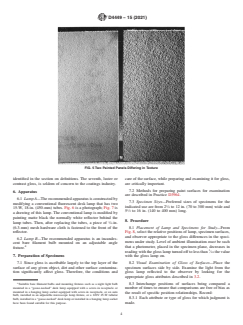
or combination thereof, of a surface (see Fig. 5).
2. Referenced Documents
4. Summary of Test Method
2.1 ASTM Standards:
D3964 Practice for Selection of Coating Specimens for
4.1 Test specimens are illuminated by special light sources
Appearance Measurements
that provide reflected images suitable for rating the gloss of
coating surfaces. Two types of lamps may be used to produce
reflected images. Lamp A consists of a modified fluorescent
This test method is under the jurisdiction of ASTM Committee E12 on Color
desk lamp covered with screen mesh. Lamp B consists of an
and Appearance and is the direct responsibility of Subcommittee E12.11 on Visual
Methods.
incandescent bare filament bulb installed in an adjustable angle
Current edition approved June 1, 2021. Published June 2021. Originally
fixture.
approved in 1985. Last previous edition approved in 2015 as D4449 – 15. DOI:
10.1520/D4449-15R21.
4.2 Light from the selected lamp illuminates the test speci-
For referenced ASTM standards, visit the ASTM website, www.astm.org, or
mens.The reflected images reveal specular gloss reflection; the
contact ASTM Customer Service at service@astm.org. For Annual Book of ASTM
sharpness of the images of the screen or lamp filament reveals
Standards volume information, refer to the standard’s Document Summary page on
the ASTM website. the detail and quality of the surface reflection (distinctness of
Copyright © ASTM International, 100 Barr Harbor Drive, PO Box C700, West Conshohocken, PA 19428-2959. United States
D4449−15 (2021)
NOTE 1—The left panel is free of directionality. The right panel is highly directional because of buffing marks.
FIG. 1Reflection of Bright Incandescent Lamp in Two Panels
NOTE 1—The panels exhibit a difference in distinctness-of-reflected image.
FIG. 2Two White Porcelain Enamel Panels
image); and spreading of the reflected light into dark areas,
D4449−15 (2021)
FIG. 3Two Blue Plastic Wall Tiles Exhibiting a Difference in Reflection Haze
NOTE 1—The panel is polished on left end to produce higher specular
gloss than the right end.
FIG. 4Panel Coated with an Automobile Finish
suchasthespacebetweenfluorescenttubesornearthefilament source that provides strong contrasting patterns of light and
image, reveals the presence of near-specular haze. dark. Such a light source is described in this test method.
5.2 The simplest concept of gloss is that it corresponds to
5. Significance and Use
the mirror-like reflectances of surfaces. However, the distribu-
5.1 Gloss is associated with the capacity of a surface to
tions and intensities of this surface-reflected light are (for real
reflect more light in some directions than in others. The
materials) highly variable and affected by a variety of factors:
directions associated with mirror (or specular) reflection nor-
surface smoothness and contour, refractive index, absorptance,
mally have the highest reflectances. Gloss is best seen and
angle of incidence, and (to a generally small extent) wave-
analyzed when the surfaces studied are illuminated by a light
length.Fromthegreatvarietyofsurface-reflectionpatternsmet
inmaterialsofcommerce,ithasbeenpossibletoidentifyseven
surface-reflection criteria or “types of gloss” regularly used by
For a more detailed account of gloss, its measurement, and relationship to
skilled technologists for intercomparing and rating their prod-
appearance generally, see R. S. Hunter and R. W. Harold, The Measurement of
nd
Appearance, 2 Edition, John Wiley and Sons, New York, NY, 1986. ucts for gloss. Six of the seven criteria, or “types of gloss,” are
D4449−15 (2021)
FIG. 5Two Painted Panels Differing in Texture
identified in the section on definitions. The seventh, luster or care of the surface, while preparing and examining it for gloss,
contrast gloss, is seldom of concern to the coatings industry. are critically important.
7.2 Methods for preparing paint surfaces for examination
6. Apparatus
are described in Practice D3964.
6.1 LampA—The recommended apparatus is constructed by
7.3 Specimen Sizes—Preferred sizes of specimens for the
modifying a conventional fluorescent desk lamp that has two
indicated use are from 2 ⁄4 to 12 in. (70 to 300 mm) wide and
15-W, 18-in. (450-mm) tubes. Fig. 6 is a photograph; Fig. 7 is
5 ⁄2 to 16 in. (140 to 400 mm) long.
a drawing of this lamp. The conventional lamp is modified by
painting matte black the normally white reflector behind the
8. Procedure
lamp tubes. Then, after replacing the tubes,
...