

ASTM D3134-15(2019)
(Practice)Standard Practice for Establishing Color and Gloss Tolerances
General Information
- Abstract
SIGNIFICANCE AND USE
5.1 Color specifications are centered around exact positions in color space. Correspondingly, gloss specifications are centered around an exact position on the gloss scale. Because it is difficult to achieve these exact positions repeatedly, it is necessary to specify tolerances that are acceptable to both the buyer and the seller. This practice details the procedure for accomplishing this goal.
SCOPE
1.1 This practice describes a procedure for establishing tolerances and evaluating the color and gloss of specimens with respect to specified standards. This practice is appropriate for nonfluorescent opaque specimens.
1.2 This practice does not indicate the extent of tolerances, but gives guidance on how they can be set. For product specification, the tolerances between specimens and the specified standard should be agreed upon between the purchaser and the seller.
1.3 This standard does not purport to address all of the safety concerns, if any, associated with its use. It is the responsibility of the user of this standard to establish appropriate safety, health, and environmental practices and determine the applicability of regulatory limitations prior to use.
1.4 This international standard was developed in accordance with internationally recognized principles on standardization established in the Decision on Principles for the Development of International Standards, Guides and Recommendations issued by the World Trade Organization Technical Barriers to Trade (TBT) Committee.
- Status
- Published
- Publication Date
- 31-Oct-2019
- Technical Committee
- E12 - Color and Appearance
- Drafting Committee
- E12.11 - Visual Methods
Overview
ASTM D3134-15(2019) - Standard Practice for Establishing Color and Gloss Tolerances is a widely recognized guideline for setting and evaluating acceptable limits of color and gloss differences in nonfluorescent opaque specimens. Published by ASTM International, this standard assists manufacturers, suppliers, and purchasers in agreeing upon measurable and visually perceptible tolerances for both color and gloss, ensuring product consistency and customer satisfaction across industries where appearance is critical.
Accurate color and gloss specifications are central to quality assurance, but reproducing exact positions in color space and gloss scale can be challenging. This standard provides a systematic approach for selecting standards, performing necessary measurements, and establishing tolerances acceptable to both buyers and sellers.
Key Topics
- Establishing Tolerances: Guidance is provided on how to determine and agree upon tolerances for color and gloss, using either instrumental or visual assessments.
- Color Specification and Measurement: The standard makes use of recognized color systems such as CIELAB and related ASTM practices for measuring and expressing color differences.
- Gloss Specification and Measurement: Gloss tolerances are recommended to be determined around an agreed-upon standard gloss level, using test methods such as ASTM D523.
- Visual and Instrumental Evaluation: Criteria for both instrumental color spectrophotometry and visual appraisal (observer selection, lighting, and viewing geometry) are included.
- Graphical Interpretation: The use of data plots to visualize historical accept/reject decisions is outlined to assist in setting meaningful tolerances.
- Documentation and Reporting: The standard details the necessary information to record, including instrument details, conditions of measurement, and compliance results.
- Practicality and Agreements: While guidance is provided, the onus is on the purchaser and seller to agree on the specific tolerance values based on practical, technical, and economic factors.
Applications
ASTM D3134-15(2019) is applicable wherever color and gloss play a significant role in product acceptance, including:
- Manufacturing: Used in automotive, appliance, consumer electronics, and building materials industries to maintain appearance uniformity batch-to-batch and lot-to-lot.
- Quality Control: Supports formulation of product specifications and aids in ongoing inspection and monitoring of production lines.
- Supply Chain Management: Assures both suppliers and buyers of products that appearance standards are met, reducing disputes and rework.
- Coatings and Paints: Particularly valuable in specifying color and gloss tolerances in pigmented coatings, where uniformity is crucial for brand quality.
- Product Development and Design: Ensures new product launches meet visual and aesthetic expectations in competitive markets.
By following ASTM D3134, organizations can create transparent and repeatable procedures for appearance specification, enhancing communication and trust between parties.
Related Standards
To fully implement practices described in ASTM D3134-15(2019), familiarity with the following related standards is beneficial:
- ASTM D523 - Test Method for Specular Gloss
- ASTM D1535 - Practice for Specifying Color by the Munsell System
- ASTM D1729 - Practice for Visual Appraisal of Colors and Color Differences of Diffusely-Illuminated Opaque Materials
- ASTM D2244 - Practice for Calculation of Color Tolerances and Color Differences from Instrumentally Measured Color Coordinates
- ASTM D3964 - Practice for Selection of Coating Specimens for Appearance Measurements
- ASTM D4449 - Test Method for Visual Evaluation of Gloss Differences Between Surfaces of Similar Appearance
- ASTM E308 - Practice for Computing the Colors of Objects by Using the CIE System
- ASTM E805, E1164, E1331, E1349, E1360, E1345, E1499 – Practices for color measurement, terminology, and observer selection
These related standards provide detailed methodologies for color and gloss measurement, interpretation, and reporting, forming the backbone of robust appearance quality systems.
Keywords: ASTM D3134, color tolerance, gloss tolerance, color difference, gloss measurement, color standards, quality control, visual appraisal, spectrophotometry, coatings.
Relations
- Effective Date
- 01-Nov-2019
- Refers
ASTM E1164-23 - Standard Practice for Obtaining Spectrometric Data for Object-Color Evaluation - Effective Date
- 01-Nov-2023
- Effective Date
- 01-Nov-2023
- Effective Date
- 01-Jun-2020
- Effective Date
- 01-Nov-2019
- Effective Date
- 01-Nov-2019
- Effective Date
- 01-May-2019
- Effective Date
- 01-May-2017
- Effective Date
- 01-Aug-2015
- Effective Date
- 01-Jul-2015
- Effective Date
- 01-May-2015
- Effective Date
- 01-Apr-2015
- Effective Date
- 01-Jan-2015
- Effective Date
- 01-Jan-2015
- Effective Date
- 01-Nov-2014
Frequently Asked Questions
ASTM D3134-15(2019) is a standard published by ASTM International. Its full title is "Standard Practice for Establishing Color and Gloss Tolerances". This standard covers: SIGNIFICANCE AND USE 5.1 Color specifications are centered around exact positions in color space. Correspondingly, gloss specifications are centered around an exact position on the gloss scale. Because it is difficult to achieve these exact positions repeatedly, it is necessary to specify tolerances that are acceptable to both the buyer and the seller. This practice details the procedure for accomplishing this goal. SCOPE 1.1 This practice describes a procedure for establishing tolerances and evaluating the color and gloss of specimens with respect to specified standards. This practice is appropriate for nonfluorescent opaque specimens. 1.2 This practice does not indicate the extent of tolerances, but gives guidance on how they can be set. For product specification, the tolerances between specimens and the specified standard should be agreed upon between the purchaser and the seller. 1.3 This standard does not purport to address all of the safety concerns, if any, associated with its use. It is the responsibility of the user of this standard to establish appropriate safety, health, and environmental practices and determine the applicability of regulatory limitations prior to use. 1.4 This international standard was developed in accordance with internationally recognized principles on standardization established in the Decision on Principles for the Development of International Standards, Guides and Recommendations issued by the World Trade Organization Technical Barriers to Trade (TBT) Committee.
SIGNIFICANCE AND USE 5.1 Color specifications are centered around exact positions in color space. Correspondingly, gloss specifications are centered around an exact position on the gloss scale. Because it is difficult to achieve these exact positions repeatedly, it is necessary to specify tolerances that are acceptable to both the buyer and the seller. This practice details the procedure for accomplishing this goal. SCOPE 1.1 This practice describes a procedure for establishing tolerances and evaluating the color and gloss of specimens with respect to specified standards. This practice is appropriate for nonfluorescent opaque specimens. 1.2 This practice does not indicate the extent of tolerances, but gives guidance on how they can be set. For product specification, the tolerances between specimens and the specified standard should be agreed upon between the purchaser and the seller. 1.3 This standard does not purport to address all of the safety concerns, if any, associated with its use. It is the responsibility of the user of this standard to establish appropriate safety, health, and environmental practices and determine the applicability of regulatory limitations prior to use. 1.4 This international standard was developed in accordance with internationally recognized principles on standardization established in the Decision on Principles for the Development of International Standards, Guides and Recommendations issued by the World Trade Organization Technical Barriers to Trade (TBT) Committee.
ASTM D3134-15(2019) is classified under the following ICS (International Classification for Standards) categories: 87.040 - Paints and varnishes. The ICS classification helps identify the subject area and facilitates finding related standards.
ASTM D3134-15(2019) has the following relationships with other standards: It is inter standard links to ASTM D3134-15, ASTM E1164-23, ASTM E1331-15(2023), ASTM D3964-10(2020), ASTM E1360-05(2019), ASTM E1331-15(2019), ASTM E1345-98(2019), ASTM E308-17, ASTM D2244-15a, ASTM E1331-15, ASTM E1360-05(2015), ASTM E308-15, ASTM D2244-15, ASTM D2244-15e1, ASTM E1345-98(2014). Understanding these relationships helps ensure you are using the most current and applicable version of the standard.
ASTM D3134-15(2019) is available in PDF format for immediate download after purchase. The document can be added to your cart and obtained through the secure checkout process. Digital delivery ensures instant access to the complete standard document.
Standards Content (Sample)
This international standard was developed in accordance with internationally recognized principles on standardization established in the Decision on Principles for the
Development of International Standards, Guides and Recommendations issued by the World Trade Organization Technical Barriers to Trade (TBT) Committee.
Designation: D3134 − 15 (Reapproved 2019)
Standard Practice for
Establishing Color and Gloss Tolerances
This standard is issued under the fixed designation D3134; the number immediately following the designation indicates the year of
original adoption or, in the case of revision, the year of last revision. A number in parentheses indicates the year of last reapproval. A
superscript epsilon (´) indicates an editorial change since the last revision or reapproval.
INTRODUCTION
Permissible color and gloss deviations from a standard are generally dependent upon the color
discrimination of the observer, on the lighting and surround in which the material is viewed, and on
special considerations related to the design, manufacture, and practical usage of the colored material
or object. The tolerances, therefore, may be influenced by economic, technical, psychological, and
practical requirements. In many circumstances, acceptability of color and gloss deviations from a
standard may differ appreciably from perceptibility for many reasons. With proper allowances,
perceptibility data can be used as an aid to develop permissible tolerances. Finally, these consider-
ations should result in a specification acceptable to both buyer and seller.
1. Scope 2. Referenced Documents
1.1 This practice describes a procedure for establishing 2.1 ASTM Standards:
tolerancesandevaluatingthecolorandglossofspecimenswith D523 Test Method for Specular Gloss
respect to specified standards. This practice is appropriate for D1535 Practice for Specifying Color by the Munsell System
nonfluorescent opaque specimens. D1729 Practice for Visual Appraisal of Colors and Color
Differences of Diffusely-Illuminated Opaque Materials
1.2 This practice does not indicate the extent of tolerances,
D2244 Practice for Calculation of Color Tolerances and
but gives guidance on how they can be set. For product
Color Differences from Instrumentally Measured Color
specification, the tolerances between specimens and the speci-
Coordinates
fiedstandardshouldbeagreeduponbetweenthepurchaserand
D3964 Practice for Selection of Coating Specimens for
the seller.
Appearance Measurements
1.3 This standard does not purport to address all of the
D4449 Test Method for Visual Evaluation of Gloss Differ-
safety concerns, if any, associated with its use. It is the
ences Between Surfaces of Similar Appearance
responsibility of the user of this standard to establish appro-
D5531 GuideforPreparation,Maintenance,andDistribution
priate safety, health, and environmental practices and deter-
of Physical Product Standards for Color and Geometric
mine the applicability of regulatory limitations prior to use.
Appearance of Coatings
1.4 This international standard was developed in accor-
E284 Terminology of Appearance
dance with internationally recognized principles on standard-
E308 PracticeforComputingtheColorsofObjectsbyUsing
ization established in the Decision on Principles for the
the CIE System
Development of International Standards, Guides and Recom-
E312 Practice for Description and Selection of Conditions
mendations issued by the World Trade Organization Technical
for Photographing Specimens Using Analog (Film) Cam-
Barriers to Trade (TBT) Committee. 3
eras and Digital Still Cameras (DSC) (Withdrawn 2017)
1 2
This practice is under the jurisdiction of ASTM Committee E12 on Color and For referenced ASTM standards, visit the ASTM website, www.astm.org, or
Appearance and is the direct responsibility of Subcommittee E12.11 on Visual contact ASTM Customer Service at service@astm.org. For Annual Book of ASTM
Methods. Standards volume information, refer to the standard’s Document Summary page on
Current edition approved Nov. 1, 2019. Published November 2019. Originally the ASTM website.
approved in 1972. Last previous edition approved in 2015 as D3134 – 15. DOI: The last approved version of this historical standard is referenced on
10.1520/D3134-15R19. www.astm.org.
Copyright © ASTM International, 100 Barr Harbor Drive, PO Box C700, West Conshohocken, PA 19428-2959. United States
D3134 − 15 (2019)
E805 Practice for Identification of Instrumental Methods of 7. Procedure
Color or Color-Difference Measurement of Materials
7.1 Selection and Specification of Color and Gloss Stan-
E1164 PracticeforObtainingSpectrometricDataforObject-
dard:
Color Evaluation
7.1.1 Select a standard in accordance with Practice D3964
E1331 Test Method for Reflectance Factor and Color by
that is preferably the same type of material as the specimens to
Spectrophotometry Using Hemispherical Geometry
be evaluated for color or gloss, or both. Prepare, in sufficient
E1345 Practice for Reducing the Effect of Variability of
quantity,secondarystandardsinaccordancewithGuideD5531
Color Measurement by Use of Multiple Measurements
that are representative of the desired color and gloss, in the
E1349 Test Method for Reflectance Factor and Color by
permanent material. Standards should have the same spectral
Spectrophotometry Using Bidirectional (45°:0° or 0°:45°)
characteristics as the manufactured product. This is usually
Geometry
accomplished by use of the same colorant composition, incor-
E1360 Practice for Specifying Color by Using the Optical
porated in the same manner into the same material. The
Society of America Uniform Color Scales System
standard should have the same texture as the manufactured
E1499 Guide for Selection, Evaluation, and Training of
product.
Observers
7.1.1.1 In order to obtain a permanent record, use Practice
E1541 Practice for Specifying and Matching Color Using
E805 and either Test Method E1331 or Test Method E1349 to
the Colorcurve System (Withdrawn 2007)
correctly identify the instrumental measurement method. Mea-
2.2 CIE Publication:
sure the color in accordance with Practices E1164 and E805.
CIE Publication 015 Colorimetry
Report the color as described in Practice E308. Do this even if
2.3 ISO Standard:
the standard is textured. (If the standard is textured, note the
ISO 15930 Graphic Technology – Part 4: Complete ex-
texture orientation during measurement.) The variability of the
changeofCMYKandspotcolourprintingdatausingPDF
measurements due to texture may be reduced by following the
1.4 (PDF/X-la)
recommendations outlined in Practice E1345.
7.1.1.2 Visual Color Assessment—Use Guide E1499 to se-
3. Terminology
lect an observer for the assessment. Assess and specify the
3.1 Definitions—For definitions of terms related to this
color in terms of a color system described in Practices D1535,
practice see Terminology E284.
E1360,or E1541.
7.1.1.3 Measure the gloss in accordance with Test Method
4. Summary of Practice
D523, or evaluate it in accordance with Test Method D4449.
4.1 This practice consists of recommendations for the se-
7.1.1.4 Employ photography for permanently recording the
lection of a standard, the necessary physical measurements to
appearance of the surface texture (see Practice E312). While
assess the permanence of the standard to reproduce it when
Practice D3134 does not deal with texture tolerances or
needed, and to establish tolerances.
specifications, it should be recognized that significant differ-
ences in surface texture between standard and test specimens
4.2 Recommendationsaregivenforthedeterminationofthe
conformance of a specimen to preestablished color and gloss significantly affect both color and gloss, whether examined
visually or instrumentally. In the case of visual evaluation of
tolerances by instrumental or visual means.
the effect of color and gloss, differences can be minimized by
5. Significance and Use
strict adherence to recommended illuminating and viewing
geometry (see Practice D1729).
5.1 Color specifications are centered around exact positions
in color space. Correspondingly, gloss specifications are cen-
7.2 Selection and Specification of Color Tolerances:
tered around an exact position on the gloss scale. Because it is
7.2.1 The purchaser and the seller shall agree on color
difficult to achieve these exact positions repeatedly, it is
toleranceswithrespecttoapreviouslyselectedstandardandon
necessary to specify tolerances that are acceptable to both the
the color scales in which they are expressed. Selection of the
buyer and the seller. This practice details the procedure for
magnitude and direction of color tolerances shall be based on
accomplishing this goal.
careful consideration of all applicable factors. For example,
tolerances may be selected on the basis of perceptibility of the
6. Specimens
magnitude of color difference, rejection of or closer limits on
6.1 The exact method of preparation of the specimen shall
certain directions of color difference, and costs of controlling
be agreed upon between the purchaser and the seller. However,
the magnitude and direction of color difference. Recommen-
for the highest precision in instrumental measurements the
dations on color scales appear in CIE Publication No. CIE
specimens should be opaque, uniform in color, plane, and
Publication 015 and Practice E308.
uniform in texture. The specimens should be relatively
7.2.1.1 Express color differences between the specimen and
permanent, and capable of being cleaned. Preferred sizes of
the standard in terms of a set of three independent parameters.
specimens for visual evaluation are given in Practice D1729,
TheCIE1976L*a*b*(CIELAB)approximatelyuniformcolor
the specific size being governed by the use of the specimens.
space and color difference equations have been recommended
forusebytheInternationalCommissiononIllumination(CIE).
See Practice D2244 and Practice E308.While this color metric
Available from CIE (International Commission on Illumination), http://
www.techstreet.com. (CIELAB) is convenient for expressing color differences, it
D3134 − 15 (2019)
must be understood that a given calculated color difference in ances. To illustrate the principle recommended: (1) rate a
one region of color space may not represent the same visual number of specimens for acceptability, (2) plot them, and (3)
difference in other regions of color space.
prepare to draw the tolerance figure dictated by the data.
7.2.2 Glossdifferencescanaffectinstrumentalmeasurement
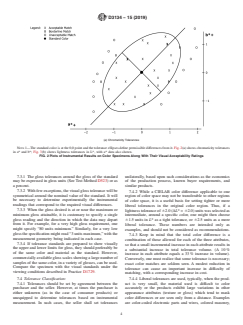
7.2.5.2 In such cases it is customary to plot the hue angle of
of color differences. Large gloss differences between visually
the standard by drawing a line from the origin (0, 0) through
identical colors can cause their color measurements to exhibit
the standard color on the a*b* plot. This line of constant hue
largercolordifferencesthaninfactexist.Whenusinghistorical
becomes the major axis. Similarly, a line perpendicular to the
data to establish color tolerances, exercise care to limit the
constant-hue line and passing through the standard color is a
specimens to those that have quite similar gloss values. When
line of constant chroma (or saturation) and becomes the minor
establishing gloss tolerances, be aware that changes in gloss
axis of the ellipse, if the data plot indicates the ellipse should
values may have an effect upon color measurements.
be symmetrical around the standard color. These lines assist in
7.2.3 Whencolordifferenceformulaeareusedinpractice,it
drawing the tolerance ellipse, Fig. 2(a).
is often desirable to identify the components of color
7.2.5.3 To determine lightness tolerances it is necessary to
difference, in terms of correlates of lightness, hue, and per-
plot the data for the same colors on a graph showing L* along
ceived chroma (saturation). It is also desirable to express color
with either a* and b*, and draw a tolerance ellipse as in Fig.
specificationsintermsofsuchcorrelates.TheCIEterminology
3(b). The choice between a* and b* is dictated by which of
appropriate to this usage is CIE 1976 lightness, CIE 1976
these attributes cover the greater range.
hue-angle, h , and CIE 1976 chroma, C* . Refer to Practice
ab ab
7.2.5.4 The scales on Fig. 2(a) and Fig. 3(b) are changed
D2244 and Practice E308 for equations and definitions. The
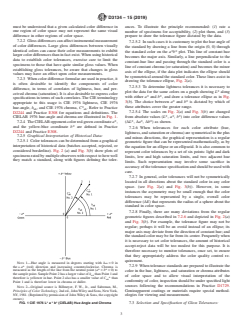
CIELAB 1976 hue-angle and chroma are illustrated in Fig. 1. from absolute values (L*, a*, b*) into color difference values
7.2.4 TheCIELABopponent-colorred-greencoordinate a*, (∆L*, ∆a*, ∆b*) as shown.
and the yellow-blue coordinate b* are defined in Practice
7.2.6 When tolerances for each color attribute (hue,
D2244 and Practice E308.
lightness,andsaturationorchroma)aresymmetricalintheplus
7.2.5 Graphical Interpretation of Historical Data:
and minus directions, the graphical representation is a regular
7.2.5.1 Color tolerances can be determined from a graphical
geometric figure that can be represented mathematically, as by
interpretation of historical data (batches accepted, rejected, or
the equation for an ellipse or an ellipsoid. It is also common to
considered borderline). Fig. 2 (a) and Fig. 3(b) show plots of
represent color tolerances by a set of six points: light and dark
specimensratedbymultipleobserverswithrespecttohowwell
limits, low and high saturation limits, and two adjacent hue
they match a standard, along with figures defining the toler-
limits. Such representation may involve some sacrifice in
accuracy of the tolerance specification and should be used with
care.
7.2.7 In general, color tolerances will not be symmetrically
located in all directions about the standard color in any color
space. (see Fig. 2(a) and Fig. 3(b)). However, in some
instances the asymmetry may be small enough that the color
tolerances may be represented by a single, overall color
difference (∆E) that represents the radius of a sphere about the
standard in color space.
7.2.8 Finally, there are many deviations from the regular
geometric figures described in 7.2.6 and depicted in Fig. 2(a)
and Fig. 3(b). For example, the tolerance figure may not be
regular; perhaps it will be an ovoid instead of an ellipse; its
major axis may deviate from the direction of constant hue; and
the sta
...