


ASTM E111-17
(Test Method)Standard Test Method for Young’s Modulus, Tangent Modulus, and Chord Modulus
Standard Test Method for Young’s Modulus, Tangent Modulus, and Chord Modulus
SIGNIFICANCE AND USE
5.1 The value of Young’s modulus is a material property useful in design for calculating compliance of structural materials that follow Hooke's law when subjected to uniaxial loading (that is, the strain is proportional to the applied force).
5.2 For materials that follow nonlinear elastic stress-strain behavior, the value of tangent or chord modulus is useful in estimating the change in strain for a specified range in stress.
5.3 Since for many materials, Young's modulus in tension is different from Young's modulus in compression, it shall be derived from test data obtained in the stress mode of interest.
5.4 The accuracy and precision of apparatus, test specimens, and procedural steps should be such as to conform to the material being tested and to a reference standard, if available.
5.5 Precise determination of Young’s modulus requires due regard for the numerous variables that may affect such determinations. These include (1) characteristics of the specimen such as orientation of grains relative to the direction of the stress, grain size, residual stress, previous strain history, dimensions, and eccentricity; (2) testing conditions, such as alignment of the specimen, speed of testing, temperature, temperature variations, condition of test equipment, ratio of error in applied force to the range in force values, and ratio of error in extension measurement to the range in extension values used in the determination; and (3) interpretation of data (see Section 9).
5.6 When the modulus determination is made at strains in excess of 0.25 %, correction shall be made for changes in cross-sectional area and gauge length, by substituting the instantaneous cross section and instantaneous gauge length for the original values.
5.7 Compression results may be affected by barreling (see Test Methods E9). Strain measurements should therefore be made in the specimen region where such effects are minimal.
SCOPE
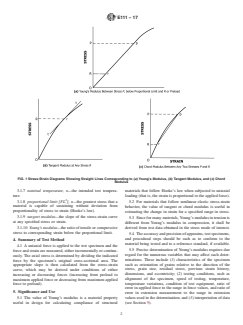
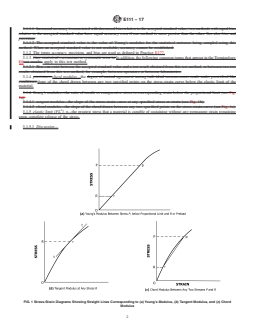
1.1 This test method covers the determination of Young's modulus, tangent modulus, and chord modulus of structural materials, see Fig. 1. This test method is limited to materials in which and to temperatures and stresses at which creep is negligible compared to the strain produced immediately upon loading and to elastic behavior.
FIG. 1 Stress-Strain Diagrams Showing Straight Lines Corresponding to (a) Young’s Modulus, (b) Tangent Modulus, and (c) Chord Modulus
1.2 Because of experimental problems associated with the establishment of the origin of the stress-strain curve described in 8.1, the determination of the initial tangent modulus (that is, the slope of the stress-strain curve at the origin) and the secant modulus are outside the scope of this test method.
1.3 The values stated in SI units are to be regarded as standard. No other units of measurement are included in this standard.
1.4 This standard does not purport to address all of the safety concerns, if any, associated with its use. It is the responsibility of the user of this standard to establish appropriate safety, health, and environmental practices and determine the applicability of regulatory limitations prior to use.
1.5 This international standard was developed in accordance with internationally recognized principles on standardization established in the Decision on Principles for the Development of International Standards, Guides and Recommendations issued by the World Trade Organization Technical Barriers to Trade (TBT) Committee.
General Information
- Status
- Published
- Publication Date
- 14-Jul-2017
- Technical Committee
- E28 - Mechanical Testing
- Drafting Committee
- E28.04 - Uniaxial Testing
Relations
- Effective Date
- 01-Jan-2024
- Effective Date
- 15-Jul-2016
- Effective Date
- 01-Feb-2015
- Effective Date
- 01-May-2014
- Effective Date
- 01-Jun-2013
- Effective Date
- 01-May-2013
- Effective Date
- 01-Jun-2012
- Effective Date
- 01-Jun-2012
- Effective Date
- 01-Dec-2011
- Effective Date
- 01-Oct-2010
- Effective Date
- 01-Jun-2010
- Effective Date
- 01-Jan-2010
- Refers
ASTM E9-09 - Standard Test Methods of Compression Testing of Metallic Materials at Room Temperature - Effective Date
- 01-Nov-2009
- Effective Date
- 15-May-2009
- Effective Date
- 15-May-2009
Overview
ASTM E111-17: Standard Test Method for Young’s Modulus, Tangent Modulus, and Chord Modulus defines procedures for determining the elastic properties of structural materials subjected to uniaxial force. This standard, developed by ASTM International, is crucial for engineers, quality control specialists, and researchers involved in mechanical testing, material compliance, and structural design.
The method focuses on measuring Young's modulus (a key indicator of stiffness), as well as tangent and chord moduli for materials within the elastic range. It is applicable only where creep is negligible compared to immediate strain and where elastic behavior is observed. The test supports material selection, component design, and verification of material integrity.
Key Topics
- Young’s Modulus: Measures the material’s stress-strain relationship in the linear (proportional) region, significant for materials following Hooke’s law.
- Tangent Modulus & Chord Modulus: Useful for estimating deformation in materials exhibiting non-linear elasticity, based on specific stress or strain intervals.
- Test Conditions: Considers specimen orientation, grain structure, testing temperature, and alignment to ensure accurate measurements.
- Precision and Bias: Emphasizes the need to control variables such as specimen characteristics, equipment calibration, and temperature uniformity, ensuring test repeatability and reducing systematic errors.
- Data Analysis: Recommends numerical methods such as least squares fitting for more reliable modulus calculations and encourages appropriate statistical evaluation of results.
Applications
The ASTM E111-17 test method is widely used in:
- Material Selection and Engineering Design: By providing accurate elastic modulus values, designers and engineers can predict how materials will perform under load, aiding in compliance and structural analysis.
- Quality Control in Manufacturing: Ensures that supplied materials meet mechanical property specifications, helping prevent service failures.
- Research and Development: Supports the characterization of new alloys, composites, and advanced structural materials under various temperature ranges.
- Education and Standardization: Offers a methodological foundation for training in mechanical testing, enhancing industry-wide consistency in modulus determination.
The method is suitable for metals, ceramics, polymers, and other structural materials, both in tensile and compressive loading modes. When using this test, it is critical to select the appropriate stress/strain range and control for confounding factors like temperature fluctuation and specimen eccentricity.
Related Standards
ASTM E111-17 is often used in conjunction with other standards to ensure comprehensive evaluation and compliance:
- ASTM E4: Practices for Force Verification of Testing Machines
- ASTM E6: Terminology Relating to Methods of Mechanical Testing
- ASTM E8/E8M: Test Methods for Tension Testing of Metallic Materials
- ASTM E9: Test Methods for Compression Testing of Metallic Materials at Room Temperature
- ASTM E21: Test Methods for Elevated Temperature Tension Tests of Metallic Materials
- ASTM E83: Practice for Verification and Classification of Extensometer Systems
- ASTM E1012: Practice for Verification of Testing Frame and Specimen Alignment Under Tensile and Compressive Axial Force Application
These related standards help users ensure the proper calibration, terminology, test specimen preparation, and alignment, which are essential for accurate modulus measurement according to ASTM E111-17.
By adhering to ASTM E111-17, material scientists and engineers are equipped to determine elastic properties precisely, advancing material innovation and structural safety across a broad spectrum of industries. For the most reliable and up-to-date requirements, always reference the latest ASTM documentation.
Buy Documents
ASTM E111-17 - Standard Test Method for Young’s Modulus, Tangent Modulus, and Chord Modulus
REDLINE ASTM E111-17 - Standard Test Method for Young’s Modulus, Tangent Modulus, and Chord Modulus
Get Certified
Connect with accredited certification bodies for this standard

Element Materials Technology
Materials testing and product certification.

Inštitut za kovinske materiale in tehnologije
Institute of Metals and Technology. Materials testing, metallurgical analysis, NDT.
Sponsored listings
Frequently Asked Questions
ASTM E111-17 is a standard published by ASTM International. Its full title is "Standard Test Method for Young’s Modulus, Tangent Modulus, and Chord Modulus". This standard covers: SIGNIFICANCE AND USE 5.1 The value of Young’s modulus is a material property useful in design for calculating compliance of structural materials that follow Hooke's law when subjected to uniaxial loading (that is, the strain is proportional to the applied force). 5.2 For materials that follow nonlinear elastic stress-strain behavior, the value of tangent or chord modulus is useful in estimating the change in strain for a specified range in stress. 5.3 Since for many materials, Young's modulus in tension is different from Young's modulus in compression, it shall be derived from test data obtained in the stress mode of interest. 5.4 The accuracy and precision of apparatus, test specimens, and procedural steps should be such as to conform to the material being tested and to a reference standard, if available. 5.5 Precise determination of Young’s modulus requires due regard for the numerous variables that may affect such determinations. These include (1) characteristics of the specimen such as orientation of grains relative to the direction of the stress, grain size, residual stress, previous strain history, dimensions, and eccentricity; (2) testing conditions, such as alignment of the specimen, speed of testing, temperature, temperature variations, condition of test equipment, ratio of error in applied force to the range in force values, and ratio of error in extension measurement to the range in extension values used in the determination; and (3) interpretation of data (see Section 9). 5.6 When the modulus determination is made at strains in excess of 0.25 %, correction shall be made for changes in cross-sectional area and gauge length, by substituting the instantaneous cross section and instantaneous gauge length for the original values. 5.7 Compression results may be affected by barreling (see Test Methods E9). Strain measurements should therefore be made in the specimen region where such effects are minimal. SCOPE 1.1 This test method covers the determination of Young's modulus, tangent modulus, and chord modulus of structural materials, see Fig. 1. This test method is limited to materials in which and to temperatures and stresses at which creep is negligible compared to the strain produced immediately upon loading and to elastic behavior. FIG. 1 Stress-Strain Diagrams Showing Straight Lines Corresponding to (a) Young’s Modulus, (b) Tangent Modulus, and (c) Chord Modulus 1.2 Because of experimental problems associated with the establishment of the origin of the stress-strain curve described in 8.1, the determination of the initial tangent modulus (that is, the slope of the stress-strain curve at the origin) and the secant modulus are outside the scope of this test method. 1.3 The values stated in SI units are to be regarded as standard. No other units of measurement are included in this standard. 1.4 This standard does not purport to address all of the safety concerns, if any, associated with its use. It is the responsibility of the user of this standard to establish appropriate safety, health, and environmental practices and determine the applicability of regulatory limitations prior to use. 1.5 This international standard was developed in accordance with internationally recognized principles on standardization established in the Decision on Principles for the Development of International Standards, Guides and Recommendations issued by the World Trade Organization Technical Barriers to Trade (TBT) Committee.
SIGNIFICANCE AND USE 5.1 The value of Young’s modulus is a material property useful in design for calculating compliance of structural materials that follow Hooke's law when subjected to uniaxial loading (that is, the strain is proportional to the applied force). 5.2 For materials that follow nonlinear elastic stress-strain behavior, the value of tangent or chord modulus is useful in estimating the change in strain for a specified range in stress. 5.3 Since for many materials, Young's modulus in tension is different from Young's modulus in compression, it shall be derived from test data obtained in the stress mode of interest. 5.4 The accuracy and precision of apparatus, test specimens, and procedural steps should be such as to conform to the material being tested and to a reference standard, if available. 5.5 Precise determination of Young’s modulus requires due regard for the numerous variables that may affect such determinations. These include (1) characteristics of the specimen such as orientation of grains relative to the direction of the stress, grain size, residual stress, previous strain history, dimensions, and eccentricity; (2) testing conditions, such as alignment of the specimen, speed of testing, temperature, temperature variations, condition of test equipment, ratio of error in applied force to the range in force values, and ratio of error in extension measurement to the range in extension values used in the determination; and (3) interpretation of data (see Section 9). 5.6 When the modulus determination is made at strains in excess of 0.25 %, correction shall be made for changes in cross-sectional area and gauge length, by substituting the instantaneous cross section and instantaneous gauge length for the original values. 5.7 Compression results may be affected by barreling (see Test Methods E9). Strain measurements should therefore be made in the specimen region where such effects are minimal. SCOPE 1.1 This test method covers the determination of Young's modulus, tangent modulus, and chord modulus of structural materials, see Fig. 1. This test method is limited to materials in which and to temperatures and stresses at which creep is negligible compared to the strain produced immediately upon loading and to elastic behavior. FIG. 1 Stress-Strain Diagrams Showing Straight Lines Corresponding to (a) Young’s Modulus, (b) Tangent Modulus, and (c) Chord Modulus 1.2 Because of experimental problems associated with the establishment of the origin of the stress-strain curve described in 8.1, the determination of the initial tangent modulus (that is, the slope of the stress-strain curve at the origin) and the secant modulus are outside the scope of this test method. 1.3 The values stated in SI units are to be regarded as standard. No other units of measurement are included in this standard. 1.4 This standard does not purport to address all of the safety concerns, if any, associated with its use. It is the responsibility of the user of this standard to establish appropriate safety, health, and environmental practices and determine the applicability of regulatory limitations prior to use. 1.5 This international standard was developed in accordance with internationally recognized principles on standardization established in the Decision on Principles for the Development of International Standards, Guides and Recommendations issued by the World Trade Organization Technical Barriers to Trade (TBT) Committee.
ASTM E111-17 is classified under the following ICS (International Classification for Standards) categories: 77.040.10 - Mechanical testing of metals. The ICS classification helps identify the subject area and facilitates finding related standards.
ASTM E111-17 has the following relationships with other standards: It is inter standard links to ASTM E8/E8M-24, ASTM E8/E8M-16, ASTM E8/E8M-15, ASTM E177-14, ASTM E8/E8M-13, ASTM E177-13, ASTM E1012-12e1, ASTM E1012-12, ASTM E8/E8M-11, ASTM E177-10, ASTM E83-10a, ASTM E83-10, ASTM E9-09, ASTM E6-09be1, ASTM E6-09b. Understanding these relationships helps ensure you are using the most current and applicable version of the standard.
ASTM E111-17 is available in PDF format for immediate download after purchase. The document can be added to your cart and obtained through the secure checkout process. Digital delivery ensures instant access to the complete standard document.
Standards Content (Sample)
This international standard was developed in accordance with internationally recognized principles on standardization established in the Decision on Principles for the
Development of International Standards, Guides and Recommendations issued by the World Trade Organization Technical Barriers to Trade (TBT) Committee.
Designation: E111 − 17
Standard Test Method for
Young’s Modulus, Tangent Modulus, and Chord Modulus
ThisstandardisissuedunderthefixeddesignationE111;thenumberimmediatelyfollowingthedesignationindicatestheyearoforiginal
adoptionor,inthecaseofrevision,theyearoflastrevision.Anumberinparenthesesindicatestheyearoflastreapproval.Asuperscript
epsilon (´) indicates an editorial change since the last revision or reapproval.
This standard has been approved for use by agencies of the U.S. Department of Defense.
1. Scope* E9Test Methods of Compression Testing of Metallic Mate-
rials at Room Temperature
1.1 This test method covers the determination of Young’s
E21TestMethodsforElevatedTemperatureTensionTestsof
modulus, tangent modulus, and chord modulus of structural
Metallic Materials
materials,seeFig.1.Thistestmethodislimitedtomaterialsin
E83Practice for Verification and Classification of Exten-
which and to temperatures and stresses at which creep is
someter Systems
negligible compared to the strain produced immediately upon
E177Practice for Use of the Terms Precision and Bias in
loading and to elastic behavior.
ASTM Test Methods
1.2 Because of experimental problems associated with the
E1012Practice for Verification of Testing Frame and Speci-
establishment of the origin of the stress-strain curve described
men Alignment Under Tensile and Compressive Axial
in 8.1, the determination of the initial tangent modulus (that is,
Force Application
the slope of the stress-strain curve at the origin) and the secant
2.2 General Considerations—While certain portions of the
modulus are outside the scope of this test method.
standards and practices listed are applicable and should be
1.3 The values stated in SI units are to be regarded as
referred to, the precision required in this test method is higher
standard. No other units of measurement are included in this
than that required in general testing.
standard.
1.4 This standard does not purport to address all of the
safety concerns, if any, associated with its use. It is the
3. Terminology
responsibility of the user of this standard to establish appro-
3.1 Definitions: Terms common to mechanical testing.
priate safety, health, and environmental practices and deter-
3.1.1 The definitions of mechanical testing terms that ap-
mine the applicability of regulatory limitations prior to use.
pear inTerminology E6 apply to this test method.These terms
1.5 This international standard was developed in accor-
include initial tangent modulus, secant modulus, gauge length,
dance with internationally recognized principles on standard-
yield strength, tensile strength, stress-strain diagram, and
ization established in the Decision on Principles for the
extensometer.
Development of International Standards, Guides and Recom-
3.1.2 The terms accuracy, precision, and bias are used as
mendations issued by the World Trade Organization Technical
defined in Practice E177.
Barriers to Trade (TBT) Committee.
3.1.3 In addition, the following common terms that appear
2. Referenced Documents in the Terminology E6 apply to this test method.
3.1.4 chord modulus—theslopeofthechorddrawnbetween
2.1 ASTM Standards:
any two specified points on the stress-strain curve below the
E6Terminology Relating to Methods of MechanicalTesting
elastic limit of the material.
E8/E8MTest Methods for Tension Testing of Metallic Ma-
terials
3.1.5 elastic limit [FL ], n—the greatest stress that a mate-
rial is capable of sustaining without any permanent strain
remaining upon complete release of the stress.
This test method is under the jurisdiction of ASTM Committee E28 on
3.1.5.1 Discussion—Due to practical considerations in de-
Mechanical Testing and is the direct responsibility of Subcommittee E28.04 on
Uniaxial Testing.
termining the elastic limit, measurements of strain using a
Current edition approved July 15, 2017. Published September 2017. Originally
small force, rather than zero force, are usually taken as the
approvedin1955.Lastpreviouseditionapprovedin2010asE111–04(2010).DOI:
initial and final reference.
10.1520/E0111-04R10
For referenced ASTM standards, visit the ASTM website, www.astm.org, or
3.1.6 indicated temperature, n—the temperature indicated
contact ASTM Customer Service at service@astm.org. For Annual Book of ASTM
by a temperature measuring device using good pyrometric
Standards volume information, refer to the standard’s Document Summary page on
the ASTM website. practice.
*A Summary of Changes section appears at the end of this standard
Copyright © ASTM International, 100 Barr Harbor Drive, PO Box C700, West Conshohocken, PA 19428-2959. United States
E111−17
FIG. 1 Stress-Strain Diagrams Showing Straight Lines Corresponding to (a) Young’s Modulus, (b) Tangent Modulus, and (c) Chord
Modulus
3.1.7 nominal temperature, n—the intended test tempera- materials that follow Hooke’s law when subjected to uniaxial
ture. loading (that is, the strain is proportional to the applied force).
3.1.8 proportional limit [FL ], n—the greatest stress that a
5.2 For materials that follow nonlinear elastic stress-strain
material is capable of sustaining without deviation from
behavior, the value of tangent or chord modulus is useful in
proportionality of stress to strain (Hooke’s law).
estimating the change in strain for a specified range in stress.
3.1.9 tangent modulus—the slope of the stress-strain curve
5.3 Sinceformanymaterials,Young’smodulusintensionis
at any specified stress or strain.
different from Young’s modulus in compression, it shall be
3.1.10 Young’s modulus—the ratio of tensile or compressive derived from test data obtained in the stress mode of interest.
stress to corresponding strain below the proportional limit.
5.4 Theaccuracyandprecisionofapparatus,testspecimens,
and procedural steps should be such as to conform to the
4. Summary of Test Method
material being tested and to a reference standard, if available.
4.1 Auniaxial force is applied to the test specimen and the
5.5 Precise determination of Young’s modulus requires due
force and strain are measured, either incrementally or continu-
regard for the numerous variables that may affect such deter-
ously. The axial stress is determined by dividing the indicated
minations. These include (1) characteristics of the specimen
force by the specimen’s original cross-sectional area. The
such as orientation of grains relative to the direction of the
appropriate slope is then calculated from the stress-strain
stress, grain size, residual stress, previous strain history,
curve, which may be derived under conditions of either
dimensions, and eccentricity; (2) testing conditions, such as
increasing or decreasing forces (increasing from preload to
alignment of the specimen, speed of testing, temperature,
maximum applied force or decreasing from maximum applied
temperature variations, condition of test equipment, ratio of
force to preload).
error in applied force to the range in force values, and ratio of
5. Significance and Use
error in extension measurement to the range in extension
5.1 The value of Young’s modulus is a material property values used in the determination; and (3) interpretation of data
useful in design for calculating compliance of structural (see Section 9).
E111−17
5.6 When the modulus determination is made at strains in 6.6 Low-Temperature Baths and Refrigeration Equipment—
excess of 0.25%, correction shall be made for changes in When determining Young’s modulus at temperatures below
cross-sectional area and gauge length, by substituting the room temperature, an appropriate low-temperature bath or
instantaneous cross section and instantaneous gauge length for refrigeration system shall be used to maintain the specimen at
the original values. the nominal temperature during testing. For a low-temperature
bath, the lower tension rod or adapter may pass through the
5.7 Compression results may be affected by barreling (see
bottom of an insulated container and be welded or fastened to
Test Methods E9). Strain measurements should therefore be
it to prevent leakage.
made in the specimen region where such effects are minimal.
NOTE 4—For nominal temperatures to about−80°C, chipped dry ice
6. Apparatus
that cools an organic solvent such as ethyl alcohol in the low-temperature
bath is suitable. Other organic solvents having lower solidification
6.1 Dead Weights—Calibrated dead weights may be used.
temperatures, such as methylcyclohexane or isopentane, cooled with
Any cumulative errors in the dead weights or the dead weight
liquid nitrogen are useful at temperatures lower than−80°C. Liquid
loading system shall not exceed 0.1%.
nitrogencanbeusedtoachieveanominaltemperatureof−196°C.Lower
nominaltemperaturesarepossiblewithliquidhydrogenandliquidhelium,
6.2 Testing Machines—In determining the suitability of a
withspecialcontainersorcryostatstominimizeheatleakageandtopermit
testing machine, the machine shall be calibrated under condi-
efficient use of these coolants. Liquid hydrogen can produce explosive
tions approximating those under which the determination is
mixtures of hydrogen gas and air. If refrigeration equipment is used to
made. Corrections may be applied to correct for proven
cool the specimens with air as the cooling medium, it is desirable to have
forced air circulation to provide uniform cooling.
systematic errors.
6.6.1 At low temperatures, when using a coolant bath,
6.3 Loading Fixtures—Loading fixtures shall be properly
immersion-type extensometers should be used.
designed and maintained. The allowable bending as defined in
Practice E1012 shall not exceed 5%.
6.7 Temperature measuring, controlling, and recording in-
struments shall be calibrated periodically against a secondary
NOTE 1— Grips and other devices for obtaining and maintaining axial
alignment are shown in Test Methods E8/E8M and E9. Procedures for
standard, such as a precision potentiometer. Lead-wire error
verifying the alignment are described in detail in Practice E1012.
shouldbecheckedwiththeleadwiresinplaceastheynormally
6.4 Extensometers—Class B-1 or better extensometers as are used.
described in Practice E83 shall be used. Corrections may be
applied for proven systematic errors in strain and are not
7. Test Specimens
considered as a change in class of the extensometer. Either an
7.1 Selection and Preparation of Specimens—Special care
averaging extensometer or the average of the strain measured
shall be taken to obtain representative specimens that are
by at least two extensometers arranged at equal intervals
straight and uniform in cross section. If straightening of the
aroundthecrosssectionshallbeused.Iftwoextensometersare
material for the specimen is required, then resultant residual
used on other than round sections, they shall be mounted at
stresses shall be removed by a subsequent stress relief anneal-
ends of an axis of symmetry of the section. If a force-strain
ing procedure that shall be reported with the test results.
recorder, strain-transfer device, or strain follower is used with
the extensometer, they shall be calibrated as a unit in the same 7.2 Dimensions—The specimen length (and fillet radius in
manner in which they are used for determination of Young’s the case of tension specimens) should be greater than the
modulus. The gauge length shall be determined with an minimum requirements for general-purpose specimens. In
accuracy consistent with the precision expected from the addition, the ratio of length to cross section of compression
modulus determination and from the extensometer. specimens should be such as to avoid buckling (see Test
Methods E9).
NOTE 2—The accuracy of the modulus determination depends on the
precision of the strain measurement. The latter can be improved by
NOTE5—Forexamplesoftensionandcompressionspecimens,seeTest
increasing the gauge length. This may, however, present problems in
Methods E8/E8M and E9.
maintaining specimen tolerances and temperature uniformity.
7.3 For tension specimens, the center lines of the grip
6.5 Furnaces or Heating Devices—When determining
sections and of the threads of threaded-end specimens shall be
Young’s modulus at elevated temperature, the furnace or
concentricwiththecenterlineofthegaugesectionwithinclose
heating device used shall be capable of maintaining a uniform
tolerances in order to obtain the degree of alignment required.
indicated temperature in the reduced section of the test
If pin-loaded sheet-type specimens are used, the centers of the
specimen so that a variation of not more than 61.5°C for
gripping holes shall be not more than 0.005 times the width of
nominaltemperaturesuptoandincluding900°C,andnotmore
the gauge section from its center line. For sheet-type
than 63.0°C for temperatures above 900°C, occurs. (Heating
specimens, small tabs or notches for attaching the extensom-
by self-resistance shall not be used.) Minimize indicated
eter may be used.
temperature variations and control changes within the allow-
able limits. An instrumented sample representative of the real
NOTE 6—The effect of eccentric loading can be illustrated by calculat-
ing the bending moment and stress thus added. For a standard 12.5-mm
test may be used demonstrate that the setup meets the above
diameter specimen, the stress increase is 1.5% for each 0.025 mm of
capabilities.
eccentricity.Thiserrorincreasestoabout2.5%per0.025mmfora9-mm
NOTE 3—Differences in thermal expansion between specimen and diameterspecimenandtoabout3.2%per0.025mmfora6-mmdiameter
extensometer parts can cause significant errors in apparent strain. specimen.
E111−17
specimenisstarted,variationsinthermalexpansionwillbereflectedinthe
7.4 The length of the reduced section of tension specimens
modulus line. Furthermore, fluctuations in temperature of the extensom-
shall exceed the gauge length by at least twice the diameter or
eter extensions during testing which result from cycling of the furnace
twice the width.The length of compression specimens shall be
temperature or changes in the level of the cooling bath can also affect the
in accordance with Test Methods E9, and all specimens shall
slope of the modulus line.
have a uniform cross-sectional area throughout the gauge
8.5 Speed of Testing—The speed of testing shall be low
length.
enough that thermal effects of adiabatic expansion or contrac-
7.4.1 If a general-purpose tension specimen such as those
tionarenegligibleandthataccuratedeterminationofforceand
shown in Test Methods E8/E8M, having a small amount of
extension is possible, yet the speed shall be high enough that
taperinthereducedsectionisused,theaveragecross-sectional
creep will be negligible. In loading with dead we
...
This document is not an ASTM standard and is intended only to provide the user of an ASTM standard an indication of what changes have been made to the previous version. Because
it may not be technically possible to adequately depict all changes accurately, ASTM recommends that users consult prior editions as appropriate. In all cases only the current version
of the standard as published by ASTM is to be considered the official document.
Designation: E111 − 04 (Reapproved 2010) E111 − 17
Standard Test Method for
Young’s Modulus, Tangent Modulus, and Chord Modulus
This standard is issued under the fixed designation E111; the number immediately following the designation indicates the year of original
adoption or, in the case of revision, the year of last revision. A number in parentheses indicates the year of last reapproval. A superscript
epsilon (´) indicates an editorial change since the last revision or reapproval.
This standard has been approved for use by agencies of the U.S. Department of Defense.
1. Scope Scope*
1.1 This test method covers the determination of Young’s modulus, tangent modulus, and chord modulus of structural materials.
materials, see Fig. 1. This test method is limited to materials in which and to temperatures and stresses at which creep is negligible
compared to the strain produced immediately upon loading and to elastic behavior.
1.2 Because of experimental problems associated with the establishment of the origin of the stress-strain curve described in 8.1,
the determination of the initial tangent modulus (that is, the slope of the stress-strain curve at the origin) and the secant modulus
are outside the scope of this test method.
1.3 The values stated in SI units are to be regarded as standard. No other units of measurement are included in this standard.
1.4 This standard does not purport to address all of the safety concerns, if any, associated with its use. It is the responsibility
of the user of this standard to establish appropriate safety safety, health, and healthenvironmental practices and determine the
applicability of regulatory requirementslimitations prior to use.
1.5 This international standard was developed in accordance with internationally recognized principles on standardization
established in the Decision on Principles for the Development of International Standards, Guides and Recommendations issued
by the World Trade Organization Technical Barriers to Trade (TBT) Committee.
2. Referenced Documents
2.1 ASTM Standards:
E4 Practices for Force Verification of Testing Machines
E6 Terminology Relating to Methods of Mechanical Testing
E8E8/E8M Test Methods for Tension Testing of Metallic Materials
E9 Test Methods of Compression Testing of Metallic Materials at Room Temperature
E21 Test Methods for Elevated Temperature Tension Tests of Metallic Materials
E83 Practice for Verification and Classification of Extensometer Systems
E231E177 MethodPractice for Static Determination of Young’s Modulus of Metals at Low and Elevated TemperaturesUse of the
Terms Precision and Bias in ASTM Test Methods (Withdrawn 1985)
E1012 Practice for Verification of Testing Frame and Specimen Alignment Under Tensile and Compressive Axial Force
Application
2.2 General Considerations—While certain portions of the standards and practices listed are applicable and should be referred
to, the precision required in this test method is higher than that required in general testing.
3. Terminology
3.1 Definitions: Terms common to mechanical testing.
3.1.1 accuracy—the degree of agreement between an accepted standard value of Young’sThe definitions of mechanical testing
terms that appear in Terminology E6 modulus (the average of many observations made according to this method, preferably by
many observers) and the value determined.apply to this test method. These terms include initial tangent modulus, secant modulus,
gauge length, yield strength, tensile strength, stress-strain diagram, and extensometer.
This test method is under the jurisdiction of ASTM Committee E28 on Mechanical Testing and is the direct responsibility of Subcommittee E28.04 on Uniaxial Testing.
Current edition approved Sept. 15, 2010July 15, 2017. Published January 2011September 2017. Originally approved in 1955. Last previous edition approved in 20042010
as E111 – 04.E111 – 04(2010). DOI: 10.1520/E0111-04R10
For referenced ASTM standards, visit the ASTM website, www.astm.org, or contact ASTM Customer Service at service@astm.org. For Annual Book of ASTM Standards
volume information, refer to the standard’s Document Summary page on the ASTM website.
*A Summary of Changes section appears at the end of this standard
Copyright © ASTM International, 100 Barr Harbor Drive, PO Box C700, West Conshohocken, PA 19428-2959. United States
E111 − 17
3.1.1.1 Increased accuracy is associated with decreased bias relative to the accepted standard value; two methods with equal bias
relative to the accepted standard value have equal accuracy even if one method is more precise than the other. See also bias and
precision.
3.1.1.2 The accepted standard value is the value of Young’s modulus for the statistical universe being sampled using this
method. When an accepted standard value is not available, accuracy cannot be established.
3.1.2 The terms accuracy, precision, and bias are used as defined in Practice E177.
3.1.3 bias, statistical—a constant or systematic error in In addition, the following common terms that appear in the Terminology
E6test results. apply to this test method.
3.1.2.1 Bias can exist between the accepted standard value and a test result obtained from this test method, or between two test
results obtained from this test method, for example, between operators or between laboratories.
3.1.4 precision—chord modulus—the degree of mutual agreement among individual measurements made under prescribed like
conditions.slope of the chord drawn between any two specified points on the stress-strain curve below the elastic limit of the
material.
3.1.4 Young’s modulus—the ratio of tensile or compressive stress to corresponding strain below the proportional limit (see Fig.
1a).
3.1.4.1 tangent modulus—the slope of the stress-strain curve at any specified stress or strain (see Fig. 1b).
3.1.4.2 chord modulus—the slope of the chord drawn between any two specified points on the stress-strain curve (see Fig. 1c).
3.1.5 elastic limit [FL ], n—the greatest stress that a material is capable of sustaining without any permanent strain remaining
upon complete release of the stress.
3.1.5.1 Discussion—
FIG. 1 Stress-Strain Diagrams Showing Straight Lines Corresponding to (a) Young’s Modulus, (b) Tangent Modulus, and (c) Chord
Modulus
E111 − 17
Due to practical considerations in determining the elastic limit, measurements of strain using a small force, rather than zero force,
are usually taken as the initial and final reference.
3.1.6 indicated temperature, n—the temperature indicated by a temperature measuring device using good pyrometric practice.
3.1.7 nominal temperature, n—the intended test temperature.
3.1.8 proportional limit [FL ], n—the greatest stress that a material is capable of sustaining without deviation from
proportionality of stress to strain (Hooke’s law).
3.1.9 tangent modulus—the slope of the stress-strain curve at any specified stress or strain.
3.1.10 Young’s modulus—the ratio of tensile or compressive stress to corresponding strain below the proportional limit.
3.2 For definitions of other terms used in this test method, refer to Terminology E6.
4. Summary of Test Method
4.1 A uniaxial force is applied to the test specimen and the force and strain are measured, either incrementally or continuously.
The axial stress is determined by dividing the indicated force by the specimen’s original cross-sectional area. The appropriate slope
is then calculated from the stress-strain curve, which may be derived under conditions of either increasing or decreasing forces
(increasing from preload to maximum applied force or decreasing from maximum applied force to preload).
5. Significance and Use
5.1 The value of Young’s modulus is a material property useful in design for calculating compliance of structural materials that
follow Hooke’s law when subjected to uniaxial loading (that is, the strain is proportional to the applied force).
5.2 For materials that follow nonlinear elastic stress-strain behavior, the value of tangent or chord modulus is useful in
estimating the change in strain for a specified range in stress.
5.3 Since for many materials, Young’s modulus in tension is different from Young’s modulus in compression, it shall be derived
from test data obtained in the stress mode of interest.
5.4 The accuracy and precision of apparatus, test specimens, and procedural steps should be such as to conform to the material
being tested and to a reference standard, if available.
5.5 Precise determination of Young’s modulus requires due regard for the numerous variables that may affect such
determinations. These include (1) characteristics of the specimen such as orientation of grains relative to the direction of the stress,
grain size, residual stress, previous strain history, dimensions, and eccentricity; (2) testing conditions, such as alignment of the
specimen, speed of testing, temperature, temperature variations, condition of test equipment, ratio of error in applied force to the
range in force values, and ratio of error in extension measurement to the range in extension values used in the determination; and
(3) interpretation of data (see Section 9).
5.6 When the modulus determination is made at strains in excess of 0.25 %, correction shouldshall be made for changes in
cross-sectional area and gagegauge length, by substituting the instantaneous cross section and instantaneous gagegauge length for
the original values.
5.7 Compression results may be affected by barreling (see Test Methods E9). Strain measurements should therefore be made
in the specimen region where such effects are minimal.
6. Apparatus
6.1 Dead Weights—Calibrated dead weights may be used. Any cumulative errors in the dead weights or the dead weight loading
system shall not exceed 0.1 %.
6.2 Testing Machines—In determining the suitability of a testing machine, the machine shall be calibrated under conditions
approximating those under which the determination is made. Corrections may be applied to correct for proven systematic errors.
6.3 Loading Fixtures—Grips and other devices for obtaining and maintaining axial alignment are shown in Test Methods
Loading E8 and E9. It is essential that the loading fixtures fixtures shall be properly designed and maintained. Procedures for
verifying the alignment are described in detail in Practice E1012. The allowable bending as defined in Practice E1012 shall not
exceed 5 %.
NOTE 1— Grips and other devices for obtaining and maintaining axial alignment are shown in Test Methods E8/E8M and E9. Procedures for verifying
the alignment are described in detail in Practice E1012.
6.4 Extensometers—Class B-1 or better extensometers as described in Practice E83 shall be used. Corrections may be applied
for proven systematic errors in strain and are not considered as a change in class of the extensometer. Either an averaging
extensometer or the average of the strain measured by at least two extensometers arranged at equal intervals around the cross
section shall be used. If two extensometers are used on other than round sections, they shall be mounted at ends of an axis of
symmetry of the section. If a force-strain recorder, strain-transfer device, or strain follower is used with the extensometer, they shall
E111 − 17
be calibrated as a unit in the same manner in which they are used for determination of Young’s modulus. The gagegauge length
shall be determined with an accuracy consistent with the precision expected from the modulus determination and from the
extensometer.
NOTE 2—The accuracy of the modulus determination depends on the precision of the strain measurement. The latter can be improved by increasing
the gagegauge length. This may, however, present problems in maintaining specimen tolerances and temperature uniformity.
6.5 Furnaces or Heating Devices—When determining Young’s modulus at elevated temperature, the furnace or heating device
used shall be capable of maintaining a uniform indicated temperature in the reduced section of the test specimen so that a variation
of not more than 61.5°C for nominal temperatures up to and including 900°C, and not more than 63.0°C for temperatures above
900°C, occurs. (Heating by self-resistance isshall not accepted.) be used.) Minimize indicated temperature variations and control
changes within the allowable limits, since differences in thermal expansion between specimen and extensometer parts may cause
significant errors in apparent strain. limits. An instrumented sample representative of the real test will may be used demonstrate
that the setup meets the above capabilities.
NOTE 3—Differences in thermal expansion between specimen and extensometer parts can cause significant errors in apparent strain.
6.6 Low-Temperature Baths and Refrigeration Equipment—When determining Young’s modulus at low temperatures,
temperatures below room temperature, an appropriate low-temperature bath or refrigeration system is required shall be used to
maintain the specimen at the specifiednominal temperature during testing. For a low-temperature bath, the lower tension rod or
adapter may pass through the bottom of an insulated container and be welded or fastened to it to prevent leakage. For temperatures
to about − 80°C, chipped dry ice may be used to cool an organic solvent such as ethyl alcohol in the low-temperature bath. Other
organic solvents having lower solidification temperatures, such as methylcyclohexane or isopentane, may be cooled with liquid
nitrogen to temperatures lower than − 80°C. Liquid nitrogen may be used to achieve a testing temperature of − 196°C. Lower
testing temperatures may be achieved with liquid hydrogen and liquid helium, but special containers or cryostats are required to
provide for minimum heat leakage to permit efficient use of these coolants. When liquid hydrogen is used, special precautions must
be taken to avoid explosions of hydrogen gas and air mixtures. If refrigeration equipment is used to cool the specimens with air
as the cooling medium, it is desirable to have forced air circulation to provide uniform cooling.
NOTE 4—At low temperatures, when using a coolant bath, immersion-type extensometers are recommended.For nominal temperatures to about − 80°C,
chipped dry ice that cools an organic solvent such as ethyl alcohol in the low-temperature bath is suitable. Other organic solvents having lower
solidification temperatures, such as methylcyclohexane or isopentane, cooled with liquid nitrogen are useful at temperatures lower than − 80°C. Liquid
nitrogen can be used to achieve a nominal temperature of − 196°C. Lower nominal temperatures are possible with liquid hydrogen and liquid helium,
with special containers or cryostats to minimize heat leakage and to permit efficient use of these coolants. Liquid hydrogen can produce explosive mixtures
of hydrogen gas and air. If refrigeration equipment is used to cool the specimens with air as the cooling medium, it is desirable to have forced air
circulation to provide uniform cooling.
6.6.1 At low temperatures, when using a coolant bath, immersion-type extensometers should be used.
6.7 Temperature measuring, controlling, and recording instruments shall be calibrated periodically against a secondary standard,
such as a precision potentiometer. Lead-wire error should be checked with the lead wires in place as they normally are used.
7. Test Specimens
7.1 Selection and Preparation of Specimens—Special care shall be taken to obtain representative specimens whichthat are
straight and uniform in cross section. If straightening of the material for the specimen is required, thethen resultant residual stresses
shall be removed by a subsequent stress relief heat treatment whichannealing procedure that shall be reported with the test results.
7.2 Dimensions—The recommended specimen length (and fillet radius in the case of tension specimens) is should be greater
than the minimum requirements for general-purpose specimens. In addition, the ratio of length to cross section of compression
specimens should be such as to avoid buckling (see Test Methods E9).
NOTE 5—For examples of tension and compression specimens, see Test Methods E8E8/E8M and E9.
7.3 For tension specimens, the center lines of the grip sections and of the threads of threaded-end specimens shall be concentric
with the center line of the gagegauge section within close tolerances in order to obtain the degree of alignment required. If
pin-loaded sheet-type specimens are used, the centers of the gripping holes shall be not more than 0.005 times the width of the
gagegauge section from its center line. For sheet-type specimens, it may be necessary to provide small tabs or notches for attaching
the extensometer.extensometer may be used.
NOTE 6—The effect of eccentric loading maycan be illustrated by calculating the bending moment and stress thus added. For a standard 12.5-mm
diameter specimen, the stress increase is 1.5 % for each 0.025 mm of eccentricity. This error increases to about 2.5 % per 0.025 mm for a 9-mm diameter
specimen and to about 3.2 % per 0.025 mm for a 6-mm diameter specimen.
7.4 The length of the reduced section of tension specimens shall exceed the gagegauge length by at least twice the diameter or
twice the width. The length of compression specimens shall be in accordance with Test Methods E9, and all specimens shall have
a uniform cross-sectional area throughout the gagegauge length.
NOTE 5—If a general-purpose tension specimen such as those shown in Test Methods E8, having a small amount of taper in the reduced section is used,
the average cross-sectional area for the gage length should be used in computing stress.
E111 − 17
7.4.1 If a general-purpose tension specimen such as those shown in Test Methods E8/E8M, having a small amount of taper in
the reduced section is used, the average cross-sectional area for the gauge length should be used in computing stress.
7.5 For compression specimens, the ends shall be flat, parallel and perpendicular to the lateral surfaces as specified in Test
Methods E9.
7.6 This test method is intended to produce intrinsic materials properties. Therefore, the specimen needs to The specimen shall
be free of residual stresses, which may require stresses. The specimen may be subjected to an annealing procedure at T /3 for 30
m
min to relieve the stresses in the material (where Tresidual stresses. is the melting point of the material in K). The procedure
m
must be mentioned in the report section. If the intent of the test is to verify the performance of a product, the heat treatment
annealing procedure may be omitted. RecordReport the condition of the material tested, including any heat treatment, in the test
report.annealing procedure.
NOTE 7—An annealing procedure at T /3 for 30 min to relieve the stresses in the material (where T is the melting point of the material in K) has
m m
been used successfully.
8. Procedure
8.1 For most loading systems and test specimens, effects of backlash, specimen curvature, initial grip alignment, etc., introduce
significant errors in the extensometer output when applying a small force to the test specimen. Measurements shall therefore
Measurements shall be made from a small force or preload, known to be high enough to minimize these effects, extensomer output
errors, to some higher applied force, still within either the proportional limit or elastic limit of the material. For linearly elastic
materials, the slope of the straight-line portion of the stress-strain curve shall be established between the preload and the
proportional limit to define Young’s modulus. If the actual stress-strain curve is desired, this line canmay appropriately be shifted
along the strain axis to coincide with the origin. For nonlinearly elastic materials the tangent or chord modulus may be established
between the appropriate stress values on the stress strain curve.
NOTE 8—For most loading systems and test specimens, effects of backlash, specimen curvature, initial grip alignment, etc., introduce significant errors
in the extensometer output when applying a small force to the test specimen.
8.2 Measurement of Specimens—Make the measurements for the determination of average cross-sectional area Measure
specimen dimensions at the ends of the gagegauge length and at least at one intermediate location. Use any means of measuring
that is capable of producing area calculations location to within 1 % accuracy.
8.3 Alignment—Take special care to ensure Ensure as nearly axial loading as possible. The strain increments between the
initial-load and the final-load measurement on opposite sides of the specimens should not differ from the average by more than
3 %.
8.4 Soaking Time of Specimens at Testing Temperature—After the specimen to be tested has reached the testingnominal
temperature, maintain the specimen at the testingnominal temperature for a sufficient length of time to attain equilibrium conditions
of the specimen and extensometer before applying force. Report the time to attain test the nominal temperature and the time at the
nominal temperature before applying force.
NOTE 9—The recommended soak time at the test temperature is 1 hour per 25 mm (1 hour/inch) of specimen thickness or diameter.
The recommended soak time at the nominal temperature is 1 hour per 25 mm (1 hour/inch) of specimen thickness or diameter. If the temperature of
the system is not uniform by the time loading of the specimen is started, variations in thermal expansion will be reflected in the modulus line. Furthermore,
fluctuations in temperature of the extensometer extensions during testing which result from cycling of the furnace temperature or changes in the level
of the cooling bath maycan also affect the slope of the modulus line.
8.5 Speed of Testing—The speed of testing shall be low enough that thermal effects of adiabatic expansion or contraction are
negl
...
Questions, Comments and Discussion
Ask us and Technical Secretary will try to provide an answer. You can facilitate discussion about the standard in here.
Loading comments...