


ASTM D5743-97(2013)
(Practice)Standard Practice for Sampling Single or Multilayered Liquids, With or Without Solids, in Drums or Similar Containers
Standard Practice for Sampling Single or Multilayered Liquids, With or Without Solids, in Drums or Similar Containers
SIGNIFICANCE AND USE
5.1 This practice is intended for use in collecting samples of single and multilayered liquids, with or without solids, from drums or similar containers, including those that are unstable, ruptured, or otherwise compromised. Special handling procedures (for example, remote drum opening, overpressurized drum opening, drum deheading, etc.) are described in Drum Handling Practices at Hazardous Waste Sites.
SCOPE
1.1 This practice covers typical equipment and methods for collecting samples of single or multilayered liquids, with or without solids, in drums or similar containers. These methods are adapted specifically for sampling drums having a volume of 110 gal (416 L) or less. These methods are applicable to hazardous material, product, or waste. Specific sample collection and handling requirements should be described in the site-specific work plan.
1.2 The values stated in inch-pound units are to be regarded as standard. The values given in parentheses are mathematical conversions to SI units that are provided for information only and are not considered standard.
1.3 This standard does not purport to address all of the safety concerns, if any, associated with its use. It is the responsibility of the user of this standard to establish appropriate safety and health practices and determine the applicability of regulatory limitations prior to use. Specific precautionary statements are given in 7.2.7.1 and Notes 1 and 2.
General Information
Standards Content (Sample)
NOTICE: This standard has either been superseded and replaced by a new version or withdrawn.
Contact ASTM International (www.astm.org) for the latest information
Designation: D5743 − 97 (Reapproved 2013)
Standard Practice for
Sampling Single or Multilayered Liquids, With or Without
Solids, in Drums or Similar Containers
This standard is issued under the fixed designation D5743; the number immediately following the designation indicates the year of
original adoption or, in the case of revision, the year of last revision. A number in parentheses indicates the year of last reapproval. A
superscript epsilon (´) indicates an editorial change since the last revision or reapproval.
1. Scope 2.2 Other Documents:
Drum Handling Practices at Hazardous Waste Sites, EPA/
1.1 This practice covers typical equipment and methods for
600/S2-86/013, PB 165362, October 1986
collecting samples of single or multilayered liquids, with or
Accident Prevention Manual; Engineering and Technol-
without solids, in drums or similar containers. These methods
ogy 13th Edition, 2009
areadaptedspecificallyforsamplingdrumshavingavolumeof
Occupational Safety and Health Guidance Manual for
110 gal (416 L) or less. These methods are applicable to
Hazardous Waste Site Activities, No. 85-115, October
hazardous material, product, or waste. Specific sample collec- 5
tion and handling requirements should be described in the
site-specific work plan.
3. Terminology
1.2 The values stated in inch-pound units are to be regarded
3.1 Definitions:
as standard. The values given in parentheses are mathematical 3.1.1 bonding—touching the sampling equipment to the
conversions to SI units that are provided for information only drum to form an electrically conductive path to minimize
and are not considered standard. potential electrical differences between the sampling equip-
ment and drum, reducing the buildup of static electricity.
1.3 This standard does not purport to address all of the
3.1.2 bung—usually a 2-in. (5.1-cm) or ⁄4-in. (1.3-cm)
safety concerns, if any, associated with its use. It is the
diameter threaded plug designed specifically to close a bung
responsibility of the user of this standard to establish appro-
hole.
priate safety and health practices and determine the applica-
bility of regulatory limitations prior to use. Specific precau- 3.1.3 bung hole—an opening in a barrel or drum through
tionary statements are given in 7.2.7.1 and Notes 1 and 2. which it can be filled, emptied, or vented.
3.1.4 deheading—removal of the lid of a closed-head drum;
2. Referenced Documents
it is usually accomplished with a drum deheader.
3.1.5 drum—implicitly any drum, barrel, or non-bulk con-
2.1 ASTM Standards:
tainer of 5 to 110-gal (19 to 416-L) capacity.
D4687 Guide for General Planning of Waste Sampling
D5088 Practice for Decontamination of Field Equipment
3.1.6 pail—a small container, usually of 5-gal (19-L) capac-
Used at Waste Sites
ity. Pails typically have bungs or spouts, or the entire lid can be
D5283 Practice for Generation of Environmental Data Re-
removed.
lated to Waste ManagementActivities: QualityAssurance
3.1.7 paperwork—all required site documentation, which
and Quality Control Planning and Implementation
may include the manifests, waste profiles, material safety data
D5495 Practice for Sampling With a Composite Liquid
sheets (MSDS), site forms, sample labels, seals, and chain of
Waste Sampler (COLIWASA)
custody forms.
3.1.8 sludge—any mixture of solids that settles out of
solution. Sludges contain liquids that are not apparent as free
This practice is under the jurisdiction of ASTM Committee D34 on Waste
liquids.
Management and is the direct responsibility of Subcommittee D34.01.02 on
Sampling Techniques.
Current edition approved April 1, 2013. Published April 2013. Originally
approved in 1995. Last previous edition approved in 2008 as D5743 – 97(2008). Available (for free) at http://www.epa.gov/nscep.
DOI: 10.1520/D5743-97R13. AvailablefromNationalSafetyCouncil,1121SpringLakeDr.,Itasca,IL60143
For referenced ASTM standards, visit the ASTM website, www.astm.org, or and at www.nsc.org.
contact ASTM Customer Service at service@astm.org. For Annual Book of ASTM Available from National Institute of Occupational Safety and Health (NIOSH)
Standards volume information, refer to the standard’s Document Summary page on at 800-356-4674 (hardcopy) or http://www. osha.gov/publications/complinks/
the ASTM website. OSHG-Hazwaste/4agency.html (download)
Copyright © ASTM International, 100 Barr Harbor Drive, PO Box C700, West Conshohocken, PA 19428-2959. United States
D5743 − 97 (2013)
3.1.9 work plan—a plan specific to a particular site; it is for should be protected from contamination.This may include, but
conducting activities specified in the plan. not be limited to, storage in aluminum foil, plastic bags,
polytetrafluoroethylene (PTFE) film, or other means of protec-
4. Summary of Practice
tion that will not impact the sample quality or intended
analysis.
4.1 Thedrumanditscontentsareinspected,andappropriate
sampling equipment is selected. A clean sampling device is
7.2 Basic Pre-Sampling Practices:
loweredslowlyintotheliquidtobesampled.Afterthematerial
7.2.1 Review all paperwork.
has entered the device, it is removed from the drum. The
7.2.2 Select the sampling equipment and sample containers
contents of the device are discharged into a sample container.
appropriateforthematerialinthedrum,asdetailedinthework
The sampling device is then either disposed of or cleaned and
plan.
decontaminated.
7.2.3 Enter the work zone.
5. Significance and Use
7.2.4 Inspect all drums to be sampled visually. Note any
5.1 This practice is intended for use in collecting samples of abnormal conditions (for example, rust marks, stains, bulges,
single and multilayered liquids, with or without solids, from or other signs of pressurization or leaks) that may require
drums or similar containers, including those that are unstable,
special handling. The work plan should clearly define the
ruptured, or otherwise compromised. Special handling proce- limiting conditions under which special handling procedures
dures (for example, remote drum opening, overpressurized
shall be initiated. See Drum Handling Practices at Hazardous
drum opening, drum deheading, etc.) are described in Drum
Waste Sites for information on opening overpressurized drums
Handling Practices at Hazardous Waste Sites.
and the use of remotely operated drum opening equipment.
7.2.5 Stage the drums to be sampled in a designated work
6. Interferences
area if they cannot be sampled in their current location. See
6.1 The condition of the materials to be sampled, and the
Drum Handling Practices at Hazardous Waste Sites for further
condition and accessibility of the drums, will have a significant
information on staging drums.
impact on the selection of sampling equipment.
7.2.5.1 Move the drums to upright stable positions if nec-
essary. Sufficient space shall be left between drums to prevent
7. Pre-Sampling
movement hazards.
7.1 General Principles and Precautions:
7.2.5.2 Allow adequate time for the drum contents to
7.1.1 Samples should be collected in accordance with an
stabilize if movement of a drum is required. The settling time
appropriate work plan (Practice D5283 and Guide D4687).
is dependent on the type of material expected.
This plan must include a worker health and safety section
7.2.5.3 Number or identify uniquely all drums to be
because there are potential hazards associated with opening
sampled.
drums as well as potentially hazardous contents. See the
7.2.6 Perform a detailed inspection of individual drums.
Occupational Safety and Health Guidance Manual for Haz-
ardous Waste Site Activities for information on health and 7.2.6.1 Record all relevant information from drum labels,
markings, data sheets, and so forth, in the field log book or on
safety at hazardous waste sites.
7.1.2 Correct sampling procedures must be applied to con- forms specified in the work plan.
ditions as they are encountered. It is impossible to specify rigid
7.2.6.2 Verify that there are no discrepancies with existing
rules describing the precise manner of sample collection
paperwork.
because of unknowns associated with each liquid sampling
7.2.6.3 Any discovered inconsistency from the paperwork
situation. It is essential that the samples be collected by a
(such as evidence of crystals on the drum exterior) should be
trained and experienced sampler because of the various con-
noted in the field log book.
ditions under which drummed liquids must be sampled.
7.2.7 Slowlyremovethebungorloosentheringthatsecures
7.1.3 To be able to make probability or confidence state-
the lid, allowing any pressure or vacuum to equalize.
ments concerning the properties of a sampled lot, the sampling
7.2.7.1 Precautionary Notes:
procedure must allow for some element of randomness in
(1) If the drum or pail appears to be under positive or
selection because of possible variations in the material. The
negative pressure (that is, a slight bulge or dimple in the lid),
sampler should always be on the alert for possible biases
control the release of pressure until it has equalized. For
arising from the use of a particular sampling device or from
example, if the drum or pail is equipped with bungs, loosen the
unexpected segregation within the material.
smaller bung first since doing so will make it easier to control
7.1.4 The sampling equipment, sample preparation
the release of pressure.
equipment,samplecontainers,etc.mustbeclean,dry,andinert
(2) Pails equipped with snap-on lids may be difficult to
tothematerialbeingsampled.Allequipment,includingsample
containers, must be inspected before use to ensure that they are open. Care must be exercised when opening to minimize the
potential of splashing of the contents.
clear of obvious dirt and contamination and are in good
working condition. Visible contamination must be removed, (3) If the top of the drum is dished inward (dimpled), it
may “pop” when equalizing pressure, spraying the sampler
and the equipment must be decontaminated with the appropri-
ate rinse materials. Decontaminated sampling equipment with any material that is sitting on top of the drum.
D5743 − 97 (2013)
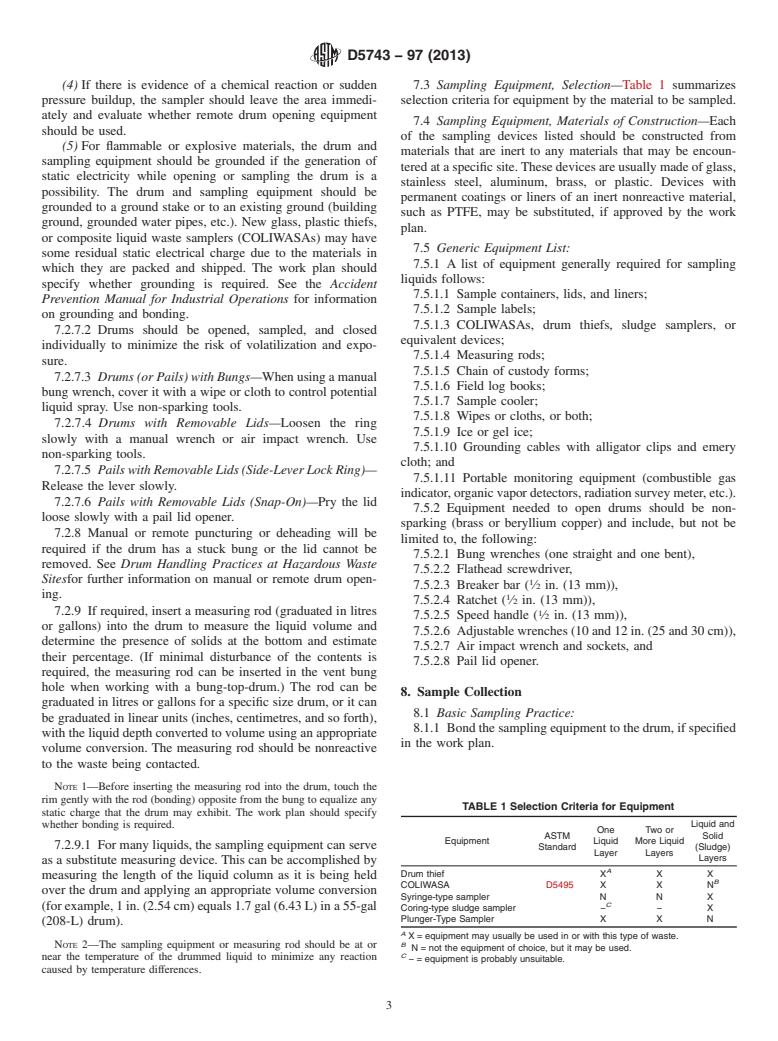
(4) If there is evidence of a chemical reaction or sudden 7.3 Sampling Equipment, Selection—Table 1 summarizes
pressure buildup, the sampler should leave the area immedi- selection criteria for equipment by the material to be sampled.
ately and evaluate whether remote drum opening equipment
7.4 Sampling Equipment, Materials of Construction—Each
should be used.
of the sampling devices listed should be constructed from
(5) For flammable or explosive materials, the drum and
materials that are inert to any materials that may be encoun-
sampling equipment should be grounded if the generation of
tered at a specific site.These devices are usually made of glass,
static electricity while opening or sampling the drum is a
stainless steel, aluminum, brass, or plastic. Devices with
possibility. The drum and sampling equipment should be
permanent coatings or liners of an inert nonreactive material,
grounded to a ground stake or to an existing ground (building
such as PTFE, may be substituted, if approved by the work
ground, grounded water pipes, etc.). New glass, plastic thiefs,
plan.
or composite liquid waste samplers (COLIWASAs) may have
7.5 Generic Equipment List:
some residual static electrical charge due to the materials in
7.5.1 A list of equipment generally required for sampling
which they are packed and shipped. The work plan should
liquids follows:
specify whether grounding is required. See the Accident
7.5.1.1 Sample containers, lids, and liners;
Prevention Manual for Industrial Operations for information
7.5.1.2 Sample labels;
on grounding and bonding.
7.5.1.3 COLIWASAs, drum thiefs, sludge samplers, or
7.2.7.2 Drums should be opened, sampled, and closed
equivalent devices;
individually to minimize the risk of volatilization and expo-
7.5.1.4 Measuring rods;
sure.
7.5.1.5 Chain of custody forms;
7.2.7.3 Drums (or Pails) with Bungs—Whenusingamanual
7.5.1.6 Field log books;
bung wrench, cover it with a wipe or cloth to control potential
7.5.1.7 Sample cooler;
liquid spray. Use non-sparking tools.
7.5.1.8 Wipes or cloths, or both;
7.2.7.4 Drums with Removable Lids—Loosen the ring
7.5.1.9 Ice or gel ice;
slowly with a manual wrench or air impact wrench. Use
7.5.1.10 Grounding cables with alligator clips and emery
non-sparking tools.
cloth; and
7.2.7.5 PailswithRemovableLids(Side-LeverLockRing)—
7.5.1.11 Portable monitoring equipment (combustible gas
Release the lever slowly.
indicator,organicvapordetectors,radiationsurveymeter,etc.).
7.2.7.6 Pails with Removable Lids (Snap-On)—Pry the lid
7.5.2 Equipment needed to open drums should be non-
loose slowly with a pail lid opener.
sparking (brass or beryllium copper) and include, but not be
7.2.8 Manual or remote puncturing or deheading will be
limited to, the following:
required if the drum has a stuck bung or the lid cannot be
7.5.2.1 Bung wrenches (one straight and one bent),
removed. See Drum Handling Practices at Hazardous Waste
7.5.2.2 Flathead screwdriver,
Sitesfor further information on manual or remote drum open-
7.5.2.3 Breaker bar ( ⁄2 in. (13 mm)),
ing.
7.5.2.4 Ratchet ( ⁄2 in. (13 mm)),
7.2.9 If required, insert a measuring rod (graduated in litres
7.5.2.5 Speed handle ( ⁄2 in. (13 mm)),
or gallons) into the drum to measure the liquid volume and
7.5.2.6 Adjustable wrenches (10 and 12 in. (25 and 30 cm)),
determine the presence of solids at the bottom and estimate
7.5.2.7 Air impact wrench and sockets, and
their percentage. (If minimal disturbance of the contents is
7.5.2.8 Pail lid opener.
required, the measuring rod can be inserted in the vent bung
hole when working with a bung-top-drum.) The rod can be
8. Sample Collection
graduated in litres or gallons for a specific size drum, or it can
8.1 Basic Sampling Practice:
be graduated in linear units (inches, centimetres, and so forth),
8.1.1 Bond the sampling equipment to the drum, if specified
with the liquid depth converted to volume using an appropriate
in the work plan.
volume conversion. The measuring rod should be nonreactive
to the waste being contacted.
NOTE 1—Before inserting the measuring rod into the drum, touch the
rim gently with the rod (bonding) opposite from the bung to equalize any
TABLE 1 Selection Criteria for Equipment
static charge that the drum may exhibit. The work plan should specify
whether bonding is required. Liquid and
One Two or
ASTM Solid
Equipment Liquid More Liquid
7.2.9.1 For many liquids, the sampling equipment can serve
Standard (Sludge)
Layer Layers
Layers
as a substitute measuring device. This can be accomplished by
A
Drum thief X XX
measuring the length of the liquid column as it is being held
B
...
Questions, Comments and Discussion
Ask us and Technical Secretary will try to provide an answer. You can facilitate discussion about the standard in here.