

ASTM B908-22
(Practice)Standard Practice for the Use of Color Codes for Zinc Casting Alloy Ingot
General Information
- Abstract
SIGNIFICANCE AND USE
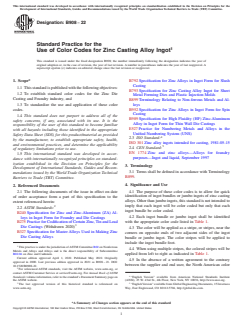
4.1 The purpose of these color codes is to allow for quick identification of ingot bundles or jumbo ingots of zinc casting alloys. Other than jumbo ingots, this standard is not intended to imply that each ingot will be color coded but only that each ingot bundle be color coded.
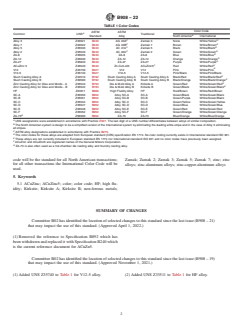
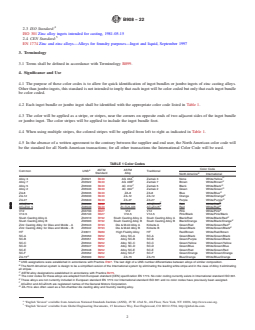
4.2 Each ingot bundle or jumbo ingot shall be identified with the appropriate color code listed in Table 1. (A) UNS assignations were established in accordance with Practice E527. The last digit of a UNS number differentiates between alloys of similar composition.(B) The North American system is design to be a simplified version of the International system by eliminating the leading white stripe and in the case of Alloy 3 eliminating all stripes.(C) ASTM alloy designations established in accordance with Practice B275.(D) The color codes for these alloys are adapted from European standard (CEN) specification EN 1774. No color coding currently exists in International standard ISO 301.(E) These alloys are not currently included in European standard EN 1774 nor International standard ISO 301 and no color codes have previously been assigned.(F) ACuZinc and ACuZinc5 are registered names of the General Motors Corporation.(G) ZA-73 is also often used as a hot-chamber die casting alloy and foundry casting alloy.
4.3 The color will be applied as a stripe, or stripes, near the corners on opposite ends of two adjacent sides of the ingot bundle or jumbo ingot. The color stripes will be applied to include the ingot bundle foot.
4.4 When using multiple stripes, the colored stripes will be applied from left to right as indicated in Table 1.
4.5 In the absence of a written agreement to the contrary between the supplier and end user, the North American color code will be the standard for all North American transactions; for all other transactions the International Color Code will be used.
SCOPE
1.1 This standard is published with the following objectives:
1.2 To establish standard color codes for the Zinc Die Casting and Foundry industry, and
1.3 To standardize the use and application of these color codes.
1.4 This standard does not purport to address all of the safety concerns, if any, associated with its use. It is the responsibility of the user of this standard to become familiar with all hazards including those identified in the appropriate Safety Data Sheet (SDS) for this product/material as provided by the manufacturer, to establish appropriate safety, health, and environmental practices, and determine the applicability of regulatory limitations prior to use.
1.5 This international standard was developed in accordance with internationally recognized principles on standardization established in the Decision on Principles for the Development of International Standards, Guides and Recommendations issued by the World Trade Organization Technical Barriers to Trade (TBT) Committee.
- Status
- Published
- Publication Date
- 31-Mar-2022
- Technical Committee
- B02 - Nonferrous Metals and Alloys
- Drafting Committee
- B02.04 - Zinc and Cadmium




Overview
ASTM B908-22: Standard Practice for the Use of Color Codes for Zinc Casting Alloy Ingot is a key industry guideline developed by ASTM International for the rapid identification of zinc casting alloy ingot bundles and jumbo ingots. This standard establishes a unified color-coding system to simplify and standardize the identification process for zinc die casting and foundry applications. It helps minimize errors and confusion in production, transport, storage, and procurement, providing a critical reference for the zinc alloys industry worldwide.
Key Topics
Purpose of Color Coding
The color codes are designed to enable swift visual identification of zinc alloy ingot bundles or jumbo ingots. Individual ingots are not typically color-coded unless part of a bundle, ensuring efficiency at scale.Application Methods
- Color stripes are applied to two adjacent sides and include the bundle foot.
- For multiple stripes, colors are applied left to right as specified in the standard.
Regional Color Code Systems
- North American System: Uses a simplified color code, often omitting the leading white stripe and with specific differences for certain alloys (e.g., Alloy 3).
- International System: Derived from the European standard EN 1774, providing broader global compatibility.
- In North America, the North American color code is standard unless otherwise agreed; elsewhere, the International Color Code applies.
Reference to Other Standards
- Unified Numbering System (UNS) numbers differentiate between similar alloys.
- Color codes are informed by ASTM, CEN (EN 1774), and adapted as necessary for alloys not included in all systems.
Safety Considerations
Users must ensure compliance with all relevant safety, health, and environmental practices, and consult Safety Data Sheets (SDS) for each zinc alloy product.
Applications
ASTM B908-22 is essential for:
Zinc Die Casting and Foundry Industry
- Rapid identification of alloys during production, reducing risk of cross-contamination or material mismatch.
- Streamlining supply chain operations by standardizing visual cues for material handlers, logistics teams, and end users.
Quality Assurance
- Supports quality control protocols by reducing the likelihood of error in material selection.
International Trade
- Facilitates smooth transactions and compliance across regions by referencing globally recognized coding systems and alloy standards.
Inventory Management
- Improves warehouse efficiency by allowing quick scanning and verification of alloy types within bundled ingots.
Related Standards
For comprehensive implementation and compliance, refer to these associated standards:
- ASTM B240: Specification for Zinc and Zinc-Aluminum (ZA) Alloys in Ingot Form for Foundry and Die Castings
- ASTM B275: Practice for Codification of Certain Zinc, Tin, and Lead Die Castings (Withdrawn 2020)
- ASTM B327: Specification for Master Alloys Used in Making Zinc Die Casting Alloys
- ASTM B792: Specification for Zinc Alloys in Ingot Form for Slush Casting
- ASTM B793: Specification for Zinc Casting Alloy Ingot for Sheet Metal Forming Dies and Plastic Injection Molds
- ASTM B899: Terminology Relating to Non-ferrous Metals and Alloys
- ASTM E527: Practice for Numbering Metals and Alloys in the Unified Numbering System (UNS)
- EN 1774: Zinc and Zinc Alloys - Alloys for Foundry Purposes - Ingot and Liquid
- ISO 301: Zinc Alloy Ingots Intended for Casting
Practical Value
Implementing ASTM B908-22 ensures consistency in color coding for zinc and zinc-aluminum casting alloy ingots, which minimizes material mix-ups, promotes international compatibility, and streamlines operations in manufacturing, storage, logistics, and end-use environments. By standardizing color identification practices, the zinc casting industry can operate more safely and efficiently, while also meeting global trade requirements and regulatory expectations.
Keywords: Zinc casting alloy, zinc ingot, color codes, zinc-aluminum alloys, Zamak, ACuZinc, die casting, foundry, ASTM B908, non-ferrous metals, material identification.
Relations
- Effective Date
- 01-Apr-2019
- Effective Date
- 01-Oct-2016
- Effective Date
- 01-Oct-2015
- Effective Date
- 01-Jun-2015
- Effective Date
- 01-Jun-2015
- Effective Date
- 01-Oct-2014
- Effective Date
- 01-Oct-2014
- Effective Date
- 01-Jun-2014
- Effective Date
- 01-Dec-2013
- Effective Date
- 01-Dec-2013
- Effective Date
- 01-Aug-2013
- Refers
ASTM B327-13a - Standard Specification for Master Alloys Used in Making Zinc Die Casting Alloys - Effective Date
- 01-Aug-2013
- Effective Date
- 01-Feb-2013
- Refers
ASTM B327-13 - Standard Specification for Master Alloys Used in Making Zinc Die Casting Alloys - Effective Date
- 01-Feb-2013
- Effective Date
- 01-Feb-2013
Get Certified
Connect with accredited certification bodies for this standard

Element Materials Technology
Materials testing and product certification.

Inštitut za kovinske materiale in tehnologije
Institute of Metals and Technology. Materials testing, metallurgical analysis, NDT.
Sponsored listings
Frequently Asked Questions
ASTM B908-22 is a standard published by ASTM International. Its full title is "Standard Practice for the Use of Color Codes for Zinc Casting Alloy Ingot". This standard covers: SIGNIFICANCE AND USE 4.1 The purpose of these color codes is to allow for quick identification of ingot bundles or jumbo ingots of zinc casting alloys. Other than jumbo ingots, this standard is not intended to imply that each ingot will be color coded but only that each ingot bundle be color coded. 4.2 Each ingot bundle or jumbo ingot shall be identified with the appropriate color code listed in Table 1. (A) UNS assignations were established in accordance with Practice E527. The last digit of a UNS number differentiates between alloys of similar composition.(B) The North American system is design to be a simplified version of the International system by eliminating the leading white stripe and in the case of Alloy 3 eliminating all stripes.(C) ASTM alloy designations established in accordance with Practice B275.(D) The color codes for these alloys are adapted from European standard (CEN) specification EN 1774. No color coding currently exists in International standard ISO 301.(E) These alloys are not currently included in European standard EN 1774 nor International standard ISO 301 and no color codes have previously been assigned.(F) ACuZinc and ACuZinc5 are registered names of the General Motors Corporation.(G) ZA-73 is also often used as a hot-chamber die casting alloy and foundry casting alloy. 4.3 The color will be applied as a stripe, or stripes, near the corners on opposite ends of two adjacent sides of the ingot bundle or jumbo ingot. The color stripes will be applied to include the ingot bundle foot. 4.4 When using multiple stripes, the colored stripes will be applied from left to right as indicated in Table 1. 4.5 In the absence of a written agreement to the contrary between the supplier and end user, the North American color code will be the standard for all North American transactions; for all other transactions the International Color Code will be used. SCOPE 1.1 This standard is published with the following objectives: 1.2 To establish standard color codes for the Zinc Die Casting and Foundry industry, and 1.3 To standardize the use and application of these color codes. 1.4 This standard does not purport to address all of the safety concerns, if any, associated with its use. It is the responsibility of the user of this standard to become familiar with all hazards including those identified in the appropriate Safety Data Sheet (SDS) for this product/material as provided by the manufacturer, to establish appropriate safety, health, and environmental practices, and determine the applicability of regulatory limitations prior to use. 1.5 This international standard was developed in accordance with internationally recognized principles on standardization established in the Decision on Principles for the Development of International Standards, Guides and Recommendations issued by the World Trade Organization Technical Barriers to Trade (TBT) Committee.
SIGNIFICANCE AND USE 4.1 The purpose of these color codes is to allow for quick identification of ingot bundles or jumbo ingots of zinc casting alloys. Other than jumbo ingots, this standard is not intended to imply that each ingot will be color coded but only that each ingot bundle be color coded. 4.2 Each ingot bundle or jumbo ingot shall be identified with the appropriate color code listed in Table 1. (A) UNS assignations were established in accordance with Practice E527. The last digit of a UNS number differentiates between alloys of similar composition.(B) The North American system is design to be a simplified version of the International system by eliminating the leading white stripe and in the case of Alloy 3 eliminating all stripes.(C) ASTM alloy designations established in accordance with Practice B275.(D) The color codes for these alloys are adapted from European standard (CEN) specification EN 1774. No color coding currently exists in International standard ISO 301.(E) These alloys are not currently included in European standard EN 1774 nor International standard ISO 301 and no color codes have previously been assigned.(F) ACuZinc and ACuZinc5 are registered names of the General Motors Corporation.(G) ZA-73 is also often used as a hot-chamber die casting alloy and foundry casting alloy. 4.3 The color will be applied as a stripe, or stripes, near the corners on opposite ends of two adjacent sides of the ingot bundle or jumbo ingot. The color stripes will be applied to include the ingot bundle foot. 4.4 When using multiple stripes, the colored stripes will be applied from left to right as indicated in Table 1. 4.5 In the absence of a written agreement to the contrary between the supplier and end user, the North American color code will be the standard for all North American transactions; for all other transactions the International Color Code will be used. SCOPE 1.1 This standard is published with the following objectives: 1.2 To establish standard color codes for the Zinc Die Casting and Foundry industry, and 1.3 To standardize the use and application of these color codes. 1.4 This standard does not purport to address all of the safety concerns, if any, associated with its use. It is the responsibility of the user of this standard to become familiar with all hazards including those identified in the appropriate Safety Data Sheet (SDS) for this product/material as provided by the manufacturer, to establish appropriate safety, health, and environmental practices, and determine the applicability of regulatory limitations prior to use. 1.5 This international standard was developed in accordance with internationally recognized principles on standardization established in the Decision on Principles for the Development of International Standards, Guides and Recommendations issued by the World Trade Organization Technical Barriers to Trade (TBT) Committee.
ASTM B908-22 is classified under the following ICS (International Classification for Standards) categories: 77.150.99 - Other products of non-ferrous metals. The ICS classification helps identify the subject area and facilitates finding related standards.
ASTM B908-22 has the following relationships with other standards: It is inter standard links to ASTM B989-19, ASTM B899-16, ASTM B899-15, ASTM B792-15, ASTM B793-15, ASTM B275-14, ASTM B899-14, ASTM B989-14, ASTM B275-13, ASTM B275-13e1, ASTM B275-05(2013), ASTM B327-13a, ASTM B792-13, ASTM B327-13, ASTM B899-13. Understanding these relationships helps ensure you are using the most current and applicable version of the standard.
ASTM B908-22 is available in PDF format for immediate download after purchase. The document can be added to your cart and obtained through the secure checkout process. Digital delivery ensures instant access to the complete standard document.
Standards Content (Sample)
This international standard was developed in accordance with internationally recognized principles on standardization established in the Decision on Principles for the
Development of International Standards, Guides and Recommendations issued by the World Trade Organization Technical Barriers to Trade (TBT) Committee.
Designation: B908 − 22
Standard Practice for the
Use of Color Codes for Zinc Casting Alloy Ingot
This standard is issued under the fixed designation B908; the number immediately following the designation indicates the year of
original adoption or, in the case of revision, the year of last revision. A number in parentheses indicates the year of last reapproval. A
superscript epsilon (´) indicates an editorial change since the last revision or reapproval.
1. Scope* B792 Specification for Zinc Alloys in Ingot Form for Slush
Casting
1.1 Thisstandardispublishedwiththefollowingobjectives:
B793 Specification for Zinc Casting Alloy Ingot for Sheet
1.2 To establish standard color codes for the Zinc Die
Metal Forming Dies and Plastic Injection Molds
Casting and Foundry industry, and
B899 Terminology Relating to Non-ferrous Metals and Al-
loys
1.3 To standardize the use and application of these color
codes. B952 Specification for Zinc Alloys in Ingot Form for Spin
Casting
1.4 This standard does not purport to address all of the
B989 Specification for High Fluidity (HF) Zinc-Aluminum
safety concerns, if any, associated with its use. It is the
Alloy in Ingot Form for Thin Wall Die Castings
responsibility of the user of this standard to become familiar
E527 Practice for Numbering Metals and Alloys in the
with all hazards including those identified in the appropriate
Unified Numbering System (UNS)
Safety Data Sheet (SDS) for this product/material as provided
2.3 ISO Standard:
by the manufacturer, to establish appropriate safety, health,
ISO 301 Zinc alloy ingots intended for casting, 1981-05-15
and environmental practices, and determine the applicability
2.4 CEN Standard:
of regulatory limitations prior to use.
EN 1774 Zinc and zinc alloys—Alloys for foundry
1.5 This international standard was developed in accor-
purposes—Ingot and liquid, September 1997
dance with internationally recognized principles on standard-
ization established in the Decision on Principles for the
3. Terminology
Development of International Standards, Guides and Recom-
3.1 Terms shall be defined in accordance with Terminology
mendations issued by the World Trade Organization Technical
B899.
Barriers to Trade (TBT) Committee.
4. Significance and Use
2. Referenced Documents
4.1 The purpose of these color codes is to allow for quick
2.1 The following documents of the issue in effect on date
identification of ingot bundles or jumbo ingots of zinc casting
of order acceptance form a part of this specification to the
alloys.Otherthanjumboingots,thisstandardisnotintendedto
extent referenced herein:
imply that each ingot will be color coded but only that each
2.2 ASTM Standards:
ingot bundle be color coded.
B240 Specification for Zinc and Zinc-Aluminum (ZA) Al-
4.2 Each ingot bundle or jumbo ingot shall be identified
loys in Ingot Form for Foundry and Die Castings
with the appropriate color code listed in Table 1.
B275 PracticeforCodificationofCertainZinc,TinandLead
Die Castings (Withdrawn 2020)
4.3 The color will be applied as a stripe, or stripes, near the
B327 Specification for Master Alloys Used in Making Zinc
corners on opposite ends of two adjacent sides of the ingot
Die Casting Alloys
bundle or jumbo ingot. The color stripes will be applied to
include the ingot bundle foot.
This practice is under the jurisdiction ofASTM Committee B02 on Nonferrous
4.4 When using multiple stripes, the colored stripes will be
Metals and Alloys and Alloys and is the direct responsibility of Subcommittee
applied from left to right as indicated in Table 1.
B02.04 on Zinc and Cadmium.
Current edition approved April 1, 2022. Published May 2022. Originally
4.5 In the absence of a written agreement to the contrary
approved in 2000. Last previous edition approved in 2021 as B908 – 21. DOI:
between the supplier and end user, the North American color
10.1520/B0908-22.
For referenced ASTM standards, visit the ASTM website, www.astm.org, or
contact ASTM Customer Service at service@astm.org. For Annual Book of ASTM
Standards volume information, refer to the standard’s Document Summary page on “English Version” available from American National Standards Institute
the ASTM website. (ANSI), 25 W. 43rd St., 4th Floor, New York, NY 10036, http://www.ansi.org.
The last approved version of this historical standard is referenced on “EnglishVersion” available from Global Engineering Documents, 15 Inverness
www.astm.org. Way, East Englewood, CO 80112-5704, http://global.ihs.com.
*A Summary of Changes section appears at the end of this standard
Copyright © ASTM International, 100 Barr Harbor Drive, PO Box C700, West Conshohocken, PA 19428-2959. United States
B908 − 22
TABLE 1 Color Codes
Color Code
ASTM AS
...
This document is not an ASTM standard and is intended only to provide the user of an ASTM standard an indication of what changes have been made to the previous version. Because
it may not be technically possible to adequately depict all changes accurately, ASTM recommends that users consult prior editions as appropriate. In all cases only the current version
of the standard as published by ASTM is to be considered the official document.
Designation: B908 − 21 B908 − 22
Standard Practice for the
Use of Color Codes for Zinc Casting Alloy Ingot
This standard is issued under the fixed designation B908; the number immediately following the designation indicates the year of
original adoption or, in the case of revision, the year of last revision. A number in parentheses indicates the year of last reapproval. A
superscript epsilon (´) indicates an editorial change since the last revision or reapproval.
1. Scope*
1.1 This standard is published with the following objectives:
1.2 To establish standard color codes for the Zinc Die Casting and Foundry industry, and
1.3 To standardize the use and application of these color codes.
1.4 This standard does not purport to address all of the safety concerns, if any, associated with its use. It is the responsibility
of the user of this standard to become familiar with all hazards including those identified in the appropriate Safety Data Sheet
(SDS) for this product/material as provided by the manufacturer, to establish appropriate safety, health, and environmental
practices, and determine the applicability of regulatory limitations prior to use.
1.5 This international standard was developed in accordance with internationally recognized principles on standardization
established in the Decision on Principles for the Development of International Standards, Guides and Recommendations issued
by the World Trade Organization Technical Barriers to Trade (TBT) Committee.
2. Referenced Documents
2.1 The following documents of the issue in effect on date of order acceptance form a part of this specification to the extent
referenced herein:
2.2 ASTM Standards:
B240 Specification for Zinc and Zinc-Aluminum (ZA) Alloys in Ingot Form for Foundry and Die Castings
B275 Practice for Codification of Certain Zinc, Tin and Lead Die Castings (Withdrawn 2020)
B327 Specification for Master Alloys Used in Making Zinc Die Casting Alloys
B792 Specification for Zinc Alloys in Ingot Form for Slush Casting
B793 Specification for Zinc Casting Alloy Ingot for Sheet Metal Forming Dies and Plastic Injection Molds
B892 Specification for ACuZinc5 (Zinc-Copper-Aluminum) Alloy in Ingot Form for Die Castings (Withdrawn 2022)
B899 Terminology Relating to Non-ferrous Metals and Alloys
B952 Specification for Zinc Alloys in Ingot Form for Spin Casting
B989 Specification for High Fluidity (HF) Zinc-Aluminum Alloy in Ingot Form for Thin Wall Die Castings
E527 Practice for Numbering Metals and Alloys in the Unified Numbering System (UNS)
This practice is under the jurisdiction of ASTM Committee B02 on Nonferrous Metals and Alloys and Alloys and is the direct responsibility of Subcommittee B02.04
on Zinc and Cadmium.
Current edition approved Nov. 1, 2021April 1, 2022. Published December 2021May 2022. Originally approved in 2000. Last previous edition approved in 20192021 as
B908 – 19.B908 – 21. DOI: 10.1520/B0908-21.10.1520/B0908-22.
For referenced ASTM standards, visit the ASTM website, www.astm.org, or contact ASTM Customer Service at service@astm.org. For Annual Book of ASTM Standards
volume information, refer to the standard’s Document Summary page on the ASTM website.
The last approved version of this historical standard is referenced on www.astm.org.
*A Summary of Changes section appears at the end of this standard
Copyright © ASTM International, 100 Barr Harbor Drive, PO Box C700, West Conshohocken, PA 19428-2959. United States
B908 − 22
2.3 ISO Standard:
ISO 301 Zinc alloy ingots intended for casting, 1981-05-15
2.4 CEN Standard:
EN 1774 Zinc and zinc alloys—Alloys for foundry purposes—Ingot and liquid, September 1997
3. Terminology
3.1 Terms shall be defined in accordance with Terminology B899.
4. Significance and Use
4.1 The purpose of these color codes is to allow for quick identification of ingot bundles or jumbo ingots of zinc casting alloys.
Other than jumbo ingots, this standard is not intended to imply that each ingot will be color coded but only that each ingot bundle
be color coded.
4.2 Each ingot bundle or jumbo ingot shall be identified with the appropriate color code listed in Table 1.
4.3 The color will be applied as a stripe, or stripes, near the corners on opposite ends of two adjacent sides of the ingot bundle
or jumbo ingot. The color stripes will be applied to include the ingot bundle foot.
4.4 When using multiple stripes, the colored stripes will be applied from left to right as indicated in Table 1.
4.5 In the absence of a written agreement to the contrary between the supplier and end user, the North American color code will
be the standard for all North American transactions; for all other transactions the International Color Code will be used.
TABLE 1 Color Codes
Color Code
ASTM ASTM
A
Common UNS Traditional
B
Standard Alloy
N
...