

ASTM B521-22
(Specification)Standard Specification for Tantalum and Tantalum Alloy Seamless and Welded Tubes
General Information
- Abstract
ABSTRACT
This specification covers tantalum and tantalum alloy seamless and welded tubes of the following grades: UNS Grade R05400 which is unalloyed tantalum, powder-metallurgy consolidation, UNS Grade R05200 which is unalloyed tantalum, vacuum melted, UNS Grade R05252 which is tantalum with 2.5% tungsten alloy, vacuum melted, UNS Grade R05255 which is tantalum with 10% tungsten alloy, vacuum melted, and UNS Grade R05240 which is tantalum alloy with 60% tantalum, 40% columbium, electron-beam furnace or vacuum arc melted, or both. Seamless tube shall be made by any seamless method and the welded tube shall be made from flat-rolled product by an automatic or semiautomatic fusion welding process with no addition of filler metal. Mechanical properties such as ultimate tensile strength, yield strength, and elongation shall be determined by tensile, flare, and reverse flattening tests. Nondestructive tests such as hydrostatic test, pneumatic test, helium leak test, and ultrasonic test shall be done as well.
SIGNIFICANCE AND USE
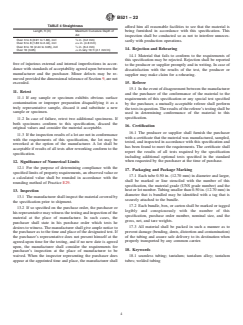
12.1 For the purpose of determining compliance with the specified limits of property requirements, an observed value or a calculated value shall be rounded in accordance with the rounding method of Practice E29.
SCOPE
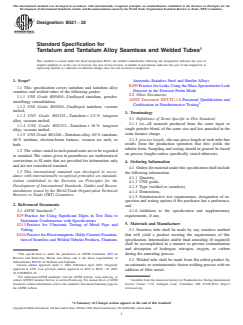
1.1 This specification covers tantalum and tantalum alloy seamless and welded tubes of the following grades:
1.1.1 UNS Grade R05400—Unalloyed tantalum, powder-metallurgy consolidation,
1.1.2 UNS Grade R05200—Unalloyed tantalum, vacuum melted,
1.1.3 UNS Grade R05252—Tantalum + 2.5 % tungsten alloy, vacuum melted.
1.1.4 UNS Grade R05255—Tantalum + 10 % tungsten alloy, vacuum melted.
1.1.5 UNS Grade R05240—Tantalum alloy, 60 % tantalum, 40 % niobium, electron-beam furnace, vacuum arc melt, or both.
1.2 The values stated in inch-pound units are to be regarded as standard. The values given in parentheses are mathematical conversions to SI units that are provided for information only and are not considered standard.
1.3 This international standard was developed in accordance with internationally recognized principles on standardization established in the Decision on Principles for the Development of International Standards, Guides and Recommendations issued by the World Trade Organization Technical Barriers to Trade (TBT) Committee.
- Status
- Published
- Publication Date
- 31-Mar-2022
- Technical Committee
- B10 - Reactive and Refractory Metals and Alloys
- Drafting Committee
- B10.03 - Niobium, Tantalum, and Vanadium
Buy Documents
ASTM B521-22 - Standard Specification for Tantalum and Tantalum Alloy Seamless and Welded Tubes
REDLINE ASTM B521-22 - Standard Specification for Tantalum and Tantalum Alloy Seamless and Welded Tubes
Overview
ASTM B521-22 is the standard specification from ASTM International covering the requirements for tantalum and tantalum alloy seamless and welded tubes. This standard applies to tubes manufactured from several grades, including unalloyed tantalum and tantalum alloys with tungsten or niobium, employing various melting and consolidating processes. ASTM B521-22 details key aspects such as chemical composition, mechanical properties, allowable tolerances, tests, inspection, packaging, and marking, ensuring consistent quality and performance for tantalum tubing products used in critical applications.
Keywords: tantalum tubes, tantalum alloys, ASTM B521, seamless tubing, welded tubing, chemical composition, mechanical properties, inspection, non-destructive testing
Key Topics
Material Grades Covered
- UNS R05400: Unalloyed tantalum, powder-metallurgy consolidation
- UNS R05200: Unalloyed tantalum, vacuum melted
- UNS R05252: Tantalum-2.5% tungsten alloy, vacuum melted
- UNS R05255: Tantalum-10% tungsten alloy, vacuum melted
- UNS R05240: Tantalum-60%, niobium-40% alloy, produced by electron-beam or vacuum arc melting
Tube Types
- Seamless Tubes: Manufactured by traditional seamless methods
- Welded Tubes: Produced from flat-rolled products using automatic or semi-automatic fusion welding without filler metal
Key Requirements
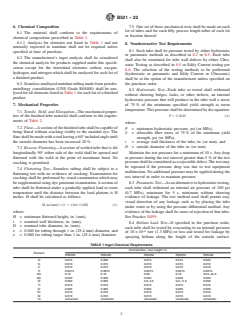
- Chemical Composition: Conforms to strict limits on elements such as oxygen, nitrogen, carbon, hydrogen, niobium, tungsten, and others, depending on the grade
- Mechanical Properties: Includes minimum tensile strength, yield strength, elongation, and ability to withstand flare and flattening tests
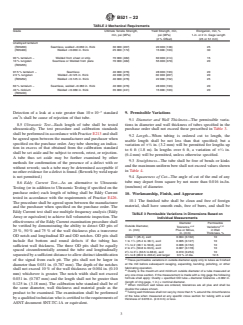
- Dimensional Tolerances: Specifies permissible variations in outside diameter, wall thickness, length, straightness, and squareness of cuts
Testing and Inspection
- Mechanical Tests: Tensile, flare, reverse flattening, and flattening tests are mandated per lot or production batch
- Nondestructive Examinations: Hydrostatic, pneumatic, helium leak, ultrasonic, and eddy current testing are outlined to ensure tube integrity
- Certification and Traceability: Producers must furnish certificates verifying compliance and test results; marking and packaging requirements ensure traceability
Applications
Tantalum and tantalum alloy tubing is valued for its exceptional corrosion resistance, high temperature stability, and bio-compatibility. Key industries and applications include:
- Chemical Processing: Heat exchangers, condensers, and piping systems handling corrosive chemicals and acids
- Aerospace: Engine components requiring high melting points and material strength
- Electronics: Components in capacitor manufacturing and in semiconductors for their stable electrical properties
- Medical Devices: Surgical instruments and implants where bio-compatibility and durability are critical
- Nuclear Applications: Tubing systems and components for handling radioactive materials safely
The performance of these tubes, as defined under ASTM B521-22, supports operational safety and reliability in highly demanding environments.
Related Standards
ASTM B521-22 references and aligns with several other ASTM and industry documents for mutual compatibility and best practices:
- ASTM E29: Practice for Using Significant Digits in Test Data to Determine Conformance with Specifications
- ASTM E213: Ultrasonic Testing of Metal Pipe and Tubing
- ASTM E426: Electromagnetic (Eddy Current) Examination of Seamless and Welded Tubular Products
- ASTM E499: Leak Testing Using the Mass Spectrometer Detector Probe Mode
- ASNT SNT-TC-1A: Personnel Qualification and Certification in Nondestructive Testing
By referencing these documents, ASTM B521-22 promotes international harmonization and reliable qualification of tantalum tubing for critical industrial applications.
For the latest version and full technical detail, always consult the official ASTM B521 standard.
Relations
- Effective Date
- 01-Aug-2012
- Effective Date
- 01-Jun-2009
- Effective Date
- 01-Oct-2008
- Effective Date
- 01-Dec-2007
- Effective Date
- 01-Dec-2006
- Effective Date
- 15-Nov-2006
- Effective Date
- 15-Sep-2006
- Effective Date
- 01-May-2006
- Effective Date
- 01-Dec-2004
- Effective Date
- 01-Jan-2004
- Effective Date
- 10-Jul-2003
- Effective Date
- 10-May-2002
- Effective Date
- 10-Jul-2000
- Effective Date
- 10-May-1999
- Effective Date
- 10-Dec-1998
Buy Documents
ASTM B521-22 - Standard Specification for Tantalum and Tantalum Alloy Seamless and Welded Tubes
REDLINE ASTM B521-22 - Standard Specification for Tantalum and Tantalum Alloy Seamless and Welded Tubes
Get Certified
Connect with accredited certification bodies for this standard

Element Materials Technology
Materials testing and product certification.

Inštitut za kovinske materiale in tehnologije
Institute of Metals and Technology. Materials testing, metallurgical analysis, NDT.
Sponsored listings
Frequently Asked Questions
ASTM B521-22 is a technical specification published by ASTM International. Its full title is "Standard Specification for Tantalum and Tantalum Alloy Seamless and Welded Tubes". This standard covers: ABSTRACT This specification covers tantalum and tantalum alloy seamless and welded tubes of the following grades: UNS Grade R05400 which is unalloyed tantalum, powder-metallurgy consolidation, UNS Grade R05200 which is unalloyed tantalum, vacuum melted, UNS Grade R05252 which is tantalum with 2.5% tungsten alloy, vacuum melted, UNS Grade R05255 which is tantalum with 10% tungsten alloy, vacuum melted, and UNS Grade R05240 which is tantalum alloy with 60% tantalum, 40% columbium, electron-beam furnace or vacuum arc melted, or both. Seamless tube shall be made by any seamless method and the welded tube shall be made from flat-rolled product by an automatic or semiautomatic fusion welding process with no addition of filler metal. Mechanical properties such as ultimate tensile strength, yield strength, and elongation shall be determined by tensile, flare, and reverse flattening tests. Nondestructive tests such as hydrostatic test, pneumatic test, helium leak test, and ultrasonic test shall be done as well. SIGNIFICANCE AND USE 12.1 For the purpose of determining compliance with the specified limits of property requirements, an observed value or a calculated value shall be rounded in accordance with the rounding method of Practice E29. SCOPE 1.1 This specification covers tantalum and tantalum alloy seamless and welded tubes of the following grades: 1.1.1 UNS Grade R05400—Unalloyed tantalum, powder-metallurgy consolidation, 1.1.2 UNS Grade R05200—Unalloyed tantalum, vacuum melted, 1.1.3 UNS Grade R05252—Tantalum + 2.5 % tungsten alloy, vacuum melted. 1.1.4 UNS Grade R05255—Tantalum + 10 % tungsten alloy, vacuum melted. 1.1.5 UNS Grade R05240—Tantalum alloy, 60 % tantalum, 40 % niobium, electron-beam furnace, vacuum arc melt, or both. 1.2 The values stated in inch-pound units are to be regarded as standard. The values given in parentheses are mathematical conversions to SI units that are provided for information only and are not considered standard. 1.3 This international standard was developed in accordance with internationally recognized principles on standardization established in the Decision on Principles for the Development of International Standards, Guides and Recommendations issued by the World Trade Organization Technical Barriers to Trade (TBT) Committee.
ABSTRACT This specification covers tantalum and tantalum alloy seamless and welded tubes of the following grades: UNS Grade R05400 which is unalloyed tantalum, powder-metallurgy consolidation, UNS Grade R05200 which is unalloyed tantalum, vacuum melted, UNS Grade R05252 which is tantalum with 2.5% tungsten alloy, vacuum melted, UNS Grade R05255 which is tantalum with 10% tungsten alloy, vacuum melted, and UNS Grade R05240 which is tantalum alloy with 60% tantalum, 40% columbium, electron-beam furnace or vacuum arc melted, or both. Seamless tube shall be made by any seamless method and the welded tube shall be made from flat-rolled product by an automatic or semiautomatic fusion welding process with no addition of filler metal. Mechanical properties such as ultimate tensile strength, yield strength, and elongation shall be determined by tensile, flare, and reverse flattening tests. Nondestructive tests such as hydrostatic test, pneumatic test, helium leak test, and ultrasonic test shall be done as well. SIGNIFICANCE AND USE 12.1 For the purpose of determining compliance with the specified limits of property requirements, an observed value or a calculated value shall be rounded in accordance with the rounding method of Practice E29. SCOPE 1.1 This specification covers tantalum and tantalum alloy seamless and welded tubes of the following grades: 1.1.1 UNS Grade R05400—Unalloyed tantalum, powder-metallurgy consolidation, 1.1.2 UNS Grade R05200—Unalloyed tantalum, vacuum melted, 1.1.3 UNS Grade R05252—Tantalum + 2.5 % tungsten alloy, vacuum melted. 1.1.4 UNS Grade R05255—Tantalum + 10 % tungsten alloy, vacuum melted. 1.1.5 UNS Grade R05240—Tantalum alloy, 60 % tantalum, 40 % niobium, electron-beam furnace, vacuum arc melt, or both. 1.2 The values stated in inch-pound units are to be regarded as standard. The values given in parentheses are mathematical conversions to SI units that are provided for information only and are not considered standard. 1.3 This international standard was developed in accordance with internationally recognized principles on standardization established in the Decision on Principles for the Development of International Standards, Guides and Recommendations issued by the World Trade Organization Technical Barriers to Trade (TBT) Committee.
ASTM B521-22 is classified under the following ICS (International Classification for Standards) categories: 77.150.99 - Other products of non-ferrous metals. The ICS classification helps identify the subject area and facilitates finding related standards.
ASTM B521-22 has the following relationships with other standards: It is inter standard links to ASTM E426-12, ASTM E213-09, ASTM E29-08, ASTM E426-98(2007), ASTM E499-95(2006), ASTM E29-06b, ASTM E29-06a, ASTM E29-06, ASTM E29-04, ASTM E213-04, ASTM E426-98(2003)e1, ASTM E29-02e1, ASTM E499-95(2000), ASTM E29-93a(1999), ASTM E426-98. Understanding these relationships helps ensure you are using the most current and applicable version of the standard.
ASTM B521-22 is available in PDF format for immediate download after purchase. The document can be added to your cart and obtained through the secure checkout process. Digital delivery ensures instant access to the complete standard document.
Standards Content (Sample)
This international standard was developed in accordance with internationally recognized principles on standardization established in the Decision on Principles for the
Development of International Standards, Guides and Recommendations issued by the World Trade Organization Technical Barriers to Trade (TBT) Committee.
Designation:B521 −22
Standard Specification for
Tantalum and Tantalum Alloy Seamless and Welded Tubes
This standard is issued under the fixed designation B521; the number immediately following the designation indicates the year of
original adoption or, in the case of revision, the year of last revision.Anumber in parentheses indicates the year of last reapproval.A
superscript epsilon (´) indicates an editorial change since the last revision or reapproval.
1. Scope* Austenitic Stainless Steel and Similar Alloys
E499Practice for Leaks Using the Mass Spectrometer Leak
1.1 This specification covers tantalum and tantalum alloy
Detector in the Detector Probe Mode
seamless and welded tubes of the following grades:
2.2 Other Documents:
1.1.1 UNS Grade R05400—Unalloyed tantalum, powder-
ASNT Document SNT-TC-1APersonnel Qualification and
metallurgy consolidation,
Certification in Nondestructive Testing
1.1.2 UNS Grade R05200—Unalloyed tantalum, vacuum
melted,
3. Terminology
1.1.3 UNS Grade R05252—Tantalum + 2.5 % tungsten
3.1 Definitions of Terms Specific to This Standard:
alloy, vacuum melted.
3.1.1 lot—all material produced from the same ingot or
1.1.4 UNS Grade R05255—Tantalum + 10 % tungsten
single powder blend, of the same size and last annealed in the
alloy, vacuum melted.
same furnace charge.
1.1.5 UNS Grade R05240—Tantalum alloy, 60% tantalum,
3.1.2 process length—the one-piece length of each tube that
40% niobium, electron-beam furnace, vacuum arc melt, or
results from the production operation that first yields the
both.
tubular form. Sampling and testing should in general be based
1.2 The values stated in inch-pound units are to be regarded
on process lengths unless specifically stated otherwise.
as standard. The values given in parentheses are mathematical
conversions to SI units that are provided for information only
4. Ordering Information
and are not considered standard.
4.1 Ordersformaterialunderthisspecificationshallinclude
1.3 This international standard was developed in accor-
the following information:
dance with internationally recognized principles on standard-
4.1.1 Quantity,
ization established in the Decision on Principles for the
4.1.2 UNS grade,
Development of International Standards, Guides and Recom-
4.1.3 Type (welded or seamless),
mendations issued by the World Trade Organization Technical
4.1.4 Dimensions,
Barriers to Trade (TBT) Committee.
4.1.5 Nondestructive test requirements, designation of in-
spection and testing options if the purchaser has a preference,
2. Referenced Documents
and
4.1.6 Additions to the specification and supplementary
2.1 ASTM Standards:
E29Practice for Using Significant Digits in Test Data to requirements, if any.
Determine Conformance with Specifications
5. Materials and Manufacture
E213Practice for Ultrasonic Testing of Metal Pipe and
Tubing 5.1 Seamless tube shall be made by any seamless method
E426PracticeforElectromagnetic(EddyCurrent)Examina- that will yield a product meeting the requirements of this
tion of Seamless and Welded Tubular Products, Titanium, specification. Intermediate and/or final annealing (if required)
shall be accomplished in a manner to prevent contamination
and absorption of hydrogen, nitrogen, oxygen, or carbon
This specification is under the jurisdiction of ASTM Committee B10 on during the annealing process.
Reactive and Refractory Metals and Alloys and is the direct responsibility of
5.2 Welded tube shall be made from flat-rolled product by
Subcommittee B10.03 on Niobium and Tantalum.
an automatic or semiautomatic fusion welding process with no
Current edition approved April 1, 2022. Published April 2022. Originally
approved in 1970. Last previous edition approved in 2019 as B521–19. DOI:
addition of filler metal.
10.1520/B0521-22.
For referenced ASTM standards, visit the ASTM website, www.astm.org, or
contact ASTM Customer Service at service@astm.org. For Annual Book of ASTM Available from the American Society for Nondestructive Testing International
Standards volume information, refer to the standard’s Document Summary page on Service Center, 1711 Arlingate Lane, Columbus, OH 43228-0518, https://
the ASTM website. www.asnt.org.
*A Summary of Changes section appears at the end of this standard
Copyright © ASTM International, 100 Barr Harbor Drive, PO Box C700, West Conshohocken, PA 19428-2959. United States
B521−22
6. Chemical Composition 7.5 One set of these mechanical tests shall be made on each
lot of tubes and for each fifty process length tubes of each lot
6.1 The material shall conform to the requirements of
or fraction thereof.
chemical composition prescribed in Table 1.
6.1.1 Analysis for elements not listed in Table 1 and not
8. Nondestructive Test Requirements
normally expected in tantalum shall not be required unless
8.1 Each tube shall be pressure tested by either hydrostatic
specified at time of purchase.
or pneumatic methods as described in 8.2 or 8.3. Each tube
6.2 The manufacturer’s ingot analysis shall be considered
shall also be examined for tube wall defects by either Ultra-
the chemical analysis for products supplied under this specifi-
sonic Testing as described in 8.5 or Eddy Current testing per
cation except for the interstitial elements carbon, oxygen,
8.6. The selection of the testing methods to be performed
hydrogen, and nitrogen which shall be analyzed for each lot of
(hydrostatic or pneumatic and Eddy Current or Ultrasonic)
a finished product.
shall be at the option of the manufacturer unless specified on
6.3 Seamlessunalloyedtantalumtubingmadefrompowder- the purchase order.
metallurgy consolidation (UNS Grade R05400) shall be ana-
8.2 Hydrostatic Test—Each tube so tested shall withstand
lyzedforallelementslistedinTable1foreachlotofafinished
without showing bulges, leaks, or other defects, an internal
product.
hydrostatic pressure that will produce in the tube wall a stress
of 75% of the minimum specified yield strength at room
7. Mechanical Properties
temperature.Thispressureshallbedeterminedbytheequation:
7.1 Tensile, Yield, and Elongation—The mechanical proper-
P 5 2 St/D (2)
ties of the finished tube material shall conform to the require-
ments of Table 2.
where:
7.2 Flare—Asectionofthefinishedtubeshallbecapableof
P = minimum hydrostatic pressure, psi (or MPa),
being flared without cracking visibly to the unaided eye. The
S = allowable fiber stress of 75% of the minimum yield
flareshallbemadewithatoolhavinga60°includedangleuntil
strength, psi (or MPa),
the outside diameter has been increased 20%.
t = average wall thickness of the tube, in. (or mm), and
D = outside diameter of the tube in. (or mm).
7.3 Reverse Flattening—Asectionofweldedtubethatisslit
Maintain the test pressure for a minimum of 10 s.Any drop
longitudinally 90° either side of the weld shall be opened and
flattened with the weld at the point of maximum bend. No in pressure during the test interval greater than 5% of the test
pressureshallbeconsideredasarejectabledefect.Thetestmay
cracking is permitted.
be repeated if the pressure drop was due to test equipment
7.4 Flattening Test—Seamless tubing shall be subject to a
malfunction. No additional pressure may be applied during the
flattening test with no evidence of cracking. Examination for
test interval in order to maintain pressure.
cracking shall be performed by visual examination which may
besupplementedusingdyepenetrantexamination.Asectionof 8.3 Pneumatic Test—Asanalternativetohydrostatictesting,
tube shall be flattened under a gradually applied load at room each tube shall withstand an internal air pressure of 100 psi
temperature until the distance between the load plattens is H (0.7 MPa), minimum for 5 s, minimum without showing
inches. H shall be calculated as follows: evidence of leakage. The test method used shall permit easy
visual detection of any leakage such as by placing the tube
H,in. mm 5 1 1 e t/e1 t/D (1)
~ ! ~ ! ~ !
under water or by using the pressure differential method. Any
where: evidence of the leakage shall be cause of rejection of that tube.
See Practice E499.
H = minimum flattened height, in. (mm),
t = nominal wall thickness, in. (mm),
8.4 Helium Leak Test—If specified in the purchase order,
D = nominal tube diameter, in. (mm),
each tube shall be tested by evacuating to an internal pressure
e = 0.040 for tubing through 1 in. (25.4 mm) diameter, and −6
of 10×10 torr (1.3 MPa) or less and tested for leakage by
e = 0.060 for tubing larger than 1 in. (25.4 mm) diameter.
spraying helium along the length of the outside surface.
TABLE 1 Ingot Chemical Requirements
(Composition, max weight %)
Element
R05200 R05400 R05252 R05255 R05240
O 0.015 0.030 0.015 0.015 0.020
N 0.010 0.010 0.010 0.010 0.010
C 0.010 0.010 0.010 0.010 0.010
H 0.0015 0.0015 0.0015 0.0015 0.0015
Nb 0.10 0.10 0.50 0.10 35.0–42.0
Mo 0.020 0.020 0.020 0.020 0.020
W 0.050 0.050 2.0–3.5 9.0–11.0 0.050
Ti 0.010 0.010 0.010 0.010 0.010
Si 0.005 0.005 0.005 0.005 0.005
Fe 0.010 0.010 0.010 0.010 0.010
Ni 0.010 0.010 0.010 0.010 0.010
Ta remainder remainder remainder remainder remainder
B521−22
TABLE 2 Mechanical Requirements
Grade Ultimate Tensile Strength, Yield Strength, min, Elongation, min, %
min, psi (MPa) psi (MPa) 1-in. or 2 in. Gage Length
(2 % Offset) (25or51mm)
Unalloyed tantalum
(R05200) Seamless, welded <0.060 in. thick 30 000 (207) 20 000 (138) 25
(R05400) Welded$0.060 in. thick 25 000 (172) 15 000 (103) 30
90 % tantalum – Welded from sheet or strip 70 000 (482) 60 000 (414) 15
10 % tungsten Seamless or Welded from plate 70 000 (482) 55 000 (379) 20
(R05255)
97.5 % tantalum – Seamless 40 000 (276) 28 000 (193) 20
2.5 % tungsten Welded <0.125 in. thick 40 000 (276) 30 000 (207) 20
(R05252) Welded$0.125 in. thick 40 000 (276) 22 000 (152) 25
60 % tantalum – Seamless, welded <0.060 in. thick 40 000 (276) 28 000 (193) 20
40 % niobium Welded$0.060 in. thick 35 000 (241) 15 000 (103) 20
(R05240)
−7
Detection of a leak at a rate greater than 10×10 standard 9. Permissible Variations
cm /s shall be cause of rejection of that tube.
9.1 Diameter and Wall Thickness—The permissible varia-
8.5 Ultrasonic Test—Each length of tube shall be tested tions in diameter and wall thickness of tubes specified in the
ultrasonically. The test procedure and calibration standards purchase order shall not exceed those prescribed in Table 3.
sha
...
This document is not an ASTM standard and is intended only to provide the user of an ASTM standard an indication of what changes have been made to the previous version. Because
it may not be technically possible to adequately depict all changes accurately, ASTM recommends that users consult prior editions as appropriate. In all cases only the current version
of the standard as published by ASTM is to be considered the official document.
Designation: B521 − 19 B521 − 22
Standard Specification for
Tantalum and Tantalum Alloy Seamless and Welded Tubes
This standard is issued under the fixed designation B521; the number immediately following the designation indicates the year of
original adoption or, in the case of revision, the year of last revision. A number in parentheses indicates the year of last reapproval. A
superscript epsilon (´) indicates an editorial change since the last revision or reapproval.
1. Scope Scope*
1.1 This specification covers tantalum and tantalum alloy seamless and welded tubes of the following grades:
1.1.1 UNS Grade R05400—Unalloyed tantalum, powder-metallurgy consolidation,
1.1.2 UNS Grade R05200—Unalloyed tantalum, vacuum melted,
1.1.3 UNS Grade R05252—Tantalum + 2.5 % tungsten alloy, vacuum melted.
1.1.4 UNS Grade R05255—Tantalum + 10 % tungsten alloy, vacuum melted.
1.1.5 UNS Grade R05240—Tantalum alloy, 60 % tantalum, 40 % niobium, electron-beam furnace or furnace, vacuum arc melt,
or both.
1.2 The values stated in inch-pound units are to be regarded as standard. The values given in parentheses are mathematical
conversions to SI units that are provided for information only and are not considered standard.
1.3 This international standard was developed in accordance with internationally recognized principles on standardization
established in the Decision on Principles for the Development of International Standards, Guides and Recommendations issued
by the World Trade Organization Technical Barriers to Trade (TBT) Committee.
2. Referenced Documents
2.1 ASTM Standards:
E29 Practice for Using Significant Digits in Test Data to Determine Conformance with Specifications
E213 Practice for Ultrasonic Testing of Metal Pipe and Tubing
E426 Practice for Electromagnetic (Eddy Current) Examination of Seamless and Welded Tubular Products, Titanium, Austenitic
Stainless Steel and Similar Alloys
E499 Practice for Leaks Using the Mass Spectrometer Leak Detector in the Detector Probe Mode
2.2 Other Documents:
ASNT Document SNT-TC-1A Personnel Qualification and Certification in Nondestructive Testing
This specification is under the jurisdiction of ASTM Committee B10 on Reactive and Refractory Metals and Alloys and is the direct responsibility of Subcommittee
B10.03 on Niobium and Tantalum.
Current edition approved Nov. 1, 2019April 1, 2022. Published December 2019April 2022. Originally approved in 1970. Last previous edition approved in 20122019 as
B521 – 12.B521 – 19. DOI: 10.1520/B0521-19.10.1520/B0521-22.
For referenced ASTM standards, visit the ASTM website, www.astm.org, or contact ASTM Customer Service at service@astm.org. For Annual Book of ASTM Standards
volume information, refer to the standard’s Document Summary page on the ASTM website.
Available from the American Society for Nondestructive Testing International Service Center, 1711 Arlingate Lane, Columbus, OH 43228-0518, https://www.asnt.org.
*A Summary of Changes section appears at the end of this standard
Copyright © ASTM International, 100 Barr Harbor Drive, PO Box C700, West Conshohocken, PA 19428-2959. United States
B521 − 22
3. Terminology
3.1 Definitions of Terms Specific to This Standard:
3.1.1 lot—all material produced from the same ingot or single powder blend, of the same size and last annealed in the same furnace
charge.
3.1.2 process length—the one-piece length of each tube that results from the production operation that first yields the tubular form.
Sampling and testing should in general be based on process lengths unless specifically stated otherwise.
4. Ordering Information
4.1 Orders for material under this specification shall include the following information:
4.1.1 Quantity,
4.1.2 UNS grade,
4.1.3 Type (welded or seamless),
4.1.4 Dimensions,
4.1.5 Nondestructive test requirements, designation of inspection and testing options if the purchaser has a preference, and
4.1.6 Additions to the specification and supplementary requirements, if any.
5. Materials and Manufacture
5.1 Seamless tube shall be made by any seamless method that will yield a product meeting the requirements of this specification.
Intermediate and/or final annealing (if required) shall be accomplished in a manner to prevent contamination and absorption of
hydrogen, nitrogen, oxygen, or carbon during the annealing process.
5.2 Welded tube shall be made from flat-rolled product by an automatic or semiautomatic fusion welding process with no addition
of filler metal.
6. Chemical Composition
6.1 The material shall conform to the requirements of chemical composition prescribed in Table 1.
6.1.1 Analysis for elements not listed in Table 1 and not normally expected in tantalum shall not be required unless specified at
time of purchase.
6.2 The manufacturer’s ingot analysis shall be considered the chemical analysis for products supplied under this specification
except for the interstitial elements carbon, oxygen, hydrogen, and nitrogen which shall be analyzed for each lot of a finished
product.
TABLE 1 Ingot Chemical Requirements
(Composition, max weight %)
Element
R05200 R05400 R05252 R05255 R05240
O 0.015 0.030 0.015 0.015 0.020
N 0.010 0.010 0.010 0.010 0.010
C 0.010 0.010 0.010 0.010 0.010
H 0.0015 0.0015 0.0015 0.0015 0.0015
Nb 0.10 0.10 0.50 0.10 35.0–42.0
Mo 0.020 0.020 0.020 0.020 0.020
W 0.050 0.050 2.0–3.5 9.0–11.0 0.050
Ti 0.010 0.010 0.010 0.010 0.010
Si 0.005 0.005 0.005 0.005 0.005
Fe 0.010 0.010 0.010 0.010 0.010
Ni 0.010 0.010 0.010 0.010 0.010
Ta remainder remainder remainder remainder remainder
B521 − 22
6.3 When requested by the purchaser at the time of purchase the manufacturer shall report the values of the interstitial elements
carbon, oxygen, hydrogen, and nitrogen as specified in Table 1 for each lot of finished product.
6.3 Seamless unalloyed tantalum tubing made from powder-metallurgy consolidation (UNS Grade R05400) shall be analyzed for
all elements listed in Table 1 for each lot of a finished product.
7. Mechanical Properties
7.1 Tensile—Tensile, Yield, and Elongation—The tensilemechanical properties of the finished tube material shall conform to the
requirements of Table 2.
7.2 Flare—A section of the finished tube shall be capable of being flared without cracking visibly to the unaided eye. The flare
shall be made with a tool having a 60° included angle until the outside diameter has been increased 20 %.
7.3 Reverse Flattening—A section of welded tube that is slit longitudinally 90° either side of the weld shall be opened and flattened
with the weld at the point of maximum bend. No cracking is permitted.
7.4 Flattening Test—Seamless tubing shall be subject to a flattening test with no evidence of cracking. Examination for cracking
shall be performed by visual examination which may be supplemented using dye penetrant examination. A section of tube shall
be flattened under a gradually applied load at room temperature until the distance between the load plattens is H inches. H shall
be calculated as follows:
H, in.~mm!5~1 1 e!t/e1~t/D! (1)
where:
H = minimum flattened height, in. (mm)
t = nominal wall thickness, in. (mm)
D = nominal tube diameter, in. (mm)
e = 0.040 for tubing through 1 in. (25.4 mm) diameter
e = 0.060 for tubing larger than 1 in. (25.4 mm) diameter
TABLE 2 Mechanical Requirements
R05200/R05400 R05252 R05255 R05240
Ultimate tensile strength, 30 000 (207) 40 000 (276) 70 000 (481) 40 000 (226)
min, psi (MPa)
Yield strength, 0.2 % 20 000 (138) 28 000 (193) 60 000 (414) 28 000 (193)
offset, min, psi (MPa)
Elongation, min %, in 1 or 25 20 15 20
2 in. (25 or 51 mm)
TABLE 2 Mechanical Requirements
Grade Ultimate Tensile Strength, Yield Strength, min, Elongation, min, %
min, psi (MPa) psi (MPa) 1-in. or 2 in. Gage Length
(2 % Offset) (25 or 51 mm)
Unalloyed tantalum
(R05200) Seamless, welded <0.060 in. thick 30 000 (207) 20 000 (138) 25
(R05400) Welded $0.060 in. thick 25 000 (172) 15 000 (103) 30
90 % tantalum – Welded from sheet or strip 70 000 (482) 60 000 (414) 15
10 % tungsten Seamless or Welded from plate 70 000 (482) 55 000 (379) 20
(R05255)
97.5 % tantalum – Seamless 40 000 (276) 28 000 (193) 20
2.5 % tungsten Welded <0.125 in. thick 40 000 (276) 30 000 (207) 20
(R05252) Welded $0.125 in. thick 40 000 (276) 22 000 (152) 25
60 % tantalum – Seamless, welded <0.060 in. thick 40 000 (276) 28 000 (193) 20
40 % niobium Welded $0.060 in. thick 35 000 (241) 15 000 (103) 20
(R05240)
B521 − 22
H = minimum flattened height, in. (mm),
t = nominal wall thickness, in. (mm),
D = nominal tube diameter, in. (mm),
e = 0.040 for tubing through 1 in. (25.4 mm) diameter, and
e = 0.060 for tubing larger than 1 in. (25.4 mm) diameter.
7.5 One set of these mechanical tests shall be made on each lot of tubes and for each fifty process length tubes of each lot or
fraction thereof.
8. Nondestructive Test Requirements
8.1 Each tube shall be pressure tested by either hydrostatic or pneumatic methods as described in 8.2 or 8.3. Each tube shall also
be examined for tube wall defects by either Ultrasonic Testing as described in 8.5 or Eddy Current testing per 8.6. The selection
of the testing methods to be performed (hydrostatic or pneumatic and Eddy Current or Ultrasonic) shall be at the option of the
manufacturer unless specified on the purchase order.
8.2 Hydrostatic Test—Each tube so tested shall withstand without showing bulges, leaks, or other defects, an internal hydrostatic
pressure that will produce in the tube wall a stress of 75 % of the minimum specified yield strength at room temperature. This
pressure shall be determined by the equation:
P 5 2 St/D (2)
where:
P = minimum hydrostatic pressure, psi (or MPa),
S = allowable fiber stress of 75 % of the minimum yield strength, psi (or MPa),
t = average wall thickness of the tube, in. (or mm), and
D = outside diameter of the tube in. (or mm).
Maintain the test pressure for a minimum of 10 s. Any drop in pressure during the test interval greater than 5 % of the test
pressure shall be considered as a rejectable defect. The test may be repeated if the pressure drop was due to test equipment
malfunction. No additional pressure may be applied during the test interval in order to maintain pressure.
8.3 Pneumatic Test—As an alternative to hydrostatic testing, each tube shall withstand an internal air pressure of 100 psi (0.7
MPa), minimum for 5 s, minimum without showing evidence of leakage. The test method used shall permit easy visual detection
of any leakage such as by placing the tube under water or by using the pressure differential method. Any evidence of the leakage
shall be cause of rejection of that tube. See Practice E499.
8.4 Helium Leak Test—If specified in the purchase order, each tube shall be tested by evacuating to an internal pressure of
−6
10 × 10 torr (1.3 MPa) or less and tested for leakage by spraying helium along the length of the ou
...