

ASTM F2999-19
(Specification)Standard Consumer Safety Specification for Adult Jewelry
General Information
- Abstract
SCOPE
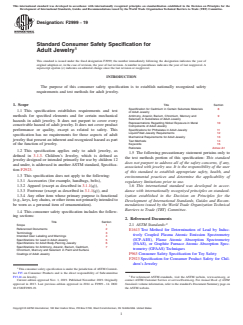
1.1 This specification establishes requirements and test methods for specified elements and for certain mechanical hazards in adult jewelry. It does not purport to cover every conceivable hazard of adult jewelry. It does not cover product performance or quality, except as related to safety. This specification has no requirements for those aspects of adult jewelry that present an inherent and recognized hazard as part of the function of jewelry.
1.2 This specification applies only to adult jewelry, as defined in 3.1.3. Children’s Jewelry, which is defined as jewelry designed or intended primarily for use by children 12 and under, is addressed in another ASTM standard, Specification F2923.
1.3 This specification does not apply to the following:
1.3.1 Accessories (for example, handbags, belts),
1.3.2 Apparel (except as described in 3.1.1(q)),
1.3.3 Footwear (except as described in 3.1.1(q)), and
1.3.4 Any other item whose primary purpose is functional (e.g., keys, key chains, or other items not primarily intended to be worn as a personal item of ornamentation).
1.4 This consumer safety specification includes the following sections:
Title
Section
Scope
1
Referenced Documents
2
Terminology
3
Intended User Labeling and Warnings
4
Specifications for Lead in Adult Jewelry
5
Specifications for Adult Body-Piercing Jewelry
6
Specifications for Antimony, Arsenic, Barium, Cadmium, Chromium, Mercury and Selenium in Paint and Surface Coatings of Adult Jewelry
7
Specification for Cadmium in Certain Substrate Materials of Adult Jewelry
8
Antimony, Arsenic, Barium, Chromium, Mercury and Selenium in Substrates of Adult Jewelry
9
Representations Regarding Nickel Exposure in Metal Components of Adult Jewelry
10
Specifications for Phthalates in Adult Jewelry
11
Liquid-Filled Jewelry Requirements
12
Mechanical Requirements for Adult Jewelry
13
Test Methods
14
Keywords
15
Rationale
Annex A1
1.5 The following precautionary statement pertains only to the test methods portion of this specification: This standard does not purport to address all of the safety concerns, if any, associated with jewelry use. It is the responsibility of the user of this standard to establish appropriate safety, health, and environmental practices and determine the applicability of regulatory limitations prior to use.
1.6 This international standard was developed in accordance with internationally recognized principles on standardization established in the Decision on Principles for the Development of International Standards, Guides and Recommendations issued by the World Trade Organization Technical Barriers to Trade (TBT) Committee.
- Status
- Published
- Publication Date
- 31-Oct-2019
- Technical Committee
- F15 - Consumer Products
- Drafting Committee
- F15.24 - Jewelry
Overview
ASTM F2999-19 is the internationally recognized Standard Consumer Safety Specification for Adult Jewelry, developed by ASTM International. This standard defines safety requirements, testing methods, and labeling guidelines to protect consumers from chemical and mechanical hazards associated with adult jewelry. It applies specifically to jewelry designed and intended for users over the age of 12, distinguishing adult jewelry from children’s jewelry, which is regulated under a separate standard (ASTM F2923). ASTM F2999-19 focuses solely on safety aspects, not encompassing product quality or performance beyond risk mitigation.
Key Topics
Intended Use and Scope
- Covers ornaments such as bracelets, rings, necklaces, earrings, anklets, brooches, and body piercing jewelry for adults.
- Excludes children’s jewelry, accessories (e.g., handbags, belts), footwear, and functional items (like keys or key chains).
Hazardous Substance Restrictions
- Limits the presence of specified elements in adult jewelry:
- Lead Content: Maximum allowable limits based on the type of material.
- Cadmium: Screening and migration limits for metal and plastic components.
- Antimony, Arsenic, Barium, Chromium, Mercury, Selenium: Restrictions on these elements in surface coatings.
- Nickel Exposure: Provides methods for substantiating claims regarding low nickel release, relevant for consumers with nickel sensitivities.
- Limits the presence of specified elements in adult jewelry:
Mechanical Safety Requirements
- Addresses risks associated with hazardous magnets, batteries, and small parts.
- Includes warning label requirements for jewelry containing potentially dangerous magnets or batteries.
User Labeling
- Recommends clear labeling such as “Not for children 12 and under” to identify intended users and differentiate from children’s jewelry.
Testing Methods
- Specifies approved chemical and mechanical test procedures to evaluate compliance.
- Allows for alternative testing if equivalency to ASTM methods can be demonstrated.
Applications
Businesses involved in the design, manufacturing, import, or sale of adult jewelry benefit from ASTM F2999-19 by ensuring their products meet recognized consumer safety standards. Typical stakeholders include:
- Manufacturers and Importers: Ensuring compliance with lead, cadmium, and other heavy metal content requirements helps mitigate liability and supports market access in regions that reference or mandate ASTM standards.
- Retailers: Demonstrating adherence to ASTM F2999-19 can reinforce consumer confidence and meet retail partners’ due diligence criteria.
- Testing Laboratories: Provides standardized analytical and physical testing methods for substance migration and mechanical hazards in jewelry.
- Regulatory Agencies: Utilized as a benchmark to assess potential risks and compliance in market surveillance efforts.
By minimizing hazardous substance exposure and addressing mechanical safety risks, ASTM F2999-19 helps protect consumers while supporting responsible business practices in the jewelry industry.
Related Standards
- ASTM F2923 - Specification for Consumer Product Safety for Children’s Jewelry
- ASTM F963 - Consumer Safety Specification for Toy Safety (contains related chemical test methods)
- EN 1811 / EN 12472 / CR 12471 - European standards for nickel release testing in jewelry and items in contact with skin
- CPSC Standards (U.S. Consumer Product Safety Commission) - Various test procedures for heavy metals in jewelry, including lead and cadmium
- EPA 3050B / 3051A / 3052 - EPA digestion methods for analysis of heavy metals
- 16 CFR 1500.14 - U.S. Code of Federal Regulations section covering labeling for hazardous substances
Keywords: adult jewelry safety, ASTM F2999-19, lead in jewelry, cadmium limits, heavy metal testing, jewelry consumer safety, nickel exposure, mechanical hazards, jewelry labeling, adult body piercing jewelry.
Relations
- Effective Date
- 01-Nov-2019
- Effective Date
- 01-Aug-2023
- Effective Date
- 01-Aug-2016
- Refers
ASTM F2923-14 - Standard Specification for Consumer Product Safety for Children’s Jewelry - Effective Date
- 01-Oct-2014
- Effective Date
- 01-Dec-2011
- Effective Date
- 01-Nov-2011
- Effective Date
- 01-Dec-2008
- Effective Date
- 15-Mar-2007
- Effective Date
- 01-Aug-2004
- Effective Date
- 01-Oct-2003
- Effective Date
- 10-Oct-1999
- Effective Date
- 10-Nov-1996
- Effective Date
- 10-Nov-1996
- Effective Date
- 10-Nov-1996
- Referred By
ASTM F2923-20 - Standard Specification for Consumer Product Safety for Children’s Jewelry - Effective Date
- 01-Nov-2019
Frequently Asked Questions
ASTM F2999-19 is a technical specification published by ASTM International. Its full title is "Standard Consumer Safety Specification for Adult Jewelry". This standard covers: SCOPE 1.1 This specification establishes requirements and test methods for specified elements and for certain mechanical hazards in adult jewelry. It does not purport to cover every conceivable hazard of adult jewelry. It does not cover product performance or quality, except as related to safety. This specification has no requirements for those aspects of adult jewelry that present an inherent and recognized hazard as part of the function of jewelry. 1.2 This specification applies only to adult jewelry, as defined in 3.1.3. Children’s Jewelry, which is defined as jewelry designed or intended primarily for use by children 12 and under, is addressed in another ASTM standard, Specification F2923. 1.3 This specification does not apply to the following: 1.3.1 Accessories (for example, handbags, belts), 1.3.2 Apparel (except as described in 3.1.1(q)), 1.3.3 Footwear (except as described in 3.1.1(q)), and 1.3.4 Any other item whose primary purpose is functional (e.g., keys, key chains, or other items not primarily intended to be worn as a personal item of ornamentation). 1.4 This consumer safety specification includes the following sections: Title Section Scope 1 Referenced Documents 2 Terminology 3 Intended User Labeling and Warnings 4 Specifications for Lead in Adult Jewelry 5 Specifications for Adult Body-Piercing Jewelry 6 Specifications for Antimony, Arsenic, Barium, Cadmium, Chromium, Mercury and Selenium in Paint and Surface Coatings of Adult Jewelry 7 Specification for Cadmium in Certain Substrate Materials of Adult Jewelry 8 Antimony, Arsenic, Barium, Chromium, Mercury and Selenium in Substrates of Adult Jewelry 9 Representations Regarding Nickel Exposure in Metal Components of Adult Jewelry 10 Specifications for Phthalates in Adult Jewelry 11 Liquid-Filled Jewelry Requirements 12 Mechanical Requirements for Adult Jewelry 13 Test Methods 14 Keywords 15 Rationale Annex A1 1.5 The following precautionary statement pertains only to the test methods portion of this specification: This standard does not purport to address all of the safety concerns, if any, associated with jewelry use. It is the responsibility of the user of this standard to establish appropriate safety, health, and environmental practices and determine the applicability of regulatory limitations prior to use. 1.6 This international standard was developed in accordance with internationally recognized principles on standardization established in the Decision on Principles for the Development of International Standards, Guides and Recommendations issued by the World Trade Organization Technical Barriers to Trade (TBT) Committee.
SCOPE 1.1 This specification establishes requirements and test methods for specified elements and for certain mechanical hazards in adult jewelry. It does not purport to cover every conceivable hazard of adult jewelry. It does not cover product performance or quality, except as related to safety. This specification has no requirements for those aspects of adult jewelry that present an inherent and recognized hazard as part of the function of jewelry. 1.2 This specification applies only to adult jewelry, as defined in 3.1.3. Children’s Jewelry, which is defined as jewelry designed or intended primarily for use by children 12 and under, is addressed in another ASTM standard, Specification F2923. 1.3 This specification does not apply to the following: 1.3.1 Accessories (for example, handbags, belts), 1.3.2 Apparel (except as described in 3.1.1(q)), 1.3.3 Footwear (except as described in 3.1.1(q)), and 1.3.4 Any other item whose primary purpose is functional (e.g., keys, key chains, or other items not primarily intended to be worn as a personal item of ornamentation). 1.4 This consumer safety specification includes the following sections: Title Section Scope 1 Referenced Documents 2 Terminology 3 Intended User Labeling and Warnings 4 Specifications for Lead in Adult Jewelry 5 Specifications for Adult Body-Piercing Jewelry 6 Specifications for Antimony, Arsenic, Barium, Cadmium, Chromium, Mercury and Selenium in Paint and Surface Coatings of Adult Jewelry 7 Specification for Cadmium in Certain Substrate Materials of Adult Jewelry 8 Antimony, Arsenic, Barium, Chromium, Mercury and Selenium in Substrates of Adult Jewelry 9 Representations Regarding Nickel Exposure in Metal Components of Adult Jewelry 10 Specifications for Phthalates in Adult Jewelry 11 Liquid-Filled Jewelry Requirements 12 Mechanical Requirements for Adult Jewelry 13 Test Methods 14 Keywords 15 Rationale Annex A1 1.5 The following precautionary statement pertains only to the test methods portion of this specification: This standard does not purport to address all of the safety concerns, if any, associated with jewelry use. It is the responsibility of the user of this standard to establish appropriate safety, health, and environmental practices and determine the applicability of regulatory limitations prior to use. 1.6 This international standard was developed in accordance with internationally recognized principles on standardization established in the Decision on Principles for the Development of International Standards, Guides and Recommendations issued by the World Trade Organization Technical Barriers to Trade (TBT) Committee.
ASTM F2999-19 is classified under the following ICS (International Classification for Standards) categories: 39.060 - Jewellery. The ICS classification helps identify the subject area and facilitates finding related standards.
ASTM F2999-19 has the following relationships with other standards: It is inter standard links to ASTM F2999-14, ASTM F963-23, ASTM F963-16, ASTM F2923-14, ASTM F963-11, ASTM F2923-11, ASTM F963-08, ASTM F963-07e1, ASTM E1613-04, ASTM F963-03, ASTM E1613-99, ASTM F963-96ae2, ASTM F963-96a, ASTM F963-96ae1, ASTM F2923-20. Understanding these relationships helps ensure you are using the most current and applicable version of the standard.
ASTM F2999-19 is available in PDF format for immediate download after purchase. The document can be added to your cart and obtained through the secure checkout process. Digital delivery ensures instant access to the complete standard document.
Standards Content (Sample)
This international standard was developed in accordance with internationally recognized principles on standardization established in the Decision on Principles for the
Development of International Standards, Guides and Recommendations issued by the World Trade Organization Technical Barriers to Trade (TBT) Committee.
Designation:F2999 −19
Standard Consumer Safety Specification for
Adult Jewelry
This standard is issued under the fixed designation F2999; the number immediately following the designation indicates the year of
original adoption or, in the case of revision, the year of last revision.Anumber in parentheses indicates the year of last reapproval.A
superscript epsilon (´) indicates an editorial change since the last revision or reapproval.
INTRODUCTION
The purpose of this consumer safety specification is to establish nationally recognized safety
requirements and test methods for adult jewelry.
1. Scope
Title Section
Specification for Cadmium in Certain Substrate Materials 8
1.1 This specification establishes requirements and test
of Adult Jewelry
Antimony, Arsenic, Barium, Chromium, Mercury and 9
methods for specified elements and for certain mechanical
Selenium in Substrates of Adult Jewelry
hazards in adult jewelry. It does not purport to cover every
Representations Regarding Nickel Exposure in Metal 10
conceivable hazard of adult jewelry. It does not cover product
Components of Adult Jewelry
Specifications for Phthalates in Adult Jewelry 11
performance or quality, except as related to safety. This
Liquid-Filled Jewelry Requirements 12
specification has no requirements for those aspects of adult
Mechanical Requirements for Adult Jewelry 13
jewelry that present an inherent and recognized hazard as part
Test Methods 14
of the function of jewelry. Keywords 15
Rationale Annex A1
1.2 This specification applies only to adult jewelry, as
1.5 The following precautionary statement pertains only to
defined in 3.1.3. Children’s Jewelry, which is defined as
the test methods portion of this specification: This standard
jewelry designed or intended primarily for use by children 12
does not purport to address all of the safety concerns, if any,
and under, is addressed in another ASTM standard, Specifica-
associated with jewelry use. It is the responsibility of the user
tion F2923.
of this standard to establish appropriate safety, health, and
1.3 This specification does not apply to the following:
environmental practices and determine the applicability of
1.3.1 Accessories (for example, handbags, belts),
regulatory limitations prior to use.
1.3.2 Apparel (except as described in 3.1.1(q)),
1.6 This international standard was developed in accor-
1.3.3 Footwear (except as described in 3.1.1(q)), and
dance with internationally recognized principles on standard-
1.3.4 Any other item whose primary purpose is functional
ization established in the Decision on Principles for the
(e.g.,keys,keychains,orotheritemsnotprimarilyintendedto
Development of International Standards, Guides and Recom-
be worn as a personal item of ornamentation).
mendations issued by the World Trade Organization Technical
Barriers to Trade (TBT) Committee.
1.4 This consumer safety specification includes the follow-
ing sections:
2. Referenced Documents
Title Section
Scope 1 2.1 ASTM Standards:
Referenced Documents 2
E1613Test Method for Determination of Lead by Induc-
Terminology 3
tively Coupled Plasma Atomic Emission Spectrometry
Intended User Labeling and Warnings 4
Specifications for Lead in Adult Jewelry 5 (ICP-AES), Flame Atomic Absorption Spectrometry
Specifications for Adult Body-Piercing Jewelry 6
(FAAS), or Graphite Furnace Atomic Absorption Spec-
Specifications for Antimony, Arsenic, Barium, Cadmium, 7
trometry (GFAAS) Techniques
Chromium, Mercury and Selenium in Paint and Surface
Coatings of Adult Jewelry
F963Consumer Safety Specification for Toy Safety
F2923Specification for Consumer Product Safety for Chil-
dren’s Jewelry
This consumer safety specification is under the jurisdiction ofASTM Commit-
tee F15 on Consumer Products and is the direct responsibility of Subcommittee
F15.24 on Jewelry. For referenced ASTM standards, visit the ASTM website, www.astm.org, or
Current edition approved Nov. 1, 2019. Published November 2019. Originally contact ASTM Customer Service at service@astm.org. For Annual Book of ASTM
approved in 2013. Last previous edition approved in 2014 as F2999–14. DOI: Standards volume information, refer to the standard’s Document Summary page on
10.1520/F2999-19. the ASTM website.
Copyright © ASTM International, 100 Barr Harbor Drive, PO Box C700, West Conshohocken, PA 19428-2959. United States
F2999−19
3 6
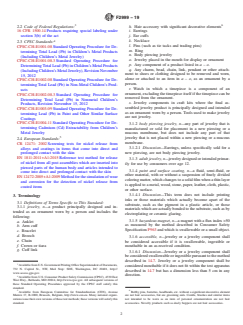
2.2 Code of Federal Regulations: h. Hair accessory with significant decorative elements
16 CFR 1500.14Products requiring special labeling under i. Earrings
section 3(b) of the act j. Ear cuffs
k. Necklace
2.3 CPSC Standards:
l. Pins (such as tie tacks and trading pins)
CPSC-CH-E1001-08Standard Operating Procedure for De-
m. Ring
termining Total Lead (Pb) in Children’s Metal Products
n. Body piercing jewelry
(Including Children’s Metal Jewelry)
o. Jewelry placed in the mouth for display or ornament
CPSC-CH-E1001-08.3Standard Operating Procedure for
p. Any component of a product listed in a – o.
DeterminingTotalLead(Pb)inChildren’sMetalProducts
q. Any charm, bead, chain, link, pendant or other attach-
(IncludingChildren’sMetalJewelry),RevisionNovember
ment to shoes or clothing designed to be removed and worn,
15, 2012
alone or attached to an item in a – o, as an ornament by a
CPSC-CH-E1002-08Standard Operating Procedure for De-
person.
termining Total Lead (Pb) in Non-Metal Children’s Prod-
r. Watch in which a timepiece is a component of an
ucts
ornament,excludingthetimepieceitselfifthetimepiececanbe
CPSC-CH-E1002-08.3Standard Operating Procedure for
removed from the ornament.
Determining Total Lead (Pb) in Nonmetal Children’s
s. Jewelry components in craft kits where the final as-
Products, Revision November 15, 2012
sembled jewelry product is principally designed and intended
CPSC-CH-E1003-09Standard Operating Procedure for De-
as an ornament worn by a person. Tools used to make jewelry
termining Lead (Pb) in Paint and Other Similar Surface
are not jewelry.
Coatings
CPSC-CH-E1004-11Standard Operating Procedure for De-
3.1.2 body piercing jewelry, n—any part of jewelry that is
termining Cadmium (Cd) Extractability from Children’s
manufactured or sold for placement in a new piercing or a
Metal Jewelry
mucous membrane, but does not include any part of that
jewelry that is not placed within a new piercing or a mucous
2.4 European Standards:
membrane.
CR 12471: 2002Screening tests for nickel release from
3.1.2.1 Discussion—Earrings, unless specifically sold for a
alloys and coatings in items that come into direct and
new piercing, are not body piercing jewelry.
prolonged contact with the skin
EN 1811:2011+A1:2015Reference test method for release
3.1.3 adultjewelry,n—jewelrydesignedorintendedprimar-
of nickel from all post assemblies which are inserted into
ily for use by consumers over age 12.
pierced parts of the human body and articles intended to
3.1.4 paint and surface coating, n—a fluid, semi-fluid, or
come into direct and prolonged contact with the skin
other material, with or without a suspension of finely divided
EN12472:2005+A1:2009Methodforthesimulationofwear
coloringmatter,whichchangestoasolidfilmwhenathinlayer
and corrosion for the detection of nickel release from
isappliedtoametal,wood,stone,paper,leather,cloth,plastic,
coated items
or other surface.
3.1.4.1 Discussion—This term does not include printing
3. Terminology
inks or those materials which actually become apart of the
3.1 Definitions of Terms Specific to This Standard:
substrate, such as the pigment in a plastic article, or those
3.1.1 jewelry, n—a product principally designed and in-
materialswhichareactuallybondedtothesubstrate,suchasby
tended as an ornament worn by a person and includes the
electroplating or ceramic glazing.
following:
3.1.5 hazardous magnet, n—a magnet with a flux index >50
a. Anklet
as measured by the method described in Consumer Safety
b. Arm cuff
SpecificationF963andwhichisswallowableorasmallobject.
c. Bracelet
d. Brooch
3.1.6 accessible, n—jewelry or a jewelry component shall
e. Chain
be considered accessible if it is swallowable, ingestible or
f. Crown or tiara
mouthable in an as-received condition.
g. Cuff link
3.1.6.1 Discussion—Jewelry or a jewelry component shall
beconsideredswallowableoringestiblepursuanttothemethod
described in 14.7. Jewelry or a jewelry component shall be
AvailablefromU.S.GovernmentPrintingOfficeSuperintendentofDocuments,
consideredmouthableifitdoesnotfitwithinthetestapparatus
732 N. Capitol St., NW, Mail Stop: SDE, Washington, DC 20401, http://
described in 14.7 but has a dimension less than 5 cm in any
www.access.gpo.gov.
direction.
AvailablefromU.S.ConsumerProductSafetyCommission(CPSC),4330East
West Hwy., Bethesda, MD 20814, http://www.cpsc.gov.All subsequent versions of
these Standard Operating Procedures approved by the CPSC staff satisfy this
standard.
5 6
Available from European Committee for Standardization (CEN), Avenue Bobby pins, barrettes, headbands, etc. without a significant decorative element
Marnix 17, B-1000, Brussels, Belgium, http://www.cen.eu. Many national organi- are not hair accessories, but are grooming aids. Combs, brushes and similar items
zationsissuetheirownversionsofthesetestmethods;theseversionswillsatisfythis not intended to be worn as an item of personal ornamentation are not hair
standard. accessories. Novelty products such as deely boppers are not hair accessories.
F2999−19
TABLE 1 Lead Content Limits for Adult Jewelry TABLE 2 Materials Excluded from Lead Limits in Adult Jewelry
Materials Covered Maximum Total Lead Limits Stainless or surgical steel within the designations of Unified
(Except as Excluded per Table 2) in Adult Jewelry Numbering System UNS S13800 – S66286, not including the
stainless steel designated as 303 Pb (UNS S30360), provided that
Electroplated metal with suitable under 6.0 %
no lead or lead-containing metal is intentionally added
and finish coats
Unplated metal 1.5 %
Precious metals: gold; sterling silver (at least 925/1000); platinum;
Plastic or rubber, including acrylic, 200 ppm
palladium; rhodium; osmium; iridium; ruthenium; titanium
polystyrene, plastic beads and stones,
and polyvinyl chloride (PVC)
Natural or cultured pearls
Materials not otherwise classified 600 ppm
Paint or surface coating 600 ppm
Precious gemstones: diamond, ruby, sapphire, emerald
Glass, ceramic, or crystal decorative components, including cat’s
eye, cubic zirconia, cubic zirconium (CZ), rhinestones, and cloisonné
4. Intended User Labeling and Warnings
Semiprecious gemstones and other minerals, provided they are not
4.1 Jewelry designed or intended primarily for use by
based on lead or lead compounds, excluding aragonite, bayldonite,
consumers over age 12 may include an age label reflecting the boleite, cerussite, crocoite, ekanite, linarite, mimetite, phosgenite,
samarskite, vanadinite and wulfenite
primary intended user for whom the product is designed and
intended, or a warning that the product is not intended for
Wood, provided it is not treated in any way to add lead
children. Examples of an age label might include, but are not
Paper and similar materials made from wood or other cellulosic fiber,
limited to, “Not for children 12 and younger,” “Not for <12,”
including, but not limited to, paperboard, linerboard and medium,
“For 13+,” “Adult use only,” or any similar language, symbol
and coatings on such paper that soak into the paper and cannot be
scraped off the surface
orcombinationdesignedtocommunicatetheprimaryintended
user. User labels, if provided, can appear in any reasonable
Elastic, fabric, ribbon, rope, or string, unless it contains intentionally
location where they will be seen and understood by the target
added lead
consumer.
All natural decorative material, including amber, bone, coral,
feathers, fur, horn, leather, shell or wood, that is in its natural state
5. Specification for Lead in Adult Jewelry
and is not treated in a way that adds lead
5.1 Lead Content Limits for Components of Adult Jewelry:
Adhesive
5.1.1 Accessible components of adult jewelry shall meet
the lead content limits of Table 1 unless the component is Repurposed components. Repurposed components are “found”
objects that are incorporated into jewelry, and may include, but are
excluded per Table 2.
not limited to, silver or pewter utensils, bottle caps, buttons.
5.1.2 References—Tests for total lead content shall be con-
ducted in accordance with a method appropriate for the
material in 14.1.
TABLE 3 Approved Materials for Adult Body-Piercing Jewelry
5.2 Exclusions from Lead Content Testing Requirements in
Surgical implant stainless steel
Surgical implant grade titanium
Adult Jewelry:
Niobium (Nb)
5.2.1 The materials listed in Table 2 are excluded from
Solid 14 karat or higher white or nickel-free gold
testingfortotalleadcontentinanycomponentofadultjewelry. Solid platinum
A dense, low-porosity plastic, including, but not limited to, Tygon or
polytetrafluoroethylene (PTFE) if the plastic contains no intentionally
6. Specifications for Adult Body-Piercing Jewelry
added lead
6.1 Body-piercing jewelry shall be made exclusively of the
materials listed in Table 3.
withthetestmethoddescribedin14.2priortocomparingthem
7. Specifications for Antimony, Arsenic, Barium,
tothevaluesinTable4todetermineconformance.Thesoluble
Cadmium, Chromium, Mercury, and Selenium in
level shall be determined by dissolving the contained solids
Paint and Surface Coatings of Adult Jewelry
(dried film including pigments, film solids, and driers) as
7.1 Surface-coating materials applied on or to adult jewelry
specified in 14.2.
shall not contain compounds of antimony, arsenic, barium,
7.2 Reference—Specification F2923; Consumer Safety
cadmium,chromium,mercury,orselenium,ofwhichthemetal
Specification F963. Follow recommended instructions and
content of the soluble material of these substances is in excess
shield the test material from light.
of the levels by weight of the contained solids (including
pigments, film solids, and driers) given in Table 4. The
8. Specification for Cadmium in Certain Substrate
analytical results obtained should be adjusted in accordance
Materials of Adult Jewelry
8.1 Accessible metal or plastic/polymeric components of
adult jewelry shall be screened for total cadmium content.
Specification F2923 sets forth comprehensive standards for children’s jewelry
(jewelry designed or intended primarily for use by consumers 12 and under). The
standard includes detailed guidance for age grading, as well as guidance and
checklists to assist in distinguishing children’s jewelry from adult jewelry. “Ithasbeenshownthattheextractionofsolublecadmiumcanrevealatwo-fold
Where components are made of the same material, only one component is to five-fold increase when extraction is conducted in the light rather than the dark.”
subject to any chemical test references in this standard. Consumer Safety Specification F963-11, Section 8.3.4, Note 7.
F2999−19
TABLE 4 Maximum Soluble Migrated Antimony, Arsenic, Barium, Cadmium, Chromium, Mercury and Selenium from Paint and Surface
Coating of Adult Jewelry
Antimony Arsenic Barium Cadmium Chromium Mercury Selenium
Element
(Sb) (As) (Ba) (Cd) (Cr) (Hg) (Se)
Maximum soluble element (in mg/kg or
ppm) in paint or surface coatings of 60 25 1000 75 60 60 500
A
adult jewelry
A
Due to interlaboratory variability, Specification F2923 and Consumer Safety Specification F963 establish the following analytical correction factors (in %): Sb,As and Se:
60 %; Hg: 50 %; Ba, Cd, and Cr: 30 %.
Covered components of adult jewelry containing 1.5 % or less 11. Specifications for Phthalates in Adult Jewelry
total cadmium do not need to be tested for migratable cad-
11.1 This standard does not establish limits on phthalates in
mium. Compliance with the screening limits may be estab-
adultjewelrybasedontheabsenceofdataestablishingasafety
lished by any method appropriate for the covered material in
risk.
14.1. Potentially ingestible or swallowable covered compo-
nents of adult jewelry that exceed this screening level shall be
12. Liquid Filled Jewelry Requirements
tested for soluble cadmium using an acid extraction test.
12.1 Liquid Screen—Adult jewelry should not contain ma-
Swallowable parts shall be identified by the method described
terials which would require special labeling under 16 CFR
in 14.7. The soluble level shall be determined by using the
1500.14.
method and limits specified in 14.3 where the component is a
plastic or polymeric material, and by using the method and
13. Mechanical Requirements for Adult Jewelry
limitsspecifiedin14.4wherethecomponentismetal.Covered
13.1 Hazardous Magnets—Adult jewelry that contains haz-
components that are mouthable and not ingestible or swallow-
ardousmagnetsasreceivedshouldincludeawarningstatement
able shall be tested using a saline extraction test using the
which contains the following text or substantially equivalent
method and limits specified in 14.5. If a jewelry product or
text which clearly conveys the same warning.
component in one dimension is smaller than 5 cm, it is
13.1.1 For all adult jewelry containing hazardous magnets:
mouthable.
WARNING. Contains magnets. Prolonged wearing can
8.2 Exclusions from Cadmium Substrate Testing Require-
form a hole in body tissue. Swallowed or inhaled magnets can
ments in Adult Jewelry:
attract through and squeeze intestines or
...
This document is not an ASTM standard and is intended only to provide the user of an ASTM standard an indication of what changes have been made to the previous version. Because
it may not be technically possible to adequately depict all changes accurately, ASTM recommends that users consult prior editions as appropriate. In all cases only the current version
of the standard as published by ASTM is to be considered the official document.
Designation: F2999 − 14 F2999 − 19
Standard Consumer Safety Specification for
Adult Jewelry
This standard is issued under the fixed designation F2999; the number immediately following the designation indicates the year of
original adoption or, in the case of revision, the year of last revision. A number in parentheses indicates the year of last reapproval. A
superscript epsilon (´) indicates an editorial change since the last revision or reapproval.
INTRODUCTION
The purpose of this consumer safety specification is to establish nationally recognized safety
requirements and test methods for adult jewelry.
1. Scope
1.1 This specification establishes requirements and test methods for specified elements and for certain mechanical hazards in
adult jewelry. It does not purport to cover every conceivable hazard of adult jewelry. It does not cover product performance or
quality, except as related to safety. This specification has no requirements for those aspects of adult jewelry that present an inherent
and recognized hazard as part of the function of jewelry.
1.2 This specification applies only to adult jewelry, as defined in 3.1.3. Children’s Jewelry, which is defined as jewelry designed
or intended primarily for use by children 12 and under, is addressed in another ASTM standard, Specification F2923.
1.3 This specification does not apply to the following:
1.3.1 Accessories (for example, handbags, belts),
1.3.2 Apparel (except as described in 3.1.1(q)),
1.3.3 Footwear (except as described in 3.1.1(q)), and
1.3.4 Any other item whose primary purpose is functional (e.g., keys, key chains, or other items not primarily intended to be
worn as a personal item of ornamentation).
1.4 This consumer safety specification includes the following sections:
Title Section
Scope 1
Referenced Documents 2
Terminology 3
Intended User Labeling and Warnings 4
Specifications for Lead in Adult Jewelry 5
Specifications for Adult Body-Piercing Jewelry 6
Specifications for Antimony, Arsenic, Barium, Cadmium, 7
Chromium, Mercury and Selenium in Paint and Surface
Coatings of Adult Jewelry
Specification for Cadmium in Certain Substrate Materials 8
of Adult Jewelry
Antimony, Arsenic, Barium, Chromium, Mercury and 9
Selenium in Substrates of Adult Jewelry
Representations Regarding Nickel Exposure in Metal 10
Components of Adult Jewelry
Specifications for Phthalates in Adult Jewelry 11
Liquid-Filled Jewelry Requirements 12
Mechanical Requirements for Adult Jewelry 13
Test Methods 14
Keywords 15
Alternative Test Methods Annex A1
Rationale Annex A2
Rationale Annex A1
This consumer safety specification is under the jurisdiction of ASTM Committee F15 on Consumer Products and is the direct responsibility of Subcommittee F15.24
on Jewelry.
Current edition approved Oct. 1, 2014Nov. 1, 2019. Published November 2014November 2019. Originally approved in 2013. Last previous edition approved in 20132014
as F2999 – 13.F2999 – 14. DOI: 10.1520/F2999-14.10.1520/F2999-19.
Copyright © ASTM International, 100 Barr Harbor Drive, PO Box C700, West Conshohocken, PA 19428-2959. United States
F2999 − 19
1.5 The following precautionary statement pertains only to the test methods portion of this specification: This standard does not
purport to address all of the safety concerns, if any, associated with jewelry use. It is the responsibility of the user of this standard
to establish appropriate safety safety, health, and healthenvironmental practices and determine the applicability of regulatory
limitations prior to use.
1.6 This international standard was developed in accordance with internationally recognized principles on standardization
established in the Decision on Principles for the Development of International Standards, Guides and Recommendations issued
by the World Trade Organization Technical Barriers to Trade (TBT) Committee.
2. Referenced Documents
2.1 ASTM Standards:
E1613 Test Method for Determination of Lead by Inductively Coupled Plasma Atomic Emission Spectrometry (ICP-AES),
Flame Atomic Absorption Spectrometry (FAAS), or Graphite Furnace Atomic Absorption Spectrometry (GFAAS) Techniques
F963-11F963 Consumer Safety Specification for Toy Safety
F2853 Test Method for Determination of Lead in Paint Layers and Similar Coatings or in Substrates and Homogenous Materials
by Energy Dispersive X-Ray Fluorescence Spectrometry Using Multiple Monochromatic Excitation Beams
F2923 Specification for Consumer Product Safety for Children’s Jewelry
2.2 Code of Federal Regulations:
16 CFR 1500.14 Products requiring special labeling under section 3(b) of the act
2.3 CPSC Standards:
CPSC-CH-E1001-08 Standard Operating Procedure for Determining Total Lead (Pb) in Non-Metal Children’s ProductsMetal
Products (Including Children’s Metal Jewelry)
CPSC-CH-E1002-08CPSC-CH-E1001-08.3 Standard Operating Procedure for Determining Total Lead (Pb) in Children’s Metal
Products (Including Children’s Metal Jewelry)Jewelry), Revision November 15, 2012
CPSC-CH-E1002-08 Standard Operating Procedure for Determining Total Lead (Pb) in Non-Metal Children’s Products
CPSC-CH-E1002-08.3 Standard Operating Procedure for Determining Total Lead (Pb) in Nonmetal Children’s Products,
Revision November 15, 2012
CPSC-CH-E1003-09 Standard Operating Procedure for Determining Lead (Pb) in Paint and Other Similar Surface Coatings
CPSC-CH-E1004-11 Standard Operating Procedure for Determining Cadmium (Cd) Extractability from Children’s Metal
Jewelry
2.4 EPA Standards:
EPA 3050B Acid Digestion of Sediments, Sludges, and Soils
EPA 3051A Microwave Assisted Acid Digestion of Sediments, Sludges, Soils, and Oils
EPA 3052 Microwave Assisted Digestion of Siliceous and Organically Based Matrices
2.4 European Standards:
CR 12471: 2002 Screening tests for nickel release from alloys and coatings in items that come into direct and prolonged contact
with the skin
EN 1811: 20111811:2011+A1:2015 Reference test method for release of nickel from all post assemblies which are inserted into
pierced parts of the human body and articles intended to come into direct and prolonged contact with the skin
EN 12472: 200912472:2005+A1:2009 Method for the simulation of wear and corrosion for the detection of nickel release from
coated items
3. Terminology
3.1 Definitions of Terms Specific to This Standard:
3.1.1 jewelry, n—a product principally designed and intended as an ornament worn by a person and includes the following:
a. Anklet
b. Arm cuff
c. Bracelet
d. Brooch
e. Chain
f. Crown or tiara
For referenced ASTM standards, visit the ASTM website, www.astm.org, or contact ASTM Customer Service at service@astm.org. For Annual Book of ASTM Standards
volume information, refer to the standard’s Document Summary page on the ASTM website.
Available from U.S. Government Printing Office Superintendent of Documents, 732 N. Capitol St., NW, Mail Stop: SDE, Washington, DC 20401, http://
www.access.gpo.gov.
Available from U.S. Consumer Product Safety Commission (CPSC), 4330 East West Hwy., Bethesda, MD 20814, http://www.cpsc.gov. All subsequent versions of these
Standard Operating Procedures approved by the CPSC staff satisfy this standard.
Available from United States Environmental Protection Agency (EPA), Ariel Rios Bldg., 1200 Pennsylvania Ave., NW, Washington, DC 20004, http://www.epa.gov.
Available from European Committee for Standardization (CEN), Avenue Marnix 17, B-1000, Brussels, Belgium, http://www.cen.eu. Many national organizations issue
their own versions of these test methods; these versions will satisfy this standard.
F2999 − 19
g. Cuff link
h. Hair accessory with significant decorative elements
i. Earrings
j. Ear cuffs
k. Necklace
l. Pins (such as tie tacks and trading pins)
m. Ring
n. Body piercing jewelry
o. Jewelry placed in the mouth for display or ornament
p. Any component of a product listed in a – o.
q. Any charm, bead, chain, link, pendant or other attachment to shoes or clothing designed to be removed and worn, alone or
attached to an item in a – o, as an ornament by a person.
r. Watch in which a timepiece is a component of an ornament, excluding the timepiece itself if the timepiece can be removed
from the ornament.
s. Jewelry components in craft kits where the final assembled jewelry product is principally designed and intended as an
ornament worn by a person. Tools used to make jewelry are not jewelry.
3.1.2 body piercing jewelry, n—any part of jewelry that is manufactured or sold for placement in a new piercing or a mucous
membrane, but does not include any part of that jewelry that is not placed within a new piercing or a mucous membrane.
3.1.2.1 Discussion—
Earrings, unless specifically sold for a new piercing, are not body piercing jewelry.
3.1.3 adult jewelry, n—jewelry designed or intended primarily for use by consumers over age 12.
3.1.4 paint and surface coating, n—a fluid, semi-fluid, or other material, with or without a suspension of finely divided coloring
matter, which changes to a solid film when a thin layer is applied to a metal, wood, stone, paper, leather, cloth, plastic, or other
surface.
3.1.4.1 Discussion—
This term does not include printing inks or those materials which actually become apart of the substrate, such as the pigment in
a plastic article, or those materials which are actually bonded to the substrate, such as by electroplating or ceramic glazing.
3.1.5 hazardous magnet, n—a magnet with a flux index >50 as measured by the method described in Consumer Safety
Specification F963-11 and which is swallowable or a small object.
3.1.6 accessible, n—jewelry or a jewelry component shall be considered accessible if it is swallowable, ingestible or mouthable
in an as-received condition.
3.1.6.1 Discussion—
Jewelry or a jewelry component shall be considered swallowable or ingestible pursuant to the method described in 14.7. Jewelry
or a jewelry component shall be considered mouthable if it does not fit within the test apparatus described in 14.7 but has a
dimension less than 5 cm in any direction.
4. Intended User Labeling and Warnings
4.1 Jewelry designed or intended primarily for use by consumers over age 12 may include an age label reflecting the primary
intended user for whom the product is designed and intended, or a warning that the product is not intended for children. Examples
of an age label might include, but are not limited to, “Not for children 12 and younger,” “Not for <12,” “For 13+,” “Adult use
only,” or any similar language, symbol or combination designed to communicate the primary intended user. User labels, if
provided, can appear in any reasonable location where they will be seen and understood by the target consumer.
5. Specification for Lead in Adult Jewelry
5.1 Lead Content Limits for Components of Adult Jewelry:
Bobby pins, barrettes, headbands, etc. without a significant decorative element are not hair accessories, but are grooming aids. Combs, brushes and similar items not
intended to be worn as an item of personal ornamentation are not hair accessories. Novelty products such as deely boppers are not hair accessories.
Specification F2923 sets forth comprehensive standards for children’s jewelry (jewelry designed or intended primarily for use by consumers 12 and under). The standard
includes detailed guidance for age grading, as well as guidance and checklists to assist in distinguishing children’s jewelry from adult jewelry.
F2999 − 19
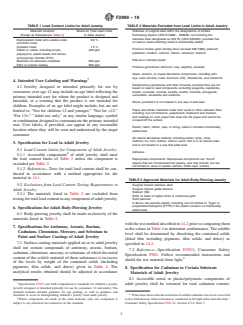
TABLE 1 Lead Content Limits for Adult Jewelry
Materials Covered Maximum Total Lead Limits
(Except as Excluded per Table 2) in Adult Jewelry
Electroplated metal with suitable under 6.0%
and finish coats
Electroplated metal with suitable under 6.0 %
and finish coats
Unplated metal 1.5%
Unplated metal 1.5 %
Plastic or rubber, including acrylic, 200 ppm
polystyrene, plastic beads and stones,
and polyvinyl chloride (PVC)
Materials not otherwise classified 600 ppm
Paint or surface coating 600 ppm
5.1.1 Accessible components of adult jewelry shall meet the lead content limits of Table 1 unless the component is excluded
per Table 2.
5.1.2 References—Tests for total lead content shall be conducted in accordance with a method appropriate for the material in
14.1.
5.2 Exclusions from Lead Content Testing Requirements in Adult Jewelry:
5.2.1 The materials listed in Table 2 are excluded from testing for total lead content in any component of adult jewelry.
6. Specifications for Adult Body-Piercing Jewelry
6.1 Body-piercing jewelry shall be made exclusively of the materials listed in Table 3.
TABLE 2 Materials Excluded from Lead Limits in Adult Jewelry
Stainless or surgical steel within the designations of Unified
Numbering System UNS S13800 – S66286, not including the
stainless steel designated as 303 Pb (UNS S30360), provided that
no lead or lead-containing metal is intentionally added
Precious metals: gold; sterling silver (at least 925/1000); platinum;
palladium; rhodium; osmium; iridium; ruthenium; titanium
Natural or cultured pearls
Precious gemstones: diamond, ruby, sapphire, emerald
Glass, ceramic, or crystal decorative components, including cat’s
eye, cubic zirconia, cubic zirconium (CZ), rhinestones, and cloisonné
Semiprecious gemstones and other minerals, provided they are not
based on lead or lead compounds, excluding aragonite, bayldonite,
boleite, cerussite, crocoite, ekanite, linarite, mimetite, phosgenite,
samarskite, vanadinite and wulfenite
Wood, provided it is not treated in any way to add lead
Paper and similar materials made from wood or other cellulosic fiber,
including, but not limited to, paperboard, linerboard and medium,
and coatings on such paper that soak into the paper and cannot be
scraped off the surface
Elastic, fabric, ribbon, rope, or string, unless it contains intentionally
added lead
All natural decorative material, including amber, bone, coral,
feathers, fur, horn, leather, shell or wood, that is in its natural state
and is not treated in a way that adds lead
Adhesive
Repurposed components. Repurposed components are “found”
objects that are incorporated into jewelry, and may include, but are
not limited to, silver or pewter utensils, bottle caps, buttons.
Where components are made of the same material, only one component is subject to any chemical test references in this standard.
F2999 − 19
TABLE 3 Approved Materials for Adult Body-Piercing Jewelry
Surgical implant stainless steel
Surgical implant grade titanium
Niobium (Nb)
Solid 14 karat or higher white or nickel-free gold
Solid platinum
A dense, low-porosity plastic, including, but not limited to,Tygon or
Polytetrafluoroethylene (PTFE) if the plastic contains no intentionally
added lead
A dense, low-porosity plastic, including, but not limited to, Tygon or
polytetrafluoroethylene (PTFE) if the plastic contains no intentionally
added lead
7. Specifications for Antimony, Arsenic, Barium, Cadmium, Chromium, Mercury, and Selenium in Paint and Surface
Coatings of Adult Jewelry
7.1 Surface-coating materials applied on or to adult jewelry shall not contain compounds of antimony, arsenic, barium,
cadmium, chromium, mercury, or selenium, of which the metal content of the soluble material of these substances is in excess of
the levels by weight of the contained solids (including pigments, film solids, and driers) given in Table 4. The analytical results
obtained should be adjusted in accordance with the test method described in 14.2 prior to comparing them to the values in Table
4 to determine conformance. The soluble level shall be determined by dissolving the contained solids (dried film including
pigments, film solids, and driers) as specified in 14.2. An alternative test method may be used if it meets the requirements of Annex
A1.
7.2 Reference—Specification F2923; Consumer Safety Specification F963-11. Follow recommended instructions and shield the
test material from light.
8. Specification for Cadmium in Certain Substrate Materials of Adult Jewelry
8.1 Accessible metal or plastic/polymeric components of adult jewelry shall be screened for total cadmium content. Covered
components of adult jewelry containing 1.5 % or less total cadmium do not need to be tested for migratable cadmium. Compliance
with the screening limits may be established by any method appropriate for the covered material in 14.1. Potentially ingestible or
swallowable covered components of adult jewelry that exceed this screening level shall be tested for soluble cadmium using an
acid extraction test. Swallowable parts shall be identified by the method described in 14.7. The soluble level shall be determined
by using the method and limits specified in 14.3 where the component is a plastic or polymeric material, and by using the method
and limits specified in 14.4 where the component is metal. Covered components that are mouthable and not ingestible or
swallowable shall be tested using a saline extraction test using the method and limits specified in 14.5. If a jewelry product or
component in one dimension is smaller than 5 cm, it is mouthable. An alternative test method may be used in lieu of any of these
methods if it meets the requirements of Annex A1.
8.2 Exclusions from Cadmium Substrate Testing Requirements in Adult Jewelry:
8.2.1 Only accessible metal or plastic/polymeric components are subject to cadmium substrate testing. All other materials are
excluded from screening and/or testing. Other materials may be added should data or information regarding potential exposure
risks from cadmium in other materials become available.
8.2.2 Reference—Specification F2923.
9. Antimony, Arsenic, Barium, Chromium, Mercury and Selenium in Substrates of Adult Jewelry
9.1 This standard does not establish limits on antimony, arsenic, barium, chromium, mercury and selenium in substrate materials
used in adult jewelry based on the absence of data establishing a potential safety risk.
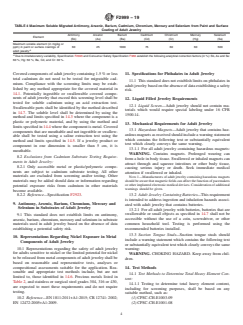
TABLE 4 Maximum Soluble Migrated Antimony, Arsenic, Barium, Cadmium, Chromium, Mercury and Selenium from Paint and Surface
Coating of Adult Jewelry
Antimony Arsenic Barium Cadmium Chromium Mercury Selenium
Element
(Sb) (As) (Ba) (Cd) (Cr) (Hg) (Se)
Maximum soluble element (in mg/kg or
ppm) in paint or surface coatings of 60 25 1000 75 60 60 500
A
adult jewelry
A
Due to interlaboratory variability, Specification F2923 and Consumer Safety Specification F963-11 establish the following analytical correction factors (in %): Sb, As and
Se: 60%;60 %; Hg: 50%;50 %; Ba, Cd, and Cr: 30%.30 %.
“It has been shown that the extraction of soluble cadmium can reveal a two-fold to five-fold increase when extraction is conducted in the light rather than the dark.”
Consumer Safety Specification F963-11, Section 8.3.4, Note 7.
F2999 − 19
10. Representations Regarding Nickel Exposure in Metal Components of Adult Jewelry
10.1 Representations regarding the safety of adult jewelry for adults sensitive to nickel or the limited potential for nickel to be
released from metal components of adult jewelry shall be based on reasonable and representative tests, analyses or compositional
assessments suitable for the application. Reasonable and appropriate test methods include, but are not limited to, those identified
in 14.6. Precious metals listed in Table 2, and stainless or surgical steel grades 304, 316 or 430, are expected to meet these
requirements and do not require testing.
10.2 Reference—EN 1811: 2011; 1811:2011+A1:2015; CR 12741: 2002; EN 12472
...