

ASTM F2923-20
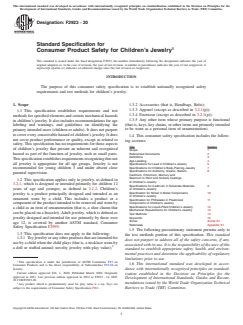
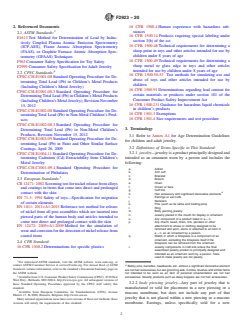
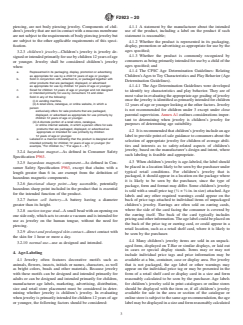
(Specification)Standard Specification for Consumer Product Safety for Children’s Jewelry
General Information
- Abstract
ABSTRACT
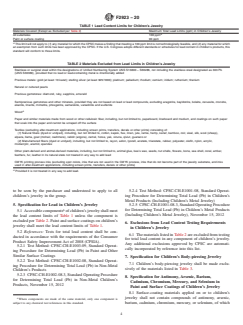
This specification establishes requirements and test methods for specified elements and certain mechanical hazards in children's jewelry. It also includes recommendations for age labelling and warnings, as well as guidelines on identifying the primary intended users, namely children or adults. The specification also lists the lead content limits for children's jewelry, the materials that are excluded from the lead limits in children's jewelry, and the approved materials for children's body piercing jewelry.
SCOPE
1.1 This specification establishes requirements and test methods for specified elements and certain mechanical hazards in children’s jewelry. It also includes recommendations for age labeling and warnings, and guidelines on identifying the primary intended users (children or adults). It does not purport to cover every conceivable hazard of children’s jewelry. It does not cover product performance or quality, except as related to safety. This specification has no requirements for those aspects of children’s jewelry that present an inherent and recognized hazard as part of the function of jewelry, such as small parts. This specification establishes requirements recognizing that not all jewelry is appropriate for all age groups. Jewelry is not recommended for young children 3 and under absent close parental supervision.
1.2 This specification applies only to jewelry, as defined in 3.2.1, which is designed or intended primarily for children 12 years of age and younger, as defined in 3.2.2. Children’s jewelry is a product principally designed and intended as an ornament worn by a child. This includes a product or a component of the product intended to be removed and worn by a child as an item of ornamentation (that is, a shoe charm that can be placed on a bracelet). Adult jewelry, which is defined as jewelry designed and intended for use primarily by those over age 12, is covered by another ASTM standard, Consumer Safety Specification F2999.
1.3 This specification does not apply to the following:
1.3.1 Toy jewelry or any other products that are intended for use by a child when the child plays (that is, a necklace worn by a doll or stuffed animal; novelty jewelry with play value);2
1.3.2 Accessories (that is, Handbags, Belts);
1.3.3 Apparel (except as described in 3.2.1(p));
1.3.4 Footwear (except as described in 3.2.1(p));
1.3.5 Any other item whose primary purpose is functional (that is, keys, key chains, or other items not primarily intended to be worn as a personal item of ornamentation).
1.4 This consumer safety specification includes the following sections:
Title
Section
Scope
1
Referenced Documents
2
Definitions
3
Age-Labeling
4
Specifications for Lead in Children’s Jewelry
5
Specifications for Children’s Body-Piercing Jewelry
7
Specifications for Antimony, Arsenic, Barium,
Cadmium, Chromium, Mercury and
Selenium in Paint and Surface Coatings
of Children’s Jewelry
8
Specifications for Cadmium in Substrate Materials
of Children’s Jewelry
9
Specification for Nickel in Metal Components
of Children’s Jewelry
10
Specification for Phthalates in Plasticized Components of Children’s Jewelry
11
Specifications for Liquid-Filled Children’s Jewelry
12
Mechanical Requirements for Children’s Jewelry
13
Test Methods
14
Keywords
15
Annex
Annex A1
Rationales
Appendix X1
1.5 The following precautionary statement pertains only to the test methods portion of this specification. This standard does not purport to address all of the safety concerns, if any, associated with its use. It is the responsibility of the user of this standard to establish appropriate safety, health, and environmental practices and determine the applicability of regulatory limitations prior to use.
1.6 This international standard was developed in accordance with internationally ...
- Status
- Published
- Publication Date
- 31-Jan-2020
- Technical Committee
- F15 - Consumer Products
- Drafting Committee
- F15.24 - Jewelry
Buy Documents
ASTM F2923-20 - Standard Specification for Consumer Product Safety for Children’s Jewelry
REDLINE ASTM F2923-20 - Standard Specification for Consumer Product Safety for Children’s Jewelry
Overview
ASTM F2923-20, "Standard Specification for Consumer Product Safety for Children’s Jewelry," establishes essential safety requirements for the design, labeling, and chemical testing of jewelry intended for children aged 12 and under. Developed by ASTM International, this standard addresses safety risks associated with heavy metals (including lead and cadmium), hazardous chemicals, and certain mechanical hazards in children’s jewelry. It also includes age-labeling recommendations and criteria for identifying intended users, ensuring consumer awareness and compliance with child safety regulations.
Key Topics
- Scope and Applicability: Covers jewelry specifically designed for children aged 12 and younger, covering decorative items such as bracelets, necklaces, rings, body piercing jewelry, and removable charms. It excludes toy jewelry, accessories (handbags, belts), most apparel and footwear, and functional items not intended as personal ornamentation.
- Chemical Requirements:
- Lead limitations: Strict limits on lead content in all accessible components and surface coatings of children’s jewelry.
- Cadmium and other elements: Requirements for cadmium in substrates, and maximum tolerable levels for antimony, arsenic, barium, chromium, mercury, and selenium in paints and coatings.
- Phthalates: Restrictions on common plasticizers in plasticized jewelry components.
- Exclusions: Specifies materials excluded from mandatory lead testing, including certain precious metals, natural stones, textiles, and natural materials proven safe.
- Body Piercing Jewelry: Limits materials for children’s body-piercing jewelry to proven safe, hypoallergenic options such as surgical-grade metals and select plastics.
- Nickel Content and Migration: Defines migration limits for nickel in jewelry components intended for direct and prolonged skin contact and for items inserted into piercing sites, referencing European harmonized standards.
- Mechanical Safety:
- Requirements for magnets, sharp points and edges, small parts, entanglement prevention (e.g., breakaway features for necklaces), and battery accessibility.
- Additional labeling and usage guidance for products containing magnets or button-cell batteries.
- Age Labeling: Recommends appropriate age labeling and warnings, emphasizing the importance of not marketing jewelry to children under age 3 without close parental supervision.
Applications
- Manufacturers and Designers: Use ASTM F2923-20 to ensure compliance in the selection of materials, product design, and risk assessment for children’s jewelry. It supports product development that minimizes exposure to toxic substances and mechanical hazards.
- Retailers and Importers: Reference this standard to determine if children’s jewelry meets regulatory requirements, helping avoid recalls or legal liabilities. Proper age labeling and warnings enhance customer trust and product safety.
- Testing Laboratories: Employ the specified analytical methods for chemical and mechanical safety testing to certify products for distribution in North America and internationally.
- Regulatory Compliance: Helps address mandatory U.S. Consumer Product Safety Commission (CPSC) and European Union requirements for lead, cadmium, phthalates, and nickel, supporting global market access.
Related Standards
- ASTM F2999 - Consumer Safety Specification for Adult Jewelry
- ASTM F963 - Consumer Safety Specification for Toy Safety
- CPSC Standards:
- CPSC-CH-E1001/E1002/E1003 - Standard Operating Procedures for determining total lead in children’s products
- CPSC-CH-E1004 - Standard Operating Procedure for determining cadmium extractability in children’s metal jewelry
- CPSC-CH-C1001 - Standard Operating Procedure for determination of phthalates
- European Standards:
- EN 1811, EN 12472 - Reference methods for testing nickel release
- EN 71-3 - Safety of toys: migration of certain elements
- Federal Regulations:
- 16 CFR 1500.48/49 - Mechanical hazard test methods for toys and children's products
- 16 CFR 1500.14, 1500.231 - Requirements for hazardous substances in children’s products
ASTM F2923-20 is an essential standard for ensuring children’s jewelry is manufactured and marketed with safety as the highest priority, providing confidence to consumers, manufacturers, and regulators alike.
Relations
- Replaces
ASTM F2923-14 - Standard Specification for Consumer Product Safety for Children’s Jewelry - Effective Date
- 01-Feb-2020
- Effective Date
- 01-Aug-2023
- Effective Date
- 01-Nov-2019
- Effective Date
- 01-Aug-2016
- Effective Date
- 01-Oct-2014
- Effective Date
- 15-Apr-2013
- Effective Date
- 01-Dec-2011
- Effective Date
- 01-Dec-2008
- Effective Date
- 15-Mar-2007
- Effective Date
- 01-Aug-2004
- Effective Date
- 01-Oct-2003
- Effective Date
- 10-Oct-1999
- Effective Date
- 10-Nov-1996
- Effective Date
- 10-Nov-1996
- Effective Date
- 10-Nov-1996
Buy Documents
ASTM F2923-20 - Standard Specification for Consumer Product Safety for Children’s Jewelry
REDLINE ASTM F2923-20 - Standard Specification for Consumer Product Safety for Children’s Jewelry
Frequently Asked Questions
ASTM F2923-20 is a technical specification published by ASTM International. Its full title is "Standard Specification for Consumer Product Safety for Children’s Jewelry". This standard covers: ABSTRACT This specification establishes requirements and test methods for specified elements and certain mechanical hazards in children's jewelry. It also includes recommendations for age labelling and warnings, as well as guidelines on identifying the primary intended users, namely children or adults. The specification also lists the lead content limits for children's jewelry, the materials that are excluded from the lead limits in children's jewelry, and the approved materials for children's body piercing jewelry. SCOPE 1.1 This specification establishes requirements and test methods for specified elements and certain mechanical hazards in children’s jewelry. It also includes recommendations for age labeling and warnings, and guidelines on identifying the primary intended users (children or adults). It does not purport to cover every conceivable hazard of children’s jewelry. It does not cover product performance or quality, except as related to safety. This specification has no requirements for those aspects of children’s jewelry that present an inherent and recognized hazard as part of the function of jewelry, such as small parts. This specification establishes requirements recognizing that not all jewelry is appropriate for all age groups. Jewelry is not recommended for young children 3 and under absent close parental supervision. 1.2 This specification applies only to jewelry, as defined in 3.2.1, which is designed or intended primarily for children 12 years of age and younger, as defined in 3.2.2. Children’s jewelry is a product principally designed and intended as an ornament worn by a child. This includes a product or a component of the product intended to be removed and worn by a child as an item of ornamentation (that is, a shoe charm that can be placed on a bracelet). Adult jewelry, which is defined as jewelry designed and intended for use primarily by those over age 12, is covered by another ASTM standard, Consumer Safety Specification F2999. 1.3 This specification does not apply to the following: 1.3.1 Toy jewelry or any other products that are intended for use by a child when the child plays (that is, a necklace worn by a doll or stuffed animal; novelty jewelry with play value);2 1.3.2 Accessories (that is, Handbags, Belts); 1.3.3 Apparel (except as described in 3.2.1(p)); 1.3.4 Footwear (except as described in 3.2.1(p)); 1.3.5 Any other item whose primary purpose is functional (that is, keys, key chains, or other items not primarily intended to be worn as a personal item of ornamentation). 1.4 This consumer safety specification includes the following sections: Title Section Scope 1 Referenced Documents 2 Definitions 3 Age-Labeling 4 Specifications for Lead in Children’s Jewelry 5 Specifications for Children’s Body-Piercing Jewelry 7 Specifications for Antimony, Arsenic, Barium, Cadmium, Chromium, Mercury and Selenium in Paint and Surface Coatings of Children’s Jewelry 8 Specifications for Cadmium in Substrate Materials of Children’s Jewelry 9 Specification for Nickel in Metal Components of Children’s Jewelry 10 Specification for Phthalates in Plasticized Components of Children’s Jewelry 11 Specifications for Liquid-Filled Children’s Jewelry 12 Mechanical Requirements for Children’s Jewelry 13 Test Methods 14 Keywords 15 Annex Annex A1 Rationales Appendix X1 1.5 The following precautionary statement pertains only to the test methods portion of this specification. This standard does not purport to address all of the safety concerns, if any, associated with its use. It is the responsibility of the user of this standard to establish appropriate safety, health, and environmental practices and determine the applicability of regulatory limitations prior to use. 1.6 This international standard was developed in accordance with internationally ...
ABSTRACT This specification establishes requirements and test methods for specified elements and certain mechanical hazards in children's jewelry. It also includes recommendations for age labelling and warnings, as well as guidelines on identifying the primary intended users, namely children or adults. The specification also lists the lead content limits for children's jewelry, the materials that are excluded from the lead limits in children's jewelry, and the approved materials for children's body piercing jewelry. SCOPE 1.1 This specification establishes requirements and test methods for specified elements and certain mechanical hazards in children’s jewelry. It also includes recommendations for age labeling and warnings, and guidelines on identifying the primary intended users (children or adults). It does not purport to cover every conceivable hazard of children’s jewelry. It does not cover product performance or quality, except as related to safety. This specification has no requirements for those aspects of children’s jewelry that present an inherent and recognized hazard as part of the function of jewelry, such as small parts. This specification establishes requirements recognizing that not all jewelry is appropriate for all age groups. Jewelry is not recommended for young children 3 and under absent close parental supervision. 1.2 This specification applies only to jewelry, as defined in 3.2.1, which is designed or intended primarily for children 12 years of age and younger, as defined in 3.2.2. Children’s jewelry is a product principally designed and intended as an ornament worn by a child. This includes a product or a component of the product intended to be removed and worn by a child as an item of ornamentation (that is, a shoe charm that can be placed on a bracelet). Adult jewelry, which is defined as jewelry designed and intended for use primarily by those over age 12, is covered by another ASTM standard, Consumer Safety Specification F2999. 1.3 This specification does not apply to the following: 1.3.1 Toy jewelry or any other products that are intended for use by a child when the child plays (that is, a necklace worn by a doll or stuffed animal; novelty jewelry with play value);2 1.3.2 Accessories (that is, Handbags, Belts); 1.3.3 Apparel (except as described in 3.2.1(p)); 1.3.4 Footwear (except as described in 3.2.1(p)); 1.3.5 Any other item whose primary purpose is functional (that is, keys, key chains, or other items not primarily intended to be worn as a personal item of ornamentation). 1.4 This consumer safety specification includes the following sections: Title Section Scope 1 Referenced Documents 2 Definitions 3 Age-Labeling 4 Specifications for Lead in Children’s Jewelry 5 Specifications for Children’s Body-Piercing Jewelry 7 Specifications for Antimony, Arsenic, Barium, Cadmium, Chromium, Mercury and Selenium in Paint and Surface Coatings of Children’s Jewelry 8 Specifications for Cadmium in Substrate Materials of Children’s Jewelry 9 Specification for Nickel in Metal Components of Children’s Jewelry 10 Specification for Phthalates in Plasticized Components of Children’s Jewelry 11 Specifications for Liquid-Filled Children’s Jewelry 12 Mechanical Requirements for Children’s Jewelry 13 Test Methods 14 Keywords 15 Annex Annex A1 Rationales Appendix X1 1.5 The following precautionary statement pertains only to the test methods portion of this specification. This standard does not purport to address all of the safety concerns, if any, associated with its use. It is the responsibility of the user of this standard to establish appropriate safety, health, and environmental practices and determine the applicability of regulatory limitations prior to use. 1.6 This international standard was developed in accordance with internationally ...
ASTM F2923-20 is classified under the following ICS (International Classification for Standards) categories: 39.060 - Jewellery; 97.190 - Equipment for children. The ICS classification helps identify the subject area and facilitates finding related standards.
ASTM F2923-20 has the following relationships with other standards: It is inter standard links to ASTM F2923-14, ASTM F963-23, ASTM F2999-19, ASTM F963-16, ASTM F2999-14, ASTM F2999-13, ASTM F963-11, ASTM F963-08, ASTM F963-07e1, ASTM E1613-04, ASTM F963-03, ASTM E1613-99, ASTM F963-96ae1, ASTM F963-96a, ASTM F963-96ae2. Understanding these relationships helps ensure you are using the most current and applicable version of the standard.
ASTM F2923-20 is available in PDF format for immediate download after purchase. The document can be added to your cart and obtained through the secure checkout process. Digital delivery ensures instant access to the complete standard document.
Standards Content (Sample)
This international standard was developed in accordance with internationally recognized principles on standardization established in the Decision on Principles for the
Development of International Standards, Guides and Recommendations issued by the World Trade Organization Technical Barriers to Trade (TBT) Committee.
Designation:F2923 −20
Standard Specification for
Consumer Product Safety for Children’s Jewelry
This standard is issued under the fixed designation F2923; the number immediately following the designation indicates the year of
original adoption or, in the case of revision, the year of last revision.Anumber in parentheses indicates the year of last reapproval.A
superscript epsilon (´) indicates an editorial change since the last revision or reapproval.
INTRODUCTION
The purpose of this consumer safety specification is to establish nationally recognized safety
requirements and test methods for children’s jewelry.
1. Scope 1.3.2 Accessories (that is, Handbags, Belts);
1.3.3 Apparel (except as described in 3.2.1(p));
1.1 This specification establishes requirements and test
1.3.4 Footwear (except as described in 3.2.1(p));
methodsforspecifiedelementsandcertainmechanicalhazards
1.3.5 Any other item whose primary purpose is functional
in children’s jewelry. It also includes recommendations for age
(that is, keys, key chains, or other items not primarily intended
labeling and warnings, and guidelines on identifying the
to be worn as a personal item of ornamentation).
primary intended users (children or adults). It does not purport
tocovereveryconceivablehazardofchildren’sjewelry.Itdoes
1.4 This consumer safety specification includes the follow-
not cover product performance or quality, except as related to
ing sections:
safety.This specification has no requirements for those aspects
Title Section
of children’s jewelry that present an inherent and recognized
Scope 1
Referenced Documents 2
hazard as part of the function of jewelry, such as small parts.
Definitions 3
Thisspecificationestablishesrequirementsrecognizingthatnot
Age-Labeling 4
all jewelry is appropriate for all age groups. Jewelry is not
Specifications for Lead in Children’s Jewelry 5
Specifications for Children’s Body-Piercing Jewelry 7
recommended for young children 3 and under absent close
Specifications for Antimony, Arsenic, Barium, 8
parental supervision.
Cadmium, Chromium, Mercury and
Selenium in Paint and Surface Coatings
1.2 This specification applies only to jewelry, as defined in
of Children’s Jewelry
3.2.1, which is designed or intended primarily for children 12
Specifications for Cadmium in Substrate Materials 9
years of age and younger, as defined in 3.2.2. Children’s of Children’s Jewelry
Specification for Nickel in Metal Components 10
jewelry is a product principally designed and intended as an
of Children’s Jewelry
ornament worn by a child. This includes a product or a
Specification for Phthalates in Plasticized 11
componentoftheproductintendedtoberemovedandwornby Components of Children’s Jewelry
Specifications for Liquid-Filled Children’s Jewelry 12
a child as an item of ornamentation (that is, a shoe charm that
Mechanical Requirements for Children’s Jewelry 13
canbeplacedonabracelet).Adultjewelry,whichisdefinedas
Test Methods 14
Keywords 15
jewelry designed and intended for use primarily by those over
Annex Annex A1
age 12, is covered by another ASTM standard, Consumer
Rationales Appendix X1
Safety Specification F2999.
1.5 The following precautionary statement pertains only to
1.3 This specification does not apply to the following:
the test methods portion of this specification. This standard
1.3.1 Toyjewelryoranyotherproductsthatareintendedfor
does not purport to address all of the safety concerns, if any,
usebyachildwhenthechildplays(thatis,anecklacewornby
associated with its use. It is the responsibility of the user of this
a doll or stuffed animal; novelty jewelry with play value);
standard to establish appropriate safety, health, and environ-
mental practices and determine the applicability of regulatory
limitations prior to use.
This specification is under the jurisdiction of ASTM Committee F15 on
1.6 This international standard was developed in accor-
Consumer Products and is the direct responsibility of Subcommittee F15.24 on
dance with internationally recognized principles on standard-
Jewelry.
Current edition approved Feb. 1, 2020. Published March 2020. Originally
ization established in the Decision on Principles for the
approved in 2011. Last previous edition approved in 2014 as F2923–14. DOI:
Development of International Standards, Guides and Recom-
10.1520/F2923-20.
mendations issued by the World Trade Organization Technical
Any product which is predominately used for play value is a toy. Toys are
subject to the requirements of Consumer Safety Specification F963. Barriers to Trade (TBT) Committee.
Copyright © ASTM International, 100 Barr Harbor Drive, PO Box C700, West Conshohocken, PA 19428-2959. United States
F2923−20
2. Referenced Documents 16 CFR 1500.4Human experience with hazardous sub-
3 stances
2.1 ASTM Standards:
16 CFR 1500.14Products requiring special labeling under
E1613Test Method for Determination of Lead by Induc-
section 3(b) of the act
tively Coupled Plasma Atomic Emission Spectrometry
16 CFR 1500.48Technical requirements for determining a
(ICP-AES), Flame Atomic Absorption Spectrometry
sharp point in toys and other articles intended for use by
(FAAS), or Graphite Furnace Atomic Absorption Spec-
children under 8 years of age
trometry (GFAAS) Techniques
16 CFR 1500.49Technical requirements for determining a
F963Consumer Safety Specification for Toy Safety
sharp metal or glass edge in toys and other articles
F2999Consumer Safety Specification for Adult Jewelry
4 intended for use by children under 8 years of age
2.2 CPSC Standards:
16 CFR 1500.50-53 Test methods for simulating use and
CPSC-CH-E1001-08Standard Operating Procedure for De-
abuse of toys and other articles intended for use by
termining Total Lead (Pb) in Children’s Metal Products
children
(Including Children’s Metal Jewelry)
16 CFR 1500.91Determinations regarding lead content for
CPSC-CH-E1001-08.3Standard Operating Procedure for
certain materials or products under section 101 of the
DeterminingTotalLead(Pb)inChildren’sMetalProducts
Consumer Product Safety Improvement Act
(IncludingChildren’sMetalJewelry),RevisionNovember
16 CFR 1500.231Guidance for hazardous liquid chemicals
15, 2012
in children’s products
CPSC-CH-E1002-08Standard Operating Procedure for De-
16 CFR 1501.3Exemptions
termining Total Lead (Pb) in Non-Metal Children’s Prod-
16 CFR 1501.4Size requirements and test procedure
ucts
CPSC-CH-E1002-08.3Standard Operating Procedure for
3. Terminology
Determining Total Lead (Pb) in Non-Metal Children’s
Products, Revision November 15, 2012
3.1 Refer to Annex A1 for Age Determination Guidelines
CPSC-CH-E1003-09Standard Operating Procedure for De-
for children and adult jewelry.
termining Lead (Pb) in Paint and Other Similar Surface
3.2 Definitions of Terms Specific to This Standard:
Coatings, April 26, 2009
3.2.1 jewelry—jewelryisaproductprincipallydesignedand
CPSC-CH-E1004-11Standard Operating Procedure for De-
termining Cadmium (Cd) Extractability from Children’s intended as an ornament worn by a person and includes the
Metal Jewelry following:
CPSC-CH-C1001-09.4Standard Operating Procedure for
a. Anklet
b. Arm cuff
Determination of Phthalates
c. Bracelet
2.3 European Standards:
d. Brooch
e. Chain
CR12471:2002Screeningtestfornickelreleasefromalloys
f. Crown or tiara
and coatings in items that come into direct and prolonged
g. Cuff link
A
contact with the skin
h. Hair accessory with significant decorative elements
i. Earrings or ear cuffs
EN 71-3: 1994Safety of toys—Specification for migration
j. Necklace
of certain elements
k. Pins (such as tie tacks and trading pins)
EN 1811: 2011+A1:2015Reference test method for release
l. Ring
m. Body piercing jewelry
of nickel from all post assemblies which are inserted into
n. Jewelry placed in the mouth for display or ornament
pierced parts of the human body and articles intended to
o. Any component of a product listed ina–n.
come into direct and prolonged contact with the skin
p. Any charm, bead, chain, link, pendant or other
attachment to shoes or clothing designed to be
EN 12472: 2005+A1:2009Method for the simulation of
removed and worn, alone or attached to an item in
wearandcorrosionforthedetectionofnickelreleasefrom
a – n, as an ornament by a person.
coated items
q. Watch in which a timepiece is a component of an
ornament, excluding the timepiece itself if the
2.4 CFR Standard:
timepiece can be removed from the ornament.
16 CFR 1308.2Determinations for specific plastics
r. Jewelry components in craft kits where the final
assembled jewelry product is principally designed and
intended as an ornament worn by a person. Tools
used to make jewelry are not jewelry.
For referenced ASTM standards, visit the ASTM website, www.astm.org, or
A
contact ASTM Customer Service at service@astm.org. For Annual Book of ASTM
Bobby pins, barrettes, headbands, etc. without a significant decorative element
Standards volume information, refer to the standard’s Document Summary page on
arenothairaccessories,butaregroomingaids.Combs,brushesandsimilaritems
the ASTM website.
not intended to be worn as an item of personal ornamentation are not hair
AvailablefromU.S.ConsumerProductSafetyCommission(CPSC),4330East
accessories. Novelty products such as deely boppers are not hair accessories.
West Hwy., Bethesda, MD 20814, http://www.cpsc.gov.All subsequent versions of
3.2.2 body piercing jewelry—Any part of jewelry that is
these Standard Operating Procedures approved by the CPSC staff satisfy this
standard.
manufactured or sold for placement in a new piercing or a
Available from European Committee for Standardization (CEN), Avenue
mucous membrane, but does not include any part of that
Marnix 17, B-1000, Brussels, Belgium, http://www.cen.eu.
jewelry that is not placed within a new piercing or a mucous
Manynationalorganizationsissuetheirownversionsofthesetestmethods;these
versions will satisfy the requirements of this standard. membrane. Earrings, unless specifically sold for a new
F2923−20
piercing, are not body piercing jewelry. Components of chil- 4.1.1 A statement by the manufacturer about the intended
dren’sjewelrythatarenotincontactwithamucousmembrane use of the product, including a label on the product if such
arenotsubjecttotherequirementsofbodypiercingjewelrybut statement is reasonable;
are subject to the other applicable requirements of this speci-
4.1.2 Whether the product is represented in its packaging,
fication.
display, promotion or advertising as appropriate for use by the
ages specified;
3.2.3 children’s jewelry—Children’s jewelry is jewelry de-
4.1.3 Whether the product is commonly recognized by
signedorintendedprimarilyforusebychildren12yearsofage
consumersasbeingprimarilyintendedforusebyachildofthe
or younger. Jewelry shall be considered children’s jewelry
ages specified; and
when:
4.1.4 The CPSC Age Determination Guidelines: Relating
a. Represented in its packaging, display, promotion or advertising
as appropriate for use by a child 12 years of age or younger.
Children’sAgestoToyCharacteristicsandPlayBehavior(Age
b. Sold in conjunction with, attached to, or packaged together with
Determination Guidelines).
other products that are packaged, displayed, or advertised
4.1.4.1 The Age Determination Guidelines were developed
as appropriate for use by children 12 years of age or younger.
c. Sized for children 12 years of age or younger and not designed
to identify toy characteristics and play behavior. They are of
or intended primarily for use by consumers 13 and older.
mostvalueinevaluatingtheappropriateagegradingofjewelry
d. Sold in any of the following:
(i) A vending machine. oncethejewelryisidentifiedasprimarilyintendedforchildren
(ii) A retail store, catalogue, or online website, in which a
12yearsofageoryoungerlookingattheotherfactors.Jewelry
person
is not recommended for children under 3 except under close
exclusively offers for sale products that are packaged,
displayed, or advertised as appropriate for use primarily by parental supervision. AnnexA1 outlines considerations impor-
children 12 years of age or younger.
tant to determining when jewelry is children’s jewelry for
(iii) A discrete portion of a retail store, catalogue,
purposes of determining age suitability.
or online internet website, in which a person offers for sale
products that are packaged, displayed, or advertised as
4.2 Itisrecommendedthatchildren’sjewelryincludeanage
appropriate or intended for use primarily by children
12 years of age or younger. label to provide point-of-sale guidance to consumers about the
e. Labeled in a manner indicating that the product is designed and
selection of appropriate jewelry for children of average abili-
intended primarily for children 12 years of age or younger (for
ties and interests as to safety-related aspects of children’s
example, “For children 3+,” “For ages4–8.”)
jewelry, based on the manufacturer’s design and intent, where
3.2.4 hazardous magnet—As defined in Consumer Safety
such labeling is feasible and appropriate.
Specification F963.
4.3 When children’s jewelry is age-labeled, the label should
3.2.5 hazardous magnetic component—As defined in Con-
beplacedinalocationlikelytobeseenbythepurchaserunder
sumer Safety Specification F963, except that chains with a
typical retail conditions. For children’s jewelry that is
length greater than 6 in. are exempt from the definition of
packaged, it should appear in a location on the package where
hazardous magnetic components.
it is likely to be seen by the purchaser, since the type of
3.2.6 functional sharp point—Any accessible, potentially
package, form and format may differ. Some children’s jewelry
hazardous sharp point included in the product that is essential
3 3
is sold with a small price tag ( ⁄4 × ⁄8 in. in size) attached.Age
for the intended function of the product.
labels and any other required warnings could appear on the
3.2.7 button cell battery—A battery having a diameter
back of price tags attached to individual items of unpackaged
greater than its height. children’s jewelry. Earrings are often sold on earring cards,
where the side of the card facing the consumer is covered by
3.2.8 suction tongue stud—Asmallbeadwithanopeningon
the earring itself. The back of the card typically includes
onesideonly,whichactstocreateavacuumandisintendedfor
pricingandotherinformation.Theagelabelcouldbeplacedon
use as jewelry on the human tongue, without the need for
the back of the price tag or earring card, or could appear in a
piercing.
retail location, such as a retail shelf card, where it is likely to
3.2.9 direct and prolonged skin contact—directcontactwith
be seen by the purchaser.
the skin for 1 hour or more a day.
4.4 Many children’s jewelry items are sold in an unpack-
3.2.10 normal use—use as designed and intended.
aged form, displayed on T-Bar or similar displays, or laid out
in cases or special display stands. Items may or may not
4. Age-Labeling
include individual price tags and price information may be
4.1 Jewelry often features decorative motifs such as available at a bin, container, case or display area. For jewelry
animals, flowers, insects, initials or names, characters, as well that is not packaged, the age label or other warnings may
as bright colors, beads and other materials. Because jewelry appear on the individual price tag or may be presented in the
with these motifs can be designed and intended primarily for form of a retail shelf card or display card in a size and form
adults or can be designed and intended primarily for children, reasonably calculated to be seen by the purchaser. Age labels
manufacturer age labels, marketing, advertising, distribution, for children’s jewelry sold in print catalogues or online stores
size and retail store placement must be considered in deter- should be displayed with the item or, if all children’s jewelry
mining whether jewelry is children’s jewelry. In evaluating available for sale in the area or section of the catalogue or
whenjewelryisprimarilyintendedforchildren12yearsofage onlinestoreissubjecttothesameagerecommendation,theage
or younger, the following factors should be considered: labelmaybedisplayedinasizeandformreasonablycalculated
F2923−20
TABLE 1 Lead Content Limits for Children’s Jewelry
Materials Covered (Except as Excluded per Table 2) Maximum Total Lead Limits (ppm) in Children’s Jewelry
A
All substrates 100 ppm
Paint or surface coating 90 ppm
A
This limit will not apply to (1) any material for which the CPSC makes a finding that meeting a 100 ppm limit is not technologically feasible, and (2) any material for which
an exemption from such limits has been approved by the CPSC. If the U.S. Congress adopts different standards or schedules for lead content in children’s products, this
standard will conform to those limits.
TABLE 2 Materials Excluded from Lead Limits in Children’s Jewelry
Stainless or surgical steel within the designations of Unified Numbering System UNS S13800 – S66286, not including the stainless steel designated as 303 Pb
(UNS S30360), provided that no lead or lead-containing metal is intentionally added
Precious metals: gold (at least 10 karat); sterling silver (at least 925/1000); platinum; palladium; rhodium; osmium; iridium; ruthenium; titanium
Natural or cultured pearls
Precious gemstones: diamond, ruby, sapphire, emerald
Semiprecious gemstones and other minerals, provided they are not based on lead or lead compounds, excluding aragonite, bayldonite, boleite, cerussite, crocoite,
ekanite, linarite, mimetite, phosgenite, samarskite, vanadinite and wulfenite
A
Wood
Paper and similar materials made from wood or other cellulosic fiber, including, but not limited to, paperboard, linerboard and medium, and coatings on such paper
that soak into the paper and cannot be scraped off the surface
Textiles (excluding after-treatment applications, including screen prints, transfers, decals or other prints) consisting of:
(1) Natural fibers (dyed or undyed), including, but not limited to, cotton, kapok, flax, linen, jute, ramie, hemp, kenaf, bamboo, coir, sisal, silk, wool (sheep),
alpaca, llama, goat (mohair, cashmere), rabbit (angora), camel, horse, yak, vicuna, qiviut, guanaco or
(2) Manufactured fibers (dyed or undyed), including, but not limited to, rayon, azlon, lyocell, acetate, triacetate, rubber, polyester, olefin, nylon, acrylic,
modacrylic, aramid, spandex
Other plant-derived and animal-derived materials, including, but not limited to, animal glue, bee’s wax, seeds, nut shells, flowers, bone, sea shell, coral, amber,
feathers, fur, leather in its natural state not treated in any way to add lead
CMYK printing process inks (excluding spot colors, inks that are not used in the CMYK process, inks that do not become part of the jewelry substrate, and inks
used in after-treatment applications, including screen prints, transfers, decals or other prints)
A
Provided it is not treated in any way to add lead.
to be seen by the purchaser and understood to apply to all 5.2.4 Test Method: CPSC-CH-E1001-08, Standard Operat-
children’s jewelry in the group. ing Procedure for Determining Total Lead (Pb) in Children’s
Metal Products (Including Children’s Metal Jewelry)
5. Specification for Lead in Children’s Jewelry
5.2.5 CPSC-CH-E1001-08.3,StandardOperatingProcedure
for Determining Total Lead (Pb) in Children’s Metal Products
5.1 Accessiblecomponents ofchildren’sjewelryshallmeet
(Including Children’s Metal Jewelry), November 15, 2012
the lead content limits of Table 1 unless the component is
excluded per Table 2. Paint and surface coatings on children’s
6. Exclusions from Lead Content Testing Requirements
jewelry shall meet the lead content limits of Table 1.
in Children’s Jewelry
5.2 References: Tests for total lead content shall be con-
6.1 ThematerialslistedinTable2areexcludedfromtesting
ducted in accordance with the requirements of the Consumer
for total lead content in any component of children’s jewelry.
Product Safety Improvement Act of 2008 (CPSIA).
Any additional exclusions approved by CPSC are automati-
5.2.1 Test Method: CPSC-CH-E1003-09, Standard Operat-
cally incorporated by reference into this list.
ing Procedure for Determining Lead (Pb) in Paint and Other
Similar Surface Coatings
7. Specification for Children’s Body-piercing Jewelry
5.2.2 Test Method: CPSC-CH-E1002-08, Standard Operat-
7.1 Children’s body-piercing jewelry shall be made exclu-
ing Procedure for Determining Total Lead (Pb) in Non-Metal
sively of the materials listed in Table 3.
Children’s Products
5.2.3 CPSC-CH-E1002-08.3,StandardOperatingProcedure
8. Specification for Antimony, Arsenic, Barium,
for Determining Total Lead (Pb) in Non-Metal Children’s
Cadmium, Chromium, Mercury, and Selenium in
Products, November 15, 2012
Paint and Surface Coatings of Children’s Jewelry
8.1 Surface-coating materials applied on or to children’s
jewelry shall not contain compounds of antimony, arsenic,
Where components are made of the same material, only one component is
subject to any chemical test references in this standard. barium, cadmium, chromium, mercury, or selenium, of which
F2923−20
TABLE 3 Approved Materials for Children’s Body Piercing Jewelry
A
Surgical implant stainless steel
Surgical implant grade titanium
Niobium (Nb)
Solid 14 karat or higher white or nickel-free gold
Solid platinum
A dense, low-porosity plastic, including, but not limited to, Tygon or Polytetrafluoroethylene (PTFE) if the plastic contains no intentionally added lead
A
Grades used must meet the lead exemption criteria in Table 2.
than a fraction of the recommended target level of 200 µg cadmium, but
the metal content of the soluble material of these substances is
the screening level is based on adoption of additional safety factors for
in excess of the levels by weight of the contained solids
calculationpurposes.DatasponsoredbyCooksonPreciousMetalsinvolv-
(including pigments, film solids, and driers) given in Table 4.
ing jewelry materials or components containing low total cadmium (from
The analytical results obtained should be adjusted in accor-
1 ppm to 1580 ppm) all passed EN 71-3: 1994 testing, and modified EN
dance with the test method in 14.3 prior to comparing them to 71-3:1994testingat4h,8h,and24h(1). Thiscadmiumscreeninglevel
is even lower and aligns with the conservative screening level set by
the values in Table 4 to determine conformance. The soluble
Consumer Safety Specification F963.
level shall be determined by dissolving the contained solids
(dried film including pigments, film solids, and driers) as 9.2 Exclusions from Cadmium Substrate Requirements in
Children’s Jewelry—Only metal or plastic/polymeric compo-
specified in 14.3.
nents are subject to cadmium substrate testing. All other
8.2 Reference—Consumer Safety Specification F963. Fol-
materialsareexcludedfromscreeningortesting,orboth.Other
low recommended instructions and shield the test material
materials may be added should data or information regarding
from light.
potential exposure risks to children from cadmium in other
NOTE 1—It has been shown that the extraction of soluble cadmium can
materials become available.
reveal a two-fold to five-fold increase when extraction is conducted in the
light rather than the dark. Consumer Safety Specification F963, 8.3.4,
10. Specification for Nickel in Metal Components of
Note 24.
Children’s Jewelry
9. Specification for Cadmium in Certain Substrate 10.1 Migration of nickel in any post assemblies of chil-
Materials of Children’s Jewelry dren’s jewelry which are inserted into pierced ears and other
pierced parts of the human body shall not exceed 0.2 µg/cm /
9.1 Accessible metal or plastic/polymeric components of
week (migration limit).
children’s jewelry shall be screened for total cadmium content.
Covered components of children’s jewelry containing 75ppm 10.2 Migration of nickel in metal components of jewelry
or less total cadmium do not need to be tested for migratable
intended to come into direct and prolonged contact with the
8 2
cadmium. (See Note 2.) Covered components of children’s skin shallnotexceed0.5µg/cm /week.Itemscoveredinclude:
jewelry that exceed this 75ppm total content screening level
(1)components of earrings (other than post assemblies),
andwhicharesmallpartsasdefinedin16CFR1501.4shallbe (2)necklaces, bracelets, chains, anklets, finger rings,
tested for soluble cadmium using an acid extraction test. The
(3)wrist-watch cases, watch straps and tighteners
soluble level shall be determined by using the method and
10.3 Where the components used in items listed in 10.2
limits specified in 14.4 where the component is a plastic or
have a non-nickel coating such coating shall be sufficient to
polymeric material, and by using the method and limits
ensure that the rate of nickel release from those parts of such
specified in 14.5 where the component is metal. Covered
articles coming into direct and prolonged contact with the skin
components that are not small parts as defined in 16 CFR 2
will not exceed 0.5 µg/cm /week for a period of at least two
1501.4 shall be tested using a saline extraction test using the
years of normal use of the article.
method and limits specified in 14.6.
NOTE 2—An evaluation of data on total versus migratable materials in 7
The boldface numbers in parentheses refer to a list of references at the end of
metals developed by the Consumer Product Safety Commission (CPSC)
this standard.
(See Staff Report, Cadmium in Metal Jewelry, October, 2010) and on
Jewelry designed to be worn on clothing (exclusive of detachable charms or
research sponsored by the Fashion Jewelry and Accessories Trade
itemsthatcouldbeaddedtobraceletsorotheritemsorpinbackslikelytotouchthe
Association (FJATA) suggests that plated metal components containing
skin), the face of a pendant, or the tongue of a box clasp, are examples of jewelry
2000ppmorlesstotalcadmiumareunlikelytoresultinexposuretomore
components not likely to be in prolonged contact with the skin.
TABLE 4 Maximum Soluble Migrated Antimony, Arsenic, Barium, Cadmium, Chromium, Mercury and Selenium from Paint and Surface
Coating of Children’s Jewelry
Element Antimony Arsenic Barium Cadmium Chromium Mercury Selenium
(Sb) (As) (Ba) (Cd) (Cr) (Hg) (Se)
Maximum soluble element (in mg/kg or ppm) 60 25 1000 75 60 60 500
in paint or surface coatings
A
of children’s jewelry
A
Due to interlaboratory error, Consumer Safety Specification F963 establishes the following analytical correction factors (in %): Sb,As and Se: 60 %; Hg: 50 %; Ba, Cd,
and Cr: 30 %.
F2923−20
10.4 Precious metals listed in Table 2, and stainless or 13.1.3 Children’s jewelry intended for children 8 years of
surgicalsteelgrades304,316,and430,areexpectedtocomply age or older consisting of earrings, brooches, necklaces or
with the requirements of 10.1 through 10.3 and do not require bracelets which contain loose as-received hazardous magnets
further testing for nickel migration. or loose as-received hazardous magnetic components, as well
as their instructions, if any, shall include a warning statement
10.5 Reference:EN1811:2011+A1:2015;CR12741:2002;
which contains the following text or substantially equivalent
EN 12472:2005+A1: 2009.
text which clearly conveys the same warning.
13.1.3.1 For Earrings: WARNING Contains small mag-
11. Specification for Phthalates in Plasticized
nets. Swallowed or inhaled magnets can attract through and
Components of Children’s Jewelry
squeeze intestines or other body tissue, causing serious injury
11.1 Plasticized accessible components of children’s jew-
or death. Seek immediate medical attention if swallowed or
elry may not contain more than 0.1 percent (1000 ppm) of the
inhaled. Use only on ears. Prolonged wearing can form a hole
following phthalates: di-(2-ethyhexyl) phthalates (DEHP),
in body tissue. Change earring position regularly to release
dibutyl phthalate (DBP), benzyl butyl phthalate (BBP), di-
pressure. Do not keep on overnight.
isononyl phthalates (DINP), diisobutyl phthalate (DIBP), di-n-
13.1.3.2 ForAll Other Jewelry: WARNINGContainssmall
pentyl phthalates (DPENP), di-n-hexyl phthalates (DHEXP),
magnets. Swallowed or inhaled magnets can attract through
dicyclohexyl phthalate (DCHP).
and squeeze intestines or other body tissue, causing serious
11.2 Testing for phthalates is not required (1) for children’s
injuryordeath.Seekimmediatemedicalattentionifswallowed
jewelry that does not contain plasticized components; (2) for
or inhaled.
children’s jewelry that contains only plasticized components
made from plasticized plastics listed under 16 CFR § 1308.2; NOTE 3—Manufacturers of children’s jewelry containing strong mag-
nets should be aware that magnetic fields can affect the function of
or (3) where the manufacturer of the children’s jewelry adopts
pacemakers or other implanted electronic medical devices. Consideration
documented sourcing and manufacturing controls that would
of additional warnings should be given.
eliminatetheriskofcomponentscontainingenumeratedphtha-
13.1.3.3 An equilateral triangle with an exclamation point
lates in excess of the limit in 11.1. Elastic string is not
shall precede the signal word. The height of the triangle shall
accessible.
beequaltoorexceedtheheightofthelettersofthesignalword
11.3 Testing of plasticized components of children’s
“WARNING”andseparatedfromitbyadistanceatleastequal
jewelry, when conducted, shall be done according to CPSC-
to the space occupied by the first letter of the signal word.The
CHC1001-09.4 test method that includes measures to prevent
height of the exclamation point shall be at least half the height
inaccurate test results by taking steps to prevent contamination
of the triangle, and be centered vertically in the triangle. The
of the test apparatus.
warning statement in 13.1.3.1 and 13.1.3.2 must appear in a
location where it is reasonably likely to be seen by the
12. Liquid Filled Jewelry Requirements
purchaser at the time of purchase, in accordance with 4.3 or
12.1 Liquid Screen—Children’s jewelry should not contain
4.4. Signal words shall appear in all capitals. The cautionary
any materials listed in 16 CFR §1500.231 or materials which
statementshallappearinconspicuousandlegibletypewhichis
would require special labeling under 16 CFR §1500.14 Per-
in contrast by typography, layout, or color with other printed
mitted liquids in liquid filled children’s jewelry should be
matter. Where color is the primary method used to achieve
screened to eliminate potential hazards in accordance with
contrast, the color of the cautionary statement shall be in sharp
Consumer Safety Specification F963.
contrast with the color of the background on which such a
statement appears.
13. Mechanical Requirements for Children’s Jewelry
13.1.3.4 The labels of products that contain more than one
13.1 Magnets—This requirement is intended to address
item subject to the requirements of 13.1.3 may combine
ingestion, inhalation and attachment hazards associated with
information, if the condensed statement contains all of the
children’s jewelry that contain a hazardous magnet. Magnets
information necessary to describe the potential hazard associ-
used in children’s jewelry in applications such as: earrings or
ated with each product.
broochestoattachacrossearlobesorthroughcloth;closuresor
13.2 Breakaway features and releases. This section is in-
fasteners in necklaces or bracelets; attaching interchangeable
tended to address the potential hazards associated with chil-
charms on bracelets or necklaces; attaching pendant pairs; or
dren’s jewelry attached around the neck of a child, which may
locket closures on necklaces or rings must comply with the
catch on objects in the child’s environment resulting in
following requirements.
entanglement or strangulation.
13.1.1 Children’s jewelry shall not have an as-received
13.2.1 Children’sjewelryintendedtobeattachedaroundthe
hazardous magnet or an as-received hazardous magnetic
neck shall release, either by designed breakaway feature,
component, with the exception of children’s jewelry that
attachment design or physical properties of the material, when
complies with 13.1.3.
subjectedto15lboftensioninaccordancewiththebreakaway
13.1.2 Children’s jewelry shall not liberate a hazardous
tension test described in 14.1.
magnet or a hazardous magnetic component after being tested
in accordance with the magnet use and abuse testing as 13.2.1.1 No hazardous magnets or hazardous magnet com-
specified in 14.2. ponents shall be released during the tension test unless the
F2923−20
product is intended for children 8 and older and the product is to situations in which a battery may be installed incorrectly
labeled in conformance with 13.1.3. (reversed) or in which a battery charger may be applied to
jewelry containing non-rechargeable batteries, or both. This
13.2.1.2 No hazardous sharp points or hazardous sharp
edges shall be observed during the tension test if the children’s section does not apply to circuits having one or two non-
rechargeable batteries as the only source of power. Children’s
jewelry is intended for children 8 and under.
jewelry having a circuit powered only by button cell type
13.2.2 Looped children’s jewelry which by reason of con-
batteries are not subject to this requirement.
struction do not fit around the test fixture, having a circumfer-
ence less than 9.4 in., shall not be subject to the requirements
13.6.5 Polarity Marking—Children’s jewelry shall be
of this section.
markedpermanentlyonthebatterycompartmentoronthearea
immediately adjacent to the battery compartment to show the
13.3 Sharp Points, Sharp Edges, Use and Abuse—
correctbatterypolarityusingthepolaritysymbols“+”and“−”.
Children’s jewelry shall be tested in accordance with 16 CFR
Additional markings located on the jewelry or in the instruc-
1500.48-53 mechanical requirements for children’s products
tions must indicate the correct battery size and voltage. These
up to 8 years of age and not present any hazard(s).
markings are not required for non-replaceable batteries or for
13.3.1 Any functional sharp point on children’s jewelry is
rechargeablebatterypacksthat,bydesign,canonlybeinserted
exempt from 16 CFR 1500.48. An example is pin stems for
in the correct orientation. Battery compartments for button cell
pins or brooches.
batteries are not subject to this requirement.
13.4 Small Parts—Children’s jewelry is subject to the ap-
NOTE 4—The battery compartment door is considered part of the
plicable exemptions of 16 CFR 1501.3.
battery compartment.
13.5 Other Recommended Cautionary Labeling—It is
13.7 Suction Tongue Studs—Suction tongue studs are pro-
strongly recommended that the manufacturer consider the risk
hibited as children’s jewelry.
of earring components becoming embedded in the ear over
long term wearing. This risk is increased with first time
14. Test Methods
piercing,commonwithchildren,duetothehealingprocessand
potential for infection. Mechanical design such as larger
14.1 Breakaway Tension Test—Using a 1.5in. 6 0.1in.
backings or use of protective washers which increase the
radius free pulley (Fig. 1), apply 15 lb force to the looped
surface area can help prevent such incidents. If mechanical
jewelry,withtheotherendloopedarounda0.170in. 60.01in.
means are not implemented a warning notifying the consumer
radius fixed rod. Apply the 15 lb force over 5 s and hold for
of the risk of embedding from continuous use, and to inspect a
10s.
piercing regularly for potential embedding of earring
components, is suggested. NOTE5—Theorientationofthetestfixturecanbeverticalorhorizontal,
on a track. The weight of the free pulley may need to be accounted for if
13.6 Children’s Jewelry Containing Batteries:
it is free hanging as shown in Fig. 1.
13.6.1 Forallchildren’sjewelrywithbatteries,batteriesthat
14.1.1 The looped jewelry shall be oriented with any clasp,
fit completely within the small parts test cylinder as specified
breakaway or other feature in the most onerous position for
in16CFR1501.4,Fig.1shallnotbeaccessible,beforeorafter
testing, requiring the highest tensile force for release. Possible
testing in accordance with 16 CFR 1500.50-53 (as applicable),
positions may include the apex of the pulley, in the free length
without the use of a coin, screwdriver, or other common
of chain or at the apex of the fixed rod. Loops with multiple
household tool. Testing is performed using the recommended
strandsshallbetestedusingallstrands,asitwouldbewornby
batteries installed.
the user.
13.6.2 Battery-Operated Children’s Jewelry—Forchildren’s
jewelry that use more than one replaceable battery in one
14.2 Magnet Test Methods—Magnets in children’s jewelry
circuit,theinstructionsortheproductshallbemarkedwiththe
shallbeevaluatedinaccordancewiththemagnetuseandabuse
following (or equivalent) information.
testing as required in Consumer Safety Specification F963.
13.6.2.1 Do not mix old and new batteries.
14.3 Method to Dissolve Soluble Matter in Paint and
13.6.2.2 Do not mix alkaline, standard (carbon-zinc), or
Surface Coatings—Soluble elements in paint and surface
rechargeable (nickel-cadmium) batteries.
coatings of jewelry should be tested for compliance with the
13.6.3 Children’s Jewelry Containing Batteries—Children’s
requirements of Section 8 in accordance with the method to
jewelry with non-replaceable batteries that are accessible with
dissolve soluble matter in paint and surface coatings CPSC-
theuseofacoin,screwdriver,orothercommonhouseholdtool
CH-E1003-09. Consistent with Consumer Safety Specification
shall bear a statement that the battery is not replaceable. If the
F963, if the sample weight of surface coating materials is less
manufacturer determines that it is impractical to label the
than 10 mg, the sample is not tested for soluble heavy metals
product,thisinformationshallbeplacedonthepackagingorin
in coatings.
the instructions.
13.6.4 Unintentional Charging—Battery-operated chil- 14.4 Method to Determine Cadmium Availability in Chil-
dren’s jewelry shall be designed so that it is not possible to dren’s Plastic Jewelry Components—Plastic components of
charge any non-rechargeable battery. This can be achieved children’s jewelry that exceed 75 ppm total cadmium shall be
through physical design of the battery compartment or through tested for migratable cadmium in accordance with Consumer
the use of an appropriate electrical circuit design. This applies Safety Specification F963.
F2923−20
FIG. 1Breakaway Test Fixture
14.5 Method to Determine Cadmium Availability in Chil- 14.6.1.1 Suspend the children’s jewelry item in a flask or
dren’s Metal Jewelry Components—Metal components of chil-
beaker using insulated wire so that the item does not touch the
dren’s jewelry that exceed 75 ppm total cadmium shall be
bottom or edge of the flask/beaker, but will be submerged by
tested for migratable cadmium in accordance with CPSC-CH-
the saline solution.
E1004-11, as adjusted for interlaboratory variability in accor-
14.6.1.2 Add a volume in millilitres of 0.9 % saline (NaCl)
dance with 14.5.1.
solution equal to 50 times the mass in grams of the jewelry
14.5.1 Extracted cadmium shall not exceed 200 µg. The
item. Record the volume added.
analytical results as determined in 14.5 shall be adjusted by
14.6.1.3 Extraction is conducted for6hat37°C 62°Cin
subtracting the assumed inter-laboratory analytical correction
the shaker bath.
factor of 30 %.
14.6.1.4 The extracted solution is analyzed for cadmium
14.5.1.1 Example 1—The analytical result for cadmium is
230µg;thecorrectionfactoris30%(0.30).Adjustedanalytical contentusinganICPspectrometer.Analysisprocedureisbased
results = 230 − (230 × 0.30) = 230 − 69 = 161 µg. The result on methodology found in Test Method E1613.
doesnotexceedtheallowedvalueformigratablecadmiumand
14.6.1.5 Extracted cadmium shall not exceed 18 µg.
is therefore acceptable.
14.7 Tests for Cleanliness and Preservative Effectiveness:
14.5.1.2 Example 2—The analytical result for migratable
cadmium is 300 µg; the correction factor is 30 % (0.30). 14.7.1 Cleanliness of Materials—The cleanliness of
14.5.1.3 Adjusted analytical results = 300 − (300 × 0.30) = cosmetics, liquids, pastes, putties, gels, and powders used in
300 − 90 = 210 µg. The result exceeds the allowed value for
children’sjewelry(excludingartmaterials)shallbedetermined
migratable cadmium and is therefore not acceptable.
using the methods in Consumer Safety Specification F963.
14.6 Saline Extraction Procedure for Plastic and Metal 14.7.2 Preservative Effectiveness—Theformulationsofcos-
Components of Children’s Jewelry: metics used in children’s jewelry shall be evaluated for the
14.6.1 The saline extraction simulates exposure to metal or
potential microbiological degradation, or they shall be tested
plastic components of children’s jewelry that are not small
for microbial control and preservative effectiveness using the
partsbutmaybemouthed.Theanalysisisgenerallyperformed
methods and limits in Consumer Safety Specification F963.
on an intact item or component unless the component is too
large. In that case a representative homogeneous sample may
15. Keywords
be cut from the item.The procedure for the saline extraction is
15.1 batteries; body piercing jewelry; cadmium; children’s
based on CPSC-CH-E1001-08, February 3, 2005, Section II,
jewelry; lead; magnets; migration; nickel
modified as follows:
F2923−20
ANNEX
(Mandatory Information)
A1. AGE DETERMINATION GUIDELINES FOR JEWELRY
INTRODUCTION
Distinguishing between jewelry designed and intended for children 12 and younger and jewelry
designed and intended for adult consumers (13 and older) can be challenging for those not involved
in the jewelry industry. The CPSIA defines children’s jewelry as jewelry designed and intended
primarily for children 12 and younger. Many factors must be considered in this evaluation. Potential
appeal of jewelry to a child or ability to physically wear an item is not determinative. Labeling,
advertising and marketing, distribution venues, manufacturer records such as design documents and
brandplansindicatingage,arefactorstoconsider.Thesejewelryagedeterminationguidelinesprovide
guidance on distinguishing between children’s jewelry and adult jewelry.
A1.1 Purpose and Scope of an online store or catalogue which offers products for
children 12 and under (for example, sections marked “Kids,”
A1.1.1 The Consumer Product Safety Improvement Act of
“Children’sProducts,”“Pre-teens,”or“Tweens”)indicatesthat
2008 (CPSIA) defined a “children’s product” as a product
the jewelry depicted and sold in that section of the online store
designed and intended primarily for children 12 and younger.
or catalogue is primarily designed or intended for children 12
Determining the primary intended user requires an analysis of
and under.
the totality of the circumstances. These guidelines provide
(5)Jewelry sold in conjunction with, attached to, or pack-
information on factors to consider in identifying and distin-
aged together with other products packaged, displayed, or
guishing children’s jewelry from adult jewelry.
advertised as primarily designed and intended for children 12
A1.2 Guidelines for Identifying Jewelry Designed and In- and under indicates that the jewelry is primarily designed or
intended for use by children 12 and under.An example would
tended Primarily for Children 12 and Younger
be a bracelet intended for personal use packaged and sold with
A1.2.1 Children’s jewelry can be identified by examining
adoll.(Adoll’sbraceletwouldbeatoy,notanitemofjewelry.)
the totality of the circumstances, considering the following:
(6)Placement of jewelry in stores or departments of stores
(1)Design drawings and brand or marketing plans indicat-
(including an online store) featuring products for children or
ing that the manufacturer’s primary intended target is children
tweens indicates that the jewelry is primarily designed or
12 and under signify that the product is children’s jewelry.
intended for use by children 12 and under. Occasional mis-
(2)Aproductlabelstating“Forchildren3andolder,”“For
placement of a jewelry item in a children’s department or area
Ages 4 – 8,” or similar language indicating that the jewelry is
does not indicate that the product is designed and intended
primarily designed or intended for use by children 12 and
prima
...
This document is not an ASTM standard and is intended only to provide the user of an ASTM standard an indication of what changes have been made to the previous version. Because
it may not be technically possible to adequately depict all changes accurately, ASTM recommends that users consult prior editions as appropriate. In all cases only the current version
of the standard as published by ASTM is to be considered the official document.
Designation: F2923 − 14 F2923 − 20
Standard Specification for
Consumer Product Safety for Children’s Jewelry
This standard is issued under the fixed designation F2923; the number immediately following the designation indicates the year of
original adoption or, in the case of revision, the year of last revision. A number in parentheses indicates the year of last reapproval. A
superscript epsilon (´) indicates an editorial change since the last revision or reapproval.
INTRODUCTION
The purpose of this consumer safety specification is to establish nationally recognized safety
requirements and test methods for children’s jewelry.
1. Scope
1.1 This specification establishes requirements and test methods for specified elements and certain mechanical hazards in
children’s jewelry. It also includes recommendations for age labeling and warnings, and guidelines on identifying the primary
intended users (children or adults). It does not purport to cover every conceivable hazard of children’s jewelry. It does not cover
product performance or quality, except as related to safety. This specification has no requirements for those aspects of children’s
jewelry that present an inherent and recognized hazard as part of the function of jewelry, such as small parts. This specification
establishes requirements recognizing that not all jewelry is appropriate for all age groups. Jewelry is not recommended for young
children 3 and under absent close parental supervision.
1.2 This specification applies only to jewelry, as defined in 3.2.1, which is designed or intended primarily for children 12 years
of age and younger, as defined in 3.2.2. Children’s jewelry is a product principally designed and intended as an ornament worn
by a child. This includes a product or a component of the product intended to be removed and worn by a child as an item of
ornamentation (that is, a shoe charm that can be placed on a bracelet). Adult jewelry, which is defined as jewelry designed and
intended for use primarily by those over age 12, is covered by another ASTM standard, Consumer Safety Specification F2999.
1.3 This specification does not apply to the following:
1.3.1 Toy jewelry or any other products that are intended for use by a child when the child plays (that is, a necklace worn by
a doll or stuffed animal; novelty jewelry with play value);
1.3.2 Accessories (that is, Handbags, Belts);
1.3.3 Apparel (except as described in 3.2.1(p));
1.3.4 Footwear (except as described in 3.2.1(p));
1.3.5 Any other item whose primary purpose is functional (that is, keys, key chains, or other items not primarily intended to
be worn as a personal item of ornamentation).
1.4 This consumer safety specification includes the following sections:
Title Section
Scope 1
Referenced Documents 2
Definitions 3
Age-Labeling 4
Specifications for Lead in Children’s Jewelry 5
Specifications for Children’s Body-Piercing Jewelry 7
Specifications for Antimony, Arsenic, Barium, 8
Cadmium, Chromium, Mercury and
Selenium in Paint and Surface Coatings
of Children’s Jewelry
Specifications for Cadmium in Substrate Materials 9
of Children’s Jewelry
Specification for Nickel in Metal Components 10
of Children’s Jewelry
This specification is under the jurisdiction of ASTM Committee F15 on Consumer Products and is the direct responsibility of Subcommittee F15.24 on Jewelry.
Current edition approved Oct. 1, 2014Feb. 1, 2020. Published November 2014March 2020. Originally approved in 2011. Last previous edition approved in 20112014 as
F2923 – 11.F2923 – 14. DOI: 10.1520/D2393-14.10.1520/F2923-20.
Any product which is predominately used for play value is a toy. Toys are subject to the requirements of Consumer Safety Specification F963-11.
Copyright © ASTM International, 100 Barr Harbor Drive, PO Box C700, West Conshohocken, PA 19428-2959. United States
F2923 − 20
Specification for Phthalates in Plasticized 11
Components of Children’s Jewelry
Specifications for Liquid-Filled Children’s Jewelry 11
Specifications for Liquid-Filled Children’s Jewelry 12
Mechanical Requirements for Children’s Jewelry 12
Mechanical Requirements for Children’s Jewelry 13
Test Methods 13
Test Methods 14
Keywords 15
Annexes Annex A1
Annex A2
Annex Annex A1
Rationales Appendix X1
1.5 The following precautionary statement pertains only to the test methods portion of this specification. This standard does not
purport to address all of the safety concerns, if any, associated with its use. It is the responsibility of the user of this standard to
establish appropriate safety and health practices and determine the applicability of regulatory limitations prior to use.
1.5 The following precautionary statement pertains only to the test methods portion of this specification. This standard does not
purport to address all of the safety concerns, if any, associated with its use. It is the responsibility of the user of this standard to
establish appropriate safety, health, and environmental practices and determine the applicability of regulatory limitations prior
to use.
1.6 This international standard was developed in accordance with internationally recognized principles on standardization
established in the Decision on Principles for the Development of International Standards, Guides and Recommendations issued
by the World Trade Organization Technical Barriers to Trade (TBT) Committee.
2. Referenced Documents
2.1 ASTM Standards:
E1613 Test Method for Determination of Lead by Inductively Coupled Plasma Atomic Emission Spectrometry (ICP-AES),
Flame Atomic Absorption Spectrometry (FAAS), or Graphite Furnace Atomic Absorption Spectrometry (GFAAS) Techniques
F963-11F963 Consumer Safety Specification for Toy Safety
F2999 Consumer Safety Specification for Adult Jewelry
2.2 CPSC Standards:
CPSC-CH-E1003-09CPSC-CH-E1001-08 Standard Operating Procedure for Determining Total Lead (Pb) in Paint and Other
Similar Surface Coatings, April 26, 2009Children’s Metal Products (Including Children’s Metal Jewelry)
CPSC-CH-E1001-08.3 Standard Operating Procedure for Determining Total Lead (Pb) in Children’s Metal Products (Including
Children’s Metal Jewelry), Revision November 15, 2012
CPSC-CH-E1002-08 Standard Operating Procedure for Determining Total Lead (Pb) in Non-Metal Children’s Products,
February 1, 2009Products
CPSC-CH-E1001-08CPSC-CH-E1002-08.3 Standard Operating Procedure for Determining Total Lead (Pb) in Children’s Metal
Products (Including Children’s Metal Jewelry)Non-Metal Children’s Products, Revision November 15, 2012
CPSC-CH-E1003-09 Standard Operating Procedure for Determining Lead (Pb) in Paint and Other Similar Surface Coatings,
April 26, 2009
CPSC-CH-E1004-11 Standard Operating Procedure for Determining Cadmium (Cd) Extractability from Children’s Metal
Jewelry
CPSC-CH-C1001-09.4 Standard Operating Procedure for Determination of Phthalates
2.3 European Standards:
CR 12471: 2002 Screening test for nickel release from alloys and coatings in items that come into direct and prolonged contact
with the skin
EN 71-3: 1994 Safety of toys—Specification for migration of certain elements
EN 1811: 20112011+A1:2015 Reference test method for release of nickel from all post assemblies which are inserted into
pierced parts of the human body and articles intended to come into direct and prolonged contact with the skin
EN 12472: 20092005+A1:2009 Method for the simulation of wear and corrosion for the detection of nickel release from coated
items
2.4 CFR Standard:
16 CFR 1308.2 Determinations for specific plastics
16 CFR 1500.4 Human experience with hazardous substances
For referenced ASTM standards, visit the ASTM website, www.astm.org, or contact ASTM Customer Service at service@astm.org. For Annual Book of ASTM Standards
volume information, refer to the standard’s Document Summary page on the ASTM website.
Available from U.S. Consumer Product Safety Commission (CPSC), 4330 East West Hwy., Bethesda, MD 20814, http://www.cpsc.gov. All subsequent versions of these
Standard Operating Procedures approved by the CPSC staff satisfy this standard.
Available from European Committee for Standardization (CEN), Avenue Marnix 17, B-1000, Brussels, Belgium, http://www.cen.eu.
Many national organizations issue their own versions of these test methods; these versions will satisfy the requirements of this standard.
F2923 − 20
16 CFR 1500.14 Products requiring special labeling under section 3(b) of the act
16 CFR 1500.48 Technical requirements for determining a sharp point in toys and other articles intended for use by children
under 8 years of age
16 CFR 1500.49 Technical requirements for determining a sharp metal or glass edge in toys and other articles intended for use
by children under 8 years of age
16 CFR 1500.50-53 Test methods for simulating use and abuse of toys and other articles intended for use by children
16 CFR 1500.91 Determinations regarding lead content for certain materials or products under section 101 of the Consumer
Product Safety Improvement Act
16 CFR 1500.231 Guidance for hazardous liquid chemicals in children’s products
16 CFR 1501.3 Exemptions
16 CFR 1501.4 Size requirements and test procedure
3. Terminology
3.1 Refer to Annex A1 for Age Determination Guidelines for children and adult jewelry.
3.2 Definitions of Terms Specific to This Standard:
3.2.1 jewelry—jewelry is a product principally designed and intended as an ornament worn by a person and includes the
following:
a. Anklet
b. Arm cuff
c. Bracelet
d. Brooch
e. Chain
f. Crown or tiara
g. Cuff link
A
h. Hair accessory with significant decorative elements
i. Earrings or ear cuffs
j. Necklace
k. Pins (such as tie tacks and trading pins)
l. Ring
m. Body piercing jewelry
n. Jewelry placed in the mouth for display or ornament
o. Any component of a product listed in a – n.
p. Any charm, bead, chain, link, pendant or other
attachment to shoes or clothing designed to be
removed and worn, alone or attached to an item in
a - n, as an ornament by a person.
p. Any charm, bead, chain, link, pendant or other
attachment to shoes or clothing designed to be
removed and worn, alone or attached to an item in
a – n, as an ornament by a person.
q. Watch in which a timepiece is a component of an
ornament, excluding the timepiece itself if the
timepiece can be removed from the ornament.
r. Jewelry components in craft kits where the final
assembled jewelry product is principally designed and
intended as an ornament worn by a person. Tools
used to make jewelry are not jewelry.
A
Bobby pins, barrettes, headbands, etc. without a significant decorative element are not hair accessories, but are grooming aids. Combs, brushes and similar items not
intended to be worn as an item of personal ornamentation are not hair accessories. Novelty products such as deely boppers are not hair accessories.
3.2.2 body piercing jewelry—Any part of jewelry that is manufactured or sold for placement in a new piercing or a mucous
membrane, but does not include any part of that jewelry that is not placed within a new piercing or a mucous membrane. Earrings,
unless specifically sold for a new piercing, are not body piercing jewelry. Components of children’s jewelry that are not in contact
with a mucous membrane are not subject to the requirements of body piercing jewelry but are subject to the other applicable
requirements of this specification.
3.2.3 children’s jewelry—Children’s jewelry is jewelry designed or intended primarily for use by children 12 years of age or
younger. Jewelry shall be considered children’s jewelry when:
F2923 − 20
a. Represented in its packaging, display, promotion or advertising
as appropriate for use by a child 12 years of age or younger.
b. Sold in conjunction with, attached to, or packaged together with
other products that are packaged, displayed, or advertised
as appropriate for use by children 12 years of age or younger.
c. Sized for children 12 years of age or younger and not designed
or intended primarily for use by consumers 13 and older.
d. Sold in any of the following:
(i) A vending machine.
(ii) A retail store, catalogue, or online website, in which a
person
exclusively offers for sale products that are packaged,
displayed, or advertised as appropriate for use primarily by
children 12 years of age or younger.
(iii) A discrete portion of a retail store, catalogue,
or online Internet Web site, in which a person offers for sale
products that are packaged, displayed, or advertised as
appropriate or intended for use primarily by children
12 years of age or younger.
(iii) A discrete portion of a retail store, catalogue,
or online internet website, in which a person offers for sale
products that are packaged, displayed, or advertised as
appropriate or intended for use primarily by children
12 years of age or younger.
e. Labeled in a manner indicating that the product is designed and
intended primarily for children 12 years of age or younger (for
example, “For children 3+,” “For ages 4 – 8.”)
3.2.4 hazardous magnet—As defined in Consumer Safety Specification F963-11.
3.2.5 hazardous magnetic component—As defined in Consumer Safety Specification F963-11,, except that chains with a length
greater than 6 in. are exempt from the definition of hazardous magnetic components.
3.2.6 functional sharp point—Any accessible, potentially hazardous sharp point included in the product that is essential for the
intended function of the product.
3.2.7 button cell battery—A battery having a diameter greater than its height.
3.2.8 suction tongue stud—A small bead with an opening on one side only, which acts to create a vacuum and is intended for
use as jewelry on the human tongue, without the need for piercing.
3.2.9 direct and prolonged skin contact—direct contact with the skin for 1 hhour or more a day.
3.2.10 normal use—use as designed and intended.
4. Age-Labeling
4.1 Jewelry often features decorative motifs such as animals, flowers, insects, initials or names, characters, as well as bright
colors, beads and other materials. Because jewelry with these motifs can be designed and intended primarily for adults or can be
designed and intended primarily for children, manufacturer age labels, marketing, advertising, distribution, size and retail store
placement must be considered in determining whether jewelry is children’s jewelry. In evaluating when jewelry is primarily
intended for children 12 years of age or younger, the following factors should be considered:
4.1.1 A statement by the manufacturer about the intended use of the product, including a label on the product if such statement
is reasonable;
4.1.2 Whether the product is represented in its packaging, display, promotion or advertising as appropriate for use by the ages
specified;
4.1.3 Whether the product is commonly recognized by consumers as being primarily intended for use by a child of the ages
specified; and
4.1.4 The CPSC Age Determination Guidelines: Relating Children’s Ages to Toy Characteristics and Play Behavior (Age
Determination Guidelines).
4.1.4.1 The Age Determination Guidelines were developed to identify toy characteristics and play behavior. They are of most
value in evaluating the appropriate age grading of jewelry once the jewelry is identified as primarily intended for children 12 years
of age or younger looking at the other factors. Jewelry is not recommended for children under 3 except under close parental
supervision. Annex A1 outlines considerations important to determining when jewelry is children’s jewelry for purposes of
determining age suitability.
4.2 It is recommended that children’s jewelry include an age label to provide point-of-sale guidance to consumers about the
selection of appropriate jewelry for children of average abilities and interests as to safety-related aspects of children’s jewelry,
based on the manufacturer’s design and intent, where such labeling is feasible and appropriate.
4.3 When children’s jewelry is age-labeled, the label should be placed in a location likely to be seen by the purchaser under
typical retail conditions. For children’s jewelry that is packaged, it should appear in a location on the package where it is likely
to be seen by the purchaser, since the type of package, form and format may differ. Some children’s jewelry is sold with a small
F2923 − 20
3 3
price tag ( ⁄4 × ⁄8 in. in size) attached. Age labels and any other required warnings could appear on the back of price tags attached
to individual items of unpackaged children’s jewelry. Earrings are often sold on earring cards, where the side of the card facing
the consumer is covered by the earring itself. The back of the card typically includes pricing and other information. The age label
could be placed on the back of the price tag or earring card, or could appear in a retail location, such as a retail shelf card, where
it is likely to be seen by the purchaser.
4.4 Many children’s jewelry items are sold in an unpackaged form, displayed on T-Bar or similar displays, or laid out in cases
or special display stands. Items may or may not include individual price tags and price information may be available at a bin,
container, case or display area. For jewelry that is not packaged, the age label or other warnings may appear on the individual price
tag or may be presented in the form of a retail shelf card or display card in a size and form reasonably calculated to be seen by
the purchaser. Age labels for children’s jewelry sold in print catalogues or online stores should be displayed with the item or, if
all children’s jewelry available for sale in the area or section of the catalogue or online store is subject to the same age
recommendation, the age label may be displayed in a size and form reasonably calculated to be seen by the purchaser and
understood to apply to all children’s jewelry in the group.
5. Specification for Lead in Children’s Jewelry
5.1 Accessible components of children’s jewelry shall meet the lead content limits of Table 1 unless the component is excluded
per Table 2. Paint and surface coatings on children’s jewelry shall meet the lead content limits of Table 1.
5.2 References: Tests for total lead content shall be conducted in accordance with the requirements of the Consumer Product
Safety Improvement Act of 2008 (CPSIA).
5.2.1 Test Method: CPSC-CH-E1003-09 – CPSC-CH-E1003-09, Standard Operating Procedure for Determining Lead (Pb) in
Paint and Other Similar Surface Coatings
5.2.2 Test Method: CPSC-CH-E1002-08, Standard Operating Procedure for Determining Total Lead (Pb) in Non-Metal
Children’s Products
5.2.3 CPSC-CH-E1002-08.3, Standard Operating Procedure for Determining Total Lead (Pb) in Non-Metal Children’s Products,
November 15, 2012
5.2.4 Test Method: CPSC-CH-E1001-08, Standard Operating Procedure for Determining Total Lead (Pb) in Children’s Metal
Products (Including Children’s Metal Jewelry)
5.2.5 CPSC-CH-E1001-08.3, Standard Operating Procedure for Determining Total Lead (Pb) in Children’s Metal Products
(Including Children’s Metal Jewelry), November 15, 2012
6. Exclusions from Lead Content Testing Requirements in Children’s Jewelry
6.1 The materials listed in Table 2 are excluded from testing for total lead content in any component of children’s jewelry. Any
additional exclusions approved by CPSC are automatically incorporated by reference into this list.
7. Specification for Children’s Body-piercing Jewelry
7.1 Children’s body-piercing jewelry shall be made exclusively of the materials listed in Table 3.
8. Specification for Antimony, Arsenic, Barium, Cadmium, Chromium, Mercury, and Selenium in Paint and Surface
Coatings of Children’s Jewelry
8.1 Surface-coating materials applied on or to children’s jewelry shall not contain compounds of antimony, arsenic, barium,
cadmium, chromium, mercury, or selenium, of which the metal content of the soluble material of these substances is in excess of
the levels by weight of the contained solids (including pigments, film solids, and driers) given in Table 4. The analytical results
obtained should be adjusted in accordance with the test method in 13.314.3 prior to comparing them to the values in Table 4 to
determine conformance. The soluble level shall be determined by dissolving the contained solids (dried film including pigments,
film solids, and driers) as specified in 13.314.3. An alternative test method may be used if it meets the requirements of Annex A2.
8.2 Reference—Consumer Safety Specification F963-11. Follow recommended instructions and shield the test material from
light.
TABLE 1 Lead Content Limits for Children’s Jewelry
Materials Covered (Except as Excluded per Table 2) Maximum Total Lead Limits (ppm) in Children’s Jewelry
A
All substrates 100 ppm
Paint or surface coating 90 ppm
A
This limit will not apply to 1)(1) any material for which the CPSC makes a finding that meeting a 100 ppm limit is not technologically feasible, and 2)(2) any material for
which an exemption from such limits has been approved by the CPSC. If the U.S. Congress adopts different standards or schedules for lead content in children’s products,
this standard will conform to those limits.
Where components are made of the same material, only one component is subject to any chemical test references in this standard.
F2923 − 20
TABLE 2 Materials Excluded from Lead Limits in Children’s Jewelry
Stainless or surgical steel within the designations of Unified Numbering System UNS S13800 – S66286, not including the stainless steel designated as 303 Pb
(UNS S30360), provided that no lead or lead-containing metal is intentionally added
Precious metals: gold (at least 10 karat); sterling silver (at least 925/1000); platinum; palladium; rhodium; osmium; iridium; ruthenium; titanium
Natural or cultured pearls
Precious gemstones: diamond, ruby, sapphire, emerald
Semiprecious gemstones and other minerals, provided they are not based on lead or lead compounds, excluding aragonite, bayldonite, boleite, cerussite, crocoite,
ekanite, linarite, mimetite, phosgenite, samarskite, vanadinite and wulfenite
A
Wood
Paper and similar materials made from wood or other cellulosic fiber, including, but not limited to, paperboard, linerboard and medium, and coatings on such paper
that soak into the paper and cannot be scraped off the surface
Textiles (excluding after-treatment applications, including screen prints, transfers, decals or other prints) consisting of:
1) Natural fibers (dyed or undyed), including, but not limited to, cotton, kapok, flax, linen, jute, ramie, hemp, kenaf, bamboo, coir, sisal, silk, wool (sheep), alpaca,
llama, goat (mohair, cashmere), rabbit (angora), camel, horse, yak, vicuna, qiviut, guanaco or
2) Manufactured fibers (dyed or undyed), including, but not limited to, rayon, azlon, lyocell, acetate, triacetate, rubber, polyester, olefin, nylon, acrylic, modacrylic,
aramid, spandex
Textiles (excluding after-treatment applications, including screen prints, transfers, decals or other prints) consisting of:
(1) Natural fibers (dyed or undyed), including, but not limited to, cotton, kapok, flax, linen, jute, ramie, hemp, kenaf, bamboo, coir, sisal, silk, wool (sheep),
alpaca, llama, goat (mohair, cashmere), rabbit (angora), camel, horse, yak, vicuna, qiviut, guanaco or
(2) Manufactured fibers (dyed or undyed), including, but not limited to, rayon, azlon, lyocell, acetate, triacetate, rubber, polyester, olefin, nylon, acrylic,
modacrylic, aramid, spandex
Other plant-derived and animal-derived materials, including, but not limited to, animal glue, bee’s wax, seeds, nut shells, flowers, bone, sea shell, coral, amber,
feathers, fur, leather in its natural state not treated in any way to add lead
CMYK printing process inks (excluding spot colors, inks that are not used in the CMYK process, inks that do not become part of the jewelry substrate, and inks
used in after-treatment applications, including screen prints, transfers, decals or other prints)
A
Provided it is not treated in any way to add lead.
TABLE 3 Approved Materials for Children’s Body Piercing Jewelry
A
Surgical implant stainless steel
Surgical implant grade titanium
Niobium (Nb)
Solid 14 karat or higher white or nickel-free gold
Solid platinum
A dense, low-porosity plastic, including, but not limited to, Tygon or Polytetrafluoroethylene (PTFE) if the plastic contains no intentionally added lead
A
Grades used must meet the lead exemption criteria in Table 2.
TABLE 4 Maximum Soluble Migrated Antimony, Arsenic, Barium, Cadmium, Chromium, Mercury and Selenium from Paint and Surface
Coating of Children’s Jewelry
Element Antimony Arsenic Barium Cadmium Chromium Mercury Selenium
(Sb) (As) (Ba) (Cd) (Cr) (Hg) (Se)
Maximum soluble element (in mg/kg or ppm) 60 25 1000 75 60 60 500
in paint or surface coatings
A
of children’s jewelry
A
Due to interlaboratory variability,error, Consumer Safety Specification F963-11 establishes the following analytical correction factors (in %): Sb, As and Se: 60%;60 %;
Hg: 50%;50 %; Ba, Cd, and Cr: 30%.30 %.
NOTE 1—It has been shown that the extraction of soluble cadmium can reveal a two-fold to five-fold increase when extraction is conducted in the light
rather than the dark. Consumer Safety Specification F963-11,, 8.3.4, Note 7.24.
9. Specification for Cadmium in Certain Substrate Materials of Children’s Jewelry
9.1 Accessible metal or plastic/polymeric components of children’s jewelry shall be screened for total cadmium content.
Covered components of children’s jewelry containing 300 ppm 75 ppm or less total cadmium do not need to be tested for
migratable cadmium. (See Note 2.) Covered components of children’s jewelry that exceed this 300 ppm 75 ppm total content
screening level and which are small parts as defined in 16 CFR 1501.4 shall be tested for soluble cadmium using an acid extraction
test. The soluble level shall be determined by using the method and limits specified in 13.414.4 where the component is a plastic
or polymeric material, and by using the method and limits specified in 13.514.5 where the component is metal. Covered
F2923 − 20
components that are not small parts as defined in 16 CFR 1501.4 shall be tested using a saline extraction test using the method
and limits specified in 13.614.6. An alternative test method may be used in lieu of any of these methods if it meets the requirements
of Annex A2.
NOTE 2—This cadmium screening level is based on An evaluation of data on total versus migratable materials in metals developed by the Consumer
Product Safety Commission (CPSC) (See Staff Report, Cadmium in Metal Jewelry, October, 2010) and on research sponsored by the Fashion Jewelry
and Accessories Trade Association (FJATA). The research (FJATA) suggests that plated metal components containing 2000 ppm or less total cadmium
are unlikely to result in exposure to more than a fraction of the recommended target level of 200 μg cadmium, but the screening level is based on adoption
of additional safety factors for calculation purposes. Data sponsored by Cookson Precious Metals involving jewelry materials or components containing
low total cadmium (from 1 ppm to 1580 ppm) all passed EN 71-3: 1994 testing, and modified EN 71-3: 1994 testing at 4, 8 and 24 h 4 h, 8 h, and 24 h
(1). This cadmium screening level is even lower and aligns with the conservative screening level set by Consumer Safety Specification F963.
9.2 Exclusions from Cadmium Substrate Requirements in Children’s Jewelry—Only metal or plastic/polymeric components are
subject to cadmium substrate testing. All other materials are excluded from screening or testing, or both. Other materials may be
added should data or information regarding potential exposure risks to children from cadmium in other materials become available.
10. Specification for Nickel in Metal Components of Children’s Jewelry
10.1 Migration of nickel in any post assemblies of children’s jewelry which are inserted into pierced ears and other pierced parts
of the human body shall not exceed 0.2 μg/cm /week (migration limit).
10.2 Migration of nickel in metal components of jewelry intended to come into direct and prolonged contact with the skin shall
not exceed 0.5 μg/cm /week. Items covered include:
(1) components of earrings (other than post assemblies),
(2) necklaces, bracelets, chains, anklets, finger rings,
(3) wrist-watch cases, watch straps and tighteners
10.3 Where the components used in items listed in 10.2 have a non-nickel coating such coating shall be sufficient to ensure that
the rate of nickel release from those parts of such articles coming into direct and prolonged contact with the skin will not exceed
0.5 μg/cm /week for a period of at least two years of normal use of the article.
10.4 Precious metals listed in Table 2, and stainless or surgical steel grades 304, 316, and 430, are expected to comply with the
requirements of 10.110.1 through 10.310.3 and do not require further testing for nickel migration.
10.5 Reference: EN 1811: 2011;2011+A1:2015; CR 12741: 2002; EN 12472:12472:2005+A1: 2009.
11. Specification for Phthalates in Plasticized Components of Children’s Jewelry
11.1 Plasticized accessible components of children’s jewelry may not contain more than 0.1 percent (1000 ppm) of the following
phthalates: di-(2-ethyhexyl) phthalates (DEHP), dibutyl phthalate (DBP), benzyl butyl phthalate (BBP), diisononyl phthalates
(DINP), diisobutyl phthalate (DIBP), di-n-pentyl phthalates (DPENP), di-n-hexyl phthalates (DHEXP), dicyclohexyl phthalate
(DCHP).
11.2 Testing for phthalates is not required (1) for children’s jewelry that does not contain plasticized components; (2) for
children’s jewelry that contains only plasticized components made from plasticized plastics listed under 16 CFR § 1308.2; or (3)
where the manufacturer of the children’s jewelry adopts documented sourcing and manufacturing controls that would eliminate the
risk of components containing enumerated phthalates in excess of the limit in 11.1. Elastic string is not accessible.
11.3 Testing of plasticized components of children’s jewelry, when conducted, shall be done according to CPSC-CHC1001-09.4
test method that includes measures to prevent inaccurate test results by taking steps to prevent contamination of the test apparatus.
12. Liquid Filled Jewelry Requirements
12.1 Liquid Screen—Children’s jewelry should not contain any materials listed in 16 CFR §1500.231 or materials which would
require special labeling under 16 CFR §1500.14 Permitted liquids in liquid filled children’s jewelry should be screened to eliminate
potential hazards in accordance with Consumer Safety Specification F963-11.
13. Mechanical Requirements for Children’s Jewelry
13.1 Magnets—This requirement is intended to address ingestion, inhalation and attachment hazards associated with children’s
jewelry that contain a hazardous magnet. Magnets used in children’s jewelry in applications such as: earrings or brooches to attach
across earlobes or through cloth; closures or fasteners in necklaces or bracelets; attaching interchangeable charms on bracelets or
necklaces; attaching pendant pairs; or locket closures on necklaces or rings must comply with the following requirements.
13.1.1 Children’s jewelry shall not have an as-received hazardous magnet or an as-received hazardous magnetic component,
with the exception of children’s jewelry that complies with 12.1.313.1.3.
The boldface numbers in parentheses refer to a list of references at the end of this standard.
Jewelry designed to be worn on clothing (exclusive of detachable charms or items that could be added to bracelets or other items or pin backs likely to touch the skin),
the face of a pendant, or the tongue of a box clasp, are examples of jewelry components not likely to be in prolonged contact with the skin.
F2923 − 20
13.1.2 Children’s jewelry shall not liberate a hazardous magnet or a hazardous magnetic component after being tested in
accordance with the magnet use and abuse testing as specified in 13.214.2.
13.1.3 Children’s jewelry intended for children 8 years of age or older consisting of earrings, brooches, necklaces or bracelets
which contain loose as-received hazardous magnets or loose as-received hazardous magnetic components, as well as their
instructions, if any, shall include a warning statement which contains the following text or substantially equivalent text which
clearly conveys the same warning.
13.1.3.1 For Earrings: WARNING Contains small magnets. Swallowed or inhaled magnets can attract through and squeeze
intestines or other body tissue, causing serious injury or death. Seek immediate medical attention if swallowed or inhaled. Use only
on ears. Prolonged wearing can form a hole in body tissue. Change earring position regularly to release pressure. Do not keep on
overnight.
13.1.3.2 For All Other Jewelry: WARNING Contains small magnets. Swallowed or inhaled magnets can attract through and
squeeze intestines or other body tissue, causing serious injury or death. Seek immediate medical attention if swallowed or inhaled.
NOTE 3—Manufacturers of children’s jewelry containing strong magnets should be aware that magnetic fields can affect the function of pacemakers
or other implanted electronic medical devices. Consideration of additional warnings should be given.
13.1.3.3 An equilateral triangle with an exclamation point shall precede the signal word. The height of the triangle shall be equal
to or exceed the height of the letters of the signal word “WARNING” and separated from it by a distance at least equal to the space
occupied by the first letter of the signal word. The height of the exclamation point shall be at least half the height of the triangle,
and be centered vertically in the triangle. The warning statement in 12.1.3.113.1.3.1 and 12.1.3.213.1.3.2 must appear in a location
where it is reasonably likely to be seen by the purchaser at the time of purchase, in accordance with 4.3 or 4.4. Signal words shall
appear in all capitals. The cautionary statement shall appear in conspicuous and legible type which is in contrast by typography,
layout, or color with other printed matter. Where color is the primary method used to achieve contrast, the color of the cautionary
statement shall be in sharp contrast with the color of the background on which such a statement appears.
13.1.3.4 The labels of products that contain more than one item subject to the requirements of 12.1.313.1.3 may combine
information, if the condensed statement contains all of the information necessary to describe the potential hazard associated with
each product.
13.2 Breakaway features and releases. This section is intended to address the potential hazards associated with children’s
jewelry attached around the neck of a child, which may catch on objects in the child’s environment resulting in entanglement or
strangulation.
13.2.1 Children’s jewelry intended to be attached around the neck shall release, either by designed breakaway feature,
attachment design or physical properties of the material, when subjected to 15 lb of tension in accordance with the breakaway
tension test described in 13.114.1.
13.2.1.1 No hazardous magnets or hazardous magnet components shall be released during the tension test unless the product
is intended for children 8 and older and the product is labeled in conformance with 12.1.313.1.3.
13.2.1.2 No hazardous sharp points or hazardous sharp edges shall be observed during the tension test if the children’s jewelry
is intended for children 8 and under.
13.2.2 Looped children’s jewelry which by reason of construction do not fit around the test fixture, having a circumference less
than 9.4 in., shall not be subject to the requirements of this section.
13.3 Sharp Points, Sharp Edges, Use and Abuse—Children’s jewelry shall be tested in accordance with 16 CFR 1500.48-53
mechanical requirements for children’s products up to 8 years of age and not present any hazard(s).
13.3.1 Any functional sharp point on children’s jewelry is exempt from 16 CFR 1500.48. An example is pin stems for pins or
brooches.
13.4 Small Parts—Children’s jewelry is subject to the applicable exemptions of 16 CFR 1501.3.
13.5 Other Recommended Cautionary Labeling—It is strongly recommended that the manufacturer consider the risk of earring
components becoming embedded in the ear over long term wearing. This risk is increased with first time piercing, common with
children, due to the healing process and potential for infection. Mechanical design such as larger backings or use of protective
washers which increase the surface area can help prevent such incidents. If mechanical means are not implemented a warning
notifying the consumer of the risk of embedding from continuous use, and to inspect a piercing regularly for potential embedding
of earring components, is suggested.
13.6 Children’s Jewelry Containing Batteries:
13.6.1 For all children’s jewelry with batteries, batteries that fit completely within the small parts test cylinder as specified in
16 CFR 1501.4, Fig. 1 shall not be accessible, before or after testing in accordance with 16 CFR 1500.50-53 (as applicable),
without the use of a coin, screwdriver, or other common household tool. Testing is performed using the recommended batteries
installed.
13.6.2 Battery-Operated Children’s Jewelry—For children’s jewelry that use more than one replaceable battery in one circuit,
the instructions or the product shall be marked with the following (or equivalent) information.
13.6.2.1 Do not mix old and new batteries.
F2923 − 20
13.6.2.2 Do not mix alkaline, standard (carbon-zinc), or rechargeable (nickel-cadmium) batteries.
13.6.3 Children’s Jewelry Containing Batteries—Children’s jewelry with non-replaceable batteries that are accessible with the
use of a coin, screwdriver, or other common household tool shall bear a statement that the battery is not replaceable. If the
manufacturer determines that it is impractical to label the product, this information shall be placed on the packaging or in the
instructions.
13.6.4 Unintentional Charging—Battery-operated children’s jewelry shall be designed so that it is not possible to charge any
non-rechargeable battery. This can be achieved through physical design of the battery compartment or through the use of an
appropriate electrical circuit design. This applies to situations in which a battery may be installed incorrectly (reversed) or in which
a battery charger may be applied to jewelry containing non-rechargeable batteries, or both. This section does not apply to circuits
having one or two non-rechargeable batteries as the only source of power. Children’s jewelry having a circuit powered only by
button cell type batteries are not subject to this requirement.
13.6.5 Polarity Marking—Children’s jewelry shall be marked permanently on the battery compartment or on the area
immediately adjacent to the battery compartment to show the correct battery polarity using the polarity symbols “+” and “−”.
Additional markings located on the jewelry or in the instructions must indicate the correct battery size and voltage. These markings
are not required for non-replaceable batteries or for rechargeable battery packs that, by design, can only be inserted in the correct
orientation. Battery compartments for button cell batteries are not subject to this requirement.
NOTE 4—The battery compartment door is considered part of the battery compartment.
13.7 Suction Tongue Studs—Suction tongue studs are prohibited as children’s jewelry.
14. Test Methods
14.1 Breakaway Tension Test—Using a 1.5-1.5 in. 6 0.1-in.0.1 in. radius free pulley (Fig. 1), apply 15 lb force to the looped
jewelry, with the other end looped around a 0.1700.170 in. 6 0.01 in. radius fixed rod. Apply the 15 lb force over 5 s and hold
for 10 s.10 s.
NOTE 5—The orientation of the test fixture can be vertical or horizontal, on a track. The weight of the free pulley may need to be accounted for if it
is free hanging as shown in Fig. 1.
14.1.1 The looped jewelry shall be oriented with any clasp, breakaway or other feature in the most onerous position for testing,
requiring the highest tensile force for release. Possible positions may include the apex of the pulley, in the free length of chain or
at the apex of the fixed rod. Loops with multiple strands shall be tested using all strands, as it would be worn by the user.
14.2 Magnet Test Methods—Magnets in children’s jewelry shall be evaluated in accordance with the magnet use and abuse
testing as required in Consumer Safety Specification F963-11.
14.3 Method to Dissolve Soluble Matter in Paint and Surface Coatings—Soluble elements in paint and surface coatings of
jewelry should be tested for compliance with the requirements of Section 8 in accordance with the method to dissolve soluble
matter in paint and surface coatings of toys in Consumer Safety Specification CPSC-CH-E1003-09. F963-11. Consistent with
Consumer Safety Specification F963-11,, if the sample weight of surface coating materials is less than 10 mg, the sample is not
tested for soluble heavy metals in coatings.
14.4 Method to Determine Cadmium Availability in Children’s Plastic Jewelry Components—Plastic components of children’s
jewelry that exceed 30075 ppm total cadmium shall be tested for migratable cadmium in accordance with Consumer Safety
Specification F963-11.
FIG. 1 Breakaway Test Fixture
F2923 − 20
14.5 Method to Determine Cadmium Availability in Children’s Metal Jewelry Components—Metal components of children’s
jewelry that exceed 30075 ppm total cadmium shall be tested for migratable cadmium in accordance with CPSC-CH-E1004-11,
as adjusted for interlaboratory variability in accordance with 13.5.114.5.1.
14.5.1 Extracted cadmium shall not exceed 200 μg. The analytical results as determined in 13.514.5 shall be adjusted by
subtracting the assumed inter-laboratory analytical correction factor of 30 %.
14.5.1.1 Example 1—The analytical result for cadmium is 230 μg; the correction factor is 30 % (0.30). Adjusted analytical
results = 230 − (230 × 0.30) = 230 − 69 = 161 μg. The result does not exceed the allowed value for migratable cadmium and is
therefore acceptable.
14.5.1.2 Example 2—The analytical result for migratable cadmium is 300 μg; the correction factor is 30 % (0.30).
14.5.1.3 Adjusted analytical results = 300 − (300 × 0.30) = 300 − 90 = 210 μg. The result exceeds the allowed value for
migratable cadmium and is therefore not acceptable.
14.6 Saline Extraction Procedure for Plastic and Metal Components of Children’s Jewelry:
14.6.1 The saline extraction simulates exposure to metal or plastic components of children’s jewelry that are not small parts but
may be mouthed. The analysis is generally performed on an intact item or component unless the component is too large. In that
case a representative homogeneous sample may be cut from the item. The procedure for the saline extraction is based on CPSC
Standard Operating Procedure for Measuring Lead in Children’s Metal Jewelry, CPSC-CH-E1001-08, February 3, 2005, Section
II, modified as follows:
14.6.1.1 Suspend the children’s jewelry item in a flask or beaker using insulated wire so that the item does not touch the bottom
or edge of the flask/beaker, but will be submerged by the saline solution.
14.6.1.2 Add a volume in millilitres of 0.9 % saline (NaCl) solution equal to 50 times the mass in grams of the jewelry item.
Record the volume added.
14.6.1.3 Extraction is conducted for 6 h at 37°C 37 °C 6 2 °C in the shaker bath.
14.6.1.4 The extracted solution is analyzed for cadmium content using an ICP spectrometer. Analysis procedure is based on
methodology found in Test Method E1613.
14.6.1.5 Extracted cadmium shall not exceed 18 μg.
14.7 Tests for Cleanliness and Preservative Effectiveness:
14.7.1 Cleanliness of Materials—The cleanliness of cosmetics, liquids, pastes, putties, gels, and powders used in children’s
jewelry (excluding art materials) shall be determined using the methods in Consumer Safety Specification F963-11.
14.7.2 Preservative Effectiveness—The formulations of cosmetics used in children’s jewelry shall be ev
...