

ASTM E1237-20
(Guide)Standard Guide for Installing Bonded Resistance Strain Gages
General Information
- Abstract
SIGNIFICANCE AND USE
4.1 Methods and procedures used in installing bonded resistance strain gages can have significant effects upon the performance of those sensors. Optimum and reproducible detection of surface deformation requires appropriate and consistent strain gage and bonding technique selection, surface preparation, procedures for gage installation and adhesive use, lead wire connection, validation of operation, and protective coating application.
SCOPE
1.1 This guide provides guidelines for installing bonded resistance strain gages. It is not intended to be used for bulk or diffused semiconductor gages. This guide pertains only to adhesively bonded strain gages.
1.2 The values stated in SI units are to be regarded as standard. No other units of measurement are included in this standard.
1.3 This standard does not purport to address all of the safety concerns, if any, associated with its use. It is the responsibility of the user of this standard to establish appropriate safety, health, and environmental practices and determine the applicability of regulatory limitations prior to use.
1.4 This international standard was developed in accordance with internationally recognized principles on standardization established in the Decision on Principles for the Development of International Standards, Guides and Recommendations issued by the World Trade Organization Technical Barriers to Trade (TBT) Committee.
- Status
- Published
- Publication Date
- 14-Aug-2020
- Technical Committee
- E28 - Mechanical Testing
- Drafting Committee
- E28.01 - Calibration of Mechanical Testing Machines and Apparatus
Overview
ASTM E1237-20: Standard Guide for Installing Bonded Resistance Strain Gages provides comprehensive guidelines for the installation of adhesively bonded resistance strain gages, which are critical for precise measurement of surface deformation in mechanical structures. Developed by ASTM International, this guide addresses the entire installation process from selection of components to surface preparation, mounting procedures, and validation checks, ensuring consistent and reproducible performance of strain gages in a wide range of environments.
This standard is intended for use with bonded resistance strain gages only and does not cover bulk or diffused semiconductor gages. It emphasizes the importance of following prescribed methods to maximize sensor accuracy, reliability, and longevity, highlighting factors such as adhesive selection, surface preparation, and protective coatings.
Key Topics
The guide details several crucial aspects of strain gage installation, including:
- Strain Gage Selection: Careful consideration of intended application, gage pattern, material compatibility, temperature compensation, and environmental factors.
- Bonding Techniques: Guidance on adhesive selection based on compatibility with both strain gage and test material, environmental exposure, and required installation time.
- Surface Preparation: Step-by-step recommendations for proper cleaning and preparation to ensure optimal adhesive bonding and reliable sensor readings.
- Gage Installation Procedures: Emphasis on clean work methods, adherence to manufacturer’s specific installation instructions, and thorough documentation of any deviations.
- Adhesive Application: Importance of monitoring curing methods, timing, pressure application, and ensuring adhesives are within shelf-life and suitable for testing conditions.
- Lead Wire Connection: Instructions for careful wire attachment, color coding, and minimizing mechanical or moisture influences that may degrade measurement accuracy.
- Validation Checks: Procedures for visual inspection, resistance tests, and functional verification to ensure reliable, repeatable strain measurements.
- Protective Coating: Recommendations for environmental protection of installed strain gages against moisture, chemicals, and mechanical damage.
Applications
ASTM E1237-20 is widely applied to:
- Mechanical testing and structural health monitoring: Ensuring precise detection of material strain in research, civil engineering, aerospace, and automotive industries.
- Quality assurance in manufacturing: Supporting consistent installation practices for embedded or surface-mounted strain gages during production and testing.
- Field installations: Providing a consistent framework for installing, validating, and maintaining strain gages in varied environments, from laboratory settings to operating machinery.
Following this standard helps operators achieve accurate, stable, and long-lasting strain measurements vital for safety, diagnostics, and innovation in material testing.
Related Standards
ASTM E1237-20 references and aligns with several other key standards in mechanical testing and sensor installation, such as:
- ASTM E6 – Terminology Relating to Methods of Mechanical Testing
- ASTM E251 – Test Methods for Performance Characteristics of Metallic Bonded Resistance Strain Gages
- ANSI/SEM 1-1984 – Standard for Portable Strain-Indicating Instruments and Designation of Strain Gage Bridge and Color Code of Terminal Connections
For comprehensive strain measurement solutions, these related standards provide additional definitions, test methods, and practical guidelines necessary for meeting the highest quality and safety requirements in mechanical sensor installations. Adhering to ASTM E1237-20 and its referenced standards ensures best practices in resistance strain gage installation, performance, and validation, supporting critical measurement applications across diverse industries.
Relations
- Effective Date
- 15-Aug-2020
- Effective Date
- 01-Jun-2020
- Effective Date
- 01-May-2020
- Effective Date
- 15-Apr-2014
- Effective Date
- 15-May-2009
- Effective Date
- 15-May-2009
- Effective Date
- 01-Apr-2009
- Effective Date
- 01-Apr-2009
- Effective Date
- 01-Jan-2009
- Effective Date
- 01-Oct-2008
- Effective Date
- 01-Feb-2008
- Effective Date
- 01-Nov-2007
- Effective Date
- 01-Jun-2007
- Effective Date
- 01-Mar-2007
- Effective Date
- 01-Apr-2006
Get Certified
Connect with accredited certification bodies for this standard

IMP NDT d.o.o.
Non-destructive testing services. Radiography, ultrasonic, magnetic particle, penetrant, visual inspection.
Inštitut za kovinske materiale in tehnologije
Institute of Metals and Technology. Materials testing, metallurgical analysis, NDT.
Q Techna d.o.o.
NDT and quality assurance specialist. 30+ years experience. NDT personnel certification per ISO 9712, nuclear and thermal power plant inspections, QA/
Sponsored listings
Frequently Asked Questions
ASTM E1237-20 is a guide published by ASTM International. Its full title is "Standard Guide for Installing Bonded Resistance Strain Gages". This standard covers: SIGNIFICANCE AND USE 4.1 Methods and procedures used in installing bonded resistance strain gages can have significant effects upon the performance of those sensors. Optimum and reproducible detection of surface deformation requires appropriate and consistent strain gage and bonding technique selection, surface preparation, procedures for gage installation and adhesive use, lead wire connection, validation of operation, and protective coating application. SCOPE 1.1 This guide provides guidelines for installing bonded resistance strain gages. It is not intended to be used for bulk or diffused semiconductor gages. This guide pertains only to adhesively bonded strain gages. 1.2 The values stated in SI units are to be regarded as standard. No other units of measurement are included in this standard. 1.3 This standard does not purport to address all of the safety concerns, if any, associated with its use. It is the responsibility of the user of this standard to establish appropriate safety, health, and environmental practices and determine the applicability of regulatory limitations prior to use. 1.4 This international standard was developed in accordance with internationally recognized principles on standardization established in the Decision on Principles for the Development of International Standards, Guides and Recommendations issued by the World Trade Organization Technical Barriers to Trade (TBT) Committee.
SIGNIFICANCE AND USE 4.1 Methods and procedures used in installing bonded resistance strain gages can have significant effects upon the performance of those sensors. Optimum and reproducible detection of surface deformation requires appropriate and consistent strain gage and bonding technique selection, surface preparation, procedures for gage installation and adhesive use, lead wire connection, validation of operation, and protective coating application. SCOPE 1.1 This guide provides guidelines for installing bonded resistance strain gages. It is not intended to be used for bulk or diffused semiconductor gages. This guide pertains only to adhesively bonded strain gages. 1.2 The values stated in SI units are to be regarded as standard. No other units of measurement are included in this standard. 1.3 This standard does not purport to address all of the safety concerns, if any, associated with its use. It is the responsibility of the user of this standard to establish appropriate safety, health, and environmental practices and determine the applicability of regulatory limitations prior to use. 1.4 This international standard was developed in accordance with internationally recognized principles on standardization established in the Decision on Principles for the Development of International Standards, Guides and Recommendations issued by the World Trade Organization Technical Barriers to Trade (TBT) Committee.
ASTM E1237-20 is classified under the following ICS (International Classification for Standards) categories: 19.060 - Mechanical testing. The ICS classification helps identify the subject area and facilitates finding related standards.
ASTM E1237-20 has the following relationships with other standards: It is inter standard links to ASTM E1237-93(2014), ASTM E251-20a, ASTM E251-20, ASTM E251-92(2014), ASTM E6-09b, ASTM E6-09be1, ASTM E251-92(2009), ASTM E6-09a, ASTM E6-09, ASTM E6-08a, ASTM E6-08, ASTM E6-07b, ASTM E6-07a, ASTM E6-07, ASTM E6-06. Understanding these relationships helps ensure you are using the most current and applicable version of the standard.
ASTM E1237-20 is available in PDF format for immediate download after purchase. The document can be added to your cart and obtained through the secure checkout process. Digital delivery ensures instant access to the complete standard document.
Standards Content (Sample)
This international standard was developed in accordance with internationally recognized principles on standardization established in the Decision on Principles for the
Development of International Standards, Guides and Recommendations issued by the World Trade Organization Technical Barriers to Trade (TBT) Committee.
Designation: E1237 − 20
Standard Guide for
Installing Bonded Resistance Strain Gages
This standard is issued under the fixed designation E1237; the number immediately following the designation indicates the year of
original adoption or, in the case of revision, the year of last revision. A number in parentheses indicates the year of last reapproval. A
superscript epsilon (´) indicates an editorial change since the last revision or reapproval.
This standard has been approved for use by agencies of the U.S. Department of Defense.
1. Scope* Color Code of Terminal Connections; August 16, 1984.
1.1 This guide provides guidelines for installing bonded
3. Terminology
resistance strain gages. It is not intended to be used for bulk or
3.1 Thetermsaccuracy,gagefactor,lot,andtypeareusedas
diffused semiconductor gages. This guide pertains only to
defined in Terminology E6. In addition, the following terms
adhesively bonded strain gages.
common to strain gages from Terminology E6 are defined.
1.2 The values stated in SI units are to be regarded as
3.2 Definitions: Definitions of terms common to mechanical
standard. No other units of measurement are included in this
testing:
standard.
3.2.1 lead wire, n—for strain gages, an electrical conductor
1.3 This standard does not purport to address all of the
used to connect a strain gage to its instrumentation.
safety concerns, if any, associated with its use. It is the
3.3 Definitions of Terms Specific to This Standard:
responsibility of the user of this standard to establish appro-
3.3.1 bonded resistance strain gage—a resistive element
priate safety, health, and environmental practices and deter-
with a carrier that is attached by bonding to the base material
mine the applicability of regulatory limitations prior to use.
so that the resistance of the element will vary as the surface of
1.4 This international standard was developed in accor-
the base material to which it is attached is deformed.
dance with internationally recognized principles on standard-
3.3.1.1 Discussion—For a complete explanation of this term
ization established in the Decision on Principles for the
see Test Methods E251.
Development of International Standards, Guides and Recom-
mendations issued by the World Trade Organization Technical
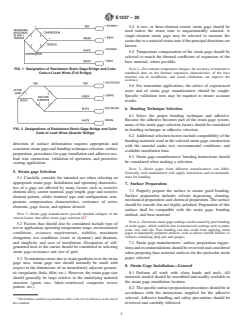
3.3.2 resistance strain gage bridge—a common Wheatstone
Barriers to Trade (TBT) Committee.
bridge made up of strain gages used for the measurement of
small changes of resistance produced by a strain gage, where
2. Referenced Documents
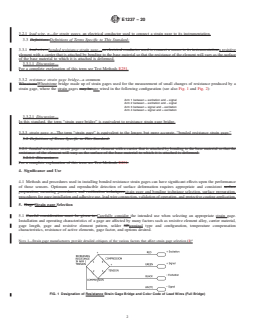
the strain gages are wired in the following configuration (see
also Fig. 1 and Fig. 2):
2.1 ASTM Standards:
E6 Terminology Relating to Methods of Mechanical Testing Arm 1 between + excitation and − signal
Arm 2 between − excitation and − signal
E251 Test Methods for Performance Characteristics of Me-
Arm 3 between + signal and − excitation
tallic Bonded Resistance Strain Gages
Arm 4 between + signal and + excitation
2.2 Other Standards:
3.3.2.1 Discussion—In this standard, the term “strain gage
ANSI/SEM 1-1984; Standard for Portable Strain-Indicating
bridge” is equivalent to resistance strain gage bridge.
Instruments—Designation of Strain Gage Bridge and
3.3.3 strain gage, n—Theterm“straingage”isequivalentto
the longer, but more accurate, “bonded resistance strain gage.”
This guide is under the jurisdiction of ASTM Committee E28 on Mechanical
4. Significance and Use
Testing and is the direct responsibility of Subcommittee E28.01 on Calibration of
Mechanical Testing Machines and Apparatus.
4.1 Methods and procedures used in installing bonded
Current edition approved Aug. 15, 2020. Published September 2020. Originally
resistance strain gages can have significant effects upon the
approved in 1993. Last previous edition approved in 2014 as E1237 – 93 (2014).
DOI: 10.1520/E1237-20. performance of those sensors. Optimum and reproducible
For referenced ASTM standards, visit the ASTM website, www.astm.org, or
contact ASTM Customer Service at service@astm.org. For Annual Book of ASTM
Standards volume information, refer to the standard’s Document Summary page on Available fromAmerican National Standards Institute (ANSI), 25 W. 43rd St.,
the ASTM website. 4th Floor, New York, NY 10036, http://www.ansi.org.
*A Summary of Changes section appears at the end of this standard
Copyright © ASTM International, 100 Barr Harbor Drive, PO Box C700, West Conshohocken, PA 19428-2959. United States
E1237 − 20
5.4 A two- or three-element rosette strain gage should be
used unless the strain state is unquestionably uniaxial. A
single-element strain gage may be selected to measure the
strainduetoauniaxialstrainstateiftheprincipaldirectionsare
known.
5.5 Temperature compensation of the strain gage should be
selected to match the thermal coefficient of expansion of the
base material, where possible.
NOTE 2—For extreme temperature changes, the accuracy of nominal or
FIG. 1 Designation of Resistance Strain Gage Bridge and Color
Code of Lead Wires (Full Bridge) handbook data on the thermal expansion characteristics of the base
material can be insufficient, and actual calibration can improve the
accuracy.
5.6 For nonroutine applications, the advice of experienced
users and of strain gage manufacturers should be sought.
Specific validation tests may be required to ensure accurate
results.
6. Bonding Technique Selection
6.1 Select the proper bonding technique and adhesive.
Because the adhesive becomes part of the strain gage system,
many of the strain gage selection factors should be considered
FIG. 2 Designations of Resistance Strain Gage Bridge and Color
in bonding technique or adhesive selection.
Code of Lead Wires (Quarter Bridge)
6.2 Additional selection factors include compatibility of the
bonding materials used in the selected strain gage construction
detection of surface deformation requires appropriate and
with the material under test, environmental conditions, and
consistent strain gage and bonding technique selection, surface
available installation time.
preparation, procedures for gage installation and adhesive use,
6.3 Strain gage manufacturers’ bonding instructions should
lead wire connection, validation of operation, and protective
be considered when making a selection.
coating application.
NOTE 3—Strain gages from different manufacturers can differ.
5. Strain gage Selection
Generally, each manufacturer will supply instructions and recommenda-
tions for bonding.
5.1 Carefully consider the intended use when selecting an
appropriate strain gage. Installation and operating characteris-
7. Surface Preparation
tics of a gage are affected by many factors such as resistive
7.1 Properly prepare the surface to ensure good bonding.
element alloy, carrier material, gage length, gage and resistive
Surface preparation includes solvent degreasing, cleaning,
element pattern, solder terminal type and configuration, tem-
mechanical preparation, and chemical preparation. The surface
perature compensation characteristics, resistance of active
should be smooth, but not highly polished. Preparation of this
elements, gage factor, and options desired.
surface shall be compatible with the strain gage, bonding
NOTE 1—Strain gage manufacturers provide detailed critiques of the
method, and base material.
various factors that affect strain gage selection (1)
NOTE4—Erroneousstraingagereadingscanbecausedbypoorbonding
5.2 Factors that should also be considered include type of
of strain gages, which could be due to unremoved coatings such as paint,
test or application, operating temperature range, environmental
scale, rust, and oils. Poor bonding can also result from applying strain
conditions, accuracy requirements, stability, maximum gages to improperly prepared surfaces, such as mirror smooth finishes or
surfaces containing deep pits and gouges.
elongation, test conditions (static or dynamic) and duration,
and simplicity and ease of installation. Dissipation of self-
7.2 Strain gage manufacturers’ surface preparation sugges-
generated heat to the carrier should be considered in selecting
tionsandrecommendationsshouldbereviewedandconsidered
strain gage resistance and size of grid.
when preparing base material surfaces for the particular strain
gages selected.
5.3 Tominimizeerrorsduetostraingradientsoverthestrain
gage area, strain gage size should normally be small with
8. Strain Gage Installation—General
respect to the dimensions of an immediately adjacent geomet-
8.1 Perform all work with clean hands and tools. All
ric irregularity (hole, fillet, etc.). However, the strain gage size
materials needed should be assembled and readily available at
should generally be large relative to the underlying material
the strain gage installation location.
structure (grain size, fabric-reinforced composite weave
pattern, etc.).
8.2 The specific surface preparation procedures should be in
accordance with the instructions supplied for the adhesive
selected. Adhesive handling and safety precautions should be
The boldface numbers in parentheses refer to the list of references at the end of
this standard. reviewed and carefully followed.
E1237 − 20
8.3 The detailed strain gage installation procedures avail- 10.4.1 The following sign conventions should be used:
able from the strain gage manufacturer for the particular strain tension, elongation, increased pressure, or other generally
gage/bonding technique system selected should be carefully accepted positive quantities should produce positive output
reviewed and rigorously followed. Deviations from these signals.
procedures should be documented and validated to ensure that
10.4.2 The color code for strain gage bridge wiring and
the installation will yield suitably accurate results. connections shall be as follows:
Red + excitation
8.4 Strain gage handling and alignment procedures should
Green + signal
be rigorously followed. Deviations, should be documented.
Black − excitation
White − signal
9. Strain Gage Installation—Adhesive
10.4.3 Ifallelementsofthestraingagebridgeareactive,the
strain gage bridge elements shall be arranged so that functions
9.1 Select the proper adhesive for a given strain gage type.
producing positive output will cause increasing resistance in
Followstra
...
This document is not an ASTM standard and is intended only to provide the user of an ASTM standard an indication of what changes have been made to the previous version. Because
it may not be technically possible to adequately depict all changes accurately, ASTM recommends that users consult prior editions as appropriate. In all cases only the current version
of the standard as published by ASTM is to be considered the official document.
Designation: E1237 − 93 (Reapproved 2014) E1237 − 20
Standard Guide for
Installing Bonded Resistance Strain Gages
This standard is issued under the fixed designation E1237; the number immediately following the designation indicates the year of
original adoption or, in the case of revision, the year of last revision. A number in parentheses indicates the year of last reapproval. A
superscript epsilon (´) indicates an editorial change since the last revision or reapproval.
This standard has been approved for use by agencies of the U.S. Department of Defense.
1. Scope Scope*
1.1 This guide provides guidelines for installing bonded resistance strain gages. It is not intended to be used for bulk or diffused
semiconductor gages. This documentguide pertains only to adhesively bonded strain gages.
1.2 The values stated in inch-poundSI units are to be regarded as standard. The values given in parentheses are mathematical
conversions to SI units that are provided for information only and are not considered No other units of measurement are included
in this standard.
1.3 This standard does not purport to address all of the safety concerns, if any, associated with its use. It is the responsibility
of the user of this standard to establish appropriate safety safety, health, and healthenvironmental practices and determine the
applicability of regulatory limitations prior to use.
1.4 This international standard was developed in accordance with internationally recognized principles on standardization
established in the Decision on Principles for the Development of International Standards, Guides and Recommendations issued
by the World Trade Organization Technical Barriers to Trade (TBT) Committee.
2. Referenced Documents
2.1 ASTM Standards:
E6 Terminology Relating to Methods of Mechanical Testing
E251 Test Methods for Performance Characteristics of Metallic Bonded Resistance Strain Gages
2.2 Other Standards:
ANSI/SEM 1-1984; Standard for Portable Strain-Indicating Instruments—Designation of Strain Gage Bridge and Color Code
of Terminal Connections; August 16, 1984.
3. Terminology
3.1 The terms accuracy, gage factor, lot, and type are used as defined in Terminology E6. In addition, the following terms common
to strain gages from Terminology E6 are defined.
3.2 Definitions: Definitions of terms common to mechanical testing:
This guide is under the jurisdiction of ASTM Committee E28 on Mechanical Testing and is the direct responsibility of Subcommittee E28.01 on Calibration of Mechanical
Testing Machines and Apparatus.
Current edition approved April 15, 2014Aug. 15, 2020. Published August 2014September 2020. Originally approved in 1993. Last previous edition approved in 20092014
as E1237E1237 – 93 (2009).(2014). DOI: 10.1520/E1237-93R14.10.1520/E1237-20.
For referenced ASTM standards, visit the ASTM website, www.astm.org, or contact ASTM Customer Service at service@astm.org. For Annual Book of ASTM Standards
volume information, refer to the standard’s Document Summary page on the ASTM website.
Available from American National Standards Institute (ANSI), 25 W. 43rd St., 4th Floor, New York, NY 10036, http://www.ansi.org.
*A Summary of Changes section appears at the end of this standard
Copyright © ASTM International, 100 Barr Harbor Drive, PO Box C700, West Conshohocken, PA 19428-2959. United States
E1237 − 20
3.2.1 lead wire, n—for strain gages, an electrical conductor used to connect a strain gage to its instrumentation.
3.3 Definitions:Definitions of Terms Specific to This Standard:
3.3.1 lead wire—bonded resistance strain gage—an electrical conductor used to connect a sensor to its instrumentation.a resistive
element with a carrier that is attached by bonding to the base material so that the resistance of the element will vary as the surface
of the base material to which it is attached is deformed.
3.3.1.1 Discussion—
For a complete explanation of this term see Test Methods E251.
3.3.2 resistance strain gage bridge—a common
WheatsoneWheatstone bridge made up of strain gages used for the measurement of small changes of resistance produced by a
strain gage, where the strain gages may be are wired in the following configuration (see also Fig. 1 and Fig. 2):
Arm 1 between + excitation and − signal
Arm 2 between − excitation and − signal
Arm 3 between + signal and − excitation
Arm 4 between + signal and + excitation
3.3.2.1 Discussion—
In this standard, the term “strain gage bridge” is equivalent to resistance strain gage bridge.
3.3.3 strain gage, n—The term “strain gage” is equivalent to the longer, but more accurate, “bonded resistance strain gage.”
3.2 Definitions of Terms Specific to This Standard:
3.2.1 bonded resistance strain gage—a resistive element with a carrier that is attached by bonding to the base material so that the
resistance of the element will vary as the surface of the base material to which it is attached is deformed.
3.2.1.1 Discussion—
For a complete explanation of this term see Test Methods E251.
4. Significance and Use
4.1 Methods and procedures used in installing bonded resistance strain gages can have significant effects upon the performance
of those sensors. Optimum and reproducible detection of surface deformation requires appropriate and consistent surface
preparation, mounting procedures, and verification techniques.strain gage and bonding technique selection, surface preparation,
procedures for gage installation and adhesive use, lead wire connection, validation of operation, and protective coating application.
5. Gage Strain gage Selection
5.1 Careful consideration must be given to Carefully consider the intended use when selecting an appropriate strain gage.
Installation and operating characteristics of a gage are affected by many factors such as resistive element alloy, carrier material,
gage length, gage and resistive element pattern, solder tabterminal type and configuration, temperature compensation
characteristics, resistance of active elements, gage factor, and options desired.
NOTE 1—Strain gage manufacturers provide detailed critiques of the various factors that affect strain gage selection (1)
FIG. 1 Designation of Resistance Strain Gage Bridge and Color Code of Lead Wires (Full Bridge)
E1237 − 20
FIG. 2 Designations of Resistance Strain Gage Bridge and Color Code of Lead Wires ((Quarter ⁄4 Bridge)
5.2 Factors that should also be considered include type of test or application, operating temperature range, environmental
conditions, accuracy requirements, stability, maximum elongation, test conditions (static or dynamic) and duration, and simplicity
and ease of installation. Dissipation of self-generated heat to the carrier should be considered in selecting strain gage resistance
and size of grid.
5.3 To minimize errors due to strain gradients over the strain gage area, strain gage size should normally be small with respect
to the dimensions of an immediately adjacent geometric irregularity (hole, fillet, etc.). However, the strain gage size should
generally be large relative to the underlying material structure (grain size, fabric-reinforced composite weave pattern, etc.).
5.4 A two- or three-element rosette strain gage should be used unless the strain state is unquestionably uniaxial. A single-element
strain gage may be selected to measure the strain due to a uniaxial strain state if the principal directions are known.
5.5 Temperature compensation of the strain gage should be selected to match the thermal coefficient of expansion of the base
material, where possible. As a note of caution, for extreme temperature changes, nominal or handbook data on the thermal
expansion characteristics of the base material may not be sufficiently accurate, and actual calibration may be required.
NOTE 2—For extreme temperature changes, the accuracy of nominal or handbook data on the thermal expansion characteristics of the base material can
be insufficient, and actual calibration can improve the accuracy.
5.6 Strain gage manufacturers provide detailed critiques of the various factors that affect gage selection (1).
5.6 For nonroutine applications, the advice of experienced users and of strain gage manufacturers should be sought. Specific
verificationvalidation tests may be required to ensure accurate results.
6. Bonding Technique Selection
6.1 Selection of Select the proper bonding technique and agent is important. adhesive. Because the bonding agent adhesive
becomes part of the strain gage system, many of the strain gage selection factors should be considered in bonding technique or
agentadhesive selection.
6.2 Additional selection factors include compatibility of the bonding materials used in the selected strain gage construction with
the material under test, environmental conditions, and available installation time.
6.3 Strain gages from different manufacturers may differ. Generally, each manufacturer will supply instructions and recommen-
dations for bonding. These instructions gage manufacturers’ bonding instructions should be considered when making a selection.
NOTE 3—Strain gages from different manufacturers can differ. Generally, each manufacturer will supply instructions and recommendations for bonding.
7. Surface Preparation
7.1 The surface must be properly prepared to ensure good bonding. Surface preparation includes solvent degreasing, cleaning,
The boldface numbers in parentheses refer to the list of references at the end of this standard.
E1237 − 20
mechanical preparation, and chemical preparation. The surface should be smooth, but not highly polished. Preparation of this
surface must be compatible with the gage, bonding method, and base material.
7.1 Erroneous gage readings may be caused by poor bonding of strain gages, which could be due to unremoved coatings such as
paint, scale, rust, and oils. Poor bonding may also result from applying gages to improperly prepared surfaces, such as mirror
smooth finishes or surfaces containing deep pits and gouges.Properly prepare the surface to ensure good bonding. Surface
preparation includes solvent degreasing, cleaning, mechanical preparation, and chemical preparation. The surface should be
smooth, but not highly polished. Preparation of this surface shall be compatible with the strain gage, bonding method, and base
material.
NOTE 4—Erroneous strain gage readings can be caused by poor bonding of strain gages, which could be due to unremoved coatings such as paint, scale,
rust, and oils. Poor bonding can also result from applying strain gages to improperly prepared surfaces, such as mirror smooth finishes or surfaces
containing deep pits and gouges.
7.2 Strain gage manufacturers supply manufacturers’ surface preparation suggestions and recommendations. This information
recommendations should be reviewed and considered when preparing base material surfaces for the particular strain gages selected.
8. Strain Gage Installation—General
8.1 All work must be performed Perform all work with clean hands and tools. All materials needed should be assembled and
readily available at the strain gage installation location.
8.2 The specific surface preparation procedures should be in accordance with the instructions supplied for the bonding agent
selected. Bonding agent adhesive selected. Adhesive handling and safety precautions should be reviewed and carefully followed.
8.3 The detailed strain gage installation procedures available from the strain gage manufacturer for the particular strain
gage/bonding technique system selected should be carefully reviewed and rigorously followed. Deviations from these procedures,
if any, procedures should be documented and verifiedvalidated to ensure that the installation will yield suitably accurate results.
8.4 Gage Strain gage handling and alignment procedures should be rigorously followed. Deviations, if any, should be documented.
9. Strain Gage Installation—Adhesive
9.1 Ensure that Select the proper adhesive is selected for a given strain gage type. Follow strain gage manufacturer’s
recommendations for selecting an adhesive.
9.2 The environment to which a strain gage is to be subjected and test duration should be considered when selecting an adhesive.
9.3 Ensure that the adhesive to be used is not out-of-date with regard to storage and shelf life shelf-life requirements.
9.4 Ensure that test material temperature range and strain gage/bonding system temperature range are compatible.
9.5 Tem
...