

ASTM E251-20a
(Test Method)Standard Test Methods for Performance Characteristics of Metallic Bonded Resistance Strain Gages
General Information
- Abstract
SIGNIFICANCE AND USE
4.1 Strain gages are the most widely used devices for the determination of materials, properties and for analyzing stresses in structures. However, performance characteristics of strain gages are affected by both the materials from which they are made and their geometric design. These test methods detail the minimum information that must accompany strain gages if they are to be used with acceptable accuracy of measurement.
4.2 Most performance characteristics of strain gages require mechanical testing that is destructive. Since test strain gages cannot be used again, it is necessary to treat data statistically and then apply values to the remaining population from the same lot or batch. Failure to acknowledge the resulting uncertainties can have serious repercussions. Resistance measurement is non-destructive and can be made for each strain gage.
4.3 Properly designed and manufactured strain gages, whose performance characteristics have been accurately determined and with appropriate uncertainties applied, represent powerful measurement tools. They can determine small dimensional changes in structures with excellent accuracy, far beyond that of other known devices. It is important to recognize, however, that individual strain gages cannot be calibrated. If calibration and traceability to a standard are required, strain gages should not be employed.
4.4 To be used, strain gages must be bonded to a structure. Good results depend heavily on the materials used to clean the bonding surface, to bond the strain gage, and to provide a protective coating. Skill of the installer is another major factor in success. Finally, instrumentation systems must be carefully designed to assure that they do not unduly degrade the performance of the strain gages. In many cases, it is impossible to achieve this goal. If so, allowance must be made when considering accuracy of data. Test conditions can, in some instances, be so severe that error signals from strain gage systems far ...
SCOPE
1.1 The purpose of these test methods are to provide uniform test methods for the determination of strain gage performance characteristics. Suggested testing equipment designs are included.
1.2 Test Methods E251 describes methods and procedures for determining five strain gage performance characteristics:
Section
Part I—General Requirements
7
Part II—Resistance at a Reference Temperature
8
Part III—Gage Factor at a Reference Temperature
9
Part IV—Temperature Coefficient of Gage Factor
10
Part V—Transverse Sensitivity
11
Part VI—Thermal Output
12
1.3 Strain gages are very sensitive devices with essentially infinite resolution. Their response to strain, however, is low and great care must be exercised in their use. The performance characteristics identified by these test methods must be known to an acceptable accuracy to obtain meaningful results in field applications.
1.3.1 Strain gage resistance is used to balance instrumentation circuits and to provide a reference value for measurements since all data are related to a change in the strain gage resistance from a known reference value.
1.3.2 Gage factor is the transfer function of a strain gage. It relates resistance change in the strain gage and strain to which it is subjected. Accuracy of strain gage data can be no better than the accuracy of the gage factor.
1.3.3 Changes in gage factor as temperature varies also affect accuracy although to a much lesser degree since variations are usually small.
1.3.4 Transverse sensitivity is a measure of the strain gage's response to strains perpendicular to its measurement axis. Although transverse sensitivity is usually much less than 10 % of the gage factor, large errors can occur if the value is not known with reasonable precision.
1.3.5 Thermal output is the response of a strain gage to temperature changes. Thermal output is an additive (not multiplica...
- Status
- Published
- Publication Date
- 31-May-2020
- Technical Committee
- E28 - Mechanical Testing
- Drafting Committee
- E28.01 - Calibration of Mechanical Testing Machines and Apparatus
Buy Documents
ASTM E251-20a - Standard Test Methods for Performance Characteristics of Metallic Bonded Resistance Strain Gages
REDLINE ASTM E251-20a - Standard Test Methods for Performance Characteristics of Metallic Bonded Resistance Strain Gages
Overview
ASTM E251-20a: Standard Test Methods for Performance Characteristics of Metallic Bonded Resistance Strain Gages is a key ASTM standard that provides uniform methods for assessing performance characteristics of metallic bonded resistance strain gages. Metallic bonded resistance strain gages are widely used for measuring material properties and analyzing stress in structures. These test methods are essential for users and manufacturers to ensure the strain gages provide reliable and accurate data for both research and industrial applications.
Key Topics
This standard covers the following critical performance characteristics for metallic bonded resistance strain gages:
- Resistance at a Reference Temperature: Specifies measurement of baseline electrical resistance at room temperature.
- Gage Factor at a Reference Temperature: Defines the strain gage’s sensitivity by relating resistance change to physical deformation (strain).
- Temperature Coefficient of Gage Factor: Measures how the sensitivity of the strain gage changes with temperature.
- Transverse Sensitivity: Evaluates the undesired response of a strain gage to strain perpendicular to its intended measurement axis.
- Thermal Output: Assesses the strain gage output resulting only from temperature changes, independent of mechanical loading.
These methods require careful measurement and, in many cases, destructive mechanical testing. As a result, the standard emphasizes the importance of statistical treatment of data to accurately characterize batch or lot performance and acknowledge uncertainty in measurements.
Applications
ASTM E251-20a’s standardized test methods deliver significant practical value for a variety of sectors, including:
- Materials Testing: Ensuring strain gages accurately capture material deformation under load, essential for mechanical property evaluation.
- Structural Analysis: Reliable strain gage performance enables precise stress analysis in civil, aerospace, automotive, and mechanical engineering structures.
- Quality Assurance: Manufacturers use these test methods to certify product batches, maintaining high standards in strain gage fabrication.
- Research and Development: Accurate measurement of strain assists in developing new materials and structures.
- Instrumentation Design: The standard guides instrumentation engineers in selecting, installing, and validating strain gages for specific applications.
It is important to note these methods pertain only to metallic bonded resistance strain gages and not to transducers or extensometers that use similar sensing elements. Proper installation, surface preparation, bonding, and protective coatings-as well as skilled installation-are critical for accurate results.
Related Standards
Users of ASTM E251-20a may also reference the following standards for a comprehensive approach to strain measurement and installation:
- ASTM E6 - Terminology Relating to Methods of Mechanical Testing: Definitions for mechanical testing terms.
- ASTM E83 - Practice for Verification and Classification of Extensometer Systems: For extensometer calibration and verification, not directly applicable to strain gages.
- ASTM E228 and ASTM E289 - Methods for Linear Thermal Expansion Measurement: Complementary for assessing thermal properties of materials.
- ASTM E1237 - Guide for Installing Bonded Resistance Strain Gages: Best practices for gage installation and surface preparation.
- OIML Recommendation No. 62 - Performance Characteristics of Metallic Resistance Strain Gages: The international reference that influenced ASTM E251’s development.
By adhering to ASTM E251-20a, organizations promote consistency, reliability, and international comparability of strain measurement data, supporting material testing, structural analysis, and product development worldwide.
Keywords: ASTM E251, metallic bonded resistance strain gages, strain gage performance, strain measurement, gage factor, transverse sensitivity, thermal output, mechanical testing, material properties, structural analysis, industrial strain gages, ASTM standards, quality assurance.
Relations
- Effective Date
- 01-Jun-2020
- Refers
ASTM E289-17 - Standard Test Method for Linear Thermal Expansion of Rigid Solids with Interferometry - Effective Date
- 01-Apr-2017
- Effective Date
- 01-Sep-2016
- Effective Date
- 01-Sep-2016
- Effective Date
- 15-Apr-2014
- Effective Date
- 01-Jun-2010
- Effective Date
- 01-Mar-2010
- Effective Date
- 01-Jan-2010
- Effective Date
- 15-May-2009
- Effective Date
- 15-May-2009
- Effective Date
- 01-Apr-2009
- Effective Date
- 01-Apr-2009
- Effective Date
- 01-Jan-2009
- Effective Date
- 01-Oct-2008
- Effective Date
- 01-Feb-2008
Buy Documents
ASTM E251-20a - Standard Test Methods for Performance Characteristics of Metallic Bonded Resistance Strain Gages
REDLINE ASTM E251-20a - Standard Test Methods for Performance Characteristics of Metallic Bonded Resistance Strain Gages
Get Certified
Connect with accredited certification bodies for this standard

IMP NDT d.o.o.
Non-destructive testing services. Radiography, ultrasonic, magnetic particle, penetrant, visual inspection.
Inštitut za kovinske materiale in tehnologije
Institute of Metals and Technology. Materials testing, metallurgical analysis, NDT.
Q Techna d.o.o.
NDT and quality assurance specialist. 30+ years experience. NDT personnel certification per ISO 9712, nuclear and thermal power plant inspections, QA/
Sponsored listings
Frequently Asked Questions
ASTM E251-20a is a standard published by ASTM International. Its full title is "Standard Test Methods for Performance Characteristics of Metallic Bonded Resistance Strain Gages". This standard covers: SIGNIFICANCE AND USE 4.1 Strain gages are the most widely used devices for the determination of materials, properties and for analyzing stresses in structures. However, performance characteristics of strain gages are affected by both the materials from which they are made and their geometric design. These test methods detail the minimum information that must accompany strain gages if they are to be used with acceptable accuracy of measurement. 4.2 Most performance characteristics of strain gages require mechanical testing that is destructive. Since test strain gages cannot be used again, it is necessary to treat data statistically and then apply values to the remaining population from the same lot or batch. Failure to acknowledge the resulting uncertainties can have serious repercussions. Resistance measurement is non-destructive and can be made for each strain gage. 4.3 Properly designed and manufactured strain gages, whose performance characteristics have been accurately determined and with appropriate uncertainties applied, represent powerful measurement tools. They can determine small dimensional changes in structures with excellent accuracy, far beyond that of other known devices. It is important to recognize, however, that individual strain gages cannot be calibrated. If calibration and traceability to a standard are required, strain gages should not be employed. 4.4 To be used, strain gages must be bonded to a structure. Good results depend heavily on the materials used to clean the bonding surface, to bond the strain gage, and to provide a protective coating. Skill of the installer is another major factor in success. Finally, instrumentation systems must be carefully designed to assure that they do not unduly degrade the performance of the strain gages. In many cases, it is impossible to achieve this goal. If so, allowance must be made when considering accuracy of data. Test conditions can, in some instances, be so severe that error signals from strain gage systems far ... SCOPE 1.1 The purpose of these test methods are to provide uniform test methods for the determination of strain gage performance characteristics. Suggested testing equipment designs are included. 1.2 Test Methods E251 describes methods and procedures for determining five strain gage performance characteristics: Section Part I—General Requirements 7 Part II—Resistance at a Reference Temperature 8 Part III—Gage Factor at a Reference Temperature 9 Part IV—Temperature Coefficient of Gage Factor 10 Part V—Transverse Sensitivity 11 Part VI—Thermal Output 12 1.3 Strain gages are very sensitive devices with essentially infinite resolution. Their response to strain, however, is low and great care must be exercised in their use. The performance characteristics identified by these test methods must be known to an acceptable accuracy to obtain meaningful results in field applications. 1.3.1 Strain gage resistance is used to balance instrumentation circuits and to provide a reference value for measurements since all data are related to a change in the strain gage resistance from a known reference value. 1.3.2 Gage factor is the transfer function of a strain gage. It relates resistance change in the strain gage and strain to which it is subjected. Accuracy of strain gage data can be no better than the accuracy of the gage factor. 1.3.3 Changes in gage factor as temperature varies also affect accuracy although to a much lesser degree since variations are usually small. 1.3.4 Transverse sensitivity is a measure of the strain gage's response to strains perpendicular to its measurement axis. Although transverse sensitivity is usually much less than 10 % of the gage factor, large errors can occur if the value is not known with reasonable precision. 1.3.5 Thermal output is the response of a strain gage to temperature changes. Thermal output is an additive (not multiplica...
SIGNIFICANCE AND USE 4.1 Strain gages are the most widely used devices for the determination of materials, properties and for analyzing stresses in structures. However, performance characteristics of strain gages are affected by both the materials from which they are made and their geometric design. These test methods detail the minimum information that must accompany strain gages if they are to be used with acceptable accuracy of measurement. 4.2 Most performance characteristics of strain gages require mechanical testing that is destructive. Since test strain gages cannot be used again, it is necessary to treat data statistically and then apply values to the remaining population from the same lot or batch. Failure to acknowledge the resulting uncertainties can have serious repercussions. Resistance measurement is non-destructive and can be made for each strain gage. 4.3 Properly designed and manufactured strain gages, whose performance characteristics have been accurately determined and with appropriate uncertainties applied, represent powerful measurement tools. They can determine small dimensional changes in structures with excellent accuracy, far beyond that of other known devices. It is important to recognize, however, that individual strain gages cannot be calibrated. If calibration and traceability to a standard are required, strain gages should not be employed. 4.4 To be used, strain gages must be bonded to a structure. Good results depend heavily on the materials used to clean the bonding surface, to bond the strain gage, and to provide a protective coating. Skill of the installer is another major factor in success. Finally, instrumentation systems must be carefully designed to assure that they do not unduly degrade the performance of the strain gages. In many cases, it is impossible to achieve this goal. If so, allowance must be made when considering accuracy of data. Test conditions can, in some instances, be so severe that error signals from strain gage systems far ... SCOPE 1.1 The purpose of these test methods are to provide uniform test methods for the determination of strain gage performance characteristics. Suggested testing equipment designs are included. 1.2 Test Methods E251 describes methods and procedures for determining five strain gage performance characteristics: Section Part I—General Requirements 7 Part II—Resistance at a Reference Temperature 8 Part III—Gage Factor at a Reference Temperature 9 Part IV—Temperature Coefficient of Gage Factor 10 Part V—Transverse Sensitivity 11 Part VI—Thermal Output 12 1.3 Strain gages are very sensitive devices with essentially infinite resolution. Their response to strain, however, is low and great care must be exercised in their use. The performance characteristics identified by these test methods must be known to an acceptable accuracy to obtain meaningful results in field applications. 1.3.1 Strain gage resistance is used to balance instrumentation circuits and to provide a reference value for measurements since all data are related to a change in the strain gage resistance from a known reference value. 1.3.2 Gage factor is the transfer function of a strain gage. It relates resistance change in the strain gage and strain to which it is subjected. Accuracy of strain gage data can be no better than the accuracy of the gage factor. 1.3.3 Changes in gage factor as temperature varies also affect accuracy although to a much lesser degree since variations are usually small. 1.3.4 Transverse sensitivity is a measure of the strain gage's response to strains perpendicular to its measurement axis. Although transverse sensitivity is usually much less than 10 % of the gage factor, large errors can occur if the value is not known with reasonable precision. 1.3.5 Thermal output is the response of a strain gage to temperature changes. Thermal output is an additive (not multiplica...
ASTM E251-20a is classified under the following ICS (International Classification for Standards) categories: 19.060 - Mechanical testing. The ICS classification helps identify the subject area and facilitates finding related standards.
ASTM E251-20a has the following relationships with other standards: It is inter standard links to ASTM E251-20, ASTM E289-17, ASTM E228-11(2016), ASTM E289-04(2016), ASTM E1237-93(2014), ASTM E83-10a, ASTM E289-04(2010), ASTM E83-10, ASTM E6-09b, ASTM E6-09be1, ASTM E6-09a, ASTM E1237-93(2009), ASTM E6-09, ASTM E6-08a, ASTM E6-08. Understanding these relationships helps ensure you are using the most current and applicable version of the standard.
ASTM E251-20a is available in PDF format for immediate download after purchase. The document can be added to your cart and obtained through the secure checkout process. Digital delivery ensures instant access to the complete standard document.
Standards Content (Sample)
This international standard was developed in accordance with internationally recognized principles on standardization established in the Decision on Principles for the
Development of International Standards, Guides and Recommendations issued by the World Trade Organization Technical Barriers to Trade (TBT) Committee.
Designation: E251 − 20a
Standard Test Methods for
Performance Characteristics of Metallic Bonded Resistance
Strain Gages
This standard is issued under the fixed designation E251; the number immediately following the designation indicates the year of
original adoption or, in the case of revision, the year of last revision.Anumber in parentheses indicates the year of last reapproval.A
superscript epsilon (´) indicates an editorial change since the last revision or reapproval.
This standard has been approved for use by agencies of the U.S. Department of Defense.
INTRODUCTION
The Organization of International Legal Metrology is a treaty organization with approximately
75member nations. In 1984, OIML issued International Recommendation No. 62, “Performance
Characteristics of Metallic Resistance Strain Gages.” Test Methods E251 has been modified and
expanded to be the United States ofAmerica’s compliant test specification. Throughout this standard
the term “strain gage” represents the longer, but more accurate, “metallic bonded resistance strain
gage.”
1. Scope it is subjected. Accuracy of strain gage data can be no better
than the accuracy of the gage factor.
1.1 The purpose of these test methods are to provide
1.3.3 Changes in gage factor as temperature varies also
uniform test methods for the determination of strain gage
affect accuracy although to a much lesser degree since varia-
performance characteristics. Suggested testing equipment de-
signs are included. tions are usually small.
1.3.4 Transversesensitivityisameasureofthestraingage’s
1.2 Test Methods E251 describes methods and procedures
response to strains perpendicular to its measurement axis.
for determining five strain gage performance characteristics:
Although transverse sensitivity is usually much less than 10%
Section
Part I—General Requirements 7 of the gage factor, large errors can occur if the value is not
Part II—Resistance at a Reference Temperature 8
known with reasonable precision.
Part III—Gage Factor at a Reference Temperature 9
1.3.5 Thermal output is the response of a strain gage to
Part IV—Temperature Coefficient of Gage Factor 10
Part V—Transverse Sensitivity 11
temperature changes. Thermal output is an additive (not
Part VI—Thermal Output 12
multiplicative) error. Therefore, it can often be much larger
1.3 Strain gages are very sensitive devices with essentially
than the strain gage output from structural loading. To correct
infinite resolution. Their response to strain, however, is low
for these effects, thermal output must be determined from
and great care must be exercised in their use.The performance
strain gages bonded to specimens of the same material on
characteristics identified by these test methods must be known
which the tests are to run, often to the test structure itself.
to an acceptable accuracy to obtain meaningful results in field
1.4 Metallic bonded resistance strain gages differ from
applications.
extensometers in that they measure average unit elongation
1.3.1 Strain gage resistance is used to balance instrumenta-
tioncircuitsandtoprovideareferencevalueformeasurements (∆L/L) over a nominal gauge length rather than total elonga-
tion between definite gauge points. Practice E83 is not appli-
since all data are related to a change in the strain gage
resistance from a known reference value. cable to these strain gages.
1.3.2 Gage factor is the transfer function of a strain gage. It
1.5 These test methods do not apply to transducers, such as
relates resistance change in the strain gage and strain to which
load cells and extensometers, that use bonded resistance strain
gages as sensing elements.
1.6 Strain gages are part of a complex system that includes
These test methods are under the jurisdiction of ASTM Committee E28 on
Mechanical Testing and are the direct responsibility of Subcommittee E28.01 on
structure, adhesive, strain gage, lead wires, instrumentation,
Calibration of Mechanical Testing Machines and Apparatus.
and (often) environmental protection.As a result, many things
Current edition approved June 1, 2020. Published August 2020. Originally
affect the performance of strain gages, including user tech-
approved in 1964. Last previous edition approved in 2014 as E251–92 (2014).
DOI: 10.1520/E0251-20A. nique.Afurthercomplicationisthatstraingagesonceinstalled
Copyright © ASTM International, 100 Barr Harbor Drive, PO Box C700, West Conshohocken, PA 19428-2959. United States
E251 − 20a
normally cannot be reinstalled in another location. Therefore, R 2 R ∆R
strain gage characteristics can be stated only on a statistical R R
0 0
K 5 5 (1)
basis. L 2 L ε
L
1.7 This standard does not purport to address all of the
safety concerns, if any, associated with its use. It is the
where:
responsibility of the user of this standard to establish appro-
K = the gage factor,
priate safety, health, and environmental practices and deter-
R = the strain gage resistance at test strain
mine the applicability of regulatory limitations prior to use.
R = the strain gage resistance at zero or reference strain,
1.8 This international standard was developed in accor-
L = the test structure length under the strain gage at test
dance with internationally recognized principles on standard-
strain,
ization established in the Decision on Principles for the
L = the test structure length under the strain gage at zero
Development of International Standards, Guides and Recom-
or reference strain,
mendations issued by the World Trade Organization Technical
∆R = the change in strain gage resistance when strain is
Barriers to Trade (TBT) Committee. changed from zero (or reference strain to test strain),
2. Referenced Documents
L2L
ɛ = 0
the mechanical strain .
L
2.1 ASTM Standards:
3.2.4 lead wire, n—for strain gages, an electrical conductor
E6Terminology Relating to Methods of MechanicalTesting
used to connect a strain gage to its instrumentation.
E83Practice for Verification and Classification of Exten-
3.2.5 lot, n—for strain gages, a group of strain gages with
someter Systems
E228Test Method for Linear Thermal Expansion of Solid grid elements from a common melt, subjected to the same
mechanical and thermal processes during manufacturing.
Materials With a Push-Rod Dilatometer
E289Test Method for Linear Thermal Expansion of Rigid
3.2.6 metallic resistance bonded strain gage, n—(see
Solids with Interferometry
Fig. 1)—a resistive element, with or without a matrix that is
E1237Guide for Installing Bonded Resistance Strain Gages
attached to a solid body by cementing, welding, or other
2.2 Other Standards:
suitable techniques so that the resistance of the element will
OIML International Recommendation No. 62Performance
vary as the surface to which it is attached is deformed.
Characteristics of Metallic Resistance Strain Gages
3. Terminology
3.1 The vocabulary included in these test methods have
been chosen so that specialized terms in the strain gage field
are clearly defined. A typical strain gage nomenclature is
provided in Appendix X1.
3.2 Definitions:Terms Common to Mechanical Testing:
3.2.1 The terms accuracy, extensometer, extensometer
system, lead wire, Poisson’s ratio, precision, reduced section,
residual stress, resolution, and verification are used as defined
in Terminology E6. In addition, the following terms common
to strain gages from Terminology E6 are defined.
3.2.2 batch, n—for strain gages, a group of strain gages of
thesametypeandlot,manufacturedasaset(madeatthesame
time and under the same conditions).
3.2.3 gage factor, n—for strain gages, the ratio between the
unit change in strain gage resistance due to strain and the
causing strain.
3.2.3.1 Discussion—Thegagefactorisdimensionlessandis
expressed as follows:
For referenced ASTM standards, visit the ASTM website, www.astm.org, or
contact ASTM Customer Service at service@astm.org. For Annual Book of ASTM
Standards volume information, refer to the standard’s Document Summary page on
the ASTM website.
Available from OIML International Organization of Legal Metrology, BIML,
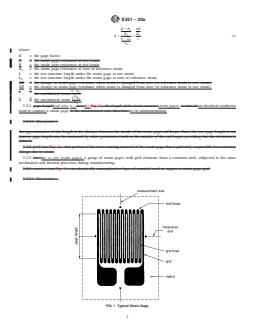
11, rue Turgot, F-75009 Paris, France, http://www.oiml.org/en FIG. 1 Typical Strain Gage
E251 − 20a
3.2.6.1 Discussion—These test methods apply to gages where:
where the instantaneous gage resistance, R, is given by the
T = the test temperature,
equation:
T = the reference temperature,
K = the gage factor at test temperature, and
R 5 R 11εK (2) t1
~ !
o
K = the gage factor at reference temperature.
t0
where:
3.3.9 thermal expansion—the dimensional change of an
R = element resistance at reference strain and temperature
o
unconstrainedspecimensubjecttoachangeintemperaturethat
levels (frequently initial test or balanced circuit
is uniform throughout the material.
conditions),
3.3.10 thermal output—the reversible part of the tempera-
ε = linear strain of the surface in the direction of the
ture induced indicated strain of a strain gage installed on an
measurementaxisofthestraingageproducedeitherby
unrestrained test specimen when exposed to a change in
a stress field (mechanical strain) or by a temperature
temperature.
change (thermal expansion), and
K = the gage factor.
3.3.11 transverse axis (see Fig. 1)—the strain gage axis at
90° to the measurement axis.
3.2.7 type, n—for strain gages, a group of strain gages that
are nominally identical with respect to physical and manufac-
3.3.12 transverse sensitivity—the ratio, expressed as a
turing characteristics. percentage, of the unit change of resistance of a strain gage
mounted perpendicular to a uniaxial strain field (transverse
3.3 Definitions of Terms Specific to This Standard:
strain gage) to the unit resistance change of a similar gage
3.3.1 calibration apparatus, n— equipment for determining
mounted parallel to the same strain field (longitudinal strain
a performance characteristic of a metallic bonded resistance
gage).
strain gage by accurately producing the necessary strains,
temperatures, and other conditions and by accurately measur-
4. Significance and Use
ing the resulting change of strain gage resistance.
4.1 Strain gages are the most widely used devices for the
3.3.2 error, n—for strain gages, the value obtained by
determination of materials, properties and for analyzing
subtracting the actual value of the strain, determined from the
stresses in structures. However, performance characteristics of
calibration apparatus, from the indicated value of the strain
straingagesareaffectedbyboththematerialsfromwhichthey
given by the strain gage output.
aremadeandtheirgeometricdesign.Thesetestmethodsdetail
3.3.2.1 Discussion—Errors attributable to measuring sys-
the minimum information that must accompany strain gages if
tems are excluded.
they are to be used with acceptable accuracy of measurement.
3.3.3 gage length , n— (see Fig. 1)—the length of the strain
sensitive section of a strain gage in the measurement axis 4.2 Mostperformancecharacteristicsofstraingagesrequire
direction. mechanical testing that is destructive. Since test strain gages
cannot be used again, it is necessary to treat data statistically
3.3.3.1 Discussion—An approximation of the gage length is
and then apply values to the remaining population from the
the distance between the inside of the strain gage end loops.
same lot or batch. Failure to acknowledge the resulting
Since the true gage length is not known, gage length may be
uncertainties can have serious repercussions. Resistance mea-
measured by other geometries (such as the outside of the end
surement is non-destructive and can be made for each strain
loops) providing that the deviation is defined.
gage.
3.3.4 grid, n—(see Fig. 1)—that portion of the strain-
sensingmaterialofthestraingagethatisprimarilyresponsible
4.3 Properly designed and manufactured strain gages,
for resistance change due to strain. whose performance characteristics have been accurately deter-
mined and with appropriate uncertainties applied, represent
3.3.5 matrix, n—(seeFig.1)—anelectricallynonconductive
powerfulmeasurementtools.Theycandeterminesmalldimen-
layer of material used to support a strain gage grid.
sional changes in structures with excellent accuracy, far be-
3.3.5.1 Discussion—The two main functions of a matrix are
yond that of other known devices. It is important to recognize,
to act as an aid for bonding the strain gage to a structure and
however, that individual strain gages cannot be calibrated. If
as an electrically insulating layer in cases where the structure
calibration and traceability to a standard are required, strain
is electrically conductive.
gages should not be employed.
3.3.6 measurement axis, n— (see Fig. 1)—the axis that is
4.4 To be used, strain gages must be bonded to a structure.
parallel with the grid lines.
Good results depend heavily on the materials used to clean the
3.3.7 strain gage, n—the term “strain gage” is equivalent to
bonding surface, to bond the strain gage, and to provide a
the longer, but more accurate, “metallic bonded resistance
protective coating. Skill of the installer is another major factor
strain gage.”
in success. Finally, instrumentation systems must be carefully
3.3.8 temperature coeffıcient of gage factor—theratioofthe
designed to assure that they do not unduly degrade the
unit variation of gage factor to the temperature variation,
performanceofthestraingages.Inmanycases,itisimpossible
expressed as follows:
to achieve this goal. If so, allowance must be made when
K 2 K 1
considering accuracy of data. Test conditions can, in some
t1 t0
· (3)
S D S D
K T 2 T instances, be so severe that error signals from strain gage
t0 1 0
E251 − 20a
systemsfarexceedthosefromthestructuraldeformationstobe 7.2.2.1 Balanced Bridge Circuit—Inthiscircuit,achangein
measured. Great care must be exercised in documenting strain gage resistance is matched by an equal unit resistance
magnitudes of error signals so that realistic values can be changeinacalibratedarmofaWheatstonebridgecircuitsoas
placed on associated uncertainties. to produce a balanced condition with zero electrical output.
This circuit is not sensitive to excitation voltage changes
5. Interferences except for self-heating effects. A sensitive null detector (gal-
vanometer) is required to obtain adequate resolution. Direct-
5.1 To assure that strain gage test data are within a defined
currentexcitationisusually,butnotnecessarily,used.Thermal
accuracy, the strain gages must be properly bonded and
emfs generated within the circuit and reactive changes in the
protected with acceptable materials. It is normally simple to
circuit may cause errors. This circuit is shown in Fig. 2.
ascertain that strain gages are not performing properly. The
7.2.2.2 Unbalanced Bridge Circuit—This circuit is similar
most common symptom is instability with time or temperature
to the balanced bridge circuit except that the bridge compo-
change.Ifstraingagesdonotreturntotheirzeroreadingwhen
nents are not adjusted after a nearly balanced initial condition
theoriginalconditionsarerepeated,orthereisloworchanging
is obtained.The output voltage of an unbalanced bridge circuit
resistance to ground, the installation is suspect. Aids in
in which one arm is varying, E , is given by the equation:
o
installation and verification of strain gage can be found in
∆R
Guide E1237.
E 5 E (4)
F G
o i
4R 12∆R
o
6. Hazards
where:
6.1 In the specimen surface cleaning, strain gage bonding,
E = input voltage,
i
and protection steps of strain gage installation, hazardous
R = resistance required for initial bridge balance, and
o
chemicals may be used. Users of these test methods are ∆R = difference between the instantaneous strain gage re-
responsibleforcontactingmanufacturersofthesechemicalsfor sistance and R .
o
applicable Material Safety Data Sheets and to adhere to the
This circuit is readily adaptable to automatic recording of
required precautions.
data. Either ac or dc excitation may be used, but errors due to
thermal emfs and reactive changes are possible. Loading
7. Test Requirements
effects due to the impedance of the recording instruments may
besignificantandmustbeconsidered.Toavoidthenecessityof
7.1 General Environmental Requirements:
accurate absolute measurement of the input and output
7.1.1 Ambient Conditions at Room Temperature—The
voltages, the readout (recording) system may be calibrated in
nominal temperature and relative humidity shall be 23°C
terms of unit resistance change of a bridge arm by use of a
(73°F)and50%,respectively.Innocaseshallthetemperature
calibrating resistor that can be varied so that the total arm
be less that 18°C (64°F) nor greater than 25°C (77°F) and
resistance changes in accurately known steps. This resistor
the relative humidity less than 35% nor more than 60%. The
should be in the opposite arm of the bridge circuit from the
fluctuations during any room temperature test of any strain
strain gage. This circuit is shown in Fig. 3.
gage shall not exceed 62°C and 65% RH.
7.2.2.3 Several types of instruments are available for ob-
7.1.2 Ambient Conditions at Elevated and Lower
taining strain data directly from a strain gage. These instru-
Temperatures—The temperature adjustment error shall not
ments use various types of excitation and system indicators.
exceed 62°C(6 3.6°F) or 62% of the deviation from room
Such strain indicators may be used only after their resolution,
temperature, whichever is greater. The total uncertainty of
accuracy, and stability have been verified by connecting a
temperatureshallnotexceed 62°C(63.6°F),or 61%ofthe
resistor that can be varied in accurately known increments in
deviation from room temperature, whichever is greater. At
placeofthestraingageandcalibratingthestrainindicatorover
elevated temperatures the mixing ratio shall be constant, that
the entire range for which it will be used. The calibrating
means independent of temperature, at a nominal value of
resistor steps shall be accurate to 0.1% of the resistance
0.009g of water per 1g of air at a pressure of 100kPa (1 bar).
–6
change or 2 × 10 of the total resistance, whichever is greater.
This value corresponds to a relative humidity of 50% at 23°C
The effects of the following factors should be determined:
(73°F).
NOTE1—Thismixingratio,independentoftemperature,canberealized
by a furnace that is well connected to an atmosphere meeting the
conditions of 7.1.1.
7.2 Test Measurement Requirements:
7.2.1 Several methods are available for measuring the
change of strain gage resistance with sufficient resolution and
accuracy. In general, any of these methods that are convenient
may be used after it has been shown that the particular
combination of instruments or components used produce a
system with the required accuracy.
7.2.2 Examples of potentially satisfactory methods are as
follows: FIG. 2 Balanced Bridge Circuit
E251 − 20a
addition, special circuits designed to compare the strain gages
being tested to a calibrated reference strain gage may be used
if it is shown that equal accuracy is obtained.
9.3 Determination of the gage factor K requires calibration
apparatus consisting of a test specimen and a loading device
capable of producing a uniform uniaxial stress in the test
specimen corresponding to nominal mean principal strain
values of 0 µm/m (µin./in.), 61000µm⁄m (µin./in.) and
61100µm⁄m (µin./in.). The Poisson’s ratio of the test speci-
men shall be 0.28 60.01 or suitable corrections must be made.
FIG. 3 Unbalanced Bridge Circuit
The mean principal strain shall be within 650 µm/m (µin./in.)
of the nominal value. The strain at the various strain gage
stationsshalldifferbynomorethan 60.5%ofthemeanvalue
thermal emf’s within the bridge circuit and within the lead
andthestrainwithinastraingagestationshallvarybynomore
wirestothestraingage;reactivechangeswithinthebridgeand
than 60.5%ofthenominalvalue.Theuncertaintyofthemean
lead wire circuits; initial bridge unbalance; and battery condi-
strain measurement shall be less than 62 µm/m (µin./in.) or
tions or power line fluctuations.
60.2% of the actual value, whichever is greater. Any test
7.3 Strain Gage Attachment:
apparatus that meets these criteria may be used for determina-
7.3.1 The attachment conditions shall correspond exactly to
tion of gage factor.
the instructions published by the strain gage manufacturer.
9.4 To the extent possible, test specimens with attached
strain gages for tests of the gage factor should be stored under
8. Test Method for Determining Strain Gage Resistance
the ambient conditions described in 7.1.1 for at least 72 h
at Ambient Conditions
before being tested
8.1 The standard 23°C (73°F) temperature resistance of
9.5 Forthedeterminationofthegagefactor,thestraingages
each unbonded strain gage shall be measured and stated.
under test should be prestrained three times with strain cycles
Alternatively,straingagesmaybecombinedinsets(4,5,or10,
similar to the ones used for the measurement, but with
for example) from the same batch that have close resistance
maximum strain levels about 10% higher.That means that the
values. All strain gages combined in sets shall fall within the
strain cycle should nominally be:
stated nominal resistance value and uncertainty from all
sources. 0 µm/m µin./in. ,
~ !
11100 µm/m µin./in. , 21100 µm/m µin./in. ,
~ ! ~ !
8.2 The unpackaged strain gages selected for testing should
11100 µm/m µin./in. , 21100 µm/m µin./in. ,
~ ! ~ !
bestoredundertheambientconditionsdescribedin7.1.1forat
11100 µm/m~µin./in.!, 21100 µm/m~µin./in.!,
least 72 h before and during resistance measurement. (5)
0 µm/m~µin./in.!, 11000 µm/m~µin./in.!,
8.3 The uncertainty of the strain gage resistance measure-
0 µm/m~µin./in.!, 21000 µm/m~µin./in.!,
ment shall be less than 60.1%. Repeated measurements shall
0 µm/m~µin./in.!.
have a range no greater than 6 0.04% of the measured value.
If possible, one half of the group of strain gages to be tested
The influence of the measuring current on the strain gage shall
should be strained this way and the other half of the sample
not be greater than 60.1% of the resistance value.
should be subjected to strains of the same magnitude but
opposite sign. The gage factor is determined from the slope
8.4 For the resistance measurement no particular mechani-
of the straight line between the measurement points
calrequirementsarenecessary.However,iftheinfluenceofthe
at+1000µm⁄m (µin.⁄in.) and−1000µm⁄m (µin./in.). Al-
flatness of the strain gage on the resistance measurement
though less desirable, it is permissible to use the strain
exceeds 60.1% of the actual value, the strain gage must be
cycles of:
held in contact with a substantially flat surface using a suitable
0 µm/m µin./in. 11100 µm/m µin./in.
~ ! ~ !
pressing device. Care must be exercised to ensure that the
0 µm/m µin./in. 11100 µm/m µin./in.
~ ! ~ !
probes used to contact the tabs of strain gages without lead
0 µm/m~µin./in.! 11100 µm/m~µin./in.!
(6)
wires do not damage foil areas.
0 µm/m~µin./in.! 11000 µm/m~µin./in.!
9. Test Methods for Determining the Gage Factor of 0 µm/m~µin./in.!
for one half of the sample and strain cycles of:
Strain Gages at a Reference Temperature
0 µm/m µin./in. 21100 µm/m µin./in.
~ ! ~ !
9.1 These test methods describe procedures for the determi-
0 µm/m~µin./in.! 21100 µm/m~µin./in.!
nation of the gage factor of strain gages. It is suggested that
0 µm/m~µin./in.! 21100 µm/m~µin./in.!
gage factor values be obtained for at least five strain gage (7)
installations of one type. 0 µm/m~µin./in.! 21000 µm/m~µin./in.!
0 µm/m~µin./in.!
9.2 For gage factor determination, the uncertainty of the
for the other half of the sample.
relative resistance change measurement shall not exceed
62µΩ⁄Ω or 60.1% of the actual value, whichever is greater. Thegagefactorisdeterminedfromtheaverageoftheslopes,
AnyofthetestmethodsdescribedinSection7maybeused.In of the straight lines between the measurement points at
E251 − 20a
0µm⁄m(µin.⁄in.) and +1000 µm/m (µin./in.) and the beam. The strain at the reference station shall be deter-
0 µm/m (µin./in.) and−1000 µm/m (µin./in.). mined each time the beam is used either with a Class A
extensometersystem,orwithacarefullyselected,permanently
9.6 As a guide, three separate test methods are described,
mounted strain gage that has been calibrated by spanning with
the choice of the test method used being determined by the
a ClassAextensometer system. The response of this reference
particular application and by the facilities that are available.
strain gage shall be verified periodically to assure compliance
These test methods do not classify strain gages according to
with specifications using a Class A extensometer system. The
accuracy or other performance characteristics. The three test
beam shall be completely recalibrated after 50 applications or
methods that are described differ primarily in the manner of
6 months, whichever comes later.
producing an accurately known surface strain, and they are
9.6.1.4 Procedures—Mount test strain gages with any ap-
thereby classified. These test methods are described in the
propriate installation technique that will not change the char-
following sections:
acteristics of the test beam (for example, excessive cure
9.6.1 Constant Bending Moment Beam Test Method:
temperaturescouldbedamaging).Mountthestraingagesatthe
9.6.1.1 Summary of Test Method—This test method uses a
stationsonthebeamwherethestrainlevelhasbeendetermined
strain on the surface of a test bar produced by loading it as a
by the calibration procedure outlined in 9.6.1.3.
constant moment beam by the application of dead-weight
9.6.1.5 Install the test specimen bearing previously un-
forces.
strained strain gages in the calibration apparatus and test
9.6.1.2 Calibration Apparatus—A typical calibration appa-
environment.After temperature equilibrium has been attained,
ratus is shown in Fig. 4. The test beam may be of any suitable
follow the strain cycle of 9.5. Take readings from the strain
material that meets the requirements of 9.3, and shall have
gagesbeforeapplyingtheload,withtheloadapplied,andafter
minimum dimensions of 19mm by 25mm by 760 mm
the load is removed for each strain cycle. Obtain compression
(0.75in. by 1in. by 30in.). The minimum distance between
strainsbymountingthebeamwiththestrain-gagedsurfaceup.
the pivot points on the supports shall be 2.45 m (96 in.). The
Obtain tension strains by mounting the beam with the strain-
beam assembly shall be symmetrical about a vertical line
gaged surface down.
throughitsmidpoint.Thepositionsofthepivotsandtheweight
9.6.1.6 Calculate the gage factors.
values shall be adjusted to provide the required strains. The
9.6.2 Constant Stress Cantilever Beam Test Method:
strain over the usable section of the beam shall vary by not
9.6.2.1 Summary of Test Method—This test method pro-
more than 1% of the strain at the reference point. The usable
portion of the beam shall be at least one half of the exposed ducesstrainonthesurfaceofacantileverbeamthatisdesigned
to have a constant stress over the major portion of its length
length.
when loaded in the prescribed manner.
9.6.1.3 Verification—The need for measuring calibration
strain directly during each test is eliminated by maintaining a 9.6.2.2 Calibration Apparatus—A calibration apparatus is
calibration of the calibration apparatus. Such a calibration is shown in Fig. 5 and detailed design of a beam that has been
made by measuring with a Class A extensometer system (see used satisfactorily is shown in Fig. 6 (Note 2). The size and
Practice E83) the actual strain produced on the surface of the arrangementoftheequipmentmustbesuchthatthebeammay
beam when it is loaded. Measurements shall be made with the
be bent sufficiently in either direction to produce a surface
extensometersystemcenteredovereachstationofthebeam.At strain of at least 1100 µm/m (µin./in.). Two or more carefully
leastthreemeasurementsshallbemadeateachstationtoverify selectedcalibratedreferencestraingages,shallbepermanently
the strain distribution over the width of the beam. The bonded to the constant-stress section of the beam as shown in
dimensions of the beam shall be checked at each station Fig. 6. Great care must be taken to install these strain gages,
periodically.Achange of 0.2% in the thickness at any station using the best current techniques to ensure bonding integrity
shall disqualify that station. Other dimensional changes that and long-term stability.These calibrated reference strain gages
wouldcauseachangeofsurfacestrainof0.2%shalldisqualify shall be individually calibrated to determine their gage factor
FIG. 4 Constant Bending-Moment Beam Method for Gage Factor Determination
E251 − 20a
FIG. 5 Constant-Stress Cantilever Beam Method for Gage Factor Determination
FIG. 6 Constant Stress Cantilever Beam
by placing a ClassAextensometer system (Practice E83)soas strain gage resistance and strain. Readings shall be taken for
to span the strain gage, bending the beam by means of the thestraincyclesstipulatedin9.5andthegagefactorcalculated
deflecting apparatus, and measuring the resulting change in (Note 3 and Note 4).
E251 − 20a
NOTE 2—In order for the beam to fulfill the requirements of a
horizontal position of the bar is convenient for mounting the
constant-stress beam, the drive rod must be attached to the beam at the
reference extensometer, but it is not necessary. The force may
apex of the angle formed by the sides of the beam. The ratio of the free
be applied by hydraulic, mechanical, or other means, but care
length of the beam to width at the base should not be less than 9:1.
mustbetakentopreventanytwistingorbendingofthetestbar.
NOTE 3—For the calibrated reference strain gage, the gage factor for
Twisting in the calibration apparatus of Fig. 7 is prevented by
compressionstrainsmaydifferfromthegagefactorfortensionstrainsand
it must be determined for both directions of loading.
the torque arm. Fig. 8 shows a test bar that has been used
NOTE 4—It may be convenient to obtain strain of the beam surface as
successfully for both tension and compression loading. The
a function of the deflection of the end of the beam as measured by a dial
strain gage under test shall be mounted at the center of the
gauge while the strain gages are being calibrated.
reduced section; and a ClassAreference extensometer system
9.6.2.3 Verification of the calibration apparatus—The
shall be mounted so as to span the strain gage. The reference
constant-stress area of the beam of the calibration apparatus
extensometer should have a gauge length as near that of the
shall be explored with a Class A extensometer system to
strain gage as possible in order to minimize the effect of
determine the area where the strain is the same as that
nonuniform strain along the length of the test bar.
experiencedbythecalibratedreferencestraingages.Thegauge
9.6.3.3 Verification—Since the calibration strain is mea-
length of the extensometer shall not exceed 25 mm (1 in.).
sured during each test, no calibration of the calibration appa-
Only areas of the beam where differences between the strains
ratus is necessary.The thickness and width of the test bar must
indicated by the extensometer and the calibrated reference
be uniform within 60.25% of their average values over a
strain gage do not exceed 10 µm/m (µin./in.) at a strain of
length extending 13 mm (0.5 in) beyond the extensometer
1000µm⁄m (µin./in.) are acceptable for testing strain gages.
gauge points in each direction. The absence of twisting and
The beam of the calibration apparatus shall be verified after
bending of the test bar must be verified.
each 50uses or 6 months, whichever comes last.
9.6.3.4 Procedure—Mount a test strain gage by any appro-
9.6.2.4 Procedure—Install the strain gages to be tested on
priate technique so that the measurement axis coincides with
the beam in the areas that have been found to be satisfactory;
the center line of the test bar. Mount the test bar in the loading
connect them to instruments for measuring their change of
device taking care to avoid bending or loading of the test bar.
resistance. The measurement axes of the strain gages shall be
Connectthestraingageelectricallytotheresistance-measuring
paralleltothecenterlineofthebeam.Aselectorswitchmaybe
circuit,andmountthereferenceextensometersoastospanthe
usedtoconnectseveralstraingagesintothemeasuringcircuits
straingage.Followthestraincyclein9.5(plusorminusstrains
if it is shown that repeated switchings do not change indicated
only) except that preload, not exceeding 5% of the maximum
strain readings by more than 2 µm/m (µin./in.).
force, may be applied to align the test bar in the machine, to
9.6.2.5 Follow the strain cycle of 9.5 and calculate gage
remove backlash, etc. Take readings simultaneously from the
factors.
electrical circuit and the reference extensometer. Calculate
9.6.3 Direct Tension or Compression Test Method:
gage factors. Repeat for strains in the opposite direction.
9.6.3.1 Summary of Test Method—This test method pro-
duces strain in a test bar by applying direct tensile or
10. Test Methods for Determining the Temperature
compressive forces to the bar.
Coefficient of Gage Factor of Strain Gages
9.6.3.2 Calibration Apparatus—A typical calibration appa-
ratus is shown in Fig. 7. In this system the test bar is strained 10.1 These test methods describe procedures for the deter-
directlyintensionorcompressionbyatestingmachineorother mination of temperature coefficient of gage factors of strain
device capable of applying an axial force to the specimen.The gages.
FIG. 7 Testing Machine for Determining the Gage Factor using the Direct Tension of Compression Method
E251 − 20a
65µm⁄m (µin.⁄in.). The strain at the various strain gage
stations shall differ by no more than 62% of the actual strain
andthestrainwithinastraingagestationshallvarybynomore
than 62% of the nominal value.
10.5 Two test methods for determining the temperature
coefficient of gage factor of strain gages are given: a static
method and a dynamic method.The choice of test method will
be determined by the temperature range, ultimate user needs,
and the number of tests to be conducted.The two test methods
FIG. 8 Test Bar for Determining the Gage Factor using the Direct
differ in the manner in which the strain is produced. One test
Tension of Compression Method
method uses measurements made under static strain and static
temperature conditions, and the other test method uses mea-
10.2 For temperature coefficient of gage factor
surements made under dynamic strain and transient tempera-
determination, the uncertainty of the relative resistance change
ture conditions.
measurement shall not exceed 65µΩ/Ω or 60.1% of the
10.5.1 Static Test Method:
actual value, whichever is greater.
10.5.1.1 Summary of Test Method—Thistestmethod usesa
constant-stress cantilever beam that is forcibly deflected in a
10.3 If convenient, strain gages may be tested in tension/
series of fixed, accumulative steps that can be accurately
compression half bridges (one strain gage in tension, the other
repeated at various temperatures of interest.
in compression) by mounting two strain gages opposite each
10.5.1.2 Atypical calibration apparatus used to produce the
other and connecting them in a half bridge.This practice helps
strain and a typical test beam are shown in Fig. 9. The test
toeliminateerrorsfromdriftandleadwires.Ifstraingagesare
beam is designed to have a considerable area of uniform stress
tested individually, an arrangement of three lead wires is used
that is directly proportional to the deflection of the end point
(see Fig. 2 and Fig. 3).
(the apex of the angle formed by the sides of the test beam) of
10.4 Todeterminethetemperaturecoefficientofgagefactor,
thetestbeam.Theframeisdesignedtoholdthebaseofthetest
itisnecessarytohaveequipmentconsistingofatestspecimen,
beam rigidly and provide a base for the sliding stepped block.
a calibration apparatus, and a furnace for producing the
The rider on the test beam is attached at the apex of the angle
temperatures needed. It must be possible to adjust the strain in
formed by the test beam sides. The frame must be much more
the test specimen to mean values of 0 µm⁄m (µin.⁄in.)
rigid than the test beam to prevent errors due to bending of the
and +1000 µm⁄m (µin./in.). It is desirable that a strain
frame. The stepped block can provide several deflection steps,
of−1000µm⁄m (µin./in.) may be produced. Instead of the
reference strain of zero, a small prestrain of between
20µm⁄m(µin.⁄in.) and 100µm⁄m (µin./in.) may be used. The
This test method is based on apparatus and techniques proposed by
adjustment error shall be no more than 650 µm/m (µin./in.).
McClintock, R.M., “Strain Gage Calibration Device for Extreme Temperatures,”
The uncertainty of the mean strain should be less than Review of Scientific Instruments, Vol 30, No. 8, 1959, p. 715.
FIG. 9 Calibration Apparatus for Static Determining of Temperature Coefficient of Gage Factor
E251 − 20a
as shown in Fig. 9. However, it is sufficient that the maximum 10.5.2.2 This test method requires a means of vibrating a
deflection produces a surface strain on the beam of constant-stress cantilever beam at a constant amplitude; vary-
ing the temperature of the beam at a nearly uniform rate; and
(1000 650)µm⁄m (µin.⁄in.). The stepped surfaces must be
parallel to each other and to the opposite sliding surface of the measuring the output voltage, or change of output voltage, of
the bridge circuit as a function of temperature. These opera-
block.The calibration apparatus must be designed so the beam
tions must be done simultaneously.
end is deflected about 2% of its total planned deflection when
the rider is in contact with the lowest step of the sliding block.
10.5.2.3 The beam vibration may be conveniently produced
Thisistoensurethatcontactisalwaysmaintainedbetweenthe
by a motor-driven cam or by an electromechanical vibrator. If
test beam and the rider. To avoid differential expansion
the vibrator is used, a method of maintaining the amplitude of
problems, all parts of the calibration apparatus, and the vibration constant is required. Monitoring the vibration ampli-
specimen, should be made from the same material, selected to
tude by means of a velocity sensing pick-up may not be
ensure proper operation over the entire temperature span to be satisfactory because of changes in the vibration frequency.
encountered.
10.5.2.4 The temperature environment is conveniently pro-
10.5.1.3 A furnace or cryostat capable of producing the duced by radiant heaters of the tungsten filament quartz tube
desired temperature conditions is required but not shown. type. Power may be supplied to these heaters by a temperature
programming unit or by manual control with an autotrans-
10.5.1.4 Mount the strain gage or strain gages to be tested
former. In order to maintain a nearly uniform temperature over
on the beam so they are symmetrically centered on the
the length of the beam, supplemental heat must be supplied to
constant-stress area and aligned with the longitudinal center
the clamped end of the beam.This may be done by resistance-
line of the beam. Mount temperature sensors as near the strain
wire heating elements built into the clamping fixture.
gage(s) as practical and at each end of the constant-stress area.
Mount the beam in the frame, and connect the strain gages 10.5.2.5 The calibration apparatus for producing the vibra-
tory motion, by means of a cam, and temperature environment
electrically to the read-out instruments.
is shown in Fig. 10. The control units for the heating elements
10.5.1.5 With the loading calibration apparatus in the fur-
are not shown. Care must be taken in the design of the
nace or cryostat and the strain gage connected to its read-out
apparatustopreventchangesintherigidityofthebeamsupport
instrumentation, allow the beam to come to temperature
andclampingwithtimeortemperature.Thedesignofthebeam
equilibrium at the reference temperature (usually room tem-
is shown in Fig. 11.
perature).Withtheriderrestingontheloweststepoftheblock,
10.5.2.6 Measuring the ac output of the strain gage circuit
take a measurement of the strain gage output. Then move the
and obtaining changes by taking differences of measured
sliding block so as to increase the beam deflection and take
values will not usually be satisfactory because of the small
straingageoutputreadingsateachstep.Againtakereadingsas
differencesoflargevaluesinvolved.However,thechangeofac
the deflection is decreased in steps. Repeat this procedure to
voltage may be measured directly by use of circuits such as
obtainthreesetsofreadings.Takethestraingageoutputdueto
those shown in Fig. 12 and Fig. 13. The input circuit, Fig. 12,
strain for each step as the average of the differences from the
providesaselectedconstantvoltageof4Vto12Vtothestrain
value at the lowest step for all strain cycles.
gage circuit, and also provides means for varying this input
10.5.1.6 Bring the temperature of the calibration apparatus
voltage over a range of 610% of the nominal value in known
to each of the preselected temperatures of interest and repeat
steps. After the ac output voltage from the strain gage circuit
the procedure. Take care to ensure that the temperature has
has been amplified to about 5 V and filtered to remove all
stabilized. Make tests at a minimum of five nearly equally
signals except that of the vibration frequency, it becomes the
spaced temperatures over the temperature range of interest.
inputsignaltotheoutputcircuit,Fig.13.Thesignalisrectified,
10.5.1.7 Calculatethetemperaturecoefficientofgagefactor
filtered to remove ripple, and suppressed by a bucking voltage
(see 3.2.3).
from a stable dc voltage source. The difference between the
10.5.2 Dynamic Test Method:
rectified signal and the suppressing voltage is recorded as a
10.5.2.1 Summary of Test Method—This test method de- function of test-beam temperature. The dc voltage input to the
pends upon the output voltage from a bridge circuit composed
strain gage circuit must be constant during the test.
of stable resistors and one or more strain gages:
10.5.2.7 Mount two strain gages on opposite sides of the
constant-stresscantileverbeamasshowninFig.11.Clampthe
E 'E K N/4 ε (8)
~ !
0 1
wideendofthebeamfirmlytotherigidmount,andconnectthe
where:
narrow end to equipment for producing sinusoidal deflections
E = output voltage from bridge circuit,
0 of constant amplitude. Make the connection to this equipment
E = input voltage to bridge circuit,
at the apex of the angle made by the sides of the main portion
K = gage factor of the strain gages,
of the beam. Connect the strain gages as adjacent arms of a
ε = strain to which the strain gages are subjected, and
bridge circuit, the other arms being stable resistors of approxi-
N = number of active strain gages.
mately the same resistance as the strain gages and chosen so
If such a bridge circuit is connected to a constant dc voltage
that the bridge circuit is nearly balanced when the beam is in
source and the strain gages are subjected to a sinusoidal strain aneutralposition.Withtheinputterminalsofthebridgecircuit
of constant amplitude, the change in the alternating output connected to a constant-voltage source, vibrate the beam to
voltage will be a measure of the change of gage factor. produce a strain of about 6500 µm/m (µin./in.). Adjust the
E251 − 20a
FIG. 10 Calibration Apparatus for Determining Temperature Coefficient Gage Factor by the Dynamic Method
FIG. 11 Constant- Stress Cantilever Beam Used for Determining Temperature Coefficient of Gage Factor Using the Dynamic Method
suppressing voltage to give zero output to the recorder. Obtain used satisfactorily. During the test keep the temperature gradi-
therecordersensitivityintermsofchangeofstraingage-circuit ent over the area of the beam near the strain gages small.
output voltage by varying the input voltage to the strain gage
Measure this temperature gradient by the difference between
circuit in known steps. The change of output voltage due to a
two temperature sensors, one mounted near the clamping
change in input voltage is the same as would be caused by the
fixture and the other mounted an equal
...
This document is not an ASTM standard and is intended only to provide the user of an ASTM standard an indication of what changes have been made to the previous version. Because
it may not be technically possible to adequately depict all changes accurately, ASTM recommends that users consult prior editions as appropriate. In all cases only the current version
of the standard as published by ASTM is to be considered the official document.
Designation: E251 − 20 E251 − 20a
Standard Test Methods for
Performance Characteristics of Metallic Bonded Resistance
Strain Gages
This standard is issued under the fixed designation E251; the number immediately following the designation indicates the year of
original adoption or, in the case of revision, the year of last revision. A number in parentheses indicates the year of last reapproval. A
superscript epsilon (´) indicates an editorial change since the last revision or reapproval.
This standard has been approved for use by agencies of the U.S. Department of Defense.
INTRODUCTION
The Organization of International Legal Metrology is a treaty organization with approximately 75
member 75 member nations. In 1984, OIML issued International Recommendation No. 62, “Perfor-
mance Characteristics of Metallic Resistance Strain Gages.” Test Methods E251 has been modified
and expanded to be the United States of America’s compliant test specification. Throughout this
standard the terms “strain gage” and “gage” are to be understood to represent term “strain gage”
represents the longer, but more accurate, “metallic bonded resistance strain gages.”gage.”
1. Scope
1.1 The purpose of these test methods are to provide uniform test methods for the determination of strain gage performance
characteristics. Suggested testing equipment designs are included.
1.2 Test Methods E251 describes methods and procedures for determining five strain gage parameters:performance
characteristics:
Section
Part I—General Requirements 7
Part II—Resistance at a Reference Temperature 8
Part III—Gage Factor at a Reference Temperature 9
Part IV—Temperature Coefficient of Gage Factor 10
Part V—Transverse Sensitivity 11
Part VI—Thermal Output 12
1.3 Strain gages are very sensitive devices with essentially infinite resolution. Their response to strain, however, is low and great
care must be exercised in their use. The performance characteristics identified by these test methods must be known to an
acceptable accuracy to obtain meaningful results in field applications.
1.3.1 Strain gage resistance is used to balance instrumentation circuits and to provide a reference value for measurements since
all data are related to a change in the strain gage resistance from a known reference value.
1.3.2 Gage factor is the transfer function of a strain gage. It relates resistance change in the strain gage and strain to which it
is subjected. Accuracy of strain gage data can be no better than the precisionaccuracy of the gage factor.
1.3.3 Changes in gage factor as temperature varies also affect accuracy although to a much lesser degree since variations are
usually small.
1.3.4 Transverse sensitivity is a measure of the strain gage’s response to strains perpendicular to its measurement axis. Although
transverse sensitivity is usually much less than 10 % of the gage factor, large errors can occur if the value is not known with
reasonable precision.
1.3.5 Thermal output is the response of a strain gage to temperature changes. Thermal output is an additive (not multiplicative)
error. Therefore, it can often be much larger than the strain gage output from structural loading. To correct for these effects, thermal
output must be determined from strain gages bonded to specimens of the same material on which the tests are to run, often to the
test structure itself.
These test methods are under the jurisdiction of ASTM Committee E28 on Mechanical Testing and are the direct responsibility of Subcommittee E28.01 on Calibration
of Mechanical Testing Machines and Apparatus.
Current edition approved May 1, 2020June 1, 2020. Published August 2020. Originally approved in 1964. Last previous edition approved in 2014 as E251 – 92 (2014).
DOI: 10.1520/E0251-92R14.10.1520/E0251-20A.
Copyright © ASTM International, 100 Barr Harbor Drive, PO Box C700, West Conshohocken, PA 19428-2959. United States
E251 − 20a
1.4 Bonded Metallic bonded resistance strain gages differ from extensometers in that they measure average unit elongation
(ΔL/L) over a nominal gagegauge length rather than total elongation between definite gauge points. Practice E83 is not applicable
to these strain gages.
1.5 These test methods do not apply to transducers, such as load cells and extensometers, that use bonded resistance strain gages
as sensing elements.
1.6 Strain gages are part of a complex system that includes structure, adhesive, strain gage, lead wires, instrumentation, and
(often) environmental protection. As a result, many things affect the performance of strain gages, including user technique. A
further complication is that strain gages once installed normally cannot be reinstalled in another location. Therefore, strain gage
characteristics can be stated only on a statistical basis.
1.7 This standard does not purport to address all of the safety concerns, if any, associated with its use. It is the responsibility
of the user of this standard to establish appropriate safety, health, and environmental practices and determine the applicability of
regulatory limitations prior to use.
1.8 This international standard was developed in accordance with internationally recognized principles on standardization
established in the Decision on Principles for the Development of International Standards, Guides and Recommendations issued
by the World Trade Organization Technical Barriers to Trade (TBT) Committee.
2. Referenced Documents
2.1 ASTM Standards:
E6 Terminology Relating to Methods of Mechanical Testing
E83 Practice for Verification and Classification of Extensometer Systems
E228 Test Method for Linear Thermal Expansion of Solid Materials With a Push-Rod Dilatometer
E289 Test Method for Linear Thermal Expansion of Rigid Solids with Interferometry
E1237 Guide for Installing Bonded Resistance Strain Gages
2.2 Other Standards:
OIML International Recommendation No. 62 Performance Characteristics of Metallic Resistance Strain Gages
3. Terminology
3.1 The vocabulary included herein has in these test methods have been chosen so that specialized terms in the strain gage field
are clearly defined. A typical strain gage nomenclature is provided in Appendix X1.
3.2 Definitions of Terms Specific to This Standard:Definitions:Terms Common to Mechanical Testing:
3.2.1 The terms accuracy, extensometer, extensometer system, lead wire, Poisson’s ratio, precision, reduced section, residual
stress, resolution, and verification are used as defined in Terminology E6. In addition, the following terms common to strain gages
from Terminology E6 are defined.
3.2.2 batch—batch, n—for strain gages, a group of strain gages of the same type and lot, manufactured as a set (made at the
same time and under the same conditions).
3.2.2 calibration apparatus— equipment for determining a characteristic of a bonded resistance strain gage by accurately
producing the necessary strains, temperatures, and other conditions; and, by accurately measuring the resulting change of gage
resistance.
3.2.3 error-strain gage— the value obtained by subtracting the actual value of the strain, determined from the calibration
apparatus, from the indicated value of the strain given by the strain gage output.
3.2.3.1 Discussion—
Errors attributable to measuring systems are excluded.
3.2.3 gage factor—factor, n—for strain gages, the ratio between the unit change in strain gage resistance due to strain and the
causing strain.
3.2.3.1 Discussion—
The gage factor is dimensionless and is expressed as follows:
For referenced ASTM standards, visit the ASTM website, www.astm.org, or contact ASTM Customer Service at service@astm.org. For Annual Book of ASTM Standards
volume information, refer to the standard’s Document Summary page on the ASTM website.
Available from OIML International Organization of Legal Metrology, BIML, 11, rue Turgot, F-75009 Paris, France, http://www.oiml.org/en
E251 − 20a
R 2 R ΔR
R R
0 0
K 5 5 (1)
L 2 L ε
L
where:
K = the gage factor,
R = the strain gage resistance at test strain,
R = the strain gage resistance at test strain
R = the strain gage resistance at zero or reference strain,
L = the test structure length under the strain gage at test strain,
L = the test structure length under the strain gage at zero or reference strain,
ΔR = the change in strain gage resistance when strain is changed from zero (or reference strain to test strain),
ΔR = the change in strain gage resistance when strain is changed from zero (or reference strain to test strain),
L2L
ε =
the mechanical strain .
L
L2L
ɛ = 0
the mechanical strain .
L
3.2.4 gage lengthlead wire, n— (see for Fig. 1)—the length of the strain sensitivestrain gages, section of an electrical conductor
used to connect a strain gage in the measurement axis direction. to its instrumentation.
3.2.5.1 Discussion—
An approximation of this length is the distance between the inside of the strain gage end loops. Since the true gage length is not
known, gage length may be measured by other geometries (such as the outside of the end loops) providing that the deviation is
defined.
3.2.6 grid (see Fig. 1)—that portion of the strain-sensing material of the strain gage that is primarily responsible for resistance
change due to strain.
3.2.5 lot—lot, n—for strain gages, a group of strain gages with grid elements from a common melt, subjected to the same
mechanical and thermal processes during manufacturing.
3.2.8 matrix—(see Fig. 1)—an electrically nonconductive layer of material used to support a strain gage grid.
3.2.8.1 Discussion—
FIG. 1 Typical Strain Gage
E251 − 20a
The two main functions of a matrix are to act as an aid for bonding the strain gage to a structure and as an electrically insulating
layer in cases where the structure is electrically conductive.
3.2.9 measurement axis (grid) (see Fig. 1)—that axis that is parallel with the grid lines.
3.2.6 metallic resistance bonded strain gage, metallic, n—resistive, bonded (see
Fig. 1)—a resistive element, with or without a matrix that is attached to a solid body by cementing, welding, or other suitable
techniques so that the resistance of the element will vary as the surface to which it is attached is deformed.
3.2.6.1 Discussion—
These test methods apply to gages where the instantaneous gage resistance, R, is given by the equation:
R 5 R 11εK (2)
~ !
R 5 R ~11εK! (2)
o
where:
R = element resistance at reference strain and temperature levels (frequently initial test or balanced circuit conditions),
ε = linear strain of the surface in the direction of the strain-sensitive axis of the gage, and
K = a proportionality factor (see gage factor).
R = element resistance at reference strain and temperature levels (frequently initial test or balanced circuit conditions),
o
ε = linear strain of the surface in the direction of the measurement axis of the strain gage produced either by a stress field
(mechanical strain) or by a temperature change (thermal expansion), and
K = the gage factor.
3.2.11 strain, linear—the unit elongation induced in a specimen either by a stress field (mechanical strain) or by a temperature
change (thermal expansion).
3.2.12 temperature coeffıcient of gage factor—the ratio of the unit variation of gage factor to the temperature variation,
expressed as follows:
K 2 K 1
t1 t0
· (3)
S DS D
K T 2 T
t0 1 0
where:
T = the test temperature,
T = the reference temperature,
K = the gage factor at test temperature, and
t1
K = the gage factor at reference temperature.
t0
3.2.13 thermal expansion—the dimensional change of an unconstrained specimen subject to a change in temperature that is
uniform throughout the material.
3.2.14 thermal output—the reversible part of the temperature induced indicated strain of a strain gage installed on an
unrestrained test specimen when exposed to a change in temperature.
3.2.15 transverse axis (see Fig. 1)—the strain gage axis at 90° to the measurement axis.
3.2.16 transverse sensitivity—the ratio, expressed as a percentage, of the unit change of resistance of a strain gage mounted
perpendicular to a uniaxial strain field (transverse gage) to the unit resistance change of a similar gage mounted parallel to the same
strain field (longitudinal gage).
3.2.7 type—type, n—for strain gages, a group of strain gages that are nominally identical with respect to physical and
manufacturing characteristics.
3.3 Definitions of Terms Specific to This Standard:
3.3.1 calibration apparatus, n— equipment for determining a performance characteristic of a metallic bonded resistance strain
gage by accurately producing the necessary strains, temperatures, and other conditions and by accurately measuring the resulting
change of strain gage resistance.
3.3.2 error, n—for strain gages, the value obtained by subtracting the actual value of the strain, determined from the calibration
apparatus, from the indicated value of the strain given by the strain gage output.
3.3.2.1 Discussion—
Errors attributable to measuring systems are excluded.
3.3.3 gage length , n— (see Fig. 1)—the length of the strain sensitive section of a strain gage in the measurement axis direction.
E251 − 20a
3.3.3.1 Discussion—
An approximation of the gage length is the distance between the inside of the strain gage end loops. Since the true gage length
is not known, gage length may be measured by other geometries (such as the outside of the end loops) providing that the deviation
is defined.
3.3.4 grid, n—(see Fig. 1)—that portion of the strain-sensing material of the strain gage that is primarily responsible for
resistance change due to strain.
3.3.5 matrix, n—(see Fig. 1)—an electrically nonconductive layer of material used to support a strain gage grid.
3.3.5.1 Discussion—
The two main functions of a matrix are to act as an aid for bonding the strain gage to a structure and as an electrically insulating
layer in cases where the structure is electrically conductive.
3.3.6 measurement axis, n— (see Fig. 1)—the axis that is parallel with the grid lines.
3.3.7 strain gage, n—the term “strain gage” is equivalent to the longer, but more accurate, “metallic bonded resistance strain
gage.”
3.3.8 temperature coeffıcient of gage factor—the ratio of the unit variation of gage factor to the temperature variation, expressed
as follows:
K 2 K 1
t1 t0
· (3)
S DS D
K T 2 T
t0 1 0
where:
T = the test temperature,
T = the reference temperature,
K = the gage factor at test temperature, and
t1
K = the gage factor at reference temperature.
t0
3.3.9 thermal expansion—the dimensional change of an unconstrained specimen subject to a change in temperature that is
uniform throughout the material.
3.3.10 thermal output—the reversible part of the temperature induced indicated strain of a strain gage installed on an
unrestrained test specimen when exposed to a change in temperature.
3.3.11 transverse axis (see Fig. 1)—the strain gage axis at 90° to the measurement axis.
3.3.12 transverse sensitivity—the ratio, expressed as a percentage, of the unit change of resistance of a strain gage mounted
perpendicular to a uniaxial strain field (transverse strain gage) to the unit resistance change of a similar gage mounted parallel to
the same strain field (longitudinal strain gage).
4. Significance and Use
4.1 Strain gages are the most widely used devices for the determination of materials, properties and for analyzing stresses in
structures. However, performance parameterscharacteristics of strain gages are affected by both the materials from which they are
made and their geometric design. These test methods detail the minimum information that must accompany strain gages if they
are to be used with acceptable accuracy of measurement.
4.2 Most performance parameterscharacteristics of strain gages require mechanical testing that is destructive. Since test strain
gages cannot be used again, it is necessary to treat data statistically and then apply values to the remaining population from the
same lot or batch. Failure to acknowledge the resulting uncertainties can have serious repercussions. Resistance measurement is
non-destructive and can be made for each strain gage.
4.3 Properly designed and manufactured strain gages, whose properties performance characteristics have been accurately
determined and with appropriate uncertainties applied, represent powerful measurement tools. They can determine small
dimensional changes in structures with excellent accuracy, far beyond that of other known devices. It is important to recognize,
however, that individual strain gages cannot be calibrated. If calibration and traceability to a standard are required, strain gages
should not be employed.
4.4 To be used, strain gages must be bonded to a structure. Good results depend heavily on the materials used to clean the
bonding surface, to bond the strain gage, and to provide a protective coating. Skill of the installer is another major factor in success.
Finally, instrumentation systems must be carefully designed to assure that they do not unduly degrade the performance of the strain
gages. In many cases, it is impossible to achieve this goal. If so, allowance must be made when considering accuracy of data. Test
E251 − 20a
conditions can, in some instances, be so severe that error signals from strain gage systems far exceed those from the structural
deformations to be measured. Great care must be exercised in documenting magnitudes of error signals so that realistic values can
be placed on associated uncertainties.
5. Interferences
5.1 To assure that strain gage test data are within a defined accuracy, the strain gages must be properly bonded and protected
with acceptable materials. It is normally simple to ascertain that strain gages are not performing properly. The most common
symptom is instability with time or temperature change. If strain gages do not return to their zero reading when the original
conditions are repeated, or there is low or changing resistance to ground, the installation is suspect. Aids in strain gage installation
and verification thereof of strain gage can be found in Guide E1237.
6. Hazards
6.1 In the specimen surface cleaning, strain gage bonding, and protection steps of strain gage installation, hazardous chemicals
may be used. Users of these test methods are responsible for contacting manufacturers of these chemicals for applicable Material
Safety Data Sheets and to adhere to the required precautions.
7. Test Requirements
7.1 General Environmental Requirements:
7.1.1 Ambient Conditions at Room Temperature—The nominal temperature and relative humidity shall be 23 °C (73 °F) and
50 %, respectively. In no case shall the temperature be less that 18 °C (64 °F) nor greater than 25 °C (77 °F) and the relative
humidity less than 35 % nor more than 60 %. The fluctuations during any room temperature test of any strain gage shall not
exceed6 2 °C and 6 5 % exceed 62 °C and 65 % RH.
7.1.2 Ambient Conditions at Elevated and Lower Temperatures—The temperature adjustment error shall not exceed 6 2 °C
62 °C (6 3.6 °F) or 6 2 % 62 % of the deviation from room temperature, whichever is greater. The total uncertainty of
temperature shall not exceed 6 2 °C (6 3.6 °F), or 6 1 % 62 °C (63.6 °F), or 61 % of the deviation from room temperature,
whichever is greater. At elevated temperatures the mixing ratio shall be constant, that means independent of temperature, at a
nominal value of 0.009 g 0.009 g of water per 1 g 1 g of air at a pressure of 1 bar. 100 kPa (1 bar). This value corresponds to a
relative humidity of 50 % at 23 °C (73 °F).
NOTE 1—This mixing ratio, independent of temperature, can be realized by a furnace that is well connected to an atmosphere meeting the conditions
of 7.1.1.
7.2 Test Measurement Requirements:
7.2.1 Several methods are available for measuring the change of strain gage resistance with sufficient resolution and accuracy.
In general, any of these methods that are convenient may be used after it has been shown that the particular combination of
instruments or components used produce a system with the required accuracy.
7.2.2 Examples of potentially satisfactory methods are as follows:
7.2.2.1 Balanced Bridge Circuit—In this circuit, a change in strain gage resistance is matched by an equal unit resistance change
in a calibrated arm of the a Wheatstone bridge circuit so as to produce a balanced condition with zero electrical output. This circuit
is not sensitive to excitation voltage changes except for self-heating effects. A sensitive null detector (galvanometer) is required
to obtain adequate resolution. Direct-current excitation is usually, but not necessarily, used. Thermal emfs generated within the
circuit and reactive changes in the circuit may cause errors. This circuit is shown in Fig. 2.
7.2.2.2 Unbalanced Bridge Circuit—This circuit is similar to the Wheatstonebalanced bridge circuit except that the bridge
components are not adjusted after a nearly balanced initial condition is obtained. The output voltage of an unbalanced bridge circuit
in which one arm is varying, E , is given by the equation:
o
E 5 E @ΔR/~4R 12ΔR!# (4)
o i o
FIG. 2 Wheatstone-Bridge Balanced Bridge Circuit
E251 − 20a
ΔR
E 5 E (4)
F G
o i
4R 12ΔR
o
where:
E = input voltage,
i
R = resistance required for initial bridge balance, and
o
ΔR = difference between the instantaneous resistance and R .
o
ΔR = difference between the instantaneous strain gage resistance and R .
o
This circuit is readily adaptable to automatic recording of data. Either ac or dc excitation may be used, but errors due to thermal
emfs and reactive changes are possible. Loading effects due to the impedance of the recording instruments may be significant and
must be considered. To avoid the necessity of accurate absolute measurement of the input and output voltages, the readout
(recording) system may be calibrated in terms of unit resistance change of a bridge arm by use of a calibrating resistor that can
be varied so that the total arm resistance changes in accurately known steps. This resistor should be in the opposite arm of the
bridge circuit from the strain gage. This circuit is shown in Fig. 3.
7.2.2.3 Several types of instruments are available for obtaining strain data directly from a resistance strain gage. These
instruments use various types of excitation and read-out systems.system indicators. Such strain indicators may be used only after
their resolution, accuracy, and stability have been verified by connecting a resistor that can be varied in accurately known
increments in place of the strain gage and calibrating the strain indicator over the entire range for which it will be used. The
–6
calibrating resistor steps shall be accurate to 0.1 % of the resistance change or 2 ppm × 10 of the total resistance, whichever is
greater. The effects of the following factors should be determined: thermal emf’s within the bridge circuit and within the leads lead
wires to the strain gage; reactive changes within the bridge and lead wire circuits; initial bridge unbalance; and,and battery
conditions or power line fluctuations.
7.3 Strain Gage Attachment:
7.3.1 The attachment conditions shall correspond exactly to the instructions published by the strain gage manufacturer.
8. Test Method for Determining Strain Gage Resistance at Ambient Conditions
8.1 The standard 23 °C (73 °F) temperature resistance of each unbonded strain gage shall be measured and stated. Alternatively,
strain gages may be combined in sets (4, 5, or 10, for example) from the same batch that have close resistance values. All strain
gages combined in sets shall fall within the stated nominal resistance value and uncertainty from all sources.
8.2 The unpackaged strain gages selected for testing should be stored under the ambient conditions described in 7.1.1 for at least
72 h before and during resistance measurement.
8.3 The uncertainty of the strain gage resistance measurement shall be less than 6 0.1 %. 60.1 %. Repeated measurements shall
have a range no greater than 6 0.04 % of the measured value. The influence of the measuring current on the strain gage shall not
be greater than 6 0.1 % 60.1 % of the resistance value.
8.4 For the resistance measurement no particular mechanical requirements are necessary. However, if the influence of the
flatness of the strain gage on the resistance measurement exceeds 6 0.1 % 60.1 % of the actual value, the strain gage must be
held in contact with a substantially flat surface using a suitable pressing device. Care must be exercised to assureensure that the
probes used to contact the tabs of strain gages without leads lead wires do not damage foil areas.
9. Test Methods for Determining the Gage Factor of Resistance Strain Gages at a Reference Temperature
9.1 These test methods describe procedures for the determination of the gage factor of bonded resistance strain gages. It is
suggested that gage factor values be obtained for at least five strain gage installations of one type.
9.2 For gage factor determination, the uncertainty of the relative resistance change measurement shall not exceed 662 μΩ 2
μΩ/Ω or 6 0.1 % ⁄Ω or 60.1 % of the actual value, whichever is greater. Any of the test methods described in Section 7 may be
FIG. 3 Unbalanced-Bridge Unbalanced Bridge Circuit
E251 − 20a
used. In addition, special circuits designed to compare the strain gages being tested to a calibrated reference strain gage may be
used if it is shown that equal accuracy is obtained.
9.3 Determination of the gage factor K requires mechanical equipmentcalibration apparatus consisting of a test specimen and
a loading device capable of producing a uniform uniaxial stress in the test specimen corresponding to nominal mean principal strain
values of 0, 6 1000 0 μm/m (μin./in.), 61000 μm ⁄m (μin./in.) and 6 61100 μm 1100 μm/m⁄m (μin./in.). The Poisson’s ratio of
the test specimen shall be 0.286 0.010.28 60.01 or suitable corrections must be made. The mean principal strain shall be within
6 50 650 μm/m (μin./in.) of the nominal value. The strain at the various strain gage stations shall differ by no more than 6 0.5 %
60.5 % of the mean value and the strain within a strain gage station shall vary by no more than 6 0.5 % 60.5 % of the nominal
value. The uncertainty of the mean strain measurement shall be less than 6 2 62 μm/m (μin./in.) or 6 0.2 % 60.2 % of the actual
value, whichever is greater. Any test apparatus that meets these criteria may be used for determination of gage factor.
9.4 To the extent possible, test specimens with attached strain gages for tests of the gage factor should be stored under the
ambient conditions described in 7.1.1 for at least 72 h before being tested
9.5 For the determination of the gage factor, the strain gages under test should be prestrained three times with strain cycles
similar to the ones used for the measurement, but with maximum strain levels about 10 % higher. That means that the loadingstrain
cycle should nominally be:
0 µm/m µin./in. ,
~ !
11100 µm/m µin./in. , 21100 µm/m µin./in. ,
~ ! ~ !
11100 µm/m µin./in. , 21100 µm/m µin./in. ,
~ ! ~ !
11100 µm/m µin./in. , 21100 µm/m µin./in. ,
~ ! ~ ! (5)
0 µm/m~µin./in.!, 11000 µm/m~µin./in.!,
0 µm/m~µin./in.!, 21000 µm/m~µin./in.!,
0 µm/m~µin./in.!.
If possible, one half of the group of strain gages to be tested should be strained this way and the other half of the sample
should be subjected to strains of the same magnitude but opposite sign. The gage factor is determined from the slope of the
straight line between the measurement points at +1000 μm ⁄m (μin. ⁄in.) and −1000 μm ⁄m (μin./in.). Although less desirable, it
is permissible to use the strain cycles of:
0,11100 µm/m µin./in. ,21100 µm/m µin./in. , (5)
~ ! ~ !
11100 µm/m µin./in. ,21100 µm/m µin./in. ,
~ ! ~ !
11100 µm/m ~µin./in.!,21100 µm/m ~µin./in.!,
0,11000 µm/m ~µin./in.!, 0,21000 µm/m ~µin./in.!, 0. (6)
0 µm/m µin./in. 11100 µm/m µin./in.
~ ! ~ !
0 µm/m µin./in. 11100 µm/m µin./in.
~ ! ~ !
0 µm/m~µin./in.! 11100 µm/m~µin./in.!
(6)
0 µm/m~µin./in.! 11000 µm/m~µin./in.!
0 µm/m~µin./in.!
for one half of the sample and strain cycles of:
0 µm/m µin./in. 21100 µm/m µin./in.
~ ! ~ !
0 µm/m~µin./in.! 21100 µm/m~µin./in.!
0 µm/m~µin./in.! 21100 µm/m~µin./in.!
(7)
0 µm/m~µin./in.! 21000 µm/m~µin./in.!
0 µm/m~µin./in.!
for the other half of the sample.
If possible, one half of the sample (group of gages to be tested) should be strained this way and the other half of the sample
should be subjected to strains of the same magnitude but opposite sign. The gage factor is determined from the slope of the straight
line between the measurement points at + 1000 μm/m (μin./in.) and − 1000 μm/m (μin./in.). Although less desirable, it is
permissible to use the strain cycles of:
0,11100 µm/m ~µin./in.!, 0,11100 µm/m ~µin./in.! (6)
0,11100 µm/m ~µin./in.!, 0,11000 µm/m ~µin./in.!, 0
for one half of the sample and strain cycles of:
0,21100 µm/m µin./in. , 0,21100 µm/m µin./in. (7)
~ ! ~ !
0,21100 µm/m ~µin./in.!, 0,21000 µm/m ~µin./in.!, 0
for the other half of the sample.
E251 − 20a
The gage factor is determined from the average of the slopes, of the straight lines between the measurement points at
00 μm ⁄m (μin. and + 1000 μm⁄in.) and +1000⁄m (μin./in.) and μm/m (μin./in.) and
0 and − 1000 μmμm/m (μin./in.)⁄m, and −1000 μm/m (μin./in.).
9.6 As a guide, three separate test methods are described, the choice of the test method used being determined by the particular
application and by the facilities that are available. These test methods do not classify strain gages according to accuracy or other
performance characteristics. The three test methods that are described differ primarily in the manner of producing an accurately
known surface strain, and they are thereby classified. These test methods are described in the following sections:
9.6.1 Constant Bending Moment Beam Test Method:
9.6.1.1 Summary of Test Method—This test method utilizesuses a strain on the surface of a test bar produced by loading it as
a constant moment beam by the application of dead-weight loads.forces.
9.6.1.2 Mechanical System—Calibration Apparatus—A typical mechanical systemcalibration apparatus is shown in Fig. 4. The
test beam may be of any suitable material that meets the requirements of 9.3, and shall have minimum dimensions of 1919 mm
by 2525 mm by 760 mm (0.75(0.75 in. by 11 in. by 30 in.). 30 in.). The minimum distance between the pivot points on the supports
shall be 2.45 m (96 in.). The beam assembly shall be symmetrical about a vertical line through its midpoint. The positions of the
pivots and the weight values shall be adjusted to provide the required strains. The strain over the usable section of the beam shall
vary by not more than 1 % of the strain at the reference point. The usable portion of the beam shall be at least one half of the
exposed length.
9.6.1.3 Verification—The need for measuring calibration strain directly during each test is eliminated by maintaining a
calibration of the system. calibration apparatus. Such a calibration is made by measuring with a Class A extensometer system (see
Practice E83) the actual strain produced on the surface of the beam when it is loaded. Measurements shall be made with the
extensometer system centered over each station of the beam. At least three measurements shall be made at each station to verify
the strain distribution over the width of the beam. The dimensions of the beam shall be checked at each station periodically. A
change of 0.2 % in the thickness at any station shall disqualify that station. Other dimensional changes that would cause a change
of surface strain of 0.2 % shall disqualify the beam. The strain at the reference station shall be determined each time the beam is
used either with a Class A extensometer, extensometer system, or with a carefully selected, permanently mounted resistance strain
gage that has been calibrated by spanning with a Class A extensometer. extensometer system. The response of this reference strain
gage shall be verified periodically to assure compliance with specifications using a Class A extensometer. extensometer system.
The beam shall be completely recalibrated after 50 applications or 6 months, whichever comes last.later.
9.6.1.4 Procedures—Mount test strain gages with any appropriate installation technique that will not change the characteristics
of the test beam (for example, excessive cure temperatures could be damaging). Mount the strain gages at the stations on the beam
where the strain level has been determined by the calibration procedure outlined in 9.6.1.3.
9.6.1.5 Install the test specimen bearing previously unstrained strain gages in the loading systemcalibration apparatus and test
environment. After temperature equilibrium has been attained, follow the loading sequencestrain cycle of 9.5. Take readings from
the strain gages before applying the load, with the load applied, and after the load is removed for each loadingstrain cycle. Obtain
compression loadsstrains by mounting the beam with the gagedstrain-gaged surface up. Obtain tension loadsstrains by mounting
the beam with the gagedstrain-gaged surface down.
9.6.1.6 Calculate the gage factors.
9.6.2 Constant Stress Cantilever Beam Test Method:
9.6.2.1 Summary of Test Method—This test method produces strain on the surface of a cantilever beam that is designed to have
a constant stress over the major portion of its length when loaded in the prescribed manner.
9.6.2.2 Mechanical System—Calibration Apparatus—A typical mechanical system calibration apparatus is shown in Fig. 5 and
detailed design of a beam that has been used satisfactorily is shown in Fig. 6 (Note 2). The size and arrangement of the equipment
FIG. 4 Constant Bending-Moment Beam Method for Gage-Factor Gage Factor Determination
E251 − 20a
FIG. 5 Constant-Stress Cantilever Beam Method for Gage-Factor Gage Factor Determination
FIG. 6 Constant Stress Cantilever Beam
must be such that the beam may be bent sufficiently in either direction to produce a surface strain of at least 1100 μm/m (μin./in.).
Two or more carefully selected calibrated reference strain gages, for use as reference standards, shall be permanently bonded to
the constant-stress section of the beam as shown in Fig. 6. Great care must be taken to install these strain gages, using the best
E251 − 20a
current techniques to ensure bonding integrity and long-term stability. These calibrated reference strain gages shall be individually
calibrated to determine their gage factor by placing a Class A extensometer system (Practice E83) so as to span the strain gage,
bending the beam by means of the deflecting apparatus, and measuring the resulting change in strain gage resistance and strain.
Readings shall be taken for the strain cycles stipulated in 9.5 and the gage factor computedcalculated (Note 3 and Note 4).
NOTE 2—In order for the beam to fulfill the requirements of a constant-stress beam, the drive rod must be attached to the beam at the apex of the angle
formed by the sides of the beam. The ratio of the free length of the beam to width at the base should not be less than 9:1.
NOTE 3—For the calibrated reference strain gage, the gage factor for compression strains may differ from the gage factor for tension strains and it must
be determined for both directions of loading.
NOTE 4—It may be convenient to obtain strain of the beam surface as a function of the deflection of the end of the beam as measured by a dial gauge
while the strain gages are being calibrated.
9.6.2.3 Verification of Beam—the calibration apparatus—The constant-stress area of the beam of the calibration apparatus shall
be explored with a Class A extensometer system to determine the area where the strain is the same as that experienced by the
calibrated reference strain gages. The gauge length of the extensometer shall not exceed 25 mm (1 in.). Only areas of the beam
where differences between the strains indicated by the extensometer and the calibrated reference strain gage do not exceed 10 μm/m
(μin./in.) at a strain of 10001000 μm μm/m ⁄m (μin./in.) are acceptable for testing strain gages. The beam of the calibration
apparatus shall be verified after each 50 uses 50 uses or 6 months, whichever comes last.
9.6.2.4 Procedure—Install the strain gages to be tested on the beam in the areas that have been found to be satisfactory; connect
them to instruments for measuring their change of resistance. The activemeasurement axes of the strain gages shall be parallel to
the center line of the beam. A selector switch may be used to connect several strain gages into the measuring circuits if it is shown
that repeated switchings do not change indicated strain readings by more than 2 μm/m (μin./in.).
9.6.2.5 Follow the loading schedulestrain cycle of 9.5 and calculate gage factors.
9.6.3 Direct Tension or Compression Test Method:
9.6.3.1 Summary of Test Method—This test method produces strain in a test bar by applying direct tensile or compressive
loadsforces to the bar.
9.6.3.2 Mechanical System—Calibration Apparatus—A typical mechanical systemcalibration apparatus is shown in Fig. 7. In
this system the test bar is strained directly in tension or compression by a testing machine or other device capable of applying an
axial loadforce to the specimen. The horizontal position of the bar is convenient for mounting the reference extensometer, but it
is not necessary. The loadforce may be applied by hydraulic, mechanical, or other means, but care must be taken to prevent any
twisting or bending of the test bar. Twisting in the mechanical systemcalibration apparatus of Fig. 7 is prevented by the torque arm.
Fig. 8 shows a test bar that has been used successfully for both tension and compression loading. The strain gage under test shall
be mounted at the center of the reduced section; and a Class A reference extensometer system shall be mounted so as to span the
strain gage. The reference extensometer should have a gauge length as near that of the strain gage as possible in order to minimize
the effect of nonuniform strain along the length of the test bar.
9.6.3.3 Verification—Since the calibration strain is measured during each test, no calibration of the system calibration apparatus
is necessary. The thickness and width of the test bar must be uniform within 6 0.25 % 60.25 % of their average values over a
length extending 13 mm (0.5 in) beyond the extensometer gauge points in each direction. The absence of twisting and bending of
the test bar must be verified.
9.6.3.4 Procedure—Mount a test strain gage by any appropriate technique so that the center of its sensitive portion measurement
axis coincides with the center line of the test bar. Mount the test bar in the loading device taking care to avoid bending or loading
FIG. 7 Testing Machine for Gage-Factor MeasurementsDetermining the Gage Factor using the Direct Tension of Compression Method
E251 − 20a
FIG. 8 Test Bar for Gage Factor TestDetermining the Gage Factor using the Direct Tension of Compression Method
of the test bar. Connect the strain gage electrically to the resistance-measuring circuit, and mount the reference extensometer so
as to span the strain gage. Follow the loadingstrain cycle in 9.5 (plus or minus strains only) except that preload, not exceeding 5 %
of the maximum load,force, may be applied to align the test bar in the machine, to remove backlash, etc. Take readings
simultaneously from the electrical circuit and the reference extensometer. Calculate gage factors. Repeat for strains in the opposite
direction.
10. Test Methods for Determining the Temperature Coefficient of Gage Factor of Resistance Strain Gages
10.1 These test methods describe procedures for the determination of temperature coefficient of gage factors of bonded
resistance strain gages.
10.2 For temperature coefficient of gage factor determination, the uncertainty of the relative resistance change measurement
shall not exceed 6 5 65 μΩ/Ω or 6 0.1 % 60.1 % of the actual value, whichever is greater.
10.3 If convenient, strain gages may be tested in tension/compression half bridges (one strain gage in tension, the other in
compression) by mounting two strain gages opposite each other and connecting them in a half bridge. This practice helps to
eliminate errors from drift and leadwires. lead wires. If strain gages are tested individually, a three-lead wiring arrangement an
arrangement of three lead wires is used (see Fig. 2 and Fig. 3).
10.4 To determine the temperature coefficient of gage factor, it is necessary to have equipment consisting of a test specimen,
a loading device,calibration apparatus, and a furnace for producing the temperatures needed. It must be possible to adjust the strain
in the test specimen to mean values of 00 μm ⁄m (μin. and + 1000⁄in.) and +1000 μm μm/m ⁄m (μin./in.). It is desirable that a strain
of − 1000of −1000 μm μm/m ⁄m (μin./in.) may be produced. Instead of the reference strain of zero, a small prestrain of between
2020 μm ⁄m (μin. ⁄in.) and 100100 μm μm/m ⁄m (μin./in.) may be used. The adjustment error shall be no more than 6 50 650 μm/m
(μin./in.). The uncertainty of the mean strain should be less than6 5than 65 μm μm/m⁄m (μin. (μin./in.). ⁄in.). The strain at the
various strain gage stations shall differ by no more than 6 2 % 62 % of the actual strain and the strain within a strain gage station
shall vary by no more than 6 2 % 62 % of the nominal value.
10.5 Two test methods for determining the temperature coefficient of gage factor of bonded resistance strain gages are
given,given: a static method and a dynamic method. The choice of test method will be determined by the temperature range,
ultimate user needs, and the number of tests to be conducted. The two test methods differ in the manner in which the strain is
produced, oneproduced. One test method making use of uses measurements made under static strain and static temperature
conditions, and the other test method making use of uses measurements made under dynamic strain and transient temperature
conditions.
10.5.1 Static Test Method:
10.5.1.1 Summary of Test Method—This test method utilizesuses a constant-stress cantilever beam that is forcibly deflected in
a series of fixed, accumulative steps that can be accurately repeated at various temperatures of interest.
10.5.1.2 Typical equipment A typical calibration apparatus used to produce the strain and a typical test beam are shown in Fig.
9. The test beam is designed to have a considerable area of uniform stress that is directly proportional to the deflection of the end
point (the apex of the angle formed by the sides of the test beam) of the test beam. The frame is designed to hold the base of the
test beam rigidly and provide a base for the sliding-stepped sliding stepped block. The rider on the test beam is attached at the apex
of the angle formed by the test beam sides. The frame must be much more rigid than the test beam to prevent errors due to bending
of the frame. The stepped block can provide several deflection steps, as shown in Fig. 9. However, it is sufficient that the maximum
deflection produces a surface strain on the beam of 1000(1000 650) μm 6⁄m (μin. 50 μm/m (μin./in.). ⁄in.). The stepped surfaces
must be parallel to each other and to the opposite sliding surface of the block. The calibration apparatus must be designed so the
beam end is deflected about 2 % of its total planned deflection when the rider is in contact with the lowest step of the sliding block.
This is to ensure that contact is always maintained between the test beam and the rider. To avoid differential expansion problems,
This test method is based on apparatus and techniques proposed by McClintock, R.M., “Strain Gage Calibration Device for Extreme Temperatures,” Review of Scientific
Instruments, Vol 30, No. 8, 1959, p. 715.
E251 − 20a
FIG. 9 Calibration Apparatus for Static Determination of G
...