


ASTM D5513-99(2009)
(Practice)Standard Practice for Microwave Digestion of Industrial Furnace Feedstreams and Waste for Trace Element Analysis
Standard Practice for Microwave Digestion of Industrial Furnace Feedstreams and Waste for Trace Element Analysis
SIGNIFICANCE AND USE
The U.S. Environmental Protection Agency Regulations, 40 CFR 266 , require that boilers, cement kilns, and other industrial furnaces utilizing waste-derived fuel adhere to specific guidelines in assessing potential metals emissions. A common approach for estimating potential emissions is performing total metals analysis on all feedstream materials. This practice describes a multi-stage microwave-assisted digestion procedure that solubilizes trace elements for spectroscopic analyses.
SCOPE
1.1 This practice describes the multi-stage microwave digestion of typical industrial furnace feedstream materials using nitric, hydrofluoric, hydrochloric, and boric acids for the subsequent determination of trace metals.
1.2 This practice has been used successfully on samples of coal, coke, cement raw feed materials, and waste-derived fuels composed primarily of waste paint-related material in preparation for measuring the following trace elements: Ag, As, Ba, Be, Cd, Cr, Hg, Pb, Sb, and Tl. This practice may be applicable to elements not previously listed.
1.3 This practice is also effective for other waste materials (for example, flyash, foundry sand, alum process residue, cement kiln dust, etc.).
1.4 The values stated in SI units are to be regarded as standard. No other units of measurement are included in this standard.
1.5 This standard does not purport to address all of the safety concerns, if any, associated with its use. It is the responsibility of the user of this standard to establish appropriate safety and health practices and determine the applicability of regulatory limitations prior to use. Specific hazard statements are given in Section 7.
General Information
Relations
Standards Content (Sample)
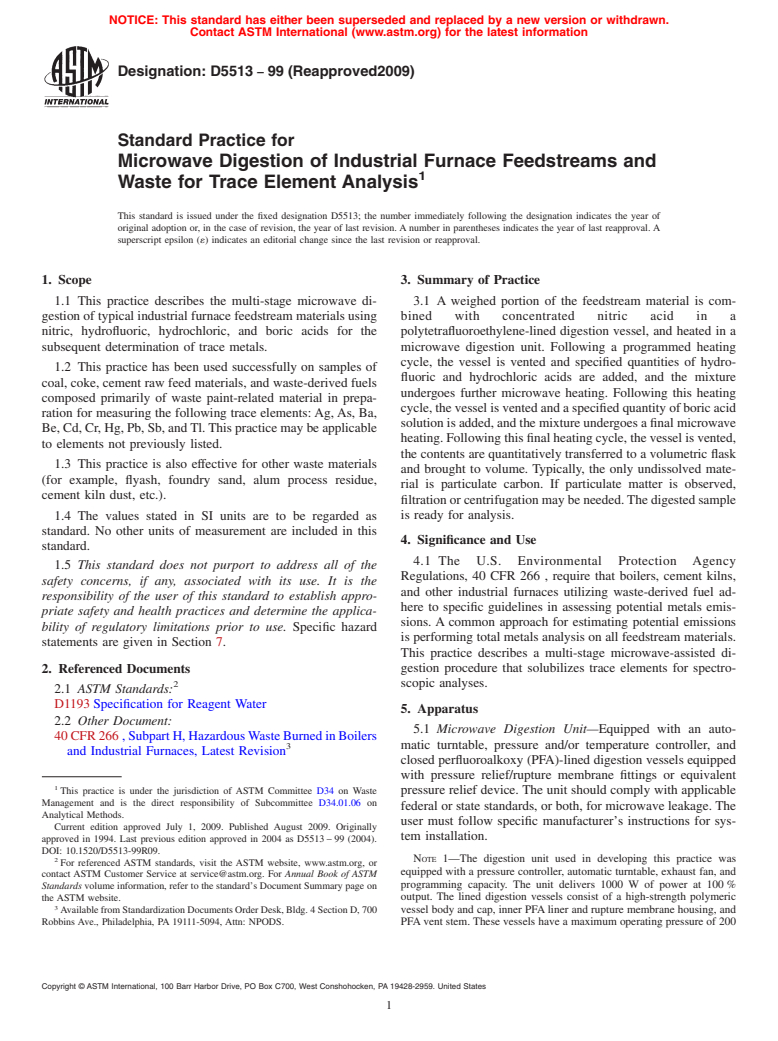
NOTICE: This standard has either been superseded and replaced by a new version or withdrawn.
Contact ASTM International (www.astm.org) for the latest information
Designation: D5513 − 99 (Reapproved2009)
Standard Practice for
Microwave Digestion of Industrial Furnace Feedstreams and
1
Waste for Trace Element Analysis
This standard is issued under the fixed designation D5513; the number immediately following the designation indicates the year of
original adoption or, in the case of revision, the year of last revision.Anumber in parentheses indicates the year of last reapproval.A
superscript epsilon (´) indicates an editorial change since the last revision or reapproval.
1. Scope 3. Summary of Practice
1.1 This practice describes the multi-stage microwave di- 3.1 A weighed portion of the feedstream material is com-
gestionoftypicalindustrialfurnacefeedstreammaterialsusing bined with concentrated nitric acid in a
nitric, hydrofluoric, hydrochloric, and boric acids for the polytetrafluoroethylene-lined digestion vessel, and heated in a
subsequent determination of trace metals. microwave digestion unit. Following a programmed heating
cycle, the vessel is vented and specified quantities of hydro-
1.2 This practice has been used successfully on samples of
fluoric and hydrochloric acids are added, and the mixture
coal, coke, cement raw feed materials, and waste-derived fuels
undergoes further microwave heating. Following this heating
composed primarily of waste paint-related material in prepa-
cycle,thevesselisventedandaspecifiedquantityofboricacid
ration for measuring the following trace elements:Ag,As, Ba,
solutionisadded,andthemixtureundergoesafinalmicrowave
Be,Cd,Cr,Hg,Pb,Sb,andTl.Thispracticemaybeapplicable
heating.Followingthisfinalheatingcycle,thevesselisvented,
to elements not previously listed.
the contents are quantitatively transferred to a volumetric flask
1.3 This practice is also effective for other waste materials
and brought to volume. Typically, the only undissolved mate-
(for example, flyash, foundry sand, alum process residue,
rial is particulate carbon. If particulate matter is observed,
cement kiln dust, etc.).
filtrationorcentrifugationmaybeneeded.Thedigestedsample
is ready for analysis.
1.4 The values stated in SI units are to be regarded as
standard. No other units of measurement are included in this
4. Significance and Use
standard.
4.1 The U.S. Environmental Protection Agency
1.5 This standard does not purport to address all of the
Regulations, 40 CFR 266 , require that boilers, cement kilns,
safety concerns, if any, associated with its use. It is the
and other industrial furnaces utilizing waste-derived fuel ad-
responsibility of the user of this standard to establish appro-
here to specific guidelines in assessing potential metals emis-
priate safety and health practices and determine the applica-
sions. A common approach for estimating potential emissions
bility of regulatory limitations prior to use. Specific hazard
is performing total metals analysis on all feedstream materials.
statements are given in Section 7.
This practice describes a multi-stage microwave-assisted di-
2. Referenced Documents gestion procedure that solubilizes trace elements for spectro-
2 scopic analyses.
2.1 ASTM Standards:
D1193Specification for Reagent Water
5. Apparatus
2.2 Other Document:
5.1 Microwave Digestion Unit—Equipped with an auto-
40CFR266,SubpartH,HazardousWasteBurnedinBoilers
3 matic turntable, pressure and/or temperature controller, and
and Industrial Furnaces, Latest Revision
closed perfluoroalkoxy (PFA)-lined digestion vessels equipped
with pressure relief/rupture membrane fittings or equivalent
1
This practice is under the jurisdiction of ASTM Committee D34 on Waste
pressure relief device.The unit should comply with applicable
Management and is the direct responsibility of Subcommittee D34.01.06 on
federal or state standards, or both, for microwave leakage.The
Analytical Methods.
user must follow specific manufacturer’s instructions for sys-
Current edition approved July 1, 2009. Published August 2009. Originally
tem installation.
approved in 1994. Last previous edition approved in 2004 as D5513–99 (2004).
DOI: 10.1520/D5513-99R09.
2 NOTE 1—The digestion unit used in developing this practice was
For referenced ASTM standards, visit the ASTM website, www.astm.org, or
equipped with a pressure controller, automatic turntable, exhaust fan, and
contact ASTM Customer Service at service@astm.org. For Annual Book of ASTM
programming capacity. The unit delivers 1000 W of power at 100%
Standards volume information, refer to the standard’s Document Summary page on
output. The lined digestion vessels consist of a high-strength polymeric
the ASTM website.
3
AvailablefromStandardizationDocumentsOrderDesk,Bldg.4SectionD,700 vessel body and cap, inner PFAliner and rupture membrane housing, and
Robbins Ave., Philadelphia, PA 19111-5094, Attn: NPODS. PFAvent stem.These vessels have a maximum operating pressure of 200
Copyright ©
...
Questions, Comments and Discussion
Ask us and Technical Secretary will try to provide an answer. You can facilitate discussion about the standard in here.